4.1. Growth Performance
Enriched environments in modern pig farms are known to reduce negative social behaviors in pigs and fulfil behavioral needs, thereby lowering stress levels that can impact welfare and growth performance [
17,
25]. Similarly, pigs raised in pens with bedded floor systems using straw and SD showed a higher daily weight gain and feed intake along with increased exploratory and manipulative behaviors compared with those housed in pens with slatted-floor systems [
4,
26]. However, in the present study, pigs in the RS group tended to have lower BW at 20 weeks of age, despite showing increased exploratory behavior during certain weeks compared with the other groups. One possible explanation for this outcome may be the influence of bedding materials on the microenvironment in the pens. Previous studies have shown that straw-based floor systems generally have approximately 30% higher NH
3 concentrations than slatted systems due to increased aerobic microbial activity within the litter [
10,
27]. Elevated NH
3 levels can irritate pigs’ respiratory tracts and mucous membranes, potentially leading to reduced feed intake [
28]. Even if the intake is not reduced, high NH
3 levels in barns may still impair feeding efficiency by inducing respiratory tract damage, oxidative stress, and inflammation, thereby increasing metabolic energy expenditure and hindering growth [
29,
30].
Furthermore, during hotter seasons, bedding materials, such as straw, may exacerbate heat stress by acting as thermal insulation, thereby raising the pen temperatures [
31]. This consideration is particularly relevant because the present trial was conducted during the hottest period of the year. In contrast, concrete floors can facilitate heat dissipation due to their lower surface temperatures [
32], which may partly explain the better growth performance in pigs housed without bedding. A similar situation may occur with SD, where increased NH
3 concentrations and its potential insulating properties could influence the housing environment; however, no change in BW was observed in this study. In the SB group, lower NH
3 levels were observed under the combined application of SB and a partly slatted flooring system, with no associated change in BW. These findings indicate the need for future studies to identify the most effective EMs under different housing and seasonal conditions for improving both welfare and productivity.
4.2. Posture and Behavior
Pigs housed in pens with SD flooring were observed to sit more frequently and displayed less lateral lying but more sternal lying compared with those in the SB group. These behavioral trends conform with the findings of Wei et al. [
33], who reported similar patterns in their study involving pigs reared in pens with deep-litter versus slatted-floor systems without EMs. Lateral lying represents a state of full relaxation and immobility, and sternal lying describes a posture in sows where they stay awake, alert, and responsive to their environment, such as engaging with EMs through activities like chewing [
34]. Moreover, pigs generally adopt a sitting posture when experiencing physical discomfort or psychological anxiety [
35]. Thus, the current findings suggest that inadequate management of the SD-based floor might have hindered the pigs’ ability to rest comfortably.
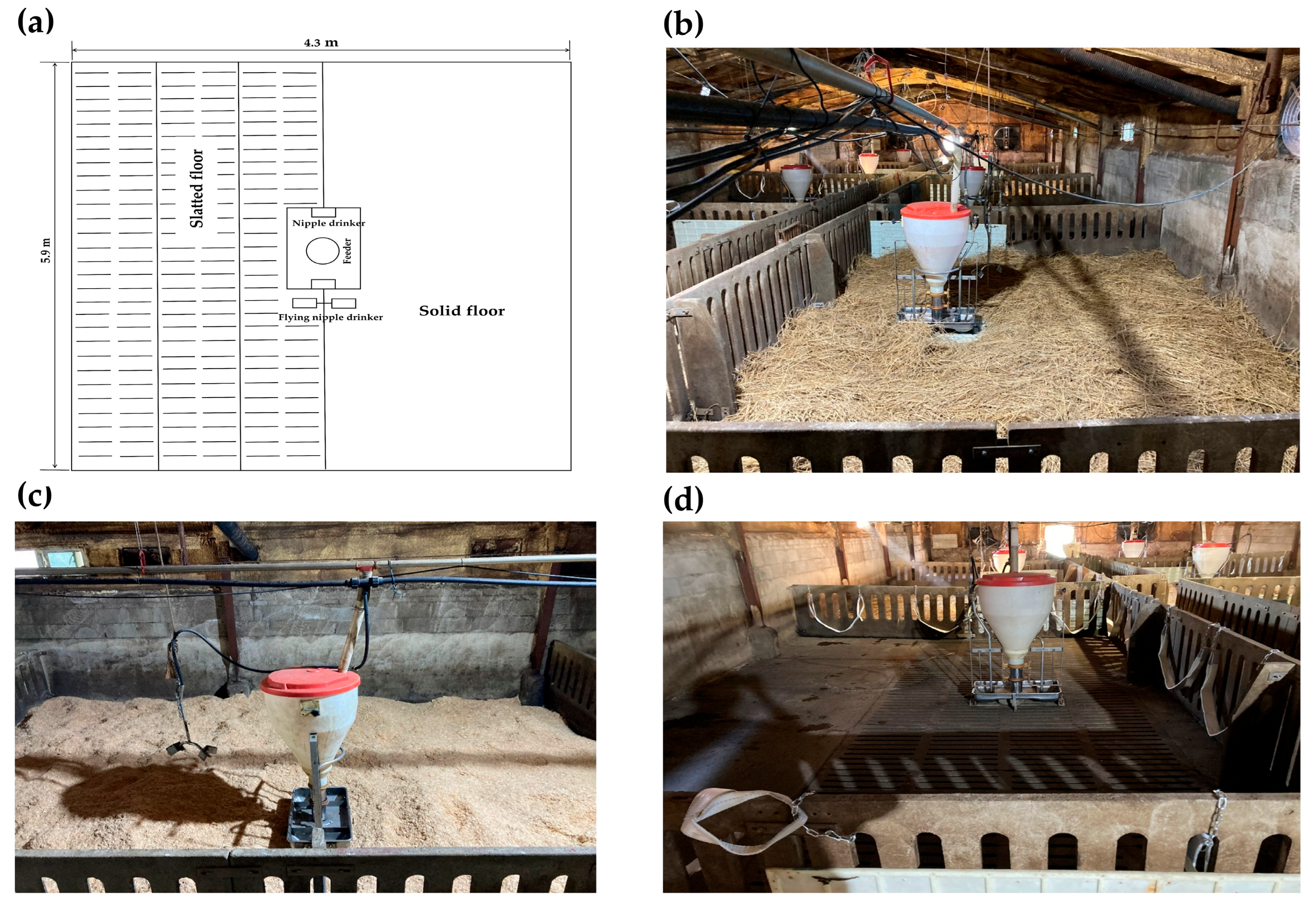
In this study, SD was spread on the floor at a shallow depth of 7 cm. Consequently, when the SD was mixed with manure, it fermented and attained a sludge-like consistency before it could dry. This mixture of sludge and SD accumulated in the pen until it was removed and replaced with fresh SD. When pigs lie laterally in this environment, their eyes, nose, and mouth can become submerged in the sludge, which can likely make breathing difficult. This may explain their preference for sitting and sternal lying postures. Previous research has demonstrated that the proper management of bedding, through frequent cleaning and replenishment, not only enhances lying comfort but also encourages pigs to adopt more comfortable resting postures, thereby improving their welfare status [
36,
37]. However, this approach may increase labor demands and overall resource input requirements, posing challenges for large-scale or resource-limited farms.
These differences were not observed when comparing the SB and control groups, suggesting that the apparent advantage of SB over SD may not be solely attributable to its structural characteristics or position in the pen but rather the slatted floor of the pen, which was also present in the control group. Slatted flooring has been associated with improved hygienic conditions, reduced moisture accumulation in the lying area, and enhanced lying comfort, thereby facilitating the adoption of more relaxed and sustained resting postures in pigs [
15,
21]. No significant postural changes were observed in the RS group, likely due to insufficient straw depth, moisture accumulation, and reduced lying comfort associated with thermal insulation effects. These findings suggest that without proper management, RS may not produce noticeable improvements in resting postures compared with slatted floors. Future studies should therefore evaluate whether increasing bedding depth or optimizing replacement frequency can improve comfort and hygiene while reducing negative environmental effects.
In this study, pigs housed in pens with floors covered with bedding materials (RS and SD) were found to have increased positive interaction and exploratory behavior in the first week compared with the other groups, which aligns with the findings of Morrison et al. [
38], who reported that the provision of SD promotes positive behaviors in pigs. Similarly, Casal-Plana et al. [
19] observed that pigs reared with EMs, such as SD, exhibited fewer stereotypic and redirected behaviors, along with increased exploratory activity. Consistent with the findings of Machado et al. [
18], pigs in the RS and SD groups in the current study exhibited higher eating and drinking behaviors and lower inactivity at week 0, which were positively correlated with exploration behavior. Exploration, which is the instinctive behavior of pigs, can reduce stress by providing them with the satisfaction of a sense of accomplishment [
39]. The reduction of stress in pigs has been reported to increase their feed intake [
25]. However, increased exploratory activity often requires higher energy expenditure, which could partially explain the absence of an effect on growth performance despite the positive welfare effects observed in the present study. Meanwhile, pigs in the SB group exhibited reduced eating/drinking behavior, which was accompanied by increased inactivity.
In the current study, pigs in the SD group showed the highest level of injurious interactions at week 3, which coincided with increased sitting and sternal resting postures, suggesting discomfort or restlessness. By this time, the SD bedding had become heavily soiled with manure, likely reducing lying comfort and contributing to increased injurious interactions. Nevertheless, as the trial progressed, the pigs in pens with RS flooring exhibited increased exploratory activity and a gradual reduction in inactivity. Meanwhile, the SD group followed a similar pattern overall, except for a notable shift at week 3 when exploration decreased and injurious interaction increased prior to bedding replacement at week 7. Although SD and RS were refreshed at that point to maintain hygiene and functionality, the deterioration observed in the earlier weeks likely influenced pig comfort and behavior, and the replacement might have moderated these effects in the later phase of the trial. In contrast, pigs in the SB and control groups showed similar levels of activity and exploration. However, pigs in the SB group exhibited a higher proportion of lateral lying. This difference may be attributed to the slatted flooring found in both groups, which offers a cleaner resting area.
4.3. Body and Ear Lesions
Although body lesions are commonly regarded as direct indicators of agonistic behaviors (e.g., fighting or biting), they can also result from increased activity in pigs, even in the absence of aggressive interactions [
40,
41]. In the present study, pigs in the RS and SD groups tended to have reduced body lesions by week 3 compared with those in other groups, with the RS group demonstrating a further reduction in lesion scores by week 10. This reduction may be attributed to the prolonged engagement in straw-rooting behavior, which has been shown to mitigate redirected behaviors, such as ear and tail biting [
42]. The current findings align with those of Fàbrega et al. [
43], confirming that straw provision can reduce both skin lesions and redirected behaviors by enhancing opportunities for exploratory activity. Furthermore, pigs reared under enriched conditions have consistently demonstrated a decrease in redirected behaviors towards pen mates, including tail biting, ear chewing, and belly-nosing [
1,
44,
45].
Notably, over the entire trial period (weeks 0–10), the SB group demonstrated the most consistent and significant reduction in body lesions. Unlike minimal EMs, such as paper or chains, which offer limited manipulation opportunities and are linked to a higher incidence of lesions [
43], SBs are durable and resist rapid deterioration, ensuring pigs can continually interact with them. Since they are suspended, they can be kept cleaner and are more accessible. Moreover, the movement provided by hanging SBs stimulates curiosity and manipulation. Hence, they hold pigs’ interest over time, reducing stress and the likelihood of redirected behaviors, such as injurious interactions.
4.4. Cleanliness Score of Body
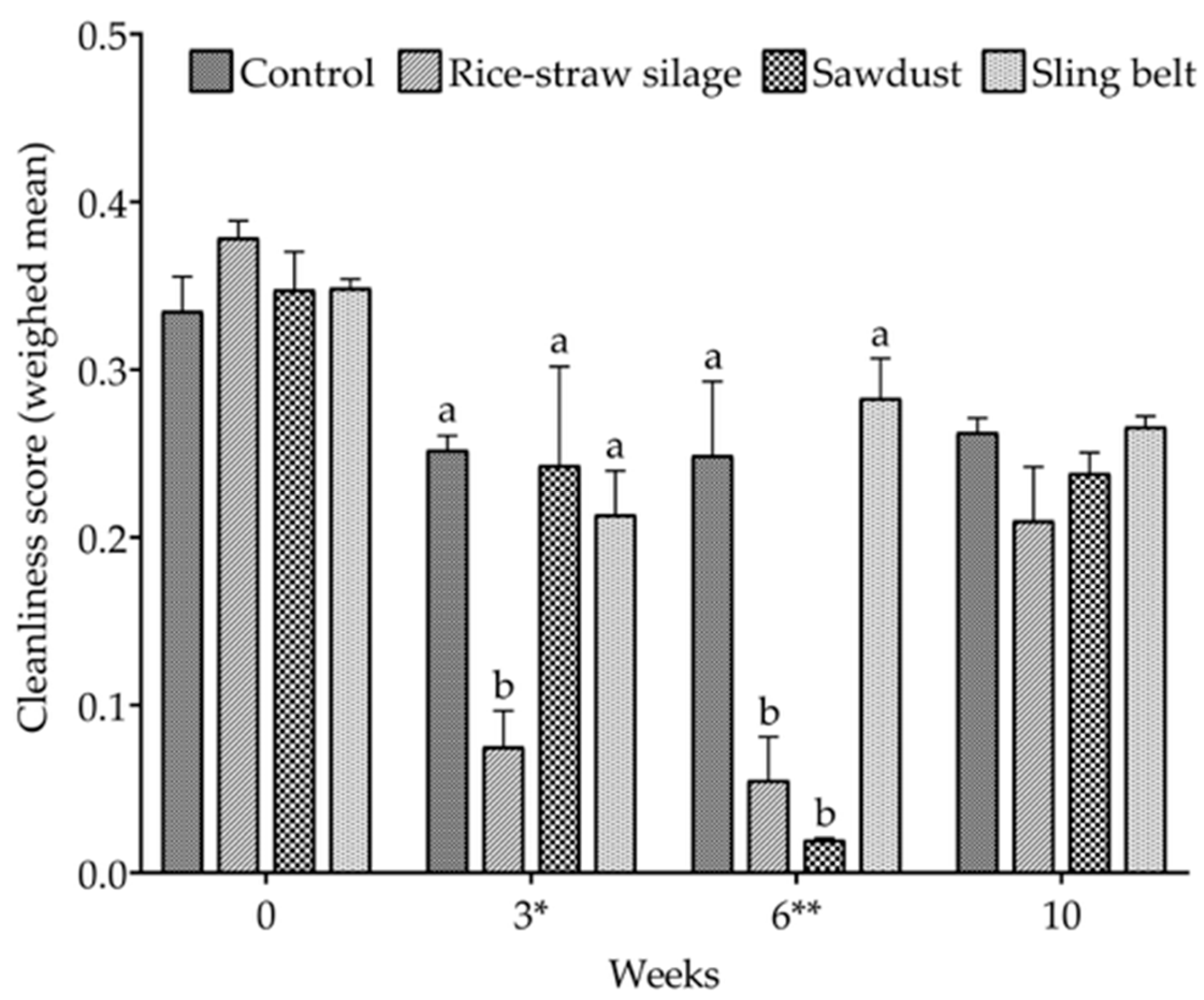
Poor hygiene and environmental conditions can compromise the mental and physical health of pigs, with cleanliness playing a crucial role in mitigating stress, reducing disease risk, and preventing behavioral disorders [
46]. Prolonged exposure to poor hygiene conditions, especially through fecal–oral contamination, has been associated with enteric diseases, liver lesions caused by ascarid infections, and decreased growth performance [
26,
47]. In the present study, pigs housed in pens with RS or SD bedding exhibited poorer body cleanliness at weeks 3 and 6 than those in pens with slatted floors, including the control and SB groups. This finding aligns with the observations of van de Weerd et al. [
48], who noted increased soiling in the front and middle parts of straw-bedded pens, which was likely because pigs avoided dunging in the slatted rear area, disrupting the natural separation of dunging and resting zones. While the use of litter or straw as rooting material can enhance cleanliness when appropriately managed, poor control over dunging areas can have the opposite effect [
49].
Pigs instinctively separate dunging, resting, and feeding areas [
50]; however, this behavior can be disrupted in bedding-based systems where spatial boundaries are unclear, leading to increased soiling and reduced welfare [
51]. Pig cleanliness is more strongly associated with the amount of solid floor space per pig than the extent of slatted flooring. AS, adequate space allowance, plays an important role in maintaining pig welfare and health [
52]. It is also influenced by structural and environmental conditions, such as bedding material, pen layout, air velocity, and temperature [
49]. Accordingly, the relatively higher cleanliness levels observed in the SB group may be related to the slatted-floor design, which facilitates the separation of functional areas and prevents the accumulation of moisture-retaining organic bedding. By avoiding fermentable materials, such as straw or SD, this system likely contributed to improved drainage and reduced soiling compared with RS and SD. These findings suggest that slatted-floor housing with SB provision can help maintain cleaner pen conditions, although the effect may be more strongly attributable to flooring type than the EM itself.
4.5. Pen Air Quality at Week 10
Pigs in intensive housing are often exposed to airborne pollutants, including PMs and gases such as NH
3 and CO
2, which impair health, welfare, and performance [
14]. In this study, NH
3 and CO
2 concentrations were highest in the RS and SD groups, where manure accumulation on the floor was greatest. Although these gas concentrations exceeded the recommended levels reported by Buoio et al. [
53] (NH
3: 10–20 ppm; CO
2: <3000 ppm), this may be attributable to the sampling location (10 cm above the floor). Nevertheless, the observed values remain within the upper range of concentrations previously reported in commercial pig buildings [
54]. NH
3 arises from the enzymatic hydrolysis of urea by fecal urease, while CO
2 results from microbial decomposition [
55,
56]. Poor manure management in bedding systems can intensify these processes through aerobic microbial activity [
9,
11,
57]. Accordingly, environmental measurements collected during the final week (week 10) indicated poorer pen air quality in the RS and SD groups. However, because air quality was assessed at a single time point, it was not possible to evaluate temporal changes or determine whether the observed differences were attributable to enrichment type alone, independent of flooring system and manure management. Replacement intervals for RS and SD varied with material type and contamination level, and all the pigs from the different treatment groups were housed in the same building with effective ventilation. Therefore, the environmental conditions for each pen were therefore assessed during the final week of the trial (week 10). Although this represents a limitation in terms of temporal scope, this approach enabled a comparative assessment of worst-case conditions across treatments.
Uneven dung distribution in the straw-bedded pens likely contributed to elevated NH
3 levels. These pollutants can cause respiratory tract damage, reduce lung function, and weaken immunity, thereby impairing pig welfare and growth performance [
14,
28,
58]. This may explain the present findings that pigs in the RS group tended to have the lowest BW at 20 weeks of age. Seasonal temperature conditions may further restrict the use of large amounts of straw because this can heighten the risk of heat stress [
43]. Similarly, in our study, humidity tended to be higher in the RS and SD groups, which might have compounded thermal discomfort in the pigs.
In contrast to toxic gas concentrations, PM
10 levels were highest in the groups having pens with slatted floors (control and SB), likely due to differences in relative humidity, which influences the suspension and settling of airborne particles. At higher humidity, water vapor binds to PM, increasing particle weight and accelerating deposition, thereby reducing airborne concentrations [
11]. This mechanism may explain the relatively lower PM concentrations observed in the bedding groups, where relative humidity tended to be higher. Nonetheless, this relationship is complex and may vary with ventilation rate and environmental temperature, highlighting the need for more controlled research to clarify these interactions. A key limitation of the present study is that environmental measurements were collected only once during the peak period of bedding use. Future studies should therefore incorporate repeated assessments across different growth stages and seasons.