


Nutrition Research in Aging Dogs and Cats: What We Know and What We Need to Do

Simple Summary
Abstract
1. Introduction
2. Methodology for Literature Search
3. What Is “Aging” in Companion Dogs and Cats
3.1. Threshold Age for Senior Dogs and Cats
3.2. Biomarkers for Nutritional Status in Aging Dogs and Cats
4. What We Have Known About Aging Dogs and Cats
4.1. Physiological Characteristics of Aging Dogs and Cats
4.2. Nutritional Requirements of Aging Dogs and Cats

| Nutrient | Changes in Demand (Compared to Adult Stage) | References |
|---|---|---|
| Water | Decreased demand, but prone to dehydration | [97] |
| Protein | A reasonable high-protein requirement | [9,103] |
| Fat | Total fat demand decreased, more omega-3 polyunsaturated fatty acids should be supplemented | [104] |
| Carbohydrates/Dietary Fiber | Carbohydrates remain necessary; appropriate dietary fiber should be provided | [85,107] |
| Vitamins | Increased demand of Vitamin C and Vitamin E | [110,111] |
| Minerals | Adequate calcium; reduced inorganic phosphorus intake | [114,115,116,117] |
4.3. Current Nutraceuticals and Supplements for Aging Dogs and Cats
5. Research Projects About Aging Companion Animals in Recent Years
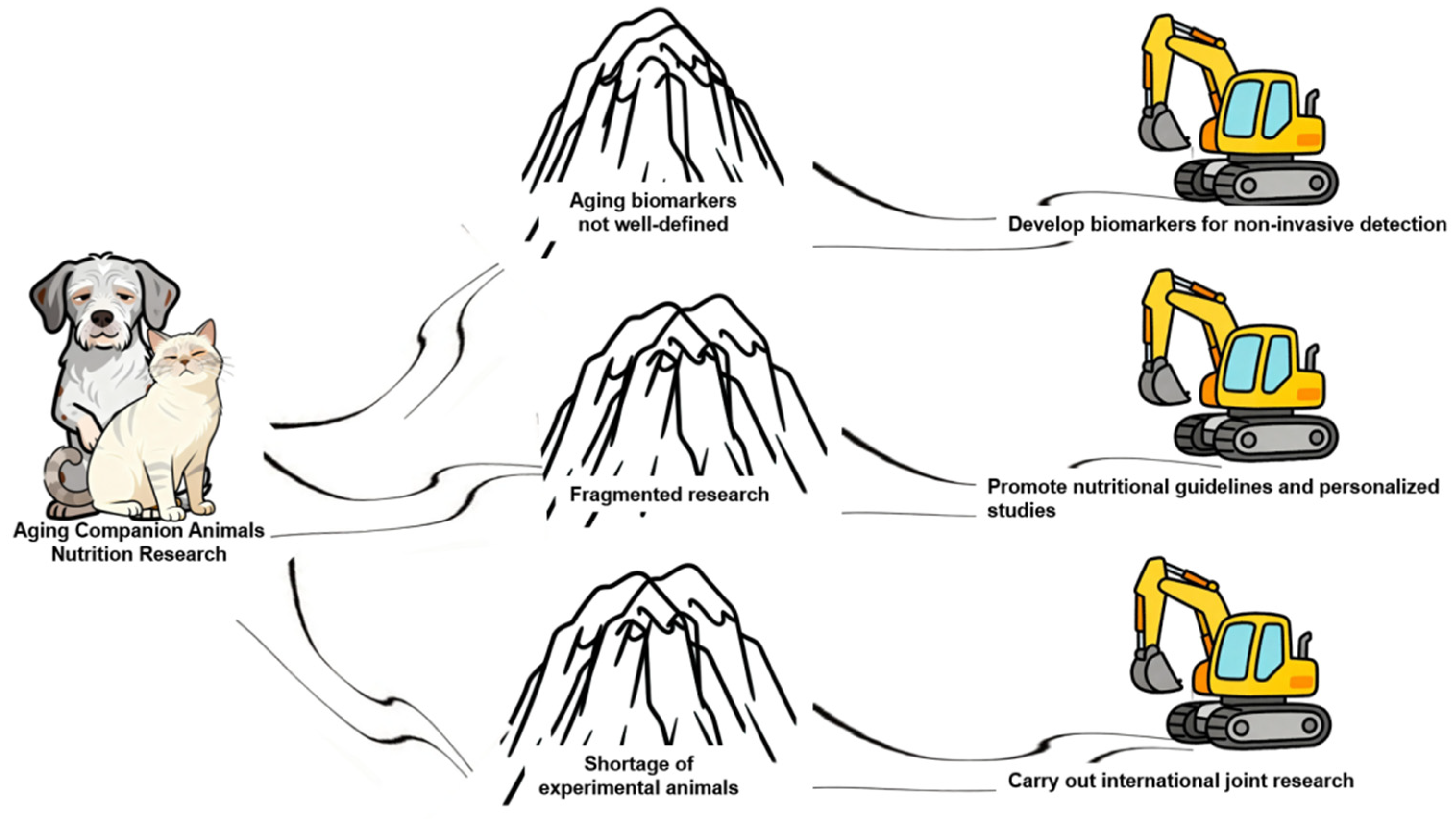
6. Future Directions in Research on Aging of Dogs and Cats
6.1. Develop Combined Biomarkers Based on Non-Invasive Detection Technology
6.2. Focus on the Common Nutritional Needs and Personalized Nutrition of Aging Dogs and Cats
6.3. Conduct Cross-National and Cross-Regional Research on Elderly Dogs and Cats
7. Conclusions
Author Contributions
Funding
Institutional Review Board Statement
Informed Consent Statement
Data Availability Statement
Acknowledgments
Conflicts of Interest
References
- Feng, X. Study on the Innovative Marketing Path of China’s Pet Economy under the New Media Environment. Management 2025, 8, 108–115. [Google Scholar]
- Churchill, J.A.; Eirmann, L. Senior Pet Nutrition and Management. Vet. Clin. N. Am. Small Anim. Pract. 2021, 51, 635–651. [Google Scholar] [CrossRef]
- Bermingham, E.N.; Patterson, K.A.; Shoveller, A.K.; Fraser, K.; Butowski, C.F.; Thomas, D.G. Nutritional needs and health outcomes of ageing cats and dogs: Is it time for updated nutrient guidelines? Anim. Front. 2024, 14, 5–16. [Google Scholar] [CrossRef]
- Bobeck, E.A. Nutrition and health: Companion animal applications: Functional nutrition in livestock and companion animals to modulate the immune response. J. Anim. Sci. 2020, 98, skaa035. [Google Scholar] [CrossRef]
- Fahey, G.C., Jr.; Barry, K.A.; Swanson, K.S. Age-related changes in nutrient utilization by companion animals. Annu. Rev. Nutr. 2008, 28, 425–445. [Google Scholar] [CrossRef]
- Körmöndi, S.; Terhes, G.; Pál, Z.; Varga, E.; Harmati, M.; Buzás, K.; Urbán, E. Human Pasteurellosis Health Risk for Elderly Persons Living with Companion Animals. Emerg. Infect. Dis. 2019, 25, 229–235. [Google Scholar] [CrossRef]
- Fortney, W.D. Implementing a Successful Senior/Geriatric Health Care Program for Veterinarians, Veterinary Technicians, and Office Managers. Vet. Clin. N. Am. Small Anim. Pract. 2012, 42, 823–834. [Google Scholar] [CrossRef]
- World Health Organization. Decade of Healthy Ageing: The Global Strategy and Action Plan on Ageing and Health 2016–2020: Towards a World in Which Everyone Can Live a Long and Healthy Life; World Health Organization: Geneva, Switzerland, 2020. [Google Scholar]
- Cai, X.; Xiao, C.; Xu, T.; Zheng, J.; Lu, N.; Gao, X.; Lu, Y. Effect of high protein feed on production performance and serum biochemical indexes of old cats. China Feed 2018, 27–30. (In Chinese) [Google Scholar] [CrossRef]
- Corby, K. Geriatric changes in dogs and cats. Vet. Tech. 2005, 26, 692–700. [Google Scholar]
- AAHA. 2021 AAHA/AAFP Feline Life Stage Guidelines; AAHA: Lakewood, CO, USA, 2021. [Google Scholar]
- Care, I.C. How to Tell Your Cat’s Age in Human Years? Available online: https://icatcare.org/articles/how-to-tell-your-cats-age-in-human-years (accessed on 28 November 2025).
- Case, L.P.; Daristotle, L.; Hayek, M.G.; Raasch, M.F. Chapter 25—Geriatrics. In Canine and Feline Nutrition, 3rd ed.; Case, L.P., Daristotle, L., Hayek, M.G., Raasch, M.F., Eds.; Mosby: Saint Louis, MO, USA, 2011; pp. 261–275. [Google Scholar]
- Salt, C.; Saito, E.K.; O’Flynn, C.; Allaway, D. Stratification of Companion Animal Life Stages from Electronic Medical Record Diagnosis Data. J. Gerontol. Ser. A 2022, 78, 579–586. [Google Scholar] [CrossRef]
- FEDIAF. FEDIAF Scientific Advisory Board Statement Nutrition of Senior Dogs; FEDIAF_SAB_Statement_Nutrition_of_Senior_Dogs_fin.pdf; FEDIAF: Brussels, Belgium, 2017. [Google Scholar]
- Guelfi, G.; Capaccia, C.; Tedeschi, M.; Bufalari, A.; Leonardi, L.; Cenci-Goga, B.; Maranesi, M. Dog Aging: A Comprehensive Review of Molecular, Cellular, and Physiological Processes. Cells 2024, 13, 2101. [Google Scholar]
- López-Otín, C.; Blasco, M.A.; Partridge, L.; Serrano, M.; Kroemer, G. Hallmarks of aging: An expanding universe. Cell 2023, 186, 243–278. [Google Scholar] [CrossRef]
- Jiménez, A.G. A revisiting of “the hallmarks of aging” in domestic dogs: Current status of the literature. GeroScience 2024, 46, 241–255. [Google Scholar] [CrossRef]
- Heaton, P.R.; Ransley, R.; Charlton, C.J.; Mann, S.J.; Stevenson, J.; Smith, B.H.E.; Rawlings, J.M.; Harper, E.J. Application of Single-Cell Gel Electrophoresis (Comet) Assay for Assessing Levels of DNA Damage in Canine and Feline Leukocytes. J. Nutr. 2002, 132, 1598S–1603S. [Google Scholar] [CrossRef]
- Blount, D.G.; Heaton, P.R.; Pritchard, D.I. Changes to Levels of DNA Damage and Apoptotic Resistance in Peripheral Blood Mononuclear Cells and Plasma Antioxidant Potential with Age in Labrador Retriever Dogs. J. Nutr. 2004, 134, 2120S–2123S. [Google Scholar] [CrossRef]
- Jimenez, A.G.; Winward, J.; Beattie, U.; Cipolli, W. Cellular metabolism and oxidative stress as a possible determinant for longevity in small breed and large breed dogs. PLoS ONE 2018, 13, e0195832. [Google Scholar] [CrossRef]
- McKevitt, T.P.; Nasir, L.; Devlin, P.; Argyle, D.J. Telomere lengths in dogs decrease with increasing donor age. J. Nutr. 2002, 132, 1604S–1606S. [Google Scholar] [CrossRef]
- Lorke, M.; Willen, M.; Lucas, K.; Schille, J.T.; Lüder Ripoli, F.; Willenbrock, S.; Beyerbach, M.; Wefstaedt, P.; Murua Escobar, H.; Nolte, I. Effect of antioxidants, mitochondrial cofactors and omega-3 fatty acids on telomere length and kinematic joint mobility in young and old shepherd dogs—A randomized, blinded and placebo-controlled study. Res. Vet. Sci. 2020, 129, 137–153. [Google Scholar] [CrossRef]
- Araujo, J.A.; Segarra, S.; Mendes, J.; Paradis, A.; Brooks, M.; Thevarkunnel, S.; Milgram, N.W. Sphingolipids and DHA Improve Cognitive Deficits in Aged Beagle Dogs. Front. Vet. Sci. 2022, 9, 646451. [Google Scholar] [CrossRef]
- Chambers, J.K.; Mutsuga, M.; Uchida, K.; Nakayama, H. Characterization of AβpN3 deposition in the brains of dogs of various ages and other animal species. Amyloid 2011, 18, 63–71. [Google Scholar] [CrossRef]
- Urfer, S.R.; Darvas, M.; Czeibert, K.; Sándor, S.; Promislow, D.E.L.; Creevy, K.E.; Kubinyi, E.; Kaeberlein, M. Canine Cognitive Dysfunction (CCD) scores correlate with amyloid beta 42 levels in dog brain tissue. GeroScience 2021, 43, 2379–2386. [Google Scholar] [CrossRef]
- Stylianaki, I.; Polizopoulou, Z.S.; Theodoridis, A.; Koutouzidou, G.; Baka, R.; Papaioannou, N.G. Amyloid-beta plasma and cerebrospinal fluid biomarkers in aged dogs with cognitive dysfunction syndrome. J. Vet. Intern. Med. 2020, 34, 1532–1540. [Google Scholar] [CrossRef]
- Panek, W.K.; Gruen, M.E.; Murdoch, D.M.; Marek, R.D.; Stachel, A.F.; Mowat, F.M.; Saker, K.E.; Olby, N.J. Plasma Neurofilament Light Chain as a Translational Biomarker of Aging and Neurodegeneration in Dogs. Mol. Neurobiol. 2020, 57, 3143–3149. [Google Scholar] [CrossRef]
- Perino, J.; Patterson, M.; Momen, M.; Borisova, M.; Heslegrave, A.; Zetterberg, H.; Gruel, J.; Binversie, E.; Baker, L.; Svaren, J.; et al. Neurofilament light plasma concentration positively associates with age and negatively associates with weight and height in the dog. Neurosci. Lett. 2021, 744, 135593. [Google Scholar] [CrossRef]
- Protopopov, V.A.; Sekunov, A.V.; Toropova, T.V.; Bryndina, I.G.; Burganova, D.N.; Milaev, V.B.; Sharafislamova, M.B.; Pozdeev, S.V.; Moskalev, A.A. Influence of a diet with potential geroprotectors on blood biochemistry and aging-associated markers in domestic cats: A pilot study. Biogerontology 2025, 26, 150. [Google Scholar] [CrossRef]
- Li, B.; Ding, Y.; Han, M.; Zhang, Z.; Ling, Z.; Zhu, W.; Zhao, X.; Zhang, Y.; Lv, C.; Li, N.; et al. Multi-omics analysis of canine aging markers and evaluation of stem cell intervention. Commun. Biol. 2025, 8, 905. [Google Scholar] [CrossRef]
- Raj, K.; Szladovits, B.; Haghani, A.; Zoller, J.A.; Li, C.Z.; Black, P.; Maddox, D.; Robeck, T.R.; Horvath, S. Epigenetic clock and methylation studies in cats. GeroScience 2021, 43, 2363–2378. [Google Scholar] [CrossRef]
- Rubbi, L.; Zhang, H.; Feng, J.; He, C.; Kurnia, P.; Ratan, P.; Tammana, A.; House, S.; Thompson, M.; Farrell, C.; et al. The effects of age, sex, weight, and breed on canid methylomes. Epigenetics 2022, 17, 1497–1512. [Google Scholar] [CrossRef]
- Horvath, S.; Lu, A.T.; Haghani, A.; Zoller, J.A.; Li, C.Z.; Lim, A.R.; Brooke, R.T.; Raj, K.; Serres-Armero, A.; Dreger, D.L.; et al. DNA methylation clocks for dogs and humans. Proc. Natl. Acad. Sci. USA 2022, 119, e2120887119. [Google Scholar] [CrossRef]
- Wang, T.; Ma, J.; Hogan, A.N.; Fong, S.; Licon, K.; Tsui, B.; Kreisberg, J.F.; Adams, P.D.; Carvunis, A.-R.; Bannasch, D.L.; et al. Quantitative Translation of Dog-to-Human Aging by Conserved Remodeling of the DNA Methylome. Cell Syst. 2020, 11, 176–185.e176. [Google Scholar] [CrossRef]
- Isaka, M. Serum concentrations of osteoprotegerin, brain-derived nerve factor, angiotensin II, and endothelin-1 in aging dogs. Open Vet. J. 2022, 12, 980–984. [Google Scholar] [CrossRef]
- Isaka, M.; Araki, R.; Ueno, H. Biomarkers of Ageing in Dogs. Preprint 2021. [Google Scholar] [CrossRef]
- Allen, M.J.; Hoffmann, W.E.; Richardson, D.C.; Breur, G.J. Serum markers of bone metabolism in dogs. Am. J. Vet. Res. 1998, 59, 250–254. [Google Scholar] [CrossRef]
- Ekici, M.; Koçkaya, M.; Baş-Ekici, H. The influence of sex and age on bone turnover markers in the adult to geriatric Kangal shepherd dogs. Vet. Clin. Pathol. 2023, 52, 353–359. [Google Scholar] [CrossRef]
- Jimenez, A.G. Plasma Concentration of Advanced Glycation End-Products From Wild Canids and Domestic Dogs Does Not Change With Age or Across Body Masses. Front. Vet. Sci. 2021, 8, 637132. [Google Scholar] [CrossRef]
- Ruparell, A.; Alexander, J.E.; Eyre, R.; Carvell-Miller, L.; Leung, Y.B.; Evans, S.J.M.; Holcombe, L.J.; Heer, M.; Watson, P. Glycine supplementation can partially restore oxidative stress-associated glutathione deficiency in ageing cats. Br. J. Nutr. 2024, 131, 1947–1961. [Google Scholar] [CrossRef]
- Park, J.S.; Mathison, B.D.; Hayek, M.G.; Zhang, J.; Reinhart, G.A.; Chew, B.P. Astaxanthin modulates age-associated mitochondrial dysfunction in healthy dogs1. J. Anim. Sci. 2013, 91, 268–275. [Google Scholar] [CrossRef]
- Alexander, J.E.; Colyer, A.; Haydock, R.M.; Hayek, M.G.; Park, J. Understanding How Dogs Age: Longitudinal Analysis of Markers of Inflammation, Immune Function, and Oxidative Stress. J. Gerontol. Ser. A 2017, 73, 720–728. [Google Scholar] [CrossRef]
- Kortum, A.J.; Cloup, E.A.; Williams, T.L.; Constantino-Casas, F.; Watson, P.J. Hepatocyte expression and prognostic importance of senescence marker p21 in liver histopathology samples from dogs with chronic hepatitis. J. Vet. Intern. Med. 2018, 32, 1629–1636. [Google Scholar] [CrossRef]
- Hassanpour, H.; Javdani, M.; Changaniyan-Khorasgani, Z.; Rezazadeh, E.; Jalali, R.; Mojtahed, M. Is castration leading to biological aging in dogs? Assessment of lipid peroxidation, inflammation, telomere length, mitochondrial DNA copy number, and expression of telomerase and age-related genes. BMC Vet. Res. 2024, 20, 485. [Google Scholar] [CrossRef]
- McKenzie, B.; Peloquin, M.; Graves, J.L.; Chen, F.; Tovar, A.; Carttar, T.A.; Tucker, K.; Vo, K.; Nelson, M.; Super, K.M.; et al. Changes in insulin, adiponectin and lipid concentrations with age are associated with frailty and reduced quality of life in dogs. Sci. Rep. 2025, 15, 5380. [Google Scholar] [CrossRef]
- Blount, D.G.; Pritchard, D.I.; Heaton, P.R. Age-related alterations to immune parameters in Labrador retriever dogs. Vet. Immunol. Immunopathol. 2005, 108, 399–407. [Google Scholar] [CrossRef]
- Fujiwara, M.; Yonezawa, T.; Arai, T.; Yamamoto, I.; Ohtsuka, H. Alterations with age in peripheral blood lymphocyte subpopulations and cytokine synthesis in beagles. Vet. Med. 2012, 3, 79–84. [Google Scholar] [CrossRef]
- McMahon, J.E.; Graves, J.L.; Tovar, A.P.; Peloquin, M.; Greenwood, K.; Chen, F.L.; Nelson, M.; McCandless, E.E.; Halioua-Haubold, C.-L.; Juarez-Salinas, D. Translational immune and metabolic markers of aging in dogs. Sci. Rep. 2025, 15, 14460. [Google Scholar] [CrossRef]
- HogenEsch, H.; Thompson, S.; Dunham, A.; Ceddia, M.; Hayek, M. Effect of age on immune parameters and the immune response of dogs to vaccines: A cross-sectional study. Vet. Immunol. Immunopathol. 2004, 97, 77–85. [Google Scholar] [CrossRef]
- Cianciolo, R.E.; Benali, S.L.; Aresu, L. Aging in the Canine Kidney. Vet. Pathol. 2016, 53, 299–308. [Google Scholar] [CrossRef]
- Nešić, S.; Kukolj, V.; Marinković, D.; Vučićević, I.; Jovanović, M. Histological and immunohistochemical characteristics of cerebral amyloid angiopathy in elderly dogs. Vet. Q. 2017, 37, 1–7. [Google Scholar] [CrossRef]
- Urfer, S.R.; Greer, K.; Wolf, N.S. Age-related cataract in dogs: A biomarker for life span and its relation to body size. AGE 2011, 33, 451–460. [Google Scholar] [CrossRef]
- Fernández-Pinteño, A.; Pilla, R.; Suchodolski, J.; Apper, E.; Torre, C.; Salas-Mani, A.; Manteca, X. Age-Related Changes in Gut Health and Behavioral Biomarkers in a Beagle Dog Population. Animals 2025, 15, 234. [Google Scholar]
- Fernández-Pinteño, A.; Pilla, R.; Manteca, X.; Suchodolski, J.; Torre, C.; Salas-Mani, A. Age-associated changes in intestinal health biomarkers in dogs. Front. Vet. Sci. 2023, 10, 1213287. [Google Scholar] [CrossRef]
- Cai, X. Functional Pet Food Science; China Agricultural Press: Beijing, China, 2023. [Google Scholar]
- Bharani, K.K.; Devarasetti, A.K.; Carey, L.; Khurana, A.; Kollipaka, R.; Hanuman, D.D.V.; Chetla, V.S.; Banothu, A.K. Effects of ashwagandha (Withania somnifera) root extract on aging-related changes in healthy geriatric dogs: A randomized, double-blinded placebo-controlled study. Vet. Med. Sci. 2024, 10, e1556. [Google Scholar] [CrossRef]
- Gems, D.; Doonan, R. Antioxidant defense and aging in C. elegans: Is the oxidative damage theory of aging wrong? Cell Cycle 2009, 8, 1681–1687. [Google Scholar] [CrossRef]
- Barbosa, M.C.; Grosso, R.A.; Fader, C.M. Hallmarks of Aging: An Autophagic Perspective. Front. Endocrinol. 2019, 9, 790. [Google Scholar] [CrossRef]
- Brown, C.A.; Elliott, J.; Schmiedt, C.W.; Brown, S.A. Chronic Kidney Disease in Aged Cats: Clinical Features, Morphology, and Proposed Pathogeneses. Vet. Pathol. 2016, 53, 309–326. [Google Scholar] [CrossRef]
- Hall, J.A.; Yerramilli, M.; Obare, E.; Yerramilli, M.; Yu, S.; Jewell, D.E. Comparison of serum concentrations of symmetric dimethylarginine and creatinine as kidney function biomarkers in healthy geriatric cats fed reduced protein foods enriched with fish oil, L-carnitine, and medium-chain triglycerides. Vet. J. 2014, 202, 588–596. [Google Scholar] [CrossRef]
- Hall, J.A.; MacLeay, J.; Yerramilli, M.; Obare, E.; Yerramilli, M.; Schiefelbein, H.; Paetau-Robinson, I.; Jewell, D.E. Positive Impact of Nutritional Interventions on Serum Symmetric Dimethylarginine and Creatinine Concentrations in Client-Owned Geriatric Cats. PLoS ONE 2016, 11, e0153654. [Google Scholar] [CrossRef]
- Cai, X.; Liao, R.; Chen, G.; Lu, Y.; Zhao, Y.; Chen, Y. The influence of food processing methods on serum parameters, apparent total-tract macronutrient digestibility, fecal microbiota and SCFA content in adult beagles. PLoS ONE 2022, 17, e0262284. [Google Scholar] [CrossRef]
- Shaikh, S.D.; Sun, N.; Canakis, A.; Park, W.Y.; Weber, H.C. Irritable Bowel Syndrome and the Gut Microbiome: A Comprehensive Review. J. Clin. Med. 2023, 12, 2558. [Google Scholar]
- Yuan, Y.; Zhu, L.; Cai, X.; Mao, H.; Wang, T.; Tao, S.; Bao, J.; Liu, C.; Feng, J. The effect of Japanese eel as a main ingredient on hair condition, antioxidant ability, apparent total tract digestibility and body weight gain in cat food. Front. Vet. Sci. 2025, 12, 1553320. [Google Scholar] [CrossRef]
- Xia, X.; Chen, W.; McDermott, J.; Han, J.J. Molecular and phenotypic biomarkers of aging. F1000Research 2017, 6, 860. [Google Scholar] [CrossRef]
- Day, M.J. Cats are not small dogs: Is there an immunological explanation for why cats are less affected by arthropod-borne disease than dogs? Parasit. Vectors 2016, 9, 507. [Google Scholar] [CrossRef]
- Villalobos, A.; Kaplan, L. The Warning Signs of Cancer in Geriatric Pets. In Canine and Feline Geriatric Oncology; Wiley-Blackwell: Hoboken, NJ, USA, 2017; pp. 51–99. [Google Scholar]
- Pathak, A.; Asediya, V.; Anjaria, P.; Singh, S.P. Chapter 23—Geriatric diseases of dogs and cats. In Introduction to Diseases, Diagnosis, and Management of Dogs and Cats; Rana, T., Ed.; Academic Press: Cambridge, MA, USA, 2024; pp. 339–361. [Google Scholar]
- Pastor, N.; Caballé, N.C.; Santella, M.; Ezquerra, L.J.; Tarazona, R.; Duran, E. Epidemiological study of canine mammary tumors: Age, breed, size and malignancy. Austral J. Vet. Sci. 2018, 50, 143–147. [Google Scholar]
- Willard, M.D. Alimentary Neoplasia in Geriatric Dogs and Cats. Vet. Clin. N. Am. Small Anim. Pract. 2012, 42, 693–706. [Google Scholar] [CrossRef]
- da Fonseca Sapin, C.; Fernandes, C.G.; de Oliveira Nobre, M.; Grecco, F.B. Brain neoplasms in elderly dogs. Acta Sci. Vet. 2019, 47, 384. [Google Scholar] [CrossRef]
- Espino, L.; Miño, N. Common Neurologic Diseases in Geriatric Dogs. Animals 2024, 14, 1753. [Google Scholar]
- Nam, Y.; White, M.; Karlsson, E.K.; Creevy, K.E.; Promislow, D.E.L.; McClelland, R.L.; Dog Aging Project Consortium. Dog size and patterns of disease history across the canine age spectrum: Results from the Dog Aging Project. PLoS ONE 2024, 19, e0295840. [Google Scholar] [CrossRef]
- Pinello, K.; Pires, I.; Castro, A.F.; Carvalho, P.T.; Santos, A.; de Matos, A.; Queiroga, F.; Canadas-Sousa, A.; Dias-Pereira, P.; Catarino, J.; et al. Cross Species Analysis and Comparison of Tumors in Dogs and Cats, by Age, Sex, Topography and Main Morphologies. Data from Vet-OncoNet. Vet. Sci. 2022, 9, 167. [Google Scholar]
- Holmstrom, S.E. Veterinary Dentistry in Senior Canines and Felines. Vet. Clin. N. Am. Small Anim. Pract. 2012, 42, 793–808. [Google Scholar] [CrossRef]
- Bermingham, E.N.; Young, W.; Butowski, C.F.; Moon, C.D.; Maclean, P.H.; Rosendale, D.; Cave, N.J.; Thomas, D.G. The Fecal Microbiota in the Domestic Cat (Felis catus) Is Influenced by Interactions Between Age and Diet; A Five Year Longitudinal Study. Front. Microbiol. 2018, 9, 1231. [Google Scholar] [CrossRef]
- Masuoka, H.; Shimada, K.; Kiyosue-Yasuda, T.; Kiyosue, M.; Oishi, Y.; Kimura, S.; Ohashi, Y.; Fujisawa, T.; Hotta, K.; Yamada, A.; et al. Transition of the intestinal microbiota of cats with age. PLoS ONE 2017, 12, e0181739. [Google Scholar] [CrossRef]
- Beale, B.S. Orthopedic problems in geriatric dogs and cats. Vet. Clin. N. Am. Small Anim. Pract. 2005, 35, 655–674. [Google Scholar] [CrossRef]
- Hunter, R.P.; Ehrenzweig, J.; Hainsworth, A.; Crawford, A.; Dagan, A.; Sage, J.; Araujo, J. One-health approach to canine cognitive decline: Dogs Overcoming Geriatric Memory and Aging Initiative for early detection of cognitive decline. Am. J. Vet. Res. 2023, 84, ajvr.23.02.0032. [Google Scholar] [CrossRef]
- Vite, C.H.; Head, E. Aging in the Canine and Feline Brain. Vet. Clin. N. Am. Small Anim. Pract. 2014, 44, 1113–1129. [Google Scholar] [CrossRef]
- Dall’Ara, P.; Lauzi, S.; Turin, L.; Castaldelli, G.; Servida, F.; Filipe, J. Effect of Aging on the Immune Response to Core Vaccines in Senior and Geriatric Dogs. Vet. Sci. 2023, 10, 412. [Google Scholar]
- Day, M.J. Ageing, Immunosenescence and Inflammageing in the Dog and Cat. J. Comp. Pathol. 2010, 142, S60–S69. [Google Scholar] [CrossRef]
- Miller, M.S.; Tilley, L.P.; Smith, F.W.K. Cardiopulmonary Disease in the Geriatric Dog and Cat. Vet. Clin. N. Am. Small Anim. Pract. 1989, 19, 87–102. [Google Scholar] [CrossRef]
- de Groot, C.P.G.M.; West, C.E.; van Staveren, W.A. Meeting nutrient and energy requirements in old age. Maturitas 2001, 38, 75–81. [Google Scholar] [CrossRef]
- Schauf, S.; Stockman, J.; Haydock, R.; Eyre, R.; Fortener, L.; Park, J.S.; Bakke, A.M.; Watson, P. Healthy Ageing Is Associated with Preserved or Enhanced Nutrient and Mineral Apparent Digestibility in Dogs and Cats Fed Commercially Relevant Extruded Diets. Animals 2021, 11, 2127. [Google Scholar]
- Teshima, E.; Brunetto, M.A.; Vasconcellos, R.S.; Gonçalves, K.N.V.; De-Oliveira, L.D.; Valério, A.G.; Carciofi, A.C. Nutrient digestibility, but not mineral absorption, is age-dependent in cats. J. Anim. Physiol. Anim. Nutr. 2010, 94, e251–e258. [Google Scholar] [CrossRef]
- Taylor, E.J.; Adams, C.; Neville, R. Some nutritional aspects of ageing in dogs and cats. Proc. Nutr. Soc. 1995, 54, 645–656. [Google Scholar] [CrossRef]
- Sheffy, B.E.; Williams, A.J.; Zimmer, J.F.; Ryan, G.D. Nutrition and metabolism of the geriatric dog. Cornell Vet. 1985, 75, 324–347. [Google Scholar]
- Tian, T.; Zhou, Y.; Xu, Y.; Xu, Y. Intestinal microbial 16S sequencing and LC-MS metabonomic analysis revealed differences between young and old cats. Heliyon 2023, 9, e16417. [Google Scholar] [CrossRef]
- Templeton, G.B.; Fefer, G.; Case, B.C.; Roach, J.; Azcarate-Peril, M.A.; Gruen, M.E.; Callahan, B.J.; Olby, N.J. Longitudinal Analysis of Canine Oral Microbiome Using Whole Genome Sequencing in Aging Companion Dogs. Animals 2023, 13, 3846. [Google Scholar]
- Pan, Y. Enhancing brain functions in senior dogs: A new nutritional approach. Top. Companion Anim. Med. 2011, 26, 10–16. [Google Scholar] [CrossRef]
- McKenzie, B.A.; Chen, F.L. Assessment and Management of Declining Physical Function in Aging Dogs. Top. Companion Anim. Med. 2022, 51, 100732. [Google Scholar] [CrossRef]
- Spasojević Kosić, L.; Trailović, D.R.; Krstić, N. Age-dependent electrocardiographic and echocardiographic changes in German Shepherd dogs. Iran. J. Vet. Res. 2017, 18, 43–48. [Google Scholar]
- Council, N.R. Nutrient Requirements of Dogs and Cats; The National Academies Press: Washington, DC, USA, 2006; p. 424. [Google Scholar]
- Hahr, J.Y. Physiology of aging. Med. Hypotheses 2019, 123, 83–85. [Google Scholar] [CrossRef]
- Yoshimura, M.; Conway-Campbell, B.; Ueta, Y. Arginine vasopressin: Direct and indirect action on metabolism. Peptides 2021, 142, 170555. [Google Scholar] [CrossRef]
- Guelfi, G.; Capaccia, C.; Ratto, V.F.; Bufalari, A.; Leonardi, L.; Mechelli, L.; Cenci, S.; Maranesi, M. The Emerging Role of Water Loss in Dog Aging. Cells 2025, 14, 545. [Google Scholar]
- Ball, P. Water is an active matrix of life for cell and molecular biology. Proc. Natl. Acad. Sci. USA 2017, 114, 13327–13335. [Google Scholar] [CrossRef]
- Ko, G.J.; Rhee, C.M.; Kalantar-Zadeh, K.; Joshi, S. The Effects of High-Protein Diets on Kidney Health and Longevity. J. Am. Soc. Nephrol. 2020, 31, 1667–1679. [Google Scholar] [CrossRef]
- Laflamme, D.; Gunn-Moore, D. Nutrition of Aging Cats. Vet. Clin. N. Am. Small Anim. Pract. 2014, 44, 761–774. [Google Scholar]
- Vinassa, M.; Vergnano, D.; Valle, E.; Giribaldi, M.; Nery, J.; Prola, L.; Bergero, D.; Schiavone, A. Profiling Italian cat and dog owners’ perception of pet food quality in purchasing habits. BMC Vet. Res. 2020, 16, 131. [Google Scholar]
- Chen, G.; Zhao, Y.; Xue, H.; Hang, Y.; Yuan, Y.; Cai, X. Correlation analysis of nutritional index, hygiene index and retail price of puffed cat food sold in China. Guangdong J. Anim. Vet. Sci. 2022, 47, 76–81. [Google Scholar]
- Li, P.; Wu, G. Amino acid nutrition and metabolism in domestic cats and dogs. J. Anim. Sci. Biotechnol. 2023, 14, 19. [Google Scholar] [CrossRef]
- Blanchard, T.; Mugnier, A.; Boulet, F.; Meynadier, A.; Priymenko, N. Epidemiological and clinical profiles of young and senior dogs fed a standard diet. Prev. Vet. Med. 2025, 240, 106537. [Google Scholar] [CrossRef]
- McKenzie, B.; Peloquin, M.; Tovar, A.; Graves, J.L.; Ratcliff, E.; Tucker, K.; Vo, K.; Greenwood, K.; Halioua-Haubold, C.-L.; Juarez-Salinas, D. Feeding dogs a high-fat diet induces metabolic changes similar to natural aging, including dyslipidemia, hyperinsulinemia, and peripheral insulin resistance. Am. J. Vet. Res. 2024, 85, ajvr.23.11.0253. [Google Scholar] [CrossRef]
- Sechi, S.; Carta, S.; Correddu, F.; Di Cerbo, A.; Nudda, A.; Cocco, R. Effects of Commercially Available Antioxidant-Enriched Fish- and Chicken-Based Diets on Biochemical Parameters and Blood Fatty Acid Profile of Old Dogs. Animals 2022, 12, 1326. [Google Scholar]
- Washizu, T.; Tanaka, A.; Sako, T.; Washizu, M.; Arai, T. Comparison of the activities of enzymes related to glycolysis and gluconeogenesis in the liver of dogs and cats. Res. Vet. Sci. 1999, 67, 205–206. [Google Scholar] [CrossRef]
- Sekh, N.; Karki, D. Dietary Fiber in Poultry Nutrition in the Light of Past, Present, and Future Research Perspective: A Review. Open J. Anim. Sci. 2022, 12, 662–687. [Google Scholar] [CrossRef]
- Paetau-Robinson, I.; Yamka, R.M.; Friesen, K.G. Foods with lipoic acid and elevated levels of vitamin E and vitamin C correlate with whole blood antioxidant concentrations and may protect geriatric dogs from oxidative stress. Int. J. Appl. Res. Vet. Med. 2008, 6, 93–100. [Google Scholar]
- Hall, J.A.; Tooley, K.A.; Gradin, J.L.; Jewell, D.E.; Wander, R.C. Effects of dietary n-6 and n-3 fatty acids and vitamin E on the immune response of healthy geriatric dogs. Am. J. Vet. Res. 2003, 64, 762–772. [Google Scholar] [CrossRef]
- Stockman, J.; Villaverde, C. Concerns related to dietary phosphorus intake in cats. J. Am. Vet. Med. Assoc. 2021, 258, 1325–1331. [Google Scholar] [CrossRef]
- Summers, S.C.; Stockman, J.; Larsen, J.A.; Zhang, L.; Rodriguez, A.S. Evaluation of phosphorus, calcium, and magnesium content in commercially available foods formulated for healthy cats. J. Vet. Intern. Med. 2020, 34, 266–273. [Google Scholar] [CrossRef]
- Calvo, M.S.; Uribarri, J. Public health impact of dietary phosphorus excess on bone and cardiovascular health in the general population123. Am. J. Clin. Nutr. 2013, 98, 6–15. [Google Scholar] [CrossRef]
- Dobenecker, B.; Webel, A.; Reese, S.; Kienzle, E. Effect of a high phosphorus diet on indicators of renal health in cats. J. Feline Med. Surg. 2018, 20, 339–343. [Google Scholar] [CrossRef]
- Coltherd, J.C.; Staunton, R.; Colyer, A.; Thomas, G.; Gilham, M.; Logan, D.W.; Butterwick, R.; Watson, P. Not all forms of dietary phosphorus are equal: An evaluation of postprandial phosphorus concentrations in the plasma of the cat. Br. J. Nutr. 2019, 121, 270–284. [Google Scholar] [CrossRef]
- Carla, S.; Britta, D. The Phosphate Additives Phosphoric Acid and Sodium Phosphate Lead to Hyperphosphatemia as well as Increased FGF23 and Renal Phosphate Excretion in Healthy Cats. J. Urol. Ren. Dis. 2023, 8, 1338. [Google Scholar] [CrossRef]
- Hadley, K.B.; Bauer, J.; Milgram, N.W. The oil-rich alga Schizochytrium sp. as a dietary source of docosahexaenoic acid improves shape discrimination learning associated with visual processing in a canine model of senescence. Prostaglandins Leukot. Essent. Fat. Acids 2017, 118, 10–18. [Google Scholar] [CrossRef][Green Version]
- Blanchard, T.; Eppe, J.; Mugnier, A.; Delfour, F.; Meynadier, A. Enhancing cognitive functions in aged dogs and cats: A systematic review of enriched diets and nutraceuticals. GeroScience 2025, 47, 2925–2947. [Google Scholar] [CrossRef]
- Taha, A.Y.; Henderson, S.T.; Burnham, W.M. Dietary enrichment with medium chain triglycerides (AC-1203) elevates polyunsaturated fatty acids in the parietal cortex of aged dogs: Implications for treating age-related cognitive decline. Neurochem. Res. 2009, 34, 1619–1625. [Google Scholar] [CrossRef]
- Raederstorff, D.; Wyss, A.; Calder, P.C.; Weber, P.; Eggersdorfer, M. Vitamin E function and requirements in relation to PUFA. Br. J. Nutr. 2015, 114, 1113–1122. [Google Scholar] [CrossRef]
- Kschonsek, J.; Stimming, M.; Libuda, L.; Kersting, M.; Böhm, V. Food-based modification of LC-PUFA concentration in complementary food did not affect plasma vitamin E concentration in infants. NFS J. 2016, 3, 25–32. [Google Scholar] [CrossRef]
- Le Bon, M.; Carvell-Miller, L.; Marshall-Jones, Z.; Watson, P.; Amos, G. A Novel Prebiotic Fibre Blend Supports the Gastrointestinal Health of Senior Dogs. Animals 2023, 13, 3291. [Google Scholar]
- Grieshop, C.; Flickinger, E.; Bruce, K.; Patil, A.R.; Czarnecki-Maulden, G.L.; Fahey, G.C., Jr. Gastrointestinal and immunological responses of senior dogs to chicory and mannan-oligosaccharides. Arch. Anim. Nutr. 2004, 58, 483–494. [Google Scholar] [CrossRef]
- Summers, S.C.; Stockman, J.; Larsen, J.A.; Sanchez Rodriguez, A.; Zhang, L. Evaluation of nutrient content and caloric density in commercially available foods formulated for senior cats. J. Vet. Intern. Med. 2020, 34, 2029–2035. [Google Scholar] [CrossRef]
- Zhang, Z.; Cai, X.; Zhao, Y.; Zhao, N.; Zhou, C.; Chen, G. Effects of natural antioxidants on bacterial count and peroxide value of pet cans after air leakage. China Feed 2024, 130–136. (In Chinese) [Google Scholar] [CrossRef]
- Pan, Y.; Kennedy, A.D.; Jönsson, T.J.; Milgram, N.W. Cognitive enhancement in old dogs from dietary supplementation with a nutrient blend containing arginine, antioxidants, B vitamins and fish oil. Br. J. Nutr. 2018, 119, 349–358. [Google Scholar] [CrossRef]
- Pan, Y.; Araujo, J.A.; Burrows, J.; de Rivera, C.; Gore, A.; Bhatnagar, S.; Milgram, N.W. Cognitive enhancement in middle-aged and old cats with dietary supplementation with a nutrient blend containing fish oil, B vitamins, antioxidants and arginine. Br. J. Nutr. 2013, 110, 40–49. [Google Scholar] [CrossRef]
- Gencoglu, H.; Orhan, C.; Sahin, E.; Sahin, K. Undenatured Type II Collagen (UC-II) in Joint Health and Disease: A Review on the Current Knowledge of Companion Animals. Animals 2020, 10, 697. [Google Scholar] [CrossRef]
- Bray, E.E.; Zheng, Z.; Tolbert, M.K.; McCoy, B.M.; Kaeberlein, M.; Kerr, K.F. Once-daily feeding is associated with better health in companion dogs: Results from the Dog Aging Project. Geroscience 2022, 44, 1779–1790. [Google Scholar] [CrossRef]
- Pereira, A.F.; Jota Baptista, C.; Faustino-Rocha, A.; Oliveira, P.A.; Coelho, A.C. Renal Biomarkers in Companion Animals—A Review. Animals 2025, 15, 818. [Google Scholar]
- Creevy, K.E.; Akey, J.M.; Kaeberlein, M.; Promislow, D.E.L.; Barnett, B.G.; Benton, B.; Borenstein, E.; Castelhano, M.G.; Chou, L.; Collins, D.; et al. An open science study of ageing in companion dogs. Nature 2022, 602, 51–57. [Google Scholar] [CrossRef]
- Prescott, J.; Keyser, A.J.; Litwin, P.; Dunbar, M.D.; McClelland, R.; Ruple, A.; Ernst, H.; Butler, B.L.; Kauffman, M.; Avery, A.; et al. Rationale and design of the Dog Aging Project precision cohort: A multi-omic resource for longitudinal research in geroscience. GeroScience 2025, 47, 5725–5748. [Google Scholar] [CrossRef]
- Li, Y.; Sexton, C.L.; Consortium, D.A.P.; Fitzpatrick, A.; Ruple, A. An analysis of behavioral characteristics and enrollment year variability in 47,444 dogs entering the Dog Aging Project from 2020 to 2023. PLoS ONE 2025, 20, e0330257. [Google Scholar] [CrossRef]
- McCoy, B.M.; Brassington, L.; Jin, K.; Dolby, G.A.; Shrager, S.; Collins, D.; Dunbar, M.; Ruple, A.; Snyder-Mackler, N. Social determinants of health and disease in companion dogs: A cohort study from the Dog Aging Project. Evol. Med. Public Health 2023, 11, 187–201. [Google Scholar] [CrossRef]
- Xue, D.; Collins, D.; Kauffman, M.; Dunbar, M.; Crowder, K.; Schwartz, S.M.; Ruple, A. Big data from small animals: Integrating multi-level environmental data into the Dog Aging Project. Rev. Sci. Tech. 2023, 42, 65–74. [Google Scholar] [CrossRef]
- Labadie, J.; Swafford, B.; DePena, M.; Tietje, K.; Page, R.; Patterson-Kane, J. Cohort profile: The Golden Retriever Lifetime Study (GRLS). PLoS ONE 2022, 17, e0269425. [Google Scholar] [CrossRef]
- Perez, K.; Swafford, B.; Labadie, J.; Ocampo, A. Lifetime age-related changes in clinical laboratory results, aging clocks and mortality predictors in 2412 Golden Retrievers. Aging Cell 2025, 24, e14438. [Google Scholar] [CrossRef]
- Luethcke, K.R.; Trepanier, L.A.; Tindle, A.N.; Labadie, J.D. Environmental exposures and lymphoma risk: A nested case-control study using the Golden Retriever Lifetime Study cohort. Canine Med. Genet. 2022, 9, 10. [Google Scholar] [CrossRef]
- Murray, J.K.; Kinsman, R.H.; Lord, M.S.; Da Costa, R.E.P.; Woodward, J.L.; Owczarczak-Garstecka, S.C.; Tasker, S.; Knowles, T.G.; Casey, R.A. ‘Generation Pup’—Protocol for a longitudinal study of dog behaviour and health. BMC Vet. Res. 2021, 17, 1. [Google Scholar] [CrossRef]
- Mondino, A.; Yang, C.-C.; Simon, K.E.; Fefer, G.; Robertson, J.; Gruen, M.E.; Olby, N.J. Cross-sectional and longitudinal analysis of health-related quality of life (HRQoL) in senior and geriatric dogs. PLoS ONE 2024, 19, e0301181. [Google Scholar] [CrossRef]
- Li, Y.; Wang, Y.; Lu, Y.; Zhang, M.; Yan, Z.; Duan, Y.; Ma, H. Breeding and application effect evaluation of Bifidobacterium adolescentis derived from felines with long life spans. Acta Microbiol. Sin. 2025, 65, 4938–4950. [Google Scholar] [CrossRef]
- DiFazio, M.R.; Thomason, J.D.; Cernicchiaro, N.; Biller, D.; Thomason, S.; Harness, P. Evaluation of a 3-dimensional ultrasound device for noninvasive measurement of urinary bladder volume in dogs. J. Vet. Intern. Med. 2020, 34, 1488–1495. [Google Scholar] [CrossRef]
- Shea, E.K.; Hess, R.S. Validation of a flash glucose monitoring system in outpatient diabetic cats. J. Vet. Intern. Med. 2021, 35, 1703–1712. [Google Scholar] [CrossRef]
- Bahr Arias, M.V.; Conceição, R.T.; Guimarães, F.C.; Cardoso, G.S.; Rocha, N. Preliminary evaluation of a non-invasive device for monitoring intracranial pressure waveforms in dogs. J. Small Anim. Pract. 2022, 63, 624–631. [Google Scholar] [CrossRef]
- Schork, I.G.; Manzo, I.A.; Oliveira, M.R.B.d.; Costa, F.V.; Young, R.J.; De Azevedo, C.S. Testing the Accuracy of Wearable Technology to Assess Sleep Behaviour in Domestic Dogs: A Prospective Tool for Animal Welfare Assessment in Kennels. Animals 2023, 13, 1467. [Google Scholar]
- Lauten, S.D. Nutritional risks to large-breed dogs: From weaning to the geriatric years. Vet. Clin. N. Am. Small Anim. Pract. 2006, 36, 1345–1359, viii. [Google Scholar] [CrossRef]
- Kępińska-Pacelik, J.; Biel, W. Nutritional Problems of Large and Giant Breed Dogs. Part II. Adult Dogs. Folia Pomeranae Univ. Technol. Stetin. Agric. Aliment. Piscaria Zootech. 2023, 367, 49–63. [Google Scholar] [CrossRef]
- Che, D.; Nyingwa, P.S.; Ralinala, K.M.; Maswanganye, G.M.T.; Wu, G. Amino Acids in the Nutrition, Metabolism, and Health of Domestic Cats. Adv. Exp. Med. Biol. 2021, 1285, 217–231. [Google Scholar] [CrossRef]
- Aditya, R.S.; Amalia, R.; Pohan, R.A.; Putri, R.D. Precision nutrition in aging: Enhancing frailty prevention through personalized dietary interventions. Metabolism 2025, 166, 156172. [Google Scholar] [CrossRef]
- Vakili, S.; Caudill, M.A. Personalized nutrition: Nutritional genomics as a potential tool for targeted medical nutrition therapy. Nutr. Rev. 2007, 65, 301–315. [Google Scholar] [CrossRef]
- Tagi, V.M.; Eletti, F.; Dolor, J.; Zuccotti, G.; Montanari, C.; Verduci, E. Telemedicine in nutritional management of children with severe neurological impairment: Implication for quality of life. Front. Nutr. 2024, 11, 1452880. [Google Scholar] [CrossRef]
| Classification | Age (Years) | Reference |
|---|---|---|
| Cat | >10 | AAHA [11] |
| >11 | iCatCare [12] | |
| >12 | Case et al. [13] | |
| >12 | Salt et al. [14] | |
| Small breed dog | >10 | FEDIAF [15] |
| >11.5 | Case et al. [13] | |
| >12 | Salt et al. [14] | |
| Medium breed dog | >10 | Case et al. [13] |
| >10 | Salt et al. [14] | |
| Big breed dog | 5–8 | FEDIAF [15] |
| >7.5 | Case et al. [13] | |
| >10 | Salt et al. [14] |
| Type | Biomarkers | Animal | References |
|---|---|---|---|
| Molecule | DNA damage | dog | [19,20] |
| cat | [19] | ||
| Molecule | Telomere length | dog | [21,22,23] |
| Molecule | Aβ1-42, and/or Aβ42/40 ratio, AβpN3 | dog | [24,25,26,27] |
| Molecule | neuronal cytoskeletal protein neurofilament light chain (NfL) | dog | [28,29] |
| Molecule | P16 | cat | [30] |
| dog | [31] | ||
| Molecule | DNA methylation | cat | [32] |
| dog | [33,34,35] | ||
| Molecule | osteoprotegerin | dog | [36,37] |
| Molecule | angiotensin II | dog | [36,37] |
| Molecule | endothelin-1 | dog | [36,37] |
| Molecule | osteocalcin | dog | [38,39] |
| Molecule | carboxyterminal propeptide of type-I procollagen | dog | [38,39] |
| Molecule | malondialdehyde | dog | [20,40] |
| Molecule | glutathione | cat | [41,42] |
| Molecule | 8-hydroxy-2-deoxyguanosine | dog | [42,43] |
| Molecule | P21 | dog | [44,45] |
| Molecule | glucose metabolism-related: adiponectin, free fatty acids/FFA 1 | dog | [46] |
| Molecule | Liver function-related: alkaline phosphatase/ALP, alanine aminotransferase/ALT 1 | dog | [46] |
| Cell | CD8+ T cells | dog | [31,47,48,49] |
| Cell | CD4+ T cells | dog | [47,48,49] |
| Cell | CD4:CD8 ratio | dog | [47,48,49,50] |
| Organ | Global glomerulosclerosis, interstitial fibrosis, and tubular atrophy | dog | [51] |
| Organ | brain amyloid accumulation | dog | [52] |
| Organ | Age-related cataract | dog | [53] |
| Gut Microbiota | Faecalibacterium | dog | [54,55] |
| System | Physiological Changes |
|---|---|
| Overall | Increased tumor incidence [68] |
| Digestive System | Increased tooth loss/oral diseases [15,75] Diminished taste/smell [15] Decreased digestive capacity [69] Altered gut microbiota structure [15,76,77] |
| Musculoskeletal | Causing osteoarthritis [78], joint degeneration [69], chronic pain [69] |
| Nervous System | Decline in cognitive abilities [79,80] Brain atrophy, neuron loss, decreased neurogenesis [80] |
| Immune System | Decreased vaccine efficacy [81] Reduced immune capacity [82] |
| Circulatory System | Increased heart disease [69,83] |
| Skin and Coat | Hair loss, thinning of the coat, and a loss of luster [69] |
Disclaimer/Publisher’s Note: The statements, opinions and data contained in all publications are solely those of the individual author(s) and contributor(s) and not of MDPI and/or the editor(s). MDPI and/or the editor(s) disclaim responsibility for any injury to people or property resulting from any ideas, methods, instructions or products referred to in the content. |
© 2026 by the authors. Licensee MDPI, Basel, Switzerland. This article is an open access article distributed under the terms and conditions of the Creative Commons Attribution (CC BY) license.
Share and Cite
Cai, X.; Mao, H.; Zhu, L. Nutrition Research in Aging Dogs and Cats: What We Know and What We Need to Do. Animals 2026, 16, 571. https://doi.org/10.3390/ani16040571
Cai X, Mao H, Zhu L. Nutrition Research in Aging Dogs and Cats: What We Know and What We Need to Do. Animals. 2026; 16(4):571. https://doi.org/10.3390/ani16040571
Chicago/Turabian StyleCai, Xuan, Hui Mao, and Lihui Zhu. 2026. "Nutrition Research in Aging Dogs and Cats: What We Know and What We Need to Do" Animals 16, no. 4: 571. https://doi.org/10.3390/ani16040571
APA StyleCai, X., Mao, H., & Zhu, L. (2026). Nutrition Research in Aging Dogs and Cats: What We Know and What We Need to Do. Animals, 16(4), 571. https://doi.org/10.3390/ani16040571

