Nutritional Evaluation of Housefly Larvae Meal in Broilers: Growth Performance, Gut Health, Metabolic Energy, and Microbiota Composition
 , ,
, ,
Simple Summary
Abstract
1. Introduction
2. Materials and Methods
2.1. HL Preparation
2.2. Materials and Methods (Experiment 1)
2.2.1. Animal Experiment Design and Diets (Experiment 1)
2.2.2. Sample Collection (Experiment 1)
2.2.3. Blood Analysis
2.2.4. Intestinal Morphological Analysis
2.2.5. 16S rRNA Gene Amplicon Sequencing and Taxonomic Analysis
2.2.6. Cecal SCFA Analysis
2.2.7. Prediction of Microbial Functional Abundance and Metabolic Pathway Analysis
2.2.8. Statistical Analysis
2.3. Materials and Methods (Experiment 2)
2.3.1. Animal Experiment Design and Diets (Experiment 2)
2.3.2. Sample Collection (Experiment 2)
2.3.3. Proximate and Chemical Analysis
2.3.4. ME Calculations
3. Results
3.1. Results (Experiment 1)
3.1.1. Growth Performance and Feed Efficiency
3.1.2. Organ Indices
3.1.3. Blood Biochemistry and Hematology
3.1.4. Intestinal Morphology
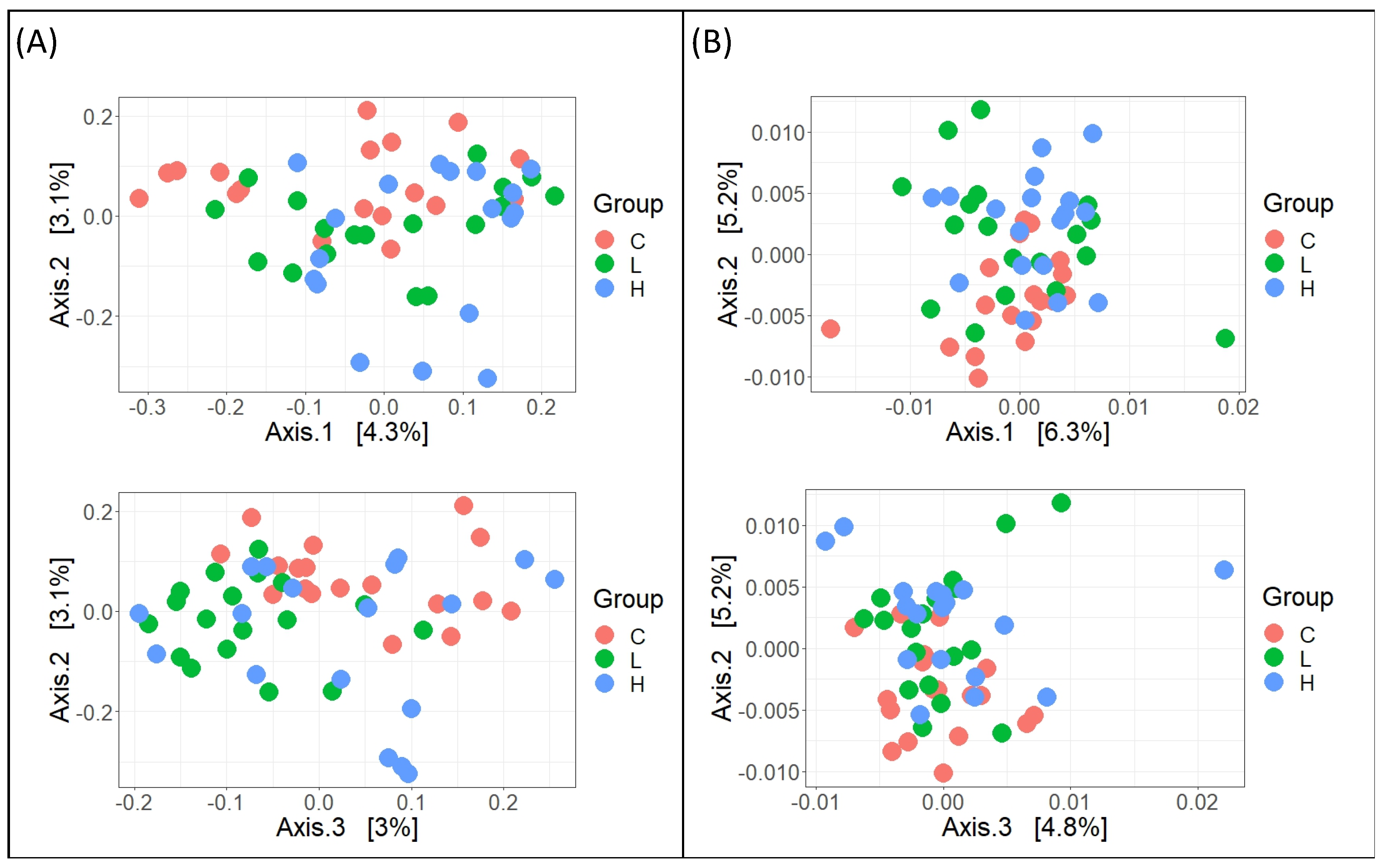
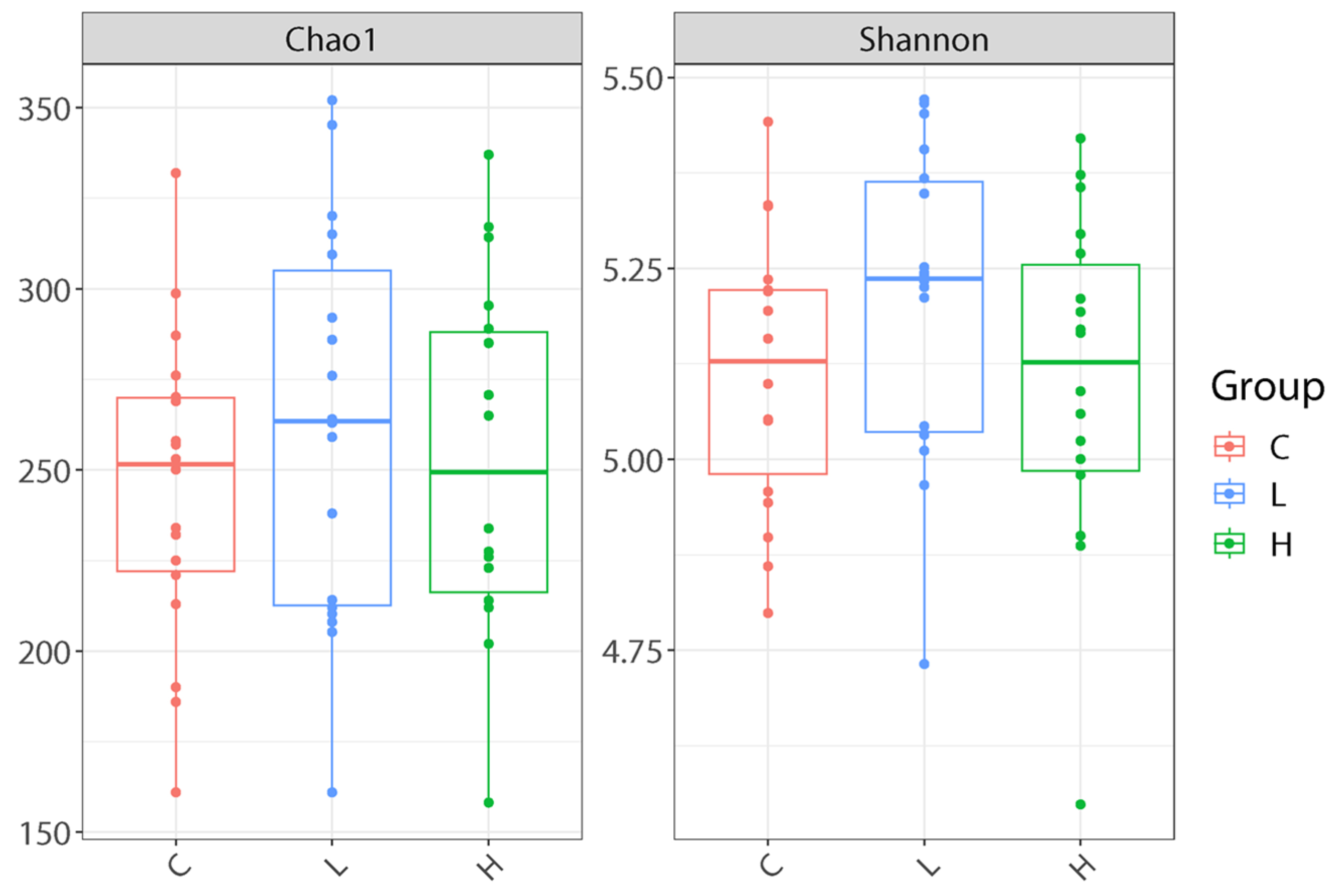
3.1.5. Cecal Microbiota Composition
3.1.6. SCFA Concentrations
3.1.7. Predicted Metabolic Pathways
3.2. Results (Experiment 2)
ME Determination
4. Discussion
4.1. Growth Performance and Physiological Adaptations
4.2. Intestinal Health and Morphological Improvements
4.3. Microbiota Composition and Functional Adaptations
4.4. SCFA Profile and Protein Utilization Efficiency
4.5. ME Value and Nutritional Implications
4.6. Bioactive Compounds and Health Benefits
4.7. Economic and Practical Implications
4.8. Integration of Experimental Findings
5. Conclusions
Supplementary Materials
Author Contributions
Funding
Institutional Review Board Statement
Informed Consent Statement
Data Availability Statement
Acknowledgments
Conflicts of Interest
Abbreviations
| FM | Fish meal |
| GOT | Glutamic oxaloacetic transaminase |
| HL | Housefly larvae |
| LDH | Lactate dehydrogenase |
| ME | Metabolizable energy |
| SCFA | Short-chain fatty acid |
References
- Van Huis, A.; Van Itterbeeck, J.; Klunder, H.; Mertens, E.; Halloran, A.; Muir, G.; Vantomme, P. Edible Insects: Future Prospects for Food and Feed Security; Food and Agriculture Organization of the United Nations: Rome, Italy, 2013. [Google Scholar]
- Makkar, H.P.S.; Tran, G.; Heuzé, V.; Ankers, P. State-of-the-art on use of insects as animal feed. Anim. Feed Sci. Technol. 2014, 197, 1–33. [Google Scholar] [CrossRef]
- National Research Council. Nutrient Requirements of Poultry, 9th revised ed.; National Academies Press: Washington, DC, USA, 1994. [Google Scholar] [CrossRef]
- Hill, F.W.; Anderson, D.L. Comparison of metabolizable energy and productive energy determinations with growing chicks. J. Nutr. 1958, 64, 587–603. [Google Scholar] [CrossRef] [PubMed]
- Sibbald, I.R. A bioassay for true metabolizable energy in feedingstuffs. Poult. Sci. 1976, 55, 303–308. [Google Scholar] [CrossRef] [PubMed]
- Oonincx, D.G.A.B.; van Itterbeeck, J.; Heetkamp, M.J.W.; van den Brand, H.; van Loon, J.J.A.; van Huis, A. An exploration on greenhouse gas and ammonia production by insect species suitable for animal or human consumption. PLoS ONE 2010, 5, e14445. [Google Scholar] [CrossRef]
- Fernando, I.; Nisa’, F.; Yudhistira, B.; Nugraha, W.S.; Sutopo, C.C.Y.; Giovanni, A.; Rahmawaty, A.; Muhammad, F.N.; Mario, M.B.; Kasza, G. A comprehensive review on the utilization of housefly larvae (Musca domestica) as dietary meals in aquaculture. Discov. Sustain. 2025, 6, 986. [Google Scholar] [CrossRef]
- Muurmann, A.T.; Eriksen, N.T.; Rasmussen, J.A.; Limborg, M.T.; Tomberlin, J.K.; Gilbert, M.T.P.; Bahrndorff, S. Growth and metabolic performance of house fly and black soldier fly larvae differ across densities and waste-based growth substrates. Waste Manag. 2025, 193, 529–538. [Google Scholar] [CrossRef]
- Pieterse, E.; Pretorius, Q. Nutritional evaluation of dried larvae and pupae meal of the housefly (Musca domestica) using chemical- and broiler-based biological assays. Anim. Prod. Sci. 2013, 54, 347–355. [Google Scholar] [CrossRef]
- Aprianto, M.A.; Muhlisin, M.; Kurniawati, A.; Hanim, C.; Ariyadi, B.; Anas, M.A. Effect supplementation of black soldier fly larvae oil (Hermetia illucens L.) calcium salt on performance, blood biochemical profile, carcass characteristic, meat quality, and gene expression in fat metabolism broilers. Poult. Sci. 2023, 102, 102984. [Google Scholar] [CrossRef]
- Jha, R.; Berrocoso, J.D. Review: Dietary fiber utilization and its effects on physiological functions and gut health of swine. Animal 2015, 9, 1441–1452. [Google Scholar] [CrossRef]
- Koh, A.; De Vadder, F.; Kovatcheva-Datchary, P.; Bäckhed, F. From dietary fiber to host physiology: Short-chain fatty acids as key bacterial metabolites. Cell 2016, 165, 1332–1345. [Google Scholar] [CrossRef]
- Morrison, D.J.; Preston, T. Formation of short chain fatty acids by the gut microbiota and their impact on human metabolism. Gut Microbes 2016, 7, 189–200. [Google Scholar] [CrossRef]
- Louis, P.; Flint, H.J. Formation of propionate and butyrate by the human colonic microbiota. Environ. Microbiol. 2017, 19, 29–41. [Google Scholar] [CrossRef] [PubMed]
- Macfarlane, G.T.; Gibson, G.R.; Beatty, E.; Cummings, J.H. Estimation of short-chain fatty acid production from protein by human intestinal bacteria based on branched-chain fatty acid measurements. FEMS Microbiol. Ecol. 1992, 10, 81–88. [Google Scholar] [CrossRef]
- Kawasaki, K.; Hashimoto, Y.; Hori, A.; Kawasaki, T.; Hirayasu, H.; Iwase, S.-I.; Hashizume, A.; Ido, A.; Miura, C.; Miura, T.; et al. Evaluation of black soldier fly (Hermetia illucens) Larvae and Pre-Pupae Raised on Household Organic Waste, as Potential Ingredients for Poultry Feed (Evaluation of Black Soldier Fly (Hermetia illucens) Larvae and Pre-Pupae Raised on Household Organic Waste, as Potential Ingredients for Poultry Feed). Animals 2019, 9, 98. [Google Scholar] [CrossRef]
- Zhao, J.; Ban, T.; Miyawaki, H.; Hirayasu, H.; Izumo, A.; Iwase, S.I.; Kasai, K.; Kawasaki, K. Long-term dietary fish meal substitution with the black soldier fly larval meal modifies the caecal microbiota and microbial pathway in laying hens. Animals 2023, 13, 2629. [Google Scholar] [CrossRef]
- Kawasaki, K.; Wada, K.; Sato, A.; Zhao, J.; Takao, N.; Sato, M.; Ban, T.; Yano, K. Effects of dietary bamboo (Phyllostachys pubescens Mazel) culm powder on blood properties and intestinal environment of rabbits. Anim. Sci. J. 2022, 93, e13774. [Google Scholar] [CrossRef]
- Bolyen, E.; Rideout, J.R.; Dillon, M.R.; Bokulich, N.A.; Abnet, C.C.; Al-Ghalith, G.A.; Alexander, H.; Alm, E.J.; Arumugam, M.; Asnicar, F.; et al. Reproducible, interactive, scalable and extensible microbiome data science using QIIME 2. Nat. Biotechnol. 2019, 37, 852–857. [Google Scholar] [CrossRef] [PubMed]
- Douglas, G.M.; Maffei, V.J.; Zaneveld, J.R.; Yurgel, S.N.; Brown, J.R.; Taylor, C.M.; Huttenhower, C.; Langille, M.G. PICRUSt2 for prediction of metagenome functions. Nat. Biotechnol. 2020, 38, 685–688. [Google Scholar] [CrossRef] [PubMed]
- Vogtmann, H.; Pfirter, H.P.; Prabucki, A.L. A new method of determining metabolisability of energy and digestibility of fatty acids in broiler diets. Br. Poult. Sci. 1975, 16, 531–534. [Google Scholar] [CrossRef]
- Sales, J.; Janssens, G.P. The use of markers to determine energy metabolizability and nutrient digestibility in avian species. World’s Poult. Sci. J. 2003, 59, 314–327. [Google Scholar] [CrossRef]
- Biasato, I.; Gasco, L.; De Marco, M.; Renna, M.; Rotolo, L.; Dabbou, S.; Capucchio, M.T.; Biasibetti, E.; Tarantola, M.; Sterpone, L.; et al. Yellow mealworm larvae (Tenebrio molitor) inclusion in diets for male broiler chickens: Effects on growth performance, gut morphology, and histological findings. Poult. Sci. 2018, 97, 540–548. [Google Scholar] [CrossRef]
- Cullere, M.; Tasoniero, G.; Giaccone, V.; Miotti-Scapin, R.; Claeys, E.; De Smet, S.; Dalle Zotte, A. Black soldier fly as dietary protein source for broiler quails: Apparent digestibility, excreta microbial load, feed choice, performance, carcass and meat traits. Animal 2016, 10, 1923–1930. [Google Scholar] [CrossRef]
- Józefiak, D.; Józefiak, A.; Kierończyk, B.; Rawski, M.; Świątkiewicz, S.; Długosz, J.; Engberg, R.M. Insects—A natural nutrient source for poultry—A review. Ann. Anim. Sci. 2016, 16, 297–313. [Google Scholar] [CrossRef]
- Santos, A.T.D.; Cruz, G.S.; Baptista, G.R. Anti-inflammatory activities of arthropod peptides: A systematic review. J. Venom. Anim. Toxins Incl. Trop. Dis. 2021, 27, e20200152. [Google Scholar] [CrossRef] [PubMed]
- Huang, J.; Sun, Z.; Zhu, Q.; Zhang, F.; Lai, C.; Zhao, J. Effects of dietary fiber fermentation and protein digestion properties on growth performance and microbial metabolites in weaned pigs. Animals 2025, 15, 1669. [Google Scholar] [CrossRef]
- Marono, S.; Loponte, R.; Lombardi, P.; Vassalotti, G.; Pero, M.E.; Russo, F.; Gasco, L.; Parisi, G.; Piccolo, G.; Nizza, S.; et al. Productive performance and blood profiles of laying hens fed Hermetia illucens larvae meal as total replacement of soybean meal from 24 to 45 weeks of age. Poult. Sci. 2017, 96, 1783–1790. [Google Scholar] [CrossRef] [PubMed]
- Zainol Abidin, N.A.; Kormin, F.; Zainol Abidin, N.A.; Mohamed Anuar, N.A.F.; Abu Bakar, M.F. The potential of insects as alternative sources of chitin: An overview on the chemical method of extraction from arious sources. Int. J. Mol. Sci. 2020, 21, 4978. [Google Scholar] [CrossRef]
- Ipema, A.F.; Bokkers, E.A.M.; Gerrits, W.J.J.; Kemp, B.; Bolhuis, J.E. Providing live black soldier fly larvae (Hermetia illucens) improves welfare while maintaining performance of piglets post-weaning. Sci. Rep. 2021, 11, 7371. [Google Scholar] [CrossRef]
- Saviano, P.; Fiorucci, L.; Grande, F.; Macrelli, R.; Troisi, A.; Polisca, A.; Orlandi, R. Pregnancy and fetal development: Cephalic presentation and other descriptive ultrasonographic findings from clinically healthy bottlenose dolphins (Tursiops truncatus) under human care. Animals 2020, 10, 908. [Google Scholar] [CrossRef]
- Van den Abbeele, P.; Ghyselinck, J.; Marzorati, M.; Koch, A.-M.; Lambert, W.; Michiels, J.; Chalvon-Demersay, T. The effect of amino acids on production of SCFA and bCFA by members of the porcine colonic microbiota. Microorganisms 2022, 10, 762. [Google Scholar] [CrossRef]
- Dias Batista, L.F.; Rivera, M.E.; Norris, A.B.; Muir, J.P.; Fonseca, M.A.; Tedeschi, L.O. The influence of extended supplementation of quebracho extract to beef steers consuming a hay diet on digestion, ruminal, and blood parameters. J. Anim. Sci. 2021, 99, skab074. [Google Scholar] [CrossRef]
- Elahi, U.; Xu, C.C.; Wang, J.; Lin, J.; Wu, S.G.; Zhang, H.J.; Qi, G.H. Insect meal as a feed ingredient for poultry. Anim. Biosci. 2022, 35, 332. [Google Scholar] [CrossRef]
- Sedgh-Gooya, S.; Torki, M.; Darbemamieh, M.; Khamisabadi, H.; Karimi Torshizi, M.A.; Abdolmohamadi, A. Yellow mealworm, Tenebrio molitor (Col: Tenebrionidae), larvae powder as dietary protein sources for broiler chickens: Effects on growth performance, carcass traits, selected intestinal microbiota and blood parameters. J. Anim. Physiol. Anim. Nutr. 2021, 105, 119–128. [Google Scholar] [CrossRef]
- Schiavone, A.; De Marco, M.; Martínez, S.; Dabbou, S.; Renna, M.; Madrid, J.; Hernandez, F.; Rotolo, L.; Costa, P.; Gai, F.; et al. Nutritional value of a partially defatted and a highly defatted black soldier fly larvae (Hermetia illucens L.) meal for broiler chickens: Apparent nutrient digestibility, apparent metabolizable energy and apparent ileal amino acid digestibility. J. Anim. Sci. Biotechnol. 2017, 8, 51. [Google Scholar] [CrossRef]
- Finke, M.D. Complete nutrient content of four species of commercially available feeder insects fed enhanced diets during growth. Zoo Biol. 2015, 34, 554–564. [Google Scholar] [CrossRef] [PubMed]
- De Marco, M.; Martínez, S.; Hernandez, F.; Madrid, J.; Gai, F.; Rotolo, L.; Belforti, M.; Bergero, D.; Katz, H.; Dabbou, S.; et al. Nutritional value of two insect larval meals (Tenebrio molitor and Hermetia illucens) for broiler chickens: Apparent nu-trient digestibility, apparent ileal amino acid digestibility and apparent metabolizable energy. Anim. Feed Sci. Technol. 2015, 209, 211–218. [Google Scholar] [CrossRef]
- Spranghers, T.; Ottoboni, M.; Klootwijk, C.; Ovyn, A.; Deboosere, S.; De Meulenaer, B.; Michiels, J.; Eeckhout, M.; De Clercq, P.; De Smet, S. Nutritional composition of black soldier fly (Hermetia illucens) prepupae reared on different organic waste substrates. J. Sci. Food Agric. 2017, 97, 2594–2600. [Google Scholar] [CrossRef] [PubMed]
- Park, S.I.; Kim, J.W.; Yoe, S.M. Purification and characterization of a novel antibacterial peptide from black soldier fly (Hermetia illucens) larvae. Dev. Comp. Immunol. 2015, 52, 98–106. [Google Scholar] [CrossRef]
- Van Huis, A. Insects as food and feed, a new emerging agricultural sector: A review. J. Insects Food Feed 2020, 6, 27–44. [Google Scholar] [CrossRef]
- Berggren, Å.; Jansson, A.; Low, M. Approaching ecological sustainability in the emerging insects-as-food industry. Trends Ecol. Evol. 2019, 34, 132–138. [Google Scholar] [CrossRef]
- Meneguz, M.; Schiavone, A.; Gai, F.; Dama, A.; Lussiana, C.; Renna, M.; Gasco, L. Effect of rearing substrate on growth performance, waste reduction efficiency and chemical composition of black soldier fly (Hermetia illucens) larvae. J. Sci. Food Agric. 2018, 98, 5776–5784. [Google Scholar] [CrossRef] [PubMed]
- Benzertiha, A.; Kierończyk, B.; Kołodziejski, P.; Pruszyńska-Oszmałek, E.; Rawski, M.; Józefiak, D.; Józefiak, A. Tenebrio molitor and Zophobas morio full-fat meals as functional feed additives affect broiler chickens’ growth performance and immune system traits. Poult. Sci. 2019, 99, 196–206. [Google Scholar] [CrossRef] [PubMed]


| Ingredients (% in Fresh Matter) | Grower Feed | Finisher Feed | ||||
|---|---|---|---|---|---|---|
| C | L | H | C | L | H | |
| Maize grain | 55.5 | 55.1 | 54.8 | 59.3 | 58.9 | 58.5 |
| Rice bran (defatted) | 6.7 | 6.7 | 6.6 | 7.2 | 7.1 | 7.1 |
| Corn gluten meal | 3.8 | 3.8 | 3.8 | 4.1 | 4.1 | 4.1 |
| Soybean meal | 21.0 | 21.5 | 22.0 | 16.0 | 16.5 | 17.0 |
| Fish meal | 5.0 | 2.5 | 0.0 | 5.0 | 2.5 | 0.0 |
| Housefly larvae meal | 0.0 | 2.5 | 5.0 | 0.0 | 2.5 | 5.0 |
| Dried distillers’ grains | 3.7 | 3.7 | 3.7 | 4.0 | 3.9 | 3.9 |
| Corn oil | 2.2 | 2.2 | 2.2 | 2.4 | 2.4 | 2.3 |
| Tricalcium phosphate | 1.3 | 1.3 | 1.3 | 1.4 | 1.4 | 1.4 |
| Premix 1 | 0.4 | 0.4 | 0.4 | 0.5 | 0.5 | 0.5 |
| Salt | 0.1 | 0.1 | 0.1 | 0.1 | 0.1 | 0.1 |
| Calcium carbonate | 0.1 | 0.1 | 0.1 | 0.1 | 0.1 | 0.1 |
| Proximate nutrients (% in dry matter) and energy content | ||||||
| Dry matter 2 | 88.10 | 88.31 | 87.90 | 87.46 | 87.58 | 87.80 |
| Crude protein 2 | 19.11 | 18.56 | 19.80 | 17.14 | 16.94 | 17.76 |
| Crude fat 2 | 3.23 | 3.06 | 3.02 | 3.43 | 3.42 | 3.58 |
| Crude fiber 2 | 3.88 | 4.00 | 4.46 | 3.10 | 3.65 | 3.80 |
| Crude ash 2 | 6.21 | 6.12 | 4.81 | 6.03 | 5.46 | 4.96 |
| NFE 3 | 55.67 | 56.57 | 55.81 | 57.76 | 58.11 | 57.7 |
| ME 3,4 (Mcal/kg) | 3.37 | 3.37 | 3.39 | 3.40 | 3.41 | 3.44 |
| Ingredient | Inclusion Rate (%) |
|---|---|
| Corn (ground) | 46.00 |
| Grain sorghum | 12.00 |
| Soybean meal | 30.53 |
| Defatted rice bran | 3.00 |
| Corn gluten meal (60% CP) | 5.00 |
| Dicalcium phosphate | 1.10 |
| Calcium carbonate | 1.05 |
| Salt | 0.30 |
| L-Lysine HCl | 0.22 |
| DL-Methionine | 0.35 |
| Choline chloride | 0.12 |
| Premix 1 | 0.30 |
| Selenium yeast | 0.03 |
| Parameters | C | L | H | p-Value |
|---|---|---|---|---|
| Body weight gain during Grower period (1w–4w) | 1189.8 ± 17.4 | 1141.7 ± 19.2 | 1019.0 ± 53.2 | 0.058 |
| Body weight gain during Finisher period (4w–7w) | 1422.3 ± 165.3 | 1748.9 ± 109.4 | 1488.7 ± 108.9 | 0.193 |
| Body weight gain during experiment (1w–7w) | 2612.1 ± 182.4 | 2890.5 ± 99.0 | 2507.6 ± 126.5 | 0.177 |
| Feed intake during Grower period (1w–4w) | 1808.6 ± 51.0 | 1813.7 ± 15.9 | 1641.1 ± 26.6 | 0.066 |
| Feed intake during Finisher period (4w–7w) | 3564.9 ± 372.2 | 4216.2 ± 289.7 | 3586.1 ± 306.2 | 0.193 |
| Feed intake during experiment (1w–7w) | 5373.5 ± 419.6 | 6029.9 ± 302.4 | 5227.2 ± 319.7 | 0.177 |
| FCR during Grower period (1w–4w) | 1.52 ± 0.02 | 1.59 ± 0.04 | 1.62 ± 0.06 | 0.301 |
| FCR during Finisher period (4w–7w) | 2.51 ± 0.04 | 2.41 ± 0.04 | 2.41 ± 0.03 | 0.177 |
| FCR during experiment (1w–7w) | 2.06 ± 0.02 | 2.08 ± 0.04 | 2.08 ± 0.04 | 0.837 |
| Parameter | C | L | H | p-Value |
|---|---|---|---|---|
| Liver (%) | 1.82 ± 0.06 | 1.74 ± 0.03 | 1.70 ± 0.04 | 0.231 |
| Spleen (%) | 0.11 ± 0.01 | 0.13 ± 0.01 | 0.11 ± 0.01 | 0.283 |
| Kidney (%) | 0.38 ± 0.03 | 0.43 ± 0.02 | 0.42 ± 0.02 | 0.268 |
| Intestine (%) | 3.96 ± 0.15 | 3.52 ± 0.10 | 3.61 ± 0.11 | 0.072 |
| Small intestinal length (cm) | 145.78 ± 4.07 | 142.22 ± 3.40 | 138.67 ± 3.17 | 0.400 |
| Parameter | C | L | H | p-Value |
|---|---|---|---|---|
| T-Cho (mg/dL) | 82.61 ± 5.25 a | 111.61 ± 4.80 b | 123.22 ± 4.03 b | <0.001 |
| GOT (IU/L) | 112.06 ± 9.44 a | 191.44 ± 11.59 b | 181.22 ± 15.07 b | <0.001 |
| LDH (IU/L) | 494.61 ± 110.14 a | 714.88 ± 89.70 b | 601.00 ± 112.61 a | 0.033 |
| TNF-α (pg/mL) | 36.77 ± 3.47 a | 37.98 ± 5.14 a | 20.70 ± 2.04 b | <0.001 |
| Parameter | C | L | H | p-Value |
|---|---|---|---|---|
| WBC (×1011/L) | 2.20 ± 0.14 | 2.20 ± 0.13 | 2.31 ± 0.06 | 0.273 |
| RBC (×1012/L) | 2.50 ± 0.17 | 2.38 ± 0.13 | 2.50 ± 0.09 | 0.063 |
| Lymphocytes (%) | 63.35 ± 1.71 a | 68.39 ± 0.31 b | 68.41 ± 0.50 b | 0.014 |
| Granulocytes (%) | 27.86 ± 1.74 a | 23.20 ± 0.36 b | 22.90 ± 0.44 b | 0.007 |
| HGB (g/L) | 100.33 ± 6.70 | 100.56 ± 5.32 | 106.71 ± 3.41 | 0.277 |
| MCH (pg) | 39.98 ± 1.07 a | 42.16 ± 0.30 b | 42.74 ± 0.42 b | 0.012 |
| MCHC (g/L) | 311.39 ± 8.94 a | 331.25 ± 2.46 b | 331.00 ± 3.07 b | 0.023 |
| Segment | Parameter | C | L | H | p-Value |
|---|---|---|---|---|---|
| Duodenum | Villus height (μm) | 1606.31 ± 50.01 a | 1687.82 ± 41.45 ab | 1773.49 ± 53.17 b | 0.044 |
| Crypt depth (μm) | 156.16 ± 3.86 | 148.14 ± 4.07 | 147.49 ± 4.09 | 0.175 | |
| V/C ratio | 10.39 ± 0.41 a | 11.52 ± 0.41 ab | 12.18 ± 0.48 b | 0.016 | |
| Jejunum | Villus height (μm) | 1366.19 ± 45.75 | 1507.93 ± 45.57 | 1416.72 ± 44.48 | 0.132 |
| Crypt depth (μm) | 153.71 ± 4.17 a | 139.17 ± 4.38 b | 131.82 ± 4.24 b | 0.004 | |
| V/C ratio | 8.92 ± 0.26 a | 10.94 ± 0.37 b | 10.86 ± 0.37 b | <0.001 | |
| Ileum | Villus height (μm) | 795.44 ± 24.87 a | 883.17 ± 28.53 b | 850.73 ± 26.78 a | 0.051 |
| Crypt depth (μm) | 144.81 ± 5.09 a | 135.91 ± 5.65 a | 130.22 ± 3.52 b | 0.061 | |
| V/C ratio | 5.55 ± 0.19 a | 6.64 ± 0.28 b | 6.57 ± 0.20 b | 0.002 |
| SCFA | C | L | H | p-Value |
|---|---|---|---|---|
| Acetic acid | 56.99 ± 9.07 | 65.25 ± 7.86 | 49.58 ± 8.11 | 0.421 |
| Propionic acid | 6.50 ± 0.83 | 6.10 ± 0.66 | 5.42 ± 0.96 | 0.095 |
| Isobutyric acid | 1.28 ± 0.09 a | 1.10 ± 0.10 ab | 0.72 ± 0.06 b | 0.009 |
| Butyric acid | 5.89 ± 1.04 | 5.61 ± 0.89 | 6.35 ± 1.11 | 0.983 |
| Isovaleric acid | 1.25 ± 0.10 a | 0.98 ± 0.10 ab | 0.86 ± 0.16 b | 0.002 |
| Valeric acid | 0.55 ± 0.38 | 0.19 ± 0.20 | 0.00 ± 0.00 | 0.340 |
| Pathway ID | Pathway Name | C | L | H | p-Value |
|---|---|---|---|---|---|
| PWY-6471 | Peptidoglycan biosynthesis IV | 3409 ± 127 a | 4183 ± 145 b | 3508 ± 170 a | 0.002 |
| GALACTUROCAT-PWY | D-galacturonate degradation I | 1726 ± 71 a | 2113 ± 92 b | 1794 ± 72 a | 0.004 |
| PWY-6588 | Pyruvate fermentation to acetate VIII | 2971 ± 192 a | 3810 ± 219 b | 3285 ± 196 ab | 0.007 |
| PWY-5347 | Superpathway of L-methionine biosynthesis | 2623 ± 157 a | 3366 ± 164 b | 2847 ± 149 ab | 0.009 |
| P124-PWY | Inosine-5’-phosphate biosynthesis I | 2090 ± 148 a | 2739 ± 159 b | 2269 ± 149 ab | 0.010 |
| P125-PWY | Superpathway of purine nucleotide salvage | 84 ± 14 a | 120 ± 11 b | 66 ± 10 a | 0.011 |
| PWY-6269 | Adenosine nucleotides degradation III | 4726 ± 142 a | 5378 ± 195 b | 4517 ± 194 a | 0.013 |
| 1CMET2-PWY | N10-formyl-THF biosynthesis | 4931 ± 175 a | 5663 ± 186 b | 4786 ± 227 a | 0.013 |
| PWY-5509 | Adenosine ribonucleotides de novo biosynthesis | 4722 ± 141 a | 5371 ± 195 b | 4513 ± 194 a | 0.013 |
| PWY0-862 | (5Z)-dodecenoate biosynthesis I | 204 ± 41 a | 217 ± 41 a | 388 ± 53 b | 0.014 |
| MET-SAM-PWY | Superpathway of S-adenosyl-L-methionine biosynthesis | 2033 ± 134 a | 2669 ± 149 b | 2246 ± 123 ab | 0.015 |
| DAPLYSINESYN-PWY | L-lysine biosynthesis I | 6187 ± 192 a | 6983 ± 242 b | 5979 ± 277 a | 0.015 |
| PYRIDNUCSYN-PWY | NAD biosynthesis I (from aspartate) | 4359 ± 153 ab | 4775 ± 169 a | 3989 ± 193 b | 0.016 |
| PWY-5695 | Urate biosynthesis/inosine 5’-phosphate degradation | 2859 ± 105 a | 3252 ± 137 b | 2918 ± 135 a | 0.016 |
| COMPLETE-ARO-PWY | Superpathway of aromatic amino acid biosynthesis | 6884 ± 218 a | 7753 ± 266 b | 6684 ± 294 a | 0.017 |
| LACTOSECAT-PWY | Lactose and galactose degradation I | 109 ± 21 a | 114 ± 27 a | 218 ± 28 b | 0.017 |
| PWY-5005 | Biotin biosynthesis II | 73 ± 15 a | 115 ± 14 ab | 155 ± 20 b | 0.017 |
| P4-PWY | Superpathway of L-lysine, L-threonine and L-methionine biosynthesis I | 3070 ± 145 a | 3685 ±142 b | 3193 ± 151 ab | 0.017 |
| PWY-6163 | Chorismate biosynthesis from 3-dehydroquinate | 6231 ± 201 a | 7021 ± 241 b | 6039 ± 267 a | 0.018 |
| PWY-5505 | L-glutamate and L-glutamine biosynthesis | 3765 ± 168 a | 4487 ± 216 b | 3681 ± 184 a | 0.018 |
| Parameter | Value |
|---|---|
| Gross Energy (Mcal/kg) | 6.15 ± 0.03 |
| Metabolizable Energy (Mcal/kg) | 4.43 ± 0.10 |
| Metabolizability (%) | 72.0 ± 1.7 |
Disclaimer/Publisher’s Note: The statements, opinions and data contained in all publications are solely those of the individual author(s) and contributor(s) and not of MDPI and/or the editor(s). MDPI and/or the editor(s) disclaim responsibility for any injury to people or property resulting from any ideas, methods, instructions or products referred to in the content. |
© 2026 by the authors. Licensee MDPI, Basel, Switzerland. This article is an open access article distributed under the terms and conditions of the Creative Commons Attribution (CC BY) license.
Share and Cite
Kawasaki, K.; Zhao, J.; Sharma, B.; Khatun, A.; Sultana, S.; Kawasaki, T.; Ishikawa, M.; Ban, T.; Yano, K. Nutritional Evaluation of Housefly Larvae Meal in Broilers: Growth Performance, Gut Health, Metabolic Energy, and Microbiota Composition. Animals 2026, 16, 386. https://doi.org/10.3390/ani16030386
Kawasaki K, Zhao J, Sharma B, Khatun A, Sultana S, Kawasaki T, Ishikawa M, Ban T, Yano K. Nutritional Evaluation of Housefly Larvae Meal in Broilers: Growth Performance, Gut Health, Metabolic Energy, and Microbiota Composition. Animals. 2026; 16(3):386. https://doi.org/10.3390/ani16030386
Chicago/Turabian StyleKawasaki, Kiyonori, Junliang Zhao, Bimala Sharma, Asia Khatun, Sharmin Sultana, Toshiya Kawasaki, Mitsuyoshi Ishikawa, Takuma Ban, and Kiminobu Yano. 2026. "Nutritional Evaluation of Housefly Larvae Meal in Broilers: Growth Performance, Gut Health, Metabolic Energy, and Microbiota Composition" Animals 16, no. 3: 386. https://doi.org/10.3390/ani16030386
APA StyleKawasaki, K., Zhao, J., Sharma, B., Khatun, A., Sultana, S., Kawasaki, T., Ishikawa, M., Ban, T., & Yano, K. (2026). Nutritional Evaluation of Housefly Larvae Meal in Broilers: Growth Performance, Gut Health, Metabolic Energy, and Microbiota Composition. Animals, 16(3), 386. https://doi.org/10.3390/ani16030386