
Olfactory Enrichment of Captive Pygmy Hippopotamuses with Applied Machine Learning

 , , , , , and
Simple Summary
Abstract
1. Introduction
2. Materials and Methods
2.1. Subjects and Settings
2.2. Data Collection
2.2.1. Manual Observations
2.2.2. Camera Installation and Ethical Approval
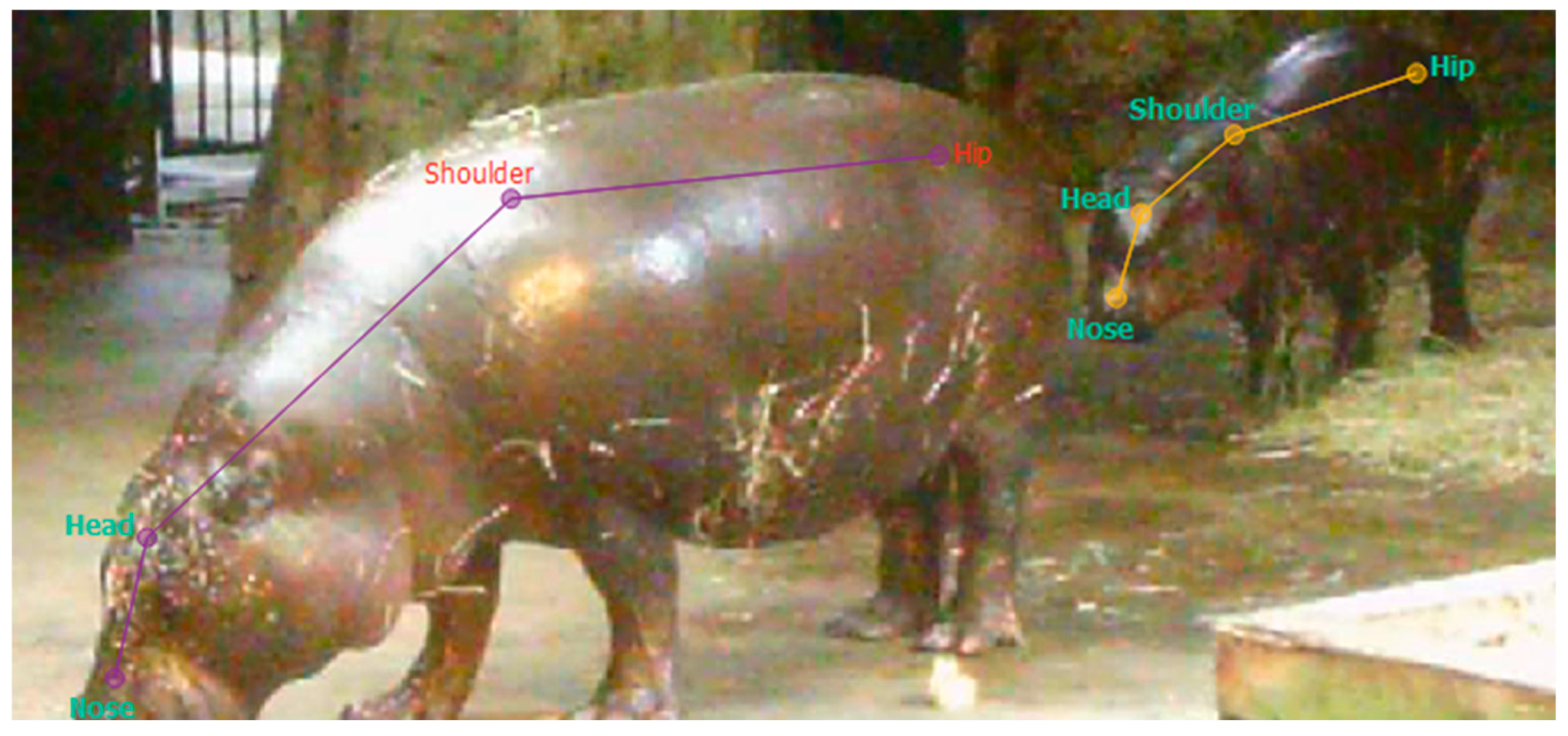
2.2.3. Machine Learning and Processing
2.2.4. Comparison Between Manual and Automatic Observations
2.3. Analysis
2.3.1. Manual Observations
2.3.2. Model Performance
2.4. Statistical Tests
2.4.1. Manual Observations
2.4.2. Machine Learning
2.5. Heat Maps for Manual Observations
3. Results
3.1. Manual Observations
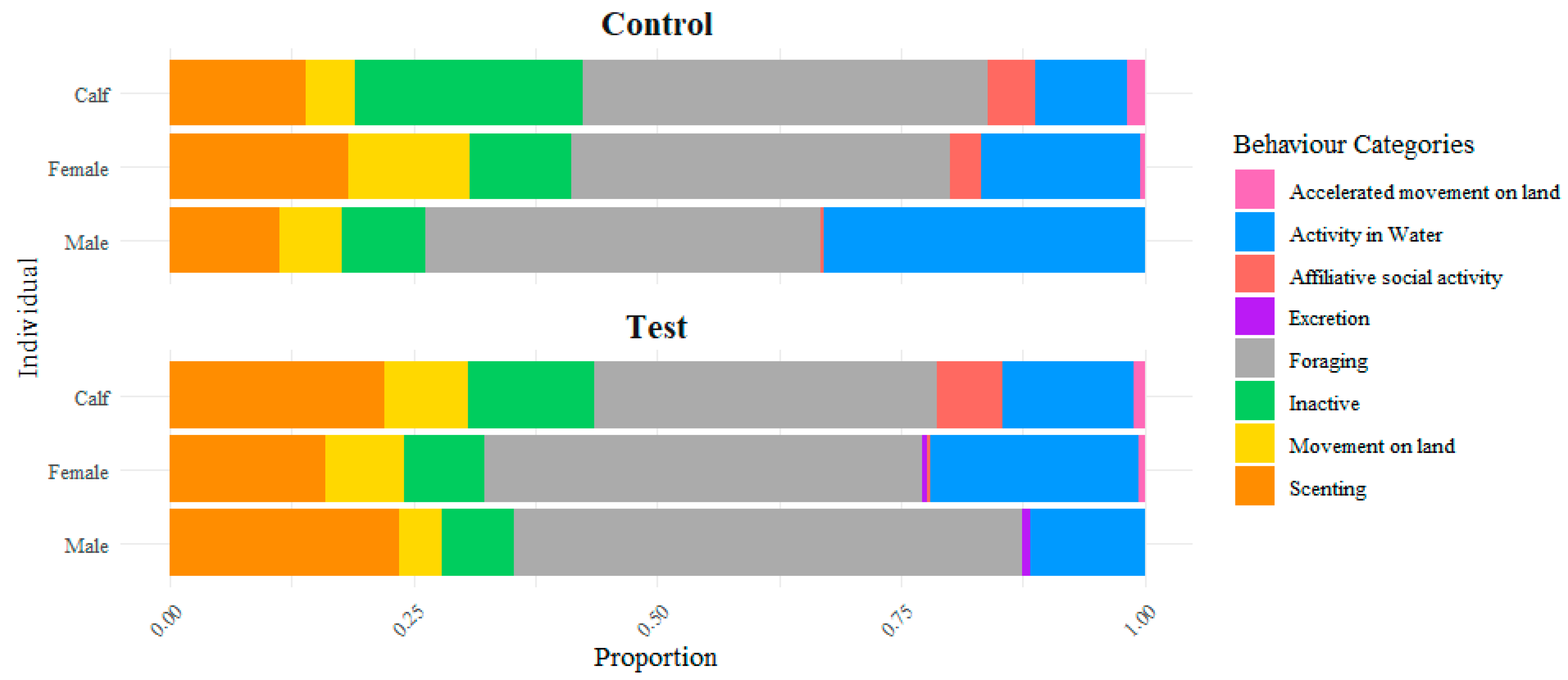
3.1.1. Proportion of Time Spent on Each Behavior
3.1.2. χ2-Test and Mann–Whitney U-Test
3.1.3. Fligner-Killeen Test
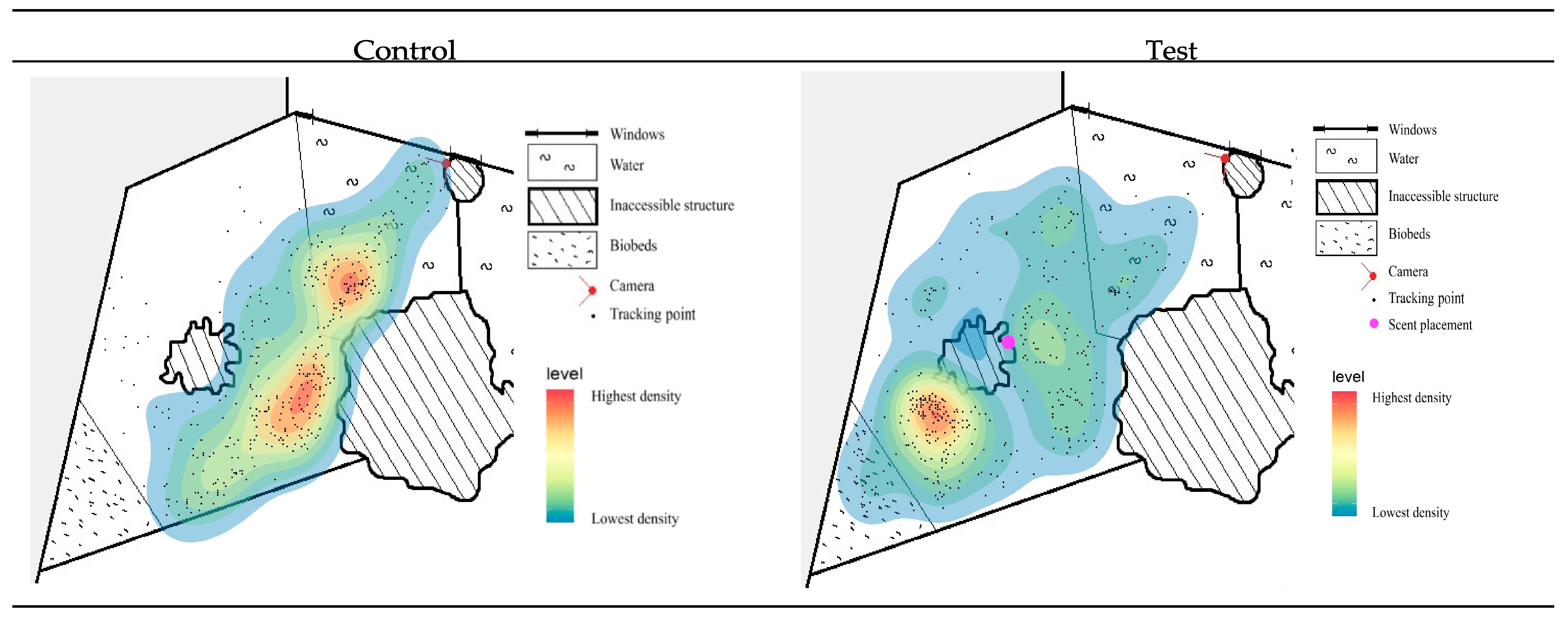
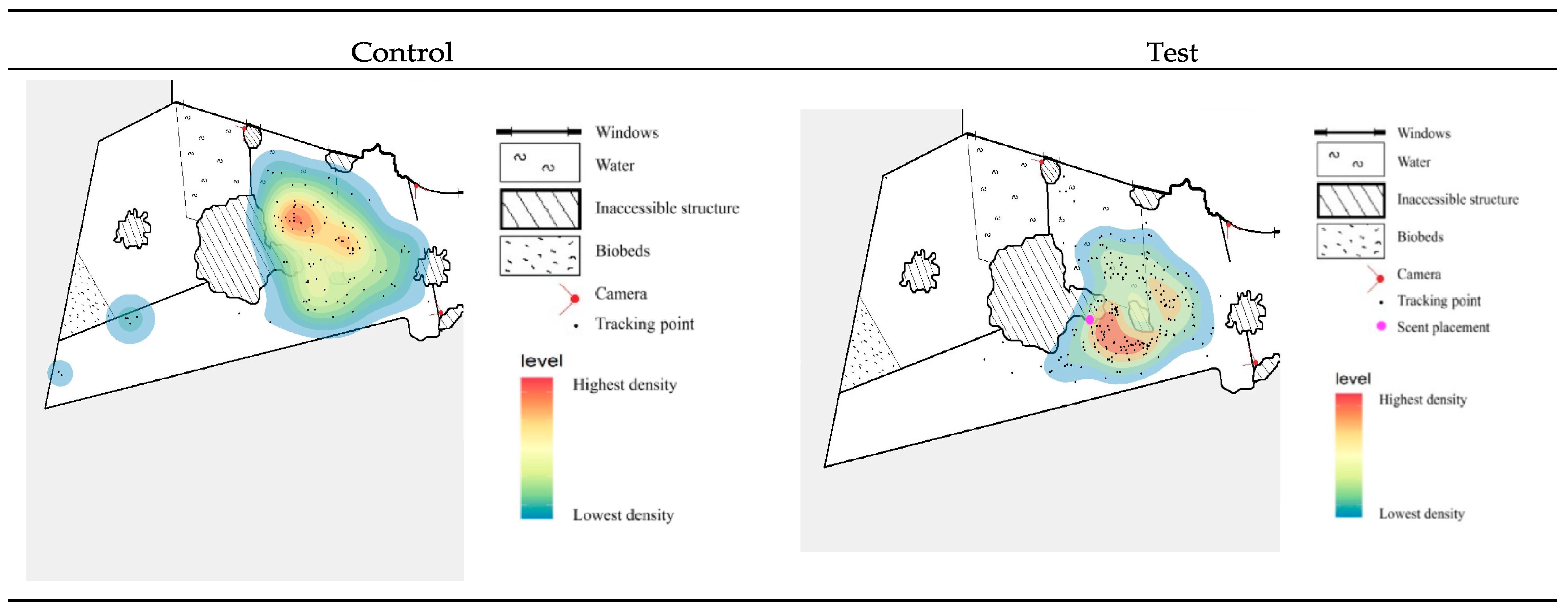
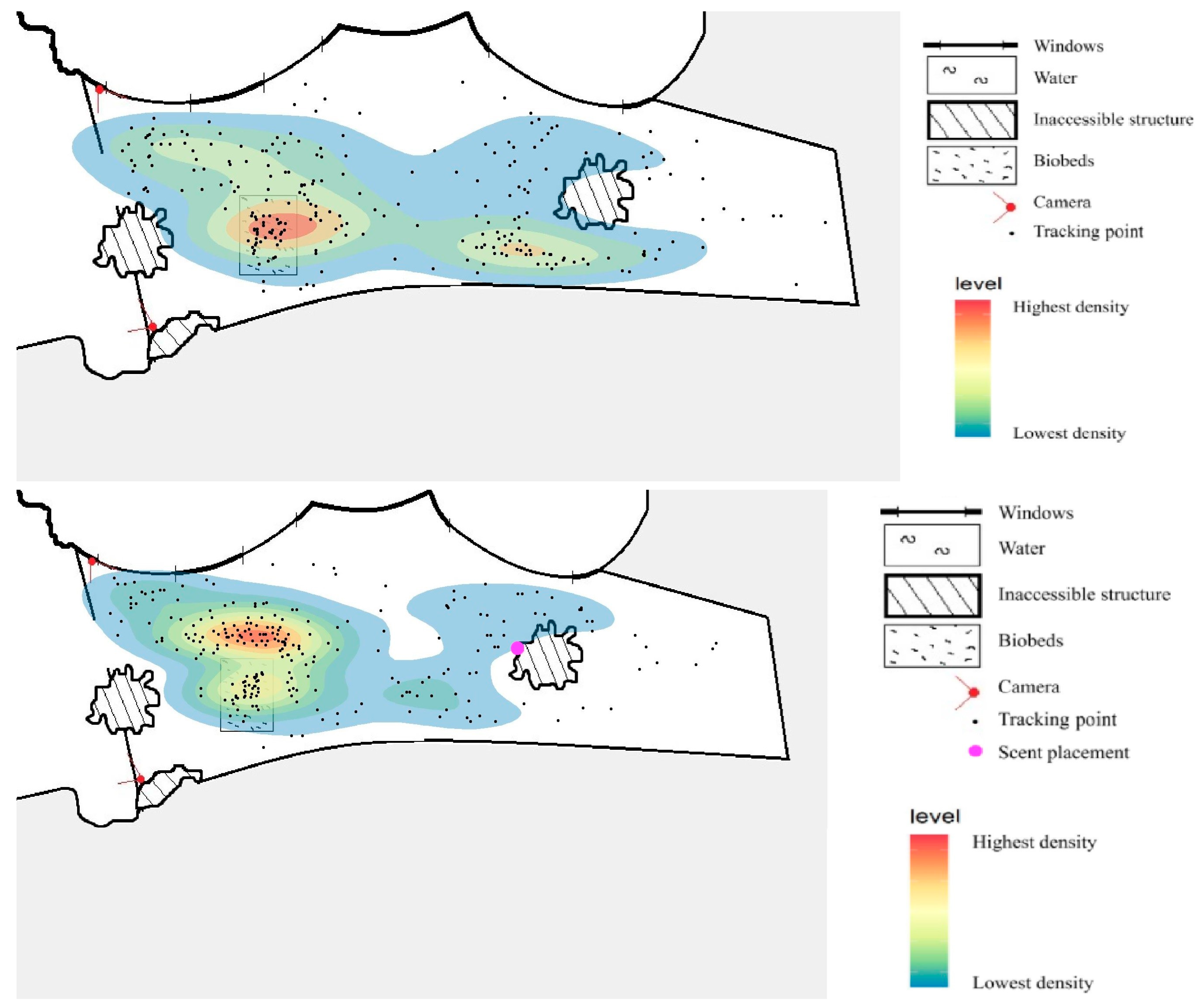
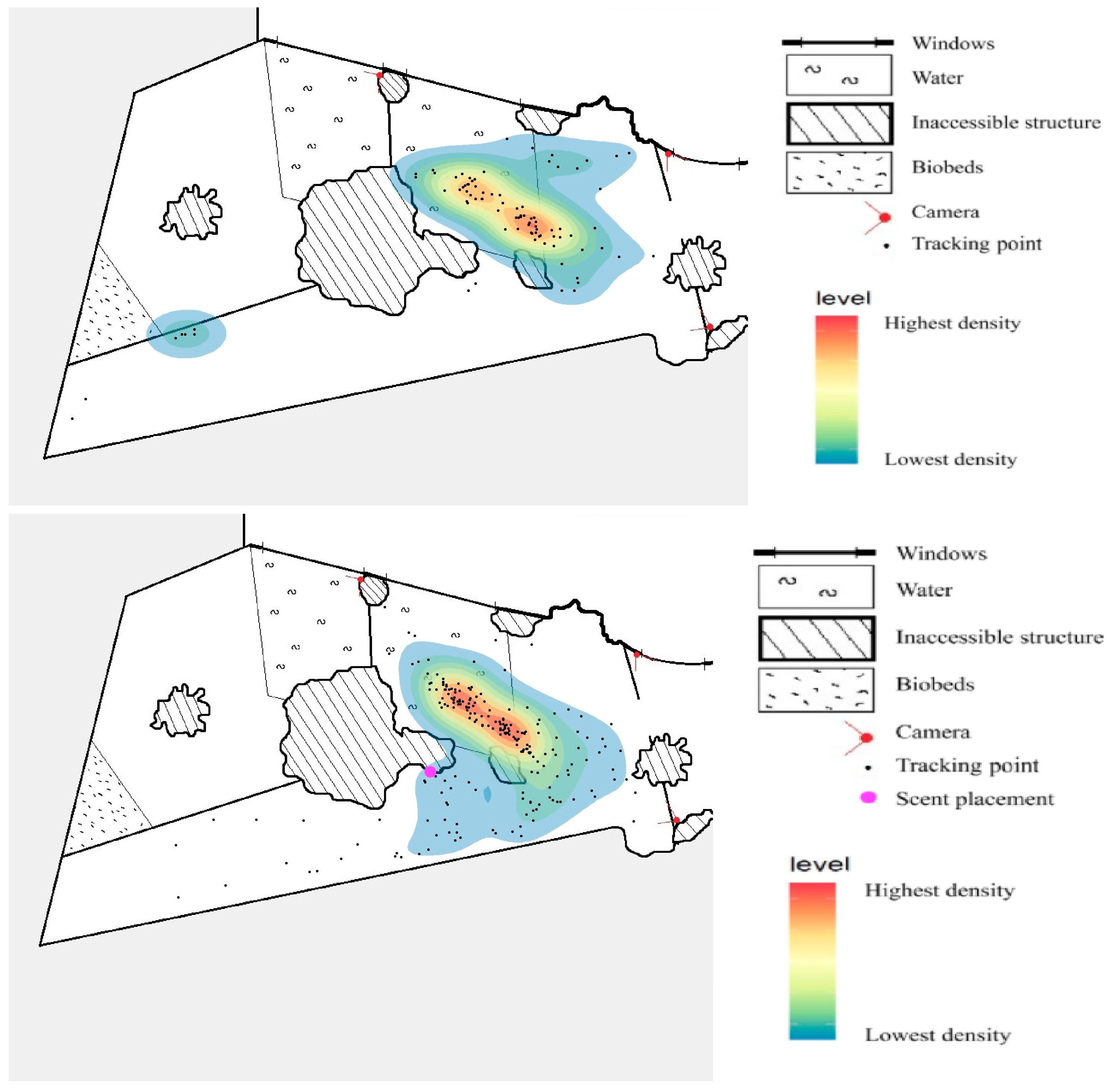
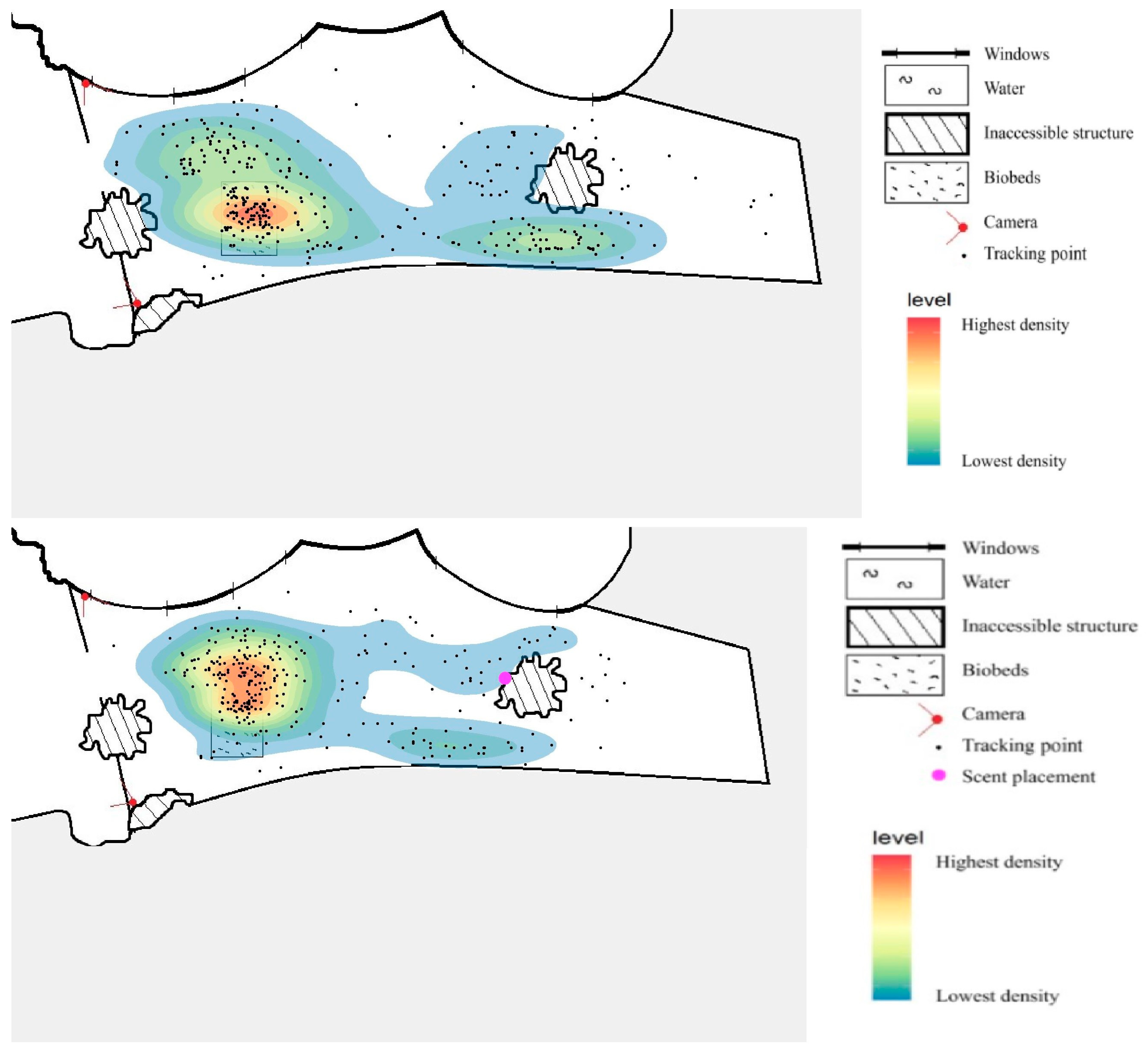
3.1.4. Heat Maps
3.2. Machine Learning
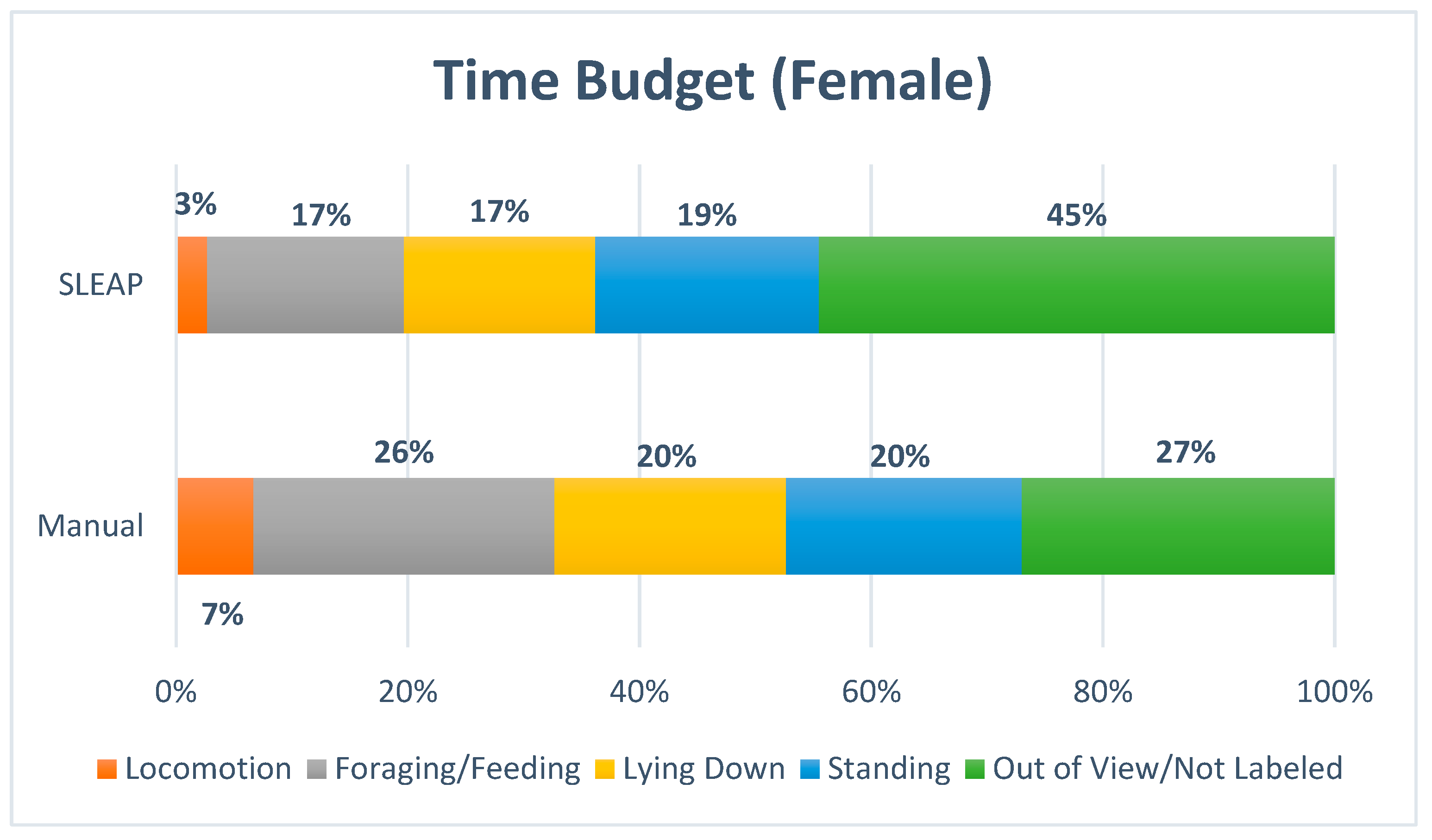
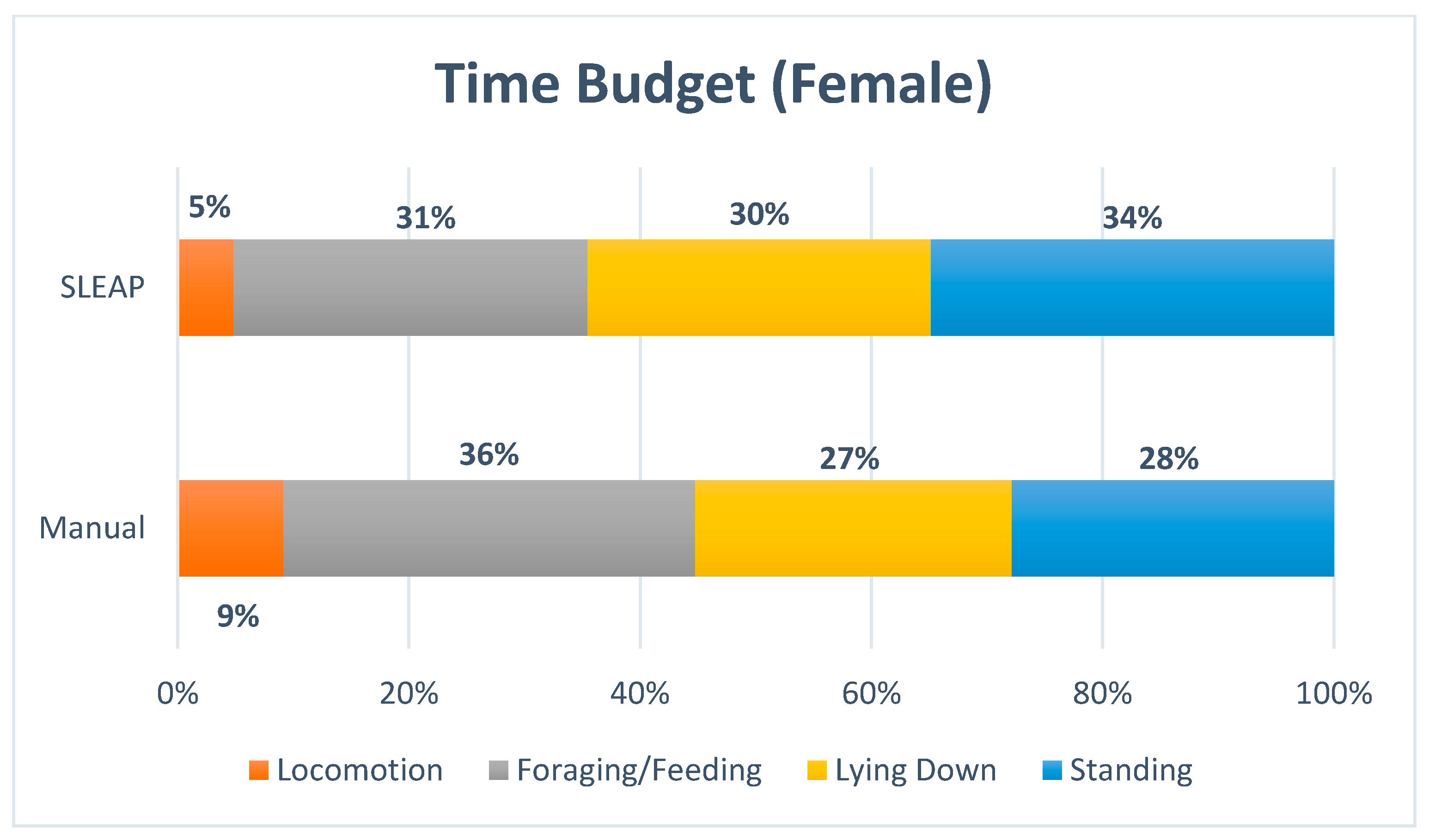
3.2.1. Activity Tracking for the Female
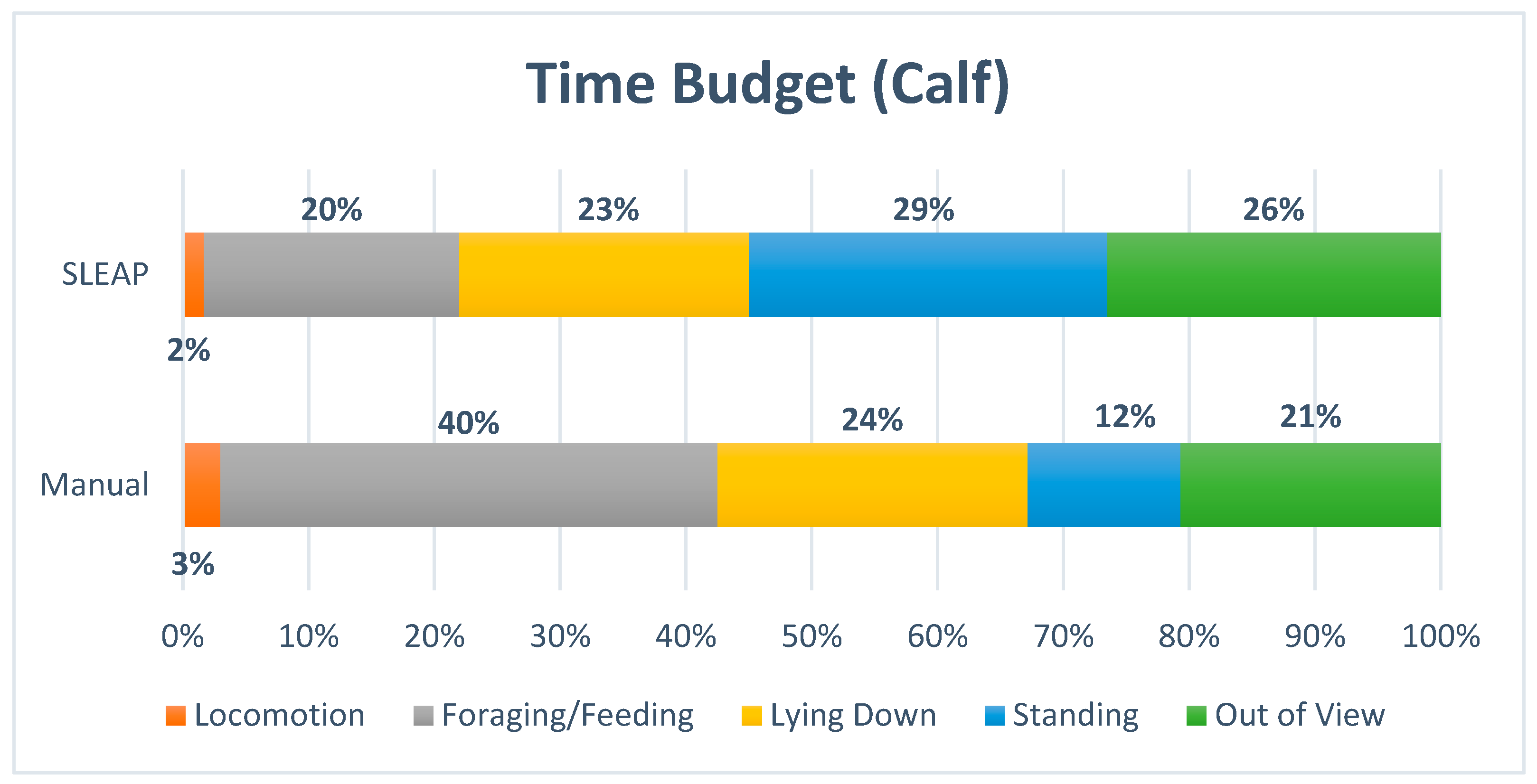
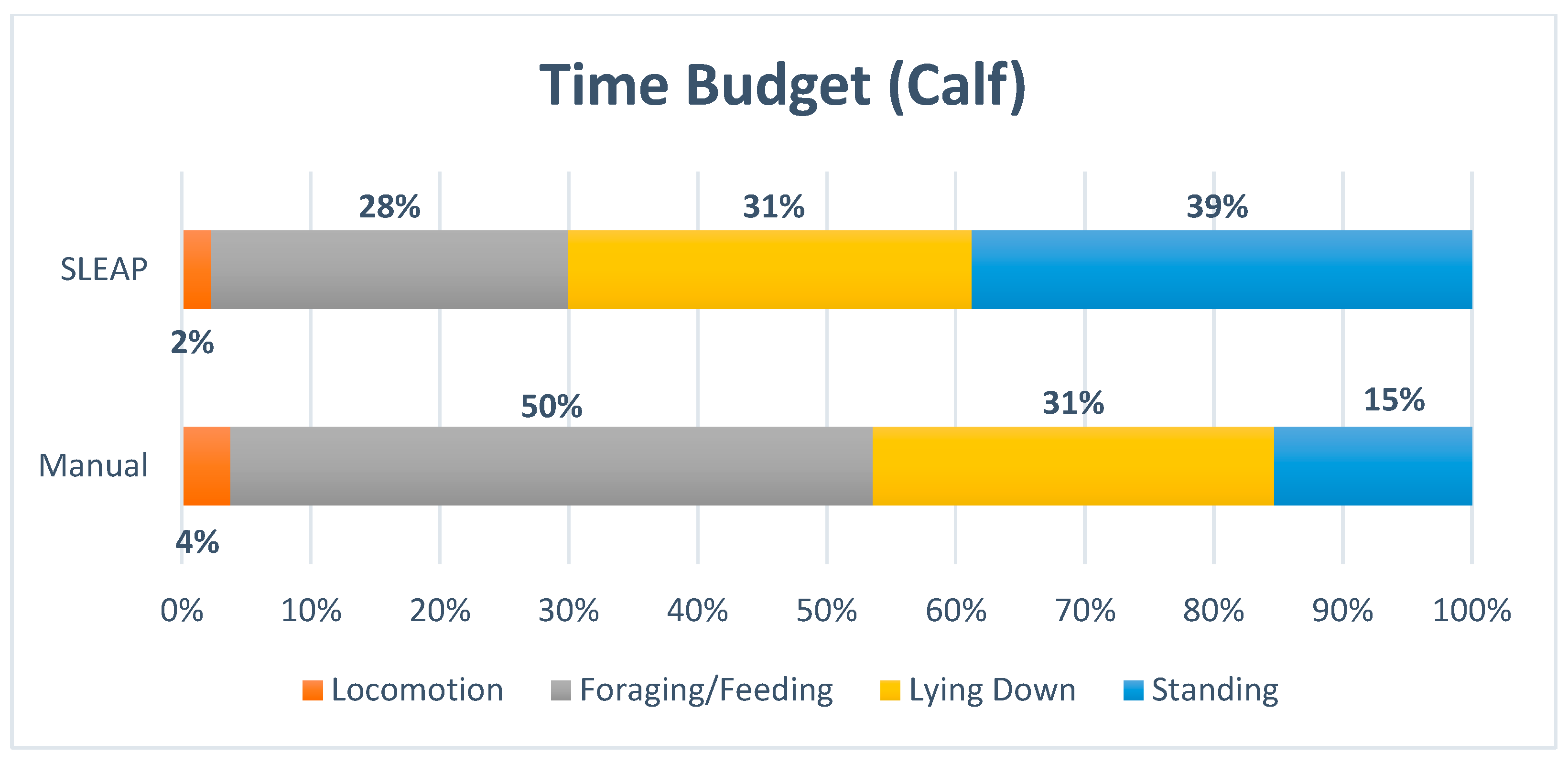
3.2.2. Activity Tracking for the Calf
4. Discussion
4.1. Manual Observations
4.1.1. Behavioral Responses to Olfactory Enrichment
4.1.2. Reliability of the Olfactory Enrichment
4.2. Results of Applied Pose Estimation
5. Conclusions
Author Contributions
Funding
Institutional Review Board Statement
Informed Consent Statement
Data Availability Statement
Acknowledgments
Conflicts of Interest
Appendix A
Behavioral Ethogram

| Behavioral Category | Active Behavior | Definition |
|---|---|---|
| Inactive | Standing Resting on land | All four legs on the ground with minimal movement, and the head positioned above the front legs. Being on either belly, or on the side, without using legs as the primary support. |
| Movement on Land | Scenting Scratching Walking | The movement in which the snout is held close to the ground without eating or drinking, accompanied by active head motion. The motion of rubbing the body against a rough or textured surface. The movement in which only one limb is lifted from the ground at a time. |
| Accelerated Movement on Land | Running Jumping | A gait in which at least two limbs, one anterior and one posterior, are lifted from the ground simultaneously. The movement in which both anterior and/or posterior limbs are lifted from the ground simultaneously. |
| Foraging | Eating Drinking | Ingestion or chewing on food. Ingestion of water. |
| Affiliative Social Activity | Social Interaction Following Chasing | Two individuals engage in social interaction, either through playful behavior or physical contact. One individual moving directly behind another while walking, following the same path or movement pattern. One individual moving directly behind another while running, following the same path or movement pattern. |
| Agonistic Social Activity | Aggressive Behavior | One individual harming or attempting to harm another, such as through biting or pushing. |
| Activity in Water | Activity in Water | All behaviors exhibited in water, including swimming, diving, standing, resting, and related activities. |
| Excretion | Excretion | Urination or defecation |
| Out of Sight | Out of Sight | Out of sight due to blind spots. |
| Other | Other | Any behaviors not otherwise defined within the ethogram. |
Appendix B
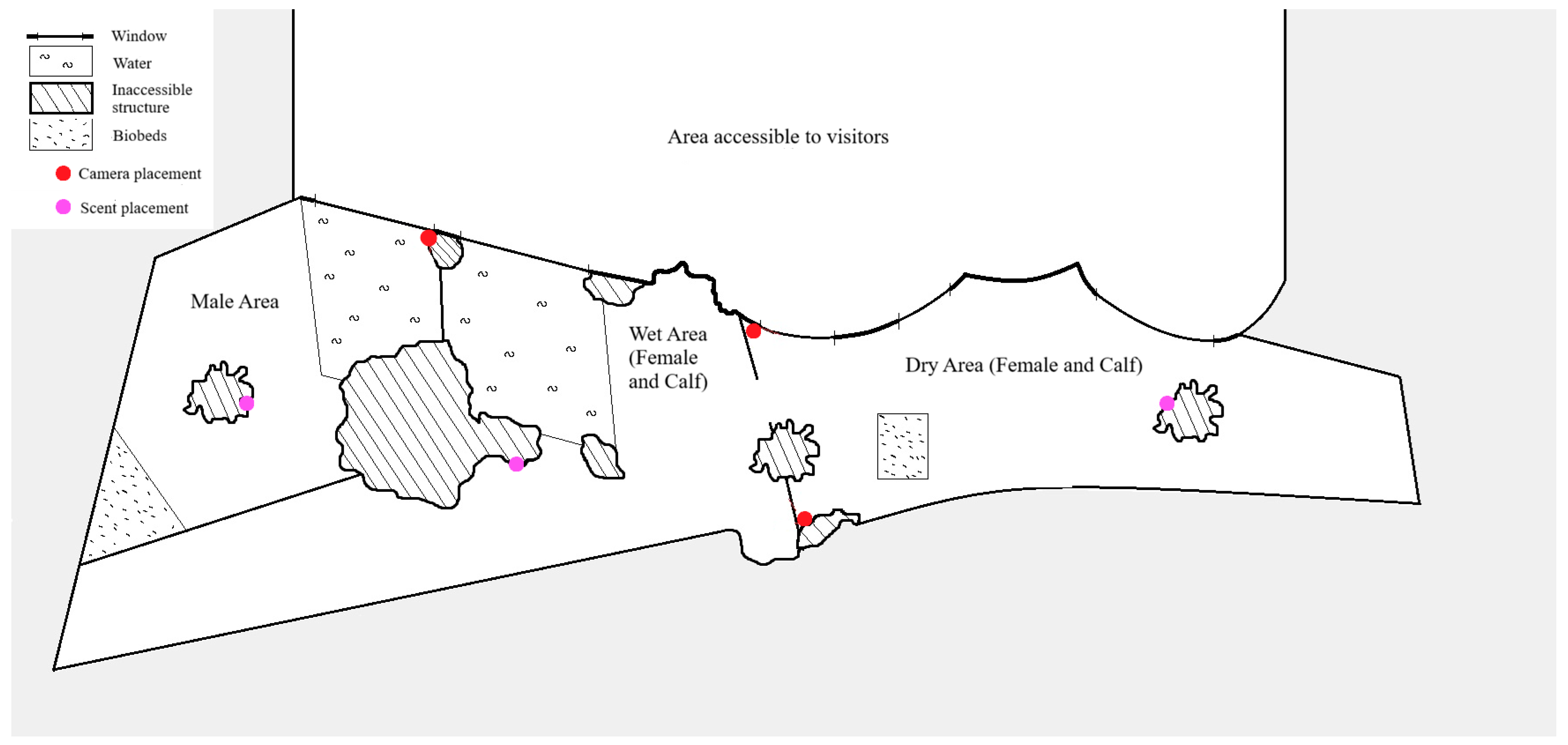
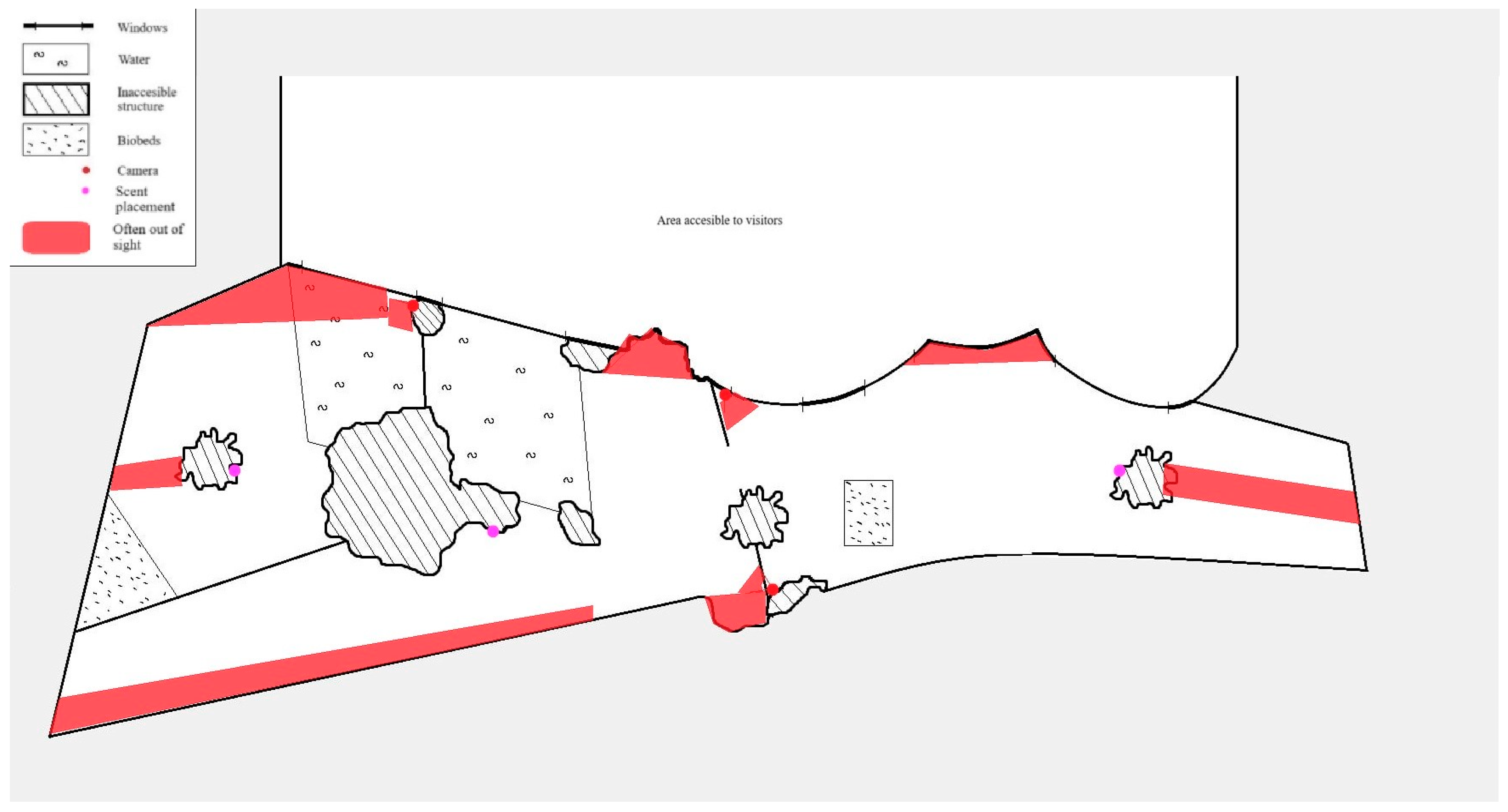
Map of Enclosure with Blind Spots

Appendix C
Collected Data
| Overview of Data | Time (s) | Tracking Points | Amount of Behavior |
|---|---|---|---|
| Male | 41.360 | 943 | 2278 |
| Female | 26.160 | 806 | 1989 |
| Calf | 30.440 | 925 | 1292 |
| Sum | 97.960 | 2674 | 5559 |
Appendix D
Appendix D.1. Heat Map of the Female in the Dry Area

Appendix D.2. Heat Map of the Female in the Wet Area

Appendix D.3. Heat Map of the Calf in the Dry Area

Appendix E
Appendix E.1. χ2-Test Comparing Control vs. Test
| Behavior | Male | Female | Calf |
|---|---|---|---|
| Activity in Water | χ2 = 10.04 p < 0.01 | χ2 = 0.7472 NS | χ2 = 0.7157 NS |
| Foraging | χ2 = 1.470 NS | χ2 = 0.4281 NS | χ2 = 0.5455 NS |
| Inactive | χ2 = 0.0945 NS | χ2 = 0.2781 NS | χ2 = 2.932 NS |
| Movement on Land | NA | χ2 = 0.9222 NS | χ2 = 0.8736 NS |
| Scenting | χ2 = 4.427 NS | χ2 = 0.1490 NS | χ2 = 1.827 NS |
Appendix E.2. χ2-Test Comparing Individuals in Control Period
| Behavior | Male vs. Female | Male vs. Calf | Female vs. Calf |
|---|---|---|---|
| Activity in Water | χ2 = 5.641 p < 0.05 | χ2 = 13.03 p < 0.001 | χ2 = 1.820 NS |
| Foraging | χ2 = 0.0305 NS | χ2 = 0.0131 NS | χ2 = 0.0837 NS |
| Inactive | χ2 = 0.1803 NS | χ2 = 6.847 p < 0.01 | χ2 = 0.4953 p < 0.05 |
| Movement on Land | χ2 = 1.876 NS | χ2 = 0.1736 NS | χ2 = 3.106 NS |
| Scenting | χ2 = 1.701 NS | χ2 = 0.3047 NS | χ2 = 0.5769 NS |
Appendix E.3. χ2-Test Comparing Individuals in Test Period
| Behavior | Male vs. Female | Male vs. Calf | Female vs. Calf |
|---|---|---|---|
| Activity in water | χ2 = 2.862 NS | χ2 = 0.1178 NS | χ2 = 0.1844 NS |
| Foraging | χ2 = 0.5396 NS | χ2 = 3.351 NS | χ2 = 1.215 NS |
| Inactive | χ2 = 0.0411 NS | χ2 = 1.581 NS | χ2 = 1.124 NS |
| Movement on land | NA | NA | χ2 = 0.0107 NS |
| Scenting | χ2 = 1.458 NS | χ2 = 0.5113 NS | χ2 = 0.9651 NS |
Appendix F
Appendix F.1. Mann-Whitney U-Test Comparing Control vs. Test
| Behavior | Male | Female | Calf |
|---|---|---|---|
| Accelerated Movement on Land | NA | W = 35.0 NS | W = 32.0 NS |
| Activity in Water | W = 50.0 NS | W = 11.0 p < 0.05 | W = 20.0 NS |
| Affiliative Social Activity | W = 36.0 NS | W = 48.0 NS | W = 13.0 NS |
| Agonistic Social Activity | NA | NA | NA |
| Excretion | W = 12.0 p < 0.05 | W = 23.5 NS | NA |
| Foraging | W = 29.0 NS | W = 46.0 NS | W = 40.0 NS |
| Inactive | W = 30.0 NS | W = 41.0 NS | W = 46.0 NS |
| Movement on land | W = 27.0 NS | W = 38.0 NS | W = 17.0 NS |
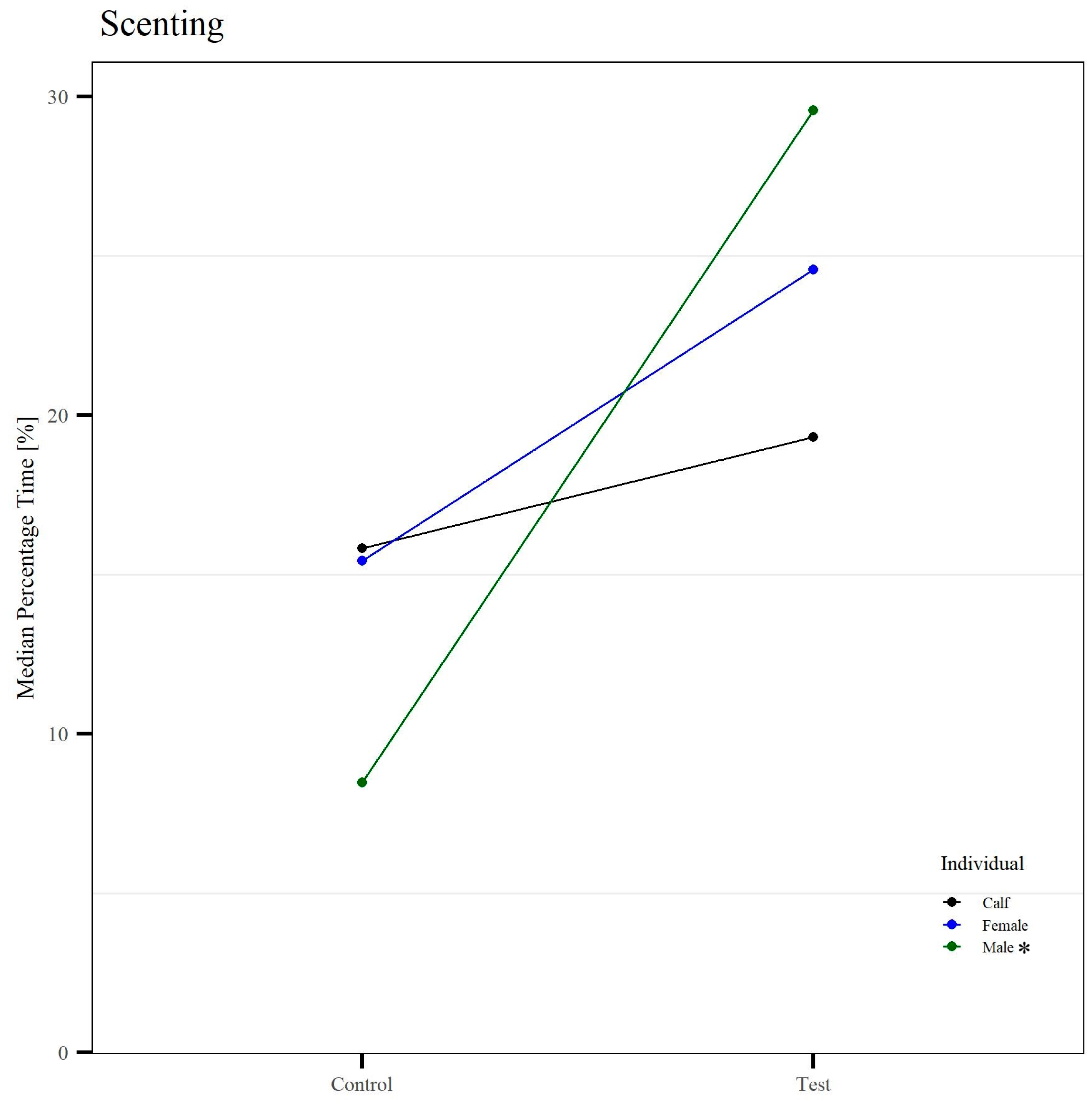
| Scenting | W = 6.0 p < 0.01 | W = 26.0 NS | W = 20.0 NS |
Appendix F.2. Mann–Whitney U-Test Comparing Individuals in Control Period
| Behavior | Male vs. Female | Male vs. Calf | Female vs. Calf |
|---|---|---|---|
| Accelerated Movement on Land | W = 16.0 p < 0.05 | W = 8.0 p < 0.01 | W = 19.0 NS |
| Activity in Water | W = 49.0 NS | W = 55.0 p < 0.05 | W = 39.0 NS |
| Affiliative Social Activity | W = 14.5 p < 0.05 | W = 2.0 p < 0.01 | W = 23.0 NS |
| Agonistic Social Activity | NA | NA | NA |
| Excretion | W = 28.0 NS | NA | W = 36.0 NS |
| Foraging | W = 29.0 NS | W = 27.0 NS | W = 29.0 NS |
| Inactive | W = 15.0 NS | W = 5.0 p < 0.01 | W = 12.0 p < 0.05 |
| Movement on Land | W = 13.0 NS | W = 24.0 NS | W = 53.0 p < 0.05 |
| Scenting | W = 13.0 NS | W = 20.0 NS | W = 40.0 NS |
Appendix F.3. Mann–Whitney U-Test Comparing Individuals in Test Period
| Behavior | Male vs. Female | Male vs. Calf | Female vs. Calf |
|---|---|---|---|
| Accelerated Movement on Land | W = 20.0 NS | W = 4.0 p < 0.01 | W = 17.5 p = 0.1311 |
| Activity in Water | W = 13.0 NS | W = 28.0 NS | W = 44.0 p = 0.2271 |
| Affiliative Social Activity | W = 24.0 NS | W = 0 p < 0.001 | W = 0 p < 0.001 |
| Agonistic Social Activity | NA | NA | NA |
| Excretion | W = 38.5 NS | W = 52.0 p < 0.05 | W = 44.0 NS |
| Foraging | W = 46.0 NS | W = 15.0 NS | W = 18.0 NS |
| Inactive | W = 28.0 NS | W = 15.0 NS | W = 18.0 NS |
| Movement on Land | W = 15.0 NS | W = 14.0 NS | W = 29.0 NS |
| Scenting | W = 42.0 NS | W = 43.0 NS | W = 40.0 NS |
Appendix G
Median Percentage of Time Allocated to Scenting

Appendix H
Appendix H.1. Fligner-Killeen Test Comparing Control vs. Test
| Behavior | Male | Female | Calf |
|---|---|---|---|
| Accelerated movement on Land | NA | T = 10.89 NS | T = 7.014 NS |
| Activity in Water | T = 9.369 p < 0.05 | T = 0.0126 NS | T = 2.258 NS |
| Affiliative Social Activity | T = 1.000 NS | T = 9.322 p < 0.01 | T = 0.2686 NS |
| Excretion | T = 10.98 p < 0.001 | T = 1.505 NS | NA |
| Foraging | T = 0.0420 NS | T = 0.8191 NS | T = 0.6933 NS |
| Inactive | T = 0.0530 NS | T = 0.5325 NS | T = 6.153 p < 0.05 |
| Movement on Land | T = 0.7827 NS | T = 0.4009 NS | T = 0.5518 NS |
| Scenting | T = 0.2682 NS | T = 2.564 × 10⁻³ NS | T = 0.0485 NS |
Appendix H.2. Fligner-Killeen Test Comparing Individuals in Control Period
| Behavior | Male vs. Female | Male vs. Calf | Female vs. Calf |
|---|---|---|---|
| Accelerated Movement on Land | T = 11.11 p < 0.001 | T = 1.547 p < 0.01 | T = 1.547 p < 0.05 |
| Activity in Water | T = 7.177 p < 0.01 | T = 9.046 p < 0.01 | T = 1.282 NS |
| Affiliative Social Activity | T = 7.427 p < 0.001 | T = 8.144 p < 0.001 | T = 0.0141 NS |
| Excretion | T = 1.000 NS | NA | T = 1.000 NS |
| Foraging | T = 1.393 NS | T = 2.884 NS | T = 0.3992 NS |
| Inactive | T = 0.0114 NS | T = 3.979 p < 0.05 | T = 5.012 p < 0.05 |
| Movement on Land | T = 0.4212 NS | T = 0.5516 NS | T = 0.0806 NS |
| Scenting | T = 0.3711 NS | T = 5.468 × 10⁻⁴ NS | T = 1.064 NS |
Appendix H.3. Fligner-Killeen Test Comparing Individuals in Test Period
| Behavior | Male vs. Female | Male vs. Calf | Female vs. Calf |
|---|---|---|---|
| Accelerated Movement on Land | T = 3.286 NS | T = 10.87 p < 0.001 | T = 1.547 NS |
| Activity in Water | T = 0.0116 NS | T = 0.8528 NS | T = 0.5899 NS |
| Affiliative Social Activity | T = 2.094 NS | T = 10.87 p < 0.001 | T = 9.274 p < 0.01 |
| Excretion | T = 0.7731 NS | T = 10.98 p < 0.01 | T = 3.286 NS |
| Foraging | T = 0.5482 NS | T = 2.340 NS | T = 0.1019 NS |
| Inactive | T = 0.0678 NS | T = 0.2288 NS | T = 0.3140 NS |
| Movement on Land | T = 0.2854 NS | T = 0.1771 NS | T = 0.0660 NS |
| Scenting | T = 0.4606 NS | T = 1.7107 NS | T = 0.2749 NS |
Appendix H.4. The Interquartile Range for Control Period
| Behavior | Male | Female | Calf |
|---|---|---|---|
| Accelerated Movement on Land | 0.3588 | NA | 3.661 |
| Activity in Water | 37.47 | 18.14 | 13.98 |
| Affiliative Social Activity | NA | 5.258 | 3.244 |
| Foraging | 48.33 | 29.28 | 9.403 |
| Inactive | 7.037 | 5.760 | 18.75 |
| Movement on Land | 7.932 | 9.819 | 3.944 |
| Scenting | 8.726 | 13.48 | 8.100 |
Appendix H.5. The Interquartile Range for Test Period
| Behavior | Male | Female | Calf |
|---|---|---|---|
| Accelerated Movement on Land | NA | 0.4641 | 1.068 |
| Activity in Water | 14.47 | 11.43 | 27.39 |
| Affiliative Social Activity | NA | 0.1293 | 4.410 |
| Excretion | 1.229 | 1.055 | NA |
| Foraging | 37.10 | 29.28 | 22.03 |
| Inactive | 5.539 | 7.011 | 2.306 |
| Movement on Land | 3.061 | 3.368 | 4.830 |
| Scenting | 15.66 | 9.578 | 7.740 |
References
- Ransom, C.; Robinson, P.T.; Collen, B. Choeropsis liberiensis. The IUCN Red List of Threatened Species 2015: E.T10032A18567171. Available online: https://www.iucnredlist.org/species/10032/18567171 (accessed on 29 December 2025).
- Martin, T.; Lemasson, A.; Wayman, J.; Farmer, H.; Newbolt, J.; Pullen, K.; Plowman, A.; Yamanashi, Y.; Delfour, F.; Ward, S.; et al. Husbandry and Management Interventions for the Conservation and Welfare of Captive Animals—A Systematic Evidence Map. J. Zoo Aquar. Res. 2025, 13, 152–163. [Google Scholar] [CrossRef]
- von Houwald, F.; Wenker, C.; Flacke, G.; Steck, B.; Osterballe, R.; Viduna, R.; Schmidt, F.; Matthews, A. EAZA Pygmy Hippopotamus Best Practice Guidelines, 1st ed.; European Association of Zoos and Aquaria: Amsterdam, The Netherlands, 2020. [Google Scholar]
- Salas, M.; Tallo-Parra, O.; Manteca, X. Evidence-Based Zoo Animal Welfare Assessment: Putting Science into Practice. J. Zoo Aquar. Res. 2024, 12, 205–211. [Google Scholar] [CrossRef]
- Brereton, J.; Rose, P. An Evaluation of the Role of ‘Biological Evidence’ in Zoo and Aquarium Enrichment Practices. Anim. Welf. 2022, 31, 13–26. [Google Scholar] [CrossRef]
- Flacke, G.L.; Chambers, B.K.; Martin, G.B.; Paris, M.C.J. The Pygmy Hippopotamus Choeropsis liberiensis (Morton, 1849): Bringing to Light Research Priorities for the Largely Forgotten, Smaller Hippo Species. Zool. Gart. 2015, 84, 234–265. [Google Scholar] [CrossRef]
- Hubrecht, R. Stereotypic Animal Behaviour: Fundamentals and Applications to Welfare. Anim. Welf. 2008, 17, 95–97. [Google Scholar] [CrossRef]
- Wells, D.L. Sensory Stimulation as Environmental Enrichment for Captive Animals: A Review. Appl. Anim. Behav. Sci. 2009, 118, 1–11. [Google Scholar] [CrossRef]
- Mason, G.J. Species Differences in Responses to Captivity: Stress, Welfare and the Comparative Method. Trends Ecol. Evol. 2010, 25, 713–721. [Google Scholar] [CrossRef]
- Clark, F.; King, A.J. A Critical Review of Zoo-Based Olfactory Enrichment. In Chemical Signals in Vertebrates 11; Hurst, J.L., Beynon, R.J., Roberts, S.C., Wyatt, T.D., Eds.; Springer: New York, NY, USA, 2008; pp. 391–398. ISBN 978-0-387-73944-1. [Google Scholar]
- Kondoh, D.; Watanabe, K.; Nishihara, K.; Ono, Y.S.; Nakamura, K.G.; Yuhara, K.; Tomikawa, S.; Sugimoto, M.; Kobayashi, S.; Horiuchi, N.; et al. Histological Properties of Main and Accessory Olfactory Bulbs in the Common Hippopotamus. Brain Behav. Evol. 2017, 90, 224–231. [Google Scholar] [CrossRef]
- Eisenberg, J.F.; Kleiman, D.G. Olfactory Communication in Mammals. Annu. Rev. Ecol. Syst. 1972, 3, 1–32. [Google Scholar] [CrossRef]
- Trelfa-Stewart, E.; Cox, L. Battle of the Enrichments: Comparing the Impact of Nutritional and Sensory Enrichment on the Behaviour of Captive Lowland Tapirs Tapirus terrestris. J. Zoo Aquar. Res. 2023, 11, 336–344. [Google Scholar] [CrossRef]
- Wilson, V.; Guenther, A.; Øverli, Ø.; Seltmann, M.W.; Altschul, D. Future Directions for Personality Research: Contributing New Insights to the Understanding of Animal Behavior. Animals 2019, 9, 240. [Google Scholar] [CrossRef]
- Santicchia, F.; Wauters, L.A.; Dantzer, B.; Westrick, S.E.; Ferrari, N.; Romeo, C.; Palme, R.; Preatoni, D.G.; Martinoli, A. Relationships between Personality Traits and the Physiological Stress Response in a Wild Mammal. Curr. Zool. 2020, 66, 197–204. [Google Scholar] [CrossRef]
- Bashaw, M.J.; Kelling, A.S.; Bloomsmith, M.A.; Maple, T.L. Environmental Effects on the Behavior of Zoo-Housed Lions and Tigers, with a Case Study o the Effects of a Visual Barrier on Pacing. J. Appl. Anim. Welf. Sci. 2007, 10, 95–109. [Google Scholar] [CrossRef] [PubMed]
- Palma, L.; Quecuta, Q.; Nanque, M. Rewriting the Unassessed, Discredited and Long-Forgotten History of the Pygmy Hippopotamus in Guinea-Bissau. Afr. J. Ecol. 2025, 63, e70089. [Google Scholar] [CrossRef]
- Bertelsen, S.S.; Sørensen, A.S.; Pagh, S.; Pertoldi, C.; Jensen, T.H. Nocturnal Behaviour of Three Zoo Elephants (Loxodonta Africana). Genet. Biodivers. J. 2020, 93–113. Available online: https://vbn.aau.dk/en/publications/nocturnal-behaviour-of-three-zoo-elephants-iloxodonta-africanai/ (accessed on 18 January 2026). [CrossRef]
- Larsen, J.; Andersen, K.; Cuprys, J.; Fosgaard, T.; Jacobsen, J.; Krysztofiak, D.; Lund, S.; Nielsen, B.; Pedersen, M.; Pedersen, M.; et al. Behavioral Analysis of a Captive Male Bornean Orangutan (Pongo Pygmaeus) When Exposed to Environmental Changes. Arch. Biol. Sci. 2023, 75, 443–458. [Google Scholar] [CrossRef]
- Gammelgård, F.; Nielsen, J.; Nielsen, E.J.; Hansen, M.G.; Alstrup, A.K.O.; Perea-García, J.O.; Jensen, T.H.; Pertoldi, C. Application of Machine Learning for Automating Behavioral Tracking of Captive Bornean Orangutans (Pongo Pygmaeus). Animals 2024, 14, 1729. [Google Scholar] [CrossRef]
- Lund, S.M.; Nielsen, J.; Gammelgård, F.; Nielsen, M.G.; Jensen, T.H.; Pertoldi, C. Behavioral Coding of Captive African Elephants (Loxodonta Africana): Utilizing DeepLabCut and Create ML for Nocturnal Activity Tracking. Animals 2024, 14, 2820. [Google Scholar] [CrossRef]
- Lund, S.M.; Gammelgård, F.; Nielsen, J.; Larsen, L.L.N.; Christensen, N.; Hansen, S.P.; Kristensen, T.; Høyer Ørneborg Rodkjær, H.; Sivagnanasundram, S.M.; Thomsen, B.Ø.; et al. Comparing Manual and Automated Spatial Tracking of Captive Spider Monkeys Using Heatmaps. Animals 2025, 15, 3056. [Google Scholar] [CrossRef]
- Pereira, T.D.; Aldarondo, D.E.; Willmore, L.; Kislin, M.; Wang, S.S.-H.; Murthy, M.; Shaevitz, J.W. Fast Animal Pose Estimation Using Deep Neural Networks. Nat. Methods 2019, 16, 117–125. [Google Scholar] [CrossRef]
- R: The R Project for Statistical Computing. Available online: https://www.r-project.org/ (accessed on 10 January 2026).
- Altmann, J. Observational Study of Behavior: Sampling Methods. Behaviour 1974, 49, 227–266. [Google Scholar] [CrossRef]
- Martin, P.; Bateson, P. Measuring Behaviour: An Introductory Guide, 3rd ed.; Cambridge University Press: Cambridge, UK, 2007; ISBN 978-0-521-53563-2. [Google Scholar]
- ZooMonitor. Available online: https://zoomonitor.org/ (accessed on 13 November 2025).
- Real, A. A Comparative Study of Tests for Homogeneity of Variances, with Applications to the Outer Continental Shelf Bidding Data. Technometrics 1981, 23, 351–361. [Google Scholar] [CrossRef]
- Fiji Downloads. Available online: https://imagej.net/software/fiji/downloads (accessed on 13 November 2025).
- Sayer, J.A.; Rakha, W.A.M. The Age of Puberty of the Hippopotamus (Hippopotamus Amphibius Linn.) in the Luangwa River in Eastern Zambia. Afr. J. Ecol. 1974, 12, 227–232. [Google Scholar] [CrossRef]
- Conway, A.L. Conservation of the Pygmy Hippopotamus (Choeropsis liberiensis) in Sierra Leone, West Africa. Ph.D. Thesis, University of Georgia, Athens, GA, USA, 2013. [Google Scholar]
- Anderson, C.; Arun, A.S.; Jensen, P. Habituation to Environmental Enrichment in Captive Sloth Bears—Effect on Stereotypies. Zoo Biol. 2010, 29, 705–714. [Google Scholar] [CrossRef]


| Behavior | Condition |
|---|---|
| Foraging/Feeding | If head position is at least 60 pixels below the shoulder, or if nose is at least 90 pixels below shoulder. |
| Locomotion | Displacement of hip and shoulder exceeded one half of a body length (hip-to-shoulder distance) between two frames. The behavior must be initially identified as Standing. |
| Lying Down | If the hip or shoulder coordinates were located within the following boundaries x_min = 1080, x_max = 1720, y_min = 270 and y_max = 400. |
| Standing | If no other behavior is qualified (default behavior). |
| Manually Observed | ||||||
|---|---|---|---|---|---|---|
| Predicted by SLEAP | Behavior: | Standing | Lying Down | Foraging/Feeding | Locomotion | Out of View |
| Standing | 100 | 2 | 158 | 27 | ||
| Lying Down | 9 | 225 | 3 | |||
| Foraging/Feeding | 1 | 221 | 2 | |||
| Locomotion | 26 | |||||
| Not labeled | 85 | 41 | 11 | 3 | 286 | |
| Sum: | 195 | 268 | 393 | 58 | 286 | |
| Metrics | Standing | Lying Down | Foraging/Feeding | Locomotion | Out of View |
|---|---|---|---|---|---|
| Precision | 0.348 | 0.949 | 0.987 | 1 | 0.671 |
| Accuracy | 0.765 | 0.954 | 0.854 | 0.973 | 0.883 |
| Sensitivity | 0.513 | 0.840 | 0.562 | 0.448 | 1 |
| Specificity | 0.814 | 0.987 | 0.996 | 1 | 0.847 |
| TSS | 0.327 | 0.827 | 0.559 | 0.448 | 0.847 |
Disclaimer/Publisher’s Note: The statements, opinions and data contained in all publications are solely those of the individual author(s) and contributor(s) and not of MDPI and/or the editor(s). MDPI and/or the editor(s) disclaim responsibility for any injury to people or property resulting from any ideas, methods, instructions or products referred to in the content. |
© 2026 by the authors. Licensee MDPI, Basel, Switzerland. This article is an open access article distributed under the terms and conditions of the Creative Commons Attribution (CC BY) license.
Share and Cite
Nielsen, J.; Gammelgård, F.; Lund, S.M.; Præstekær, A.S.B.; Vinterberg Frandsen, A.; Strandqvist, C.; Nielsen, M.H.; Olsen, R.N.; Pagh, S.; Faddersbøll, T.L.; et al. Olfactory Enrichment of Captive Pygmy Hippopotamuses with Applied Machine Learning. Animals 2026, 16, 385. https://doi.org/10.3390/ani16030385
Nielsen J, Gammelgård F, Lund SM, Præstekær ASB, Vinterberg Frandsen A, Strandqvist C, Nielsen MH, Olsen RN, Pagh S, Faddersbøll TL, et al. Olfactory Enrichment of Captive Pygmy Hippopotamuses with Applied Machine Learning. Animals. 2026; 16(3):385. https://doi.org/10.3390/ani16030385
Chicago/Turabian StyleNielsen, Jonas, Frej Gammelgård, Silje Marquardsen Lund, Anja Sofie Banasik Præstekær, Astrid Vinterberg Frandsen, Camilla Strandqvist, Mikkel Haugaard Nielsen, Rasmus Nikolajgaard Olsen, Sussie Pagh, Thea Loumand Faddersbøll, and et al. 2026. "Olfactory Enrichment of Captive Pygmy Hippopotamuses with Applied Machine Learning" Animals 16, no. 3: 385. https://doi.org/10.3390/ani16030385
APA StyleNielsen, J., Gammelgård, F., Lund, S. M., Præstekær, A. S. B., Vinterberg Frandsen, A., Strandqvist, C., Nielsen, M. H., Olsen, R. N., Pagh, S., Faddersbøll, T. L., & Pertoldi, C. (2026). Olfactory Enrichment of Captive Pygmy Hippopotamuses with Applied Machine Learning. Animals, 16(3), 385. https://doi.org/10.3390/ani16030385