
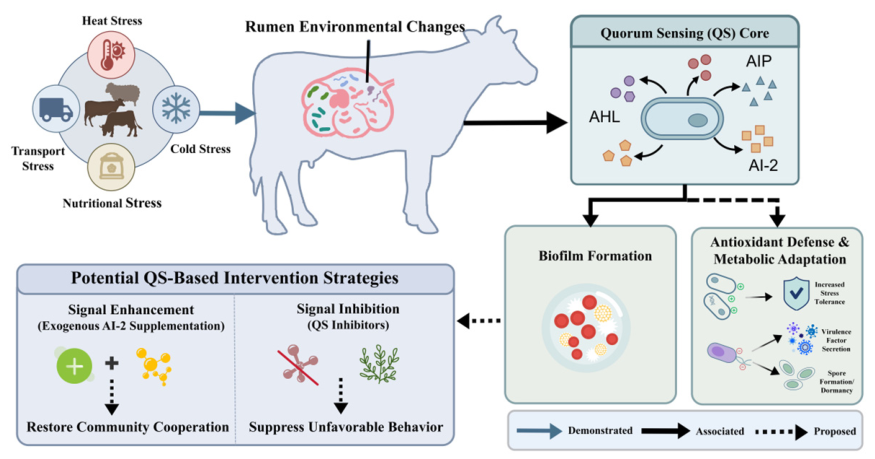
The Potential Role of Quorum Sensing in Rumen Microbial Adaptation to Environmental and Nutritional Stress: A Review


Simple Summary
Abstract
1. Introduction
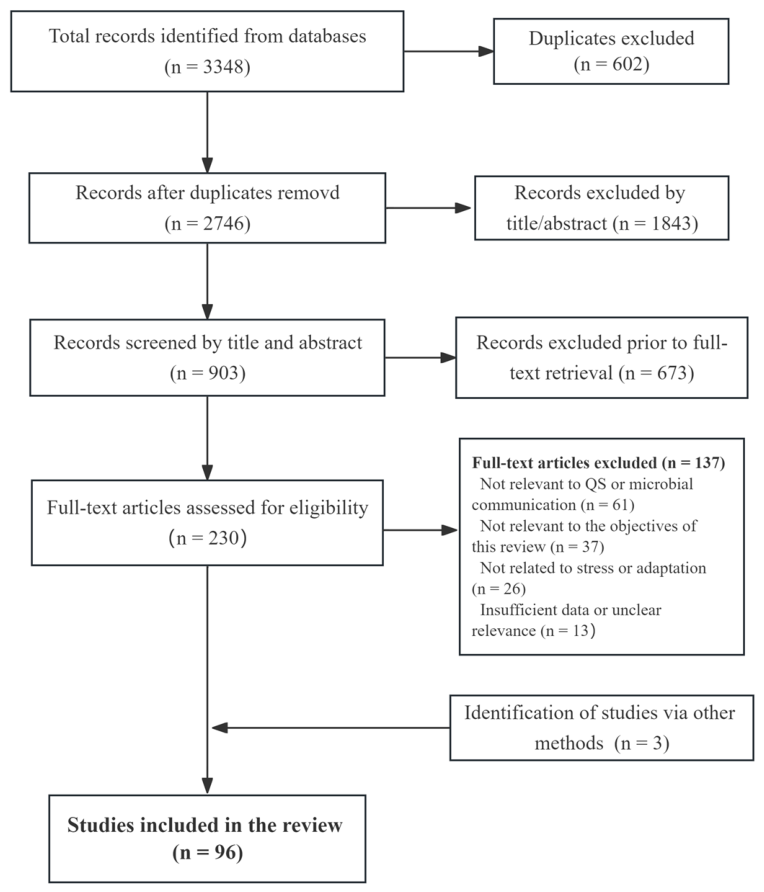
2. Review Methodology
3. Effects of Different Types of Stress on Rumen Fermentation and Microbial Communities
3.1. Heat Stress
3.2. Cold Stress
3.3. Transport Stress
3.4. Nutritional Stress
4. Potential Regulatory Roles of Rumen Microbial QS in Stress Responses
4.1. Effects of Stress on Rumen QS Signaling Molecules
4.2. QS-Mediated Microbial Stress Adaptation Mechanisms
5. QS-Mediated Regulation of Rumen Microbial Ecology
5.1. Signal Enhancement
5.2. Signal Inhibition
5.3. Evidence from Ruminant Studies
6. Future Research Directions and Perspectives
7. Conclusions
Author Contributions
Funding
Institutional Review Board Statement
Informed Consent Statement
Data Availability Statement
Conflicts of Interest
Abbreviations
| VFA | Volatile fatty acids |
| QS | Quorum sensing |
| AHL | N-acyl-homoserine lactones |
| AIP | Autoinducer peptides |
| AI-2 | Autoinducer-2 |
| HDMF | 4-hydroxy-2,5-dimethyl-3(2H)-furanone |
| RUSITEC | Rumen simulation technique |
| DM | Dry matter |
References
- Sha, Y.; Ren, Y.; Zhao, S.; He, Y.; Xinyu, G.; Pu, X.; Li, W.; Liu, X.; Wang, J.; Li, S. Response of ruminal microbiota–host gene interaction to high-altitude environments in Tibetan sheep. Int. J. Mol. Sci. 2022, 23, 12430. [Google Scholar] [CrossRef] [PubMed]
- Morgavi, D.P.; Kelly, W.J.; Janssen, P.H.; Attwood, G.T. Rumen microbial (meta) genomics and its application to ruminant production. Animal 2013, 7, 184–201. [Google Scholar] [CrossRef] [PubMed]
- Zeineldin, M.; Barakat, R.; Elolimy, A.; Salem, A.Z.M.; Elghandour, M.M.Y.; Monroy, J.C. Synergetic action between the rumen microbiota and bovine health. Microb. Pathog. 2018, 124, 106–115. [Google Scholar] [CrossRef] [PubMed]
- Fraser, D. Biology of animal stress: Implications for animal well-being. J. Appl. Anim. Welf. Sci. 1999, 2, 157–159. [Google Scholar] [CrossRef] [PubMed]
- Selye, H. A syndrome produced by diverse nocuous agents. Nature 1936, 138, 32. [Google Scholar] [CrossRef]
- Koolhaas, J.M.; Bartolomucci, A.; Buwalda, B.; de Boer, S.F.; Flügge, G.; Korte, S.M.; Meerlo, P.; Murison, R.; Olivier, B.; Palanza, P.; et al. Stress revisited: A critical evaluation of the stress concept. Neurosci. Biobehav. Rev. 2011, 35, 1291–1301. [Google Scholar] [CrossRef] [PubMed]
- Moberg, G. Biological Response to Stress: Implications for Animal Welfare. In The Biology of Animal Stress: Basic Principles and Implications for Animal Welfare; Moberg, G.P., Mench, J.A., Eds.; CABI Publishing: Wallingford, UK, 2000; pp. 1–21. [Google Scholar] [CrossRef]
- Brandl, H.B.; Pruessner, J.C.; Farine, D.R. The social transmission of stress in animal collectives. Proc. Biol. Sci. 2022, 289, 20212158. [Google Scholar] [CrossRef] [PubMed]
- Federiconi, A.; Ghiaccio, F.; Mammi, L.; Cavallini, D.; Visentin, G.; Formigoni, A.; Palmonari, A. Changes in the rumen microbial community composition of dairy cows subjected to an acidogenic diet. J. Dairy Sci. 2024, 107, 7810–7821. [Google Scholar] [CrossRef] [PubMed]
- Collier, R.J.; Beede, D.K.; Thatcher, W.W.; Israel, L.A.; Wilcox, C.J. Influences of environment and its modification on dairy animal health and production. J. Dairy Sci. 1982, 65, 2213–2227. [Google Scholar] [CrossRef] [PubMed]
- Cholewińska, P.; Górniak, W.; Wojnarowski, K. Impact of selected environmental factors on microbiome of the digestive tract of ruminants. BMC Vet. Res. 2021, 17, 25. [Google Scholar] [CrossRef] [PubMed]
- Feng, L.; Zhang, Y.; Liu, W.; Du, D.; Jiang, W.; Wang, Z.; Li, N.; Hu, Z. Altered rumen microbiome and correlations of the metabolome in heat-stressed dairy cows at different growth stages. Microbiol. Spectr. 2023, 11, e03312–e03323. [Google Scholar] [CrossRef] [PubMed]
- Waters, C.M.; Bassler, B.L. Quorum sensing: Cell-to-cell communication in bacteria. Annu. Rev. Cell Dev. Biol. 2005, 21, 319–346. [Google Scholar] [CrossRef] [PubMed]
- Miller, M.B.; Bassler, B.L. Quorum sensing in bacteria. Annu. Rev. Microbiol. 2001, 55, 165–199. [Google Scholar] [CrossRef] [PubMed]
- Fuqua, W.C.; Winans, S.C.; Greenberg, E.P. Quorum sensing in bacteria: The LuxR-LuxI family of cell density-responsive transcriptional regulators. J. Bacteriol. 1994, 176, 269–275. [Google Scholar] [CrossRef] [PubMed]
- Passos da Silva, D.; Schofield, M.C.; Parsek, M.R.; Tseng, B.S. An update on the sociomicrobiology of quorum sensing in gram-negative biofilm development. Pathogens 2017, 6, 51. [Google Scholar] [CrossRef] [PubMed]
- Vendeville, A.; Winzer, K.; Heurlier, K.; Tang, C.M.; Hardie, K.R. Making ‘sense’ of metabolism: Autoinducer-2, Luxs and pathogenic bacteria. Nat. Rev. Microbiol. 2005, 3, 383–396. [Google Scholar] [CrossRef] [PubMed]
- Lawther, K.; Santos, F.G.; Oyama, L.B.; Huws, S.A. Invited review—Chemical signalling within the rumen microbiome. Anim. Biosci. 2024, 37, 337–345. [Google Scholar] [CrossRef] [PubMed]
- Liu, X.; Liu, Q.; Sun, S.; Sun, H.; Wang, Y.; Shen, X.; Zhang, L. Exploring AI-2-mediated interspecies communications within rumen microbial communities. Microbiome 2022, 10, 167. [Google Scholar] [CrossRef] [PubMed]
- Pereira, C.S.; Thompson, J.A.; Xavier, K.B. AI-2-mediated signalling in bacteria. FEMS Microbiol. Rev. 2013, 37, 156–181. [Google Scholar] [CrossRef] [PubMed]
- Bassler, B.L.; Losick, R. Bacterially speaking. Cell 2006, 125, 237–246. [Google Scholar] [CrossRef] [PubMed]
- Ghali, I.; Shinkai, T.; Mitsumori, M. Mining of luxS genes from rumen microbial consortia by metagenomic and metatranscriptomic approaches. Anim. Sci. J. 2016, 87, 666–673. [Google Scholar] [CrossRef] [PubMed]
- Bernabucci, U.; Lacetera, N.; Baumgard, L.H.; Rhoads, R.P.; Ronchi, B.; Nardone, A. Metabolic and hormonal acclimation to heat stress in domesticated ruminants. Animal 2010, 4, 1167–1183. [Google Scholar] [CrossRef] [PubMed]
- West, J.W. Effects of heat-stress on production in dairy cattle. J. Dairy Sci. 2003, 86, 2131–2144. [Google Scholar] [CrossRef] [PubMed]
- Tajima, K.; Nonaka, I.; Higuchi, K.; Takusari, N.; Kurihara, M.; Takenaka, A.; Mitsumori, M.; Kajikawa, H.; Aminov, R.I. Influence of high temperature and humidity on rumen bacterial diversity in Holstein heifers. Anaerobe 2007, 13, 57–64. [Google Scholar] [CrossRef] [PubMed]
- Joshi, H.; Caprio, M.; Reon, L.; Fan, P. Rumen microbiota-based machine learning approach for predicting heat stress and identifying associated microbes. Microb. Ecol. 2025, 89, 11. [Google Scholar] [CrossRef] [PubMed]
- Uyeno, Y.; Sekiguchi, Y.; Tajima, K.; Takenaka, A.; Kurihara, M.; Kamagata, Y. An rRNA-based analysis for evaluating the effect of heat stress on the rumen microbial composition of Holstein heifers. Anaerobe 2010, 16, 27–33. [Google Scholar] [CrossRef] [PubMed]
- Zhao, S.; Min, L.; Zheng, N.; Wang, J. Effect of heat stress on bacterial composition and metabolism in the rumen of lactating dairy cows. Animals 2019, 9, 925. [Google Scholar] [CrossRef] [PubMed]
- Baek, Y.C.; Choi, H.; Jeong, J.Y.; Lee, S.D.; Kim, M.J.; Lee, S.; Ji, S.Y.; Kim, M. The impact of short-term acute heat stress on the rumen microbiome of Hanwoo steers. J. Anim. Sci. Technol. 2020, 62, 208–217. [Google Scholar] [CrossRef] [PubMed]
- Zhong, S.; Ding, Y.; Wang, Y.; Zhou, G.; Guo, H.; Chen, Y.; Yang, Y. Temperature and humidity index (THI)-induced rumen bacterial community changes in goats. Appl. Microbiol. Biotechnol. 2019, 103, 3193–3203. [Google Scholar] [CrossRef] [PubMed]
- Young, B.A. Cold stress as it affects animal production. J. Anim. Sci. 1981, 52, 154–163. [Google Scholar] [CrossRef] [PubMed]
- Kennedy, P.M.; Christopherson, R.J.; Milligan, L.P. The effect of cold exposure of sheep on digestion, rumen turnover time and efficiency of microbial synthesis. Br. J. Nutr. 1976, 36, 231–242. [Google Scholar] [CrossRef]
- Cunningham, M.D.; Martz, F.A.; Merilan, C.P. Effect of drinking-water temperature upon ruminant digestion, intraruminal temperature, and water consumption of nonlactating dairy cows. J. Dairy Sci. 1964, 47, 382–385. [Google Scholar] [CrossRef]
- Rahman, M.S.; Chlingaryan, A.; Thomson, P.C.; Islam, M.R.; Lees, A.M.; Gregorini, P.; Pereira, F.C.; Clark, C.E.F. In vitro simulation of drinking events in cattle. MethodsX 2025, 15, 103593. [Google Scholar] [CrossRef] [PubMed]
- Sha, Y.; Hu, J.; Shi, B.; Dingkao, R.; Wang, J.; Li, S.; Zhang, W.; Luo, Y.; Liu, X. Supplementary feeding of cattle-yak in the cold season alters rumen microbes, volatile fatty acids, and expression of SGLT1 in the rumen epithelium. PeerJ 2021, 9, e11048. [Google Scholar] [CrossRef] [PubMed]
- Guo, H.; Zhou, G.; Tian, G.; Liu, Y.; Dong, N.; Li, L.; Zhang, S.; Chai, H.; Chen, Y.; Yang, Y. Changes in rumen microbiota affect metabolites, immune responses and antioxidant enzyme activities of sheep under cold stimulation. Animals 2021, 11, 712. [Google Scholar] [CrossRef] [PubMed]
- Liu, X.; Sha, Y.; Dingkao, R.; Zhang, W.; Lv, W.; Wei, H.; Shi, H.; Hu, J.; Wang, J.; Li, S.; et al. Interactions between rumen microbes, VFAs, and host genes regulate nutrient absorption and epithelial barrier function during cold season nutritional stress in Tibetan sheep. Front. Microbiol. 2020, 11, 593062. [Google Scholar] [CrossRef] [PubMed]
- Guo, X.; Sha, Y.; Pu, X.; Xu, Y.; Yao, L.; Liu, X.; He, Y.; Hu, J.; Wang, J.; Li, S.; et al. Coevolution of rumen epithelial circRNAs with their microbiota and metabolites in response to cold-season nutritional stress in Tibetan sheep. Int. J. Mol. Sci. 2022, 23, 10488. [Google Scholar] [CrossRef] [PubMed]
- Schwartzkopf-Genswein, K.S.; Faucitano, L.; Dadgar, S.; Shand, P.; González, L.A.; Crowe, T.G. Road transport of cattle, swine and poultry in North America and its impact on animal welfare, carcass and meat quality: A review. Meat Sci. 2012, 92, 227–243. [Google Scholar] [CrossRef] [PubMed]
- Fazio, E.; Ferlazzo, A. Evaluation of stress during transport. Vet. Res. Commun. 2003, 27, 519–524. [Google Scholar] [CrossRef] [PubMed]
- Earley, B.; Buckham Sporer, K.; Gupta, S. Invited review: Relationship between cattle transport, immunity and respiratory disease. Animal 2017, 11, 486–492. [Google Scholar] [CrossRef] [PubMed]
- Knowles, T.G. A review of the road transport of cattle. Vet. Rec. 1999, 144, 197–201. [Google Scholar] [CrossRef] [PubMed]
- Deng, L.; He, C.; Zhou, Y.; Xu, L.; Xiong, H. Ground transport stress affects bacteria in the rumen of beef cattle: A real-time PCR analysis. Anim. Sci. J. 2017, 88, 790–797. [Google Scholar] [CrossRef] [PubMed]
- Li, F.; Shah, A.M.; Wang, Z.; Peng, Q.; Hu, R.; Zou, H.; Tan, C.; Zhang, X.; Liao, Y.; Wang, Y.; et al. Effects of land transport stress on variations in ruminal microbe diversity and immune functions in different breeds of cattle. Animals 2019, 9, 599. [Google Scholar] [CrossRef] [PubMed]
- Li, Y.; Mao, K.; Zang, Y.; Lu, G.; Qiu, Q.; Ouyang, K.; Zhao, X.; Song, X.; Xu, L.; Liang, H.; et al. Revealing the developmental characterization of rumen microbiome and its host in newly received cattle during receiving period contributes to formulating precise nutritional strategies. Microbiome 2023, 11, 238. [Google Scholar] [CrossRef] [PubMed]
- Calsamiglia, S.; Blanch, M.; Ferret, A.; Moya, D. Is subacute ruminal acidosis a pH related problem? Causes and tools for its control. Anim. Feed Sci. Technol. 2012, 172, 42–50. [Google Scholar] [CrossRef]
- Meale, S.J.; Li, S.; Azevedo, P.; Derakhshani, H.; Plaizier, J.C.; Khafipour, E.; Steele, M.A. Development of ruminal and fecal microbiomes are affected by weaning but not weaning strategy in dairy calves. Front. Microbiol. 2016, 7, 582. [Google Scholar] [CrossRef] [PubMed]
- Khan, M.A.; Bach, A.; Weary, D.M.; von Keyserlingk, M.A.G. Invited review: Transitioning from milk to solid feed in dairy heifers. J. Dairy Sci. 2016, 99, 885–902. [Google Scholar] [CrossRef] [PubMed]
- Plaizier, J.C.; Krause, D.O.; Gozho, G.N.; McBride, B.W. Subacute ruminal acidosis in dairy cows: The physiological causes, incidence and consequences. Vet. J. 2008, 176, 21–31. [Google Scholar] [CrossRef] [PubMed]
- Hook, S.E.; Steele, M.A.; Northwood, K.S.; Dijkstra, J.; France, J.; Wright, A.D.; McBride, B.W. Impact of subacute ruminal acidosis (SARA) adaptation and recovery on the density and diversity of bacteria in the rumen of dairy cows. FEMS Microbiol. Ecol. 2011, 78, 275–284. [Google Scholar] [CrossRef] [PubMed]
- Xue, Y.; Lin, L.; Hu, F.; Zhu, W.; Mao, S. Disruption of ruminal homeostasis by malnutrition involved in systemic ruminal microbiota-host interactions in a pregnant sheep model. Microbiome 2020, 8, 138. [Google Scholar] [CrossRef] [PubMed]
- Durand, M.; Kawashima, R. Influence of Minerals in Rumen Microbial Digestion. In Digestive Physiology and Metabolism in Ruminants; Ruckebusch, Y., Thivend, P., Eds.; Springer: Dordrecht, The Netherlands, 1980; pp. 375–408. [Google Scholar] [CrossRef]
- Zhang, Z.D.; Wang, C.; Du, H.S.; Liu, Q.; Guo, G.; Huo, W.J.; Zhang, J.; Zhang, Y.L.; Pei, C.X.; Zhang, S.L. Effects of sodium selenite and coated sodium selenite on lactation performance, total tract nutrient digestion and rumen fermentation in Holstein dairy cows. Animal 2020, 14, 2091–2099. [Google Scholar] [CrossRef] [PubMed]
- Li, F.; Yan, M.; Su, D.; Peng, J.; Wang, X.; Hao, J.; Ma, T.; Lin, Y.; Shi, H. Integrated meta-omics reveals AFB1 dose-dependent remodeling of the rumen microbiome-virome-metabolome axis driving metabolic impairment in goats. Microbiome 2025, 14, 18. [Google Scholar] [CrossRef] [PubMed]
- Papenfort, K.; Bassler, B.L. Quorum sensing signal-response systems in Gram-negative bacteria. Nat. Rev. Microbiol. 2016, 14, 576–588. [Google Scholar] [CrossRef] [PubMed]
- Rutherford, S.T.; Bassler, B.L. Bacterial quorum sensing: Its role in virulence and possibilities for its control. Cold Spring Harb. Perspect. Med. 2012, 2, a012427. [Google Scholar] [CrossRef] [PubMed]
- Russell, J.B.; Wilson, D.B. Why are ruminal cellulolytic bacteria unable to digest cellulose at low pH? J. Dairy Sci. 1996, 79, 1503–1509. [Google Scholar] [CrossRef] [PubMed]
- Tajima, K.; Aminov, R.I.; Nagamine, T.; Matsui, H.; Nakamura, M.; Benno, Y. Diet-dependent shifts in the bacterial population of the rumen revealed with real-time PCR. Appl. Environ. Microbiol. 2001, 67, 2766–2774. [Google Scholar] [CrossRef] [PubMed]
- Lukás, F.; Gorenc, G.; Kopecný, J. Detection of possible AI-2-mediated quorum sensing system in commensal intestinal bacteria. Folia Microbiol. 2008, 53, 221–224. [Google Scholar] [CrossRef] [PubMed]
- Mitsumori, M.; Xu, L.; Kajikawa, H.; Kurihara, M.; Tajima, K.; Hai, J.; Takenaka, A. Possible quorum sensing in the rumen microbial community: Detection of quorum-sensing signal molecules from rumen bacteria. FEMS Microbiol. Lett. 2003, 219, 47–52. [Google Scholar] [CrossRef] [PubMed]
- Ng, W.L.; Bassler, B.L. Bacterial quorum-sensing network architectures. Annu. Rev. Genet. 2009, 43, 197–222. [Google Scholar] [CrossRef] [PubMed]
- Yates, E.A.; Philipp, B.; Buckley, C.; Atkinson, S.; Chhabra, S.R.; Sockett, R.E.; Goldner, M.; Dessaux, Y.; Cámara, M.; Smith, H.; et al. N-acylhomoserine lactones undergo lactonolysis in a pH-, temperature-, and acyl chain length-dependent manner during growth of Yersinia pseudotuberculosis and Pseudomonas aeruginosa. Infect. Immun. 2002, 70, 5635–5646. [Google Scholar] [CrossRef] [PubMed]
- Wei, X.; Long, T.; Li, Y.; Ouyang, K.; Qiu, Q. Diet shift may trigger LuxS/AI-2 quorum sensing in rumen bacteria. Bioengineering 2022, 9, 379. [Google Scholar] [CrossRef] [PubMed]
- Wang, Z.; Ma, T.; He, J.; Ge, Y.; Liu, Q.; Lan, X.; Liu, L.; Wan, F.; Shen, W. Impact of zearalenone on quorum sensing signaling molecules and its association with the suppression of ruminal microbial fermentation in a RUSITEC system. J. Anim. Sci. Biotechnol. 2026, 17, 15. [Google Scholar] [CrossRef] [PubMed]
- Wang, Z.; Guo, H.; He, J.; Zhang, Z.; Huws, S.; Guo, T.; Shen, W.; Wan, F. Responses of rumen bacterial microflora to aflatoxin B1 challenge: Potential roles of AHLs/AI-2 mediated quorum sensing. Anim. Microbiome 2026, 8, 15. [Google Scholar] [CrossRef] [PubMed]
- Wang, Z.; Wu, Q.; Shen, W.; Wan, F.; He, J.; Liu, L.; Tang, S.; Tan, Z. Cooling redistributed endotoxin across different biofluids via modulating the ruminal microbiota and metabolome without altering quorum sensing signal levels in heat-stressed beef bulls. Anim. Microbiome 2025, 7, 38. [Google Scholar] [CrossRef] [PubMed]
- Liu, C.; Li, L.; Dai, J.; Qu, M.; Ouyang, K.; Qiu, Q. Heated drinking water in winter improves growth performance of male Hu sheep by modulating rumen quorum sensing and metabolites, and enhancing serum antioxidant capacity. Anim. Biosci. 2025, 38, 2280–2296. [Google Scholar] [CrossRef] [PubMed]
- Schuster, M.; Lostroh, C.P.; Ogi, T.; Greenberg, E.P. Identification, timing, and signal specificity of Pseudomonas aeruginosa quorum-controlled genes: A transcriptome analysis. J. Bacteriol. 2003, 185, 2066–2079. [Google Scholar] [CrossRef] [PubMed]
- Miller, M.B.; Skorupski, K.; Lenz, D.H.; Taylor, R.K.; Bassler, B.L. Parallel quorum sensing systems converge to regulate virulence in Vibrio cholerae. Cell 2002, 110, 303–314. [Google Scholar] [CrossRef] [PubMed]
- Hammer, B.K.; Bassler, B.L. Quorum sensing controls biofilm formation in Vibrio cholerae. Mol. Microbiol. 2003, 50, 101–104. [Google Scholar] [CrossRef] [PubMed]
- Meng, F.; Lyu, Y.; Zhao, H.; Lyu, F.; Bie, X.; Lu, Y.; Zhao, M.; Chen, Y.; Lu, Z. LsrR-like protein responds to stress tolerance by regulating polysaccharide biosynthesis in Lactiplantibacillus plantarum. Int. J. Biol. Macromol. 2023, 225, 1193–1203. [Google Scholar] [CrossRef] [PubMed]
- Gozho, G.N.; Krause, D.O.; Plaizier, J.C. Ruminal lipopolysaccharide concentration and inflammatory response during grain-induced subacute ruminal acidosis in dairy cows. J. Dairy Sci. 2007, 90, 856–866. [Google Scholar] [CrossRef] [PubMed]
- Na, S.W.; Guan, L.L. Understanding the role of rumen epithelial host-microbe interactions in cattle feed efficiency. Anim. Nutr. 2022, 10, 41–53. [Google Scholar] [CrossRef] [PubMed]
- Hassett, D.J.; Ma, J.F.; Elkins, J.G.; McDermott, T.R.; Ochsner, U.A.; West, S.E.; Huang, C.T.; Fredericks, J.; Burnett, S.; Stewart, P.S.; et al. Quorum sensing in Pseudomonas aeruginosa controls expression of catalase and superoxide dismutase genes and mediates biofilm susceptibility to hydrogen peroxide. Mol. Microbiol. 1999, 34, 1082–1093. [Google Scholar] [CrossRef] [PubMed]
- Wen, Z.T.; Burne, R.A. LuxS-mediated signaling in Streptococcus mutans is involved in regulation of acid and oxidative stress tolerance and biofilm formation. J. Bacteriol. 2004, 186, 2682–2691. [Google Scholar] [CrossRef] [PubMed]
- Pestova, E.V.; Håvarstein, L.S.; Morrison, D.A. Regulation of competence for genetic transformation in Streptococcus pneumoniae by an auto-induced peptide pheromone and a two-component regulatory system. Mol. Microbiol. 1996, 21, 853–862. [Google Scholar] [CrossRef] [PubMed]
- González-Pastor, J.E.; Hobbs, E.C.; Losick, R. Cannibalism by sporulating bacteria. Science 2003, 301, 510–513. [Google Scholar] [CrossRef] [PubMed]
- Vlamakis, H.; Chai, Y.; Beauregard, P.; Losick, R.; Kolter, R. Sticking together: Building a biofilm the Bacillus subtilis way. Nat. Rev. Microbiol. 2013, 11, 157–168. [Google Scholar] [CrossRef] [PubMed]
- Novick, R.P.; Geisinger, E. Quorum sensing in staphylococci. Annu. Rev. Genet. 2008, 42, 541–564. [Google Scholar] [CrossRef] [PubMed]
- Podkowik, M.; Perault, A.I.; Putzel, G.; Pountain, A.; Kim, J.; DuMont, A.L.; Zwack, E.E.; Ulrich, R.J.; Karagounis, T.K.; Zhou, C.; et al. Quorum-sensing agr system of Staphylococcus aureus primes gene expression for protection from lethal oxidative stress. eLife 2024, 12, RP89098. [Google Scholar] [CrossRef] [PubMed]
- Li, H.; Li, X.; Wang, Z.; Fu, Y.; Ai, Q.; Dong, Y.; Yu, J. Autoinducer-2 regulates Pseudomonas aeruginosa PAO1 biofilm formation and virulence production in a dose-dependent manner. BMC Microbiol. 2015, 15, 192. [Google Scholar] [CrossRef] [PubMed]
- Gu, Y.; Tian, J.; Zhang, Y.; Wu, R.; Li, L.; Zhang, B.; He, Y. Dissecting signal molecule AI-2 mediated biofilm formation and environmental tolerance in Lactobacillus plantarum. J. Biosci. Bioeng. 2021, 131, 153–160. [Google Scholar] [CrossRef] [PubMed]
- Tian, J.; Liang, Y.; Ragauskas, A.J.; Zhong, Y.; Lin, Y. Effects of AI-2 quorum sensing inhibitors on mitigating bacterial contamination in bioethanol production. Biomass Bioenerg. 2024, 184, 107211. [Google Scholar] [CrossRef]
- Liu, L.; Wu, R.; Zhang, J.; Shang, N.; Li, P. D-Ribose interferes with quorum sensing to inhibit biofilm formation of Lactobacillus paraplantarum L-ZS9. Front. Microbiol. 2017, 8, 1860. [Google Scholar] [CrossRef] [PubMed]
- Zhang, Y.; Zhong, H.; Zheng, Y.; Wang, Y.; He, Y.; Gu, Y. Use of whole-genome analysis to study the effect of various quorum-sensing inhibitors on the biofilm formation of Lactobacillus fermentum. LWT-Food Sci. Technol. 2023, 173, 114378. [Google Scholar] [CrossRef]
- Martinelli, D.; Grossmann, G.; Séquin, U.; Brandl, H.; Bachofen, R. Effects of natural and chemically synthesized furanones on quorum sensing in Chromobacterium violaceum. BMC Microbiol. 2004, 4, 25. [Google Scholar] [CrossRef] [PubMed]
- Vattem, D.A.; Mihalik, K.; Crixell, S.H.; McLean, R.J. Dietary phytochemicals as quorum sensing inhibitors. Fitoterapia 2007, 78, 302–310. [Google Scholar] [CrossRef] [PubMed]
- Kalia, V.C. Quorum sensing inhibitors: An overview. Biotechnol. Adv. 2013, 31, 224–245. [Google Scholar] [CrossRef] [PubMed]
- Asfour, H.Z. Anti-quorum sensing natural compounds. J. Microsc. Ultrastruct. 2018, 6, 1–10. [Google Scholar] [CrossRef] [PubMed]
- Deryabin, D.; Galadzhieva, A.; Kosyan, D.; Duskaev, G. Plant-derived inhibitors of AHL-mediated quorum sensing in bacteria: Modes of action. Int. J. Mol. Sci. 2019, 20, 5588. [Google Scholar] [CrossRef] [PubMed]
- Patra, A.K.; Saxena, J. A new perspective on the use of plant secondary metabolites to inhibit methanogenesis in the rumen. Phytochemistry 2010, 71, 1198–1222. [Google Scholar] [CrossRef] [PubMed]
- Calsamiglia, S.; Busquet, M.; Cardozo, P.W.; Castillejos, L.; Ferret, A. Invited review: Essential oils as modifiers of rumen microbial fermentation. J. Dairy Sci. 2007, 90, 2580–2595. [Google Scholar] [CrossRef] [PubMed]
- Patra, A.K.; Saxena, J. Dietary phytochemicals as rumen modifiers: A review of the effects on microbial populations. Antonie Van Leeuwenhoek 2009, 96, 363–375. [Google Scholar] [CrossRef] [PubMed]
- Fu, C.; Ge, J.; Qu, M.; Ouyang, K.; Qiu, Q. Effects of 4-hydroxy-2,5-dimethyl-3(2H)-furanone supplementation on growth performance, serum antioxidant capacity, rumen fermentation characteristics, rumen bacterial quorum sensing, and microbial community in Hu sheep. Anim. Biosci. 2025, 38, 1422–1434. [Google Scholar] [CrossRef] [PubMed]
- Ge, J.; Li, Y.; Zhao, X.; Ouyang, K.; Qu, M.; Qiu, Q. Dietary supplementation with D-ribose enhances growth performance, improves serum antioxidant capacity, and inhibits rumen microbial LuxS/AI-2 quorum sensing of Hu sheep. Anim. Biosci. 2026, 39, 250291. [Google Scholar] [CrossRef] [PubMed]
- Qiu, Q.; Liu, C.; Ma, Y.; Li, L.; Ouyang, K.; Qu, M. Resveratrol alleviates heat stress of Hu sheep by modulating rumen biofilm-related microbial traits and enhancing serum antioxidant capacity. Anim. Feed Sci. Technol. 2026, 343, 116869. [Google Scholar] [CrossRef]


| Stress Type | Rumen Environmental Alterations | Microbial Community Shifts | QS Signaling Responses | Evidence Type | References |
|---|---|---|---|---|---|
| Heat stress | Reduced ruminal pH; weakened buffering capacity; altered substrate availability; increased thermal load | Increased abundance of lactate-producing and amylolytic bacteria; decreased abundance of fibrolytic bacteria | QS signaling molecule concentrations remained relatively stable under heat-stress alleviation conditions | Direct rumen QS evidence | [28,30,66] |
| Cold stress | Lower rumen temperature; changes in fermentation characteristics during winter | Microbial diversity increased; adaptive shifts in fiber-degrading bacteria | Increased drinking water temperature elevated AI-2 concentrations and enhanced biofilm formation | Direct rumen QS evidence | [38,67] |
| Transport stress | Fasting; dehydration; reduced ruminal pH; altered fermentation substrates | Fibrobacter succinogenes and Ruminococcus flavefaciens transiently increased (within 6 h, returning to baseline by day 15); soluble carbohydrate-utilizing bacteria increased | Direct evidence of QS changes is currently unavailable | Hypothetical/extrapolated mechanisms | [43,44] |
| Nutritional stress (Dietary shift) | Increased fermentable carbohydrate intake; decreased ruminal pH; altered volatile fatty acid profiles | Increased abundance of Lactobacillus and Streptococcus spp.; decreased abundance of Fibrobacter and Ruminococcus spp. | Increased AI-2 concentration; enhanced biofilm formation; upregulation of ftsH expression | Direct rumen QS evidence | [50,63] |
| Nutritional stress (Mycotoxin challenge) | Impaired fermentation; pH fluctuations; decreased substrate utilization | Altered microbial community structure with reduced abundance of key fibrolytic and methanogenic microorganisms | Reduced concentrations of AI-2 and multiple AHL signaling molecules | Indirect evidence from rumen simulation studies | [64,65] |
| Animal Species/Experimental Model | Stressor/Experimental Condition | QS Molecules | Analytical Methods | Main Findings | Reference |
|---|---|---|---|---|---|
| Hu sheep (in vivo feeding trial) | Nutritional stress: reduced dietary concentrate-to-forage ratio (from 75:25 to 49:51) | AI-2 | Fe(III)-1,10-phenanthroline colorimetric assay | Lower concentrate proportion; elevated ruminal microbial density and AI-2 levels; promoted microbial biofilm formation; upregulated ftsH expression | [63] |
| RUSITEC system (in vitro) | Nutritional stress: zearalenone challenge | AI-2; C4-HSL | HPLC-FD (AI-2); UHPLC-MS/MS (C4-HSL) | Zearalenone exposure decreased AI-2 concentrations and exhibited a tendency to lower C4-HSL abundance, accompanied by impaired rumen function | [64] |
| RUSITEC system (in vitro) | Nutritional stress: aflatoxin B1 challenge | AI-2; C4-HSL; C6-HSL; 3-oxo-C6-HSL | HPLC-FD (AI-2); UHPLC-MS/MS (AHL) | Aflatoxin B1 suppressed the concentrations of all detected QS signals, disrupted ruminal bacterial community structure and weakened overall fermentation capacity | [65] |
| Cannulated Simmental beef bulls (in vivo feeding trial) | Heat stress: cooling intervention (mechanical ventilation and water spray) | AI-2; 3-oxo-C6-HSL | HPLC-FD (AI-2); UHPLC-MS (3-oxo-C6-HSL) | Heat stress and subsequent cooling reshaped ruminal microbiota and metabolome profiles, while the concentrations of AI-2 and 3-oxo-C6-HSL remained stable | [66] |
| Hu sheep (in vivo feeding trial) | Cold stress: increased drinking water temperature | AI-2 | Fe(III)-1,10-phenanthroline colorimetric assay | Warm drinking water under cold stress increased ruminal AI-2 concentration, enhanced microbial biofilm formation and alleviated systemic oxidative stress | [67] |
Disclaimer/Publisher’s Note: The statements, opinions and data contained in all publications are solely those of the individual author(s) and contributor(s) and not of MDPI and/or the editor(s). MDPI and/or the editor(s) disclaim responsibility for any injury to people or property resulting from any ideas, methods, instructions or products referred to in the content. |
© 2026 by the authors. Licensee MDPI, Basel, Switzerland. This article is an open access article distributed under the terms and conditions of the Creative Commons Attribution (CC BY) license.
Share and Cite
Liu, C.; Ouyang, K.; Qu, M.; Qiu, Q. The Potential Role of Quorum Sensing in Rumen Microbial Adaptation to Environmental and Nutritional Stress: A Review. Animals 2026, 16, 2356. https://doi.org/10.3390/ani16152356
Liu C, Ouyang K, Qu M, Qiu Q. The Potential Role of Quorum Sensing in Rumen Microbial Adaptation to Environmental and Nutritional Stress: A Review. Animals. 2026; 16(15):2356. https://doi.org/10.3390/ani16152356
Chicago/Turabian StyleLiu, Chang, Kehui Ouyang, Mingren Qu, and Qinghua Qiu. 2026. "The Potential Role of Quorum Sensing in Rumen Microbial Adaptation to Environmental and Nutritional Stress: A Review" Animals 16, no. 15: 2356. https://doi.org/10.3390/ani16152356
APA StyleLiu, C., Ouyang, K., Qu, M., & Qiu, Q. (2026). The Potential Role of Quorum Sensing in Rumen Microbial Adaptation to Environmental and Nutritional Stress: A Review. Animals, 16(15), 2356. https://doi.org/10.3390/ani16152356