Spatiotemporal Patterns of Suitable Wintering Habitats for the White-Naped Cranes Under Climate and Land-Use Change
Simple Summary
Abstract
1. Introduction
2. Materials and Methods
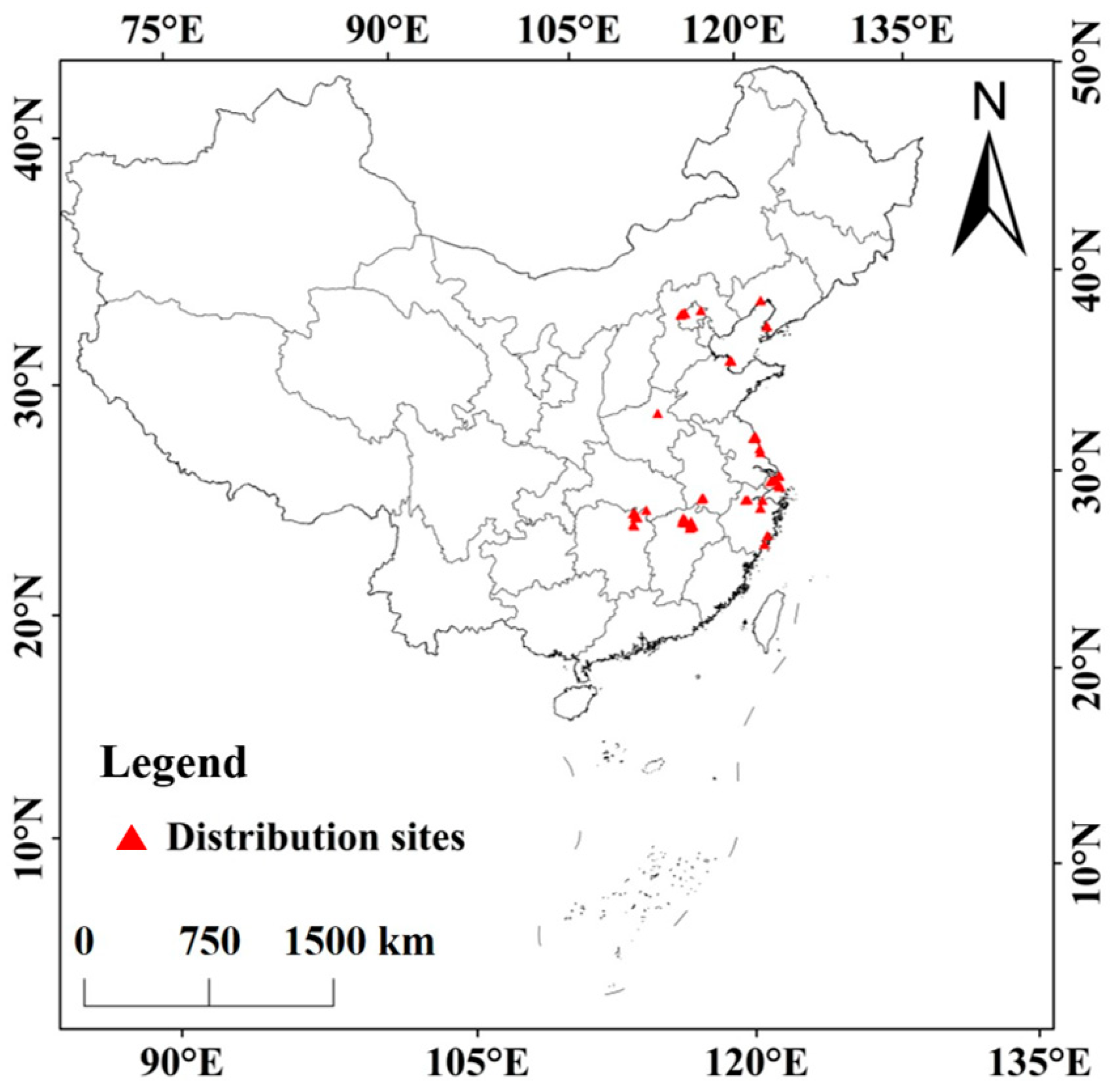
2.1. Distribution Data of the White-Naped Cranes
2.2. Environmental Data
2.3. Model Operation
2.4. Key Environmental Variables
2.5. Suitable Areas Classification
2.6. Changes in the Suitable Areas and Centroid Shift
3. Results
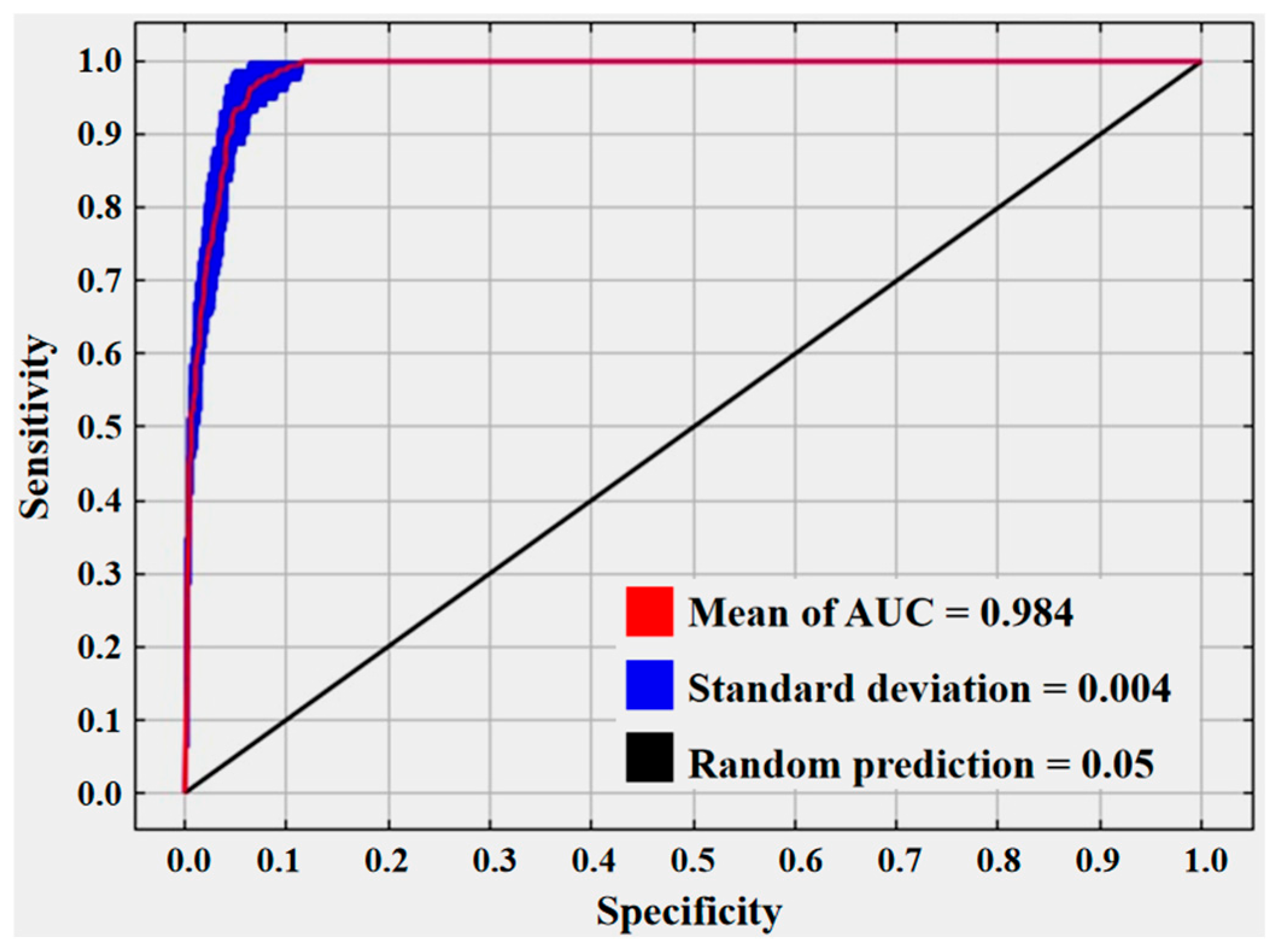
3.1. Model Accuracy
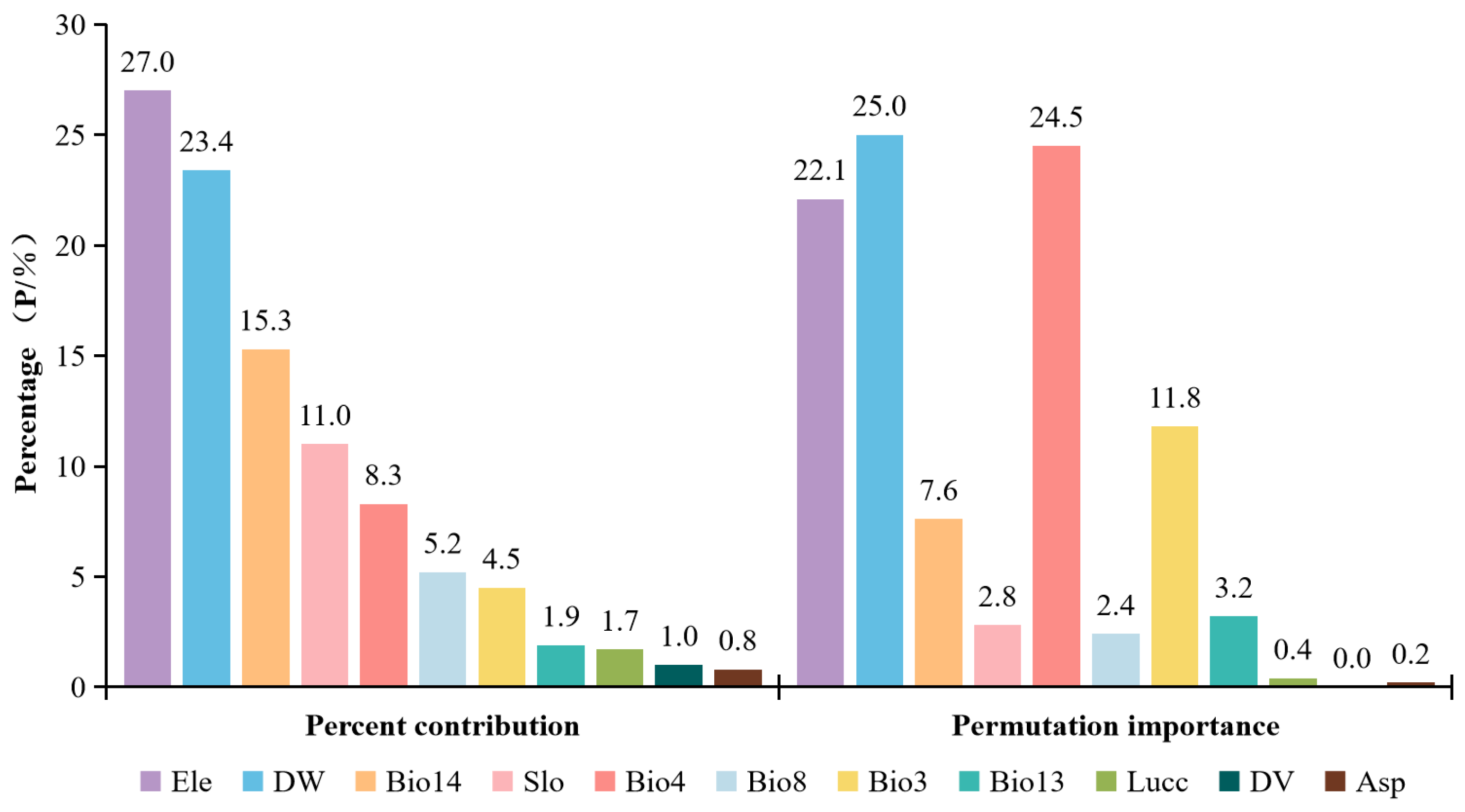
3.2. Importance of Environment Variables
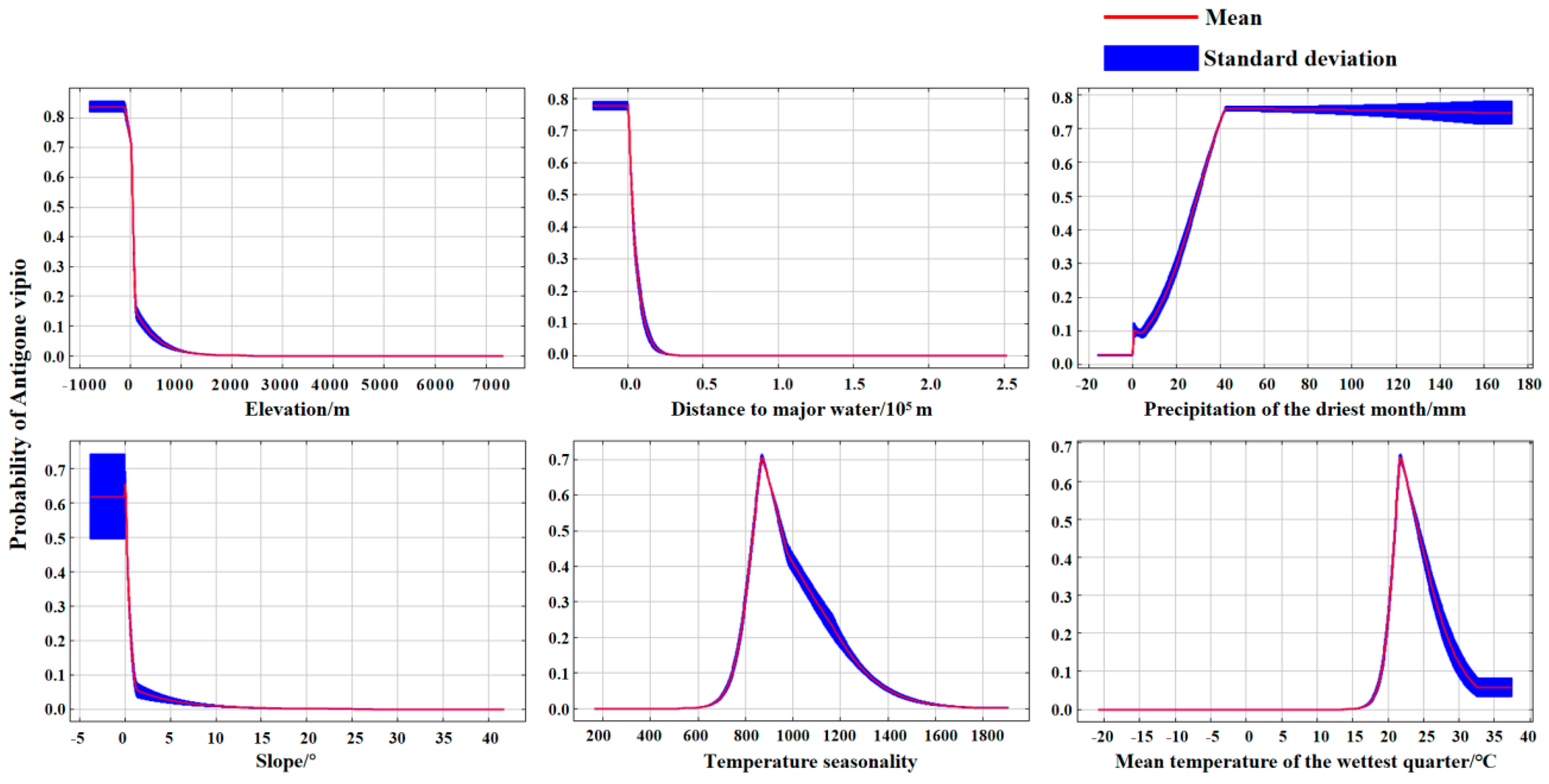
3.3. Key Environmental Variable Response Curves
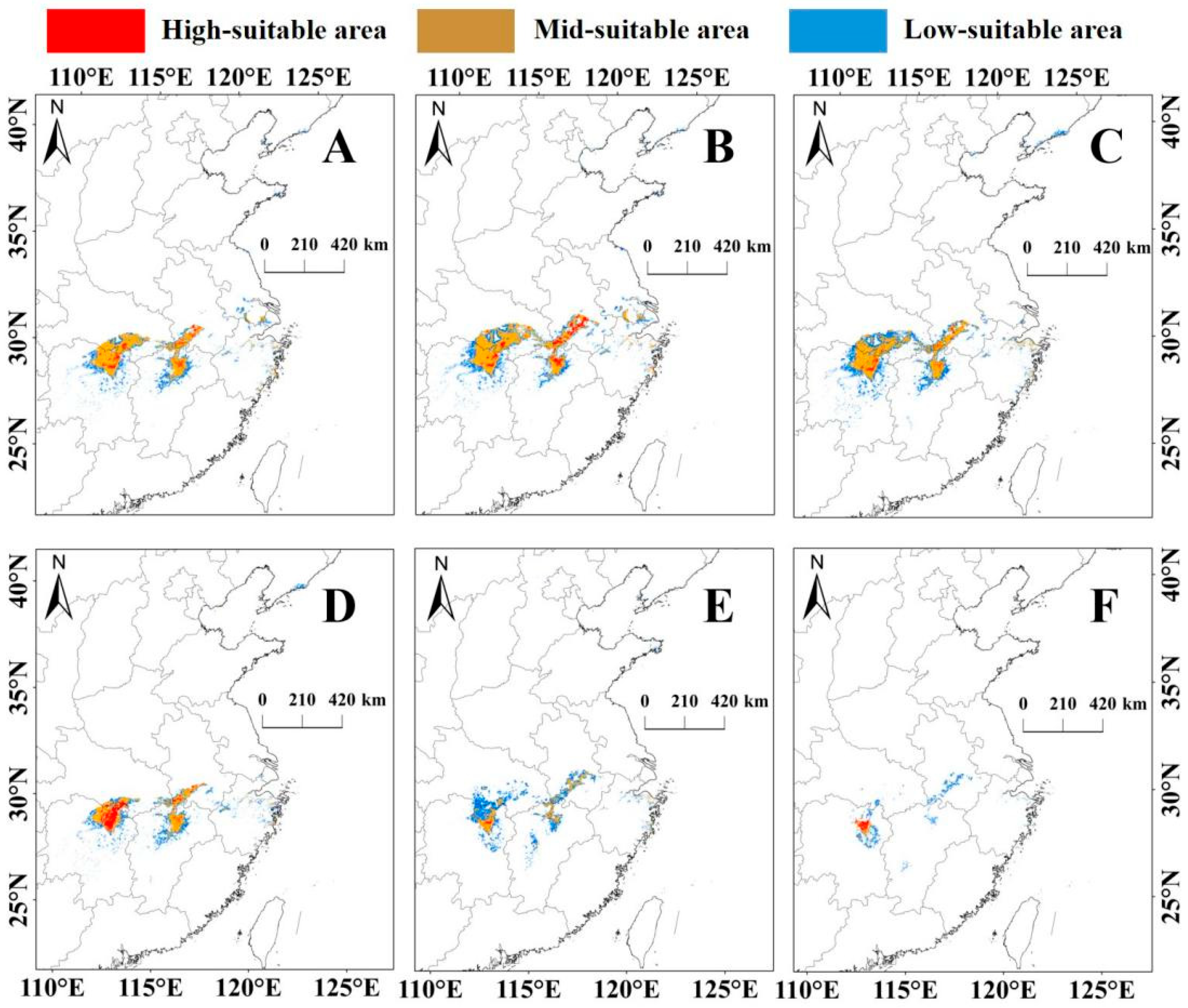
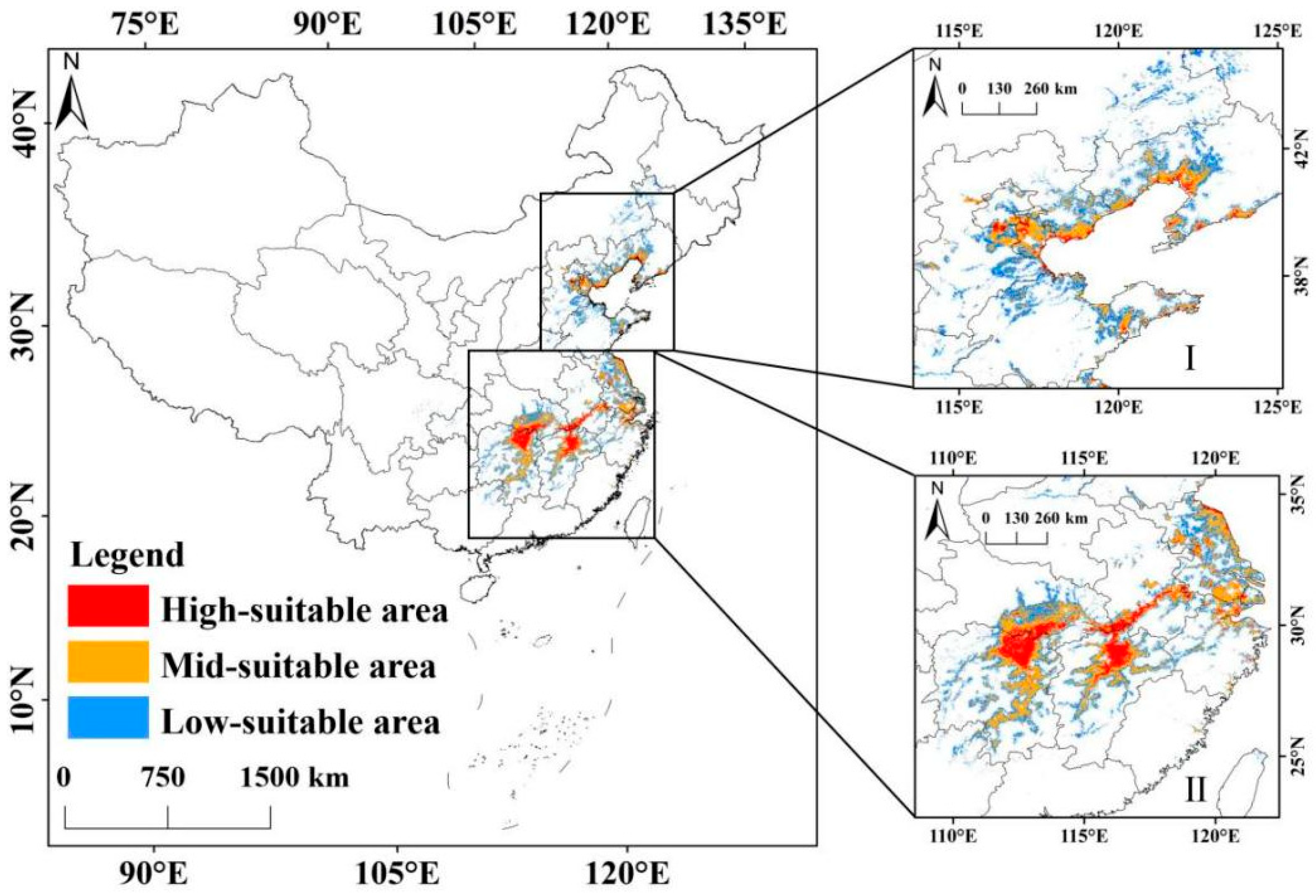
3.4. Current Suitable Wintering Habitats for the White-Naped Cranes
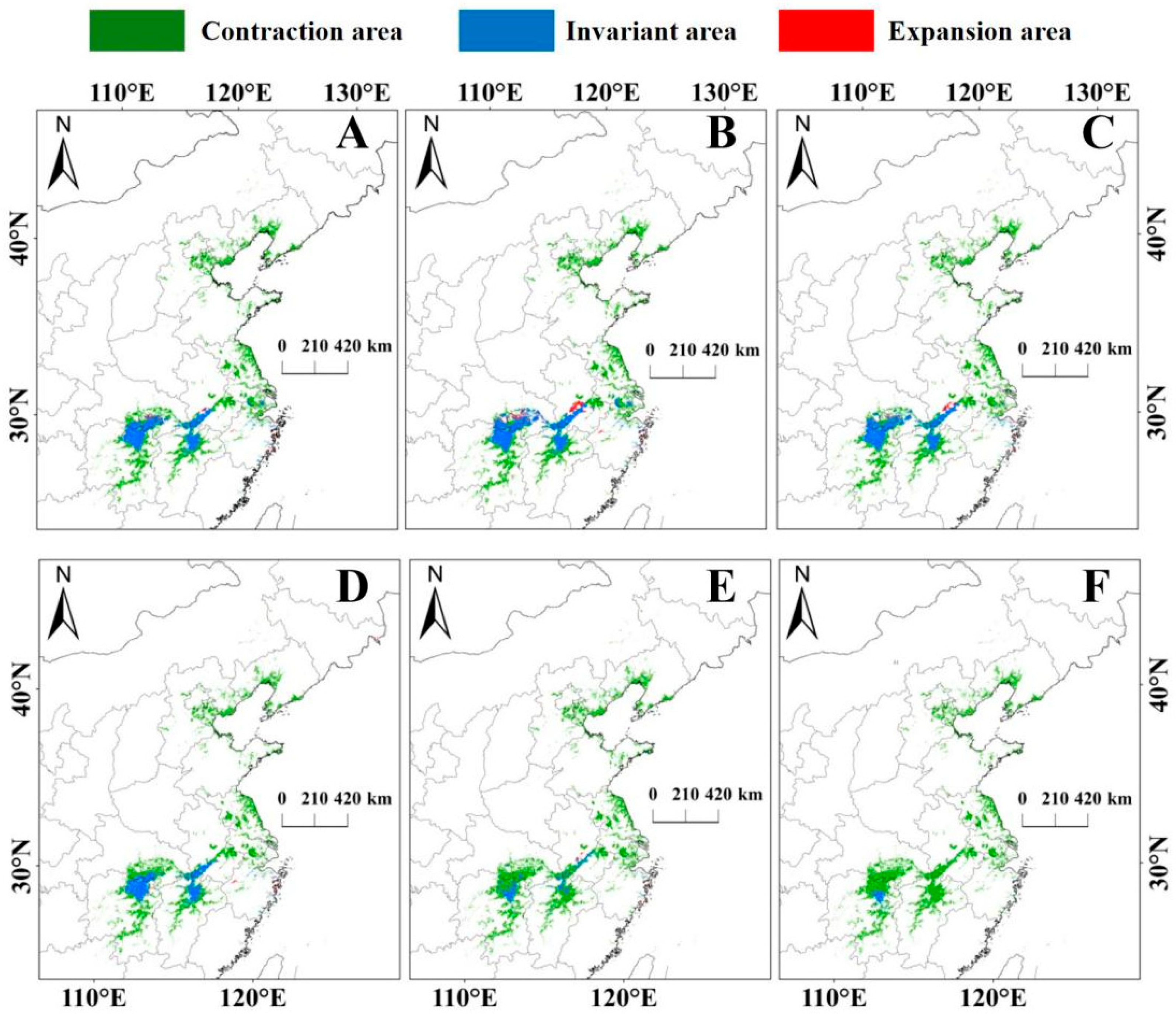
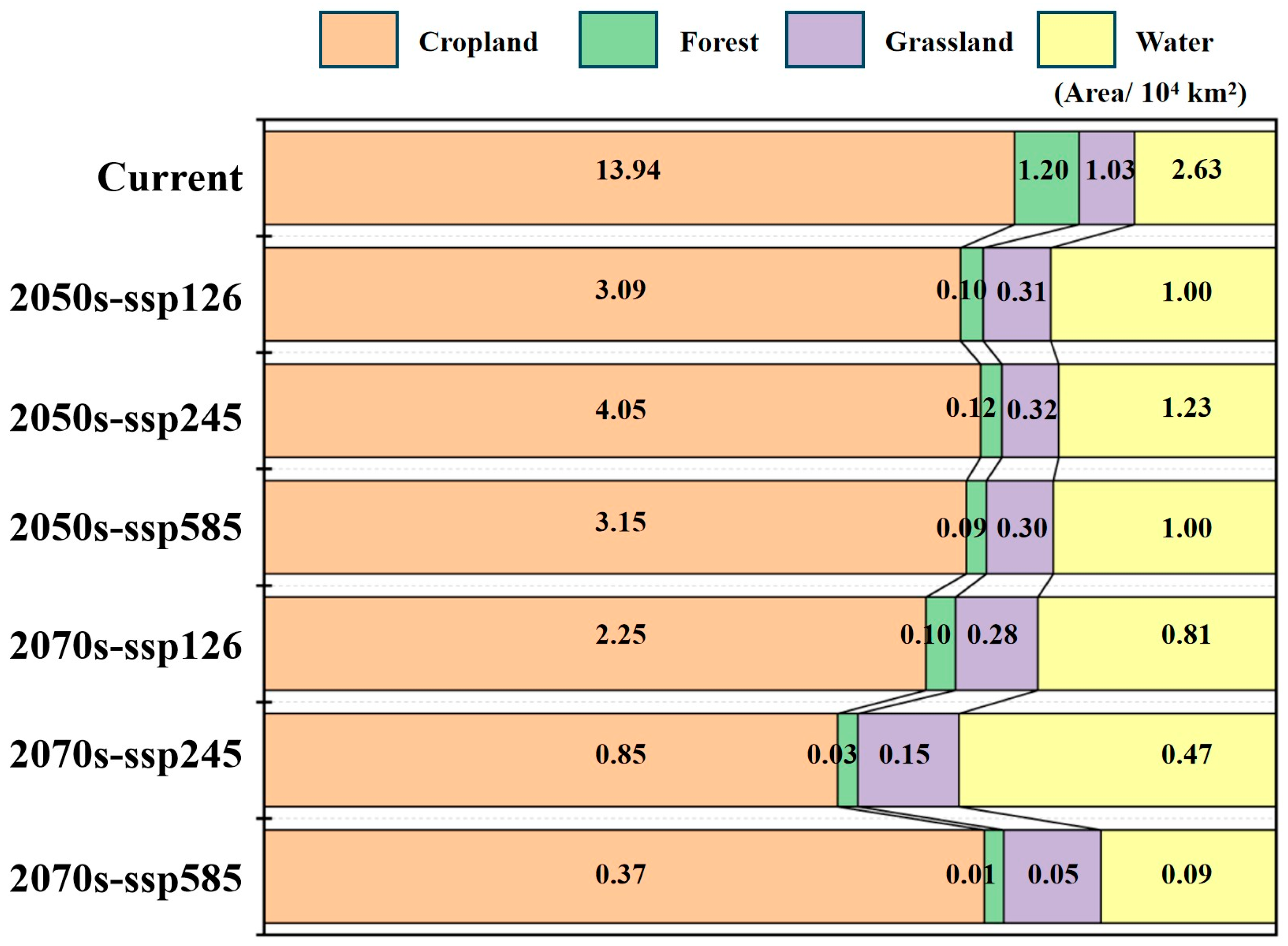
3.5. Suitable Habitats for the White-Naped Cranes and Land-Use Changes Under Future Climate Scenarios
3.6. Changes in Key Environmental Variables Across Different Periods
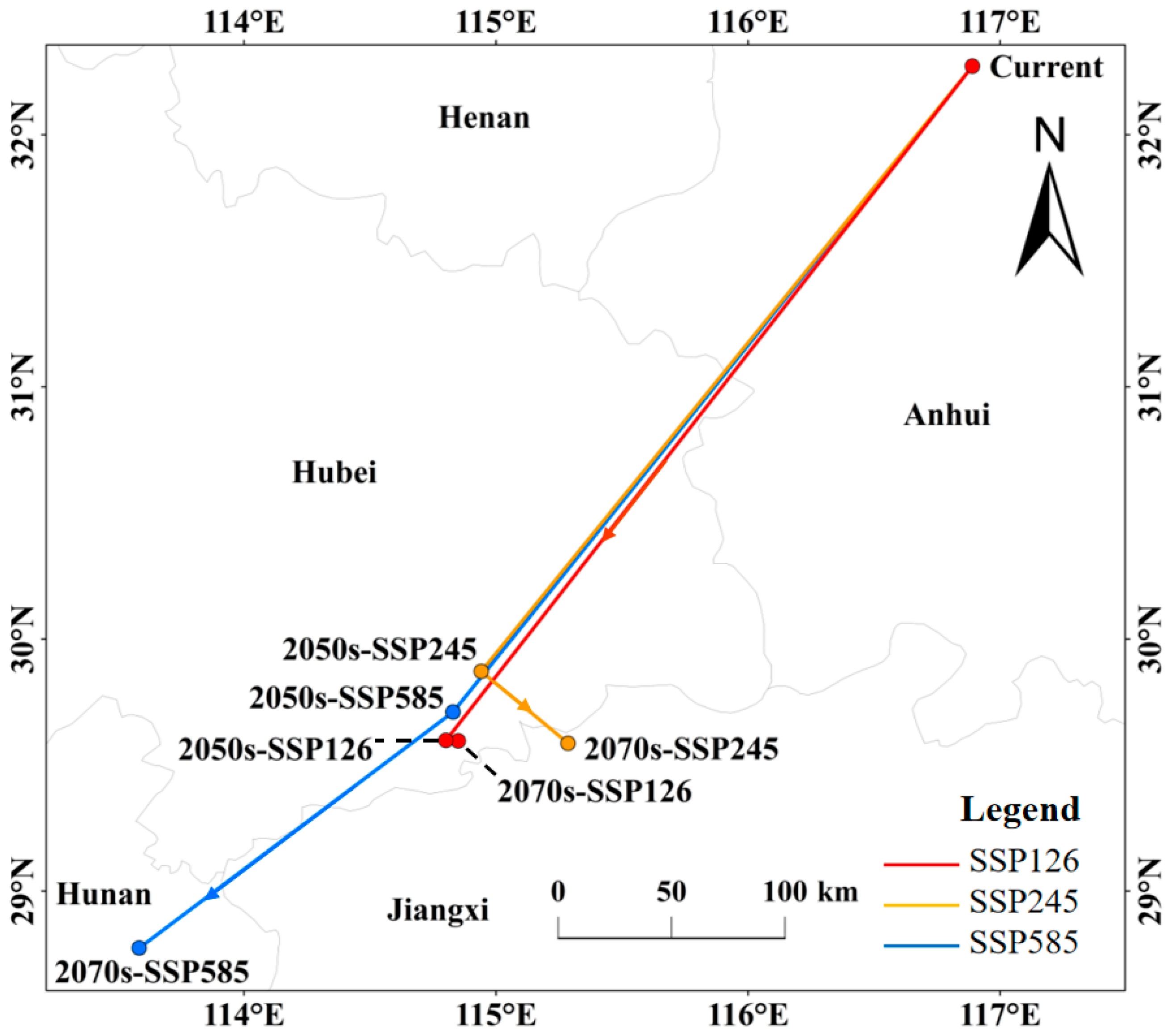
3.7. Distribution Centroid Shift of White-Naped Crane
4. Discussion
4.1. Accuracy of the Maxent Model
4.2. Key Environmental Variables and Causes
4.3. Current Suitable Wintering Habitats for the White-Naped Cranes
4.4. Spatiotemporal Changes in Suitable Habitats for the White-Naped Cranes Under Future Climate Scenarios
4.5. Future Shift in the Distribution Centroid for the White-Naped Cranes
4.6. Conservation Recommendations
- (1)
- Optimize nature reserve development: With the projected shift of wintering habitats toward the middle reaches of the Yangtze River, priority should be given to the Dongting Lake region in Hunan Province. Although multiple national and provincial nature reserves have been established around Dongting Lake, wetland fragmentation remains within these protected areas. Measures such as ditch restoration, and the construction of ecological corridors should be implemented to rehabilitate wetlands.
- (2)
- Strengthen hydrological monitoring: Given that distance to major water and precipitation of the driest month significantly influence suitable wintering habitats, monitoring of hydrological changes should be intensified. Fluctuations in water levels affect the growth of submerged vegetation, thereby impacting crane foraging. Therefore, rational management of water level fluctuations is essential.
- (3)
- Scientific assessment of population dynamics and suitable habitat conditions: Under projected future climate scenarios, existing suitable habitats in inland lakes such as Poyang Lake (Jiangxi) and Caizi Lake (Anhui) are at risk of loss. Scientific evaluations of population dynamics and habitat suitability in these regions should be conducted, including assessments of age ratios, food availability, and changes in habitat quality. Protective measures should be implemented prior to the loss of suitable habitats.
- (4)
- Reduce human disturbance: The quality of natural suitable habitats for the White-naped Cranes has declined because of the increased human interference. Such interference affects crane foraging, resting, and vigilance behaviors. Enhanced management of restricted access zones, limitations on human activities, and reduction in disturbances are expected to improve the quality of natural suitable habitats. Furthermore, human activities contribute to climate warming, which significantly impacts wetlands. Adoption of low-emission strategies is recommended to protect suitable habitats for waterbirds.
5. Conclusions
Author Contributions
Funding
Institutional Review Board Statement
Informed Consent Statement
Data Availability Statement
Conflicts of Interest
Appendix A

| Period | Region | Climate Scenarios | Average Key Environmental Variables | |||||
|---|---|---|---|---|---|---|---|---|
| Bio14/mm | Bio4 | Bio8/°C | Ele/m | DW/m | Slo/° | |||
| Current | High-suitable area | 34.22 | 910.02 | 22.47 | 21.04 | 2076.99 | 0.12 | |
| 2050s | Contraction area | SSP126 | 27.90 | 975.67 | 27.49 | 52.24 | 7794.18 | 0.32 |
| SSP245 | 32.42 | 979.78 | 27.63 | 51.29 | 7904.84 | 0.35 | ||
| SSP585 | 29.55 | 981.62 | 28.61 | 49.95 | 7539.25 | 0.35 | ||
| Invariant area | SSP126 | 43.10 | 896.52 | 24.39 | 23.37 | 1890.57 | 0.14 | |
| SSP245 | 48.65 | 914.69 | 24.97 | 23.52 | 1868.92 | 0.14 | ||
| SSP585 | 43.29 | 926.49 | 25.77 | 23.94 | 1778.16 | 0.13 | ||
| Expansion area | SSP126 | 37.30 | 874.81 | 23.73 | 33.86 | 3699.16 | 0.41 | |
| SSP245 | 36.30 | 918.89 | 24.19 | 30.13 | 4134.82 | 0.32 | ||
| SSP585 | 34.53 | 916.79 | 25.03 | 30.07 | 3596.64 | 0.29 | ||
| 2070s | Contraction area | SSP126 | 31.37 | 963.96 | 28.34 | 50.69 | 6975.55 | 0.35 |
| SSP245 | 26.71 | 958.89 | 27.61 | 46.09 | 6619.88 | 0.31 | ||
| SSP585 | 32.83 | 982.65 | 29.37 | 44.55 | 6113.57 | 0.30 | ||
| Invariant area | SSP126 | 47.49 | 896.62 | 23.36 | 25.17 | 1799.65 | 0.16 | |
| SSP245 | 37.98 | 909.58 | 23.47 | 21.34 | 1351.66 | 0.15 | ||
| SSP585 | 54.57 | 933.61 | 22.93 | 35.30 | 2334.04 | 0.19 | ||
| Expansion area | SSP126 | 37.84 | 878.29 | 22.96 | 72.80 | 3319.72 | 1.08 | |
| SSP245 | 29.79 | 866.90 | 24.42 | 15.03 | 3802.36 | 0.46 | ||
| SSP585 | 48.25 | 896.24 | 23.56 | 63.01 | 4667.27 | 0.55 | ||
References
- Wang, J.Y.; Ding, H.X.; Shao, M.Q.; Yang, F.C.; Zeng, J.H.; Zeng, F.F. Prediction of potential distribution areas of scaly-sided mergansers, based on MaxEnt modeling, in Jiangxi Province. Chin. J. Appl. Environ. Biol. 2023, 29, 117–124. [Google Scholar]
- Liu, X.Y.; Zhang, Z.X.; Li, J.; Chen, J.; Hua, J.; Peng, Y.; Yan, X.; Qiu, J. An prediction of the potential distribution of suitable habitat for Grus leucogeranus using the MaxEnt model. J. Nanjing For. Univ. Nat. Sci. Ed. 2024, 48, 181–188. [Google Scholar]
- Li, Y.; Lu, L.Y.; Tian, X.H.; Duan, Y.B. Prediction of the suitable habitat distribution of Oriental White Stork in Shandong Province. Acta Ecol. Sin. 2023, 43, 2194–2201. [Google Scholar] [CrossRef]
- Zhang, W.; Lyu, J.; Wang, W.X.; Tian, H.J. Prediction of potentially suitable habitats of Ciconia nigra in Beijing based on Maxent model. Chin. J. Ecol. 2025, 44, 4092–4099. [Google Scholar]
- Li, R.; Jiao, Y.M.; Liu, X. Habitat suitability analysis of Black-necked crane nocturnal habitat based on MaxEnt model—A case study of Dashan Bao Black-necked crane National Nature Resene in Yunnan. J. China West Norm. Univ. (Nat. Sci.) 2018, 39, 352–357. [Google Scholar]
- Jiang, Z.; Shao, M.; Wang, J. Simulation of spatial and temporal patterns of suitable wintering habitat for hooded crane (Grus monacha) under climate and land use change scenarios. Animals 2024, 15, 6. [Google Scholar] [CrossRef]
- Wang, J.Y.; Shao, M.Q.; Hu, Q.W. Simulation and evolutionary trend prediction of temporal and spatial patterns of wintering suitable habitat for Leucogeranus leucogeranus under climate and land use change scenarios. Chin. J. Appl. Environ. Biol. 2024, 30, 485–495. [Google Scholar]
- Luo, C.H.; Wang, W.Y.; Huang, J.X.; Wang, P.; Ma, M.H.; Chen, J.L.; Zhao, C.F. Prediction the impact of climate change on the habitat distribution of Grus nigricollis based on the MaxEnt model. Chin. J. Appl. Ecol. 2025, 36, 1251–1260. [Google Scholar]
- Ma, Y.; Zhang, Y.Q.; Sun, X.Y.; Guo, R.P.; Wu, Z.J.; Lu, H.X.; Wu, Q.M.; Zhang, J.F. Habitat suitability evaluation of white-naped crane during breeding period at Huihe National Nature Reserve. Chin. J. Wildl. 2024, 45, 162–168. [Google Scholar]
- Wu, H.F.; Jin, J.F.; Nymbayar, B.; Li, F.S.; Ding, C.Q. Wintering home range variation of white-naped cranes Grus vipio and its correlation with water level and temperature in Poyang Lake. Chin. J. Zool. 2018, 53, 497–506. [Google Scholar]
- Shao, M.Q.; Jiang, J.H.; Dai, N.H.; Liao, Z.Y. Population sizes and flocking features of wintering common cranes and white-naped cranes in Poyang Lake. J. Ecol. Rural Environ. 2014, 30, 464–469. [Google Scholar]
- Li, F.S.; Wu, J.D.; James, H.; James, B. Number and distribution of cranes wintering at Poyang Lake, China during 2011–2012. Avian Res. 2012, 3, 180–190. [Google Scholar] [CrossRef]
- Wang, Y.X.; Zhao, Q.S.; Xie, Y.B.; Damba, L.; Deng, X.Q.; Ga, R.D.; Liu, G.H.; Xu, Z.W.; Li, Y.; Gao, D.L.; et al. Population dynamics and age ratio of large-bodied waterbird species in the wetland of the Yangze River floodplain. Acta Ecol. Sin. 2023, 43, 868–877. [Google Scholar]
- Jia, Y.F.; Liu, Y.Z.; Jiao, S.W.; Guo, J.; Lu, C.; Zhou, Y.; Wang, Y.Y.; Lei, G.C.; Wen, L.; Mo, X.Q. Shifting of the migration route of White-naped Crane (Antigone vipio) due to wetland loss in China. Remote Sens. 2021, 13, 2984. [Google Scholar] [CrossRef]
- Zou, H.F.; Li, Q.L.; Wu, Q.M.; Wu, Y.N.; Gao, X.D.; Wang, L.; Zhu, R.P. Nutritional preference and diet composition of white-naped crane during its incubation period at Zhalong National Nature Reserve. Chin. J. Wildl. 2017, 38, 236–241. [Google Scholar]
- Lang, X.M.; Gankhuyag, P.O.; Oyunchimeg, T.; Dashdorj, K.; Baasansuren, E.; Amarkhuu, G.; Mi, C.R.; Guo, Y.M. Luan River upper reaches: The important stopover site of the white-naped crane (Grus vipio) western population. Biodivers. Sin. 2020, 28, 1213–1221. [Google Scholar] [CrossRef]
- Liu, L. Study on habitat environmental quality and habitat selection of crane in Xianghai Wetland. Heilongjiang Environ. J. 2020, 33, 2–3+7. [Google Scholar]
- Li, A.M.; Li, Y.K.; Shao, R.Q.; Shen, J.; Qian, L.; Zhang, C.; Wang, X.F.; Fang, P.J. Population size dynamics and distribution of wintering cranes in Poyang Lake. J. Ecol. Rural Environ. 2022, 38, 777–786. [Google Scholar]
- Xu, Z.L.; Peng, H.H.; Peng, S.Z. The development and evaluation of species distribution models. Acta Ecol. Sin. 2015, 35, 557–567. [Google Scholar] [CrossRef]
- Yang, F.C.; Hong, Z.C.; Ding, H.X.; Shao, M.Q. Prediction of potential wintering distribution areas of mandarin duck based on maximum entropy model. Wetl. Sci. 2024, 22, 60–71. [Google Scholar]
- Shao, M.Q.; Wang, J.Y.; Ding, H.X. Suitable overwintering habitat simulation and the drivers of their population expansion for Siberian cranes (Grus leucogeranus) in China. Chin. J. Appl. Ecol. 2023, 34, 1639–1648. [Google Scholar]
- Weng, Y.W.; Cai, W.J.; Wang, C. The application and future directions of the Shared Socioeconomic Pathways (SSPs). Clim. Change Res. 2020, 16, 215–222. [Google Scholar]
- Qasim, S.; Mahmood, T.; Rakha, B.A.; Nadeem, M.S.; Akrim, F.; Aslam, A.; Belant, J.L. Predicting current and future habitat of Indian pangolin (Manis crassicaudata) under climate change. Sci. Rep. 2024, 14, 7564. [Google Scholar] [CrossRef] [PubMed]
- Zhang, G.P.; Liu, J.Y.; Zhang, Z.X. Spatial-temporal changes of Cropland in China for the past 10 years based on remote sensing. Atca Geogr. Sin. 2003, 3, 323–332. [Google Scholar]
- Zhang, H.; Zhao, H.X.; Wang, H. Potential geographical distribution of Populus euphratica in China under future climate change scenarios based on Maxent model. Acta Ecol. Sin. 2020, 40, 6552–6563. [Google Scholar]
- Xiao, Q.; Zhang, M.T.; Wu, Y.; Ding, H.; Lei, J.C.; Zhu, S.L.; Zhang, Z.H.; Chen, L. Prediction of potential distribution of the invasive species Procambarus clarkii in China based on ecological niche models. Chin. J. Appl. Ecol. 2020, 31, 309–318. [Google Scholar]
- Yao, Z.Y.; Han, Q.F.; Lin, B. Prediction of distribution area of main noxious and miscellaneous weeds in Xinjiang based on MaxEnt model. Acta Ecol. Sin. 2023, 43, 5096–5109. [Google Scholar] [CrossRef]
- Jimenez, V.A.; Lobo, J.M. Threshold criteria for conversion of probability of species presence to either-or presence-absence. Acta Oecol. 2007, 31, 361–369. [Google Scholar] [CrossRef]
- Liu, C.; Berry, P.M.; Dawson, T.P.; Pearson, R.G. Selecting thresholds of occurrence in the prediction of species distributions. Ecography 2005, 28, 385–393. [Google Scholar] [CrossRef]
- Gu, J.; Zhang, Y.; Wang, F.; Kong, Z. Simulation and analysis of red-crowned crane habitat suitability using maximum entropy and information entropy models. Ecol. Indic. 2023, 155, 110999. [Google Scholar] [CrossRef]
- Yan, Z.S.; Shao, M.Q.; Wang, J.Y. Prediction of suitable wintering habitat for Grus grus and key factors influencing population distribution in China. Chin. J. Appl. Ecol. 2025, 36, 578–586. [Google Scholar]
- Yang, J.Y.; Ding, G.Y.; Tian, X.J. Research progress the application of the MaxEnt model in species habitat prediction. Chin. J. Appl. Ecol. 2025, 36, 614–624. [Google Scholar]
- Zhao, Y.X.; Wen, Y.Y.; Wang, F.; Cui, X.T.; Lan, Z.C.; Cai, Y.J.; Zhang, Y.J.; Lu, S.B. The effect of flooding duration on the vegetation biomass allocation pattern in shallow lakes of Poyang Lake. J. Jiangxi Norm. Univ. Nat. Sci. Ed. 2024, 48, 572–579. [Google Scholar]
- Chen, C.; Fang, C.Y.; Xiao, X.; Chen, H.; Lin, H. The three-dimensional dynamical visualization simulation method for ecological processes in Poyang Lake. J. Jiangxi Norm. Univ. Nat. Sci. Ed. 2024, 48, 311–318. [Google Scholar]
- Nam, H.K.; Kim, H.J.; Davaasuren, B.; Natsagdorj, T.; Batbayar, N.; Nergui, J.; Park, J.Y.; Tsend, O.; Hur, W.H.; Kim, D.W.; et al. Migration and population characteristics of white-naped cranes wintering on the Korean Peninsula. Sci. Rep. 2025, 15, 18785. [Google Scholar] [CrossRef] [PubMed]
- Wu, Q.M.; Zou, H.F. Forage habitat selection of white-naped crane during its incubation period on Zhalong Wetland. Chin. J. Appl. Ecol. 2009, 20, 1716–1722. [Google Scholar]
- Wu, Q.; Zou, H.; Ma, J. Nest site selection of white-naped crane (Grus vipio) at Zhalong National Nature Reserve, Heilongjiang, China. J. For. Res. 2014, 25, 947–952. [Google Scholar] [CrossRef]
- Chen, B.; Cui, P.; Liu, G.H.; Li, F.S.; Wu, X.D.; Wu, J.D.; Zeng, N.J.; Zhao, N.; Xu, H.G. Relationships between changing water levels and numbers of wintering tuber-eating birds in Poyang Lake National Nature Reserve. J. Lake Sin. 2014, 26, 243–252. [Google Scholar]
- Tang, W.; Hu, G.F.; Hu, Q.; Dai, N.H.; Shao, M.Q. The current status of wintering waterbird diversity in Poyang Lake and its surrounding areas after extreme drought. J. Jiangxi Norm. Univ. Nat. Sci. Ed. 2025, 49, 476–480. [Google Scholar]
- Christine, R.; Yi, C.X.; George, H. Temperature variance portends and indicates the extent of abrupt climate shifts. IOP SciNotes 2021, 2, 014002. [Google Scholar] [CrossRef]
- Wu, H.P.; Hao, B.B.; Jo, H.; Cai, Y.P. Seasonality and species specificity of submerged macrophyte biomass in shallow lakes under the influence of climate warming and eutrophication. Front. Plant Sci. 2021, 12, 678259. [Google Scholar] [CrossRef] [PubMed]
- Hou, J.J.; Li, L.; Wang, Y.F.; Wang, W.J.; Zhan, H.Y.; Dai, N.H.; Lu, P. Influences of submerged plant collapse on diet composition, breadth, and overlap among four crane species at Poyang Lake, China. Front. Zool. 2021, 18, 24. [Google Scholar] [CrossRef] [PubMed]
- Edd, H.; Riley, D. Contributions of mean temperature and temperature variation to population stability and community diversity. Ecol. Evol. 2022, 12, e8665. [Google Scholar] [CrossRef]
- Wang, C.; Dong, B.; Zhu, M.; Huang, H.; Cui, Y.; Gao, X.; Liu, L. Habitat selection of wintering cranes (Gruidae) in typical lake wetland in the lower reaches of the Yangtze River, China. Environ. Sci. Pollut. Res. 2019, 26, 8266–8279. [Google Scholar] [CrossRef] [PubMed]
- Wang, C.; Dong, B.; Zhu, M.; Huang, H.; Zhao, K.K.; Lu, D.; Cui, Y.H.; Gao, X. Habitat selection of wintering crane in Shengjin Lake wetland. Chin. J. Ecol. 2018, 37, 810–816. [Google Scholar]
- Cui, Y.; Dong, B.; Chen, L.; Gao, X.; Cui, Y. Study on habitat suitability of overwintering cranes based on landscape pattern change—A case study of typical lake wetlands in the middle and lower reaches of the Yangtze River. Environ. Sci. Pollut. Res. 2019, 26, 14962–14975. [Google Scholar] [CrossRef]
- Xu, H.; Dong, B.; Xu, Z.; Ma, J.J.; Shen, F. Study on habitat suitability and ecological network of rare cranes in Poyang Lake National Nature Reserve. Ecol. Indic. 2025, 174, 113480. [Google Scholar] [CrossRef]
- Lin, J.Y. Monitoring Water Volume Changes in Poyang Lake and Dongting Lake Using Multi-Source Remote Sensing; Nanjing University of Information Science and Technology: Nanjing, China, 2025. [Google Scholar]
- Li, Z.; Gui, J.; Feng, Q.; Zhang, B.J.; Cui, Q. Contribution of the cryosphere to runoff in “Chinese water tower” based on environmental isotopes. Geosci. Front. 2023, 14, 101613. [Google Scholar] [CrossRef]
- Liu, Y.; Wu, L.; Guo, J.; Jiao, S.W.; Ren, S.C.; Lu, C.; Wang, Y.Y.; Jia, Y.F.; Lei, G.C.; Wen, L.; et al. Habitat selection and food choice of white-naped cranes (Grus vipio) at stopover sites based on satellite tracking and stable isotope Analysis. Avian. Res. 2022, 13, 100060. [Google Scholar] [CrossRef]
- Deng, H.; Chen, Y.; Li, Y. Glacier and snow variations and their impacts on regional water resources in Mountains. J. Geogr. Sci. 2019, 29, 84–100. [Google Scholar] [CrossRef]
- Wood, L.R.; Neumann, K.; Nicholson, K.N.; Bird, B.W.; Dowling, C.B.; Sharma, S. Melting Himalayan Glaciers threaten domestic water resources in the Mount Everest Region, Nepal. Front. Earth Sci. 2020, 8, 00128. [Google Scholar] [CrossRef]
- Deng, G.Y.; Zhu, S.Y.; Jiang, H.B.; Gao, J.; Li, D.H.; Wen, Y.; Sheng, L.X.; He, C.G.; Cao, Y.Y. Responses of the Siberian crane population to temporal and spatial hydrological variations in stopover sites in northeast China. Ecol. Indic. 2023, 154, 110635. [Google Scholar] [CrossRef]
- Duan, H.L.; Pan, Y.W.; Yu, X.B.; Xia, S.X. Effects of habitat change on the wintering waterbird community in China’s largest freshwater lake. Remote. Sens. 2023, 15, 4582. [Google Scholar] [CrossRef]
- Xu, D.H.; Bisht, G.; Tan, Z.L.; Sinha, E.; Vittorio, A.V.D.; Zhou, T.; Lvanov, V.Y.; Leung, L.R. Climate change will reduce North American inland wetland areas and disrupt their seasonal Regimes. Nat. Commun. 2024, 15, 2438. [Google Scholar] [CrossRef]
- Zhang, Z.H.; Wang, C.; Gong, G.Q.; Chen, Y.Y.; Ma, S.Y.; Wu, Y.T.; Wang, H.W.; Li, Y.F.; Duan, H.L. Biodiversity conservation and management of lake wetlands based on the spatiotemporal evolution patterns of crane Habitats. J. Environ. Manag. 2024, 353, 120257. [Google Scholar] [CrossRef]




| Variable | Description | Unit |
|---|---|---|
| bio 1 | Annual mean temperature | °C |
| bio 2 | Mean diurnal temperature range | °C |
| bio 3 | Isothermality | — |
| bio 4 | Temperature seasonality | — |
| bio 5 | Max temperature of the warmest month | °C |
| bio 6 | Min temperature of the coldest month | °C |
| bio 7 | Temperature annual range | °C |
| bio 8 | Mean temperature of the wettest quarter | °C |
| bio 9 | Mean temperature of the driest quarter | °C |
| bio 10 | Mean temperature of the warmest quarter | °C |
| bio 11 | Mean temperature of the coldest quarter | °C |
| bio 12 | Annual precipitation | mm |
| bio 13 | Precipitation of the wettest month | mm |
| bio 14 | Precipitation of the driest month | mm |
| bio 15 | Precipitation seasonality (coefficient of variation) | — |
| bio 16 | Precipitation of the wettest quarter | mm |
| bio 17 | Precipitation of the driest quarter | mm |
| bio 18 | Precipitation of the warmest quarter | mm |
| bio 19 | Precipitation of the coldest quarter | mm |
| Ele | Elevation | m |
| Asp | Aspect | — |
| Slo | Slope | ° |
| NDVI | Normalized difference vegetation index | — |
| LUCC | Land-use classification | — |
| DP | Distance to paddy field | m |
| DW | Distance to major water | m |
| DB | Distance to beach | m |
| DR | Distance to road | m |
| DV | Distance to village | m |
| Climatic Mode | High-Suitable Area (km2) | Mid-Suitable Area (km2) | Low-Suitable Area (km2) |
|---|---|---|---|
| Current | 5.64 × 10⁴ | 16.71 × 10⁴ | 20.33 × 10⁴ |
| 2050s-SSP126 | 0.57 × 10⁴ | 4.44 × 10⁴ | 3.03 × 10⁴ |
| 2050s-SSP245 | 0.94 × 10⁴ | 5.37 × 10⁴ | 3.97 × 10⁴ |
| 2050s-SSP585 | 0.30 × 10⁴ | 4.73 × 10⁴ | 4.01 × 10⁴ |
| 2070s-SSP126 | 1.06 × 10⁴ | 2.76 × 10⁴ | 2.38 × 10⁴ |
| 2070s-SSP245 | 0.08 × 10⁴ | 1.57 × 10⁴ | 3.50 × 10⁴ |
| 2070s-SSP585 | 0.22 × 10⁴ | 0.34 × 10⁴ | 1.01 × 10⁴ |
| Climatic Mode | Area (km2) | Centroid Coordinate | Migration Distance (km) | ||
|---|---|---|---|---|---|
| Expansion Area | Invariant Area | Contraction Area | |||
| current | 116.89° E, 32.27° N | ||||
| 2050s-SSP126 | 0.27 × 10⁴ | 4.73 × 10⁴ | 15.17 × 10⁴ | 114.80° E, 29.60° N | 357.49 |
| 2050s-SSP245 | 0.77 × 10⁴ | 5.47 × 10⁴ | 14.83 × 10⁴ | 114.94° E, 29.87° N | 324.69 |
| 2050s-SSP585 | 0.39 × 10⁴ | 4.62 × 10⁴ | 14.89 × 10⁴ | 114.83° E, 29.71° N | 345.58 |
| 2070s-SSP126 | 0.15 × 10⁴ | 3.67 × 10⁴ | 14.94 × 10⁴ | 114.85° E, 29.60° N | 4.79 |
| 2070s-SSP245 | 0.10 × 10⁴ | 1.55 × 10⁴ | 17.36 × 10⁴ | 115.29° E, 29.59° N | 45.97 |
| 2070s-SSP585 | 0.03 × 10⁴ | 0.53 × 10⁴ | 17.36 × 10⁴ | 113.58° E, 28.77° N | 159.43 |
Disclaimer/Publisher’s Note: The statements, opinions and data contained in all publications are solely those of the individual author(s) and contributor(s) and not of MDPI and/or the editor(s). MDPI and/or the editor(s) disclaim responsibility for any injury to people or property resulting from any ideas, methods, instructions or products referred to in the content. |
© 2026 by the authors. Licensee MDPI, Basel, Switzerland. This article is an open access article distributed under the terms and conditions of the Creative Commons Attribution (CC BY) license.
Share and Cite
Xiao, H.; Shao, M.; Jiang, Z. Spatiotemporal Patterns of Suitable Wintering Habitats for the White-Naped Cranes Under Climate and Land-Use Change. Animals 2026, 16, 1839. https://doi.org/10.3390/ani16121839
Xiao H, Shao M, Jiang Z. Spatiotemporal Patterns of Suitable Wintering Habitats for the White-Naped Cranes Under Climate and Land-Use Change. Animals. 2026; 16(12):1839. https://doi.org/10.3390/ani16121839
Chicago/Turabian StyleXiao, He, Mingqin Shao, and Zeng Jiang. 2026. "Spatiotemporal Patterns of Suitable Wintering Habitats for the White-Naped Cranes Under Climate and Land-Use Change" Animals 16, no. 12: 1839. https://doi.org/10.3390/ani16121839
APA StyleXiao, H., Shao, M., & Jiang, Z. (2026). Spatiotemporal Patterns of Suitable Wintering Habitats for the White-Naped Cranes Under Climate and Land-Use Change. Animals, 16(12), 1839. https://doi.org/10.3390/ani16121839