Article

Dietary Supplementation with Raspberry or Strawberry Seed Oil Impacts Folliculogenesis, Hormonal Parameters and the Fatty Acid Profile in the Juvenile Rabbit Ovary


1
Department of Endocrinology, Institute of Zoology and Biomedical Research, Faculty of Biology, Jagiellonian University, Gronostajowa 9, 30-387 Krakow, Poland
2
Department of Genetics, Animal Breeding and Ethology, University of Agriculture in Krakow, Al. Mickiewicza 24/28, 30-059 Krakow, Poland
*
Author to whom correspondence should be addressed.
Animals 2026, 16(10), 1528; https://doi.org/10.3390/ani16101528 (registering DOI)
Submission received: 18 March 2026 / Revised: 14 May 2026 / Accepted: 15 May 2026 / Published: 16 May 2026
(This article belongs to the Section Animal Reproduction)

Simple Summary

Nutrition can influence female reproduction, but the effects of seed oils on the ovary are not well understood. This study investigated whether low dietary supplementation (1%) with raspberry (RO) or strawberry (SO) seed oils affects ovarian development in young rabbits. From 5 to 12 weeks of age, rabbits were fed a control diet or diets supplemented with RO or SO. After the feeding period, blood and ovarian samples were collected to examine follicle development, hormone levels, fatty acid profile, and the expression of genes related to lipid metabolism. Both seed oils reduced the number of primary follicles, while RO increased the number of antral follicles. Animals receiving the oils also showed higher levels of hormones, including the follicle-stimulating hormone and anti-Müllerian hormone. RO additionally increased progesterone and estradiol concentrations, whereas SO increased progesterone only. SO also changed the fatty acid composition of the ovary by increasing certain monounsaturated fatty acids and reducing polyunsaturated fatty acids, likely through changes in the expression of a lipid-metabolizing enzyme. Overall, the results suggest that dietary seed oils can influence ovarian development and hormonal regulation, which contributes to improving our understanding of how nutrition affects female reproductive functions.

Abstract

This study demonstrated the effects of dietary supplementation with 1% raspberry (RO) or 1% strawberry (SO) seed oil from 5 to 12 weeks of age (n = 6/group) on folliculogenesis, hormonal parameters, the ovarian fatty acid profile, and the expression of related genes in juvenile rabbits. After slaughter, ovaries and blood were collected. Ovaries were used for histology, fatty acid profiling, and gene expression analysis, while plasma was used to measure progesterone (P4), testosterone (T), estradiol-17β (E2), follicle-stimulating hormone (FSH), and anti-Müllerian hormone (AMH) concentrations. Both RO and SO reduced the number of primary follicles (p = 0.04), whereas RO increased the number of antral follicles (p = 0.04) compared with the control. In both supplemented groups, FSH (p = 0.04 and p = 0.035) and AMH (p = 0.04) concentrations were higher. RO increased P4 and E2 (p = 0.03 and p = 0.013) concentrations, while SO only increased P4 (p = 0.02) levels. SO altered the ovarian fatty acid profile, increasing selected monounsaturated fatty acids and reducing polyunsaturated fatty acids, likely by increasing the expression of the converting enzyme, stearoyl-CoA desaturase 5 (p = 0.038). Overall, both oils influenced folliculogenesis through hormonal changes, and SO modified ovarian fatty acid composition, which may affect ovarian function in juvenile rabbits.

1. Introduction

The ovary is a female reproductive organ that supports oocyte development and ovulation, and is also responsible for the synthesis of steroid hormones, namely progesterone (P4), testosterone (T), and estradiol-17β (E2), which regulate reproductive cycles and maintain endocrine homeostasis [1]. The progressive development of ovarian follicles from the primordial to preovulatory stage is called folliculogenesis. This process is strictly coordinated by interactions between endocrine, paracrine, and autocrine signals [2]. A crucial role is played by pituitary gonadotropins, e.g., follicle-stimulating hormone (FSH) and luteinizing hormone (LH), as well as local intraovarian mediators, including growth factors, cytokines, and metabolic substrates [3]. In addition, the steps of folliculogenesis are regulated by the anti-Müllerian hormone (AMH), which is produced in the ovary [4]. Rabbits are a useful model for studying the dynamics of ovarian follicle development because, in this species, folliculogenesis occurs entirely postnatally. During the first three weeks of life, the ovary contains primordial and developing follicles, while antral follicles emerge in juvenile animals around week 12 [5].
Besides internal signals, ovarian processes can be influenced by external factors, including fatty acids (FAs) derived from the diet [6]. FAs are not only a source of energy but also crucial components of biological membranes, as well as precursors for hormones and intracellular messengers [7]. Based on the presence of double bonds, they are classified into saturated fatty acids (SFAs, without double bonds), and unsaturated fatty acids (UFAs), which include monounsaturated fatty acids (MUFAs, with a single double bond) or polyunsaturated fatty acids (PUFAs, with multiple double bond) [8]. The limiting step in FA metabolism is the conversion of SFAs into MUFAs, which is carried out by stearoyl-CoA desaturases (SCDs) [9]. Ovarian cells can uptake FAs through the CD36 transporter, which has been identified in granulosa cell membranes of different species [6], following hydrolysis of triglycerides from circulating chylomicrons and very low-density lipoproteins by lipoprotein lipase (LPL) [10]. It is well established that FAs are involved in follicular development, steroidogenesis and oocyte maturation in both humans and animals [9,11,12]. On the other hand, certain pathological nutrition statuses, including obesity or high-fat diets, can affect the survival, proliferation, and energy balance of ovarian cells [13].
The growing interest in healthy diets has increased the consumption of fruit seed oils, which display health benefits attributed to their unique FA profiles and bioactive compounds, such as phytosterols, phenols, tocopherols carotenoids, and flavonoids [14]. Fruit seeds are the main by-product of fruit processing and are commonly regarded as waste. To facilitate their utilization and avoid disposal costs and environmental contamination, they are being increasingly used as a cheaper and alternative source of edible oils [15]. Recently, there has been growing interest in raspberry (Rubus idaeus L.) (RO) and strawberry (Fragaria × ananassa) (SO) seed oils, which are rich in UFAs, especially linoleic and oleic acids [16,17]. The direct impact of these oils on ovarian functions has not been studied. However, linoleic and oleic acids have been found to modulate ovarian follicle growth and development through the regulation of granulosa cell proliferation and apoptosis in humans and cows [18,19,20]. Furthermore, they affect ovarian steroidogenesis, namely P4 synthesis, in goats [21] and FSH-induced E2 production in buffalo [22]. Oleic acid has also been found to regulate the expression of genes related to FSH and LH signaling in bovine granulosa cells [23]. Although there is no data about the relationship between linoleic and oleic acid contents and AMH levels, one study showed that oleoylethanolamide (a bioactive lipid derived from oleic acid) decreased AMH concentrations in women with polycystic ovary syndrome [24]. Based on these findings, we hypothesized that low (1%) dietary supplementation with RO or SO would influence folliculogenesis, plasma concentrations of steroids, FSH, AMH, the FA profile, and the expression of FA metabolism-associated genes, namely CD36, LPL and SCD5, in the ovaries of 12-week-old rabbits. This work seeks to provide new insights into the role of fruit seed-derived oils in female reproductive biology, given that their supplementation could represent an effective strategy for regulating female reproductive potential.

2. Materials and Methods

2.1. Experiment Design

The animals used in this study were purchased from the Faculty of Animal Science of the University of Agricultural in Kraków (Poland). As previously described [16,17], Termond White female rabbits were kept with their litters in wooden cages placed in a temperature-controlled room until weaning, with unrestricted access to water, a 14 h light/10 h dark photoperiod, and mechanical ventilation. On postnatal day 35, the young were weaned and randomly assigned into experimental groups (n = 6/group). They were then transferred to metal cages intended for rabbit husbandry, each fitted with a plastic feeder and a nipple drinker.
Between 5 and 12 weeks of age, the rabbits had unrestricted access to pelleted feed provided by FHP Barbara Ltd. (Turza, Poland). In addition, the animals had unlimited access to fresh water, which was distributed via an automatically replenishing watering line. Animals in the control group received fresh non-supplemented pellets, while the other groups received pellets containing 1% RO or 1% SO (Table 1). The chemical composition of feed was performed by the laboratory of the Department of Nutrition and Fisheries (University of Agriculture in Kraków, Poland). Analyses were performed in accordance with internationally recognized methods (AOAC International, 2005) as follows: dry matter (method 934.01), ash (942.05), crude protein (976.05), crude fat (920.39) and crude fiber (978.10) [25]. We applied low supplementation levels that are sufficient to modify tissue fatty acid composition without altering energy balance as previously described [16,17]. The RO and SO were purchased from Olvita (Marcinowice, Poland). The oils were produced using cold pressing of oil seeds, which were then filtered and stored at 4 °C in dark glass bottles. Unrefined oils were mixed with the feed components, which were then pelleted by the feeder manufacturer. The FA profile of RO and SO were recently provided [16,17].
The rabbits were sacrificed at 12 weeks of age (day 84; n = 6/group; average body weight 2.6 kg; sexually immature) after a 24 h fasting period with unrestricted access to water. They were stunned, promptly exsanguinated, and subsequently skinned and eviscerated. Immediately after slaughter, the ovaries were harvested—one ovary was fixed in 10% buffered formalin for histology, while the contralateral ovary was snap-frozen for real-time PCR analysis and fatty acid content assessment. Blood samples were placed in heparin-coated tubes and centrifuged (4000× g, 10 min, 4 °C), and the plasma was stored at −20 °C until it was used for the hormonal analyses.

2.2. Ovarian Histology

The rabbit ovaries were fixed as previously described [27,28], and 5 μm thick sections were stained with hematoxylin–eosin (H&E). Follicle counts were performed in a blinded manner on three sections per ovary: one central section and two lateral sections, one on each side. The total follicle count was determined for each entire section. Follicles were categorized as follows: (1) primordial—surrounded by a partial or complete layer of flattened pre-granulosa cells; (2) primary—enclosed by a complete layer of cuboidal granulosa cells; (3) preantral—comprising two or more complete granulosa cell layers, a theca layer, and lacking an antrum; (4) antral—characterized by a fluid-filled antral cavity within the granulosa layers; (5) atretic—antral follicles exhibiting granulosa cells with pyknotic nuclei [27,28].

2.3. FSH and AMH Level Analysis

Plasma levels of FSH and AMH were measured using commercial enzyme-linked immunosorbent assay (ELISA) kits: Rabbit FSH ELISA Kit (# ELK5563; ELK Biotechnology, Denver, CO, USA) and Rabbit AMH ELISA Kit (#ELK9037; ELK Biotechnology, Denver, CO, USA), as well as a Labtech LT-4500 ELISA plate reader (Labtech International Ltd., Uckfield, UK) at 450 nm. The assay sensitivity was 0.68 mIU/mL for FSH and 25.4 pg/mL for AMH, with detection ranges of 1.57–100 mIU/mL and 78.13–5000 pg/mL, respectively. For both FSH and AMH, the intra-assay coefficients of variation were below 8%, while the inter-assay coefficients of variation were below 10%. All analyses were performed in triplicate.

2.4. Steroids Level Analysis

P4, T, and E2 plasma concentrations were assessed using commercial ELISA kits (#DE1561, #DE1559, #DEH3355, respectively; DRG MedTek, Warsaw, Poland) and a Labtech LT-4500 ELISA plate reader at 450 nm. The assay sensitivities were 0.045 ng/mL for P4, 0.083 ng/mL for T and 9.714 pg/mL for E2, with measurement ranges of 0–40 ng/mL, 0–16 ng/mL, and 0–2000 pg/mL, respectively. The intra- and inter-assay coefficients of variation were 5.4% and 9.96% for P4, 3.28% and 6.71% for T, and 3.1% and 4.7% for E2, respectively. All analyses were performed in triplicate.

2.5. FA Content Analysis

The FA content in the ovarian tissue was determined following extraction with a chloroform–methanol solution [29]. The FA composition of the corresponding methyl esters was analyzed by gas chromatography using a Trace GC Ultra system (Thermo Electron Corp., Waltham, MA, USA). Separation was achieved on a 30 cm Supelcowax capillary column (Bellefonte, PA, USA) with an internal diameter of 0.25 mm and a film thickness of 0.25 μm. Helium served as the carrier gas at a flow rate of 1 mL/min. The injector and detector temperatures were set at 220 °C and 250 °C, respectively. The oven temperature was held at 160 °C for 3 min, then increased at a rate of 3 °C per minute to 210 °C, and maintained at this temperature for 25 min. Individual FA methyl esters were identified by comparison to a standard mixture (Supelco 37 Component FAME Mix; Sigma-Aldrich, St. Louis, MO, USA) and CLA isomers (Sigma-Aldrich). All samples were analyzed in duplicate. The results are presented as a percentage (%) of the total FA content followed by calculation using ChromQuest 4.1 software (Thermo Electron, Milan, Italy).

2.6. Real-Time Quantitative PCR Analysis

Total RNA was extracted from frozen ovarian samples with TRI Reagent (Ambion, Austin, TX, USA) followed by RNA quality and quantity determination, and RNA integrity as described in detail [30]. The reverse transcription to cDNA was performed with a High-Capacity cDNA Reverse Transcription Kit (Applied Biosystems, Foster City, CA, USA), and subsequent real-time PCR was conducted using a StepOneTM Real-Time PCR System (Applied Biosystems) and the rabbit-specific TaqMan Gene Expression Assays (Applied Biosystems) for CD36 (assay ID: Oc03395926_m1), LPL (Custom Plus TaqMan RNA Assay based on rabbit LPL cDNA sequence), and SCD5 (Custom Plus TaqMan RNA Assay based on rabbit SCD5 cDNA sequence). β-actin (ACTB; assay ID: Oc03824857_g1) was used as the endogenous control. All reactions were carried out in duplicates. A negative control without template was conducted, and genomic DNA amplification contamination was checked by omitting reverse transcriptase during the reverse transcription reaction.
The relative expression of CD36, LPL, and SCD5 is presented as 2−ΔCt values, which were used to statistically compare differences after normalization to ACTB levels (ΔCt value) [31].

2.7. Statistical Analysis

Data are presented as mean ± standard error of the mean (SEM) and were analyzed using Statistica v.13.1 (StatSoft, Inc., Tulsa, OK, USA). Normality was assessed with the Shapiro–Wilk and Lilliefors tests. Due to the lack of normal distribution of data, the Kruskal–Wallis test was performed, followed by Dunn’s post hoc multiple comparisons to evaluate differences between the control and supplemented groups. Statistical significance was set at p < 0.05 (95% confidence level).

3. Results

3.1. Effect of Dietary Supplementation with RO or SO on Ovarian Histology

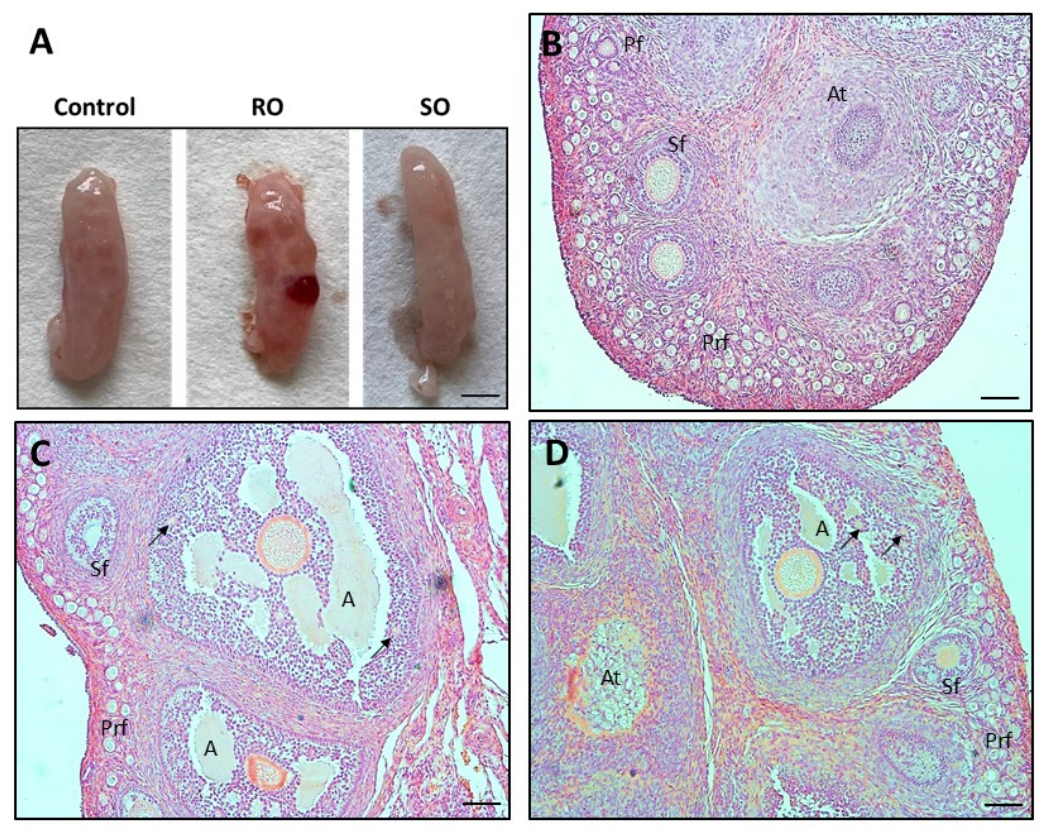
In all examined groups, primordial, primary, secondary, antral, and atretic follicles were observed (Figure 1B–D). There were significant differences in the number of primary and antral follicles following dietary supplementation with RO or SO: a decrease in the numbers of primary follicles was observed in both the RO (p = 0.04) and SO (p = 0.04) groups in comparison to the control group, while an increased number of antral follicles (p = 0.04) was only observed following RO supplementation (Table 2).

3.2. Effect of Dietary Supplementation with RO or SO on Plasma FSH, AMH and Steroid Concentrations

Dietary supplementation with RO and SO significantly increased FSH (p = 0.04 and p = 0.035, respectively) and AMH (p = 0.04 and p = 0.04, respectively) levels compared to the control diet (Table 3).
Regarding steroids, the RO and SO groups showed markedly increased plasma P4 concentrations (p = 0.03 and p = 0.02, respectively) in comparison to the control group. The E2 level was greater (p = 0.013) in the RO group than in the control and SO groups. The concentration of T was unchanged in both the RO and SO groups (Table 3).

3.3. Effect of Dietary Supplementation with RO or SO on FA Profile in Ovarian Tissue

Analysis of the FA profile in the ovarian tissue revealed pronounced changes following SO, but not RO, supplementation in comparison to the control diet (Table 4). Among SFAs, the lauric (p = 0.0097) and myristic (p = 0.005) acid contents were higher, while the amounts of stearic (p = 0.005) and arachidic acids (p = 0.049) were lower in comparison to the control group. Regarding MUFAs, the myristoleic (p = 0.005) and palmitoleic (p = 0.005) acid contents were greater than those of the control group. In addition, the level of cis-vaccenic acid was lower (p = 0.04) in the SO group compared to the RO group. Most PUFAs were decreased in the SO group compared to the control group, including dihomo-γ-linoleic acid (p = 0.018), arachidonic acid (p = 0.049), eicosapentaenoic acid (p = 0.049), adrenic acid (p = 0.007), and docosapentaenoic acid (p = 0.009). In contrast, the linoleic acid content was significantly higher (p = 0.018) than in the control group.

3.4. Effect of Dietary Supplementation with RO or SO on CD36, LPL, and SCD5 mRNA Abundance

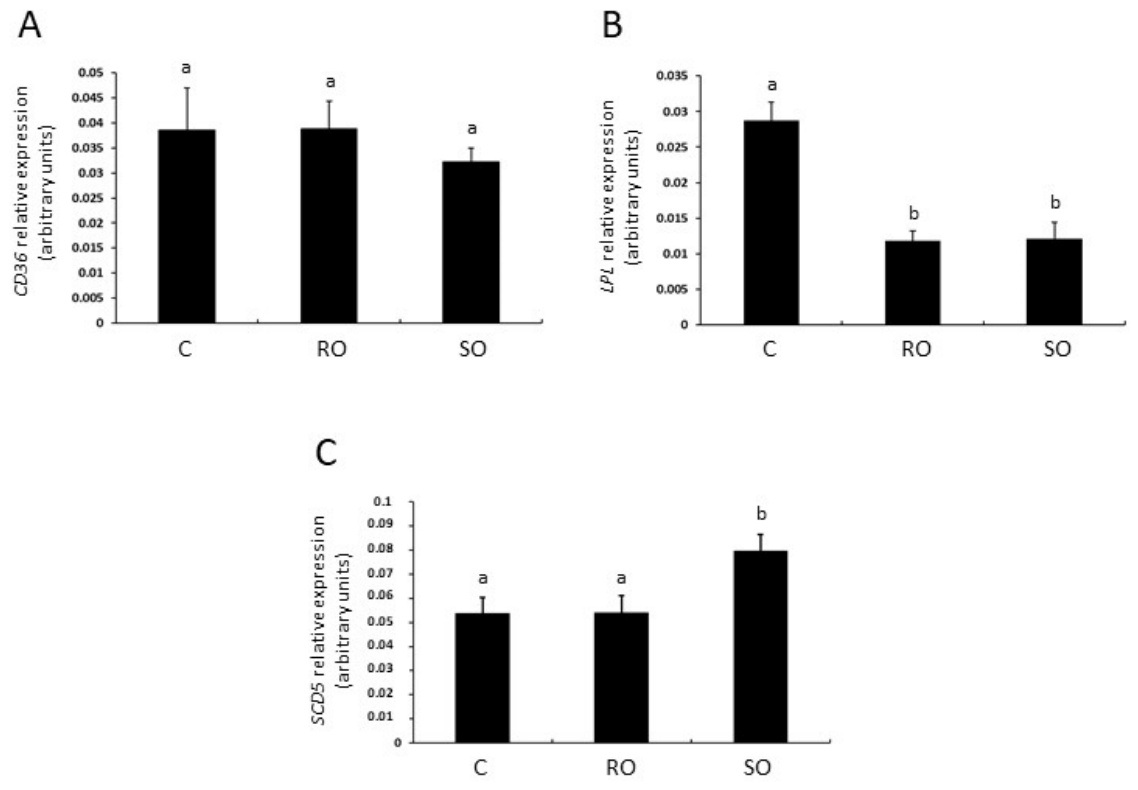
To examine the effect of the RO- and SO-supplemented diets on the ovarian expression of the genes encoding FA translocase (CD36), lipoprotein lipase (LPL), and stearoyl-CoA desaturase 5 (SCD5), real-time PCR analysis was conducted. In both groups, LPL mRNA transcript abundance was decreased (Figure 2B; p = 0.014 and p = 0.015, respectively) in comparison to the control group, whereas the CD36 transcript level was unaltered (Figure 2A). The SO group showed an increase in SCD5 mRNA transcript abundance compared to the control group (Figure 2C; p = 0.038).

4. Discussion

This study demonstrates, for the first time, that low-level dietary supplementation with RO or SO influences follicle development, hormonal parameters, and the FA profile in juvenile rabbit ovaries. Both oils affected the initial recruitment of ovarian follicles, while only RO influenced the cyclic recruitment of antral follicles. Notably, SO supplementation modified the ovarian FA profile, specifically by increasing the content of MUFAs and decreasing the amount of PUFAs, with the exception of an increased linoleic acid content, which might modulate the local ovarian microenvironment.
In the current study, we observed significant changes in the FA profile of rabbit ovarian tissues following SO supplementation. Among SFAs, SO increased the lauric and myristic acid levels while decreasing the stearic and arachidic acid contents. Evidence from studies on mice, cows, and pigs indicate that SFAs, such as stearic and palmitic acids, exert detrimental effects on ovarian granulosa cells via apoptosis induction [23,32,33]. Herein, we observed a tendency toward a greater number of atretic follicles following SO supplementation; however, these results were not statistically significant. In goats, lauric acid increases plasma E2 concentration during estrus [34]; this is in contrast to our findings. Although we observed a higher lauric acid content in the SO group, the E2 level remained unchanged. We also noted an increase in two MUFAs, namely myristoleic and palmitoleic acids. To explain this, we analyzed the expression of SCD5 mRNA, which is responsible for the conversion of SFAs into MUFAs [9], and found it to be up-regulated. Similarly, increased mRNA SCD5 abundance has been reported in the oocytes of dairy cows fed a diet supplemented with palmitoleic acid [35].
Furthermore, in the SO group, we observed decreased levels of several PUFAs: dihomo-γ-linoleic acid/DGLA, arachidonic acid, eicosapentaenoic acid, adrenic acid, and docosapentaenoic acid. The linoleic acid content in this group was greater compared to the control group, reflecting the FA composition of SO, which is particularly rich in this FA [17]. Despite similar chemical compositions, RO did not induce significant changes in the ovarian FA profile. This may be due to the substantially higher FA content in SO compared to RO (e.g., linoleic acid content: 581.45 g/kg in SO vs. 60.15 g/kg in RO; oleic acid content: 207.62 g/kg in SO vs. 24.88 g/kg in RO) [16,17], which might ultimately influence cellular metabolism and FA accumulation. In summary, our findings suggest that the ovarian tissue FA profile established following the SO supplementation might be important in determining ovarian function in juvenile rabbits.
The limiting step in cellular FA utilization is the hydrolysis of triglycerides from circulating lipoproteins by LPL [10]. In vivo studies demonstrated the effect of PUFAs on LPL gene expression, which varies depending on tissue type and metabolic demand [36]. Both RO and SO decreased LPL mRNA transcript abundance in the rabbit ovary, similar to findings in rats fed high-fat diets containing docosahexaenoic acid or a mix of eicosapentaenoic/docosahexaenoic acids, which showed reduced Lpl transcript abundance in retroperitoneal white adipose tissue [34]. The FAs released during triglyceride hydrolysis are subsequently transported into cells via various FA transporters, including CD36 [10]. In general, CD36 gene expression has been reported to be up-regulated by PUFAs; however, a stronger effect has been attributed to omega-3 than to omega-6 PUFAs [37]. In the current study, neither RO nor SO influenced CD36 mRNA transcript abundance in the rabbit ovary. These oils are predominantly rich in omega-6 PUFAs, which might not be able to exert a significant effect at the transcriptional level. Collectively, the down-regulation of LPL and unchanged CD36 transcript abundance indicate a lack of RO- and SO-induced effects on the plasma-derived FA uptake by ovarian cells in the rabbit.
Although we did not observe enhanced lipid transporter CD36 gene expression in the rabbit ovary, both RO and SO supplementation markedly increased plasma P4 concentrations without affecting T levels, suggesting the activation of early steroidogenesis. This is consistent with previous reports indicating a positive effect of UFAs on P4 production. Linoleic acid induces P4 synthesis by increasing the phosphorylation of mitogen-activated protein kinases (ERK1/2) in caprine granulosa cells [21]. Likewise, arachidonic acid has been shown to induce ERK and Akt phosphorylation, leading to elevated P4 production in bovine granulosa cells [38]. Thus, dietary supplementation with RO or SO appears to be sufficient to modulate the initial steps of steroidogenesis despite not increasing lipid delivery to the rabbit ovary.
FAs have been reported to influence ovarian function by affecting steroidogenesis, as well as granulosa cell proliferation and apoptosis, all of which are necessary for proper follicular development [6]. The early stages of ovarian folliculogenesis involve the initial recruitment of primordial follicles from the resting pool and inducing them to grow [39]. In the present study, both RO and SO supplementation reduced the number of primary follicles. This is in accordance with our previous research showing delayed primordial follicle transition into the primary stage following dietary algae (which is rich in omega-3 FAs) and sunflower oil (which is rich in omega-6 FAs) supplementation [27]. In the current study, this shift in follicular dynamics was accompanied by increased plasma AMH concentrations following the administration of both oils. AMH is known to inhibit initial recruitment of primordial follicles in humans [4]; however, its role in rabbit folliculogenesis remains poorly understood. Previous research examining the relationship between AMH concentrations, spay status, pseudopregnancy, and ovarian follicle numbers in female rabbits demonstrated a correlation between serum AMH levels and the number of secondary follicles, which are the primary source of AMH [40]. Our results indicate that RO and SO may affect early follicle growth in juvenile rabbits, potentially through the modulation of AMH concentrations.
Antral follicle development is FSH-dependent. Only follicles responsive to FSH stimulation can enter the final stage of maturation and eventually lead to ovulation. Furthermore, FSH enhances aromatase activity and subsequent E2 biosynthesis within the follicle [41]. In the current study, we found a greater number of antral follicles after RO supplementation, suggesting accelerated folliculogenesis at advanced stages. Additionally, we observed elevated plasma FSH and E2 concentrations, suggesting that RO might stimulate FSH-dependent follicular growth in the juvenile rabbit ovary. Similar results have been reported in studies showing that dietary supplementation with PUFAs enhances follicular maturation and steroidogenesis [11]. Unexpectedly, the addition of SO did not increase the number of antral follicles and E2 production despite the elevated FSH concentrations, indicating a different responsiveness of antral follicles to FSH. Alternatively, differences in the duration and magnitude of FSH stimulation following RO and SO administration may determine the number of follicles undergoing cyclic recruitment [41]. It is also possible that antral follicles are more sensitive to the altered ovarian FA profile caused by SO supplementation, which may modulate the ovarian microenvironment. It should be highlighted that we herein observed non-significant differences regarding the number of primordial and secondary follicles, despite large differences between means. This might be a result of an insufficient sample size to detect relevant differences; thus, conclusions about these variables cannot be clearly stated.
In this study, RO and SO were added to the food pellets, not extracted compounds from the oils. Therefore, we cannot definitely determine which oil’s component (phenolic compounds, tocols, tocopherols, tocotrienols or phytosterols [42]) was responsible for the observed effects or if they were partly due to synergistic actions. Furthermore, the limitation of the study might be the lack of chemical characterization of RO and SO besides FA profile. Although there are many active compounds in RO and SO, based on the literature, we mainly attributed the observed effects to FAs.

5. Conclusions

In summary, our study demonstrates, for the first time, the effects of low-level dietary supplementation with RO or SO on folliculogenesis, hormonal parameters, and the FA profile of the juvenile rabbit ovary. Both oils increased AMH concentration, which may contribute to the maintenance of the ovarian reserve by delaying the transition of primordial follicles to the primary stage. In addition, RO increased FSH levels, which might enhance the number of antral follicles undergoing cyclic recruitment and, consequently, E2 concentrations. Interestingly, we observed SO-induced changes in the ovarian FA profile, which may affect the ovarian microenvironment and, subsequently, key ovarian processes such as folliculogenesis and steroidogenesis. However, further mechanistic studies integrating transcriptomic, proteomic, and lipidomic analyses are needed to clarify the molecular pathways linking dietary RO or SO supplementation with ovarian physiology.

Author Contributions

Conceptualization, M.G. and S.P.; methodology, M.G.; validation, M.G. and K.M.; formal analysis, M.G. and K.M.; investigation, M.G., K.M., K.G. and M.K.; resources, M.G. and S.P.; data curation, M.G.; writing—original draft preparation, M.G.; writing—review and editing, M.G. and S.P.; visualization, M.G.; supervision, M.G.; funding acquisition, M.G. and S.P. All authors have read and agreed to the published version of the manuscript.

Funding

This research received no external funding.

Institutional Review Board Statement

All procedures were performed following the guidelines for animal experiments in European Union’s Directive (2010/63/EU) regarding the protection of animals used for experiments and Council Regulation (EC) n. 1099/2009 on the protection of animals at the time of sacrifice. All experimental protocols were approved by the 2nd Local Institutional Animal Care and Use Committee (IACUC) in Krakow (agreement No. 267/2018) and the Institutional Animal Care Review Board of the Faculty of Animal Sciences, University of Agriculture in Krakow (approval numbers: 29/2016, 37/2016 and 2/2018).

Informed Consent Statement

Not applicable.

Data Availability Statement

The data that support the findings of this study are available from the corresponding author upon request.

Acknowledgments

We extend our sincere gratitude to Henryk Pustkowiak (Department of Genetics, Animal Breeding and Ethology, University of Agriculture in Krakow, Krakow, Poland) for carrying out the fatty acid content analysis.

Conflicts of Interest

The authors declare no conflicts of interest.

References

  1. Richards, J.S.; Pangas, S.A. The ovary: Basic biology and clinical implications. J. Clin. Investig. 2010, 120, 963–972. [Google Scholar] [CrossRef]
  2. Sugiura, K.; Maruyama, N.; Akimoto, Y.; Matsushita, K.; Endo, T. Paracrine regulation of granulosa cell development in the antral follicles in mammals. Reprod. Med. Biol. 2023, 22, e12538. [Google Scholar] [CrossRef]
  3. Mikhael, S.; Punjala-Patel, A.; Gavrilova-Jordan, L. Hypothalamic-pituitary-ovarian axis disorders impacting female fertility. Biomedicines 2019, 7, 5. [Google Scholar] [CrossRef]
  4. di Clemente, N.; Racine, C.; Pierre, A.; Taieb, J. Anti-Müllerian hormone in female reproduction. Endocr. Rev. 2021, 42, 753–782. [Google Scholar] [CrossRef] [PubMed]
  5. Hutt, K.J.; McLaughlin, E.A.; Holland, M.K. Primordial follicle activation and follicular development in the juvenile rabbit ovary. Cell Tissue Res. 2006, 326, 809–822. [Google Scholar] [CrossRef]
  6. Baddela, V.S.; Sharma, A.; Vanselo, J. Non-esterified fatty acids in the ovary: Friends or foes? Reprod. Biol. Endocrinol. 2020, 18, 60. [Google Scholar] [CrossRef] [PubMed]
  7. Harayama, T.; Shimizu, T. Roles of polyunsaturated fatty acids, from mediators to membranes. J. Lipid Res. 2020, 61, 1150–1160. [Google Scholar] [CrossRef] [PubMed]
  8. Tvrzicka, E.; Kremmyda, L.S.; Stankova, B.; Zak, A. Fatty acids as biocompounds: Their role in human metabolism, health and disease—A review. Part 1: Classification, dietary sources and biological functions. Biomed. Pap. Med. Fac. Univ. Palacky Olomouc Czech Repub. 2011, 155, 117–130. [Google Scholar] [CrossRef]
  9. Lee-Okada, H.C.; Xue, C.; Yokomizo, T. Recent advances on the physiological and pathophysiological roles of polyunsaturated fatty acids and their biosynthetic pathway. Biochim. Biophys. Acta Mol. Cell Biol. Lipids 2025, 1870, 159564. [Google Scholar] [CrossRef]
  10. Wu, S.A.; Kersten, S.; Qi, L. Lipoprotein lipase and its regulators: An unfolding story. Trends Endocrinol. Metab. 2021, 32, 48–61. [Google Scholar] [CrossRef]
  11. Wathes, D.C.; Abayasekara, D.R.; Aitken, R.J. Polyunsaturated fatty acids in male and female reproduction. Biol. Reprod. 2007, 77, 190–201. [Google Scholar] [CrossRef]
  12. Zeng, X.; Li, S.; Liu, L.; Cai, S.; Ye, Q.; Xue, B.; Wang, X.; Zhang, S.; Chen, F.; Cai, C.; et al. Role of functional fatty acids in modulation of reproductive potential in livestock. J. Anim. Sci. Biotechnol. 2023, 14, 24. [Google Scholar] [CrossRef]
  13. Shi, M.; Sirard, M.A. Metabolism of fatty acids in follicular cells, oocytes, and blastocysts. Reprod. Fertil. 2022, 3, R96–R108. [Google Scholar] [CrossRef]
  14. Kaseke, T.; Opara, U.L.; Fawole, O.A. Fatty acid composition, bioactive phytochemicals, antioxidant properties and oxidative stability of edible fruit seed oil: Effect of preharvest and processing factors. Heliyon 2020, 6, e04962. [Google Scholar] [CrossRef]
  15. Choe, U.; Childs, H.; Zeng, M.; Zheng, W.; Zhu, H.; Zhu, L.; Xie, Z.; Gao, B.; Yu, L. Value-added utilization of fruit seed oils for improving human health: A progress review. ACS Food Sci. Technol. 2023, 3, 528–538. [Google Scholar] [CrossRef]
  16. Pałka, S.E.; Siudak, Z.; Kmiecik, M.; Migdał, Ł.; Otwinowska-Mindur, A.; Grzesiak, M. A study on the modifying effect of raspberry seed oil on rabbit meat quality and chemical composition. Animals 2024, 14, 1150. [Google Scholar] [CrossRef] [PubMed]
  17. Pałka, S.E.; Siudak, Z.; Kmiecik, M.; Otwinowska-Mindur, A.; Grzesiak, M. A preliminary study on the modifying effect of strawberry seed oil and sex on rabbit meat quality. Animals 2024, 14, 3234. [Google Scholar] [CrossRef]
  18. Vanholder, T.; Leroy, J.L.; Soom, A.V.; Opsomer, G.; Maes, D.; Coryn, M.; de Kruif, A. Effect of non-esterified fatty acids on bovine granulosa cell steroidogenesis and proliferation in vitro. Anim. Reprod. Sci. 2005, 87, 33–44. [Google Scholar] [CrossRef] [PubMed]
  19. Jorritsma, R.; Cesar, M.; Hermans, J.; Kruitwagen, C.; Vos, P.; Kruip, T. Effects of non-esterified fatty acids on bovine granulosa cells and developmental potential of oocytes in vitro. Anim. Reprod. Sci. 2004, 81, 225–235. [Google Scholar] [CrossRef]
  20. Mu, Y.M.; Yanase, T.; Nishi, Y.; Tanaka, A.; Saito, M.; Jin, C.H.; Mukasa, C.; Okabe, T.; Nomura, M.; Goto, K.; et al. Saturated FFAs, palmitic acid and stearic acid, induce apoptosis in human granulosa cells. Endocrinology 2001, 142, 3590–3597. [Google Scholar] [CrossRef] [PubMed]
  21. Coyral-Castel, S.; Rame, C.; Fatet, A.; Dupont, J. Effects of unsaturated fatty acids on progesterone secretion and selected protein kinases in goat granulosa cells. Domest. Anim. Endocrinol. 2010, 38, 272–283. [Google Scholar] [CrossRef] [PubMed]
  22. Sharma, I.; Singh, D. Conjugated linoleic acids attenuate FSH-and IGF1-stimulated cell proliferation; IGF1, GATA4, and aromatase expression; and estradiol-17β production in buffalo granulosa cells involving PPARγ, PTEN, and PI3K/Akt. Reproduction 2012, 144, 373–383. [Google Scholar] [CrossRef]
  23. Sharma, A.; Baddela, V.S.; Becker, F.; Dannenberger, D.; Viergutz, T.; Vanselow, J. Elevated free fatty acids affect bovine granulosa cell function: A molecular cue for compromised reproduction during negative energy balance. Endocr. Connect. 2019, 8, 493–505. [Google Scholar] [CrossRef]
  24. Shivyari, F.T.; Pakniat, H.; Nooshabadi, M.R.; Rostami, S.; Haghighian, H.K.; Shiri-Shahsavari, M.R. Examining the oleoylethanolamide supplement effects on glycemic status, oxidative stress, inflammation, and anti-mullerian hormone in polycystic ovary syndrome. J. Ovarian. Res. 2024, 17, 111. [Google Scholar] [CrossRef]
  25. AOAC International. Official Methods of Analysis; AOAC International: Gaithersburg, MD, USA, 2005. [Google Scholar]
  26. Wiseman, J.; Villamide, M.-J.; de Blas, C.; Carabaño, M.-J.; Carabaño, R.M. Prediction of the digestible energy and digestibility of gross energy of feeds for rabbits. 1. Individual classes of feeds. Anim. Feed Sci. Technol. 1992, 39, 27–38. [Google Scholar] [CrossRef]
  27. Grzesiak, M.; Maj, D.; Hrabia, A. Effects of dietary supplementation with algae, sunflower oil or soybean oil on folliculogenesis in the rabbit ovary during sexual maturation. Acta Histochem. 2020, 122, 151581. [Google Scholar] [CrossRef]
  28. Grzesiak, M.; Kapusta, K.; Kaminska, K.; Pałka, S.; Kmiecik, M.; Zubel-Lojek, J. Effect of dietary supplementation with nettle or fenugreek on folliculogenesis and steroidogenesis in the rabbit ovary—An in vivo study. Theriogenology 2021, 173, 1–11. [Google Scholar] [CrossRef] [PubMed]
  29. Folch, J.; Lees, M.; Stanley, G.H.S. A simple method for the isolation and purification of total lipids from animal tissues. J. Biol. Chem. 1957, 226, 497–509. [Google Scholar] [CrossRef]
  30. Maj, D.; Grzesiak, M. Changes in rabbit meat texture and calpain system genes expression following dietary supplementation with algae or vegetable oils. Anim. Sci. Pap. Rep. 2024, 42, 271–284. [Google Scholar] [CrossRef]
  31. Livak, K.J.; Schmittgen, T.D. Analysis of relative gene expression data using real-time quantitative PCR and the 2−ΔΔCt method. Methods 2001, 25, 402–408. [Google Scholar] [CrossRef]
  32. Chen, Z.; Lei, L.; Wen, D.; Yang, L. Melatonin attenuates palmitic acid-induced mouse granulosa cells apoptosis via endoplasmic reticulum stress. J. Ovarian Res. 2019, 12, 43. [Google Scholar] [CrossRef]
  33. Shibahara, H.; Ishiguro, A.; Inoue, Y.; Koumei, S.; Kuwayama, T.; Iwata, H. Mechanism of palmitic acid-induced deterioration of in vitro development of porcine oocytes and granulosa cells. Theriogenology 2020, 141, 54–61. [Google Scholar] [CrossRef]
  34. Nugroho, P.; Wiryawan, K.G.; Astuti, D.A.; Manalu, W. Stimulation of follicle growth and development during estrus in Ettawa grade does fed a flushing supplement of different polyunsaturated fatty acids. Vet. World 2021, 14, 11–22. [Google Scholar] [CrossRef] [PubMed]
  35. Plante-Dubé, M.; Picard, C.; Gilbert, I.; Robert, C.; Fievez, V.; Vlaeminck, B.; Belleannée, C.; Gervais, R.; Chouinard, P.Y. Effects of a dietary supplement enriched in palmitoleic acid on fatty acid composition of follicular fluid, granulosa cell metabolism, and oocyte developmental capacity in early lactation dairy cows. J. Dairy Sci. 2021, 104, 3693–3706. [Google Scholar] [CrossRef] [PubMed]
  36. McTavish, P.V.; Mutch, D.M. Omega-3 fatty acid regulation of lipoprotein lipase and FAT/CD36 and its impact on white adipose tissue lipid uptake. Lipids Health Dis. 2024, 23, 386. [Google Scholar] [CrossRef]
  37. Raclot, T.; Groscolas, R.; Langin, D.; Ferré, P. Site-specific regulation of gene expression by n-3 polyunsaturated fatty acids in rat white adipose tissues. J. Lipid Res. 1997, 38, 1963–1972. [Google Scholar] [CrossRef]
  38. Zhang, N.; Wang, L.; Luo, G.; Tang, X.; Ma, L.; Zheng, Y.; Liu, S.; Price, C.A.; Jiang, Z. Arachidonic acid regulation of intracellular signaling pathways and target gene expression in bovine ovarian granulosa cells. Animals 2019, 9, 374. [Google Scholar] [CrossRef] [PubMed]
  39. Monget, P.; McNatty, K.; Monniaux, D. The crazy ovary. Genes 2021, 12, 928. [Google Scholar] [CrossRef]
  40. Böhmer, F.; Erber, K.; Ewringmann, A.; Klein, R.; Reese, S.; Böhmer, C.; Meyer-Lindenberg, A.; Walter, B. Anti-Müllerian hormone concentrations in female rabbits and its relation to spay status, pseudopregnancy and ovarian follicle numbers. Reprod. Domest. Anim. 2022, 57, 1636–1643. [Google Scholar] [CrossRef]
  41. Macklon, N.S.; Fauser, B.C. Follicle-stimulating hormone and advanced follicle development in the human. Arch. Med. Res. 2001, 32, 595–600. [Google Scholar] [CrossRef]
  42. Pieszka, M.; Tombarkiewicz, B.; Roman, A.; Migdał, W.; Niedziółka, J. Effect of bioactive substances found in rapeseed, raspberry and strawberry seed oils on blood lipid profile and selected parameters of oxidative status in rats. Environ. Toxicol. Pharmacol. 2013, 36, 1055–1062. [Google Scholar] [CrossRef] [PubMed]
Figure 1. Representative photographs of the ovaries obtained from juvenile rabbits with visible antral follicles filled with follicular fluid. Bar = 10 mm (A). Histology of the ovaries from rabbits fed a control diet (B) or a diet supplemented with 1% RO (C) or 1% SO (D). Bar = 50 µm. A, antral follicle; At, atretic follicle; Prf, primordial follicle; Pf, primary follicle; RO, raspberry seed oil; Sf, secondary follicle; SO, strawberry seed oil; → Call-Exner bodies.
Animals 16 01528 g001
Figure 2. The mRNA transcript abundance of fatty acid translocase ((A); CD36), lipoprotein lipase ((B); LPL), and stearoyl-CoA desaturase 5 ((C); SCD5) in the ovaries of juvenile rabbits fed a control diet (C) or a diet supplemented with raspberry (RO) or strawberry (SO) seed oil. The mRNA abundance was determined using quantitative real-time PCR, and is expressed as 2–ΔCt values relative to ACTB (β-actin). Different superscript letters denote statistically significant differences among groups (p < 0.05; Dunn’s multiple comparison test). n = 6/group.
Animals 16 01528 g002
Table 1. Ingredients and chemical composition of rabbit diets (%).
Treatment
ControlROSO
Ingredient
Wheat29.5828.5828.58
Maize24.5024.5024.50
Bran15.0015.0015.00
Sunflower meal11.0011.0011.00
Lucerne meal 10.0010.0010.00
Soybean meal7.007.007.00
Mineral and vitamin premix1.501.501.50
Calcium carbonate0.800.800.80
Dicalcium phosphate0.620.620.62
Raspberry seed oil -1.00-
Strawberry seed oil--1.00
Chemical component
Dry matter 89.0789.1289.03
Crude ash7.407.277.39
Total nitrogen2.572.542.50
Total protein16.4215.9616.00
Crude fat3.904.024.11
Crude fiber14.6214.3914.96
Estimated digestible
energy [MJ/kg]
9.29.49.5
RO, raspberry seed oil-treated group; SO, strawberry seed oil-treated group. Each treatment (diet) contains (per kilogram): 10.000 IU of vitamin A; 1.500 IU of vitamin D3; 30 mg of vitamin E; 7.5 mg of Cu; 50 mg of Fe; 75 mg of Mn; 50 mg of Zn; 1.0 mg of I; 0.2 mg of Se. For estimation of digestible energy (DE), the following equation was used: DE = 12.912 − 0.0236CF + 0.010CP + 0.020EE, where CF is crude fiber, CP is crude protein, and EE is ether extract/crude fat (all in g/kg DM) [26].
Table 2. Effects of dietary supplementation with raspberry (RO) or strawberry (SO) seed oil on the number of follicles (mean ± SEM) in the rabbit ovary (n = 6/group).
TreatmentFollicle Number (Mean ± SEM)
PrimordialPrimarySecondaryAntralAtretic
Control151.2 ± 57.88.5 ± 1.5 a 6.5 ± 2.83.66 ± 1.75 a1.2 ± 0.6
RO117.5 ± 48.03.8 ± 2.6 b13.5 ± 6.56.66 ± 3.14 b1.5 ± 1.2
SO112.2 ± 20.64.0 ± 2.0 b 9.8 ± 5.85.16 ± 1.16 a2.5 ± 1.7
Different superscript letters denote statistically significant differences among groups (p < 0.05; Dunn’s multiple comparison test).
Table 3. The plasma concentrations (mean ± SEM) of progesterone (P4), testosterone (T), estradiol-17β (E2), follicle-stimulating hormone (FSH) and anti-Müllerian hormone (AMH) in rabbits fed a control diet or a diet supplemented with raspberry (RO) or strawberry (SO) seed oil (n = 6/group).
P4 (ng/mL)T (ng/mL)E2 (pg/mL)FSH (mIU/mL)AMH (pg/mL)
Control0.55 ± 0.24 a0.52 ± 0.09112.5 ± 18.2 a44.85 ± 10.09 a3484.25 ± 475 a
RO1.32 ± 0.16 b0.46 ± 0.12229.65 ± 11.64 b56.05 ± 3.8 b4232 ± 711 b
SO1.58 ± 0.2 b0.45 ± 0.1489.76 ± 11.9 ab65.19 ± 10.04 b4141.5 ± 186 b
Different superscript letters denote statistically significant differences among groups (p < 0.05; Dunn’s multiple comparison test).
Table 4. Effects of dietary supplementation with raspberry (RO) or strawberry (SO) seed oil on the fatty acid profile (mean ± SEM) in the rabbit ovary (n = 4/group).
Fatty Acids (%)Treatment
ControlROSO
Saturated fatty acids (SFAs)10:0 (decanoic acid)0.12 ± 0.0120.14 ± 0.0070.15 ± 0.048
12:0 (lauric acid)0.27 ± 0.38 a0.36 ± 0.076 ab0.96 ± 0.016 b
14:0 (myristic acid)1.34 ± 0.131 a1.77 ± 0.07 ab3.05 b ± 0.025
15:0 (pentadecanoic acid)0.47 a ± 0.0230.45 a ± 0.0090.54 ± 0.008 a
16:0 (palmitic acid)22.08 ± 0.05522.69 ± 0.67322.74 ± 1.624
17:0 (heptadecanoic acid)0.73 ± 0.0370.63 ± 0.0080.60 ± 0.016
18:0 (stearic acid)14.29 ± 0.609 a11.98 ± 0.22 ab7.74 ± 0.37 b
20:0 (arachidic acid)0.22 ± 0.011 a0.17 ± 0.007 ab0.13 ± 0.012 b
Monounsaturated fatty acids (MUFAs)14:1 (myristoleic acid)0.05 ± 0.002 a0.11 ± 0.006 ab0.25 ± 0.025 b
16:1 n-9 (palmitoleic acid)0.59 ± 0.0460.60 ± 0.0360.44 ± 0.11
16:1 n-7 (palmitoleic acid)0.88 ± 0.029 a1.87 ± 0.145 ab2.43 ± 0.13 b
17:1 (heptadecenoic acid)0.23 ± 0.0080.25 ± 0.0270.26 ± 0.037
18:1 n-9 (oleic acid)22.57 ± 1.1825.04 ± 0.66226.44 ± 0.803
18:1 n-7 (cis-vaccenic acid)1.37 ± 0.064 ab1.40 ± 0.022 a1.05 ± 0.046 b
20:1 (eicosenoic acid)0.42 ± 0.0190.44 ± 0.0360.32 ± 0.015
Polyunsaturated fatty acids (PUFAs)18:2 n-6 (linoleic acid)13.94 ± 0.884 a16.36 ± 1.141 ab25.96 ± 2.128 b
18:3 n-6 (γ-linolenic acid/GLA)0.16 ± 0.0020.15 ± 0.0110.08 ± 0.001
18:3 n-3 (α-linolenic acid/ALA)0.72 ± 0.130.88 ± 0.0231.66 ± 0.15
CLA (rumenic acid)0.03 ± 0.0090.03 ± 0.0070.03 ± 0.06
20:2 (eicosadienoic acid)0.71 ± 0.0950.66 ± 0.0160.36 ± 0.06
20:3 n-6 (dihomo-γ-linoleic acid/DGLA)1.46 ± 0.165 a1.15 ± 0.068 ab0.40 ± 0.046 b
20:4 n-6 (arachidonic acid)10.70 ± 0.865 a7.88 ± 0.518 ab2.73 ± 0.169 b
20:4 n-3 (eicosatetraenoic acid)0.04 ± 0.0020.05 ± 0.0020.03 ± 0.003
20:5 n-3 (eicosapentaenoic acid/EPA)0.26 ± 0.042 a0.12 ± 0.008 ab0.01 ± 0.001 b
22:4 n-6 (adrenic acid)3.78 ± 0.404 a2.74 ± 0.182 ab1.01 ± 0.102 b
22:5 n-6 (osbond acid)1.07 ± 0.0150.80 ± 0.0780.27 ± 0.014
22:5 n-3 (docosapentaenoic acid)1.09 ± 0.085 a0.85 ± 0.057 ab0.26 ± 0.007 b
22:6 n-3 (docosahexaenoic acid/DHA)0.35 ± 0.0350.38 ± 0.0890.06 a± 0.006
Total99.95 ± 0.00799.95 ± 0.00599.98 ± 0.002
Different superscript letters denote statistically significant differences among groups (p < 0.05; Dunn’s multiple comparison test).
Disclaimer/Publisher’s Note: The statements, opinions and data contained in all publications are solely those of the individual author(s) and contributor(s) and not of MDPI and/or the editor(s). MDPI and/or the editor(s) disclaim responsibility for any injury to people or property resulting from any ideas, methods, instructions or products referred to in the content.