The More the Better: Genetic Monitoring of Paracentrotus lividus (Lamarck, 1816) Experimental Restockings in Sardinia (Western Mediterranean Sea)
by
 , , , and
Simone Di Crescenzo
1,†,
Chiara Pani
1,†,
Viviana Pasquini
1,
Marco Maxia
2,
Pierantonio Addis
1,* and
and
Rita Cannas
1,* 1
Department of Life and Environmental Sciences, University of Cagliari, 09126 Cagliari, Italy
2
Agris, Agricultural Research Agency of Sardinia, Loc. Bonassai S.S. 291 Sassari-Fertilia—Km. 18,600, 07100 Sassari, Italy
*
Authors to whom correspondence should be addressed.
†
These authors contributed equally to this work.
Animals 2025, 15(4), 554; https://doi.org/10.3390/ani15040554
Submission received: 14 January 2025
/
Revised: 7 February 2025
/
Accepted: 10 February 2025
/
Published: 14 February 2025
Simple Summary
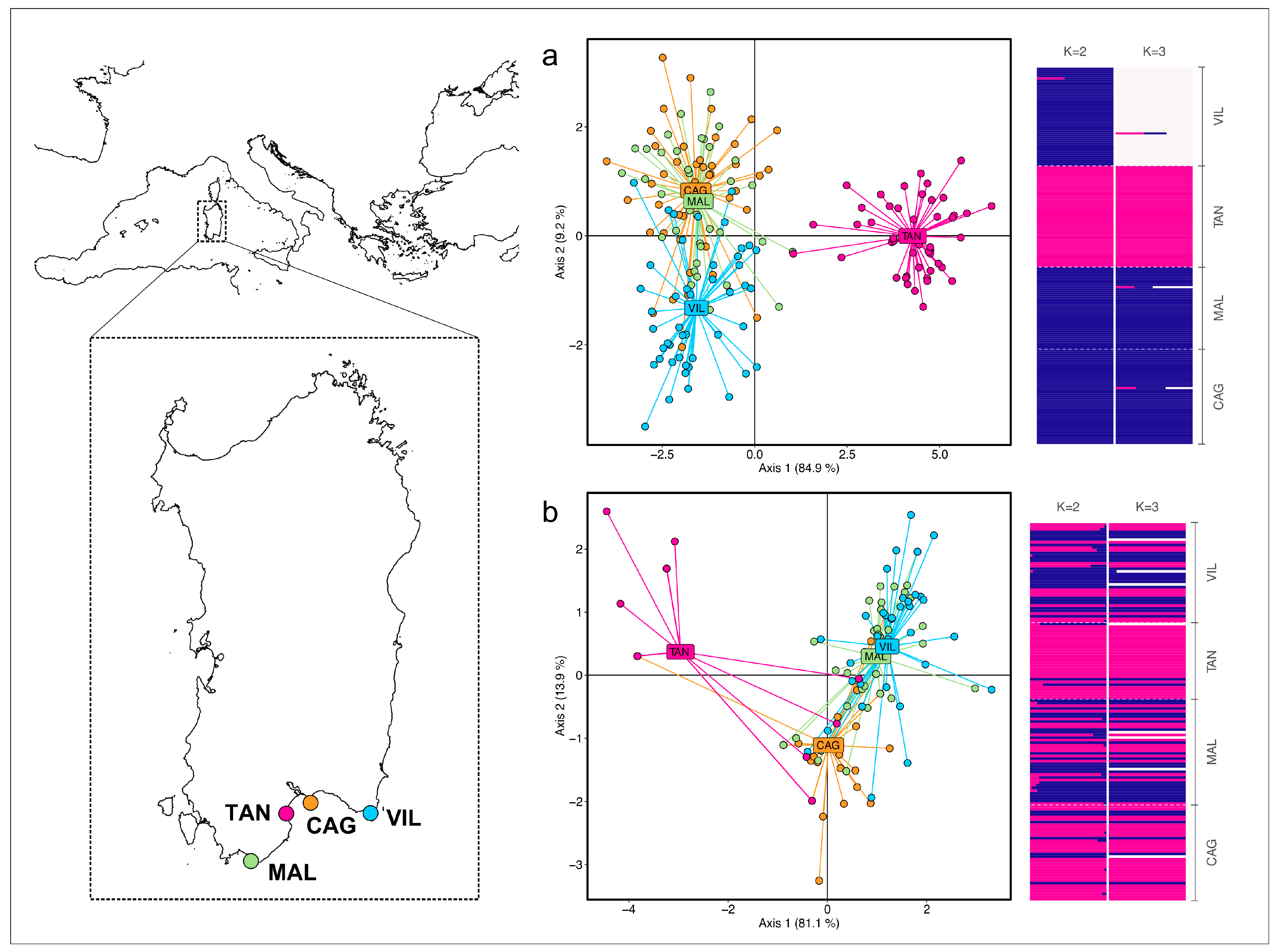
The common purple sea urchin, Paracentrotus lividus, is a widely distributed species in the Mediterranean Sea and the North-East Atlantic Ocean. In recent years, it has been heavily exploited for human consumption, with a drastic reduction in its abundance and increasing interest in the experimental farming of it for commercial and restoration purposes. Using genetic tools, the present research aimed at characterizing the Sardinian wild populations and the genetic differences between wild and hatchery-reared individuals. A substantial reduction in genetic diversity and differentiation from the wild populations was found in the sea urchins from the hatchery, characterized by a very small genetic diversity as well as a high degree of relatedness. The results clearly indicate that the breeders used in the hatchery were insufficient to represent the wild populations; hence, larger numbers should be used in future rearing attempts. Overall, the wild Sardinian populations appear to be weakly differentiated, suggesting a large degree of gene flow between them.
Abstract
Paracentrotus lividus is a widely distributed species in the Mediterranean Sea and North-East Atlantic Ocean, where it plays an important ecological and commercial role. The growing demand for its delicious gonads has rapidly led to the overexploitation of the natural populations around Sardinia (western Mediterranean). The present research aimed at understanding the population genetics of the species within the area, and at gathering data on the juveniles produced in an experimental ‘conservation hatchery’ facility. A multilocus approach was used, combining mitochondrial genes (COI and Cytb) and microsatellite markers. Overall, both the microsatellites and mitochondrial results indicate that the hatchery-produced juveniles were less genetically diverse and significantly divergent from the wild populations, most likely because of a bottleneck effect due to the insufficient number of parental breeders used. As concerns the wild populations, despite the high harvesting pressure, they still have a good quantity of genetic variation. A weak overall differentiation was found, suggesting extensive gene flow among the sites. However, the differentiation in the pairwise comparisons between the wild Sardinian samples was found to be significant with regard to the mitochondrial sequences, to be further investigated with additional studies. These data provide the scientific knowledge necessary to inform future management actions and to improve future aquaculture protocols.