Establishment and Biological Characteristics Analysis of a Hybrid Culter Lineage from Megalobrama amblycephala (♀) and Culter alburnus (♂)


 and
and
Simple Summary
Abstract
1. Introduction
2. Materials and Methods
2.1. Ethics Statement
2.2. Hybrid Lineage Establishment and Sample Collection
2.3. Measurement of DNA Content and Preparation of Chromosomal Metaphase Spreads
2.4. Analysis of Morphological Traits
2.5. DNA Extraction, Amplification, and Sequencing of ITS
2.6. MSAP Analysis
2.7. Transcriptome Analysis
3. Results
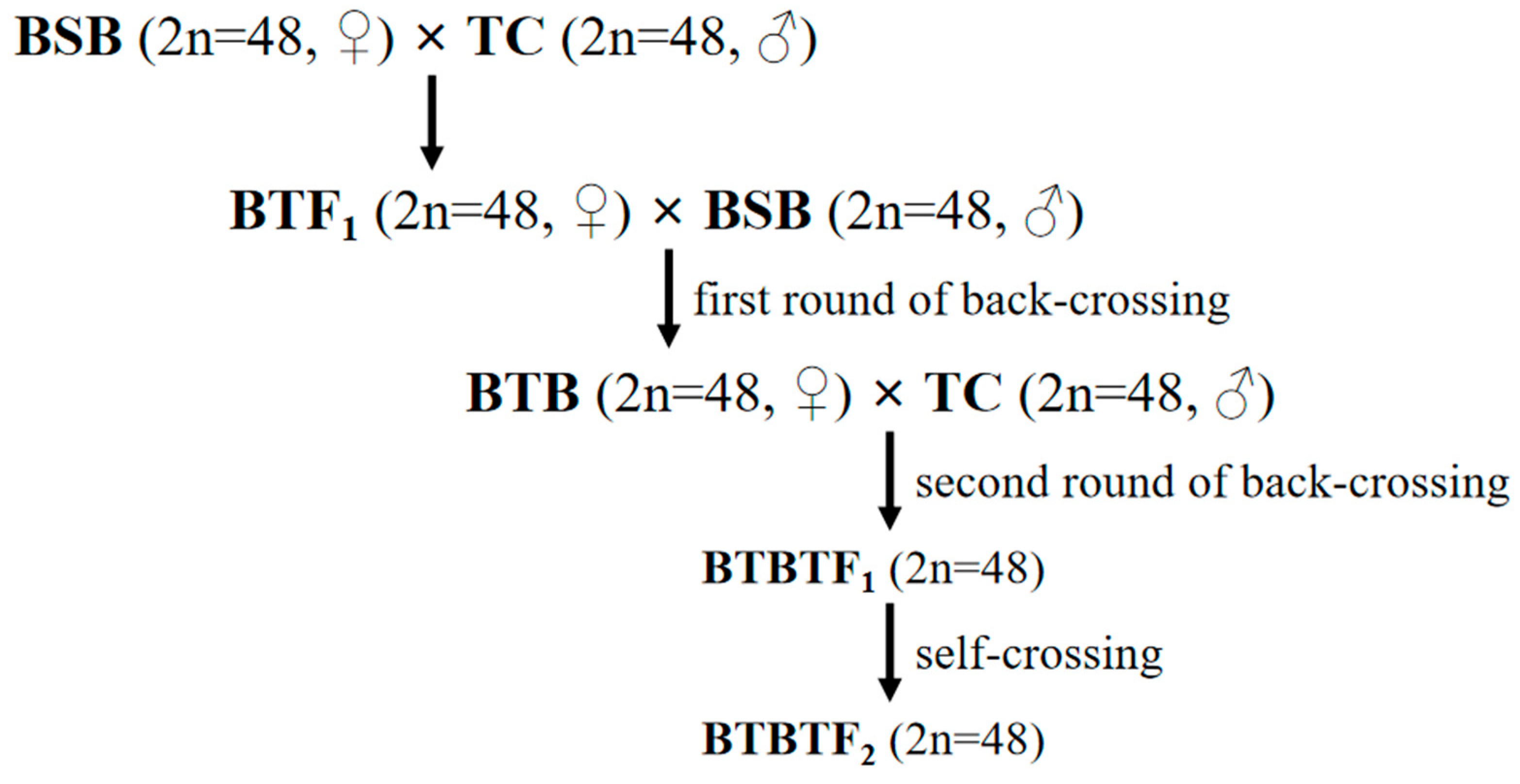
3.1. Hybrid Lineage Establishment
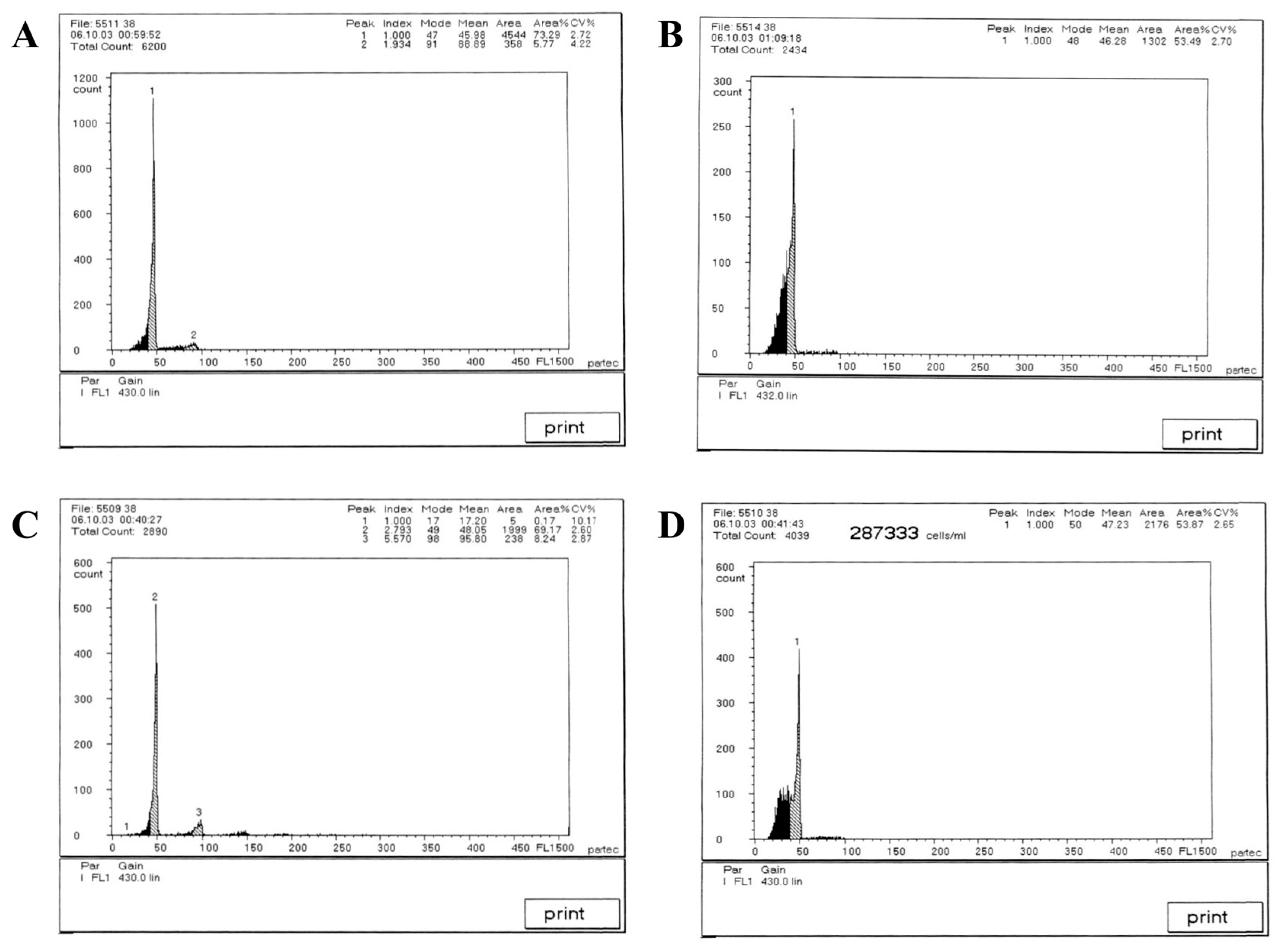
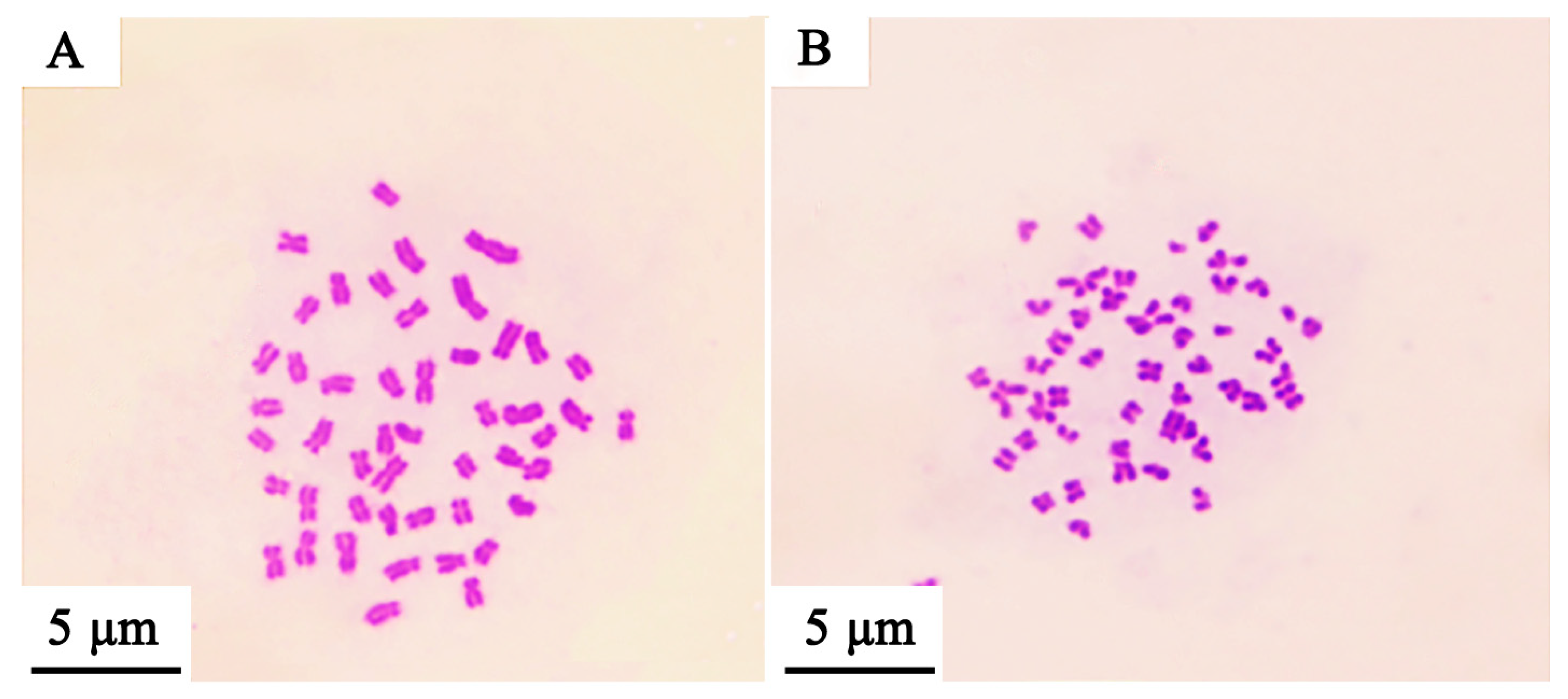
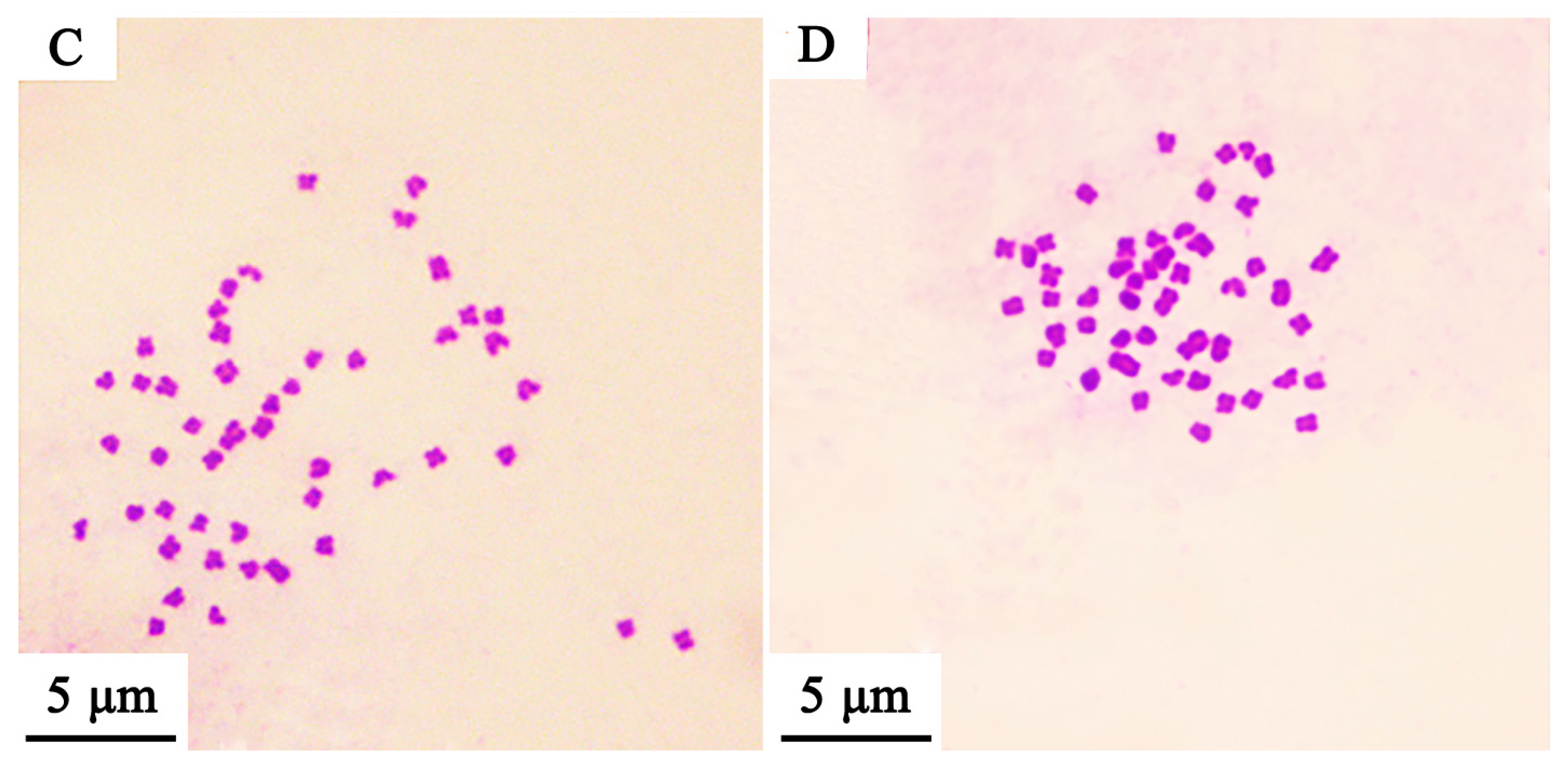
3.2. DNA Content and Chromosome Number
3.3. Morphological Traits
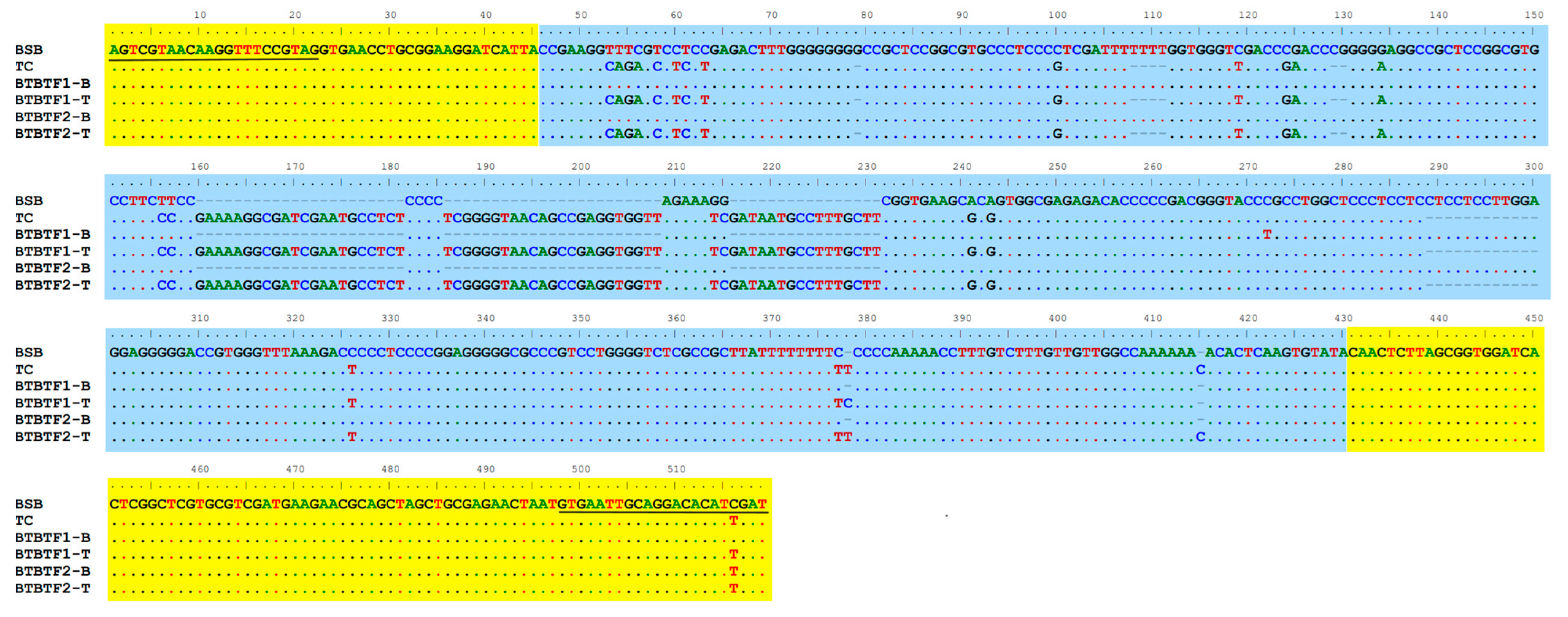
3.4. ITS Sequence Sequencing Results and Analysis
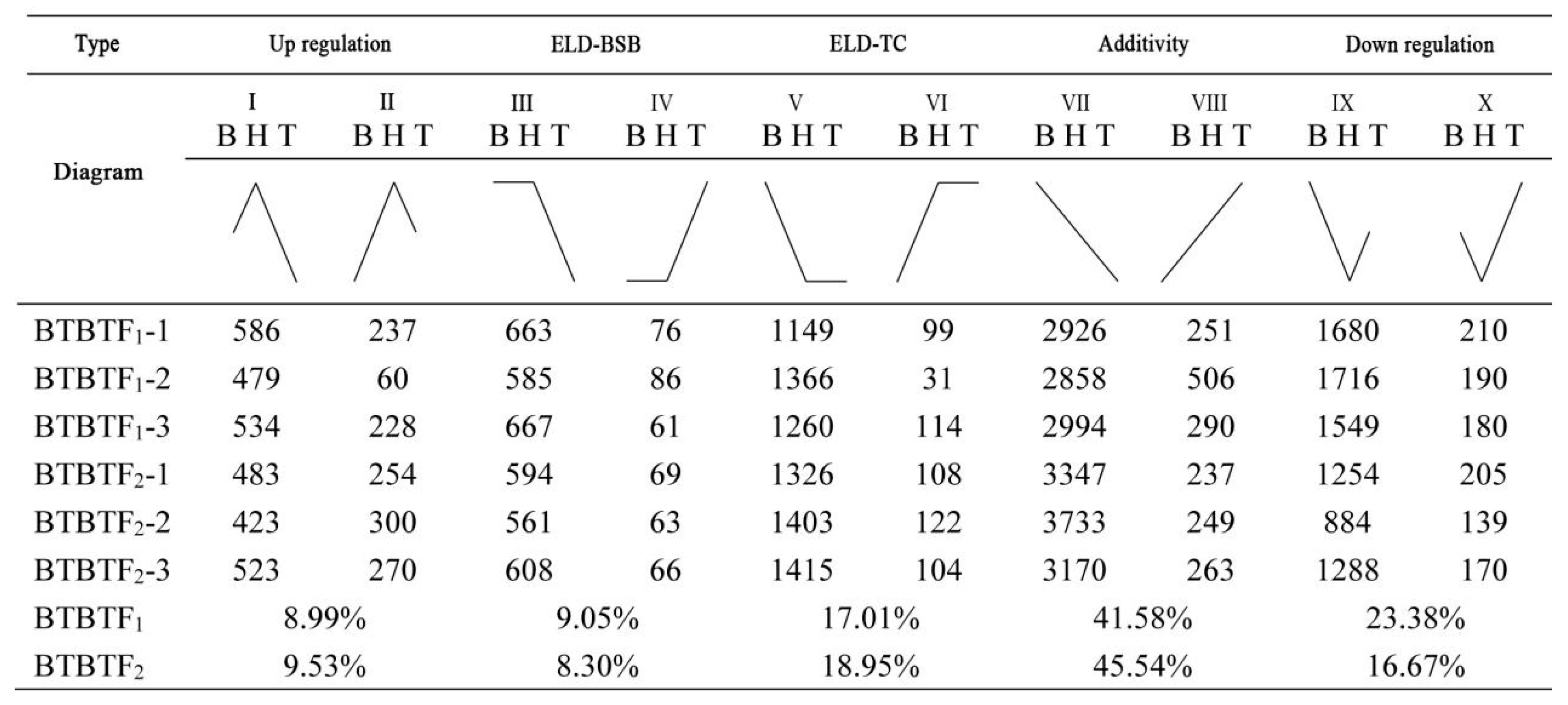
3.5. MSAP Analysis
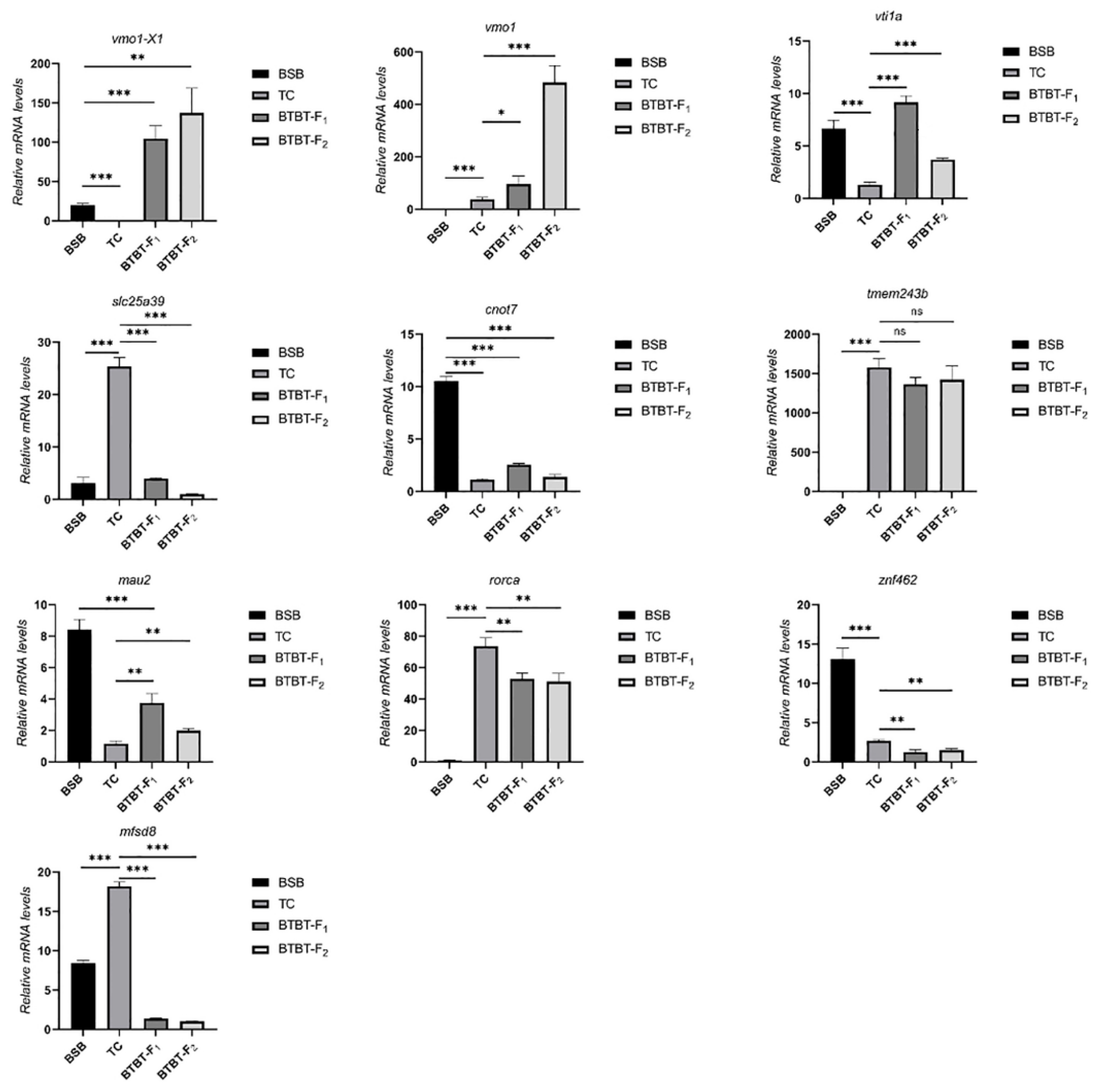
3.6. Transcriptome Analysis
4. Discussion
5. Conclusions
Author Contributions
Funding
Institutional Review Board Statement
Informed Consent Statement
Data Availability Statement
Acknowledgments
Conflicts of Interest
References
- Zhu, D.; Li, Q.; Wang, G.; Sun, Y.; Chen, J.; Li, P. The complete mitochondrial genome of the hybrid of Culter alburnus (♀) × Ancherythroculter nigrocauda (♂). Mitochondrial DNA 2016, 27, 1171–1172. [Google Scholar] [CrossRef]
- Zhang, G.; Fang, D.; Xue, X.; Zhang, M.; Feng, X.; Yang, X. Culter alburnus Basilewsky in different populations: Genetic diversity analysis based on Cytochrome B (Cyt b) gene. Chin. Agric. Sci. Bull. 2021, 37, 118–124. [Google Scholar]
- Huang, Y.; Gong, W.; Ren, H.; Xiong, J.; Gao, X.; Sun, X. Identification of the conserved and novel microRNAs by deep sequencing and prediction of their targets in Topmouth culter. Gene 2017, 626, 298–304. [Google Scholar] [CrossRef]
- Wang, Y.; Ren, L.; Xu, D.-P.; Fang, D.-A. Exploring the trophic niche characteristics of four carnivorous Cultrinae fish species in Lihu Lake, Taihu Basin, China. Front. Ecol. Evol. 2022, 10, 954231. [Google Scholar] [CrossRef]
- Chen, J.; Luo, M.; Li, S.; Tao, M.; Ye, X.; Duan, W.; Zhang, C.; Qin, Q.; Xiao, J.; Liu, S. A comparative study of distant hybridization in plants and animals. Sci. China Life Sci. 2018, 61, 285–309. [Google Scholar] [PubMed]
- Rahman, M.A.; Lee, S.G.; Yusoff, F.M.; Rafiquzzaman, S. Hybridization and its application in aquaculture. Sex Control Aquac. 2018, 163–178. [Google Scholar]
- Wang, M.; Ou, Y.; Guo, Z.; Li, J.; Li, H.; Li, X.; Li, J.; Wang, S.; Liu, Q.; Wang, J.; et al. Characterization of allodiploid and allotriploid fish derived from hybridization between Cyprinus carpio haematopterus (♀) and Gobiocypris rarus (♂). Reprod. Breed. 2024, 4, 46–54. [Google Scholar] [CrossRef]
- Zhang, X.; Liu, F.; Li, B.; Yu, J.; Duan, L.; Huang, Z.; Zhou, Z.; Shu, Y.; Lin, J.; Xiong, X.; et al. Comparative analysis of nutrients in muscle and ovary between an improved fish and its parents. Reprod. Breed. 2024, 4, 16–21. [Google Scholar] [CrossRef]
- Goswami, M.; Kuchay, M.A. Chapter-12 Hybridization: Importance, Techniques and Consequences. Recent Trends Agric. 2023, 185, 321. [Google Scholar]
- Qin, Q.; Wang, Y.; Wang, J.; Dai, J.; Xiao, J.; Hu, F.; Luo, K.; Tao, M.; Zhang, C.; Liu, Y.; et al. The autotetraploid fish derived from hybridization of Carassius auratus red var. (female)× Megalobrama amblycephala (male). Biol. Reprod. 2014, 91, 1–11. [Google Scholar] [CrossRef] [PubMed]
- Chen, S.; Wang, J.; Liu, S.; Qin, Q.; Xiao, J.; Duan, W.; Luo, K.; Liu, J.; Liu, Y. Biological characteristics of an improved triploid crucian carp. Sci. China Ser. C Life Sci. 2009, 52, 733–738. [Google Scholar] [CrossRef]
- Gan, Y.M. Identification of Individual Chromosomes and Localization of rDNA in Tetraploid Cotton Species and Their Donor Genomes. PhD. Thesis, Huazhong Agricultural University, Wuhan, China, 2011. [Google Scholar]
- Péter, P.; Jaakko, H. Nuclear ribosomal spacer regions in plant phylogenetics: Problems and prospects. Mol. Biol. Rep. 2010, 37, 1897–1912. [Google Scholar]
- Gaut, B.; Tredway, L.; Kubik, C.; Gaut, R.; Meyer, W. Phylogenetic relationships and genetic diversity among members of the Festuca-Lolium complex (Poaceae) based on ITS sequence data. Plant Syst. Evol. 2000, 224, 33–53. [Google Scholar] [CrossRef]
- Wyatt, P.; Pitts, C.; Butlin, R. A molecular approach to detect hybridization between bream Abramis brama, roach Rutlius rutilus and rudd Scardinius erythrophthalmus. J. Fish Biol. 2006, 69, 52–71. [Google Scholar] [CrossRef]
- Park, S.-Y.; Murthy, H.; Chakrabarthy, D.; Paek, K.-Y. Detection of epigenetic variation in tissue-culture-derived plants of Doritaenopsis by methylation-sensitive amplification polymorphism (MSAP) analysis. Vitr. Cell. Dev. Biol.-Plant 2009, 45, 104–108. [Google Scholar]
- Peraza-Echeverria, S.; Herrera-Valencia, V.A.; Kay, A.-J. Detection of DNA methylation changes in micropropagated banana plants using methylation-sensitive amplification polymorphism (MSAP). Plant Sci. 2001, 161, 359–367. [Google Scholar] [CrossRef]
- Shao, T.; Yuan, Z.; Qing, X.; Dong, S.; Ying, Y. Comparison of methylation level of genomes among different animal species and various tissues. Chin. J. Agric. Biotechnol. 2007, 4, 75–79. [Google Scholar] [CrossRef]
- Zhao, Y.; Zhou, J.; Dong, Y.; Xu, D.; Qi, D. Transcriptome Analysis Reveals the Molecular Mechanisms Underlying Growth Superiority in a Novel Gymnocypris Hybrid, Gymnocypris przewalskii♀× Gymnocypris eckloni♂. Genes 2024, 15, 182. [Google Scholar] [CrossRef] [PubMed]
- Wu, C.; Chen, Q.; Huang, X.; Hu, F.; Zhu, S.; Luo, L.; Gong, D.; Gong, K.; Zhao, R.; Zhang, C. Genomic and epigenetic alterations in diploid gynogenetic hybrid fish. Aquaculture 2019, 512, 734383. [Google Scholar] [CrossRef]
- Wu, C.; Huang, X.; Chen, Q.; Hu, F.; Zhou, L.; Gong, K.; Fu, W.; Gong, D.; Zhao, R.; Zhang, C. The formation of a new type of hybrid culter derived from a hybrid lineage of Megalobrama amblycephala (♀) × Culter alburnus (♂). Aquaculture 2020, 525, 735328. [Google Scholar] [CrossRef]
- Ajmone-Marsan, P.; Boettcher, P.J.; Ginja, C.; Kantanen, J.; Lenstra, J.A. Genomic Characterization of Animal Genetic Resources. Practical Guide; Food and Agriculture; Organization of the United Nations: Rome, Italy, 2023. [Google Scholar]
- Liu, Q.; Liu, J.; Liang, Q.; Qi, Y.; Tao, M.; Zhang, C.; Qin, Q.; Zhao, R.; Chen, B.; Liu, S. A hybrid lineage derived from hybridization of Carassius cuvieri and Carassius auratus red var. and a new type of improved fish obtained by back-crossing. Aquaculture 2019, 505, 173–182. [Google Scholar] [CrossRef]
- Xiao, J.; Fangzhou, H.; Kaikun, L.; Li, W.; Liu, S. Unique nucleolar dominance patterns in distant hybrid lineage derived from Megalobrama amblycephala × Culter alburnus. BMC Genet. 2016, 17, 150. [Google Scholar] [CrossRef] [PubMed]
- Xiao, J.; Song, C.; Liu, S.; Tao, M.; Hu, J.; Wang, J.; Liu, W.; Zeng, M.; Liu, Y. DNA methylation analysis of allotetraploid hybrids of red crucian carp (Carassius auratus red var.) and common carp (Cyprinus carpio L.). PLoS ONE 2013, 8, e56409. [Google Scholar] [CrossRef] [PubMed]
- Liu, Q.; Qi, Y.; Liang, Q.; Xu, X.; Hu, F.; Wang, J.; Xiao, J.; Wang, S.; Li, W.; Tao, M. The chimeric genes in the hybrid lineage of Carassius auratus cuvieri (♀) × Carassius auratus red var. (♂). Sci. China Life Sci. 2018, 61, 1079–1089. [Google Scholar] [CrossRef]
- Liu, Q.; Liu, J.; Yuan, L.; Li, L.; Tao, M.; Zhang, C.; Qin, Q.; Chen, B.; Ma, M.; Tang, C. The establishment of the fertile fish lineages derived from distant hybridization by overcoming the reproductive barriers. Reproduction 2020, 159, R237–R249. [Google Scholar] [CrossRef] [PubMed]
- Hu, L.; Huang, X.; Mao, J.; Wang, C.; Bao, Z. Genomic characterization of interspecific hybrids between the scallops Argopecten purpuratus and A. irradians irradians. PLoS ONE 2013, 8, e62432. [Google Scholar] [CrossRef]
- Zhang, Z.H.; Chen, J.; Li, L.; Tao, M.; Zhang, C.; Qin, Q.; Xiao, J.; Liu, Y.; Liu, S. Research advances in animal distant hybridization. Sci. China Life Sci. 2014, 57, 889–902. [Google Scholar] [CrossRef]
- Soltis, P.S.; Soltis, D.E. The role of genetic and genomic attributes in the success of polyploids. Proc. Natl. Acad. Sci. USA 2000, 97, 7051–7057. [Google Scholar] [CrossRef]
- Schumer, M.; Cui, R.; Powell, D.L.; Rosenthal, G.G.; Andolfatto, P. Ancient hybridization and genomic stabilization in a swordtail fish. Science 2016, 351, 936–939. [Google Scholar] [CrossRef]
- Allendorf, F.W.; Leary, R.F.; Spruell, P.; Wenburg, J.K. The problems with hybrids: Setting conservation guidelines. Trends Ecol. Evol. 2001, 16, 613–622. [Google Scholar] [CrossRef]
- Bommarito, P.A.; Fry, R.C. The role of DNA methylation in gene regulation. In Toxicoepigenetics; Elsevier: Cambridge, MA, USA, 2019; pp. 127–151. [Google Scholar]
- Ou, M.; Mao, H.; Luo, Q.; Zhao, J.; Liu, H.; Zhu, X.; Chen, K.; Xu, H. The DNA methylation level is associated with the superior growth of the hybrid fry in snakehead fish (Channa argus× Channa maculata). Gene 2019, 703, 125–133. [Google Scholar] [CrossRef] [PubMed]
- Li, W.; Liu, J.; Tan, H.; Luo, L.; Cui, J.; Hu, J.; Wang, S.; Liu, Q.; Hu, F.; Tang, C. Asymmetric expression patterns reveal a strong maternal effect and dosage compensation in polyploid hybrid fish. BMC Genom. 2018, 19, 1–14. [Google Scholar] [CrossRef] [PubMed]
- Finn, E.H.; Smith, C.L.; Rodriguez, J.; Sidow, A.; Baker, J.C. Maternal bias and escape from X chromosome imprinting in the midgestation mouse placenta. Dev. Biol. 2014, 390, 80–92. [Google Scholar] [CrossRef] [PubMed]





| Adaptor/Primer Name | Sequence (5′-3′) |
|---|---|
| EcoRI-adaptor 1 | CTCGTAGACTGCGTACC |
| EcoRI-adaptor 2 | AATTGGTACGCAGTCTAC |
| MspI/HpaII-adaptor 1 | GACGATGAGTCTAGAA |
| MspI/HpaII-adaptor 2 | CGTTCTAGACTCATC |
| EcoRI- preselective primer | GACTGCGTACCAATTCA |
| MspI/HpaII- preselective primer | GATGAGTCTAGAACGGT |
| EcoRI-selective primer 1 | GACTGCGTACCAATTCAAT |
| EcoRI-selective primer 2 | GACTGCGTACCAATTCAGA |
| EcoRI-selective primer 3 | GACTGCGTACCAATTCAGC |
| EcoRI-selective primer 4 | GACTGCGTACCAATTCAGT |
| EcoRI-selective primer 5 | GACTGCGTACCAATTCACA |
| MspI/HpaII-selective primer 1 | GATGAGTCTAGAACGGTAG |
| MspI/HpaII-selective primer 2 | GATGAGTCTAGAACGGTAC |
| MspI/HpaII-selective primer 3 | GATGAGTCTAGAACGGTAT |
| MspI/HpaII-selective primer 4 | GATGAGTCTAGAACGGTGA |
| MSPI/HPAII-selective primer 5 | GATGAGTCTAGAACGGTGC |
| MSPI/HPAII-selective primer 6 | GATGAGTCTAGAACGGTGT |
| MSPI/HPAII-selective primer 7 | GATGAGTCTAGAACGGTCA |
| MSPI/HPAII-selective primer 8 | GATGAGTCTAGAACGGTCG |
| Pattern Gene Primers | Primer Sequence (5′-3′) |
|---|---|
| vmo1-X1-F | GTGACGAATGGAATGGAGCAG |
| vmo1-X1-R | CCACCTTCAAACGAAACCCT |
| vmo1-F | ATGCGTCGCCTCCTTTCC |
| vmo1-R | TGTGCTCCACTCATCTGGTCTTAC |
| vti1a-F | CCTGGAGGTTCGTGAGATTC |
| vti1a-R | CTGTCCCACTTGCTCGGTTT |
| slc25a39-F | TTTCAGCCCTTTACTGGTTT |
| slc25a39-R | CTGGATTTGCCTGCGTGTT |
| cnot7-F | CCTCAGCATCAGGCAGGGTC |
| cnot7-R | CGCAATACTTGGCATCATCG |
| tmem243b-F | TCTTCCCTTCACTGCCTCCC |
| tmem243b-R | TCGCCCTGCCTATACCAAAA |
| mau2-F | TTGCTGTTGATGGAGCGTAAG |
| mau2-R | TGGGAAGCCAGTGGAAGAGG |
| rorca-F | CTGGATGACATAACCACGCTACC |
| rorca-R | GGAGAACTTTGGGAGGACGAA |
| znf462-F | ACAACGGGATTGAAGGGTCAG |
| znf462-R | TACGGACGAGGTCGGCATT |
| mfsd8-F | GAGTCCATCCTCGTCTTCCTG |
| mfsd8-R | GAATGTCTGCCCACTGTATTGTAG |
| Fish Type | Mean DNA Content | Observed | Expected |
|---|---|---|---|
| BSB | 45.98 | ||
| TC | 46.28 | ||
| BTBTF1 | 48.05 | BTBTF1/BSB = 1.05 a | 1 |
| BTBTF1/TC = 1.04 a | 1 | ||
| BTBTF2 | 47.23 | BTBTF2/BSB = 1.03 a | 1 |
| BTBTF2/TC = 1.02 a | 1 | ||
| BTBTF2/BTBTF1 = 0.98 a | 1 | ||
| Fish Type | Distribution of Chromosome Number | Proportion of Phases with 48 Chromosomes | ||
|---|---|---|---|---|
| <48 | 48 | >48 | ||
| BSB | 6 | 90 | 4 | 90% |
| TC | 8 | 87 | 5 | 87% |
| BTBTF1 | 6 | 92 | 2 | 92% |
| BTBTF2 | 11 | 88 | 1 | 88% |
| Fish Type | FL/BL | BL/BH | BL/HL | HL/HH | BH/HH | CPL/CPH | |
|---|---|---|---|---|---|---|---|
| Mean ± Standard Deviation | BSB | 1.17 ± 0.03 | 2.36 ± 0.04 | 4.52 ± 0.21 | 1.21 ± 0.12 | 2.10 ± 0.21 | 1.07 ± 0.10 |
| TC | 1.16 ± 0.02 | 4.02 ± 0.23 | 5.11 ± 0.25 | 2.05 ± 0.25 | 2.37 ± 0.12 | 1.24 ± 0.12 | |
| BTBTF1 | 1.18 ± 0.03 | 3.80 ± 0.15 | 4.48 ± 0.19 | 1.80 ± 0.11 | 2.11 ± 0.06 | 1.13 ± 0.05 | |
| BTBTF2 | 1.18 ± 0.02 | 3.71 ± 0.11 | 4.58 ± 0.21 | 1.81 ± 0.24 | 2.16 ± 0.08 | 1.15 ± 0.07 | |
| p value | BSB vs. TC | >0.05 | <0.01 | <0.01 | <0.01 | <0.01 | <0.01 |
| BSB vs. BTBTF1 | >0.05 | <0.01 | >0.05 | <0.01 | >0.05 | 0.02 | |
| BSB vs. BTBTF2 | 0.03 | <0.01 | >0.05 | <0.01 | >0.05 | <0.01 | |
| TC vs. BTBTF1 | >0.05 | <0.01 | <0.01 | <0.01 | <0.01 | <0.01 | |
| TC vs. BTBTF2 | <0.01 | <0.01 | <0.01 | <0.01 | <0.01 | <0.01 | |
| BTBTF1 vs. BTBTF2 | >0.05 | 0.02 | >0.05 | >0.05 | 0.02 | >0.05 |
| Fish Type | Lateral Scales | Upper Lateral Scales | Lower Lateral Scales | Dorsal Fin rays | Abdominal Fin Rays | Anal Fin Rays | |
|---|---|---|---|---|---|---|---|
| Range of countable traits | BSB | 49–53 | 9–11 | 9–12 | III + 8–9 | 8–10 | III + 24–27 |
| TC | 82–91 | 16–18 | 6–7 | III + 7 | 9 | III + 21–23 | |
| BTBTF1 | 66–71 | 12–15 | 9–11 | III + 8–9 | 9 | III + 23–26 | |
| BTBTF2 | 64–68 | 14–16 | 10–11 | III + 8–9 | 9 | III + 23–25 | |
| p value | BSB vs. TC | <0.01 | <0.01 | <0.01 | <0.01 | >0.05 | <0.01 |
| BSB vs. BTBTF1 | <0.01 | <0.01 | <0.01 | >0.05 | >0.05 | >0.05 | |
| BSB vs. BTBTF2 | <0.01 | <0.01 | >0.05 | >0.05 | >0.05 | <0.01 | |
| TC vs. BTBTF1 | <0.01 | <0.01 | <0.01 | <0.01 | >0.05 | <0.01 | |
| TC vs. BTBTF2 | <0.01 | <0.01 | <0.01 | <0.01 | >0.05 | <0.01 | |
| BTBTF1 vs. BTBTF2 | <0.01 | <0.01 | <0.01 | >0.05 | >0.05 | >0.05 |
| Fish Type | Type 1 | Type 2 | Type 3 | Total | Percent of Type 1 (%) | Percent of Type 2 (%) | Percent of Type 3 (%) |
|---|---|---|---|---|---|---|---|
| BSB | 532 | 439 | 178 | 1149 | 46.30 | 38.21 | 15.49 |
| TC | 676 | 383 | 238 | 1297 | 52.12 | 29.53 | 18.35 |
| BTBTF1 | 1358 | 612 | 642 | 2612 | 51.99 | 23.43 | 24.58 |
| BTBTF2 | 1354 | 547 | 579 | 2480 | 54.60 | 22.06 | 23.34 |
| Fish Type | Class | Subclass | Total Number in Class | Total Number in Subclass | Percent of Class (%) | Percent of Subclass (%) |
|---|---|---|---|---|---|---|
| BTBTF1 | A | A1 | 740 | 287 | 37.13 | 14.40 |
| A2 | 141 | 7.07 | ||||
| A3 | 312 | 15.66 | ||||
| B | B1 | 258 | 113 | 12.94 | 5.67 | |
| B2 | 48 | 2.40 | ||||
| B3 | 97 | 4.87 | ||||
| C | C1 | 607 | 297 | 30.46 | 14.92 | |
| C2 | 156 | 7.82 | ||||
| C3 | 154 | 7.72 | ||||
| D | D1 | 388 | 121 | 19.47 | 6.07 | |
| D2 | 151 | 7.58 | ||||
| D3 | 116 | 5.82 | ||||
| BTBTF2 | A | A1 | 700 | 272 | 38.83 | 15.09 |
| A2 | 120 | 6.66 | ||||
| A3 | 308 | 17.08 | ||||
| B | B1 | 222 | 102 | 12.31 | 5.66 | |
| B2 | 39 | 2.16 | ||||
| B3 | 81 | 4.49 | ||||
| C | C1 | 480 | 196 | 26.62 | 10.87 | |
| C2 | 149 | 8.26 | ||||
| C3 | 135 | 7.49 | ||||
| D | D1 | 401 | 129 | 22.24 | 7.15 | |
| D2 | 119 | 6.60 | ||||
| D3 | 153 | 8.49 |
Disclaimer/Publisher’s Note: The statements, opinions and data contained in all publications are solely those of the individual author(s) and contributor(s) and not of MDPI and/or the editor(s). MDPI and/or the editor(s) disclaim responsibility for any injury to people or property resulting from any ideas, methods, instructions or products referred to in the content. |
© 2025 by the authors. Licensee MDPI, Basel, Switzerland. This article is an open access article distributed under the terms and conditions of the Creative Commons Attribution (CC BY) license (https://creativecommons.org/licenses/by/4.0/).
Share and Cite
Huang, J.; Yang, Y.; Huang, J.; Huang, X.; Zhu, J.; Xiong, Y.; Qin, L.; Liang, H.; Wen, M.; Wang, Y.; et al. Establishment and Biological Characteristics Analysis of a Hybrid Culter Lineage from Megalobrama amblycephala (♀) and Culter alburnus (♂). Animals 2025, 15, 3555. https://doi.org/10.3390/ani15243555
Huang J, Yang Y, Huang J, Huang X, Zhu J, Xiong Y, Qin L, Liang H, Wen M, Wang Y, et al. Establishment and Biological Characteristics Analysis of a Hybrid Culter Lineage from Megalobrama amblycephala (♀) and Culter alburnus (♂). Animals. 2025; 15(24):3555. https://doi.org/10.3390/ani15243555
Chicago/Turabian StyleHuang, Jinhui, Yingying Yang, Jiawang Huang, Xiaoyu Huang, Jiaxuan Zhu, Yanran Xiong, Lang Qin, Hongxuan Liang, Ming Wen, Yuxiang Wang, and et al. 2025. "Establishment and Biological Characteristics Analysis of a Hybrid Culter Lineage from Megalobrama amblycephala (♀) and Culter alburnus (♂)" Animals 15, no. 24: 3555. https://doi.org/10.3390/ani15243555
APA StyleHuang, J., Yang, Y., Huang, J., Huang, X., Zhu, J., Xiong, Y., Qin, L., Liang, H., Wen, M., Wang, Y., Huang, X., Hu, F., Wang, S., Wu, C., & Liu, S. (2025). Establishment and Biological Characteristics Analysis of a Hybrid Culter Lineage from Megalobrama amblycephala (♀) and Culter alburnus (♂). Animals, 15(24), 3555. https://doi.org/10.3390/ani15243555