Review

The Role of Probiotics in Enhancing Animal Health: Mechanisms, Benefits, and Applications in Livestock and Companion Animals


by
Sorin Marian Mârza
1,†,
Camelia Munteanu
2,*,†,
Ionel Papuc
1,
Lăcătuş Radu
1 and
Robert Cristian Purdoiu
1
1
Clinical Sciences Department, Faculty of Veterinary Medicine, University of Agricultural Sciences and Veterinary Medicine, 3-5 Manastur Street, 400372 Cluj-Napoca, Romania
2
Biology Section, Faculty of Agriculture, University of Agricultural Sciences and Veterinary Medicine, 3-5 Manastur Street, 400372 Cluj-Napoca, Romania
*
Author to whom correspondence should be addressed.
These authors contributed equally to this work.
Animals 2025, 15(20), 2986; https://doi.org/10.3390/ani15202986
Submission received: 1 July 2025 / Revised: 10 October 2025 / Accepted: 14 October 2025 / Published: 15 October 2025

Abstract

Simple Summary

This review highlights the diverse applications and benefits of probiotics in animal health, focusing on both livestock and companion animals. Probiotics enhance gut health, modulate the immune system, and suppress pathogens, leading to improved productivity and disease prevention. In livestock, they improve feed conversion ratios, mitigate methane emissions, and serve as natural alternatives to antibiotics, aligning with sustainability goals. In companion animals, probiotics alleviate gastrointestinal issues, reduce stress through the gut–brain axis, and address conditions like allergies.

Abstract

This review examines the diverse ways in which probiotics, defined as live microorganisms that provide health benefits to the host when administered in adequate amounts, contribute to animal health and welfare across both livestock and companion species. By modulating gut microbiota, enhancing immune responses, and suppressing harmful pathogens, probiotics represent an effective strategy for disease prevention and performance improvement without reliance on antibiotics. In livestock production, these beneficial microbes have been shown to optimize feed utilization, support growth, and reduce methane emissions, thereby contributing to more sustainable farming practices. Their role extends beyond productivity, as probiotics also help mitigate antimicrobial resistance (AMR) by offering natural alternatives to conventional treatments. In aquaculture, they further promote environmental sustainability by improving water quality and reducing pathogen loads. For companion animals such as dogs and cats, probiotics are increasingly recognized for their ability to support gastrointestinal balance, alleviate stress through gut–brain axis interactions, and aid in the management of common conditions including diarrhea, food sensitivities, and allergies. The integration of probiotics into veterinary practice thus reflects a growing emphasis on holistic and preventive approaches to animal health. Despite these advances, several challenges remain, including variability in strain-specific efficacy, regulatory limitations, and cost-effectiveness in large-scale applications. Emerging research into precision probiotics, host–microbiome interactions, and innovative delivery methods offers promising avenues to overcome these barriers. As such, probiotics can be regarded not only as functional supplements but also as transformative tools that intersect animal health, productivity, and sustainability.

1. Introduction

The growing interest in sustainable and health-conscious practices in animal husbandry and pet care has brought probiotics to the forefront of veterinary research. Probiotics are live microorganisms that confer a health benefit to the host when administered in adequate amounts, and they have demonstrated potential to promote animal welfare, enhance immunity, and improve overall performance in livestock and companion animals [1,2]. Among the ones we can highlight, common probiotic taxa include Lactobacillus, Bifidobacterium, and Enterococcus, as well as the yeast Saccharomyces boulardii; these organisms interact with the gastrointestinal (GI) microbiota to optimize health outcomes [3]. In turn, one way to support these beneficial bacteria is through the use of prebiotics, which selectively stimulate resident microbes such as bifidobacteria and can offer more durable modulation of the gut microbiota than probiotics, whose effects may be transient [4]. In ruminants, probiotics can modulate rumen fermentation dynamics [5]. For example, probiotic supplementation has been shown to enhance rumen microbial crude protein synthesis and fiber digestibility while maintaining stable rumen fermentation and microbial ecology. Such findings illustrate how microbiome-aware probiotic interventions can align productivity with sustainability goals [6]. The mechanisms underlying probiotic effects are multifaceted, encompassing competitive exclusion of pathogens, production of antimicrobial compounds, reinforcement of epithelial barrier function, and modulation of host immune responses [7]. At the production level, probiotics have been associated with improved feed conversion ratios, reduced incidence of gastrointestinal disease, and enhanced growth performance, positioning them as economically viable complements or alternatives to traditional growth-promoting antibiotics [8]. Advances in microbiome research have clarified host–microbiota relationships and how probiotics can influence community composition and metabolism to bolster resilience against pathogenic challenges [9]. In poultry systems, where antibiotic growth promoters have been restricted or banned in many jurisdictions, probiotics are increasingly deployed as effective alternatives. Supplementation has been shown to strengthen gut integrity, lower pathogen loads, and improve nutrient utilization, thereby supporting more sustainable production [10,11]. Strains such as L. plantarum and Propionibacterium freudenreichii have been linked to reduced methane emissions and improved feed efficiency, underscoring a potential contribution to lowering the environmental footprint of ruminant agriculture [12]. In swine, probiotics represent a promising option for preventing and treating post-weaning diarrhea (PWD) by restoring intestinal microecological balance, strengthening mucosal and immune barriers, and promoting pathogen exclusion, antimicrobial production, toxin neutralization, and maintenance of barrier integrity [13]. In dogs, probiotics are used to manage lifestyle-associated perturbations of the microbiota and immune function. Clinical and translational evidence demonstrates improvements in gastrointestinal health, reductions in diarrhea frequency, and broader immunomodulatory effects, including attenuation of cutaneous inflammation in canine dermatitis. In cats, probiotics are likewise employed to support gastrointestinal health and to reduce the frequency of diarrhea. Emerging data suggest wider immunomodulatory benefits in felines, broadly comparable to those reported in dogs. Clinical and translational evidence indicates benefits for gastrointestinal health, reductions in diarrhea frequency, and broader immunomodulatory effects in dogs and cats [14,15]. Experimental work in stress-induced murine models further demonstrates psychobiotic effects. For example, oral administration of L. plantarum D-9 alleviated anxiety- and depression-like behaviors by modulating tryptophan metabolism, the hypothalamic–pituitary–adrenal axis, inflammation, and gut microbiota composition [16] (Figure 1). Despite the promising benefits of probiotics, challenges remain in their widespread adoption. These include variability in strain efficacy, lack of standardized dosing protocols, and gaps in understanding host-specific responses to different probiotics. For instance, in vivo studies in cattle have demonstrated inconsistent effects of probiotic strains on rumen fermentation and productivity [17]. In poultry, probiotic supplementation at different doses produced variable outcomes in growth and microbiota modulation [18]. Similar inconsistencies have been reported in piglets [19], while in companion animals, probiotics have shown mixed efficacy in managing diarrhea and other clinical conditions [20]. The economic benefits of probiotic use cannot be overlooked. By improving animal productivity and reducing the reliance on costly treatments for disease, probiotics present a cost-effective solution for farmers and pet owners alike [21]. For example, supplementation in dairy cattle has been linked to improved milk yield and lower veterinary expenditures [22], while in poultry, enhanced feed conversion efficiency translates into reduced production costs [10]. In swine, preventing post-weaning diarrhea through probiotic interventions can substantially decrease economic losses related to morbidity and medication [23]. In companion animals, probiotics have been reported to reduce the incidence of gastrointestinal disorders, lowering healthcare-related expenses for owners [24,25,26]. Moreover, public awareness regarding antibiotic resistance has created a growing demand for natural alternatives, further driving the adoption of probiotics in both commercial and domestic animal care [27].
Furthermore, regulatory frameworks governing probiotic use in animal feed vary widely across regions, complicating their commercialization and application. In the European Union, probiotics are classified as feed additives and require approval under Regulation (EC) No 1831/2003, with extensive safety and efficacy evaluations conducted by the European Food Safety Authority (EFSA). By contrast, in the United States, the Food and Drug Administration (FDA) generally regulates probiotics intended for animal use as feed ingredients or under the Generally Recognized as Safe (GRAS) system, which is less restrictive. In Asian countries, such as China and Japan, frameworks differ, with China implementing strict licensing procedures through the Ministry of Agriculture and Rural Affairs, while Japan has historically adopted a more permissive approach. These regulatory discrepancies create challenges for harmonization and for the global commercialization of probiotic products [28]. The use of probiotics in animal health has also been linked to the mitigation of chronic inflammatory conditions, as they can regulate cytokine production and balance pro-inflammatory and anti-inflammatory pathways [29]. For instance, strains such as L. rhamnosus have demonstrated the ability to enhance mucosal barrier function by increasing tight junction integrity in the gut epithelium [30]. This action is particularly relevant in preventing the translocation of pathogens, a common issue in intensive livestock farming environments [31]. These microorganisms are also capable of producing and degrading neuroactive compounds, thereby influencing host physiology through microbial endocrinology pathways. Recent work in poultry has shown that selected strains can both produce dopamine and degrade histamine in feed environments, providing proof-of-concept for designing microbial interventions with targeted neurochemical functions [32,33]. In aquaculture, probiotics are gaining traction as a sustainable method to improve water quality and reduce disease outbreaks, particularly in shrimp and fish farming [33]. Research shows that B. subtilis can outcompete harmful bacteria in aquatic systems, leading to healthier fish and improved production metrics [34]. Similarly, probiotics in aquaculture have been shown to enhance growth rates and feed efficiency while reducing the need for antibiotic treatments [35]. In aquaculture, pathogens such as Vibrio harveyi pose significant health and economic challenges. Beyond immune modulation, it is increasingly recognized that neurochemicals influence pathogen behavior; norepinephrine and dopamine have been shown to enhance V. harveyi motility, biofilm formation, and virulence [36]. These findings suggest that probiotic modulation of microbial endocrinology could represent a novel pathway for mitigating pathogenicity in aquaculture systems. Emerging fields such as precision microbiome engineering are poised to revolutionize probiotic applications by allowing targeted modulation of the gut microbiota for specific health outcomes [37]. Advances in sequencing technologies and bioinformatics are helping to identify novel probiotic strains with unique functional properties, such as antimicrobial peptide production and bile acid metabolism [38]. Insights from livestock and companion animals highlight the gut microbiota’s vital role in promoting resilience to environmental stressors—such as in hibernating species—and offer valuable perspectives for modulating the human microbiome to mitigate lifestyle disease complications [39]. The ability of probiotics to modulate the host’s gut–brain axis is a burgeoning area of research, particularly in companion animals, where stress-induced behaviors are a concern [40]. Specific strains such as L. reuteri have shown potential to reduce stress and improve social behaviors through the production of neuroactive compounds like gamma-aminobutyric acid (GABA) [41]. This connection between the gut microbiota and the central nervous system highlights probiotics’ broader implications beyond physical health [42]. In poultry production, the adoption of probiotics has been linked to significant reductions in Campylobacter and Salmonella colonization in the gut, addressing critical public health risks associated with zoonotic pathogens. The mechanism of action includes competitive exclusion and the secretion of bacteriocins that inhibit pathogenic bacteria [43]. Additionally, probiotics such as P. acidilactici have demonstrated resilience under harsh gastrointestinal conditions, making them effective candidates for large-scale use in poultry farming [44]. In swine, the administration of probiotics during gestation and lactation has been shown to improve sows’ gut health and positively influence the microbiota composition of their offspring [45]. Such maternal effects suggest that probiotics may play a role in early-life microbiome programming, with long-term benefits for animal health and performance [46]. The environmental implications of probiotics also merit attention. In aquaculture, the use of probiotics has been associated with a reduction in antibiotic residues and improved water quality, contributing to more sustainable farming practices. The environmental implications of probiotics also merit attention. In aquaculture, the use of probiotics has been associated with a reduction in antibiotic residues and improved water quality, contributing to more sustainable farming practices [47]. Successful cases include the use of Carnobacterium and Shewanella probiotics in salmon to reduce A. salmonicida infections [48], and Bacillus or Photobacterium strains in marine fish to combat Vibrio spec [49]. For instance, supplementing B. subtilis in feed during vaccination led to up to 86% survival in European seabass challenged with V. anguillarum, versus much lower survival in fish that were only vaccinated without probiotics [50]. In such cases, probiotics enhanced mucosal immune responses, improving vaccine performance. One striking example of probiotic impact is seen when they are combined with vaccines, as probiotics can act synergistically with immunization to improve antigen uptake at gut-associated lymphoid tissue and boost specific antibody levels [51]. Delivery methods unique to aquaculture have also been explored, including bathing fish in probiotic-rich water or administering probiotics via live feed such as brine shrimp nauplii [44]. One striking example of probiotic impact is seen when they are combined with vaccines. A recent review highlighted that probiotics can act synergistically with fish vaccines: for instance, supplementing B. subtilis in feed during vaccination led to up to 86% survival in European seabass challenged with V. anguillarum, compared to much lower survival in fish that were only vaccinated without probiotics. Probiotics in that case enhanced mucosal immune responses, improving antigen uptake at gut-associated lymphoid tissue and boosting specific antibody levels, thereby significantly “improving vaccine performance”. Delivery methods unique to aquaculture have been explored too—including bathing fish in probiotic-rich water or even administering probiotics via live feed (e.g., brine shrimp nauplii carrying probiotics to larval fish). These methods can seed the fish’s microbiome early on, sometimes conferring disease resistance from fry stages [52]. In shrimp and other shellfish, probiotics are heavily used not only for the animal’s gut health but also for water quality management. Intensive shrimp farming often suffers from water quality deterioration and pathogen outbreaks (like Vibrio harveyi causing vibriosis or AHPND). Probiotics (commonly Bacillus spp., Nitrobacter, Lactobacillus, and Photosynthetic bacteria) are added to shrimp ponds to perform multiple roles. They “improve water microbial composition” and reduce ammonia and nitrite levels by promoting beneficial bacterial communities that degrade waste products [53,54,55]. Similarly, the inclusion of probiotics in livestock feed has been linked to decreased greenhouse gas emissions, particularly methane, as a result of altered rumen fermentation pathways [56]. Emerging research is also exploring the potential of probiotics to influence metabolic disorders in animals, including obesity and insulin resistance, through their impact on gut microbiota composition and energy regulation [46]. Also, Dandrieux (2016) [57] argues that “chronic enteropathy” is a more appropriate term than “inflammatory bowel disease” in dogs, as it encompasses a broader spectrum of conditions with variable responses to treatment—including dietary, antibiotic, and immunosuppressive therapies—distinct from human IBD in pathogenesis, classification, and clinical outcome [55]. Beyond scientific strategies such as microencapsulation and the use of prebiotics or synbiotics to enhance probiotic performance, successful application in practice also depends on regulatory requirements. Regulatory standards often require evidence of quality control: the strain must be deposited in a culture collection and designated with a unique identifier [56]. Codex Alimentarius guidelines on probiotics in food emphasize accurate labeling (the genus, species, and strain designation, along with viable count, should be on the label) and require that health claims be substantiated by scientific evidence. For animal probiotics, different jurisdictions have different requirements, but generally a demonstration of safety and some evidence of efficacy in target species is needed for approval. The European Union (EFSA) requires, for feed additives, a dossier including safety studies (e.g., showing no antibiotic resistance beyond intrinsic, no toxin genes) and at least three controlled efficacy studies in the target species demonstrating the claimed benefit [58]. Despite the promising benefits, challenges remain in their widespread adoption. These include variability in strain efficacy, lack of standardized dosing protocols, and gaps in understanding host-specific responses to different probiotics. Furthermore, regulatory frameworks governing probiotic use in animal feed vary widely, and approval often requires rigorous safety and efficacy data, which can be a barrier for commercialization. Economic constraints, particularly for small-scale producers, also hinder adoption if probiotic costs do not clearly justify the benefits.

2. Materials and Methods

This review synthesizes evidence from 197 peer-reviewed sources. A systematic search was conducted using PubMed, Scopus, Web of Science, and Google Scholar, with keywords such as ‘probiotics,’ animal gut microbiota, ‘livestock probiotics,’ and ‘companion animal health.’ Inclusion criteria required peer-reviewed articles focused on probiotic effects on animal health. Articles solely about human probiotics, were not excluded. The methodological quality of the included studies was assessed using established risk-of-bias tools, specifically RoB 2.0 for clinical trials and SYRCLE for animal studies, to ensure robust evaluation of the evidence. Boolean operators like AND and OR were applied to combine keywords effectively, ensuring the retrieval of relevant literature across diverse topics related to probiotics and animal health. Articles were included or excluded based on predefined criteria to maintain the quality and relevance of the review. Inclusion criteria required articles to be published in peer-reviewed journals, focused on the effects of probiotics on animal health, and written in English. Eligible articles included those discussing probiotic effects on gut health, immune modulation, disease resistance, or behavioral outcomes in livestock and companion animals. Studies published between 2000 and 2024 were prioritized to capture recent advancements. Exclusion criteria removed non-peer-reviewed materials, such as conference abstracts or editorials, as well as studies solely focused on probiotics for plants. Although the review primarily emphasizes livestock and companion animals, selected human studies were included when their findings were mechanistically relevant or extrapolable to veterinary medicine. Articles with unclear methodologies or insufficient results were also excluded. Data extraction focused on several key aspects. The most commonly studied probiotic strains in veterinary medicine extend beyond L. acidophilus, B. longum, and S. boulardii, and include species such as L. reuteri, L. plantarum, E. faecium, and B. subtilis in swine; S. cerevisiae, B. licheniformis, P. freudenreichii, and L. casei in ruminants; L. johnsonii, L. salivarius, B. amyloliquefaciens, and E. faecium in poultry; and E. faecium, L. rhamnosus, and L. acidophilus in dogs and cats. These strains were highlighted for their specific mechanisms of action and efficacy across different animal species. Target species examined in the reviewed studies included production animals such as swine, cattle, and poultry, as well as companion animals like dogs and cats. Key health outcomes were identified, including gut microbiota modulation, immune enhancement, pathogen exclusion, and improvements in stress-related behaviors. Many studies also explored the practical applications of probiotics, such as their use as antibiotic alternatives, growth promoters, and treatments for gastrointestinal disorders.
Each study was evaluated for transparency in methodology, sample size adequacy, accurate identification of probiotic strains, precise dosages, and statistical robustness. Randomized controlled trials (RCTs) were prioritized as they offered strong evidence of probiotic efficacy. The data collected from the reviewed studies were synthesized into thematic categories to identify trends and knowledge gaps. Probiotic mechanisms of action were a central theme, including their influence on gut microbiota composition, immune modulation, and pathogen inhibition. Livestock applications focused on probiotics as growth promoters, with significant evidence supporting their ability to improve feed conversion ratios and reduce pathogen loads. In companion animals, probiotics were shown to alleviate gastrointestinal issues, enhance immune responses, and reduce stress-related behaviors. Environmental benefits of probiotics were also noted, such as their potential to reduce methane emissions in ruminants and improve water quality in aquaculture systems. A meta-analysis was not conducted due to the heterogeneity observed in study designs, probiotic strains, dosages, and reported outcomes. This need has also been emphasized in the previous literature, where inconsistent methodologies were identified as major barriers to reproducibility and translation of probiotic research into veterinary and clinical practice [59,60]. In particular, a recent review by Marková et al. (2024) [61] exposed the misalignment between commonly targeted probiotic taxa and those microbial taxa actually correlating with improved performance in poultry, further underscoring methodological inconsistencies in the field [57].

Methods for Figures

Figures were created using Bio Render (https://BioRender.com/55butv3, accessed date 15 June 2025).

3. Mechanisms of Action of Probiotics

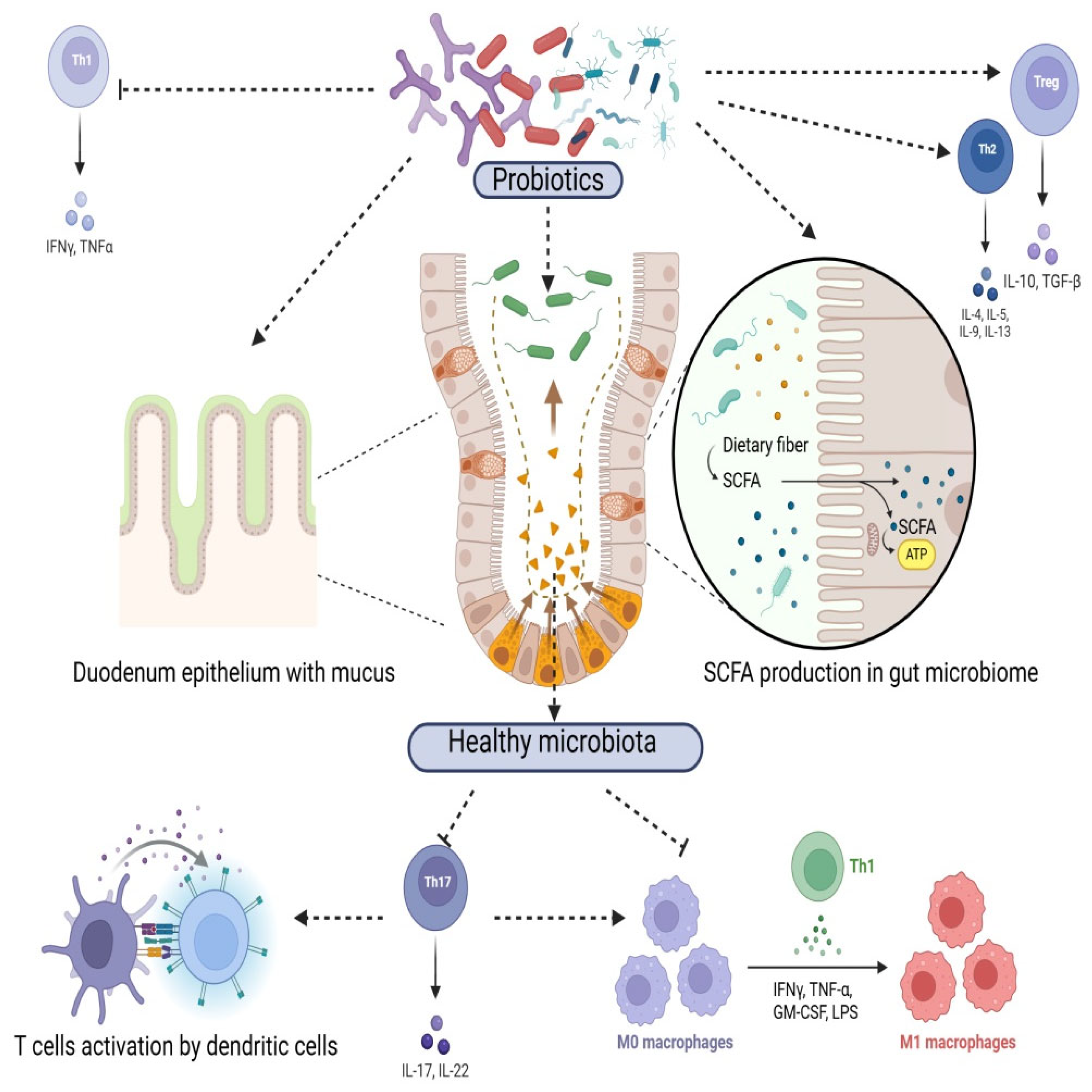
Immunomodulatory effects are also strain-dependent; for instance, L. reuteri supplementation in pigs reduced pro-inflammatory cytokine expression and promoted regulatory T cell activity, highlighting probiotic influence on Th1/Th2/Th17 balance [62].
Beyond gastrointestinal and immune-related effects, probiotics can also produce neuroactive compounds such as γ-aminobutyric acid (GABA), serotonin, and dopamine, which influence host physiology through the microbiota–gut–brain axis. This emerging field, termed microbial endocrinology, highlights that probiotics may act as delivery vehicles for neurochemicals, thereby linking gut microbiota composition to behavioral and neurophysiological outcomes in both livestock and companion animals [24,63]. Probiotics exert their beneficial effects on animal health through a range of complex mechanisms that target the gut microbiota, immune system, and host physiology. Reinforcement of epithelial barrier integrity is another important effect, as probiotics can up-regulate tight-junction proteins and reduce intestinal permeability, improving host resilience to infection [29,64]. One classical mechanism of action is competitive exclusion, where probiotics occupy ecological niches and compete for nutrients, thereby limiting pathogen colonization; in addition, several strains produce bacteriocins and organic acids that inhibit opportunistic microbes [65]. These mechanisms are highly strain- and species-specific, reflecting the diversity of probiotic organisms and their interactions with different host systems (Figure 2). Advances in encapsulation technologies have further enhanced the viability and efficacy of probiotics, ensuring their survival during processing, storage, and passage through the digestive tract [66]. Microencapsulation techniques, for instance, protect probiotics from harsh gastric conditions and improve their targeted delivery to the intestines [54]. These innovations have expanded the applicability of probiotics in both feed and pharmaceutical formulations [55]. Furthermore, the synergy between probiotics and prebiotics—collectively termed synbiotics—offers an additional layer of benefits by providing a substrate for beneficial bacteria, thereby enhancing their proliferation and activity within the gut. For example, combinations of Lactobacillus strains with dietary fibers have been shown to amplify both the microbial and host-derived benefits, such as increased short-chain fatty acid production and improved gut barrier function [67,68]. Furthermore, the synergy between probiotics and prebiotics—collectively termed synbiotics—offers additional benefits by providing a selective substrate for the probiotic organisms. For example, combinations of Lactobacillus strains with fermentable fibers have been shown to amplify beneficial outcomes, such as increased short-chain fatty acid production and improved gut barrier function [61,69]. Evidence from human studies also illustrates that probiotic efficacy depends on host-specific microbiome features; for instance, Maldonado-Gómez et al. (2016) [70] demonstrated that stable engraftment of B. longum AH1206 in the gut occurred only when compatible ecological niches were available in the host’s resident microbiota, highlighting the individualized nature of probiotic responses.

3.1. Gut Microbiota Modulation

One of the primary actions of probiotics is the modulation of the gut microbiota. Probiotic organisms compete with pathogenic bacteria for nutrients and adhesion sites on the intestinal epithelium, thereby reducing the colonization and proliferation of harmful microbes [4]. This process, known as competitive exclusion, has been demonstrated in livestock to reduce pathogens such as Salmonella and Escherichia coli. In swine, supplementation with L. sobrius and E. faecium has improved growth performance and stabilized fecal microbiota in weaned piglets [70]. In poultry, B. subtilis and L. salivarius strains have reduced necrotic enteritis and improved feed conversion efficiency [71]. In ruminants, S. cerevisiae enhances fiber digestibility, stabilizes rumen fermentation, and improves milk production efficiency, while P. freudenreichii contributes to rumen stability and nutrient utilization [72]. In companion animals, E. faecium and L. acidophilus have been shown to improve gastrointestinal health, reduce diarrhea episodes, and modulate fecal bacterial groups in dogs [73]. Additionally, probiotics enhance the abundance of beneficial bacterial taxa, including members of the genera Lactobacillus and Bifidobacterium, which play key roles in maintaining gut health [74]. Probiotics have also shown inhibitory effects against other harmful bacteria, including Clostridium perfringens, a major cause of necrotic enteritis in poultry and gastrointestinal disease in livestock. Additionally, probiotics enhance the abundance of beneficial bacterial taxa, including members of the genera Lactobacillus and Bifidobacterium, which play key roles in maintaining gut health [75].
Probiotics also influence microbial diversity and metabolic activity in the gut. For instance, certain strains stimulate the production of short-chain fatty acids (SCFAs) like acetate, propionate, and butyrate, which serve as energy sources for epithelial cells and contribute to maintaining intestinal integrity [76]. Increased SCFA production has been associated with improved gut barrier function and reduced inflammation in both livestock and companion animals [77].
Probiotic supplementation enhances the resilience of gut microbiota, allowing it to recover more effectively following disruptions such as antibiotic use, stress, or dietary changes. This resilience is pivotal in maintaining microbial homeostasis, which supports overall host health and productivity. Furthermore, probiotics influence inter-microbial communication via quorum sensing inhibition, which reduces pathogen virulence and biofilm formation, as demonstrated in various animal models [78]. Some strains also increase the production of bioactive metabolites, such as conjugated linoleic acids and antimicrobial peptides, which regulate inflammatory pathways and enhance nutrient uptake [79]. These multifaceted interactions underline the essential role of probiotics in fostering a stable and functionally diverse gut ecosystem, critical for optimal animal health and performance. Despite these benefits, probiotic responses are not universal. Outcomes may vary between individuals due to host genetics, diet composition, and baseline microbiota, and efficacy is often strain-specific [1,80].

3.2. Immune System Modulation

Another critical mechanism by which probiotics enhance health is through the modulation of the host immune system. Probiotics interact with gut-associated lymphoid tissue (GALT) to stimulate the production of immunoglobulins (e.g., IgA) and cytokines that regulate immune responses [81]. These interactions enhance mucosal immunity, providing a first line of defense against intestinal infections (Figure 2).
Probiotics can also modulate systemic immunity by balancing pro-inflammatory and anti-inflammatory pathways. For example, L. reuteri has been shown to reduce the levels of pro-inflammatory cytokines like tumor necrosis factor-alpha (TNF-α) while promoting the release of anti-inflammatory cytokines such as interleukin-10 (IL-10) [82]. This immunomodulatory effect is particularly beneficial in mitigating chronic inflammation and immune dysregulation in animals subjected to environmental or dietary stressors [83].

3.3. Pathogen Inhibition

Probiotic organisms produce antimicrobial compounds, including bacteriocins, hydrogen peroxide, and organic acids, which inhibit the growth of pathogenic bacteria [50]. These antimicrobial effects are strain-dependent and have been demonstrated in both in vitro and in vivo studies. For example, Lactobacillus acidophilus produces lactic acid, which lowers intestinal pH and creates an unfavorable environment for pathogens like Clostridium perfringens [24]. Many probiotic bacteria produce natural anti-microbials. Lactic acid bacteria (LAB) such as Lactobacillus and Enterococcus secrete organic acids (lactic, acetic acid) that lower gut pH, creating an unfavorable environment for pathogens (most pathogens grow poorly at low pH) [1]. LAB also produce bacteriocins, which are small peptide antibiotics capable of inhibiting or killing closely related bacterial species. For example, L. salivarius produces bacteriocins effective against C. perfringens, the causative agent of necrotic enteritis in poultry [84]. Similarly, E. faecium SF68, a probiotic used in pets, produces enterocins that inhibit Salmonella and E. coli in vitro [85]. These bacteriocins can reduce pathogen populations in the gut without the need for antibiotic intervention, thereby contributing to healthier microbial balance. These substances can reduce pathogen populations in the gut without the need for antibiotics. A practical illustration: a Lactobacillus-based probiotic culture given to chicks at 10^7 CFU per bird significantly reduced Salmonella Enteriti discounts in the ceca (as measured by culturing), indicating that the probiotic released inhibitory compounds or acids that curtailed Salmonella growth [85,86]. Some Bacillus probiotics used in livestock also secrete potent anti-microbials (e.g., subtilin, bacitracin-like lipopeptides) that suppress pathogens such as Listeria and Staphylococcus.
Additionally, probiotics can disrupt the quorum-sensing mechanisms of pathogenic bacteria, thereby inhibiting their ability to form biofilms and express virulence factors [86]. This property is particularly relevant in poultry farming, where biofilm-associated infections by Salmonella and Campylobacter pose significant challenges [87].
Probiotics influence the maturation and activity of innate immune cells, such as macrophages and neutrophils. They enhance macrophage phagocytosis, enabling more effective clearance of pathogens from the gut environment [88]. Certain probiotic strains, such as L. rhamnosus, are known to up-regulate the production of antimicrobial peptides, which act as a first line of defense against microbial invasion [83].
Additionally, probiotics interact with Toll-like receptors (TLRs), particularly TLR2 and TLR4, present on epithelial and immune cells. This interaction triggers intracellular signaling cascades, such as the NF-κB and MAPK pathways, leading to the secretion of cytokines that orchestrate immune responses [89]. This mechanism is particularly vital in modulating inflammation, as probiotics like Bifidobacterium breve balance pro-inflammatory and anti-inflammatory cytokines, helping to prevent overactivation of immune responses [90].
Probiotics further contribute to systemic immune modulation through the production of short-chain fatty acids (SCFAs), such as butyrate, which play a role in reducing inflammation and maintaining intestinal integrity. These SCFAs serve as energy sources for intestinal epithelial cells, promoting their proliferation and fortifying the mucosal barrier against pathogen translocation. Strains like L. reuteri are notable for stimulating regulatory T cells, which help maintain immune tolerance and reduce hypersensitivity to non-harmful antigens [91].
Finally, probiotics contribute to gut–brain axis communication, providing systemic benefits. By reducing stress-induced alterations in immune function, probiotics limit the impact of chronic stress on overall immunity [92]. These multifaceted mechanisms make probiotics indispensable tools in supporting balanced immune responses and improving resilience to both pathogenic challenges and environmental stressors (Figure 2).

3.4. Enhancement of Intestinal Barrier Function

Probiotics contribute to the maintenance of a healthy intestinal barrier by increasing the expression of tight junction proteins such as occludin and claudin [93]. These molecular pathways involve activation of protein kinase C (PKC), mitogen-activated protein kinase (MAPK), and modulation of toll-like receptor (TLR)-mediated signaling, which collectively stabilize tight junction complexes and limit paracellular permeability [94]. This barrier reinforcement prevents the translocation of pathogens and endotoxins into systemic circulation [95]. In young cattle, supplementation with S. cerevisiae has contributed to the prevention of neonatal diarrhea, partly through stabilization of the intestinal barrier and modulation of local immune responses [96]. This strengthens the epithelial barrier, preventing the translocation of pathogens and endotoxins into systemic circulation. Studies in swine have shown that probiotic supplementation reduces intestinal permeability and the associated risk of systemic infections during stressful periods like weaning [43].
In addition to their effects on tight junctions, probiotics also promote the secretion of mucus by goblet cells in the intestinal lining (Figure 2). This mucus layer acts as a physical barrier, trapping pathogens and facilitating their removal from the gut [31].

3.5. Mechanisms Linking Probiotics to Stress and Depression in Animals

Probiotics have emerged as a promising tool for modulating the gut–brain axis, which is a bidirectional communication network between the gastrointestinal tract and the central nervous system. This relationship highlights their potential to alleviate stress and depression through several mechanisms [32].
Firstly, probiotics such as L. rhamnosus can influence the production of neurotransmitters. For example, in a mouse model, L. rhamnosus was shown to alter gamma-aminobutyric acid (GABA) receptor expression in the brain, resulting in reduced anxiety- and depression-like behaviors. Evidence in other species suggests similar potential effects. In pigs, supplementation with L. rhamnosus and B. longum has been associated with reduced cortisol levels and calmer behavior under stress conditions [97,98]. In poultry, B. subtilis supplementation has been linked to lower stress indicators and improved welfare outcomes, including reduced feather-pecking [99,100]. In dogs, E. faecium has shown promise in supporting behavioral stability during stressful events, such as shelter housing and travel [74,101].
Secondly, chronic stress activates the hypothalamic–pituitary–adrenal (HPA) axis, resulting in elevated corticosterone levels that are associated with depressive behaviors. Probiotics can mitigate this response by reducing stress-induced increases in adrenocorticotrophic hormone and corticosterone, which alleviates anxiety and depression-like symptoms [38].
Thirdly, inflammation plays a significant role in the development of depression. Probiotics can reduce systemic inflammation by enhancing gut barrier function and modulating immune responses. Studies have shown that probiotic supplementation decreases levels of pro-inflammatory cytokines, which are often elevated in depressive states [82]. While much of the mechanistic detail comes from rodent models, these findings provide translational insight into potential applications for improving welfare in livestock and companion animals. More comparative studies are needed to confirm whether the same neuroendocrine and immunological pathways observed in mice are consistently modulated in veterinary species.

Probiotics and Cancer in Animals

Although direct research on the effects of probiotics on cancer-related depression in animals remains limited, their role in cancer progression and associated mechanisms provides insights into their potential benefits [102]. A robust immune system is vital for combating cancer, and probiotics enhance immune responses, potentially inhibiting tumor growth. Certain probiotic strains have been shown to increase the activity of natural killer cells and macrophages, which are critical components of the body’s defense mechanisms against cancer [103].
In addition to immune modulation, probiotics contribute to anticancer effects through several other mechanisms. They can induce tumor apoptosis and promote cell cycle arrest in malignant cells [104]. Probiotics also produce anticancer metabolites, including short-chain fatty acids (SCFAs) such as butyrate and propionate, which have been implicated in the inhibition of tumor cell proliferation and induction of apoptosis [105]. Conjugated linoleic acid (CLA), generated by certain Lactobacillus and Propionibacterium species, exhibits anticarcinogenic activity by modulating lipid metabolism and suppressing tumor growth [106]. Moreover, probiotics can beneficially modulate the intestinal microbiome, reducing procarcinogenic metabolites such as secondary bile acids and nitrosamines, thereby lowering cancer risk [107].
For instance, oral administration of L. casei variety rhamnosus (Lcr35) and a combination of L. acidophilus and B. bifidum (LaBi) in mice undergoing 5-FU chemotherapy resulted in decreased diarrhea severity, reduced pro-inflammatory cytokine levels, and improved intestinal histology [108]. By influencing the gut–brain axis, probiotics may indirectly impact cancer progression and associated mood disorders. Alterations in gut microbiota composition have been linked to changes in behavior and cognition in animals, suggesting a pathway through which probiotics could exert beneficial effects [109].

4. Applications of Probiotics in Animal Health

4.1. Livestock Animals

Probiotics have become a cornerstone of sustainable livestock farming, offering solutions for enhanced productivity, health, and environmental management. Applications of probiotics in animal health can be discussed across three categories: livestock animals (cattle, pigs, poultry, horses), companion animals (dogs, cats), and laboratory animals used as experimental models (rats)

4.1.1. Cattle

In dairy cattle, probiotics can improve milk yield and composition. Inclusion of S. cerevisiae in feed stabilizes rumen pH and supports cellulolytic bacteria, which enhances fiber digestion and energy availability and in turn influences milk production and quality [110]. Probiotic use has also been associated with higher milk fat and protein, traits that are important for market value [111]. Probiotics help mitigate metabolic disorders such as ruminal acidosis that arise in high-concentrate diets. Lactate-producing bacteria such as L. plantarum and lactate-utilizing bacteria such as P. freudenreichii can promote conversion of lactate to propionate and thereby stabilize rumen pH while improving energy metabolism. Environmental benefits are increasingly reported [112]. Certain probiotics, including B. subtilis, are associated with lower enteric methane output by redirecting hydrogen away from methanogenesis. This reduces energy loss as methane and can modestly improve feed efficiency [113]. Responses differ across production systems and physiological stages. In dairy herds, probiotics may enhance feed utilization and milk production, although results vary by strain, dose, and diet. For example, selected lactate-producing bacteria have improved milk yield and feed efficiency in some trials, likely through pH stabilization and improved fiber digestion [114]. A meta-analysis in dairy calves reported increases in pre-weaning average daily gain of approximately 40 to 80 g per day and better feed conversion ratio, while also noting inconsistent or contradictory findings in some studies [115]. In beef feedlot cattle, direct-fed microbials (DFM) are used primarily to support growth and carcass safety. Reviews report modest improvements in average daily gain (about 0.08 kg) and feed conversion ratio (about 0.13) under intensive conditions [116]. Beyond performance, probiotics can reduce pathogen shedding. For example, feeding specific Lactobacillus strains to feedlot cattle before slaughter reduced fecal shedding of E. coli O157:H7 and shortened the duration of carriage; by the end of one trial, none of the probiotic-treated steers were shedding O157 in the rumen compared with high prevalence in controls [117]. These effects have downstream implications for food safety. Production context shapes cost-effectiveness. Under extensive grazing, a diverse rumen microbiota may limit marginal gains, whereas in high-grain feedlots with greater risk of subacute ruminal acidosis, probiotics tend to be more beneficial. Economic analyses consider improvements in feed efficiency and health outcomes against product cost, with positive returns contingent on strain efficacy and pricing [55].

4.1.2. Poultry

The poultry industry faces persistent challenges related to gut health, pathogen control, and feed efficiency. In ovo administration of B. bifidum and B. longum on day 17 of incubation improved broiler growth and ileal development without adverse effects on serum biochemistry or hepatic and renal indicators [118]. Probiotics address production constraints through complementary mechanisms that include modulation of the gut microbiota, enhancement of nutrient absorption, reinforcement of barrier function, and support of mucosal and systemic immunity. Intestinal morphology and barrier integrity are central to performance outcomes. In broilers, L. reuteri and B. bifidum increase villus height and the villus-to-crypt depth ratio, which improves nutrient absorption and feed conversion ratio (FCR), yielding higher body weight gains and lower feed costs [84]. Pathogen control remains a priority for both animal health and food safety. Probiotics limit colonization by Salmonella spp. and Campylobacter spp. through competitive exclusion and through production of bacteriocins, organic acids, and hydrogen peroxide that create inhibitory conditions for enteric pathogens [119]. These reductions are relevant to lowering slaughter-phase prevalence. Probiotics offer practical alternatives to antimicrobial growth promoters (AGPs) in both meat and egg production. In commercial broilers, B. subtilis has improved growth performance and reduced mortality [100]. In laying hens, probiotic use has been associated with lower circulating pro-inflammatory cytokines (IL-1, IL-6, TNF-α) and higher serum antioxidant enzyme activity, suggesting mitigation of systemic inflammation and oxidative stress in aging flocks [120]. In challenge models, a multi-species probiotic containing Lactobacillus and Bacillus hastened clearance of S. Enteritidis, with a markedly higher proportion of cleared birds by day 28 compared with untreated controls, and with performance similar to an oxytetracycline reference group [119]. Supplementation with L. rhamnosus has also reduced cecal Salmonella by approximately 2 log CFU in treated broilers [119]. B. subtilis strengthens the intestinal barrier and immunity by up-regulating tight-junction proteins, cytokines, and immunoglobulins, with dual-strain formulations showing consistent effects [120]. Under heat stress, combinations of B. subtilis with P. farinosa or Lactobacillus spp. improve feed efficiency, lower pathogenic E. coli, and favor beneficial taxa [121]. A recent broiler trial also reported that dietary B. xiamenensis increased final body weight, improved villus morphology, and reduced cecal E. coli and Salmonella counts relative to controls [122]. Drinking-water supplementation with B. subtilis and B. pumilus mitigates heat-stress damage by partially restoring jejunal and ileal villus height and improving thermoregulation indices [123,124].

4.1.3. Swine

Probiotics play a pivotal role in swine production, particularly during the critical post-weaning period. Weaning is associated with significant stress, gut microbiota disruption, and increased susceptibility to diarrhea, all of which adversely affect growth performance. L. rhamnosus and B. lactis have demonstrated efficacy in restoring microbial balance during the post-weaning period, reducing the prevalence of Escherichia coli-associated diarrhea [125]. These probiotics enhance intestinal barrier integrity by increasing tight junction protein expression and preventing the translocation of pathogens and toxins [126]. Probiotic supplementation also improves nutrient digestibility and growth performance in pigs. By increasing the production of short-chain fatty acids (SCFAs), probiotics stimulate epithelial cell proliferation and energy utilization in the gut [89]. Enhanced digestion and absorption of nutrients translate to higher daily weight gains and better feed efficiency. In addition to gastrointestinal benefits, probiotics modulate systemic immunity in swine. Probiotic-fed pigs exhibit increased serum levels of immunoglobulins (IgA and IgG) and reduced pro-inflammatory cytokines, indicating enhanced immune resilience [127]. These effects are particularly valuable in intensive farming systems, where disease outbreaks pose significant economic risks. In swine, probiotics are actively studied as alternatives to AGPs, with applications from sows through nursery and finishing pigs [13,128]. With many countries phasing out in-feed antibiotics, interest in probiotics for herd health and growth has surged. In gestating and lactating sows, probiotics have shown benefits for both sow well-being and offspring performance. A recent controlled study in late-gestation sows found that a Bacillus-based probiotic significantly relieved constipation and systemic inflammation in sows, and improved piglet growth. Treated sows had higher anti-inflammatory cytokines (IL-4, IL-10) and lower pro-inflammatory markers (IL-1β, TNF-α), indicating reduced inflammation. Notably, their piglets had higher daily weight gain and weaning weights compared to controls [13,127]. Other trials report that feeding sows probiotics (e.g., C. butyricum or multi-strain blends) during late gestation/lactation can reduce neonatal diarrhea in piglets by improving colostrum quality and seeding a healthier microbiome in the neonate. In a comprehensive review, Su et al. (2022) [13] highlight that post-weaning piglets suffer from disrupted microbial homeostasis and compromised intestinal barrier function, features often addressed by antibiotics, and that probiotics can restore microbial balance and reinforce intestinal mucosal and immunological barriers to help prevent post-weaning diarrhea (PWD). Trials have shown that piglets given probiotic supplements experience lower incidence of PWD and improved weight gains compared to unsupplemented controls. Sows on probiotics often show improved feed intake, fewer peripartum digestive upsets, and possibly improved mood/behavior—one study observed probiotic-supplemented sows were calmer and their piglets less aggressive, hinting at gut–microbiota effects on behavior [13,129]. For piglets, probiotics are chiefly used to prevent post-weaning diarrhea (PWD) and improve growth in the nursery phase. Early weaned piglets undergo stress and gut microbiota disruption, traditionally managed with antibiotics [130]. Probiotics offer a promising alternative. Multiple studies document that certain probiotic strains can avert and treat PWD by reinforcing the intestinal barrier and immune defenses. For example, Lactobacillus and Enterococcus strains have been shown to reduce the incidence and severity of PWD. In one trial, piglets given a mix of L. acidophilus, L. casei, B. thermophilum, and E. faecium had a >50% reduction in diarrhea incidence post-weaning [131].

4.1.4. Probiotics in Horses

Horses have a specialized hindgut microbiota that is essential for fermenting fiber and maintaining overall health. Disruptions to this microbial ecosystem, often caused by dietary changes or stress, can lead to conditions such as colic, laminitis, and diarrhea [132] (Table 1). Probiotics provide a natural solution to stabilize the equine gut and prevent these serious health issues [133]. Colic is among the most common and potentially life-threatening conditions in horses. Probiotic strains such as Saccharomyces boulardii have been shown to stabilize the hindgut microbiota, limiting the proliferation of gas-forming bacteria and thereby reducing gastrointestinal disturbances. This protective effect is particularly valuable during dietary transitions, which are recognized risk factors for digestive upset and colic [134]. Probiotics also play a role in preventing laminitis, a painful and often debilitating condition associated with hindgut acidosis. By improving the fermentation of dietary fibers and reducing the accumulation of lactic acid, probiotics help maintain a stable hindgut environment. Strains such as L. plantarum are effective in mitigating the cascade of events that lead to laminitis, particularly during sudden dietary changes, when horses consume diets high in starch or fructans, such as excess grain or lush spring pastures, undigested carbohydrates reach the hindgut, where amylolytic bacteria, such as streptococci, rapidly ferment them, producing excess lactic acid. This causes a sharp drop in hindgut pH, leading to acidosis that disrupts the microbial balance by killing off beneficial fibrolytic bacteria. Lactobacillus plantarum intervenes by competing with these amylolytic bacteria for carbohydrate substrates, slowing their fermentation and reducing the accumulation of lactic acid. In ex vivo studies, L. plantarum has been shown to limit pH drops by up to 1 unit during starch overload, helping to maintain a more stable environment in the hindgut. This action attenuates the initial dysbiosis that sets the stage for laminitis, making L. plantarum a key ally in the prevention of diet-induced laminitis [135]. Horses often experience stress during transport or competition, which can lead to gut dysbiosis and associated health issues. Probiotics enhance gut barrier integrity and reduce inflammatory cytokines, mitigating the effects of stress on the gut. In equine trials, supplementation has been associated with stabilized fecal pH, reduced lactic acid accumulation, and improved volatile fatty acid profiles following stressors such as transport, supporting a protective role against dysbiosis [74]. For adult horses, probiotics have been considered for various purposes: maintaining gut health in performance horses, preventing colic and laminitis, and aiding recovery from colitis [136]. Horses are hindgut fermenters highly susceptible to dysbiosis when diet or routine changes (e.g., high starch intake, sudden feed change). Probiotics, especially yeast cultures and lactic acid bacteria, have been given to stabilize the hindgut pH and microbial balance [137]. Some studies with performance horses (e.g., racehorses or events under intensive training) indicate probiotics may reduce stress-related gut disturbances. One study found that horses undergoing transport-like stress had more stable fecal microbiota when supplemented with a yeast-derived post-biotic (SCFP), compared to controls, though effects on stool consistency were not reported [138]. Additionally, an intriguing line of research is linking the gut microbiome with horse behavior and stress. As with other species, identifying the right strains for the equine gut and ensuring they reach the hindgut alive (many bacteria may be digested before reaching the cecum) are ongoing challenges. In terms of laminitis, which is often precipitated by hindgut dysbiosis (excess starch in the hindgut causing a bloom of lactic-acid bacteria and toxin release), there is theoretical rationale to use probiotics to prevent those damaging imbalances. Researchers have identified certain fiber-digesting bacteria that decline during laminitis episodes and hypothesize that replenishing them could avert the cascade leading to laminar inflammation [62]. Although disturbances in fiber-digesting bacteria have been implicated in laminitis pathophysiology, there is currently no clinical trial evidence that probiotic administration prevents this condition. At best, some probiotics might reduce the risk by maintaining a healthier hindgut environment when horses consume high carbohydrate diets—this is an active area of investigation [139]. Until such data is available, the use of probiotics in horses will likely remain cautious and adjunctive—an optional tool in the toolbox rather than a mainstay therapy.

4.2. Laboratory Animals

Experimental studies involving rats provide crucial insights into the mechanisms and potential benefits of probiotics. Rats are widely used in research due to their controlled environments and genetic homogeneity, which enable detailed investigations into the physiological and biochemical effects of probiotics. These studies have advanced our understanding of probiotics’ roles in gastrointestinal health, immune modulation, and systemic well-being [140]. Probiotics in rats primarily act by modulating gut microbiota composition and function. They enhance the production of short-chain fatty acids (SCFAs) such as butyrate, which strengthens the intestinal barrier and supports epithelial cell health [141]. In a murine model, the administration of a probiotic mixture containing L. acidophilus and B. longum significantly enhanced mucosal immunity by increasing the number of IgA-producing cells in Peyer’s patches and the lamina propria. Furthermore, the same study demonstrated a marked reduction in pro-inflammatory cytokines, including IL-6, IL-12, and TNF-α, highlighting the immunomodulatory potential of these probiotics [142]. These effects collectively contribute to improved gut integrity and reduced inflammation. Rats have been instrumental in demonstrating the diverse health benefits of probiotics. For gastrointestinal health, probiotics mitigate the severity of experimental colitis, enhance gut barrier function, and alleviate symptoms of irritable bowel syndrome (IBS) [143]. Systemically, probiotics influence metabolic conditions by improving insulin sensitivity and reducing markers of inflammation, suggesting their role in managing obesity and related disorders [144]. Additionally, probiotics have shown promising effects on the gut–brain axis in rat models, reducing anxiety-like behaviors and other stress-induced conditions through microbiota-mediated mechanisms [145]. The findings from studies in rats have significant implications for both human and animal health. These models highlight the therapeutic potential of probiotics in treating chronic gastrointestinal disorders, enhancing systemic immunity, and even addressing neurobehavioral conditions. As research advances, precision probiotics tailored to target specific pathways and conditions may emerge, providing enhanced efficacy and specificity [146]. Experimental studies involving rats provide crucial insights into the mechanisms and potential benefits of probiotics. Rats are widely used in research due to their physiological similarities to other mammals and controlled experimental tractability.

4.3. Companion Animals

Probiotics have become increasingly popular in the care of companion animals, including dogs, and cats. These animals frequently encounter health challenges such as gastrointestinal disturbances, immune system dysfunctions, and stress-induced conditions, all of which probiotics can help address. By targeting the gut microbiota, probiotics contribute to enhanced health and well-being in these species.

4.3.1. Dogs

Dogs are particularly susceptible to gastrointestinal disorders, including acute diarrhea, chronic enteropathies, and inflammatory bowel disease (IBD). Probiotic supplementation has demonstrated significant benefits in managing these conditions by restoring microbial balance and improving gut barrier integrity [147]. For example, strains such as L. acidophilus and E. faecium have been shown to reduce the duration and severity of diarrhea in dogs by suppressing pathogenic bacteria like C. difficile. These probiotics also improve stool quality, providing relief for dogs with acute or chronic gastrointestinal distress [148]. In addition to gut health, probiotics play a vital role in modulating the canine immune system. By enhancing the production of secretory immunoglobulin A (IgA) in the gut, probiotics strengthen mucosal immunity, making dogs more resilient to infections and illnesses. This effect is particularly valuable for dogs recovering from illness or undergoing antibiotic therapy, where gut microbiota can be compromised [149]. Probiotics also impact canine behavior through the gut–brain axis. Research has shown that strains like L. rhamnosus produce neuroactive compounds that interact with the vagus nerve, influencing stress and anxiety levels [150]. A large double-blind, randomized, placebo-controlled trial in shelters showed that dogs receiving a synbiotic containing E. faecium NCIMB 10415 experienced significantly fewer days with diarrhea compared to placebo-treated dogs, demonstrating the probiotic’s efficacy in managing acute gastrointestinal disturbances [151]. Dogs supplemented with these probiotics exhibit reduced stress-induced behaviors, particularly in situations involving environmental changes or separation anxiety. This emerging area highlights the potential of probiotics as a natural tool for managing behavioral issues in dogs [14]. Controlled clinical trials in dogs with acute diarrhea have yielded promising results. One randomized, placebo-controlled trial showed that dogs with acute diarrhea receiving a multi-strain probiotic had a faster return to normal stool (3.5 days on average) compared to 4.6 days in dogs treated with the antibiotic metronidazole [152]. In fact, the probiotic was statistically as effective as the antibiotic in resolving diarrhea, highlighting its potential as a first-line therapy for uncomplicated diarrhea. Another placebo-controlled study in shelter dogs found that a synbiotic (probiotic + prebiotic) significantly decreased the incidence of stress-related diarrhea—only 7.7% of probiotic-treated dogs had ≥2 days of diarrhea, versus 20.7% in the placebo group [153]. These findings suggest probiotics can help prevent diarrhea in high-stress environments (kennels, shelters) by mitigating dysbiosis. Probiotics have also been evaluated in dogs with chronic gastrointestinal diseases like Inflammatory Bowel Disease (IBD). A small study using the probiotic mixture VSL#3 in canine IBD showed reduced clinical severity and improved histologic scores, alongside increased expression of tight junction proteins (indicating improved gut barrier). While sample sizes are limited, such trials demonstrate tangible benefits of probiotics in restoring gut health [154]. Notably, in canine atopic dermatitis, two months of L. sakei Probio-65 administration significantly reduced disease severity as measured by the Pruritus Visual Analog Scale and the Canine Atopic Dermatitis Extent and Severity Index [155].

4.3.2. Cats

In cats, gastrointestinal health is often disrupted by dietary sensitivities, stress, or medical treatments such as antibiotics [154]. Probiotics offer a natural means of improving gut health and overall well-being in felines. B. animalis may facilitate peptide assimilation via intracellular peptidases (e.g., PepO) and by reshaping colonic fermentation toward SCFA production; in cats, these shifts have been associated with improved barrier function and lower inflammatory tone [21]. Lactiplantibacillus plantarum increased serum IgA and IL-4, reduced TNF-α, and lowered circulating D-lactate and diamine oxidase (barrier injury markers), consistent with improved gut barrier integrity and an anti-inflammatory shift [156]. Probiotic supplementation has also been associated with improved stool consistency in cats with sensitive stomachs [157]. Probiotics have shown promise in managing conditions beyond the gastrointestinal tract, such as food allergies and skin disorders. Cats with allergic dermatitis often experience systemic inflammation, which can be alleviated through probiotic supplementation. In feline allergic dermatitis (FASS), cutaneous OSMR-β (part of the IL-31 receptor complex) is significantly up-regulated in lesional skin, whereas classical Th2 cytokines are low/variable—underscoring that IL-4/IL-13-centric paradigms from dogs/humans do not transfer wholesale to cats [40,158]. By modulating the immune response, probiotics reduce inflammation, improving skin health and coat quality. This dual benefit of improved gut and skin health underscores the systemic effects of probiotics in felines [15]. Behavioral benefits of probiotics are also being explored in cats. Research suggests that probiotics such as L. reuteri can reduce signs of stress during transport or veterinary visits. This calming effect is thought to be mediated by the gut–brain axis, similar to findings in dogs. Probiotics could therefore play a role in reducing stress-related health issues in cats [74,147]. Mechanistically, B. animalis AHC7 attenuates NF-κB activation in vivo, decreases TNF-α/IFN-γ from Peyer’s patch lymphocytes, and, via dendritic-cell conditioning, expands CD25+Foxp3+ regulatory T cells, offering a plausible Treg-mediated route by which bifidobacteria dampen mucosal inflammation (cross-species data supporting a conserved pathway) [159]. Nonetheless, a few controlled trials in cats have been conducted, mostly for diarrhea management. In one study, older shelter cats were given E. faecium SF68 (a common pet probiotic) to see if it would prevent stress diarrhea; it did not significantly prevent diarrhea occurrence, but it did decrease the number of cats with prolonged diarrhea (≥2 days). In shelter cats, E. faecium SF68 reduced prolonged diarrhea episodes, with a lower proportion experiencing ≥ 2 days of diarrhea compared to controls [160,161].
Table 1. Probiotics employed in different animal species and their reported effects.
Animal
Species
Probiotic Strains/FormulationsReported EffectsReferences
Cattle (Dairy and Beef)Saccharomyces cerevisiaeStabilizes rumen pH, supports cellulolytic bacteria, improves fiber digestion, enhances milk yield and composition[109,110]
Lactobacillus plantarum, Propionibacterium freudenreichiiConverts lactate to propionate, stabilizes rumen pH, improves energy metabolism[111,112]
Bacillus subtilisReduces enteric methane emissions, improves feed efficiency[113]
Lactate-producing bacteria (various strains)Improve milk yield and feed efficiency by stabilizing rumen pH[114]
Lactobacillus spp. (specific strains)Reduces fecal shedding of E. coli O157:H7 in feedlot cattle, improving food safety[116]
Poultry (Broilers and Layers)Bifidobacterium bifidum, B. longum (in ovo)Improves broiler growth and ileal development[118]
Lactobacillus reuteri, B. bifidumIncrease villus height and villus/crypt ratio, improve nutrient absorption and feed conversion[162]
Bacillus subtilisImproves growth performance, reduces mortality, strengthens intestinal barrier[119,120]
Multi-species mix (Lactobacillus, Bacillus)Hastens clearance of Salmonella Enteritidis[118]
Lactobacillus rhamnosusReduces cecal Salmonella (~2 log CFU reduction)[118]
Bacillus xiamenensisIncreases body weight, improves villus morphology, reduces E. coli and Salmonella[122]
B. subtilis, B. pumilus (water)Mitigates heat stress, restores villus height[122]
Swine (Sows & Piglets)Lactobacillus rhamnosus, Bifidobacterium lactisRestores microbial balance post-weaning, reduces E. coli diarrhea[127]
Clostridium butyricum (multi-strain blends)Improves colostrum quality, reduces neonatal diarrhea[127]
Bacillus-based probioticsRelieve constipation and systemic inflammation in sows, improve piglet growth[127]
Multi-strain mix (L. acidophilus, L. casei, B. thermophilum, E. faecium)Reduces post-weaning diarrhea incidence by >50%[131]
HorsesSaccharomyces boulardiiStabilizes hindgut microbiota, reduces gas-forming bacteria, prevents colic[133]
Lactobacillus plantarumReduces hindgut lactic acid accumulation, stabilizes pH, mitigates laminitis risk[135]
Yeast cultures (e.g., S. cerevisiae post-biotics)Stabilize fecal microbiota during stress/transport[138]
Laboratory Animals (Rats)Lactobacillus acidophilus, B. longumEnhance mucosal immunity (↑IgA), reduce pro-inflammatory cytokines, improve gut integrity[143,145]
DogsLactobacillus acidophilus, Enterococcus faeciumReduce diarrhea severity/duration, improve stool quality, strengthen mucosal immunity[146,148,149]
Lactobacillus rhamnosusProduces neuroactive compounds influencing stress/anxiety[101,151]
Multi-strain probioticFaster resolution of acute diarrhea, comparable to metronidazole[151,156]
Synbiotic (E. faecium NCIMB 10415 prebiotic)Reduces stress-related diarrhea in shelters[146,148]
VSL#3 (multi-strain)Reduces clinical severity of IBD, improves gut barrier[151]
Lactobacillus sakei Probio-65Reduces severity of atopic dermatitis[14]
CatsBifidobacterium animalisImproves SCFA production, enhances barrier function, lowers inflammation[150,154]
Lactiplantibacillus plantarumIncreases IgA/IL-4, reduces TNF-α, improves gut barrier[154]
Lactobacillus reuteriReduces stress during transport or vet visits[158]
Enterococcus faecium SF68Decreases prolonged diarrhea episodes in shelters[21,155]
Legend: ↑—enhance immunity by increasing IgA.

5. Environmental and Sustainability Aspects of Probiotics

Probiotics have transformative potential beyond improving animal health. Their applications align closely with goals for environmental sustainability, offering practical solutions to reduce pollution, mitigate greenhouse gas emissions, enhance resource efficiency, and combat the global issue of antimicrobial resistance. These benefits position probiotics as a cornerstone of sustainable animal agriculture. Recent studies also emphasize that probiotic interventions can lower methane emissions in ruminants by shifting fermentation toward propionate production, thereby reducing the carbon footprint of livestock production [163]. Meta-analysis of probiotic interventions shows that feeding direct-fed microbials to cattle can reduce ruminal methane emissions by approximately 5–15%, depending on diet and strain selection. Meta-analyses indicate that, overall, probiotic (direct-fed microbial) supplementation does not reliably lower enteric methane in cattle; any reductions appear strain-, diet- and duration-dependent and are generally small at the aggregate level [164]. Recent reviews highlight that probiotics may serve as viable alternatives to antibiotics in livestock production, with some evidence suggesting they can reduce antibiotic usage and influence the resistome, thereby helping to limit environmental dissemination of resistance genes [165].

5.1. Reducing Methane Emissions in Livestock

Ruminants like cattle and sheep produce significant amounts of methane, a potent greenhouse gas, during rumen fermentation. Methane accounts for up to 10–12% of the gross energy loss in ruminants, making its mitigation both an environmental and an economic priority [62] (Table 2). Probiotics such as S. cerevisiae and B. subtilis reduce methane emissions by altering microbial populations in the rumen [166]. These probiotics reduce rumen protozoa and the protozoa-associated methanogenic archaea (PAM), thereby contributing to lower methane production [76]. VFAs serve as an energy source for the animal, increasing feed efficiency while reducing methane output [158]. For example, studies have shown that dairy cows supplemented with S. cerevisiae emit 15–20% less methane while showing a 5% improvement in milk production [167]. Additionally, probiotics (e.g., Saccharomyces cerevisiae CNCM I-1077 and selected lactic acid bacteria) stabilize rumen pH—raising mean pH (6.53 vs. 6.32), increasing minimum pH (5.97 vs. 5.69), and reducing time spent below the SARA threshold (pH < 5.6)—and enhance the establishment of cellulolytic bacteria; these shifts increase fermentation efficiency and are associated with lower methane formation (e.g., 18–30.6% lower CH4 in vitro with Lactobacillus plantarum supernatant; >40–50% lower CH4 in vitro with methanotroph-based DFMs) [168]. This dual benefit underscores the potential of probiotics to make livestock farming more sustainable.

5.2. Improving Water Quality in Aquaculture

Aquaculture systems often suffer from water pollution caused by uneaten feed, animal waste, and the proliferation of pathogenic bacteria. These factors can lead to poor water quality, disease outbreaks, and environmental degradation in surrounding ecosystems [169]. Probiotics offer a natural solution to these challenges by improving both water quality and animal health [44]. Probiotic strains such as B. subtilis and L. plantarum are used in shrimp and fish farming to suppress harmful bacteria like Vibrio spp. Consistent with controlled trials synthesized in a recent meta-analysis, the overall pooled effect of probiotics on enteric methane was not significant; however, multi-strain bacterial probiotics reduced methane emissions (SMD = −0.36; 95% CI −0.62 to −0.11; p = 0.005), and consortia favoring reductive acetogenesis/propionate production showed a larger reduction (SMD = −0.71; 95% CI −1.04 to −0.36; p = 0.001); longer supplementation durations further strengthened these reductions [170]. In addition to disease control, probiotics contribute to better nutrient cycling. For instance, B. subtilis enhances the breakdown of organic matter, reducing ammonia and nitrate concentrations in water. For example, B. subtilis DM115 achieved 98.45% NH3–N removal within 24 h under optimized conditions; in field ponds, a Bacillus-based water probiotic (incl. B. subtilis) lowered unionized NH3 from 0.050 → 0.006 mg L−1 (T2) and 0.030 → 0.005 mg L−1 (T3) over 8 weeks—77–81% lower than the post-treatment control (0.026 mg L−1); differences were significant (ANOVA, different-letter superscripts; p ≤ 0.05). Additionally, an immobilized B. subtilis strain (sp. N4) optimized for aquaculture showed ~99% nitrite removal and was applied to keep ammonia/nitrite/nitrate low in intensive systems [171,172]. Lower ammonia levels improve water quality and create a healthier environment for aquatic animals [173]. Field studies have demonstrated that shrimp farms using probiotics experience a 20% reduction in mortality rates and a 30% improvement in growth rates compared to conventional systems [113]. Furthermore, these systems require fewer chemical treatments, reducing environmental risks associated with antibiotic and pesticide residues.

5.3. Reducing Antibiotic Usage

Antibiotics have long been used in animal agriculture for growth promotion and disease prevention. Globally, bacterial antimicrobial resistance (AMR) was associated with 4.95 million deaths (95% UI 3.62–6.57) in 2019, including 1.27 million deaths directly attributable to resistance. Economically, unchecked AMR is projected to reduce annual global GDP by 1.1–3.8% by 2050, with output losses reaching US$3.4 trillion per year by 2030, ~US$6.1 trillion by 2050, and pushing >28 million additional people into extreme poverty by 2050; healthcare expenditures in the high-AMR case reach ~US$1.2 trillion in 2050. In food-animal production, antibiotic use remains substantial—~99,502 tons in 2020, projected to 107,472 tons by 2030 (+8.0%), consistent with earlier estimates of a ~67% increase from 2010 to 2030 [174,175]. However, their overuse has led to the global crisis of antimicrobial resistance (AMR), which poses significant risks to human and animal health. Probiotics offer a viable alternative to antibiotics, particularly in intensive farming systems where disease pressures are high [176]. Probiotics enhance gut health by promoting a stable and diverse microbial community that naturally suppresses pathogens. Mechanisms such as competitive exclusion, production of bacteriocins, and immune modulation reduce the need for antibiotics to prevent or treat infections [132]. For example, in poultry farming, probiotics have been shown to prevent necrotic enteritis, a common bacterial disease caused by C. perfringens, with efficacy comparable to antibiotic treatments [177]. Beyond disease prevention, probiotics improve growth performance by enhancing nutrient absorption and FCR. In swine, studies have demonstrated that probiotic supplementation reduces the incidence of post-weaning diarrhea by 30% while improving daily weight gain by 10% [178]. These results highlight probiotics’ potential to replace antibiotics as growth promoters without compromising productivity. Reducing antibiotic use also mitigates the spread of antibiotic-resistant genes in agricultural systems. This aligns with global initiatives like the World Health Organization’s (WHO) Global Action Plan on antimicrobial resistance (AMR), which advocates for sustainable alternatives to antibiotics in animal farming [179].

5.4. Sustainable Farming Practices

Probiotics contribute to sustainable farming by improving resource efficiency, reducing waste, and enhancing overall productivity. One of the most significant benefits of probiotics is their ability to optimize nutrient utilization, leading to lower feed requirements per unit of production. For example, poultry-fed diets supplemented with probiotics show a 10% improvement in FCR, reducing the need for grain and other feed inputs [180]. Probiotics also reduce environmental pollution by decreasing nutrient excretion in manure. Nitrogen and phosphorus runoff from livestock operations are major contributors to water pollution and eutrophication. Probiotic supplementation reduces the excretion of these nutrients by improving their absorption in the gut. Studies in swine have shown that probiotic-fed pigs excrete 20% less nitrogen and phosphorus compared to non-supplemented controls [181]. In organic farming systems, probiotics align with principles of reduced chemical inputs and natural disease management. These systems often incorporate probiotics as part of integrated pest and disease control strategies. Additionally, the use of probiotic-treated manure as an organic fertilizer enhances soil health, contributing to circular farming systems where waste products are repurposed as valuable resources. Quantitatively, Bacillus clausii administration for one month in humans modulated 423 mucosal genes (158 up-regulated; 265 down-regulated) in duodenal biopsies. In human PBMC-derived dendritic cells, Lactobacillus rhamnosus Lcr35 produced dose-dependent transcriptional shifts: at MOI 0.01, 58 genes were up-regulated and 138 down-regulated, whereas at MOI 10, 823 genes were up-regulated and 859 down-regulated (≥3-fold change). qRT-PCR confirmed marked increases at MOI 10 in key inflammatory transcripts—CCL20 (~100×), IL1B (~300×), IL12B (~400×), and TNF-α (~200×) [182]. Probiotics also play a role in enhancing animal welfare, which is increasingly prioritized in sustainable farming practices. By reducing the prevalence of disease and improving overall health, probiotics contribute to better living conditions for animals, aligning with consumer demands for ethically produced animal products.

5.5. Molecular Mechanisms of Probiotic Action

Multiple mechanisms underlie these gene-level effects. Some probiotic cell components (like peptidoglycans, teichoic acids, or DNA rich in CpG motifs) act as ligands for host receptors (TLRs, NOD-like receptors), thereby activating signaling pathways (MAPK, NF-κB, etc.) in immune cells. The outcome can be cell-type specific: for example, probiotics interacting with dendritic cells can cause up-regulation of IL-10 andIL-12 genes, skewing T cell responses toward regulatory or Th1 phenotypes depending on context [183]. In epithelial cells, probiotics have been noted to activate pathways that strengthen cell junctions one strain of Lactobacillus was shown to increase phosphorylation of occludin and ZO-1 (tight junction proteins), thereby reinforcing the gut barrier at the protein level. Another molecular action is the secretion of metabolites by probiotics that then act as signaling molecules. Short-chain fatty acids (SCFAs) like butyrate, produced by probiotic fermentation, can enter host cells and function as histone deacetylase inhibitors, thereby altering gene expression patterns (usually promoting anti-inflammatory genes and mucin genes) [184]. SCFAs also bind G-protein-coupled receptors on enteroendocrine cells, stimulating hormone release (like PYY or GLP-2) that influences gut barrier integrity and immune modulation [185]. A concrete example of probiotic molecular action comes from aquaculture: in fish, Bacillus probiotics were found to activate innate immune signaling via TLR pathways, leading to increased cytokine production (e.g., more IL-1β, IL-8 from macrophages), which in turn primed the fish’s adaptive immunity [46]. The probiotics fortified the mucosal immune barrier, evidenced by higher mucosal IgA levels and up regulation of genes related to antigen presentation and lymphocyte activation [186]. Consequently, fish could mount a stronger immune response upon pathogen exposure. Such studies often employ transcriptomic analysis (RNA sequencing) of fish gut or gill tissues, revealing broad changes: dozens of immune and stress-response genes are differentially expressed in probiotic-treated fish vs. controls. For example, in Atlantic salmon distal intestine, 10 weeks of diets containing Pediococcus acidilactici produced RNA-seq signatures with 33 DEGs (27 up/6 down; FOS–BC vs. FOS) and 220 DEGs (174 up/46 down; GOS–BC vs. FOS–BC; BH-adjusted q ≤ 0.1), enrichments including ‘immune response’ and ‘response to stress,’ and up-regulation of il17 family and NADPH-oxidase genes (e.g., duox/duox2, noxo1a/b, gpx1b). Likewise, in zebrafish intestine, continuous exposure to Lactobacillus casei BL23 yielded 369 DEGs (237 up/132 down) at 35 dpf, affecting tight-junction, ECM–receptor interaction, and PPAR pathways [187,188].

5.6. Key Pathogens and Efficacy in Each Species

In cattle, important targets include E. coli (both enterotoxigenic strains in calves and Shiga-toxin producing O157 in feeder cattle), Salmonella, and C. perfringens (causative of calf enterotoxemia). Probiotics (like L. acidophilus NP51) have been shown to cut E. coli O157:H7 shedding by more than half in feedlot cattle [189]. As noted, Zhao et al. achieved near elimination of O157 in probiotic-treated calves. For Salmonella, some dairy calf studies saw reduced fecal Salmonella counts with L. casei supplementation [83]. However, results can vary by farm hygiene and Salmonella challenge load. In swine, neonatal and weaned piglets often face Enterotoxigenic E. coli (ETEC)—probiotics like Lactobacillus reuteri and B. subtilis have reduced ETEC attachment to the gut lining and lower edscours. One study found a multi-strain probiotic led to significantly fewer piglets shedding ETEC F18 in feces (only 20% shed vs. 60% in controls) [190]. Swine probiotics also target Salmonella spp.: in weaned pigs challenged with S. typhimurium, a defined lactic-acid–bacteria mixture that included Pediococcus pentosaceus DPC6006 significantly reduced fecal Salmonella counts and disease severity; moreover, Pediococcus acidilactici supplementation reduced bacterial translocation to mesenteric lymph nodes after ETEC challenge [191]. Additionally, Lawsonia (ileitis) and Brachyspira (swine dysentery) are pathogens of interest—some evidence suggests certain Faecalibacterium or Prevotella probiotics might inhibit Brachyspira through butyrate production, though this is still being researched [192]. In poultry, as discussed, the biggest wins have been against Salmonella. Competitive exclusion products given to chicks can result in 99% lower Salmonella colonization if applied early enough. With Campylobacter, a combination of prebiotics and probiotics (synbiotics) sometimes yields ~1–2log CFU reductions in cecal load—not enough to eliminate the risk, but a useful decrease [193]. In broilers challenged with Clostridium perfringens (necrotic enteritis), a spore-forming Bacillus probiotic significantly suppressed disease severity: small-intestine lesion score fell from 2.17 to 1.13 (−48%; p < 0.001) and duodenal lesions from 1.13 to 0.38 (−66%; p < 0.001) at 2 days post-infection, with overall feed conversion numerically improved across d1–42 (FCR 1.65 vs. 1.67; p = 0.101) [194]. In aquaculture, probiotics have been successful against Vibrio species (like V. harveyi, V. parahaemolyticus causing AHPND in shrimp). By seeding shrimp tanks with beneficial Bacilli, farmers observed a dramatic drop in Vibrio counts in water and shrimp guts [46]. Aeromonas hydrophila is a ubiquitous freshwater pathogen that causes ulcerative disease in many cultured fish; Lactobacillus probiotics can reduce mortality by enhancing innate immunity—for example, feeding L. plantarum VSG3 (10^8 CFU g−1) to rohu for 60 days significantly increased serum lysozyme and phagocytic activity and yielded 77.7% post-challenge survival at 10 days after A. hydrophila infection (p < 0.05). Probiotics may also reduce fecal shedding of Salmonella in dogs on raw diets (though this has not been deeply studied yet). In cats, probiotics might help control T. foetus (a protozoal cause of colitis) indirectly by boosting native flora that outcompete the protozoa—a hypothesis under investigation. Probiotic efficacy is often quantified by pathogen load reductions or disease incidence reductions. By four weeks, almost 50% of probiotic birds had cleared Salmonella entirely (0 CFU in ceca) compared to only ~10% of controls [141]. In cattle, a direct-fed Lactobacillus trial showed a 50% lower odds of E. coli O157 prevalence in probiotic-supplemented steers (8% vs. 15% shedding). Shrimp survival improvements provide an indirect quantification: an 86% survival in probiotic-treated, Vibrio-challenged fish vs. 50% in non-treated in one case [195]. These numbers, while variable, illustrate meaningful pathogen control. In vivo studies commonly report ~1–3 log10 CFU reductions in probiotic/competitive-exclusion groups (e.g., 1–2 log10 decreases in broiler cecal/colon Campylobacter at slaughter age; 1.5–4 log10 decreases with selected probiotic isolates). Moreover, risk modeling indicates that 2–3 log10 reductions in broiler cecal Campylobacter translate into ~42–58% lower public-health risk [196,197].
Table 2. Environmental and sustainability aspects of probiotics in animal production.
AspectMechanismOutcomeReferences
Environmental sustainability of probioticsReduce pollution, mitigate greenhouse gases, enhance resource efficiency, combat AMRProbiotics contribute to sustainable animal agriculture[44,170,171]
Reducing methane emissions in livestockAlter rumen microbial populations; suppress methanogenic archaea; redirect H2 to VFAs15–20% less methane in dairy cows; 5% increase in milk; improved feed efficiency[113,173,174,175,176]
Improving water quality in aquacultureProbiotics (B. subtilis, L. plantarum) suppress pathogens; enhance nutrient cycling; degrade organic matter; remove NH3 and NO220% reduction in shrimp mortality; 30% improved growth; fewer chemical treatments; healthier water[176,177,178,179,180]
Reducing antibiotic usageCompetitive exclusion, bacteriocin production, immune modulationReduced disease incidence; 30% less post-weaning diarrhea in swine; improved growth performance; lower AMR spread[184,185,186,187,188,189]
Sustainable farming practicesOptimize nutrient utilization; reduce nutrient excretion; improve gut absorption; use probiotic-treated manure10% better FCR in poultry; 20% less N and P excretion in swine; enhanced soil health; improved animal welfare[190,191]
Molecular mechanisms of probiotic actionLigand interactions with TLRs/NODs; activate MAPK/NF-κB pathways; SCFA production; histone modification; GPCR signalingUp-regulation of immune, barrier, and anti-inflammatory genes; stronger gut/immune barrier; improved host resilience[192,193,194,195,196]
Key pathogens and efficacy in each species—CattleTarget E. coli O157, Salmonella, C. perfringens; Lactobacillus NP51, L. casei50% reduction in E. coli O157 shedding; reduced Salmonella counts[72]
Key pathogens and efficacy in each species—SwineTarget ETEC, Salmonella, Lawsonia, Brachyspira; Lactobacillus reuteri, B. subtilis, PediococcusReduced ETEC shedding (20% vs. 60% controls); reduced Salmonella translocation[43,192]
Key pathogens and efficacy in each species—PoultryTarget Salmonella, Campylobacter, C. perfringens; Bacillus-based DFMs99% lower Salmonella colonization; 1–2 log10 reduction Campylobacter; 48–66% lower NE lesions[6,99]
Key pathogens and efficacy in each species—AquacultureTarget Vibrio spp., Aeromonas hydrophila; Bacillus spp., L. plantarum86% survival in Vibrio-challenged shrimp; 77.7% survival in fish; reduced pathogen load[46,47,48]

6. Conclusions

Probiotic supplementation has been shown to exert multifaceted effects on animal physiology, contributing to improved health status, enhanced growth performance, and increased sustainability across multiple species. Their mechanisms of action include modulation of the gastrointestinal microbiota, regulation of host immune responses, and mitigation of pathogenic colonization, thereby reducing the necessity for antibiotic interventions and supporting evidence-based advancements in animal husbandry and veterinary medicine. In livestock, probiotics contribute to improved feed efficiency, reduced methane emissions, and enhanced growth performance, aligning with global goals for sustainable farming. For companion animals, probiotics play a critical role in managing gastrointestinal health, alleviating stress through the gut–brain axis, and addressing conditions such as allergies and behavioral disorders.
Despite these advantages, significant challenges remain. Variability in probiotic efficacy across species, strains, and environmental conditions continues to limit their predictable outcomes. Regulatory frameworks for probiotics in animal feed lack global standardization, creating barriers to commercialization and widespread adoption. Additionally, the cost of probiotics, particularly for small-scale farmers, hinders their accessibility and practical implementation. Looking ahead, the future of probiotics lies in precision and innovation. Advances in microbiome research and sequencing technologies offer the opportunity to develop targeted probiotic strains tailored to specific species, individual microbiota profiles, or production systems. There is also growing interest in genetically engineered probiotics and in the use of probiotics’ post-biotic products for targeted health outcomes. Addressing current challenges, such as strain efficacy variability and regulatory approval processes, through scientific and technological innovation will be crucial for wider adoption. Integration of probiotics with host genomics and metabolomics will further enhance their effectiveness and enable personalized animal health solutions. Expanding applications of probiotics into underexplored areas, such as wildlife conservation and exotic pet care, could open new frontiers in animal health. Moreover, the role of probiotics in climate change mitigation, through reduced methane emissions and improved resource efficiency, underscores their importance in addressing global environmental challenges. Moreover, the use of probiotics aligns with efforts to combat antimicrobial resistance (AMR), which poses significant risks to both human and animal health. By serving as alternatives to prophylactic antibiotics, especially in intensive farming systems where disease pressure is high, probiotics can reduce the selection for antibiotic-resistant pathogens. This benefit underscores the public health importance of integrating probiotics into animal management.
To fully unlock the potential of probiotics, a multidisciplinary approach is essential. Collaboration among researchers, industry stakeholders, policymakers, and farmers will drive innovation, streamline regulatory processes, and increase awareness about the benefits of probiotics. With continued research and development, probiotics have the potential to revolutionize animal health and farming practices, creating a more sustainable and ethical future for animal agriculture.

Author Contributions

Conceptualization, S.M.M., R.C.P. and C.M.; methodology, C.M. and L.R.; software, R.C.P.; validation, S.M.M. and I.P.; investigation, C.M. and L.R.; resources, L.R. and S.M.M.; data curation, I.P.; writing—original draft preparation, S.M.M.; writing—review and editing, C.M. and I.P.; visualization, S.M.M.; supervision, I.P. and R.C.P.; project administration, S.M.M.; funding acquisition, S.M.M. All authors have read and agreed to the published version of the manuscript.

Funding

Internal project 6059 USAMV Cluj.

Institutional Review Board Statement

Not applicable.

Informed Consent Statement

Not applicable.

Data Availability Statement

The original contributions presented in this study are included in the article. Further inquiries can be directed to the corresponding author(s).

Conflicts of Interest

The authors declare no conflicts of interest.

References

  1. Ouwehand, A.C.; Salminen, S.; Isolauri, E. Probiotics: An Overview of Beneficial Effects. Antonie Van Leeuwenhoek 2002, 82, 279–289. [Google Scholar] [CrossRef]
  2. FAO/WHO Health and Nutritional Properties of Probiotics in Food Including Powder Milk with Live Lactic Acid Bacteria: Report of a Joint FAO/WHO Expert Consultation 2021. Available online: https://www.fao.org/3/a0512e/a0512e.pdf (accessed on 12 May 2025).
  3. Joerger, R.D.; Ganguly, A. Current Status of the Preharvest Application of Pro- and Prebiotics to Farm Animals to Enhance the Microbial Safety of Animal Products. Microbiol. Spectr. 2017, 5, 1–10. [Google Scholar] [CrossRef]
  4. Roberfroid, M. Prebiotics: The Concept Revisited. J. Nutr. 2007, 137, 830S–837S. [Google Scholar] [CrossRef]
  5. Cherdthong, A.; Wanapat, M.; Wachirapakorn, C. Influence of Urea Calcium Mixture Supplementation on Ruminal Fermentation Characteristics of Beef Cattle Fed on Concentrates Containing High Levels of Cassava Chips and Rice Straw. Anim. Feed Sci. Technol. 2011, 163, 43–51. [Google Scholar] [CrossRef]
  6. Patterson, J.; Burkholder, K. Application of Prebiotics and Probiotics in Poultry Production. Poult. Sci. 2003, 82, 627–631. [Google Scholar] [CrossRef]
  7. Yirga, H. The Use of Probiotics in Animal Nutrition. J. Probiotics Health 2015, 3, 132. [Google Scholar] [CrossRef]
  8. Astuti, W.D.; Wiryawa, K.G.; Wina, E.; Widyastuti, Y.; Suharti, S.; Ridwan, R. Effects of Selected Lactobacillus plantarum as Probiotic on In Vitro Ruminal Fermentation and Microbial Population. Pak. J. Nutr. 2018, 17, 131–139. [Google Scholar] [CrossRef]
  9. Krehbiel, C.R.; Rust, S.R.; Zhang, G.; Gilland, S.E. Bacterial Direct-Fed Microbials in Ruminant Diets: Performance Response and Mode of Action. J. Anim. Sci. 2003, 81, E120–E132. [Google Scholar] [CrossRef]
  10. Huyghebaert, G.; Ducatelle, R.; Immerseel, F.V. An Update on Alternatives to Antimicrobial Growth Promoters for Broilers. Vet. J. 2011, 187, 182–188. [Google Scholar] [CrossRef] [PubMed]
  11. Kabir, S.M.L. The Role of Probiotics in the Poultry Industry. Int. J. Mol. Sci. 2009, 10, 3531–3546. [Google Scholar] [CrossRef] [PubMed]
  12. Seo, J.K.; Kim, S.-W.; Kim, M.H.; Upadhaya, S.D.; Kam, D.K.; Ha, J.K. Direct-Fed Microbials for Ruminant Animals. Asian-Australas. J. Anim. Sci. 2010, 23, 1657–1667. [Google Scholar] [CrossRef]
  13. Su, W.; Gong, T.; Jiang, Z.; Lu, Z.; Wang, Y. The Role of Probiotics in Alleviating Postweaning Diarrhea in Piglets from the Perspective of Intestinal Barriers. Front. Cell. Infect. Microbiol. 2022, 12, 883107. [Google Scholar] [CrossRef]
  14. Kim, H.; Rather, I.A.; Kim, H.; Kim, S.; Kim, T.; Jang, J.; Seo, J.; Lim, J.; Park, Y.-H. A Double-Blind, Placebo Controlled-Trial of a Probiotic Strain Lactobacillus sakei Probio-65 for the Prevention of Canine Atopic Dermatitis. J. Microbiol. Biotechnol. 2015, 25, 1966–1969. [Google Scholar] [CrossRef] [PubMed]
  15. Grześkowiak, Ł.; Endo, A.; Beasley, S.; Salminen, S. Microbiota and Probiotics in Canine and Feline Welfare. Anaerobe 2015, 34, 14–23. [Google Scholar] [CrossRef] [PubMed]
  16. Jia, L.; Xiao, L.; Fu, Y.; Shao, Z.; Jing, Z.; Yuan, J.; Xie, Y.; Guo, J.; Wang, Y.; Geng, W. Neuroprotective Effects of Probiotics on Anxiety- and Depression-like Disorders in Stressed Mice by Modulating Tryptophan Metabolism and the Gut Microbiota. Food Funct. 2024, 15, 2895–2905. [Google Scholar] [CrossRef] [PubMed]
  17. Uyeno, Y.; Shigemori, S.; Shimosato, T. Effect of Probiotics/Prebiotics on Cattle Health and Productivity. Microbes Environ. 2015, 30, 126–132. [Google Scholar] [CrossRef]
  18. Chaucheyras-Durand, F.; Durand, H. Probiotics in Animal Nutrition and Health. Benef. Microbes 2010, 1, 3–9. [Google Scholar] [CrossRef]
  19. Mountzouris, K.C.; Tsitrsikos, P.; Palamidi, I.; Arvaniti, A.; Mohnl, M.; Schatzmayr, G.; Fegeros, K. Effects of Probiotic Inclusion Levels in Broiler Nutrition on Growth Performance, Nutrient Digestibility, Plasma Immunoglobulins, and Cecal Microflora Composition. Poult. Sci. 2010, 89, 58–67. [Google Scholar] [CrossRef]
  20. Dowarah, R.; Verma, A.K.; Agarwal, N.; Singh, P.; Singh, B.R. Selection and Characterization of Probiotic Lactic Acid Bacteria and Its Impact on Growth, Nutrient Digestibility, Health and Antioxidant Status in Weaned Piglets. PLoS ONE 2018, 13, e0192978. [Google Scholar] [CrossRef]
  21. Bybee, S.N.; Scorza, A.V.; Lappin, M.R. Effect of the Probiotic Enterococcus faecium SF68 on Presence of Diarrhea in Cats and Dogs Housed in an Animal Shelter. J. Vet. Intern. Med. 2011, 25, 856–860. [Google Scholar] [CrossRef]
  22. Lozupone, C.A.; Stombaugh, J.I.; Gordon, J.I.; Jansson, J.K.; Knight, R. Diversity, Stability and Resilience of the Human Gut Microbiota. Nature 2012, 489, 220–230. [Google Scholar] [CrossRef]
  23. Frizzo, L.S.; Soto, L.P.; Zbrun, M.V.; Bertozzi, E.; Sequeira, G.; Armesto, R.R.; Rosmini, M.R. Lactic Acid Bacteria to Improve Growth Performance in Young Calves Fed Milk Replacer and Spray-Dried Whey Powder. Anim. Feed Sci. Technol. 2010, 157, 159–167. [Google Scholar] [CrossRef]
  24. Dowarah, R.; Verma, A.K.; Agarwal, N. The Use of Lactobacillus as an Alternative of Antibiotic Growth Promoters in Pigs: A Review. Anim. Nutr. 2017, 3, 1–6. [Google Scholar] [CrossRef]
  25. Shija, V.M.; Amoah, K.; Cai, J. Effect of Bacillus Probiotics on the Immunological Responses of Nile Tilapia (Oreochromis niloticus): A Review. Fishes 2023, 8, 366. [Google Scholar] [CrossRef]
  26. Yang, Q.; Anh, N.D.Q.; Bossier, P.; Defoirdt, T. Norepinephrine and Dopamine Increase Motility, Biofilm Formation, and Virulence of Vibrio Harveyi. Front. Microbiol. 2014, 5, 584. [Google Scholar] [CrossRef] [PubMed]
  27. Derrien, M.; Van Hylckama Vlieg, J.E.T. Fate, Activity, and Impact of Ingested Bacteria within the Human Gut Microbiota. Trends Microbiol. 2015, 23, 354–366. [Google Scholar] [CrossRef]
  28. Kelley, R.L.; Minikhiem, D.; Kiely, B.; O’Mahony, L.; O’Sullivan, D.; Boileau, T.; Park, J.S. Clinical Benefits of Probiotic Canine-Derived Bifidobacterium animalis Strain AHC7 in Dogs with Acute Idiopathic Diarrhea. Vet. Ther. Res. Appl. Vet. Med. 2009, 10, 121–130. [Google Scholar]
  29. Sanders, M.E.; Merenstein, D.J.; Reid, G.; Gibson, G.R.; Rastall, R.A. Probiotics and Prebiotics in Intestinal Health and Disease: From Biology to the Clinic. Nat. Rev. Gastroenterol. Hepatol. 2019, 16, 605–616. [Google Scholar] [CrossRef] [PubMed]
  30. Collado, M.C.; Gueimonde, M.; Hernández, M.; Sanz, Y.; Salminen, S. Adhesion of Selected Bifidobacterium strains to Human Intestinal Mucus and the Role of Adhesion in Enteropathogen Exclusion. J. Food Prot. 2005, 68, 2672–2678. [Google Scholar] [CrossRef]
  31. Sun, Y.; O’Riordan, M.X.D. Regulation of Bacterial Pathogenesis by Intestinal Short-Chain Fatty Acids. In Advances in Applied Microbiology; Elsevier: Amsterdam, The Netherlands, 2013; Volume 85, pp. 93–118. ISBN 978-0-12-407672-3. [Google Scholar]
  32. Mackie, R.I.; White, B.A. Recent Advances in Rumen Microbial Ecology and Metabolism: Potential Impact on Nutrient Output. J. Dairy Sci. 1990, 73, 2971–2995. [Google Scholar] [CrossRef]
  33. Lyte, M.; Daniels, K. A Microbial Endocrinology-Designed Discovery Platform to Identify Histamine-Degrading Probiotics: Proof of Concept in Poultry. Microorganisms 2025, 13, 751. [Google Scholar] [CrossRef]
  34. Nayak, S.K. Probiotics and Immunity: A Fish Perspective. Fish Shellfish Immunol. 2010, 29, 2–14. [Google Scholar] [CrossRef]
  35. Verschuere, L.; Rombaut, G.; Sorgeloos, P.; Verstraete, W. Probiotic Bacteria as Biological Control Agents in Aquaculture. Microbiol. Mol. Biol. Rev. 2000, 64, 655–671. [Google Scholar] [CrossRef] [PubMed]
  36. Mafra, D.; Borges, N.A.; Baptista, B.G.; Martins, L.F.; Borland, G.; Shiels, P.G.; Stenvinkel, P. What Can the Gut Microbiota of Animals Teach Us about the Relationship between Nutrition and Burden of Lifestyle Diseases? Nutrients 2024, 16, 1789. [Google Scholar] [CrossRef]
  37. Uyeh, D.D.; Ha, Y.; Park, T. Animal Feed Formulation: Rapid and Non-Destructive Measurement of Components from Waste by-Products. Anim. Feed Sci. Technol. 2021, 274, 114848. [Google Scholar] [CrossRef]
  38. Aslam, B.; Wang, W.; Arshad, M.I.; Khurshid, M.; Muzammil, S.; Rasool, M.H.; Nisar, M.A.; Alvi, R.F.; Aslam, M.A.; Qamar, M.U.; et al. Antibiotic Resistance: A Rundown of a Global Crisis. Infect. Drug Resist. 2018, 11, 1645–1658. [Google Scholar] [CrossRef] [PubMed]
  39. Foster, J.A.; McVey Neufeld, K.-A. Gut–Brain Axis: How the Microbiome Influences Anxiety and Depression. Trends Neurosci. 2013, 36, 305–312. [Google Scholar] [CrossRef]
  40. Bravo, J.A.; Forsythe, P.; Chew, M.V.; Escaravage, E.; Savignac, H.M.; Dinan, T.G.; Bienenstock, J.; Cryan, J.F. Ingestion of Lactobacillus Strain Regulates Emotional Behavior and Central GABA Receptor Expression in a Mouse via the Vagus Nerve. Proc. Natl. Acad. Sci. USA 2011, 108, 16050–16055. [Google Scholar] [CrossRef]
  41. Mayer, E.A.; Knight, R.; Mazmanian, S.K.; Cryan, J.F.; Tillisch, K. Gut Microbes and the Brain: Paradigm Shift in Neuroscience. J. Neurosci. 2014, 34, 15490–15496. [Google Scholar] [CrossRef]
  42. Lee, M.D.; Pedroso, A.A.; Maurer, J.J. Bacterial Composition of a Competitive Exclusion Product and Its Correlation with Product Efficacy at Reducing Salmonella in Poultry. Front. Physiol. 2023, 13, 1043383. [Google Scholar] [CrossRef]
  43. Yang, E.; Fan, L.; Jiang, Y.; Doucette, C.; Fillmore, S. Antimicrobial Activity of Bacteriocin-Producing Lactic Acid Bacteria Isolated from Cheeses and Yogurts. AMB Express 2012, 2, 48. [Google Scholar] [CrossRef]
  44. Zhang, Y.; Zhang, Y.; Liu, F.; Mao, Y.; Zhang, Y.; Zeng, H.; Ren, S.; Guo, L.; Chen, Z.; Hrabchenko, N.; et al. Mechanisms and Applications of Probiotics in Prevention and Treatment of Swine Diseases. Porc. Health Manag. 2023, 9, 5. [Google Scholar] [CrossRef]
  45. Ayana, G.U.; Kamutambuko, R. Probiotics in Disease Management for Sustainable Poultry Production. Adv. Gut Microbiome Res. 2024, 2024, 4326438. [Google Scholar] [CrossRef]
  46. Hai, N.V. The Use of Probiotics in Aquaculture. J. Appl. Microbiol. 2015, 119, 917–935. [Google Scholar] [CrossRef]
  47. Tayyab, M.; Islam, W.; Waqas, W.; Zhang, Y. Probiotic–Vaccine Synergy in Fish Aquaculture: Exploring Microbiome-Immune Interactions for Enhanced Vaccine Efficacy. Biology 2025, 14, 629. [Google Scholar] [CrossRef]
  48. Rahayu, S.; Amoah, K.; Huang, Y.; Cai, J.; Wang, B.; Shija, V.M.; Jin, X.; Anokyewaa, M.A.; Jiang, M. Probiotics Application in Aquaculture: Its Potential Effects, Current Status in China and Future Prospects. Front. Mar. Sci. 2024, 11, 1455905. [Google Scholar] [CrossRef]
  49. Ringø, E.; Olsen, R.E.; Gifstad, T.Ø.; Dalmo, R.A.; Amlund, H.; Hemre, G.-I.; Bakke, A.M. Prebiotics in Aquaculture: A Review. Aquac. Nutr. 2010, 16, 117–136. [Google Scholar] [CrossRef]
  50. Gobi, N.; Vaseeharan, B.; Chen, J.-C.; Rekha, R.; Vijayakumar, S.; Anjugam, M.; Iswarya, A. Dietary Supplementation of Probiotic Bacillus licheniformis Dahb1 Improves Growth Performance, Mucus and Serum Immune Parameters, Antioxidant Enzyme Activity as Well as Resistance against Aeromonas hydrophila in Tilapia Oreochromis mossambicus. Fish Shellfish Immunol. 2018, 74, 501–508. [Google Scholar] [CrossRef] [PubMed]
  51. Lazado, C.C.; Caipang, C.M.A. Mucosal Immunity and Probiotics in Fish. Fish Shellfish Immunol. 2014, 39, 78–89. [Google Scholar] [CrossRef] [PubMed]
  52. Pérez-Sánchez, T.; Balcázar, J.L.; Merrifield, D.L.; Carnevali, O.; Gioacchini, G.; De Blas, I.; Ruiz-Zarzuela, I. Expression of Immune-Related Genes in Rainbow Trout (Oncorhynchus mykiss) Induced by Probiotic Bacteria during Lactococcus garvieae Infection. Fish Shellfish Immunol. 2011, 31, 196–201. [Google Scholar] [CrossRef]
  53. Yao, M.; Xie, J.; Du, H.; McClements, D.J.; Xiao, H.; Li, L. Progress in Microencapsulation of Probiotics: A Review. Compr. Rev. Food Sci. Food Saf. 2020, 19, 857–874. [Google Scholar] [CrossRef]
  54. Rittisak, S.; Charoen, R.; Seamsin, S.; Buppha, J.; Ruangthong, T.; Muenkhling, S.; Riansa-ngawong, W.; Eadmusik, S.; Phattayakorn, K.; Jantrasee, S.; et al. Effects of Incorporated Collagen/Prebiotics and Different Coating Substances on the Survival Rate of Encapsulated Probiotics. Food Sci. Biotechnol. 2025, 34, 1383–1399. [Google Scholar] [CrossRef]
  55. Rajam, R.; Subramanian, P. Encapsulation of Probiotics: Past, Present and Future. Beni-Suef Univ. J. Basic Appl. Sci. 2022, 11, 46. [Google Scholar] [CrossRef]
  56. Krasaekoopt, W.; Bhandari, B.; Deeth, H. Evaluation of Encapsulation Techniques of Probiotics for Yoghurt. Int. Dairy J. 2003, 13, 3–13. [Google Scholar] [CrossRef]
  57. Dandrieux, J.R.S. Inflammatory Bowel Disease versus Chronic Enteropathy in Dogs: Are They One and the Same? J. Small Anim. Pract. 2016, 57, 589–599. [Google Scholar] [CrossRef] [PubMed]
  58. EFSA. Introduction of a Qualified Presumption of Safety (QPS) Approach for Assessment of Selected Microorganisms Referred to EFSA—Opinion of the Scientific Committee. EFSA J. 2007, 587, 1–16. [Google Scholar] [CrossRef]
  59. Nitschke, M.; Costa, S.G.V.A.O. Biosurfactants in Food Industry. Trends Food Sci. Technol. 2007, 18, 252–259. [Google Scholar] [CrossRef]
  60. Slavin, J. Fiber and Prebiotics: Mechanisms and Health Benefits. Nutrients 2013, 5, 1417–1435. [Google Scholar] [CrossRef]
  61. Marková, K.; Kreisinger, J.; Vinkler, M. Are There Consistent Effects of Gut Microbiota Composition on Performance, Productivity and Condition in Poultry? Poult. Sci. 2024, 103, 103752. [Google Scholar] [CrossRef] [PubMed]
  62. Leistikow, K.R.; Beattie, R.E.; Hristova, K.R. Probiotics beyond the Farm: Benefits, Costs, and Considerations of Using Antibiotic Alternatives in Livestock. Front. Antibiot. 2022, 1, 1003912. [Google Scholar] [CrossRef] [PubMed]
  63. Hou, C.; Zeng, X.; Yang, F.; Liu, H.; Qiao, S. Study and Use of the Probiotic Lactobacillus Reuteri in Pigs: A Review. J. Anim. Sci. Biotechnol. 2015, 6, 14. [Google Scholar] [CrossRef] [PubMed]
  64. Marques, C.G.; Cruz, E.M.R.M.D.; Bezerra, V.M.; Costa, J.T.G.; Lira, S.M.; Holanda, M.O.; Silva, J.Y.G.D.; Canabrava, N.D.V.; Silva, B.B.D.; Guedes, M.I.F. Prebióticos e Probióticos Na Saúde e No Tratamento de Doenças Intestinais: Uma Revisão Integrativa. Res. Soc. Dev. 2020, 9, e6459109071. [Google Scholar] [CrossRef]
  65. Anderson, R.C.; Cookson, A.L.; McNabb, W.C.; Park, Z.; McCann, M.J.; Kelly, W.J.; Roy, N.C. Lactobacillus plantarum MB452 Enhances the Function of the Intestinal Barrier by Increasing the Expression Levels of Genes Involved in Tight Junction Formation. BMC Microbiol. 2010, 10, 316. [Google Scholar] [CrossRef]
  66. Morgavi, D.P.; Forano, E.; Martin, C.; Newbold, C.J. Microbial Ecosystem and Methanogenesis in Ruminants. Animal 2010, 4, 1024–1036. [Google Scholar] [CrossRef]
  67. Zheng, Y.; Zhang, Z.; Tang, P.; Wu, Y.; Zhang, A.; Li, D.; Wang, C.-Z.; Wan, J.-Y.; Yao, H.; Yuan, C.-S. Probiotics Fortify Intestinal Barrier Function: A Systematic Review and Meta-Analysis of Randomized Trials. Front. Immunol. 2023, 14, 1143548. [Google Scholar] [CrossRef]
  68. Van Zanten, G.C.; Knudsen, A.; Röytiö, H.; Forssten, S.; Lawther, M.; Blennow, A.; Lahtinen, S.J.; Jakobsen, M.; Svensson, B.; Jespersen, L. The Effect of Selected Synbiotics on Microbial Composition and Short-Chain Fatty Acid Production in a Model System of the Human Colon. PLoS ONE 2012, 7, e47212. [Google Scholar] [CrossRef]
  69. Lyte, M. Probiotics Function Mechanistically as Delivery Vehicles for Neuroactive Compounds: Microbial Endocrinology in the Design and Use of Probiotics. BioEssays 2011, 33, 574–581. [Google Scholar] [CrossRef]
  70. Maldonado-Gómez, M.X.; Martínez, I.; Bottacini, F.; O’Callaghan, A.; Ventura, M.; van Sinderen, D.; Hillmann, B.; Vangay, P.; Knights, D.; Hutkins, R.W.; et al. Stable Engraftment of Bifidobacterium longum AH1206 in the Human Gut Depends on Individualized Features of the Resident Microbiome. Cell Host Microbe 2016, 20, 515–526. [Google Scholar] [CrossRef]
  71. Konstantinov, S.R.; Smidt, H.; Akkermans, A.D.L.; Casini, L.; Trevisi, P.; Mazzoni, M.; De Filippi, S.; Bosi, P.; De Vos, W.M. Feeding of Lactobacillus sobrius Reduces Escherichia coli F4 Levels in the Gut and Promotes Growth of Infected Piglets: Probiotic Treatment of ETEC Challenges in Piglets. FEMS Microbiol. Ecol. 2008, 66, 599–607. [Google Scholar] [CrossRef] [PubMed]
  72. Tan, G.-Y.; Yang, L.; Fu, Y.-Q.; Feng, J.-H.; Zhang, M.-H. Effects of Different Acute High Ambient Temperatures on Function of Hepatic Mitochondrial Respiration, Antioxidative Enzymes, and Oxidative Injury in Broiler Chickens. Poult. Sci. 2010, 89, 115–122. [Google Scholar] [CrossRef] [PubMed]
  73. Desnoyers, M.; Giger-Reverdin, S.; Bertin, G.; Duvaux-Ponter, C.; Sauvant, D. Meta-Analysis of the Influence of Saccharomyces cerevisiae Supplementation on Ruminal Parameters and Milk Production of Ruminants. J. Dairy Sci. 2009, 92, 1620–1632. [Google Scholar] [CrossRef]
  74. Yang, Q.; Wu, Z. Gut Probiotics and Health of Dogs and Cats: Benefits, Applications, and Underlying Mechanisms. Microorganisms 2023, 11, 2452. [Google Scholar] [CrossRef]
  75. Pinho, M.G.; Kjos, M.; Veening, J.-W. How to Get (a)Round: Mechanisms Controlling Growth and Division of Coccoid Bacteria. Nat. Rev. Microbiol. 2013, 11, 601–614. [Google Scholar] [CrossRef]
  76. Kulkarni, R.R.; Gaghan, C.; Gorrell, K.; Sharif, S.; Taha-Abdelaziz, K. Probiotics as Alternatives to Antibiotics for the Prevention and Control of Necrotic Enteritis in Chickens. Pathogens 2022, 11, 692. [Google Scholar] [CrossRef]
  77. Wei, Y.; Chen, F.; Xia, W.; Song, J.; Liang, J.; Yang, X. Characterization and Antimicrobial Potential of Bacteriocin-Producing Lactic Acid Bacteria Isolated from the Gut of Blattella germanica. Microbiol. Spectr. 2025, e01203-25. [Google Scholar] [CrossRef] [PubMed]
  78. Schneitz, C.; Koivunen, E.; Tuunainen, P.; Valaja, J. The Effects of a Competitive Exclusion Product and Two Probiotics on Salmonella Colonization and Nutrient Digestibility in Broiler Chickens. J. Appl. Poult. Res. 2016, 25, 396–406. [Google Scholar] [CrossRef]
  79. Patel, S.; Goyal, A. The Current Trends and Future Perspectives of Prebiotics Research: A Review. 3 Biotech 2012, 2, 115–125. [Google Scholar] [CrossRef]
  80. Saxelin, M.; Tynkkynen, S.; Mattila-Sandholm, T.; De Vos, W.M. Probiotic and Other Functional Microbes: From Markets to Mechanisms. Curr. Opin. Biotechnol. 2005, 16, 204–211. [Google Scholar] [CrossRef] [PubMed]
  81. Zommiti, M.; Chikindas, M.L.; Ferchichi, M. Probiotics—Live Biotherapeutics: A Story of Success, Limitations, and Future Prospects—Not Only for Humans. Probiotics Antimicrob. Proteins 2020, 12, 1266–1289. [Google Scholar] [CrossRef]
  82. Sanz, Y.; De Palma, G. Gut Microbiota and Probiotics in Modulation of Epithelium and Gut-Associated Lymphoid Tissue Function. Int. Rev. Immunol. 2009, 28, 397–413. [Google Scholar] [CrossRef]
  83. Lee, J.; Yang, W.; Hostetler, A.; Schultz, N.; Suckow, M.A.; Stewart, K.L.; Kim, D.D.; Kim, H.S. Characterization of the Anti-Inflammatory Lactobacillus Reuteri BM36301 and Its Probiotic Benefits on Aged Mice. BMC Microbiol. 2016, 16, 69. [Google Scholar] [CrossRef] [PubMed]
  84. Zhu, R.; Zhang, Y.; Wang, X.; Liu, B.D.; Chowdhury, D.; Li, Z.; Pan, M.; Peng, T.; Chen, J.; Huang, W.; et al. Probiotic Bacteria-Released Extracellular Vesicles Enhance Macrophage Phagocytosis in Polymicrobial Sepsis by Activating the FPR1/2 Pathway. Mol. Med. 2024, 30, 216. [Google Scholar] [CrossRef]
  85. Yildirim, Z.; İLk, Y.; Yildirim, M.; Tokatli, K.; Öncül, N. Inhibitory Effect of Enterocin KP in Combination with Sublethal Factors on Escherichia coli O157:H7 or Salmonella typhimurium in BHI Broth and UHT Milk. Turk. J. Biol. 2014, 38, 412–419. [Google Scholar] [CrossRef]
  86. Higgins, S.E.; Higgins, J.P.; Wolfenden, A.D.; Henderson, S.N.; Torres-Rodriguez, A.; Tellez, G.; Hargis, B. Evaluation of a Lactobacillus-Based Probiotic Culture for the Reduction of Salmonella enteritidis in Neonatal Broiler Chicks. Poult. Sci. 2008, 87, 27–31. [Google Scholar] [CrossRef]
  87. Javanshir, N.; Hosseini, G.N.G.; Sadeghi, M.; Esmaeili, R.; Satarikia, F.; Ahmadian, G.; Allahyari, N. Evaluation of the Function of Probiotics, Emphasizing the Role of Their Binding to the Intestinal Epithelium in the Stability and Their Effects on the Immune System. Biol. Proced. Online 2021, 23, 23. [Google Scholar] [CrossRef]
  88. Morishita, M.; Sagayama, R.; Yamawaki, Y.; Yamaguchi, M.; Katsumi, H.; Yamamoto, A. Activation of Host Immune Cells by Probiotic-Derived Extracellular Vesicles via TLR2-Mediated Signaling Pathways. Biol. Pharm. Bull. 2022, 45, 354–359. [Google Scholar] [CrossRef]
  89. Gou, H.-Z.; Zhang, Y.-L.; Ren, L.-F.; Li, Z.-J.; Zhang, L. How Do Intestinal Probiotics Restore the Intestinal Barrier? Front. Microbiol. 2022, 13, 929346. [Google Scholar] [CrossRef] [PubMed]
  90. Wang, Y.; Kasper, L.H. The Role of Microbiome in Central Nervous System Disorders. Brain. Behav. Immun. 2014, 38, 1–12. [Google Scholar] [CrossRef] [PubMed]
  91. Mantis, N.J.; Rol, N.; Corthésy, B. Secretory IgA’s Complex Roles in Immunity and Mucosal Homeostasis in the Gut. Mucosal Immunol. 2011, 4, 603–611. [Google Scholar] [CrossRef]
  92. Heuvelin, E.; Lebreton, C.; Grangette, C.; Pot, B.; Cerf-Bensussan, N.; Heyman, M. Mechanisms Involved in Alleviation of Intestinal Inflammation by Bifidobacterium Breve Soluble Factors. PLoS ONE 2009, 4, e5184. [Google Scholar] [CrossRef]
  93. Furusawa, Y.; Obata, Y.; Fukuda, S.; Endo, T.A.; Nakato, G.; Takahashi, D.; Nakanishi, Y.; Uetake, C.; Kato, K.; Kato, T.; et al. Commensal Microbe-Derived Butyrate Induces the Differentiation of Colonic Regulatory T Cells. Nature 2013, 504, 446–450. [Google Scholar] [CrossRef]
  94. Westfall, S.; Caracci, F.; Estill, M.; Frolinger, T.; Shen, L.; Pasinetti, G.M. Chronic Stress-Induced Depression and Anxiety Priming Modulated by Gut-Brain-Axis Immunity. Front. Immunol. 2021, 12, 670500. [Google Scholar] [CrossRef]
  95. Ahn, S.-I.; Cho, S.; Jeon, E.; Park, M.; Chae, B.; Ditengou, I.C.P.; Choi, N.-J. The Effect of Probiotics on Intestinal Tight Junction Protein Expression in Animal Models: A Meta-Analysis. Appl. Sci. 2022, 12, 4680. [Google Scholar] [CrossRef]
  96. Ulluwishewa, D.; Anderson, R.C.; McNabb, W.C.; Moughan, P.J.; Wells, J.M.; Roy, N.C. Regulation of Tight Junction Permeability by Intestinal Bacteria and Dietary Components. J. Nutr. 2011, 141, 769–776. [Google Scholar] [CrossRef] [PubMed]
  97. Lu, Q.; Niu, J.; Wu, Y.; Zhang, W. Effects of Saccharomyces cerevisiae Var. Boulardii on Growth, Incidence of Diarrhea, Serum Immunoglobulins, and Rectal Microbiota of Suckling Dairy Calves. Livest. Sci. 2022, 258, 104875. [Google Scholar] [CrossRef]
  98. Gouvêa, V.N.D.; Biehl, M.V.; Ferraz Junior, M.V.D.C.; Moreira, E.M.; Faleiro Neto, J.A.; Westphalen, M.F.; Oliveira, G.B.; Ferreira, E.M.; Polizel, D.M.; Pires, A.V. Effects of Soybean Oil or Various Levels of Whole Cottonseed on Intake, Digestibility, Feeding Behavior, and Ruminal Fermentation Characteristics of Finishing Beef Cattle. Livest. Sci. 2021, 244, 104390. [Google Scholar] [CrossRef]
  99. Zheng, P.; Zeng, B.; Zhou, C.; Liu, M.; Fang, Z.; Xu, X.; Zeng, L.; Chen, J.; Fan, S.; Du, X.; et al. Gut Microbiome Remodeling Induces Depressive-like Behaviors through a Pathway Mediated by the Host’s Metabolism. Mol. Psychiatry 2016, 21, 786–796. [Google Scholar] [CrossRef]
  100. Abd El-Hack, M.E.; El-Saadony, M.T.; Shafi, M.E.; Qattan, S.Y.A.; Batiha, G.E.; Khafaga, A.F.; Abdel-Moneim, A.E.; Alagawany, M. Probiotics in Poultry Feed: A Comprehensive Review. J. Anim. Physiol. Anim. Nutr. 2020, 104, 1835–1850. [Google Scholar] [CrossRef]
  101. Lee, D.; Goh, T.W.; Kang, M.G.; Choi, H.J.; Yeo, S.Y.; Yang, J.; Huh, C.S.; Kim, Y.Y.; Kim, Y. Perspectives and Advances in Probiotics and the Gut Microbiome in Companion Animals. J. Anim. Sci. Technol. 2022, 64, 197–217. [Google Scholar] [CrossRef]
  102. Noor, S.; Ali, S.; Riaz, S.; Sardar, I.; Farooq, M.A.; Sajjad, A. Chemopreventive Role of Probiotics against Cancer: A Comprehensive Mechanistic Review. Mol. Biol. Rep. 2023, 50, 799–814. [Google Scholar] [CrossRef]
  103. Motevaseli, E.; Dianatpour, A.; Ghafouri-Fard, S. The Role of Probiotics in Cancer Treatment: Emphasis on Their In Vivo and In Vitro Anti-Metastatic Effects. Int. J. Mol. Cell. Med. 2017, 6, 66–76. [Google Scholar] [CrossRef]
  104. Li, J.; Sung, C.Y.J.; Lee, N.; Ni, Y.; Pihlajamäki, J.; Panagiotou, G.; El-Nezami, H. Probiotics Modulated Gut Microbiota Suppresses Hepatocellular Carcinoma Growth in Mice. Proc. Natl. Acad. Sci. USA 2016, 113, E1306–E1315. [Google Scholar] [CrossRef]
  105. Hamer, H.M.; Jonkers, D.; Venema, K.; Vanhoutvin, S.; Troost, F.J.; Brummer, R.-J. Review Article: The Role of Butyrate on Colonic Function. Aliment. Pharmacol. Ther. 2008, 27, 104–119. [Google Scholar] [CrossRef] [PubMed]
  106. Yang, B.; Chen, H.; Stanton, C.; Ross, R.P.; Zhang, H.; Chen, Y.Q.; Chen, W. Review of the Roles of Conjugated Linoleic Acid in Health and Disease. J. Funct. Foods 2015, 15, 314–325. [Google Scholar] [CrossRef]
  107. O’Callaghan, A.; Van Sinderen, D. Bifidobacteria and Their Role as Members of the Human Gut Microbiota. Front. Microbiol. 2016, 7, 925. [Google Scholar] [CrossRef]
  108. Yeung, C.-Y.; Chan, W.-T.; Jiang, C.-B.; Cheng, M.-L.; Liu, C.-Y.; Chang, S.-W.; Chiang Chiau, J.-S.; Lee, H.-C. Amelioration of Chemotherapy-Induced Intestinal Mucositis by Orally Administered Probiotics in a Mouse Model. PLoS ONE 2015, 10, e0138746. [Google Scholar] [CrossRef]
  109. Tun, H.M.; Li, S.; Yoon, I.; Meale, S.J.; Azevedo, P.A.; Khafipour, E.; Plaizier, J.C. Saccharomyces cerevisiae Fermentation Products (SCFP) Stabilize the Ruminal Microbiota of Lactating Dairy Cows during Periods of a Depressed Rumen pH. BMC Vet. Res. 2020, 16, 237. [Google Scholar] [CrossRef]
  110. Ansari, F.; Neshat, M.; Pourjafar, H.; Jafari, S.M.; Samakkhah, S.A.; Mirzakhani, E. The Role of Probiotics and Prebiotics in Modulating of the Gut-Brain Axis. Front. Nutr. 2023, 10, 1173660. [Google Scholar] [CrossRef]
  111. Stanton, C.; Gardiner, G.; Meehan, H.; Collins, K.; Fitzgerald, G.; Lynch, P.B.; Ross, R.P. Market Potential for Probiotics. Am. J. Clin. Nutr. 2001, 73, 476s–483s. [Google Scholar] [CrossRef]
  112. Chaucheyras-Durand, F.; Walker, N.D.; Bach, A. Effects of Active Dry Yeasts on the Rumen Microbial Ecosystem: Past, Present and Future. Anim. Feed Sci. Technol. 2008, 145, 5–26. [Google Scholar] [CrossRef]
  113. Singh, B.; Mal, G.; Kalra, R.S.; Marotta, F. Probiotics Against Methanogens and Methanogenesis. In Probiotics as Live Biotherapeutics for Veterinary and Human Health, Volume 1; Springer Nature: Cham, Switzerland, 2024; pp. 355–376. ISBN 978-3-031-65454-1. [Google Scholar]
  114. Wang, L.; Sun, H.; Gao, H.; Xia, Y.; Zan, L.; Zhao, C. A Meta-Analysis on the Effects of Probiotics on the Performance of Pre-Weaning Dairy Calves. J. Anim. Sci. Biotechnol. 2023, 14, 3. [Google Scholar] [CrossRef]
  115. Cangiano, L.R.; Yohe, T.T.; Steele, M.A.; Renaud, D.L. Invited Review: Strategic Use of Microbial-Based Probiotics and Prebiotics in Dairy Calf Rearing. Appl. Anim. Sci. 2020, 36, 630–651. [Google Scholar] [CrossRef]
  116. Zhao, T.; Doyle, M.P.; Harmon, B.G.; Brown, C.A.; Mueller, P.O.E.; Parks, A.H. Reduction of Carriage of Enterohemorrhagic Escherichia coli O157:H7 in Cattle by Inoculation with Probiotic Bacteria. J. Clin. Microbiol. 1998, 36, 641–647. [Google Scholar] [CrossRef]
  117. Brashears, M.M.; Galyean, M.L.; Loneragan, G.H.; Mann, J.E.; Killinger-Mann, K. Prevalence of Escherichia coli O157:H7 and Performance by Beef Feedlot Cattle Given Lactobacillus Direct-Fed Microbials. J. Food Prot. 2003, 66, 748–754. [Google Scholar] [CrossRef]
  118. El-Moneim, A.E.-M.E.A.; El-Wardany, I.; Abu-Taleb, A.M.; Wakwak, M.M.; Ebeid, T.A.; Saleh, A.A. Assessment of In Ovo Administration of Bifidobacterium bifidum and Bifidobacterium longum on Performance, Ileal Histomorphometry, Blood Hematological, and Biochemical Parameters of Broilers. Probiotics Antimicrob. Proteins 2020, 12, 439–450. [Google Scholar] [CrossRef]
  119. Cai, Y.; Xiao, C.; Tian, B.; Dorthe, S.; Meuter, A.; Song, B.; Song, Z. Dietary Probiotic Based on a Dual-Strain Bacillus subtilis Improves Immunity, Intestinal Health, and Growth Performance of Broiler Chickens. J. Anim. Sci. 2024, 102, skae183. [Google Scholar] [CrossRef]
  120. Xu, H.; Lu, Y.; Li, D.; Yan, C.; Jiang, Y.; Hu, Z.; Zhang, Z.; Du, R.; Zhao, X.; Zhang, Y.; et al. Probiotic Mediated Intestinal Microbiota and Improved Performance, Egg Quality and Ovarian Immune Function of Laying Hens at Different Laying Stage. Front. Microbiol. 2023, 14, 1041072. [Google Scholar] [CrossRef] [PubMed]
  121. Wang, Z.; Wang, X.; Zhu, C.; Xiong, Y.; Yan, K.; He, S. Effects of Bacillus subtilis and Lactobacillus on Growth Performance, Serum Biochemistry, Nutrient Apparent Digestibility, and Cecum Flora in Heat-Stressed Broilers. Int. J. Biometeorol. 2024, 68, 2705–2713. [Google Scholar] [CrossRef] [PubMed]
  122. Jiang, S.; Yan, F.-F.; Hu, J.-Y.; Mohammed, A.; Cheng, H.-W. Bacillus subtilis-Based Probiotic Improves Skeletal Health and Immunity in Broiler Chickens Exposed to Heat Stress. Animals 2021, 11, 1494. [Google Scholar] [CrossRef]
  123. Samanta, S.; Roy, B.; Samanta, I.; Pradhan, S.; Soren, S. Efficacy of Bacillus xiamenensis Probiotic Supplementation on Growth Performance and Gut Health of Commercial Broiler Chickens. Int. J. Vet. Sci. Anim. Husb. 2025, 10, 01–06. [Google Scholar] [CrossRef]
  124. Lee, K.W.; Lee, S.H.; Lillehoj, H.S.; Li, G.X.; Jang, S.I.; Babu, U.S.; Park, M.S.; Kim, D.K.; Lillehoj, E.P.; Neumann, A.P.; et al. Effects of Direct-Fed Microbials on Growth Performance, Gut Morphometry, and Immune Characteristics in Broiler Chickens. Poult. Sci. 2010, 89, 203–216. [Google Scholar] [CrossRef]
  125. Qiu, K.; Li, C.; Wang, J.; Qi, G.; Gao, J.; Zhang, H.; Wu, S. Effects of Dietary Supplementation with Bacillus subtilis, as an Alternative to Antibiotics, on Growth Performance, Serum Immunity, and Intestinal Health in Broiler Chickens. Front. Nutr. 2021, 8, 786878. [Google Scholar] [CrossRef]
  126. Li, X.-Q.; Zhu, Y.-H.; Zhang, H.-F.; Yue, Y.; Cai, Z.-X.; Lu, Q.-P.; Zhang, L.; Weng, X.-G.; Zhang, F.-J.; Zhou, D.; et al. Risks Associated with High-Dose Lactobacillus rhamnosus in an Escherichia coli Model of Piglet diarrhoea: Intestinal Microbiota and Immune Imbalances. PLoS ONE 2012, 7, e40666. [Google Scholar] [CrossRef] [PubMed]
  127. Wang, J.; Li, S.; Tang, W.; Diao, H.; Zhang, H.; Yan, H.; Liu, J. Dietary Complex Probiotic Supplementation Changed the Composition of Intestinal Short-Chain Fatty Acids and Improved the Average Daily Gain of Growing Pigs. Vet. Sci. 2023, 10, 79. [Google Scholar] [CrossRef]
  128. Gonzalez-Ronquillo, M.; Villegas-Estrada, D.; Robles-Jimenez, L.E.; Garcia Herrera, R.A.; Villegas-Vázquez, V.L.; Vargas-Bello-Pérez, E. Effect of the Inclusion of Bacillus spp. in Growing–Finishing Pigs’ Diets: A Meta-Analysis. Animals 2022, 12, 2269. [Google Scholar] [CrossRef]
  129. Nuntapaitoon, M.; Chatthanathon, P.; Palasuk, M.; Wilantho, A.; Ruampatana, J.; Tongsima, S.; Settachaimongkon, S.; Somboonna, N. Maternal Clostridium Butyricum Supplementation during Late Gestation and Lactation Enhances Gut Bacterial Communities, Milk Quality, and Reduces Piglet Diarrhea. Comput. Struct. Biotechnol. J. 2025, 27, 2933–2945. [Google Scholar] [CrossRef]
  130. Pereira, M.M.C.; Andretta, I.; Franceschi, C.H.; Kipper, M.; Mariani, A.; Stefanello, T.; Carvalho, C.; Vieira, J.; Moura Rocha, L.; Ribeiro, A.M.L. Effects of Multistrain Probiotic Supplementation on Sows’ Emotional and Cognitive States and Progeny Welfare. Animals 2024, 14, 847. [Google Scholar] [CrossRef] [PubMed]
  131. Ma, T.; Huang, W.; Li, Y.; Jin, H.; Kwok, L.-Y.; Sun, Z.; Zhang, H. Probiotics Alleviate Constipation and Inflammation in Late Gestating and Lactating Sows. NPJ Biofilms Microbiomes 2023, 9, 70. [Google Scholar] [CrossRef] [PubMed]
  132. Shin, D.; Chang, S.Y.; Bogere, P.; Won, K.; Choi, J.-Y.; Choi, Y.-J.; Lee, H.K.; Hur, J.; Park, B.-Y.; Kim, Y.; et al. Beneficial Roles of Probiotics on the Modulation of Gut Microbiota and Immune Response in Pigs. PLoS ONE 2019, 14, e0220843. [Google Scholar] [CrossRef]
  133. Costa, M.C.; Weese, J.S. The Equine Intestinal Microbiome. Anim. Health Res. Rev. 2012, 13, 121–128. [Google Scholar] [CrossRef]
  134. Gookin, J.L.; Strong, S.J.; Bruno-Bárcena, J.M.; Stauffer, S.H.; Williams, S.; Wassack, E.; Azcarate-Peril, M.A.; Estrada, M.; Seguin, A.; Balzer, J.; et al. Randomized Placebo-Controlled Trial of Feline-Origin Enterococcus Hirae Probiotic Effects on Preventative Health and Fecal Microbiota Composition of Fostered Shelter Kittens. Front. Vet. Sci. 2022, 9, 923792. [Google Scholar] [CrossRef] [PubMed]
  135. Perricone, V.; Sandrini, S.; Irshad, N.; Comi, M.; Lecchi, C.; Savoini, G.; Agazzi, A. The Role of Yeast Saccharomyces cerevisiae in Supporting Gut Health in Horses: An Updated Review on Its Effects on Digestibility and Intestinal and Fecal Microbiota. Animals 2022, 12, 3475. [Google Scholar] [CrossRef]
  136. Cooke, C.G.; Gibb, Z.; Harnett, J.E. The Safety, Tolerability and Efficacy of Probiotic Bacteria for Equine Use. J. Equine Vet. Sci. 2021, 99, 103407. [Google Scholar] [CrossRef]
  137. Schoster, A.; Weese, J.S.; Guardabassi, L. Probiotic Use in Horses—What Is the Evidence for Their Clinical Efficacy? J. Vet. Intern. Med. 2014, 28, 1640–1652. [Google Scholar] [CrossRef]
  138. Ganda, E.; Chakrabarti, A.; Sardi, M.I.; Tench, M.; Kozlowicz, B.K.; Norton, S.A.; Warren, L.K.; Khafipour, E. Saccharomyces cerevisiae Fermentation Product Improves Robustness of Equine Gut Microbiome upon Stress. Front. Vet. Sci. 2023, 10, 1134092. [Google Scholar] [CrossRef]
  139. Steelman, S.M.; Chowdhary, B.P.; Dowd, S.; Suchodolski, J.; Janečka, J.E. Pyrosequencing of 16S rRNA Genes in Fecal Samples Reveals High Diversity of Hindgut Microflora in Horses and Potential Links to Chronic Laminitis. BMC Vet. Res. 2012, 8, 231. [Google Scholar] [CrossRef]
  140. Skrypnik, K.; Bogdański, P.; Schmidt, M.; Suliburska, J. The Effect of Multispecies Probiotic Supplementation on Iron Status in Rats. Biol. Trace Elem. Res. 2019, 192, 234–243. [Google Scholar] [CrossRef]
  141. Facchin, S.; Bertin, L.; Bonazzi, E.; Lorenzon, G.; De Barba, C.; Barberio, B.; Zingone, F.; Maniero, D.; Scarpa, M.; Ruffolo, C.; et al. Short-Chain Fatty Acids and Human Health: From Metabolic Pathways to Current Therapeutic Implications. Life 2024, 14, 559. [Google Scholar] [CrossRef] [PubMed]
  142. Liu, Y.; Wang, J.; Wu, C. Modulation of Gut Microbiota and Immune System by Probiotics, Pre-Biotics, and Post-Biotics. Front. Nutr. 2022, 8, 634897. [Google Scholar] [CrossRef]
  143. Yang, Z.; Tang, C.; Sun, X.; Wu, Z.; Zhu, X.; Cui, Q.; Zhang, R.; Zhang, X.; Su, Y.; Mao, Y.; et al. Protective Effects of SCFAs on Organ Injury and Gut Microbiota Modulation in Heat-Stressed Rats. Ann. Microbiol. 2024, 74, 6. [Google Scholar] [CrossRef]
  144. Stenman, L.K.; Burcelin, R.; Lahtinen, S. Establishing a Causal Link between Gut Microbes, Body Weight Gain and Glucose Metabolism in Humans—Towards Treatment with Probiotics. Benef. Microbes 2016, 7, 11–22. [Google Scholar] [CrossRef]
  145. Huang, L.; Lv, X.; Ze, X.; Ma, Z.; Zhang, X.; He, R.; Fan, J.; Zhang, M.; Sun, B.; Wang, F.; et al. Combined Probiotics Attenuate Chronic Unpredictable Mild Stress-Induced Depressive-like and Anxiety-like Behaviors in Rats. Front. Psychiatry 2022, 13, 990465. [Google Scholar] [CrossRef]
  146. Rose, L.; Rose, J.; Gosling, S.; Holmes, M. Efficacy of a Probiotic-Prebiotic Supplement on Incidence of Diarrhea in a Dog Shelter: A Randomized, Double-Blind, Placebo-Controlled Trial. J. Vet. Intern. Med. 2017, 31, 377–382. [Google Scholar] [CrossRef] [PubMed]
  147. Boucher, L.; Leduc, L.; Leclère, M.; Costa, M.C. Current Understanding of Equine Gut Dysbiosis and Microbiota Manipulation Techniques: Comparison with Current Knowledge in Other Species. Animals 2024, 14, 758. [Google Scholar] [CrossRef] [PubMed]
  148. Xia, J.; Cui, Y.; Guo, Y.; Liu, Y.; Deng, B.; Han, S. The Function of Probiotics and Prebiotics on Canine Intestinal Health and Their Evaluation Criteria. Microorganisms 2024, 12, 1248. [Google Scholar] [CrossRef]
  149. Shmalberg, J.; Montalbano, C.; Morelli, G.; Buckley, G.J. A Randomized Double Blinded Placebo-Controlled Clinical Trial of a Probiotic or Metronidazole for Acute Canine Diarrhea. Front. Vet. Sci. 2019, 6, 163. [Google Scholar] [CrossRef]
  150. Lappin, M.R. Clinical and Research Experiences with Probiotics in Cats. 28 March 2011. Available online: https://www.dvm360.com/view/clinical-and-research-experiences-with-probiotics-cats-sponsored-nestl-purina (accessed on 12 May 2025).
  151. White, R.; Atherly, T.; Guard, B.; Rossi, G.; Wang, C.; Mosher, C.; Webb, C.; Hill, S.; Ackermann, M.; Sciabarra, P.; et al. Randomized, Controlled Trial Evaluating the Effect of Multi-Strain Probiotic on the Mucosal Microbiota in Canine Idiopathic Inflammatory Bowel Disease. Gut Microbes 2017, 8, 451–466. [Google Scholar] [CrossRef] [PubMed]
  152. Xu, H.; Huang, W.; Hou, Q.; Kwok, L.-Y.; Laga, W.; Wang, Y.; Ma, H.; Sun, Z.; Zhang, H. Oral Administration of Compound Probiotics Improved Canine Feed Intake, Weight Gain, Immunity and Intestinal Microbiota. Front. Immunol. 2019, 10, 666. [Google Scholar] [CrossRef]
  153. Socha, P.A.; Socha, B.M. The Impact of a Multi-Strain Probiotic Supplementation on Puppies Manifesting Diarrhoeic Symptoms During the Initial Seven Days of Life. Animals 2025, 15, 1700. [Google Scholar] [CrossRef]
  154. Zhang, M.; Cui, Y.; Mei, X.; Li, L.; Wang, H.; Li, Y.; Wu, Y. Effect of Dietary Composite Probiotic Supplementation on the Microbiota of Different Oral Sites in Cats. Vet. Sci. 2024, 11, 351. [Google Scholar] [CrossRef]
  155. Wernimont, S.M.; Radosevich, J.; Jackson, M.I.; Ephraim, E.; Badri, D.V.; MacLeay, J.M.; Jewell, D.E.; Suchodolski, J.S. The Effects of Nutrition on the Gastrointestinal Microbiome of Cats and Dogs: Impact on Health and Disease. Front. Microbiol. 2020, 11, 1266. [Google Scholar] [CrossRef]
  156. Gómez-Gallego, C.; Junnila, J.; Männikkö, S.; Hämeenoja, P.; Valtonen, E.; Salminen, S.; Beasley, S. A Canine-Specific Probiotic Product in Treating Acute or Intermittent Diarrhea in Dogs: A Double-Blind Placebo-Controlled Efficacy Study. Vet. Microbiol. 2016, 197, 122–128. [Google Scholar] [CrossRef]
  157. Goodman-Davis, R.; Figurska, M.; Cywinska, A. Gut Microbiota Manipulation in Foals—Naturopathic Diarrhea Management, or Unsubstantiated Folly? Pathogens 2021, 10, 1137. [Google Scholar] [CrossRef]
  158. Older, C.E.; Diesel, A.B.; Heseltine, J.C.; Friedeck, A.; Hedke, C.; Pardike, S.; Breitreiter, K.; Rossi, M.A.; Messamore, J.; Bammert, G.; et al. Cytokine Expression in Feline Allergic Dermatitis and Feline Asthma. Vet. Dermatol. 2021, 32, 613. [Google Scholar] [CrossRef]
  159. McGilloway, M.; Manley, S.; Aho, A.; Heeringa, K.N.; Whitacre, L.; Lou, Y.; Squires, E.J.; Pearson, W. Dietary Fermentation Product of Aspergillus oryzae Prevents Increases in Gastrointestinal Permeability (‘Leaky Gut’) in Horses Undergoing Combined Transport and Exercise. Animals 2023, 13, 951. [Google Scholar] [CrossRef]
  160. Ncho, C.M.; Kim, S.-H.; Rang, S.A.; Lee, S.S. A Meta-Analysis of Probiotic Interventions to Mitigate Ruminal Methane Emissions in Cattle: Implications for Sustainable Livestock Farming. Animal 2024, 18, 101180. [Google Scholar] [CrossRef] [PubMed]
  161. Hasan, K.N.; Banerjee, G. Recent Studies on Probiotics as Beneficial Mediator in Aquaculture: A Review. J. Basic Appl. Zool. 2020, 81, 53. [Google Scholar] [CrossRef]
  162. Craven, S.E.; Stern, N.J.; Bailey, J.S.; Cox, N.A. Incidence of Clostridium Perfringens in Broiler Chickens and Their Environment during Production and Processing. Avian Dis. 2001, 45, 887. [Google Scholar] [CrossRef]
  163. James, G.; Das, B.C.; Jose, S.; Rejish Kumar, V.J. Bacillus as an Aquaculture Friendly Microbe. Aquac. Int. 2021, 29, 323–353. [Google Scholar] [CrossRef]
  164. Wang, Q.; Fu, W.; Lu, R.; Pan, C.; Yi, G.; Zhang, X.; Rao, Z. Characterization of Bacillus subtilis Ab03 for Efficient Ammonia Nitrogen Removal. Syst. Microbiol. Biomanuf. 2022, 2, 580–588. [Google Scholar] [CrossRef]
  165. Proespraiwong, P.; Mavichak, R.; Imaizumi, K.; Hirono, I.; Unajak, S. Evaluation of Bacillus spp. as Potent Probiotics with Reduction in AHPND-Related Mortality and Facilitating Growth Performance of Pacific White Shrimp (Litopenaeus vannamei) Farms. Microorganisms 2023, 11, 2176. [Google Scholar] [CrossRef]
  166. Prajapati, K.; Bisani, K.; Prajapati, H.; Prajapati, S.; Agrawal, D.; Singh, S.; Saraf, M.; Goswami, D. Advances in Probiotics Research: Mechanisms of Action, Health Benefits, and Limitations in Applications. Syst. Microbiol. Biomanuf. 2024, 4, 386–406. [Google Scholar] [CrossRef]
  167. Global Action Plan on Antimicrobial Resistance 2016. Available online: https://www.who.int/publications/i/item/9789241509763 (accessed on 9 May 2025).
  168. O’Mahony, D.; Murphy, S.; Boileau, T.; Park, J.; O’Brien, F.; Groeger, D.; Konieczna, P.; Ziegler, M.; Scully, P.; Shanahan, F.; et al. Bifidobacterium animalis AHC7 Protects against Pathogen-Induced NF-κB Activation in Vivo. BMC Immunol. 2010, 11, 63. [Google Scholar] [CrossRef]
  169. Anggriawan, R.; Paramita Lokapirnasari, W.; Hidanah, S.; Anam Al Arif, M.; Ayu Candra, D. The Role of Probiotics as Alternatives to Antibiotic Growth Promoters in Enhancing Poultry Performance. J. Anim. Health Prod. 2024, 12, 610–620. [Google Scholar] [CrossRef]
  170. Jeyanathan, J.; Martin, C.; Morgavi, D.P. The Use of Direct-Fed Microbials for Mitigation of Ruminant Methane Emissions: A Review. Animal 2014, 8, 250–261. [Google Scholar] [CrossRef]
  171. Darabighane, B.; Salem, A.Z.M.; Mirzaei Aghjehgheshlagh, F.; Mahdavi, A.; Zarei, A.; Elghandour, M.M.M.Y.; López, S. Environmental Efficiency of Saccharomyces cerevisiae on Methane Production in Dairy and Beef Cattle via a Meta-Analysis. Environ. Sci. Pollut. Res. 2019, 26, 3651–3658. [Google Scholar] [CrossRef]
  172. Plaza-Diaz, J. Modulation of Immunity and Inflammatory Gene Expression in the Gut, in Inflammatory Diseases of the Gut and in the Liver by Probiotics. World J. Gastroenterol. 2014, 20, 15632. [Google Scholar] [CrossRef]
  173. Min, B.-R.; Lee, S.; Jung, H.; Miller, D.N.; Chen, R. Enteric Methane Emissions and Animal Performance in Dairy and Beef Cattle Production: Strategies, Opportunities, and Impact of Reducing Emissions. Animals 2022, 12, 948. [Google Scholar] [CrossRef]
  174. Bergman, E.N. Energy Contributions of Volatile Fatty Acids from the Gastrointestinal Tract in Various Species. Physiol. Rev. 1990, 70, 567–590. [Google Scholar] [CrossRef]
  175. Sarmikasoglou, E.; Sumadong, P.; Dagaew, G.; Johnson, M.L.; Vinyard, J.R.; Salas-Solis, G.; Siregar, M.; Faciola, A.P. Effects of Bacillus subtilis on in Vitro Ruminal Fermentation and Methane Production. Transl. Anim. Sci. 2024, 8, txae054. [Google Scholar] [CrossRef]
  176. Thrune, M.; Bach, A.; Ruiz-Moreno, M.; Stern, M.D.; Linn, J.G. Effects of Saccharomyces cerevisiae on Ruminal pH and Microbial Fermentation in Dairy Cows. Livest. Sci. 2009, 124, 261–265. [Google Scholar] [CrossRef]
  177. Burkholder, J.; Libra, B.; Weyer, P.; Heathcote, S.; Kolpin, D.; Thorne, P.S.; Wichman, M. Impacts of Waste from Concentrated Animal Feeding Operations on Water Quality. Environ. Health Perspect. 2007, 115, 308–312. [Google Scholar] [CrossRef]
  178. Markowiak, P.; Śliżewska, K. The Role of Probiotics, Prebiotics and Synbiotics in Animal Nutrition. Gut Pathog. 2018, 10, 21. [Google Scholar] [CrossRef]
  179. Maher, J.M.; Drouillard, J.S.; Baker, A.N.; De Aguiar Veloso, V.; Kang, Q.; Kastner, J.J.; Gragg, S.E. Impact of the Probiotic Organism Megasphaera elsdenii on Escherichia coli O157:H7 Prevalence in Finishing Cattle. J. Food Prot. 2023, 86, 100133. [Google Scholar] [CrossRef] [PubMed]
  180. Huang, T.-Y.; Ju, H.-J.; Huang, M.-Y.; Kuo, Q.-M.; Su, W.-T. Optimal Nitrite Degradation by Isolated Bacillus subtilis Sp. N4 and Applied for Intensive Aquaculture Water Quality Management with Immobilized Strains. J. Environ. Manage. 2025, 374, 123896. [Google Scholar] [CrossRef] [PubMed]
  181. Hassan, M.A.; Fathallah, M.A.; Elzoghby, M.A.; Salem, M.G.; Helmy, M.S. Influence of Probiotics on Water Quality in Intensified Litopenaeus vannamei Ponds under Minimum-Water Exchange. AMB Express 2022, 12, 22. [Google Scholar] [CrossRef] [PubMed]
  182. Hansen, L.H.B.; Lauridsen, C.; Nielsen, B.; Jørgensen, L.; Canibe, N. Impact of Early Inoculation of Probiotics to Suckling Piglets on Postweaning Diarrhoea—A Challenge Study with Enterotoxigenic E. coli F18. animal 2022, 16, 100667. [Google Scholar] [CrossRef]
  183. Song, H.; Mun, S.-H.; Han, D.-W.; Kang, J.-H.; An, J.-U.; Hwang, C.-Y.; Cho, S. Probiotics Ameliorate Atopic Dermatitis by Modulating the Dysbiosis of the Gut Microbiota in Dogs. BMC Microbiol. 2025, 25, 228. [Google Scholar] [CrossRef]
  184. Murray, C.J.L.; Ikuta, K.S.; Sharara, F.; Swetschinski, L.; Robles Aguilar, G.; Gray, A.; Han, C.; Bisignano, C.; Rao, P.; Wool, E.; et al. Global Burden of Bacterial Antimicrobial Resistance in 2019: A Systematic Analysis. Lancet 2022, 399, 629–655. [Google Scholar] [CrossRef]
  185. World Bank Group. Drug-Resistant Infections: A Threat to Our Economic Future; World Bank Group: Washington, DC, USA, 2025. [Google Scholar]
  186. Neveling, D.P.; Van Emmenes, L.; Ahire, J.J.; Pieterse, E.; Smith, C.; Dicks, L.M.T. Effect of a Multi-Species Probiotic on the Colonisation of Salmonella in Broilers. Probiotics Antimicrob. Proteins 2020, 12, 896–905. [Google Scholar] [CrossRef]
  187. Psichas, A.; Sleeth, M.L.; Murphy, K.G.; Brooks, L.; Bewick, G.A.; Hanyaloglu, A.C.; Ghatei, M.A.; Bloom, S.R.; Frost, G. The Short Chain Fatty Acid Propionate Stimulates GLP-1 and PYY Secretion via Free Fatty Acid Receptor 2 in Rodents. Int. J. Obes. 2015, 39, 424–429. [Google Scholar] [CrossRef] [PubMed]
  188. Tolhurst, G.; Heffron, H.; Lam, Y.S.; Parker, H.E.; Habib, A.M.; Diakogiannaki, E.; Cameron, J.; Grosse, J.; Reimann, F.; Gribble, F.M. Short-Chain Fatty Acids Stimulate Glucagon-Like Peptide-1 Secretion via the G-Protein–Coupled Receptor FFAR2. Diabetes 2012, 61, 364–371. [Google Scholar] [CrossRef]
  189. Lefevre, M.; Racedo, S.M.; Ripert, G.; Housez, B.; Cazaubiel, M.; Maudet, C.; Jüsten, P.; Marteau, P.; Urdaci, M.C. Probiotic Strain Bacillus subtilis CU1 Stimulates Immune System of Elderly during Common Infectious Disease Period: A Randomized, Double-Blind Placebo-Controlled Study. Immun. Ageing 2015, 12, 24. [Google Scholar] [CrossRef]
  190. Dhanasiri, A.K.S.; Jaramillo-Torres, A.; Chikwati, E.M.; Forberg, T.; Krogdahl, Å.; Kortner, T.M. Effects of Dietary Supplementation with Prebiotics and Pediococcus acidilactici on Gut Health, Transcriptome, Microbiota, and Metabolome in Atlantic Salmon (Salmo salar L.) after Seawater Transfer. Anim. Microbiome 2023, 5, 10. [Google Scholar] [CrossRef] [PubMed]
  191. Qin, C.; Xie, Y.; Wang, Y.; Li, S.; Ran, C.; He, S.; Zhou, Z. Impact of Lactobacillus casei BL23 on the Host Transcriptome, Growth and Disease Resistance in Larval Zebrafish. Front. Physiol. 2018, 9, 1245. [Google Scholar] [CrossRef]
  192. Lessard, M.; Dupuis, M.; Gagnon, N.; Nadeau, É.; Matte, J.J.; Goulet, J.; Fairbrother, J.M. Administration of Pediococcus acidilactici or Saccharomyces cerevisiae boulardii Modulates Development of Porcine Mucosal Immunity and Reduces Intestinal Bacterial Translocation after Escherichia coli Challenge1,2. J. Anim. Sci. 2009, 87, 922–934. [Google Scholar] [CrossRef]
  193. Helm, E.T.; Gabler, N.K.; Burrough, E.R. Highly Fermentable Fiber Alters Fecal Microbiota and Mitigates Swine Dysentery Induced by Brachyspira hyodysenteriae. Animals 2021, 11, 396. [Google Scholar] [CrossRef]
  194. Nisbet, D. Defined Competitive Exclusion Cultures in the Prevention of Enteropathogen colonisation in Poultry and Swine. Antonie Van Leeuwenhoek 2002, 81, 481–486. [Google Scholar] [CrossRef]
  195. Kan, L.; Guo, F.; Liu, Y.; Pham, V.H.; Guo, Y.; Wang, Z. Probiotics Bacillus Licheniformis Improves Intestinal Health of Subclinical Necrotic Enteritis-Challenged Broilers. Front. Microbiol. 2021, 12, 623739. [Google Scholar] [CrossRef]
  196. Wisener, L.V.; Sargeant, J.M.; O’Connor, A.M.; Faires, M.C.; Glass-Kaastra, S.K. The Use of Direct-Fed Microbials to Reduce Shedding of Escherichia coli O157 in Beef Cattle: A Systematic Review and Meta-analysis. Zoonoses Public Health 2015, 62, 75–89. [Google Scholar] [CrossRef] [PubMed]
  197. Szott, V.; Reichelt, B.; Friese, A.; Roesler, U. A Complex Competitive Exclusion Culture Reduces Campylobacter jejuni Colonization in Broiler Chickens at Slaughter Age In Vivo. Vet. Sci. 2022, 9, 181. [Google Scholar] [CrossRef] [PubMed]
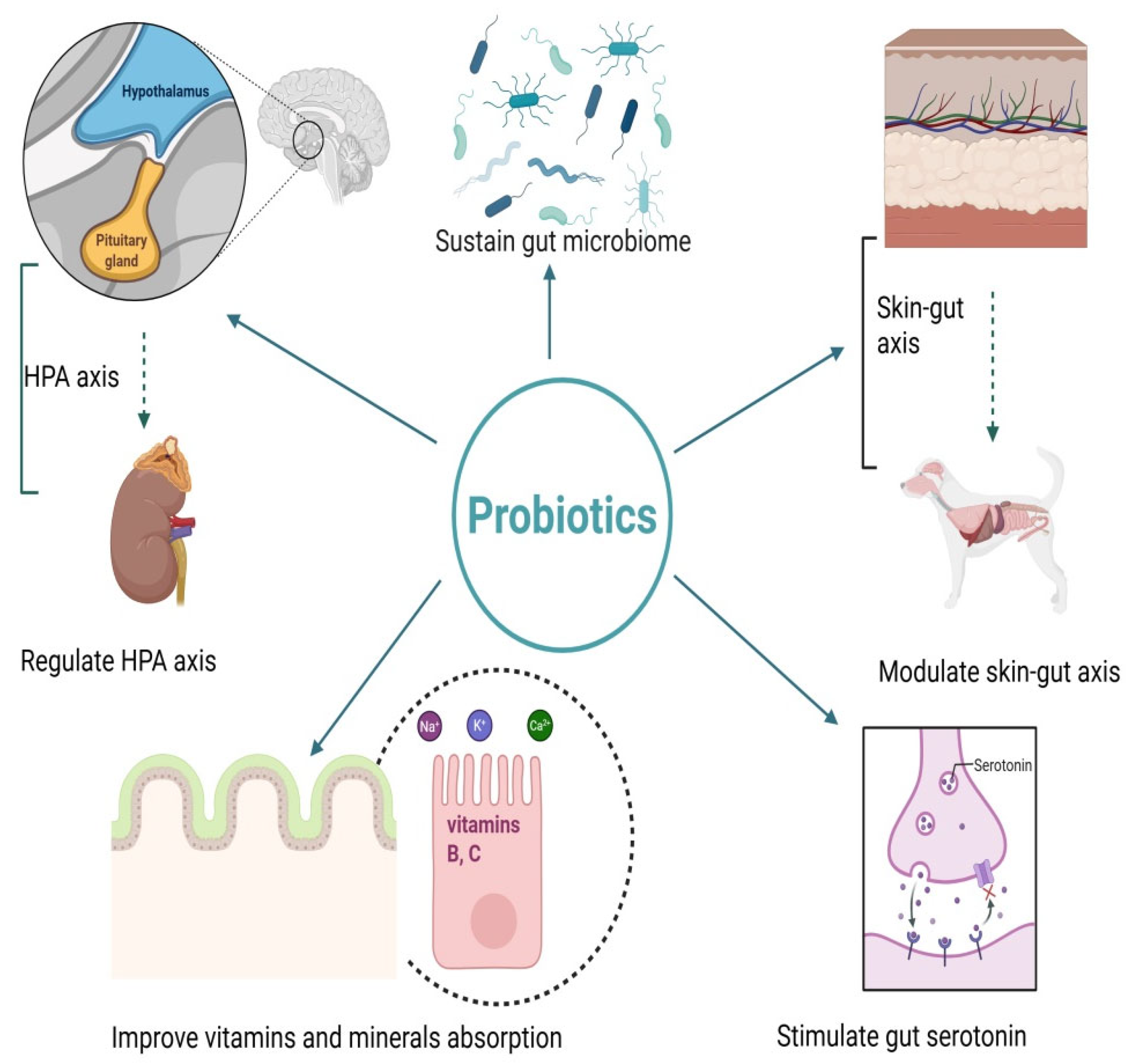
Figure 1. The Multifaceted Impact of Probiotics in Animals: Probiotics play a crucial role in maintaining an animal’s overall health in various ways. They maintain the intestinal flora, which is essential for a healthy internal environment. Another important mechanism for stress management that probiotics aid in regulating is the HPA axis. Through better absorption of vital minerals and vitamins, such as B, C, Na+, K+, and Ca2+, they improve overall nutrition. Additionally, probiotics contribute to the gut’s production of serotonin, a neurotransmitter that influences mood. Lastly, they alter the skin–gut axis, highlighting the close relationship between healthy skin and a functioning digestive tract.
Animals 15 02986 g001
Figure 2. Immunity and Probiotics: The Gut Microbiota’s Function in Reducing Inflammation. Probiotics induce healthy gut microbiota. It can influence the immune response, as illustrated in this figure. Bacteria from the gut produce short-chain fatty acids (SCFAs), which have anti-inflammatory properties. This interaction reduces the pro-inflammatory activity of Th1 and Th17 cells while increasing regulatory T cells (Tregs) and anti-inflammatory cytokines (such as IL-10 and TGF-β). As a result, a balanced microbiome supports a robust immune system and helps avoid excessive inflammation.
Animals 15 02986 g002
Disclaimer/Publisher’s Note: The statements, opinions and data contained in all publications are solely those of the individual author(s) and contributor(s) and not of MDPI and/or the editor(s). MDPI and/or the editor(s) disclaim responsibility for any injury to people or property resulting from any ideas, methods, instructions or products referred to in the content.