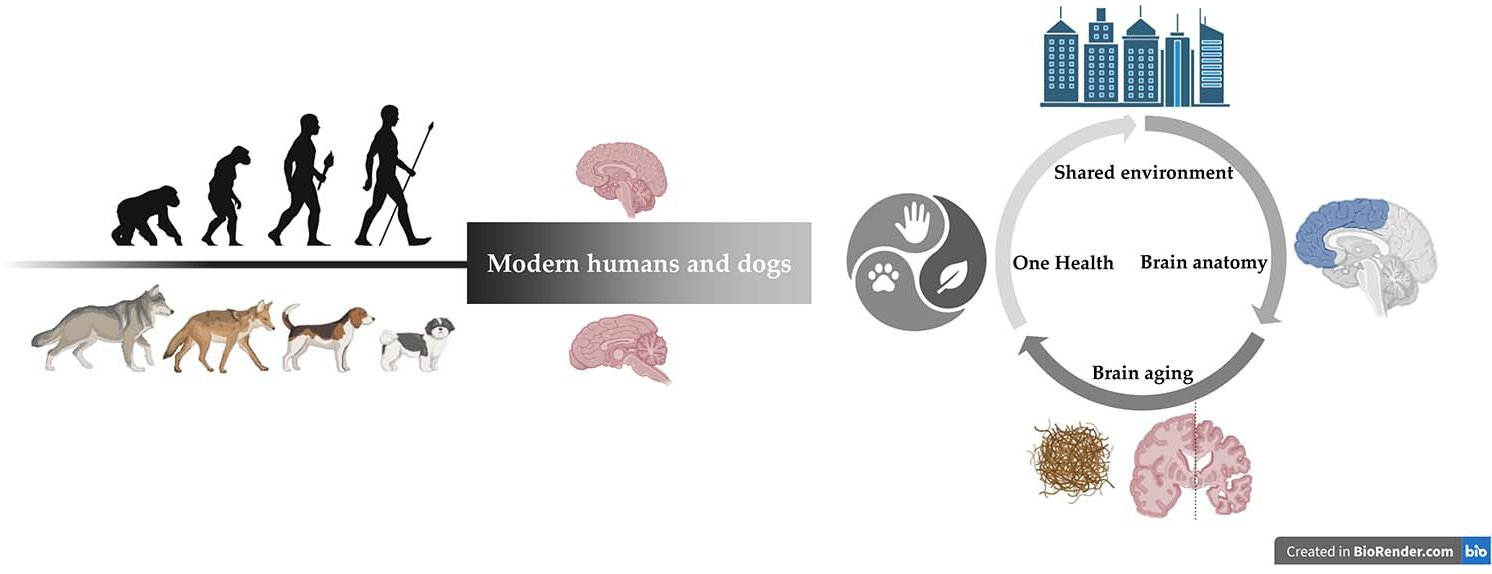
One Health, Two Species: Linking Domestication to Cognitive Aging in Dogs and Humans


Simple Summary
Abstract
1. The Evolutionary Perspective
2. Domestication and Neural Evolution
2.1. Impact of Domestication on Brain Anatomy
2.2. Genetic and Epigenetic Underpinnings of Domestication and Brain Evolution
3. Brain Aging and Neurodegenerative Diseases
3.1. Brain Aging
3.2. Alzheimer’s and Alzheimer’s-like Symptoms and Neuropathology
4. Parallel Evolution in Shared Environments: A One Health and Translational Perspective
5. Conclusions
Funding
Data Availability Statement
Acknowledgments
Conflicts of Interest
Abbreviations
| AD | Alzheimer’s disease |
| CCD | canine cognitive dysfunction |
| c. | centuries |
| DMN | default-mode networks |
| EQ | encephalization quotient |
| HPA | hypothalamic–pituitary–adrenal (axis) |
| NCDS | neural crest domestication syndrome |
| NFTs | neurofibrillary tangles |
| MRI | magnetic resonance imaging |
| Mya | million years ago |
| Kya | kilo years ago (kilo corresponds to a thousand) |
| PFC | prefrontal cortex |
References
- Hecht, E.E.; Barton, S.A.; Rogers Flattery, C.N.; Meza Meza, A. The evolutionary neuroscience of domestication. Trends Cogn. Sci. 2023, 27, 553–567. [Google Scholar] [CrossRef]
- Balcarcel, A.M.; Geiger, M.; Clauss, M.; Sánchez-Villagra, M.R. The mammalian brain under domestication: Discovering patterns after a century of old and new analyses. J. Exp. Zool. B Mol. Dev. Evol. 2022, 338, 460–483. [Google Scholar] [CrossRef]
- Hare, B.; Wobber, V.; Wrangham, R. The self-domestication hypothesis: Evolution of bonobo psychology is due to selection against aggression. Anim. Behav. 2012, 83, 573–585. [Google Scholar] [CrossRef]
- Tancredi, D.; Cardinali, I. Being a Dog: A Review of the Domestication Process. Genes 2023, 14, 992. [Google Scholar] [CrossRef]
- Wrangham, R. The Goodness Paradox: The Strange Relationship Between Virtue and Violence in Human Evolution; Knopf Doubleday Publishing Group: New York, NY, USA, 2019. [Google Scholar]
- Gleeson, B.T. Human Self-Domestication. In Encyclopedia of Evolutionary Psychological Science; Shackelford, T.K., Weekes-Shackelford, V.A., Eds.; Springer International Publishing: Cham, Switzerland, 2019; pp. 1–3. [Google Scholar]
- Cieri, R.L.; Churchill, S.E.; Franciscus, R.G.; Tan, J.; Hare, B. Craniofacial Feminization, Social Tolerance, and the Origins of Behavioral Modernity. Curr. Anthropol. 2014, 55, 419–443. [Google Scholar] [CrossRef]
- Ahmad, H.I.; Ahmad, M.J.; Jabbir, F.; Ahmar, S.; Ahmad, N.; Elokil, A.A.; Chen, J. The Domestication Makeup: Evolution, Survival, and Challenges. Front. Ecol. Evol. 2020, 8, 103. [Google Scholar] [CrossRef]
- Wang, G.-D.; Zhai, W.; Yang, H.-C.; Wang, L.; Zhong, L.; Liu, Y.-H.; Fan, R.-X.; Yin, T.-T.; Zhu, C.-L.; Poyarkov, A.D.; et al. Out of southern East Asia: The natural history of domestic dogs across the world. Cell Res. 2016, 26, 21–33. [Google Scholar] [CrossRef]
- Galibert, F.; Quignon, P.; Hitte, C.; André, C. Toward understanding dog evolutionary and domestication history. Comptes Rendus Biol. 2011, 334, 190–196. [Google Scholar] [CrossRef]
- Martínez Sánchez, R.M.; Rubio Valverde, M.; Moreno-García, M.; Maldonado Ruiz, A.; Granados Torres, A.; Delgado Huertas, A. Who let the dogs in? Lap dogs, canid sacrifices and funerary practices in the Roman cemetery of Llanos del Pretorio (Cordoba, Spain). Archaeol. Anthropol. Sci. 2020, 12, 87. [Google Scholar] [CrossRef]
- Li, Y.; Huang, M.; Wang, Z.; Liu, X.; He, S.; Wang, T.; Ma, B.; Liu, J.; Li, X.; Xiong, J.; et al. Genomic selection analysis of morphological and adaptation traits in Chinese indigenous dog breeds. Front. Vet. Sci. 2023, 10, 1237780. [Google Scholar] [CrossRef] [PubMed]
- Hobbins, P.; Worboys, M.; Strange, J.M.; Pemberton, N. The Invention of the Modern Dog: Breed and Blood in Victorian Britain. Isis 2020, 111, 407–409. [Google Scholar] [CrossRef]
- Hunter, P. Learning tricks from old dogs: Dog studies shed new light on ageing and cognitive decline. EMBO Rep. 2023, 24, e57706. [Google Scholar] [CrossRef] [PubMed]
- Calderón-Garcidueñas, L.; Mora-Tiscareño, A.; Ontiveros, E.; Gómez-Garza, G.; Barragán-Mejía, G.; Broadway, J.; Chapman, S.; Valencia-Salazar, G.; Jewells, V.; Maronpot, R.R.; et al. Air pollution, cognitive deficits and brain abnormalities: A pilot study with children and dogs. Brain Cogn. 2008, 68, 117–127. [Google Scholar] [CrossRef] [PubMed]
- Smith, T.D.; Van Valkenburgh, B. The dog-human connection. Anat. Rec. 2021, 304, 10–18. [Google Scholar] [CrossRef]
- Kruska, D.C. On the evolutionary significance of encephalization in some eutherian mammals: Effects of adaptive radiation, domestication, and feralization. Brain Behav. Evol. 2005, 65, 73–108. [Google Scholar] [CrossRef] [PubMed]
- Ruff, C.B.; Trinkaus, E.; Holliday, T.W. Body mass and encephalization in Pleistocene Homo. Nature 1997, 387, 173–176. [Google Scholar] [CrossRef]
- Dunbar, R.I.M. The social brain hypothesis. Evol. Anthropol. Issues News Rev. 1998, 6, 178–190. [Google Scholar] [CrossRef]
- Hare, B. Survival of the Friendliest: Homo sapiens Evolved via Selection for Prosociality. Annu. Rev. Psychol. 2017, 68, 155–186. [Google Scholar] [CrossRef]
- Berns, G. Decoding the Canine Mind. Cerebrum 2020, 2020, cer-04. [Google Scholar]
- Hare, B.; Tomasello, M. Human-like social skills in dogs? Trends Cogn. Sci. 2005, 9, 439–444. [Google Scholar] [CrossRef]
- Garamszegi, L.Z.; Kubinyi, E.; Czeibert, K.; Nagy, G.; Csörgő, T.; Kolm, N. Evolution of relative brain size in dogs-no effects of selection for breed function, litter size, or longevity. Evolution 2023, 77, 1591–1606. [Google Scholar] [CrossRef] [PubMed]
- Wilkins, A.S.; Wrangham, R.W.; Fitch, W.T. The “domestication syndrome” in mammals: A unified explanation based on neural crest cell behavior and genetics. Genetics 2014, 197, 795–808. [Google Scholar] [CrossRef]
- Lesch, R.; Fitch, W.T. The domestication of the larynx: The neural crest connection. J. Exp. Zool. B Mol. Dev. Evol. 2024, 342, 342–349. [Google Scholar] [CrossRef]
- Hecht, E.E.; Smaers, J.B.; Dunn, W.D.; Kent, M.; Preuss, T.M.; Gutman, D.A. Significant Neuroanatomical Variation Among Domestic Dog Breeds. J. Neurosci. 2019, 39, 7748–7758. [Google Scholar] [CrossRef]
- Roth, G.; Dicke, U. Evolution of the brain and intelligence. Trends Cogn. Sci. 2005, 9, 250–257. [Google Scholar] [CrossRef]
- Horschler, D.J.; Hare, B.; Call, J.; Kaminski, J.; Miklósi, Á.; MacLean, E.L. Absolute brain size predicts dog breed differences in executive function. Anim. Cogn. 2019, 22, 187–198. [Google Scholar] [CrossRef]
- Saganuwan, S.A. Modified formulas for calculation of encephalization: Quotient in dogs. BMC Res. Notes 2021, 14, 223. [Google Scholar] [CrossRef] [PubMed]
- Bradac, G.B. Brain Formation and Development. In Origin and Development of Cerebral Vessels; Bradac, G.B., Ed.; Springer Nature: Cham, Switzerland, 2025; pp. 1–5. [Google Scholar]
- Andics, A.; Gácsi, M.; Faragó, T.; Kis, A.; Miklósi, A. Voice-sensitive regions in the dog and human brain are revealed by comparative fMRI. Curr. Biol. 2014, 24, 574–578. [Google Scholar] [CrossRef]
- Marti, R.; Petignat, M.; Marcar, V.L.; Hattendorf, J.; Wolf, M.; Hund-Georgiadis, M.; Hediger, K. Effects of contact with a dog on prefrontal brain activity: A controlled trial. PLoS ONE 2022, 17, e0274833. [Google Scholar] [CrossRef]
- Andics, A.; Gábor, A.; Gácsi, M.; Faragó, T.; Szabó, D.; Miklósi, Á. Neural mechanisms for lexical processing in dogs. Science 2016, 353, 1030–1032. [Google Scholar] [CrossRef] [PubMed]
- Thompkins, A.M.; Lazarowski, L.; Ramaiahgari, B.; Gotoor, S.S.R.; Waggoner, P.; Denney, T.S.; Deshpande, G.; Katz, J.S. Dog-human social relationship: Representation of human face familiarity and emotions in the dog brain. Anim. Cogn. 2021, 24, 251–266. [Google Scholar] [CrossRef]
- Szabó, D.; Gábor, A.; Gácsi, M.; Faragó, T.; Kubinyi, E.; Miklósi, Á.; Andics, A. On the Face of It: No Differential Sensitivity to Internal Facial Features in the Dog Brain. Front. Behav. Neurosci. 2020, 14, 25. [Google Scholar] [CrossRef]
- Raghanti, M.A.; Munger, E.L.; Wicinski, B.; Butti, C.; Hof, P.R. 2.14—Comparative Structure of the Cerebral Cortex in Large Mammals. In Evolution of Nervous Systems, 2nd ed.; Kaas, J.H., Ed.; Academic Press: Oxford, UK, 2017; pp. 267–289. [Google Scholar]
- Boch, M.; Huber, L.; Lamm, C. Domestic dogs as a comparative model for social neuroscience: Advances and challenges. Neurosci. Biobehav. Rev. 2024, 162, 105700. [Google Scholar] [CrossRef] [PubMed]
- Bergström, A.; Frantz, L.; Schmidt, R.; Ersmark, E.; Lebrasseur, O.; Girdland-Flink, L.; Lin, A.T.; Storå, J.; Sjögren, K.-G.; Anthony, D.; et al. Origins and genetic legacy of prehistoric dogs. Science 2020, 370, 557–564. [Google Scholar] [CrossRef]
- Wang, C.; Wallerman, O.; Arendt, M.L.; Sundström, E.; Karlsson, Å.; Nordin, J.; Mäkeläinen, S.; Pielberg, G.R.; Hanson, J.; Ohlsson, Å.; et al. A novel canine reference genome resolves genomic architecture and uncovers transcript complexity. Commun. Biol. 2021, 4, 185. [Google Scholar] [CrossRef]
- Li, Y.; Vonholdt, B.M.; Reynolds, A.; Boyko, A.R.; Wayne, R.K.; Wu, D.D.; Zhang, Y.P. Artificial selection on brain-expressed genes during the domestication of dog. Mol. Biol. Evol. 2013, 30, 1867–1876. [Google Scholar] [CrossRef][Green Version]
- Sutter, N.B.; Bustamante, C.D.; Chase, K.; Gray, M.M.; Zhao, K.; Zhu, L.; Padhukasahasram, B.; Karlins, E.; Davis, S.; Jones, P.G.; et al. A single IGF1 allele is a major determinant of small size in dogs. Science 2007, 316, 112–115. [Google Scholar] [CrossRef]
- Plassais, J.; vonHoldt, B.M.; Parker, H.G.; Carmagnini, A.; Dubos, N.; Papa, I.; Bevant, K.; Derrien, T.; Hennelly, L.M.; Whitaker, D.T.; et al. Natural and human-driven selection of a single non-coding body size variant in ancient and modern canids. Curr. Biol. 2022, 32, 889–897.e889. [Google Scholar] [CrossRef] [PubMed]
- Vonholdt, B.M.; Pollinger, J.P.; Lohmueller, K.E.; Han, E.; Parker, H.G.; Quignon, P.; Degenhardt, J.D.; Boyko, A.R.; Earl, D.A.; Auton, A.; et al. Genome-wide SNP and haplotype analyses reveal a rich history underlying dog domestication. Nature 2010, 464, 898–902. [Google Scholar] [CrossRef] [PubMed]
- Saetre, P.; Lindberg, J.; Leonard, J.A.; Olsson, K.; Pettersson, U.; Ellegren, H.; Bergström, T.F.; Vilà, C.; Jazin, E. From wild wolf to domestic dog: Gene expression changes in the brain. Brain Res. Mol. Brain Res. 2004, 126, 198–206. [Google Scholar] [CrossRef]
- Albert, F.W.; Somel, M.; Carneiro, M.; Aximu-Petri, A.; Halbwax, M.; Thalmann, O.; Blanco-Aguiar, J.A.; Plyusnina, I.Z.; Trut, L.; Villafuerte, R.; et al. A comparison of brain gene expression levels in domesticated and wild animals. PLoS Genet. 2012, 8, e1002962. [Google Scholar] [CrossRef]
- Awalt, S.L.; Boghean, L.; Klinkebiel, D.; Strasser, R. A dog’s life: Early life histories influence methylation of glucocorticoid (NR3C1) and oxytocin (OXTR) receptor genes, cortisol levels, and attachment styles. Dev. Psychobiol. 2024, 66, e22482. [Google Scholar] [CrossRef]
- Jiang, S.; Postovit, L.; Cattaneo, A.; Binder, E.B.; Aitchison, K.J. Epigenetic Modifications in Stress Response Genes Associated with Childhood Trauma. Front. Psychiatry 2019, 10, 808. [Google Scholar] [CrossRef]
- Banta, J.A.; Richards, C.L. Quantitative epigenetics and evolution. Hered 2018, 121, 210–224. [Google Scholar] [CrossRef]
- Sundman, A.S.; Pértille, F.; Lehmann Coutinho, L.; Jazin, E.; Guerrero-Bosagna, C.; Jensen, P. DNA methylation in canine brains is related to domestication and dog-breed formation. PLoS ONE 2020, 15, e0240787. [Google Scholar] [CrossRef]
- Schütt, T.; Pedersen, J.T.; Berendt, M. Chapter 15—The Domestic Dog as a Model for Human Brain Aging and Alzheimer’s Disease. In Conn’s Handbook of Models for Human Aging, 2nd ed.; Ram, J.L., Conn, P.M., Eds.; Academic Press: Cambridge, MA, USA, 2018; pp. 177–194. [Google Scholar]
- Youssef, S.A.; Capucchio, M.T.; Rofina, J.E.; Chambers, J.K.; Uchida, K.; Nakayama, H.; Head, E. Pathology of the Aging Brain in Domestic and Laboratory Animals, and Animal Models of Human Neurodegenerative Diseases. Vet. Pathol. 2016, 53, 327–348. [Google Scholar] [CrossRef] [PubMed]
- Dunbar, R. Evolution of the social brain. Science 2003, 302, 1160–1161. [Google Scholar] [CrossRef]
- Castiglione, S.; Serio, C.; Piccolo, M.; Mondanaro, A.; Melchionna, M.; Di Febbraro, M.; Sansalone, G.; Wroe, S.; Raia, P. The influence of domestication, insularity and sociality on the tempo and mode of brain size evolution in mammals. Biol. J. Linn. Soc. 2021, 132, 221–231. [Google Scholar] [CrossRef]
- Driscoll, C.A.; Macdonald, D.W.; O’Brien, S.J. From wild animals to domestic pets, an evolutionary view of domestication. Proc. Natl. Acad. Sci. USA 2009, 106 (Suppl. S1), 9971–9978. [Google Scholar] [CrossRef]
- Carstensen, L.L.; Isaacowitz, D.M.; Charles, S.T. Taking time seriously. A theory of socioemotional selectivity. Am. Psychol. 1999, 54, 165–181. [Google Scholar] [CrossRef] [PubMed]
- Dewey, C.W.; Davies, E.S.; Xie, H.; Wakshlag, J.J. Canine Cognitive Dysfunction: Pathophysiology, Diagnosis, and Treatment. Vet. Clin. N. Am. Small Anim. Pract. 2019, 49, 477–499. [Google Scholar] [CrossRef] [PubMed]
- Morrill, K.; Chen, F.; Karlsson, E. Comparative neurogenetics of dog behavior complements efforts towards human neuropsychiatric genetics. Hum. Genet. 2023, 142, 1231–1246. [Google Scholar] [CrossRef]
- Hunter, R.P.; Ehrenzweig, J.; Hainsworth, A.; Crawford, A.; Dagan, A.; Sage, J.; Araujo, J. One-health approach to canine cognitive decline: Dogs Overcoming Geriatric Memory and Aging Initiative for early detection of cognitive decline. Am. J. Vet. Res. 2023, 84. [Google Scholar] [CrossRef] [PubMed]
- Ehrenzweig, J.; Hunter, R.P. Canine cognitive decline and Alzheimer disease: Clinical insights to solve a shared one-health problem. J. Am. Vet. Med. Assoc. 2023, 261, 1597–1604. [Google Scholar] [CrossRef]
- Studzinski, C.M.; Araujo, J.A.; Milgram, N.W. The canine model of human cognitive aging and dementia: Pharmacological validity of the model for assessment of human cognitive-enhancing drugs. Prog. Neuropsychopharmacol. Biol. Psychiatry 2005, 29, 489–498. [Google Scholar] [CrossRef]
- Cotman, C.W.; Head, E. The Canine (Dog) Model of Human Aging and Disease: Dietary, Environmental and Immunotherapy Approaches. J. Alzheimer’s Dis. 2008, 15, 685–707. [Google Scholar] [CrossRef] [PubMed]
- Prpar Mihevc, S.; Majdič, G. Canine Cognitive Dysfunction and Alzheimer’s Disease—Two Facets of the Same Disease? Front. Neurosci. 2019, 13, 604. [Google Scholar] [CrossRef]
- Schütt, T.; Helboe, L.; Pedersen, L.; Waldemar, G.; Berendt, M.; Pedersen, J.T. Dogs with Cognitive Dysfunction as a Spontaneous Model for Early Alzheimer’s Disease: A Translational Study of Neuropathological and Inflammatory Markers. J. Alzheimers Dis. 2016, 52, 433–449. [Google Scholar] [CrossRef]
- Head, E.; Rofina, J.; Zicker, S. Oxidative stress, aging, and central nervous system disease in the canine model of human brain aging. Vet. Clin. N. Am. Small Anim. Pract. 2008, 38, 167–178, vi. [Google Scholar] [CrossRef]
- Colle, M.A.; Hauw, J.J.; Crespeau, F.; Uchihara, T.; Akiyama, H.; Checler, F.; Pageat, P.; Duykaerts, C. Vascular and parenchymal Abeta deposition in the aging dog: Correlation with behavior. Neurobiol. Aging 2000, 21, 695–704. [Google Scholar] [CrossRef]
- Landsberg, G.M.; Nichol, J.; Araujo, J.A. Cognitive dysfunction syndrome: A disease of canine and feline brain aging. Vet. Clin. N. Am. Small Anim. Pract. 2012, 42, 749–768, vii. [Google Scholar] [CrossRef]
- Frantz, L.A.; Mullin, V.E.; Pionnier-Capitan, M.; Lebrasseur, O.; Ollivier, M.; Perri, A.; Linderholm, A.; Mattiangeli, V.; Teasdale, M.D.; Dimopoulos, E.A.; et al. Genomic and archaeological evidence suggest a dual origin of domestic dogs. Science 2016, 352, 1228–1231. [Google Scholar] [CrossRef]
- Nagasawa, M.; Mitsui, S.; En, S.; Ohtani, N.; Ohta, M.; Sakuma, Y.; Onaka, T.; Mogi, K.; Kikusui, T. Social evolution. Oxytocin-gaze positive loop and the coevolution of human-dog bonds. Science 2015, 348, 333–336. [Google Scholar] [CrossRef]
- Newberry, R.C. Behavioral, emotional, and cognitive effects of domestication. In APA Handbook of Comparative Psychology: Basic Concepts, Methods, Neural Substrate, and Behavior; American Psychological Association: Washington, DC, USA, 2017; Volume 1, pp. 315–329. [Google Scholar]
- Hansen Wheat, C.; van der Bijl, W.; Temrin, H. Dogs, but Not Wolves, Lose Their Sensitivity Toward Novelty with Age. Front. Psychol. 2019, 10, 2001. [Google Scholar] [CrossRef] [PubMed]
- Sykes, N.; Beirne, P.; Horowitz, A.; Jones, I.; Kalof, L.; Karlsson, E.; King, T.; Litwak, H.; McDonald, R.A.; Murphy, L.J.; et al. Humanity’s Best Friend: A Dog-Centric Approach to Addressing Global Challenges. Animals 2020, 10, 502. [Google Scholar] [CrossRef]
- Fallahi, M.; Masoudi, A.A.; Vaez Torshizi, R.; Maghsoudi, A. Socio-economic evaluation of human-dog coexistence: A 40,000 years history. Vet. Med. Sci. 2024, 10, e70012. [Google Scholar] [CrossRef]
- Fernández, M.; Paradisi, M.; D’Intino, G.; Del Vecchio, G.; Sivilia, S.; Giardino, L.; Calzà, L. A single prenatal exposure to the endocrine disruptor 2,3,7,8-tetrachlorodibenzo-p-dioxin alters developmental myelination and remyelination potential in the rat brain. J. Neurochem. 2010, 115, 897–909. [Google Scholar] [CrossRef]
- Frye, C.A.; Bo, E.; Calamandrei, G.; Calzà, L.; Dessì-Fulgheri, F.; Fernández, M.; Fusani, L.; Kah, O.; Kajta, M.; Le Page, Y.; et al. Endocrine disrupters: A review of some sources, effects, and mechanisms of actions on behaviour and neuroendocrine systems. J. Neuroendocrinol. 2012, 24, 144–159. [Google Scholar] [CrossRef] [PubMed]
- Arcangeli, G.; Lulli, L.G.; Traversini, V.; De Sio, S.; Cannizzaro, E.; Galea, R.P.; Mucci, N. Neurobehavioral Alterations from Noise Exposure in Animals: A Systematic Review. Int. J. Environ. Res. Public Health 2022, 20, 591. [Google Scholar] [CrossRef] [PubMed]
- Crisante, A.; Newberry, F.; Clegg, S.R.; Mitchell, G.L.; Pike, T.W.; Ratcliffe, V.; Spain, A.; Wilkinson, A.; Zulch, H.; Mills, D.S. A critical review of research concerning the gut microbiome in dogs and its relationship with behaviour. Appl. Anim. Behav. Sci. 2025, 292, 106755. [Google Scholar] [CrossRef]
- Kim, H.; Chae, Y.; Cho, J.H.; Song, M.; Kwak, J.; Doo, H.; Choi, Y.; Kang, J.; Yang, H.; Lee, S.; et al. Understanding the diversity and roles of the canine gut microbiome. J. Anim. Sci. Biotechnol. 2025, 16, 95. [Google Scholar] [CrossRef] [PubMed]
- Bray, E.E.; Raichlen, D.A.; Forsyth, K.K.; Promislow, D.E.L.; Alexander, G.E.; MacLean, E.L. Associations between physical activity and cognitive dysfunction in older companion dogs: Results from the Dog Aging Project. Geroscience 2023, 45, 645–661. [Google Scholar] [CrossRef]
- Livingston, G.; Huntley, J.; Liu, K.Y.; Costafreda, S.G.; Selbæk, G.; Alladi, S.; Ames, D.; Banerjee, S.; Burns, A.; Brayne, C.; et al. Dementia prevention, intervention, and care: 2024 report of the Lancet standing Commission. Lancet 2024, 404, 572–628. [Google Scholar] [CrossRef] [PubMed]
- Costa, L.G.; Cole, T.B.; Coburn, J.; Chang, Y.C.; Dao, K.; Roque, P. Neurotoxicants are in the air: Convergence of human, animal, and in vitro studies on the effects of air pollution on the brain. Biomed. Res. Int. 2014, 2014, 736385. [Google Scholar] [CrossRef] [PubMed]
- Calderón-Garcidueñas, L.; Maronpot, R.R.; Torres-Jardon, R.; Henríquez-Roldán, C.; Schoonhoven, R.; Acuña-Ayala, H.; Villarreal-Calderón, A.; Nakamura, J.; Fernando, R.; Reed, W.; et al. DNA damage in nasal and brain tissues of canines exposed to air pollutants is associated with evidence of chronic brain inflammation and neurodegeneration. Toxicol. Pathol. 2003, 31, 524–538. [Google Scholar] [CrossRef]
- Head, E.; Nukala, V.N.; Fenoglio, K.A.; Muggenburg, B.A.; Cotman, C.W.; Sullivan, P.G. Effects of age, dietary, and behavioral enrichment on brain mitochondria in a canine model of human aging. Exp. Neurol. 2009, 220, 171–176. [Google Scholar] [CrossRef]
- Beerda, B.; Schilder, M.B.H.; van Hooff, J.A.R.A.M.; de Vries, H.W.; Mol, J.A. Behavioural and Hormonal Indicators of Enduring Environmental Stress in Dogs. Anim. Welf. 2000, 9, 49–62. [Google Scholar] [CrossRef]
- Kim, E.J.; Pellman, B.; Kim, J.J. Stress effects on the hippocampus: A critical review. Learn. Mem. 2015, 22, 411–416. [Google Scholar] [CrossRef]
- Giovanniello, J.R.; Paredes, N.; Wiener, A.; Ramírez-Armenta, K.; Oragwam, C.; Uwadia, H.O.; Yu, A.L.; Lim, K.; Pimenta, J.S.; Vilchez, G.E.; et al. A dual-pathway architecture for stress to disrupt agency and promote habit. Nature 2025, 640, 722–731. [Google Scholar] [CrossRef]
- Reperant, L.A.; Brown, I.H.; Haenen, O.L.; de Jong, M.D.; Osterhaus, A.D.; Papa, A.; Rimstad, E.; Valarcher, J.F.; Kuiken, T. Companion Animals as a Source of Viruses for Human Beings and Food Production Animals. J. Comp. Pathol. 2016, 155, S41–S53. [Google Scholar] [CrossRef]
- Stufano, A.; Schino, V.; Plantone, D.; Lucchese, G. Occupational zoonoses, neurological diseases, and public health: A one health approach. Infect. Med. 2025, 4, 100184. [Google Scholar] [CrossRef] [PubMed]
- Sexton, C.; Ruple, A. Canine sentinels and our shared exposome. Science 2024, 384, 1170–1172. [Google Scholar] [CrossRef] [PubMed]

| Era/Time Period | Human Milestones | Dog Milestones | Shared Adaptation |
|---|---|---|---|
| >2 mya | Early Homo evolution, tool use, social groups | No domestication | Foundation of social cognition |
| ~100 kya | Anatomically modern humans | Wild wolves coexisting | Selection for benignness (self-domestication/handraising) |
| ~50–30 kya | Behavioral modernity, symbolic culture, art, language | Proto-domestication; early wolf-human mutualism | Mutual social attentiveness |
| ~20–15 kya | Early dog-human cohabitation | Dog genetic divergence from wolves | Selection for tameness, cooperation |
| ~12–10 kya | Neolithic Revolution: agriculture | Dogs help herd, guard, scavenge | Shared diets, microbiomes, pathogens |
| ~8–4 kya | Urban societies, early empires | Dogs in art, status symbols | Co-adaptation to urban life; urban ecological pressures |
| ~2 kya | Classical societies, cognitive specialization | Early breed diversification (Roman/Chinese records) | Trainability, breed-specific behaviors |
| 18th–19th c. | Scientific and Industrial Revolutions | Standardized breeding | Shared stress and emotional labor roles |
| 20th–21st c. | Genomic era, One Health awareness, aging/neurodegeneration studies | Companion animals, genetic models, cognitive disorder research | Shared cognitive aging, environmental sensitivity, disease susceptibility |
Disclaimer/Publisher’s Note: The statements, opinions and data contained in all publications are solely those of the individual author(s) and contributor(s) and not of MDPI and/or the editor(s). MDPI and/or the editor(s) disclaim responsibility for any injury to people or property resulting from any ideas, methods, instructions or products referred to in the content. |
© 2025 by the author. Licensee MDPI, Basel, Switzerland. This article is an open access article distributed under the terms and conditions of the Creative Commons Attribution (CC BY) license (https://creativecommons.org/licenses/by/4.0/).
Share and Cite
Quadalti, C. One Health, Two Species: Linking Domestication to Cognitive Aging in Dogs and Humans. Animals 2025, 15, 2851. https://doi.org/10.3390/ani15192851
Quadalti C. One Health, Two Species: Linking Domestication to Cognitive Aging in Dogs and Humans. Animals. 2025; 15(19):2851. https://doi.org/10.3390/ani15192851
Chicago/Turabian StyleQuadalti, Corinne. 2025. "One Health, Two Species: Linking Domestication to Cognitive Aging in Dogs and Humans" Animals 15, no. 19: 2851. https://doi.org/10.3390/ani15192851
APA StyleQuadalti, C. (2025). One Health, Two Species: Linking Domestication to Cognitive Aging in Dogs and Humans. Animals, 15(19), 2851. https://doi.org/10.3390/ani15192851