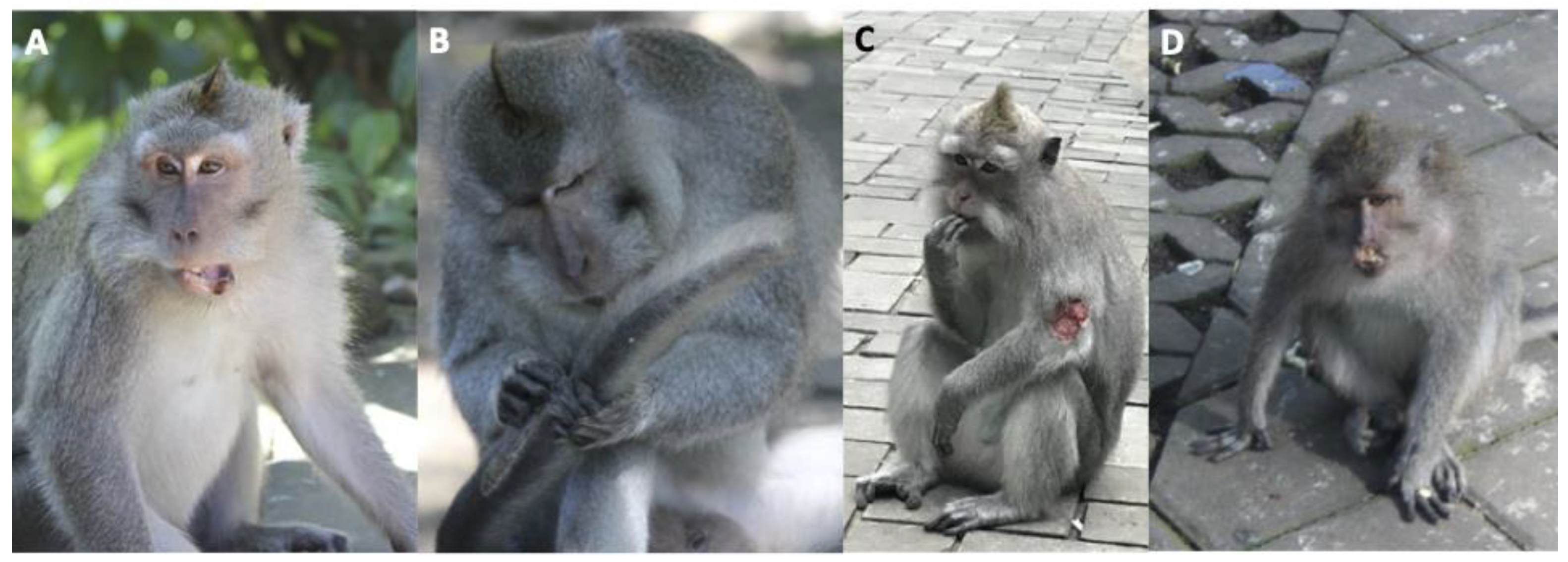
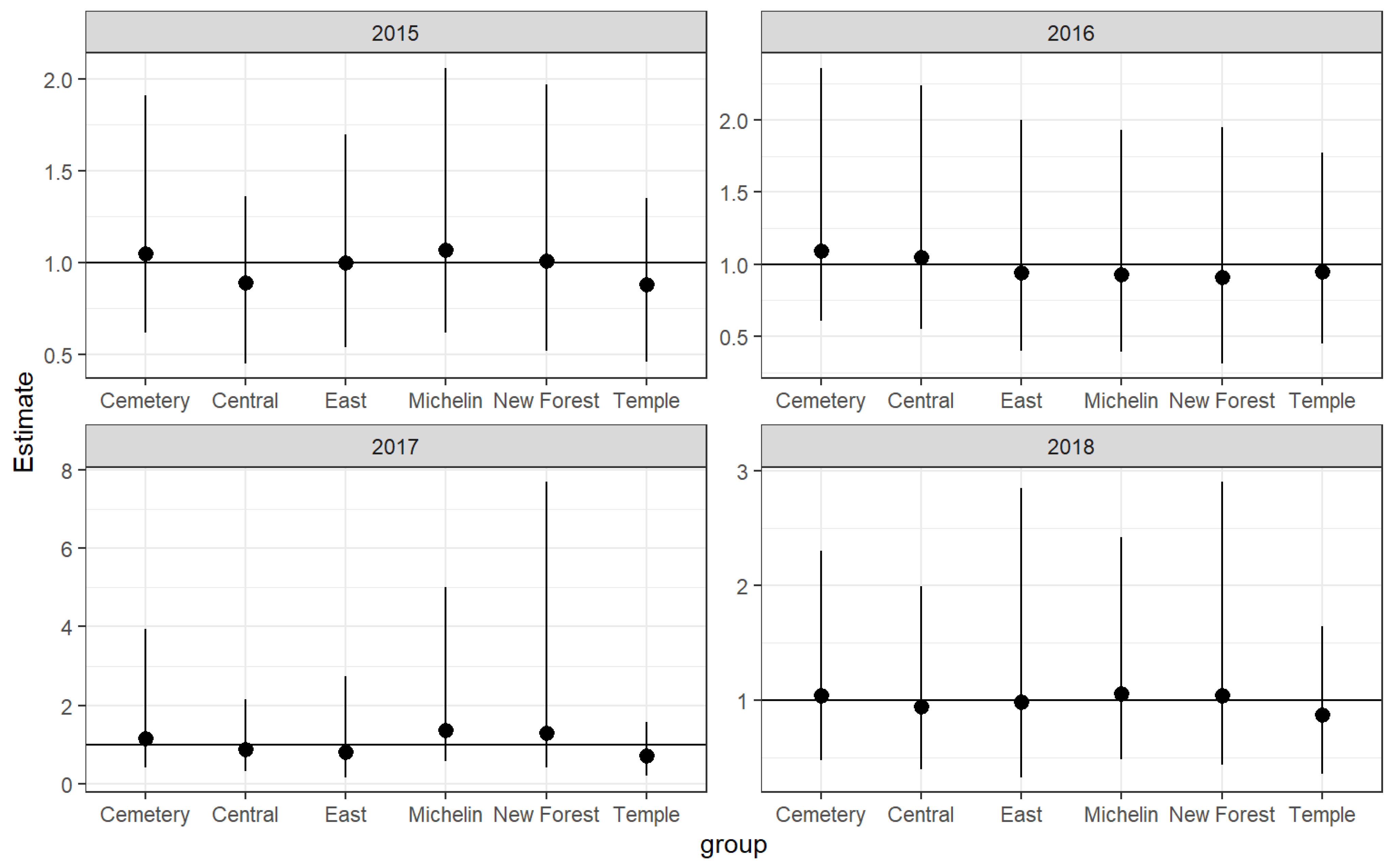
Healing Hanuman’s Army: Veterinary Care as a Core Component of One Health Principles in a Southeast Asian Monkey Forest
 , , , , ,
Simple Summary
Abstract
1. Introduction
2. Materials and Methods
2.1. Study Site and Study Subjects
2.2. Ubud Monkey Forest Veterinary Clinic
2.3. Data Collection
2.4. Data Analysis
2.4.1. Model Definition
2.4.2. Bayesian Sampling and Model Selection
- A baseline intercept only model: ;
- A population-effects only model: ;
- A mixed model with population and group effects: .
2.5. Ethical Considerations
3. Results
3.1. Model Selection
3.2. General Summary of the Multilevel Model
3.3. Group-Level Results
3.4. Population-Level Effects
3.5. Summary Statistics
4. Discussion
4.1. Sex
4.2. Age
4.3. Social Groups
4.4. Anatomical Location
4.5. Natural Injuries and Mortality
4.6. Anthropogenic Injuries and Mortality
4.7. Electrocutions
4.8. Vehicular Collisions
4.9. Gunshots
4.10. Plastic Pollution
4.11. The Ubud Monkey Forest Veterinary Clinic as a Model of Culturally Integrated Animal Care
5. Conclusions
Author Contributions
Funding
Institutional Review Board Statement
Informed Consent Statement
Data Availability Statement
Acknowledgments
Conflicts of Interest
References
- Lowry, H.; Lill, A.; Wong, B.B. Behavioural responses of wildlife to urban environments. Biol. Rev. 2013, 88, 537–549. [Google Scholar] [CrossRef] [Scilit] [PubMed]
- Johnson, M.T.; Munshi-South, J. Evolution of life in urban environments. Science 2017, 358, eaam8327. [Google Scholar] [CrossRef] [Scilit] [PubMed]
- Riley, E.P. The maturation of ethnoprimatology: Theoretical and methodological pluralism. Int. J. Primatol. 2018, 39, 705–729. [Google Scholar] [CrossRef] [Scilit]
- Suer, C.; Petit, O.; De Marco, A.; Jacobs, A.T.; Waranbe, K.; Thierry, B. A comparative network analysis of social type in macaques. Anim. Behav. 2011, 82, 845–852. [Google Scholar] [CrossRef] [Scilit]
- Fuentes, A. Social minds and social selves: Redefining the human-alloprimate interface. In The Politics of Species: Reshaping Our Relationships with Other Animals; Cambridge University Press: Cambridge, UK, 2013; pp. 79–188. [Google Scholar]
- Lansing, J.S.; Cox, M.P. Islands of Order: A Guide to Complexity Modeling for the Social Sciences; Princeton University Press: Princeton, NJ, USA, 2019. [Google Scholar]
- Loudon, J.E.; Howells, M.E.; Fuentes, A. The importance of integrative anthropology: A preliminary investigation employing primatological and cultural anthropological data collection methods in assessing human-monkey co-existence in Bali, Indonesia. Ecol. Environ. Anthropol. 2006, 2, 2–13. [Google Scholar]
- Mackenzie, J.S.; Jeggo, M. The One health approach—Why is it so important? Trop. Med. Infect. Dis. 2019, 4, 88. [Google Scholar] [CrossRef] [Scilit] [PubMed]
- Malone, N.; Wade, A.H.; Fuentes, A.; Riley, E.P.; Remis, M.; Robinson, C.J. Ethnoprimatology: Critical interdisciplinarity and multispecies approaches in anthropology. Crit. Anthropol. 2014, 34, 8–29. [Google Scholar] [CrossRef] [Scilit]
- Gadgil, M.; Berkes, F.; Folke, C. Indigenous knowledge for biodiversity conservation. Ambio 1993, 22, 151–156. [Google Scholar]
- Wijana, I.N.; Wesnawa, G.A. The mapping of rare plant species distribution in monkey forest, Ubud, Gianyar, Bali. Media Komun. Geogr. 2018, 19, 23–30. [Google Scholar] [CrossRef] [Scilit]
- Howells, M.E.; Loudon, J.E.; Brotcorne, F.; Peterson, J.V.; Wandia, I.N.; Putra, I.A.; Fuentes, A. Primates and primatologists: Reflecting on two decades of primatological and ethnoprimatological research, tourism, and conservation at the Ubud Monkey Forest. In Ecotourism and Indonesia’s Primates; Springer: Berlin/Heidelberg, Germany, 2022; pp. 153–178. [Google Scholar]
- Brotcorne, F. Demography, behavior, and sterilization of a long-tailed macaque (Macaca fascicularis) population in Ubud monkey forest (Bali): A long term follow-up. In Progress Report RISTEK; RISTEK: Jakarta, Indonesia, 2018. [Google Scholar]
- Gelamn, A.; Hill, J. Data Analysis Using Regression and Multilevel/Hierarchical Models; Cambridge University Press: Cambridge, UK, 2006. [Google Scholar]
- Bürkner, P.C. Advance Bayesian Multilevel Modeling with the R Package brms. R J. 2018, 10, 395–411. [Google Scholar] [CrossRef] [Scilit]
- Bürkner, P.C. brms: An R package for Bayesian multilevel models using Stan. J. Stat. Softw. 2017, 80, 1–28. [Google Scholar] [CrossRef] [Scilit]
- R Core Team. R: A Language and Environment for Statistical Computing; R Foundation for Statistical Computing: Vienna, Austria, 2023. [Google Scholar]
- McElreath, R. Statitical Rethinking: A Bayesian Course with Examples in R and STAN; CRC Press: Boca Raton, FL, USA, 2020. [Google Scholar]
- Devaux, C.A.; Mediannikov, O.; Medkour, H.; Raoult, D. Infectious Disease Rik Across the Growing Human—Non Human Primate Interface: A Review of the Evidence. Front. Public Health 2019, 7, 305. [Google Scholar] [CrossRef] [Scilit] [PubMed]
- Jones-Engel, L.; Engel, G.A.; Schillaci, M.A.; Babo, R.; Froehlich, J. Detection of antibodies to selected human pathogens among wild and pet macaques (Macaca tonkeana) in Sulawesi, Indonesia. Am. J. Primatol. 2001, 54, 171–178. [Google Scholar] [CrossRef] [Scilit] [PubMed]
- Hockings, K.J.; Mubemba, B.; Avanzi, C.; Pleh, K.; Düx, A.; Bersacola, E.; Bessa, J.; Ramon, M.; Metzger, S.; Patrono, L.V.; et al. Leprosy in wild chimpanzees. Nature 2021, 598, 652–656. [Google Scholar] [CrossRef] [Scilit] [PubMed]
- Engel, G.; O’Hara, T.M.; Cardona-Marek, T.; Heidrich, J.; Chalise, M.K.; Kyes, R.; Jones-Engel, L. Synanthropic primates in Asia: Potential sentinels for environmental toxins. Am. J. Phys. Anthropol. 2010, 142, 453–460. [Google Scholar] [CrossRef] [Scilit]
- Hayama, S.I.; Tsuchiya, M.; Ochiai, K.; Nakiri, S.; Nakanishi, S.; Ishii, N.; Kato, T.; Tanaka, A.; Konno, F.; Kawamoto, Y.; et al. Small head size and delayed body weight growth in wild Japanese monkey fetuses after the Fukushima Daiichi nuclear disaster. Sci. Rep. 2017, 7, 1–7. [Google Scholar] [CrossRef] [Scilit] [PubMed]
- Krief, S.; Berny, P.; Gumisiriza, F.; Gross, R.; Demeneix, B.; Fini, J.B.; Chapman, C.A.; Chapman, L.J.; Seguya, A.; Wasswa, J. Agricultural expansion as risk to endangered wildlife: Pesticide exposure in wild chimpanzees and baboons displaying facial dysplasia. Sci. Total Environ. 2017, 598, 647–656. [Google Scholar] [CrossRef] [Scilit]
- Loudon, J.E.; Lewis, A.E.; Turner, T.R.; Howells, M.E.; Lieurance, A.; Pender, J.E. Heavy metal ecotoxicology of vervet monkeys (Chlorocebus pygerythrus) across field sites in South Africa. Primates 2022, 63, 525–533. [Google Scholar] [CrossRef] [Scilit]
- Chapman, C.A.; Peres, C.A. Primate conservation: Lessons learned in the last 20 years can guide future efforts. Evol. Anthropol. 2021, 30, 345–361. [Google Scholar] [CrossRef] [Scilit]
- Lane-deGraaf, K.E.; Fuentes, A.; Hollocher, H. Landscape genetics reveal fine-scale boundaries in island populations of Indonesian long-tailed macaques. Landsc. Ecol. 2014, 29, 1505–1519. [Google Scholar] [CrossRef] [Scilit]
- Hansen, M.F.; Nawangsari, V.A.; van Beest, F.M.; Schmidt, N.M.; Fuentes, A.; Traeholt, C.; Stelvig, M.; Dabelsteen, T. Estimating densities and spatial distribution of a commensal primate species, the long-tailed macaque (Macaca fascicularis). Conserv. Sci. Pract. 2019, 1, e88. [Google Scholar] [CrossRef] [Scilit]
- Brotcorne, F. Behavioral Ecology of Commensal Long-Tailed Macaque (Macaca fascicularis) Populations in Bali, Indonesia: Impact of Anthropic Factors. Ph.D. Thesis, University of Liège, Liège, Belgium, 2014. [Google Scholar]
- Peterson, J.V.; Fuentes, A.; Wandia, I.N. Affiliation among subadult males varies between populations of long-tailed macaques. Acta Ethol. 2021, 24, 9–21. [Google Scholar] [CrossRef] [Scilit]
- Goodall, J. The Chimpanzees of Gombe: Patterns of Behavior; Belknap: Cambridge, UK, 1986. [Google Scholar]
- Cunneyworth, P.M.; Slade, A.M. Impact of electric shock and electrocution on populations of four monkey species in the suburban town of Diani, Kenya. Int. J. Primatol. 2021, 42, 171–186. [Google Scholar] [CrossRef] [Scilit]
- Cunneyworth, P.M.; Duke, J. Vehicle collisions among four species of monkeys between 2000 and 2018 on a suburban road in Diani, Kenya. Int. J. Primatol. 2020, 41, 45–60. [Google Scholar] [CrossRef] [Scilit]
- Schilaci, M.A.; Engel, G.A.; Fuentes, A.; Rompis, A.; Putra, A.; Wandia, I.N.; Bailey, J.A.; Brogdon, B.G.; Jones-Engel, L. The not-so-sacred monkeys of Bali: A radiographic study of human-primate commensalism. In Indonesian Primates; Springer: Berlin/Heidelberg, Germany, 2010; pp. 249–256. [Google Scholar]
- Deleuze, S.; Brotcorne, F.; Polet, R.; Soma, G.; Rigauz, G.; Giraud, G.; Cloutier, F.; Poncin, P.; Wandia, N.; Huynen, M.-C. Tubectomy of pregnant and non-pregnant female Balinese macaques (Macaca fascicularis) with post-operative monitoring. Front. Vet. Sci. 2021, 8, 688656. [Google Scholar] [CrossRef] [Scilit]
- Giraud, G.; Sosa, S.; Hambuckers, A.; Deleuze, S.; Wandia, I.N.; Huynen, M.-C.; Poncin, P.; Brotcorne, F. Effect of infant presence on social networks of sterilized and intact wild female Balinese macaques (Macaca fascicularis). Animals 2021, 11, 2538. [Google Scholar] [CrossRef] [Scilit] [PubMed]
- Vriend, P.; Hidayat, H.; van Leeuwen, J.; Cordova, M.R.; Purba, N.P.; Löhr, A.J.; Faizal, I.; Ningsih, N.S.; Augstina, K.; Husrin, S.; et al. Plastic pollution research in Indonesia: State of science and future research directions to reduce impacts. Front. Environ. Sci. 2021, 9, 187. [Google Scholar] [CrossRef] [Scilit]
- Lutgendorf, P. Hanuman’s Tale: The Messages of a Divine Monkey; Oxford University Press: Oxford, UK, 2007. [Google Scholar]
- Wheatley, B.P. Sacred Monkeys of Bali; Waveland Press: Prospect Heights, IL, USA, 1999. [Google Scholar]
- Peterson, J.V.; Riley, E.P. Monyet yang dihargai, monyet yang dibenci: The human-macaque interface in Indonesia. In The Macaque Connection: Cooperation and Conflict between Humans and Macaques; Springer: Berlin/Heidelberg, Germany, 2012; pp. 149–166. [Google Scholar]
- Peterson, J.V. Tri Hita Karana. The International Encyclopedia of Primatology; Wiley: Hoboken, NJ, USA, 2016; pp. 1–2. [Google Scholar]



| Social Group | 2015 | 2016 | 2017 | 2018 |
|---|---|---|---|---|
| Cemetery | 85 | 78 | 96 | 92 |
| Central | 152 | 146 | 148 | 199 |
| East | 90 | 113 | 138 | 104 |
| Michelin | 85 | 108 | 104 | 152 |
| New Forest | 84 | 109 | 102 | 105 |
| Temple | 163 | 124 | 161 | 112 |
| Total | 659 | 678 | 749 | 764 |
| Females | |||
| Year | Injuries | Mortalities | Total |
| 2015 | 4 | 8 | 12 |
| 2016 | 19 | 18 | 37 |
| 2017 | 4 | 10 | 14 |
| 2018 | 8 | 9 | 17 |
| Total | 35 | 45 | 80 |
| Males | |||
| Year | Injuries | Mortalities | Total |
| 2015 | 26 | 19 | 45 |
| 2016 | 43 | 24 | 67 |
| 2017 | 22 | 20 | 42 |
| 2018 | 21 | 18 | 39 |
| Total | 112 | 81 | 193 |
| Model | ELPD | ELPD Difference | Standard Error of the Difference |
|---|---|---|---|
| Multilevel | −176.0 | 0.0 | 0.0 |
| Population-Effects Only | −180.8 | −4.8 | 4.2 |
| Intercept Only | −190.6 | −14.6 | 6.0 |
| Group-Level Terms | ||||
| Parameter | Estimate | Estimated Error | L-95 | U-95 |
| sd(2015) | 0.28 | 0.24 | 0.01 | 0.92 |
| sd(2016) | 0.35 | 0.30 | 0.01 | 1.07 |
| sd(2017) | 0.62 | 0.44 | 0.03 | 1.67 |
| sd(2018) | 0.41 | 0.34 | 0.02 | 1.23 |
| cor(2015,2016) | −0.07 | 0.45 | −0.86 | 0.78 |
| cor(2015,2017) | 0.01 | 0.44 | −0.81 | 0.81 |
| cor(2016,2017) | 0.02 | 0.44 | −0.79 | 0.81 |
| cor(2015,2018) | −0.02 | 0.45 | −0.83 | 0.81 |
| cor(2016,2018) | 0.03 | 0.46 | −0.81 | 0.82 |
| cor(2017,2018) | 0.08 | 0.44 | −0.77 | 0.85 |
| Population-Level Terms | ||||
| Parameter | Estimate | Estimated Error | L-95 | U-95 |
| βIntercept | 1.60 | 0.49 | 0.68 | 2.61 |
| β1–4 years old | −0.80 | 0.38 | −1.55 | −0.08 |
| β5–9 years old | −1.34 | 0.38 | −2.09 | −0.61 |
| β10–15 years old | −1.76 | 0.40 | −2.56 | −0.97 |
| β16+ years old | −0.48 | 0.77 | −2.00 | 1.06 |
| βsex_male | −0.67 | 0.28 | −1.21 | −0.12 |
| βfighting | −0.75 | 0.55 | −1.82 | 0.30 |
| βanthropogenic | 0.76 | 0.37 | 0.05 | 1.49 |
| β2016 | −0.52 | 0.40 | −1.28 | 0.32 |
| β2017 | 0.17 | 0.49 | −0.75 | 1.17 |
| β2018 | −0.21 | 0.45 | −1.07 | 0.71 |
| Parameter | Odds of Death | Odds of Injury |
|---|---|---|
| βIntercept | 5.01 | 0.20 |
| β1–4 years old | 0.45 | 2.24 |
| β5–9 years old | 0.26 | 3.84 |
| β10–15 years old | 0.17 | 5.88 |
| β16+ years old | 0.61 | 1.64 |
| βsex_male | 0.51 | 1.95 |
| βfighting | 0.47 | 2.13 |
| βanthropogenic | 2.15 | 0.47 |
| β2016 | 0.59 | 1.70 |
| β2017 | 1.17 | 0.85 |
| β2018 | 0.81 | 1.24 |
| Age Category | Injuries | Mortalities |
|---|---|---|
| 0–1 years | 8 | 33 |
| 1–4 years | 35 | 41 |
| 5–9 years | 53 | 33 |
| 10–15 years | 51 | 18 |
| 16+ years | 2 | 1 |
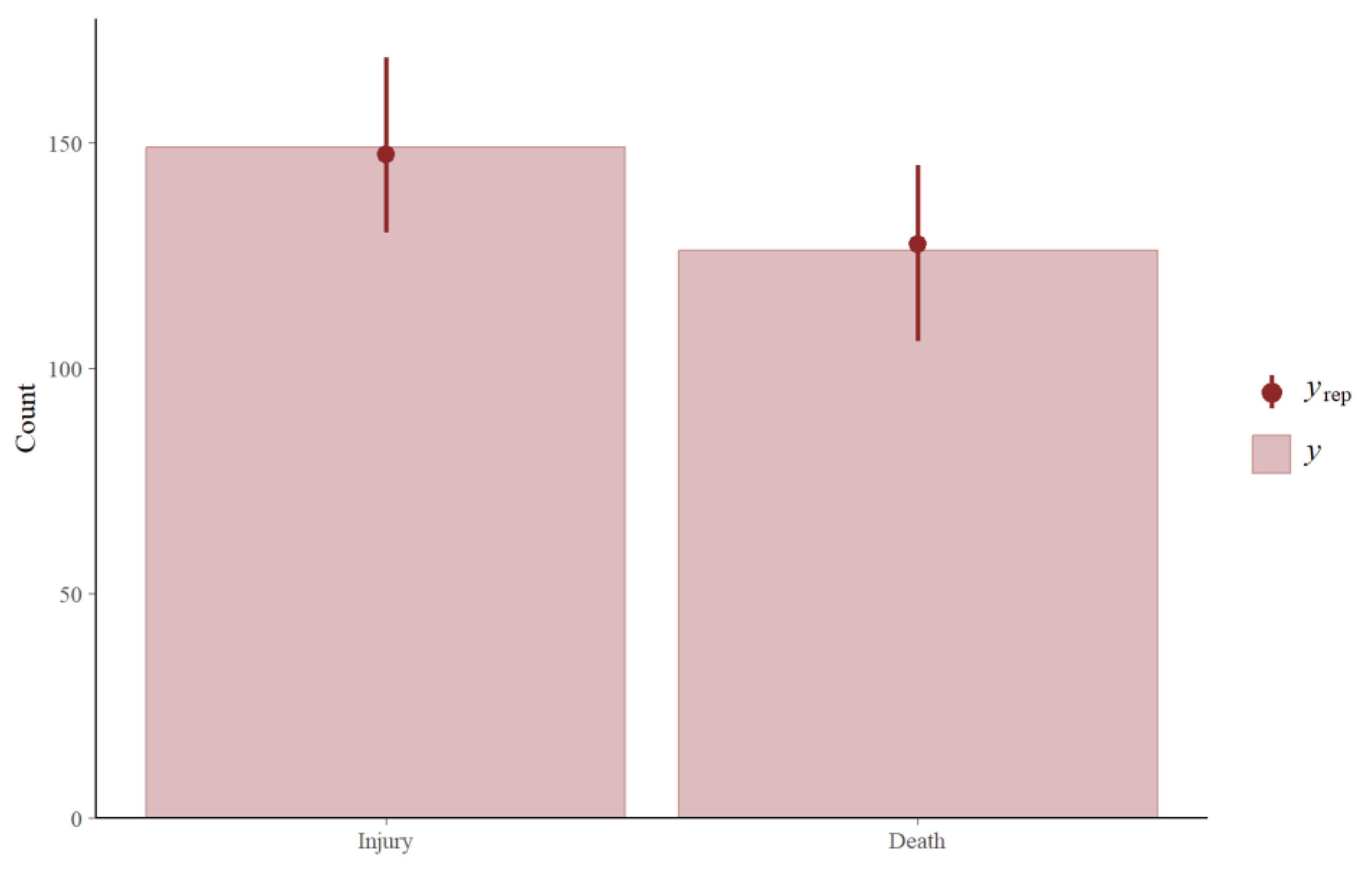
| Total | 149 | 126 |
| Year | Cemetery | Central | East | Michelin | New Forest | Temple | Total Injuries | Total Mortalities |
|---|---|---|---|---|---|---|---|---|
| 2015 | 1(1) | 5 (2) | 9 (12) | 0 (0) | 0 (0) | 17 (12) | 32 | 27 |
| 2016 | 12 (14) | 15 (9) | 4 (2) | 4 (3) | 3 (1) | 24 (13) | 62 | 42 |
| 2017 | 2 (4) | 7 (8) | 1 (0) | 4 (9) | 0 (2) | 12 (7) | 26 | 30 |
| 2018 | 4 (8) | 5 (4) | 0 (0) | 5 (6) | 1 (2) | 14 (7) | 29 | 27 |
| Total | 19 (27) | 32 (23) | 14 (14) | 13 (18) | 4 (5) | 67 (39) | 149 | 126 |
| Anatomical Side | Injuries | Mortalities |
|---|---|---|
| left | 16 | 4 |
| left & right | 3 | 3 |
| right | 25 | 3 |
| N/A | 65 | 70 |
| Total | 109 | 80 |
| Body Part | Injuries | Mortalities |
|---|---|---|
| Abdomen | 1 | 1 |
| Ano-genital | 3 | 3 |
| One arm | 1 | 0 |
| Back | 3 | 0 |
| Body (sides and ventrum) | 31 | 60 |
| Eye | 1 | 0 |
| Face | 4 | 0 |
| Feet (both) | 0 | 1 |
| Foot | 5 | 2 |
| Hand | 22 | 3 |
| Hands (both) | 2 | 1 |
| Head | 18 | 4 |
| Leg | 24 | 2 |
| Legs (both) | 0 | 1 |
| Mouth | 14 | 1 |
| Neck | 2 | 2 |
| Scrotum | 2 | 0 |
| Tail | 7 | 2 |
| Total | 140 | 83 |
| Year | Natural | Anthropogenic | Total |
|---|---|---|---|
| 2015 | 27 | 5 | 32 |
| 2016 | 56 | 6 | 62 |
| 2017 | 24 | 2 | 26 |
| 2018 | 28 | 1 | 29 |
| Total | 135 | 14 | 149 |
| Diagnosis/Treatment | Injuries | Mortalities |
|---|---|---|
| Dead (after birth) | 0 | 5 |
| Dead (no reason recorded) | 0 | 15 |
| Fall | 7 | 38 |
| Fighting | 14 | 4 |
| Operation | 1 | 0 |
| Released | 1 | 0 |
| Seizure | 1 | 1 |
| Sick | 3 | 6 |
| Starvation | 0 | 1 |
| Surgery (recovering after surgery) | 2 | 1 |
| Tumor | 7 | 0 |
| Ulcer | 3 | 0 |
| Wound(s) | 96 | 28 |
| Total | 135 | 99 |
| Year | Non-Fighting Injuries | Fighting Injuries | Total |
|---|---|---|---|
| 2015 | 22 | 10 (3) | 32 |
| 2016 | 58 | 4 (0) | 62 |
| 2017 | 26 | 0 | 26 |
| 2018 | 29 | 0 (1) | 29 |
| Total | 135 | 14 (4) | 149 |
| Diagnosis | Injuries | Mortalities |
|---|---|---|
| Bottle cap (in cheek pouch) | 5 | 0 |
| Electrocution | 9 | 11 |
| Hit by car | 0 | 3 |
| Hit by motor scooter | 0 | 9 |
| Gunshot | 0 | 4 |
| Total | 14 | 27 |
Disclaimer/Publisher’s Note: The statements, opinions and data contained in all publications are solely those of the individual author(s) and contributor(s) and not of MDPI and/or the editor(s). MDPI and/or the editor(s) disclaim responsibility for any injury to people or property resulting from any ideas, methods, instructions or products referred to in the content. |
© 2023 by the authors. Licensee MDPI, Basel, Switzerland. This article is an open access article distributed under the terms and conditions of the Creative Commons Attribution (CC BY) license (https://creativecommons.org/licenses/by/4.0/).
Share and Cite
Loudon, J.E.; Howells, M.E.; Wolfe, C.A.; Buana, I.N.; Buda, W.; Wandia, I.N.; Putra, I.G.A.A.; Patterson, M.; Fuentes, A. Healing Hanuman’s Army: Veterinary Care as a Core Component of One Health Principles in a Southeast Asian Monkey Forest. Animals 2024, 14, 117. https://doi.org/10.3390/ani14010117
Loudon JE, Howells ME, Wolfe CA, Buana IN, Buda W, Wandia IN, Putra IGAA, Patterson M, Fuentes A. Healing Hanuman’s Army: Veterinary Care as a Core Component of One Health Principles in a Southeast Asian Monkey Forest. Animals. 2024; 14(1):117. https://doi.org/10.3390/ani14010117
Chicago/Turabian StyleLoudon, James E., Michaela E. Howells, Christopher A. Wolfe, I. Nyoman Buana, Wayan Buda, I. Nengah Wandia, I. Gusti Agung Arta Putra, Meghan Patterson, and Agustín Fuentes. 2024. "Healing Hanuman’s Army: Veterinary Care as a Core Component of One Health Principles in a Southeast Asian Monkey Forest" Animals 14, no. 1: 117. https://doi.org/10.3390/ani14010117
APA StyleLoudon, J. E., Howells, M. E., Wolfe, C. A., Buana, I. N., Buda, W., Wandia, I. N., Putra, I. G. A. A., Patterson, M., & Fuentes, A. (2024). Healing Hanuman’s Army: Veterinary Care as a Core Component of One Health Principles in a Southeast Asian Monkey Forest. Animals, 14(1), 117. https://doi.org/10.3390/ani14010117