Residue Depletion Profile and Estimation of Withdrawal Period for Sulfadimethoxine and Ormetoprim in Edible Tissues of Nile Tilapia (Oreochromis sp.) on Medicated Feed
by
 , , , , ,
Lucas Victor Pereira de Freitas
1,† ,
,
Carlos Augusto Alvarenga da Mota Júnior
1,†,
Marina Alves Damaceno
1,
Juliana Grell Fernandes Silveira
1,
Ana Carolina Vellosa Portela
1,
Sarah Chagas Campanharo
1,
Agnaldo Fernando Baldo da Silva
1,
Inácio Mateus Assane
2 ,
,
Fabiana Pilarski
2,
James Jacob Sasanya
3 and
Jonas Augusto Rizzato Paschoal
1,* 1
Department of Biomolecular Sciences, School of Pharmaceutical Sciences of Ribeirão Preto, University of São Paulo (USP), Ribeirao Preto 14040-900, SP, Brazil
2
Laboratory of Microbiology and Parasitology of Aquatic Organisms, Aquaculture Center of Unesp, Sao Paulo State University (Unesp), Jaboticabal 14884-900, SP, Brazil
3
International Atomic Energy Agency, A-1400 Vienna, Austria
*
Author to whom correspondence should be addressed.
†
These authors contributed equally to this work.
Animals 2023, 13(15), 2499; https://doi.org/10.3390/ani13152499
Submission received: 12 June 2023
/
Revised: 10 July 2023
/
Accepted: 1 August 2023
/
Published: 3 August 2023
(This article belongs to the Special Issue Pharmacokinetics and Pharmacodynamics in Aquatic Animals)
Simple Summary
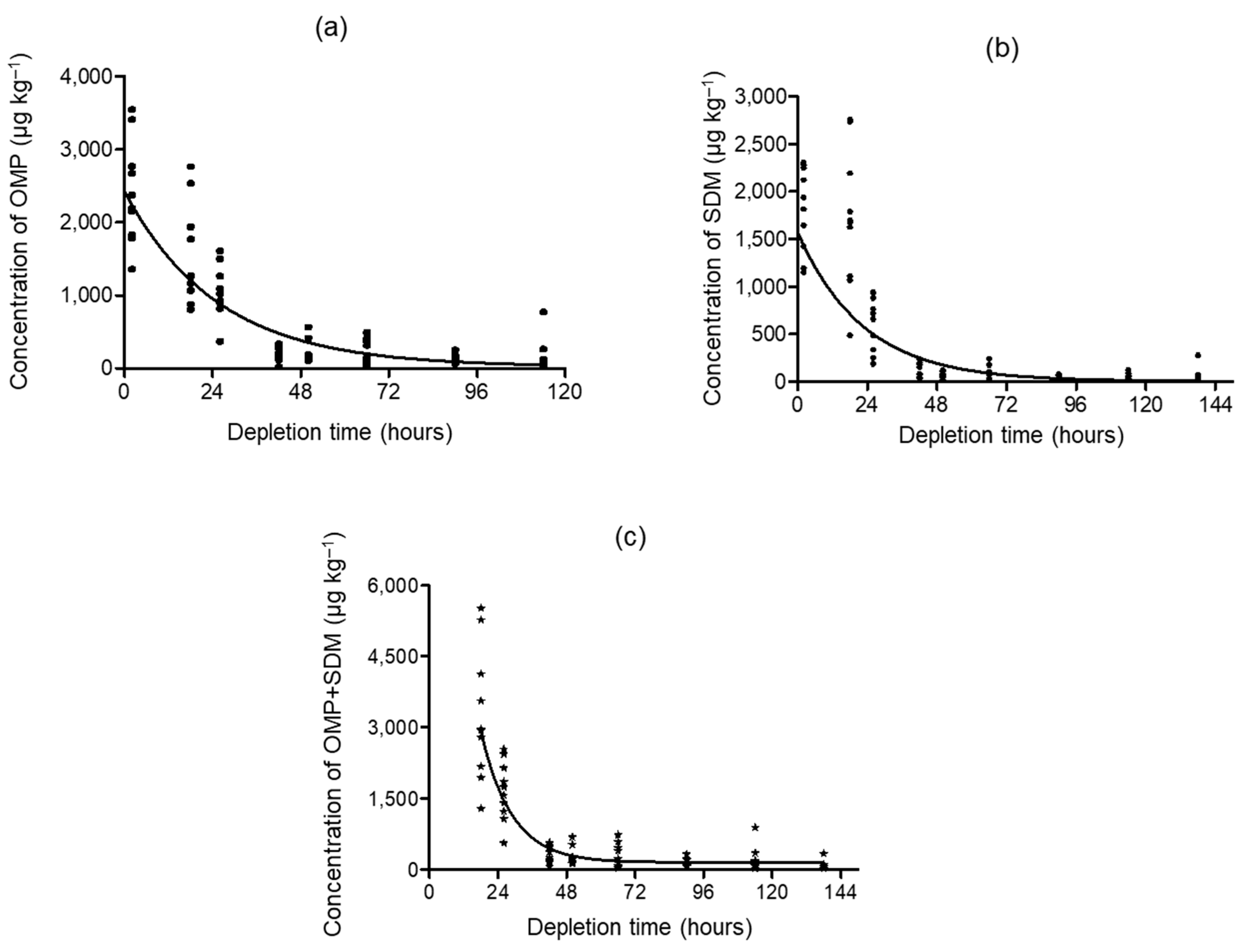
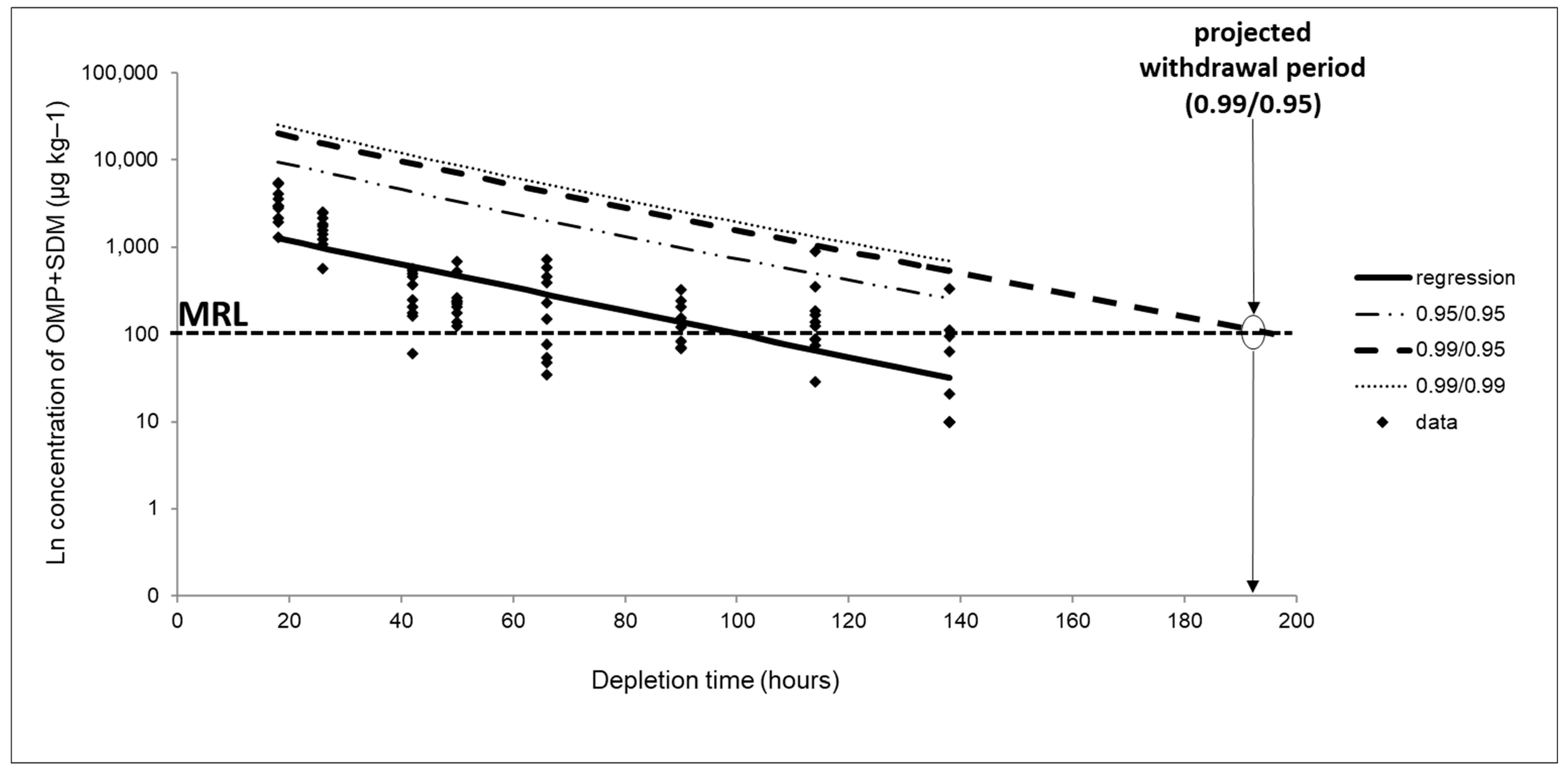
The use of veterinary drugs in fish farms is required to maintain animal health, minimize economic losses, and increase productivity. This study investigated the residue depletion profile of sulfadimethoxine (SDM) and ormetoprim (OMP) in Nile tilapia (Oreochromis sp.) after oral administration aiming to estimate a minimum withdrawal. The medicated feed used was prepared and analyzed to ensure suitability for animal treatment and prevent environmental contamination. After treatment, fish were euthanized at different times, their fillets were collected, and the drug residues were determined. Two analytical methods were developed to quantify SDM and OMP in feed and fillet samples. Meanwhile, a withdrawal period of 252 °C days was estimated.
Abstract
Sulfadimethoxine (SDM) and ormetoprim (OMP) are antimicrobials used in combination to treat bacterial infections in fish farming. The use of this drug combination is not yet regulated in some countries, such as Brazil. Due to the lack of regulated drugs for aquaculture in Brazil, this study investigated the residue depletion profile of SDM and OMP in Nile tilapia (Oreochromis sp.) after oral administration. Fish were treated with medicated feed containing a 5:1 ratio of SDM:OMP at the dose of 50 mg kg BW−1 for five consecutive days with an average water temperature of 28 °C. The drugs were incorporated into the feed by using a gelatin coating process which promoted homogeneity in drug concentration and prevented the drug leaching into the water during medication. The SDM and OMP determination in fish fillets (muscle plus skin in natural proportions) was performed using the QuEChERS approach followed by LC-MS/MS quantification. The analytical method was validated according to Brazilian and selected international guidelines. A withdrawal period of 9 days (or 252 °C days) was estimated for the sum of SDM and OMP residues at concentration levels below the maximum residue level of 100 µg kg−1.
Keywords:
aquaculture; tilapia; food safety; veterinary drug residues; withdrawal period; QuEChERS; LC-MS/MS