Investigation of the Role of Healthy and Sick Equids in the COVID-19 Pandemic through Serological and Molecular Testing
by
 , ,
, ,
Kaila O. Y. Lawton
1 ,
,
Rick M. Arthur
2,
Benjamin C. Moeller
3,4,
Samantha Barnum
1 and
Nicola Pusterla
1,* 1
Department of Medicine and Epidemiology, School of Veterinary Medicine, University of California, Davis, CA 95616, USA
2
School of Veterinary Medicine, University of California, Davis, CA 95616, USA
3
KL Maddy Equine Analytical Chemistry Laboratory, School of Veterinary Medicine, University of California, Davis, CA 95616, USA
4
Department of Molecular Biosciences, School of Veterinary Medicine, University of California, Davis, CA 95616, USA
*
Author to whom correspondence should be addressed.
Animals 2022, 12(5), 614; https://doi.org/10.3390/ani12050614
Submission received: 21 December 2021
/
Revised: 3 January 2022
/
Accepted: 25 February 2022
/
Published: 28 February 2022
(This article belongs to the Special Issue Virus Infection in Equine)
Simple Summary
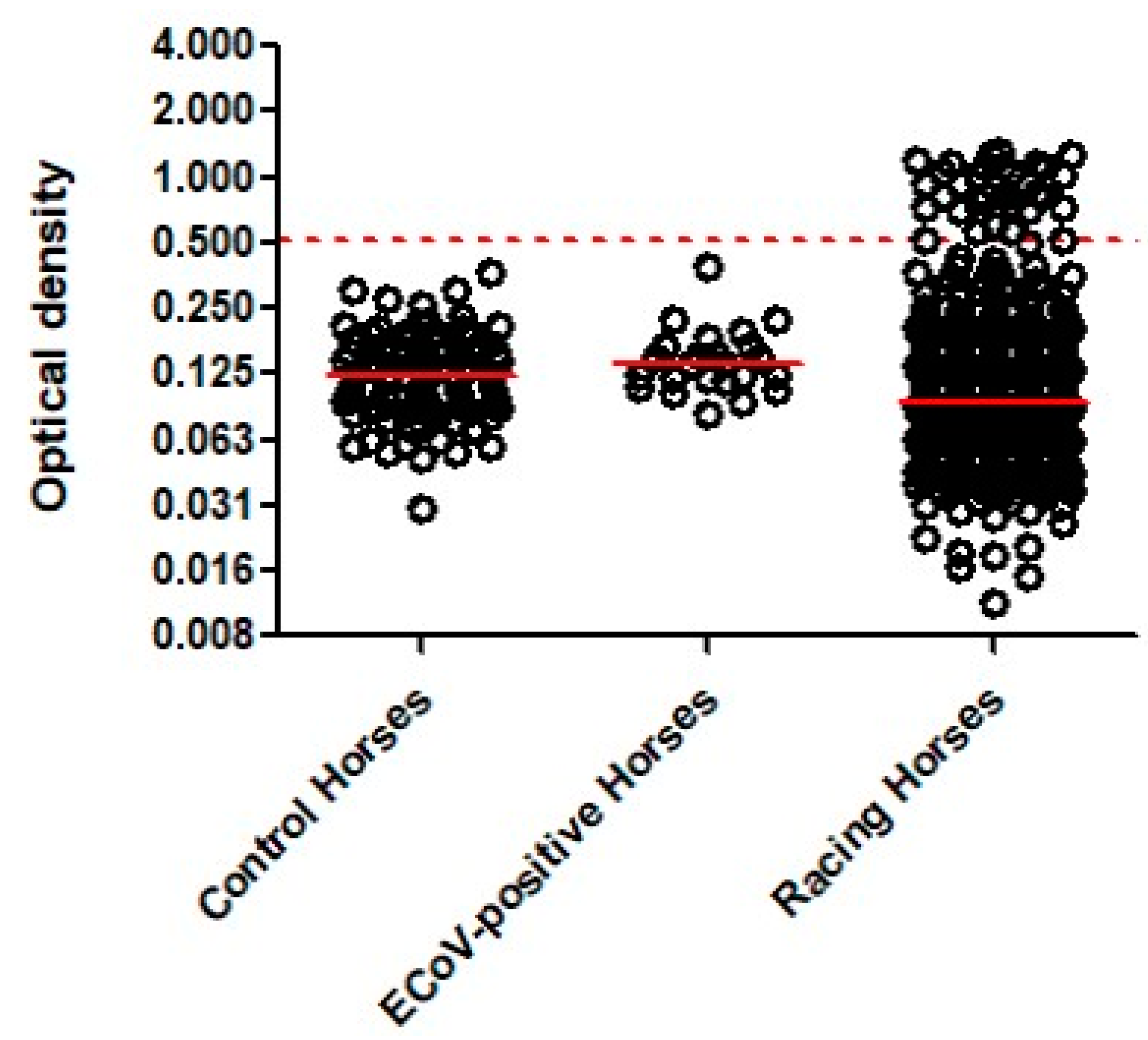
The objective of the present study was to determine if horses are susceptible to SARS-CoV-2. Nasal swabs from 667 equids with acute onset of fever and respiratory signs were tested by qPCR for SARS-CoV-2. Further, 633 serum samples collected from a cohort of 587 healthy racing Thoroughbreds with possible exposure to humans with SARS-CoV-2 infection were tested for antibodies to SARS-CoV-2 using an ELISA targeting the receptor-binding domain of the spike protein. All 667 horses with fever and respiratory signs tested qPCR-negative for SARS-CoV-2. A total of 35/587 (5.9%) Thoroughbred racing horses had detectable IgG antibodies to SARS-CoV-2. While horses appear to be susceptible to SARS-CoV-2 when in close contact with humans with SARS-CoV-2 infection, clinical disease was not observed in the study horses. Experimental challenge studies using pure inocula are needed in order to study the clinical, hematological, molecular, and serological features of adult horses infected with SARS-CoV-2.
Abstract
More and more studies are reporting on the natural transmission of SARS-CoV-2 between humans with COVID-19 and their companion animals (dogs and cats). While horses are apparently susceptible to SARS-CoV-2 infection based on the homology between the human and the equine ACE-2 receptor, no clinical or subclinical infection has yet been reported in the equine species. To investigate the possible clinical role of SARS-CoV-2 in equids, nasal secretions from 667 horses with acute onset of fever and respiratory signs were tested for the presence of SARS-CoV-2 by qPCR. The samples were collected from January to December of 2020 and submitted to a commercial molecular diagnostic laboratory for the detection of common respiratory pathogens (equine influenza virus, equine herpesvirus-1/-4, equine rhinitis A and B virus, Streptococcus equi subspecies equi). An additional 633 serum samples were tested for antibodies to SARS-CoV-2 using an ELISA targeting the receptor-binding domain of the spike protein. The serum samples were collected from a cohort of 587 healthy racing Thoroughbreds in California after track personnel tested qPCR-positive for SARS-CoV-2. While 241/667 (36%) equids with fever and respiratory signs tested qPCR-positive for at least one of the common respiratory pathogens, not a single horse tested qPCR-positive for SARS-CoV-2. Amongst the racing Thoroughbreds, 35/587 (5.9%) horses had detectable antibodies to SARS-CoV-2. Similar to dogs and cats, horses do not seem to develop clinical SARS-CoV-2 infection. However, horses can act as incidental hosts and experience silent infection following spillover from humans with COVID-19. SARS-CoV-2-infected humans should avoid close contact with equids during the time of their illness.
Keywords:
SARS-CoV-2; horses; nasal secretions; blood; qPCR; ELISA; sick equids; healthy horses