Measurement Duration but Not Distance, Angle, and Neighbour-Proximity Affects Precision in Enteric Methane Emissions when Using the Laser Methane Detector Technique in Lactating Dairy Cows
by
 , , , and
Raphaël Boré
1, 
Thiphaine Bruder
2,
Mohammed El Jabri
1,
Margaret March
3,
Paul R. Hargreaves
3,
Benoît Rouillé
1,
Richard J. Dewhurst
3 and
Mizeck G. G. Chagunda
4,* 1
Institut de l’Élevage, 149 Rue de Bercy, 75012 Paris, France
2
Nasekomo, 1612 Sofia, Bulgaria
3
SRUC (Scotland’s Rural College), Kings Buildings, West Mains Road, Edinburgh EH9 3JG, UK
4
Department of Animal Breeding and Husbandry in the Tropics and Subtropics, University of Hohenheim, Garbenstr. 17, 70599 Stuttgart, Germany
*
Author to whom correspondence should be addressed.
Animals 2022, 12(10), 1295; https://doi.org/10.3390/ani12101295
Submission received: 30 March 2022
/
Revised: 14 May 2022
/
Accepted: 16 May 2022
/
Published: 18 May 2022
(This article belongs to the Special Issue Techniques and Strategies to Quantify and Reduce Greenhouse Gases Emissions from Livestock)
Simple Summary
Methane that is breathed out and eructed from ruminants is a potent greenhouse gas that contributes to climate change. Although metabolic chambers are the “gold standard” for measuring methane from livestock, their application in production farms is very limited. There is a need to develop proxy methods that can be applied in such production environments. The proprietary Laser Methane Detector (LMD) has been trialed for the previous decade and has demonstrated its usefulness as a non-invasive and portable instrument to determine methane output from ruminants. In validating the reliability and stability of the data generated by the LMD, the current study gives answers to some very practical assumptions used in the use of the LMD and enhances the confidence in its use in ruminants.
Abstract
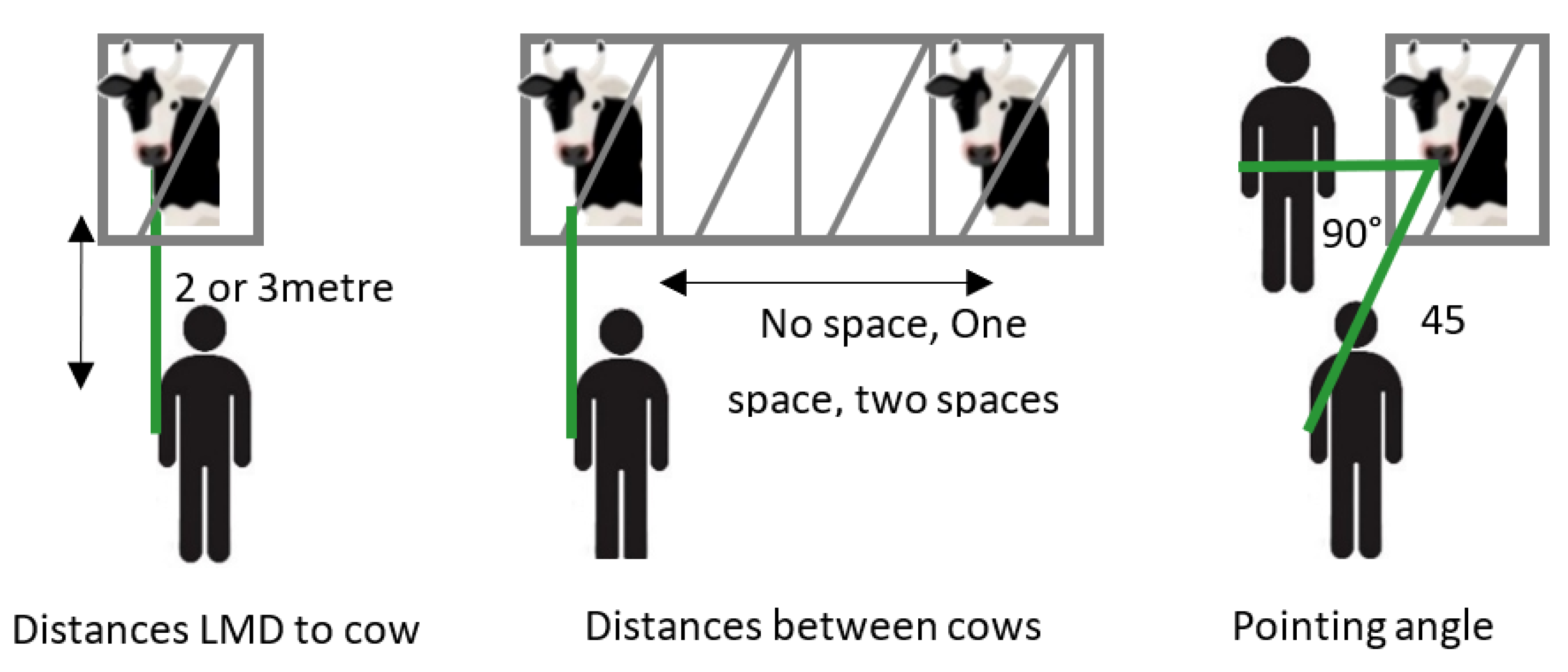
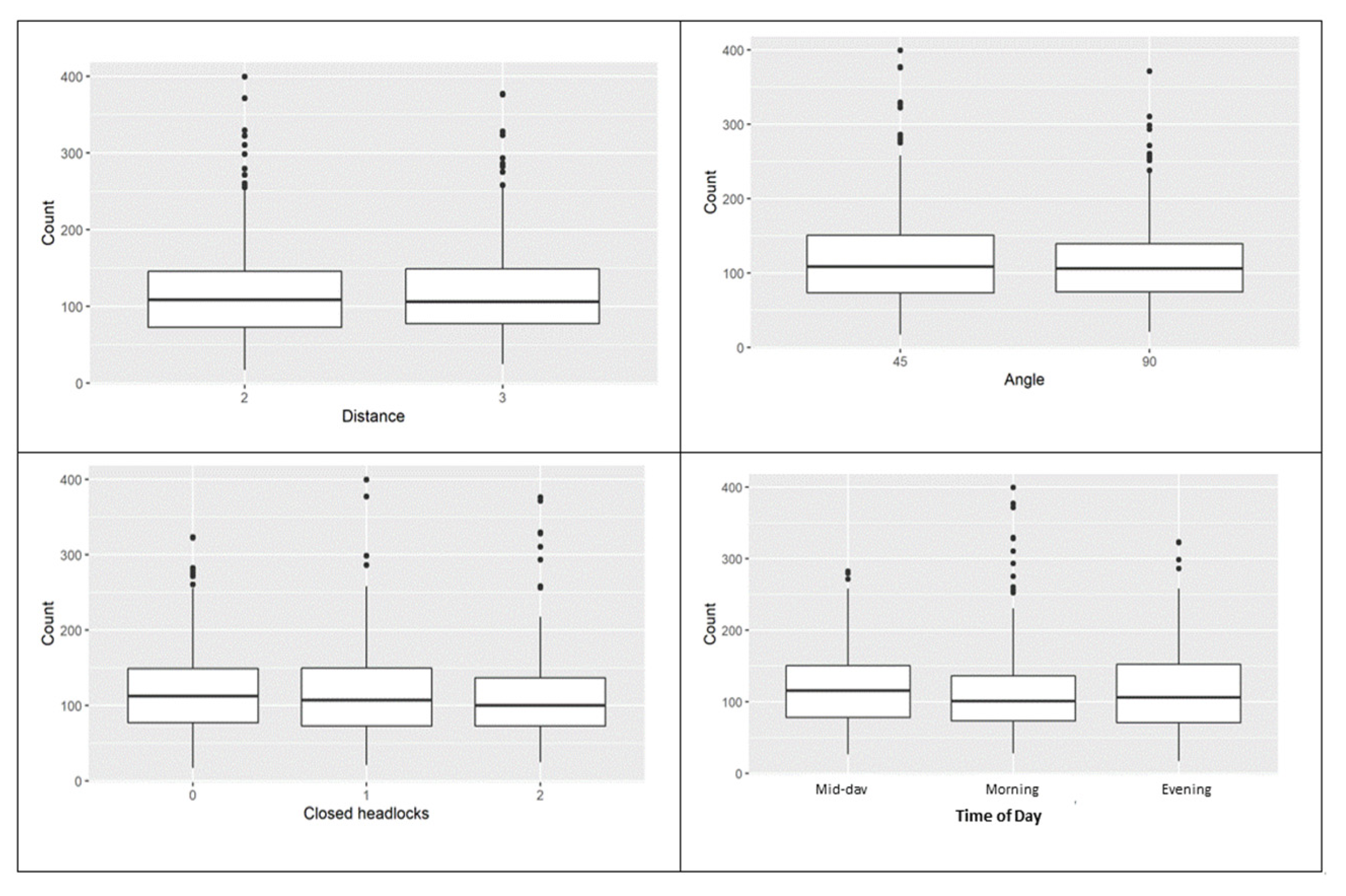
The laser methane detector (LMD), is a proprietary hand-held open path laser measuring device. Its measurements are based on infrared absorption spectroscopy using a semiconductor laser as a collimated excitation source. In the current study, LMD measurements were carried out in two experiments using 20 and 71 lactating dairy cows in Spain and Scotland, respectively. The study aimed at testing four assumptions that may impact on the reliability and repeatability of the LMD measurements of ruminants. The study has verified that there is no difference in enteric methane measurements taken from a distance of 3 m than from those taken at a distance of 2 m; there was no effect to the measurements when the measurement angle was adjusted from 90° to 45°; that the presence of an adjacent animal had no effect on the methane measurements; and that measurements lasting up to 240 s are more precise than those taken for a shorter duration. The results indicate that angle, proximity to other animals, and distance had no effects and that measurements need to last a minimum of 240 s to maintain precision.