The Fatty Acid-Based Erythrocyte Membrane Lipidome in Dogs with Chronic Enteropathy
by
 , , , , , and
Paolo Emidio Crisi
1 ,
,
Alessia Luciani
1,†,
Morena Di Tommaso
1,†,
Paraskevi Prasinou
1,
Francesca De Santis
1,
Chryssostomos Chatgilialoglu
2 ,
,
Marco Pietra
3,
Fabio Procoli
4,
Anna Sansone
2,
Maria Veronica Giordano
1,
Alessandro Gramenzi
1,*,
Carla Ferreri
2,* and
and
Andrea Boari
1 1
Veterinary Teaching Hospital, Faculty of Veterinary Medicine, University of Teramo, 64100 Teramo, Italy
2
ISOF, Consiglio Nazionale delle Ricerche, 40129 Bologna, Italy
3
Department of Veterinary Medical Sciences, Alma Mater Studiorum—University of Bologna, Ozzano dell’Emilia, 40064 Bologna, Italy
4
Ospedale Veterinario I Portoni Rossi, Zola Predosa, 40069 Bologna, Italy
*
Authors to whom correspondence should be addressed.
†
These authors have contributed equally to this work and share second authorship.
Animals 2021, 11(9), 2604; https://doi.org/10.3390/ani11092604
Submission received: 4 June 2021
/
Revised: 23 August 2021
/
Accepted: 1 September 2021
/
Published: 5 September 2021
(This article belongs to the Special Issue Advances in Small Animal Gastroenterology)
Simple Summary
Molecular-based approaches are rapidly developing in medicine for the evaluation of physiological and pathological conditions and for the discovery of new biomarkers in prevention and therapy. Membrane fatty acid-based lipidomic analysis in healthy animals provides a benchmark to study disease conditions and was useful to evidence significant differences in dogs affected by chronic enteropathy. Such molecular information might have the potential to become a useful tool in the assessment of canine chronic enteropathy, being connected with nutritional and metabolic status of the subjects, as well as it may reflect “gut health” and suggest appropriate intervention by “lipid therapy”.
Abstract
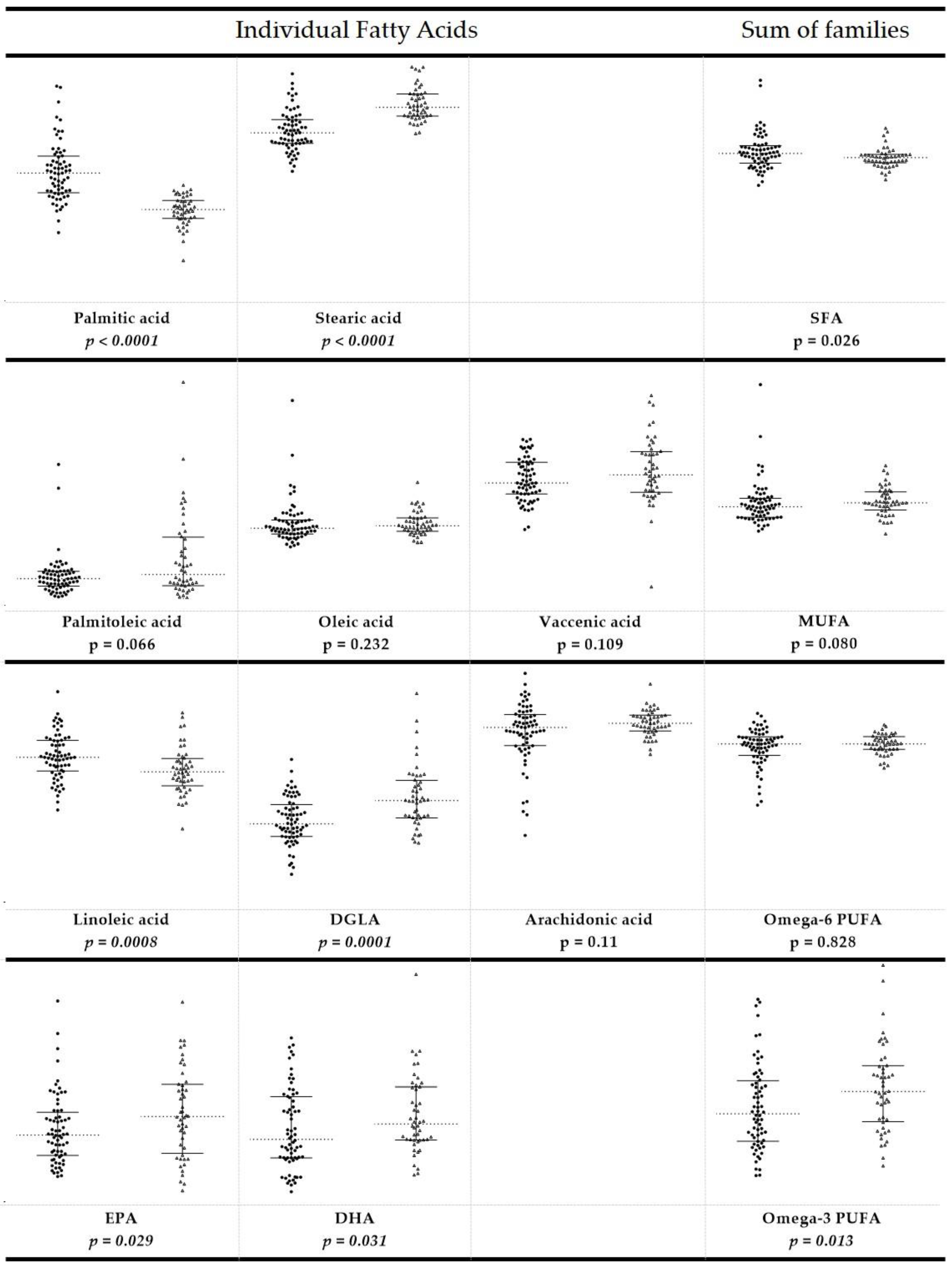
Canine chronic enteropathies (CEs) are inflammatory processes resulting from complex interplay between the mucosal immune system, intestinal microbiome, and dietary components in susceptible dogs. Fatty acids (FAs) play important roles in the regulation of physiologic and metabolic pathways and their role in inflammation seems to be dual, as they exhibit pro–inflammatory and anti–inflammatory functions. Analysis of red blood cell (RBC) membrane fatty acid profile represents a tool for assessing the quantity and quality of structural and functional molecular components. This study was aimed at comparing the FA membrane profile, determined by Gas Chromatography and relevant lipid parameter of 48 CE dogs compared with 68 healthy dogs. In CE patients, the levels of stearic (p < 0.0001), dihomo–gamma–linolenic, eicosapentaenoic (p = 0.02), and docosahexaenoic (p = 0.02) acids were significantly higher, and those of palmitic (p < 0.0001) and linoleic (p = 0.0006) acids were significantly lower. Non-responder dogs presented higher percentages of vaccenic acid (p = 0.007), compared to those of dogs that responded to diagnostic trials. These results suggest that lipidomic status may reflect the “gut health”, and the non–invasive analysis of RBC membrane might have the potential to become a candidate biomarker in the evaluation of dogs affected by CE.