A Freedom of Coxiella burnetii Infection Survey in European Bison (Bison bonasus) in Poland


1
Białowieża National Park, Park Pałacowy 11, 17-230 Białowieża, Poland
2
Institute of Forest Sciences, Faculty of Civil Engineering and Environmental Sciences, Białystok University of Technology, Wiejska 45 E, 15-351 Białystok, Poland
3
Department of Food Hygiene and Public Health Protection, Institute of Veterinary Medicine, Warsaw University of Life Sciences—SGGW, Nowoursynowska 159, 02-776 Warsaw, Poland
4
Department of Animal Genetics and Conservation, Institute of Animal Science, Warsaw University of Life Sciences—SGGW, Ciszewskiego 8, 02-786 Warsaw, Poland
*
Author to whom correspondence should be addressed.
Animals 2021, 11(3), 651; https://doi.org/10.3390/ani11030651
Submission received: 1 February 2021
/
Revised: 23 February 2021
/
Accepted: 24 February 2021
/
Published: 1 March 2021
(This article belongs to the Special Issue Zoonoses and Wildlife: One Health Approach)
Simple Summary
Q fever is one of the important diseases transmissible from animals to humans. The source of infection can be numerous species of animals including mammals, birds, reptiles, amphibians as well as ticks. The role of wildlife in its epidemiology is poorly understood. Therefore, we examined 523 sera samples obtained from European bison for the presence of specific antibodies to assess whether infection occurs in this species and whether European bison may be an important source of infection in the natural environment as suggested by historical reports. The antibodies were found only in one free-living bull, while two other samples were doubtful. The results suggest the transmission of infection to the European bison was rather accidental and its role as an important source of infection nowadays is unlikely.
Abstract
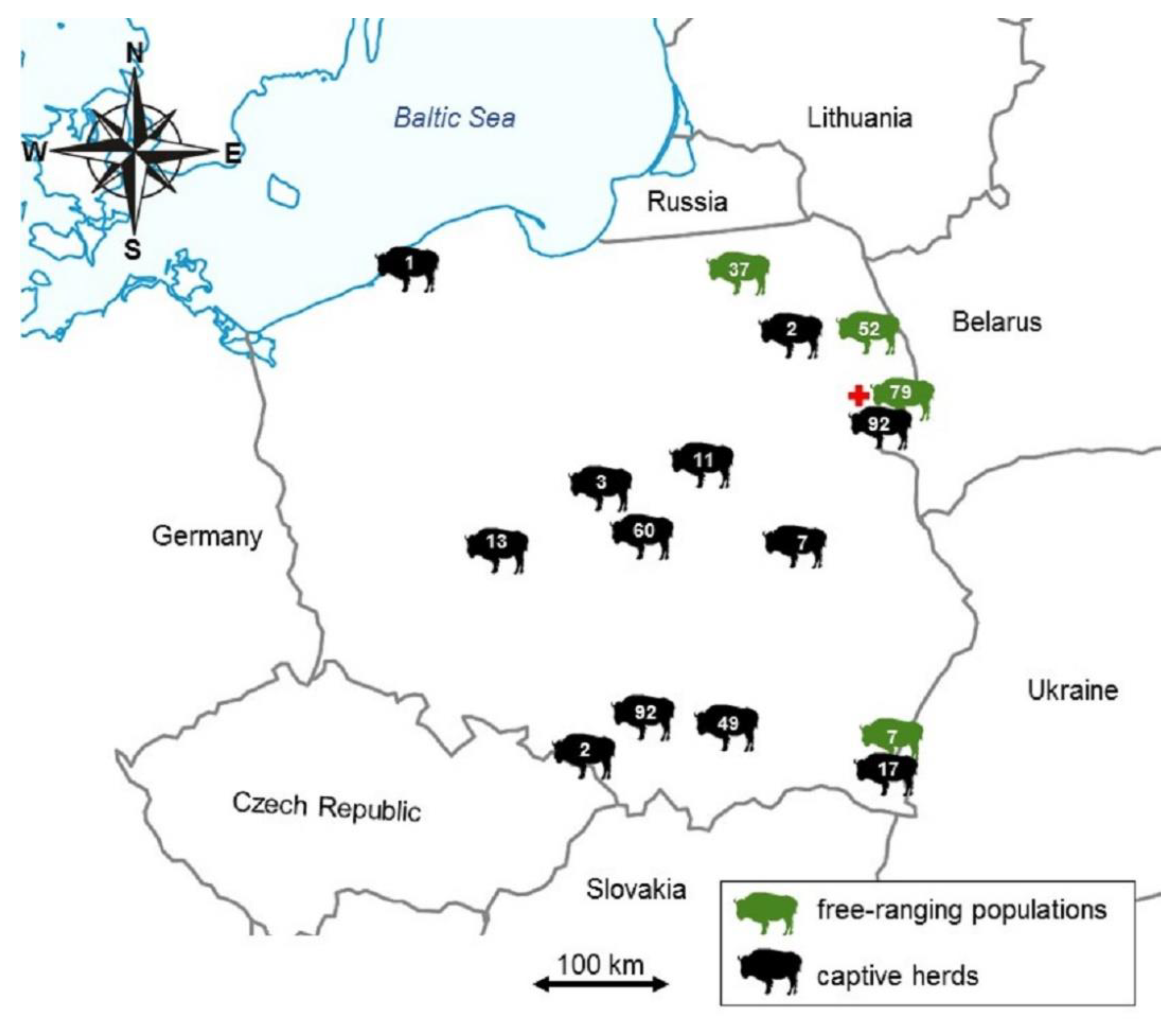
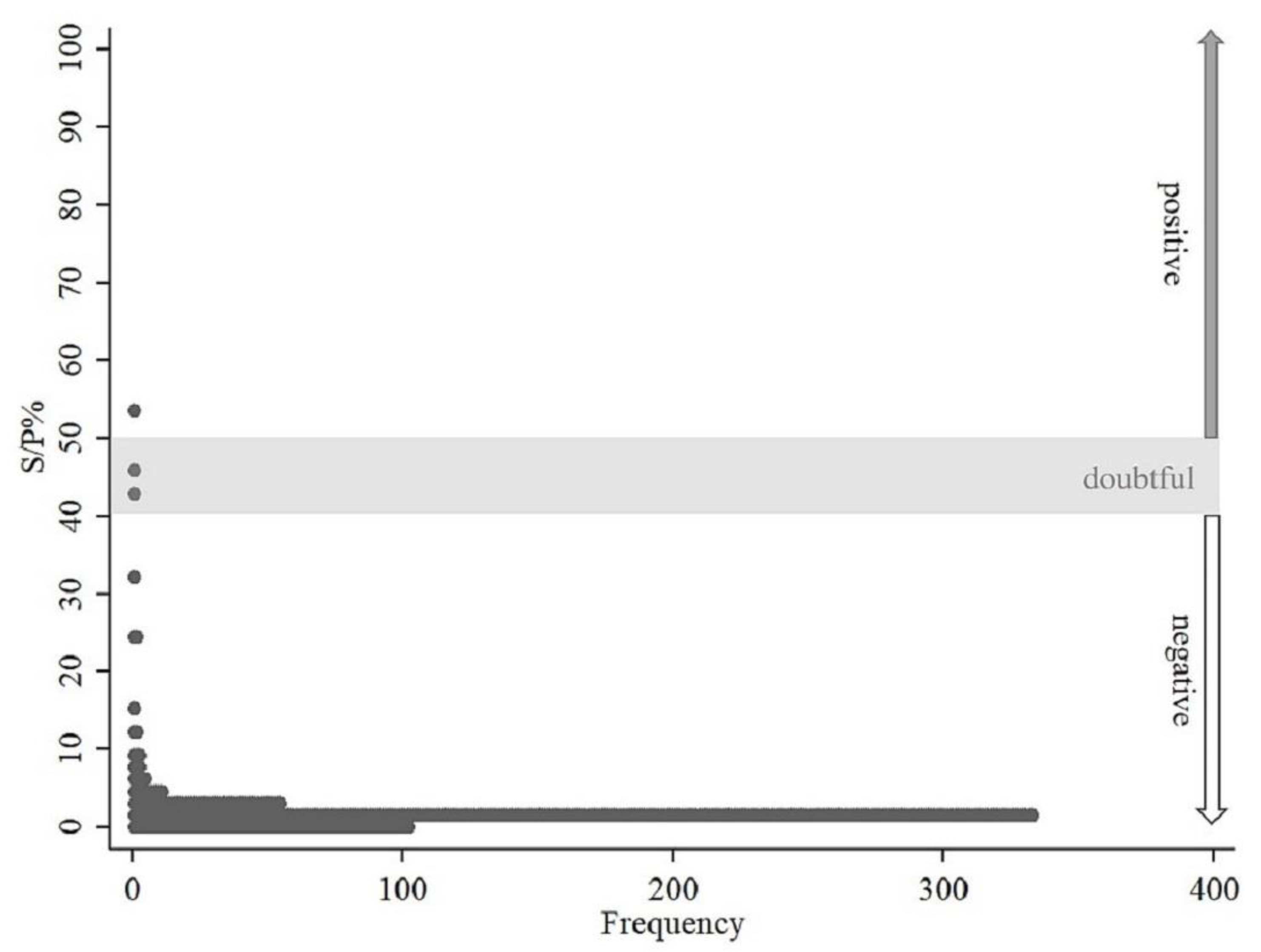
Q fever is an important zoonosis caused by the intracellular Gram-negative bacteria Coxiella burnetii. The source of infection are numerous species of mammals, birds, reptiles and amphibians, as well as ticks. The disease is widespread throughout Europe, but the role of wildlife in its epidemiology is poorly understood. The European bison (Bison bonasus) population has been growing European-wide quite dynamically over the last few years. The aim of this study was to determine whether C. burnetii infection occurs in European bison and whether it can be considered an important bacterial reservoir in the natural environment. Five hundred and twenty three samples of European bison sera originating from 14 (out of the 26 existing) Polish populations were examined for the presence of specific antibodies using an ID Screen Q Fever Indirect Multi-species ELISA test. Only one (0.19%) serum sample was positive in ELISA, and two other samples were doubtful. The only seropositive animal found in this study was a free-living bull. It suggests possible transmission from domestic cattle by sharing pastures. The transmission of C. burnetii into the European bison was rather accidental in the country and its role as an important wild reservoir is unlikely. Since no tests are available for wildlife ruminants there is a need for the adaptation of the available tests.
Keywords:
Coxiella burnetii; Q fever; serology; epidemiology; wildlife; European bison