

Effect of Dietary Insoluble and Soluble Fibre on Growth Performance, Digestibility, and Nitrogen, Energy, and Mineral Retention Efficiency in Growing Rabbits

 ,
, 
Simple Summary
Abstract
1. Introduction
2. Materials and Methods
2.1. Animals and Housing
2.2. Diets
2.3. Growth Performance and Body Chemical Composition Trial
2.4. Faecal Digestibility Trial
2.5. Calculations of Energy and Nitrogen Efficiency
2.6. Gut Histology and Enzymatic Activity and Immune Function
2.7. Chemical Analysis
2.8. Statistical Analysis
3. Results
4. Discussion
5. Conclusions
Supplementary Materials
Author Contributions
Funding
Conflicts of Interest
References
- Gómez-Conde, M.S.; García, J.; Chamorro, S.; Eiras, P.; Rebollar, P.G.; Pérez de Rozas, A.; Badiola, I.; de Blas, C.; Carabaño, R. Neutral detergent-soluble fiber improves gut barrier function in twenty-five-day-old weaned rabbits1. J. Anim. Sci. 2007, 85, 3313–3321. [Google Scholar] [CrossRef] [PubMed]
- El abed, N.; Delgado, R.; Abad-Guamán, R.; Romero, C.; Villamide, M.J.; Menoyo, D.; Carabaño, R.; García, J. Soluble and insoluble fibre from sugar beet pulp enhance intestinal mucosa morphology in young rabbits. In Book of Abstracts of the 62nd Annual Meeting of the European Association for Animal Production; EAAP Book of Abstracts; Wageningen Academic Publishers: Stavanger, Norway, 2011; Volume 17, p. 159. ISBN 978-90-8686-731-8. [Google Scholar]
- Gómez-Conde, M.S.; de Rozas, A.P.; Badiola, I.; Pérez-Alba, L.; de Blas, C.; Carabaño, R.; García, J. Effect of neutral detergent soluble fibre on digestion, intestinal microbiota and performance in twenty five day old weaned rabbits. Livest. Sci. 2009, 125, 192–198. [Google Scholar] [CrossRef]
- Rodríguez-Romero, N.; Abecia, L.; Fondevila, M. Bacterial profile from caecal contents and soft faeces in growing rabbits given diets differing in soluble and insoluble fibre levels. Anaerobe 2012, 18, 602–607. [Google Scholar] [CrossRef]
- El abed, N.; Badiola, I.; Pérez de Rozas, A.; González, J.; Menoyo, D.; Carabaño, R.; García, J. Effect of soluble and insoluble fractions of sugar beet pulp on ileal and caecal microbiota of rabbits after weaning. World Rabbit Sci. 2013, 21, 207–208. [Google Scholar] [CrossRef]
- Martínez-Vallespín, B.; Martínez-Paredes, E.; Ródenas, L.; Cervera, C.; Pascual, J.J.; Blas, E. Combined feeding of rabbit female and young: Partial replacement of starch with acid detergent fibre or/and neutral detergent soluble fibre at two protein levels. Livest. Sci. 2011, 141, 155–165. [Google Scholar] [CrossRef]
- Trocino, A.; García Alonso, J.; Carabaño, R.; Xiccato, G. A meta-analysis on the role of soluble fibre in diets for growing rabbits. World Rabbit Sci. 2013, 21. [Google Scholar] [CrossRef]
- Delgado, R.; Nicodemus, N.; Abad-Guamán, R.; Sastre, J.; Menoyo, D.; Carabaño, R.; García, J. Effect of dietary soluble fibre and n-6/n-3 fatty acid ratio on growth performance and nitrogen and energy retention efficiency in growing rabbits. Anim. Feed Sci. Technol. 2018, 239, 44–54. [Google Scholar] [CrossRef]
- Abad-Guamán, R. Identification of the Method to Quantify Soluble Fibre and the Effect of the Source of Fibre on the Ileal and Faecal Digestibility of Soluble and Insoluble Fibre in Rabbits. Ph.D. Thesis, E.T.S.I. Agrónomos (Universidad Politécnica de Madrid), Madrid, Spain, 2015. [Google Scholar]
- Garcia, G.; Galvez, J.F.; de Blas, J.C. Effect of substitution of sugarbeet pulp for barley in diets for finishing rabbits on growth performance and on energy and nitrogen efficiency. J. Anim. Sci. 1993, 71, 1823–1830. [Google Scholar] [CrossRef]
- Carabaño, R.; Motta-Ferreira, W.; de Blas, J.C.; Fraga, M.J. Substitution of sugarbeet pulp for alfalfa hay in diets for growing rabbits. Anim. Feed Sci. Technol. 1997, 65, 249–256. [Google Scholar] [CrossRef]
- de Blas, C.; Villamide, M.J. Nutritive value of beet and citrus pulps for rabbits. Anim. Feed Sci. Technol. 1990, 31, 239–246. [Google Scholar] [CrossRef]
- García, J.; Carabaño, R.; de Blas, J.C. Effect of fiber source on cell wall digestibility and rate of passage in rabbits. J. Anim. Sci. 1999, 77, 898. [Google Scholar] [CrossRef] [PubMed]
- Gidenne, T. Effets d’une réduction de la teneur en fibres alimentaires sur le transit digestif du lapin. Comparaison et validation de modèles d’ajustement des cinétiques d’excrétion fécale des marqueurs. Reprod. Nutr. Dev. 1994, 34, 295–306. [Google Scholar] [CrossRef] [PubMed]
- Gutiérrez, I.; Espinosa, A.; García, J.; Carabaño, R.; De Blas, J.C. Effect of levels of starch, fiber, and lactose on digestion and growth performance of early-weaned rabbits. J. Anim. Sci. 2002, 80, 1029–1037. [Google Scholar] [CrossRef] [PubMed]
- Tazzoli, M.; Trocino, A.; Birolo, M.; Radaelli, G.; Xiccato, G. Optimizing feed efficiency and nitrogen excretion in growing rabbits by increasing dietary energy with high-starch, high-soluble fibre, low-insoluble fibre supply at low protein levels. Livest. Sci. 2015, 172, 59–68. [Google Scholar] [CrossRef]
- BOE.es—Documento BOE-A-2013-1337. Available online: https://www.boe.es/diario_boe/txt.php?id=BOE-A-2013-1337 (accessed on 21 May 2020).
- de Blas, C.; Mateos, G.G. Feed formulation. In Nutrition of the Rabbit, 3rd ed.; CABI Publishing CAB International: Wallingford, UK, 2020; pp. 243–253. ISBN 978-1-78924-127-3. [Google Scholar]
- Saiz, A.; García-Ruiz, A.I.; Fernández, A.; Nicodemus, N. Application of Bioelectrical impedance analysis (BIA) to study the carcass chemical composition of rabbits from 35 to 63 d of age. World Rabbit Sci. 2013, 21, 208–209. [Google Scholar] [CrossRef]
- Saiz, A.; García-Ruiz, A.I.; Fuentes-Pila, J.; Nicodemus, N. Application of bioelectrical impedance analysis to assess rabbit’s body composition from 25 to 77 days of age1. J. Anim. Sci. 2017, 95, 2782–2793. [Google Scholar] [CrossRef]
- Pérez, J.M.; Cervera, C.; Falcao E Cunha, L.; Maertens, L.; Villamide, M.J.; Xiccato, G. European ring-test on in vivo determination of digestibility in rabbits: Reproducibility of a reference method in comparison with domestic laboratory procedures. World Rabbit Sci. 1995, 3, 171–178. [Google Scholar] [CrossRef]
- Xiccato, G.; Trocino, A. Energy and protein metabolism and requirements. In Nutrition of the Rabbit, 3rd ed.; CABI Publishing CAB International: Wallingford, UK, 2020; pp. 89–125. ISBN 978-1-78924-127-3. [Google Scholar]
- Delgado, R.; Menoyo, D.; Abad-Guamán, R.; Nicodemus, N.; Carabaño, R.; García, J. Effect of dietary soluble fibre level and n-6/n-3 fatty acid ratio on digestion and health in growing rabbits. Anim. Feed Sci. Technol. 2019, 255, 114222. [Google Scholar] [CrossRef]
- Horwitz, W.; AOAC International (Eds.) Official Methods of Analysis of AOAC International, 18th ed.; Current Through rev. 1, 2006; AOAC International: Gaithersburg, MD, USA, 2006; ISBN 978-0-935584-77-6. [Google Scholar]
- Mertens, D.R. Gravimetric determination of amylase-treated neutral detergent fiber in feeds with refluxing in beakers or crucibles: Collaborative study. J. AOAC Int. 2002, 85, 1217–1240. [Google Scholar]
- Solans, L.; Arnal, L.J.; Sanz, C.; Benito, A.; Chacón, G.; Alzuguren, O.; Fernández, B.A. Rabbit Enteropathies on commercial farms in the iberian peninsula: Etiological agents identified in 2018–2019. Animals 2019, 9, 1142. [Google Scholar] [CrossRef]
- Xiccato, G.; Trocino, A.; Majolini, D.; Fragkiadakis, M.; Tazzoli, M. Effect of decreasing dietary protein level and replacing starch with soluble fibre on digestive physiology and performance of growing rabbits. Animal 2011, 5, 1179–1187. [Google Scholar] [CrossRef] [PubMed]
- Grueso, I.; De Blas, J.C.; Cachaldora, P.; Mendez, J.; Losada, B.; García-Rebollar, P. Combined effects of supplementation of diets with hops and of a substitution of starch with soluble fiber on feed efficiency and prevention of digestive disorders in rabbits. Anim. Feed Sci. Technol. 2013, 180, 92–100. [Google Scholar] [CrossRef]
- Chamorro, S.; Gómez-Conde, M.S.; Pérez de Rozas, A.M.; Badiola, I.; Carabaño, R.; De Blas, J.C. Effect on digestion and performance of dietary protein content and of increased substitution of lucerne hay with soya-bean protein concentrate in starter diets for young rabbits. Animal 2007, 1, 651. [Google Scholar] [CrossRef] [PubMed][Green Version]
- Gidenne, T.; Kerdiles, V.; Jehl, N.; Arveux, P.; Eckenfelder, B.; Briens, C.; Stephan, S.; Fortune, H.; Montessuy, S.; Muraz, G. Protein replacement by digestible fibre in the diet of growing rabbits: 2-Impact on performances, digestive health and nitrogen output. Anim. Feed Sci. Technol. 2013, 183, 142–150. [Google Scholar] [CrossRef]
- Gutiérrez, I.; Espinosa, A.; García, J.; Carabaño, R.; De Blas, C. Effect of protein source on digestion and growth performance of early-weaned rabbits. Anim. Res. 2003, 52, 461–471. [Google Scholar] [CrossRef]
- Gidenne, T.; Carabaño, R.; Abad-Guamán, R.; García, J.; de Blas, C. Fibre digestion. In Nutrition of the Rabbit, 3rd ed.; CABI Publishing CAB International: Wallingford, UK, 2020; pp. 69–88. ISBN 978-1-78924-127-3. [Google Scholar]
- Gidenne, T.; Perez, J.-M. Replacement of digestible fibre by starch in the dietof the growing rabbit. I. Effects on digestion, rate of passage and retention of nutrients. Ann. Zootech. 2000, 49, 357–368. [Google Scholar] [CrossRef][Green Version]
- Nicodemus, N.; Carabaño, R.; García, J.; Méndez, J.; de Blas, C. Performance response of lactating and growing rabbits to dietary lignin content. Anim. Feed Sci. Technol. 1999, 80, 43–54. [Google Scholar] [CrossRef]
- Gidenne, T.; Arveux, P.; Madec, O. The effect of the quality of dietary lignocellulose on digestion, zootechnical performance and health of the growing rabbit. Anim. Sci. 2001, 73, 97–104. [Google Scholar] [CrossRef]
- Ocasio-Vega, C.; Abad-Guamán, R.; Delgado, R.; Carabaño, R.; Carro, M.D.; García, J. Effect of cellobiose supplementation and dietary soluble fibre content on in vitro caecal fermentation of carbohydrate-rich substrates in rabbits. Arch. Anim. Nutr. 2018, 72, 221–238. [Google Scholar] [CrossRef]
- Caîsin, L.; Martínez-Paredes, E.; Ródenas, L.; Moya, V.J.; Pascual, J.J.; Cervera, C.; Blas, E.; Pascual, M. Effect of increasing lignin in isoenergetic diets at two soluble fibre levels on digestion, performance and carcass quality of growing rabbits. Anim. Feed Sci. Technol. 2020, 262, 114396. [Google Scholar] [CrossRef]
- Trocino, A.; Fragkiadakis, M.; Majolini, D.; Carabaño, R.; Xiccato, G. Effect of the increase of dietary starch and soluble fibre on digestive efficiency and growth performance of meat rabbits. Anim. Feed Sci. Technol. 2011, 165, 265–277. [Google Scholar] [CrossRef]
- Trocino, A.; Fragkiadakis, M.; Majolini, D.; Tazzoli, M.; Radaelli, G.; Xiccato, G. Soluble fibre, starch and protein level in diets for growing rabbits: Effects on digestive efficiency and productive traits. Anim. Feed Sci. Technol. 2013, 180, 73–82. [Google Scholar] [CrossRef]
- Villamide, M.J.; Carabaño, R.; Maertens, L.; Pascual, J.; Gidenne, T.; Falcao-E-Cunha, L.; Xiccato, G. Prediction of the nutritional value of European compound feeds for rabbits by chemical components and in vitro analysis. Anim. Feed Sci. Technol. 2009, 150, 283–294. [Google Scholar] [CrossRef]
- Trocino, A.; Fragkiadakis, M.; Radaelli, G.; Xiccato, G. Effect of dietary soluble fibre level and protein source on growth, digestion, caecal activity and health of fattening rabbits. World Rabbit Sci. 2010, 18, 199–210. [Google Scholar] [CrossRef]
- Garcia, G.; Galvez, J.F.; De Blas, J.C. Substitution of barley grain by sugar-beet pulp in diets for finishing rabbits. 1. Effect on energy and nitrogen balance. J. Appl. Rabbit Res. 1992, 15, 1008. [Google Scholar]
- Garcia, G.; Galvez, J.F.; De Blas, J.C. Substitution of barley grain by sugar-beet pulp in diets for finishing rabbits. 2. Effect on growth performance. J. Appl. Rabbit Res. 1992, 15, 1017. [Google Scholar]
- García, J.; Gidenne, T.; Gidenne, T.; Falcao-e-Cunha, L.; de Blas, C. Identification of the main factors that influence caecal fermentation traits in growing rabbits. Anim. Res. 2002, 51, 165–173. [Google Scholar] [CrossRef]
- Fernández, C.; Fraga, M.J. Effect of fat inclusion in diets for rabbits on the efficiency of digestible energy and protein utilization. World Rabbit Sci. 2010, 4. [Google Scholar] [CrossRef]
- Girard, C.L.; Robert, S.; Matte, J.J.; Farmer, C.; Martineau, G.P. Influence of high fibre diets given to gestating sows on serum concentrations of micronutrients. Livest. Prod. Sci. 1995, 43, 15–26. [Google Scholar] [CrossRef]
- Stanogias, G.; Pearce, G.R.; Alifakiotis, T.; Michaelidis, J.; Pappa-Michaelidis, B. Effects of dietary concentration and source of fibre on the apparent absorption of minerals by pigs. Anim. Feed Sci. Technol. 1994, 47, 287–295. [Google Scholar] [CrossRef]
- Tortuero, F.; Rioperez, J.; Cosin, C.; Barrera, J.; Rodriguez, M.L. Effects of dietary fiber sources on volatile fatty acid production, intestinal microflora and mineral balance in rabbits. Anim. Feed Sci. Technol. 1994, 48, 1–14. [Google Scholar] [CrossRef]

| Item 1 | Low-Insoluble Fibre | High-Insoluble Fibre | ||
|---|---|---|---|---|
| Low SF | High SF | Low SF | High SF | |
| LIF-LSF | LIF-HSF | HIF-LSF | HIF-HSF | |
| Ingredient, g/kg as fed | ||||
| Barley | 150.0 | 141.0 | 70.0 | 70.0 |
| Wheat | 150.0 | 141.0 | 70.0 | 70.0 |
| Dehydrated alfalfa | 101.8 | 101.8 | 154.0 | 154.0 |
| Cereal straw | 84.0 | 63.0 | 169.3 | 146.6 |
| Defatted grape seed meal | 36.0 | 27.0 | 72.6 | 62.9 |
| Wheat bran | 176.5 | 60.0 | 133.8 | 10.0 |
| Sugar beet pulp | 0.0 | 170.0 | 0.0 | 170.0 |
| Gluten feed | 93.5 | 30.5 | 71.3 | 5.0 |
| Sunflower meal | 110.0 | 171.0 | 130.0 | 185.0 |
| Soybean meal | 60.0 | 60.0 | 60.0 | 60.0 |
| Lard | 0.0 | 0.0 | 35.0 | 35.0 |
| Cane molasses | 10.0 | 10.0 | 10.0 | 10.0 |
| L-Lysine 50 | 3.0 | 2.4 | 3.2 | 2.6 |
| Alimet | 0.5 | 0.5 | 0.9 | 0.9 |
| L-Threonine | 1.0 | 0.6 | 1.2 | 0.8 |
| L-Tryptophan | 0.2 | 0.2 | 0.2 | 0.2 |
| Sodium chloride | 2.5 | 2.5 | 2.5 | 2.5 |
| Calcium carbonate | 16.0 | 8.0 | 10.0 | 4.0 |
| Calcium phosphate | 3.5 | 9.0 | 4.5 | 9.0 |
| Mineral/vitamin premix 1 | 1.5 | 1.5 | 1.5 | 1.5 |
| Chemical composition, g/kg DM | ||||
| DM | 903 | 905 | 908 | 906 |
| Ash | 83.9 | 89.1 | 90.9 | 96.3 |
| Total dietary fibre 2 | 398 | 444 | 484 | 519 |
| Neutral detergent fibre (NDF 2) | 311 | 317 | 396 | 390 |
| Acid detergent fibre 3 | 162 | 179 | 230 | 247 |
| Acid detergent lignin 3 | 36.6 | 38.3 | 66.4 | 65.2 |
| Soluble fibre 4 | 86.7 | 127.5 | 88.1 | 129.0 |
| Crude protein (CP) | 197 | 198 | 187 | 183 |
| CP-Total dietary fibre | 61.1 | 67.9 | 69.2 | 72.3 |
| CP-NDF | 33.8 | 37.4 | 33.8 | 38.0 |
| Starch | 212 | 181 | 117 | 86.3 |
| Ether extract | 31.6 | 35.9 | 79.3 | 65.7 |
| Gross energy, MJ/kg DM | 18.0 | 17.7 | 18.9 | 18.3 |
| Item | Diets 1 | SEM | p-Value | ||||||
|---|---|---|---|---|---|---|---|---|---|
| Low-Insoluble Fibre | High-Insoluble Fibre | IF and SF | IF × SF | IF | SF | IF × SF | |||
| Low-Soluble Fibre LIF-LSF | High-Soluble Fibre LIF-HSF | Low-Soluble Fibre HIF-LSF | High-Soluble Fibre HIF-HSF | ||||||
| N | 51 | 52 | 47 | 48 | |||||
| 28–42 days of age | |||||||||
| Body weight 28 day, g | 496 | 459 | 533 | 540 | 6.58 | 9.30 | <0.001 | 0.103 | 0.018 |
| Growth rate, g/day | 52.5 | 51.1 | 52.6 | 52.0 | 0.66 | 0.93 | 0.660 | 0.266 | 0.653 |
| Feed intake, g/day | 107 | 107 | 118 | 118 | 1.89 | 2.68 | <0.001 | 0.907 | 0.974 |
| Feed efficiency, g/g | 0.519 | 0.489 | 0.447 | 0.445 | 0.010 | 0.015 | <0.001 | 0.277 | 0.340 |
| 42–62 days of age | |||||||||
| Body weight 42 day,g | 1241 | 1221 | 1242 | 1233 | 9.172 | 13.01 | 0.656 | 0.263 | 0.649 |
| Growth rate, g/day | 50.7 | 50.3 | 49.2 | 47.9 | 0.50 | 0.71 | 0.012 | 0.234 | 0.517 |
| Feed intake, g/day | 152 | 148 | 170 | 164 | 1.51 | 2.15 | <0.001 | 0.009 | 0.515 |
| Feed efficiency, g/g | 0.336 | 0.345 | 0.291 | 0.294 | 0.004 | 0.005 | <0.001 | 0.276 | 0.581 |
| 28–62 days of age | |||||||||
| Body weight 62 g/day | 2254 | 2227 | 2225 | 2191 | 13.39 | 19.01 | 0.109 | 0.098 | 0.867 |
| Growth rate, g/day | 51.4 | 50.6 | 50.6 | 49.6 | 0.39 | 0.56 | 0.109 | 0.099 | 0.870 |
| Feed intake, g/day | 133 | 131 | 149 | 145 | 1.22 | 1.73 | <0.001 | 0.048 | 0.650 |
| Feed efficiency, g/g | 0.388 | 0.391 | 0.341 | 0.344 | 0.003 | 0.005 | <0.001 | 0.541 | 0.968 |
| Item | Diets 1 | SEM | p-Value | ||||||
|---|---|---|---|---|---|---|---|---|---|
| Low-Insoluble Fibre | High-Insoluble Fibre | IF and SF | IF × SF | IF | SF | IF × SF | |||
| Low-Soluble Fibre LIF-LSF | High-Soluble Fibre LIF-HSF | Low-Soluble Fibre HIF-LSF | High-Soluble Fibre HIF-HSF | ||||||
| N | 9 | 8 | 10 | 9 | |||||
| Initial body weight, g | 1961 | 1856 | 1939 | 1904 | 23.26 | 32.88 | 0.691 | 0.042 | 0.300 |
| Feed intake, g DM/day | 135 | 128 | 136 | 142 | 3.28 | 4.63 | 0.113 | 0.803 | 0.180 |
| Faecal apparent digestibility, % | |||||||||
| Dry matter | 63.9 | 66.8 | 55.7 | 57.0 | 0.40 | 0.57 | <0.001 | <0.001 | 0.111 |
| Organic matter | 65.1 | 68.5 | 56.6 | 58.1 | 0.44 | 0.62 | <0.001 | <0.001 | 0.147 |
| Ash | 50.5 | 48.3 | 47.5 | 41.7 | 1.08 | 1.53 | 0.004 | 0.014 | 0.237 |
| Gross energy | 63.1 b | 66.7 a | 56.2 c | 57.2 c | 0.41 | 0.58 | <0.001 | <0.001 | 0.037 |
| Crude protein, CP | 75.7 ab | 76.8 a | 74.5 b | 72.1 c | 0.49 | 0.70 | <0.001 | 0.377 | 0.018 |
| Total dietary fibre | 35.4 c | 50.1 a | 33.5 c | 40.9 b | 0.59 | 0.83 | <0.001 | <0.001 | <0.001 |
| Neutral detergent fibre | 28.1 c | 40.2 a | 28.0 c | 31.6 b | 0.69 | 0.97 | <0.001 | <0.001 | <0.001 |
| Soluble fibre | 61.9 | 74.7 | 58.0 | 69.0 | 1.51 | 2.14 | 0.034 | <0.001 | 0.637 |
| Digestible energy, MJ/kg DM | 11.38 b | 11.78 a | 10.64 c | 10.46 c | 0.075 | 0.106 | <0.001 | 0.287 | 0.010 |
| Digestible CP, g/kg DM | 14.91 a | 15.23 a | 13.89 b | 13.17 c | 0.095 | 0.134 | <0.001 | 0.147 | <0.001 |
| Ratio digestible [CP/energy], g/MJ | 13.11 | 12.93 | 13.105 | 12.59 | 0.052 | 0.074 | 0.012 | <0.001 | 0.069 |
| Item | Diets 1 | SEM | p-Value | ||||||
|---|---|---|---|---|---|---|---|---|---|
| Low-Insoluble Fibre | High-Insoluble Fibre | IF and SF | IF × SF | IF | SF | IF × SF | |||
| Low-Soluble Fibre LIF-LSF | High-Soluble Fibre LIF-HSF | Low-Soluble Fibre HIF-LSF | High-Soluble Fibre HIF-HSF | ||||||
| N | 34 | 36 | 32 | 33 | |||||
| kg BW0.75 | 1.27 | 1.25 | 1.25 | 1.24 | 0.01 | 0.01 | 0.101 | 0.086 | 0.389 |
| 2 Nitrogen intake, g/kg BW0.75 d | |||||||||
| Ni, | 2.98 | 2.97 | 3.23 | 3.10 | 0.03 | 0.04 | <0.001 | 0.111 | 0.157 |
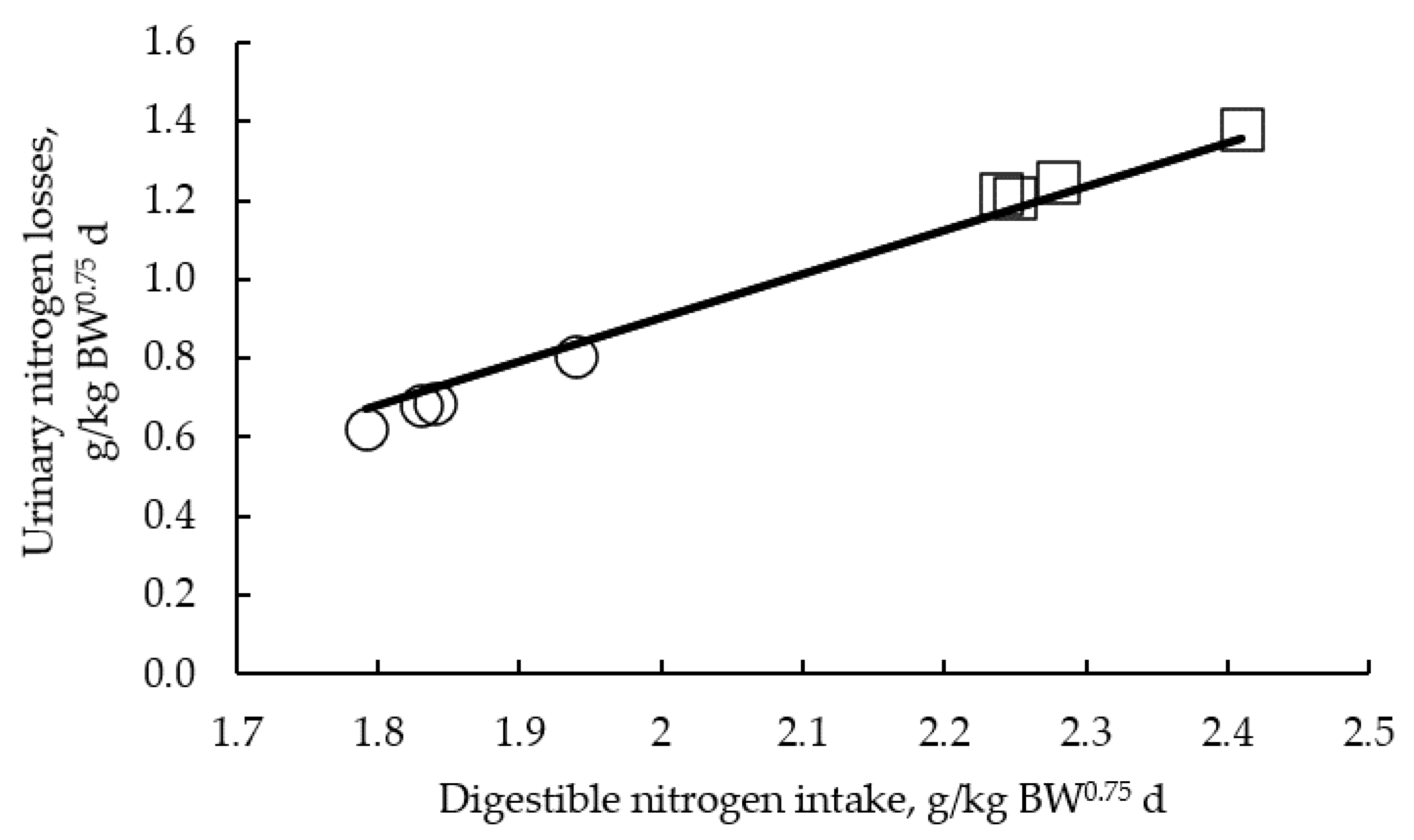
| DNi | 2.25 b | 2.28 b | 2.41 a | 2.24 b | 0.02 | 0.03 | 0.138 | 0.030 | 0.003 |
| 3 Nitrogen retained, g/kg BW0.75 d | |||||||||
| NR whole body | 1.05 | 1.03 | 1.02 | 1.02 | 0.05 | 0.01 | 0.040 | 0.166 | 0.510 |
| NR carcass | 0.711 | 0.696 | 0.682 | 0.677 | 0.007 | 0.010 | 0.017 | 0.275 | 0.570 |
| 4 Nitrogen efficiency | |||||||||
| NR whole body/Ni | 0.353 | 0.351 | 0.318 | 0.330 | 0.004 | 0.006 | <0.001 | 0.383 | 0.186 |
| NR whole body/DNi | 0.467 a | 0.456 a | 0.427 b | 0.458 a | 0.005 | 0.007 | 0.017 | 0.161 | 0.005 |
| NR whole body/DNp | 0.561 a | 0.549 a | 0.506 b | 0.550 a | 0.007 | 0.010 | 0.015 | 0.111 | 0.049 |
| NR carcass/DNi | 0.316 a | 0.308 a | 0.284 b | 0.305 a | 0.004 | 0.006 | 0.004 | 0.283 | 0.011 |
| NR carcass/DNp | 0.381 a | 0.370 a | 0.336 b | 0.366 a | 0.005 | 0.008 | 0.004 | 0.205 | 0.008 |
| 5 Nitrogen losses, g/kg BW0.75 d | |||||||||
| Skin and viscera | 0.337 | 0.335 | 0.343 | 0.342 | 0.006 | 0.008 | 0.469 | 0.803 | 0.988 |
| Faeces | 0.725 c | 0.691 d | 0.824 b | 0.865 a | 0.008 | 0.011 | <0.001 | 0.74 | <0.001 |
| Urine | 1.21 b | 1.25 b | 1.38 a | 1.22 b | 0.02 | 0.03 | 0.057 | 0.082 | 0.002 |
| Item | Diets 1 | SEM | p-Value | ||||||
|---|---|---|---|---|---|---|---|---|---|
| Low-Insoluble Fibre | High-Insoluble Fibre | IF and SF | IF × SF | IF | SF | IF × SF | |||
| Low-Soluble Fibre LIF-LSF | High-Soluble Fibre LIF-HSF | Low-Soluble Fibre HIF-LSF | High-Soluble Fibre HIF-HSF | ||||||
| N | 34 | 36 | 32 | 33 | |||||
| BW0.75 d | 1.27 | 1.25 | 1.25 | 1.24 | 0.01 | 0.01 | 0.101 | 0.086 | 0.389 |
| 2 Energy intake, MJ/kg BW0.75 d | |||||||||
| GEi | 1.70 | 1.65 | 2.05 | 1.94 | 0.02 | 0.03 | <0.001 | 0.002 | 0.24 |
| DEi | 1.08 b | 1.10 b | 1.15 a | 1.11 ab | 0.01 | 0.02 | 0.016 | 0.619 | 0.027 |
| 3 Energy retained, kJ/kg BW0.75 d | |||||||||
| ER whole body | 354 | 339 | 338 | 333 | 4.04 | 5.73 | 0.068 | 0.067 | 0.405 |
| ER carcass | 219 | 209 | 206 | 203 | 2.83 | 4.01 | 0.030 | 0.084 | 0.348 |
| 4 Energy efficiency 1 | |||||||||
| ER whole body/GEi | 0.208 | 0.207 | 0.165 | 0.173 | 0.003 | 0.004 | <0.001 | 0.415 | 0.247 |
| ER whole body/DEi | 0.330 a | 0.311 b | 0.294 b | 0.302 b | 0.004 | 0.006 | <0.001 | 0.350 | 0.029 |
| ER whole body/DEp | 0.677 a | 0.631 ab | 0.557 c | 0.598 bc | 0.014 | 0.020 | <0.001 | 0.896 | 0.027 |
| ER carcass/DEi | 0.204 a | 0.191 b | 0.179 b | 0.184 b | 0.003 | 0.004 | <0.001 | 0.323 | 0.024 |
| ER carcass/DEp | 0.419 a | 0.387 a | 0.339 b | 0.365 ab | 0.009 | 0.012 | <0.001 | 0.831 | 0.017 |
| 5 Energy losses, MJ/kg BW0.75 d | |||||||||
| Skin and viscera, | 0.135 | 0.132 | 0.131 | 0.130 | 0.003 | 0.004 | 0.647 | 0.331 | 0.794 |
| Faeces | 0.628 | 0.551 | 0.896 | 0.828 | 0.007 | 0.010 | <0.001 | <0.001 | 0.624 |
| Urine + heat production | 0.721 c | 0.765 bc | 0.814 a | 0.777 ab | 0.012 | 0.017 | 0.004 | 0.837 | 0.014 |
| Item | Diets 1 | SEM | p-Value | ||||||
|---|---|---|---|---|---|---|---|---|---|
| Low-Insoluble Fibre | High-Insoluble Fibre | IF and SF | IF × SF | IF | SF | IF × SF | |||
| Low-Soluble Fibre LIF-LSF | High-Soluble Fibre LIF-HSF | Low-Soluble Fibre HIF-LSF | High-Soluble Fibre HIF-HSF | ||||||
| N | 34 | 36 | 32 | 33 | |||||
| 2 Mineral intake, g/kg BW0.75 d | |||||||||
| MIi, | 7.92 | 8.34 | 9.66 | 9.66 | 0.09 | 0.13 | <0.001 | 0.097 | 0.095 |
| DMIi | 3.97 b | 4.04 b | 4.59 a | 4.02 b | 0.04 | 0.06 | <0.001 | <0.001 | <0.001 |
| 3 Mineral retained, g/kg BW0.75 d | |||||||||
| MIR whole body | 1.25 | 1.22 | 1.23 | 1.23 | 0.01 | 0.01 | 0.337 | 0.223 | 0.068 |
| MIR carcass | 1.027 | 1.016 | 0.998 | 0.996 | 0.005 | 0.007 | <0.001 | 0.315 | 0.531 |
| Minerals efficiency | |||||||||
| MIR whole body/MIi | 0.159 a | 0.148 b | 0.127 c | 0.128 c | 0.002 | 0.002 | <0.001 | 0.032 | 0.009 |
| MIR whole body/DMIi | 0.318 a | 0.306 a | 0.268 b | 0.308 a | 0.003 | 0.005 | <0.001 | 0.005 | <0.001 |
| MIR in carcass/DMIi | 0.261 a | 0.254 ab | 0.218 c | 0.249 b | 0.003 | 0.004 | <0.001 | 0.036 | <0.001 |
| 4 Mineral losses, g/kg BW0.75 d | |||||||||
| Skin and viscera, | 0.227 | 0.207 | 0.227 | 0.236 | 0.007 | 0.011 | 0.192 | 0.594 | 0.160 |
| Faeces | 3.95 | 4.30 | 5.07 | 5.63 | 0.05 | 0.07 | <0.001 | <0.001 | 0.110 |
| Urine | 2.71 b | 2.81 b | 3.36 a | 2.79 b | 0.04 | 0.06 | <0.001 | <0.001 | <0.001 |
| Item | Diets 1 | SEM | p-Value | ||||||
|---|---|---|---|---|---|---|---|---|---|
| Low-Insoluble Fibre | High Insoluble Fibre | IF and SF | IF × SF | IF | SF | IF × SF | |||
| Low-Soluble Fibre LIF-LSF | High-Soluble Fibre LIF-HSF | Low-Soluble Fibre HIF-LSF | High-Soluble Fibre HIF-HSF | ||||||
| N | 10 | 7 | 9 | 7 | |||||
| Villous height, µm | 380 | 340 | 383 | 422 | 14.8 | 20.8 | 0.052 | 0.995 | 0.071 |
| Crypt depth, µm | 144 | 156 | 147 | 160 | 5.45 | 7.69 | 0.667 | 0.115 | 0.989 |
| Ratio villous height/crypt depth | 2.71 | 2.20 | 2.67 | 2.70 | 0.15 | 0.22 | 0.293 | 0.290 | 0.232 |
| Goblet cells, no/villous | 11.1 | 9.86 | 10.3 | 11.8 | 1.06 | 1.49 | 0.707 | 0.923 | 0.350 |
| Mucose protein, mg/g of tissue | 61.5 | 46.2 | 57.6 | 52.2 | 4.81 | 6.80 | 0.878 | 0.136 | 0.470 |
| Sucrose activity, µmol of glucose/mg of protein | 273 | 212 | 218 | 174 | 17.0 | 24.0 | 0.059 | 0.034 | 0.703 |
© 2020 by the authors. Licensee MDPI, Basel, Switzerland. This article is an open access article distributed under the terms and conditions of the Creative Commons Attribution (CC BY) license (http://creativecommons.org/licenses/by/4.0/).
Share and Cite
Farías-Kovac, C.; Nicodemus, N.; Delgado, R.; Ocasio-Vega, C.; Noboa, T.; Abdelrasoul, R.A.-S.; Carabaño, R.; García, J. Effect of Dietary Insoluble and Soluble Fibre on Growth Performance, Digestibility, and Nitrogen, Energy, and Mineral Retention Efficiency in Growing Rabbits. Animals 2020, 10, 1346. https://doi.org/10.3390/ani10081346
Farías-Kovac C, Nicodemus N, Delgado R, Ocasio-Vega C, Noboa T, Abdelrasoul RA-S, Carabaño R, García J. Effect of Dietary Insoluble and Soluble Fibre on Growth Performance, Digestibility, and Nitrogen, Energy, and Mineral Retention Efficiency in Growing Rabbits. Animals. 2020; 10(8):1346. https://doi.org/10.3390/ani10081346
Chicago/Turabian StyleFarías-Kovac, Carlos, Nuria Nicodemus, Rebeca Delgado, César Ocasio-Vega, Tamia Noboa, Ramadan Allam-Sayed Abdelrasoul, Rosa Carabaño, and Javier García. 2020. "Effect of Dietary Insoluble and Soluble Fibre on Growth Performance, Digestibility, and Nitrogen, Energy, and Mineral Retention Efficiency in Growing Rabbits" Animals 10, no. 8: 1346. https://doi.org/10.3390/ani10081346
APA StyleFarías-Kovac, C., Nicodemus, N., Delgado, R., Ocasio-Vega, C., Noboa, T., Abdelrasoul, R. A.-S., Carabaño, R., & García, J. (2020). Effect of Dietary Insoluble and Soluble Fibre on Growth Performance, Digestibility, and Nitrogen, Energy, and Mineral Retention Efficiency in Growing Rabbits. Animals, 10(8), 1346. https://doi.org/10.3390/ani10081346

