What Is a Dingo? The Phenotypic Classification of Dingoes by Aboriginal and Torres Strait Islander Residents in Northern Australia


Simple Summary
Abstract
1. Introduction
2. Materials and Methods
2.1. Study Region
2.2. Discussions with Stakeholder Groups
2.3. Questionnaire Implementation with Community Residents
3. Results
3.1. Stakeholder Groups
3.2. Community Residents
4. Discussion
5. Conclusions
Supplementary Materials
Author Contributions
Funding
Acknowledgments
Conflicts of Interest
References
- Mace, G.M. The role of taxonomy in species conservation. Philos. Trans. R. Soc. B Biol. Sci. 2004, 359, 711–719. [Google Scholar] [CrossRef] [PubMed]
- Smith, B.P.; Cairns, K.M.; Adams, J.W.; Newsome, T.M.; Fillios, M.; Déaux, E.C.; Parr, W.C.H.; Letnic, M.; van Eeden, L.M.; Appleby, R.G.; et al. Taxonomic status of the Australian dingo: The case for Canis dingo Meyer, 1793. Zootaxa 2019, 4564, 173–197. [Google Scholar] [CrossRef]
- Jackson, S.M.; Groves, C.P.; Fleming, P.J.S.; Aplin, K.P.; Eldridge, M.D.B.; Gonzalez, A.; Helgen, K.M. The wayward dog: Is the Australian native dog or dingo a distinct species? Zootaxa 2017, 4317, 201–224. [Google Scholar] [CrossRef]
- Stephens, D.; Wilton, A.N.; Fleming, P.J.S.; Berry, O. Death by sex in an Australian icon: A continent-wide survey reveals extensive hybridization between dingoes and domestic dogs. Mol. Ecol. 2015, 24, 5643–5656. [Google Scholar] [CrossRef] [PubMed]
- Smith, B.; Appleby, R. Forging a new future for the Australian dingo. In The Dingo Debate: Origins, Behaviour and Conservation; Smith, B., Ed.; CSIRO Publishing: Clayton South, Australia, 2015; pp. 301–316. [Google Scholar]
- Van Eeden, L.M.; Dickman, C.R.; Newsome, T.M.; Crowther, M.S. What should we do with wild dogs?: Taxonomic tangles and the management of dingo-dog hybridisation. Aust. Zool. 2019, 40, 92–101. [Google Scholar] [CrossRef]
- Crowther, M.S.; Fillios, M.; Colman, N.; Letnic, M. An updated description of the Australian dingo (Canis dingo Meyer, 1793). J. Zool. 2014, 293, 192–203. [Google Scholar] [CrossRef]
- Australia, W. National Wild Dog Action Plan: Promoting and Supporting Community-Driven Action for Landscape-Scale Wild Dog Management; ACT: Barton, Australia, 2014. [Google Scholar]
- Degeling, C.; Brookes, V.; Lea, T.; Ward, M. Rabies response, One Health and more-than-human considerations in Indigenous communities in northern Australia. Soc. Sci. Med. 2018, 212, 60–67. [Google Scholar] [CrossRef]
- Hudson, E.G.; Brookes, V.J.; Ward, M.P. Assessing the Risk of a Canine Rabies Incursion in Northern Australia. Front. Vet. Sci. 2017, 4, 141. [Google Scholar] [CrossRef]
- Sparkes, J.; Fleming, P.J.S.; Ballard, G.; Scott-Orr, H.; Durr, S.; Ward, M.P. Canine Rabies in Australia: A Review of Preparedness and Research Needs. Zoonoses Public Health 2015, 62, 237–253. [Google Scholar] [CrossRef] [PubMed]
- ProMED. Rabies (06): Asia (Indonesia, Pakistan) Human, Dog, Control, Archive Number: 20190218.6322909. Available online: https://promedmail.org/promed-post/?id=6322909 (accessed on 19 April 2020).
- Johnstone-Robertson, S.P.; Fleming, P.J.S.; Ward, M.P.; Davis, S.A. Predicted Spatial Spread of Canine Rabies in Australia. PLoS Negl. Trop. Dis. 2017, 11. [Google Scholar] [CrossRef] [PubMed]
- Animal Health Australia. Disease Strategy: Rabies (Version 3.0), Australian Veterinary Emergency Plan (AUSVETPLAN); Primary Industries Ministerial Council: Canberra, Australia, 2011. [Google Scholar]
- Maher, E.K.; Ward, M.P.; Brookes, V.J. Investigation of the temporal roaming behaviour of free-roaming domestic dogs in Indigenous communities in northern Australia to inform rabies incursion preparedness. Sci. Rep. 2019, 9, 14893. [Google Scholar] [CrossRef]
- Hudson, E.G.; Brookes, V.J.; Dürr, S.; Ward, M.P. Domestic dog roaming patterns in remote northern Australian indigenous communities and implications for disease modelling. Prev. Vet. Med. 2017, 146, 52–60. [Google Scholar] [CrossRef]
- Bombara, C.B.; Duerr, S.; Machovsky-Capuska, G.E.; Jones, P.W.; Ward, M.P. A preliminary study to estimate contact rates between free-roaming domestic dogs using novel miniature cameras. PLoS ONE 2017, 12. [Google Scholar] [CrossRef] [PubMed]
- Cairns, K.M.; Nesbitt, B.J.; Laffan, S.W.; Letnic, M.; Crowther, M.S. Geographic hot spots of dingo genetic ancestry in southeastern Australia despite hybridisation with domestic dogs. Conserv. Genet. 2020, 21, 77–90. [Google Scholar] [CrossRef]
- McLeod, R. Cost of Pest Animals in NSW and Australia, 2013–2014; Report prepared for the NSW Natural Resources Commission; eSYS Development Pty Ltd: Sydney, Australia, 2016. [Google Scholar]
- Letnic, M.; Ritchie, E.G.; Dickman, C.R. Top predators as biodiversity regulators: The dingo Canis lupus dingo as a case study. Biol. Rev. 2012, 87, 390–413. [Google Scholar] [CrossRef]
- Van Eeden, L.M.; Newsome, T.M.; Crowther, M.S.; Dickman, C.R.; Bruskotter, J. Social identity shapes support for management of wildlife and pests. Biol. Conserv. 2019, 231, 167–173. [Google Scholar] [CrossRef]
- Elledge, A.E.; Allen, L.R.; Carlsson, B.-L.; Wilton, A.N.; Leung, L.K.-P. An evaluation of genetic analyses, skull morphology and visual appearance for assessing dingo purity: Implications for dingo conservation. Wildl. Res. 2008, 35, 812–820. [Google Scholar] [CrossRef]
- Dodson, M. The wentworth lecture the end in the beginning: Re (de) finding aboriginality. Aust. Aborig. Stud. 1994, 1, 2. [Google Scholar]
- Probyn-Rapsey, F. Dingoes and dog-whistling: A cultural politics of race and species in Australia. Anim. Stud. J. 2015, 4, 55–77. [Google Scholar]
- Australian Bureau of Statistics. 2016 Census QuickStats. Available online: https://quickstats.censusdata.abs.gov.au/census_services/getproduct/census/2016/quickstat/036 (accessed on 19 April 2020).
- Queensland Government. Remnant Regional Ecosystem Vegetation in Queensland. Available online: https://www.qld.gov.au/environment/plants-animals/plants/ecosystems/remnant-vegetation (accessed on 19 April 2020).
- United Nations Educational Scientific and Cultural Organisation, UNESCO. Great Barrier Reef. Available online: https://whc.unesco.org/en/list/154/ (accessed on 19 April 2020).
- Brookes, V.J.; Kennedy, E.; Dhagapan, P.; Ward, M.P. Qualitative Research to Design Sustainable Community-Based Surveillance for Rabies in Northern Australia and Papua New Guinea. Front. Vet. Sci. 2017, 4. [Google Scholar] [CrossRef] [PubMed]
- Hudson, E.G.; Brookes, V.J.; Ward, M.P. Demographic studies of owned dogs in the Northern Peninsula Area, Australia, to inform population and disease management strategies. Aust. Vet. J. 2018, 96, 487–494. [Google Scholar] [CrossRef]
- Dürr, S.; Ward, M.P. Roaming behaviour and home range estimation of domestic dogs in Aboriginal and Torres Strait Islander communities in northern Australia using four different methods. Prev. Vet. Med. 2014, 117, 340–357. [Google Scholar] [CrossRef] [PubMed]
- Dürr, S.; Ward, M.P. Development of a Novel Rabies Simulation Model for Application in a Non-endemic Environment. PLoS Negl. Trop. Dis. 2015, 9, e0003876. [Google Scholar] [CrossRef]
- Hudson, E.G.; Dhand, N.; Dürr, S.; Ward, M.P. A Survey of Dog Owners in Remote Northern Australian Indigenous Communities to Inform Rabies Incursion Planning. PLoS Negl. Trop. Dis. 2016, 10, e0004649. [Google Scholar] [CrossRef]
- Carter, J.; Wardell-Johnson, A.; Archer-Lean, C. Butchulla perspectives on dingo displacement and agency at K’gari-Fraser Island, Australia. Geoforum 2017, 85, 197–205. [Google Scholar] [CrossRef]
- Newsome, A.; Corbett, L. The identity of the dingo III.* The incidence of dingoes, dogs and hybrids and their coat colours in remote and settled regions of Australia. Aust. J. Zool. 1985, 33, 363–375. [Google Scholar] [CrossRef]
- Newsome, T.M.; Stephens, D.; Ballard, G.-A.; Dickman, C.R.; Fleming, P.J. Genetic profile of dingoes (Canis lupus dingo) and free-roaming domestic dogs (C. l. familiaris) in the Tanami Desert, Australia. Wildl. Res. 2013, 40, 196–206. [Google Scholar] [CrossRef]
- Radford, C.G.; Letnic, M.; Fillios, M.; Crowther, M.S. An assessment of the taxonomic status of wild canids in south-eastern New South Wales: Phenotypic variation in dingoes. Aust. J. Zool. 2012, 60, 73–80. [Google Scholar] [CrossRef]
- Trigger, D.; Mulcock, J.; Gaynor, A.; Toussaint, Y. Ecological restoration, cultural preferences and the negotiation of ‘nativeness’ in Australia. Geoforum 2008, 39, 1273–1283. [Google Scholar] [CrossRef]
- Simberloff, D. Confronting introduced species: A form of xenophobia? Biol. Invasions 2003, 5, 179–192. [Google Scholar] [CrossRef]
- Allen, B.L.; Allen, L.R.; Ballard, G.; Jackson, S.M.; Fleming, P.J. A roadmap to meaningful dingo conservation. Canid Biol. Conserv. 2017, 20, 45–56. [Google Scholar]
- Salvatori, V.; Donfrancesco, V.; Trouwborst, A.; Boitani, L.; Linnell, J.D.; Alvares, F.; Åkesson, M.; Balys, V.; Blanco, J.C.; Chiriac, S. European agreements for nature conservation need to explicitly address wolf-dog hybridisation. Biol. Conserv. 2020, 248, 108525. [Google Scholar] [CrossRef]
- Robinson, C.J.; Wallington, T.J. Boundary work: Engaging knowledge systems in co-management of feral animals on Indigenous lands. Ecol. Soc. 2012, 17. [Google Scholar] [CrossRef]
- Hudson, E.G.; Brookes, V.J.; Dürr, S.; Ward, M.P. Modelling targeted rabies vaccination strategies for a domestic dog population with heterogeneous roaming patterns. PLoS Negl. Trop. Dis. 2019, 13, e0007582. [Google Scholar] [CrossRef]
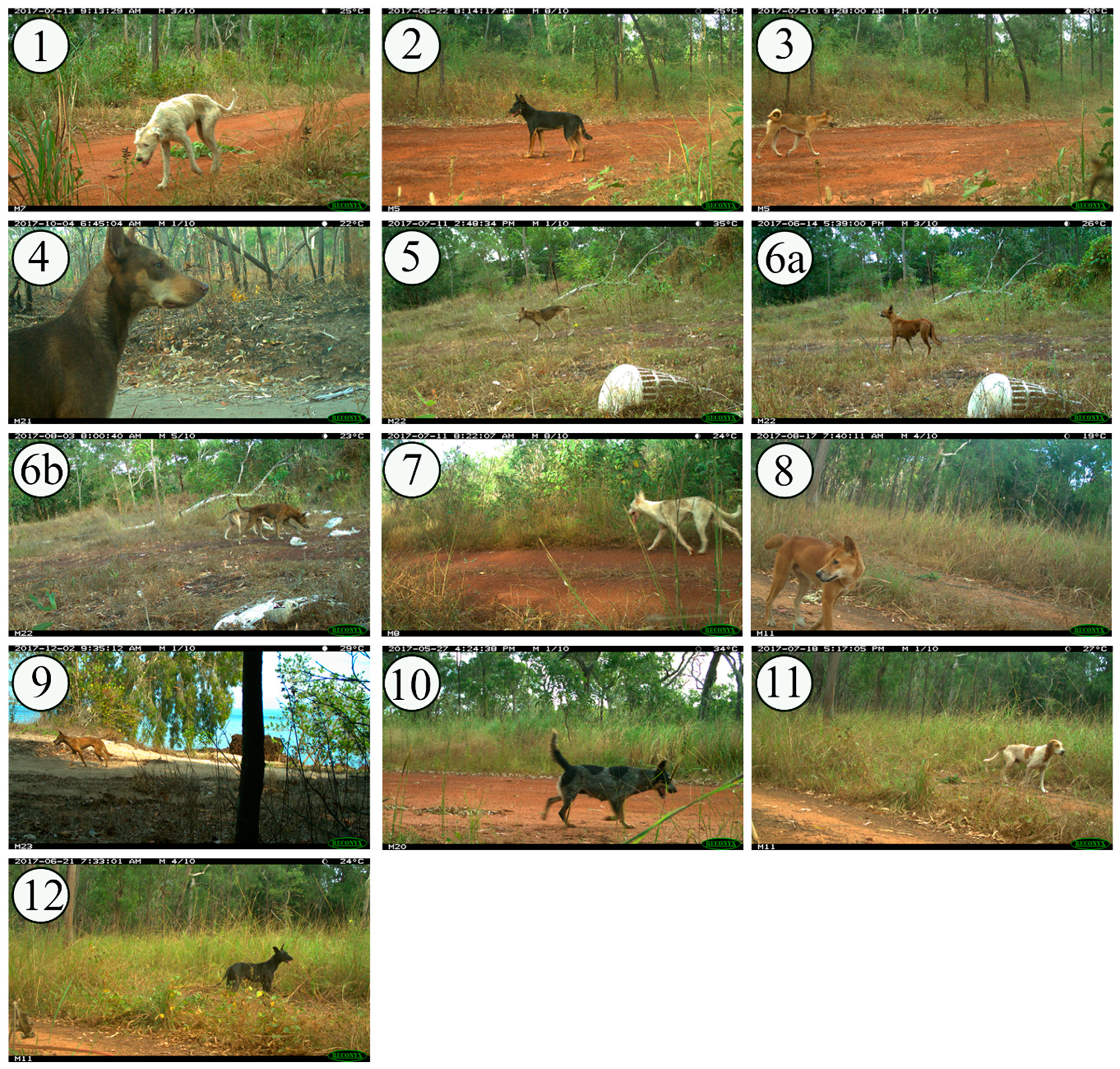


| Picture | Head | Ears | Body Conformation | Coat | Tail Shape | White Points | Domestic Breed |
|---|---|---|---|---|---|---|---|
| 1 | Short nose, broad cranium | Floppy | Large frame, light build | Rough, patchy white-brown | Thin | NA | – |
| 2 | Long nose | Pointed | Medium frame, heavy build | Black and tan | Bushy | Back foot | – |
| 3 | Long nose | Pointed | Medium frame, light build | Tan | Curly and bushy | Front foot | – |
| 4 | Long nose | Pointed | NA | Brown, kelpie markings | NA | None apparent | Kelpie |
| 5 | Long nose | Pointed | Medium frame, light build | Sable, grey to light tan | Bushy | Yes | |
| 6a | Long nose | Upright but not pointed | Large frame, heavy build | Red | Thin | Nose | – |
| 6b | Long nose | Pointed | Large frame, light build | Red | Thin with feathering | All feet | – |
| 7 | Long nose | Pointed | Medium frame, light build | Patchy white and brown | Thin | NA | – |
| 8 | Long nose | Pointed | Medium frame, light build | Tan | Bushy | Yes | – |
| 9 | Long nose | Pointed | Medium frame, light build | Tan-red | Bushy | None apparent | – |
| 10 | Long nose | Pointed | Small frame, heavy build | Patchy black and grey with ticking | Bushy | None | Blue cattle dog |
| 11 | Short nose, broad cranium | Floppy | Medium frame, heavy build | Patchy brown and white | Thin | NA | – |
| 12 | Long nose | Upright but not pointed | Large frame, heavy build | Black | Thin | None apparent | – |
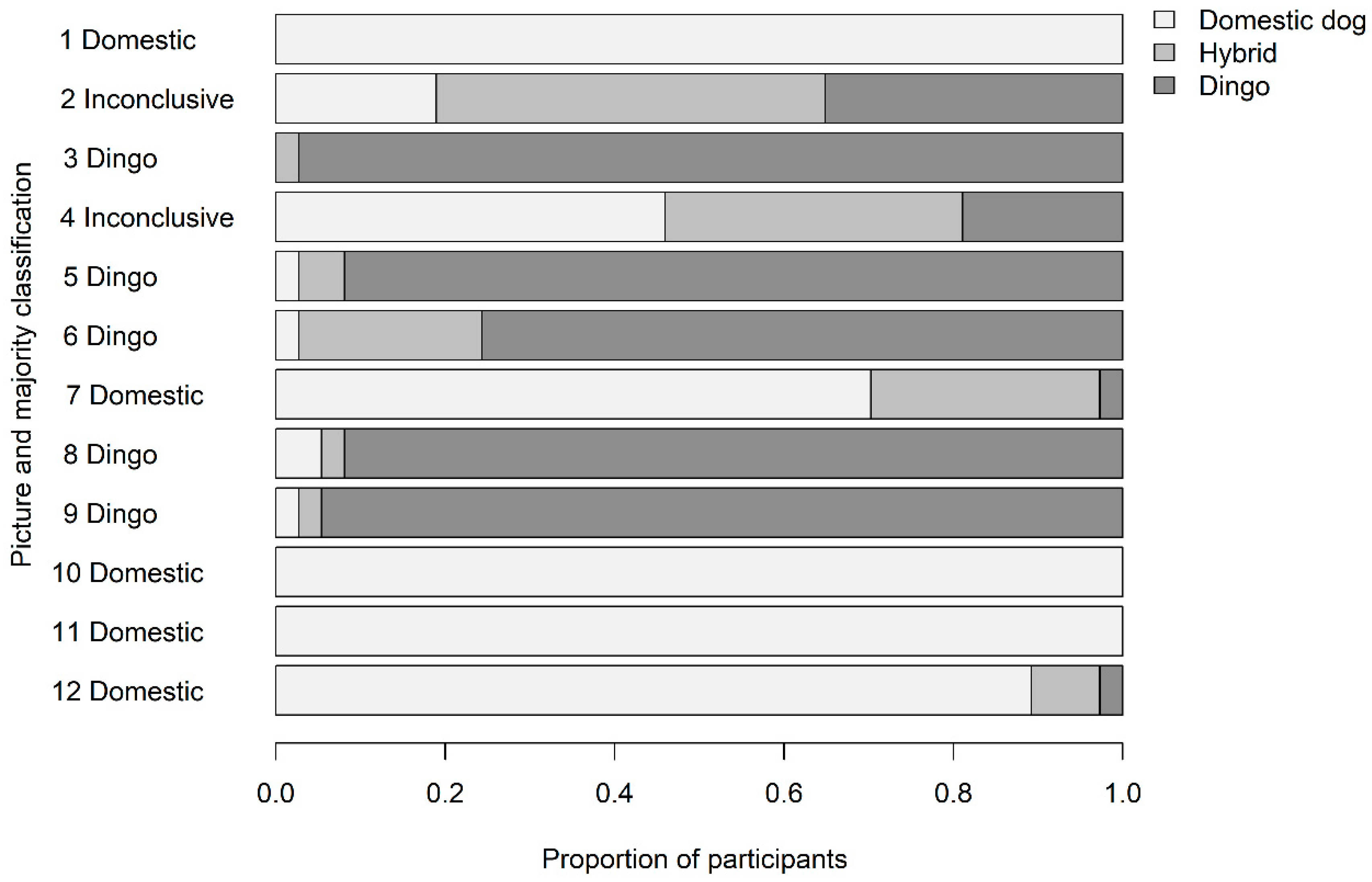
| Dingo | Hybrid | Domestic | ||||||||
|---|---|---|---|---|---|---|---|---|---|---|
| Picture | Proportion | Low | High | Proportion | Low | High | Proportion | Low | High | Overall Classification |
| 1 | 0 | 0 | 0.05 | 0 | 0 | 0.05 | 1 | 1 | 1 | Domestic |
| 2 | 0.4 | 0.23 | 0.6 | 0.37 | 0.2 | 0.57 | 0.23 | 0.07 | 0.43 | Inconclusive |
| 3 | 1 | 1 | 1 | 0 | 0 | 0.05 | 0 | 0 | 0.05 | Dingo |
| 4 | 0.2 | 0.03 | 0.39 | 0.3 | 0.13 | 0.49 | 0.5 | 0.33 | 0.69 | Inconclusive |
| 5 | 0.93 | 0.9 | 1 | 0.07 | 0.03 | 0.17 | 0 | 0 | 0.1 | Dingo |
| 6 | 0.8 | 0.7 | 0.95 | 0.17 | 0.07 | 0.32 | 0.03 | 0 | 0.19 | Dingo |
| 7 | 0.03 | 0 | 0.21 | 0.27 | 0.13 | 0.44 | 0.7 | 0.57 | 0.87 | Domestic |
| 8 | 0.97 | 0.93 | 1 | 0 | 0 | 0.06 | 0.03 | 0 | 0.09 | Dingo |
| 9 | 0.93 | 0.9 | 1 | 0.03 | 0 | 0.13 | 0.03 | 0 | 0.13 | Dingo |
| 10 | 0 | 0 | 0.05 | 0 | 0 | 0.05 | 1 | 1 | 1 | Domestic |
| 11 | 0 | 0 | 0.05 | 0 | 0 | 0.05 | 1 | 1 | 1 | Domestic |
| 12 | 0 | 0 | 0.1 | 0.07 | 0.03 | 0.17 | 0.93 | 0.9 | 1 | Domestic |
© 2020 by the authors. Licensee MDPI, Basel, Switzerland. This article is an open access article distributed under the terms and conditions of the Creative Commons Attribution (CC BY) license (http://creativecommons.org/licenses/by/4.0/).
Share and Cite
Brookes, V.J.; Degeling, C.; van Eeden, L.M.; Ward, M.P. What Is a Dingo? The Phenotypic Classification of Dingoes by Aboriginal and Torres Strait Islander Residents in Northern Australia. Animals 2020, 10, 1230. https://doi.org/10.3390/ani10071230
Brookes VJ, Degeling C, van Eeden LM, Ward MP. What Is a Dingo? The Phenotypic Classification of Dingoes by Aboriginal and Torres Strait Islander Residents in Northern Australia. Animals. 2020; 10(7):1230. https://doi.org/10.3390/ani10071230
Chicago/Turabian StyleBrookes, Victoria J., Chris Degeling, Lily M. van Eeden, and Michael P. Ward. 2020. "What Is a Dingo? The Phenotypic Classification of Dingoes by Aboriginal and Torres Strait Islander Residents in Northern Australia" Animals 10, no. 7: 1230. https://doi.org/10.3390/ani10071230
APA StyleBrookes, V. J., Degeling, C., van Eeden, L. M., & Ward, M. P. (2020). What Is a Dingo? The Phenotypic Classification of Dingoes by Aboriginal and Torres Strait Islander Residents in Northern Australia. Animals, 10(7), 1230. https://doi.org/10.3390/ani10071230