Moody Mares—Is Ovariectomy a Solution?



Simple Summary
Abstract
1. Introduction
Aim
2. Materials and Methods
3. Results
4. Discussion
5. Conclusions
Author Contributions
Funding
Conflicts of Interest
Appendix A
 | Riding problems in general |
| Increased flank sensitivity during grooming/stroking |
| Tendency to bite/threaten to bite humans |
| Tendency to bite/threaten to bite other horses |
| Front limb kicking towards humans |
| Front limb kicking when in contact with other horses |
| Kicks/threatens to kick humans |
| Kicks/threatens to kick other horses |
| Aggressive/frustrated behavior when humans/horses approach from behind |
| Rearing/threatening to rear during ridden exercise |
| The mare loses contact with the bit when the rider’s legs are used during ridden exercise |
| The mare is unwilling to keep energetic forward movement during ridden exercise |
| The mare bucks during ridden exercise |
| The mare kicks towards the rider’s legs during ridden exercise |
| I did not experience any of the listed symptoms |
| Increased flank sensitivity during grooming/stroking |  |
| Tendency to bite/threaten to bite humans | |
| Tendency to bite/threaten to bite other horses | |
| Front limb kicking towards humans | |
| Front limb kicking when in contact with other horses | |
| Kicks/threatens to kick humans | |
| Kicks/threatens to kick other horses | |
| Aggressive/frustrated behavior when humans/horses approach from behind | |
| Rearing/threatening to rear during ridden exercise | |
| The mare loses contact with the bit when the rider’s legs are used during ridden exercise | |
| The mare is unwilling to keep energetic forward movement during ridden exercise | |
| The mare bucks during ridden exercise | |
| The mare kicks towards the rider’s legs during ridden exercise | |
| I did not experience any of the listed symptoms |
| Yes |
| No |
| Very good effect—The symptoms completely resolved |
| Good effect—Most symptoms resolved or was markedly improved |
| Medium effect—Some symptoms were improved to a lesser degree |
| No effect |
| Negative effect—The symptoms worsened |
| Yes |
| No |
| Very good effect—The symptoms completely resolved |
| Good effect—Most symptoms resolved or was markedly improved |
| Medium effect—Some symptoms were improved to a lesser degree |
| No effect |
| Negative effect—The symptoms worsened |
| Yes |
| No |
| Very good effect—The symptoms completely resolved |
| Good effect—Most symptoms resolved or was markedly improved |
| Medium effect—Some symptoms were improved to a lesser degree |
| No effect |
| Negative effect—The symptoms worsened |
| Yes |
| No |
| Very good effect—The symptoms completely resolved |
| Good effect—Most symptoms resolved or was markedly improved |
| Medium effect—Some symptoms were improved to a lesser degree |
| No effect |
| Negative effect—The symptoms worsened |
| Riding problems in general | |
| Increased flank sensitivity during grooming/stroking | |
| Tendency to bite/threaten to bite humans | |
| Tendency to bite/threaten to bite other horses | |
| Front limb kicking towards humans | |
| Front limb kicking when in contact with other horses | |
| Kicks/threatens to kick humans | |
| Kicks/threatens to kick other horses | |
| Aggressive/frustrated behavior when humans/horses approach from behind | |
| Rearing/threatening to rear during ridden exercise | |
| The mare loses contact with the bit when the rider’s legs are used during ridden exercise | |
| The mare is unwilling to keep energetic forward movement during ridden exercise | |
| The mare bucks during ridden exercise | |
| The mare kicks towards the rider’s legs during ridden exercise | |
| I did not experience any of the listed symptoms |
| The mare has fewer days in estrus |
| The mare has more days in estrus |
| The mare expresses her estrus more strongly than before surgery |
| The mare expresses her estrus milder than before surgery |
| The estrus of the mare is unchanged after surgery |
| Yes |
| No |
References
- Smith, L.J.; Mair, T.S. Unilateral and bilateral laparoscopic ovariectomy of mares by electrocautery. Vet. Rec. 2008, 163, 297–300. [Google Scholar] [CrossRef] [Scilit] [PubMed]
- Alldredge, J.G.; Hendrickson, D.A. Use of high-power ultrasonic shears for laparoscopic ovariectomy in mares. J. Am. Vet. Med. Assoc. 2004, 225, 1578–1580. [Google Scholar] [CrossRef] [Scilit] [PubMed]
- Hooper, R.N.; Taylor, T.S.; Varner, D.D.; Blanchard, T.L. Effects of bilateral ovariectomy via colpotomy in mares: 23 cases (1984–1990). J. Am. Vet. Med. Assoc. 1993, 203, 1043–1046. [Google Scholar] [PubMed]
- Kamm, J.L.; Hendrickson, D.A. Clients’ perspectives on the effects of laparoscopic ovariectomy on equine behavior and medical problems. J. Equine Vet. Sci. 2007, 27, 435–438. [Google Scholar] [CrossRef] [Scilit]
- Daniel, A.; McCue, P.; Ferris, R.; Miller, C.; Leise, B. Bilateral ovarian leiomyoma treated by standing laparoscopic ovariectomy. Equine Vet. Educ. 2015, 27, 510–514. [Google Scholar] [CrossRef] [Scilit]
- McEntee, K. Reproductive Pathology of Domestic Mammals; Academic Press: San Diego, CA, USA, 1990. [Google Scholar]
- Frederico, L.M.; Gerard, M.P.; Pinto, C.R.; Gradil, C.M. Bilateral occurrence of granulosa-theca cell tumors in an Arabian mare. Can. Vet. J. 2007, 48, 502–505. [Google Scholar] [PubMed]
- Turner, T.A.; Manno, M. Bilateral granulosa cell tumor in a mare. J. Am. Vet. Med. Assoc. 1983, 182, 713–714. [Google Scholar] [PubMed]
- Sherlock, C.E.; Lott-Ellis, K.; Bergren, A.; Withers, J.M.; Fews, D.; Mair, T.S. Granulosa cell tumours in the mare: A review of 52 cases. Equine Vet. Educ. 2016, 28, 75–82. [Google Scholar] [CrossRef] [Scilit]
- Verma, V.; Paul, S.; Chahal, K.; Singh, J. Pregnancy luteoma: A rare case report. Int. J. Appl. Basic Med Res. 2016, 6, 282–283. [Google Scholar] [CrossRef] [Scilit] [PubMed]


| Histological Diagnosis | Number of Mares |
|---|---|
| Normal ovaries | 10 |
| No histopathologic examination | 4 |
| Unilateral Granulosa theca cell tumor | 8 |
| Bilateral Granulosa theca cell tumor | 1 |
| Bilateral leiomyoma | 3 |
| Luteoma | 1 |
| Unspecified tumor | 1 |
| Total | 28 |
| Distribution of Case Series | Normal Ovaries | Neoplasia |
|---|---|---|
| n | 10 | 14 |
| Mean age (years) | 8.1 (±3.0) | 9.9 (±2.9) |
| Mean duration of symptoms (years) | 2.3 (±1.9) | 1.5 (1.0) |
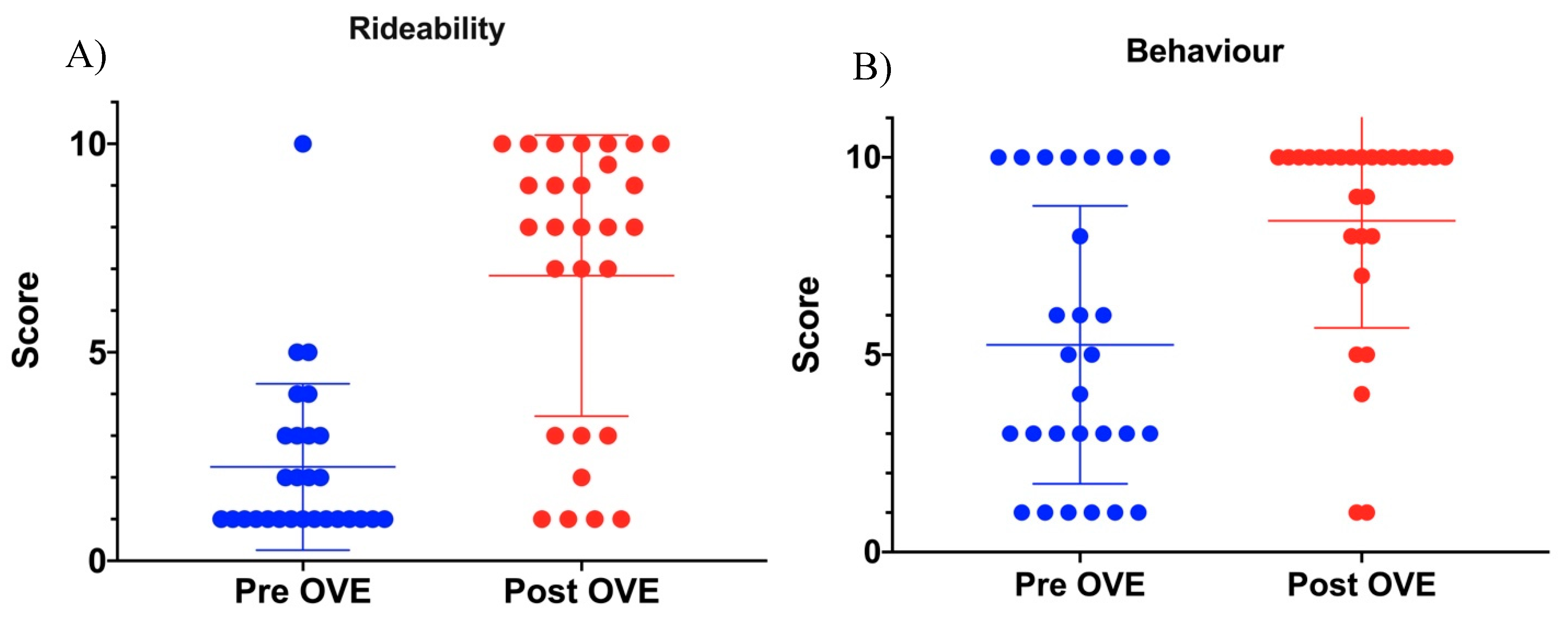
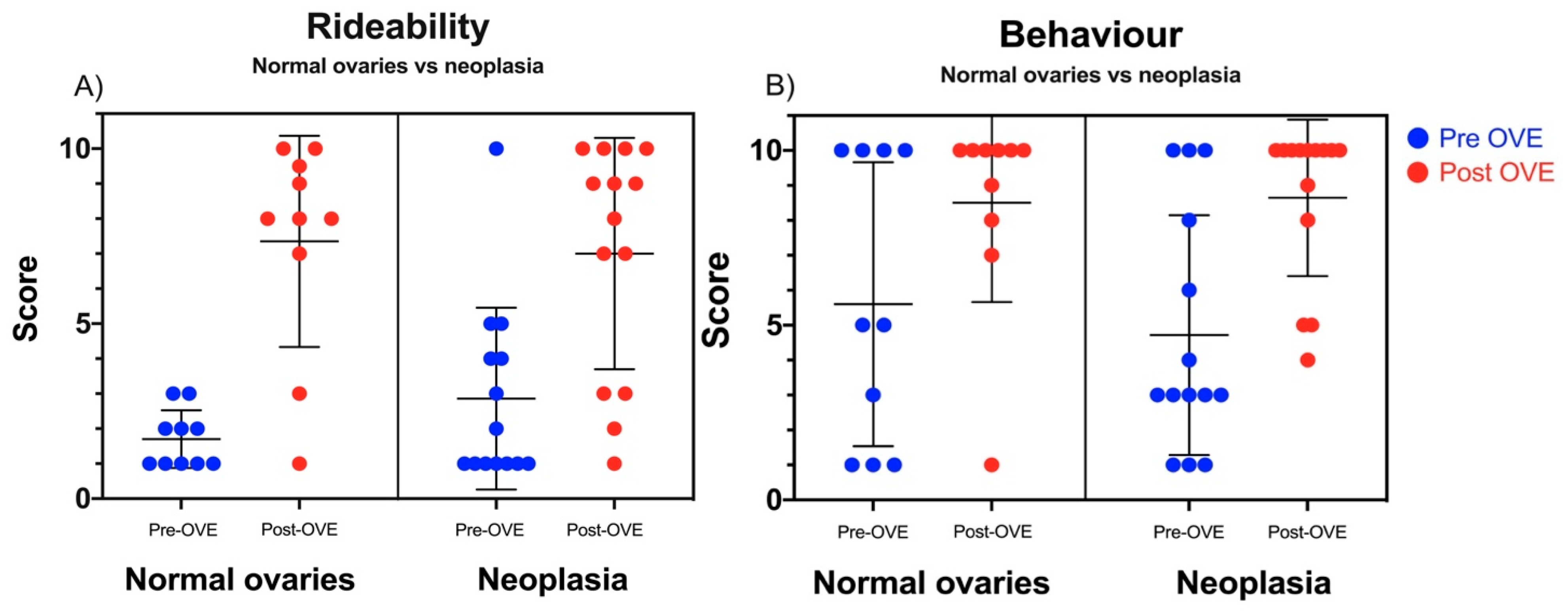
| Mean rideability score (pre-/post OVE) | 1.7 (±0.8)/7.4 (±3.0) | 2.9 (±2.6)/7.0 (±3.3) |
| Mean behaviour score (pre-/post OVE) | 5.6 (±4.1)/8.5 (2.8) | 4.7 (±3.4)/8.6 (±2.2) |
| Change in Rideability Score | Mares with Normal Ovaries (n) | Mares with Ovarian Neoplasia (n) |
|---|---|---|
| ≥5 | 8 | 8 |
| <5 | 2 | 6 |
| Rate of mares with a change of ≥ 5 in rideability score | 8/10 = 80% | 8/14 ≅ 57% |
| Change in Behaviour Score | Mares with Normal Ovaries (n) | Mares with Ovarian Neoplasia (n) |
|---|---|---|
| ≥5 | 4 | 6 |
| <5 | 6 | 8 |
| Rates | 4/10 = 40% | 6/14 ≅ 43% |
© 2020 by the authors. Licensee MDPI, Basel, Switzerland. This article is an open access article distributed under the terms and conditions of the Creative Commons Attribution (CC BY) license (http://creativecommons.org/licenses/by/4.0/).
Share and Cite
Melgaard, D.T.; Korsgaard, T.S.; Thoefner, M.S.; Petersen, M.R.; Pedersen, H.G. Moody Mares—Is Ovariectomy a Solution? Animals 2020, 10, 1210. https://doi.org/10.3390/ani10071210
Melgaard DT, Korsgaard TS, Thoefner MS, Petersen MR, Pedersen HG. Moody Mares—Is Ovariectomy a Solution? Animals. 2020; 10(7):1210. https://doi.org/10.3390/ani10071210
Chicago/Turabian StyleMelgaard, Daniel Taasti, Trine Stokbro Korsgaard, Martin Soendergaard Thoefner, Morten Roenn Petersen, and Hanne Gervi Pedersen. 2020. "Moody Mares—Is Ovariectomy a Solution?" Animals 10, no. 7: 1210. https://doi.org/10.3390/ani10071210
APA StyleMelgaard, D. T., Korsgaard, T. S., Thoefner, M. S., Petersen, M. R., & Pedersen, H. G. (2020). Moody Mares—Is Ovariectomy a Solution? Animals, 10(7), 1210. https://doi.org/10.3390/ani10071210