Changes in the Percentages of B- and T-Lymphocytes and Antibody Titres in Laying Hens Infested with Dermanyssus gallinae—A Preliminary Study


Department of Parasitology and Invasive Diseases, Faculty of Veterinary Medicine, University of Warmia and Mazury in Olsztyn, ul. Oczapowskiego 13, 10-719 Olsztyn, Poland
*
Author to whom correspondence should be addressed.
Animals 2020, 10(6), 987; https://doi.org/10.3390/ani10060987
Submission received: 28 April 2020
/
Revised: 2 June 2020
/
Accepted: 3 June 2020
/
Published: 5 June 2020
(This article belongs to the Special Issue Veterinary Microbiology & Parasitology)
Simple Summary
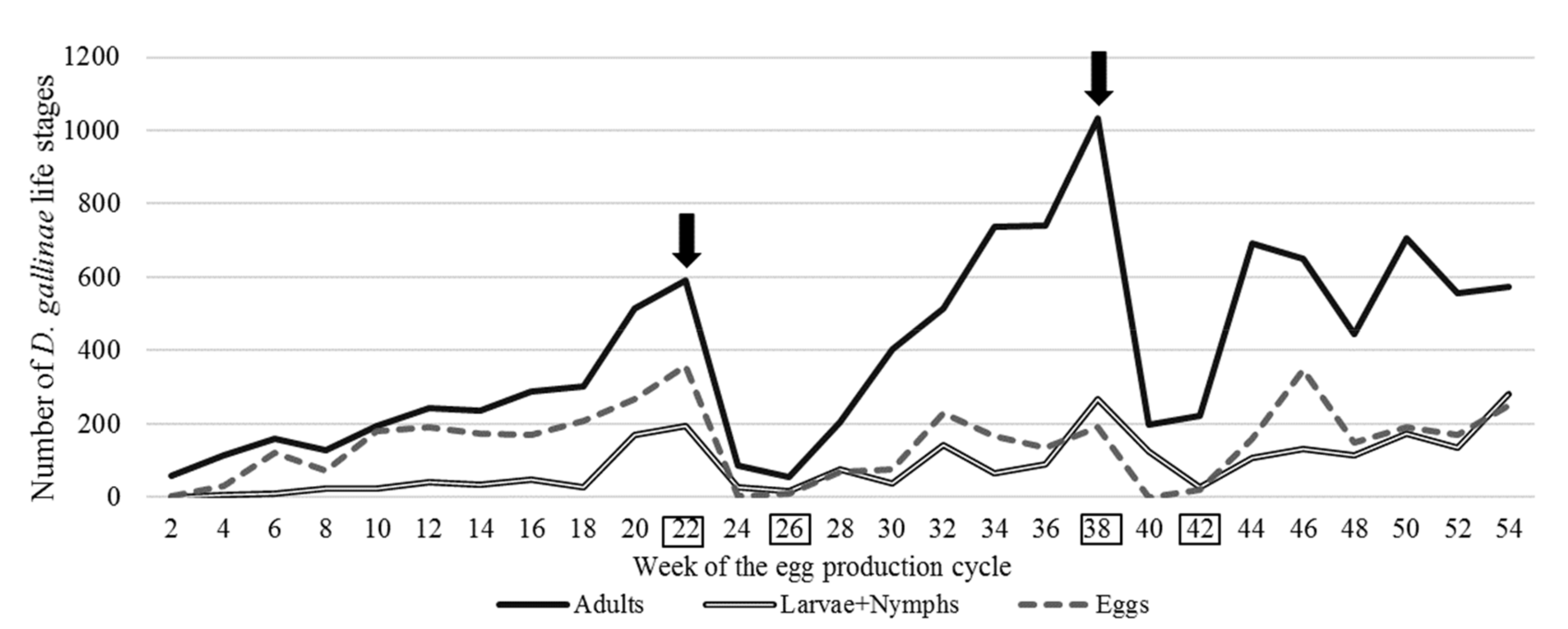
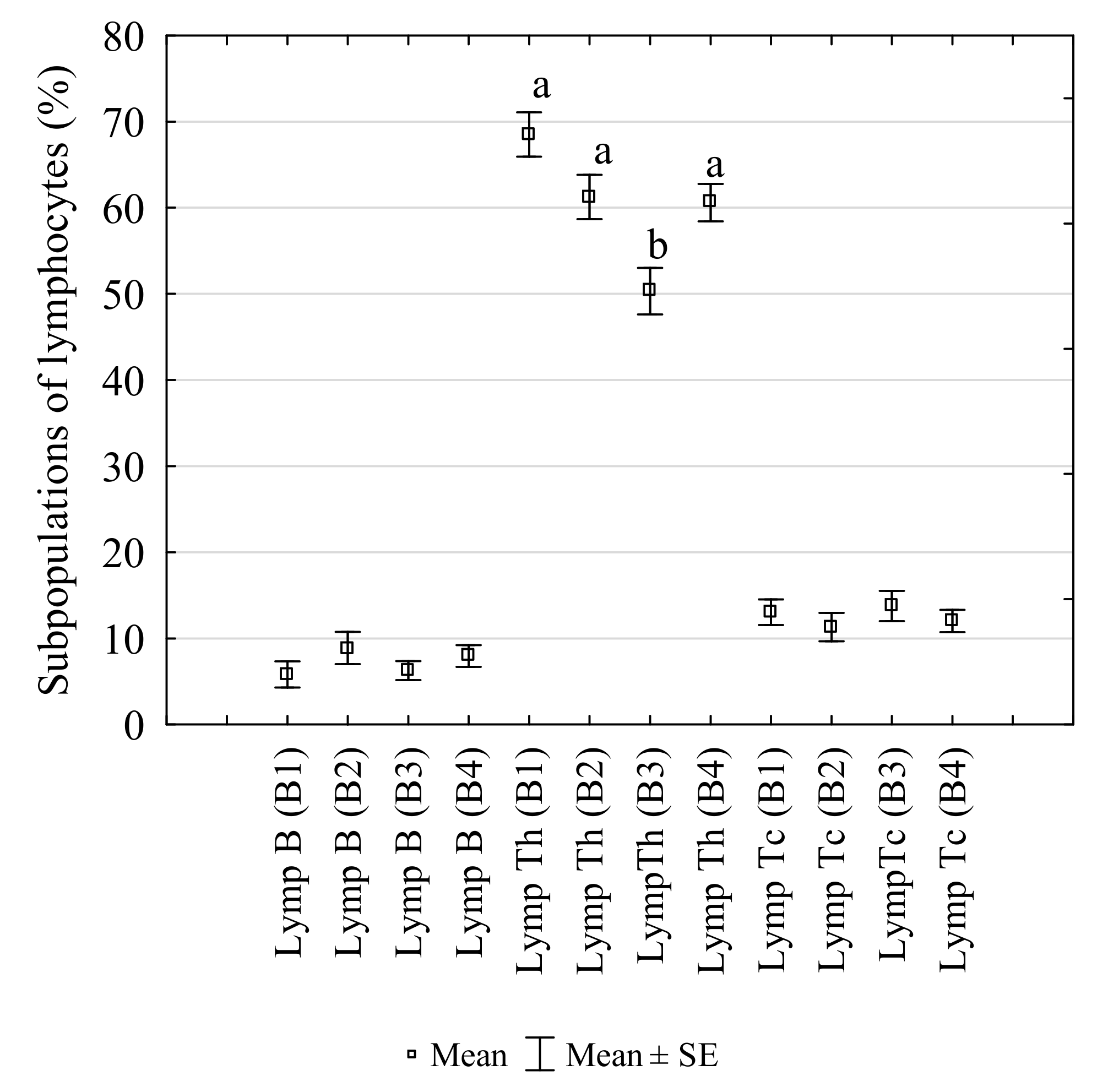
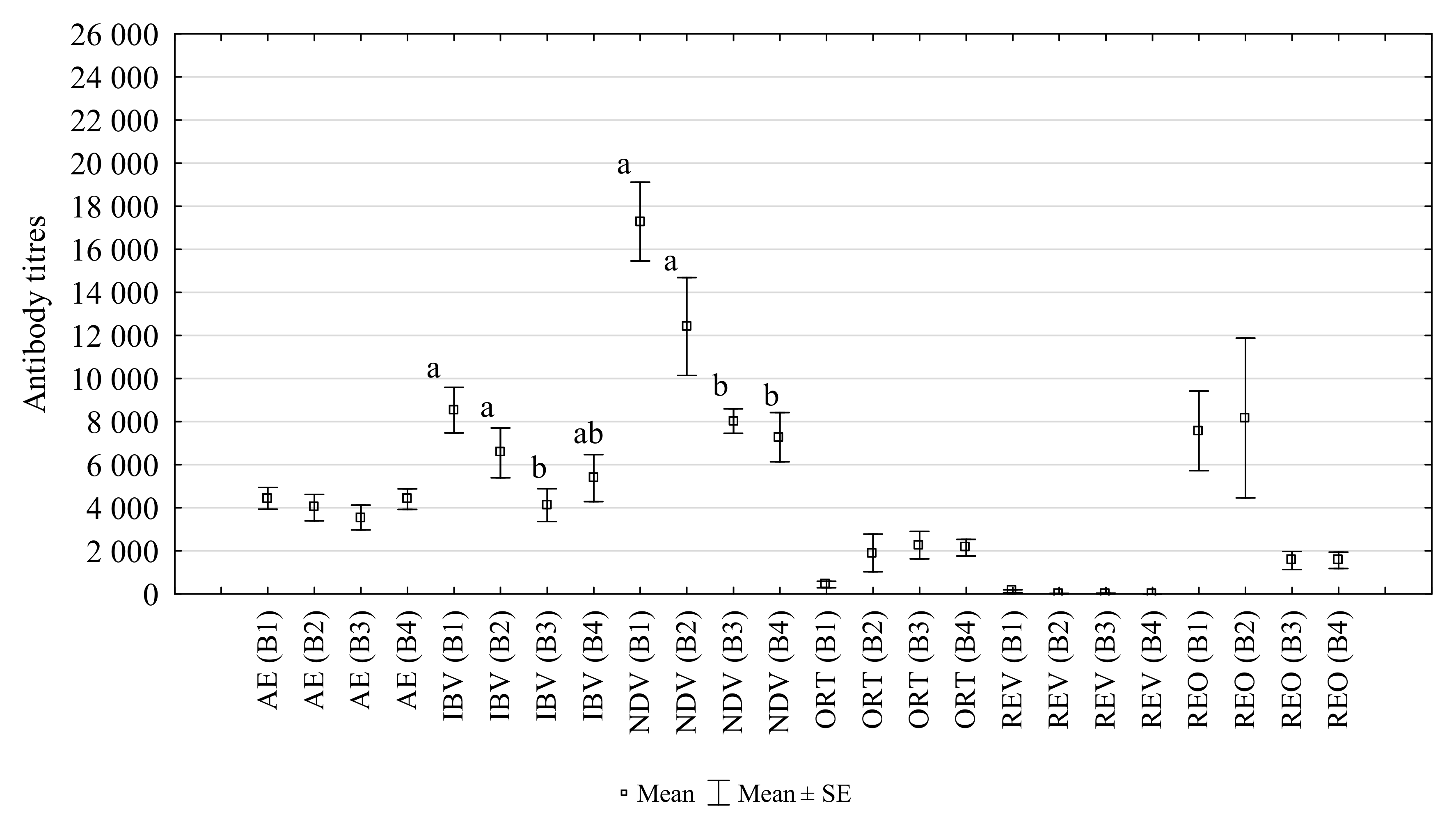
Dermanyssus gallinae, a hematophagous ectoparasite, adversely affects the health status of laying hens, leading to reduced egg production and significant economic losses in commercial poultry farms. The aim of this study was to determine the effect of D. gallinae on the immunological parameters (three lymphocyte subpopulations) and post-vaccination antibody titres (against most important avian pathogens) in layer hens during the egg production cycle. A total of 80 blood samples were collected at four time-points (B1–B4) from 10 Hy-Line Brown hens naturally infested with D. gallinae, which were randomly selected from a commercial layer farm. The infestation was monitored and treated twice with Biobeck PA 910 (active ingredient AI – silicon dioxide). The samples were collected before and after each treatment. The percentages of subpopulations of B cells and helper (Th) and cytotoxic (Tc) T cells were determined by flow cytometry. Antibody titres were determined by the immunoenzymatic method. The percentage of Th cells and post-vaccination anti-infectious bronchitis virus (anti-IBV) and anti-Newcastle disease virus (anti-NDV) antibodies decreased significantly at the second infestation peak when the number of parasites was twice higher than at the first infestation peak. There were non-significant correlations between the number of mites and antibody titres. These findings suggested that D. gallinae might inhibit humoral immune responses since the percentages of B cells and Th cells were negatively correlated with the number of mites. The percentage of Tc cells was positively correlated with the number of mites, which indicated that D. gallinae could stimulate cellular immune responses in infested laying hens. However, further research is needed to determine whether D. gallinae suppresses the production of vaccine-induced antibodies.
Abstract
(1) Background: Dermanyssus gallinae, a hematophagous ectoparasite, adversely affects the health status of laying hens, leading to reduced egg production and significant economic losses in commercial farms. The aim of this study was to determine the effect of D. gallinae on the development of post-vaccination immune responses in layer hens. (2) Methods: A total of 80 blood samples were collected at four time-points (B1–B4) from 10 Hy-Line Brown hens, randomly selected from a commercial layer farm. The flock was naturally infested with D. gallinae and treated twice with Biobeck PA 910 (AI silicon dioxide). The samples were collected before and after each treatment. The percentages of IgM+ B cells, CD3+/CD4+ T cells and CD3+/CD8a+ T cells were determined by flow cytometry; the titres of antibodies against avian encephalomyelitis, infectious bronchitis virus, Newcastle disease virus, Ornithobacterium rhinotracheale, reticuloendotheliosis virus and avian reovirus were determined by the immunoenzymatic method. (3) Results: The percentage of Th cells and post-vaccination anti-IBV and anti-NDV antibodies decreased significantly at the second infestation peak when the number of parasites was twice higher than at the first infestation peak. Non-significant negative correlations were found between the number of mites and the percentage of B cells (R = −0.845, p > 0.05) and between the number of mites and the percentage of Th cells (R = −0.522, p > 0.05), and a significant positive correlation was noted between the number of mites and the percentage of Tc cells (R = −0.982, p < 0.05). There were non-significant correlations between the number of mites and antibody titres. (4) Conclusion: The present findings suggested that D. gallinae might inhibit immune responses since the percentages of B cells and Th cells were negatively correlated with the number of mites. The percentage of Tc cells was positively correlated with the number of mites, which indicated that D. gallinae could stimulate cellular immune responses in infested laying hens. However, further research is needed to determine whether D. gallinae suppresses the production of vaccine-induced antibodies.