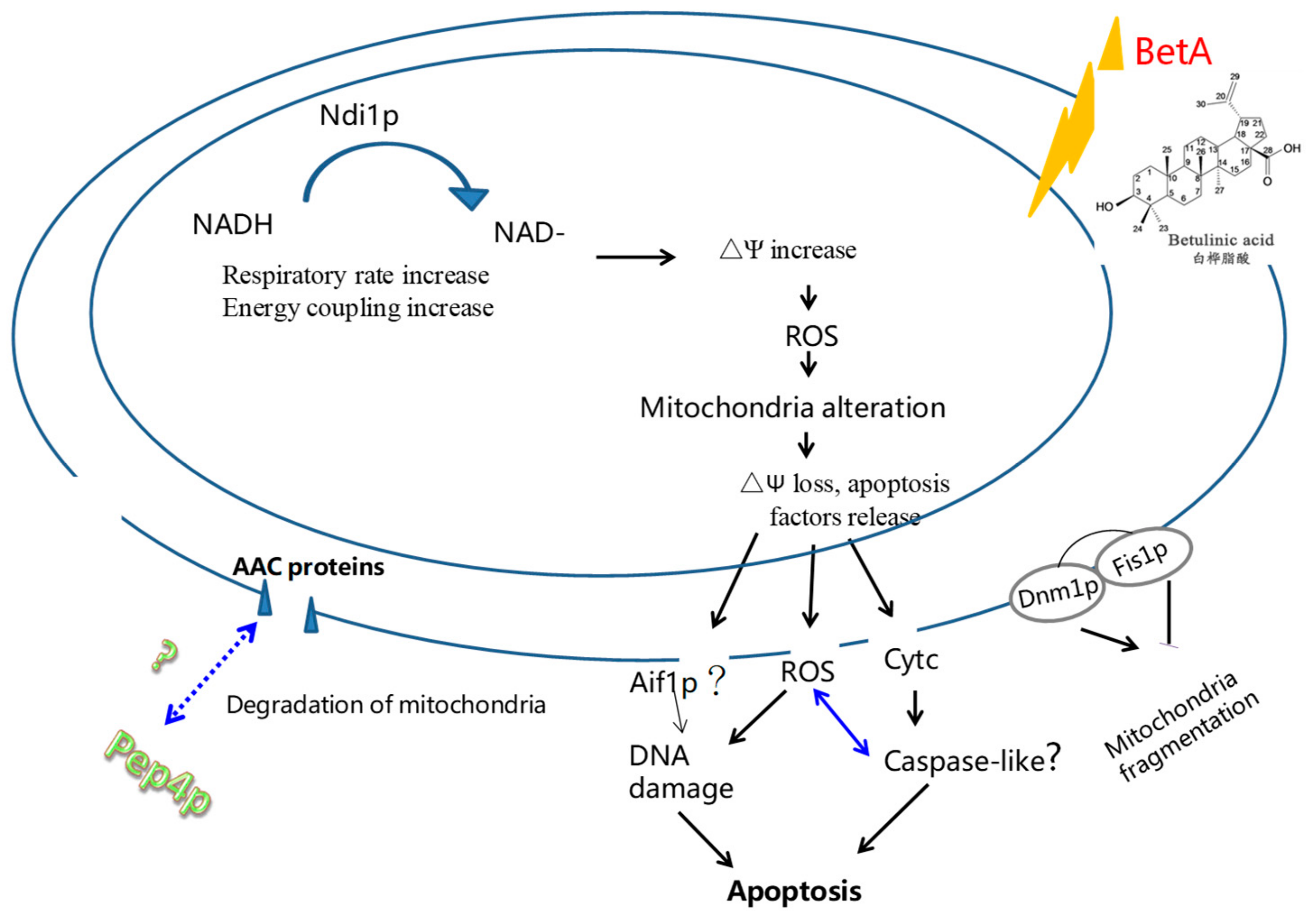
Mitochondria-Mediated Programmed Cell Death in Saccharomyces Cerevisiae Induced by Betulinic Acid is Accelerated by the Deletion of PEP4 Gene



Abstract
Share and Cite
Lu, H.; Shu, Q.; Lou, H.; Chen, Q. Mitochondria-Mediated Programmed Cell Death in Saccharomyces Cerevisiae Induced by Betulinic Acid is Accelerated by the Deletion of PEP4 Gene. Microorganisms 2019, 7, 538. https://doi.org/10.3390/microorganisms7110538
Lu H, Shu Q, Lou H, Chen Q. Mitochondria-Mediated Programmed Cell Death in Saccharomyces Cerevisiae Induced by Betulinic Acid is Accelerated by the Deletion of PEP4 Gene. Microorganisms. 2019; 7(11):538. https://doi.org/10.3390/microorganisms7110538
Chicago/Turabian StyleLu, Hongyun, Qin Shu, Hanghang Lou, and Qihe Chen. 2019. "Mitochondria-Mediated Programmed Cell Death in Saccharomyces Cerevisiae Induced by Betulinic Acid is Accelerated by the Deletion of PEP4 Gene" Microorganisms 7, no. 11: 538. https://doi.org/10.3390/microorganisms7110538
APA StyleLu, H., Shu, Q., Lou, H., & Chen, Q. (2019). Mitochondria-Mediated Programmed Cell Death in Saccharomyces Cerevisiae Induced by Betulinic Acid is Accelerated by the Deletion of PEP4 Gene. Microorganisms, 7(11), 538. https://doi.org/10.3390/microorganisms7110538