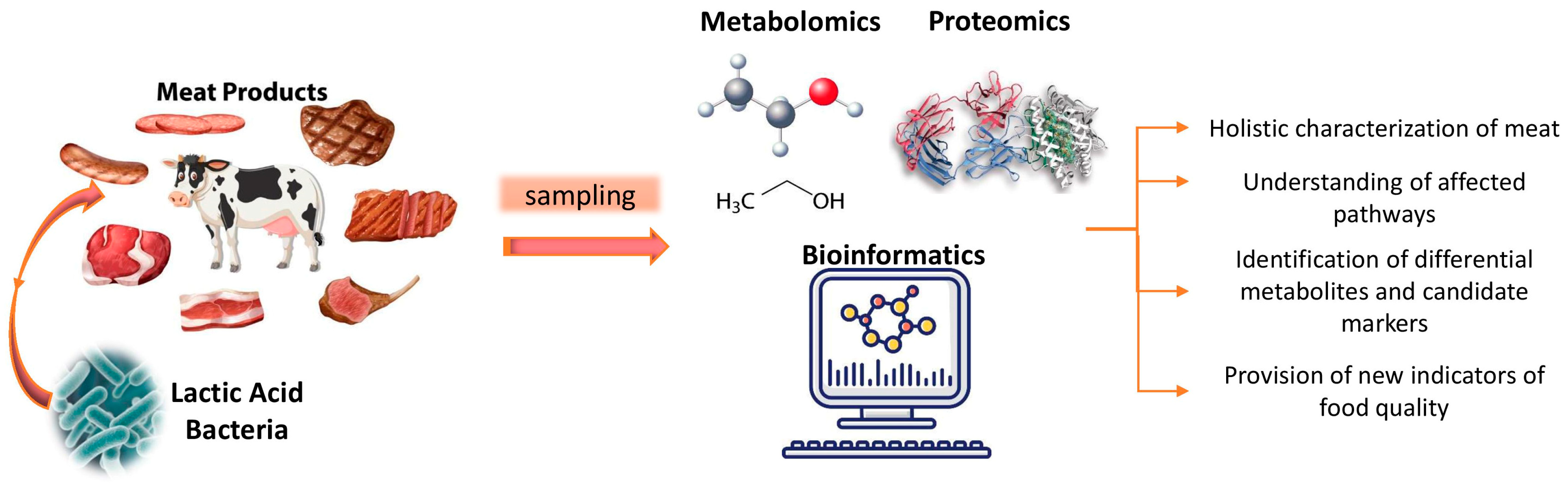


Metabolomic Approaches in Fermented Meat Products: Focus on Lactic Acid Bacteria and Starter Cultures




Abstract
1. Introduction
2. Omics Technologies in LAB

| Microorganism/Starter Culture | Extraction Method | Metabolite Identification Methods | Data Analysis | Results | References |
|---|---|---|---|---|---|
| Pediococcus pentosaceus | hot ethanol method | GC-TOF-MS | PCA, OPLS-DA, SPSS 25.0, ANOVA | In total, 326 metabolites were detected: 141 were known and 15 unknown; 74 differentiated metabolites were classified into eleven categories, primarily amino acids and nucleotides. | [33] |
| Staphylococcus spp. | VMethanol: VChloroform = 3:1), then 5 mL of L-2-Chlorophenylalanine (1 mg/mL stock in dH2O) was added as internal standard | GC-TOF-MS | RDA triplot analysis, KEGG | Significantly correlated with changes in differentiated metabolites during Panxian ham processing. Production of all amino acids and fatty acids except stearic acid. | [34] |
| Staphylococcus (S. carnosus, S. xylosus, S. equorum, S. saprophyticus) | headspace solid-phase microextraction | UHPLC- QTOF-MS | PCA, PLS-DA, Pearson’s correlation coefficient (PCC) | Closely associated with the production of esters, methyl aldehydes, and ketones in Fuet fermented sausages. | [37] |
| Staphylococcus spp., Tetragenococcus, Halomonas | V methyl butyl ether: V methanol = 5:1), | LC-Q-TOF-MS | Student’s t-test, PCA, OPLS, one-way ANOVA | Positively correlated with amino acids and lipid metabolites, ethyl tetradecanoate, ricinoleic acid, inosinic acid, sciadonic acid, taurine; linoleic acid, oleic acid, pyrophosphate, and carnosine in dry-cured ham. | [38] |
| Staphylococcus saprophyticus. | QuEChERS method (Quick, Easy, Cheap, Effective, Rug-ged, and Safe) solid phase extraction | UHPLC-MS/MS | ANOVA, PCA, OPLS-DA | Positively correlated with dimethylamine and trimethylamines well as specific peptides and free amino acids in reduced-nitrite Chinese fermented sausages. | [39] |
| Lactococcus (L. garvieae, L. formosensis, L. lactis) Macrococcus | QuEChERS method (Quick, Easy, Cheap, Effective, Rugged, and Safe) solid phase ex-traction | UHPLC-MS/MS | ANOVA, PCA, OPLS-DA | Negative correlated with dimethylamine and trimethylamines as well as specific peptides and free amino acids in reduced-nitrite Chinese fermented sausages. Gallic acid (GA) promoted the growth of Lactococcus while suppressing the proliferation of spoilage bacteria and Macrococcus. | [39] |
| Latilactobacillus sakei, Pediococcus pentosaceus, Staphylococcus xylosus | homogenizer-assisted ex-traction method | UHPLC-HRMS | HCA, PCA, OPLS-DA | Less sensitive to lower pH values. Major role in modifying metabolomic profile during ripening. Activity involving lipids and proteins in Italian Salami, dry-fermented sausages. Proteolytic activity. When mixed with Latilactobacillus sakei and Pediococcus pentosaceus for the production of Italian Salami, 144 discriminant metabolites recorded. Arginylserine was the exclusive metabolite. The above mixed cultures deliver a great enhancement of amino acid and peptide levels, followed by those of pyrimidines, purines, and imidazoles. | [40] |
| Pediococcus acidilactici, Rhizopus oryzae | SPME (7.5 mL of sodium chloride and 15 μL of the standard in-ternal Cyclo-hexanone) | UHPLC-MS/MS | ANOVA, PCA, PLS-DA, | Highly correlated with a variety of metabolites like esters and aldehydes (positively correlated). Associated with the formation of amino acids, and peptides. Eight amino acid and four peptide contents were significantly increased after inoculation. Promote the formation of secondary alcohols (phenethyl alcohol and 1-octen-3-ol). Improve the flavor of fermented dry-cure mutton sausages. | [41] |
3. Omics Technologies in Meat Products or Cured Meat Products Inoculated with LAB
4. Discussion
| Meat Substrate | Extraction Method | Metabolite Identification Methods | Data Analysis | Results | Reference |
|---|---|---|---|---|---|
| Beijing You chicken | HPLC-QTRAP-MS | SPSS 22.0, one-way ANOVA and Ducan’s test, PCA, orthogonal projection to latent structures (OPLS-DA) | In total, 544 metabolites were sorted into 32 categories. L-carnitine, L-methionine and 3-hydroxybutyrate increased with age. | [74] | |
| Chicken, turkey, mixed ground meat for sausages | HPLC-HRMS–Q-Orbitrap | Hierarchical clustering analysis for BWC and VP, one-way ANOVA with Tukey post hoc test, multivariate paired t-test. | Irradiation did not cause changes in main food ingredients such as free amino acids, only altered a few metabolic pathways. | [75] | |
| Goose meat | 1.0 mL pure methanol (or 70% aqueous methanol) containing 0.1 mg L–1 lidocaine for lipid-solubility metabolites | UPLC-ESI-MS/MS | OPLS-DA, K-means cluster, KEGG | Sorting of 776 metabolites into 16 classes. Increase of carnitine, anserine, nicotinamide riboside with age. Conversely, decrease of hypoxanthine, 2-methylsuccinic acid, and glutaric acid with age. | [76] |
| Liancheng white duck breast meat and Cherry Valley duck meat | 800 mL of icy cold solvent (methanol/acetonitrile1:1, v/v) | UHPLC-QTOF-MS | SPSS 17.0, one-way ANOVA and Mann–Whitney test, PCA, OPLS-DA | Significant differences between the two breeds; 28 differentiated metabolites were classified. Carbohydrates, amino acids, fatty acids, and eicosanoids were the main ones. | [77] |
| White and Black Tibetan sheep | 1 mL of n-hexane, with 5mL of pure water subsequently added for washing | UPLC-QTOF-MS, NMR for targeted, UHPLC-QTOF-MS/MS for untargeted | PCA | Black Tibetan sheep were superior to the White Tibetan sheep; identification of 49 differential metabolites, including carbohydrates, amino acids and derivatives, fatty acids and derivatives, and other organic compounds. | [78] |
| Chicken | Solid-phase microextraction (SPME) | UHPLC-Orbitrap MS | PCA, OPLS-DA | Detection of 821 metabolites and division into 16 classes. The amino acids and their metabolites class was the largest (314 metabolites) followed by organic acids and their derivatives (102 metabolites) | [79] |
| Sour meat | 1 mL of tissue extract (75% 9:1 methanol: chloroform, 25% H2O) | GC-MS | PCA, OPLS-DA, one-way ANOVA | Identified 68 and 77 differential metabolites in low-salt and traditional sour meat. Level of free amino acids in low-salt sour meat was higher than in traditional sour meat. | [29] |
| Salami | 10 mL of an 80% methanolic solution acidified with 0.1% formic acid using a homogenizer | UHPLC- QTOF-MS | HCA, PCA, OPLS-DA, one-way ANOVA | Identified 111 metabolites. Of these, fatty acyls and glycerophospholipids were the main ones. | [54] |
| Chicken meat | mixture of CH3OH-d4 (0.375 mL) and 0.375 mL KH2PO4 buffer in D2O (pH 6) containing 0.1% TSP as internal standard. | 1H NMR | one-way ANOVA, Tukey’s test | In total, 25 metabolites were identified. | [55] |
| Panxian ham | 3 mL extraction liquid (VMethanol: VChloroform = 3:1), then 5 mL of L-2-Chlorophenylalanine (1 mg/mL stock in dH2O) was added as internal standard followed | GC-TOF-MS | PCA, OPLS-DA, CV-ANOVA, one-way ANOVA, KEGG | In total, 226 metabolites were detected and 31 significantly different metabolites were identified, | [34] |
| Fuet, spontaneously fermented sausage, and inoculated fermented sausage with commercial starter culture | headspace solid-phase microextraction | UHPLC- QTOF-MS | PCA, PLS-DA, Pearson’s correlation coefficient (PCC) | Many differential metabolites were identified including amino acids, dipeptides, carbohydrates, organic acids, fatty acids, and phosphocholine derivatives | [37] |
| Dry-cured ham | 600 μL of methanol/water (2:1, v/v) | 1H-NMR | PCA, OPLS-DA | In total, 28 metabolites were detected including amino acids, peptides, organic acids, nucleic acids and their derivatives, sugars, etc. | [71] |
| Dry-cured ham | methanol (500 μL) containing (20 μM each) methionine sulfone, D-camphor-10-sulfonic acid, and 2-(N-morpholino) ethanesulfonic acid as internal standards | CE-MS | one-way ANOVA, Bonferroni’s multiple comparison tests, Pearson’s correlation coefficient | Various hydrophilic molecules, such as amino acids (glutamine, cysteine, asparagine, leucine), organic acids, peptides, nucleotides, and their intermediate metabolites were quantified | [45] |
| Dahe black pig dry-cured ham | SPME | SPME GC-MS | ANOVA, OPLS-DA | In total, 407 volatile compounds were identified during the ripening process. Main volatile compounds formed at 210 days of ripening. Aldehydes and alcohols were the most abundant flavor compound. | [46] |
| Ciauscolo salami | 65 μm PDMS/DVB SPME fiber | SPME GC-MS | one-way ANOVA, PCA, HSD test | In total, 53 volatile substances were identified. The most represented were monoterpene and sesquiterpene including limonene, sabinene, α-pinene, β-pinene, 3-carene, α-thujene, and β- copaene, α-copaene, respectively. Allyl methyl sulphide and diallyl sulphide, together with diallyl disulphide and allyl methyl disulphide, were the major aliphatic sulphur compounds. | [47] |
| Salchichon dry-fermented sausages | A D2O solution (15 μL) containing trimethylsilyl 3-propionic acid sodium salt (TSP, 0.1 mM) was added to the 30 μL disposable Kel-F HR-MAS inserts | 1H HR-MAS NMR | one-way ANOVA, Bartlett’s test, Duncan’s test, PCA | In total, 177 metabolites were identified, including amino acids, peptides and analogues, carbohydrates, organic acids and derivatives, nucleosides, nucleotides and analogues, fatty acids and miscellaneous, such as Acetone, Crn, Cho, PCho, GPCho, or IMP | [56] |
| Dry-cured ham | V methyl butyl ether: V methanol = 5:1), | LC-Q-TOF-MS | Student’s t-test, PCA, OPLS, one-way ANOVA | In total, 269 different compounds were detected, comprising 49 amino acids, 108 lipids and lipid-like molecules, 76 organic acids and derivatives, and nine nucleic acids, nucleotides, and analogues. | [38] |
| Chinese fermented sausages | QuEChERS method (Quick, Easy, Cheap, Effective, Rugged, and Safe) solid phase extraction | UHPLC-MS/MS | ANOVA, PCA, OPLS-DA | In total, 719 metabolites were identified, including 285 organic acids and derivatives, 157 lipids and lipid-like molecules, 78 organophosphorus compounds, 54 organic oxygen compounds, 13 organic nitrogen compounds, and other metabolites like benzenoids, organic nitrogen compounds, phenylpropanoids and polyketides, alkaloids and derivatives, organosulfur compounds, hydrocarbons, and others. | [39] |
| Italian Salami, dry-fermented sausages | homogenizer-assisted extraction method | UHPLC-HRMS | HCA, PCA, OPLS-DA | Identified 1841 metabolites, included amino acids, peptides, glycerolipids, and nucleic acids, showing a fundamental role of glucose addition in relation to starter culture inoculation. | [40] |
| Jinhua ham, Chinese dry-cured ham | Lin et al. method [26] 1 mL of mixed solution (methanol:acetonitrile:water = 2:2:1, v/v/v) | LC-MS/MS | HCA, PCA, PLS-DA, KEGG | In total, 42 metabolites were identified including 10 amino acid derivatives, 19 peptides, nine organic acids, and four nucleotides. Differential metabolites between normal and spoiled ham were peptides and amino acid derivatives. Purine metabolism, pyrimidine metabolism, and protein degradation were the core metabolic pathways in spoiled ham. | [43] |
| Dry-cured mutton sausages | SPME (7.5 mL of sodium chloride and 15 μL of the standard internal Cyclohexanone) | HS-SPME-GC–MS | ANOVA, PCA, PLS-DA, | In total, 92 volatile metabolites were identified, of which 46 were present in both traditionally fermented and inoculated samples, and 12 key volatile metabolites were identified regarding inoculated fermentation. | [41] |
| Dry-aged beef loins | Bligh–Dyer extraction protocol | UPLC-MS | Multivariate statistical analysis | Mechanisms involved in flavor generation during dry-aging were elucidated. | [68] |
| Beef exudate | Bligh–Dyer extraction protocol | LC-MS/MS | Multivariate statistical analysis | Meat exudate profiling was used to determine the impact of postmortem aging on oxidative stability of beef muscles. | [69] |
| Beef exudate/Salmonella contamination | Bligh and Dyer method | LC-MS/MS | Multivariate statistical analysis | Spoilage-associated metabolites and key metabolites associated with Salmonella contamination were detected. | [70] |
| Harbin dry-sausages | headspace solid-phase microextraction (HS-SPME) | LC-MS/MS | Multivariate statistical analysis | Staphylococci contributed to flavor formation through protein hydrolysis and amino acid metabolism. | [72] |
| Dry-sausages from Northeast China | headspace solid-phase microextraction device | GC-MS | Comparative analysis | Quality and flavor differences between traditional and conventional dry-sausages were characterized. | [73] |
5. Conclusions
Author Contributions
Funding
Institutional Review Board Statement
Informed Consent Statement
Data Availability Statement
Conflicts of Interest
References
- Sabatini, N. A Comparison of the Volatile Compounds, in Spanish-Style, Greek-Style and Castelvetrano-Style Green Olives of the Nocellara Del Belice Cultivar. In Olives and Olive Oil in Health and Disease Prevention; Elsevier: Amsterdam, The Netherlands, 2010; pp. 219–231. [Google Scholar]
- Mozzi, F. Lactic Acid Bacteria. In Encyclopedia of Food and Health; Elsevier: Amsterdam, The Netherlands, 2016; pp. 501–508. [Google Scholar]
- Soni, R.; Jain, N.K.; Shah, V.; Soni, J.; Suthar, D.; Gohel, P. Development of Probiotic Yogurt: Effect of Strain Combination on Nutritional, Rheological, Organoleptic and Probiotic Properties. J. Food Sci. Technol. 2020, 57, 2038–2050. [Google Scholar] [CrossRef] [PubMed]
- Papadopoulou, O.S.; Argyri, A.A.; Varzakis, E.; Sidira, M.; Kourkoutas, Y.; Galanis, A.; Tassou, C.; Chorianopoulos, N.G. Use of Lactobacilli Strains with Probiotic Potential in Traditional Fermented Milk and Their Impact on Quality and Safety Related to Listeria monocytogenes. Int. Dairy J. 2019, 98, 44–53. [Google Scholar] [CrossRef]
- Sidira, M.; Santarmaki, V.; Kiourtzidis, M.; Argyri, A.A.; Papadopoulou, O.S.; Chorianopoulos, N.; Tassou, C.; Kaloutsas, S.; Galanis, A.; Kourkoutas, Y. Evaluation of Immobilized Lactobacillus plantarum 2035 on Whey Protein as Adjunct Probiotic Culture in Yoghurt Production. LWT 2017, 75, 137–146. [Google Scholar] [CrossRef]
- Dimitrellou, D.; Kandylis, P.; Sidira, M.; Koutinas, A.A.; Kourkoutas, Y. Free and Immobilized Lactobacillus casei ATCC 393 on Whey Protein as Starter Cultures for Probiotic Feta-Type Cheese Production. J. Dairy Sci. 2014, 97, 4675–4685. [Google Scholar] [CrossRef] [PubMed]
- Sidira, M.; Saxami, G.; Dimitrellou, D.; Santarmaki, V.; Galanis, A.; Kourkoutas, Y. Monitoring Survival of Lactobacillus casei ATCC 393 in Probiotic Yogurts Using an Efficient Molecular Tool. J. Dairy Sci. 2013, 96, 3369–3377. [Google Scholar] [CrossRef] [PubMed]
- Szutowska, J. Functional Properties of Lactic Acid Bacteria in Fermented Fruit and Vegetable Juices: A Systematic Literature Review. Eur. Food Res. Technol. 2020, 246, 357–372. [Google Scholar] [CrossRef]
- Lee, J.-J.; Choi, Y.-J.; Lee, M.J.; Park, S.J.; Oh, S.J.; Yun, Y.-R.; Min, S.G.; Seo, H.-Y.; Park, S.-H.; Lee, M.-A. Effects of Combining Two Lactic Acid Bacteria as a Starter Culture on Model Kimchi Fermentation. Food Res. Int. 2020, 136, 109591. [Google Scholar] [CrossRef] [PubMed]
- Hu, W.; Yang, X.; Ji, Y.; Guan, Y. Effect of Starter Cultures Mixed with Different Autochthonous Lactic Acid Bacteria on Microbial, Metabolome and Sensory Properties of Chinese Northeast Sauerkraut. Food Res. Int. 2021, 148, 110605. [Google Scholar] [CrossRef] [PubMed]
- Sidira, M.; Mitropoulou, G.; Galanis, A.; Kanellaki, M.; Kourkoutas, Y. Effect of Sugar Content on Quality Characteristics and Shelf-Life of Probiotic Dry-Fermented Sausages Produced by Free or Immobilized Lactobacillus casei ATCC 393. Foods 2019, 8, 219. [Google Scholar] [CrossRef] [PubMed]
- Sidira, M.; Kandylis, P.; Kanellaki, M.; Kourkoutas, Y. Effect of Curing Salts and Probiotic Cultures on the Evolution of Flavor Compounds in Dry-Fermented Sausages during Ripening. Food Chem. 2016, 201, 334–338. [Google Scholar] [CrossRef] [PubMed]
- Sidira, M.; Kandylis, P.; Kanellaki, M.; Kourkoutas, Y. Effect of Immobilized Lactobacillus casei on Volatile Compounds of Heat Treated Probiotic Dry-Fermented Sausages. Food Chem. 2015, 178, 201–207. [Google Scholar] [CrossRef] [PubMed]
- Sidira, M.; Galanis, A.; Nikolaou, A.; Kanellaki, M.; Kourkoutas, Y. Evaluation of Lactobacillus casei ATCC 393 Protective Effect against Spoilage of Probiotic Dry-Fermented Sausages. Food Control 2014, 42, 315–320. [Google Scholar] [CrossRef]
- Sidira, M.; Karapetsas, A.; Galanis, A.; Kanellaki, M.; Kourkoutas, Y. Effective Survival of Immobilized Lactobacillus casei during Ripening and Heat Treatment of Probiotic Dry-Fermented Sausages and Investigation of the Microbial Dynamics. Meat Sci. 2014, 96, 948–955. [Google Scholar] [CrossRef] [PubMed]
- Zhang, Y.; Hu, P.; Xie, Y.; Wang, X. Co-Fermentation with Lactobacillus curvatus LAB26 and Pediococcus pentosaceus SWU73571 for Improving Quality and Safety of Sour Meat. Meat Sci. 2020, 170, 108240. [Google Scholar] [CrossRef] [PubMed]
- Virdis, C.; Sumby, K.; Bartowsky, E.; Jiranek, V. Lactic Acid Bacteria in Wine: Technological Advances and Evaluation of Their Functional Role. Front. Microbiol. 2021, 11, 612118. [Google Scholar] [CrossRef] [PubMed]
- Parlindungan, E.; Jones, O.A.H. Using Metabolomics to Understand Stress Responses in Lactic Acid Bacteria and Their Applications in the Food Industry. Metabolomics 2023, 19, 99. [Google Scholar] [CrossRef] [PubMed]
- Barbieri, F.; Laghi, L.; Montanari, C.; Lan, Q.; Levante, A.; Gardini, F.; Tabanelli, G. Insights into the Metabolomic Diversity of Latilactobacillus sakei. Foods 2022, 11, 477. [Google Scholar] [CrossRef] [PubMed]
- Sidira, M.; Kandylis, P.; Kanellaki, M.; Kourkoutas, Y. Effect of Immobilized Lactobacillus casei on the Evolution of Flavor Compounds in Probiotic Dry-Fermented Sausages during Ripening. Meat Sci. 2015, 100, 41–51. [Google Scholar] [CrossRef] [PubMed]
- Tang, H.; Huang, W.; Yao, Y.-F. The Metabolites of Lactic Acid Bacteria: Classification, Biosynthesis and Modulation of Gut Microbiota. Microb. Cell 2023, 10, 49–62. [Google Scholar] [CrossRef] [PubMed]
- Muroya, S.; Ueda, S.; Komatsu, T.; Miyakawa, T.; Ertbjerg, P. MEATabolomics: Muscle and Meat Metabolomics in Domestic Animals. Metabolites 2020, 10, 188. [Google Scholar] [CrossRef] [PubMed]
- Zhang, J.; Ye, Y.; Sun, Y.; Pan, D.; Ou, C.; Dang, Y.; Wang, Y.; Cao, J.; Wang, D. 1H NMR and Multivariate Data Analysis of the Differences of Metabolites in Five Types of Dry-Cured Hams. Food Res. Int. 2018, 113, 140–148. [Google Scholar] [CrossRef] [PubMed]
- Zhang, T.; Chen, C.; Xie, K.; Wang, J.; Pan, Z. Current State of Metabolomics Research in Meat Quality Analysis and Authentication. Foods 2021, 10, 2388. [Google Scholar] [CrossRef] [PubMed]
- Utpott, M.; Rodrigues, E.; Rios, A.D.O.; Mercali, G.D.; Flôres, S.H. Metabolomics: An Analytical Technique for Food Processing Evaluation. Food Chem. 2022, 366, 130685. [Google Scholar] [CrossRef] [PubMed]
- Lin, F.; Cai, F.; Luo, B.; Gu, R.; Ahmed, S.; Long, C. Variation of Microbiological and Biochemical Profiles of Laowo Dry-Cured Ham, an Indigenous Fermented Food, during Ripening by GC-TOF-MS and UPLC-QTOF-MS. J. Agric. Food Chem. 2020, 68, 8925–8935. [Google Scholar] [CrossRef] [PubMed]
- Sugimoto, M.; Obiya, S.; Kaneko, M.; Enomoto, A.; Honma, M.; Wakayama, M.; Soga, T.; Tomita, M. Metabolomic Profiling as a Possible Reverse Engineering Tool for Estimating Processing Conditions of Dry-Cured Hams. J. Agric. Food Chem. 2017, 65, 402–410. [Google Scholar] [CrossRef] [PubMed]
- Wang, Y.; Wu, J.; Lv, M.; Shao, Z.; Hungwe, M.; Wang, J.; Bai, X.; Xie, J.; Wang, Y.; Geng, W. Metabolism Characteristics of Lactic Acid Bacteria and the Expanding Applications in Food Industry. Front. Bioeng. Biotechnol. 2021, 9, 612285. [Google Scholar] [CrossRef] [PubMed]
- Wang, Q.; Li, X.; Xue, B.; Wu, Y.; Song, H.; Luo, Z.; Shang, P.; Liu, Z.; Huang, Q. Low-Salt Fermentation Improves Flavor and Quality of Sour Meat: Microbiology and Metabolomics. LWT 2022, 171, 114157. [Google Scholar] [CrossRef]
- Wang, Y.; Han, J.; Wang, D.; Gao, F.; Zhang, K.; Tian, J.; Jin, Y. Research Update on the Impact of Lactic Acid Bacteria on the Substance Metabolism, Flavor, and Quality Characteristics of Fermented Meat Products. Foods 2022, 11, 2090. [Google Scholar] [CrossRef] [PubMed]
- Yao, K.; Liu, D.; Liang, M.; Brennan, C.S.; Brennan, M. Detection of Nitrite Degradation by Lactobacillus plantarum DMDL9010 through the Anaerobic Respiration Electron Transport Chain Using Proteomic Analysis. Int. J. Food Sci. Technol. 2021, 56, 1608–1622. [Google Scholar] [CrossRef]
- Besser, M.; Terberger, J.; Weber, L.; Ghebremedhin, B.; Naumova, E.A.; Arnold, W.H.; Stuermer, E.K. Impact of Probiotics on Pathogen Survival in an Innovative Human Plasma Biofilm Model (hpBIOM). J. Transl. Med. 2019, 17, 243. [Google Scholar] [CrossRef] [PubMed]
- Zhang, H.; Liu, J.; Wen, R.; Chen, Q.; Kong, B. Metabolomics Profiling Reveals Defense Strategies of Pediococcus pentosaceus R1 Isolated from Harbin Dry Sausages under Oxidative Stress. LWT 2021, 135, 110041. [Google Scholar] [CrossRef]
- Mu, Y.; Su, W.; Mu, Y.; Jiang, L. Combined Application of High-Throughput Sequencing and Metabolomics Reveals Metabolically Active Microorganisms During Panxian Ham Processing. Front. Microbiol. 2020, 10, 3012. [Google Scholar] [CrossRef] [PubMed]
- Peñaranda, I.; Egea, M.; Álvarez, D.; Garrido, M.D.; Linares, M.B. Spanish Fuet Sausages Fat-Reduced to Diminish Boar Taint: Sensory and Technological Quality. Animals 2023, 13, 912. [Google Scholar] [CrossRef] [PubMed]
- Martínez Zamora, L.; Peñalver, R.; Ros, G.; Nieto, G. Innovative Natural Functional Ingredients from Olive and Citrus Extracts in Spanish-Type Dry-Cured Sausage “Fuet”. Antioxidants 2021, 10, 180. [Google Scholar] [CrossRef] [PubMed]
- Yang, P.; Zhong, G.; Yang, J.; Zhao, L.; Sun, D.; Tian, Y.; Li, R.; Rong, L. Metagenomic and Metabolomic Profiling Reveals the Correlation between the Microbiota and Flavor Compounds and Nutrients in Fermented Sausages. Food Chem. 2022, 375, 131645. [Google Scholar] [CrossRef] [PubMed]
- Zhu, Y.; Guo, Y.; Yang, F.; Zhou, C.; Tang, C.; Zhou, G. Combined Application of High-Throughput Sequencing and UHPLC-Q/TOF-MS-Based Metabolomics in the Evaluation of Microorganisms and Metabolites of Dry-Cured Ham of Different Origins. Int. J. Food Microbiol. 2021, 359, 109422. [Google Scholar] [CrossRef] [PubMed]
- Zhou, Q.; Jiang, L.; Zhu, J.; Lu, Y.; He, Q. The Metabolic Regulation Mechanism of Gallic Acid on Biogenic Amines and Nitrosamines in Reduced-Nitrite Chinese Fermented Sausages: A Perspective of Metabolomics and Metagenomics. Food Chem. 2024, 456, 139900. [Google Scholar] [CrossRef] [PubMed]
- Rocchetti, G.; Rebecchi, A.; Maria Lopez, C.; Dallolio, M.; Dallolio, G.; Trevisan, M.; Lucini, L. Impact of Axenic and Mixed Starter Cultures on Metabolomic and Sensory Profiles of Ripened Italian Salami. Food Chem. 2023, 402, 134182. [Google Scholar] [CrossRef] [PubMed]
- Jiang, L.; Mu, Y.; Su, W.; Tian, H.; Zhao, M.; Su, G.; Zhao, C. Effects of Pediococcus acidilactici and Rhizopus oryzae on Microbiota and Metabolomic Profiling in Fermented Dry-Cure Mutton Sausages. Food Chem. 2023, 403, 134431. [Google Scholar] [CrossRef] [PubMed]
- Lee, S.B.; Rhee, Y.K.; Gu, E.-J.; Kim, D.-W.; Jang, G.-J.; Song, S.-H.; Lee, J.-I.; Kim, B.-M.; Lee, H.-J.; Hong, H.-D.; et al. Mass-Based Metabolomic Analysis of Lactobacillus Sakei and Its Growth Media at Different Growth Phases. J. Microbiol. Biotechnol. 2017, 27, 925–932. [Google Scholar] [CrossRef] [PubMed]
- Liao, R.; Xia, Q.; Zhou, C.; Geng, F.; Wang, Y.; Sun, Y.; He, J.; Pan, D.; Cao, J. LC-MS/MS-Based Metabolomics and Sensory Evaluation Characterize Metabolites and Texture of Normal and Spoiled Dry-Cured Hams. Food Chem. 2022, 371, 131156. [Google Scholar] [CrossRef] [PubMed]
- Franciosa, I.; Alessandria, V.; Dolci, P.; Rantsiou, K.; Cocolin, L. Sausage Fermentation and Starter Cultures in the Era of Molecular Biology Methods. Int. J. Food Microbiol. 2018, 279, 26–32. [Google Scholar] [CrossRef] [PubMed]
- Sugimoto, M.; Sugawara, T.; Obiya, S.; Enomoto, A.; Kaneko, M.; Ota, S.; Soga, T.; Tomita, M. Sensory Properties and Metabolomic Profiles of Dry-Cured Ham during the Ripening Process. Food Res. Int. 2020, 129, 108850. [Google Scholar] [CrossRef] [PubMed]
- Shi, Y.; Li, X.; Huang, A. A Metabolomics-Based Approach Investigates Volatile Flavor Formation and Characteristic Compounds of the Dahe Black Pig Dry-Cured Ham. Meat Sci. 2019, 158, 107904. [Google Scholar] [CrossRef] [PubMed]
- Belleggia, L.; Milanović, V.; Ferrocino, I.; Cocolin, L.; Haouet, M.N.; Scuota, S.; Maoloni, A.; Garofalo, C.; Cardinali, F.; Aquilanti, L.; et al. Is There Any Still Undisclosed Biodiversity in Ciauscolo Salami? A New Glance into the Microbiota of an Artisan Production as Revealed by High-Throughput Sequencing. Meat Sci. 2020, 165, 108128. [Google Scholar] [CrossRef] [PubMed]
- Van Reckem, E.; Claeys, E.; Charmpi, C.; Sosa Fajardo, A.; Van Der Veken, D.; Maes, D.; Weckx, S.; De Vuyst, L.; Leroy, F. High-Throughput Amplicon Sequencing to Assess the Impact of Processing Factors on the Development of Microbial Communities during Spontaneous Meat Fermentation. Int. J. Food Microbiol. 2021, 354, 109322. [Google Scholar] [CrossRef] [PubMed]
- Ferrocino, I.; Bellio, A.; Giordano, M.; Macori, G.; Romano, A.; Rantsiou, K.; Decastelli, L.; Cocolin, L. Shotgun Metagenomics and Volatilome Profile of the Microbiota of Fermented Sausages. Appl. Environ. Microbiol. 2018, 84, e02120-17. [Google Scholar] [CrossRef] [PubMed]
- Van Reckem, E.; Geeraerts, W.; Charmpi, C.; Van Der Veken, D.; De Vuyst, L.; Leroy, F. Exploring the Link Between the Geographical Origin of European Fermented Foods and the Diversity of Their Bacterial Communities: The Case of Fermented Meats. Front. Microbiol. 2019, 10, 2302. [Google Scholar] [CrossRef] [PubMed]
- Omer, M.K.; Álvarez-Ordoñez, A.; Prieto, M.; Skjerve, E.; Asehun, T.; Alvseike, O.A. A Systematic Review of Bacterial Foodborne Outbreaks Related to Red Meat and Meat Products. Foodborne Pathog. Dis. 2018, 15, 598–611. [Google Scholar] [CrossRef] [PubMed]
- Loukieh, M.; Mouannes, E.; Abou Jaoudeh, C.; Hanna Wakim, L.; Fancello, F.; Bou Zeidan, M. Street Foods in Beirut City: An Assessment of the Food Safety Practices and of the Microbiological Quality. J. Food Saf. 2018, 38, e12455. [Google Scholar] [CrossRef]
- Rocchetti, G.; Barba, F.J.; Lorenzo, J.M.; Munekata, P.E.S.; Bernardo, L.; Tomasevic, I.; Pateiro, M.; Lucini, L. Untargeted Metabolomics to Explore the Oxidation Processes during Shelf Life of Pork Patties Treated with Guarana Seed Extracts. Int. J. Food Sci. Technol. 2020, 55, 1002–1009. [Google Scholar] [CrossRef]
- Rocchetti, G.; Falasconi, I.; Dallolio, G.; Lorenzo, J.M.; Lucini, L.; Rebecchi, A. Impact of Hurdle Technologies and Low Temperatures during Ripening on the Production of Nitrate-Free Pork Salami: A Microbiological and Metabolomic Comparison. LWT 2021, 141, 110939. [Google Scholar] [CrossRef]
- Muhialdin, B.J.; Kadum, H.; Fathallah, S.; Meor Hussin, A.S. Metabolomics Profiling and Antibacterial Activity of Fermented Ginger Paste Extends the Shelf Life of Chicken Meat. LWT 2020, 132, 109897. [Google Scholar] [CrossRef]
- García-García, A.B.; Lamichhane, S.; Castejón, D.; Cambero, M.I.; Bertram, H.C. 1H HR-MAS NMR-Based Metabolomics Analysis for Dry-Fermented Sausage Characterization. Food Chem. 2018, 240, 514–523. [Google Scholar] [CrossRef] [PubMed]
- Tang, R.; Luo, J.; Wang, W.; Liu, D.; Wang, G.; Guo, X. Rutin’s Natural Source Flos Sophorae as Potential Antioxidant and Improver of Fungal Community in Chinese Sausages. LWT 2019, 101, 435–443. [Google Scholar] [CrossRef]
- Li, B.; Xu, Y.; Li, J.; Niu, S.; Wang, C.; Zhang, N.; Yang, M.; Zhou, K.; Chen, S.; He, L.; et al. Effect of Oxidized Lipids Stored under Different Temperatures on Muscle Protein Oxidation in Sichuan-Style Sausages during Ripening. Meat Sci. 2019, 147, 144–154. [Google Scholar] [CrossRef] [PubMed]
- Li, L.; Zou, D.; Ruan, L.; Wen, Z.; Chen, S.; Xu, L.; Wei, X. Evaluation of the Biogenic Amines and Microbial Contribution in Traditional Chinese Sausages. Front. Microbiol. 2019, 10, 872. [Google Scholar] [CrossRef] [PubMed]
- Ashaolu, T.J.; Khalifa, I.; Mesak, M.A.; Lorenzo, J.M.; Farag, M.A. A Comprehensive Review of the Role of Microorganisms on Texture Change, Flavor and Biogenic Amines Formation in Fermented Meat with Their Action Mechanisms and Safety. Crit. Rev. Food Sci. Nutr. 2023, 63, 3538–3555. [Google Scholar] [CrossRef] [PubMed]
- Zhang, K.; Zhang, T.-T.; Guo, R.-R.; Ye, Q.; Zhao, H.-L.; Huang, X.-H. The Regulation of Key Flavor of Traditional Fermented Food by Microbial Metabolism: A Review. Food Chem. X 2023, 19, 100871. [Google Scholar] [CrossRef] [PubMed]
- Leroy, F.; Verluyten, J.; De Vuyst, L. Functional Meat Starter Cultures for Improved Sausage Fermentation. Int. J. Food Microbiol. 2006, 106, 270–285. [Google Scholar] [CrossRef] [PubMed]
- Zhong, A.; Chen, W.; Duan, Y.; Li, K.; Tang, X.; Tian, X.; Wu, Z.; Li, Z.; Wang, Y.; Wang, C. The Potential Correlation between Microbial Communities and Flavors in Traditional Fermented Sour Meat. LWT 2021, 149, 111873. [Google Scholar] [CrossRef]
- Sidira, M.; Smaoui, S.; Varzakas, T. Recent Proteomics, Metabolomics and Lipidomics Approaches in Meat Safety, Processing and Quality Analysis. Appl. Sci. 2024, 14, 5147. [Google Scholar] [CrossRef]
- Theodoridis, G.; Pechlivanis, A.; Thomaidis, N.; Spyros, A.; Georgiou, C.; Albanis, T.; Skoufos, I.; Kalogiannis, S.; Tsangaris, G.; Stasinakis, A.; et al. FoodOmicsGR_RI: A Consortium for Comprehensive Molecular Characterisation of Food Products. Metabolites 2021, 11, 74. [Google Scholar] [CrossRef] [PubMed]
- Gagaoua, M.; Franco, D.; Ramanathan, R. Meat Omics: Trends and Applications of Omics Strategies in Meat Research. J. Proteom. 2024, 295, 105090. [Google Scholar] [CrossRef] [PubMed]
- Rehman, S.U.; Setyabrata, D.; Tuell, J.R.; Hatzakis, E.; Kim, Y.H.B. Metabolomics in Meat Science from Farm to Fork: A Comprehensive Review of Quality, Safety, and Authenticity Applications. Meat Muscle Biol. 2026, 10, 23089. [Google Scholar] [CrossRef]
- Setyabrata, D.; Cooper, B.R.; Sobreira, T.J.P.; Legako, J.F.; Martini, S.; Kim, Y.H.B. Elucidating Mechanisms Involved in Flavor Generation of Dry-Aged Beef Loins Using Metabolomics Approach. Food Res. Int. 2021, 139, 109969. [Google Scholar] [CrossRef] [PubMed]
- Setyabrata, D.; Ma, D.; Xie, S.; Thimmapuram, J.; Cooper, B.R.; Aryal, U.K.; Kim, Y.H.B. Proteomics and Metabolomics Profiling of Meat Exudate to Determine the Impact of Postmortem Aging on Oxidative Stability of Beef Muscles. Food Chem. X 2023, 18, 100660. [Google Scholar] [CrossRef] [PubMed]
- Abdelhaseib, M.; Lichti, N.; Cooper, B.R.; Ebner, P.; Kim, Y.H.B. Exudate-Based Microbial and Metabolomic Profiling for Assessing Beef Spoilage and Salmonella Contamination. Food Biosci. 2026, 80, 109035. [Google Scholar] [CrossRef]
- Zhang, J.; Yi, Y.; Pan, D.; Zhou, G.; Wang, Y.; Dang, Y.; He, J.; Li, G.; Cao, J. 1H NMR-Based Metabolomics Profiling and Taste of Boneless Dry-Cured Hams during Processing. Food Res. Int. 2019, 122, 114–122. [Google Scholar] [CrossRef] [PubMed]
- Fan, Y.; Li, Z.; Zhang, Z.; Liu, S.; Kong, B.; Sun, F. Bacterial Community, Protein Hydrolysis, and Metabolomics Reveal the Contribution of Staphylococci to Flavor of Harbin Dry Sausages. Meat Sci. 2026, 233, 110023. [Google Scholar] [CrossRef] [PubMed]
- Wang, H.; Sui, Y.; Liu, J.; Kong, B.; Li, H.; Qin, L.; Chen, Q. Analysis and Comparison of the Quality and Flavour of Traditional and Conventional Dry Sausages Collected from Northeast China. Food Chem. X 2023, 20, 100979. [Google Scholar] [CrossRef] [PubMed]
- Ge, Y.; Gai, K.; Li, Z.; Chen, Y.; Wang, L.; Qi, X.; Xing, K.; Wang, X.; Xiao, L.; Ni, H.; et al. HPLC-QTRAP-MS-Based Metabolomics Approach Investigates the Formation Mechanisms of Meat Quality and Flavor of Beijing You Chicken. Food Chem. X 2023, 17, 100550. [Google Scholar] [CrossRef] [PubMed]
- Panseri, S.; Arioli, F.; Pavlovic, R.; Di Cesare, F.; Nobile, M.; Mosconi, G.; Villa, R.; Chiesa, L.M.; Bonerba, E. Impact of Irradiation on Metabolomics Profile of Ground Meat and Its Implications toward Food Safety. LWT 2022, 161, 113305. [Google Scholar] [CrossRef]
- Weng, K.; Huo, W.; Song, L.; Cao, Z.; Zhang, Y.; Zhang, Y.; Chen, G.; Xu, Q. Effect of Marketable Age on Nutritive Profile of Goose Meat Based on Widely Targeted Metabolomics. LWT 2022, 170, 114071. [Google Scholar] [CrossRef]
- Zhang, L.; Li, L.; Xin, Q.; Zhu, Z.; Miao, Z.; Zheng, N. Metabolomic Characterization of Liancheng White and Cherry Valley Duck Breast Meat and Their Relation to Meat Quality. Poult. Sci. 2023, 102, 103020. [Google Scholar] [CrossRef] [PubMed]
- Ma, Y.; Han, L.; Zhang, S.; Zhang, X.; Hou, S.; Gui, L.; Sun, S.; Yuan, Z.; Wang, Z.; Yang, B. Insight into the Differences of Meat Quality between Qinghai White Tibetan Sheep and Black Tibetan Sheep from the Perspective of Metabolomics and Rumen Microbiota. Food Chem. X 2023, 19, 100843. [Google Scholar] [CrossRef] [PubMed]
- Wang, Y.; Liu, L.; Liu, X.; Wang, Y.; Yang, W.; Zhao, W.; Zhao, G.; Cui, H.; Wen, J. Identification of Characteristic Aroma Compounds in Chicken Meat and Their Metabolic Mechanisms Using Gas Chromatography–Olfactometry, Odor Activity Values, and Metabolomics. Food Res. Int. 2024, 175, 113782. [Google Scholar] [CrossRef] [PubMed]
- Gao, M.; Chen, S.; Fan, H.; Li, P.; Liu, A.; Li, D.; Li, X.; Hu, Y.; Han, G.; Guo, Y.; et al. Soyasaponin and Vertical Microbial Transmission: Maternal Effect on the Intestinal Development and Health of Early Chicks. iMeta 2025, 4, e70044. [Google Scholar] [CrossRef] [PubMed]
- Cao, Q.; Fan, X.; Xu, J.; Shi, Z.; Wang, W.; Wang, Z.; Sun, Y.; Xia, Q.; Zhou, C.; Pan, D. Insights into the Molecular Mechanisms of Lipid Metabolism of Air-Dried Goose on the Formation of Flavor Substances by Co-Inoculation of Lactic Acid Bacteria and Staphylococcus Based on GC-MS and Lipidomics. Food Chem. 2025, 463, 141388. [Google Scholar] [CrossRef] [PubMed]
- Wu, X.; Pan, D.; Xia, Q.; Sun, Y.; Geng, F.; Cao, J.; Zhou, C. The Combination of High-Throughput Sequencing and LC–MS/MS Reveals the Mechanism of Staphylococcus Inoculation on Bacterial Community Succession and Taste Development during the Processing of Dry-Cured Bacon. J. Sci. Food Agric. 2023, 103, 7187–7198. [Google Scholar] [CrossRef] [PubMed]
- Zhang, N.; Li, R.; Wu, L.; Zhang, D.; Song, F.; Li, W.; Yao, Y.; Rong, L. Strain-Level Diversity of Staphylococcus equorum Impacts the Quality Characteristics and Flavor Profile of Qinling Dry Fermented Sausages. Food Biosci. 2025, 71, 107228. [Google Scholar] [CrossRef]
- Xia, Y.; Kuda, T.; Zhou, Q.; He, Q. Bidirectional Modulation of Microbial Communities by Tea Polyphenols and Gallic Acid Enhances Quality in Dry Fermented Sausages. Food Res. Int. 2026, 233, 118924. [Google Scholar] [CrossRef] [PubMed]
- Liu, X.; Li, X.; Lian, Z.; Lv, P.; Luo, A. Synergistic Metabolism of Lactobacillus and Yeast at Different Inoculation Improves the Quality of Fermented Beef. Front. Microbiol. 2026, 17, 1754736. [Google Scholar] [CrossRef] [PubMed]
- Gong, X.; Chen, X.; Mi, R.; Qi, B.; Xiong, S.; Li, J.; Zhu, Q.; Wang, S. Two Debaryomyces Hansenii Strains as Starter Cultures for Improving the Nutritional and Sensory Quality of Dry-Cured Pork Belly. Food Res. Int. 2024, 183, 114227. [Google Scholar] [CrossRef] [PubMed]
- Windarsih, A.; Rohman, A.; Khasanah, Y.; Erwanto, Y.; Abu Bakar, N.K. Chemometrics Assisted LC-HRMS Non-Targeted Metabolomics for Discrimination of Beef, Chicken, and Wild Boar Meats. Trop. Anim. Sci. J. 2024, 47, 381–391. [Google Scholar] [CrossRef]
- Alabi, J.O.; Okedoyin, D.O.; Wuaku, M.; Anotaenwere, C.C.; Adelusi, O.O.; Ike, K.A.; Gray, D.; Oderinwale, O.A.; Enikuomehin, J.M.; Ekwemalor, K.A.; et al. Untargeted Metabolomics of Dairy Cows as Influenced by the Combinations of Essential Oil Blends and Fumaric Acid as Natural Feed Additives Using RUSITEC. Metabolites 2025, 15, 681. [Google Scholar] [CrossRef] [PubMed]
- Jiao, Y.; Cai, M.; Tang, W.; Wang, Z.; Liu, Y. Beneficial Effects of Lactobacillus Delbrueckii Subsp. Lactis N102 and Lactobacillus Sakei H1-5 Added as Starter Strains on the Metabolome, Safety and Quality of Dry-Fermented Sausages. Foods 2025, 14, 1675. [Google Scholar] [CrossRef] [PubMed]
- Zhou, C.-Y.; Bai, Y.; Wang, C.; Li, C.-B.; Xu, X.-L.; Pan, D.-D.; Cao, J.-X.; Zhou, G.-H. 1H NMR-Based Metabolomics and Sensory Evaluation Characterize Taste Substances of Jinhua Ham with Traditional and Modern Processing Procedures. Food Control 2021, 126, 107873. [Google Scholar] [CrossRef]
- Li, X.; Zheng, Y.; Cui, W.; Bai, X.; Zhu, C.; Zhao, G. Comparative Effects of the Single and Binary Fermentations of Latilactobacillus sakei and Staphylococcus carnosus on the Growth and Metabolomic Profiles of Fermented Beef Sausages. Microorganisms 2025, 13, 1523. [Google Scholar] [CrossRef] [PubMed]

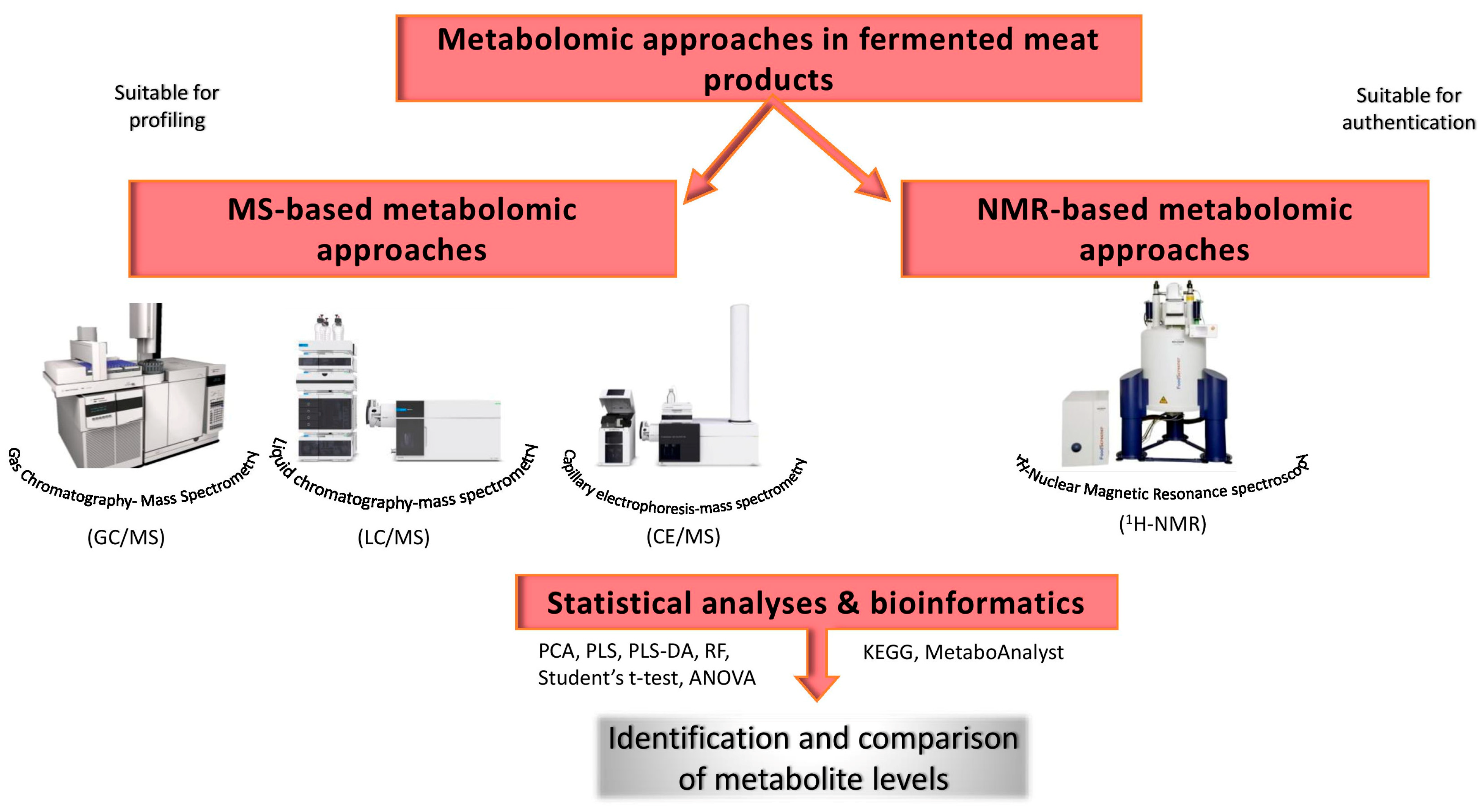
Disclaimer/Publisher’s Note: The statements, opinions and data contained in all publications are solely those of the individual author(s) and contributor(s) and not of MDPI and/or the editor(s). MDPI and/or the editor(s) disclaim responsibility for any injury to people or property resulting from any ideas, methods, instructions or products referred to in the content. |
© 2026 by the authors. Licensee MDPI, Basel, Switzerland. This article is an open access article distributed under the terms and conditions of the Creative Commons Attribution (CC BY) license.
Share and Cite
Sidira, M.; Nelios, G.; Varzakas, T. Metabolomic Approaches in Fermented Meat Products: Focus on Lactic Acid Bacteria and Starter Cultures. Microorganisms 2026, 14, 1591. https://doi.org/10.3390/microorganisms14071591
Sidira M, Nelios G, Varzakas T. Metabolomic Approaches in Fermented Meat Products: Focus on Lactic Acid Bacteria and Starter Cultures. Microorganisms. 2026; 14(7):1591. https://doi.org/10.3390/microorganisms14071591
Chicago/Turabian StyleSidira, Marianthi, Grigorios Nelios, and Theodoros Varzakas. 2026. "Metabolomic Approaches in Fermented Meat Products: Focus on Lactic Acid Bacteria and Starter Cultures" Microorganisms 14, no. 7: 1591. https://doi.org/10.3390/microorganisms14071591
APA StyleSidira, M., Nelios, G., & Varzakas, T. (2026). Metabolomic Approaches in Fermented Meat Products: Focus on Lactic Acid Bacteria and Starter Cultures. Microorganisms, 14(7), 1591. https://doi.org/10.3390/microorganisms14071591