Article

Timing-Dependent Effects of Prebiotic–Probiotic Supplementation on High-Fat-Diet-Induced Testicular Dysfunction and Gut Microbiota Alterations in Rats


1
Department of Pharmaceutical Toxicology, Faculty of Pharmacy, Anadolu University, Eskişehir 26470, Türkiye
2
Department of Pharmaceutical Microbiology, Faculty of Pharmacy, Anadolu University, Eskişehir 26470, Türkiye
3
Department of Biology, Faculty of Science, Eskisehir Technical University, Eskişehir 26470, Türkiye
4
Department of Pharmaceutical Microbiology, Faculty of Pharmacy, Hacettepe University, Ankara 06100, Türkiye
*
Author to whom correspondence should be addressed.
Microorganisms 2026, 14(7), 1566; https://doi.org/10.3390/microorganisms14071566

Submission received: 18 May 2026 / Revised: 4 July 2026 / Accepted: 9 July 2026 / Published: 17 July 2026
(This article belongs to the Collection Feature Papers in Gut Microbiota Research)

Abstract

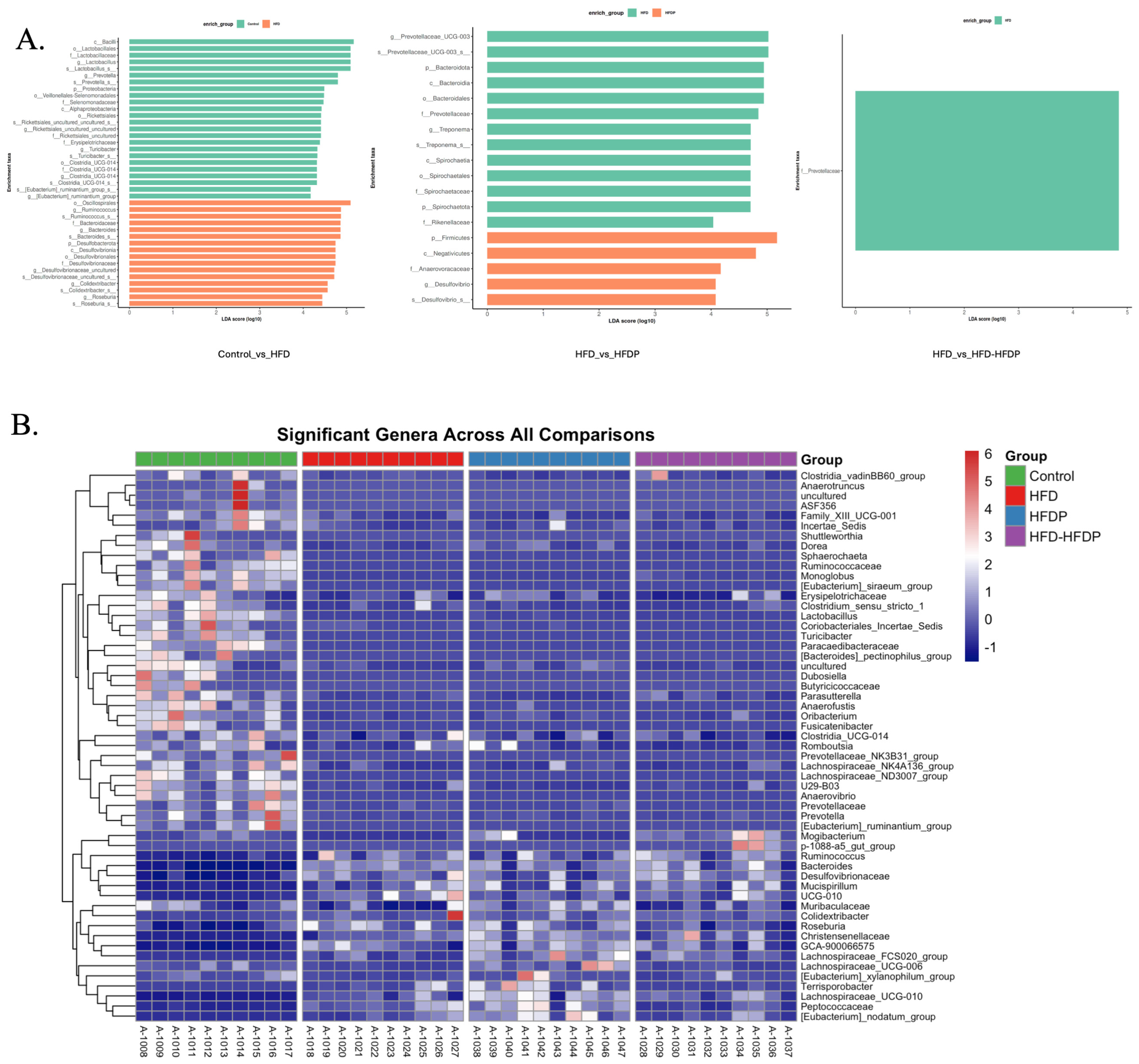
Obesity is a chronic metabolic condition characterized by low-grade inflammation and oxidative imbalance and is strongly associated with impaired male reproductive function. This study investigated whether prebiotic–probiotic supplementation could prevent or attenuate high-fat diet (HFD)-induced metabolic inflammation-associated reproductive toxicity in male rats. Animals were assigned to four groups: normal diet (ND), HFD, HFD with concurrent prebiotic–probiotic supplementation from the onset of feeding (P-HFD), and HFD followed by supplementation initiated after 5 weeks (HFD-P). Evaluations included body and reproductive organ weights, sperm parameters, testicular histopathology, reproductive hormones, oxidative stress and inflammatory biomarkers, and gut microbiome composition. HFD feeding induced pronounced reproductive impairment, evidenced by reduced relative testicular weight, disrupted spermatogenesis, decreased LH levels, elevated TNF-α, a paradoxical increase in intratesticular testosterone despite reduced LH, and marked gut dysbiosis, characterized by shifts in microbial community structure along with reduced microbial diversity. Prebiotic–probiotic supplementation did not fully restore microbial richness or return the microbiota to an ND-like configuration; however, concurrent supplementation induced more pronounced taxonomic restructuring than delayed supplementation. While P-HFD did not show significant improvements in sperm parameters or LH, it exhibited clear histological preservation of testicular structure, reduced TNF-α, and partial normalization of testosterone, indicating attenuation of HFD-induced inflammation-associated testicular toxicity rather than complete functional recovery. In contrast, delayed supplementation produced no meaningful improvement in reproductive, hormonal, or microbiome-related outcomes and, in several respects, more pronounced testicular inflammation and structural degeneration than HFD alone. Collectively, these findings indicate that intervention timing is critical: concurrent administration conferred greater structural and anti-inflammatory protection against HFD-induced testicular damage, whereas delayed intervention was insufficient—or even counterproductive—once testicular injury was established. This timing-dependent response highlights the potential of microbiota-targeted strategies as supportive, timing-sensitive approaches for mitigating obesity-related male reproductive toxicity.
Keywords: obesity; high-fat diet; male reproductive toxicity; prebiotic–probiotic supplementation; gut microbiome; inflammation; oxidative stress obesity; high-fat diet; male reproductive toxicity; prebiotic–probiotic supplementation; gut microbiome; inflammation; oxidative stress