Six-Year Biochar Experiment Reduces Soil N2O Emissions in Eucalyptus Plantations: Associations with Microbial N-Cycle Genes
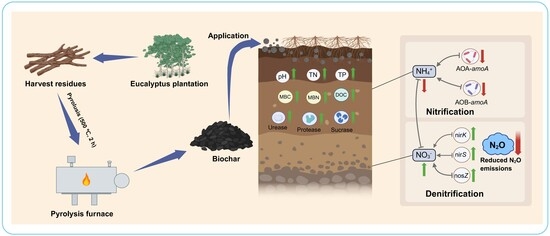
Abstract
1. Introduction
2. Materials and Methods
2.1. Sampling Area and Experimental Setup
2.2. Sample Collection
2.3. Soil Physicochemical Property Analysis
2.4. Measurements of Soil Enzyme Activity
2.5. Quantification of Soil Total Nitrification Rate, Denitrification Rate, and Related Gene Abundance
2.6. Measurement of N2O Flux
2.7. Statistical Analysis
3. Results
3.1. Changes in Soil Temperature, Soil Water Content, and pH
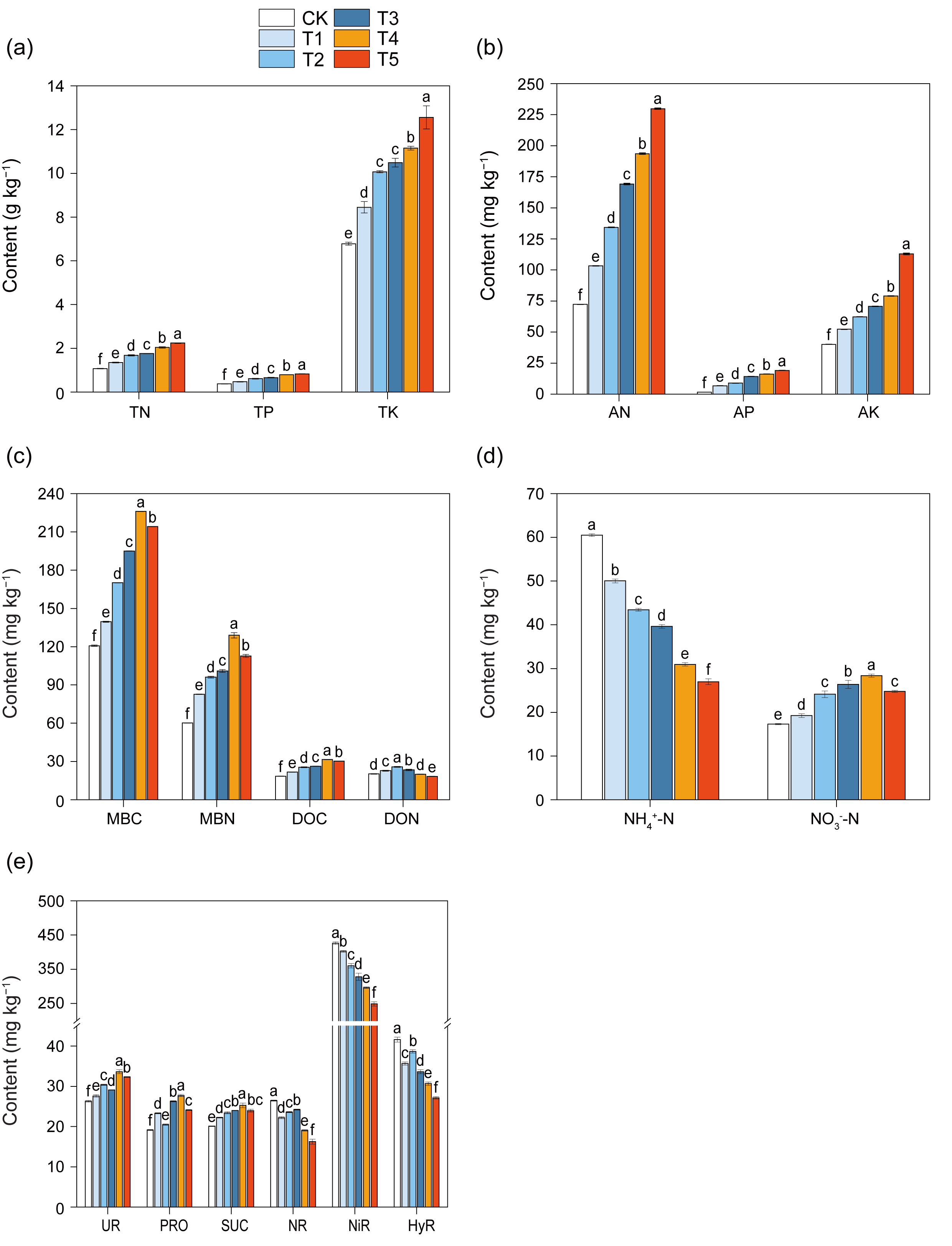
3.2. Changes in Soil Nutrient and Carbon and Nitrogen Contents
3.3. Changes in Soil Enzyme Activities
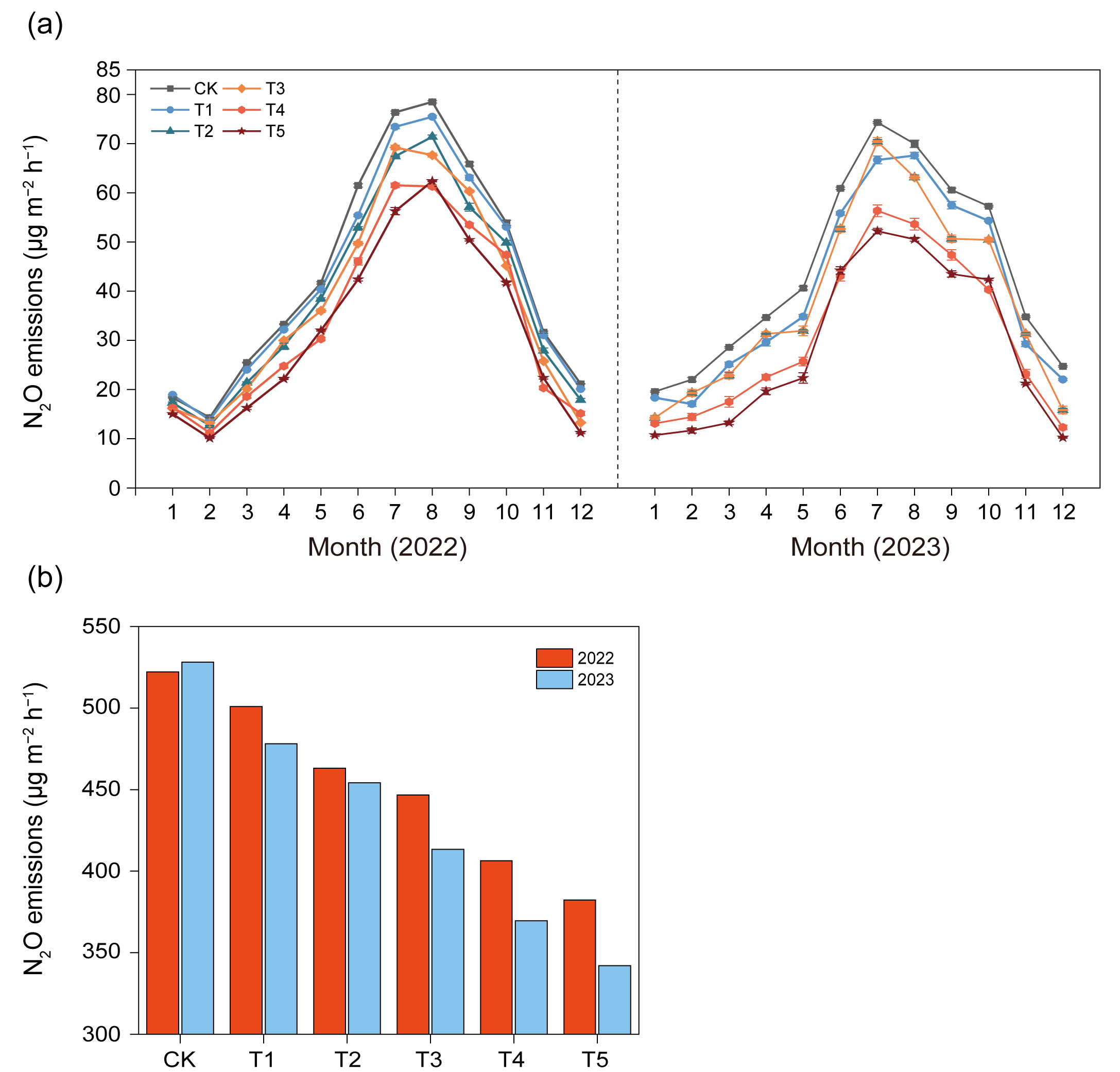
3.4. Changes in Soil N2O Emissions
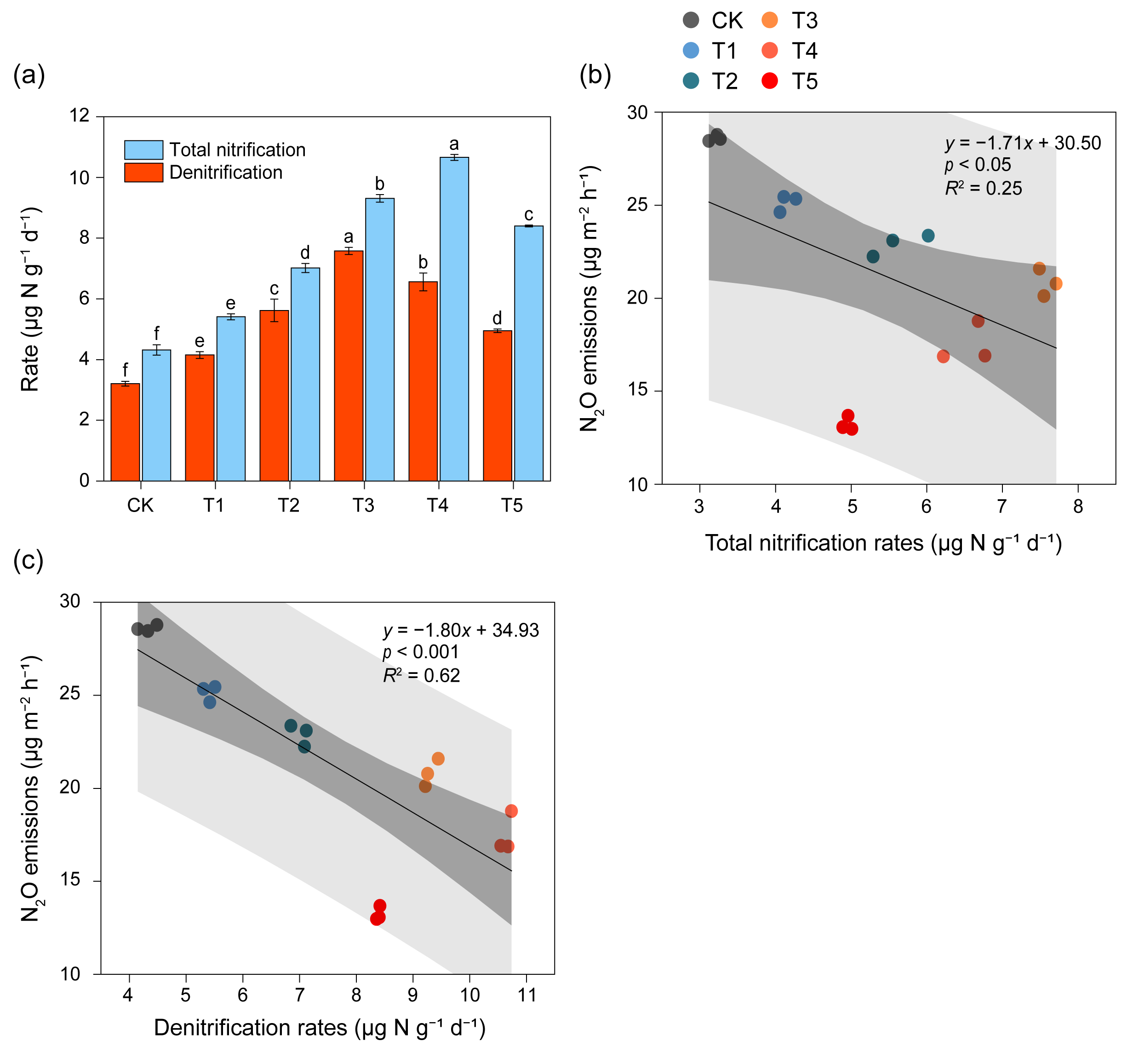
3.5. Changes in Nitrification and Denitrification
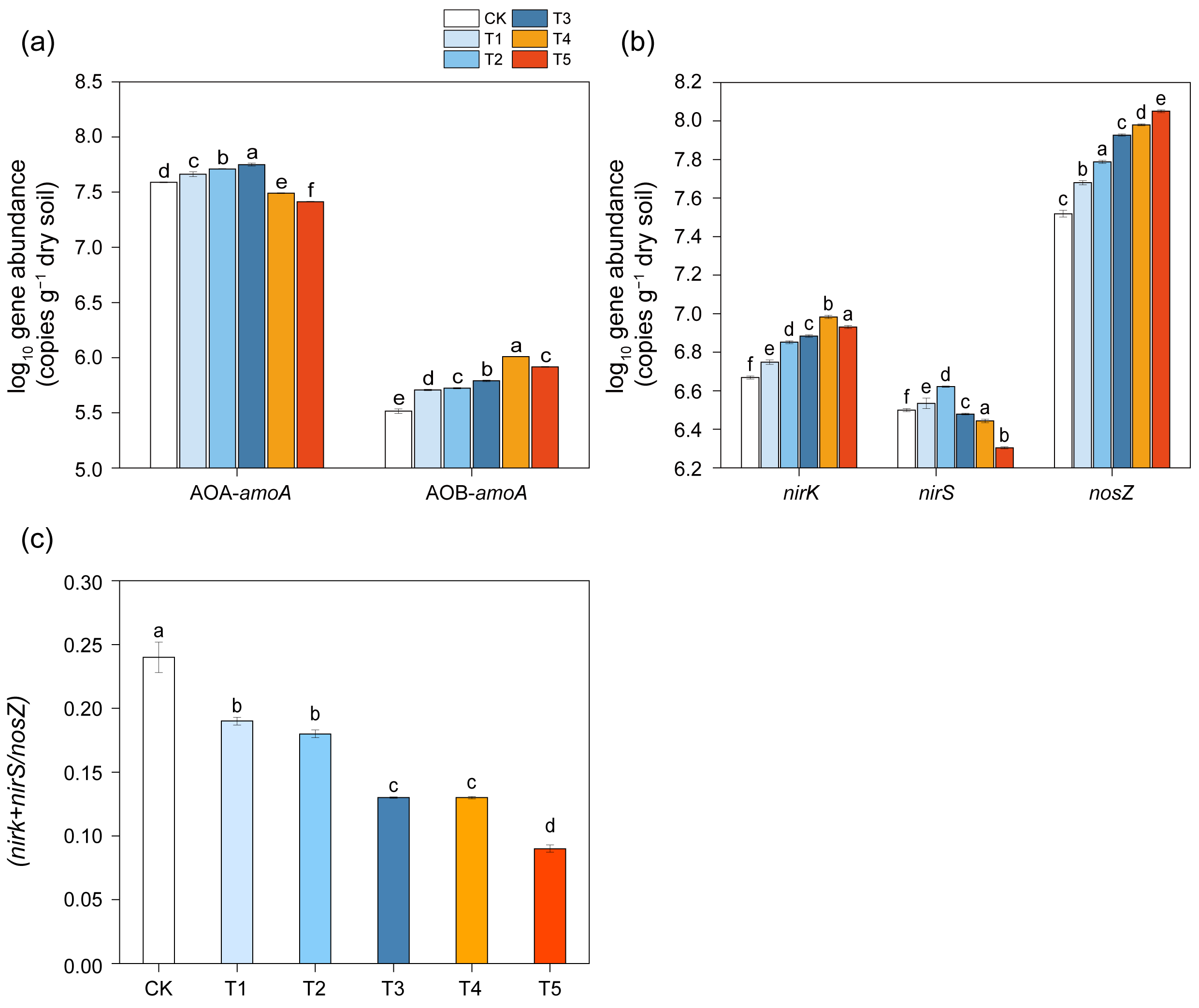
3.6. Changes in Nitrogen-Cycle-Related Functional Genes
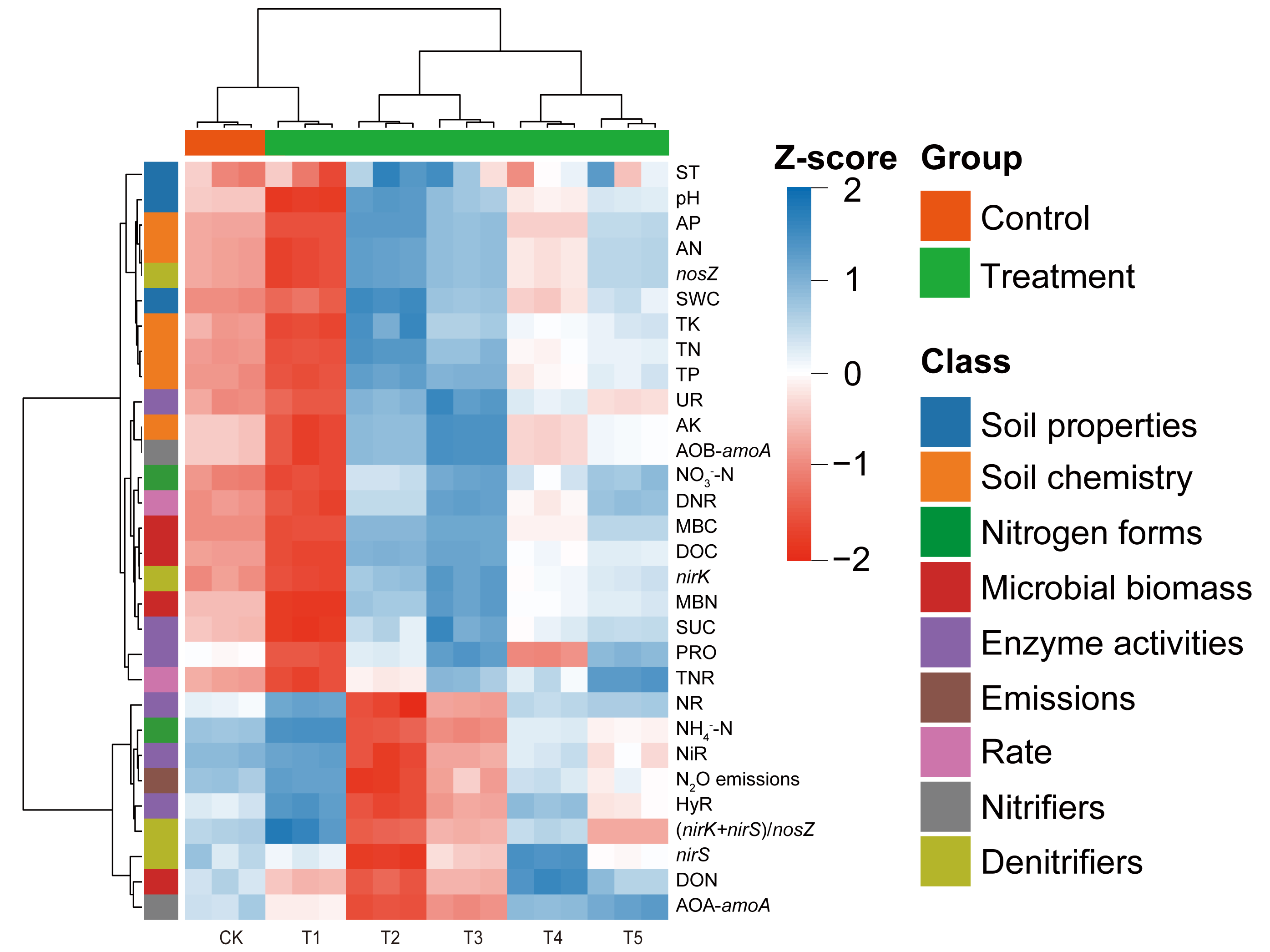
3.7. Correlation Analysis of Physicochemical Properties, Enzyme Activities, and Nitrogen-Cycle-Related Functional Genes
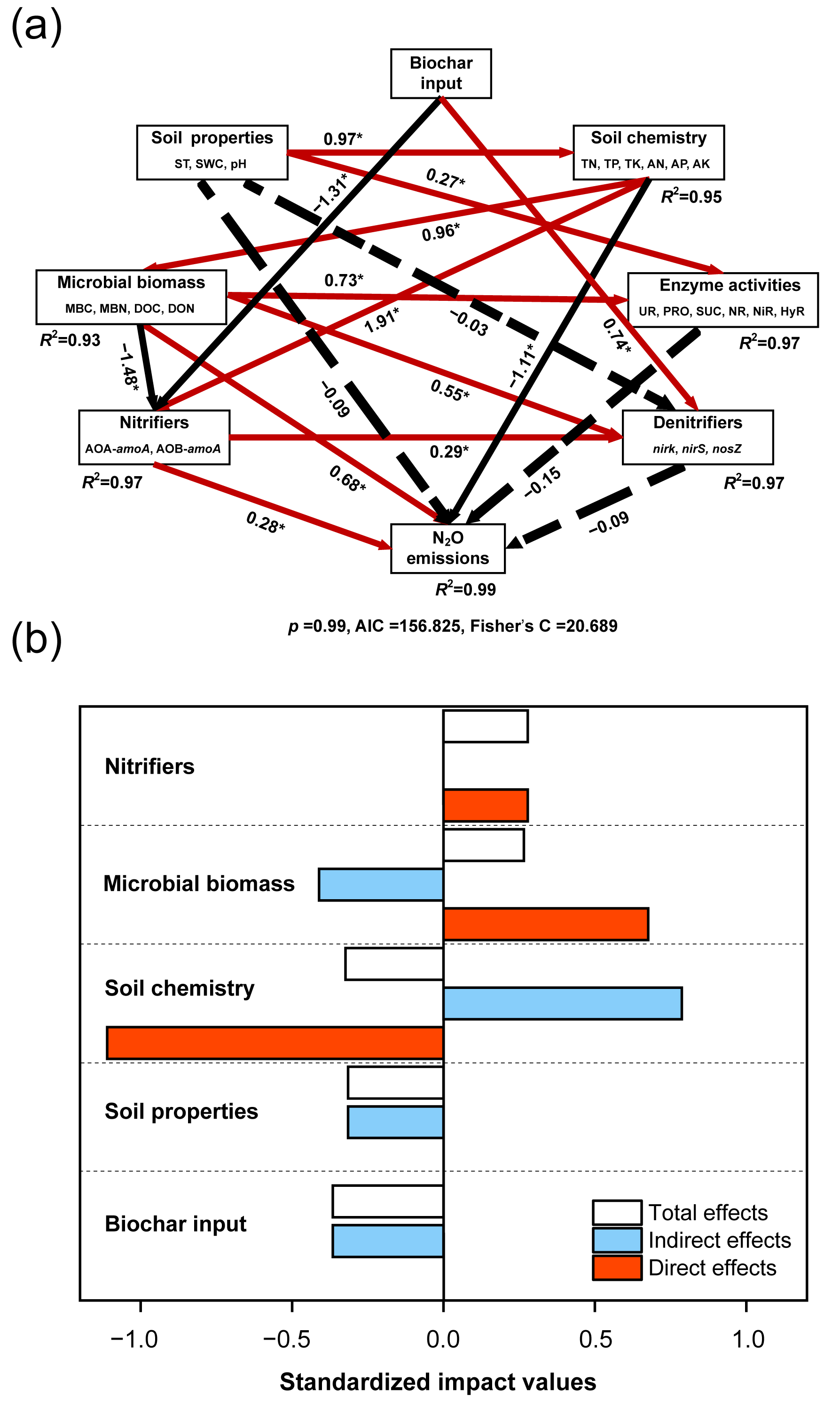
3.8. SEM Model and Standardised Impact Values
4. Discussion
4.1. Effect of Biochar Application on Soil N2O Emissions in Eucalyptus Plantations
4.2. Effect of Biochar on the Abundance of Soil N-Cycle Functional Genes
4.3. Limitations and Future Prospects
5. Conclusions
Supplementary Materials
Author Contributions
Funding
Data Availability Statement
Acknowledgments
Conflicts of Interest
References
- Kopittke, P.M.; Dalal, R.C.; McKenna, B.A.; Smith, P.; Wang, P.; Weng, Z.; van der Bom, F.J.T.; Menzies, N.W. Soil is a major contributor to global greenhouse gas emissions and climate change. Soil 2024, 10, 873–885. [Google Scholar] [CrossRef] [Scilit]
- Xu, R.; Prentice, I.C.; Spahni, R.; Niu, H. Modelling terrestrial nitrous oxide emissions and implications for climate feedback. New Phytol. 2012, 196, 472–488. [Google Scholar] [CrossRef] [Scilit] [PubMed]
- Deng, B.; Fang, H.; Jiang, N.; Feng, W.; Luo, L.; Wang, J.; Wang, H.; Hu, D.; Guo, X.; Zhang, L. Biochar Is Comparable to Dicyandiamide in the Mitigation of Nitrous Oxide Emissions from Camellia oleifera Abel. Fields. Forests 2019, 10, 1076. [Google Scholar] [CrossRef] [Scilit]
- Tian, H.; Xu, R.; Canadell, J.G.; Thompson, R.L.; Winiwarter, W.; Suntharalingam, P.; Davidson, E.A.; Ciais, P.; Jackson, R.B.; Janssens-Maenhout, G.; et al. A comprehensive quantification of global nitrous oxide sources and sinks. Nature 2020, 586, 248–256. [Google Scholar] [CrossRef] [Scilit] [PubMed]
- Zhu, G.; Shi, H.; Zhong, L.; He, G.; Wang, B.; Shan, J.; Han, P.; Liu, T.; Wang, S.; Liu, C.; et al. Nitrous oxide sources, mechanisms and mitigation. Nat. Rev. Earth Environ. 2025, 6, 574–592. [Google Scholar] [CrossRef] [Scilit]
- Lu, C.Q.; Li, L.C.; Winiwarter, W.; Canadell, J.G.; Liu, W.H.; Tian, H.Q. Underestimation of Future Agricultural Soil N2O Emissions and Abatement Needs. Glob. Change Biol. 2026, 32, e70919. [Google Scholar] [CrossRef] [Scilit] [PubMed]
- Thomson, A.J.; Giannopoulos, G.; Pretty, J.; Baggs, E.M.; Richardson, D.J. Biological sources and sinks of nitrous oxide and strategies to mitigate emissions. Philos. Trans. R. Soc. B 2012, 367, 1157–1168. [Google Scholar] [CrossRef] [Scilit] [PubMed]
- Qin, W.; Wei, S.P.; Zheng, Y.; Choi, E.; Li, X.; Johnston, J.; Wan, X.; Abrahamson, B.; Flinkstrom, Z.; Wang, B.; et al. Ammonia-oxidizing bacteria and archaea exhibit differential nitrogen source preferences. Nat. Microbiol. 2024, 9, 524–536. [Google Scholar] [CrossRef] [Scilit] [PubMed]
- Xiong, R.; Gao, N.; Huang, W.; Zhang, X.; Shen, W. Recent progress in microbial production and consumption of nitrous oxide in agricultural soils. World J. Microbiol. Biotechnol. 2025, 41, 235. [Google Scholar] [CrossRef] [Scilit] [PubMed]
- Nguyen, T.B.; Sherpa, K.; Bui, X.T.; Nguyen, V.; Vo, T.D.H.; Ho, H.T.T.; Chen, C.W.; Dong, C.D. Biochar for soil remediation: A comprehensive review of current research on pollutant removal. Environ. Pollut. 2023, 337, 122571. [Google Scholar] [CrossRef] [Scilit] [PubMed]
- Yang, J.R.; Xia, L.L.; van Groenigen, K.J.; Zhao, X.; Ti, C.P.; Wang, W.L.; Du, Z.L.; Fan, M.S.; Zhuang, M.H.; Smith, P.; et al. Sustained benefits of long-term biochar application for food security and climate change mitigation. Proc. Natl. Acad. Sci. USA 2025, 122, e2509237122. [Google Scholar] [CrossRef] [Scilit] [PubMed]
- Rittl, T.F.; Butterbach-Bahl, K.; Basile, C.M.; Pereira, L.A.; Alms, V.; Dannenmann, M.; Couto, E.G.; Cerri, C.E.P. Greenhouse gas emissions from soil amended with agricultural residue biochars: Effects of feedstock type, production temperature and soil moisture. Biomass Bioenergy 2018, 117, 1–9. [Google Scholar] [CrossRef] [Scilit]
- Suddick, E.C.; Six, J. An estimation of annual nitrous oxide emissions and soil quality following the amendment of high temperature walnut shell biochar and compost to a small scale vegetable crop rotation. Sci. Total Environ. 2013, 465, 298–307. [Google Scholar] [CrossRef] [Scilit] [PubMed]
- Verhoeven, E.; Six, J. Biochar does not mitigate field-scale N2O emissions in a Northern California vineyard: An assessment across two years. Agric. Ecosyst. Environ. 2014, 191, 27–38. [Google Scholar] [CrossRef] [Scilit]
- Kaur, N.; Kieffer, C.; Ren, W.; Hui, D.F. How much is soil nitrous oxide emission reduced with biochar application? An evaluation of meta-analyses. GCB Bioenergy 2023, 15, 24–37. [Google Scholar] [CrossRef] [Scilit]
- Chen, W.; Zou, Y.; Dang, Y.; Sakai, T. Spatial distribution and dynamic change monitoring of Eucalyptus plantations in China during 1994–2013. Trees-Struct. Funct. 2022, 36, 405–414. [Google Scholar] [CrossRef] [Scilit]
- Xie, Y.; Arnold, R.J.; Wu, Z.H.; Chen, S.; Du, A.; Luo, J. Advances in eucalypt research in China. Front. Agric. Sci. Eng. 2017, 4, 380–390. [Google Scholar] [CrossRef] [Scilit]
- Chu, S.; Ouyang, J.; Liao, D.; Zhou, Y.; Liu, S.; Shen, D.; Wei, X.; Zeng, S. Effects of enriched planting of native tree species on surface water flow, sediment, and nutrient losses in a Eucalyptus plantation forest in southern China. Sci. Total Environ. 2019, 675, 224–234. [Google Scholar] [CrossRef] [Scilit] [PubMed]
- Ntshuxeko, V.E.; Ruwanza, S. Physical properties of soil in Pine elliottii and Eucalyptus cloeziana plantations in the Vhembe biosphere, Limpopo Province of South Africa. J. For. Res. 2020, 31, 625–635. [Google Scholar] [CrossRef] [Scilit]
- Wang, Y.; Zhu, Y.; Meng, S.; Wang, S.; Yang, F.; Qin, F.; Lu, J. Linkages between the soil microbial network and nutrient cycling along a subtropical plantation chronosequence. Plant Soil 2025, 515, 1463–1476. [Google Scholar] [CrossRef] [Scilit]
- Zhu, L.; Wang, J.; Weng, Y.; Chen, X.; Wu, L. Soil characteristics of Eucalyptus urophylla × Eucalyptus grandis plantations under different management measures for harvest residues with soil depth gradient across time. Ecol. Indic. 2020, 117, 106530. [Google Scholar] [CrossRef] [Scilit]
- Duan, C.Y. Effects of Eucalyptus Branches Biochar Application on Soil Nitrogen Components and Microbiological Characteristics of Eucalyptus Plantation in Northern Guangxi. Master’s Thesis, Guangxi Normal University, Guilin, China, 2020. [Google Scholar]
- Mou, Z.; Shen, Y.; Cao, Y.; Wang, Z.; Chen, Y.; Teng, Q.; Huang, K. Effects of Biochar Application on Soil Organic Carbon Component in Eucalyptus Plantations After Five Years in Northern Guangxi. Environ. Sci. 2023, 48, 6869–6879. [Google Scholar] [CrossRef] [Scilit] [PubMed]
- Guo, Y.; Wang, D.; Zheng, J.; Zhao, S.; Zhang, X. Effect of Biochar on Soil Greenhouse Gas Emissions in Semi-arid Region. Environ. Sci. 2015, 36, 3393–3401. [Google Scholar] [CrossRef]
- Zhou, L.; Li, J.; Mi, C.; Fan, H.; Ma, S.; Shao, J. Effect of straw biochar on availability of phosphorus in brown soil during the freezing and thawing period. Acta Pedol. Sin. 2017, 54, 171–179. [Google Scholar] [CrossRef]
- Bao, S. Chemical Analysis for Agricultural Soil; China Agriculture Press: Beijing, China, 2000. [Google Scholar]
- Vance, E.D.; Brookes, P.C.; Jenkinson, D.S. An extraction method for measuring soil microbial biomass C. Soil Biol. Biochem. 1987, 19, 703–707. [Google Scholar] [CrossRef] [Scilit]
- Guan, S. Soil Enzymes and Their Research Methods; China Agriculture Press: Beijing, China, 1986. [Google Scholar]
- Chen, S.; Huang, Y. Determination of respiration, gross nitrification and denitrification in soil profile using BaPS system. J. Environ. Sci. 2006, 18, 937–943. [Google Scholar] [CrossRef] [Scilit] [PubMed]
- Wang, Y.; Wang, Y. Quick measurement of CH4, CO2 and N2O emissions from a short-plant ecosystem. Adv. Atmos. Sci. 2003, 20, 842–844. [Google Scholar] [CrossRef] [Scilit]
- Zhang, X.; Lv, J.; Zhang, Y.; Li, S.; Chen, X.; Sha, Z. A Meta-Analysis Study on the Use of Biochar to Simultaneously Mitigate Emissions of Reactive Nitrogen Gases (N2O and NO) from Soils. Sustainability 2023, 15, 2384. [Google Scholar] [CrossRef] [Scilit]
- Xu, Z.; Zhang, S.; Lakshmanan, P.; Li, Y.; Xu, D.; Zhu, Q. Mitigation of soil acidification is critical for reducing GHG emission and improving soil quality, crop yield and farm economic benefits: Evidence from a global meta-analysis. Field Crops Res. 2025, 322, 109757. [Google Scholar] [CrossRef] [Scilit]
- Cayuela, M.L.; Sanchez-Monedero, M.A.; Roig, A.; Hanley, K.; Enders, A.; Lehmann, J. Biochar and denitrification in soils: When, how much and why does biochar reduce N2O emissions? Sci. Rep. 2013, 3, 1732. [Google Scholar] [CrossRef] [Scilit] [PubMed]
- Quin, P.; Joseph, S.; Husson, O.; Donne, S.; Mitchell, D.; Munroe, P.; Phelan, D.; Cowie, A.; Van Zwieten, L. Lowering N2O emissions from soils using eucalypt biochar: The importance of redox reactions. Sci. Rep. 2015, 5, 16773. [Google Scholar] [CrossRef] [Scilit] [PubMed]
- Zhang, Y.; Yan, C.; Wang, T.; Zhang, G.; Bahn, M.; Mo, F.; Han, J. Biochar strategy for long-term N2O emission reduction: Insights into soil physical structure and microbial interaction. Soil Biol. Biochem. 2025, 202, 109685. [Google Scholar] [CrossRef] [Scilit]
- Liu, X.; Liu, X.; Gao, S. The electrochemical mechanism of biochar for mediating the product ratio of N2O/(N2O+N2) in the denitrification process. Sci. Total Environ. 2024, 951, 175566. [Google Scholar] [CrossRef] [Scilit] [PubMed]
- Liu, H.; Li, X.H.; Lu, S.; Wang, N.; Li, Y.; Zhang, Y.; Qi, G.; Lu, H.; Dong, H.; Wang, H.; et al. Biennial biochar application mitigates N2O emissions in saline-alkali soils by modulating microbial communities and metabolic pathways. Environ. Technol. Innov. 2025, 40, 104475. [Google Scholar] [CrossRef] [Scilit]
- Iturbe-Espinoza, P.; Elsgaard, L.; Sapkota, R.; Ellegaard-Jensen, L.; Winding, A. Eight-year effect of biochar amendment on soil properties, extracellular enzyme activity, N-cycling genes and microbiome structure in two Danish fallow soils. Microbiol. Res. 2026, 303, 128398. [Google Scholar] [CrossRef] [Scilit] [PubMed]
- He, L.; Bi, Y.; Zhao, J.; Pittelkow, C.M.; Zhao, X.; Wang, S.; Xing, G. Population and community structure shifts of ammonia oxidizers after four-year successive biochar application to agricultural acidic and alkaline soils. Sci. Total Environ. 2018, 619, 1105–1115. [Google Scholar] [CrossRef] [Scilit] [PubMed]
- Zhang, L.; Hu, H.; Shen, J.; He, J. Ammonia-oxidizing archaea have more important role than ammonia-oxidizing bacteria in ammonia oxidation of strongly acidic soils. ISME J. 2012, 6, 1032–1045. [Google Scholar] [CrossRef] [Scilit] [PubMed]
- Liu, Q.; Wu, Y.; Ma, J.; Jiang, J.; You, X.; Lv, R.; Zhou, S.; Pan, C.; Liu, B.; Xu, Q.; et al. How does biochar influence soil nitrification and nitrification-induced N2O emissions? Sci. Total Environ. 2024, 908, 168530. [Google Scholar] [CrossRef] [Scilit] [PubMed]
- Di, H.J.; Cameron, K.C.; Shen, J.P.; Winefield, C.S.; O’Callaghan, M.; Bowatte, S.; He, J.Z. Nitrification driven by bacteria and not archaea in nitrogen-rich grassland soils. Nat. Geosci. 2009, 2, 621–624. [Google Scholar] [CrossRef] [Scilit]
- Cantou, G.; Wang, J.J.; Zhou, B.; Lee, J.-M.; Park, J.-H. Toxicological fate of biochar according to feedstock and pyrolysis temperature. Ind. Crops Prod. 2025, 236, 122094. [Google Scholar] [CrossRef] [Scilit]
- Yao, R.-J.; Li, H.-Q.; Yang, J.-S.; Wang, X.-P.; Xie, W.-P.; Zhang, X. Biochar Addition Inhibits Nitrification by Shifting Community Structure of Ammonia-Oxidizing Microorganisms in Salt-Affected Irrigation-Silting Soil. Microorganisms 2022, 10, 436. [Google Scholar] [CrossRef] [Scilit] [PubMed]
- Leininger, S.; Urich, T.; Schloter, M.; Schwark, L.; Qi, J.; Nicol, G.W.; Prosser, J.I.; Schuster, S.C.; Schleper, C. Archaea predominate among ammonia-oxidizing prokaryotes in soils. Nature 2006, 442, 806–809. [Google Scholar] [CrossRef] [Scilit] [PubMed]
- Morimoto, S.; Hayatsu, M.; Hoshino, Y.T.; Nagaoka, K.; Yamazaki, M.; Karasawa, T.; Takenaka, M.; Akiyama, H. Quantitative Analyses of Ammonia-oxidizing Archaea (AOA) and Ammonia-oxidizing Bacteria (AOB) in Fields with Different Soil Types. Microbes Environ. 2011, 26, 248–253. [Google Scholar] [CrossRef] [Scilit] [PubMed]
- Zhang, H.; Sun, H.; Zhou, S.; Bai, N.; Zheng, X.; Li, S.; Zhang, J.; Lv, W. Effect of Straw and Straw Biochar on the Community Structure and Diversity of Ammonia-oxidizing Bacteria and Archaea in Rice-wheat Rotation Ecosystems. Sci. Rep. 2019, 9, 9367. [Google Scholar] [CrossRef] [Scilit] [PubMed]
- Li, Q.; Zhao, L.; Wang, F.; Chen, H.; Qian, X. Reduction in N2O Emissions and Improvement in Nitrifier and Denitrifier Communities through Bamboo-Biochar-Based Fertilization in Pomelo Orchard Soil. Agronomy 2023, 13, 2504. [Google Scholar] [CrossRef] [Scilit]
- Wang, C.; Lu, H.; Dong, D.; Deng, H.; Strong, P.J.; Wang, H.; Wu, W. Insight into the Effects of Biochar on Manure Composting: Evidence Supporting the Relationship between N2O Emission and Denitrifying Community. Environ. Sci. Technol. 2013, 47, 7341–7349. [Google Scholar] [CrossRef] [Scilit] [PubMed]
- Aamer, M.; Shaaban, M.; Hassan, M.U.; Huang, G.; Liu, Y.; Haiying, T.; Rasul, F.; Ma, Q.; Li, Z.; Rasheed, A.; et al. Biochar mitigates the N2O emissions from acidic soil by increasing the nosZ and nirK gene abundance and soil pH. J. Environ. Manag. 2020, 255, 109891. [Google Scholar] [CrossRef] [Scilit] [PubMed]
- Liao, J.; Hu, A.; Zhao, Z.; Liu, X.; Jiang, C.; Zhang, Z. Biochar with large specific surface area recruits N2O-reducing microbes and mitigate N2O emission. Soil Biol. Biochem. 2021, 156, 108212. [Google Scholar] [CrossRef] [Scilit]
- Harter, J.; El-Hadidi, M.; Huson, D.H.; Kappler, A.; Behrens, S. Soil biochar amendment affects the diversity of nosZ transcripts: Implications for N2O formation. Sci. Rep. 2017, 7, 3338. [Google Scholar] [CrossRef] [Scilit] [PubMed]
- Wang, H.; Guo, Y.; Fang, H.; Cheng, S.; Shi, F.; Chen, L.; Pu, H.; Liu, B. Divergent effects of straw and straw-derived biochar on soil N transformation and N2O emissions: A global meta-analysis. J. Environ. Manag. 2025, 395, 127784. [Google Scholar] [CrossRef] [Scilit] [PubMed]




| Soil Properties | Group | Mean ± SD (2022) | ΔT (°C) | Mean ± SD (2023) | ΔT (°C) |
|---|---|---|---|---|---|
| Soil temperature (°C) | CK | 18.60 ± 0.03 f | 18.59 ± 0.04 e | ||
| T1 | 18.71 ± 0.02 e | +0.11 | 18.87 ± 0.10 d | +0.28 | |
| T2 | 18.81 ± 0.02 d | +0.21 | 19.04 ± 0.03 c | +0.44 | |
| T3 | 18.87 ± 0.02 c | + 0.27 | 19.12 ± 0.03 bc | + 0.52 | |
| T4 | 18.94 ± 0.01 b | +0.34 | 19.23 ± 0.01 b | +0.64 | |
| T5 | 19.07 ± 0.02 a | +0.47 | 19.44 ± 0.16 a | +0.84 | |
| Soil water content (%) | CK | 18.76 ± 0.08 f | 20.28 ± 0.03 f | ||
| T1 | 19.27 ± 0.07 e | +0.51 | 21.27 ± 0.08 e | +0.99 | |
| T2 | 20.46 ± 0.03 d | +1.69 | 21.88 ± 0.11 d | +1.61 | |
| T3 | 21.07 ± 0.03 c | +2.30 | 23.22 ± 0.06 b | +2.94 | |
| T4 | 22.05 ± 0.10 b | +3.28 | 24.12 ± 0.04 c | +3.84 | |
| T5 | 22.89 ± 0.06 a | +4.12 | 25.25 ± 0.08 a | +4.97 | |
| pH | CK | 5.40 ± 0.00 f | 5.39 ± 0.00 f | ||
| T1 | 6.17 ± 0.00 e | +0.77 | 6.13 ± 0.01 e | +0.74 | |
| T2 | 6.38 ± 0.00 d | +0.98 | 6.27 ± 0.00 d | +0.88 | |
| T3 | 6.70 ± 0.01 c | +1.30 | 6.57 ± 0.02 c | +1.19 | |
| T4 | 6.89 ± 0.01 b | +1.49 | 6.74 ± 0.02 b | +1.35 | |
| T5 | 7.19 ± 0.01 a | +1.79 | 7.05 ± 0.02 a | +1.67 |
Disclaimer/Publisher’s Note: The statements, opinions and data contained in all publications are solely those of the individual author(s) and contributor(s) and not of MDPI and/or the editor(s). MDPI and/or the editor(s) disclaim responsibility for any injury to people or property resulting from any ideas, methods, instructions or products referred to in the content. |
© 2026 by the authors. Licensee MDPI, Basel, Switzerland. This article is an open access article distributed under the terms and conditions of the Creative Commons Attribution (CC BY) license.
Share and Cite
Luo, Y.; Shen, Y.; Shi, H.; Teng, Q.; Xu, G.; Huang, L.; Chu, J.; Liao, J.; Zhang, D.; Huang, K.; et al. Six-Year Biochar Experiment Reduces Soil N2O Emissions in Eucalyptus Plantations: Associations with Microbial N-Cycle Genes. Microorganisms 2026, 14, 1519. https://doi.org/10.3390/microorganisms14071519
Luo Y, Shen Y, Shi H, Teng Q, Xu G, Huang L, Chu J, Liao J, Zhang D, Huang K, et al. Six-Year Biochar Experiment Reduces Soil N2O Emissions in Eucalyptus Plantations: Associations with Microbial N-Cycle Genes. Microorganisms. 2026; 14(7):1519. https://doi.org/10.3390/microorganisms14071519
Chicago/Turabian StyleLuo, Yunhuang, Yuyi Shen, Hao Shi, Qiumei Teng, Guangping Xu, Liangliang Huang, Junzhi Chu, Jialin Liao, Denan Zhang, Kechao Huang, and et al. 2026. "Six-Year Biochar Experiment Reduces Soil N2O Emissions in Eucalyptus Plantations: Associations with Microbial N-Cycle Genes" Microorganisms 14, no. 7: 1519. https://doi.org/10.3390/microorganisms14071519
APA StyleLuo, Y., Shen, Y., Shi, H., Teng, Q., Xu, G., Huang, L., Chu, J., Liao, J., Zhang, D., Huang, K., Sun, Y., Tan, Z., & Cao, Y. (2026). Six-Year Biochar Experiment Reduces Soil N2O Emissions in Eucalyptus Plantations: Associations with Microbial N-Cycle Genes. Microorganisms, 14(7), 1519. https://doi.org/10.3390/microorganisms14071519