Rhizosphere Ion Composition Shapes Microbial Communities and Is Associated with Plant Growth Variation in Saline–Alkali Soils

Abstract
1. Introduction
2. Materials and Methods
2.1. Soil Sampling
2.2. Determination of Soil Physicochemical Properties
2.3. DNA Extraction and Sequencing
2.4. Bioinformatics Analysis
2.5. Statistical Analysis
3. Results
3.1. Ion Composition Characteristics of Rhizosphere Soil
3.2. Rhizosphere Microbial Diversity
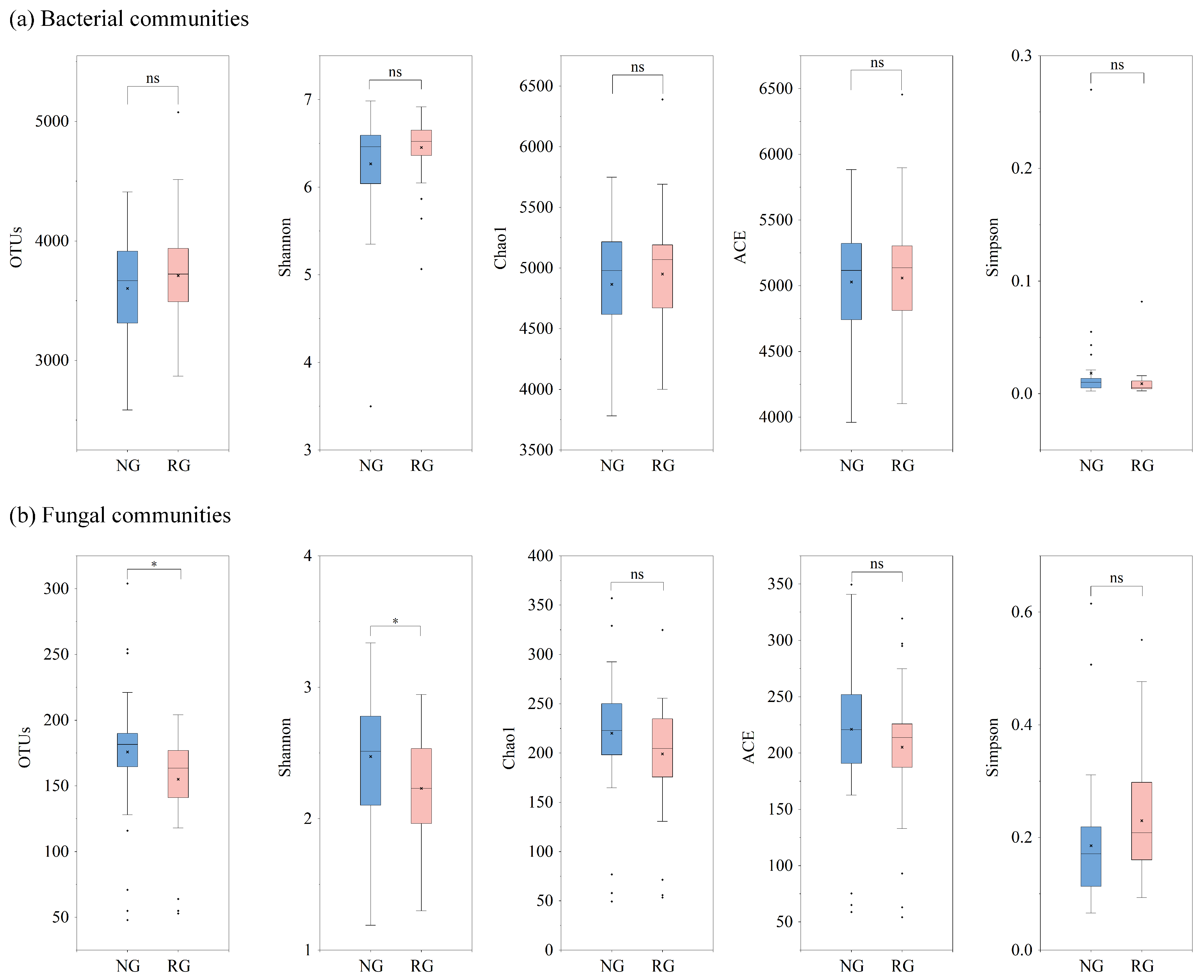
3.2.1. Alpha Diversity of Bacterial and Fungal Communities
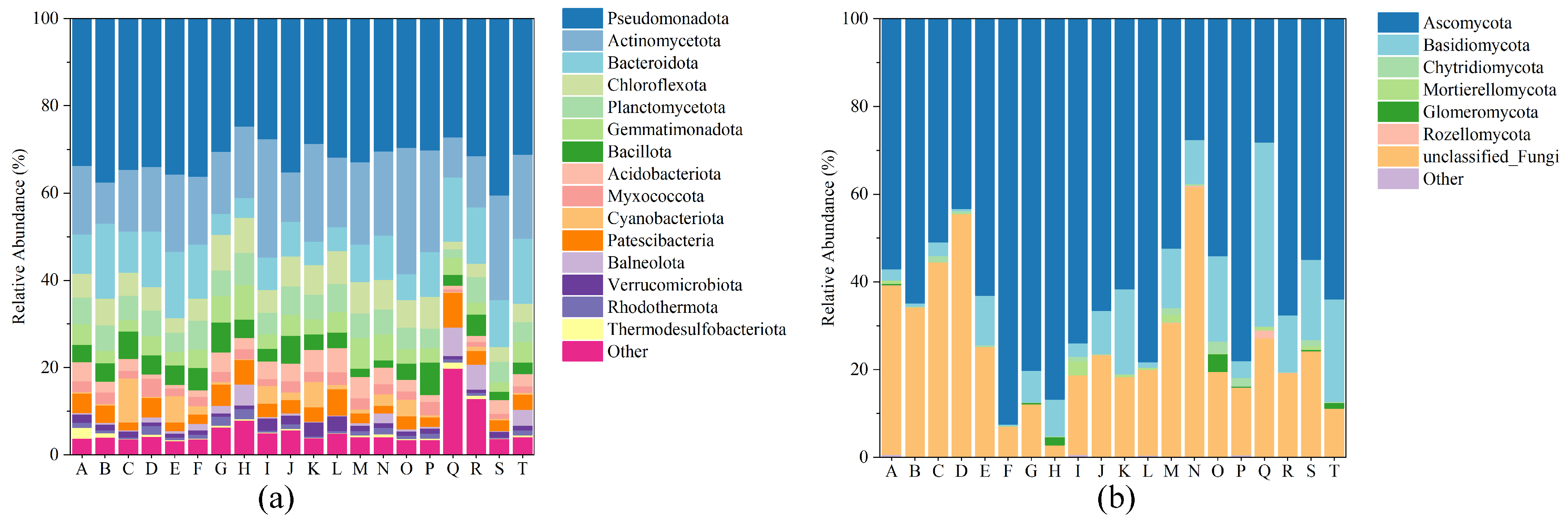
3.2.2. Microbial Community Composition and Dominant Taxa
3.2.3. Taxa Associated with Plant Growth Conditions
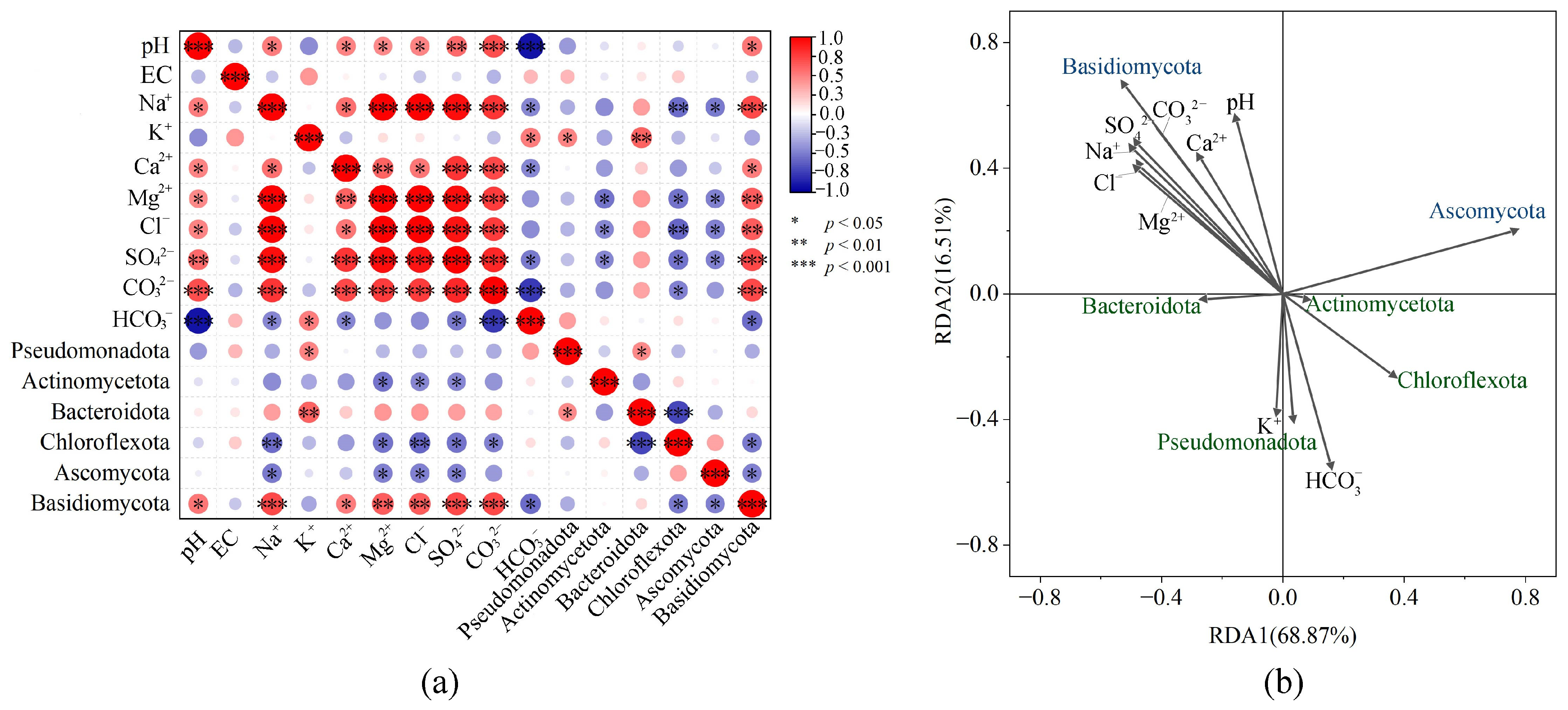
3.3. Relationships Between Ion Composition and Microbial Communities
4. Discussion
4.1. Heterogeneity of Ion Composition in Saline–Alkali Soils
4.2. Differential Responses of Microbial Communities to Ion Environment and Plant Growth Status
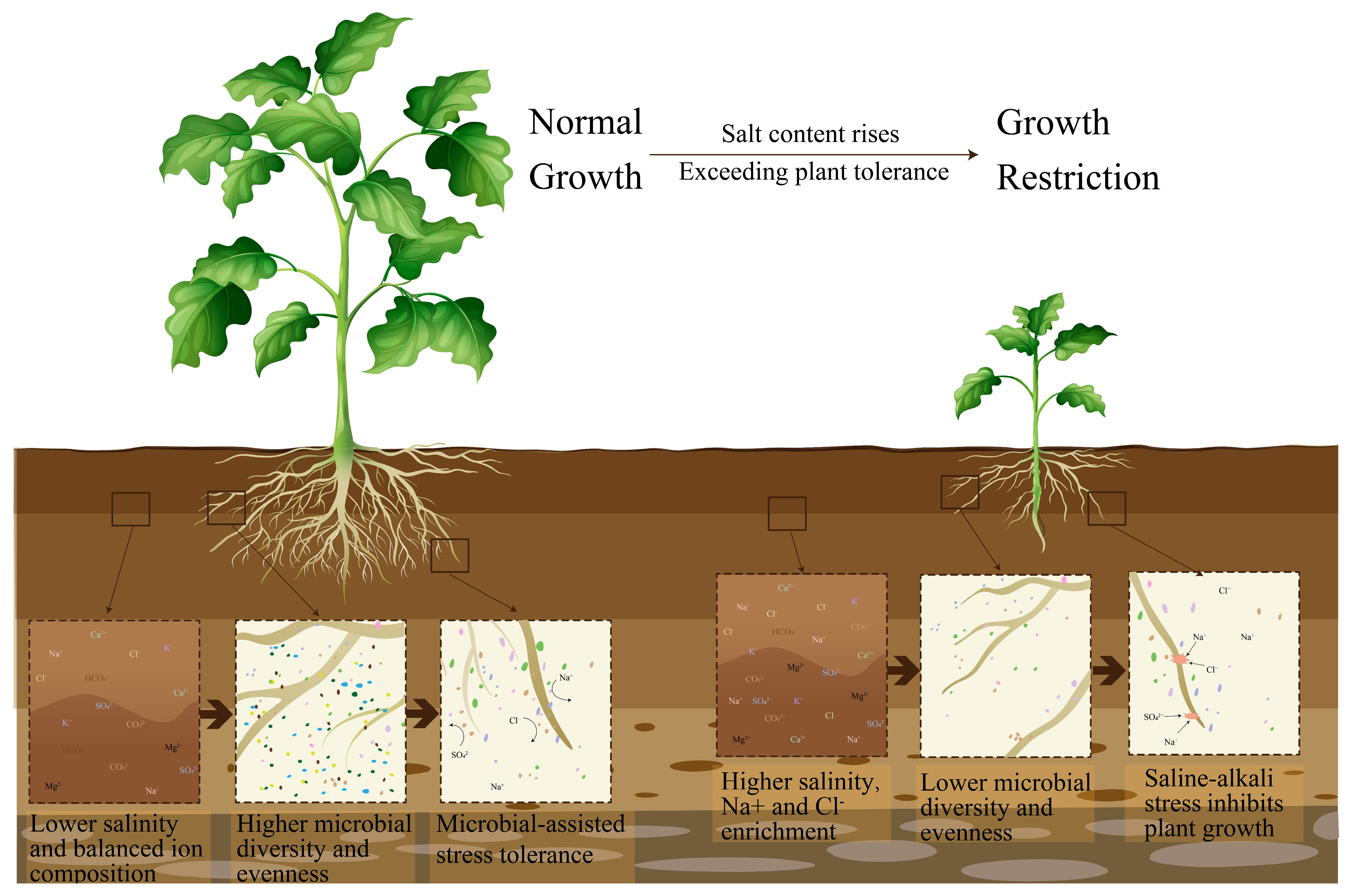
4.3. Potential Mechanisms of Plant Microbial Interactions Driven by Ionic Composition
4.4. Plant-Dependent Responses to Apparent Salinity Threshold and Associated Microbial Variation
4.5. Limitations and Future Perspectives
5. Conclusions
Supplementary Materials
Author Contributions
Funding
Institutional Review Board Statement
Informed Consent Statement
Data Availability Statement
Conflicts of Interest
References
- Haj-Amor, Z.; Araya, T.; Kim, D.G.; Bouri, S.; Lee, J.; Ghiloufi, W.; Yang, Y.; Kang, H.; Jhariya, M.K.; Banerjee, A.; et al. Soil salinity and its associated effects on soil microorganisms, greenhouse gas emissions, crop yield, biodiversity and desertification: A review. Sci. Total Environ. 2022, 843, 156946. [Google Scholar] [CrossRef]
- Ondrasek, G.; Rengel, Z. Environmental salinization processes: Detection, implications & solutions. Sci. Total Environ. 2021, 754, 142432. [Google Scholar] [CrossRef] [PubMed]
- Mohanavelu, A.; Naganna, S.R.; Al-Ansari, N. Irrigation Induced Salinity and Sodicity Hazards on Soil and Groundwater: An Overview of Its Causes, Impacts and Mitigation Strategies. Agriculture 2021, 11, 983. [Google Scholar] [CrossRef]
- Fan, W.; Xiao, Y.; Dong, J.; Xing, J.; Tang, F.; Shi, F. Variety-driven rhizosphere microbiome bestows differential salt tolerance to alfalfa for coping with salinity stress. Front. Plant Sci. 2023, 14, 1324333. [Google Scholar] [CrossRef] [PubMed]
- Liu, Y.P.; Xun, W.B.; Chen, L.; Xu, Z.H.; Zhang, N.; Feng, H.C.; Zhang, Q.; Zhang, R.F. Rhizosphere microbes enhance plant salt tolerance: Toward crop production in saline soil. Comput. Struct. Biotechnol. J. 2022, 20, 6543–6551. [Google Scholar] [CrossRef]
- Xia, F.; Hao, H.; Qi, Y.; Bai, H.; Li, H.; Shi, Z.; Shi, L. Effect of Salt Stress on Microbiome Structure and Diversity in Chamomile (Matricaria chamomilla L.) Rhizosphere Soil. Agronomy 2023, 13, 1444. [Google Scholar] [CrossRef]
- Wei, T.J.; Li, G.; Cui, Y.R.; Xie, J.; Gao, X.A.; Teng, X.; Zhao, X.Y.; Guan, F.C.; Liang, Z.W. Variation Characteristics of Root Traits of Different Alfalfa Cultivars under Saline-Alkaline Stress and their Relationship with Soil Environmental Factors. Phyton-Int. J. Exp. Bot. 2024, 93, 29–43. [Google Scholar] [CrossRef]
- Hou, Y.; Zeng, W.; Hou, M.; Wang, Z.; Luo, Y.; Lei, G.; Zhou, B.; Huang, J. Responses of the Soil Microbial Community to Salinity Stress in Maize Fields. Biology 2021, 10, 1114. [Google Scholar] [CrossRef] [PubMed]
- Shi, Y.; Li, Y.T.; Yang, T.; Chu, H.Y. Threshold effects of soil pH on microbial co-occurrence structure in acidic and alkaline arable lands. Sci. Total Environ. 2021, 800, 149592. [Google Scholar] [CrossRef]
- Guo, H.; Huang, Z.; Li, M.; Hou, Z. Growth, ionic homeostasis, and physiological responses of cotton under different salt and alkali stresses. Sci. Rep. 2020, 10, 21844. [Google Scholar] [CrossRef]
- Song, J.J.; Guan, X.T.; Cui, H.J.; Liu, L.; Li, Y.H.; Li, Y.; Li, Y.; Ma, S.R. The impact of salt-tolerant plants on soil nutrients and microbial communities in soda saline-alkali lands of the Songnen plain. Front. Microbiol. 2025, 16, 1592834. [Google Scholar] [CrossRef] [PubMed]
- He, Q.; Silliman, B.R.; Cui, B.S. Incorporating thresholds into understanding salinity tolerance: A study using salt-tolerant plants in salt marshes. Ecol. Evol. 2017, 7, 6326–6333. [Google Scholar] [CrossRef] [PubMed]
- Pan, Y.Q.; Kang, P.; Tan, M.; Hu, J.P.; Zhang, Y.Q.; Zhang, J.L.; Song, N.P.; Li, X.R. Root exudates and rhizosphere soil bacterial relationships of Nitraria tangutorum are linked to k-strategists bacterial community under salt stress. Front. Plant Sci. 2022, 13, 997292. [Google Scholar] [CrossRef]
- Wang, Y.; Gong, H.; Zhang, Z.; Sun, Z.; Liu, S.; Ma, C.; Wang, X.; Liu, Z. Effects of microbial communities during the cultivation of three salt-tolerant plants in saline-alkali land improvement. Front. Microbiol. 2024, 15, 1470081. [Google Scholar] [CrossRef]
- Yan, S.H.; Zhang, T.B.; Zhang, B.B.; Zhang, T.G.; Cheng, Y.; Wang, C.; Luo, M.; Feng, H.; Siddique, K.H.M. The higher relative concentration of K+ to Na+ in saline water improves soil hydraulic conductivity, salt-leaching efficiency and structural stability. Soil 2023, 9, 339–349. [Google Scholar] [CrossRef]
- Bao, S.D. Soil Agricultural Chemical Analysis; China Agriculture Press: Beijing, China, 2005. [Google Scholar]
- DZ/T 0064.49-93; Determination of Carbonate and Bicarbonate in Soil. China Geological Survey: Beijing, China, 1993.
- Wang, T.; Zhang, S.; Zhang, S.; Shao, M.; Ding, Z.; Zhou, Y.; Su, C. The Process of Soil Carbon Sequestration in Different Ecological Zones of Qingtu Lake in the Arid–Semi-Arid Region of Western China. Microorganisms 2024, 12, 2122. [Google Scholar] [CrossRef]
- Su, C.; Zhang, S.; Zhou, Y.; Tan, H.; Zhang, S.; Wang, T.; Ding, Z.; Liao, J. Microbial Community Response and Assembly Process of Yellow Sand Matrix in a Desert Marginal Zone Under Morchella Cultivation. Microorganisms 2025, 13, 921. [Google Scholar] [CrossRef]
- Lei, S.H.; Jia, X.X.; Zhao, C.L.; Shao, M. A review of saline-alkali soil improvements in China: Efforts and their impacts on soil properties. Agric. Water Manag. 2025, 317, 109617. [Google Scholar] [CrossRef]
- Wei, T.J.; Jiang, C.J.; Jin, Y.Y.; Zhang, G.H.; Wang, M.M.; Liang, Z.W. Ca2+/Na+ Ratio as a Critical Marker for Field Evaluation of Saline-Alkaline Tolerance in Alfalfa (Medicago sativa L.). Agronomy 2020, 10, 191. [Google Scholar] [CrossRef]
- Manzoor, Q.; Jim, D.O.; Sven, S.; Ghulam, M. Vegetative bioremediation of sodic and saline-sodic soils for productivity enhancement and environment conservation. In Biosaline Agriculture and Salinity Tolerance in Plants; Birkhäuser: Basel, Switzerland, 2006; pp. 137–146. [Google Scholar] [CrossRef]
- Hadi, M.R.; Karimi, N. The role of calcium in plants’ salt tolerance. J. Plant Nutr. 2012, 35, 2037–2054. [Google Scholar] [CrossRef]
- Cui, G.; Lu, Y.; Zheng, C.; Liu, Z.; Sai, J. Relationship between Soil Salinization and Groundwater Hydration in Yaoba Oasis, Northwest China. Water 2019, 11, 175. [Google Scholar] [CrossRef]
- Otlewska, A.; Migliore, M.; Dybka-Stępień, K.; Manfredini, A.; Struszczyk-Świta, K.; Napoli, R.; Białkowska, A.; Canfora, L.; Pinzari, F. When Salt Meddles Between Plant, Soil, and Microorganisms. Front. Plant Sci. 2020, 11, 553087. [Google Scholar] [CrossRef]
- Yuan, Z.L.; Irina, S.D.; Labbé, J.; Redman, R.; Qin, Y.; Rodriguez, R.; Zhang, C.; Tuskan, G.A.; Lin, F. Specialized Microbiome of a Halophyte and its Role in Helping Non-Host Plants to Withstand Salinity. Sci. Rep. 2016, 6, 32467. [Google Scholar] [CrossRef] [PubMed]
- Zhang, Z.C.; Feng, S.C.; Luo, J.Q.; Hao, B.H.; Diao, F.W.; Li, X.; Jia, B.B.; Wang, L.X.; Bao, Z.H.; Guo, W. Evaluation of Microbial Assemblages in Various Saline-Alkaline Soils Driven by Soluble Salt Ion Components. J. Agric. Food Chem. 2021, 69, 3390–3400. [Google Scholar] [CrossRef]
- Rath, K.M.; Maheshwari, A.; Rousk, J. Linking Microbial Community Structure to Trait Distributions and Functions Using Salinity as an Environmental Filter. mBio 2019, 10, e01607-19. [Google Scholar] [CrossRef] [PubMed]
- Wan, W.J.; Liu, S.; Li, X.; Xing, Y.H.; Chen, W.L.; Huang, Q.Y. Bridging Rare and Abundant Bacteria with Ecosystem Multifunctionality in Salinized Agricultural Soils: From Community Diversity to Environmental Adaptation. mSystems 2021, 6, e01221-20. [Google Scholar] [CrossRef] [PubMed]
- Wang, X.L.; Chi, Y.K.; Song, S.Z. Important soil microbiota’s effects on plants and soils: A comprehensive 30-year systematic literature review. Front. Microbiol. 2024, 15, 1347745. [Google Scholar] [CrossRef]
- Yu, S.H.; Liu, P.Y.; Liu, Y.H.; Wang, Y.Q. Research Advances in Ecological Functions and Regulatory Mechanisms of the Arbuscular Mycorrhizal Fungi-Plant-Soil Interaction Network. Adv. Environ. Prot. 2025, 15, 852–861. [Google Scholar] [CrossRef]
- Liu, H.Q.; Lu, X.B.; Li, Z.H.; Tian, C.Y.; Song, J. The role of root-associated microbes in growth stimulation of plants under saline conditions. Land Degrad. Dev. 2021, 32, 3471–3486. [Google Scholar] [CrossRef]
- Wang, S.; Sun, L.; Ling, N.; Zhu, C.; Chi, F.Q.; Li, W.Q.; Hao, X.Y.; Zhang, W.; Bian, J.Y.; Chen, L.; et al. Exploring Soil Factors Determining Composition and Structure of the Bacterial Communities in Saline-Alkali Soils of Songnen Plain. Front. Microbiol. 2019, 10, 2902. [Google Scholar] [CrossRef]
- Peng, M.; Jia, H.B.; Wang, Q.Y. The Effect of Land Use on Bacterial Communities in Saline-Alkali Soil. Curr. Microbiol. 2017, 74, 325–333. [Google Scholar] [CrossRef]
- Zheng, Y.; Cao, X.; Zhou, Y.; Ma, S.; Wang, Y.; Li, Z.; Zhao, D.; Yang, Y.; Zhang, H.; Meng, C.; et al. Purines enrich root-associated Pseudomonas and improve wild soybean growth under salt stress. Nat. Commun. 2024, 15, 3520. [Google Scholar] [CrossRef]
- Misko, A.L.; Germida, J.J. Taxonomic and functional diversity of pseudomonads isolated from the roots of field-grown canola. FEMS Microbiol. Ecol. 2002, 42, 399–407. [Google Scholar] [CrossRef] [PubMed]
- Yang, J.; Li, W.; Teng, D.; Yang, X.; Zhang, Y.; Li, Y. Metagenomic Insights into Microbial Community Structure, Function, and Salt Adaptation in Saline Soils of Arid Land, China. Microorganisms 2022, 10, 2183. [Google Scholar] [CrossRef]
- Zhu, S.S.; Lei, Y.H.; Wang, C.; Wei, Y.M.; Wang, C.C.; Sun, Y.F. Patterns of yeast diversity distribution and its drivers in rhizosphere soil of Hami melon orchards in different regions of Xinjiang. BMC Microbiol. 2021, 21, 170. [Google Scholar] [CrossRef]
- Liu, B.S.; Hu, Y.H.; Wang, Y.; Xue, H.H.; Li, Z.H.; Li, M. Effects of saline-alkali stress on bacterial and fungal community diversity in Leymus chinensis rhizosphere soil. Environ. Sci. Pollut. Res. 2022, 29, 70000–70013. [Google Scholar] [CrossRef] [PubMed]
- Du, J.; Wang, Z.; Hu, L.; Wang, L.; Fang, J.; Liu, R. Comparative Genomics Reveal Distinct Environment Preference and Functional Adaptation Among Lineages of Gemmatimonadota. Microorganisms 2024, 12, 2198. [Google Scholar] [CrossRef]
- Dong, Y.; Chen, R.; Graham, E.B.; Yu, B.; Bao, Y.; Li, X.; You, X.; Feng, Y. Eco-evolutionary strategies for relieving carbon limitation under salt stress differ across microbial clades. Nat. Commun. 2024, 15, 6013. [Google Scholar] [CrossRef]
- Peng, Y.L.; Gao, Z.W.; Gao, Y.; Liu, G.F.; Sheng, L.X.; Wang, D.L. Eco-physiological Characteristics of Alfalfa Seedlings in Response to Various Mixed Salt-alkaline Stresses. J. Integr. Plant Biol. 2008, 50, 29–39. [Google Scholar] [CrossRef] [PubMed]
- Roy, S.; Chakraborty, A.P.; Chakraborty, R. Understanding the potential of root microbiome influencing salt-tolerance in plants and mechanisms involved at the transcriptional and translational level. Physiol. Plant. 2021, 173, 1657–1681. [Google Scholar] [CrossRef]
- Ruppel, S.; Franken, P.; Witzel, K. Properties of the halophyte microbiome and their implications for plant salt tolerance. Funct. Plant Biol. 2013, 40, 940–951. [Google Scholar] [CrossRef] [PubMed]
- Kumar, N.; Haldar, S.; Saikia, R. Root exudation as a strategy for plants to deal with salt stress: An updated review. Environ. Exp. Bot. 2023, 216, 105518. [Google Scholar] [CrossRef]
- Upadhyay, S.K.; Srivastava, A.K.; Rajput, V.D.; Chauhan, P.K.; Bhojiya, A.A.; Jain, D.; Chaubey, G.; Dwivedi, P.; Sharma, B.; Minkina, T. Root Exudates: Mechanistic Insight of Plant Growth Promoting Rhizobacteria for Sustainable Crop Production. Front. Microbiol. 2022, 13, 916488. [Google Scholar] [CrossRef]
- Parasar, B.J.; Sharma, I.; Agarwala, N. Root exudation drives abiotic stress tolerance in plants by recruiting beneficial microbes. Appl. Soil Ecol. 2021, 198, 105351. [Google Scholar] [CrossRef]
- Feng, D.; Li, W.; Huang, P.; Gu, M.; Tang, G.; Ding, Y.; Cao, G.; Xu, W. Mechanisms of microorganisms alleviating drought and salt stresses in plants. Microorganisms 2025, 13, 2565. [Google Scholar] [CrossRef] [PubMed]



| No. | pH | EC (μs/cm) | Na+ (g/kg) | K+ (g/kg) | Ca2+ (g/kg) | Mg2+ (g/kg) | Cl− (g/kg) | SO42− (g/kg) | CO32− (g/kg) | HCO3− (g/kg) | |
|---|---|---|---|---|---|---|---|---|---|---|---|
| Maize (NG) | A | 8.37 ± 0.85 | 964.83 ± 88.15 | 0.4442 ± 0.0846 | 0.1230 ± 0.0187 | 1.1179 ± 0.0316 | 0.1421 ± 0.0823 | 0.4300 ± 0.0025 | 3.0845 ± 0.4983 | 0.0138 ± 0.0012 | 0.2376 ± 0.0729 |
| Maize (RG) | B | 8.28 ± 0.91 | 1720.52 ± 50.85 | 0.8797 ± 0.0844 | 0.3810 ± 0.0170 | 1.9127 ± 0.4151 | 0.2845 ± 0.0625 | 0.4793 ± 0.0613 | 6.9565 ± 1.6903 | 0.0046 ± 0.0015 | 0.2782 ± 0.0512 |
| Rapeseed (NG) | C | 8.32 ± 0.18 | 1338.27 ± 53.02 | 1.0163 ± 0.0040 | 0.1487 ± 0.0072 | 0.8276 ± 0.3645 | 0.2726 ± 0.0614 | 1.2595 ± 0.0430 | 3.1175 ± 0.5534 | 0.0129 ± 0.0010 | 0.2028 ± 0.0915 |
| Rapeseed (RG) | D | 8.14 ± 0.57 | 2036.22 ± 88.75 | 1.8999 ± 0.0155 | 0.5921 ± 0.0377 | 1.1276 ± 0.2235 | 0.4884 ± 0.1564 | 2.0780 ± 0.0466 | 3.8545 ± 0.9193 | 0.0151 ± 0.0017 | 0.3014 ± 0.0388 |
| Suaeda (NG) | E | 8.56 ± 0.75 | 2005.15 ± 17.37 | 1.7575 ± 0.0404 | 0.4047 ± 0.0775 | 1.0846 ± 0.1059 | 0.4306 ± 0.0855 | 1.9335 ± 0.2855 | 4.7353 ± 0.5359 | 0.0233 ± 0.0013 | 0.2434 ± 0.0698 |
| Suaeda (RG) | F | 8.57 ± 0.43 | 1892.04 ± 76.25 | 1.5728 ± 0.0999 | 0.3980 ± 0.0047 | 1.0753 ± 0.2603 | 0.3765 ± 0.0831 | 1.7545 ± 0.5485 | 4.4675 ± 0.7155 | 0.0161 ± 0.0017 | 0.1710 ± 0.0085 |
| Sesbania (NG) | G | 8.45 ± 0.93 | 1908.78 ± 37.15 | 0.7850 ± 0.0176 | 0.0657 ± 0.0033 | 2.4665 ± 0.6068 | 0.3598 ± 0.0083 | 0.6185 ± 0.0374 | 4.9185 ± 0.5870 | 0.0219 ± 0.0072 | 0.1652 ± 0.0116 |
| Sesbania (RG) | H | 8.80 ± 0.29 | 2053.84 ± 59.95 | 1.8028 ± 0.0193 | 0.0649 ± 0.0024 | 2.3394 ± 1.0425 | 0.4004 ± 0.0439 | 1.3750 ± 0.0866 | 7.0735 ± 2.1586 | 0.0164 ± 0.0059 | 0.1797 ± 0.0039 |
| Barley (NG) | I | 8.24 ± 0.67 | 1197.93 ± 14.51 | 0.3518 ± 0.0899 | 0.0345 ± 0.0081 | 1.3741 ± 0.0438 | 0.2090 ± 0.0973 | 0.4489 ± 0.0518 | 3.9845 ± 0.5963 | 0.0054 ± 0.0020 | 0.2666 ± 0.0574 |
| Barley (RG) | J | 8.67 ± 0.29 | 1689.94 ± 42.73 | 0.8011 ± 0.0704 | 0.0853 ± 0.0049 | 1.9775 ± 0.1205 | 0.3554 ± 0.0433 | 0.6210 ± 0.0455 | 5.2465 ± 0.2354 | 0.0178 ± 0.0054 | 0.1681 ± 0.0101 |
| Oat (NG) | K | 8.48 ± 0.24 | 749.89 ± 57.75 | 0.2048 ± 0.0621 | 0.0173 ± 0.0050 | 0.6649 ± 0.2705 | 0.0985 ± 0.0256 | 0.1826 ± 0.0156 | 2.5845 ± 0.9641 | 0.0169 ± 0.0056 | 0.1768 ± 0.0045 |
| Oat (RG) | L | 8.71 ± 0.82 | 1039.88 ± 25.82 | 0.2373 ± 0.0334 | 0.0231 ± 0.0061 | 1.4659 ± 0.6404 | 0.1575 ± 0.0793 | 0.2213 ± 0.0315 | 3.8395 ± 0.6758 | 0.0206 ± 0.0055 | 0.1420 ± 0.0240 |
| Reed (NG) | M | 8.83 ± 0.52 | 2061.85 ± 82.25 | 2.5351 ± 0.0051 | 0.1063 ± 0.0039 | 2.1741 ± 0.9947 | 0.5027 ± 0.0584 | 1.8610 ± 0.4785 | 9.3498 ± 2.9298 | 0.0235 ± 0.0078 | 0.1217 ± 0.0349 |
| Reed (RG) | N | 8.84 ± 0.13 | 2072.55 ± 54.61 | 2.5796 ± 0.0306 | 0.1094 ± 0.0043 | 2.2406 ± 0.6081 | 0.4975 ± 0.0916 | 2.3720 ± 0.2252 | 8.7355 ± 1.7522 | 0.0276 ± 0.0091 | 0.1159 ± 0.0038 |
| Sunflower (NG) | O | 8.66 ± 0.61 | 1061.69 ± 93.75 | 0.7248 ± 0.0157 | 0.0727 ± 0.0039 | 1.0021 ± 0.2965 | 0.1727 ± 0.0427 | 0.6114 ± 0.0825 | 3.5158 ± 0.5665 | 0.0060 ± 0.0018 | 0.1681 ± 0.0101 |
| Sunflower (RG) | P | 8.96 ± 0.48 | 672.66 ± 87.92 | 0.6954 ± 0.0322 | 0.0681 ± 0.0013 | 0.4344 ± 0.0775 | 0.1008 ± 0.0709 | 0.4293 ± 0.0255 | 1.9345 ± 0.5211 | 0.0175 ± 0.0058 | 0.1130 ± 0.0395 |
| Tamarisk (NG) | Q | 9.07 ± 0.61 | 802.52 ± 73.45 | 14.0093 ± 0.4113 | 0.1302 ± 0.0041 | 3.4460 ± 1.0720 | 1.6599 ± 0.6815 | 9.9905 ± 0.9349 | 22.7090 ± 6.4821 | 0.0812 ± 0.0081 | 0.0608 ± 0.0672 |
| Tamarisk (RG) | R | 9.19 ± 0.97 | 415.56 ± 36.80 | 4.2031 ± 0.0863 | 0.0881 ± 0.0082 | 3.6282 ± 1.0215 | 0.6917 ± 0.0277 | 4.1980 ± 0.8845 | 12.3538 ± 2.1554 | 0.0583 ± 0.0021 | 0.0289 ± 0.0845 |
| Thistle (NG) | S | 8.47 ± 0.08 | 1641.83 ± 57.35 | 0.3008 ± 0.0649 | 0.0849 ± 0.0014 | 3.1491 ± 1.1285 | 0.1690 ± 0.0471 | 0.1337 ± 0.0253 | 6.6995 ± 1.7758 | 0.0166 ± 0.0055 | 0.2318 ± 0.0076 |
| Thistle (RG) | T | 8.91 ± 0.29 | 2018.78 ± 67.06 | 1.6294 ± 0.0176 | 0.0601 ± 0.0038 | 2.3184 ± 0.6535 | 0.2934 ± 0.0753 | 0.5860 ± 0.0754 | 6.1705 ± 2.4527 | 0.0561 ± 0.0019 | 0.0289 ± 0.0604 |
Disclaimer/Publisher’s Note: The statements, opinions and data contained in all publications are solely those of the individual author(s) and contributor(s) and not of MDPI and/or the editor(s). MDPI and/or the editor(s) disclaim responsibility for any injury to people or property resulting from any ideas, methods, instructions or products referred to in the content. |
© 2026 by the authors. Licensee MDPI, Basel, Switzerland. This article is an open access article distributed under the terms and conditions of the Creative Commons Attribution (CC BY) license.
Share and Cite
Wan, X.; Yao, X.; Zhang, S.; Zhang, S.; Yin, Q. Rhizosphere Ion Composition Shapes Microbial Communities and Is Associated with Plant Growth Variation in Saline–Alkali Soils. Microorganisms 2026, 14, 1333. https://doi.org/10.3390/microorganisms14061333
Wan X, Yao X, Zhang S, Zhang S, Yin Q. Rhizosphere Ion Composition Shapes Microbial Communities and Is Associated with Plant Growth Variation in Saline–Alkali Soils. Microorganisms. 2026; 14(6):1333. https://doi.org/10.3390/microorganisms14061333
Chicago/Turabian StyleWan, Xiang, Xuezhu Yao, Shengyin Zhang, Shuncun Zhang, and Qi Yin. 2026. "Rhizosphere Ion Composition Shapes Microbial Communities and Is Associated with Plant Growth Variation in Saline–Alkali Soils" Microorganisms 14, no. 6: 1333. https://doi.org/10.3390/microorganisms14061333
APA StyleWan, X., Yao, X., Zhang, S., Zhang, S., & Yin, Q. (2026). Rhizosphere Ion Composition Shapes Microbial Communities and Is Associated with Plant Growth Variation in Saline–Alkali Soils. Microorganisms, 14(6), 1333. https://doi.org/10.3390/microorganisms14061333