Transcriptomic Signatures of Trichomonas vaginalis Isolates That Exhibit Low, Intermediate, and High In Vitro Resistance to Metronidazole


Abstract
1. Introduction
2. Materials and Methods
2.1. Selection of T. vaginalis Isolates and Culture Growth
2.2. T. vaginalis 5-Nitroimidazole Drug Susceptibility Testing Assay
2.3. Extraction of Total RNA and Next-Generation Sequencing
2.4. Bioinformatics and Statistical Analyses
2.5. Weighted Gene Co-Expression Network Analysis (WGCNA) Methods
2.6. Curated Iron/Redox Pathway Gene Set Analysis
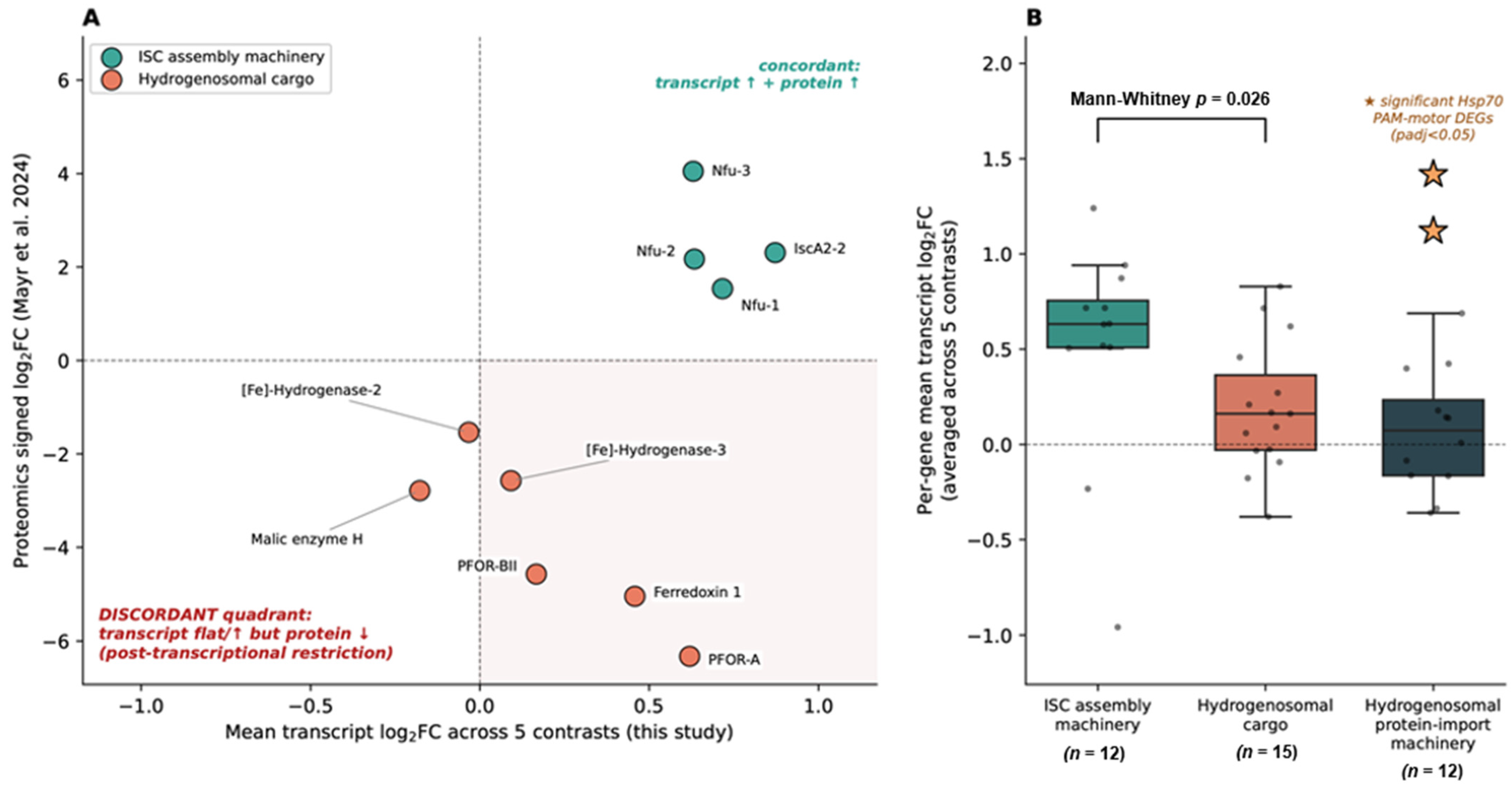
2.7. Cross-Comparison with Published Proteomic Data
2.8. Statistical Reporting Conventions
3. Results
3.1. Distribution of 5-Nitroimidazole Minimum Lethal Concentrations
3.2. Identification of Differentially Expressed Genes by MTZ Resistance Status
3.2.1. Differential Gene Expression in Isolates with Low-MTZ-Resistance MLCs
3.2.2. Differential Gene Expression in Isolates with Intermediate MTZ MLCs
3.2.3. Differential Gene Expression in Isolates with High MTZ MLCs
3.2.4. Cross-Drug Differential Gene Expression Overlap Among 5-Nitroimidazoles
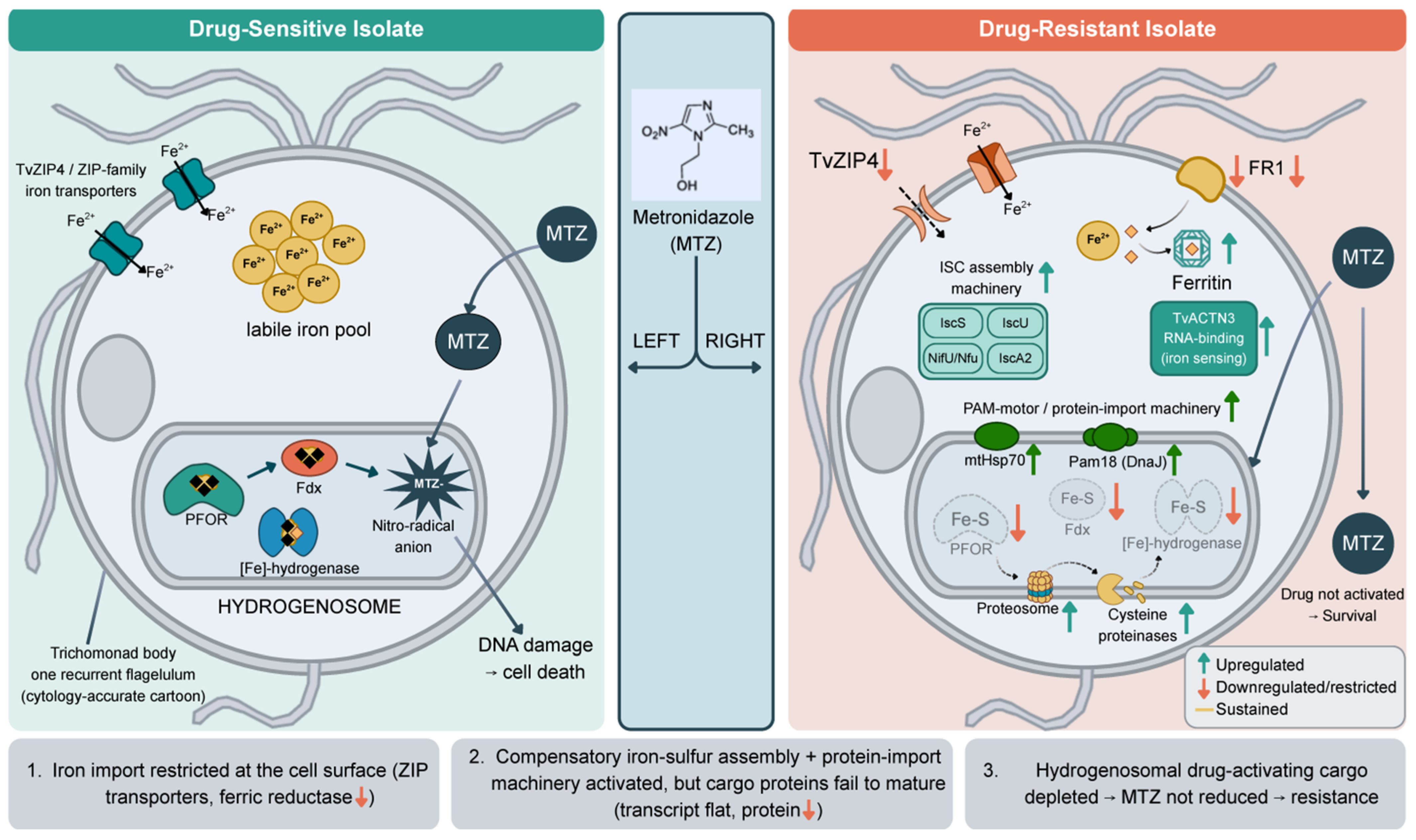
3.3. Iron Transport Restriction in Resistant Isolates
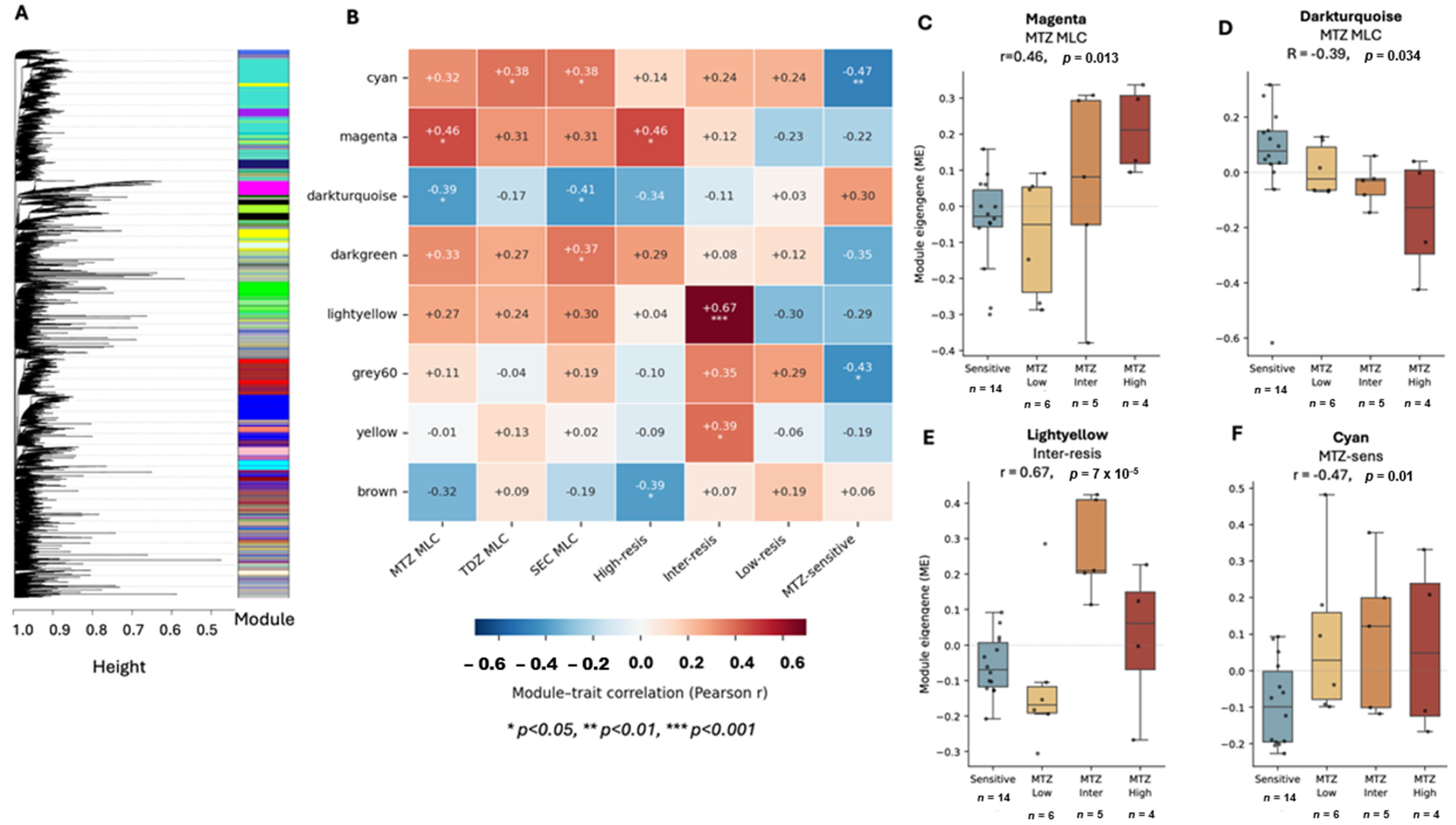
3.4. Weighted Gene Co-Expression Network Analysis (WGCNA) Results
3.4.1. Modules Associated with MTZ Resistance
3.4.2. Modules Associated with TDZ and SEC Resistance
3.4.3. Integration of WGCNA Modules with DEG Lists
3.5. Transcript–Protein Discordance: Coordinated Iron/Redox Pathway Response
3.6. Cross-Comparison with Proteomics Data
4. Discussion
Supplementary Materials
Author Contributions
Funding
Institutional Review Board Statement
Informed Consent Statement
Data Availability Statement
Acknowledgments
Conflicts of Interest
References
- Kissinger, P. Trichomonas vaginalis: A review of epidemiologic, clinical and treatment issues. BMC Infect. Dis. 2015, 15, 307. [Google Scholar] [CrossRef] [PubMed]
- Meites, E.; Gaydos, C.A.; Hobbs, M.M.; Kissinger, P.; Nyirjesy, P.; Schwebke, J.R.; Secor, W.E.; Sobel, J.D.; Workowski, K.A. A review of evidence-based care of symptomatic trichomoniasis and asymptomatic Trichomonas vaginalis infections. Clin. Infect. Dis. 2015, 61, S837–S848. [Google Scholar] [CrossRef]
- Workowski, K.A.; Bachmann, L.H.; Chan, P.A.; Johnston, C.M.; Muzny, C.A.; Park, I.; Reno, H.; Zenilman, J.M.; Bolan, G.A. Sexually transmitted infections treatment guidelines, 2021. MMWR Recomm. Rep. 2021, 70, 1–187. [Google Scholar] [CrossRef]
- Patel, E.U.; Gaydos, C.A.; Packman, Z.R.; Quinn, T.C.; Tobian, A.A.R. Prevalence and correlates of Trichomonas vaginalis infection among men and women in the United States. Clin. Infect. Dis. 2018, 67, 211–217. [Google Scholar] [CrossRef]
- Muzny, C.A.; George, S.; Kissinger, P.J.; Van Gerwen, O.T. Trichomoniasis and other sexually transmitted parasitic diseases in women. Clin. Obstet. Gynecol. 2025, 68, 194–205. [Google Scholar] [CrossRef]
- Cosar, C.; Julou, L. The activity of 1-(2-hydroxyethyl)-2-methyl-5-nitroimidazole (r. P. 8823) against experimental Trichomonas vaginalis infections. Ann. Inst. Pasteur. 1959, 96, 238–241. [Google Scholar]
- Robinson, S.C. Trichomonal vaginitis resistant to metranidazole. Can. Med. Assoc. J. 1962, 86, 665. [Google Scholar]
- Muzny, C.A. Why does Trichomonas vaginalis continue to be a “neglected” sexually transmitted infection? Clin. Infect. Dis. 2018, 67, 218–220. [Google Scholar] [CrossRef] [PubMed]
- Hoots, B.E.; Peterman, T.A.; Torrone, E.A.; Weinstock, H.; Meites, E.; Bolan, G.A. A trich-y question: Should Trichomonas vaginalis infection be reportable? Sex. Transm. Dis. 2013, 40, 113–116. [Google Scholar] [CrossRef]
- Kirkcaldy, R.D.; Augostini, P.; Asbel, L.E.; Bernstein, K.T.; Kerani, R.P.; Mettenbrink, C.J.; Pathela, P.; Schwebke, J.R.; Secor, W.E.; Workowski, K.A.; et al. Trichomonas vaginalis antimicrobial drug resistance in 6 us cities, STD surveillance network, 2009–2010. Emerg. Infect. Dis. 2012, 18, 939–943. [Google Scholar] [CrossRef]
- Schwebke, J.R.; Barrientes, F.J. Prevalence of Trichomonas vaginalis isolates with resistance to metronidazole and tinidazole. Antimicrob. Agents Chemother. 2006, 50, 4209–4210. [Google Scholar] [CrossRef]
- Bosserman, E.A.; Helms, D.J.; Mosure, D.J.; Secor, W.E.; Workowski, K.A. Utility of antimicrobial susceptibility testing in Trichomonas vaginalis-infected women with clinical treatment failure. Sex. Transm. Dis. 2011, 38, 983–987. [Google Scholar] [CrossRef]
- Graves, K.J.; Reily, C.; Tiwari, H.K.; Srinivasasainagendra, V.; Secor, W.E.; Novak, J.; Muzny, C.A. Identification of Trichomonas vaginalis 5-nitroimidazole resistance targets. Pathogens 2023, 12, 692. [Google Scholar] [CrossRef]
- Mayr, A.L.; Paunkov, A.; Hummel, K.; Razzazi-Fazeli, E.; Leitsch, D. Comparative proteomic analysis of metronidazole-sensitive and resistant Trichomonas vaginalis suggests a novel mode of metronidazole action and resistance. Int. J. Parasitol. Drugs Drug Resist. 2024, 26, 100566. [Google Scholar] [CrossRef]
- Augostini, P.; Bradley, E.L.P.; Raphael, B.H.; Secor, W.E. In vitro testing of Trichomonas vaginalis drug susceptibility: Evaluation of minimal lethal concentrations for metronidazole and tinidazole that correspond with treatment failure. Sex. Transm. Dis. 2023, 50, 370–373. [Google Scholar] [CrossRef]
- Aurrecoechea, C.; Brestelli, J.; Brunk, B.P.; Carlton, J.M.; Dommer, J.; Fischer, S.; Gajria, B.; Gao, X.; Gingle, A.; Grant, G.; et al. GiardiaDB and TrichDB: Integrated genomic resources for the eukaryotic protist pathogens Giardia lamblia and Trichomonas vaginalis. Nucleic Acids Res. 2009, 37, D526–D530. [Google Scholar] [CrossRef]
- Dunne, R.L.; Dunn, L.A.; Upcroft, P.; O’Donoghue, P.J.; Upcroft, J.A. Drug resistance in the sexually transmitted protozoan Trichomonas vaginalis. Cell Res. 2003, 13, 239–249. [Google Scholar] [CrossRef]
- Beltran, N.C.; Horvathova, L.; Jedelsky, P.L.; Sedinova, M.; Rada, P.; Marcincikova, M.; Hrdy, I.; Tachezy, J. Iron-induced changes in the proteome of Trichomonas vaginalis hydrogenosomes. PLoS ONE 2013, 8, e65148. [Google Scholar] [CrossRef]
- Argaez-Correa, W.; Alvarez-Sanchez, M.E.; Arana-Argaez, V.E.; Ramirez-Camacho, M.A.; Novelo-Castilla, J.S.; Coral-Martinez, T.I.; Torres-Romero, J.C. The role of iron status in the early progression of metronidazole resistance in Trichomonas vaginalis under microaerophilic conditions. J. Eukaryot. Microbiol. 2019, 66, 309–315. [Google Scholar] [CrossRef]
- Graves, K.J.; Novak, J.; Secor, W.E.; Kissinger, P.J.; Schwebke, J.R.; Muzny, C.A. A systematic review of the literature on mechanisms of 5-nitroimidazole resistance in Trichomonas vaginalis. Parasitology 2020, 147, 1383–1391. [Google Scholar] [CrossRef]
- Gehl, V.; Paunkov, A.; Leitsch, D. A reassessment of the role of oxygen scavenging enzymes in the emergence of metronidazole resistance in trichomonads. Int. J. Parasitol. Drugs Drug Resist. 2021, 16, 38–44. [Google Scholar] [CrossRef]
- Leitsch, D.; Burgess, A.G.; Dunn, L.A.; Krauer, K.G.; Tan, K.; Duchene, M.; Upcroft, P.; Eckmann, L.; Upcroft, J.A. Pyruvate: Ferredoxin oxidoreductase and thioredoxin reductase are involved in 5-nitroimidazole activation while flavin metabolism is linked to 5-nitroimidazole resistance in Giardia lamblia. J. Antimicrob. Chemother. 2011, 66, 1756–1765. [Google Scholar] [CrossRef]
- Leitsch, D.; Drinic, M.; Kolarich, D.; Duchene, M. Down-regulation of flavin reductase and alcohol dehydrogenase-1 (ADH1) in metronidazole-resistant isolates of Trichomonas vaginalis. Mol. Biochem. Parasitol. 2012, 183, 177–183. [Google Scholar] [CrossRef]
- Leitsch, D.; Janssen, B.D.; Kolarich, D.; Johnson, P.J.; Duchene, M. Trichomonas vaginalis flavin reductase 1 and its role in metronidazole resistance. Mol. Microbiol. 2014, 91, 198–208. [Google Scholar] [CrossRef] [PubMed]
- Tachezy, J.; Makki, A.; Hrdy, I. The hydrogenosome of Trichomonas vaginalis. J. Eukaryot. Microbiol. 2022, 69, e12922. [Google Scholar] [CrossRef]
- Land, K.M.; Clemens, D.L.; Johnson, P.J. Loss of multiple hydrogenosomal proteins associated with organelle metabolism and high-level drug resistance in trichomonads. Exp. Parasitol. 2001, 97, 102–110. [Google Scholar] [CrossRef]
- Kulda, J. Trichomonads, hydrogenosomes and drug resistance. Int. J. Parasitol. 1999, 29, 199–212. [Google Scholar] [CrossRef]
- Hrdy, I.; Cammack, R.; Stopka, P.; Kulda, J.; Tachezy, J. Alternative pathway of metronidazole activation in Trichomonas vaginalis hydrogenosomes. Antimicrob. Agents Chemother. 2005, 49, 5033–5036. [Google Scholar] [CrossRef]
- Hrdy, I.; Hirt, R.P.; Dolezal, P.; Bardonova, L.; Foster, P.G.; Tachezy, J.; Embley, T.M. Trichomonas hydrogenosomes contain the NADH dehydrogenase module of mitochondrial complex I. Nature 2004, 432, 618–622. [Google Scholar] [CrossRef] [PubMed]
- Johnson, P.J.; Lahti, C.J.; Bradley, P.J. Biogenesis of the hydrogenosome in the anaerobic protist Trichomonas vaginalis. J. Parasitol. 1993, 79, 664–670. [Google Scholar] [CrossRef] [PubMed]
- Mentel, M.; Zimorski, V.; Haferkamp, P.; Martin, W.; Henze, K. Protein import into hydrogenosomes of Trichomonas vaginalis involves both N-terminal and internal targeting signals: A case study of thioredoxin reductases. Eukaryot. Cell 2008, 7, 1750–1757. [Google Scholar] [CrossRef] [PubMed]



| STATUS | ID | MTZ MLC | TDZ MLC | SEC MLC |
|---|---|---|---|---|
| HIGH MLC RESISTANCE MTZ MLC ≥ 400 µg/mL | CDC0685 | 400 | 400 | 50 |
| CDC1631 | 400 | 50 | 3.1 | |
| CDC6505 | 400 | 400 | 25 | |
| TV009 | 400 | 25 | 100 | |
| INTERMEDIATE MLC RESISTANCE MTZ MLC = 100–200 µg/mL | CDC1629 | 200 | 25 | 200 |
| CDC1650 | 200 | 25 | 3.1 | |
| CDC5601 | 100 | 50 | 3.1 | |
| LUP009 | 100 | 50 | 50 | |
| VC004 | 100 | 12.5 | 50 | |
| LOW MLC RESISTANCE MTZ MLC = 50 µg/mL | CDC1550 | 50 | 6.3 | 50 |
| CDC1582 | 50 | 3.1 | 1.6 | |
| TV1062 | 50 | 0.8 | 25 | |
| VC005 | 50 | 100 | 25 | |
| VC006 | 50 | 25 | 50 | |
| VC010 | 50 | 12.5 | 50 | |
| MTZ-SENSITIVE MLCs MTZ MLC < 50 µg/mL | TV1054 | 25 | 0.8 | 6.3 |
| LUP007 | 12.5 | 3.1 | 1.6 | |
| WF001 | 12.5 | 1.6 | 12.5 | |
| LUP005 | 6.3 | 3.1 | 3.1 | |
| LUP006 | 6.3 | 1.6 | 12.5 | |
| CDC520 | 3.1 | 0.8 | 1.6 | |
| LUP001 | 3.1 | 0.8 | 6.3 | |
| LUP002 | 3.1 | 1.6 | 0.2 | |
| LUP004 | 3.1 | 0.8 | 1.6 | |
| VC001 | 3.1 | 1.6 | 3.1 | |
| ECU001 | 1.6 | 3.1 | 3.1 | |
| LUP003 | 1.6 | 1.6 | 12.5 | |
| LUP008 | 1.6 | 1.6 | 0.8 | |
| TV1038 | 0.4 | 1.6 | ≤0.2 | |
| VC003 | 0.4 | 0.8 | 1.6 |
Disclaimer/Publisher’s Note: The statements, opinions and data contained in all publications are solely those of the individual author(s) and contributor(s) and not of MDPI and/or the editor(s). MDPI and/or the editor(s) disclaim responsibility for any injury to people or property resulting from any ideas, methods, instructions or products referred to in the content. |
© 2026 by the authors. Licensee MDPI, Basel, Switzerland. This article is an open access article distributed under the terms and conditions of the Creative Commons Attribution (CC BY) license.
Share and Cite
Graves, K.J.; Reily, C.; Secor, W.E.; Novak, J.; Muzny, C.A. Transcriptomic Signatures of Trichomonas vaginalis Isolates That Exhibit Low, Intermediate, and High In Vitro Resistance to Metronidazole. Microorganisms 2026, 14, 1314. https://doi.org/10.3390/microorganisms14061314
Graves KJ, Reily C, Secor WE, Novak J, Muzny CA. Transcriptomic Signatures of Trichomonas vaginalis Isolates That Exhibit Low, Intermediate, and High In Vitro Resistance to Metronidazole. Microorganisms. 2026; 14(6):1314. https://doi.org/10.3390/microorganisms14061314
Chicago/Turabian StyleGraves, Keonte J., Colin Reily, W. Evan Secor, Jan Novak, and Christina A. Muzny. 2026. "Transcriptomic Signatures of Trichomonas vaginalis Isolates That Exhibit Low, Intermediate, and High In Vitro Resistance to Metronidazole" Microorganisms 14, no. 6: 1314. https://doi.org/10.3390/microorganisms14061314
APA StyleGraves, K. J., Reily, C., Secor, W. E., Novak, J., & Muzny, C. A. (2026). Transcriptomic Signatures of Trichomonas vaginalis Isolates That Exhibit Low, Intermediate, and High In Vitro Resistance to Metronidazole. Microorganisms, 14(6), 1314. https://doi.org/10.3390/microorganisms14061314