Expanding the PHES-ODM: A Comprehensive, Open-Source Data Model for the Future of Wastewater-Based Epidemiology

 , , , , , ,
  and
and
Abstract
1. Introduction
2. Materials and Methods
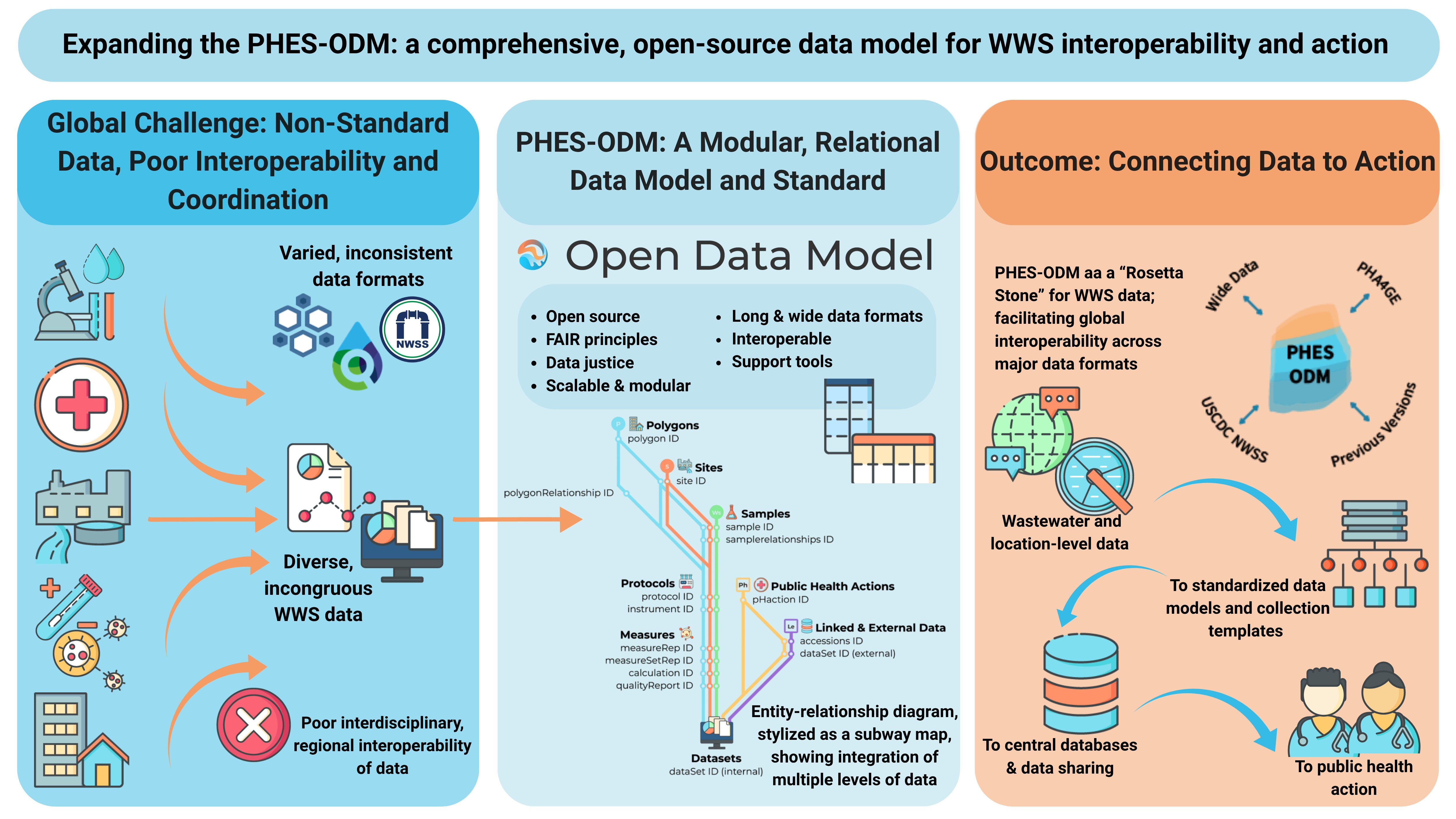
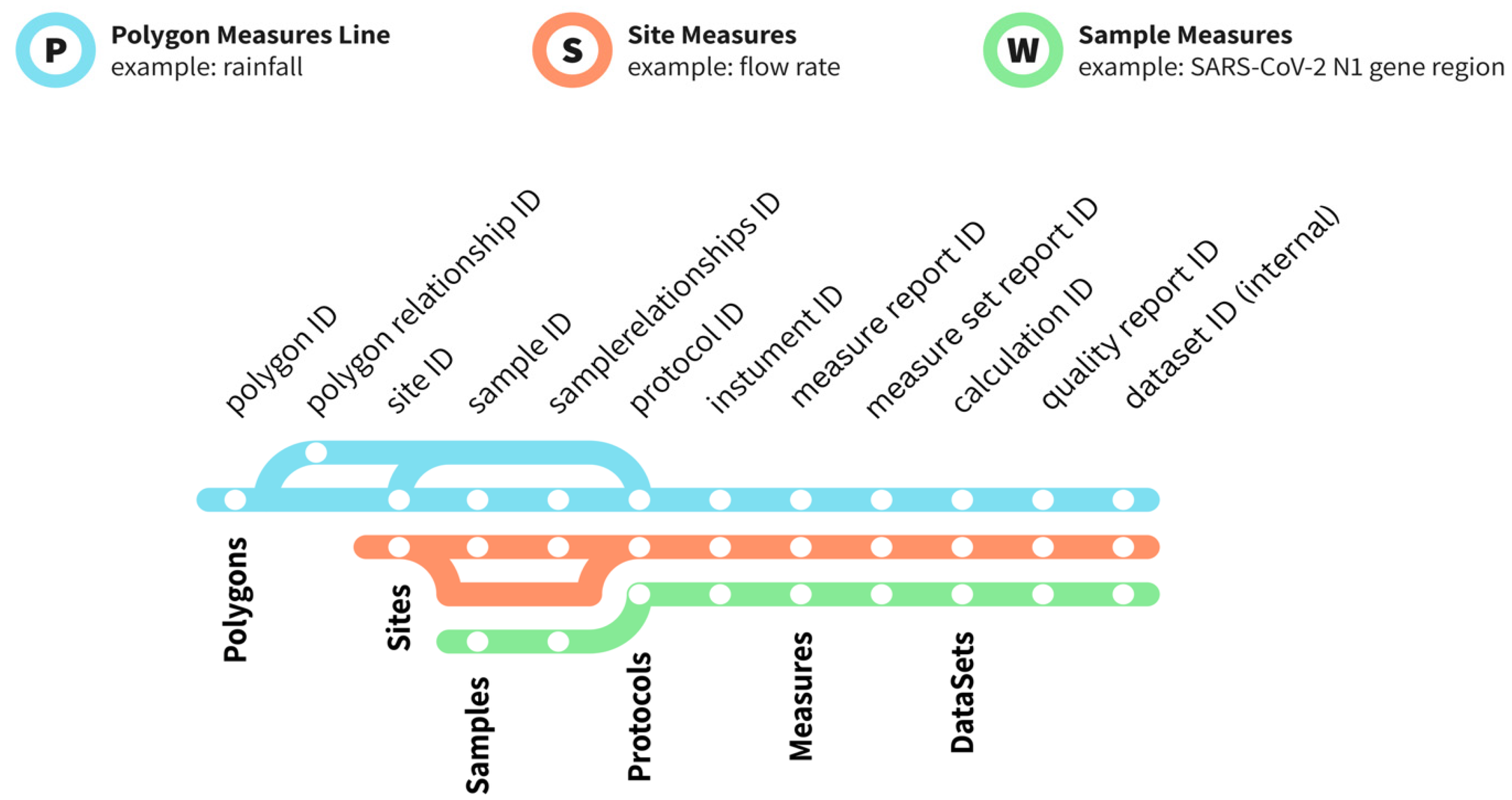
2.1. Overview of the PHES-ODM: The Structure of the Model
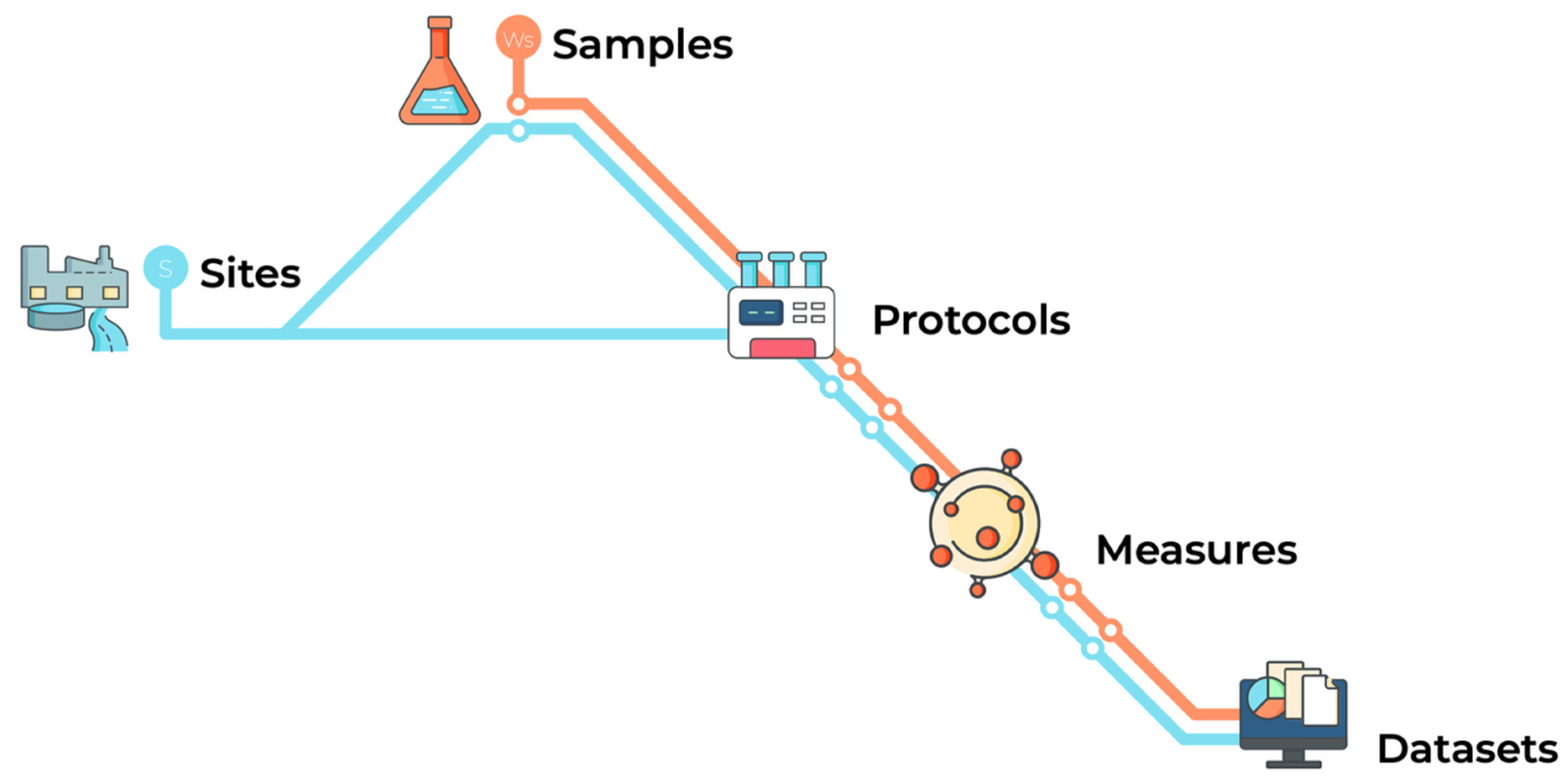
- Polygons: Defined areas such as catchments and administrative regions;
- Sites: Technical data such as flow rate at a treatment plant;
- Samples: A discrete portion of water collected at a point or over a period;
- Measures: Any observation from a site or sample;
- Populations: Public health outcomes for a defined area.
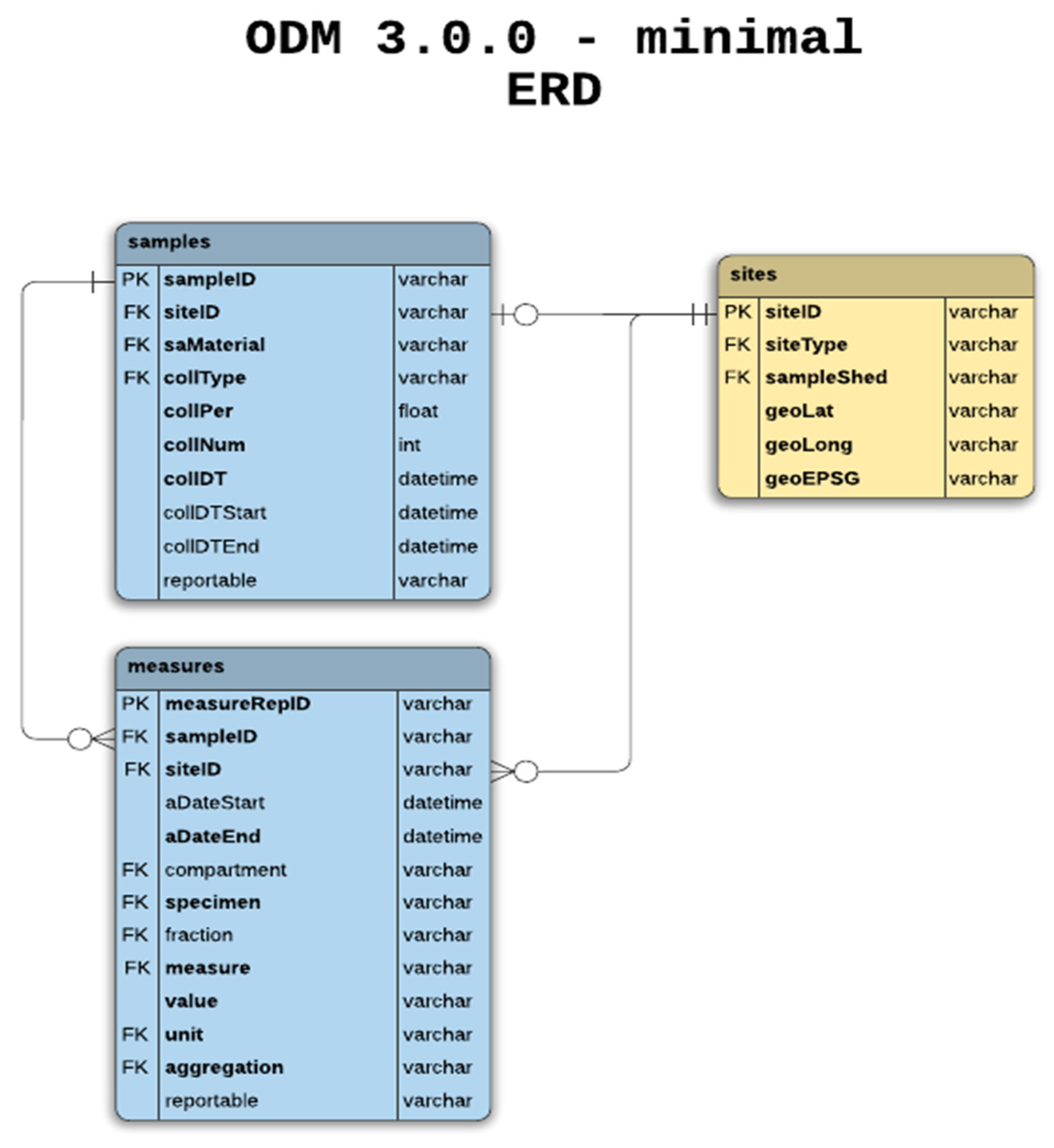
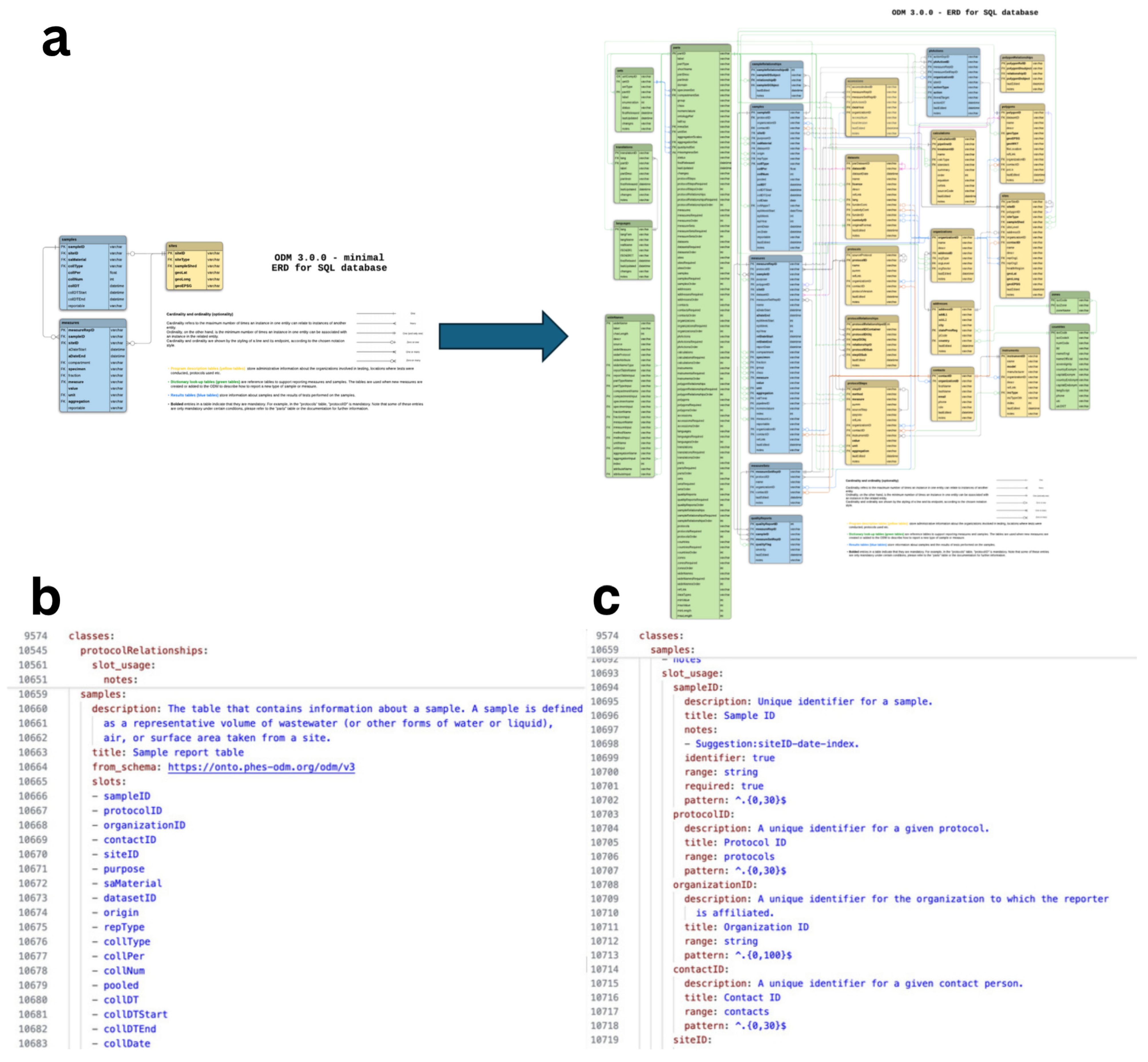
2.2. Minimal Version of the PHES-ODM
2.3. Model Governance and Future Transitions
2.4. Audience and Aims for WWS Data
2.5. WWS Data Standardization and Interoperability
2.6. Semantic Integration and Shared Formatting
2.7. Lessons from Other Data Standards and Models
2.8. Structural Solutions for Data Challenges and Interoperability
- Data dictionaries and ontology integration to counter ambiguous data definitions.
- Protocols and calculations data tables to counter a lack of contextual information.
- Data relevancy periods to clarify data temporality.
- “Last edited” and “notes” fields for tracking data corrections transparently.
- A “site level” and “specimen” field for tracking spatial resolution of the data.
- “Reportable” and “quality flag” fields for recording measure quality issues; a validation library to improve data quality issues.
- “License“ fields connected to datasets and measures to ensure responsible and legal use.
- Documentation and online community resources to balance ease of use against a robust model.
- Outreach and extensive documentation.
- Building tools with built-for-purpose interfaces, including data parsers and validators.
- Ready-to-use templates for common use cases, and video documentation to support their uptake.
- Adoption incentives.

| Feature | PHES-ODM | NORMAN SCORE | W-SPHERE | NWSS | PHA4GE | AMELAG | MIxS |
|---|---|---|---|---|---|---|---|
| Reference | Manuel et al., 2021 [13]; Therrien et al., 2024 [14] | NORMAN Network, 2020 [52] | Global Water Pathogens Project, 2020 [53] | USCDC [16] | Griffiths et al., 2022 [54]; Paull et al., 2025 [55] | RKI, 2025 [56]; RKI & UBA, 2026 [57] | Genomic Standards Consortium [58] |
| Intended Audience | WWS practitioners (public health authorities, Engineers in WWS) | Ecotoxicologists, SARS-CoV-2 template for WBE practitioners | WWS practitioners | WWS practitioners | Environmental Genomics | WWS practitioners | Environmental Genomics |
| Documentation language | Narrative documentation: English; database definitions and data dictionary: English, French, Spanish, Portuguese | English | English | English | English | German, English | English |
| Public data dictionary of headers and tables | Yes | No | Yes | No (outdated version available from USCDC archive) | Yes | Yes | Yes |
| Public data dictionary of values | Yes | No | No | No (outdated version available from USCDC archive) | Yes | No | Yes |
| Database structure type | Relational database | Flat-file database | Flat-file database | Flat-file database | Flat-file database | Flat-file database | Flat-file database |
| Public database definition | Yes | Yes | No | No | Yes | Yes | No |
| Public data conversion tools | Yes | No | No | No | Yes | No | No |
| Public data validation tools | Dictionary, software tool, templates, validation rules schema | Template | Template | None | Dictionary, software tool, templates | Dictionary, validation rules schema | Dictionary, software tool |
| Public data sharing infrastructure | Python library, explicit measure and dataset licensing, external dataset linkages | No | High-level dashboard | High-level dashboard | Software tool (DataHarmonizer v1.6.5) | Dashboard, Zenodo publication of data | Many repositories require adherence to this standard to share |
| Public data collection templates | Yes | Yes | Yes | No | Yes | No | No |
| Governance and development | Open source | Inter-institutional | Internal | Internal | Open source | Internal | Open source |
| Model license | CC-BY4 | Not found for the model, but the template is open access | Not found | Not found | CC-BY4 | CC-BY4 | CC-BY4 |
| Clear channels for user feedback | GitHub issues, Discourse discussion board, email maintainers | Email maintainers | Email maintainers | Email maintainers | GitHub issues, email maintainers | Email maintainers | GitHub issues, email maintainers |
| Rights management | Element level (any row, header or combination) | Dataset level | Dataset level | Dataset level | Dataset level | Dataset level | Dataset level |
| Environmental compartments | Various | Various, but only wastewater in the template | Wastewater | Wastewater | Various | Wastewater | Various |
| Pathogen measurement | Any pathogen in the dictionary (Multiple+) | Yes, but only SARS-CoV-2 in template | SARS-CoV-2-specific | Multiple | Multiple | Multiple | Multiple |
| Detailed protocol recording and linkage | Yes | No | No | No | No | No | No |
| Detailed sample relationship records | Yes | No | No | No | No | No | No |
| Measurement methods | Yes | Yes, but only PCR and sequencing-specific in the template | PCR and sequencing-specific | PCR and sequencing-specific | Sequencing-specific | Not found | Sequencing-specific |
| In-sample measurements | Any measure in the dictionary | Water quality, but only PCR in the template | PCR and sequencing | PCR and sequencing, pH, Conductivity, TSS | PCR and sequencing, water quality | PCR and sequencing, pH, temperature | PCR and sequencing, water quality |
| Collection site information | Yes | Yes | Yes | Yes | Yes | Yes | WWTP infrastructure details |
| On-site measurements | Any measure in the dictionary (expandable) | Flow, weather, COD, TSS, NH4+-N, water temperature | Flow | Flow, water temperature | Flow, weather, COD, TSS, NH4+-N, water temperature, conductivity, pH, contamination | Flow, pH, temperature | COD, TSS, NH4+-N, phosphate, salinity, |
| Population count | Served by site, or within a geographic region (polygon) | Served by site | Served by site | Served by site | Served by site | Served by site | No |
| Sewer network information | Possible to record details as measures in the dictionary | No | No | Average wastewater travel time, industrial input, stormwater input | Upstream activity and treatment | No | Industrial input, reactor type, sludge retention time |
| Sample and sampling method | Yes | Yes | Yes | Yes | Yes | No | No |
| Used by a national/ supranational WWS programme | Yes | No | No | Yes | No | Yes | No |
| Records provenance and transformation steps | Yes | No | No | No | Yes (accession IDs for reference sequences; libraries and processing software) | Yes (reports viral load, flow-standardized viral load, and predicted viral load) | Yes (libraries and processing software) |
| Genomic repository linkages | Yes | No | No | No | Yes | No | Yes |
| Population health data | Any measure in the dictionary (aggregate health data—population level) | SARS-CoV-2 prevalence | No | No | No | No | No |
| Ontology integration | Limited | No | No | No | Yes | No | Yes |
| Interoperable with at least one other major dictionary using public tools | Yes (PHA4GE, NWSS) | No | No | Yes (PHES-ODM; managed by PHES-ODM) | Yes (PHES-ODM; managed by PHES-ODM) | No | No |
3. Results and Discussion
3.1. Addressing the Audience: Public Health Surveillance
The Public Health Actions Table
3.2. Addressing the Audience: Data Analysts
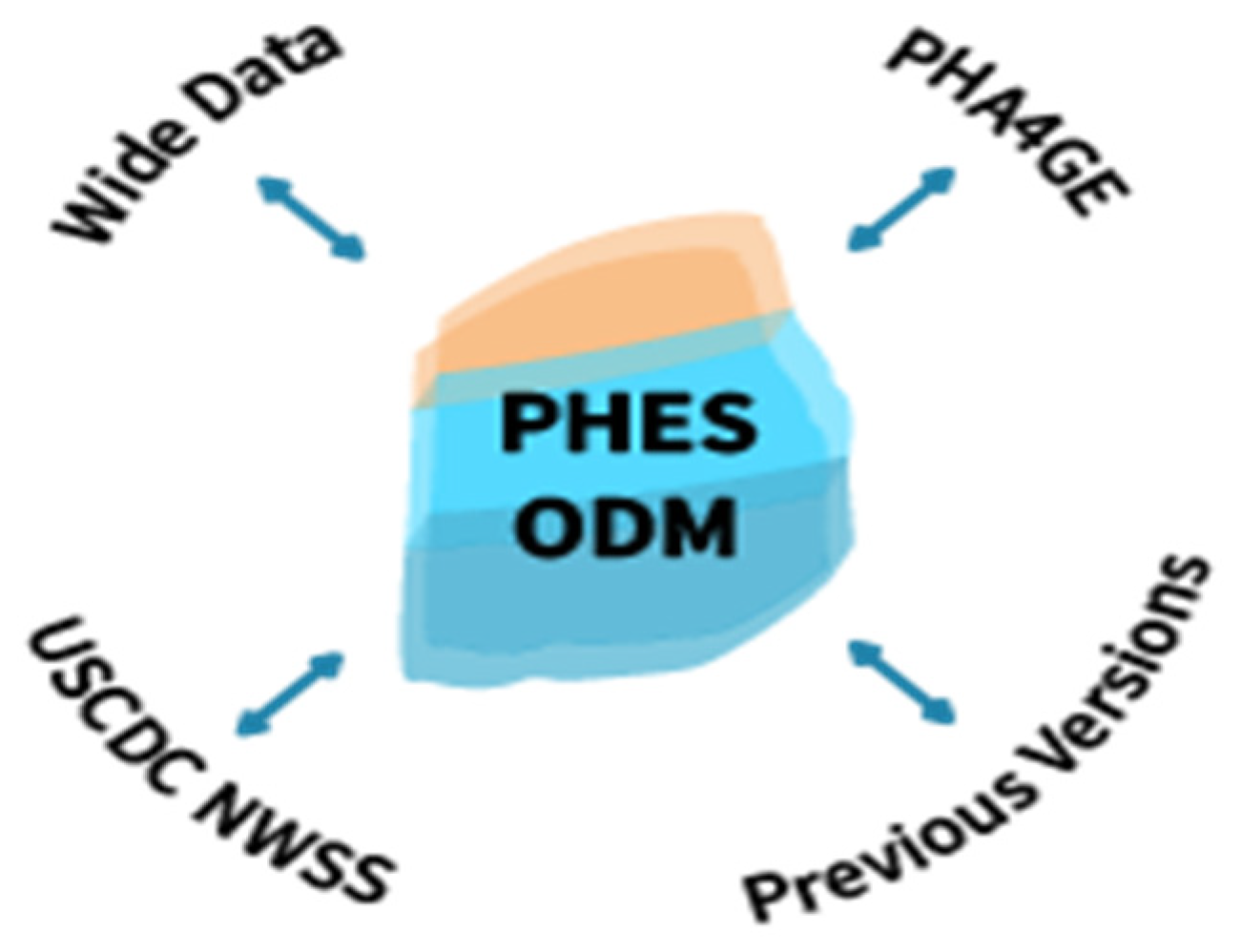
3.3. Addressing Standardization Challenges: Data Mapping and Interoperability

3.4. Implementing Structural Solutions: Expanding Metadata and Their Context
3.4.1. Implementing Structural Solutions: Data Definitions
3.4.2. Implementing Structural Solutions: Defining Temporality of Data
3.4.3. Implementing Structural Solutions: Contextualizing Data Quality
3.4.4. Implementing Structural Solutions: Ownership and Licensing
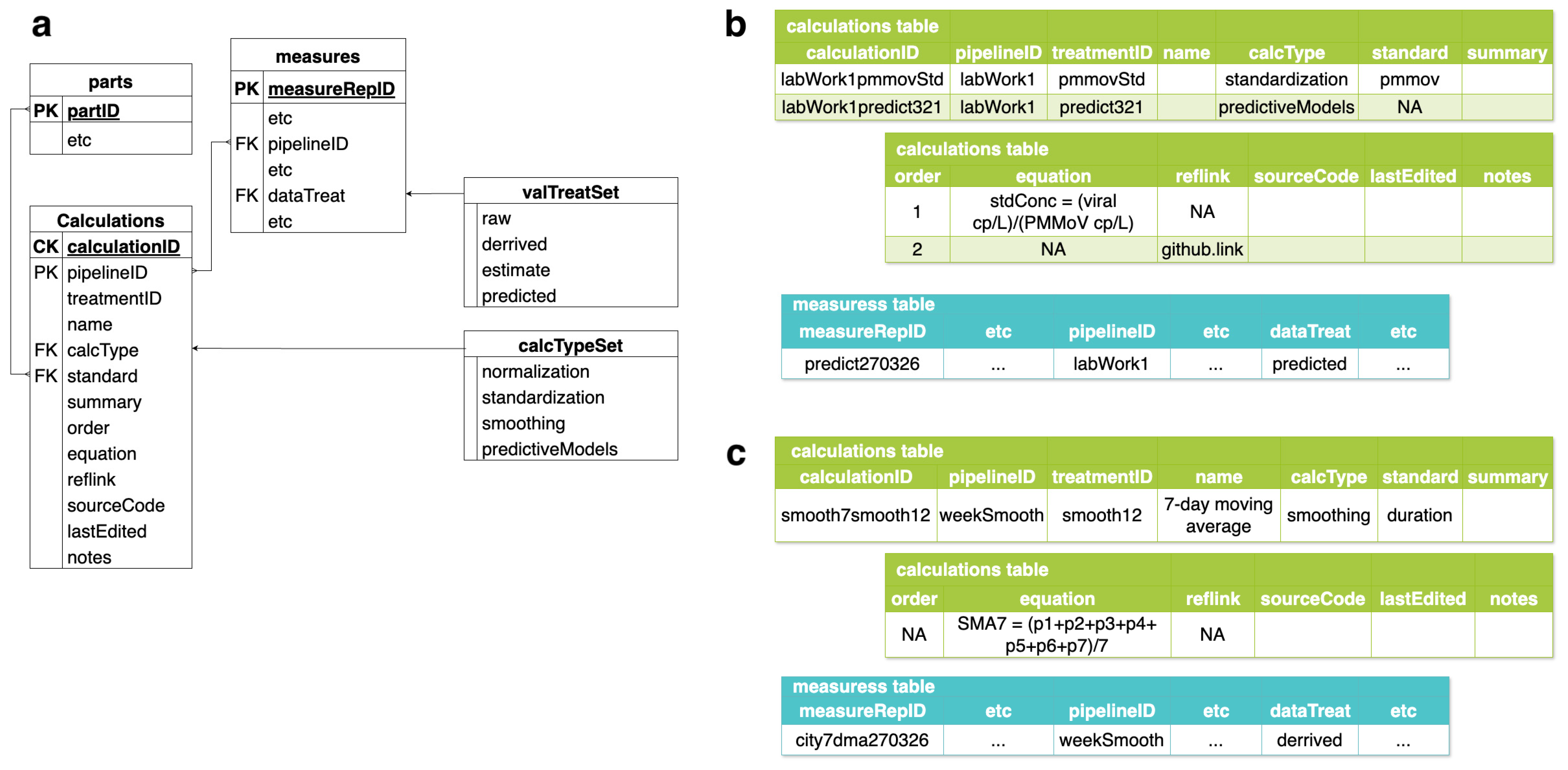
3.4.5. Implementing Structural Solutions: Data Treatments and the Calculations Table
3.4.6. Implementing Structural Solutions: Site Level and Recording Spatial Resolution
3.4.7. Implementing Structural Solutions: Robustness vs. Ease of Use
3.4.8. Implementing Structural Solutions: Expanding Data Relationships
3.4.9. Implementing Structural Solutions: Future Directions
4. Conclusions
Author Contributions
Funding
Institutional Review Board Statement
Informed Consent Statement
Data Availability Statement
Acknowledgments
Conflicts of Interest
Abbreviations
| CDM | Common Data Model |
| COD | Chemical Oxygen Demand |
| CWL | Common Workflow Language |
| EDGE | Enterics, Diagnostics, Genomics & Epidemiology |
| FAIR | Findable, Accessible, Interoperable, and Reuseable |
| FHIR | Fast Health Interoperability Resources |
| FK | Foreign Key |
| GIS | Geographic Information System(s) |
| GISAID | Global Initiative on Sharing All Influenza Data |
| GMA | Greater Metropolitan Area |
| HL7 | Health Level Seven International |
| ICHI | International Classification of Health Interventions |
| LOINC | Logical Observation Identifiers Names and Codes |
| MIxS | Minimum Information about any (x) Sequence |
| NH4+-N | Nitrogen present as ammonium |
| NWSS | National Wastewater Surveillance System |
| OHDSI | Observational Health Data Sciences and Informatics |
| OMOP | Observational Medical Outcomes Partnership |
| PCR | Polymerase Chain Reaction |
| PHA4GE | Public Health Alliance for (4) Genomic Surveillance |
| PHAC | Public Health Agency of Canada |
| PHES-EF | Public Health and Environmental Surveillance Evaluation Framework |
| PHES-ODM | Public Health and Environmental Surveillance Open Data Model |
| PK | Primary Key |
| PMMoV | Pepper Mild Mottle Virus |
| RKI | Robert Koch Institute |
| SSSOM | Simple Standard for Sharing Ontological Mappings |
| TSS | Total Suspended Solids |
| UBA | Umweltbundesamt (German Federal Environment Agency) |
| USCDC | United States Centers for Disease Control and Prevention |
| WDL | Workflow Description Language |
| WWE | Wastewater Epidemiology |
| WHO | World Health Organization |
| WHO-FIC | World Health Organization Family of International Classifications |
| WWS | Wastewater Surveillance |
| WWTP | Wastewater Treatment Plant |
References
- Singh, S.; Ahmed, A.I.; Almansoori, S.; Alameri, S.; Adlan, A.; Odivilas, G.; Chattaway, M.A.; Salem, S.B.; Brudecki, G.; Elamin, W. A narrative review of wastewater surveillance: Pathogens of concern, applications, detection methods, and challenges. Front. Public Health 2024, 12, 1445961. [Google Scholar] [CrossRef] [Scilit] [PubMed]
- van der Drift, A.; Welling, A.; Arntzen, V.; Nagelkerke, E.; van der Beek, R.; de Roda Husman, A. Wastewater surveillance studies on pathogens and their use in public health decision-making: A scoping review. Sci. Total Environ. 2025, 993, 179982. [Google Scholar] [CrossRef] [Scilit]
- Naughton, C.; Roman, F.; Alvarado, A.G.; Tariqi, A.Q.; Deeming, M.A.; Kadonsky, K.F.; Bibby, K.; Bivins, A.; Medema, G.; Ahmed, W.; et al. Show us the data: Global COVID-19 wastewater monitoring efforts, equity, and gaps. FEMS Microbes 2023, 4, xtad003. [Google Scholar] [CrossRef] [Scilit]
- COVIDPoops19. ArcGIS Dashboard. 2024. Available online: https://www.arcgis.com/apps/dashboards/c778145ea5bb4daeb58d31afee389082 (accessed on 3 March 2026).
- Keshaviah, A.; Diamond, M.B.; Wade, M.J.; Scarpino, S.V. Wastewater monitoring can anchor global disease surveillance systems. Lancet Glob. Health 2023, 11, e976–e981. [Google Scholar] [CrossRef] [Scilit]
- Diamond, M.B.; Whistler, T.; Rando, K.; Nwachukwu, C.; Yousif, M. Policy dimensions of global wastewater surveillance. Bull. World Health Organ. 2024, 102, 622–622A. [Google Scholar] [CrossRef] [Scilit] [PubMed]
- Rockefeller Foundation. Wastewater Surveillance. Available online: https://www.rockefellerfoundation.org/initiatives/wastewater-surveillance/ (accessed on 3 March 2026).
- Bill & Melinda Gates Foundation. Enterics, Diagnostics, Genomics & Epidemiology (EDGE). Available online: https://www.gatesfoundation.org/our-work/programs/global-health/enterics-diagnostics-genomics-and-epidemiology (accessed on 3 March 2026).
- GLOWACON (Global Consortium for Wastewater and Environmental Surveillance for Public Health). Available online: https://glowacon.org (accessed on 3 March 2026).
- Manuel, D.G.; Amadei, C.A.; Campbell, J.R.; Brault, J.-M.; Veillard, J. Strengthening Public Health Surveillance Through Wastewater Testing: An Essential Investment for the COVID-19 Pandemic and Future Health Threats; World Bank: Washington, DC, USA, 2022. [Google Scholar] [CrossRef] [Scilit]
- van Panhuis, W.G.; Paul, P.; Emerson, C.; Grefenstette, J.; Wilder, R.; Herbst, A.J.; Heymann, D.; Burke, D.S. A systematic review of barriers to data sharing in public health. BMC Public Health 2014, 14, 1144. [Google Scholar] [CrossRef] [Scilit]
- Wilkinson, M.; Dumontier, M.; Aalbersberg, I.J.; Appleton, G.; Axton, M.; Baak, A.; Blomberg, N.; Boiten, J.W.; Santos, L.B.D.S.; Bourne, P.E.; et al. The FAIR guiding principles for scientific data management and stewardship. Sci. Data 2016, 3, 160018. [Google Scholar] [CrossRef] [Scilit]
- Manuel, D.G.; Therrien, J.-D.; Thomson, M.; Sion, E.-S.; Maere, T.; Nicolaï, N.; Vanrolleghem, P.A.; The PHES-ODM Research Group/Big Life Lab. PHES-ODM, Version 1.0.0. Computer Software. OSF: Charlottesville, VA, USA, 2021. [CrossRef]
- Therrien, J.-D.; Thomson, M.; Sion, E.-S.; Lee, I.; Maere, T.; Nicolaï, N.; Manuel, D.G.; Vanrolleghem, P.A. A comprehensive, open-source data model for wastewater-based epidemiology. Water Sci. Technol. 2024, 89, 1–19. [Google Scholar] [CrossRef] [Scilit]
- Mathieu, E.; Ritchie, H.; Rodés-Guirao, L.; Appel, C.; Gavrilov, D.; Giattino, C.; Hasell, J.; Macdonald, B.; Dattani, S.; Beltekian, D.; et al. COVID-19 Pandemic. Our World in Data. 2020. Available online: https://ourworldindata.org/coronavirus (accessed on 3 March 2026).
- USCDC (United States Centers for Disease Control and Prevention). National Wastewater Surveillance System (NWSS). Available online: https://www.cdc.gov/nwss/index.html (accessed on 3 March 2026).
- Joung, M.J.; Mangat, C.S.; Mejia, E.; Nagasawa, A.; Nichani, A.; Perez-Iratxeta, C.; Peterson, S.W.; Champredon, D. Coupling Wastewater-Based Epidemiological Surveillance and Modelling of SARS-COV-2/COVID-19: Practical Applications at the Public Health Agency of Canada. medRxiv 2022. [Google Scholar] [CrossRef] [Scilit] [PubMed]
- OClair Environnement. CETo: Connect. Predict. Prevent. 2021. Available online: https://ceto.ca/ (accessed on 3 March 2026).
- Shionogi & Shimadzu. AdvanSentinel. 2025. Available online: https://advansentinel.com/en (accessed on 3 March 2026).
- Pepe, R.S.; Coe, K. Data dictionaries: Essential tools for the ethical and transparent use of integrated data. Int. J. Popul. Data Sci. 2025, 10, 2956. [Google Scholar] [CrossRef] [Scilit]
- D’Ignazio, C.; Klein, L.F. The numbers don’t speak for themselves. In Data Feminism; MIT Press: Cambridge, MA, USA, 2020; pp. 36–57. [Google Scholar]
- Regenstrief Institute. LOINC. Available online: https://loinc.org/ (accessed on 3 March 2026).
- Harrington, J.L. Why good design matters. In Relational Database Design and Implementation, 3rd ed.; Morgan Kaufmann: San Francisco, CA, USA, 2009; pp. 45–50. [Google Scholar]
- Watt, A. The entity relationship data model. In Database Design, 2nd ed.; BCcampus: Victoria, BC, Canada, 2014; pp. 33–48. [Google Scholar]
- Helleiner, E. Economic globalization’s polycrisis. Int. Stud. Q. 2024, 68, sqae024. [Google Scholar] [CrossRef] [Scilit]
- PHES-EF. Public Health Environmental Surveillance Evaluation Framework. Available online: https://phes-ef.org/ (accessed on 3 March 2026).
- European Commission Joint Research Centre. Guidance on Wastewater Surveillance. EU Wastewater Observatory for Public Health. Available online: https://wastewater-observatory.jrc.ec.europa.eu/#/guidance/3 (accessed on 3 March 2026).
- Esri. Polygon. GIS Dictionary. Available online: https://support.esri.com/en-us/gis-dictionary/polygon (accessed on 3 March 2026).
- Moxon, S.A.T.; Solbrig, H.; Harris, N.L.; Kalita, P.; Miller, M.A.; Patil, S.; Schaper, K.; Bizon, C.; Caufield, J.H.; Cuesta, S.C.; et al. LinkML: An open data modeling framework. GigaScience 2026, 15, giaf152. [Google Scholar] [CrossRef] [Scilit]
- PHES-ODM (Public Health Environmental Surveillance Open Data Model). ODM Discourse Forum. Available online: https://odm.discourse.group/latest (accessed on 3 March 2026).
- PHES-ODM (Public Health Environmental Surveillance Open Data Model). PHES-ODM Video Resources [Video Collection]. Vimeo. Available online: https://vimeo.com/user/126292027/folder/6496228 (accessed on 3 March 2026).
- PHES-ODM (Public Health Environmental Surveillance Open Data Model). PHES-ODM Documentation. 2026. Available online: https://docs.phes-odm.org/ (accessed on 3 March 2026).
- Corcho, O.; Eriksson, M.; Kurowski, K.; Ojstersek, M.; Choirat, C.; van de Sanden, M.; Coppens, F. EOSC Interoperability Framework; Publications Office of the European Union: Luxembourg, 2021. [Google Scholar] [CrossRef]
- Vogt, L. The CLEAR principle. J. Biomed. Semant. 2025, 16, 18. [Google Scholar] [CrossRef] [Scilit]
- Emerson, S.D.; McLinden, T.; Sereda, P.; Yonkman, A.M.; Trigg, J.; Peterson, S.; Hogg, R.S.; Salters, K.A.; Lima, V.D.; Barrios, R. Secondary use of routinely collected administrative health data. Int. J. Popul. Data Sci. 2024, 9, 2407. [Google Scholar] [CrossRef] [Scilit]
- Kapitan, D.; Heddema, F.; Dekker, A.; Sieswerda, M.; Verhoeff, B.J.; Berg, M. Data interoperability in context. J. Med. Internet Res. 2025, 27, e66616. [Google Scholar] [CrossRef] [Scilit]
- Narayanan, A.; Toubiana, V.; Barocas, S.; Nissenbaum, H.; Boneh, D. A critical look at decentralized personal data architectures. arXiv 2012. [Google Scholar] [CrossRef] [Scilit]
- Gomstyn, A.; Jonker, A. What Is Data Interoperability? IBM Think. 2026. Available online: https://www.ibm.com/think/topics/data-interoperability (accessed on 3 March 2026).
- ISO Standard No. 8601-1:2019; Date and Time—Representations for Information Interchange—Part 1: Basic Rules. International Organization for Standardization: Geneva, Switzerland, 2019.
- PHES-ODM (Public Health Environmental Surveillance Open Data Model). PHES-ODM Validator. Available online: https://validate.phes-odm.org/ (accessed on 3 March 2026).
- ISO Standard No. 3166-1:2020; Codes for the Representation of Names of Countries and Their Subdivisions—Part 1: Country Code. International Organization for Standardization: Geneva, Switzerland, 2020. Available online: https://www.iso.org/home.html (accessed on 3 March 2026).
- Buttigieg, P.L.; Pafilis, E.; Lewis, S.E.; Schildhauer, M.P.; Walls, R.L.; Mungall, C.J. The environment ontology in 2016: Bridging domains with increased scope, semantic density, and interoperation. J. Biomed. Semant. 2016, 7, 57. [Google Scholar] [CrossRef] [Scilit]
- GenEpiO Consortium. Genomic Epidemiology Ontology. Ontobee. Available online: https://genepio.org/ (accessed on 3 March 2026).
- National Cancer Institute. NCI Thesaurus, Version 26.02d; National Institutes of Health: Bethesda, MD, USA, 2026. Available online: https://www.ebi.ac.uk/ols4/ontologies/ncit (accessed on 3 March 2026).
- Fabry, P.; Barton, A.; Ethier, J.-F. Rethinking Meaning and Ontologies From the Perspective of Ontological Units. Appl. Ontol. 2026, 21, 3–23. [Google Scholar] [CrossRef] [Scilit]
- Matentzoglu, N.; Balhoff, J.; Bello, S.; Bizon, C.; Brush, M.; Callahan, T.; Chute, C.; Duncan, W.; Evelo, C.; Gabriel, D.; et al. A Simple Standard for Sharing Ontological Mappings (SSSOM). Database 2022, 2022, baac035. [Google Scholar] [CrossRef] [Scilit] [PubMed]
- eCQI Resource Center. FHIR®—Fast Healthcare Interoperability Resources®; U.S. Department of Health and Human Services: Washington, DC, USA, 2026. Available online: https://ecqi.healthit.gov/fhir/about (accessed on 3 March 2026).
- Observational Health Data Sciences and Informatics. Data Standardization. OHDSI. Available online: https://www.ohdsi.org/data-standardization/ (accessed on 3 March 2026).
- Ayaz, M.; Pasha, M.; Alzahrani, M.; Budiarto, R.; Stiawan, D. The Fast Health Interoperability Resources (FHIR) Standard: Systematic Literature Review of Implementations, Applications, Challenges and Opportunities. JMIR Med. Inform. 2021, 9, e21929, Erratum in JMIR Med. Inform. 2021, 9, e32869. https://doi.org/10.2196/32869. [Google Scholar] [CrossRef] [Scilit] [PubMed]
- Health Level Seven International. fhir-omop-ig: A FHIR Implementation Guide That Supports Conversion of Data from FHIR to OMOP and OMOP to FHIR [Computer Software]. GitHub. Available online: https://github.com/HL7/fhir-omop-ig/ (accessed on 3 March 2026).
- Hallinan, C.M.; Ward, R.; Hart, G.K.; Sullivan, C.; Pratt, N.; Ng, A.P.; Capurro, D.; Van Der Vegt, A.; Liaw, S.-T.; Daly, O.; et al. Seamless EMR data access: Integrated governance, digital health and the OMOP-CDM. BMJ Health Care Inform. 2024, 31, e100953. [Google Scholar] [CrossRef] [Scilit]
- NORMAN Network. SARS-CoV-2 in Wastewater (NORMAN Database System). 2020. Available online: https://www.norman-network.com/nds/sars_cov_2/ (accessed on 3 March 2026).
- Global Water Pathogens Project. Wastewater SPHERE. 2020. Available online: https://sphere.waterpathogens.org/ (accessed on 3 March 2026).
- Griffiths, E.J.; Timme, R.E.; Mendes, C.I.; Page, A.J.; Alikhan, N.-F.; Fornika, D.; Maguire, F.; Campos, J.; Park, D.; Olawoye, I.B.; et al. Future-proofing and maximizing the utility of metadata: The PHA4GE SARS-CoV-2 contextual data specification package. GigaScience 2022, 11, giac003. [Google Scholar] [CrossRef] [Scilit] [PubMed]
- Paull, J.S.; Barclay, C.; Cameron, R.; Dooley, D.; Gill, I.; Abraham, D.; Arteaga, R.; Carrillo-Reyes, J.; Ghiglione, B.; Haim, M. Fixing the plumbing: Building interoperability between wastewater genomic surveillance datasets and systems using the PHA4GE contextual data specification. OSF Prepr. 2025. [Google Scholar] [CrossRef] [Scilit]
- RKI (Robert Koch Institute). AMELAG Technical Guide for Wastewater Surveillance. 2025. Available online: https://www.rki.de/EN/Topics/Research-and-data/Surveillance-panel/Wastewater-surveillance/Guideline.pdf (accessed on 3 March 2026).
- RKI (Robert Koch Institute); UBA (Umweltbundesamt (German Federal Environment Agency)). Wastewater Surveillance AMELAG [Data set]. Zenodo 2026. [Google Scholar] [CrossRef]
- Genomic Standards Consortium. Minimum Information About Any (x) Sequence (MIxS), Minimum Information About Any Metagenome or Environmental Sequence (MIMS), Wastewater/Sludge Extension. MIxS:0016013—Wastewater Surveillance Environmental Package. Available online: https://genomicsstandardsconsortium.github.io/mixs/0016013/ (accessed on 3 March 2026).
- D’Aoust, P.M.; Hegazy, N.; Ramsay, N.T.; Yang, M.I.; Dhiyebi, H.A.; Edwards, E.; Servos, M.R.; Ybazeta, G.; Habash, M.; Goodridge, L.; et al. SARS-CoV-2 viral titer measurements in Ontario, Canada wastewaters throughout the COVID-19 pandemic. Sci. Data 2024, 11, 656. [Google Scholar] [CrossRef] [Scilit]
- World Health Organization. International Classification of Health Interventions (ICHI). Available online: https://icd.who.int/dev11/l-ichi/en (accessed on 3 March 2026).
- PHES-ODM (Public Health Environmental Surveillance Open Data Model). Wide-Names. PHES-ODM Documentation. Available online: https://docs.phes-odm.org/wide-names.html (accessed on 11 March 2026).
- Big Life Lab. PHES-ODM Mapper [Computer Software]. GitHub. Available online: https://github.com/Big-Life-Lab/PHES-ODM-Mapper (accessed on 3 March 2026).
- Alshehri, M. Background. EpiWeeks Documentation. Available online: https://epiweeks.readthedocs.io/en/stable/background.html (accessed on 3 March 2026).
- Levade, I.; Khan, A.I.; Chowdhury, F.; Calderwood, S.B.; Ryan, E.T.; Harris, J.B.; LaRocque, R.C.; Bhuiyan, T.R.; Qadri, F.; Weil, A.A.; et al. A combination of metagenomic and cultivation approaches reveals hypermutator phenotypes within Vibrio cholerae–infected patients. mSystems 2021, 6, e00889-21. [Google Scholar] [CrossRef] [Scilit]
- N’Guessan, A.; Tsitouras, A.; Sanchez-Quete, F.; Goitom, E.; Reiling, S.J.; Galvez, J.H.; Nguyen, T.L.; Loan Nguyen, H.T.; Visentin, F.; Hachad, M.; et al. Detection of prevalent SARS-CoV-2 variant lineages in wastewater and clinical sequences from cities in Québec, Canada. medRxiv 2022. [Google Scholar] [CrossRef] [Scilit]
- Hegazy, N.; Peng, K.K.; D’Aoust, P.M.; Pisharody, L.; Mercier, E.; Ramsay, N.T.; Kabir, M.P.; Nguyen, T.B.; Tomalty, E.; Addo, F.; et al. Variability of clinical metrics in small population communities. ACS EST Water 2025, 5, 1605–1619. [Google Scholar] [CrossRef] [Scilit]
- USCDC (United States Centers for Disease Control and Prevention). About Wastewater Data. 2025. Available online: https://www.cdc.gov/nwss/about-data.html (accessed on 3 March 2026).
- Brown, A.W.; Kaiser, K.A.; Allison, D.B. Issues with data and analyses. Proc. Natl. Acad. Sci. USA 2018, 115, 2563–2570. [Google Scholar] [CrossRef] [Scilit]
- PHES-ODM (Public Health Environmental Surveillance Open Data Model). PHES-ODM Validation Documentation. Available online: https://validate-docs.phes-odm.org/ (accessed on 3 March 2026).
- Big Life Lab. PHES-ODM Sharing Library. GitHub. Available online: https://github.com/Big-Life-Lab/PHES-ODM-sharing (accessed on 3 March 2026).
- Big Life Lab. PHES-ODM Issues. GitHub. Available online: https://github.com/PHES-ODM/PHES-ODM/issues (accessed on 3 March 2026).
- Crusoe, M.R.; Abeln, S.; Iosup, A.; Amstutz, P.; Chilton, J.; Tijanić, N.; Ménager, H.; Soiland-Reyes, S.; Gavrilović, B.; Goble, C.; et al. Methods Included: Standardizing Computational Reuse and Portability with the Common Workflow Language. Commun. ACM 2022, 65, 54–63. [Google Scholar] [CrossRef] [Scilit]
- OpenWDL. Workflow Description Language (WDL) Specification (Version 1.1). 2023. Available online: https://github.com/openwdl/wdl (accessed on 3 March 2026).
- COVID-19 Data Portal. Partners and Working Groups. Available online: https://www.covid19dataportal.org/partners?activeTab=Working%20groups (accessed on 3 March 2026).
- WHO (World Health Organization). Wastewater and Environmental Surveillance (WES). Available online: https://www.who.int/teams/environment-climate-change-and-health/water-sanitation-and-health/sanitation-safety/wastewater (accessed on 3 March 2026).






| Table | Variable | Description |
|---|---|---|
| Sites | Site ID | Unique identifier for the location where a sample was taken. |
| Site name | Human-readable name of the site. | |
| Sample shed | Geographic area, physical space, or structure from which a sample is taken. | |
| Site type | Type of site or institution where the sample was taken. | |
| Samples | Sample ID | Unique identifier for a sample. |
| Site ID | Site where the sample was collected. | |
| Sample material | Type of sample. | |
| Sample collection type | The type of collection (e.g., grab, composite). | |
| Collection date time | Date, time, and time zone the sample was taken (or start of the collection period). | |
| Measures | Measure Report ID | Unique identifier for a measurement. |
| Sample ID | Sample to which the measure refers (optional for site-level measures such as flow). | |
| Analysis date start | Date the measurement or analysis was started. | |
| Measure | A measurement or observation of any biological, physical, or chemical substance. | |
| Value | Value of a measure, observation, or attribute. | |
| Unit | Units of measurement |
Disclaimer/Publisher’s Note: The statements, opinions and data contained in all publications are solely those of the individual author(s) and contributor(s) and not of MDPI and/or the editor(s). MDPI and/or the editor(s) disclaim responsibility for any injury to people or property resulting from any ideas, methods, instructions or products referred to in the content. |
© 2026 by the authors. Licensee MDPI, Basel, Switzerland. This article is an open access article distributed under the terms and conditions of the Creative Commons Attribution (CC BY) license.
Share and Cite
Thomson, M.; Therrien, J.-D.; Hizon, N.; Lin, J.T.-m.; Wellman, M.; Sion, E.-S.; Bennett, C.; Vanrolleghem, P.A.; Manuel, D. Expanding the PHES-ODM: A Comprehensive, Open-Source Data Model for the Future of Wastewater-Based Epidemiology. Microorganisms 2026, 14, 1267. https://doi.org/10.3390/microorganisms14061267
Thomson M, Therrien J-D, Hizon N, Lin JT-m, Wellman M, Sion E-S, Bennett C, Vanrolleghem PA, Manuel D. Expanding the PHES-ODM: A Comprehensive, Open-Source Data Model for the Future of Wastewater-Based Epidemiology. Microorganisms. 2026; 14(6):1267. https://doi.org/10.3390/microorganisms14061267
Chicago/Turabian StyleThomson, Mathew, Jean-David Therrien, Nikho Hizon, Janet Ting-mei Lin, Martin Wellman, Eugen-Sorin Sion, Carol Bennett, Peter A. Vanrolleghem, and Douglas Manuel. 2026. "Expanding the PHES-ODM: A Comprehensive, Open-Source Data Model for the Future of Wastewater-Based Epidemiology" Microorganisms 14, no. 6: 1267. https://doi.org/10.3390/microorganisms14061267
APA StyleThomson, M., Therrien, J.-D., Hizon, N., Lin, J. T.-m., Wellman, M., Sion, E.-S., Bennett, C., Vanrolleghem, P. A., & Manuel, D. (2026). Expanding the PHES-ODM: A Comprehensive, Open-Source Data Model for the Future of Wastewater-Based Epidemiology. Microorganisms, 14(6), 1267. https://doi.org/10.3390/microorganisms14061267