Integrated Microbiological, Physicochemical, and Sensory Assessment of Shrimp Quality During Commercial Iced Storage: Implications for Shelf-Life Evaluation and Freshness Indicators

 ,
,  ,
,  and
and 
Abstract
1. Introduction
2. Material and Methods
2.1. Sample Collection
2.2. Microbiological Analyses
2.3. Physicochemical Analyses
2.4. Sensory Analysis
2.5. Statistical Analysis
3. Results and Discussion
3.1. Microbiological Analysis
3.2. Evolution of pH and TBARS
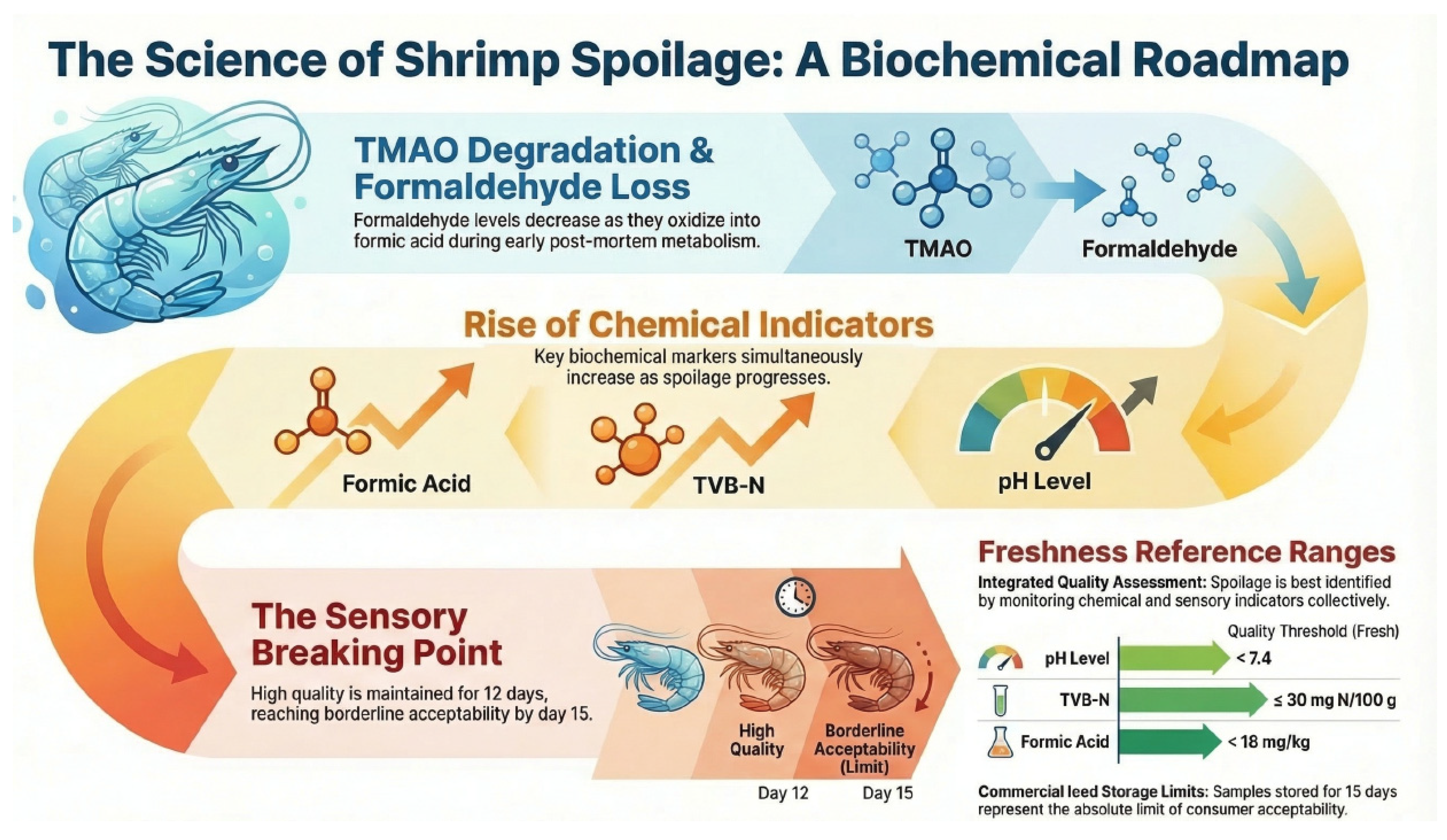
3.3. Evolution of TVB-N, FA, and Formic Acid
3.4. Sensory Analysis
4. Conclusions
Author Contributions
Funding
Institutional Review Board Statement
Informed Consent Statement
Data Availability Statement
Acknowledgments
Conflicts of Interest
References
- Aydın, C.M.; Tıraşın, E.M.; Ünlüoğlu, A.; Dal, İ.; Akalın, S.; Karakuş, M. Population dynamics of the deep-water rose shrimp Parapenaeus longirostris (Lucas, 1846) in Antalya Bay (eastern Mediterranean Sea, southern Türkiye). Reg. Stud. Mar. Sci. 2025, 87, 104233. [Google Scholar] [CrossRef]
- Chatzispyrou, A.; Lampri, P.N.; Fytilakos, I.; Kapiris, K. Morphological study of the deep-water rose shrimp Parapenaeus longirostris (Lucas, 1846) (Crustacea: Decapoda: Dendrobranchiata: Penaeidae) in the eastern Ionian and Aegean Sea (Eastern Mediterranean Sea). Cah. Biol. Mar. 2018, 59, 1–7. [Google Scholar] [CrossRef]
- FAO GLOBEFISH. Quarterly Shrimp Analysis—October 2025; FAO: Rome, Italy, 2025. [Google Scholar]
- FAO. General Fisheries Commission for the Mediterranean—Data Collection Reference Framework (DCRF); FAO: Rome, Italy, 2025. [Google Scholar]
- Heu, M.S.; Kim, J.S.; Shahidi, F. Components and nutritional quality of shrimp processing by-products. Food Chem. 2003, 82, 235–242. [Google Scholar] [CrossRef]
- Oksuz, A.; Ozyilmaz, A.; Aktas, M.; Gercek, G.; Motte, J. A comparative study on proximate, mineral and fatty acid compositions of deep seawater rose shrimp (Parapenaeus longirostris, Lucas 1846) and red shrimp (Plesionika martia, A. Milne-Edwards, 1883). J. Anim. Vet. Adv. 2009, 8, 183–189. [Google Scholar]
- Tawade, P.S.; Koli, J.M.; Patange, S.B.; Sharangdher, S.T.; Mohite, A.S. Biochemical and Microbiological Quality of Cultured Shrimp Litopenaeus vannamei of Different Farms of Ratnagiri. Int. J. Curr. Microbiol. Appl. Sci. 2019, 8, 2110–2124. [Google Scholar] [CrossRef]
- Seafood Market Reports. Available online: https://www.reportlinker.com/market-report/Seafood/4209/Seafood (accessed on 19 January 2026).
- Pellegrini, M.; Andyanto, D.; Iacumin, L.; Comi, G. Evaluation of Total Volatile Basic Nitrogen, Formaldehyde, and Formic Acid as Markers to Define the Acceptability of Farmed Sea Bass and Sea Bream Stored Under Vacuum (VP) or in Modified-Atmosphere Packaging (MAP) at 4 ± 2 °C. Microorganisms 2025, 13, 2774. [Google Scholar] [CrossRef] [PubMed]
- Huss, H.H. Quality and Quality Changes in Fresh Fish; FAO Fisheries Technical Paper No. 348; Food and Agriculture Organization of the United Nations: Rome, Italy, 1995; p. 200. [Google Scholar]
- Comi, G.; Iacumin, L. Meat and Fish spoilage. In The Microbial Quality of Food; Bevilacqua, A., Corbo, M.R., Sinigaglia, M., Eds.; Woodhead Publishing, Elsevier: Cambridge, UK, 2024. [Google Scholar]
- Dalgaard, P. Qualitative and quantitative characterization of spoilage bacteria from packed fish. Int. J. Food Microbiol. 1995, 26, 319–333. [Google Scholar] [CrossRef]
- Carrascosa, C.; Millian, R.; Saavedra, P.; Jaber, J.R.; Raposo, A.; Peréz, E.; Montenegro, T.; Sanjuán, E. Microbiological evolution of gilthead sea bream (Sparus aurata) in Canary Islands during ice storage. J. Food Sci. Technol. 2015, 52, 1586–1593. [Google Scholar] [CrossRef]
- Bassi, L.E.; Hassouna, M.; Shinzato, N.; Matsgui, T. Biopreservation of Refrigerated and Vacuum-Packed Dicentrarchus labrax by Lactic Acid Bacteria. J. Food Sci. 2009, 74, 335–339. [Google Scholar] [CrossRef]
- Declerck, D.; van Hauwaert, H. Value of the Indol Determination as an Objective Quality Test on Commercial Shrimps; Mededelingen van het Rijksstation voor Zeevisserij (Belgium). no. 174; FAO AGRIS, International System for Agricultural Science and Technology: Rome, Italy, 1981. [Google Scholar]
- Gram, L.; Huss, H.H. Microbiological spoilage of fish and fish products. Int. J. Food Microbiol. 1996, 33, 121–137. [Google Scholar] [CrossRef]
- Liston, J. Microbiology in fishery science. In Advances in Fish Science and Technology; Connell, J.J., Ed.; Fishing News Book Ltd.: Farnham, England, 1980; pp. 138–157. [Google Scholar]
- Broekaert, K.; Heyndrickx, M.; Herman, L.; Devlieghere, F.; Vlaemynck, G. Seafood quality analysis: Molecular identification of dominant microbiota after ice storage on several general growth media. Food Microbiol. 2011, 28, 1162–1169. [Google Scholar] [CrossRef]
- Chinivasagam, H.N.; Bremner, H.A.; Thrower, S.J.; Nottingham, S.M. Spoilage pattern of five species of Australian prawns: Deterioration is influenced by environment of capture and mode of storage. J. Aquat. Food Prod. Technol. 1996, 5, 25–50. [Google Scholar] [CrossRef]
- Mejlholm, O.; Boknaes, N.; Dalgaard, P. Shelf life and safety aspects of chilled cooked and peeled shrimps (Pandalus borealis) in modified atmosphere packaging. J. Appl. Microbiol. 2005, 99, 66–76. [Google Scholar] [CrossRef] [PubMed]
- Noseda, B.; Goethals, J.; De Smedt, L.; Dewulf, J.; Samapundo, S.; Van Langenhove, H.; Devlieghere, F. Effect of O2 e CO2 enriched atmospheres on microbiological growth and volatile metabolite production in packaged cooked peeled gray shrimp (Crangon crangon). Int. J. Food Microbiol. 2012, 160, 65–75. [Google Scholar] [CrossRef]
- Yang, S.P.; Xie, J.; Qian, Y.F. Determination of Spoilage Microbiota of Pacific White Shrimp During Ambient and Cold Storage Using Next-Generation Sequencing and Culture-Dependent Method. J. Food Sci. 2017, 82, 1178–1183. [Google Scholar] [CrossRef]
- Qian, Y.F.; Yang, S.P.; Xie, J.; Xiong, Q.; Gao, Z.L. Impact of the O2 concentrations on bacterial communities and quality of modified atmosphere packaged Pacific white shrimp (Litopenaeus vannamei). J. Food Sci. 2013, 78, M1878–M1884. [Google Scholar] [CrossRef]
- Majibur Rahman, M.; Rahman, F.; Afroze, F.; Yesmin, F.; Fatema, K.K.; Kanta Das, K.; Noor, R. Prevalence of Pathogenic Bacteria in Shrimp Samples Collected from Hatchery, Local Markets and the Shrimp Processing Plant. Bangladesh J. Microbiol. 2012, 29, 7–10. [Google Scholar] [CrossRef][Green Version]
- Gecan, J.S.; Blander, R.; Staruszkiewicz, W.F. Fresh and Frozen Shrimp: A profile of filth, Microbiological Contamination, and Decomposition. J. Food Prot. 1994, 57, 154–158. [Google Scholar] [CrossRef]
- Wallace, B.J.; Guzewich, J.J.; Cambridge, M.; Altekruse, S.; Morse, D.L. Seafood-Associated Disease outbreaks in New York, 1980–1994. Am. J. Prev. Med. 1999, 17, 48–54. [Google Scholar] [CrossRef] [PubMed]
- Niamah, A.K. Detected of aerogene in Aeromonas hydrophila isolates from shrimp and peeled shrimp samples in local markets. J. Microbiol. Biotech. Food Sci. 2012, 2, 634–639. [Google Scholar]
- Macé, S.; Cardinal, C.; Jaffrès, E.; Cornet, J.; Lalanne, V.; Chevalier, F.; Sérot, T.; Pilet, M.F.; Dousset, X.; Joffraud, J.J. Evaluation of the spoilage potential of bacteria isolated from spoiled cooked whole tropical shrimp (Penaeus vannamei) stored under modified atmosphere packaging. Food Microbiol. 2014, 40, 9–17. [Google Scholar] [CrossRef] [PubMed]
- European Commission. EEC/95—Commission Decision of 8 March 1995 fixing the total volatile basic nitrogen (TVB-N) limit values for certain categories of fishery products and specifying the analysis methods to be used (95/149/EC). No. L 97/84, 29/04/1995. Off. J. Eur. Communities 1995, 97, 84–87. [Google Scholar]
- Pearson, D. Laboratory Techniques in Food Analysis; Butterworths & Co. Publishers Ltd.: London, UK, 1973; pp. 169+201–202. [Google Scholar]
- Ke, P.Y.; Cervantes, E.; Robles-Martınez, C. Determination of thiobarbituric acid reactive substances (TBARS) in fish tissue by an improved distillation spectrophotometer method. J. Sci. Food Agric. 1984, 35, 1248–1254. [Google Scholar] [CrossRef]
- Tappi, S.; De Aguiar Saldanha Pinheiro, A.C.; Mercatante, D.; Picone, G.; Soglia, F.; Rodriguez-Estrada, M.T.; Rocculi, P. Quality changes during frozen storage of mechanical-separated flesh obtained from an underutilized crustacean. Foods 2020, 9, 1485. [Google Scholar] [CrossRef]
- Parlapani, F.F.; Haroutounian, S.A.; Nychas, G.J.E.; Boziaris, I.S. Microbiological spoilage and volatiles production of gutted European sea bass stored under air and commercial modified atmosphere package at 2 °C. Food Microbiol. 2015, 50, 44–53. [Google Scholar] [CrossRef]
- Dainty, R.H. Chemical/biochemical detection of spoilage. Int. J. Food Microbiol. 1996, 33, 19–33. [Google Scholar] [CrossRef]
- Summers, G.; Wibisono, R.D.; Hedderley, D.I.; Fletcher, G.C. Trimethylamine oxide content and spoilage potential of NewZealand commercial fish species. N. Z. J. Mar. Freshw. Res. 2017, 51, 393–405. [Google Scholar] [CrossRef]
- Cantoni, C.; Renon, P.; Comi, G. Trasformazione dell’aldeide formica nelle carni di animali marini. Arch. Vet. Ital. 1978, 29, 67–68. [Google Scholar]
- Fu, X.; Xue, C.; Miao, B.; Liang, J.; Li, Z.; Cui, F. Purification and characterization of trimethylamine-N-oxide demethylase from jumbo squid (Dosidicus gigas). J. Agric. Food Chem. 2006, 54, 968–972. [Google Scholar] [CrossRef]
- Benjakul, S.; Visessanguan, W.; Tanaka, M. Partial purification and characterization of trimethylamine-N-oxide demethylase from lizardfish kidney. Comp. Biochem. Physiol. Part B Biochem. Mol. Biol. 2003, 135, 359–371. [Google Scholar] [CrossRef]
- Bhowmik, S.; Begum, M.; Alam, A.K.M.N. Formaldehyde Associated risk assessment of fish sold in local markets of Bangladesh. Agric. Res. 2020, 9, 102–108. [Google Scholar] [CrossRef]
- Cantoni, C.; Bianchi, M.A.; Beretta, G. L’aldeide formica nei prodotti ittici. Arch. Vet. It. 1976, 17, 145–148. [Google Scholar]
- Jinadasa, B.K.K.K.; Elliott, C.; Jayasinghe, G.D.T.M. A review of the presence of formaldehyde in fish and seafood. Food Control 2022, 136, 108882. [Google Scholar] [CrossRef]
- Sanyal, S.; Sinha, K.; Saha, S.; Banerjee, S. Formalin in fish trading: An inefficient practice for sustaining fish quality. Fish. Aquat. Life 2017, 25, 43–50. [Google Scholar] [CrossRef][Green Version]
- Laly, S.; Priya, E.; Panda, S.; Zynudheen, A. Formaldehyde in seafood: A review. Fish. Technol. 2018, 55, 87–93. [Google Scholar]
- Aminah, A.S.; Zailina, H.; Fatimah, A.B. Health risk assessment of adults consuming commercial fish contaminated with formaldehyde. Food Public Health 2013, 3, 52–58. [Google Scholar] [CrossRef]
- Bianchi, F.; Careri, M.; Musci, M.; Mangia, A. Fish and food safety: Determination of formaldehyde in 12 fish species by SPME extraction and GC–MS analysis. Food Chem. 2007, 100, 1049–1053. [Google Scholar] [CrossRef]
- Mendes, R.; Goncalves, A.; Pestana, J.; Pestana, C. Indole production and deepwater pink shrimp (Parapenaeus longirostris) decomposition. Eur. Food Res. Technol. 2005, 221, 320–328. [Google Scholar] [CrossRef]
- Yeh, T.S.; Lin, T.C.; Chen, C.C.; Wen, H.M. Analysis of free and bound formaldehyde in squid and squid products by gas chromatography–mass spectrometry. J. Food Drug Anal. 2013, 21, 190–197. [Google Scholar] [CrossRef]
- Chung, S.W.C.; Chan, B.T.P. Trimethylamine oxide, dimethylamine, trimethylamine and formaldehyde levels in main traded fish species in Hong Kong. Food Addit. Contam. Part B. 2009, 2, 44–51. [Google Scholar] [CrossRef]
- European Food Safety Authority. Endogenous formaldehyde turnover in humans compared with exogenous contribution from food sources. Eur. Food Saf. Auth. J. 2014, 12, 3550. [Google Scholar]
- Anissah, U.; Putri, A.K.; Barokah, G.R. An estimation of endogenous formaldehyde exposure due to consumption of Indonesian opah fish (Lampris guttatus) in three major export destination countries. Squalen Bull. Mar. Fish. Postharvest Biotechnol. 2019, 14(1), 1–8. [Google Scholar] [CrossRef]
- Chandralekha, A.; Baranage, C.; Samarajeewa, U. Formaldehyde levels in fish from the Kandy market. J. Nation. Sci. Found. Sri Lanka 2017, 20, 115–121. [Google Scholar] [CrossRef]
- Devaraj, P.; Babu, V.; Cengiz, E.I. Qualitative detection of formaldehyde and ammonia in fish and other seafoods obtained from Chennai’s (India) fish markets. Environ. Monit. Assess. 2021, 193, 78–85. [Google Scholar] [CrossRef] [PubMed]
- Zhu, J.; Li, J.; Jia, J. Effects of thermal processing and various chemical substances on formaldehyde and dimethylamine formation in squid Dosidicus gigas. J. Sci. Food Agric. 2012, 92, 2436–2442. [Google Scholar] [CrossRef]
- Wahed, P.; Razzaq, M.A.; Dharmapuri, S.; Corrales, M. Determination of formaldehyde in food and feed by an in-house validated HPLC method. Food Chem. 2016, 202, 476–483. [Google Scholar] [CrossRef]
- Kundu, M.; Prasad, S.; Krishnan, P.; Gajjala, S. A novel electrochemical biosensor based on hematite (α-Fe2O3) flowerlike nanostructures for sensitive determination of formaldehyde adulteration in fruit juices. Food Bioprocess Technol. 2019, 12, 1659–1671. [Google Scholar] [CrossRef]
- USEPA. Formaldehyde; CASRN 50-00-0; US Environmental Protection Agency: Washington, DC, USA, 1991. Available online: https://cfpub.epa.gov/ncea/iris2/chemicallanding.cfm?substa nce_nmbr=419 (accessed on 19 January 2026).
- Pearce, N.; Blair, A.; Vineis, P.; Ahrens, W.; Andersen, A.; Anto, J.M.; Armstrong, B.K.; Baccarelli, A.A.; Beland, F.A.; Berrington, A.; et al. IARC monographs: 40 years of evaluating carcinogenic hazards to humans. Environ. Health Perspect. 2015, 123, 507–514. [Google Scholar] [CrossRef]
- U.S. Department of Health and Human Services. Report on Carcinogens, 14th ed.; Formaldehyde, CAS No. 50-00-0; U.S. Department of Health and Human Services: Washington, DC, USA, 2020. Available online: http://ntp.niehs.nih.gov/go/roc (accessed on 19 January 2026).
- ISO 11290-1:1996 Adm.1:2004; Microbiology of Food and Animal Feeding Stuffs—Horizontal Method for the Detection of Listeria monocytogenes. ISO: Geneva, Switzerland, 2004.
- ISO 6579-1:2002 Cor.1:2004; Microbiology of Food and Animal Feeding Stuffs—Horizontal Method for the Detection of Salmonella spp. ISO: Geneva, Switzerland, 2004.
- Boland, F.E.; Lin, R.C.; Mulvaney, T.R.; MCclure, F.D.; Johnston, M.R. pH Determination in Acidified Foods: Collaborative Study. J. Assoc. Off. Anal. Chem. 1981, 64, 332–336. [Google Scholar] [CrossRef]
- ISO 4120:2004; Triangle Test Methodology. Standard Test Method for Sensory Analysis—General Guidance for the Design of Test Rooms. ISO: Geneva, Switzerland, 2004.
- Stone, H.; Sidel, J.L. Sensory Evaluation Practices, 3rd ed.; Elsevier Academic Press: San Diego, CA, USA, 2004. [Google Scholar]
- Lo, C.f.; Kou, G.H. Virus-associated white spot syndrome of shrimp in Taiwan, a review. Fish Pathol. 1998, 33, 365–371. [Google Scholar] [CrossRef]
- Takahashi, Y.; Shimoyama, Y.; Momoyama, K. Pathogenicity and characteristics of Vibrio sp. isolated from cultured kuruma prawn Penaeus japonicus Bate. Bull. Jpn. Soc. Sci. Fish. 1985, 51, 721–730. [Google Scholar] [CrossRef][Green Version]
- Samia, S.; Galib, H.T.; Tanvir, A.S.; Basudeb, C.S.; Walliullah, M.; Tasnia, A.; Mrityunjoy, A. Microbiological quality analysis of shrimps collected from local market around Dhaka city. Int. Food Res. J. 2014, 21, 33. [Google Scholar]
- Yousuf, A.H.M.; Ahmed, M.K.; Yeasmin, S.; Ahsan, N.; Rahman, M.M.; Islam, M.M. Prevalence of microbial load in shrimp, Penaeus monodon and prawn, Macrobrachium rosenbergii from Bangladesh. World J. Agric. Sci. 2008, 4, 852–855. [Google Scholar]
- Zapatka, F.; Bartolomeo, B. Microbiological Evaluation of Cold-Water Shrimp (Pandalus borealis). Appl. Microbiol. 1973, 25, 858–861. [Google Scholar] [CrossRef]
- Mendes, R.; Quinta, R.; Nunes, M.L. Changes in baseline levels of nucleotides during ice storage of fish and crustaceans from the Portuguese coast. Eur. Food Res. Technol. 2001, 212, 141–146. [Google Scholar] [CrossRef]
- Nirmal, N.P.; Benjakul, S. Effect of ferulic acid on inhibition of polyphenoloxidase and quality changes of Pacific white shrimp (Litopenaeus vannamen) during iced storage. Food Chem. 2009, 116, 323–331. [Google Scholar] [CrossRef]
- Canizales-Rodriguez, D.F.; Ocano-Higuera, V.M.; Marquez-Rios, E.; Graciano-Verdugo, A.Z.; Càrdena-Lopez, J.L.; Yepiz-Gòmez, M.S. Biochemical, Physical, Chemical, and Microbiological assessment of Blue Shrimp (Litopenaeus stylirostris) stored in ice. J. Aquat. Food Prod. Technol. 2015, 24, 259–269. [Google Scholar] [CrossRef]
- Ali, S.S.R.; Ramachandran, M.; Chakma, S.K.; Asrar, M. Proximate composition of commercially important marine fishes and shrimps from the Chennai coast, India. Int. J. Fish. Aquat. Stud. 2017, 5, 113–119. [Google Scholar]
- Hossain, A.; Mandal, S.C.; Rahman, M.S.; Rahman, M.M.; Hasan, M. Microbiological quality of processed frozen black tiger shrimps in fish processing plant. World J. Fish Mar. Sci. 2010, 2, 124–128. [Google Scholar]
- Azzam, M.; Sekheta, F.; Sahtout, A.H.; Hisham, A.; Sekheta, F.; Sharabi, R.O.; Airoud, K.A. The group of hidden hazards in enhanced HACCP and ISO-22000 based quality systems. Int. J. Food Saf. 2010, 12, 146–157. [Google Scholar]
- ICMS, International Commission on Microbiological Specification for Foods. Microorganisms in Foods Sampling for Microbiological Analysis: Principles and Specific Applications, 2nd ed.; University of Toronto Press: Toronto, ON, Canada, 1986. [Google Scholar]
- FDA. Revised Guidelines for the Assessment of Microbiological Quality of Processed Food; Food and Drug Administration: Silver Spring, MD, USA, 2013. [Google Scholar]
- Espe, M.; Kiessling, A.; Lunestad, B.T.; Torrissen, O.J.; Rørå, A.M.B. Quality of cold smoked salmon collected in one French hypermarket during a period of 1 year. Food Sci. Technol. 2004, 37, 627–638. [Google Scholar] [CrossRef]
- Olafsdottir, G.; Chanie, E.; Westad, F.; Luten, J.; Kristbergsson, K. Prediction of microbial and sensory quality of cold smoked atlantic salmon Salmo salar by electronic nose. J. Food Sci. 2005, 70, 563–574. [Google Scholar] [CrossRef]
- Regulation (EC) No 852/2004 of the European Parliament and of the Council of 29 April 2004 on the Hygiene of Foodstuffs. Available online: http://data.europa.eu/eli/reg/2004/852/oj (accessed on 23 February 2026).
- Regulation (EC) No 853/2004 of the European Parliament and of the Council of 29 April 2004 Laying Down Specific Hygiene Rules for Food of Animal Origin. Available online: http://data.europa.eu/eli/reg/2004/853/oj (accessed on 23 February 2026).
- Commission Regulation (EC) No 2073/2005 of 15 November 2005 on Microbiological Criteria for Foodstuffs (Text with EEA Relevance). Available online: http://data.europa.eu/eli/reg/2005/2073/oj (accessed on 23 February 2026).
- Regulation (EC) No 882/2004 of the European Parliament and of the Council of 29 April 2004 on Official Controls Performed to Ensure the Verification of Compliance with Feed and Food Law, Animal Health and Animal Welfare Rules. Available online: http://data.europa.eu/eli/reg/2004/882/oj (accessed on 23 February 2026).
- Regulation (EC) No 854/2004 of the European Parliament and of the Council of 29 April 2004 Laying Down Specific Rules for the Organisation of Official Controls on Products of Animal Origin Intended for Human Consumption. Available online: http://data.europa.eu/eli/reg/2004/854/oj (accessed on 23 February 2026).
- Linee Guida per il Controllo Ufficiale ai Sensi dei Regolamenti (CE) 882/2004 e 854/2004” Repertorio Atti n. 212-CSR del 10/11/2016. Available online: https://www.iss.it/cnr-lpbl-normativa/-/asset_publisher/hCdLcO9sbUko/content/normativa-1-1 (accessed on 17 February 2026).
- Noseda, B.; Vermeulen, A.; Ragaert, P.; Devlieghere, F. Packaging of fish and fishery products. IFST Advances in Food Science Series. In Seafood Processing: Technology, Quality & Safety; Boziaris, I.S., Ed.; Wiley-Blackwell: West Sussex, UK, 2014; pp. 237–261. [Google Scholar]
- Kostaki, M.; Giatrakou, V.; Savvaidis, I.N.; Kontominas, M.G. Combined effect of MAP and thyme essential oil on the microbiological, chemical and sensory attributes of organically aquacultured sea bass (Dicentrarchus labrax) fillets. Food Microbiol. 2009, 26, 475–482. [Google Scholar] [CrossRef]
- Simeonidou, S.; Govans, A.; Kawabata, M. Quality assessment of seven Mediterranean fish species during storage. Food Res. Int. 1998, 30, 479–484. [Google Scholar] [CrossRef]
- Martinez, O.A.; Gòmez, G.M.C.; Montero, P. Chemical and microbial indexes of Norvegian lobsters (Nephros norvegicus) dusted with sulphites. J. Food Sci. 2008, 43, 1099–1110. [Google Scholar] [CrossRef]
- Huidobro, A.; López-Caballero, M.; Mendes, R. Onboard processing of deepwater pink shrimp (Parapenaeus longirostris) with liquid ice: Effect on quality. Eur. Food Res. Technol. 2002, 214, 469–475. [Google Scholar] [CrossRef]
- Gonglaves, A.C.; Lopez-Caballero, M.E.; Nunes, M.L. Quality changes of deepwater pink shrimp (Parapenaeus longirostris) packed in modified atmosphere. J. Food Sci. 2003, 68, 2586–2590. [Google Scholar] [CrossRef]
- Chung, C.Y.; Lain, J.L. Study on the composition of frozen shrimp II. Deterioration during iced and refrigerated storage. Nat. Sci. Counc. Mon. (ROC) 1979, 7, 1136–1141. [Google Scholar]
- Mendes, R.; Huidobro, A.; Lopez-Caballero, E. Indole levels in deepwater pink shrimp (Parapenaeus longirostris) from the Portuguese coast. Eff. Temp. Abuse. Eur. Food Res. Technol. 2002, 214, 125–130. [Google Scholar] [CrossRef]
- Angel, S.; Basker, D.; Kanner, J.; Juven, B.J. Assessment of shelf-life of fresh water prawns stored at 0 °C. J. Food Technol. 1981, 16, 357–366. [Google Scholar] [CrossRef]
- Che Man, Y.B.; Ramadas, J. Effect of packaging environment on quality changes of smoked Spanish mackerel under refrigeration. J. Food Qual. 1998, 21, 167–174. [Google Scholar] [CrossRef]
- Kanner, J.; Karel, M. Changes in lysozyme due to reactions with peroxidizing methyl linoleate in a dehydrated model system. J. Agric. Food Chem. 1976, 24, 468–476. [Google Scholar] [CrossRef]
- Chang, O.; Cheuk, W.L.; Nickelson, R.; Martin, R.; Finne, G. Indole in shrimp: Effect of fresh storage temperature, freezing and boiling. J. Food Sci. 1983, 48, 813–816. [Google Scholar] [CrossRef]
- Chambers, T.L.; Staruszkiewicz, A.W., Jr. Ultraviolet detection procedure for liquid chromatographic determination of indole in shrimp. J. Assoc. Off. Anal. Chem. 1981, 64, 603–606. [Google Scholar] [CrossRef]
- Iyengar, J.R.; Visweswariah, K.; Moorjani, M.N.; Bhatia, D.S. Assessment of the progressive spoilage of ice-stored shrimp. J. Fish. Res. Board Can. 1960, 17, 475–485. [Google Scholar] [CrossRef]
- Puga Lopez, D.; Ponce Palafox, J.T.; Barba-Quintero, G.; Torres-Herrera, M.R.; Romero-Beltrán, E.; Arredondo Figueroa, J.L.; Garcia-Ulloa Gomez, M. Physicochemical, proximate composition, microbiological and sensory analysis of farmed and wild harvested white shrimp Litopenaeus vannamei (Bonne, 1931) tissues. Curr. Res. J. Biol. Sci. 2013, 3, 130–135. [Google Scholar] [CrossRef]
- Don, S.; Xavier, K.M.; Devi, S.T.; Nayak, B.B.; Kannuchamy, N. Identification of potential spoilage bacteria in farmed shrimp (Litopenaeus vannamei): Application of Relative Rate. Int. J. Curr. Microbiol. Appl. Sci. 2019, 8, 2110–2124. [Google Scholar] [CrossRef]
- Hoque, M.S.; Jacxsens, L.; Rahman, M.B.; Nowsad, A.A.K.M.; Azad, S.M.O.; De Meulenaer, B.; Rahman, M. Evaluation of artificially contaminated fish with formaldehyde under laboratory conditions and exposure assessment in freshwater fish in Southern Bangladesh. Chemosphere 2018, 195, 702–712. [Google Scholar] [CrossRef] [PubMed]
- Immaculate, J.; Jamila, P. Quality characteristics including formaldehyde content in selected Sea foods of Tuticorin, southeast coast of India. Int. Food Res. J. 2018, 25, 293–302. [Google Scholar]
- Nielsen, M.K.; Jørgensen, B.M. Quantitative relationship between trimethylamine oxide aldolase activity and formaldehyde accumulation in white muscle from gadiform fish during frozen storage. J. Agric. Food Chem. 2004, 52, 3814–3822. [Google Scholar] [CrossRef]
- del Mar Rey-Mansilla, M.; Sotelo, C.G.; Aubourg, S.P.; Rehbein, H.; Havemeister, W.; Jørgensen, B.; Nielsen, M.K. Localization of formaldehyde production during frozen storage of European hake (Merluccius merluccius). Eur. Food Res. Technol. 2001, 213, 43–47. [Google Scholar] [CrossRef]
- GOSL. The Gazette of the Democratic Socialist Republic of Sri Lanka, 2010, No 1649/19, 529 Food (Formaldehyde in Fish) Regulations. Available online: https://www.gazette.lk/ (accessed on 19 January 2026).


| Parapenaeus longirostris | Days | ||||
|---|---|---|---|---|---|
| Microorganisms | 0 | 4 | 8 | 12 | 15 |
| Mesophilic TVC | 2.5 ± 0.5 a | 4.1 ± 0.3 b | 5.1 ± 0.3 c | 5.7 ± 0.1 d | 5.8 ± 0.2 d |
| Psycrophilic TVC | 1.9 ± 0.2 a | 2.9 ± 0.1 b | 5.8 ± 0.5 c | 6.2 ± 0.2 c | 6.4 ± 0.4 c |
| Total Coliforms | 1.5 ± 0.1 a | 1.6 ± 0.2 a | 1.8 ± 0.3 a | 2.0 ± 0.1 b | 3.9 ± 0.3 c |
| Pseudomonas spp. | 2.5 ± 0.2 a | 3.8 ± 0.2 b | 4.2 ± 0.1 c | 4.9 ± 0.1 d | 5.5 ± 0.4 e |
| E. coli | <10 | <10 | <10 | <10 | <10 |
| Staphylococcus coagulase + | <10 | <10 | <10 | <10 | <10 |
| Vibrio spp. | <10 | <10 | <10 | <10 | <10 |
| Lactic acid bacteria | 2.0 ± 0.1 a | 2.1 ± 0.2 a | 2.8 ± 0.1 b | 2.9 ± 0.2 b | 3.3 ± 0.1 b |
| Yeast and moulds | <10 a | <10 a | 2.0 ± 0.1 b | 2.3 ± 0.3 b | 2.5 ± 0.5 b |
| Clostridia H2S+ | <10 | <10 | <10 | <10 | <10 |
| Melicertus kerathurus | Days | ||||
|---|---|---|---|---|---|
| Microorganisms | 0 | 4 | 8 | 12 | 15 |
| Mesophilic TVC | 2.8 ± 0.1 a | 3.9 ± 0.3 b | 4.2 ± 0.1 b | 4.8 ± 0.3 c | 5.4 ± 0.3 c |
| Psycrophilic TVC | 2.0 ± 0.1 a | 2.6 ± 0.3 b | 4.7 ± 0.2 c | 5.5 ± 0.1 d | 6.2 ± 0.2 e |
| Total Coliforms | 1.8 ± 0.2 a | 1.8 ± 0.1 a | 2.0 ± 0.1 b | 2.0 ± 0.2 b | 3.9 ± 0.1 c |
| Pseudomonas spp. | 2.2 ± 0.1 a | 3.5 ± 0.3 b | 4.4 ± 0.1 c | 4.8 ± 0.2 d | 5.6 ± 0.2 e |
| E. coli | <10 | <10 | <10 | <10 | <10 |
| Staphylococcus coagulase + | <10 | <10 | <10 | <10 | <10 |
| Vibrio spp. | <10 | <10 | <10 | <10 | <10 |
| Lactic acid bacteria | 2.0 ± 0.2 a | 2.3 ± 0.1 a | 2.7 ± 0.2 b | 3.0 ± 0.3 b | 3.4 ± 0.1 b |
| Yeast and moulds | <10 a | <10 a | 2.0 ± 0.2 b | 2.1 ± 0.1 b | 2.2 ± 0.3 b |
| Clostridia H2S+ | <10 | <10 | <10 | <10 | <10 |
| Days | Parapenaeus longirostris | Melicertus kerathurus | ||
|---|---|---|---|---|
| pH | TBARS | pH | TBARS | |
| 0 | 6.8 ± 0.2 a | 0.6 ± 0.3 a | 6.8 ± 0.2 a | 0.7 ± 0.1 a |
| 4 | 6.9 ± 0.1 a | 0.6 ± 0.3 a | 6.8 ± 0.1 a | 0.8 ± 0.2 a |
| 8 | 6.9 ± 0.1 a | 0.9 ± 0.1 a | 7.0 ± 0.1 b | 0.8 ± 0.2 a |
| 12 | 7.1 ± 0.1 b | 0.9 ± 0.2 a | 7.2 ± 0.1 b | 0.9 ± 0.1 a |
| 15 | 7.4 ± 0.1 c | 1.1 ± 0.1 a | 7.5 ± 0.1 c | 1.0 ± 0.1 a |
| Parapenaeus longirostris | Melicertus kerathurus | |||||
|---|---|---|---|---|---|---|
| Days | TVB-N | Formaldehyde | Formic Acid | TVB-N | Formaldehyde | Formic Acid |
| 0 | 12.9 ± 0.8 a | 20.3 ± 1.8 f | 6.1 ± 2.2 k | 13.2 ± 1.1 a | 18.2 ± 2.1 f | 5.6 ± 2.2 k |
| 4 | 15.5 ± 0.5 b | 4.8 ± 2.1 g | 12.9 ± 2.1 l | 19.2 ± 0.8 b | 4.9 ± 1.2 g | 14.5 ± 0.7 l |
| 8 | 22.4 ± 0.3 c | 1.5 ± 1.3 g | 13.8 ± 3.3 l | 23.3 ± 1.1 c | 3.3 ± 1.1 g | 13.5 ± 1.0 l |
| 12 | 27.8 ± 1.1 d | 1.3 ± 0.4 g | 15.5 ± 1.8 l | 29.2 ± 0.2 d | 1.2 ± 0.3 h | 15.4 ± 0.8 m |
| 15 | 33.4 ± 0.3 e | 1.1 ± 0.3 g | 17.4 ± 1.3 l | 34.9 ± 0.1 e | 0.9 ± 0.2 h | 17.2 ± 0.9 n |
| Days | Parapenaeus longirostris | Melicertus kerathurus |
|---|---|---|
| 0 | 8.0 ± 0.5 a | 7.7 ± 0.2 a |
| 4 | 7.2 ± 0.2 a | 6.9 ± 0.3 b |
| 8 | 4.8 ± 0.1 b | 4.6 ± 0.1 c |
| 12 | 3.2 ± 0.3 c | 3.1 ± 0.4 d |
| 15 | 2.8 ± 0.5 c | 2.7 ± 0.2 d |
| 30 | 1.6 ± 0.6 d | 1.5 ± 0.3 e |
| Samples | Formaldehyde (mg/kg) | |
|---|---|---|
| Parapenaeus longirostris | Melicertus kerathurus | |
| Control | 23.5 ± 3.1 aA | 25.3 ± 2.7 aA |
| Boiled | 7.8 ± 0.2 aB | 8.0 ± 0.1 aB |
| Fried | 4.7 ± 1.5 aB | 6.3 ± 2.3 aB |
| Shrimp Species | Storage Time Comparison | Correct Responses (n/20) | Triangle Test Significance | Predominant Quality Score * | Overall Acceptability |
|---|---|---|---|---|---|
| Parapenaeus longirostris | 0 vs. 12 days | 8 | Not significant (p > 0.05) | 1 vs. 2 | Acceptable |
| 0 vs. 15 days | 20 | Significant (p < 0.05) | 1 vs. 3 | Acceptable | |
| 12 vs. 15 days | 20 | Significant (p < 0.05) | 2 vs. 3 | Acceptable | |
| Melicertus kerathurus | 0 vs. 12 days | 10 | Not significant (p > 0.05) | 1 vs. 2 | Acceptable |
| 0 vs. 15 days | 20 | Significant (p < 0.05) | 1 vs. 3 | Acceptable | |
| 12 vs. 15 days | 20 | Significant (p < 0.05) | 2 vs. 3 | Acceptable |
Disclaimer/Publisher’s Note: The statements, opinions and data contained in all publications are solely those of the individual author(s) and contributor(s) and not of MDPI and/or the editor(s). MDPI and/or the editor(s) disclaim responsibility for any injury to people or property resulting from any ideas, methods, instructions or products referred to in the content. |
© 2026 by the authors. Licensee MDPI, Basel, Switzerland. This article is an open access article distributed under the terms and conditions of the Creative Commons Attribution (CC BY) license.
Share and Cite
Pellegrini, M.; Andyanto, D.; Petozzi, A.; Iacumin, L.; Bernardi, C.E.M.; Comi, G. Integrated Microbiological, Physicochemical, and Sensory Assessment of Shrimp Quality During Commercial Iced Storage: Implications for Shelf-Life Evaluation and Freshness Indicators. Microorganisms 2026, 14, 1266. https://doi.org/10.3390/microorganisms14061266
Pellegrini M, Andyanto D, Petozzi A, Iacumin L, Bernardi CEM, Comi G. Integrated Microbiological, Physicochemical, and Sensory Assessment of Shrimp Quality During Commercial Iced Storage: Implications for Shelf-Life Evaluation and Freshness Indicators. Microorganisms. 2026; 14(6):1266. https://doi.org/10.3390/microorganisms14061266
Chicago/Turabian StylePellegrini, Michela, Debbie Andyanto, Asia Petozzi, Lucilla Iacumin, Cristian Edoardo Maria Bernardi, and Giuseppe Comi. 2026. "Integrated Microbiological, Physicochemical, and Sensory Assessment of Shrimp Quality During Commercial Iced Storage: Implications for Shelf-Life Evaluation and Freshness Indicators" Microorganisms 14, no. 6: 1266. https://doi.org/10.3390/microorganisms14061266
APA StylePellegrini, M., Andyanto, D., Petozzi, A., Iacumin, L., Bernardi, C. E. M., & Comi, G. (2026). Integrated Microbiological, Physicochemical, and Sensory Assessment of Shrimp Quality During Commercial Iced Storage: Implications for Shelf-Life Evaluation and Freshness Indicators. Microorganisms, 14(6), 1266. https://doi.org/10.3390/microorganisms14061266