Patterns, Associated Factors, and Anatomical Concordance of Nasal and Throat Staphylococcus aureus Carriage Among Community-Dwelling Adults in Germany



Abstract
1. Introduction
2. Materials and Methods
2.1. Study Design and Participants
2.2. Data Collection
2.3. Microbiological Culture and Isolation
2.4. Methicillin-Resistant S. aureus
2.5. Antibiotic Susceptibility Testing
2.6. Repetitive-Element PCR (Rep-PCR)
2.7. Statistical Analysis
3. Results
4. Discussion
5. Conclusions
Supplementary Materials
Author Contributions
Funding
Institutional Review Board Statement
Informed Consent Statement
Data Availability Statement
Acknowledgments
Conflicts of Interest
Abbreviations
| WHO | World Health Organization |
| S. aureus | Staphylococcus aureus |
| CNS | Coagulase-negative staphylococci |
| S. epidermidis | Staphylococcus epidermidis |
| S. hominis | Staphylococcus hominis |
| S. haemolyticus | Staphylococcus haemolyticus |
| S. saprophyticus | Staphylococcus saprophyticus |
| S. warneri | Staphylococcus warneri |
| MRSA | Methicillin-resistant Staphylococcus aureus |
| CA-MRSA | Community-associated methicillin-resistant Staphylococcus aureus |
| mecA | Methicillin resistance gene A |
| PBP2a | Penicillin-binding protein 2a |
| SCCmec | Staphylococcal cassette chromosome mec |
| PVL | Panton–Valentine leukocidin |
| lukF-PV/lukS-PV | Panton–Valentine leukocidin toxin components |
| REP | Repetitive extragenic palindromic sequences |
| rep-PCR | Repetitive element polymerase chain reaction |
| PCR | Polymerase chain reaction |
| MALDI-TOF MS | Matrix-assisted laser desorption and ionization time-of-flight mass spectrometry |
| ATCC | American Type Culture Collection |
| DNA | Deoxyribonucleic acid |
| MDR | Multidrug-resistant |
| EUCAST | European Committee on Antimicrobial Susceptibility Testing |
| CI | Confidence interval |
| OR | Odds ratio |
| AIC | Akaike information criterion |
| AUC | Area under the curve |
| PABAK | Prevalence- and bias-adjusted kappa |
| UPGMA | Unweighted pair group method with arithmetic mean |
| µL | Microliter |
References
- World Health Organization. Antimicrobial Resistance. Available online: https://www.who.int/news-room/fact-sheets/detail/antimicrobial-resistance (accessed on 29 March 2026).
- Taylor, T.A.; Tobin, E.H.; Unakal, C.G. Staphylococcus aureus Infection [Updated 1 December 2025]. In StatPearls [Internet]; StatPearls Publishing: Treasure Island, FL, USA, 2026. Available online: https://www.ncbi.nlm.nih.gov/books/NBK441868/ (accessed on 29 March 2026).
- Elek, S.D. (Ed.) Staphylococcus pyogenes and Its Relation to Disease; E. & S. Livingstone: Edinburgh, UK, 1959. [Google Scholar]
- Kanafani, Z.A.; Fowler, V.G. Evans’ infections of humans: Staphylococcal infections. In Bacterial Infections of Humans; Brachman, P.S., Abrutyn, E., Eds.; Springer: Boston, MA, USA, 2009; pp. 725–741. [Google Scholar]
- Foster, T. Staphylococcus. In Medical Microbiology, 4th ed.; Baron, S., Ed.; Chapter 12; University of Texas Medical Branch at Galveston: Galveston, TX, USA, 1996. Available online: https://www.ncbi.nlm.nih.gov/books/NBK8448/ (accessed on 29 March 2026).
- Chaibenjawong, P.; Foster, S.J. Desiccation tolerance in Staphylococcus aureus. Arch. Microbiol. 2011, 193, 125–135. [Google Scholar] [CrossRef]
- Feng, Y.; Ming, T.; Zhou, J.; Lu, C.; Wang, R.; Su, X. The response and survival mechanisms of Staphylococcus aureus under high salinity stress in salted foods. Foods 2022, 11, 1503. [Google Scholar] [CrossRef]
- Sollid, J.U.; Furberg, A.S.; Hanssen, A.M.; Johannessen, M. Staphylococcus aureus: Determinants of human carriage. Infect. Genet. Evol. 2014, 21, 531–541. [Google Scholar] [CrossRef]
- Ruscher, C. Erratum zu: Empfehlungen zur Prävention und Kontrolle von Methicillin-resistenten Staphylococcus aureus-Stämmen (MRSA) in medizinischen und pflegerischen Einrichtungen. Bundesgesundheitsblatt Gesundheitsforschung Gesundheitsschutz 2015, 58, 654. [Google Scholar] [CrossRef] [PubMed]
- Tong, S.Y.; Davis, J.S.; Eichenberger, E.; Holland, T.L.; Fowler, V.G., Jr. Staphylococcus aureus infections: Epidemiology, pathophysiology, clinical manifestations, and management. Clin. Microbiol. Rev. 2015, 28, 603–661. [Google Scholar] [CrossRef] [PubMed]
- Chambers, H.F. The changing epidemiology of Staphylococcus aureus. Emerg. Infect. Dis. 2001, 7, 178–182. [Google Scholar] [CrossRef]
- Chmielowiec-Korzeniowska, A.; Tymczyna, L.; Wlazło, Ł.; Nowakowicz-Dębek, B.; Trawińska, B. Staphylococcus aureus carriage state in healthy adult population and phenotypic and genotypic properties of isolated strains. Postepy Dermatol. Alergol. 2020, 37, 184–189. [Google Scholar] [CrossRef]
- Touaitia, R.; Mairi, A.; Ibrahim, N.A.; Basher, N.S.; Idres, T.; Touati, A. Staphylococcus aureus: A review of the pathogenesis and virulence mechanisms. Antibiotics 2025, 14, 470. [Google Scholar] [CrossRef]
- Sakr, A.; Brégeon, F.; Mège, J.L.; Rolain, J.M.; Blin, O. Staphylococcus aureus nasal colonization: An update on mechanisms, epidemiology, risk factors, and subsequent infections. Front. Microbiol. 2018, 9, 2419. [Google Scholar] [CrossRef]
- Nilsson, P.; Ripa, T. Staphylococcus aureus throat colonization is more frequent than colonization in the anterior nares. J. Clin. Microbiol. 2006, 44, e00880-06. [Google Scholar] [CrossRef] [PubMed]
- Mertz, D.; Frei, R.; Periat, N.; Zimmerli, M.; Battegay, M.; Flückiger, U.; Widmer, A.F. Exclusive Staphylococcus aureus throat carriage: At-risk populations. Arch. Intern. Med. 2009, 169, 172–178. [Google Scholar] [CrossRef] [PubMed]
- Young, B.C.; Votintseva, A.A.; Foster, D.; Godwin, H.; Miller, R.R.; Anson, L.W.; Walker, A.S.; Peto, T.E.A.; Crook, D.W.; Knox, K. Multi-site and nasal swabbing for carriage of Staphylococcus aureus: What does a single nose swab predict? J. Hosp. Infect. 2017, 96, 232–237. [Google Scholar] [CrossRef]
- Tsang, S.T.J.; McHugh, M.P.; Guerendiain, D.; Gwynne, P.J.; Boyd, J.; Simpson, A.H.R.W.; Walsh, T.S.; Laurenson, I.F.; Templeton, K.E. Underestimation of Staphylococcus aureus (MRSA and MSSA) carriage associated with standard culturing techniques: One third of carriers missed. Bone Joint Res. 2018, 7, 79–84. [Google Scholar] [CrossRef]
- Gastmeier, P.; Breier, A.-C.; Sohr, D.; Geffers, C. Prevention of postoperative wound infections. Trauma Berufskrankh. 2012, 14, S110–S114. [Google Scholar] [CrossRef]
- Batra, R.; Eziefula, A.C.; Wyncoll, D.; Edgeworth, J. Throat and rectal swabs may have an important role in MRSA screening of critically ill patients. Intensive Care Med. 2008, 34, 1703–1706. [Google Scholar] [CrossRef]
- Becker, K.; Heilmann, C.; Peters, G. Coagulase-negative staphylococci. Clin. Microbiol. Rev. 2014, 27, 870–926. [Google Scholar] [CrossRef]
- Piette, A.; Verschraegen, G. Role of coagulase-negative staphylococci in human disease. Vet. Microbiol. 2009, 134, 45–54. [Google Scholar] [CrossRef]
- Lehnhof, T. Attributable Economic Consequences of Colonization with Methicillin-Resistant Staphylococcus aureus (MRSA). Habilitation Dissertation, University of Saarland, Homburg/Saar, Germany, 2009. Available online: https://scidok.sulb.uni-saarland.de/volltexte/2010/3269/pdf/Promotion_MRSA.pdf (accessed on 29 March 2026).
- Thacharodi, A.; Hassan, S.; Ahmed, T.; Acharya, G.; Geli Blacknell, N.M.; Singh, P.; Pal, S.; Saraswathi, A.; Kosuru, B.R.; Sofi, M.A.; et al. Methicillin-resistant Staphylococcus aureus is raising global concern as it overcomes immune challenges through various virulence mechanisms. iScience 2025, 29, 114376. [Google Scholar] [CrossRef] [PubMed]
- Höffler, U.; Pulverer, G. Facultative pathogenic bacteria of the resident flora of the human skin. In XXXII. Tagung Gehalten in Westerland/Sylt vom 16. bis 20. September 1980; Christophers, E., Goos, M., Eds.; Springer: Berlin/Heidelberg, Germany, 1981; pp. 276–279. [Google Scholar]
- Yu, W.; Kim, H.K.; Rauch, S.; Schneewind, O.; Missiakas, D. Pathogenic conversion of coagulase-negative staphylococci. Microbes Infect. 2017, 19, 101–109. [Google Scholar] [CrossRef]
- Shoaib, M.; Aqib, A.I.; Muzammil, I.; Majeed, N.; Bhutta, Z.A.; Kulyar, M.F.; Fatima, M.; Zaheer, C.F.; Muneer, A.; Murtaza, M.; et al. MRSA compendium of epidemiology, transmission, pathophysiology, treatment, and prevention within one health framework. Front. Microbiol. 2023, 13, 1067284. [Google Scholar] [CrossRef] [PubMed]
- Räz, A.K.; Andreoni, F.; Boumasmoud, M.; Bergada-Pijuan, J.; Schweizer, T.A.; Mairpady Shambat, S.; Hasse, B.; Zinkernagel, A.S.; Brugger, S.D. Limited adaptation of Staphylococcus aureus during transition from colonization to invasive infection. Microbiol. Spectr. 2023, 11, e0259021. [Google Scholar] [CrossRef]
- van der Zee, A.; Verbakel, H.; van Zon, J.C.; Frenay, I.; van Belkum, A.; Peeters, M.; Buiting, A.; Bergmans, A. Molecular genotyping of Staphylococcus aureus strains: Comparison of repetitive element sequence-based PCR with various typing methods and isolation of a novel epidemicity marker. J. Clin. Microbiol. 1999, 37, 342–349. [Google Scholar] [CrossRef]
- Wichelhaus, T.A.; Schäfer, V.; Brade, V. Typierungsverfahren in der Infektionsepidemiologie. Chemother. J. 2000, 9, 2. [Google Scholar]
- Wang, S.H.; Stevenson, K.B.; Hines, L.; Mediavilla, J.R.; Khan, Y.; Soni, R.; Dutch, W.; Brandt, E.; Bannerman, T.; Kreiswirth, B.N.; et al. Evaluation of repetitive element polymerase chain reaction for surveillance of methicillin-resistant Staphylococcus aureus at a large academic medical center and community hospitals. Diagn. Microbiol. Infect. Dis. 2015, 81, 13–17. [Google Scholar] [CrossRef]
- Tobin, E.H.; Jogu, P.; Koirala, J. Methicillin-Resistant Staphylococcus aureus [Updated 1 December 2025]. In StatPearls [Internet]; StatPearls Publishing: Treasure Island, FL, USA, 2026. Available online: https://www.ncbi.nlm.nih.gov/books/NBK482221/ (accessed on 29 March 2026).
- Tarai, B.; Das, P.; Kumar, D. Recurrent challenges for clinicians: Emergence of methicillin-resistant Staphylococcus aureus, vancomycin resistance, and current treatment options. J. Lab. Physicians 2013, 5, 71–78. [Google Scholar] [CrossRef]
- Abebe, A.A.; Birhanu, A.G. Methicillin resistant Staphylococcus aureus: Molecular mechanisms underlying drug resistance development and novel strategies to combat. Infect. Drug Resist. 2023, 16, 7641–7662. [Google Scholar] [CrossRef] [PubMed]
- Berger-Bachi, B.; Rohrer, S. Factors influencing methicillin resistance in staphylococci. Arch. Microbiol. 2002, 178, 165–171. [Google Scholar] [CrossRef] [PubMed]
- Federal Ministry of Health. Hospital Germ MRSA. Germany. 2020. Available online: https://www.bundesgesundheitsministerium.de/themen/praevention/gesundheitsgefahren/infektionskrankheiten/mrsa.html (accessed on 29 March 2026).
- Knox, J.; Uhlemann, A.C.; Lowy, F.D. Staphylococcus aureus infections: Transmission within households and the community. Trends Microbiol. 2015, 23, 437–444. [Google Scholar] [CrossRef]
- Balasubramanian, D.; Harper, L.; Shopsin, B.; Torres, V.J. Staphylococcus aureus pathogenesis in diverse host environments. Pathog. Dis. 2017, 75, ftx005. [Google Scholar] [CrossRef]
- Chang, J.; Lee, C.; Kim, I.; Kim, J.; Kim, J.-H.; Yun, T.; Hooper, D.C.; Walker, S.; Lee, W. Environmental cues in different host niches shape the survival fitness of Staphylococcus aureus. Nat. Commun. 2025, 16, 6928. [Google Scholar] [CrossRef] [PubMed]
- Mukherjee, N.; Dowd, S.E.; Wise, A.; Kedia, S.; Vohra, V.; Banerjee, P. Diversity of bacterial communities of fitness center surfaces in a U.S. metropolitan area. Int. J. Environ. Res. Public Health 2014, 11, 12544–12561. [Google Scholar] [CrossRef]
- Kahanov, L.; Kim, Y.K.; Eberman, L.; Dannelly, K.; Kaur, H.; Ramalinga, A. Staphylococcus aureus and community-associated methicillin-resistant Staphylococcus aureus (CA-MRSA) in and around therapeutic whirlpools in college athletic training rooms. J. Athl. Train. 2015, 50, 432–437. [Google Scholar] [CrossRef]
- Locke, T.E.; Keeley, A.J.; Laundy, N.; Keil, C.; Hamilton, J.; Pandor, A.; de Silva, T.I.; Darton, T.C. Prevalence and risk factors for Staphylococcus aureus colonisation among healthy individuals in low- and middle-income countries: A systematic review and meta-analysis. J. Infect. 2025, 90, 106462. [Google Scholar] [CrossRef] [PubMed]
- Graham, P.L., 3rd; Lin, S.X.; Larson, E.L. A U.S. population-based survey of Staphylococcus aureus colonization. Ann. Intern. Med. 2006, 144, 318–325. [Google Scholar] [CrossRef] [PubMed]
- Mertz, D.; Frei, R.; Jaussi, B.; Tietz, A.; Stebler, C.; Flückiger, U.; Widmer, A.F. Throat swabs are necessary to reliably detect carriers of Staphylococcus aureus. Clin. Infect. Dis. 2007, 45, 475–477. [Google Scholar] [CrossRef]
- Kus, J.V.; Sant, N.A. The Staphylococcus aureus complex: Implications for the clinical microbiology laboratory. J. Clin. Microbiol. 2025, 63, e0127624. [Google Scholar] [CrossRef]
- Kim, M.W.; Greenfield, B.K.; Snyder, R.E.; Steinmaus, C.M.; Riley, L.W. The association between community-associated Staphylococcus aureus colonization and disease: A systematic review and meta-analysis. BMC Infect. Dis. 2018, 18, 86. [Google Scholar] [CrossRef]
- Congdon, S.T.; Guaglione, J.A.; Ricketts, O.M.A.; Murphy, K.V.; Anderson, M.G.; Trowbridge, D.A.; Al-Abduladheem, Y.; Phillips, A.M.; Beausoleil, A.M.; Stanley, A.J.; et al. Prevalence and antibiotic resistance of Staphylococcus aureus associated with a college-aged cohort: Life-style factors that contribute to nasal carriage. Front. Cell Infect. Microbiol. 2023, 13, 1195758. [Google Scholar] [CrossRef]
- Carroll, K.C.; Pfaller, M.A.; American Society for Microbiology (Eds.) Manual of Clinical Microbiology, 13th ed.; Manual of Clinical Microbiology; Wiley: Hoboken, NJ, USA, 2023. [Google Scholar]
- Lina, G.; Piémont, Y.; Godail-Gamot, F.; Bes, M.; Peter, M.O.; Gauduchon, V.; Vandenesch, F.; Etienne, J. Involvement of Panton–Valentine leukocidin-producing Staphylococcus aureus in primary skin infections and pneumonia. Clin. Infect. Dis. 1999, 29, 1128–1132. [Google Scholar] [CrossRef]
- European Committee on Antimicrobial Susceptibility Testing (EUCAST). Expert Rules. Available online: https://www.eucast.org/bacteria/important-additional-information/expert-rules/ (accessed on 24 April 2026).
- Magiorakos, A.P.; Srinivasan, A.; Carey, R.B.; Carmeli, Y.; Falagas, M.E.; Giske, C.G.; Harbarth, S.; Hindler, J.F.; Kahlmeter, G.; Olsson-Liljequist, B.; et al. Multidrug-resistant, extensively drug-resistant and pandrug-resistant bacteria: An international expert proposal for interim standard definitions for acquired resistance. Clin. Microbiol. Infect. 2012, 18, 268–281. [Google Scholar] [CrossRef] [PubMed]
- Versalovic, J.; Koeuth, T.; Lupski, J.R. Distribution of repetitive DNA sequences in eubacteria and application to fingerprinting of bacterial genomes. Nucleic Acids Res. 1991, 19, 6823–6831. [Google Scholar] [CrossRef]
- Versalovic, J.; Schneider, M.; De Bruijn, F.J.; Lupski, J.R. Genomic fingerprinting of bacteria using repetitive sequence-based polymerase chain reaction. Methods Mol. Cell. Biol. 1994, 5, 25–40. [Google Scholar]
- Hartling, L.; Hamm, M.; Milne, A.; Vandermeer, B.; Santaguida, P.L.; Ansari, M.; Tsertsvadze, A.; Hempel, S.; Shekelle, P.; Dryden, D.M. Validity and Inter-Rater Reliability Testing of Quality Assessment Instruments [Internet]; Agency for Healthcare Research and Quality (US): Rockville, MD, USA, 2012. Available online: https://www.ncbi.nlm.nih.gov/books/NBK92295/table/methods.t2/ (accessed on 25 April 2026).
- Hueston, W.J.; Everett, C.J.; Diaz, V.A. Nasal carriage of Staphylococcus aureus and methicillin-resistant S. aureus in the United States, 2001–2002. Ann. Fam. Med. 2006, 4, 132–137. [Google Scholar] [CrossRef]
- Hurley, J.C. Unusually high incidences of Staphylococcus aureus infection within studies of ventilator-associated pneumonia prevention using topical antibiotics: Benchmarking the evidence base. Microorganisms 2018, 6, 2. [Google Scholar] [CrossRef] [PubMed]
- Darisipudi, M.N.; Nordengrün, M.; Bröker, B.M.; Péton, V. Messing with the sentinels—The interaction of Staphylococcus aureus with dendritic cells. Microorganisms 2018, 6, 87. [Google Scholar] [CrossRef]
- Piewngam, P.; Otto, M. Staphylococcus aureus colonisation and strategies for decolonization. Lancet Microbe 2024, 5, e606–e618. [Google Scholar] [CrossRef]
- da Costa, T.M.; de Oliveira, C.R.; Chambers, H.F.; Chatterjee, S.S. PBP4: A new perspective on Staphylococcus aureus β-lactam resistance. Microorganisms 2018, 6, 57. [Google Scholar] [CrossRef]
- Parsons, J.B.; Mourad, A.; Conlon, B.P.; Kielian, T.; Fowler, V.G., Jr. Methicillin-resistant and susceptible Staphylococcus aureus: Tolerance, immune evasion and treatment. Nat. Rev. Microbiol. 2026, 24, 127–145. [Google Scholar] [CrossRef] [PubMed]
- Marincola, G.; Liong, O.; Schoen, C.; Abouelfetouh, A.; Hamdy, A.; Wencker, F.D.R.; Marciniak, T.; Becker, K.; Köck, R.; Ziebuhr, W. Antimicrobial resistance profiles of coagulase-negative staphylococci in community-based healthy individuals in Germany. Front. Public Health 2021, 9, 684456. [Google Scholar] [CrossRef]
- Izydorcyzk, C.; Church, D.L. Evolution and rise of antimicrobial resistance in key public health bacteria within and across the One Health sectors. Future Microbiol. 2026, 21, 181–215. [Google Scholar] [CrossRef] [PubMed]
- Yuan, H.; Xu, J.; Wang, Y.; Li, Y.; Hao, Y.; Long, J.; Liu, F.; Zhu, J.; Yang, H. The global antimicrobial resistance trends of Staphylococcus aureus and influencing factors. Microbiol. Res. 2025, 16, 118. [Google Scholar] [CrossRef]
- Speziale, P.; Rindi, S.; Pietrocola, G. Antibody-based agents in the management of antibiotic-resistant Staphylococcus aureus diseases. Microorganisms 2018, 6, 25. [Google Scholar] [CrossRef] [PubMed]
- Abdullahi, I.N.; Lozano, C.; Latorre-Fernández, J.; Zarazaga, M.; Stegger, M.; Torres, C. Genomic analysis of multi-drug resistant coagulase-negative staphylococci from healthy humans and animals revealed unusual mechanisms of resistance and CRISPR-Cas system. Int. Microbiol. 2025, 28, 941–963. [Google Scholar] [CrossRef]
- Halablab, M.A.; Hijazi, S.M.; Fawzi, M.A.; Araj, G.F. Staphylococcus aureus nasal carriage rate and associated risk factors in individuals in the community. Epidemiol. Infect. 2010, 138, 702–706. [Google Scholar] [CrossRef] [PubMed]
- Cole, A.M.; Tahk, S.; Oren, A.; Yoshioka, D.; Kim, Y.-H.; Park, A.; Ganz, T. Determinants of Staphylococcus aureus nasal carriage. Clin. Vaccine Immunol. 2001, 8, 1064–1069. [Google Scholar] [CrossRef]
- Johannessen, M.; Sollid, J.E.; Hanssen, A.M. Host- and microbe determinants that may influence the success of S. aureus colonization. Front. Cell Infect. Microbiol. 2012, 2, 56. [Google Scholar] [CrossRef]
- Coll, F.; Blane, B.; Bellis, K.L.; Matuszewska, M.; Wonfor, T.; Jamrozy, D.; Toleman, M.S.; Geoghegan, J.A.; Parkhill, J.; Massey, R.C.; et al. The mutational landscape of Staphylococcus aureus during colonisation. Nat. Commun. 2025, 16, 302. [Google Scholar] [CrossRef] [PubMed]
- Price, J.R.; Didelot, X.; Crook, D.W.; Llewelyn, M.J.; Paul, J. Whole genome sequencing in the prevention and control of Staphylococcus aureus infection. J. Hosp. Infect. 2013, 83, 14–21. [Google Scholar] [CrossRef]
- Benoit, J.B.; Frank, D.N.; Bessesen, M.T. Genomic evolution of Staphylococcus aureus isolates colonizing the nares and progressing to bacteremia. PLoS ONE 2018, 13, e0195860. [Google Scholar] [CrossRef]
- Luteijn, J.M.; Hubben, G.A.; Pechlivanoglou, P.; Bonten, M.J.; Postma, M.J. Diagnostic accuracy of culture-based and PCR-based detection tests for methicillin-resistant Staphylococcus aureus: A meta-analysis. Clin. Microbiol. Infect. 2011, 17, 146–154. [Google Scholar] [CrossRef]
- Holfelder, M.; Eigner, U.; Turnwald, A.M.; Witte, W.; Weizenegger, M.; Fahr, A. Direct detection of methicillin-resistant Staphylococcus aureus in clinical specimens by a nucleic acid-based hybridisation assay. Clin. Microbiol. Infect. 2006, 12, 1163–1167. [Google Scholar] [CrossRef] [PubMed]
- Liu, Y.; Zhang, J.; Ji, Y. PCR-based approaches for the detection of clinical methicillin-resistant Staphylococcus aureus. Open Microbiol. J. 2016, 10, 45–56. [Google Scholar] [CrossRef] [PubMed]



| Overall (n = 100) | Females (n = 65) | Males (n = 35) | p-Value | ||
|---|---|---|---|---|---|
| Age (years) | 34 (26, 55) | 32 (23, 62) | 36 (27, 49) | 0.9 | |
| Age Groups | <18 | 3 (3.0%) | 3 (4.6%) | 0 (0%) | 0.050 |
| 18–34 | 50 (50%) | 33 (51%) | 17 (49%) | ||
| 35–49 | 16 (16%) | 6 (9.2%) | 10 (29%) | ||
| 50–64 | 13 (13%) | 8 (12%) | 5 (14%) | ||
| >65 | 18 (18%) | 15 (23%) | 3 (8.6%) | ||
| Diabetes I/II | 3 (3.0%) | 2 (3.1%) | 1 (2.9%) | >0.9 | |
| Blood pressure medication | 14 (14%) | 10 (15%) | 4 (11%) | 0.8 | |
| Inpatient treatment | 19 (19%) | 16 (25%) | 3 (8.6%) | 0.051 | |
| Other chronic condition | 0 (0%) | 0 (0%) | 0 (0%) | >0.9 | |
| Antibiotic therapy | 15 (15%) | 9 (14%) | 6 (17%) | 0.7 | |
| Chronic wounds | 2 (2.0%) | 1 (1.5%) | 1 (2.9%) | >0.9 | |
| Acute wounds | 6 (6.0%) | 2 (3.1%) | 4 (11%) | 0.2 | |
| Catheter therapy | 2 (2.0%) | 1 (1.5%) | 1 (2.9%) | >0.9 | |
| Care-home contact (relatives) | 8 (8.0%) | 6 (9.2%) | 2 (5.7%) | 0.7 | |
| Healthcare worker | 27 (27%) | 18 (28%) | 9 (26%) | 0.8 | |
| Agriculture contact | 4 (4.0%) | 2 (3.1%) | 2 (5.7%) | 0.6 | |
| Skin infections | 2 (2.0%) | 2 (3.1%) | 0 (0%) | 0.5 | |
| Cystic fibrosis | 0 (0%) | 0 (0%) | 0 (0%) | >0.9 | |
| Atopic dermatitis | 0 (0%) | 0 (0%) | 0 (0%) | >0.9 | |
| Overall S. aureus carriage | 39 (39%) | 24 (37%) | 15 (43%) | 0.6 | |
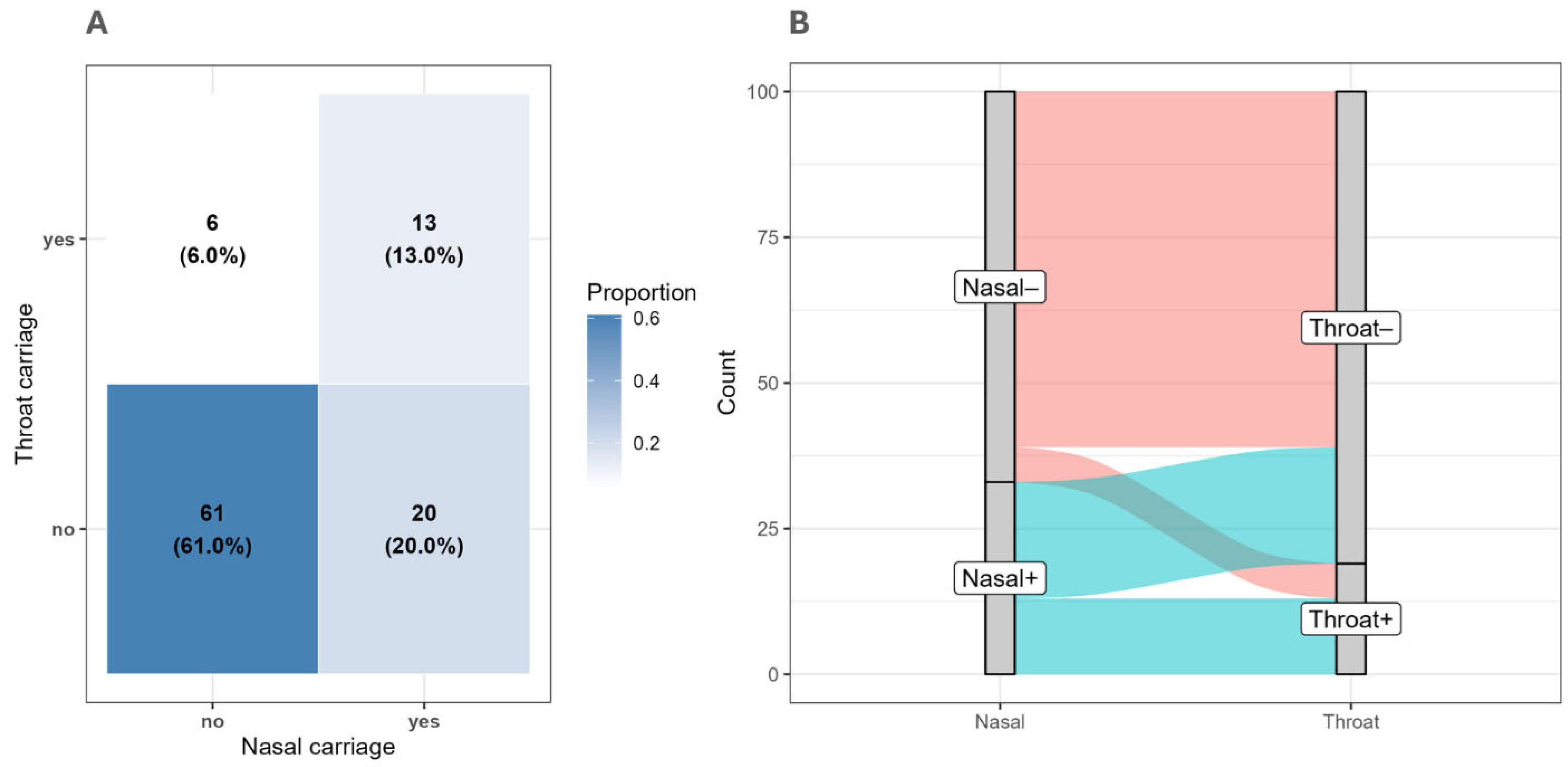
| Nasal S. aureus carriage | 33 (33%) | 19 (29%) | 14 (40%) | 0.3 | |
| Throat S. aureus carriage | 19 (19%) | 15 (23%) | 4 (11%) | 0.2 | |
| MRSA-positive | 3 (3.0%) | 3 (4.6%) | 0 (0%) | 0.5 | |
| S. aureus carriage pattern | Neither | 61 (61%) | 41 (63%) | 20 (57%) | 0.2 |
| Nasal only | 20 (20%) | 9 (14%) | 11 (31%) | ||
| Throat only | 6 (6.0%) | 5 (7.7%) | 1 (2.9%) | ||
| Nasal + Throat | 13 (13%) | 10 (15%) | 3 (8.6%) | ||
| Resistance Category | Resistance Profile | Total | Nasal | Throat |
|---|---|---|---|---|
| Fully susceptible | No resistance detected | 11 (35%) | 5 | 6 |
| Single-class resistance | Penicillin G | 15 (47%) | 10 | 5 |
| Tetracycline | 1 (3%) | 1 | 0 | |
| Two-class resistance | Penicillin G, Erythromycin | 1 (3%) | 1 | 0 |
| Cefotaxime, Erythromycin | 1 (3%) | 0 | 1 | |
| Cefotaxime, Penicillin G | 1 (3%) | 1 | 0 | |
| Multidrug resistance | Penicillin G, Erythromycin, Fusidic acid | 1 (3%) | 1 | 0 |
| Cefotaxime, Tetracycline, Penicillin G, Erythromycin, Fusidic acid | 1 (3%) | 0 | 1 |
| Overall S. aureus | Nasal Carriage | Throat Carriage | |||||||
|---|---|---|---|---|---|---|---|---|---|
| OR | 95% CI | p-Value | OR | 95% CI | p-Value | OR | 95% CI | p-Value | |
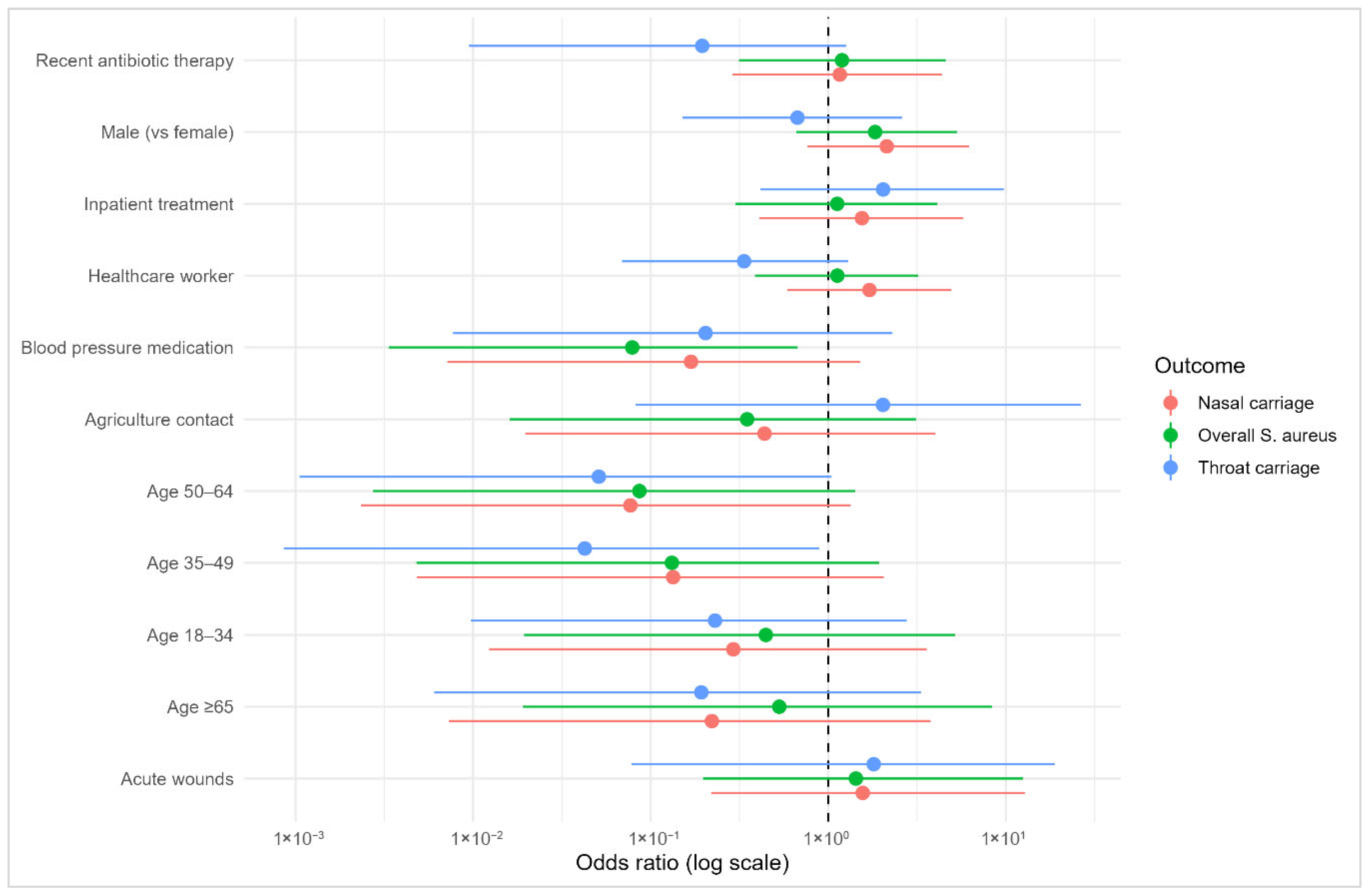
| Age (years) | 0.98 | 0.96, 1.01 | 0.2 | 0.98 | 0.95, 1.01 | 0.2 | 0.98 | 0.95, 1.01 | 0.3 |
| Sex (ref: females) | 9.11 | 0.75, 163 | 0.10 | 6.46 | 0.55, 103 | 0.2 | 3.21 | 0.08, 435 | 0.6 |
| Recent antibiotic therapy (ref: no) | 1.30 | 0.39, 4.20 | 0.7 | 1.30 | 0.37, 4.25 | 0.7 | 0.25 | 0.01, 1.47 | 0.2 |
| Age x Sex (ref: females) | 0.95 | 0.88, 1.01 | 0.12 | 0.96 | 0.89, 1.02 | 0.3 | 0.94 | 0.80, 1.04 | 0.4 |
| Model fit (AIC) | 135.8575316 | 128.2740936 | 98.3245397 | ||||||
| Model discrimination (AUC) | 0.6469105 | 0.6503844 | 0.6806368 | ||||||
Disclaimer/Publisher’s Note: The statements, opinions and data contained in all publications are solely those of the individual author(s) and contributor(s) and not of MDPI and/or the editor(s). MDPI and/or the editor(s) disclaim responsibility for any injury to people or property resulting from any ideas, methods, instructions or products referred to in the content. |
© 2026 by the authors. Licensee MDPI, Basel, Switzerland. This article is an open access article distributed under the terms and conditions of the Creative Commons Attribution (CC BY) license.
Share and Cite
Martens, A.; Schauer, M.; Motevalli, M.; König, B. Patterns, Associated Factors, and Anatomical Concordance of Nasal and Throat Staphylococcus aureus Carriage Among Community-Dwelling Adults in Germany. Microorganisms 2026, 14, 1053. https://doi.org/10.3390/microorganisms14051053
Martens A, Schauer M, Motevalli M, König B. Patterns, Associated Factors, and Anatomical Concordance of Nasal and Throat Staphylococcus aureus Carriage Among Community-Dwelling Adults in Germany. Microorganisms. 2026; 14(5):1053. https://doi.org/10.3390/microorganisms14051053
Chicago/Turabian StyleMartens, Alexander, Markus Schauer, Mohamad Motevalli, and Brigitte König. 2026. "Patterns, Associated Factors, and Anatomical Concordance of Nasal and Throat Staphylococcus aureus Carriage Among Community-Dwelling Adults in Germany" Microorganisms 14, no. 5: 1053. https://doi.org/10.3390/microorganisms14051053
APA StyleMartens, A., Schauer, M., Motevalli, M., & König, B. (2026). Patterns, Associated Factors, and Anatomical Concordance of Nasal and Throat Staphylococcus aureus Carriage Among Community-Dwelling Adults in Germany. Microorganisms, 14(5), 1053. https://doi.org/10.3390/microorganisms14051053