Article

Soil Bacterial and Fungal Community Structure and Its Driving Factors Under Small-Scale Altitude Gradient on the Southern Slope of the Qilian Mountains

1
School of Life Sciences, Qinghai Normal University, Xining 810008, China
2
Qilian Mountain Southern Slope Forest Ecosystem Research Station, Huzhu 810500, China
3
Key Laboratory of Medicinal Animal and Plant Resources of Qinghai-Tibetan Plateau, Xining 810008, China
4
Team of Germplasm Resources Formation Mechanism and Utilization on the Qinghai-Tibetan Plateau, Xining 810008, China
5
College of Geographical Sciences, Qinghai Normal University, Xining 810008, China
*
Authors to whom correspondence should be addressed.
Microorganisms 2026, 14(4), 928; https://doi.org/10.3390/microorganisms14040928

Submission received: 17 February 2026 / Revised: 15 April 2026 / Accepted: 16 April 2026 / Published: 20 April 2026
(This article belongs to the Special Issue Research of Soil Microbial Communities)

Abstract

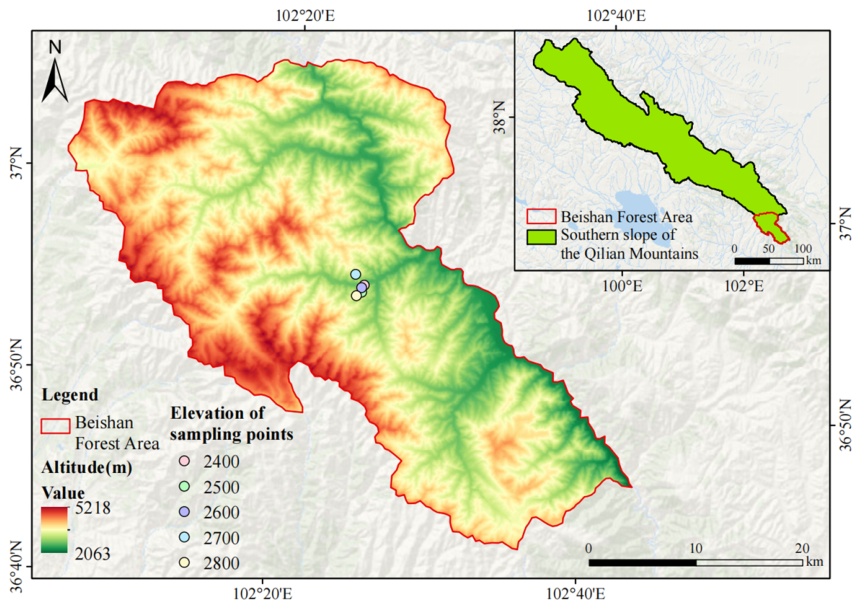
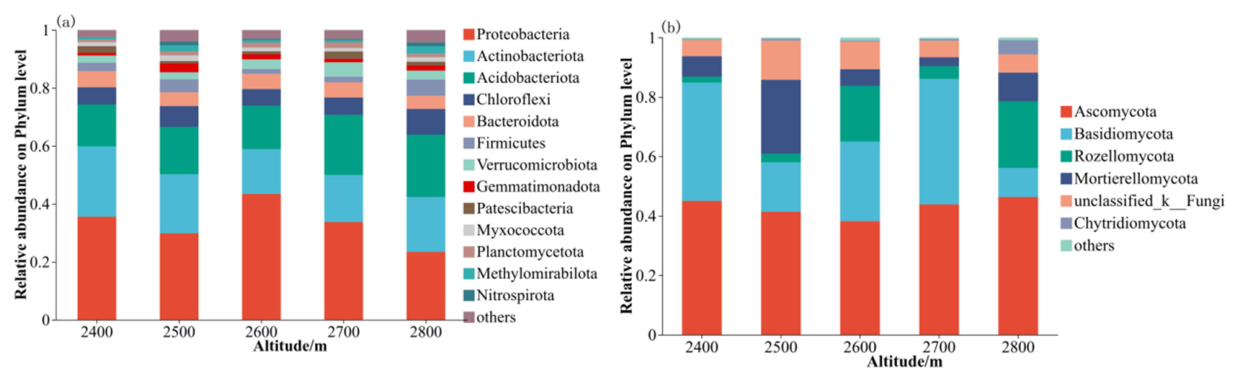
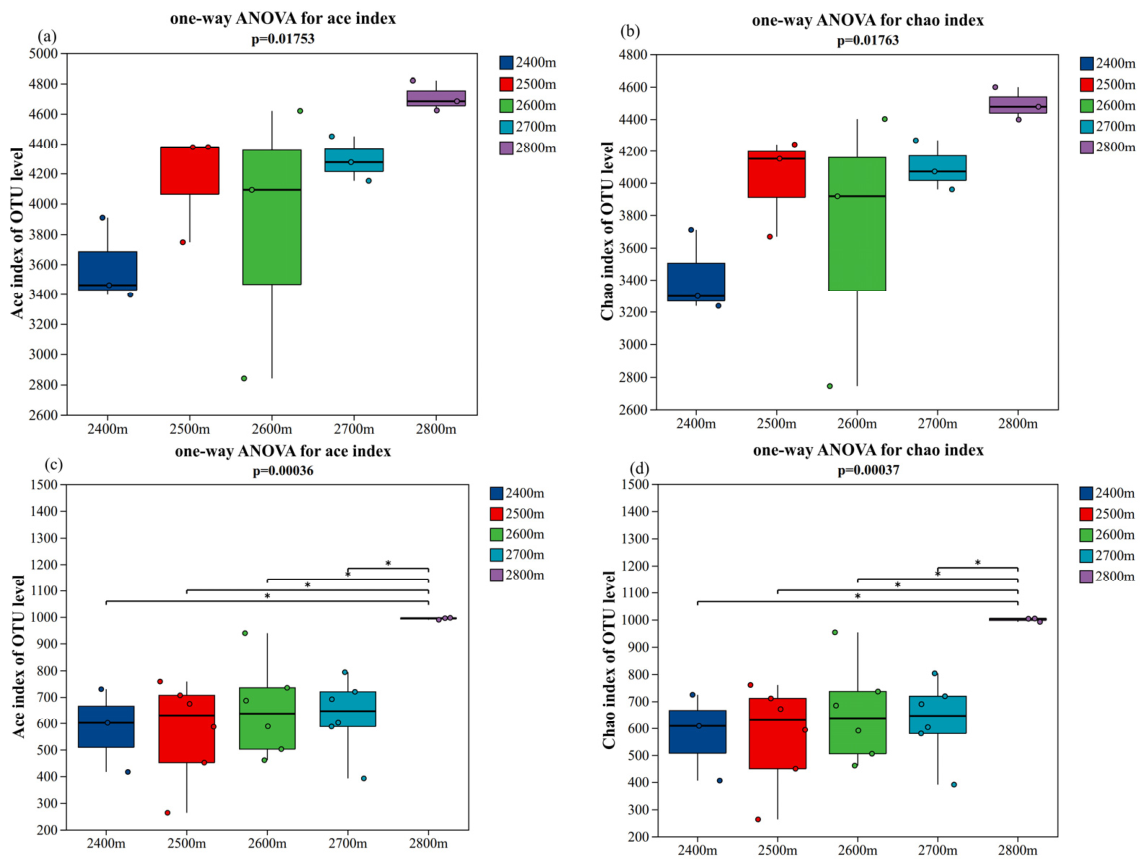
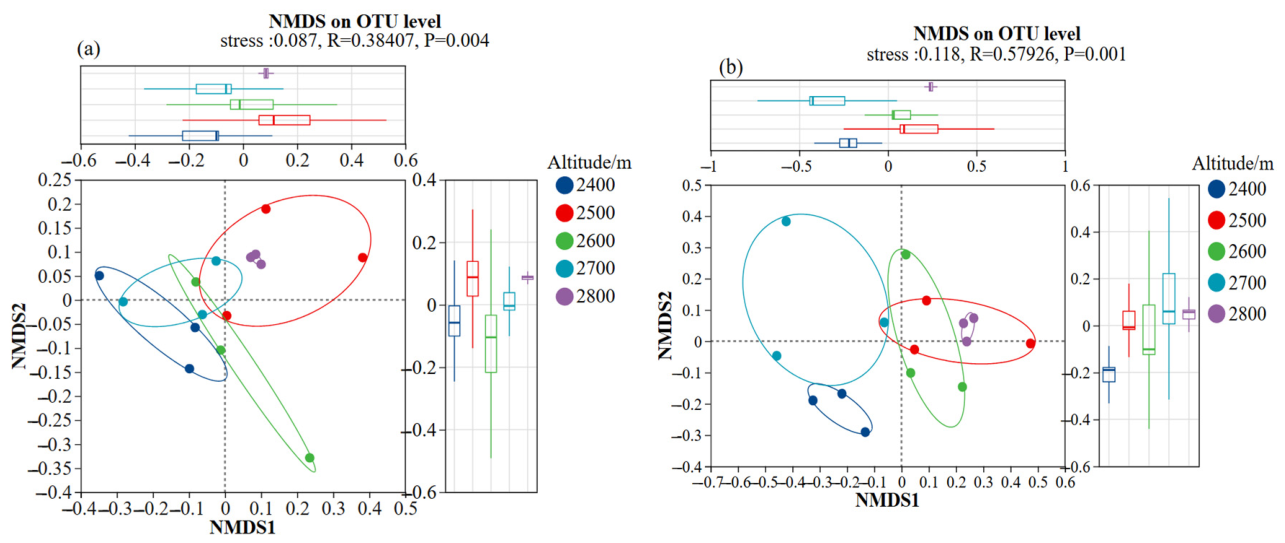
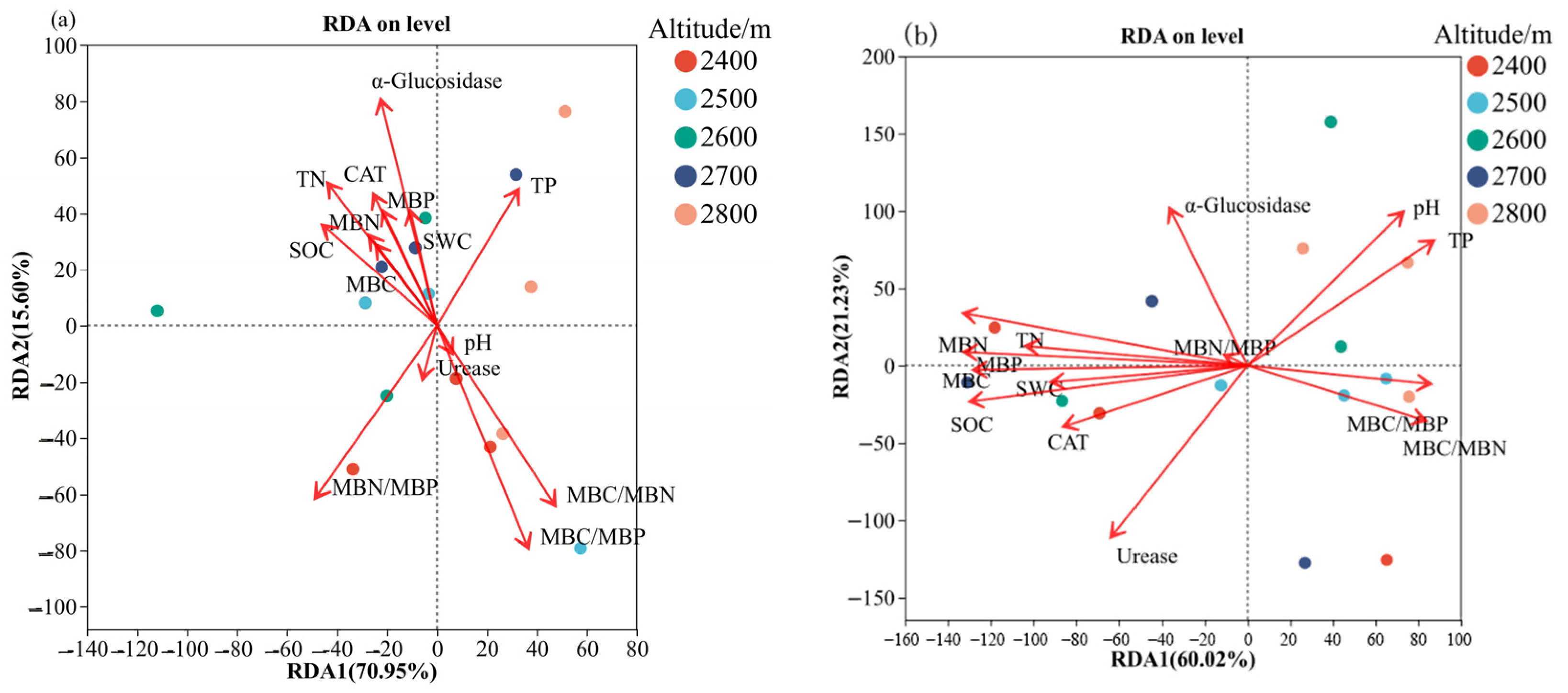
Aiming to clarify the spatial distribution characteristics of soil microbial assemblages and the environmental factors shaping them across a narrow altitudinal transect, this investigation concentrated on the surface soil layer within naturally occurring mixed forests of Picea crassifolia and Betula platyphylla, situated in the elevation band from 2400 to 2800 m along the southern flank of the Qilian Mountains. Leveraging the Illumina NextSeq 2000 high-throughput sequencing platform, integrated with α- and β-diversity analyses and redundancy analysis (RDA), we systematically characterized the composition and diversity traits of soil bacterial and fungal communities, as well as their associations with environmental factors. Notably, the bacterial communities were dominated by Pseudomonadota, Actinomycetota, and Acidobacteria with the abundance of Pseudomonadota decreasing with increasing altitude and that of Acidobacteria increasing with increasing altitude. Furthermore, Ascomycota and Basidiomycota were the dominant phyla in the fungal community. In contrast, bacterial α-diversity—as estimated by the Ace index—showed no significant variation across altitudes. Yet, the fungal alpha diversity metrics—namely Ace and Chao1—were markedly elevated at the 2800 m elevation relative to those observed at both intermediate and lower-altitude locations. Importantly, fungal diversity and community composition showed stronger altitudinal differentiation than bacterial communities in this dataset. Moreover, soil pH, total phosphorus, organic carbon, litter C:N:P stoichiometric ratios, and microbial biomass C:N:P stoichiometric ratios were strongly associated with soil microbial community variation along the altitude gradient, suggesting that they may act as important environmental filters. In conclusion, altitude-driven variations in litter characteristics and soil physicochemical properties jointly shape the assembly processes and spatial distribution patterns of soil microbial communities in this region.
Keywords: small-scale altitude; microbial communities; litter; soil physicochemical properties; functional prediction small-scale altitude; microbial communities; litter; soil physicochemical properties; functional prediction