1. Introduction
Antimicrobial resistance (AMR) is a growing global threat, contributing to an estimated 1.27 million deaths in 2019 attributable to bacterial resistance [
1,
2]. The rise of multidrug-resistant organisms (MDRO), particularly Gram-negative bacteria, is complicating the treatment of common infections and placing a significant burden on healthcare systems [
3,
4]. Among the most concerning pathogens are
Escherichia coli and other Enterobacterales, which are becoming more resistant to last-resort antibiotics like carbapenems, colistin, and tigecycline [
5,
6,
7,
8].
Although intrinsically susceptible to most antibiotics,
E. coli can acquire resistance genes through horizontal gene transfer, making it a significant cause of nosocomial infections and a growing public health concern [
9,
10,
11]. As a commensal inhabitant of the gastrointestinal tract, it can serve as a reservoir for resistance genes while also being a leading pathogen responsible for urinary tract infections and sepsis [
12,
13,
14].
β-lactam antibiotics, which include penicillin, cephalosporins, monobactams, and carbapenems, are among the most common agents used to treat bacterial infections [
15,
16]. β-lactam resistance is primarily caused by β-lactmases, enzymes that hydrolyze β-lactam rings and therefore inactivate the drug [
17]. Based on amino acid sequence homology, β-lactamases are classified into four Ambler classes (A, B, C, and D). Classes A, C, and D are serine β-lactamases, whereas class B enzymes are metallo-β-lactamases that require zinc for activity [
18]. New Delhi metallo-β-lactamase (NDM), a class B enzyme, confers resistance to nearly all β-lactams except monobactams, posing a significant clinical challenge [
19,
20].
The
blaNDM gene, typically located on a plasmid, enables the spread of carbapenem resistance through horizontal gene transfer [
21]. A diverse set of plasmid types can serve as vectors for
blaNDM, further promoting its dissemination [
22,
23,
24,
25,
26]. Among
blaNDM variants,
blaNDM-5 is a newly emerged carbapenemase with greater hydrolytic activity against carbapenems and cephalosporins (cefotaxime and ceftazidime), attributed to two mutations (Val88Leu and Met154Leu) compared to
blaNDM-1 [
27].
Recent surveillance reports have shown an increase in
E. coli isolates carrying
blaNDM-5 variants in the European Union/European Economic Area (EU/EEA) [
28]. While European surveillance has noted this increase, detailed molecular characterization of NDM-producing
E. coli at a national level, particularly in countries like Croatia, remains limited. Such data are crucial for understanding local transmission dynamics and informing infection control policies.
The aim of the study is to characterize the sequence types (ST), plasmid profiles, and blaNDM gene variants in a collection of NDM-producing E. coli isolates collected over a one-year period, providing insights into the molecular epidemiology and potential dissemination pathways of carbapenem resistance in Croatia.
2. Materials and Methods
The Croatian Committee for Antibiotic Resistance Surveillance at the Croatian Academy of Medical Sciences has maintained a national surveillance program since 1997, covering >90% of the population. Since the beginning of the program, carbapenem-resistant Enterobacterales have been designated as alert organisms and are mandatorily reported to the Reference Centre for Antimicrobial Resistance Surveillance.
In this prospective study, NDM-positive E. coli isolates from clinical samples were collected through the national surveillance network of Croatian microbiological laboratories between 1 March 2023 and 31 March 2024, and submitted to the Reference Centre for Antimicrobial Resistance Surveillance. Metadata collected alongside the isolates included the submitting institution, patient demographics, specimen type, sampling date, and information on prior travel or residence outside Croatia.
Upon arrival, isolates were plated on blood agar, incubated overnight at 36 ± 1 °C, and stored at −80 °C in 15% glycerol stock. Prior to genomic analysis, the stored isolates were streak-plated on blood agar and incubated overnight at 36 ± 1 °C. The colonies were identified using matrix-assisted laser desorption ionization-time of flight mass spectrometry (MALDI-TOF; Bruker Diagnostics, Bremen, Germany). In-house PCR retesting was performed to confirm the presence of the carbapenemase genes, including blaNDM, blaOXA-48-like, blaVIM, blaIMP, and blaKPC.
Total DNA was extracted from the selected colonies using the ZymoBIOMICSTM DNA Miniprep Kit (Zymo Research, Irvine, CA, USA) following the manufacturer’s instructions. Genomic libraries were prepared with the Nextera XT DNA Library Preparation Kit (Illumina Inc., San Diego, CA, USA). The Illumina MiSeq platform (Illumina Inc., USA) was used for the 2 × 250 bp paired-end sequencing.
For bioinformatic analysis, default parameters were used. Firstly, raw data quality was assessed with FastQC (v0.12.1) [
29]. De novo genome assembly of the short reads was performed using SPAdes Genome Assembler (v3.15.2) [
30]. QUAST (v5.0.2) was used to generate genome assembly statistics [
31]. KmerFinder (v3.0.2) was used for silico identification of bacterial species [
32,
33]. Multilocus sequence typing (MLST v2.0) was used to determine STs [
34]. PlasmidFinder (v2.0.1) was used for identification of plasmid incompatibility groups [
35]. AMRFinderPlus (v4.0.3) was used to find acquired AMR genes and point mutations [
36]. Phylogenetic reconstruction was performed using Parsnp (v2.1.0), which constructs an assembly-based alignment of core-genome single-nucleotide polymorphisms using the
E. coli strain K-12 as a reference genome. [
37]. Statistical analysis and visualization of the data were performed using R studio (V4.1.2) [
38].
3. Results
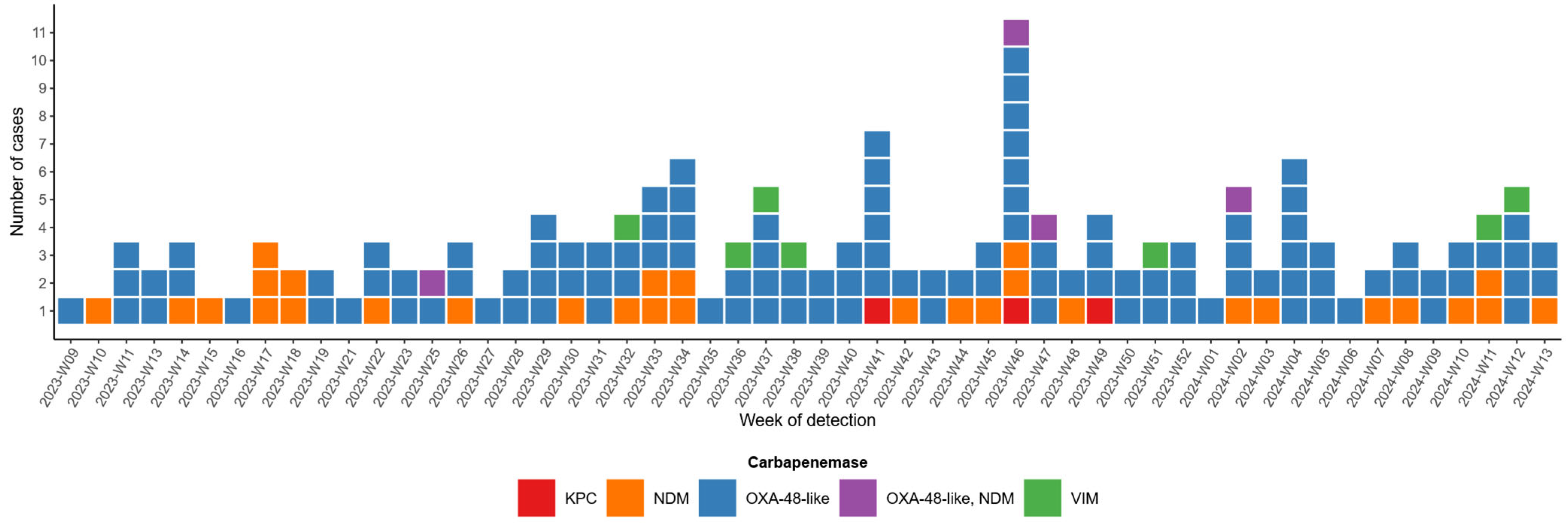
According to the national surveillance data, a total of 160 carbapenem-producing
E. coli isolates were reported from March 2023 to the end of March 2024 in Croatia (
Figure 1).
The most common carbapenemase gene was blaOXA-48-like, identified in 116 (72.50%) E. coli isolates, followed by blaNDM, which was detected in 30 (18.75%) isolates. The presence of dual carbapenemases (blaOXA-48-like and blaNDM) was detected in four (2.50%) isolates. Genes blaVIM and blaKPC were detected in seven (4.38%) isolates and three (1.87%) isolates respectively.
Whole-genome sequencing was performed on 22 of the 34 reported isolates; the remaining isolates were unavailable as they did not survive transport or failed to grow upon subculture. Therefore, 22 NDM-producing E. coli isolates were carried forward for further analysis. The most prevalent blaNDM variant was blaNDM-1, identified in 17 (77.27%) isolates, while blaNDM-5 was detected in 5 (22.73%) isolates. When comparing to other STs in this dataset, blaNDM-1 was not associated with any specific ST in this group.
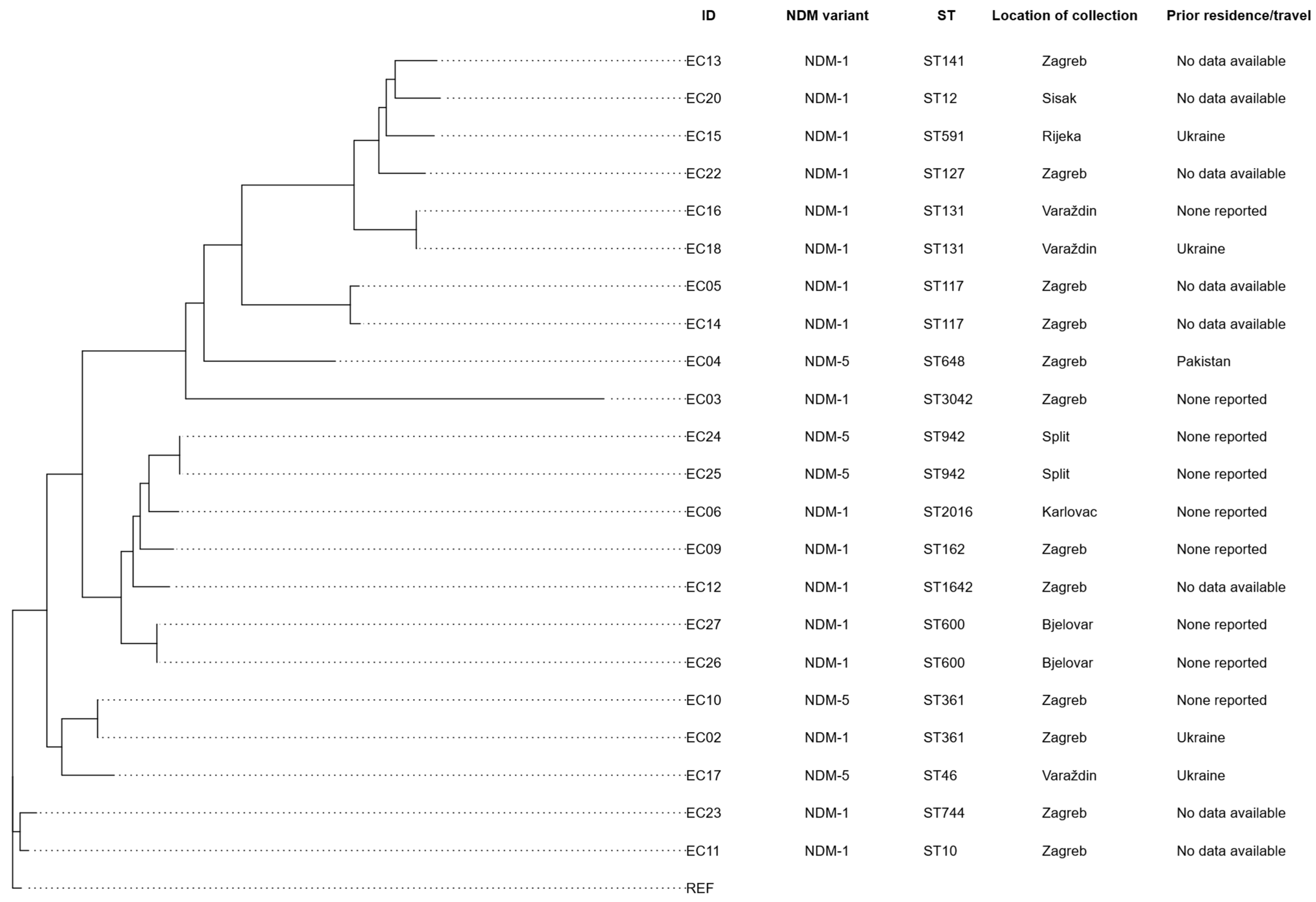
Phylogenetic analysis was performed to investigate the relatedness among the analyzed isolates (
Figure 2). The analysis revealed no significant clustering of isolates. MLST analysis revealed a total of 17 distinct STs in this dataset, highlighting considerable genetic diversity. The high level of diversity was confirmed with the Simpson diversity index, which was equal to 0.978.
Information on residence and/or prior travel within the past 6 months was available for 14 E. coli isolates. Among them, three (21.43%) isolates were linked to war-wounded patients from Ukraine and were associated with blaNDM-1-producing E. coli. Additionally, two (14.28%) isolates were associated with blaNDM-5—one from a patient who had travel history to Pakistan and one from a war-wounded patient from Ukraine. For the remaining 9 (64.29%) isolates, there were no specific data for prior travel and/or residence links. Moreover, no significant correlation was found between specific STs and prior travel and/or residence information.
Screening of plasmid replicons among 22
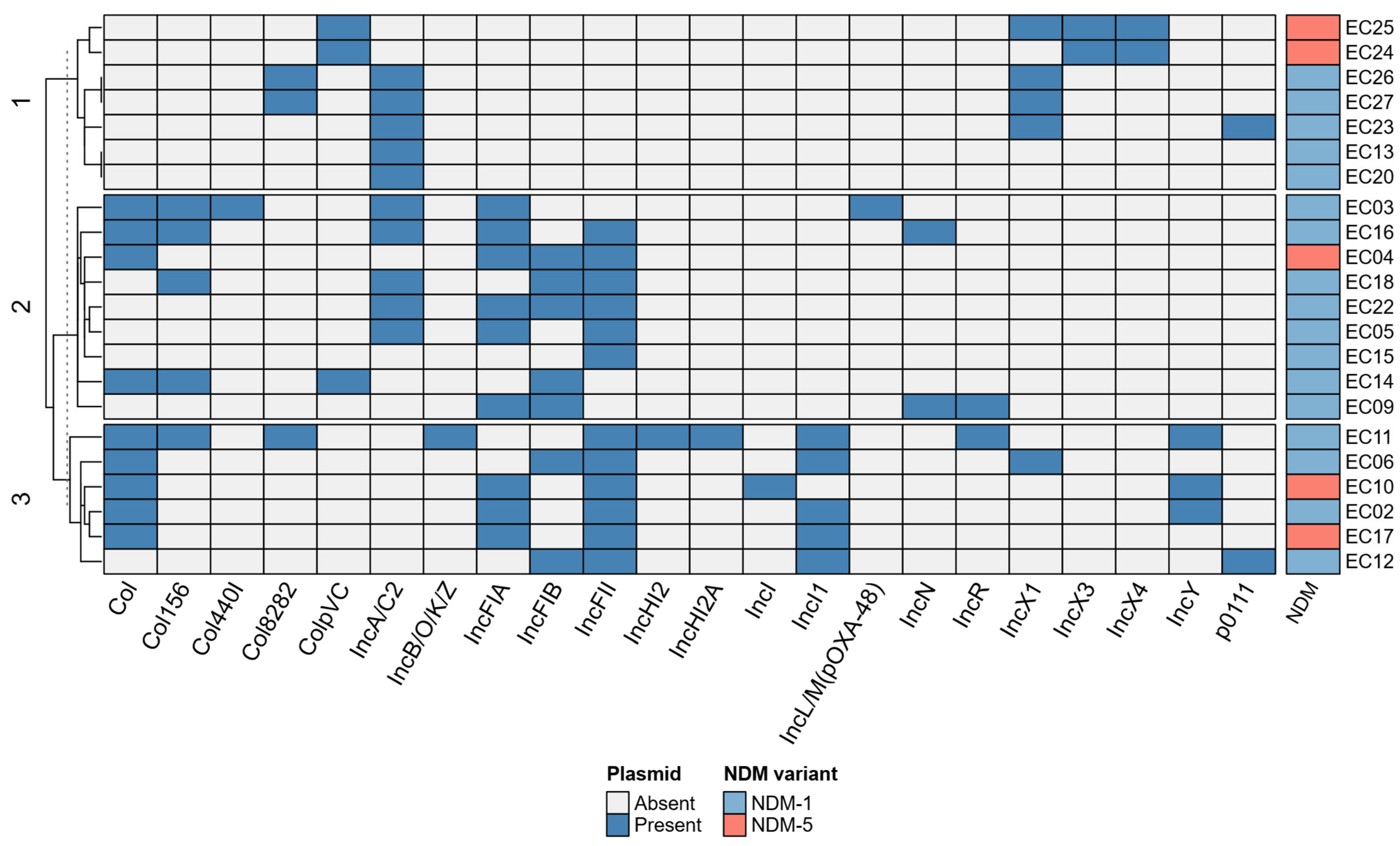
E. coli isolates identified a diverse plasmid population with 22 replicon types. Each isolate harbored three or more plasmid replicons (
Figure 3). The most frequently detected replicon type was IncFII (12/22, 54.54%), followed by IncA/C2 (10/22, 45.45%), IncFIA (9/22, 40.91%), and Col (9/22, 40.91%). Based on total replicon types, isolates carrying the
blaNDM-5 were grouped into three clusters, displaying plasmid diversity within these strains.
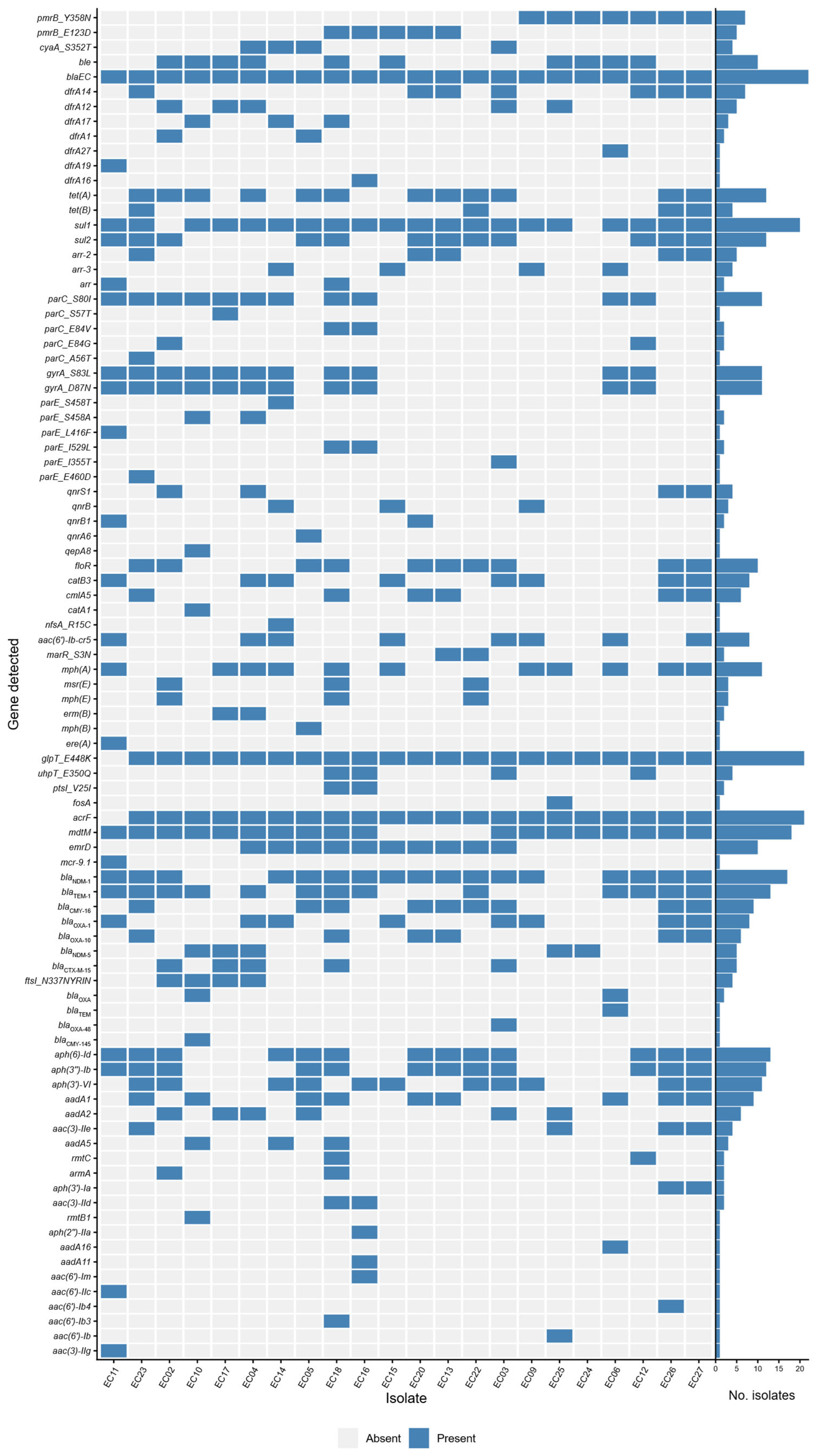
The prevalence of resistance genes among the analyzed isolates is summarized in
Figure 4. The isolates were screened for known resistance determinants, including both horizontally acquired genes and chromosomal point mutations.
The heatmap shows substantial variability in resistome profiles across the isolates, with no clear clustering patterns observed. While certain genes, including blaNDM, blaTEM, sulfonamide resistance genes, and efflux-associated genes (e.g., acrF, mdtM), were widely distributed, many other resistance determinants were detected sporadically. The frequent co-occurrence of multiple resistance genes across different antimicrobial classes highlights the multidrug resistance pattern across the dataset.
Notably, the combination of blaNDM with blaCTX-M-15 and/or blaCMY-16 was detected in 12 isolates. In addition, 12 resistance determinants were present in at least 50% of the isolates, including genes associated with tetracycline resistance (tetA), sulfonamides (sul1, sul2), fluoroquinolones (mutations in parC and gyrA), macrolides (mphA), fosfomycin (mutation in glpT), efflux pumps (acrF, mdtM), β-lactams (blaNDM-1, blaTEM-1), and aminoglycosides (aph(6)-Id, aph(3″)-Ib, aph(3′)-VI).
4. Discussion
Carbapenem-resistant Enterobacterales are classified as critical priority pathogens by the World Health Organization (WHO) due to their association with high morbidity and mortality, posing a significant challenge to healthcare systems [
39]. This study analyzed the distribution of NDM-producing
E. coli isolates in Croatia over one year, examining their STs, plasmid replicon types, and AMR genes. Additionally, we present national surveillance data from 1 March 2023 to 31 March 2024, providing insights into trends of carbapenem-resistant
E. coli (CREC) in Croatia.
Recent global surveillance highlights clear geographical differences in CREC epidemiology. While
blaNDM predominates worldwide, particularly in Asia and North America, European data show a different pattern, with
blaOXA-48-like as the most prevalent carbapenemase, followed by
blaNDM [
40]. In contrast,
blaKPC is more strongly associated with South America but is also present in parts of Europe and North America [
40]. Our national surveillance data align with the detected European trend, identifying
blaOXA-48-like as the most frequent carbapenemase gene among CREC isolates in Croatia, followed by
blaNDM, consistent with previous European reports [
41,
42,
43]. Although
blaKPC-producing
E. coli are currently detected only sporadically in our national surveillance dataset, their greater dissemination potential requires continued surveillance [
44].
A recent European Centre for Disease Prevention and Control (ECDC) surveillance report from 2023 highlighted an increasing prevalence of
blaNDM-5 E. coli isolates in the EU/EEA since 2012 [
28]. However, most of these isolates were linked to regions outside the EU/EEA, particularly Asia and Africa. In contrast, our dataset did not reveal a similar trend. Although we had limited information on prior travel and residence, available data linked
blaNDM-1 isolates to war-wounded patients transferred from Ukraine and patients with no documented travel history, whereas
blaNDM-5 isolates were predominantly identified in patients with no documented travel history, except for two cases associated with travel to Pakistan and a wounded soldier from Ukraine.
Even though the genetic diversity of NDM-producing
E. coli isolates is high, previous studies have identified five dominant STs associated with carbapenem resistance: ST131, ST167, ST405, ST410, and ST1284 [
45]. Our phylogenetic analysis confirmed a high genetic diversity among isolates, suggesting a polyclonal spread. This was further supported by ST profiling, where most isolates did not cluster closely. Five clusters of two isolates each were identified, including a cluster of ST131 isolates, as well as clusters belonging to ST942, ST600, ST117, and ST361. The ST131 cluster comprised two isolates carrying
blaNDM-1. ST131 is a globally disseminated lineage commonly associated with the spread of
blaCTX-M-15, and it may similarly contribute to the dissemination of carbapenemase genes [
46].
According to ECDC surveillance, five dominant STs were associated with
blaNDM-5 in
E. coli isolates from Europe: ST167, ST405, ST410, ST361, and ST648 [
28]. Our analysis found that Croatian isolates carrying
blaNDM-5 were associated with ST361 and ST648, further supporting their role in carbapenemase gene dissemination. Additionally, ST942 was the only clonal lineage with
blaNDM-5 that formed a cluster in our dataset, suggesting a potential clonal outbreak and new ST to continue to monitor.
Plasmids play a crucial role in the dissemination of
blaNDM genes, facilitating horizontal gene transfer and contributing to the rapid spread of carbapenem resistance among Gram-negative bacteria [
21,
47]. In this study, 22 different plasmid replicon types were identified among the analyzed isolates, with IncFII and IncA/C being the most prevalent. IncFII, a common conjugative plasmid in
E. coli, plays a critical role in the spread of resistance genes, including
blaNDM-1, among Gram-negative bacteria [
48]. Similarly, the IncA/C2 plasmid family has been recognized as clinically significant due to its ability to carry and transfer multiple resistance determinants [
49]. Additionally, the IncX family was associated with
blaNDM-5 [
50]. In our study, isolates carrying IncX replicon types formed a distinct cluster based on plasmid profile analysis, particularly associated with ST942, distinguishing them from the remaining isolates and further supporting this association.
The emergence of CREC is particularly concerning, as
E. coli had the highest estimated incidence of invasive isolates in the EU/EEA among all reporting laboratories in 2021. According to published data from 2023, eight out of 44 EU/EEA countries (18%) reported CREC rates of 1% or higher [
51]. While Croatia remains in the low-resistance category, this should be interpreted with caution, as the number of CREC isolates is increasing. Our dataset identified 76 different resistance genes, highlighting the complexity of resistance mechanisms. The combination of multiple mechanisms often results in multidrug-resistant or extensively drug-resistant strains, significantly limiting therapeutic options. Another critical concern is the high proportion of isolates co-harboring ESBL-encoding genes, rendering them resistant to monobactam. In our dataset, approximately half of NDM-positive isolates (54.55%) carried either one or both
blaCTX-M-15 and
blaCMY-16 genes, further limiting the effectiveness of β-lactam antibiotics. This combination has major clinical implications for treatment options. Additionally, high resistance rates to aminoglycosides, fosfomycin, and quinolones further complicate treatment, highlighting the need for surveillance.
5. Conclusions
This study provides insight into the molecular epidemiology of NDM-producing E. coli isolates from Croatia over a one-year period. Genomic characterization revealed high diversity among sequence types, with no evidence of clonal clustering. Consistent with this, a diverse range of plasmid replicon types was identified, highlighting the complexity of plasmid transmission dynamics. Importantly, the blaNDM-5 variant was detected in multiple isolates, indicating its sporadic presence in Croatia. Of particular concern is the co-occurrence of blaNDM and ESBL-encoding genes, which significantly limits therapeutic options for β-lactam antibiotics.
These findings highlight the importance of continuous genomic surveillance at the national level to better understand local transmission dynamics and inform infection control policies. Strengthening infection prevention and control measures, alongside antimicrobial stewardship programs, is essential to limit further spread.
Our study has several limitations. It was based on a relatively small number of isolates collected over a short time, and the use of short-read sequencing restricted full plasmid characterization. Nevertheless, this study contributes valuable insights into the epidemiology of NDM-producing E. coli in Croatia and underscores the need for coordinated, multidisciplinary efforts to combat antimicrobial resistance.
Author Contributions
A.T.A., M.J. and I.B. designed the study. M.J. and J.U. performed sample preparation and sequencing. M.J. and J.U. performed data analysis. J.U. interpreted data and drafted the manuscript. All authors have read and agreed to the published version of the manuscript.
Funding
This work was supported by the EURGen-RefLabCap project (SC 20197401).
Institutional Review Board Statement
Not applicable.
Informed Consent Statement
Not applicable.
Data Availability Statement
Sequence data from 22 sequenced isolates of NDM-producing E. coli have been deposited in the European Nucleotide Archive (ENA) database under study accession number PRJEB87695.
Acknowledgments
We would like to thank Sandra Lucić and Irena Groš for their technical assistance with isolate collection. Additionally, we are grateful to our colleagues who contributed by sending isolates from various regions of Croatia to our laboratory: Sanja Krešić, Karolina Dobrović, Sanja Maraković, Ana Nikić Hecer, Ivana Mareković, Khalil Nemer, Maja Abram, Iva Koščak, Marija Tonkić, and Tamara Marković. During the preparation of this manuscript, the authors used [ChatGPT, GPT-4 version] for the purposes of writing. The tool was used to help with phrasing, grammar, and improving clarity and structure of the manuscript. All scientific content, data interpretation, and final decisions were made by the authors. The authors have reviewed and edited the output and take full responsibility for the content of this publication. Some preliminary results of this work were previously presented as a conference poster; the present manuscript significantly extends these findings.
Conflicts of Interest
The authors declare no conflicts of interest.
References
- European Centre for Disease Prevention and Control; World Health Organization. Antimicrobial Resistance Surveillance in Europe 2022: 2020 Data; Publications Office of the European Union: Luxembourg, 2022; Available online: https://www.ecdc.europa.eu/sites/default/files/documents/Joint-WHO-ECDC-AMR-report-2022.pdf (accessed on 8 November 2024).
- Murray, C.J.L.; Ikuta, K.S.; Sharara, F.; Swetschinski, L.; Aguilar, G.R.; Gray, A.; Han, C.; Bisignano, C.; Rao, P.; Wool, E.; et al. Global burden of bacterial antimicrobial resistance in 2019: A systematic analysis. Lancet 2022, 399, 629–655, Erratum in Lancet 2022, 400, 1102. [Google Scholar] [CrossRef] [PubMed]
- Logan, L.K.; Weinstein, R.A. The Epidemiology of Carbapenem-Resistant Enterobacteriaceae: The Impact and Evolution of a Global Menace. J. Infect. Dis. 2017, 215, S28–S36. [Google Scholar] [CrossRef] [PubMed]
- Growing Resistance to Last-Line Antibiotics: 2013. Available online: https://antibiotic.ecdc.europa.eu/en/publications-data/growing-resistance-last-line-antibiotics-2013 (accessed on 8 November 2024).
- Sheu, C.-C.; Chang, Y.-T.; Lin, S.-Y.; Chen, Y.-H.; Hsueh, P.-R. Infections Caused by Carbapenem-Resistant Enterobacteriaceae: An Update on Therapeutic Options. Front. Microbiol. 2019, 10, 80. [Google Scholar] [CrossRef] [PubMed]
- Li, H.; Lin, H.; Fu, Q.; Fu, Y.; Tan, J.; Wang, Y.; Zhou, R.; Sun, Z.; Li, J. Co-transfer of mcr-1 and mcr-3 variant in Escherichia coli ST1632 isolate in China: Silence is not always golden. Pak. Vet. J. 2025, 45, 913–916. [Google Scholar] [CrossRef]
- Haeili, M.; Aghajanzadeh, M.; Moghaddasi, K.; Omrani, M.; Ghodousi, A.; Cirillo, D.M. Emergence of transferable tigecycline and eravacycline resistance gene tet(X4) in Escherichia coli isolates from Iran. Sci. Rep. 2025, 15, 16581. [Google Scholar] [CrossRef]
- Madni, W.; Zahoor, M.A.; Nawaz, Z.; Khurshid, M. Prevalence and sequence analysis of Escherichia coli harboring colistin, gentamicin, streptomycin, tetracycline and quinolone resistance genes from commercial broilers. Pak. Vet. J. 2025, 45, 390–395. [Google Scholar] [CrossRef]
- Mangroliya, D.; Adhyaru, H.; Kabariya, J.; Ramani, V. Genomic insights into plasmid mediated AMR genes, virulence factors and mobile genetic elements in raw milk Escherichia coli from Gujarat, India. Sci. Rep. 2025, 15, 6320. [Google Scholar] [CrossRef]
- Poirel, L.; Madec, J.-Y.; Lupo, A.; Schink, A.-K.; Kieffer, N.; Nordmann, P.; Schwarz, S. Antimicrobial Resistance in Escherichia coli. Microbiol. Spectr. 2018, 6, 10–1128. [Google Scholar] [CrossRef]
- Tobin, E.H.; Zahra, F. Nosocomial Infections. In StatPearls [Internet]; StatPearls Publishing: Treasure Island, FL, USA, 2026. Available online: https://www.ncbi.nlm.nih.gov/books/NBK559312/ (accessed on 22 March 2026).
- Aziz, M.; Park, D.E.; Quinlivan, V.; Dimopoulos, E.A.; Wang, Y.; Sung, E.H.; Roberts, A.L.S.; Nyaboe, A.; Davis, M.F.; Casey, J.A.; et al. Zoonotic Escherichia coli and urinary tract infections in Southern California. mBio 2025, 16, e01428-25. [Google Scholar] [CrossRef]
- Ducarmon, Q.R.; Zwittink, R.D.; Willems, R.P.J.; Verhoeven, A.; Nooij, S.; van der Klis, F.R.M.; Franz, E.; Kool, J.; Giera, M.; Vandenbroucke-Grauls, C.M.J.E.; et al. Gut colonisation by extended-spectrum β-lactamase-producing Escherichia coli and its association with the gut microbiome and metabolome in Dutch adults: A matched case-control study. Lancet Microbe 2022, 3, e443–e451. [Google Scholar] [CrossRef]
- Wende, M.; Osbelt, L.; Eisenhard, L.; Lesker, T.R.; Damaris, B.F.; Mutukumarasamy, U.; Bielecka, A.; Almási, É.D.H.; Winter, K.A.; Schauer, J.; et al. Suppression of gut colonization by multidrug-resistant Escherichia coli clinical isolates through cooperative niche exclusion. Nat. Commun. 2025, 16, 5426. [Google Scholar] [CrossRef] [PubMed]
- Anderson, S.J.; Feye, K.M.; Schmidt-McCormack, G.R.; Malovic, E.; Mlynarczyk, G.S.; Izbicki, P.; Arnold, L.F.; Jefferson, M.A.; de la Rosa, B.M.; Wehrman, R.F.; et al. Off-Target drug effects resulting in altered gene expression events with epigenetic and “Quasi-Epigenetic origins”. Pharmacol. Res. 2016, 107, 229–233. [Google Scholar] [CrossRef] [PubMed]
- Balsalobre, L.; Blanco, A.; Alarcón, T. Beta-Lactams. In Antibiotic Drug Resistance, 1st ed.; Capelo-Martínez, J., Igrejas, G., Eds.; Wiley: Hoboken, NJ, USA, 2019; pp. 57–72. [Google Scholar] [CrossRef]
- De Angelis, G.; Del Giacomo, P.; Posteraro, B.; Sanguinetti, M.; Tumbarello, M. Molecular Mechanisms, Epidemiology, and Clinical Importance of β-Lactam Resistance in Enterobacteriaceae. Int. J. Mol. Sci. 2020, 21, 5090. [Google Scholar] [CrossRef]
- Ambler, R. The structure of β-lactamases. Philos. Trans. R. Soc. Lond. B Biol. Sci. 1980, 289, 321–331. [Google Scholar] [CrossRef] [PubMed]
- Boyd, S.E.; Livermore, D.M.; Hooper, D.C.; Hope, W.W. Metallo-β-Lactamases: Structure, Function, Epidemiology, Treatment Options, and the Development Pipeline. Antimicrob. Agents Chemother. 2020, 64, e00397-20. [Google Scholar] [CrossRef]
- Naas, T.; Oueslati, S.; Bonnin, R.A.; Dabos, M.L.; Zavala, A.; Dortet, L.; Retailleau, P.; Iorga, B.I. Beta-lactamase database (BLDB)–structure and function. J. Enzym. Inhib. Med. Chem. 2017, 32, 917–919. [Google Scholar] [CrossRef]
- Sakamoto, N.; Akeda, Y.; Sugawara, Y.; Matsumoto, Y.; Motooka, D.; Iida, T.; Hamada, S. Role of Chromosome- and/or Plasmid-Located blaNDM on the Carbapenem Resistance and the Gene Stability in Escherichia coli. Microbiol. Spectr. 2022, 10, e00587-22. [Google Scholar] [CrossRef]
- Sheng, J.; Lan, H.; Wang, X.; Yao, J.; Hu, Y.; Guo, J.; Zhou, L.; Tang, X.; Xu, H.; Yu, Y.; et al. Global geographic and genomic epidemiology analysis of carbapenem-resistant Escherichia coli carrying blaNDM-9. mSphere 2025, 10, e00704-25. [Google Scholar] [CrossRef]
- Huang, Y.-S.; Tsai, W.-C.; Li, J.-J.; Chen, P.-Y.; Wang, J.-T.; Chen, Y.-T.; Chen, F.-J.; Lauderdale, T.-L.; Chang, S.-C. Increasing New Delhi metallo-β-lactamase-positive Escherichia coli among carbapenem non-susceptible Enterobacteriaceae in Taiwan during 2016 to 2018. Sci. Rep. 2021, 11, 2609. [Google Scholar] [CrossRef]
- Zhai, Y.; Lee, S.; Teng, L.; Ma, Z.; Hilliard, N.B.; May, R.J.; Brown, S.A.; Yu, F.; Desear, K.E.; Cherabuddi, K.; et al. Dissemination mechanisms of NDM genes in hospitalized patients. JAC-Antimicrob. Resist. 2021, 3, dlab032. [Google Scholar] [CrossRef]
- Nisa, T.T.; Sugawara, Y.; Hamaguchi, S.; Takeuchi, D.; Abe, R.; Kuroda, E.; Morita, M.; Zuo, H.; Ueda, A.; Nishi, I.; et al. Genomic characterization of carbapenemase-producing Enterobacterales from Dhaka food markets unveils the spread of high-risk antimicrobial-resistant clones and plasmids co-carrying blaNDM and mcr-1.1. JAC Antimicrob. Resist. 2024, 6, dlae124. [Google Scholar] [CrossRef] [PubMed]
- Weber, A.; Denkel, L.; Geffers, C.; Kola, A.; Maechler, F. NDM-1 plasmid clustering reflects clonal transmission of Klebsiella pneumoniae ST147 in four hospitals in Berlin, Germany. Antimicrob. Resist. Infect. Control 2025, 14, 114. [Google Scholar] [CrossRef] [PubMed]
- Li, L.; Gao, Y.; Wang, L.; Lu, F.; Ji, Q.; Zhang, Y.; Yang, S.; Cheng, P.; Sun, F.; Qu, S. The effects of NDM-5 on Escherichia coli and the screening of interacting proteins. Front. Microbiol. 2024, 15, 1328572. [Google Scholar] [CrossRef] [PubMed]
- European Centre for Disease Prevention and Control. Increase in Escherichia coli Isolates Carrying blaNDM-5 in the European Union/European Economic Area, 2012–2022; ECDC: Stockholm, Sweden, 2023. [Google Scholar]
- Andrews, S. FastQC: A Quality Control Tool for High Throughput Sequence Data. Available online: https://www.bioinformatics.babraham.ac.uk/projects/fastqc/ (accessed on 1 May 2025).
- Bankevich, A.; Nurk, S.; Antipov, D.; Gurevich, A.A.; Dvorkin, M.; Kulikov, A.S.; Lesin, V.M.; Nikolenko, S.I.; Pham, S.; Prjibelski, A.D.; et al. SPAdes: A New Genome Assembly Algorithm and Its Applications to Single-Cell Sequencing. J. Comput. Biol. 2012, 19, 455–477. [Google Scholar] [CrossRef]
- Gurevich, A.; Saveliev, V.; Vyahhi, N.; Tesler, G. QUAST: Quality assessment tool for genome assemblies. Bioinformatics 2013, 29, 1072–1075. [Google Scholar] [CrossRef]
- Hasman, H.; Saputra, D.; Sicheritz-Ponten, T.; Lund, O.; Svendsen, C.A.; Frimodt-Møller, N.; Aarestrup, F.M. Rapid Whole-Genome Sequencing for Detection and Characterization of Microorganisms Directly from Clinical Samples. J. Clin. Microbiol. 2014, 52, 139–146. [Google Scholar] [CrossRef]
- Larsen, M.V.; Cosentino, S.; Lukjancenko, O.; Saputra, D.; Rasmussen, S.; Hasman, H.; Sicheritz-Pontén, T.; Aarestrup, F.M.; Ussery, D.W.; Lund, O. Benchmarking of Methods for Genomic Taxonomy. J. Clin. Microbiol. 2014, 52, 1529–1539. [Google Scholar] [CrossRef]
- Larsen, M.V.; Cosentino, S.; Rasmussen, S.; Friis, C.; Hasman, H.; Marvig, R.L.; Jelsbak, L.; Sicheritz-Pontéen, T.; Ussery, D.W.; Aarestrup, F.M.; et al. Multilocus Sequence Typing of Total-Genome-Sequenced Bacteria. J. Clin. Microbiol. 2012, 50, 1355–1361. [Google Scholar] [CrossRef]
- Carattoli, A.; Zankari, E.; Garcìa-Fernandez, A.; Larsen, M.; Lund, O.; Voldby Villa, L.; Møller Aarestrup, F.; Hasman, H. In Silico Detection and Typing of Plasmids using PlasmidFinder and Plasmid Multilocus Sequence Typing. Antimicrob. Agents Chemother. 2014, 58, 3895–3903. [Google Scholar] [CrossRef]
- Feldgarden, M.; Brover, V.; Gonzalez-Escalona, N.; Frye, J.G.; Haendiges, J.; Haft, D.H.; Hoffmann, M.; Pettengill, J.B.; Prasad, A.B.; Tillman, G.E.; et al. AMRFinderPlus and the Reference Gene Catalog facilitate examination of the genomic links among antimicrobial resistance, stress response, and virulence. Sci. Rep. 2021, 11, 12728. [Google Scholar] [CrossRef]
- Treangen, T.J.; Ondov, B.D.; Koren, S.; Phillippy, A.M. The Harvest suite for rapid core-genome alignment and visualization of thousands of intraspecific microbial genomes. Genome Biol. 2014, 15, 524. [Google Scholar] [CrossRef]
- RStudio Team. RStudio: Integrated Development for R; RStudio Team: Boston, MA, USA, 2020; Available online: https://posit.co (accessed on 1 May 2025).
- WHO. Bacterial Priority Pathogens List 2024: Bacterial Pathogens of Public Health Importance, to Guide Research, Development, and Strategies to Prevent and Control Antimicrobial Resistance, 1st ed.; World Health Organization: Geneva, Switzerland, 2024. [Google Scholar]
- Huang, J.; Lv, C.; Li, M.; Rahman, T.; Chang, Y.-F.; Guo, X.; Song, Z.; Zhao, Y.; Li, Q.; Ni, P.; et al. Carbapenem-resistant Escherichia coli exhibit diverse spatiotemporal epidemiological characteristics across the globe. Commun. Biol. 2024, 7, 51. [Google Scholar] [CrossRef] [PubMed]
- Findlay, J.; Perreten, V.; Poirel, L.; Nordmann. Molecular analysis of OXA-48-producing Escherichia coli in Switzerland from 2019 to 2020. Eur. J. Clin. Microbiol. Infect. Dis. 2022, 41, 1355–1360. [Google Scholar] [CrossRef]
- Peirano, G.; Pitout, J.D.D. Rapidly spreading Enterobacterales with OXA-48-like carbapenemases. J. Clin. Microbiol. 2025, 63, e01515-24. [Google Scholar] [CrossRef] [PubMed]
- Kohlenberg, A.; Svartström, O.; Apfalter, P.; Hartl, R.; Bogaerts, P.; Huang, T.-D.; Chudejova, K.; Malisova, L.; Eisfeld, J.; Sandfort, M.; et al. Emergence of Escherichia coli ST131 carrying carbapenemase genes, European Union/European Economic Area, August 2012 to May 2024. Eurosurveillance 2024, 29, 2400727. [Google Scholar] [CrossRef]
- Cao, S.; Jiang, X.; Suo, J.; Lu, Y.; Ju, M.; Zeng, Q.; Zheng, Q.; Zhang, Z.; Tang, W. Molecular characteristics and antimicrobial susceptibility profiles of blaKPC-producing Escherichia coli isolated from a teaching hospital in Shanghai, China. Infect. Drug Resist. 2024, 17, 319–327. [Google Scholar] [CrossRef] [PubMed]
- Peirano, G.; Chen, L.; Nobrega, D.; Finn, T.J.; Kreiswirth, B.N.; DeVinney, R.; Pitout, J.D. Genomic Epidemiology of Global Carbapenemase-Producing Escherichia coli, 2015–2017. Emerg. Infect. Dis. 2022, 28, 924. [Google Scholar] [CrossRef]
- Mathers, A.J.; Peirano, G.; Pitout, J.D.D. The Role of Epidemic Resistance Plasmids and International High-Risk Clones in the Spread of Multidrug-Resistant Enterobacteriaceae. Clin. Microbiol. Rev. 2015, 28, 565–591. [Google Scholar] [CrossRef]
- Shoaib, M.; Hameed, M.F.; Aqib, A.I.; Wang, W.; Wang, Q.; Wang, S.; Pu, W. Emerging threat of antimicrobial resistance determinants and plasmid replicon types acquisition by Escherichia coli of poultry and other food-producing animal origin in China: Local findings with global implications. Poult. Sci. 2025, 104, 106055. [Google Scholar] [CrossRef]
- Jia, Y.; Hu, H.; Zhai, Y.; Zhao, B.; Sun, H.; Hu, G.; Pan, Y.; Yuan, L. CpxR negatively regulates IncFII-replicon plasmid pEC011 conjugation by directly binding to multi-promoter regions. Res. Vet. Sci. 2022, 150, 98–106. [Google Scholar] [CrossRef]
- Xu, J.; Guo, H.; Li, L.; He, F. Molecular epidemiology and genomic insights into the transmission of carbapenem-resistant NDM-producing Escherichia coli. Comput. Struct. Biotechnol. J. 2023, 21, 847–855. [Google Scholar] [CrossRef]
- Daaboul, D.; Kassem, I.I.; El Omari, K.; Dabboussi, F.; Oueslati, S.; Naas, T.; Osman, M. The occurrence of the carbapenemase gene, blaNDM-5, on a transmissible IncX3 plasmid in multidrug-resistant Escherichia coli isolated from a farm dog. J. Glob. Antimicrob. Resist. 2024, 36, 59–61. [Google Scholar] [CrossRef]
- European Centre for Disease Prevention and Control; World Health Organization. Antimicrobial Resistance Surveillance in Europe 2023: 2021 Data; Publications Office of the European Union: Luxembourg, 2023; Available online: https://www.ecdc.europa.eu/sites/default/files/documents/Antimicrobial%20resistance%20surveillance%20in%20Europe%202023%20-%202021%20data.pdf (accessed on 13 February 2025).
| Disclaimer/Publisher’s Note: The statements, opinions and data contained in all publications are solely those of the individual author(s) and contributor(s) and not of MDPI and/or the editor(s). MDPI and/or the editor(s) disclaim responsibility for any injury to people or property resulting from any ideas, methods, instructions or products referred to in the content. |