Lactic Acid Production from Acid Hydrolysate of Ulva pertusa as a Sustainable Biomass Feedstock

Abstract
1. Introduction
2. Materials and Methods
2.1. Biomass Preparation and Proximate Composition
2.2. Elemental and Mineral Analyses
2.3. Acid Hydrolysis of Ulva pertusa Biomass
2.4. Microorganisms and Culture Conditions
2.5. Lactic Acid Fermentation
2.6. Analytical Methods
2.7. Calculation of Lactic Acid Yield
3. Results and Discussion
3.1. Chemical Composition of Ulva pertusa
3.2. Acid Hydrolysis and Sugar Composition
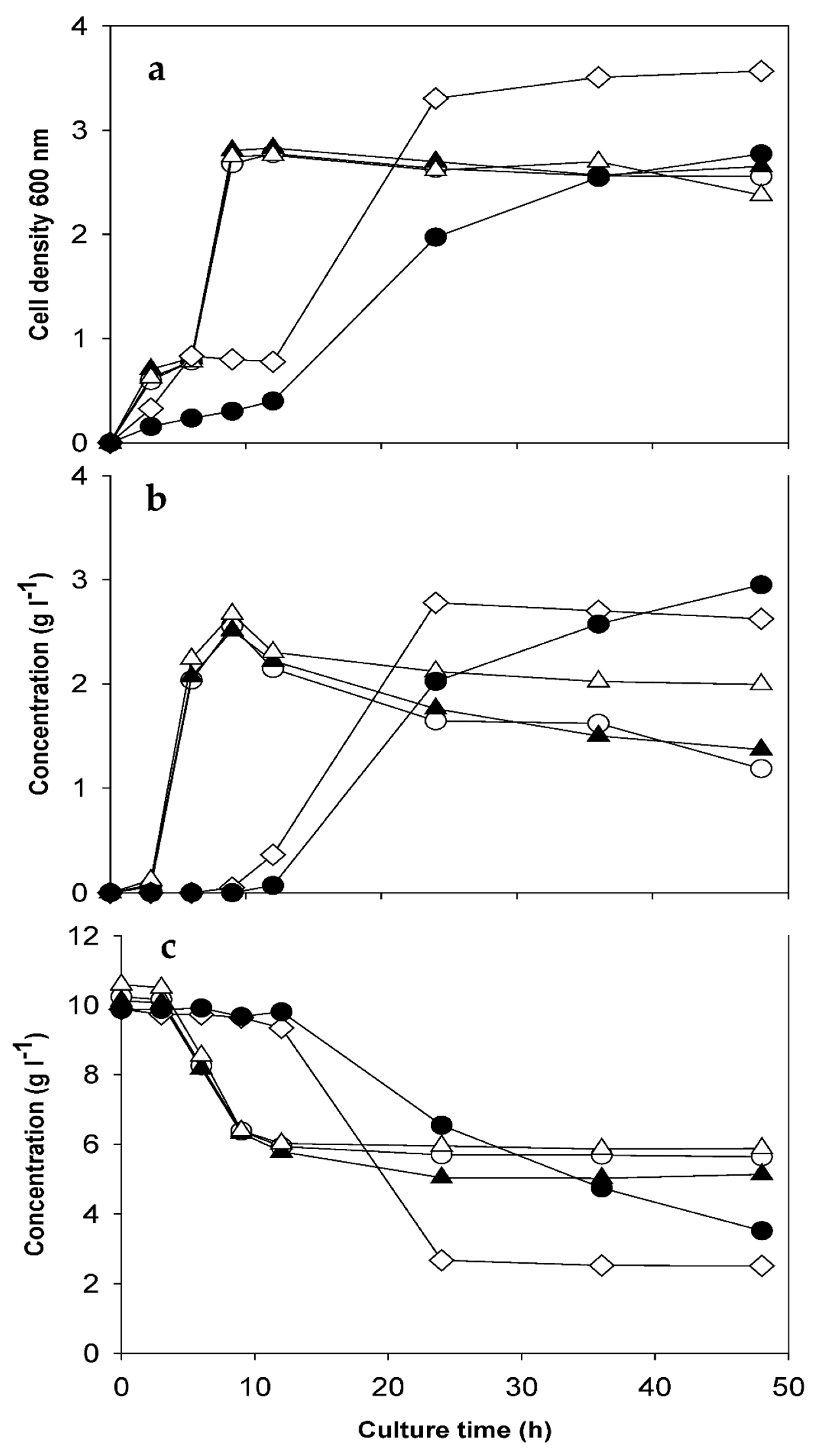
3.3. Lactic Acid Fermentation by Lactobacillus Strains
3.4. Fermentation Kinetics and Metabolic Shifts
3.5. Comparison with Lignocellulosic Feedstocks
4. Conclusions
Author Contributions
Funding
Institutional Review Board Statement
Informed Consent Statement
Data Availability Statement
Conflicts of Interest
References
- Hofmann, L.C.; Strauss, S.; Shpigel, M.; Guttman, L.; Stengel, D.B.; Rebours, C.; Gjorgovska, N.; Turan, G.; Balina, K.; Zammit, G.; et al. The green seaweed Ulva: Tomorrow’s “wheat of the sea” in research, production and applications. Crit. Rev. Food Sci. Nutr. 2024, 64, 2018–2045. [Google Scholar]
- Trivedi, J.; Aila, M.; Bangwal, D.P.; Kaul, S.; Garg, M.O. Algae based biorefinery—How to make sense? Renew. Sustain. Energy Rev. 2015, 47, 295–307. [Google Scholar] [CrossRef]
- Nguyen, T.H.; Sunwoo, I.Y.; Jeong, G.-T.; Kim, S.-K. Detoxification of hydrolysates of the red seaweed Gelidium amansii for improved bioethanol production. Appl. Biochem. Biotechnol. 2019, 188, 977–990. [Google Scholar] [CrossRef]
- Wi, S.G.; Kim, H.J.; Mahadevan, S.A.; Yang, D.J.; Bae, H.J. The potential value of the seaweed Ceylon moss (Gelidium amansii) as an alternative bioenergy resource. Bioresour. Technol. 2009, 100, 6658–6660. [Google Scholar] [CrossRef]
- Gao, M.T.; Hirata, M.; Toorisaka, E.; Hano, T. Acid-hydrolysis of seaweed wastes for lactic acid fermentation. Biomass Bioenergy 2010, 34, 323–326. [Google Scholar]
- Lin, H.-T.V.; Huang, M.-Y.; Kao, T.-Y.; Lu, W.-J.; Lin, H.-J.; Pan, C.-L. Production of lactic acid from seaweed hydrolysates via lactic acid bacteria fermentation. Fermentation 2020, 6, 37. [Google Scholar] [CrossRef]
- Wee, Y.J.; Kim, J.N.; Ryu, H.W. Biotechnological production of lactic acid and its recent application. Food Technol. Biotechnol. 2006, 44, 163–172. [Google Scholar]
- Datta, R.; Henry, M. Lactic acid: Recent advances in products, processes and technologies—A review. J. Chem. Technol. Biotechnol. 2006, 81, 1119–1129. [Google Scholar] [CrossRef]
- Astrid, J.R.L.; Guillermo, A.R.M.; Betânia, H.L.; André, L.J.; Rubens, M.F. Poly-lactic acid synthesis for application in biomedical devices—A review. Biotechnol. Adv. 2025, 67, 108215. [Google Scholar]
- Farobie, O.; Sari, V.A.; Hartulistiyoso, E.; Fatriasari, W.; Nandiyanto, A.B.D.; Amrullah, A.; Ernawati, L.; Misbahuddin. Sustainable biogas production through anaerobic co-digestion of Ulva lactuca (Chlorophyta) and cow manure: A kinetic and process optimization study. RSC Sustain. 2025, 3, 3483–3498. [Google Scholar] [CrossRef]
- John, R.P.; Nampoothiri, K.M.; Pandey, A. Fermentative production of lactic acid from biomass: An overview on process developments and future perspectives. Appl. Microbiol. Biotechnol. 2007, 74, 524–534. [Google Scholar] [CrossRef] [PubMed]
- Abdel-Rahman, M.A.; Tashiro, Y.; Sonomoto, K. Lactic acid production from lignocellulose-derived sugars using lactic acid bacteria: Overview and future prospects. J. Biotechnol. 2011, 156, 286–301. [Google Scholar] [CrossRef]
- Kumar, A.; Singh, J.; Singh, D.; Singh, H. Lactic acid production: Approaches and trends. J. Environ. Chem. Eng. 2020, 8, 103607. [Google Scholar]
- Jang, J.S.; Cho, Y.; Jeong, G.-T.; Kim, S.-K. Optimization of saccharification and fermentation of seaweed hydrolysates for bioethanol production. Bioresour. Technol. 2012, 120, 196–202. [Google Scholar]
- Lee, S.Y.; Chang, J.H.; Lee, S.B. Chemical composition, saccharification yield, and the potential of the green seaweed Ulva pertusa. Biotechnol. Bioprocess Eng. 2014, 19, 1022–1033. [Google Scholar] [CrossRef]
- Lahaye, M.; Robic, A. Structure and functional properties of ulvan, a polysaccharide from green seaweeds. Biomacromolecules 2007, 8, 1765–1774. [Google Scholar] [CrossRef]
- Michalak, I.; Chojnacka, K. Algae as production systems of bioactive compounds. Eng. Life Sci. 2015, 15, 160–176. [Google Scholar] [CrossRef]
- Harun, R.; Danquah, M.K. Influence of acid pre-treatment on microalgal biomass for bioethanol production. Process Biochem. 2011, 46, 304–309. [Google Scholar] [CrossRef]
- Singh, A.; Nigam, P.S.; Murphy, J.D. Renewable fuels from algae: An answer to debatable land based fuels. Bioresour. Technol. 2011, 102, 10–16. [Google Scholar] [CrossRef] [PubMed]
- Park, J.H.; Hong, J.Y.; Jang, H.C.; Oh, S.G.; Kim, S.H.; Yoon, J.J.; Kim, Y.H. Use of Gelidium amansii as biomass for lactic acid production by simultaneous saccharification and fermentation. Appl. Microbiol. Biotechnol. 2012, 93, 273–283. [Google Scholar] [CrossRef]
- Bruhn, A.; Dahl, J.; Nielsen, H.B.; Nikolaisen, L.; Rasmussen, M.B.; Markager, S.; Olesen, B.; Arias, C.; Jensen, P.D. Bioenergy potential of Ulva lactuca: Biomass yield, methane production and combustion. Bioresour. Technol. 2011, 102, 2595–2604. [Google Scholar] [CrossRef] [PubMed]
- Rajendran, V.; Sundaram, M.; Rengasamy, R.; Manivasagan, P. Lactic acid production from marine macroalgae Gracilaria corticata using Lactobacillus delbrueckii. Indian J. Geo-Mar. Sci. 2015, 44, 151–156. [Google Scholar]
- Kim, J.K.; Yarish, C.; Hwang, E.K.; Park, M.; Kim, Y. Seaweed aquaculture: Cultivation technologies, challenges and its ecosystem services. Algae 2017, 32, 1–13. [Google Scholar] [CrossRef]
- Wells, M.L.; Potin, P.; Craigie, J.S.; Raven, J.A.; Merchant, S.S.; Helliwell, K.E.; Smith, A.G.; Camire, M.E.; Brawley, S.H. Algae as nutritional and functional food sources: Revisiting our understanding. J. Appl. Phycol. 2017, 29, 949–982. [Google Scholar] [CrossRef] [PubMed]
- Cui, F.; Li, T.; Wan, C. Lactic acid production from corn stover using mixed cultures of Lactobacillus rhamnosus and Lactobacillus brevis. Bioresour. Technol. 2011, 102, 1831–1836. [Google Scholar] [CrossRef] [PubMed]
- Korea Food and Drug Administration. The Korea Food Codes; Korea Food and Drug Administration: Seoul, Republic of Korea, 2011; Chapter 10; Volume 2, pp. 1–53. [Google Scholar]


| Proximate Composition (g/100 g Dry Weight) | Ultimate Analysis (g/100 g Dry Weight) | Mineral Analysis (μg g−1 Dry Weight) | Sugar Composition of Hydrolysate (g/100 g Dry Weight) | ||||
|---|---|---|---|---|---|---|---|
| Carbohydrate | 52.3 | C | 34.87 | Mg | 19,580 | L-rhamnose | 11.6 |
| Protein | 25.1 | H | 5.28 | Ca | 13,320 | D-glucose | 5.0 |
| Lipid | 0.1 | O | 46.54 | K | 3070 | D-glucuronic acid | 2.7 |
| Ash | 22.5 | N | 3.77 | Fe | 2980 | D-glucuronolactone | 2.2 |
| S | 3.13 | Al | 2670 | D-xylose | 2.3 | ||
| P | 0.12 | Na | 1060 | ||||
| others | 6.29 | Sr | 120 | ||||
| Mn | 50 | ||||||
| Cu | 20 | ||||||
| Total | 100 | 100 | 42,750 | 23.8 | |||
| Parameter | Group A | Group B | |||
|---|---|---|---|---|---|
| L. rhamnosus | L. salivarius | L. plantarum | L. casei | L. brevis | |
| Cell density (OD600) | 2.68 | 2.81 | 2.75 | 2.77 | 3.31 |
| Total products (g L−1) * | 5.2 | 4.9 | 5.3 | 6.7 | 6.8 |
| Lactic acid (g L−1) * | 2.6 | 2.5 | 2.7 | 3.0 | 2.8 |
| Acetic acid (g L−1) | 0.6 | 0.6 | 0.6 | 1.9 | 1.5 |
| Succinic acid | 1.8 | 1.7 | 1.8 | 1.0 | 1.4 |
| 1,2-propanediol | 0.2 | 0.1 | 0.2 | 0.6 | 0.6 |
| Acetaldehyde | - | - | - | 0.2 | 0.5 |
| L-rhamnose | 2.2 | 2.4 | 2.5 | 3.0 | 3.2 |
| D-glucose | 1.4 | 1.3 | 1.4 | 1.4 | 1.4 |
| D-xylose | 0.3 | 0.1 | 0.3 | 0.3 | 1.4 |
| D-glucuronic acid | 0.0 | 0.0 | 0.0 | 1.7 | 1.3 |
| D-glucuronolactone | 0.1 | 0.1 | 0.2 | 0.2 | 0.2 |
| Lactic acid yield (g g−1) | 0.66 | 0.66 | 0.63 | 0.46 | 0.39 |
Disclaimer/Publisher’s Note: The statements, opinions and data contained in all publications are solely those of the individual author(s) and contributor(s) and not of MDPI and/or the editor(s). MDPI and/or the editor(s) disclaim responsibility for any injury to people or property resulting from any ideas, methods, instructions or products referred to in the content. |
© 2026 by the authors. Licensee MDPI, Basel, Switzerland. This article is an open access article distributed under the terms and conditions of the Creative Commons Attribution (CC BY) license.
Share and Cite
Choi, Y.; Hwang, H. Lactic Acid Production from Acid Hydrolysate of Ulva pertusa as a Sustainable Biomass Feedstock. Microorganisms 2026, 14, 788. https://doi.org/10.3390/microorganisms14040788
Choi Y, Hwang H. Lactic Acid Production from Acid Hydrolysate of Ulva pertusa as a Sustainable Biomass Feedstock. Microorganisms. 2026; 14(4):788. https://doi.org/10.3390/microorganisms14040788
Chicago/Turabian StyleChoi, Yoojin, and Hyeongjin Hwang. 2026. "Lactic Acid Production from Acid Hydrolysate of Ulva pertusa as a Sustainable Biomass Feedstock" Microorganisms 14, no. 4: 788. https://doi.org/10.3390/microorganisms14040788
APA StyleChoi, Y., & Hwang, H. (2026). Lactic Acid Production from Acid Hydrolysate of Ulva pertusa as a Sustainable Biomass Feedstock. Microorganisms, 14(4), 788. https://doi.org/10.3390/microorganisms14040788