1. Introduction
Salmonella spp. is one of the main causative agents of foodborne infections, capable of causing foodborne outbreaks on international, national, and local levels [
1,
2,
3]. In the European Union, salmonellosis is the second most frequently reported cause of gastrointestinal infection; the five most frequent
Salmonella serovars in the European Union, in descending order, are Enteritidis, Typhimurium, monophasic Typhimurium, Infantis, and Newport [
4]. Human infection by
Salmonella strains is transmitted via the consumption of contaminated foods of animal origin (mainly eggs, meat, poultry, and milk). Other routes include the consumption of inadequately cooked meat, improper food handling, and consumption of unpasteurized dairy products and seafood. Fresh products, such as vegetables and fruit, may also be implicated in transmission, especially if there is manure or irrigation water contamination [
5,
6,
7,
8,
9].
In most cases, infections caused by
Salmonella spp. are self-limiting and do not require antimicrobial treatment. However, antimicrobial therapy is essential and can be lifesaving in invasive salmonellosis, which primarily affects individuals with specific risk factors, including young children, the elderly, and the immunocompromised [
10,
11,
12,
13,
14,
15]. Immunocompromised children—such as those with hemoglobin disorders, HIV infection, malignancies, or other underlying conditions—are at particularly high risk of severe disease and mortality due to complications [
16].
Salmonellosis in children constitutes a major public health concern, especially in low- and middle-income countries [
17,
18]. This increased vulnerability can be attributed to immaturity of the immune system, particularities of the intestinal microbiota, as well as behaviors that favor exposure to pathogenic microorganisms [
19,
20]. Several retrospective reviews and studies have shown that this age group, particularly infants, is the most susceptible to non-typhoidal salmonellosis groups [
13,
21,
22,
23,
24,
25]. Clinically salmonellosis develops mainly as an acute gastrointestinal syndrome, with fever, abdominal pain, diarrhea, and, in severe cases, dehydration, hemorrhagic colitis, or even sepsis [
26,
27].
In Greece, the responsible authority for salmonellosis surveillance is the National Public Health Organization (EODY). There are two parallel surveillance systems for salmonellosis: the Mandatory Notification System (MNS) and the laboratory surveillance system through the National Reference Centre for Salmonella–Shigella (NSSRC). This system is voluntary, but universal, including all clinical microbiology laboratories across the country which are advised to submit isolates to the NSSRC for further typing. Data concerning cases and clusters of salmonellosis are collected during investigations and entered into a dedicated database at the Department of Foodborne/Waterborne Diseases and Food Safety of EODY [
28].
Since 2010, efforts have been made to improve case notification by physicians due to existing underreporting, through feedback to hospitals, informational publications on the importance of notification, and other measures [
13,
29]. According to national surveillance data, during the period 2004–2020, a total of 10,707 salmonellosis cases were reported, with a mean annual notification rate of 5.7 cases per 100,000 population, while the most frequently reported non-typhoidal
Salmonella serovars in Greece were
Salmonella Enteritidis (
S. Enteritidis) and
Salmonella Typhimurium (
S. Typhimurium) [
28,
30]. This study analyzed confirmed pediatric salmonellosis cases in Greece (2005–2024) to describe temporal, geographical, demographic, and serovar patterns, while inferential analysis was not performed.
3. Results
3.1. Population Overview
In Greece, during the period 2005–2024, a total of 7340 confirmed salmonellosis cases were reported among children aged 0–14 years, while 7154 confirmed salmonellosis cases were used for analysis after excluding imported cases. 5973 (84%) were reported by public hospitals, 1070 (15%) by private hospitals, and the remaining (1%) by private diagnostic laboratories, health centers, and private physicians. The median age of cases was 3 years (IQR: 6 years). Of these, 3880 cases (54%) were male children, 3267 (46%) were female, while for 7 cases (0.1%) sex was not reported.
For male cases, the median age was 3 years (IQR: 6 years), while for female cases the median age was also 3 years (IQR: 6 years). Further analysis by age group showed that 61% of all recorded cases belonged to the 0–4-year age group, with a median age of 1 year (IQR: 3, 53% male cases). This was followed by the 5–9-year age group (26%), with a median age of 7 years (IQR: 3, 55% male cases), and the 10–14-year age group (13.0%), with a median age of 12 years (IQR: 3, 59% male cases).
Of all reported cases, 6002 (84%) were Greek nationals, 480 (6%) were migrants, 175 (2%) were tourists, 15 (0.1%) were refugees, while for 497 cases (8%) no data were available. Regarding the presence of special population groups, only 5% of reported cases belonged to such groups; among those, 4% belonged to the Greek Roma population.
During the period 2005–2024, the mean annual notification rate of salmonellosis among individuals aged < 15 years was 23.0 cases per 100,000 population (
Table 1). Analysis by five-year age subgroups (0–4 years, 5–9 years, 10–14 years) showed that salmonellosis was most frequent in the 0–4-year age group, where the mean annual notification rate was 49.9 cases per 100,000 population (
Table 2).
3.2. Exposure-Related Factors
During the same period, 1080 reported cases (15%) indicated an epidemiological link with another case. Additionally, 175 cases (2.4%) were tourists, and 186 cases (2.5%) reported recent travel history abroad within the incubation period. Of these, 54% belonged to the 0–4-year age group, 27% to the 5–9-year age group, and 19% to the 10–14-year age group. Those with recent travel history abroad within the incubation period were excluded from the downstream analysis, as they were considered imported cases.
Twenty-eight percent of cases reported attendance in a school setting. Among these, 29% belonged to the 0–4-year age group, 44% to the 5–9-year age group, and 27% to the 10–14-year age group.
3.3. Hospitalization and Clinical Severity
During the period 2005–2024, 6733 children aged 0–14 years (92%) reported clinical manifestations of salmonellosis. Enteritis (81%) and enteric fever (17%) were the most frequently reported, followed by dysentery (9%) and sepsis (1%). This distribution was maintained when analysis was conducted by age group. Clinical symptoms by age and sex are presented in
Table 3.
Overall, 6261 cases (88%) were hospitalized; among them, 54% were male children. Further analysis by age group showed that 60% of hospitalized cases were 0–4 years old (54% male), 26% were 5–9 years old (55% male), and 14% were 10–14 years old (58% male). Analysis showed that there was no statistically significant association between hospitalization and sex (p = 0.9314) of the child. Also, there was no statistically significant association between hospitalization and age group (p = 0.4966) of the child.
Invasive infections (bacteremia, sepsis) were recorded in 2% of cases, while other severe clinical manifestations (renal failure, myocarditis, etc.) were recorded at rates < 1%. Among all cases, 65% reported recovery at the time of notification, while 25% reported ongoing illness. Death was the outcome in three cases (0.04%), two of whom were male children. All three fatal cases belonged to the 5–9-year age group. None belonged to a special population group, or epidemiological link to a confirmed case in their immediate environment, and only two had been hospitalized prior to death.
3.4. Temporal Notification and Hospitalization Rate
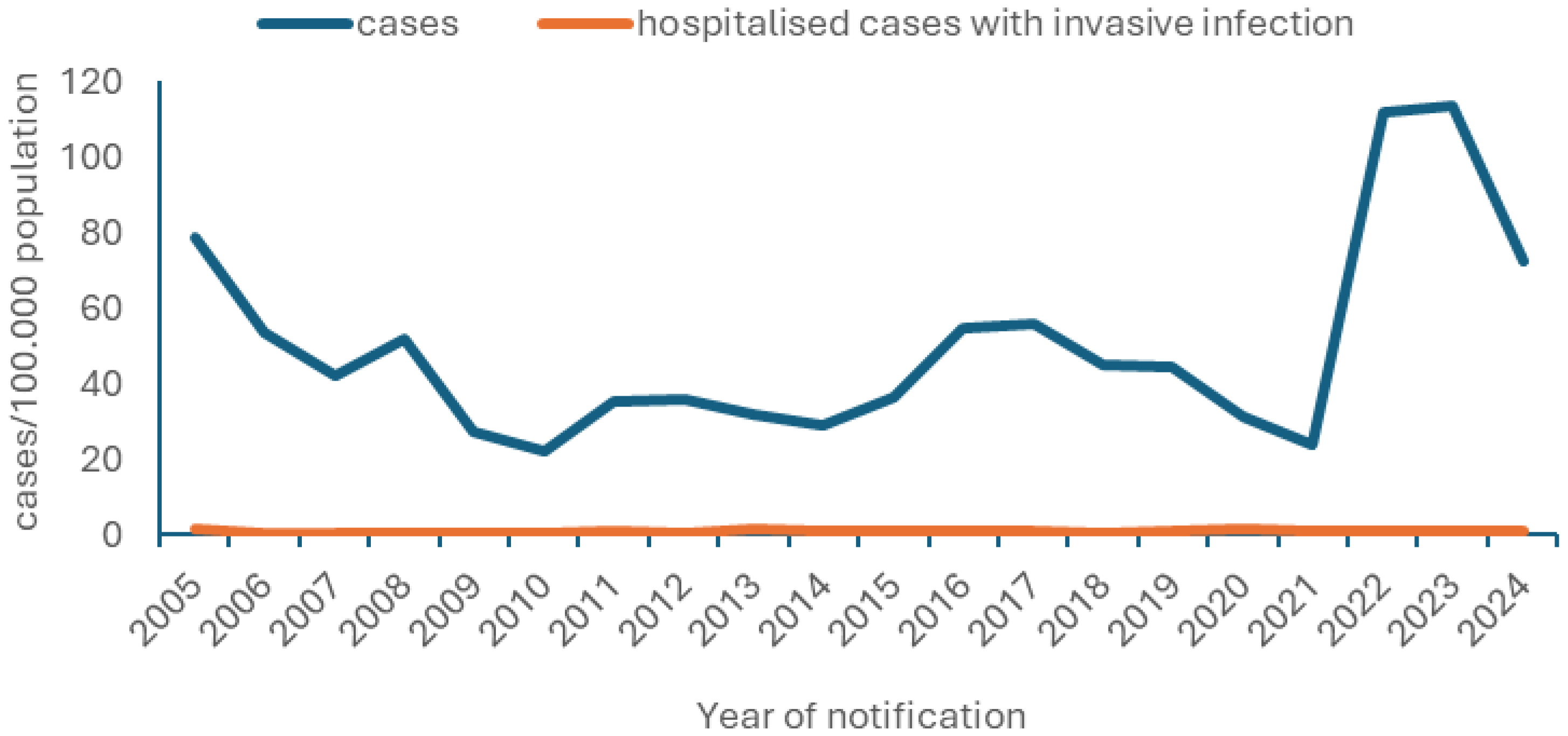
During the period 2005–2024, a gradual decline in disease incidence among children aged < 15 years was observed (
Figure 1) until 2021, after which an increase was noted. The same pattern was observed following age stratification (
Supplementary Figure S1). The post-2021 increase continued until 2023, followed by a subsequent decline. The temporal distribution of salmonellosis notification rates and cases requiring hospitalization due to invasive infection among children aged 0–14 years during 2005–2024 is shown in
Figure 1.
Table 4 presents the total number of hospitalized salmonellosis cases among children aged 0–14 years per year of notification and age group.
3.5. Seasonality and Geographical Distribution
Throughout the study period, a seasonal monthly pattern in salmonellosis frequency was observed with mean annual notification rates increasing from spring through the summer months, peaking in August, and then gradually decreasing during autumn (
Table 5).
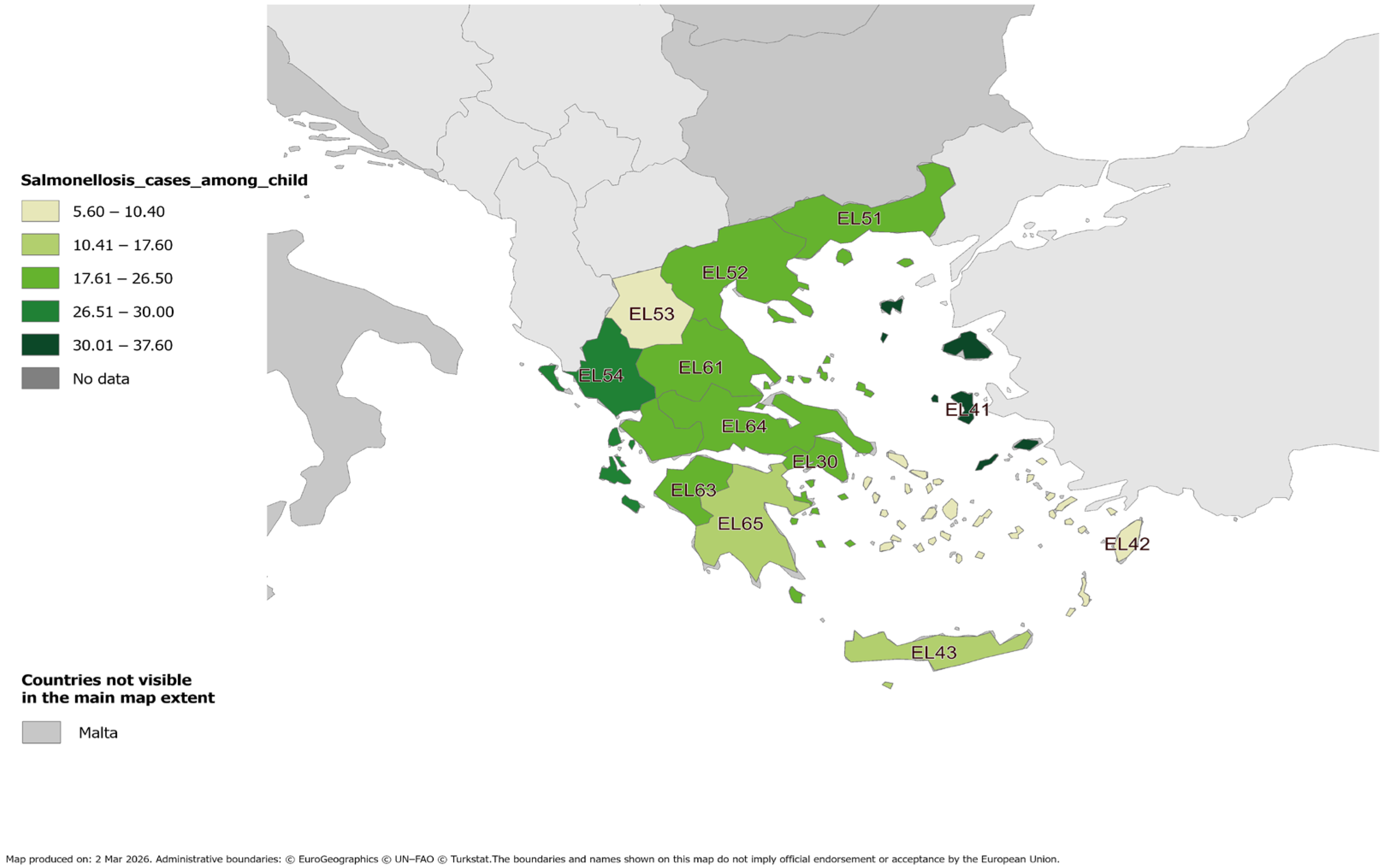
Among children aged < 15 years during 2005–2024, the highest mean annual notification rate was observed in the North Aegean Islands (37.7 cases per 100,000 population), while the lowest was observed in Western Macedonia (5.6 cases per 100,000 population) (
Supplementary Table S1). These data are presented geographically on the map shown in
Figure 2.
Age-stratified analysis showed that in the 0–4-year age group, the highest and lowest mean annual notification rates were observed in the North Aegean Islands (66.4 cases per 100,000 population) and Western Macedonia (11.5 cases per 100,000 population), respectively. In the 5–9-year age group, the highest and lowest mean annual notification rates were observed in the North Aegean Islands (31.0 cases per 100,000 population) and Western Macedonia (3.4 cases per 100,000 population), respectively. In the 10–14-year age group, the highest and lowest mean annual notification rates were observed in the North Aegean Islands (15.6 cases per 100,000 population) and Western Macedonia (2.8 cases per 100,000 population), respectively. Detailed data are presented in
Supplementary Table S2, and geographically on the maps shown in
Supplementary Figures S2–S4.
3.6. Serovar Distribution
During the period 2005–2024, 2823
Salmonella isolates (38%) were serotyped at the NSSRC. The most frequently recorded serovars among children aged 0–14 years over the 20-year surveillance period were
S. Enteritidis (54%),
S. Typhimurium (13%),
Salmonella Bovismorbificans (
S. Bovismorbificans) (4%), monophasic
Salmonella Typhimurium (monophasic
S. Typhimurium) (4%),
Salmonella Oranienburg
(S. Oranienburg) (2%), and
Salmonella enterica subsp.
salamae (II) (1%). The percentage distribution of
Salmonella serovars among children aged 0–14 years by year during the surveillance period is presented in
Table 6.
Age-stratified analysis showed that the most frequently identified serovars during the 2005–2024 surveillance period across all age groups were
S. Enteritidis and
S. Typhimurium. Similarly, these two serovars predominate in all age groups and among children with invasive infection. These data are presented in
Supplementary Table S3.
4. Discussion
In summary, our study shows that during 2005–2024, salmonellosis notification rates among children under 15 years of age declined until 2021, followed by a moderate increase thereafter. The higher burden observed among children aged 0–4 years aligns with established epidemiological patterns of enteric infections in early childhood and may reflect increased biological susceptibility and greater likelihood of healthcare-seeking behavior. The pronounced summer peak indicates a stable and recurrent transmission pattern, highlighting the importance of temporally targeted prevention measures. Geographical heterogeneity was also observed, with higher mean annual rates in the North Aegean Islands and lower rates in Western Macedonia. This may reflect either true regional variation or differences in case detection, healthcare access, laboratory capacity, etc.; however, in the absence of detailed contextual data, these differences cannot be attributed to specific underlying factors. Finally, the sustained predominance of S. Enteritidis and S. Typhimurium suggests continued circulation of these serovars despite long-standing control measures.
The high proportion of pediatric cases could be attributed either to a genuinely higher burden among children or to increased diagnostic testing and healthcare-seeking behavior in this population [
19,
20]. Analysis of hospitalization data revealed a high frequency of hospitalizations across all age groups, whereas hospitalizations due to severe (invasive) infections remained low. These findings along with the rarely observed mortality underscore that the disease is generally mild, although severe cases may occur [
29]. This discrepancy suggests that hospitalization in passive surveillance systems should be interpreted cautiously when used as an indicator of clinical severity. Disease incidence was higher among children aged 0–4 years, a finding consistent with reports from other countries [
33] and compatible with increased vulnerability in early childhood. Factors such as dietary transition, introduction of new foods including eggs, evolving hygiene practices, and developmental behaviors likely contribute to exposure risk during this period of life.
Data analysis showed declining salmonellosis notification rates in Greece up to 2021, followed by an increase. However, given the descriptive non-inferential nature of this surveillance analysis, formal time-series modeling or regression-based trend testing was not performed. Globally, surveillance data demonstrated a strong declining trend of human salmonellosis until 2015, with stabilization thereafter until 2020 [
34,
35,
36,
37,
38]. During the pandemic period, incidence remained stable during the pandemic and increased thereafter [
39,
40]. Within the EU/EEA, statistically significant declining trends were recorded up to the pandemic years in several countries including Greece [
33,
41,
42,
43,
44]. These parallel temporal patterns suggest that the observed decline was not unique to Greece but part of a broader European trend. It should also be considered that the observed temporal patterns may have been partially influenced by changes in the surveillance system over time. These changes may have affected case ascertainment and reporting completeness. Public health measures implemented during the pandemic, such as travel restrictions, reduced social contact, restaurant closures, and intensified hygiene practices, may have affected both exposure opportunities and case detection [
45]. The increase observed after 2021 may reflect a combination of factors. This may include either a true increase in exposure as social mixing, travel, and food-service activity resumed, or a rebound in healthcare-seeking behavior, diagnostic testing, and surveillance performance following pandemic-related disruptions. However, given the descriptive nature of the dataset and study, causal conclusions cannot be drawn. Outside the EU/EEA, similar long-term declines followed by post-pandemic increases were observed in the United States [
40,
46,
47] and in the United Kingdom [
48,
49,
50], further supporting the interpretation that both structural control measures and contextual surveillance factors contributed to the observed trajectory.
During the study period, the most frequently identified serovars among children aged 0–14 years were
S. Enteritidis,
S. Typhimurium, monophasic
S. Typhimurium,
S. Bovismorbificans,
S. Oranienburg, and
S. enterica subsp.
salamae (II). Following age stratification, the same serovars predominated. Monitoring and control programs were developed within the European Union (EU) [
51] and implemented in Greece since 2007 to reduce targeted
Salmonella serovars in poultry populations. These programs contributed to reductions in
S. Enteritidis and
S. Typhimurium prevalence in poultry and to declines in human salmonellosis at the European level [
25,
50,
52]; however, these serovars remain dominant among human cases in Europe [
40]. From a One Health perspective, the persistence of
S. Enteritidis and
S. Typhimurium in humans, along with their detection in poultry and other animal sources, underscores the significance of integrated One Health surveillance that links veterinary and human laboratory data, including AMR data, to better understand transmission dynamics of Salmonella serovars.
Our analysis also highlighted a seasonal pattern in disease occurrence in Greece. Notification rates increased from spring, peaked in August, and declined thereafter. Seasonality may be partially explained by increasing temperatures from spring through summer, along with increased outdoor activities and social interactions. In addition, higher environmental temperatures favor the growth of
Salmonella, leading to higher pathogen concentrations in the food chain during warmer months [
53,
54,
55,
56]. This finding is consistent with findings from other European countries [
28,
39]. Similar late-summer peaks have been documented in Canada [
57] and the United States [
58], whereas in the Southern Hemisphere, peak incidence occurs during the warmest month of the year [
59]. Reports from the United Kingdom [
60], Italy [
61], and Scandinavian countries [
62] describe comparable seasonal patterns. The stability of this seasonal curve over two decades suggests that climatic and behavioral factors continue to play a central role in transmission dynamics.
The geographical distribution of pediatric cases showed the highest mean annual notification rates in the North Aegean Islands and the lowest in Western Macedonia. Although no specific explanatory factor could be identified from the available dataset, the persistence of this pattern across age groups indicates that regional variation is consistent over time. In the absence of detailed outbreak or exposure data, interpretation should remain cautious, and enhanced regional surveillance may help clarify underlying drivers.
Several limitations should be acknowledged. Missing data affected multiple database variables, and the absence of information on suspected food items precluded identification of specific exposures. Reporting delays and incomplete forms reduced the completeness of clinical data. The surveillance system does not permit systematic case follow-up, limiting outcome assessment. In addition, the lack of antimicrobial susceptibility data restricted analysis of severe and hospitalized cases. The high hospitalization proportions likely reflected characteristics of passive, clinician-based surveillance and hospital-dominated reporting. Thus, milder cases managed in outpatient settings may have been underrepresented. Therefore, hospitalization proportions should not be interpreted as a direct proxy of clinical severity in the population. Finally, the absence of outbreak investigation data prevented linkage of cases to specific sources or vehicles of transmission. Nevertheless, the extended observation period and nationwide coverage provide a comprehensive overview of pediatric salmonellosis trends in Greece.
The findings of this study have several public health implications despite limitations. The consistently higher burden among children aged 0–4 years supports the need for targeted parental education on safe food handling and hygiene practices in domestic kitchens, particularly during periods of dietary transition. The stable and pronounced summer peak indicates that prevention efforts and food safety messaging should be intensified prior to and during high-temperature months. Increased clinical awareness among pediatric healthcare providers, especially during the summer season, may facilitate timely diagnosis and appropriate parental counseling. Strengthening surveillance completeness, improving laboratory data integration, and expanding serotyping coverage would further enhance monitoring capacity and inform control strategies.




 ,
,