


Abstract
Bursaphelenchus rainulfi is a pine-associated, non-pathogenic nematode that serves as a motile comparative species for evaluating nematophagous fungi. We investigated the in vitro biocontrol activity of Purpureocillium takamizusanense strain PMEPF27, originally isolated from insect cadavers in Taiwan, against mixed motile stages of B. rainulfi. Identity of the fungus was confirmed by morphology and ITS/EF-1α sequencing. Nematodes were exposed in liquid suspension to PMEPF27 conidia, with sterile water as the negative control and fluopyram as the positive control. Mortality was monitored over 7 days, and scanning electron microscopy was used to observe fungus–nematode interactions. PMEPF27 caused significantly higher mortality than the water control, reaching ~80% by day 7, and showed surface disruption of nematode cuticles, although no direct spore penetration was observed. These findings expand the nematophagous profile of P. takamizusanense beyond egg and sedentary stages, validate B. rainulfi as a motile comparative species in pine-nematode bioassays, and highlight PMEPF27 as a promising candidate for biocontrol development.
1. Introduction
Plant-parasitic nematodes (PPNs) are among the most destructive pests in agriculture and forestry, causing an estimated 12–13% reduction in global crop yields annually [1,2]. The pine wood nematode (PWN), Bursaphelenchus xylophilus, is particularly notorious as the causal agent of pine wilt disease (PWD) and is considered one of the most damaging forest pathogens worldwide [3]. Initially believed to be native to North America, the devastating impact of PWN was first documented in Japan during the early 20th century [4,5], and the nematode later made its way to Europe, first impacting Portugal and later spreading to Spain [6]. Because B. xylophilus is a quarantine organism in many countries, work with this pathogen is restricted and requires strict phytosanitary measures [7].
Current control measures for PWN and other PPNs rely heavily on chemical nematicides and phytosanitary interventions, like fumigation or burning of infested wood [8,9,10,11]. However, these approaches raise environmental and safety concerns, and their effectiveness is limited by cost, labor, and the potential for nematicide resistance [12]. There is an urgent need for sustainable, ecologically friendly nematode management strategies [13]. Consequently, there is a strong need for alternative, sustainable approaches and for laboratory models that allow mechanistic study of nematode–microbe interactions without the regulatory burden of working directly with quarantine nematodes [14].
Biological control has emerged as a promising pillar of integrated pest management (IPM), utilizing the natural antagonism between microorganisms and pests to achieve suppression [15]. Among the various microorganisms explored, nematophagous fungi have received considerable attention due to their diverse mechanisms of action, which include parasitism and the secretion of cuticle-degrading enzymes [16,17]. The genus Purpureocillium, formerly categorized under Paecilomyces, contains several species recognized for their robust nematophagous properties [18,19]. Purpureocillium lilacinum is perhaps the most well-known member, having been extensively commercialized for its ability to parasitize the eggs and sedentary stages of various nematodes [20,21]. The mechanisms of nematode inhibition by P. lilacinum include the production of cuticle-degrading enzymes such as proteases, chitinases, and lipases that facilitate hyphal penetration of nematode eggs and cuticles [22,23]. Additionally, P. lilacinum produces secondary metabolites with nematicidal and egg-hatching inhibitory effects [24,25].
In contrast, P. takamizusanense has been much less studied. First described as the anamorph of a Cordyceps teleomorph (Isaria takamizusanensis), it is recognized as an emerging entomopathogenic fungus in Asia [26,27]. Recent reports indicate that P. takamizusanense can infect diverse insect hosts and may exhibit plant growth-promoting traits, such as phosphate solubilization [26]. The genome of P. takamizusanense has been sequenced, revealing 11,855 protein-coding genes and 36 biosynthetic gene clusters that may contribute to bioinsecticidal activity [28]. Whether this species also possesses nematophagous capabilities remains largely unexplored.
Previous research on Purpureocillium biocontrol has largely concentrated on nematode eggs or sedentary stages, whereas comparatively less is known about activity toward motile vermiform stages. Evaluating pathogenicity against actively moving nematodes is essential for assessing the true biocontrol potential of these fungi. In the present study, B. rainulfi was selected as a model organism to examine the nematicidal capacity of P. takamizusanense strain PMEPF27. B. rainulfi is a pine-associated species originally described from decaying pine wood in Malaysia and subsequently reported in China and Taiwan [29,30]. Pathogenicity assays have demonstrated that it does not induce pine wilt disease [30], yet it co-occurs with other pine-associated nematodes and can serve as a reliable surrogate in laboratory bioassays. Furthermore, interactions of B. rainulfi with nematophagous fungi, including susceptibility to Esteya vermicola infection in vitro [31], reinforce its suitability as a model for fungus–nematode studies.
Here, we use B. rainulfi as a non-pathogenic motile model to investigate the nematophagous potential of P. takamizusanense PMEPF27 under controlled in vitro conditions. The objectives of this study were to (i) confirm the identity of strain PMEPF27 using morphological and molecular approaches, (ii) quantify its effect on motile B. rainulfi survival over time in comparison with a chemical nematicide control, and (iii) characterize fungus–nematode surface interactions by scanning electron microscopy (SEM) to generate hypotheses about possible killing mechanisms. To contextualize whether the observed activity reflects strain-specific or broader EPF-associated effects, we additionally included Beauveria bassiana PMEPF23 as a taxonomically distinct entomopathogenic fungal comparative control. By combining a non-pathogenic pine-associated nematode with an entomopathogenic fungus that shows nematicidal activity, we establish a tractable model system for dissecting fungal factors involved in nematode killing without the need to manipulate quarantine nematodes in the laboratory.
This study establishes a safe and tractable experimental model for investigating fungus–nematode interactions using a non-pathogenic, pine-associated motile nematode under controlled in vitro conditions. By demonstrating that P. takamizusanense can increase the mortality of motile nematodes, our findings expand the currently limited understanding of nematode-targeting activity in this species. These results contribute to a deeper understanding of fungal-nematode interactions and may inform the development of sustainable, biologically based strategies for nematode management.
2. Materials and Methods
2.1. Preparation of Bursaphelenchus rainulfi
Bursaphelenchus rainulfi was obtained from Dr. Pei-Chen Chen (Department of Plant Pathology, National Chung Hsing University, Taiwan). The nematodes were maintained on Alternaria sp. colonies cultured on potato dextrose agar (PDA), as described for this species [30]. Alternaria sp. colonies were cut using a circular puncher (diameter 1 cm) and subcultured on PDA, then incubated at 28 °C in the dark for 7 days. After 7 days, B. rainulfi were transferred onto Alternaria sp. colonies and cultured in the dark at 28 °C for 14 days. The B. rainulfi culture medium was washed with 3 mL of sterile water to prepare a nematode suspension. Each biological replicate in the experimental set contained approximately 50 nematodes.
2.2. Cultivation of Entomopathogenic Fungi (EPF)
The entomopathogenic fungal (EPF) strains used in the experiments were PMEPF27 (Purpureocillium takamizusanense) (PMEPF27) and PMEPF23 (Beauveria bassiana). PMEPF23 was isolated from a lepidopteran larva collected in Heping District, Taichung City, Taiwan. PMEPF27 was isolated from Tessaratoma papillosa collected in Laopi Village, Neipu Township, Pingtung County, Taiwan.
For conidial production, each EPF strain was cultured on PDA at 28 °C in the dark for 14 days. After incubation, the EPF culture medium was washed with 3 mL of sterile water, and a triangular glass rod was used to prepare spore suspensions. Spore concentrations were determined using a hemocytometer and adjusted to 1 × 10⁶ conidia mL−1 for bioassays.
2.3. Morphological Observation of PMEPF27
For microscopy observation of sporulation structures of PMEPF27, the fungal strain was cultured on water agar (WA) at 28 °C in the dark for 14 days. A circular piece (diameter 1 cm) of the mycelial medium was cut and placed on a slide, and the structures were observed using a microscope (Zeiss Axio Scope, Jena, Germany). Colony characteristics were documented on PDA after 7 days of incubation at 28 °C, including colony morphology, pigmentation, texture, and radial growth rate.
2.4. Molecular Identification of Fungal Isolate
PMEPF27 and PMEPF23 colonies were cultured on WA medium for 14 days. The mycelium was ground to a powder with liquid nitrogen, and 100 mg of the powdered sample was transferred to a 1.5 mL microcentrifuge tube. Fungal genomic DNA was isolated using the Plant DNA Mini Kit (LabPrep, Taipei, Taiwan) according to the manufacturer’s instructions. Molecular identification of fungi was conducted using ITS and EF-1α gene primers (Supplementary Table S1). The ITS region was amplified using primers ITS1 (5′-TCCGTAGGTGAACCTGCGG-3′) and ITS4 (5′-TCCTCCGCTTATTGATATGC-3′) [32]. The EF-1α gene was amplified using primers EF1-983F (5′-GCYCCYGGHCAYCGTGAYTTYAT-3′) and EF1-2218R (5′-ATGACACCRACRGCRACRGTYTG-3′) [33]. PCR was performed in 25 μL reactions containing 1× PCR buffer, 2.5 mM MgCl2, 0.2 mM dNTPs, 0.4 μM of each primer, 1 U Taq polymerase, and approximately 50 ng of template DNA. PCR cycling conditions were: initial denaturation at 95 °C for 5 min; 35 cycles of 95 °C for 30 s, 55 °C for 30 s, and 72 °C for 1 min; and final extension at 72 °C for 10 min. PCR products were purified using the GEL/PCR Purification mini Kit (FavorPrep™, Ping-Tung, Taiwan) and sequenced by Tri-I Biotech Inc., New Taipei City, Taiwan. Sequences were deposited in GenBank (PMEFP27 ITS: PZ092910; EF-1α: PZ111818).
2.5. Phylogenetic Analyses
Phylogenetic analyses of PMEPF27 were performed using the ITS and EF-1α sequences, along with reference strains, using Bayesian inference and maximum likelihood approaches. The accession numbers for the reference stains are listed in Supplementary Table S2. MrBayes inference analysis was conducted using MrBayes V3.2.7 [34,35,36]. Markov Chain Monte Carlo (MCMC) sampling was employed for 1,000,000 generations with lset nst = 6, while other parameters remained unchanged. Evolutionary analysis was performed using the Maximum Likelihood method and Tamura-Nei model [37]. The evolutionary history was inferred utilizing MEGA X [38].
2.6. In Vitro Nematode Mortality Assay of Entomopathogenic Fungi Against Bursaphelenchus rainulfi
A 6 cm plastic culture dish containing approximately 50 individual B. rainulfi in 3 mL sterile water was mixed with 3 mL of the corresponding conidial suspension (PMEPF27 or PMEPF23) adjusted to 1 × 10⁶ conidia mL−1, resulting in a final concentration of 5 × 10⁵ conidia mL−1. The culture dishes were tightly sealed with Parafilm to prevent evaporation and observed under a dissecting microscope at 24 h intervals for 7 days. The number of motile (living) and immotile (dead) nematodes was recorded. Nematodes were considered dead when they showed no movement after gentle agitation or mechanical stimulation with a fine probe. The 7-day observation period was selected to capture delayed mortality effects and to characterize the full time course of fungal activity, which can develop over multiple days.
In the negative control group, the spore suspension of either PMEPF27 or PMEPF23 was replaced with sterile water. In the positive control group, fluopyram (Velum® Prime, Bayer CropScience, St. Louis, MO, USA), a succinate dehydrogenase inhibitor nematicide, was used. A 1500-fold dilution of fluopyram was mixed with an equal volume of nematode suspension, resulting in the manufacturer’s recommended concentration for nematode control (approximately 0.5 mg L−1 active ingredient). Each treatment group consisted of three biological replicates (n = 3). The experiment was repeated twice to confirm reproducibility (experimental sets 1 and 2). For each time point, mortality data were analyzed by one-way ANOVA followed by Tukey’s multiple-comparison test to evaluate differences among treatments (negative control, fluopyram, and fungal treatment). Statistical significance was defined at p < 0.05.
2.7. Scanning Electron Microscopy
The fungal-infected B. rainulfi were first prepared as described previously for the in vitro assay. Nematodes were collected by centrifugation (300 rpm, 3 min, 25 °C) and deposited at the bottom, which were then transferred onto the glass coverslips using 200 µL and 1000 µL pipettes. The samples were fixed in glutaraldehyde and stored at 4 °C for 1–2 h. Sample preparation for SEM, including dehydration and critical point drying, was conducted similarly according to the standard biological specimen protocols described previously [39]. Following incubation, samples were washed twice with PBS buffer for 15 min each. A graded series of alcohol concentrations (30%, 50%, 70%, 80%, 90%) was used for dehydration, 10 min each step, followed by two 15 min treatments with 100% alcohol, and then two 15 min treatments with acetone. Samples were then dried using a critical point dryer (CPD) (73 atm, 1 h 10 min, 37 °C). After drying, the coverslips were attached to metal stubs coated with carbon tape using forceps and sputter-coated using an ion sputter coater (7 atm, 180 s, 30–40 °C). Finally, the surface morphology of the nematodes and the fungal parasitism were examined using a scanning electron microscope (Hitachi, Tokyo, Japan).
3. Results
3.1. Growth Characteristics and Morphology
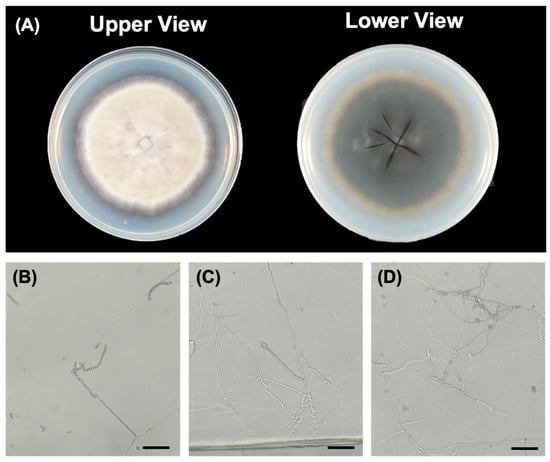
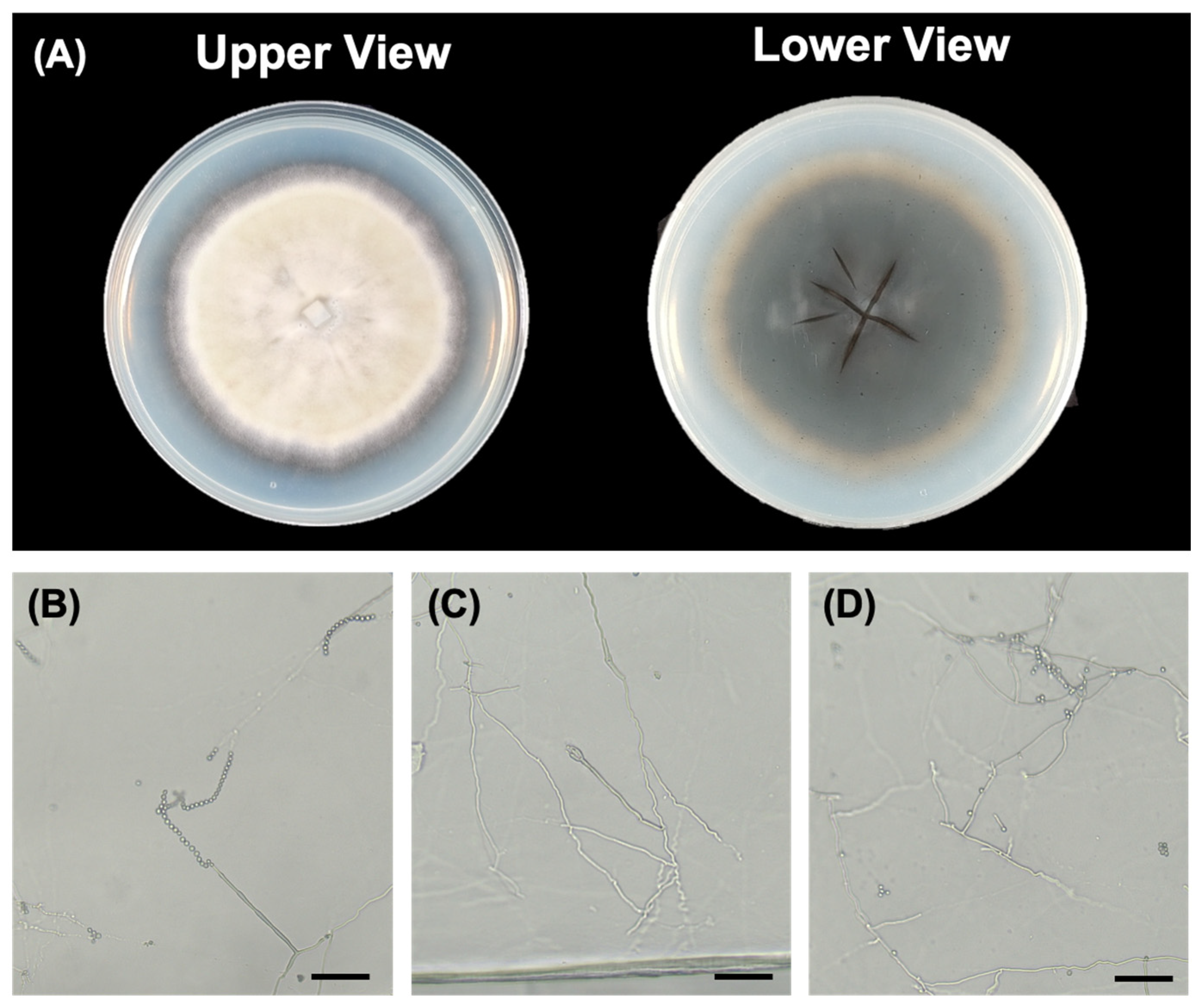
Strain PMEPF27 grew readily on PDA, exhibiting a dense, velvety texture with a radially folded surface and white to purplish pigmentation at the colony edge (Figure 1A). The radial growth reached 1.81 ± 0.28 cm after 7 days of incubation at 28 °C. The reverse side of colonies showed cream to pale purple coloration.
Figure 1.
Colony morphology and conidiation of PMEPF27. (A) Colony appearance of PMEPF27 grown on potato dextrose agar (PDA), shown from the upper and lower (reverse) sides. (B–D) Light micrographs of asexual reproductive structures, showing phialides with conidia in chains (B), hyphae bearing conidiophores (C), and clustered conidiogenous structures with conidial chains (D). Scale bars = 10 μm (B–D).
Microscopic examination of PMEPF27 showed smooth-walled, single-celled conidia that were elliptical to cylindrical in shape, and arranged in long chains (Figure 1B–D). Conidia measured 2.5–4.0 μm in length and 1.5–2.5 μm in width. Hyphae were septate and branched. Conidiophores were erect and often formed clusters with a series of phialides (Figure 1B–D). These morphological characteristics were consistent with the description of Purpureocillium species [40,41].
3.2. Molecular Characterization of PMEPF27
To confirm the taxonomic identity of PMEPF27, the internal transcribed spacer (ITS) region and elongation factor-1α (EF-1α) gene regions were amplified and sequenced. The ITS sequence was 532 bp (GenBank: PZ092910) and the EF-1α sequence was 936 bp (GenBank: PZ11818). BLAST 2.17.0 analysis showed high sequence similarity of PMEFP27 to P. takamizusanense reference strains for both ITS and EF-1α (Supplementary Table S2).
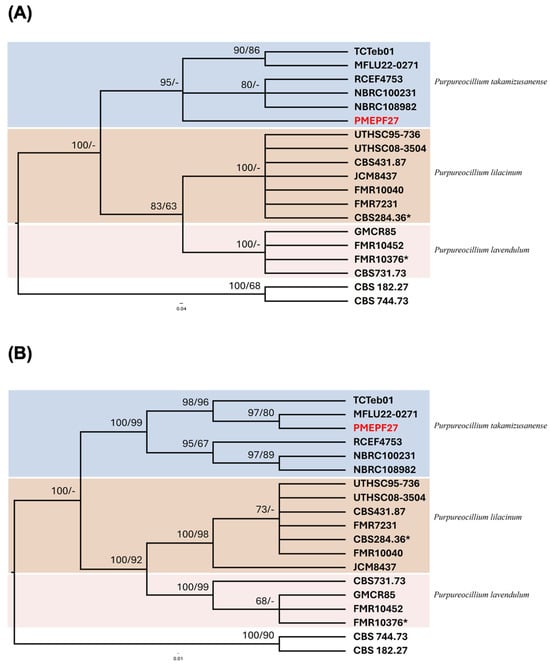
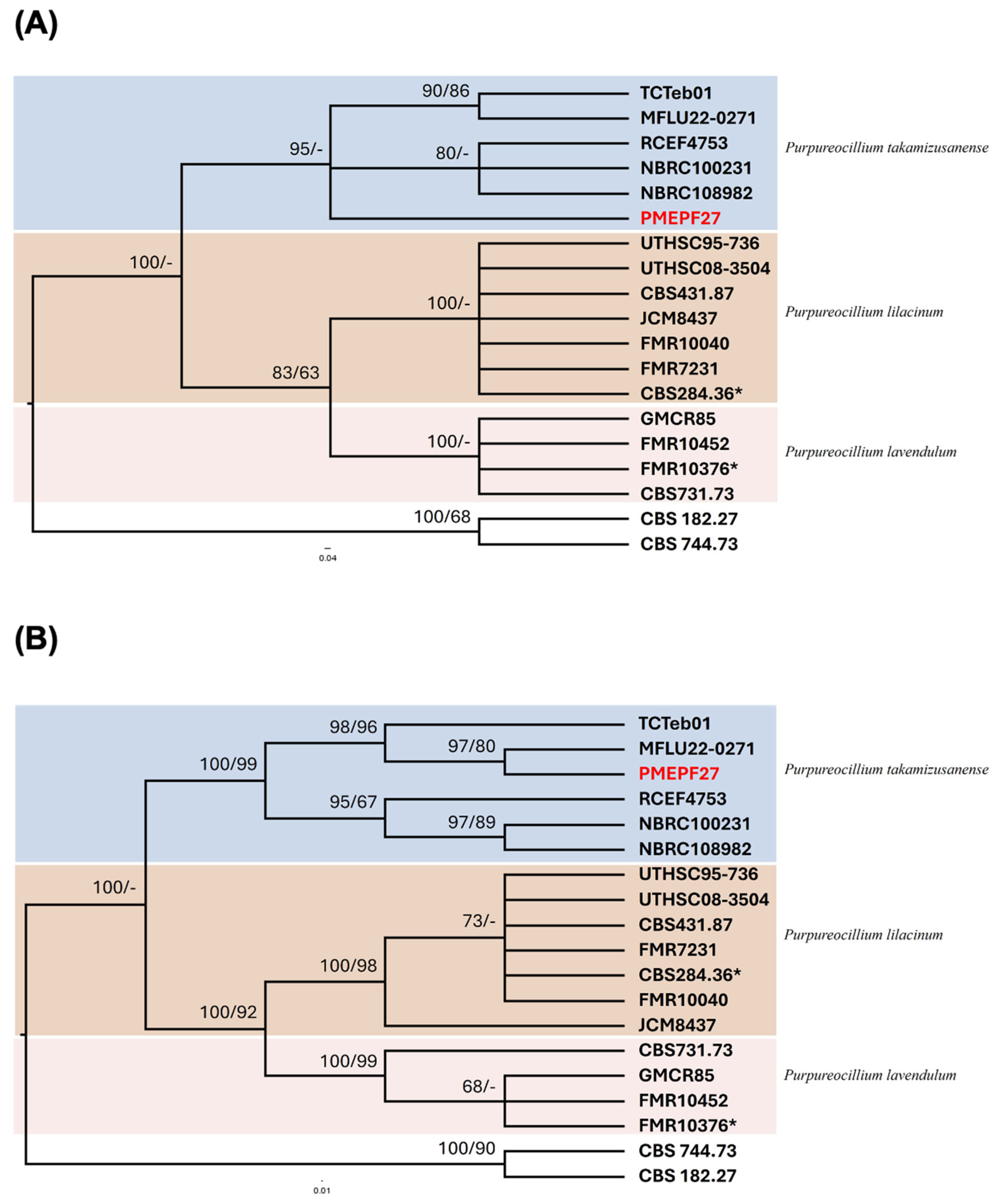
Phylogenetic analysis using Bayesian inference (MrBayes) and maximum likelihood (ML) methods showed three main distinct clades comprising P. takamizusanense, P. lilacinum, and P. lavendulum (Figure 2). PMEPF27 clustered within the clade comprising P. takamizusanense with high statistical support in both trees. In the ITS-based tree, PMEPF27 grouped with P. takamizusanense reference strains with 100% Bayesian posterior probability and 98% ML bootstrap support (Figure 2A). Similarly, in the EF-1α-based tree, PMEPF27 formed a well-supported clade with P. takamizusanense strains, showing 100% Bayesian posterior probability and 97% ML bootstrap support (Figure 2B). These results identified PMEPF27 as P. takamizusanense.
Figure 2.
Phylogenetic tree depicting the relationship between PMEPF27 and related genera, constructed using the MrBayes analysis method based on ITS (A) and EF-1α (B) sequence data. Bayesian posterior probabilities and maximum-likelihood (ML) values, denoted as MrBayes/ML, are provided on each branch. The tree was inferred through Markov Chain Monte Carlo sampling for 1,000,000 iterations, with Paecilomyces marquandii and Nomuraea atypicola designated as outgroups. The asterisk (*) indicates the ex-type strain. The strain identified in this study, PMEPF27, is highlighted in red. The bar represents genetic distance.
3.3. Pathogenicity of PMEPF27 Against Bursaphelenchus rainulfi
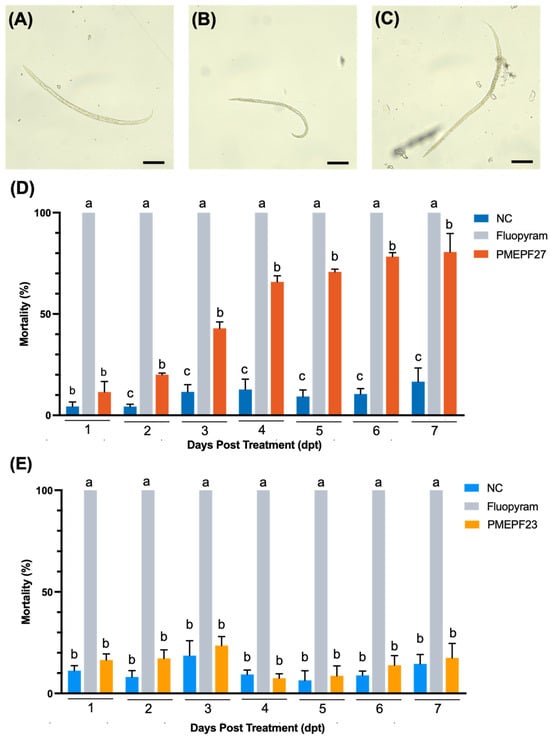
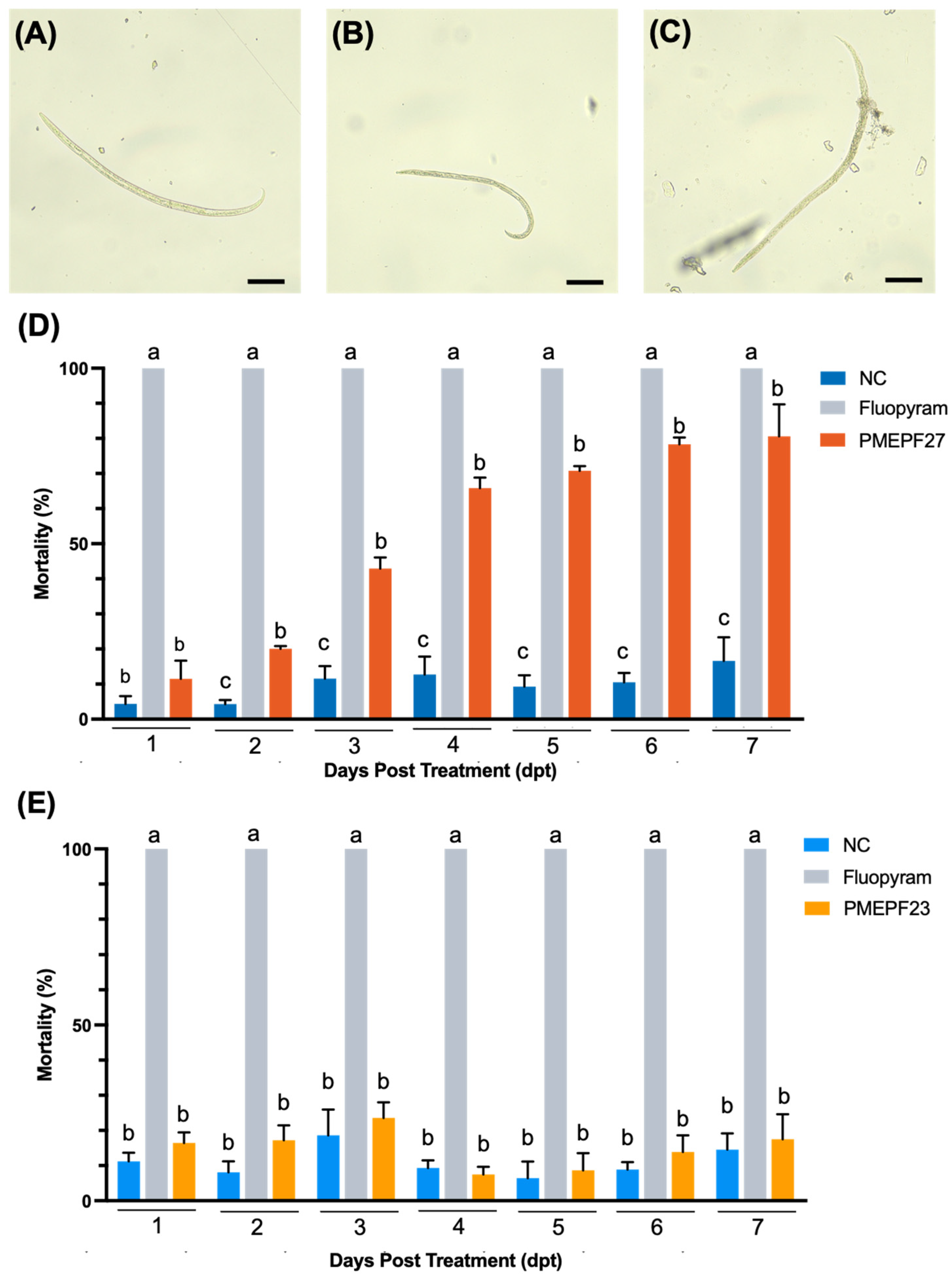
Mortality of motile B. rainulfi was quantified following exposure to conidial suspensions of PMEPF27 (P. takamizusanense) (Figure 3A–D). To contextualize whether the observed mortality patterns were specific to PMEPF27 or could also be observed with another EPF taxon under the same assay format, PMEPF23 (B. bassiana) was evaluated in a parallel assay as a taxonomically distinct entomopathogenic fungal control (Figure 4). In each assay, sterile water served as the negative control (NC) and fluopyram served as the chemical positive control. Fluopyram resulted in 100% mortality by 1 day post-treatment (dpt), the first observation time point, whereas mortality in NC remained low throughout the observation period (Figure 3D and Figure 4).
Figure 3.
Effects of entomopathogenic fungi on Bursaphelenchus rainulfi mortality in vitro. (A–C) Representative micrographs of B. rainulfi after exposure to sterile water (negative control; A), fluopyram (chemical control; B), or PMEPF27 (Purpureocillium takamizusanense; C). Scale bars = 100 μm. (D) Mortality (%) of B. rainulfi after treatment with sterile water, fluopyram, or PMEPF27 over 1–7 days post-treatment (dpt). (E) Mortality (%) of B. rainulfi after treatment with sterile water, fluopyram, or PMEPF23 (Beauveria bassiana) over 1–7 dpt. Bars represent mean ± SD (n = 3). For each dpt, treatment means were compared by one-way ANOVA followed by Tukey’s multiple-comparison test (p < 0.05). Different letters indicate significant differences among treatments within the same dpt.
Figure 4.
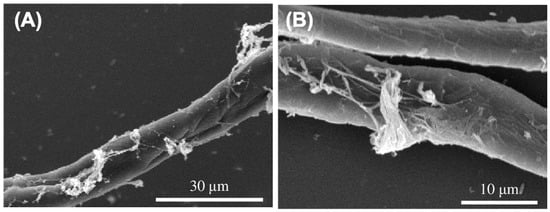
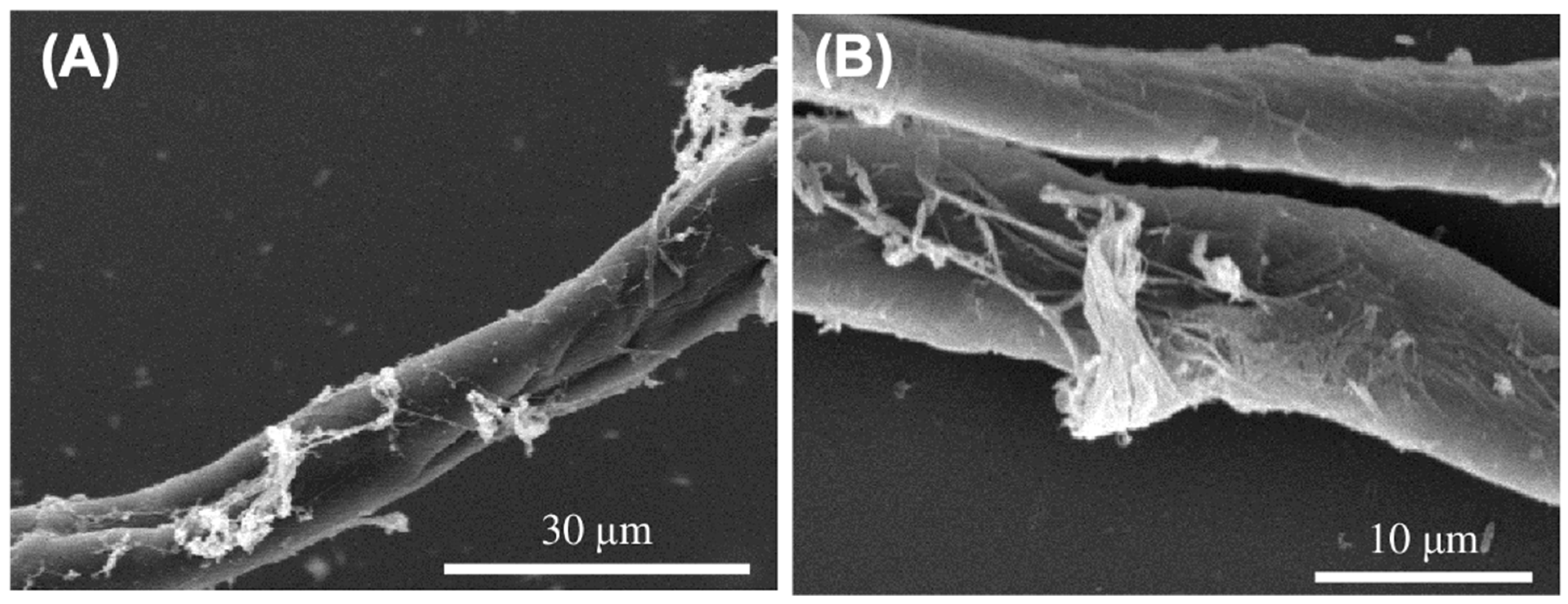
Scanning electron microscopy of Bursaphelenchus rainulfi following exposure to PMEPF27. (A) Shows a nematode cuticle with visible signs of degradation and adherence of extracellular structures at a magnification of scale bar = 30 µm. (B) A close-up view of a breached cuticle segment with extensive structural disintegration and fungal hyphae attachment. Scale bar = 10 µm.
PMEPF27 exposure produced a clear time-dependent increase in mortality relative to NC (Figure 3D). Mortality increased progressively over the observation period and reached high levels at later time points (5–7 dpt). The independent repeat (Experimental Set 2) showed a similar temporal pattern (Supplementary Figure S1A), supporting reproducibility. One-way ANOVA followed by Tukey’s multiple-comparison test indicated significantly higher mortality in the PMEPF27 treatment than in NC at multiple time points (p < 0.05; Figure 3D).
In the PMEPF23 assay, mortality remained comparatively low over time (Figure 4). Although immotile nematodes were observed in the PMEPF23 treatment, the overall mortality profile did not show a sustained increase relative to NC under the multiple-comparison analysis. The independent repeat (Experimental Set 2) is provided in Supplementary Figure S1B. Together, these results indicate that EPF strains differed in the magnitude and temporal dynamics of mortality against motile B. rainulfi under the assay conditions, with PMEPF27 showing the stronger time-dependent effect.
3.4. Pathogenicity of PMEPF27 Against Bursaphelenchus rainulfi as Revealed by Scanning Electron Microscopy (SEM)
To further analyze the interaction of PMEPF27 and B. rainulfi, scanning electron microscopy (SEM) was used to observed B. rainulfi that was exposed to PMEPF27. Based on the observation under SEM, by 72 h post-exposure, marked degradation of the nematode cuticle was observed (Figure 4). Although several nematodes displayed eroded, disrupted, and breached cuticles, no PMEPF27 spores were detected adhering to the nematodes at the examined time point.
4. Discussion
This study demonstrates the strong in vitro biocontrol activity of P. takamizusanense PMEPF27 against motile B. rainulfi, a pine-associated nematode that serves as a surrogate species for laboratory evaluation of fungal effects relevant to pinewood nematode systems. Previous research on this fungus has focused predominantly on its entomopathogenic properties and potential plant growth-promoting capabilities [26,27,42]. In Taiwan, P. takamizusanense was first documented as an entomopathogenic fungus infecting Tessaratoma papillosa adults [41], and the species has been reported to exhibit activity against agricultural pests from multiple insect orders [26]. Our findings expand the currently recognized functional scope of P. takamizusanense and motivate further examination of the interactions with nematodes.
P. lilacinum has been extensively studied for nematode control over past decades [22,23,43,44,45,46]. A number of studies emphasize egg parasitism where fungi penetrate egg shells or cuticles and then consume the nematode contents [47]. The fungus produces an array of hydrolytic enzymes, including serine proteases, subtilisins, chitinases, and lipases, that degrade the chitin-rich egg shells and protein-rich cuticles of nematodes [22,23,48,49]. Whole-genome analysis has confirmed that P. lilacinum possesses large sets of these hydrolytic enzymes, with serine proteases specifically up-regulated in the presence of nematode eggs [19,28]. For example, overexpression of a serine protease gene in P. lilacinum significantly enhanced virulence against Meloidogyne incognita eggs [50]. In the case of motile nematodes, P. lilacinum can also infect second-stage juveniles (J2) by enzymatic digestion of the cuticle [51,52], though many studies have concentrated on egg infection since eggs are stationary targets.
In our assay, PMEPF27 caused a time-dependent increase in mortality of motile nematodes over 5–7 days, whereas fluopyram produced complete mortality by the first observation time point. Although PMEPF27 acted more slowly than the chemical control, it produced substantial mortality by later time points. The time course observed here is consistent with report for other Purpureocillium spp. affecting motile juveniles over multi-day intervals, including P. lavendulum against M. incognita J2 [53], and P. lilacinum, which typically kills Meloidogyne eggs and females within 5–7 days [19,49,54]. While chemicals like fluopyram offer rapid nematicidal effect, biological agents like P. lilacinum are increasingly recommended for sequential application with chemical nematicides to provide sustained control and improved yields [54].
In addition, culture-derived compounds from P. lavendulum have been reported to exhibit nematicidal or egg-hatching inhibitory effects [53,55]. Recent chemo-profiling has identified specific metabolites responsible for this activity, including 5-methoxymethyl-1H-pyrrole-2-carboxaldehyde from P. lavendulum [53], as well as hydroxylated fatty acids and steroids [55]. In P. lilacinum, organic acids, phenolic compounds, and fatty acids such as myristic and lauric acid have been correlated with high J2 mortality [24,25]. Together, these findings support the view that Purpureocillium spp. may affect nematodes through a combination of processes, although the relative contributions are likely strain- and context dependent.
The SEM observations documented cuticle damage in PMEPF27-treated nematodes; however, we did not conidia directly attached to nematode surfaces or appressoria-like penetration structures at the examined time points. These observations are compatible with, but do not demonstrate, a role extracellular enzymes and metabolites. Secondary metabolite diversity and secreted enzymes, including leucinostatins, have been documented in Purpureocillium spp. and are linked to nematode antagonisms in other systems [18,22,23,24,25,56]. Genomic resources available for P. takamizusanense also suggest the potential for substantial repertoire of secreted proteins and secondary-metabolite biosynthetic gene clusters [28]. Accordingly, an important next step will be to couple time-resolved microscopy with assays of extracellular enzyme activities and culture-filtrate bioactivity, followed by chemical profiling and gene-level interrogation, to identify which factors are responsible for PMEPF27-induced mortality.
Our study also supports B. rainulfi as a potential comparative model organism for evaluating fungal effects on pine-associated nematodes. B. rainulfi is phylogenetically related to the pathogenic B. xylophilus but does not cause pine wilt disease [30], making it a safer alternative for laboratory studies that do not require quarantine facilities. In Taiwan, pathogenicity assays on Pinus thunbergii indicate that B. rainulfi did not induce wilting symptoms under tested conditions [30]. The species has been reported from pine wood in Malaysia, China, and Taiwan and co-occurs with other Bursaphelenchus spp. in pine ecosystems [29,30,57]. Previous studies also showed that B. rainulfi is susceptible to infection by the nematophagous fungus Esteya vermicola [31], demonstrating its utility for fungus–nematode interaction studies. Future studies could directly compare PMEFP27 effects on B. rainulfi and B. xylophilus to PMEPF27 to determine whether the biocontrol efficacy extends to the pathogenic species.
Our comparison of P. takamizusanense PMEPF27 and B. bassiana PMEPF23 revealed marked differences in nematicidal activity. Including PMEPF23 as a taxonomically distinct entomopathogenic fungal control provided context for EPF-associated effects under the same assay format. Under our conditions, PMEPF23 produced comparatively low mortality and did not show a sustained increase relative to the negative control, whereas PMEPF27 produced a stronger time-dependent effect. Although Beauveria species have been reported to exhibit nematicidal activity against B. xylophilus in vitro and B. mucronatus in vivo [58,59], nematode-antagonistic effects appear to be strain- and context-dependent rather than universal within the genus. In contrast, the stronger activity observed for PMEPF27 is consistent with the biology of Purpureocillium species, which commonly inhabit soil environments where nematode interactions are frequent [18,22]. Furthermore, the ability of Purpureocillium isolates to tolerate water stress and varying temperature ranges supports their capacity to function effectively under variable agroecological conditions [12,18]. Together, these findings highlight the importance of standardized assays and empirical screening when selecting fungal candidates for nematode biocontrol.
This study provides evidence that P. takamizusanense PMEPF27 can affect motile pine-associated nematodes in vitro. These findings expand the currently recognized functional breadth of B. rainulfi and establish a tractable platform for future mechanistic studies. Further work should prioritize identification of causal factors underlying mortality, evaluation against B. xylophilus under appropriate containment, and assessment of formulation and delivery strategies relevant to pine systems.
5. Conclusions
P. takamizusanense PMEPF27 increased the mortality of motile B. rainulfi under controlled in vitro conditions and was associated with surface cuticle damage observable by SEM. Molecular and phylogenetic analyses identified PMEPF27 as P. takamizusanense. The use of B. rainulfi as a non-quarantine, pine-associated motile model provides a tractable platform for screening and hypothesis generation relevant to pinewood nematode systems. Future work should determine the causal factors underlying PMEPF27-associated mortality through targeted assays of culture filtrates, extracellular enzyme activities, and secreted metabolites, and should evaluate efficacy against B. xylophilus under appropriate containment.
Supplementary Materials
The following supporting information can be downloaded at: https://www.mdpi.com/article/10.3390/microorganisms14030714/s1, Table S1: Primers used for molecular identification of PMEPF27 strain; Table S2: Species used for phylogenetic analysis of PMEPF27; Figure S1: Independent repeat (Experimental Set 2) of Bursaphelenchus rainulfi mortality assays. References [32,33] are cited in Supplementary Materials.
Author Contributions
Conceptualization, Y.-Y.Y. and Y.T.; methodology, E.G.C., X.-Y.W., I.-E.S., H.-Y.H., Y.-Z.X. and Y.-H.L.; formal analysis, E.G.C. and X.-Y.W.; investigation, E.G.C., X.-Y.W., I.-E.S., H.-Y.H. and Y.-Z.X.; resources, T.-Y.C., J.-C.C., Y.-Y.Y. and Y.T.; data curation, E.G.C. and X.-Y.W.; writing—original draft preparation, E.G.C. and Y.T.; writing—review and editing, E.G.C., T.-Y.C., J.-C.C., Y.-Y.Y. and Y.T.; visualization, E.G.C. and X.-Y.W.; supervision, Y.-H.L., J.-C.C., Y.-Y.Y. and Y.T.; project administration, M.-L.W., J.-C.C., Y.-Y.Y. and Y.T.; funding acquisition, M.-L.W., T.-Y.C., J.-C.C., Y.-Y.Y. and Y.T. All authors have read and agreed to the published version of the manuscript.
Funding
This work was supported by the Ministry of Agriculture, Executive Yuan, Taiwan (Grant Number: 114AS-1.3.2-AS-12 and 115AS-1.3.2-AS-26); and National Taiwan University, Taiwan.
Institutional Review Board Statement
Not applicable.
Informed Consent Statement
Not applicable.
Data Availability Statement
The original contributions presented in this study are included in the article/Supplementary Materials. Further inquiries can be directed to the corresponding authors.
Acknowledgments
The authors extend their sincere gratitude to Pei-Chen Chen of the Department of Plant Pathology at National Chung Hsing University, Taiwan, for generously providing the Bursaphelenchus rainulfi specimens utilized in this study.
Conflicts of Interest
The authors declare no conflicts of interest.
References
- Singh, S.; Singh, B.; Singh, A. Nematodes: A threat to sustainability of agriculture. Proc. Environ. Sci. 2015, 29, 215–216. [Google Scholar] [CrossRef] [Scilit]
- Decraemer, W.; Hunt, D.J. Structure and classification. In Plant Nematology; CABI Wallingford UK: Wallingford, UK, 2006; pp. 3–32. [Google Scholar]
- Pires, D.; Vicente, C.S.; Inácio, M.L.; Mota, M. The Potential of Esteya spp. for the Biocontrol of the Pinewood Nematode, Bursaphelenchus xylophilus. Microorganisms 2022, 10, 168. [Google Scholar] [CrossRef] [Scilit] [PubMed]
- Linit, M. Nemtaode-vector relationships in the pine wilt disease system. J. Nematol. 1988, 20, 227. [Google Scholar]
- Kikuchi, T.; Cotton, J.A.; Dalzell, J.J.; Hasegawa, K.; Kanzaki, N.; McVeigh, P.; Takanashi, T.; Tsai, I.J.; Assefa, S.A.; Cock, P.J. Genomic insights into the origin of parasitism in the emerging plant pathogen Bursaphelenchus xylophilus. PLoS Pathog. 2011, 7, e1002219. [Google Scholar] [CrossRef] [Scilit]
- Mota, M.M.; Braasch, H.; Bravo, M.A.; Penas, A.C.; Burgermeister, W.; Metge, K.; Sousa, E. First report of Bursaphelenchus xylophilus in Portugal and in Europe. Nematology 1999, 1, 727–734. [Google Scholar] [CrossRef] [Scilit]
- Dwinell, L.D. The pinewood nematode: Regulation and mitigation. Ann. Rev. Phytopathol. 1997, 35, 153–166. [Google Scholar] [CrossRef] [Scilit]
- Takai, K.; Suzuki, T.; Kawazu, K. Development and preventative effect against pine wilt disease of a novel liquid formulation of emamectin benzoate. Pest Manag. Sci. 2003, 59, 365–370. [Google Scholar] [CrossRef] [Scilit]
- Kwon, T.-S.; Song, M.-Y.; Shin, S.-C.; Park, Y.-S. Effects of aerial insecticide sprays on ant communities to control pine wilt disease in Korean pine forests. App. Entomol. Zool. 2005, 40, 563–574. [Google Scholar] [CrossRef] [Scilit]
- Zhao, B.G. Pine wilt disease in China. In Pine Wilt Disease; Springer: Tokyo, Japan, 2008; pp. 18–25. [Google Scholar]
- Bonifácio, L.F.; Sousa, E.; Naves, P.; Inacio, M.L.; Henriques, J.; Mota, M.; Barbosa, P.; Drinkall, M.J.; Buckley, S. Efficacy of sulfuryl fluoride against the pinewood nematode, Bursaphelenchus xylophilus (Nematoda: Aphelenchidae), in Pinus pinaster boards. Pest Manag. Sci. 2014, 70, 6–13. [Google Scholar] [CrossRef] [Scilit] [PubMed]
- Rigobelo, E.C.; Nicodemo, D.; Babalola, O.O.; Desoignies, N. Purpureocillium lilacinum as an agent of nematode control and plant growth-promoting fungi. Agronomy 2024, 14, 1225. [Google Scholar] [CrossRef] [Scilit]
- Poveda, J.; Abril-Urias, P.; Escobar, C. Biological control of plant-parasitic nematodes by filamentous fungi inducers of resistance: Trichoderma, mycorrhizal and endophytic fungi. Front. Microbiol. 2020, 11, 992. [Google Scholar] [CrossRef] [Scilit]
- Zhang, Y.; Li, S.; Li, H.; Wang, R.; Zhang, K.-Q.; Xu, J. Fungi–nematode interactions: Diversity, ecology, and biocontrol prospects in agriculture. J. Fungi 2020, 6, 206. [Google Scholar] [CrossRef] [Scilit] [PubMed]
- Topalović, O.; Hussain, M.; Heuer, H. Plants and associated soil microbiota cooperatively suppress plant-parasitic nematodes. Front. Microbiol. 2020, 11, 313. [Google Scholar] [CrossRef] [Scilit] [PubMed]
- Dou, G.; Yan, D.-H. Research progress on biocontrol of pine wilt disease by microorganisms. Forests 2022, 13, 1047. [Google Scholar] [CrossRef] [Scilit]
- Ayaz, M.; Zhao, J.-T.; Zhao, W.; Chi, Y.-K.; Ali, Q.; Ali, F.; Khan, A.R.; Yu, Q.; Yu, J.-W.; Wu, W.-C. Biocontrol of plant parasitic nematodes by bacteria and fungi: A multi-omics approach for the exploration of novel nematicides in sustainable agriculture. Front. Microbiol. 2024, 15, 1433716. [Google Scholar] [CrossRef] [Scilit]
- Girardi, N.S.; Sosa, A.L.; Etcheverry, M.G.; Passone, M.A. In vitro characterization bioassays of the nematophagous fungus Purpureocillium lilacinum: Evaluation on growth, extracellular enzymes, mycotoxins and survival in the surrounding agroecosystem of tomato. Fungal Biol. 2022, 126, 300–307. [Google Scholar] [CrossRef] [Scilit]
- Prasad, P.; Varshney, D.; Adholeya, A. Whole genome annotation and comparative genomic analyses of bio-control fungus Purpureocillium lilacinum. BMC Genom. 2015, 16, 1004. [Google Scholar] [CrossRef] [Scilit]
- James, B.; Godonou, I.; Atcha, C.; Baimey, H.; Adango, E.; Boulga, J.; Goudegnon, E. Healthy vegetables through participatory IPM in peri-urban areas of Benin. In Summary of Activities and Achievements; IITA: Abomey-Calavi, Benin, 2006; p. 134. [Google Scholar]
- Kerry, B.R. Rhizosphere interactions and the exploitation of microbial agents for the biological control of plant-parasitic nematodes. Ann. Rev. Phytopathol. 2000, 38, 423–441. [Google Scholar] [CrossRef] [Scilit] [PubMed]
- Moreno-Gavíra, A.; Huertas, V.; Diánez, F.; Sánchez-Montesinos, B.; Santos, M. Paecilomyces and its importance in the biological control of agricultural pests and diseases. Plants 2020, 9, 1746. [Google Scholar] [CrossRef] [Scilit]
- Bali, G.K.; Singh, S.K.; Maurya, D.K.; Wani, F.J.; Pandit, R.S. Morphological and molecular identification of the entomopathogenic fungus Purpureocillium lilacinum and its virulence against Tuta absoluta (Meyrick) (Lepidoptera: Gelechiidae) larvae and pupae. Egypt. J. Biol. Pest Control 2022, 32, 86. [Google Scholar] [CrossRef] [Scilit]
- Patidar, P.; Prasad, L.; Sagar, S.; Sirohi, A.; Saharan, M.S.; Dhillon, M.K.; Singh, V.K.; Bag, T.K. Chemo-profiling of Purpureocillium lilacinum and Paecilomyces variotii isolates using GC-MS analysis, and evaluation of their metabolites against M. incognita. PLoS ONE 2024, 19, e0297925. [Google Scholar] [CrossRef] [Scilit] [PubMed]
- Sharma, A.; Gupta, A.; Dalela, M.; Sharma, S.; Sayyed, R.; Enshasy, H.A.E.; Elsayed, E.A. Linking organic metabolites as produced by Purpureocillium lilacinum 6029 cultured on Karanja deoiled cake medium for the sustainable management of root-knot nematodes. Sustainability 2020, 12, 8276. [Google Scholar] [CrossRef] [Scilit]
- Lo, P.-H.; El-Sayid Abdrabo, K.A.; Nai, Y.-S.; Lu, H.-l.; Huang, Y.-T. Versatile entomopathogenic activity of Purpureocillium takamizusanense against diverse agricultural pests. bioRxiv 2025. [Google Scholar] [CrossRef] [Scilit]
- Zhang, Z.; Chen, W.; Liang, J.; Zhang, L.; Han, Y.; Huang, J.; Liang, Z. Revealing the non-overlapping characteristics between original centers and genetic diversity of Purpureocillium lilacinum. Fungal Ecol. 2022, 60, 101179. [Google Scholar] [CrossRef] [Scilit]
- Nguyen, N.-H.; Tamura, T.; Shimizu, K. Draft genome sequence of Purpureocillium takamizusanense, a potential bioinsecticide. Microbiol. Resour. Announc. 2022, 11, e00268-22. [Google Scholar] [CrossRef] [Scilit] [PubMed]
- Braasch, H.; Burgermeister, W. Bursaphelenchus rainulfi sp. n. (Nematoda: Parasitaphelenchidae), first record of the genus Bursaphelenchus Fuchs, 1937 from Malaysia. Nematology 2002, 4, 971–978. [Google Scholar] [CrossRef] [Scilit]
- Chang, C.; Chen, P. Identification of Bursaphelenchus rainulfi (Nematoda: Parasitaphelenchidae), a new record pine wood nematode species in Taiwan and its pathogenicity. J. Plant Med. 2020, 62, 31–40. [Google Scholar]
- Wang, X.; Wang, T.; Wang, J.; Guan, T.; Li, H. Morphological, molecular and biological characterization of Esteya vermicola, a nematophagous fungus isolated from intercepted wood packing materials exported from Brazil. Mycoscience 2014, 55, 367–377. [Google Scholar] [CrossRef] [Scilit]
- White, T.J.; Bruns, T.; Lee, S.; Taylor, J. Amplification and direct sequencing of fungal ribosomal RNA genes for phylogenetics. PCR Protoc. A Guide Methods Appl. 1990, 18, 315–322. [Google Scholar]
- Rehner, S.A.; Buckley, E. A Beauveria phylogeny inferred from nuclear ITS and EF1-α sequences: Evidence for cryptic diversification and links to Cordyceps teleomorphs. Mycologia 2005, 97, 84–98. [Google Scholar] [CrossRef] [Scilit]
- Huelsenbeck, J.P.; Ronquist, F. MRBAYES: Bayesian inference of phylogenetic trees. Bioinformatics 2001, 17, 754–755. [Google Scholar] [CrossRef] [Scilit]
- Ronquist, F.; Huelsenbeck, J.P. MrBayes 3: Bayesian phylogenetic inference under mixed models. Bioinformatics 2003, 19, 1572–1574. [Google Scholar] [CrossRef] [Scilit] [PubMed]
- Ronquist, F.; Teslenko, M.; Van Der Mark, P.; Ayres, D.L.; Darling, A.; Höhna, S.; Larget, B.; Liu, L.; Suchard, M.A.; Huelsenbeck, J.P. MrBayes 3.2: Efficient Bayesian phylogenetic inference and model choice across a large model space. System. Biol. 2012, 61, 539–542. [Google Scholar] [CrossRef] [Scilit] [PubMed]
- Tamura, K.; Nei, M. Estimation of the number of nucleotide substitutions in the control region of mitochondrial DNA in humans and chimpanzees. Mol. Biol. Evol. 1993, 10, 512–526. [Google Scholar] [CrossRef] [Scilit] [PubMed]
- Kumar, S.; Stecher, G.; Li, M.; Knyaz, C.; Tamura, K. MEGA X: Molecular evolutionary genetics analysis across computing platforms. Mol. Biol. Evol. 2018, 35, 1547. [Google Scholar] [CrossRef] [Scilit]
- Bozzola, J.J.; Russell, L.D. Electron Microscopy: Principles and Techniques for Biologists; Jones & Bartlett Learning: Burlington, MA, USA, 1999. [Google Scholar]
- Luangsa-Ard, J.; Houbraken, J.; van Doorn, T.; Hong, S.-B.; Borman, A.M.; Hywel-Jones, N.L.; Samson, R.A. Purpureocillium, a new genus for the medically important Paecilomyces lilacinus. FEMS Microbiol. Lett. 2011, 321, 141–149. [Google Scholar] [CrossRef] [Scilit]
- Lo, P.; Yu, Y.; Pai, K. First report of Purpureocillium takamizusanense as an entomopathogenic fungus infecting Tessaratoma papillosa (Drury) in Taiwan. J. Plant Med. 2019, 61, 27–30. [Google Scholar]
- Lopez-Nuñez, R.; Prieto-Rubio, J.; Bautista, I.; Lidón-Cerezuela, A.L.; Valverde-Urrea, M.; Lopez-Moya, F.; Lopez-Llorca, L.V. Chitosan reduces naturally occurring plant pathogenic fungi and increases nematophagous fungus Purpureocillium in soil under field conditions. Front. Agron. 2025, 6, 1502402. [Google Scholar] [CrossRef] [Scilit]
- Lan, X.; Zhang, J.; Zong, Z.; Ma, Q.; Wang, Y. Evaluation of the biocontrol potential of Purpureocillium lilacinum QLP12 against Verticillium dahliae in eggplant. BioMed Res. Int. 2017, 2017, 4101357. [Google Scholar] [CrossRef] [Scilit]
- Elsherbiny, E.A.; Taher, M.A.; Elsebai, M.F. Activity of Purpureocillium lilacinum filtrates on biochemical characteristics of Sclerotinia sclerotiorum and induction of defense responses in common bean. Eur. J. Plant Pathol. 2019, 155, 39–52. [Google Scholar] [CrossRef] [Scilit]
- Li, Y.; Zhang, C.; Zhong, M.; Hu, S.; Cui, Y.; Fang, J.; Yu, X. Revealing the metabolic potential and environmental adaptation of nematophagous fungus, Purpureocillium lilacinum, derived from hadal sediment. Front. Microbiol. 2024, 15, 1474180. [Google Scholar] [CrossRef] [Scilit]
- de Freitas Soares, F.E.; Sufiate, B.L.; de Queiroz, J.H. Nematophagous fungi: Far beyond the endoparasite, predator and ovicidal groups. Agric. Nat. Resour. 2018, 52, 1–8. [Google Scholar] [CrossRef] [Scilit]
- Khan, A.; Williams, K.L.; Nevalainen, H.K. Infection of plant-parasitic nematodes by Paecilomyces lilacinus and Monacrosporium lysipagum. BioControl 2006, 51, 659–678. [Google Scholar] [CrossRef] [Scilit]
- Giné, A.; Sorribas, F.J. Effect of plant resistance and BioAct WG (Purpureocillium lilacinum strain 251) on Meloidogyne incognita in a tomato–cucumber rotation in a greenhouse. Pest Manag. Sci. 2017, 73, 880–887. [Google Scholar] [CrossRef] [Scilit]
- El-Marzoky, A.M.; Ali, M.A.; Elnahal, A.S.; Abuljadayel, D.A.; Alkherb, W.A.; Moustafa, M.; Alshaharni, M.O.; Abd El-Aal, E.M. The Combination Effect of Purpureocillium lilacinum Strain (AUMC 10620) and Avermectin (B1a and B1b) on Control Citrus Nematode Tylenchulus semipenetrans (Cobb) Under Laboratory and Field Conditions. Biology 2025, 14, 60. [Google Scholar] [CrossRef] [Scilit]
- Wang, J.; Wang, J.; Liu, F.; Pan, C. Enhancing the virulence of Paecilomyces lilacinus against Meloidogyne incognita eggs by overexpression of a serine protease. Biotechnol. Lett. 2010, 32, 1159–1166. [Google Scholar] [CrossRef] [Scilit]
- Kiewnick, S.; Sikora, R. Biological control of the root-knot nematode Meloidogyne incognita by Paecilomyces lilacinus strain 251. Biol. Control 2006, 38, 179–187. [Google Scholar] [CrossRef] [Scilit]
- Khan, M.; Tanaka, K. Purpureocillium lilacinum for plant growth promotion and biocontrol against root-knot nematodes infecting eggplant. PLoS ONE 2023, 18, e0283550. [Google Scholar] [CrossRef] [Scilit] [PubMed]
- Bao, Z.-X.; Liu, R.; Li, C.-Q.; Pan, X.-R.; Zhao, P.-J. Pathogenicity and Metabolites of Purpureocillium lavendulum YMF1. 00683 against Meloidogyne incognita. Pathogens 2022, 11, 795. [Google Scholar] [CrossRef] [Scilit] [PubMed]
- Khan, A.; Khan, A.; Ali, A.; Fatima, S.; Siddiqui, M.A. Root-knot nematodes (Meloidogyne spp.): Biology, plant-nematode interactions and their environmentally benign management strategies. Gesunde Pflanz. 2023, 75, 2187–2205. [Google Scholar] [CrossRef] [Scilit]
- Liu, R.; Bao, Z.-X.; Li, G.-H.; Li, C.-Q.; Wang, S.-L.; Pan, X.-R.; Zhang, K.-Q.; Zhao, P.-J. Identification of nematicidal metabolites from Purpureocillium lavendulum. Microorganisms 2022, 10, 1343. [Google Scholar] [CrossRef] [Scilit]
- Chen, W.; Hu, Q. Secondary metabolites of Purpureocillium lilacinum. Molecules 2021, 27, 18. [Google Scholar] [CrossRef] [Scilit]
- Jiang, L.-q.; Li, X.-q.; Zheng, J.-w. First record of Bursaphelenchus rainulfi on pine trees from eastern China and its phylogenetic relationship with intro-genus species. J. Zhejiang Univ. Sci. B 2007, 8, 345–351. [Google Scholar] [CrossRef] [Scilit] [PubMed]
- Sánchez-Gómez, T.; Harte, S.J.; Zamora, P.; Bareyre, M.; Díez, J.J.; Herrero, B.; Niño-Sánchez, J.; Martín-García, J. Nematicidal effect of Beauveria species and the mycotoxin beauvericin against pinewood nematode Bursaphelenchus xylophilus. Front. For. Glob. Change 2023, 6, 1229456. [Google Scholar] [CrossRef] [Scilit]
- Sánchez-Gómez, T.; Zamora, P.; Díez, J.J.; Herrero, B.; Poveda, J.; Martín-García, J. Using Bursaphelenchus mucronatus to demonstrate the potential nematicidal effect of Beauveria bassiana on pine wood nematode (Bursaphelenchus xylophilus) under in vivo conditions. Ann. For. Sci. 2025, 82, 4. [Google Scholar] [CrossRef] [Scilit]
Disclaimer/Publisher’s Note: The statements, opinions and data contained in all publications are solely those of the individual author(s) and contributor(s) and not of MDPI and/or the editor(s). MDPI and/or the editor(s) disclaim responsibility for any injury to people or property resulting from any ideas, methods, instructions or products referred to in the content. |
© 2026 by the authors. Licensee MDPI, Basel, Switzerland. This article is an open access article distributed under the terms and conditions of the Creative Commons Attribution (CC BY) license.