Artificial Intelligence for Microbial Isolation and Cultivation: Progress and Challenges


Abstract
1. Introduction
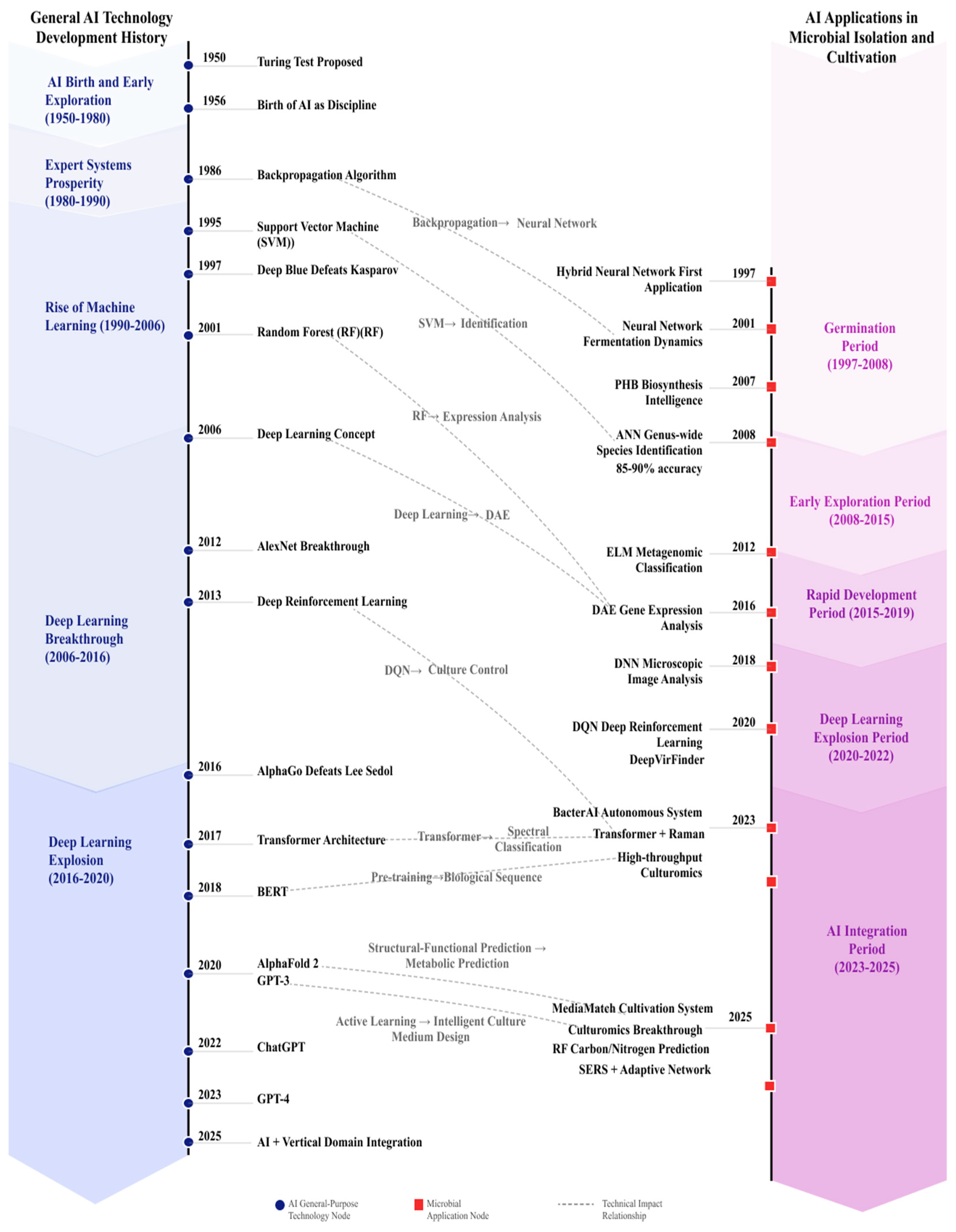
2. Germination Period (1997–2008): From Bioprocess Control to Microbial Cultivation Optimization
3. Early Exploration Period (2008–2015): Systematic Application of Traditional ML
4. Rapid Development Period (2015–2019): Initial Application of DL
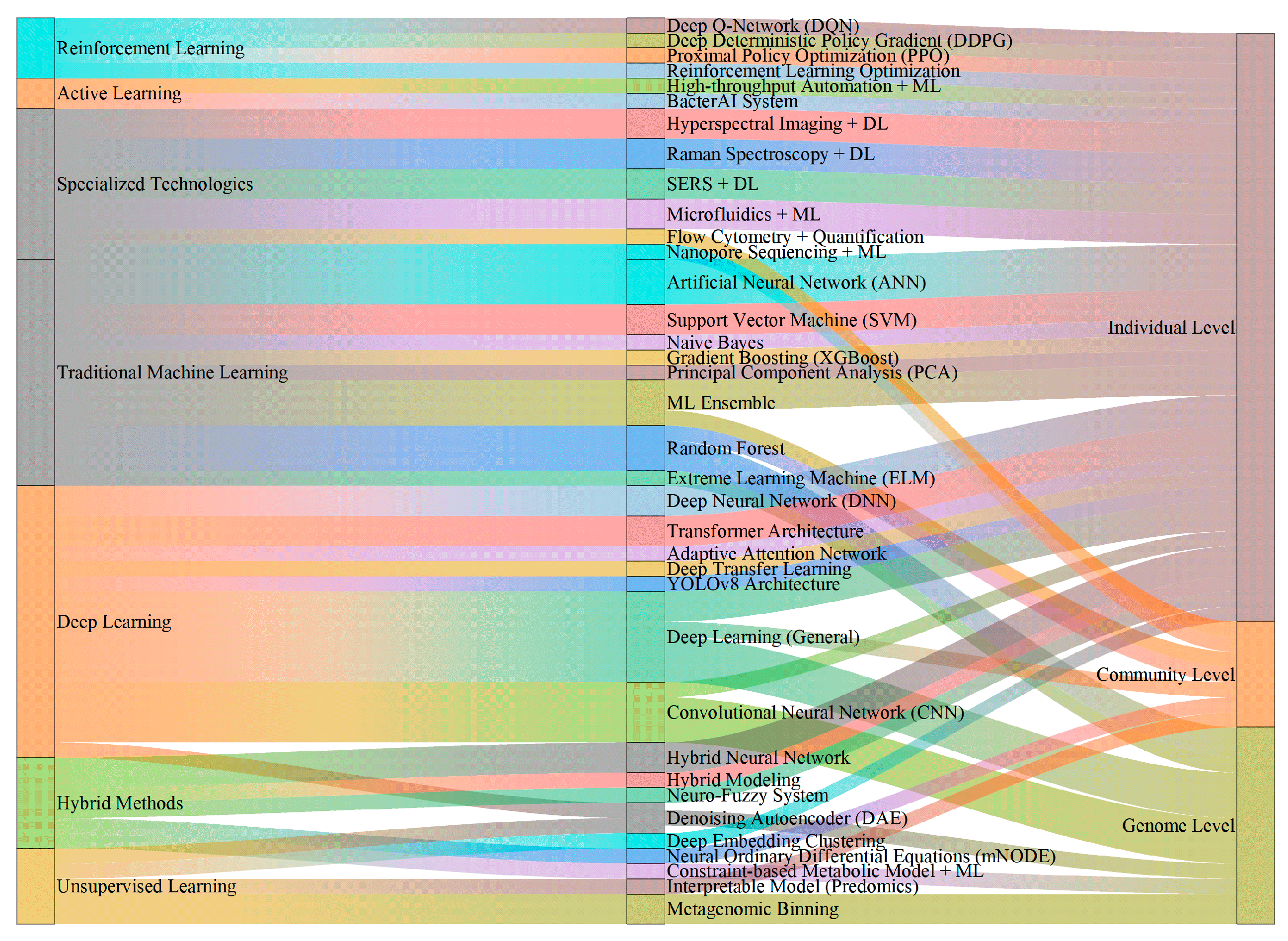
5. DL Explosion Period (2020–2022): Completion of Multi-Level Technical Framework
5.1. Genome Level
5.2. Community Level
5.3. Individual Level
6. AI Integration Period (2023–Present): Maturation of End-to-End Intelligent Systems
6.1. Genome Level
6.2. Individual Level
6.2.1. Colony Detection
6.2.2. Single-Cell Rapid Identification
6.2.3. Autonomous Learning Systems
6.3. Community Level
6.4. Summary
7. Discussion
7.1. Core Challenges
7.2. Benchmarking and Reproducibility Challenges
7.3. Future Directions
- •
- Microbial Foundation Models—Large-scale pre-trained models (i.e., DL models pre-trained on broad datasets and fine-tuned for specific downstream tasks, analogous to GPT in natural language processing) will be trained on massive microbial multi-omics data to learn universal microbial feature representations and biological principles;
- •
- Digital Twin Microbial Factories—Constructing virtual simulation models (i.e., computational replicas that mirror real-time biological processes) of microbial cultivation processes to achieve “digital twins” from cells to bioreactors and from single strains to communities;
- •
- Federated Learning and Data Sharing—Integrating microbial cultivation data from different laboratories globally while protecting data privacy;
- •
- Physics-Informed Neural Networks (PINNs)—Embedding fundamental physicochemical laws and biological mechanisms into neural network architectures. For example, PINNs could encode Monod growth kinetics or thermodynamic constraints directly into network loss functions, ensuring that predictions of fermentation outcomes in food microbiology or wastewater treatment remain physically plausible even when training data are limited;
- •
- Single-Cell Multi-omics and Spatial Microbiome AI—Combining single-cell sequencing, spatial transcriptomics, and other technologies to parse single-cell level heterogeneity;
- •
- Interpretable AI and Causal Inference—Developing more advanced interpretable AI methods combined with causal inference [30];
- •
- Automated and Autonomous Laboratories—Building highly automated intelligent laboratories to achieve full-process automation from sample preprocessing, cultivation, monitoring, and analysis to decision-making.
8. Conclusions
Author Contributions
Funding
Institutional Review Board Statement
Informed Consent Statement
Data Availability Statement
Conflicts of Interest
References
- Locey, K.J.; Lennon, J.T. Scaling Laws Predict Global Microbial Diversity. Proc. Natl. Acad. Sci. USA 2016, 113, 5970–5975. [Google Scholar] [CrossRef]
- Stewart, E.J. Growing Unculturable Bacteria. J. Bacteriol. 2012, 194, 4151–4160. [Google Scholar] [CrossRef] [PubMed]
- Lagier, J.-C.; Dubourg, G.; Million, M.; Cadoret, F.; Bilen, M.; Fenollar, F.; Levasseur, A.; Rolain, J.-M.; Fournier, P.-E.; Raoult, D. Culturing the Human Microbiota and Culturomics. Nat. Rev. Microbiol. 2018, 16, 540–550. [Google Scholar] [CrossRef] [PubMed]
- Lewis, W.H.; Tahon, G.; Geesink, P.; Sousa, D.Z.; Ettema, T.J.G. Innovations to Culturing the Uncultured Microbial Majority. Nat. Rev. Microbiol. 2021, 19, 225–240. [Google Scholar] [CrossRef]
- Patnaik, P.R. Spectral Analysis of the Effect of Inflow Noise on a Fed-Batch Fermentation for Recombinant β-Galactosidase. Bioprocess Eng. 1997, 17, 93–97. [Google Scholar] [CrossRef]
- Patnaik, P.R. Hybrid Neural Simulation of a Fed-Batch Bioreactor for a Nonideal Recombinant Fermentation. Bioprocess Biosyst. Eng. 2001, 24, 151–161. [Google Scholar] [CrossRef]
- Patnaik, P.R. Neural Network Designs for Poly-β-Hydroxybutyrate Production Optimization under Simulated Industrial Conditions. Biotechnol. Lett. 2005, 27, 409–415. [Google Scholar] [CrossRef]
- Patnaik, P.R. The Extended Kalman Filter as a Noise Modulator for Continuous Yeast Cultures under Monotonic, Oscillating and Chaotic Conditions. Chem. Eng. J. 2005, 108, 91–99. [Google Scholar] [CrossRef]
- Patnaik, P.R. “Intelligent” Descriptions of Microbial Kinetics in Finitely Dispersed Bioreactors: Neural and Cybernetic Models for PHB Biosynthesis by Ralstonia Eutropha. Microb. Cell Fact. 2007, 6, 23. [Google Scholar] [CrossRef]
- Slabbinck, B.; De Baets, B.; Dawyndt, P.; De Vos, P. Genus-Wide Bacillus Species Identification through Proper Artificial Neural Network Experiments on Fatty Acid Profiles. Antonie Van Leeuwenhoek 2008, 94, 187–198. [Google Scholar] [CrossRef]
- Rasheed, Z.; Rangwala, H. Metagenomic taxonomic classification using extreme learning machines. J. Bioinform. Comput. Biol. 2012, 10, 1250015. [Google Scholar] [CrossRef] [PubMed]
- Tan, J.; Hammond, J.H.; Hogan, D.A.; Greene, C.S. ADAGE-Based Integration of Publicly Available Pseudomonas Aeruginosa Gene Expression Data with Denoising Autoencoders Illuminates Microbe-Host Interactions. mSystems 2016, 1, e00025-15. [Google Scholar] [CrossRef] [PubMed]
- Bokulich, N.A.; Collins, T.S.; Masarweh, C.; Allen, G.; Heymann, H.; Ebeler, S.E.; Mills, D.A. Associations among Wine Grape Microbiome, Metabolome, and Fermentation Behavior Suggest Microbial Contribution to Regional Wine Characteristics. mBio 2016, 7, e00631-16. [Google Scholar] [CrossRef] [PubMed]
- Andini, N.; Wang, B.; Athamanolap, P.; Hardick, J.; Masek, B.J.; Thair, S.; Hu, A.; Avornu, G.; Peterson, S.; Cogill, S.; et al. Microbial Typing by Machine Learned DNA Melt Signatures. Sci. Rep. 2017, 7, 42097. [Google Scholar] [CrossRef]
- Marques, R.; Von Stosch, M.; Portela, R.M.C.; Torres, C.A.V.; Antunes, S.; Freitas, F.; Reis, M.A.M.; Oliveira, R. Hybrid Modeling of Microbial Exopolysaccharide (EPS) Production: The Case of Enterobacter A47. J. Biotechnol. 2017, 246, 61–70. [Google Scholar] [CrossRef]
- DiMucci, D.; Kon, M.; Segrè, D. Machine Learning Reveals Missing Edges and Putative Interaction Mechanisms in Microbial Ecosystem Networks. mSystems 2018, 3, e00181-18. [Google Scholar] [CrossRef]
- Ancin-Murguzur, F.J.; Barbero-López, A.; Kontunen-Soppela, S.; Haapala, A. Automated Image Analysis Tool to Measure Microbial Growth on Solid Cultures. Comput. Electron. Agric. 2018, 151, 426–430. [Google Scholar] [CrossRef]
- Bellenberg, S.; Buetti-Dinh, A.; Galli, V.; Ilie, O.; Herold, M.; Christel, S.; Boretska, M.; Pivkin, I.V.; Wilmes, P.; Sand, W.; et al. Automated Microscopic Analysis of Metal Sulfide Colonization by Acidophilic Microorganisms. Appl. Environ. Microbiol. 2018, 84, e01835-18, Erratum in Appl. Environ. Microbiol. 2020, 86, e02702-19. [Google Scholar] [CrossRef]
- Czajka, J.J.; Nathenson, J.A.; Benites, V.T.; Baidoo, E.E.K.; Cheng, Q.; Wang, Y.; Tang, Y.J. Engineering the Oleaginous Yeast Yarrowia Lipolytica to Produce the Aroma Compound β-Ionone. Microb. Cell Fact. 2018, 17, 136. [Google Scholar] [CrossRef]
- Ren, J.; Song, K.; Deng, C.; Ahlgren, N.A.; Fuhrman, J.A.; Li, Y.; Xie, X.; Poplin, R.; Sun, F. Identifying Viruses from Metagenomic Data Using Deep Learning. Quant. Biol. 2020, 8, 64–77. [Google Scholar] [CrossRef]
- Taylan, O.; Tahsin Yilmaza, M.; Balubaida, M.; Alamoudia, R.; Bakhsha, A.; El-Obeidb, T.; Dertlic, E.; Şahinc, E.; Bakhsha, A.; Herrera-Viedma, E. Machine learning application for optimizing asymmetrical reduction of acetophenone employing complete cell of lactobacillus senmaizuke as an environmentally friendly approach. Int. J. Ecosyst. Ecol. Sci. 2020, 10, 123–136. [Google Scholar] [CrossRef]
- Lee, J.-Y.; Sadler, N.C.; Egbert, R.G.; Anderton, C.R.; Hofmockel, K.S.; Jansson, J.K.; Song, H.-S. Deep Learning Predicts Microbial Interactions from Self-Organized Spatiotemporal Patterns. Comput. Struct. Biotechnol. J. 2020, 18, 1259–1269. [Google Scholar] [CrossRef]
- Prifti, E.; Chevaleyre, Y.; Hanczar, B.; Belda, E.; Danchin, A.; Clément, K.; Zucker, J.-D. Interpretable and Accurate Prediction Models for Metagenomics Data. GigaScience 2020, 9, giaa010. [Google Scholar] [CrossRef]
- Treloar, N.J.; Fedorec, A.J.H.; Ingalls, B.; Barnes, C.P. Deep Reinforcement Learning for the Control of Microbial Co-Cultures in Bioreactors. PLoS Comput. Biol. 2020, 16, e1007783. [Google Scholar] [CrossRef] [PubMed]
- Arisdakessian, C.G.; Nigro, O.D.; Steward, G.F.; Poisson, G.; Belcaid, M. CoCoNet: An Efficient Deep Learning Tool for Viral Metagenome Binning. Bioinformatics 2021, 37, 2803–2810. [Google Scholar] [CrossRef] [PubMed]
- Bai, Z.; Zhang, Y.; Miyano, S.; Yamaguchi, R.; Fujimoto, K.; Uematsu, S.; Imoto, S. Identification of Bacteriophage Genome Sequences with Representation Learning. Bioinformatics 2022, 38, 4264–4270. [Google Scholar] [CrossRef]
- Zhang, Y.; Li, C.; Feng, H.; Zhu, D. DLmeta: A Deep Learning Method for Metagenomic Identification. In Proceedings of the 2022 IEEE International Conference on Bioinformatics and Biomedicine (BIBM); IEEE: Las Vegas, NV, USA, 2022; pp. 303–308. [Google Scholar]
- Bi, X.; Cheng, Y.; Xu, X.; Lv, X.; Liu, Y.; Li, J.; Du, G.; Chen, J.; Ledesma-Amaro, R.; Liu, L. Et i Bsu1209: A Comprehensive Multiscale Metabolic Model for Bacillus Subtilis. Biotech. Bioeng. 2023, 120, 1623–1639. [Google Scholar] [CrossRef]
- Zhao, Z.; Zhao, Y.; Hua, M.; Yao, X.; Hu, B. Deep Metagenomic Insights into the Formation Characteristics of the Resistome in Pristine Saline Lakes. Water Res. 2026, 289, 124937. [Google Scholar] [CrossRef]
- Palsson, B.O.; Lee, S.Y.; Kim, G.B. Approaches for Accelerating Microbial Gene Function Discovery Using Artificial Intelligence. Nat. Microbiol. 2026, 11, 350–358. [Google Scholar] [CrossRef]
- Shen, W.; Lees, J.A.; Iqbal, Z. LexicMap: Efficient Sequence Alignment against Millions of Prokaryotic Genomes. bioRxiv 2024. [Google Scholar] [CrossRef]
- Wang, Z.; Li, S.; Pan, H.; Li, Y.; Wang, X.; Zhou, H.; Shan, J. Prediction of Carbon and Nitrogen Source Preferences in Microbial Metabolism Using Protein Sequence Data. J. Microbiol. Methods 2025, 238, 107266. [Google Scholar] [CrossRef]
- Yang, F.; Zhong, Y.; Yang, H.; Wan, Y.; Hu, Z.; Peng, S. Microbial Colony Detection Based on Deep Learning. Appl. Sci. 2023, 13, 10568. [Google Scholar] [CrossRef]
- Majchrowska, S.; Pawłowski, J.; Guła, G.; Bonus, T.; Hanas, A.; Loch, A.; Pawlak, A.; Roszkowiak, J.; Golan, T.; Drulis-Kawa, Z. Assessing Microbial Colony Counting: A Deep Learning Approach with the AGAR Image Dataset. Neurocomputing 2025, 630, 129654. [Google Scholar] [CrossRef]
- Lyu, J.-W.; Zhang, X.D.; Tang, J.-W.; Zhao, Y.-H.; Liu, S.-L.; Zhao, Y.; Zhang, N.; Wang, D.; Ye, L.; Chen, X.-L.; et al. Rapid Prediction of Multidrug-Resistant Klebsiella Pneumoniae through Deep Learning Analysis of SERS Spectra. Microbiol. Spectr. 2023, 11, e04126-22. [Google Scholar] [CrossRef] [PubMed]
- Liu, B.; Liu, K.; Qi, X.; Zhang, W.; Li, B. Classification of Deep-Sea Cold Seep Bacteria by Transformer Combined with Raman Spectroscopy. Sci. Rep. 2023, 13, 3240. [Google Scholar] [CrossRef] [PubMed]
- Lü, F.; Zhang, Y.; Liang, H.; Sun, L. Unsupervised Classification of Environmental Marine Microbes Using a Raman Spectra-Based Deep Learning Framework. J. Oceanol. Limnol. 2025. [Google Scholar] [CrossRef]
- Zheng, Y.; Zhou, H.; Peng, Y.; Wang, X.; Yang, Y.; Deng, Y.; Liu, Y.; Pan, H.; Zhao, X.; Yang, X.; et al. Deep Learning-Enhanced Hyperspectral Imaging for Rapid Screening of Co-Metabolic Microplastic-Degrading Bacteria in Environmental Samples. J. Hazard. Mater. 2025, 493, 138370. [Google Scholar] [CrossRef] [PubMed]
- Bi, L.; Zhang, H.; Mu, C.; Sun, K.; Chen, H.; Zhang, Z.; Chen, L. Paper-Based SERS Chip with Adaptive Attention Neural Network for Pathogen Identification. J. Hazard. Mater. 2025, 494, 138694. [Google Scholar] [CrossRef]
- ul Ain, Q.; Asif, S. A Novel Ensemble Approach with Deep Transfer Learning for Accurate Identification of Foodborne Bacteria from Hyperspectral Microscopy. Comput. Biol. Chem. 2024, 113, 108238. [Google Scholar] [CrossRef] [PubMed]
- Asama, R.; Liu, C.J.S.; Tominaga, M.; Cheng, Y.-R.; Nakamura, Y.; Kondo, A.; Wang, H.-Y.; Ishii, J. Droplet-Based Microfluidic Platform for Detecting Agonistic Peptides That Are Self-Secreted by Yeast Expressing a G-Protein-Coupled Receptor. Microb. Cell Factories 2024, 23, 104. [Google Scholar] [CrossRef]
- Potenza, L.; Kaminski, T.S.; Andrzejewski, M. Induced Droplet Ovalisation (IDO): Image-Based Microfluidic Method for High-Throughput and Label-Free Characterization of Microbial Proteolytic Strains from Wastewater Sludge. bioRxiv 2025. [Google Scholar] [CrossRef]
- Dama, A.C.; Kim, K.S.; Leyva, D.M.; Lunkes, A.P.; Schmid, N.S.; Jijakli, K.; Jensen, P.A. BacterAI Maps Microbial Metabolism without Prior Knowledge. Nat. Microbiol. 2023, 8, 1018–1025. [Google Scholar] [CrossRef] [PubMed]
- Huang, Y.; Sheth, R.U.; Zhao, S.; Cohen, L.A.; Dabaghi, K.; Moody, T.; Sun, Y.; Ricaurte, D.; Richardson, M.; Velez-Cortes, F.; et al. High-Throughput Microbial Culturomics Using Automation and Machine Learning. Nat. Biotechnol. 2023, 41, 1424–1433. [Google Scholar] [CrossRef] [PubMed]
- Liu, J.; Xu, G.; Liu, W.; Liu, T.; Li, Y.; Tu, T.; Luo, H.; Wu, N.; Yao, B.; Tian, J.; et al. MediaMatch: Prediction of Bacterial Growth on Different Culture Media Using the XGBoost Algorithm. Microb. Biotechnol. 2025, 18, e70245. [Google Scholar] [CrossRef] [PubMed]
- Yao, X.; Wang, J.; He, M.; Liu, Z.; Zhao, Y.; Li, Y.; Chi, T.; Zhu, L.; Zheng, P.; Jetten, M.S. Methane-Dependent Complete Denitrification by a Single Methylomirabilis Bacterium. Nat. Microbiol. 2024, 9, 464–476. [Google Scholar] [CrossRef]
- Yao, X.; Hu, B. Methane-Dependent Denitrification by Methylomirabilis: An Indirect Nitrous Oxide Sink? Trends Microbiol. 2024, 32, 1053–1057. [Google Scholar] [CrossRef] [PubMed]
- Yao, X.; Zhang, M.; Jetten, M.S.; Zhu, L.; Hu, B. Iron Modulates the Growth and Activity of Nitrate-Dependent Methanotrophic Bacteria by Reprogramming Carbon Metabolism. Environ. Sci. Technol. 2025, 59, 9134–9145. [Google Scholar] [CrossRef]
- Wang, T.; Wang, X.-W.; Lee-Sarwar, K.A.; Litonjua, A.A.; Weiss, S.T.; Sun, Y.; Maslov, S.; Liu, Y.-Y. Predicting Metabolomic Profiles from Microbial Composition through Neural Ordinary Differential Equations. Nat. Mach. Intell. 2023, 5, 284–293. [Google Scholar] [CrossRef]
- Zhao, Y.; Liu, Z.; Zhang, B.; Cai, J.; Yao, X.; Zhang, M.; Deng, Y.; Hu, B. Inter-Bacterial Mutualism Promoted by Public Goods in a System Characterized by Deterministic Temperature Variation. Nat. Commun. 2023, 14, 5394. [Google Scholar] [CrossRef]
- Wang, Y.; Lei, X.; Pan, Y. Predicting Microbe-disease Association Based on Heterogeneous Network and Global Graph Feature Learning. Chin. J. Electron. 2022, 31, 345–353. [Google Scholar] [CrossRef]
- Pan, J.; You, Z.; You, W.; Zhao, T.; Feng, C.; Zhang, X.; Ren, F.; Ma, S.; Wu, F.; Wang, S.; et al. PTBGRP: Predicting Phage–Bacteria Interactions with Graph Representation Learning on Microbial Heterogeneous Information Network. Brief. Bioinform. 2023, 24, bbad328. [Google Scholar] [CrossRef] [PubMed]
- Wang, X.-W.; Sun, Z.; Jia, H.; Michel-Mata, S.; Angulo, M.T.; Dai, L.; He, X.; Weiss, S.T.; Liu, Y.-Y. Identifying Keystone Species in Microbial Communities Using Deep Learning. Nat. Ecol. Evol. 2024, 8, 22–31. [Google Scholar] [CrossRef]
- Wang, B.; Zhao, W.; Du, X.; Zhang, J.; Zhang, C.; Wang, L.; He, Y. Predicting Potential Microbe-Disease Associations Based on Heterogeneous Graph Attention Network and Deep Sparse Autoencoder. Eng. Appl. Artif. Intell. 2025, 147, 110301. [Google Scholar] [CrossRef]
- Wu, L.; Wang, X.-W.; Tao, Z.; Wang, T.; Zuo, W.; Zeng, Y.; Liu, Y.-Y.; Dai, L. Data-Driven Prediction of Colonization Outcomes for Complex Microbial Communities. Nat. Commun. 2024, 15, 2406. [Google Scholar] [CrossRef] [PubMed]
- Mermans, F.; Chatzigiannidou, I.; Teughels, W.; Boon, N. Quantifying Synthetic Bacterial Community Composition with Flow Cytometry: Efficacy in Mock Communities and Challenges in Co-Cultures. mSystems 2025, 10, e01009-24. [Google Scholar] [CrossRef]
- Bartsch, S.; Kreutz, C.; Scholz, K.J.; Kohnert, E.; Hertel, J.; Wolf, M.; Jakubovics, N.; Al-Ahmad, A.; Cieplik, F. Culturomics: Deciphering the Microbial Dark Matter in the Oral Cavity. J. Dent. Res. 2025, 104, 1171–1180. [Google Scholar] [CrossRef]
- Chen, K.; Pachter, L. Bioinformatics for Whole-Genome Shotgun Sequencing of Microbial Communities. PLoS Comp. Biol. 2005, 1, e24. [Google Scholar] [CrossRef]
- Yu, Y.; Wang, J.; Liu, Y.; Yu, P.; Wang, D.; Zheng, P.; Zhang, M. Revisit the Environmental Impact of Artificial Intelligence: The Overlooked Carbon Emission Source? Front. Environ. Sci. Eng. 2024, 18, 158. [Google Scholar] [CrossRef]



| Development Stage | Application Level | Technology Type | Year | Key Performance | Advantages and Limitations | Ref. |
|---|---|---|---|---|---|---|
| Germination Period (1997–2008) | Individual | Hybrid neural network/Neural network simulation | 1997–2007 | Accurate prediction under noise interference | Adv: Precise prediction in noisy environments; Lim: Only applicable to known cultivable microorganisms | [5,6,7,8,9] |
| Individual | Artificial neural network (fatty acid profile analysis) | 2008 | Identification accuracy of 85–90% | Adv: Significantly outperforms traditional methods; Lim: Requires standardized sample preparation | [10] | |
| Early Exploration Period (2008–2015) | Genome | Extreme learning machine | 2012 | Fast training speed, suitable for short sequences | Adv: Rapid identification of novel microbial taxa; Lim: Shallow model with limited generalization capability | [11] |
| Genome | Denoising autoencoder (ADAGE) | 2016 | Integrated 900+ datasets, discovered new virulence factors | Adv: Automatic pattern discovery without manual annotation; Lim: Requires large amounts of public data | [12] | |
| Community | ML association analysis | 2016 | Analyzed 200+ fermentation samples, revealed community-chemistry correlations | Adv: Discovering potential microbiome-metabolite connections; Lim: Cannot determine causal relationships | [13] | |
| Rapid Development Period (2015–2019) | Individual | Naive Bayes (DNA melting curve) | 2017 | Accuracy > 90%, detection time < 2 h | Adv: Rapid distinction of closely related species; Lim: Requires specialized high-resolution melting equipment | [14] |
| Individual | Hybrid modeling | 2017 | Prediction error 5–8%, better than single methods | Adv: More accurate prediction combining mechanistic knowledge and data learning; Lim: Limited generalizability | [15] | |
| Individual | Random forest (interaction network inference) | 2018 | Only 5% known interactions needed to predict 80% unknown | Adv: Greatly reduces experimental workload; Lim: Depends on quality and coverage of existing interaction data | [16] | |
| Individual | Support vector machine/Deep neural network | 2018 | 100× faster, accuracy > 95% | Adv: High-throughput automated screening; Lim: Requires large annotated image datasets | [17,18] | |
| Individual | ML optimization (metabolic engineering) | 2018 | Target yield improved > 10-fold | Adv: Efficient exploration of vast parameter spaces; Lim: Specific to particular strains and products | [19] | |
| DL Explosion Period (2020–2022) | Genome | Deep convolutional neural network (DeepVirFinder) | 2020 | Virus identification accuracy 93–98% | Adv: Discovery of novel viruses without reference database; Lim: Reduced performance for short sequences | [20] |
| Individual | ML optimization (whole-cell catalysis) | 2020 | Yield improved > 40%, selectivity > 95% | Adv: Excellent enantioselectivity; Lim: Only applicable to specific reaction systems | [21] | |
| Community | DL interaction prediction | 2020 | Prediction accuracy 84%, distinguishes competition, symbiosis, etc. | Adv: Automatic learning of interaction patterns; Lim: Requires spatiotemporal pattern data | [22] | |
| Community | Interpretable AI (Predomics) | 2020 | Validated on 100+ datasets | Adv: Transparent and highly interpretable; Lim: Limited complex prediction capability | [23] | |
| Individual | Deep reinforcement learning (co-culture control) | 2020 | Automatic learning within 24 h | Adv: Suitable for difficult-to-cultivate microorganisms; Lim: Requires real-time sensors | [24] | |
| Genome | DL metagenomic tools | 2021–2022 | Automated viral binning, bacteriophage identification | Adv: Efficient processing of large-scale data; Lim: High computational resource requirements | [25,26,27] | |
| AI Integration Period (2023–Present) | Genome | Constraint-based metabolic model | 2023 | Complete metabolic model constructed | Adv: Multiscale prediction guiding cultivation; Lim: Model construction is time-consuming | [28] |
| Genome | Ultra-deep metagenomics | 2025 | 756 ARG subtypes, 183 HGT events identified | Adv: Baseline for intrinsic resistance; Lim: Remote sampling | [29] | |
| Genome | DL gene function annotation | 2026 | Predicted ~5000 enzyme functions, 276 transcription factors verified | Adv: Attention mechanisms reveal molecular basis of predictions; Lim: Computational predictions require experimental validation | [30] | |
| Genome | LexicMap sequence alignment | 2025 | 72× faster than BLASTn, only 7 GB memory | Adv: Rapid search of 2.3 million genomes; Lim: Index files require large storage | [31] | |
| Genome | Random forest (carbon/nitrogen source prediction) | 2025 | 87% accuracy predicting 214 carbon and 95 nitrogen sources | Adv: Direct prediction of cultivation conditions without experimentation; Lim: Prediction quality depends on protein sequence quality | [32] | |
| Individual | YOLOv8 colony detection | 2023 | mAP > 92%, real-time detection | Adv: Fast speed; Lim: Difficulty recognizing complex colony morphologies | [33] | |
| Individual | AGAR standard dataset | 2025 | 18,000 images with 336,442 annotated colonies | Adv: Unified benchmark for detection algorithm evaluation; Lim: Limited species coverage | [34] | |
| Individual | Raman spectroscopy + DL | 2023–2025 | Accuracy 89–95%, detection time < 5 min | Adv: Cultivation-free, single-cell level, low cost; Lim: Requires specialized equipment | [35,36,37,38,39] | |
| Individual | Deep transfer learning + hyperspectral | 2024 | Multimodal spectral information fusion | Adv: Non-destructive rapid detection; Lim: Hyperspectral equipment is expensive | [40] | |
| Individual | Microfluidics + ML | 2024–2025 | High-throughput screening | Adv: Single-cell resolution; Lim: Complex integration, difficult operation | [41,42] | |
| Individual | Active learning (BacterAI) | 2023 | ~50% reduction in experimental iterations | Adv: Autonomous design without prior knowledge; Lim: Single experiment cycle remains bottleneck | [43] | |
| Individual | High-throughput culturomics | 2023 | 100× throughput improvement, >10,000 new strains isolated | Adv: Discovery of new species; Lim: High equipment costs | [44] | |
| Individual | XGBoost medium prediction (MediaMatch) | 2025 | Successfully cultivated 38% of “unculturable” species | Adv: 40× efficiency improvement; Lim: Depends on historical cultivation data | [45] | |
| Individual | Long-term enrichment + single-cell sorting | 2024 | First pure culture of complete denitrifying methanotroph | Adv: Breakthrough for “unculturable” anaerobes; Lim: Extended cultivation time | [46,47,48] | |
| Community | Neural ordinary differential equations (mNODE) | 2023 | Prediction accuracy 75% | Adv: High interpretability; Lim: High computational complexity | [49] | |
| Community | Multi-omics + co-cultivation validation | 2023 | Mutualism 31–45% via cobalamin sharing | Adv: Guides helper species selection; Lim: Environment-specific | [50] | |
| Community | Graph neural network (microbe-disease/interaction prediction) | 2023–2024 | Prediction accuracy > 90% | Adv: Integration of heterogeneous information; Lim: Requires high-quality knowledge graphs | [51,52,53,54] | |
| Community | Data-driven colonization prediction | 2024 | No kinetic model required | Adv: Direct prediction of colonization outcomes; Lim: Generalization capability needs validation | [55] | |
| Community | Flow cytometry + quantitative analysis | 2025 | Accurate quantification of species ratios in mock communities | Adv: Rapid quantification of community composition; Lim: Challenges in real co-culture systems | [56] | |
| Community | Multidimensional culturomics | 2025 | Culturability improved to 15–30% | Adv: Systematic integration of multiple technologies; Lim: Requires significant equipment and personnel investment | [57] |
Disclaimer/Publisher’s Note: The statements, opinions and data contained in all publications are solely those of the individual author(s) and contributor(s) and not of MDPI and/or the editor(s). MDPI and/or the editor(s) disclaim responsibility for any injury to people or property resulting from any ideas, methods, instructions or products referred to in the content. |
© 2026 by the authors. Licensee MDPI, Basel, Switzerland. This article is an open access article distributed under the terms and conditions of the Creative Commons Attribution (CC BY) license.
Share and Cite
Li, M.; Yao, X.; Zhang, M.; Hu, B. Artificial Intelligence for Microbial Isolation and Cultivation: Progress and Challenges. Microorganisms 2026, 14, 654. https://doi.org/10.3390/microorganisms14030654
Li M, Yao X, Zhang M, Hu B. Artificial Intelligence for Microbial Isolation and Cultivation: Progress and Challenges. Microorganisms. 2026; 14(3):654. https://doi.org/10.3390/microorganisms14030654
Chicago/Turabian StyleLi, Mingyu, Xiangwu Yao, Meng Zhang, and Baolan Hu. 2026. "Artificial Intelligence for Microbial Isolation and Cultivation: Progress and Challenges" Microorganisms 14, no. 3: 654. https://doi.org/10.3390/microorganisms14030654
APA StyleLi, M., Yao, X., Zhang, M., & Hu, B. (2026). Artificial Intelligence for Microbial Isolation and Cultivation: Progress and Challenges. Microorganisms, 14(3), 654. https://doi.org/10.3390/microorganisms14030654