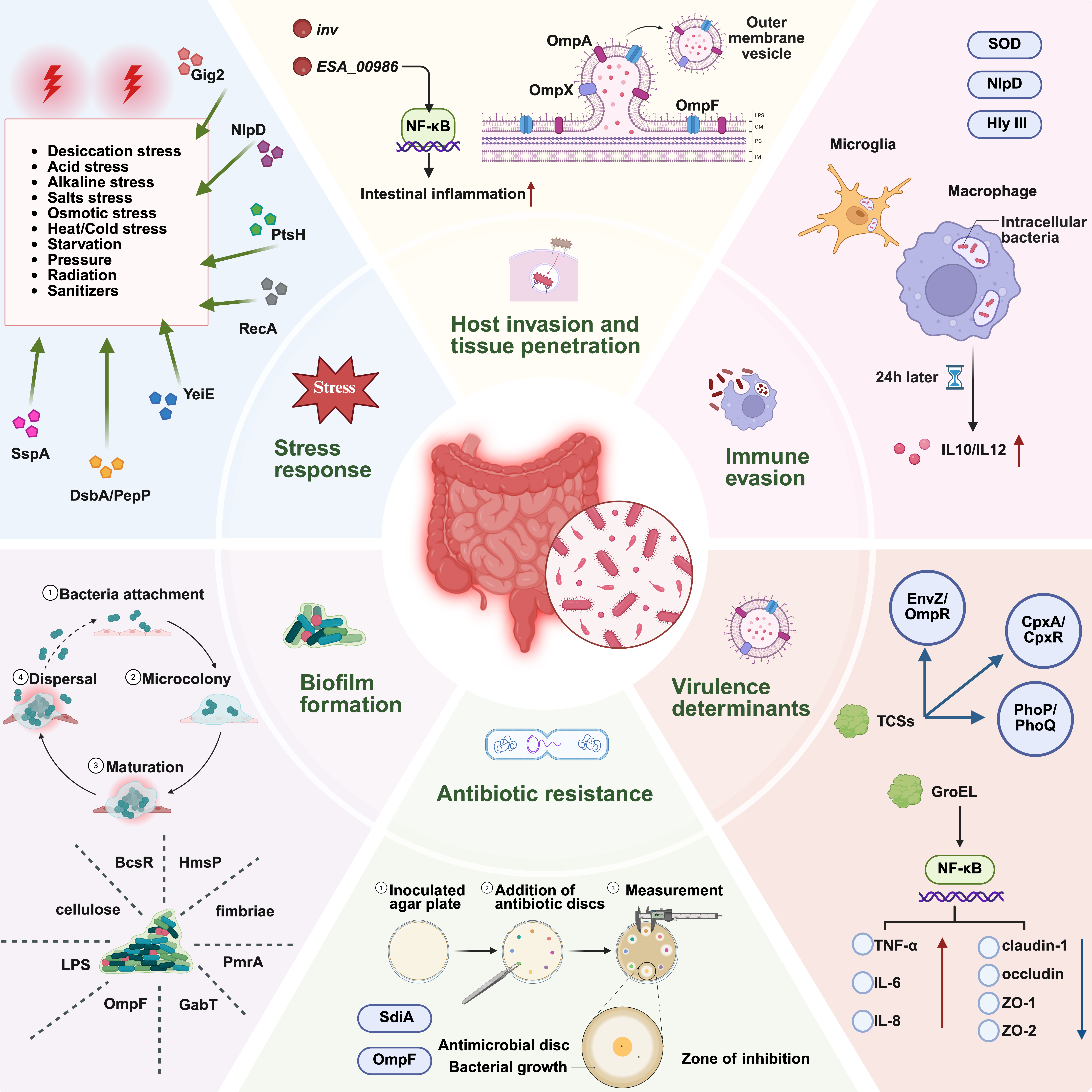
Deciphering Cronobacter sakazakii Pathogenesis: From Host Invasion to Future Directions


 ,
,
Abstract
1. Introduction
2. Symptoms, At-Risk Populations, and Important Outbreaks
3. Pathogenesis
3.1. Host Invasion and Tissue Penetration
3.2. Immune Evasion
3.3. Virulence Determinants
3.4. Biofilm Formation
3.5. Stress Response
3.6. Antibiotic Resistance
4. Diagnosis
4.1. Detection of C. sakazakii
4.2. Identification of C. sakazakii
5. Infection Control and Prevention
5.1. Regulation
5.2. Therapeutics
5.3. Biocontrol Strategies
5.3.1. Probiotics, Prebiotics, and Synbiotics
5.3.2. Bioactive Peptides
5.3.3. Phage Therapy
5.3.4. Organic Acids
5.3.5. Plant-Derived Natural Compounds
5.3.6. Practical Challenges and Research Gaps
6. Conclusions
Author Contributions
Funding
Institutional Review Board Statement
Informed Consent Statement
Data Availability Statement
Conflicts of Interest
References
- Forsythe, S.J. Updates on the Cronobacter Genus. Annu. Rev. Food Sci. Technol. 2018, 9, 23–44. [Google Scholar] [CrossRef] [Scilit]
- Nazarowec-White, M.; Farber, J.M. Enterobacter sakazakii: A Review. Int. J. Food Microbiol. 1997, 34, 103–113. [Google Scholar] [CrossRef] [Scilit]
- Bowen, A.B.; Braden, C.R. Invasive Enterobacter sakazakii Disease in Infants. Emerg. Infect. Dis. 2006, 12, 1185–1189. [Google Scholar] [CrossRef] [Scilit]
- Friedemann, M. Epidemiology of Invasive Neonatal Cronobacter (Enterobacter sakazakii) Infections. Eur. J. Clin. Microbiol. Infect. Dis. 2009, 28, 1297–1304. [Google Scholar] [CrossRef] [Scilit]
- Lepuschitz, S.; Ruppitsch, W.; Pekard-Amenitsch, S.; Forsythe, S.J.; Cormican, M.; Mach, R.L.; Piérard, D.; Allerberger, F. Multicenter Study of Cronobacter sakazakii Infections in Humans, Europe, 2017. Emerg. Infect. Dis. 2019, 25, 515–522. [Google Scholar] [CrossRef] [Scilit] [PubMed]
- Zeng, H.; Zhang, J.; Wu, Q.; He, W.; Wu, H.; Ye, Y.; Li, C.; Ling, N.; Chen, M.; Wang, J.; et al. Reconstituting the History of Cronobacter Evolution Driven by Differentiated CRISPR Activity. Appl. Environ. Microbiol. 2018, 84, e00267-18. [Google Scholar] [CrossRef] [Scilit] [PubMed]
- Wang, L.; Wu, P.; Su, Y.; Wei, Y.; Guo, X.; Yang, L.; Wang, M.; Liu, B. Detection of Genus and Three Important Species of Cronobacter Using Novel Genus- and Species-Specific Genes Identified by Large-Scale Comparative Genomic Analysis. Front. Microbiol. 2022, 13, 885543. [Google Scholar] [CrossRef] [Scilit]
- Haston, J.C.; Miko, S.; Cope, J.R.; McKeel, H.; Walters, C.; Joseph, L.A.; Griswold, T.; Katz, L.S.; Andújar, A.A.; Tourdot, L.; et al. Cronobacter sakazakii Infections in Two Infants Linked to Powdered Infant Formula and Breast Pump Equipment—United States, 2021 and 2022. MMWR Morb. Mortal. Wkly. Rep. 2023, 72, 223–226. [Google Scholar] [CrossRef] [Scilit] [PubMed]
- World Health Organization; Food and Agriculture Organization of the United Nations. Enterobacter sakazakii and Other Microorganisms in Powdered Infant Formula: Meeting Report; World Health Organization: Geneva, Switzerland, 2004. [Google Scholar]
- Ling, N.; Jiang, Y.; Zeng, H.; Ding, Y.; Forsythe, S. Advances in Our Understanding and Distribution of the Cronobacter Genus in China. J. Food Sci. 2021, 86, 276–283. [Google Scholar] [CrossRef] [Scilit] [PubMed]
- Fei, P.; Jiang, Y.; Jiang, Y.; Yuan, X.; Yang, T.; Chen, J.; Wang, Z.; Kang, H.; Forsythe, S.J. Prevalence, Molecular Characterization, and Antibiotic Susceptibility of Cronobacter sakazakii Isolates from Powdered Infant Formula Collected from Chinese Retail Markets. Front. Microbiol. 2017, 8, 2026. [Google Scholar] [CrossRef] [Scilit]
- Tang, K.; Liu, Y.; Meng, K.; Jiang, L.; Tan, S.; Liu, Y.; Chen, J. Breastfeeding Duration of Different Age Groups and Its Associated Factors among Chinese Women: A Cross-Sectional Study. Int. Breastfeed. J. 2019, 14, 19. [Google Scholar] [CrossRef] [Scilit] [PubMed]
- Bharti, D.; Lekshmi, M.; Kumar, S.H.; Nayak, B.B. Prevalence of Cronobacter spp. in Tropical Seafood From Mumbai, India: Comparative Study of Isolation Media and PCR Detection. J. AOAC Int. 2025, 108, 173–179. [Google Scholar] [CrossRef] [Scilit]
- Jang, H.; Chase, H.R.; Gangiredla, J.; Grim, C.J.; Patel, I.R.; Kothary, M.H.; Jackson, S.A.; Mammel, M.K.; Carter, L.; Negrete, F.; et al. Analysis of the Molecular Diversity Among Cronobacter Species Isolated From Filth Flies Using Targeted PCR, Pan Genomic DNA Microarray, and Whole Genome Sequencing Analyses. Front. Microbiol. 2020, 11, 561204. [Google Scholar] [CrossRef] [Scilit]
- Li, Y.; Lin, G.; Zhang, L.; Hu, Y.; Hong, C.; Xie, A.; Fang, L. Genomic Insights into Cronobacter spp. Recovered from Food and Human Clinical Cases in Zhejiang Province, China (2008–2021). J. Appl. Microbiol. 2023, 134, lxad033. [Google Scholar] [CrossRef] [Scilit]
- Tesfai, A.; Beamer, S.K.; Matak, K.E.; Jaczynski, J. Effect of Electron Beam on Chemical Changes of Nutrients in Infant Formula. Food Chem. 2014, 149, 208–214. [Google Scholar] [CrossRef] [Scilit]
- Ling, N.; Zhang, X.; Forsythe, S.; Zhang, D.; Shen, Y.; Zhang, J.; Ding, Y.; Wang, J.; Wu, Q.; Ye, Y. Bacteroides fragilis Ameliorates Cronobacter malonaticus Lipopolysaccharide-Induced Pathological Injury Through Modulation of the Intestinal Microbiota. Front. Immunol. 2022, 13, 931871. [Google Scholar] [CrossRef] [Scilit]
- Chauhan, R.; Tall, B.D.; Gopinath, G.; Azmi, W.; Goel, G. Environmental Risk Factors Associated with the Survival, Persistence, and Thermal Tolerance of Cronobacter sakazakii During the Manufacture of Powdered Infant Formula. Crit. Rev. Food Sci. Nutr. 2023, 63, 12224–12239. [Google Scholar]
- Peter, C.S.; Feuerhahn, M.; Bohnhorst, B.; Schlaud, M.; Ziesing, S.; von der Hardt, H.; Poets, C.F. Necrotising Enterocolitis: Is There a Relationship to Specific Pathogens? Eur. J. Pediatr. 1999, 158, 67–70. [Google Scholar] [CrossRef] [Scilit]
- Walsh, M.C.; Kliegman, R.M. Necrotizing Enterocolitis: Treatment Based on Staging Criteria. Pediatr. Clin. N. Am. 1986, 33, 179–201. [Google Scholar] [CrossRef] [Scilit] [PubMed]
- Masood, N.; Moore, K.; Farbos, A.; Paszkiewicz, K.; Dickins, B.; McNally, A.; Forsythe, S. Genomic Dissection of the 1994 Cronobacter sakazakii Outbreak in a French Neonatal Intensive Care Unit. BMC Genom. 2015, 16, 750. [Google Scholar] [CrossRef] [Scilit] [PubMed]
- Singer, M.; Deutschman, C.S.; Seymour, C.W.; Shankar-Hari, M.; Annane, D.; Bauer, M.; Bellomo, R.; Bernard, G.R.; Chiche, J.D.; Coopersmith, C.M.; et al. The Third International Consensus Definitions for Sepsis and Septic Shock (Sepsis-3). JAMA 2016, 315, 801–810. [Google Scholar] [CrossRef] [Scilit]
- Henry, C.J.; Semova, G.; Barnes, E.; Cotter, I.; Devers, T.; Rafaee, A.; Slavescu, A.; Cathain, N.O.; McCollum, D.; Roche, E.; et al. Neonatal Sepsis: A Systematic Review of Core Outcomes from Randomised Clinical Trials. Pediatr. Res. 2022, 91, 735–742. [Google Scholar] [CrossRef] [Scilit]
- Burdette, J.H.; Santos, C. Enterobacter sakazakii Brain Abscess in the Neonate: The Importance of Neuroradiologic Imaging. Pediatr. Radiol. 2000, 30, 33–34. [Google Scholar] [CrossRef] [Scilit]
- Feeney, A.; Kropp, K.A.; O’Connor, R.; Sleator, R.D. Cronobacter sakazakii: Stress Survival and Virulence Potential in an Opportunistic Foodborne Pathogen. Gut Microbes 2014, 5, 711–718. [Google Scholar] [CrossRef] [Scilit]
- Centers for Disease Control and Prevention. Enterobacter sakazakii Infections Associated With the Use of Powdered Infant Formula—Tennessee, 2001. JAMA 2002, 287, 2204–2205. [Google Scholar]
- Lai, K.K. Enterobacter sakazakii Infections Among Neonates, Infants, Children, and Adults: Case Reports and a Review of the Literature. Medicine 2001, 80, 113–122. [Google Scholar] [CrossRef] [Scilit] [PubMed]
- Patrick, M.E.; Mahon, B.E.; Greene, S.A.; Rounds, J.; Cronquist, A.; Wymore, K.; Boothe, E.; Lathrop, S.; Palmer, A.; Bowen, A. Incidence of Cronobacter spp. Infections, United States, 2003–2009. Emerg. Infect. Dis. 2014, 20, 1520–1523. [Google Scholar] [PubMed]
- Mohan Nair, M.K.; Venkitanarayanan, K. Role of Bacterial OmpA and Host Cytoskeleton in the Invasion of Human Intestinal Epithelial Cells by Enterobacter sakazakii. Pediatr. Res. 2007, 62, 664–669. [Google Scholar] [CrossRef] [Scilit]
- Kim, K.P.; Loessner, M.J. Enterobacter sakazakii Invasion in Human Intestinal Caco-2 Cells Requires the Host Cell Cytoskeleton and Is Enhanced by Disruption of Tight Junction. Infect. Immun. 2008, 76, 562–570. [Google Scholar] [CrossRef] [Scilit]
- Kim, K.; Kim, K.P.; Choi, J.; Lim, J.A.; Lee, J.; Hwang, S.; Ryu, S. Outer Membrane Proteins A (OmpA) and X (OmpX) Are Essential for Basolateral Invasion of Cronobacter sakazakii. Appl. Environ. Microbiol. 2010, 76, 5188–5198. [Google Scholar] [CrossRef] [Scilit] [PubMed]
- Singamsetty, V.K.; Wang, Y.; Shimada, H.; Prasadarao, N.V. Outer Membrane Protein A Expression in Enterobacter sakazakii Is Required to Induce Microtubule Condensation in Human Brain Microvascular Endothelial Cells for Invasion. Microb. Pathog. 2008, 45, 181–191. [Google Scholar] [CrossRef] [Scilit]
- Mittal, R.; Wang, Y.; Hunter, C.J.; Gonzalez-Gomez, I.; Prasadarao, N.V. Brain Damage in Newborn Rat Model of Meningitis by Enterobacter sakazakii: A Role for Outer Membrane Protein A. Lab. Investig. 2009, 89, 263–277. [Google Scholar]
- Giri, C.P.; Shima, K.; Tall, B.D.; Curtis, S.; Sathyamoorthy, V.; Hanisch, B.; Kim, K.S.; Kopecko, D.J. Cronobacter spp. (Previously Enterobacter sakazakii) Invade and Translocate Across Both Cultured Human Intestinal Epithelial Cells and Human Brain Microvascular Endothelial Cells. Microb. Pathog. 2012, 52, 140–147. [Google Scholar] [CrossRef] [Scilit]
- Jaradat, Z.W.; Al Mousa, W.; Elbetieha, A.; Al Nabulsi, A.; Tall, B.D. Cronobacter spp.—Opportunistic Food-Borne Pathogens: A Review of Their Virulence and Environmental-Adaptive Traits. J. Med. Microbiol. 2014, 63, 1023–1037. [Google Scholar]
- Kothary, M.H.; Gopinath, G.R.; Gangiredla, J.; Rallabhandi, P.V.; Harrison, L.M.; Yan, Q.Q.; Chase, H.R.; Lee, B.; Park, E.; Yoo, Y.; et al. Analysis and Characterization of Proteins Associated with Outer Membrane Vesicles Secreted by Cronobacter spp. Front. Microbiol. 2017, 8, 134. [Google Scholar]
- Ye, Y.; Gao, J.; Jiao, R.; Li, H.; Wu, Q.; Zhang, J.; Zhong, X. The Membrane Proteins Involved in Virulence of Cronobacter sakazakii Virulent G362 and Attenuated L3101 Isolates. Front. Microbiol. 2015, 6, 1238. [Google Scholar] [CrossRef] [Scilit] [PubMed]
- Alzahrani, H.; Winter, J.; Boocock, D.; De Girolamo, L.; Forsythe, S.J. Characterization of Outer Membrane Vesicles from a Neonatal Meningitic Strain of Cronobacter sakazakii. FEMS Microbiol. Lett. 2015, 362, fnv085. [Google Scholar] [CrossRef] [Scilit]
- Chandrapala, D.; Kim, K.; Choi, Y.; Senevirathne, A.; Kang, D.H.; Ryu, S.; Kim, K.P. Putative Inv Is Essential for Basolateral Invasion of Caco-2 Cells and Acts Synergistically with OmpA to Affect In Vitro and In Vivo Virulence of Cronobacter sakazakii ATCC 29544. Infect. Immun. 2014, 82, 1755–1765. [Google Scholar] [CrossRef] [Scilit] [PubMed]
- Fan, Y.; Li, P.; Zhu, D.; Zhao, C.; Jiao, J.; Ji, X.; Du, X. Effects of ESA_00986 Gene on Adhesion/Invasion and Virulence of Cronobacter sakazakii and Its Molecular Mechanism. Foods 2023, 12, 2572. [Google Scholar] [CrossRef] [Scilit]
- Gao, J.; Han, Z.; Li, P.; Zhang, H.; Du, X.; Wang, S. Outer Membrane Protein F Is Involved in Biofilm Formation, Virulence and Antibiotic Resistance in Cronobacter sakazakii. Microorganisms 2021, 9, 2338. [Google Scholar] [CrossRef] [Scilit]
- Duess, J.W.; Sampah, M.E.; Lopez, C.M.; Tsuboi, K.; Scheese, D.J.; Sodhi, C.P.; Hackam, D.J. Necrotizing Enterocolitis, Gut Microbes, and Sepsis. Gut Microbes 2023, 15, 2221470. [Google Scholar] [CrossRef] [Scilit]
- Creed, P.V.; Hamilton, S.S.; Redkey, J.; Streicher, D.A.; Alali, M. Neonatal Meningitis Due to Cronobacter sakazakii. Pediatr. Ann. 2023, 52, e430–e433. [Google Scholar] [CrossRef] [Scilit] [PubMed]
- Townsend, S.; Hurrell, E.; Forsythe, S. Virulence Studies of Enterobacter sakazakii Isolates Associated with a Neonatal Intensive Care Unit Outbreak. BMC Microbiol. 2008, 8, 64. [Google Scholar]
- Carvalho, G.G.; Calarga, A.P.; Zorgi, N.E.; Astudillo-Trujillo, C.A.; Gontijo, M.T.P.; Brocchi, M.; Giorgio, S.; Kabuki, D.Y. Virulence and DNA Sequence Analysis of Cronobacter spp. Isolated from Infant Cereals. Int. J. Food Microbiol. 2022, 376, 109745. [Google Scholar] [CrossRef] [Scilit]
- Almajed, F.S.; Forsythe, S.J. Cronobacter sakazakii Clinical Isolates Overcome Host Barriers and Evade the Immune Response. Microb. Pathog. 2016, 90, 55–63. [Google Scholar] [CrossRef] [Scilit]
- Townsend, S.M.; Hurrell, E.; Gonzalez-Gomez, I.; Lowe, J.; Frye, J.G.; Forsythe, S.; Badger, J.L. Enterobacter sakazakii Invades Brain Capillary Endothelial Cells, Persists in Human Macrophages Influencing Cytokine Secretion and Induces Severe Brain Pathology in the Neonatal Rat. Microbiology 2007, 153, 3538–3547. [Google Scholar] [CrossRef] [Scilit]
- Ji, X.; Lu, P.; Xue, J.; Zhao, N.; Zhang, Y.; Dong, L.; Zhang, X.; Li, P.; Hu, Y.; Wang, J.; et al. The Lipoprotein NlpD in Cronobacter sakazakii Responds to Acid Stress and Regulates Macrophage Resistance and Virulence by Maintaining Membrane Integrity. Virulence 2021, 12, 415–429. [Google Scholar] [CrossRef] [Scilit] [PubMed]
- Liu, J.; Wan, Q.; Gaoxin, D.; Song, Z.; Mao, K.; Wu, F.; Liu, X.; Mu, L. Hemolysin III Drives Neuroinvasion and Meningitis While Impacting Desiccation Resilience in Cronobacter sakazakii. Appl. Environ. Microbiol. 2025, 91, e0033925. [Google Scholar] [CrossRef] [Scilit]
- Xiong, J.; Tang, H.; Sun, L.; Zhu, J.; Tao, S.; Luo, J.; Li, J.; Li, J.; Wu, H.; Yang, J. A Macrophage Cell Membrane-Coated Cascade-Targeting Photothermal Nanosystem for Combating Intracellular Bacterial Infections. Acta Biomater. 2024, 175, 293–306. [Google Scholar] [CrossRef] [Scilit]
- Liu, Y.; Zhang, J.; Zhao, H.; Zhong, F.; Li, J.; Zhao, L. VBNC Cronobacter sakazakii Survives in Macrophages by Resisting Oxidative Stress and Evading Recognition by Macrophages. BMC Microbiol. 2024, 24, 458. [Google Scholar] [CrossRef] [Scilit]
- Fu, X.; Liu, Z.; Wang, Y. Advances in the Study of Immunosuppressive Mechanisms in Sepsis. J. Inflamm. Res. 2023, 16, 3967–3981. [Google Scholar] [CrossRef] [Scilit] [PubMed]
- Shaw, C.; Hess, M.; Weimer, B.C. Two-Component Systems Regulate Bacterial Virulence in Response to the Host Gastrointestinal Environment and Metabolic Cues. Virulence 2022, 13, 1666–1680. [Google Scholar] [CrossRef] [Scilit]
- Jin, T.; Zhan, X.; Pang, L.; Peng, B.; Zhang, X.; Zhu, W.; Yang, B.; Xia, X. CpxAR Two-Component System Contributes to Virulence Properties of Cronobacter sakazakii. Food Microbiol. 2024, 117, 104393. [Google Scholar] [CrossRef] [Scilit] [PubMed]
- Ji, X.; Shi, A.; Wang, J.; Zhang, B.; Hu, Y.; Lv, H.; Wu, J.; Sun, Y.; Liu, J.M.; Zhang, Y.; et al. EnvZ/OmpR Controls Protein Expression and Modifications in Cronobacter sakazakii for Virulence and Environmental Resilience. J. Agric. Food Chem. 2024, 72, 18697–18707. [Google Scholar] [CrossRef] [Scilit] [PubMed]
- Ma, Y.; Zhang, Y.; Chen, K.; Zhang, L.; Zhang, Y.; Wang, X.; Xia, X. The Role of PhoP/PhoQ Two Component System in Regulating Stress Adaptation in Cronobacter sakazakii. Food Microbiol. 2021, 100, 103851. [Google Scholar] [CrossRef] [Scilit]
- Ma, Y.; Zhang, Y.; Wang, Y.; Qiao, Z.; Liu, Y.; Xia, X. PhoP/PhoQ Two-Component System Contributes to Intestinal Inflammation Induced by Cronobacter sakazakii in Neonatal Mice. Foods 2024, 13, 2808. [Google Scholar] [CrossRef] [Scilit]
- Shi, A.; Xue, J.; Liu, Y.; Wang, J.; Liu, X.; Song, L.; Sun, S. Impact of kdpE Gene Deletion on Virulence and Environmental Resilience in Cronobacter sakazakii. Food Res. Int. 2025, 210, 116362. [Google Scholar] [CrossRef] [Scilit]
- Cruz, A.; Xicohtencatl-Cortes, J.; González-Pedrajo, B.; Bobadilla, M.; Eslava, C.; Rosas, I. Virulence Traits in Cronobacter Species Isolated from Different Sources. Can. J. Microbiol. 2011, 57, 735–744. [Google Scholar] [CrossRef] [Scilit] [PubMed]
- Franco, A.A.; Kothary, M.H.; Gopinath, G.; Jarvis, K.G.; Grim, C.J.; Hu, L.; Datta, A.R.; McCardell, B.A.; Tall, B.D. Cpa, the Outer Membrane Protease of Cronobacter sakazakii, Activates Plasminogen and Mediates Resistance to Serum Bactericidal Activity. Infect. Immun. 2011, 79, 1578–1587. [Google Scholar] [CrossRef] [Scilit]
- Kim, S.; Hwang, H.; Kim, K.P.; Yoon, H.; Kang, D.H.; Ryu, S. Hfq Plays Important Roles in Virulence and Stress Adaptation in Cronobacter sakazakii ATCC 29544. Infect. Immun. 2015, 83, 2089–2098. [Google Scholar] [CrossRef] [Scilit]
- Wang, M.; Wang, L.; Wu, P.; Chen, T.; Zhu, Y.; Zhang, Y.; Wei, Y.; Qian, C.; Wang, Y.; Liu, B. Genomics and Experimental Analysis Reveal a Novel Factor Contributing to the Virulence of Cronobacter sakazakii Strains Associated With Neonate Infection. J. Infect. Dis. 2019, 220, 306–315. [Google Scholar] [CrossRef] [Scilit]
- Kim, S.; Yoon, H.; Ryu, S. New Virulence Factor CSK29544_02616 as LpxA Binding Partner in Cronobacter sakazakii. Sci. Rep. 2018, 8, 835. [Google Scholar] [CrossRef] [Scilit] [PubMed]
- Li, P.; Zong, W.; Zhang, Z.; Lv, W.; Ji, X.; Zhu, D.; Du, X.; Wang, S. Effects and Molecular Mechanism of Flagellar Gene flgK on the Motility, Adhesion/Invasion, and Desiccation Resistance of Cronobacter sakazakii. Food Res. Int. 2023, 164, 112418. [Google Scholar] [CrossRef] [Scilit]
- Lu, P.; Dong, X.; Ji, X. Cronobacter sakazakii Pyridoxal Kinase PdxY Mediated by TreR and pESA3 Is Essential for Vitamin B6 (PLP) Maintenance and Virulence. Appl. Environ. Microbiol. 2023, 89, e0092423. [Google Scholar] [CrossRef] [Scilit]
- Zhu, D.; Fan, Y.; Wang, X.; Li, P.; Huang, Y.; Jiao, J.; Zhao, C.; Li, Y.; Wang, S.; Du, X. Characterization of Molecular Chaperone GroEL as a Potential Virulence Factor in Cronobacter sakazakii. Foods 2023, 12, 3404. [Google Scholar] [CrossRef] [Scilit]
- Lu, P.; Xue, J.; Chen, X.; Ji, X. DnaK-Mediated Protein Deamidation: A Potential Mechanism for Virulence and Stress Adaptation in Cronobacter sakazakii. Appl. Environ. Microbiol. 2023, 89, e0050523. [Google Scholar] [CrossRef] [Scilit] [PubMed]
- Shi, A.; Wang, W.; Wang, C.; Weng, X.; Tian, Q.; Sun, S. Disruption of the rpfB Gene Impairs Growth and Virulence in Cronobacter sakazakii through Downregulation of the Shikimate Pathway. J. Agric. Food Chem. 2025, 73, 12465–12473. [Google Scholar] [CrossRef] [Scilit]
- Vestby, L.K.; Grønseth, T.; Simm, R.; Nesse, L.L. Bacterial Biofilm and its Role in the Pathogenesis of Disease. Antibiotics 2020, 9, 59. [Google Scholar] [CrossRef] [Scilit]
- Azeredo, J.; Azevedo, N.F.; Briandet, R.; Cerca, N.; Coenye, T.; Costa, A.R.; Desvaux, M.; Di Bonaventura, G.; Hébraud, M.; Jaglic, Z.; et al. Critical Review on Biofilm Methods. Crit. Rev. Microbiol. 2017, 43, 313–351. [Google Scholar] [CrossRef] [Scilit] [PubMed]
- de la Fuente-Núñez, C.; Reffuveille, F.; Fernández, L.; Hancock, R.E. Bacterial Biofilm Development as a Multicellular Adaptation: Antibiotic Resistance and New Therapeutic Strategies. Curr. Opin. Microbiol. 2013, 16, 580–589. [Google Scholar] [CrossRef] [Scilit]
- Kumar, C.G.; Anand, S.K. Significance of Microbial Biofilms in Food Industry: A Review. Int. J. Food Microbiol. 1998, 42, 9–27. [Google Scholar] [CrossRef] [Scilit]
- Hartmann, I.; Carranza, P.; Lehner, A.; Stephan, R.; Eberl, L.; Riedel, K. Genes Involved in Cronobacter sakazakii Biofilm Formation. Appl. Environ. Microbiol. 2010, 76, 2251–2261. [Google Scholar] [CrossRef] [Scilit]
- Wang, L.; Hu, X.; Tao, G.; Wang, X. Outer Membrane Defect and Stronger Biofilm Formation Caused by Inactivation of a Gene Encoding for Heptosyltransferase I in Cronobacter sakazakii ATCC BAA-894. J. Appl. Microbiol. 2012, 112, 985–997. [Google Scholar] [CrossRef] [Scilit]
- Gao, J.X.; Li, P.; Du, X.J.; Han, Z.H.; Xue, R.; Liang, B.; Wang, S. A Negative Regulator of Cellulose Biosynthesis, bcsR, Affects Biofilm Formation, and Adhesion/Invasion Ability of Cronobacter sakazakii. Front. Microbiol. 2017, 8, 1839. [Google Scholar] [CrossRef] [Scilit] [PubMed]
- Xu, Z.; Liu, Z.; Soteyome, T.; Hua, J.; Zhang, L.; Yuan, L.; Ye, Y.; Cai, Z.; Yang, L.; Chen, L.; et al. Impact of pmrA on Cronobacter sakazakii Planktonic and Biofilm Cells: A Comprehensive Transcriptomic Study. Food Microbiol. 2021, 98, 103785. [Google Scholar] [CrossRef] [Scilit]
- Ji, X.; Fan, D.; Wang, J.; Zhang, B.; Hu, Y.; Lv, H.; Wu, J.; Sun, Y.; Liu, J.; Zhang, Y.; et al. Cronobacter sakazakii Lysozyme Inhibitor LprI Mediated by HmsP and c-di-GMP Is Essential for Biofilm Formation and Virulence. Appl. Environ. Microbiol. 2024, 90, e0156424. [Google Scholar] [CrossRef] [Scilit]
- Raza, A.; Salehi, H.; Haghjou, M.M.; Rahman, M.A.; Peng, Y.; Li, Y.; Charagh, S.; Khan, M.I.R.; Chen, Y.; Siddique, K.H.M.; et al. The Hidden Role of Amino Acids and Secondary Metabolites in Plant Drought Tolerance. Plant Sci. 2026, 364, 112919. [Google Scholar] [CrossRef] [Scilit] [PubMed]
- Mathew, B.; Mathew, G.E.; Suresh, J.; Usman, D.; Shiva Subramanyan, P.N.; Safna, K.F. Ligand Based Drug Design of New Heterocyclic Imines of GABA Analogues: A Molecular Docking Approach for the Discovery of New GABA-AT Inhibitors. Cent. Nerv. Syst. Agents Med. Chem. 2016, 17, 58–63. [Google Scholar] [CrossRef] [Scilit]
- Andersen, J.V. The Glutamate/GABA-Glutamine Cycle: Insights, Updates, and Advances. J. Neurochem. 2025, 169, e70029. [Google Scholar] [CrossRef] [Scilit] [PubMed]
- Wu, J.; Yu, Y.; Liu, F.; Cao, Y.; Ren, J.; Fan, Y.; Xiao, X. γ-Aminobutyric Acid (GABA) Metabolic Bypass Plays a Crucial Role in Stress Tolerance and Biofilm Formation in C. sakazakii ATCC 29544. Foods 2025, 14, 171. [Google Scholar] [CrossRef] [Scilit]
- Soni, A.; Bremer, P.; Brightwell, G. A Comprehensive Review of Variability in the Thermal Resistance (D-Values) of Food-Borne Pathogens—A Challenge for Thermal Validation Trials. Foods 2022, 11, 4117. [Google Scholar] [CrossRef] [Scilit]
- Yan, Y.; Cao, M.; Ma, J.; Suo, J.; Bai, X.; Ge, W.; Lü, X.; Zhang, Q.; Chen, J.; Cui, S.; et al. Mechanisms of Thermal, Acid, Desiccation and Osmotic Tolerance of Cronobacter spp. Crit. Rev. Food Sci. Nutr. 2025, 65, 6569–6591. [Google Scholar] [CrossRef] [Scilit]
- Yang, Y.; Wang, W.; Meng, X.; Niu, B.; Yang, J.; Chen, Q. The betA/B Genes as a Key Factor in Cronobacter sakazakii Survival Under Desiccation Stress. J. Dairy Sci. 2025, 108, 8205–8221. [Google Scholar] [CrossRef] [Scilit] [PubMed]
- Lu, P.; Xue, J.; Shi, A.; Ji, X. Opposing Regulation of Gig2 by RecA and GlrK Controls Redox-Linked Desiccation Tolerance in Cronobacter sakazakii. Food Microbiol. 2025, 132, 104860. [Google Scholar] [CrossRef] [Scilit]
- Xue, J.; Meng, K.; Lv, J.; Liu, L.; Duan, F.; Ji, X.; Ding, L. NlpD as a Crucial Factor in Desiccation Resistance and Biofilm Formation in Cronobacter sakazakii. Sci. Rep. 2025, 15, 6289. [Google Scholar] [CrossRef] [Scilit] [PubMed]
- Jin, T.; Pang, L.; Yue, T.; Niu, L.; Li, T.; Liang, Y.; Zhang, Y.; Yan, C.; Yang, B.; Zhang, C.; et al. The Role of dsbA and pepP Genes in the Environmental Tolerance and Virulence Factors of Cronobacter sakazakii. Food Res. Int. 2024, 190, 114555. [Google Scholar] [CrossRef] [Scilit] [PubMed]
- Lu, P.; Xue, J.; Ji, X. RecA Deletion Disrupts Protein Homeostasis, Leading to Deamidation, Oxidation, and Impaired Glycolysis in Cronobacter sakazakii. Appl. Environ. Microbiol. 2025, 91, e0197124. [Google Scholar] [CrossRef] [Scilit]
- Zhan, J.; Tan, X.; Wang, X. Null Mutation in sspA of Cronobacter sakazakii Influences Its Tolerance to Environmental Stress. Can. J. Microbiol. 2021, 67, 902–918. [Google Scholar] [CrossRef] [Scilit]
- Hong, S.; Kim, J.; Cho, E.; Na, S.; Yoo, Y.J.; Cho, Y.H.; Ryu, S.; Ha, N.C. Crystal Structures of YeiE from Cronobacter sakazakii and the Role of Sulfite Tolerance in Gram-Negative Bacteria. Proc. Natl. Acad. Sci. USA 2022, 119, e2118002119. [Google Scholar] [CrossRef] [Scilit]
- Sun, Y.; Li, J.; Yang, Y.; Yang, G.; Shi, Y.; Wang, S.; Wang, M.; Xia, X. The Role of ptsH in Stress Adaptation and Virulence in Cronobacter sakazakii BAA-894. Foods 2022, 11, 2680. [Google Scholar] [CrossRef] [Scilit]
- Wu, S.; Subharat, P.; Brightwell, G. A New Insight into the Bactericidal Mechanism of 405 nm Blue Light-Emitting-Diode against Dairy Sourced Cronobacter sakazakii. Foods 2021, 10, 1996. [Google Scholar] [CrossRef] [Scilit]
- Du, X.J.; Wang, X.Y.; Dong, X.; Li, P.; Wang, S. Characterization of the Desiccation Tolerance of Cronobacter sakazakii Strains. Front. Microbiol. 2018, 9, 2867. [Google Scholar] [CrossRef] [Scilit] [PubMed]
- Ekundayo, T.C.; Ijabadeniyi, O.A. Global and Regional Prevalence of Cronobacter sakazakii in Powdered Milk and Flour. Sci. Rep. 2024, 14, 6865. [Google Scholar] [CrossRef] [Scilit]
- Cheng, C.; Yan, X.; Liu, B.; Jiang, T.; Zhou, Z.; Guo, F.; Zhang, Q.; Li, C.; Fang, T. SdiA Enhanced the Drug Resistance of Cronobacter sakazakii and Suppressed Its Motility, Adhesion and Biofilm Formation. Front. Microbiol. 2022, 13, 901912. [Google Scholar] [CrossRef] [Scilit]
- Baumbach, J.; Rooney, K.; Smelser, C.; Torres, P.; Bowen, A.; Nichols, M. Cronobacter Species Isolation in Two Infants—New Mexico, 2008. MMWR Morb. Mortal. Wkly. Rep. 2009, 58, 1179–1183. [Google Scholar]
- Willis, J.; Robinson, J.E. Enterobacter sakazakii Meningitis in Neonates. Pediatr. Infect. Dis. J. 1988, 7, 196–199. [Google Scholar] [CrossRef] [Scilit]
- Barron, J.C.; Forsythe, S.J. Dry Stress and Survival Time of Enterobacter sakazakii and Other Enterobacteriaceae in Dehydrated Powdered Infant Formula. J. Food Prot. 2007, 70, 2111–2117. [Google Scholar] [CrossRef] [Scilit] [PubMed]
- Al-Nabulsi, A.A.; Osaili, T.M.; Elabedeen, N.A.; Jaradat, Z.W.; Shaker, R.R.; Kheirallah, K.A.; Tarazi, Y.H.; Holley, R.A. Impact of Environmental Stress Desiccation, Acidity, Alkalinity, Heat or Cold on Antibiotic Susceptibility of Cronobacter sakazakii. Int. J. Food Microbiol. 2011, 146, 137–143. [Google Scholar] [CrossRef] [Scilit]
- Hochel, I.; Růžičková, H.; Krásný, L.; Demnerová, K. Occurrence of Cronobacter spp. in Retail Foods. J. Appl. Microbiol. 2012, 112, 1257–1265. [Google Scholar] [CrossRef] [Scilit] [PubMed]
- Shi, L.; Liang, Q.; Zhan, Z.; Feng, J.; Zhao, Y.; Chen, Y.; Huang, M.; Tong, Y.; Wu, W.; Chen, W.; et al. Co-Occurrence of 3 Different Resistance Plasmids in a Multi-Drug Resistant Cronobacter sakazakii Isolate Causing Neonatal Infections. Virulence 2018, 9, 110–120. [Google Scholar] [CrossRef] [Scilit]
- Bhowmik, S.; Rivu, S.; Bari, M.L.; Ahmed, S. Genome Mining of Cronobacter sakazakii in Bangladesh Reveals the Occurrence of High-Risk ST83 and Rare ST789 Lineages. Pathogens 2025, 14, 1220. [Google Scholar] [CrossRef] [Scilit]
- Olsen, N.S.; Riber, L. Metagenomics as a Transformative Tool for Antibiotic Resistance Surveillance: Highlighting the Impact of Mobile Genetic Elements with a Focus on the Complex Role of Phages. Antibiotics 2025, 14, 296. [Google Scholar] [CrossRef] [Scilit] [PubMed]
- Qin, X.; Wang, H.; Miao, C.; Yang, X.; Zhang, Y.; Feng, J.; Forsythe, S.J.; Man, C.; Jiang, Y. Comparative Genomics Reveals Environmental Adaptation Differences Between Cronobacter Species. Food Res. Int. 2021, 147, 110541. [Google Scholar] [CrossRef] [Scilit]
- Gao, M.; Pradhan, A.K.; Blaustein, R.A. Genomic Diversity of Cronobacter sakazakii Across the Food System to Consumers at the Global Scale. Int. J. Food Microbiol. 2025, 441, 111335. [Google Scholar] [CrossRef] [Scilit]
- Lee, I.P.A.; Andam, C.P. Pan-Genome Diversification and Recombination in Cronobacter sakazakii, an Opportunistic Pathogen in Neonates, and Insights to Its Xerotolerant Lifestyle. BMC Microbiol. 2019, 19, 306. [Google Scholar] [CrossRef] [Scilit] [PubMed]
- Zeng, H.; Zou, H.; Huang, X.; Liang, B.; Liu, S.; Zhao, W.; Xu, M.; Chen, M. Emergence of Transmissible mcr-9.1 Plasmids in Clinical Cronobacter sakazakii: CRISPR Typing Unravels Phage-Driven Evolution and High-Risk Lineage. Appl. Environ. Microbiol. 2025, 91, e0137925. [Google Scholar] [CrossRef] [Scilit]
- Casalinuovo, F.; Rippa, P.; Battaglia, L.; Parisi, N. Isolation of Cronobacter spp. (Enterobacter sakazakii) from Artisanal Mozzarella. Ital. J. Food Saf. 2014, 3, 1526. [Google Scholar] [CrossRef] [Scilit]
- Kong, D.; Liu, L.; Xing, C.; Kuang, H.; Xu, C. Sensitive and Highly Specific Detection of Cronobacter sakazakii Based on Monoclonal Sandwich ELISA. Food Agric. Immunol. 2015, 26, 566–576. [Google Scholar]
- Chen, W.; Ai, L.; Yang, J.; Ren, J.; Li, Y.; Guo, B. Development of a PCR Assay for Rapid Detection of Cronobacter spp. from Food. Can. J. Microbiol. 2013, 59, 656–661. [Google Scholar] [CrossRef] [Scilit]
- Li, Y.; Chen, Q.; Jiang, H.; Jiao, Y.; Lu, F.; Bie, X.; Lu, Z. Novel Development of a qPCR Assay Based on the rpoB Gene for Rapid Detection of Cronobacter spp. Curr. Microbiol. 2016, 72, 436–443. [Google Scholar] [CrossRef] [Scilit] [PubMed]
- Liu, X.; Fang, J.; Zhang, M.; Wang, X.; Wang, W.; Gong, Y.; Xi, X.; Li, M. Development of a Loop-Mediated Isothermal Amplification Assay for Detection of Cronobacter spp. (Enterobacter sakazakii). World J. Microbiol. Biotechnol. 2012, 28, 1013–1020. [Google Scholar] [CrossRef] [Scilit]
- Chen, P.; Yang, Q.; Li, S.; Liu, X.; Li, B.; Zhang, J.; Wang, J.; Yue, X.; Wang, Y. Nanobody-Induced Aggregation of Gold Nanoparticles: A Mix-and-Read Strategy for the Rapid Detection of Cronobacter sakazakii. Anal. Chem. 2024, 96, 17602–17611, Erratum in Anal. Chem. 2025, 97, 17307–17308. [Google Scholar]
- Lehner, A.; Tasara, T.; Stephan, R. 16S rRNA Gene Based Analysis of Enterobacter sakazakii Strains from Different Sources and Development of a PCR Assay for Identification. BMC Microbiol. 2004, 4, 43. [Google Scholar] [CrossRef] [Scilit] [PubMed]
- Song, D.; Su, Q.; Jia, A.; Fu, S.; Ma, X.; Li, T.; Man, C.; Yang, X.; Jiang, Y. A Method to Directly Identify Cronobacter sakazakii in Liquid Medium by MALDI-TOF MS. Foods 2023, 12, 1981. [Google Scholar] [CrossRef] [Scilit]
- Mousavi, Z.E.; Koolman, L.; Macori, G.; Fanning, S.; Butler, F. Comprehensive Genomic Characterization of Cronobacter sakazakii Isolates from Infant Formula Processing Facilities Using Whole-Genome Sequencing. Microorganisms 2023, 11, 2749. [Google Scholar] [CrossRef] [Scilit]
- O’Grady, J.; Cronin, U.; Tierney, J.; Piterina, A.V.; O’Meara, E.; Wilkinson, M.G. Gaps in the Assortment of Rapid Assays for Microorganisms of Interest to the Dairy Industry. Adv. Appl. Microbiol. 2020, 113, 1–56. [Google Scholar]
- Norberg, S.; Stanton, C.; Ross, R.P.; Hill, C.; Fitzgerald, G.F.; Cotter, P.D. Cronobacter spp. in Powdered Infant Formula. J. Food Prot. 2012, 75, 607–620. [Google Scholar] [CrossRef] [Scilit]
- Seo, K.H.; Brackett, R.E. Rapid, Specific Detection of Enterobacter sakazakii in Infant Formula Using a Real-Time PCR Assay. J. Food Prot. 2005, 68, 59–63. [Google Scholar] [CrossRef] [Scilit]
- Rodrigues, M.E.; Lopes, S.P.; Pereira, C.R.; Azevedo, N.F.; Lourenço, A.; Henriques, M.; Pereira, M.O. Polymicrobial Ventilator-Associated Pneumonia: Fighting In Vitro Candida albicans-Pseudomonas aeruginosa Biofilms with Antifungal-Antibacterial Combination Therapy. PLoS ONE 2017, 12, e0170433. [Google Scholar] [CrossRef] [Scilit] [PubMed]
- Pintea-Simon, I.A.; Bancu, L.; Mare, A.D.; Ciurea, C.N.; Toma, F.; Man, A. Rapid Molecular Diagnostics of Pneumonia Caused by Gram-Negative Bacteria: A Clinician’s Review. Antibiotics 2024, 13, 805. [Google Scholar]
- Zhou, A.; Wang, L.; Zhang, J.; Yang, X.; Ou, Z.; Zhao, L. Survival of Viable but Nonculturable Cronobacter sakazakii in Macrophages Contributes to Infections. Microb. Pathog. 2021, 158, 105064. [Google Scholar] [CrossRef] [Scilit]
- Zhao, X.; Zhong, J.; Wei, C.; Lin, C.W.; Ding, T. Current Perspectives on Viable but Non-Culturable State in Foodborne Pathogens. Front. Microbiol. 2017, 8, 580. [Google Scholar] [CrossRef] [Scilit] [PubMed]
- Shukla, S.; Haldorai, Y.; Bajpai, V.K.; Rengaraj, A.; Hwang, S.K.; Song, X.; Kim, M.; Huh, Y.S.; Han, Y.K. Electrochemical Coupled Immunosensing Platform Based on Graphene Oxide/Gold Nanocomposite for Sensitive Detection of Cronobacter sakazakii in Powdered Infant Formula. Biosens. Bioelectron. 2018, 109, 139–149. [Google Scholar] [CrossRef] [Scilit]
- Park, S.; Shukla, S.; Kim, Y.; Oh, S.; Hun Kim, S.; Kim, M. Development of Sandwich Enzyme-Linked Immunosorbent Assay for the Detection of Cronobacter muytjensii (Formerly Called Enterobacter sakazakii). Microbiol. Immunol. 2012, 56, 472–479. [Google Scholar] [CrossRef] [Scilit]
- Wang, P.; Chen, Q.; Wang, Y.; Sun, X.; Liu, Z. Development of a Visual Assay for Detection of Viable Cronobacter sakazakii Using RT-PSR and Hydroxynaphthol Blue Indicator. Biology 2025, 14, 383. [Google Scholar] [CrossRef] [Scilit]
- Gičová, A.; Oriešková, M.; Oslanecová, L.; Drahovská, H.; Kaclíková, E. Identification and Characterization of Cronobacter Strains Isolated from Powdered Infant Foods. Lett. Appl. Microbiol. 2014, 58, 242–247. [Google Scholar] [CrossRef] [Scilit]
- Muthubharathi, B.C.; Ravichandiran, V.; Balamurugan, K. Cronobacter sakazakii Cue for the Attraction and Its Impact on the Immunity of Caenorhabditis elegans. Infect. Immun. 2022, 90, e0028122. [Google Scholar] [CrossRef] [Scilit]
- Zimmermann, J.; Schmidt, H.; Loessner, M.J.; Weiss, A. Development of a Rapid Detection System for Opportunistic Pathogenic Cronobacter spp. in Powdered Milk Products. Food Microbiol. 2014, 42, 19–25. [Google Scholar] [CrossRef] [Scilit] [PubMed]
- Feng, W.; Newbigging, A.M.; Tao, J.; Cao, Y.; Peng, H.; Le, C.; Wu, J.; Pang, B.; Li, J.; Tyrrell, D.L.; et al. CRISPR Technology Incorporating Amplification Strategies: Molecular Assays for Nucleic Acids, Proteins, and Small Molecules. Chem. Sci. 2021, 12, 4683–4698. [Google Scholar] [CrossRef] [Scilit] [PubMed]
- Xun, G.; Lane, S.T.; Petrov, V.A.; Pepa, B.E.; Zhao, H. A Rapid, Accurate, Scalable, and Portable Testing System for COVID-19 Diagnosis. Nat. Commun. 2021, 12, 2905. [Google Scholar] [CrossRef] [Scilit]
- Craw, P.; Balachandran, W. Isothermal Nucleic Acid Amplification Technologies for Point-of-Care Diagnostics: A Critical Review. Lab Chip 2012, 12, 2469–2486. [Google Scholar] [CrossRef] [Scilit] [PubMed]
- Notomi, T.; Okayama, H.; Masubuchi, H.; Yonekawa, T.; Watanabe, K.; Amino, N.; Hase, T. Loop-Mediated Isothermal Amplification of DNA. Nucleic Acids Res. 2000, 28, E63. [Google Scholar] [CrossRef] [Scilit]
- Fan, H.; Long, B.; Wu, X.; Bai, Y. Development of a Loop-Mediated Isothermal Amplification Assay for Sensitive and Rapid Detection of Cronobacter sakazakii. Foodborne Pathog. Dis. 2012, 9, 1111–1118. [Google Scholar] [CrossRef] [Scilit]
- Liu, Y.; Mustapha, A. Detection of Viable Escherichia coli O157:H7 in Ground Beef by Propidium Monoazide Real-Time PCR. Int. J. Food Microbiol. 2014, 170, 48–54. [Google Scholar] [CrossRef] [Scilit]
- Liu, F.; Lu, H.; Dong, B.; Huang, X.; Cheng, H.; Qu, R.; Hu, Y.; Zhong, L.; Guo, Z.; You, Y.; et al. Systematic Evaluation of the Viable Microbiome in the Human Oral and Gut Samples with Spike-in Gram+/− Bacteria. mSystems 2023, 8, e0073822. [Google Scholar] [CrossRef] [Scilit]
- Wang, L.; Ke, Y.; Li, Y.; Li, Y.; Yan, Y.; Song, Y.; Yang, R.; Gao, B.; Han, Y. Preparation of Polyclonal Antibody Against a Universal Bacterial Antigen OmpA Deduced by Bioinformatic Analysis and Preliminary Evaluation of Concentration Effects on Foodborne Pathogens. Heliyon 2023, 9, e16353. [Google Scholar] [CrossRef] [Scilit]
- Lv, X.; Wang, L.; Zhang, J.; He, X.; Shi, L.; Zhao, L. Quantitative Detection of Trace VBNC Cronobacter sakazakii by Immunomagnetic Separation in Combination with PMAxx-ddPCR in Dairy Products. Food Microbiol. 2021, 99, 103831. [Google Scholar] [CrossRef] [Scilit] [PubMed]
- He, S.; Joseph, N.; Feng, S.; Jellicoe, M.; Raston, C.L. Application of Microfluidic Technology in Food Processing. Food Funct. 2020, 11, 5726–5737. [Google Scholar] [CrossRef] [Scilit]
- Jayamohan, H.; Sant, H.J.; Gale, B.K. Applications of Microfluidics for Molecular Diagnostics. Methods Mol. Biol. 2013, 949, 305–334. [Google Scholar]
- Linshiz, G.; Jensen, E.; Stawski, N.; Bi, C.; Elsbree, N.; Jiao, H.; Kim, J.; Mathies, R.; Keasling, J.D.; Hillson, N.J. End-to-End Automated Microfluidic Platform for Synthetic Biology: From Design to Functional Analysis. J. Biol. Eng. 2016, 10, 3. [Google Scholar] [CrossRef] [Scilit] [PubMed]
- Zhang, D.; Bi, H.; Liu, B.; Qiao, L. Detection of Pathogenic Microorganisms by Microfluidics Based Analytical Methods. Anal. Chem. 2018, 90, 5512–5520. [Google Scholar] [CrossRef] [Scilit]
- Tang, D.; Qi, S.; Liu, M.; Yang, J.; Wang, Z. Design of a Fully Automatic Nucleic Acid Detection Device and Its Application in Cronobacter sakazakii Detection. J. Agric. Food Chem. 2025, 73, 8054–8061. [Google Scholar] [CrossRef] [Scilit] [PubMed]
- Jaradat, Z.W.; Ababneh, Q.O.; Saadoun, I.M.; Samara, N.A.; Rashdan, A.M. Isolation of Cronobacter spp. (Formerly Enterobacter sakazakii) from Infant Food, Herbs and Environmental Samples and the Subsequent Identification and Confirmation of the Isolates Using Biochemical, Chromogenic Assays, PCR and 16S rRNA Sequencing. BMC Microbiol. 2009, 9, 225. [Google Scholar] [CrossRef] [Scilit]
- Strydom, A.; Cameron, M.; Witthuhn, R.C. Phylogenetic Analysis of Cronobacter Isolates Based on the rpoA and 16S rRNA Genes. Curr. Microbiol. 2012, 64, 251–258. [Google Scholar] [CrossRef] [Scilit]
- Mousavi, Z.E.; Hunt, K.; Koolman, L.; Butler, F.; Fanning, S. Cronobacter Species in the Built Food Production Environment: A Review on Persistence, Pathogenicity, Regulation and Detection Methods. Microorganisms 2023, 11, 1379. [Google Scholar] [CrossRef] [Scilit]
- Rahi, P.; Prakash, O.; Shouche, Y.S. Matrix-Assisted Laser Desorption/Ionization Time-of-Flight Mass-Spectrometry (MALDI-TOF MS) Based Microbial Identifications: Challenges and Scopes for Microbial Ecologists. Front. Microbiol. 2016, 7, 1359. [Google Scholar] [CrossRef] [Scilit] [PubMed]
- Horinouchi, N.; Shiota, S.; Takakura, T.; Yoshida, A.; Kikuchi, K.; Nishizono, A.; Miyazaki, E. Bacteremia Caused by Enterobacter asburiae Misidentified Biochemically as Cronobacter sakazakii and Accurately Identified by Matrix-Assisted Laser Desorption/Ionization Time-of-Flight Mass Spectrometry: A Case Report. J. Med. Case Rep. 2022, 16, 19. [Google Scholar] [CrossRef] [Scilit]
- Patel, R. New Developments in Clinical Bacteriology Laboratories. Mayo Clin. Proc. 2016, 91, 1448–1459. [Google Scholar] [CrossRef] [Scilit] [PubMed]
- Lagneaux, P.; Widjaja, N.; Lagneaux, B.; Nguyen, T.K.C.; Licandro, H.; Winckler, P.; Waché, Y. Optical Photothermal Infrared (OPTIR) Spectroscopy Assisted by Machine Learning for Lactic Acid Bacteria Identification at Strain Level. Analyst 2026, 151, 1172–1181. [Google Scholar] [CrossRef] [Scilit]
- Park, M.; Park, C.; Kim, S.B.; Kim, S. Optimized Viability-ddPCR with Triton X-100 Enhancement for Selective Detection of Live Salmonella enterica and Cronobacter sakazakii. J. Microbiol. Biotechnol. 2026, 36, e2508007. [Google Scholar] [CrossRef] [Scilit]
- Aly, M.A.; Domig, K.J.; Kneifel, W.; Reimhult, E. Whole Genome Sequencing-Based Comparison of Food Isolates of Cronobacter sakazakii. Front. Microbiol. 2019, 10, 1464. [Google Scholar] [CrossRef] [Scilit] [PubMed]
- European Food Safety Authority. Opinion of the Scientific Panel on Biological Hazards (BIOHAZ) Related to the Microbiological Risks in Infant Formulae and Follow-On Formulae. EFSA J. 2004, 2, 113. [Google Scholar] [CrossRef] [Scilit]
- Marzouk, S.; Rumalla, K.C.; Lurie, P.G. Restructuring the FDA’s Food Program: Promises and Pitfalls. Foods 2024, 13, 3334. [Google Scholar] [CrossRef] [Scilit]
- World Health Organization. Enterobacter sakazakii and Salmonella in Powdered Infant Formula: Meeting Report; World Health Organization: Geneva, Switzerland, 2006. [Google Scholar]
- World Health Organization; Food and Agriculture Organization of the United Nations. Safe Preparation, Storage and Handling of Powdered Infant Formula: Guidelines; World Health Organization: Geneva, Switzerland, 2007. [Google Scholar]
- Judelsohn, R.; Marshall, G.S. The Burden of Infant Meningococcal Disease in the United States. J. Pediatr. Infect. Dis. Soc. 2012, 1, 64–73. [Google Scholar] [CrossRef] [Scilit]
- Muytjens, H.L.; Zanen, H.C.; Sonderkamp, H.J.; Kollée, L.A.; Wachsmuth, I.K.; Farmer, J.J., III. Analysis of Eight Cases of Neonatal Meningitis and Sepsis Due to Enterobacter sakazakii. J. Clin. Microbiol. 1983, 18, 115–120. [Google Scholar] [CrossRef] [Scilit]
- Chaves, C.E.V.; Brandão, M.L.L.; Lacerda, M.; Rocha, C.; Leone de Oliveira, S.; Parpinelli, T.C.; Vasconcellos, L.; Forsythe, S.J.; Paniago, A.M.M. Fatal Cronobacter sakazakii Sequence Type 494 Meningitis in a Newborn, Brazil. Emerg. Infect. Dis. 2018, 24, 1948–1950. [Google Scholar] [CrossRef] [Scilit]
- Shin, S.H.; Kim, K.S. Treatment of Bacterial Meningitis: An Update. Expert Opin. Pharmacother. 2012, 13, 2189–2206. [Google Scholar] [CrossRef] [Scilit] [PubMed]
- Csorba, C.; Pajić, M.; Blagojević, B.; Forsythe, S.; Radinović, M.; Velebit, B. Prevalence, Characterization, and Antibiotic Susceptibility of Cronobacter spp. in a Milk Powder Processing Environment: The First Reported Case in Serbia. Food Sci. Nutr. 2022, 10, 554–563. [Google Scholar] [CrossRef] [Scilit]
- Farinella, A.; Salvagno, M.; Minini, A.; Attanasio, L.; Cunha, A.; Menozzi, M.; Saravia, A.; Amado, F.; Gorham, J.; Hites, M.; et al. Beta-Lactam Antibiotic Concentrations and the Acquisition of Multi-Drug Resistant Bacteria in Critically Ill Patients. Life 2025, 15, 739. [Google Scholar] [CrossRef] [Scilit] [PubMed]
- Fijan, S. Probiotics and Their Antimicrobial Effect. Microorganisms 2023, 11, 528. [Google Scholar] [CrossRef] [Scilit] [PubMed]
- Swanson, K.S.; Gibson, G.R.; Hutkins, R.; Reimer, R.A.; Reid, G.; Verbeke, K.; Scott, K.P.; Holscher, H.D.; Azad, M.B.; Delzenne, N.M.; et al. The International Scientific Association for Probiotics and Prebiotics (ISAPP) consensus statement on the definition and scope of synbiotics. Nat. Rev. Gastroenterol. Hepatol. 2020, 17, 687–701. [Google Scholar] [CrossRef] [Scilit]
- Collado, M.C.; Isolauri, E.; Salminen, S. Specific Probiotic Strains and Their Combinations Counteract Adhesion of Enterobacter sakazakii to Intestinal Mucus. FEMS Microbiol. Lett. 2008, 285, 58–64. [Google Scholar] [CrossRef] [Scilit]
- Sharma, G.; Prakash, A. Susceptibility of Cronobacter sakazakii to Plant Products, Antibiotics, and to Lactic Acid Bacteria. Int. J. Nutr. Pharmacol. Neurol. Dis. 2013, 3, 263–268. [Google Scholar] [CrossRef] [Scilit]
- Wang, W.; Geng, M.; Zhu, C.; Huang, L.; Zhang, Y.; Zhang, T.; Zhao, C.; Zhang, T.; Du, X.; Wang, N. Protective Effects and Mechanism of a Novel Probiotic Strain Ligilactobacillus salivarius YL20 against Cronobacter sakazakii-Induced Necrotizing Enterocolitis In Vitro and In Vivo. Nutrients 2022, 14, 3827. [Google Scholar] [CrossRef] [Scilit] [PubMed]
- Quintero, M.; Maldonado, M.; Perez-Munoz, M.; Jimenez, R.; Fangman, T.; Rupnow, J.; Wittke, A.; Russell, M.; Hutkins, R. Adherence Inhibition of Cronobacter sakazakii to Intestinal Epithelial Cells by Prebiotic Oligosaccharides. Curr. Microbiol. 2011, 62, 1448–1454. [Google Scholar] [CrossRef] [Scilit]
- Ghosh, S.; Chowdhury, R.; Bhattacharya, P. Mixed Consortia in Bioprocesses: Role of Microbial Interactions. Appl. Microbiol. Biotechnol. 2016, 100, 4283–4295. [Google Scholar] [CrossRef] [Scilit]
- Kim, D.H.; Jeong, D.; Song, K.Y.; Kang, I.B.; Kim, H.; Seo, K.H. Culture Supernatant Produced by Lactobacillus kefiri from Kefir Inhibits the Growth of Cronobacter sakazakii. J. Dairy Res. 2018, 85, 98–103. [Google Scholar] [CrossRef] [Scilit]
- Tripathi, V.; Vashishtha, B. Bioactive Compounds of Colostrum and Its Application. Food Rev. Int. 2006, 22, 225–244. [Google Scholar] [CrossRef] [Scilit]
- Maldonado-Gomez, M.X.; Lee, H.; Barile, D.; Lu, M.; Hutkins, R.W. Adherence Inhibition of Enteric Pathogens to Epithelial Cells by Bovine Colostrum Fractions. Int. Dairy J. 2015, 40, 24–32. [Google Scholar] [CrossRef] [Scilit]
- Kussendrager, K.D.; van Hooijdonk, A.C. Lactoperoxidase: Physico-Chemical Properties, Occurrence, Mechanism of Action and Applications. Br. J. Nutr. 2000, 84, S19–S25. [Google Scholar] [CrossRef] [Scilit]
- Kim, K.P.; Klumpp, J.; Loessner, M.J. Enterobacter sakazakii Bacteriophages Can Prevent Bacterial Growth in Reconstituted Infant Formula. Int. J. Food Microbiol. 2007, 115, 195–203. [Google Scholar] [CrossRef] [Scilit]
- Zuber, S.; Boissin-Delaporte, C.; Michot, L.; Iversen, C.; Diep, B.; Brüssow, H.; Breeuwer, P. Decreasing Enterobacter sakazakii (Cronobacter spp.) Food Contamination Level with Bacteriophages: Prospects and Problems. Microb. Biotechnol. 2008, 1, 532–543. [Google Scholar] [CrossRef] [Scilit]
- Endersen, L.; Buttimer, C.; Nevin, E.; Coffey, A.; Neve, H.; Oliveira, H.; Lavigne, R.; O’Mahony, J. Investigating the Biocontrol and Anti-Biofilm Potential of a Three Phage Cocktail against Cronobacter sakazakii in Different Brands of Infant Formula. Int. J. Food Microbiol. 2017, 253, 1–11. [Google Scholar] [CrossRef] [Scilit]
- Back, S.-Y.; Jin, H.-H.; Lee, S.-Y. Inhibitory Effect of Organic Acids against Enterobacter sakazakii in Laboratory Media and Liquid Foods. Food Control 2009, 20, 867–872. [Google Scholar] [CrossRef] [Scilit]
- Shi, C.; Song, K.; Zhang, X.; Sun, Y.; Sui, Y.; Chen, Y.; Jia, Z.; Sun, H.; Sun, Z.; Xia, X. Antimicrobial Activity and Possible Mechanism of Action of Citral against Cronobacter sakazakii. PLoS ONE 2016, 11, e0159006. [Google Scholar] [CrossRef] [Scilit]
- Shi, C.; Sun, Y.; Zheng, Z.; Zhang, X.; Song, K.; Jia, Z.; Chen, Y.; Yang, M.; Liu, X.; Dong, R.; et al. Antimicrobial Activity of Syringic Acid against Cronobacter sakazakii and Its Effect on Cell Membrane. Food Chem. 2016, 197, 100–106. [Google Scholar] [CrossRef] [Scilit]
- Kim, T.J.; Weng, W.L.; Silva, J.L.; Jung, Y.S.; Marshall, D. Identification of Natural Antimicrobial Substances in Red Muscadine Juice against Cronobacter sakazakii. J. Food Sci. 2010, 75, M150–M154. [Google Scholar] [CrossRef] [Scilit] [PubMed]
- Li, R.; Fei, P.; Man, C.X.; Lou, B.B.; Niu, J.T.; Feng, J.; Sun, L.H.; Li, M.Y.; Jiang, Y.J. Tea Polyphenols Inactivate Cronobacter sakazakii Isolated from Powdered Infant Formula. J. Dairy Sci. 2016, 99, 1019–1028. [Google Scholar] [CrossRef] [Scilit] [PubMed]
- Al-Nabulsi, A.A.; Awaisheh, S.S.; Osaili, T.M.; Olaimat, A.N.; Rahahaleh, R.J.; Al-Dabbas, F.M.; Al-Kharabsheh, L.A.; Gyawali, R.; Ibrahim, S.A. Inactivation of Cronobacter sakazakii in Reconstituted Infant Milk Formula by Plant Essential Oils. J. Appl. Bot. Food Qual. 2015, 88, 97–102. [Google Scholar]
- Guo, D.; Wang, S.; Li, J.; Bai, F.; Yang, Y.; Xu, Y.; Liang, S.; Xia, X.; Wang, X.; Shi, C. The Antimicrobial Activity of Coenzyme Q0 against Planktonic and Biofilm Forms of Cronobacter sakazakii. Food Microbiol. 2020, 86, 103337. [Google Scholar] [CrossRef] [Scilit]
- Anastassopoulou, C.; Panagiotopoulos, A.P.; Ferous, S.; Tsakris, A. Phages Connect the Biological Dots of Antimicrobial Resistance: From Genesis and Spread to Alternative Treatment Modules. J. Antimicrob. Chemother. 2025, 80, 2892–2901. [Google Scholar] [CrossRef] [Scilit] [PubMed]
- Grover, S.; Rashmi, H.M.; Srivastava, A.K.; Batish, V.K. Probiotics for Human Health—New Innovations and Emerging Trends. Gut Pathog. 2012, 4, 15. [Google Scholar] [CrossRef] [Scilit]
- Sommer, J.; Trautner, C.; Witte, A.K.; Fister, S.; Schoder, D.; Rossmanith, P.; Mester, P.J. Don’t Shut the Stable Door after the Phage Has Bolted—The Importance of Bacteriophage Inactivation in Food Environments. Viruses 2019, 11, 468. [Google Scholar] [CrossRef] [Scilit]
- Raheem, A.; Liang, L.; Zhang, G.; Cui, S. Modulatory Effects of Probiotics During Pathogenic Infections With Emphasis on Immune Regulation. Front. Immunol. 2021, 12, 616713. [Google Scholar] [CrossRef] [Scilit] [PubMed]
- Feng, K.; Huangfu, L.; Liu, C.; Bonfili, L.; Xiang, Q.; Wu, H.; Bai, Y. Electrospinning and Electrospraying: Emerging Techniques for Probiotic Stabilization and Application. Polymers 2023, 15, 2402. [Google Scholar] [CrossRef] [Scilit]
- Moreno, J.S.; Dima, P.; Chronakis, I.S.; Mendes, A.C. Electrosprayed Ethyl Cellulose Core-Shell Microcapsules for the Encapsulation of Probiotics. Pharmaceutics 2021, 14, 7. [Google Scholar] [CrossRef] [Scilit] [PubMed]
- Traore, K.; Seyer, D.; Mihajlovski, A.; Sagona, A.P. Engineered Bacteriophages for Therapeutic and Diagnostic Applications. Dis. Model. Mech. 2025, 18, dmm052393. [Google Scholar] [CrossRef] [Scilit]
- Gumustop, I.; Genel, I.; Kurt, I.C.; Ortakci, F. Comparative Genomics of Lentilactobacillus buchneri Reveals Strain-Level Hyperdiversity and Broad-Spectrum CRISPR Immunity against Human and Livestock Gut Phages. PLoS ONE 2025, 20, e0325832. [Google Scholar] [CrossRef] [Scilit]
- Chantapakul, B.; Parreira, V.R.; Farber, J.M. Effect of Bacterial Endophytes Isolated from Tropical Fruits against Listeria monocytogenes and Cronobacter sakazakii in Model Food Products. J. Food Prot. 2024, 87, 100330. [Google Scholar] [CrossRef] [Scilit] [PubMed]
- Beuchat, L.R.; Kim, H.; Gurtler, J.B.; Lin, L.C.; Ryu, J.H.; Richards, G.M. Cronobacter sakazakii in Foods and Factors Affecting Its Survival, Growth, and Inactivation. Int. J. Food Microbiol. 2009, 136, 204–213. [Google Scholar] [CrossRef] [Scilit]
- Elgar, D.; Evers, J.M.; Holroyd, S.E.; Johnson, R.; Rowan, A. The Measurement of Protein in Powdered Milk Products and Infant Formulas: A Review and Recent Developments. J. AOAC Int. 2016, 99, 26–29. [Google Scholar] [CrossRef] [Scilit]
- Pina-Pérez, M.C.; Rodrigo, D.; Martínez, A. Nonthermal Inactivation of Cronobacter sakazakii in Infant Formula Milk: A Review. Crit. Rev. Food Sci. Nutr. 2016, 56, 1620–1629. [Google Scholar] [CrossRef] [Scilit]
- Friedemann, M. Enterobacter sakazakii in Food and Beverages (Other than Infant Formula and Milk Powder). Int. J. Food Microbiol. 2007, 116, 1–10. [Google Scholar] [CrossRef] [Scilit]
- Jang, H.; Gopinath, G.R.; Eshwar, A.; Srikumar, S.; Nguyen, S.; Gangiredla, J.; Patel, I.R.; Finkelstein, S.B.; Negrete, F.; Woo, J.; et al. The Secretion of Toxins and Other Exoproteins of Cronobacter: Role in Virulence, Adaption, and Persistence. Microorganisms 2020, 8, 229. [Google Scholar] [CrossRef] [Scilit] [PubMed]
- Wason, S.; Verma, T.; Subbiah, J. Validation of Process Technologies for Enhancing the Safety of Low-Moisture Foods: A Review. Compr. Rev. Food Sci. Food Saf. 2021, 20, 4950–4992. [Google Scholar] [CrossRef] [Scilit] [PubMed]


| Method | Principle | Pre-Detection Steps | Pre-Treatment Time | Assay Time | Limit of Detection | Reference |
|---|---|---|---|---|---|---|
| Traditional culture | Cultural isolation | Pre-enrichment; selective enrichment | 40–44 h | 24 h | Qualitative | [108] |
| ELISA | Antigen–antibody detection | Mix; enrichment; centrifugation | 4.5 h | 3.5–4 h | 1 × 10⁴ cfu/mL (pure culture); 1 cfu/g (in PIF after enrichment) | [109] |
| Conventional PCR | Nucleic acid amplification | Enrichment; boiling; centrifugation | 6.5 h | 2–2.5 h (including agarose gel separation and visualization) | 1.41 pg/PCR | [110] |
| qPCR | Nucleic acid amplification | Enrichment; DNA extraction | 12.5 h | 1.5–2 h | 3.44 log CFU/mL (g) (without enrichment); 0.03 log CFU/mL (after 12 h enrichment) | [111] |
| LAMP | Nucleic acid amplification | DNA extraction | <30 min | 1 h | 9.1 fg/μL (DNA); 101 CFU/mL (sample) | [112] |
| Biosensors | Nanobody-induced AuNP aggregation | Dissolution; centrifugation; dilution; filtration | 10–15 min | 20 min | 136 CFU/mL (quantitative); 103 CFU/mL (visual) | [113] |
| Method | Principle | Pre-Identification Steps | Preparation Time | Identification Time | Limit of Identification | Reference |
|---|---|---|---|---|---|---|
| Traditional biochemical identification | Biochemical reaction | Isolation; purification | 48 h | <10 h | 0.5–0.63 McFarland | [108] |
| 16S rRNA gene sequencing | Nucleic acid amplification | Strain cultivation; DNA extraction | 1–2 d | 2–2.5 h | 10 pg/PCR | [114] |
| MALDI-TOF MS | Protein fingerprinting | Pre-enrichment; cell collection and washing; chemical and physical lysis; target plate spotting and drying | 6.5 h | 0.4 min | 4.1 × 101 cfu/mL (PBS); 2.72 × 10³ cfu/mL (PIF) | [115] |
| WGS | Genome sequencing | Strain resuscitation and purification; DNA extraction; library construction | 3–4 d | 2–3 d | Single colony | [116] |
Disclaimer/Publisher’s Note: The statements, opinions and data contained in all publications are solely those of the individual author(s) and contributor(s) and not of MDPI and/or the editor(s). MDPI and/or the editor(s) disclaim responsibility for any injury to people or property resulting from any ideas, methods, instructions or products referred to in the content. |
© 2026 by the authors. Licensee MDPI, Basel, Switzerland. This article is an open access article distributed under the terms and conditions of the Creative Commons Attribution (CC BY) license.
Share and Cite
Zhang, C.; Liu, S.; Zhang, B.; Chen, Y.; Dong, Q.; Lan, P.; Zhou, J.; Fang, L. Deciphering Cronobacter sakazakii Pathogenesis: From Host Invasion to Future Directions. Microorganisms 2026, 14, 572. https://doi.org/10.3390/microorganisms14030572
Zhang C, Liu S, Zhang B, Chen Y, Dong Q, Lan P, Zhou J, Fang L. Deciphering Cronobacter sakazakii Pathogenesis: From Host Invasion to Future Directions. Microorganisms. 2026; 14(3):572. https://doi.org/10.3390/microorganisms14030572
Chicago/Turabian StyleZhang, Chen, Shuyu Liu, Bowen Zhang, Yiqin Chen, Qingli Dong, Peng Lan, Jiancang Zhou, and Lei Fang. 2026. "Deciphering Cronobacter sakazakii Pathogenesis: From Host Invasion to Future Directions" Microorganisms 14, no. 3: 572. https://doi.org/10.3390/microorganisms14030572
APA StyleZhang, C., Liu, S., Zhang, B., Chen, Y., Dong, Q., Lan, P., Zhou, J., & Fang, L. (2026). Deciphering Cronobacter sakazakii Pathogenesis: From Host Invasion to Future Directions. Microorganisms, 14(3), 572. https://doi.org/10.3390/microorganisms14030572