Article

A Division-Associated Envelope Protein, MAB_2363, Drives Intrinsic Resistance and Virulence in Mycobacterium abscessus


1
School of Basic Medical Sciences, Division of Life Sciences and Medicine, University of Science and Technology of China, Hefei 230000, China
2
State Key Laboratory of Respiratory Disease, Guangzhou Institutes of Biomedicine and Health, Chinese Academy of Sciences, Guangzhou 510000, China
3
China-New Zealand Joint Laboratory on Biomedicine and Health, Guangzhou Institutes of Biomedicine and Health, Chinese Academy of Sciences, Guangzhou 510000, China
4
University of Chinese Academy of Sciences, Beijing 100000, China
5
The Guangdong-Hong Kong-Macao Joint Laboratory for Cell Fate Regulation and Diseases, GMU-GIBH Joint School of Life Sciences, Guangzhou Medical University, Guangzhou 510180, China
6
State Key Laboratory of Respiratory Disease, Guangzhou Medical University, Guangzhou 510180, China
7
State Key Laboratory of Respiratory Disease, Guangzhou Chest Hospital, Guangzhou 510095, China
8
Guangzhou National Laboratory, Guangzhou 510005, China
*
Authors to whom correspondence should be addressed.
Microorganisms 2026, 14(2), 409; https://doi.org/10.3390/microorganisms14020409
Submission received: 19 December 2025 / Revised: 3 February 2026 / Accepted: 4 February 2026 / Published: 9 February 2026
(This article belongs to the Section Medical Microbiology)

Abstract

Mycobacterium abscessus exhibits intrinsic resistance to conventional antibiotics, significantly limiting treatment options. Our previous studies established that MAB_2362 (SteA) is a key regulator of cell division that contributes to intrinsic resistance and virulence. Considering that SteA-like proteins often act alongside SteB counterparts, we hypothesized that the adjacent gene MAB_2363 encodes the corresponding SteB-like division regulator. In this study, we found that deletion of MAB_2363 significantly increased susceptibility to multiple antibiotics and disrupted cell wall permeability. Microscopy revealed pronounced cell division defects in the mutant, including elongated cell morphology and multiple septa. Subcellular localization of a GFP-MAB_2363 fusion protein demonstrated its enrichment at division septa, confirming its direct involvement in cell division. Furthermore, deletion of MAB_2363 led to attenuated virulence, as evidenced by reduced bacterial survival in macrophages and murine infection models. To assess its functional relation with MAB_2362, we compared the single-deletion mutant of MAB_2363 with the single-deletion mutant of MAB_2362 and the double-deletion mutant of MAB_2362-MAB_2363. Notably, the phenotypes of the MAB_2363 mutant, including cell division defects, antibiotic susceptibility, and virulence, were markedly milder than those of the other two mutants. Collectively, these findings indicate that MAB_2363 functions as a secondary but essential division-associated factor that operates during cell division, thereby influencing intrinsic resistance and virulence in M. abscessus.

1. Introduction

Mycobacterium abscessus (M. abscessus), a rapidly growing nontuberculous mycobacterium, is a significant cause of pulmonary disease primarily affecting immunocompromised individuals and patients with pre-existing pulmonary conditions and is also a recognized pathogen in skin and soft tissue infections [1,2]. Treatment of M. abscessus infections poses substantial clinical challenges owing to its intrinsic resistance against multiple antibiotics, mediated by different mechanisms, including efflux pump systems, enzymatic modifications of drug targets or antimicrobial agents, and the highly impermeable mycobacterial cell wall [3]. Current standard treatments involve prolonged (≥18 months) multidrug regimens [4,5,6], typically incorporating oral macrolides (e.g., azithromycin, clarithromycin) combined with parenteral aminoglycosides (e.g., amikacin) and β-lactam antibiotics (e.g., imipenem, cefoxitin), often supplemented by tetracyclines, oxazolidinones, or fluoroquinolones [7,8,9]. Despite these intensive treatment strategies, reported cure rates remain low (25–45%) and are frequently accompanied by high relapse rates [5,6]. These clinical limitations highlight the urgent need to deepen our understanding of drug-resistance mechanisms in M. abscessus and to identify new therapeutic targets.
Cytokinesis in bacteria is coordinated by the divisome, a dynamic and multi-protein complex. The process is initiated by the GTP-dependent polymerization of the tubulin-like protein FtsZ into a Z-ring at the future division site, which subsequently recruits a cascade of proteins involved in septal peptidoglycan (PG) synthesis, hydrolysis, and remodeling [10,11]. A precise spatiotemporal balance between PG synthesis, mediated by penicillin-binding proteins and PG hydrolysis, mediated by enzymes such as peptidoglycan amidases and endopeptidases is paramount for efficient daughter cell separation and the maintenance of cellular integrity [12,13]. Disruption of this balance, as demonstrated in Escherichia coli and Staphylococcus aureus, results in profound morphological defects and often alters susceptibility to antibiotics [11,14].
In Actinobacteria, including mycobacteria, cytokinesis is further complicated by their multi-layered cell envelope composed of a thick PG layer covalently linked to arabinogalactan and an outer membrane enriched in mycolic acids [15,16]. Several factors that coordinate PG remodeling with envelope biogenesis have been identified in related species. For instance, depletion of the divisome-associated protein Wag31 (DivIVA) in Mycobacterium smegmatis (M. smegmatis) leads to branched cell morphology and severe division defects [17,18], while loss of the PG amidase Ami1 in Mycobacterium tuberculosis (M. tuberculosis) causes defects in cell separation and enhances susceptibility to β-lactam antibiotics [19].
A conserved system exemplifies this coordination is the SteA-SteB system, first characterized in Corynebacterium glutamicum (C. glutamicum) [20]. SteA and SteB localize to the division septum and are proposed to synchronize septal PG hydrolysis with the biogenesis of the outer layers. Deletion of either steA or steB leads to severe cytokinesis defects, along with a marked increase in susceptibility to the cell envelope-targeting antibiotic ethambutol [20]. Homologs of the SteA-SteB system exist in M. abscessus. Although MAB_2362 (SteA) has been shown to regulate cell division and thereby influence intrinsic antibiotic resistance and virulence [21], the functional roles of MAB_2363, a candidate for SteB, in linking cell division to antibiotic resistance and virulence in this pathogen has remained entirely unexplored.
In this study, we provide the first evidence that MAB_2363 links cell division to intrinsic drug resistance and virulence in M. abscessus. Our findings reveal that MAB_2363 acts as a septum-localized division factor that is essential for maintaining cell envelope integrity, antibiotic resistance, and pathogenicity. Together, these discoveries advance our understanding of intrinsic resistance mechanisms in M. abscessus and identify MAB_2363 as a potential target for therapeutic intervention.

2. Materials and Methods

2.1. Strains, Plasmids and Culture Conditions

M. abscessus GZ002 (NCBI GenBank accession number CP034181), was obtained from Guangzhou Chest Hospital [22,23]. The derivative strain Mab: pNHEJ-Cpf1 was constructed previously in our laboratory [24]. Mycobacteria were cultured in Middlebrook 7H9 broth (Difco, Beirut, Lebanon) medium supplemented with 0.2% glycerol, 0.05% Tween-80, and 10% OADC or on Middlebrook 7H10/7H11 agar supplemented with 0.5% glycerol and 10% OADC. Medium was further supplemented with kanamycin (KAN, 100 µg/mL) or zeocin (ZEO, 30 µg/mL) as required. Anhydrotetracycline (ATc) was used at 200 ng/mL for induction. Escherichia coli DH5α was grown in LB broth or on LB agar supplemented with KAN (50 µg/mL) or ZEO (30 µg/mL) at 37 °C. The strains used in this study are listed in Table S5. RAW264.7 macrophages were cultured in Dulbecco’s Modified Eagle Medium (DMEM, Sbjbio, Nanjing, China) supplemented with 10% fetal bovine serum (FBS, Sbjbio, Nanjing, China) at 37 °C under 5% CO2. Restriction enzymes Bpm I (New England Biolabs), Hind III, Cla I, and BamH I (TaKaRa, Osaka, Japan) were commercially sourced. Plasmids used in this study are listed in Table S6.

2.2. Construction of Knockout and Complemented Strains

The genes were knocked out using a CRISPR-Cpf1-assisted non-homologous end joining system [24]. Guide RNAs were designed, synthesized, annealed, and cloned into linearized pCR-Zeo plasmids. The recombinant plasmids were electroporated into the Mab:pNHEJ-Cpf1. Transformants were selected on 7H11 agar plates supplemented with KAN (100 µg/mL), ATc (200 ng/mL), and ZEO (30 µg/mL) at 30 °C for 5 days. The knockout strains were identified by screening single colonies using PCR, and confirmed by Sanger sequencing.
For complementation, the target gene was amplified and cloned into the expression vector pMV261 via Gibson assembly. The resulting construct was then introduced into the knockout strain by electroporation to generate the complemented strain. The GFP fusion strain was constructed using the same strategy. All plasmids and PCR primers used in this study are listed in Tables S6 and S7.

2.3. Antibiotic Susceptibility Testing

The minimum inhibitory concentrations (MICs) of different antibiotics were determined using a broth microdilution method. Bacterial cultures were grown to an optical density (OD600) of 0.6–0.8. Twofold serial dilutions of antibiotics were prepared in a 96-well plate, and bacteria were diluted to a final concentration of 5 × 10⁵ CFUs/mL in Tween-80-free 7H9 medium. All plates were incubated at 37 °C for 3 days. Experiments were performed in triplicate. The MIC was defined as the lowest antibiotic concentration that completely inhibited visible bacterial growth. For dose–response curves, assay plates were prepared as described above and M. abscessus strains were incubated for 3 days at 37 °C after which plates were removed and 0.6 mM resazurin (final concentration 60 µM) was added to each well and incubated for an additional 24 h. After incubation, fluorescent intensity (540/590 nm) was quantified using a FlexStation 3 (Molecular Devices, San Jose, CA, USA). To assess antibiotic susceptibility on solid media, strains were cultured to the exponential growth phase. A 10-fold serial dilution of bacterial suspensions was prepared, and 2 μL aliquots were spotted onto 7H10 agar plates containing different antibiotic concentrations or no antibiotic. Plates were incubated at 37 °C for 3 days.

2.4. Cell Wall Permeability Assay

As described previously, the cell wall permeability of strains was evaluated using EtBr uptake assays [25]. Bacterial cultures were grown to mid-log phase, washed three times with PBS containing 0.05% Tween 80, and resuspended in the same buffer to an OD600 of 0.5. An EtBr solution (4 μg/mL) was prepared in PBS with 0.05% Tween 80, supplemented with glucose to a final concentration of 0.8%. Aliquots (100 μL) of this solution were transferred to a white 96-well plate, followed by the addition of 100 μL of bacterial suspension. Fluorescence of EtBr was measured every minute for 60 min using a FlexStation 3 (Molecular Devices, San Jose, CA, USA) with excitation and emission wavelengths of 530 nm and 590 nm, respectively. All experiments were conducted in triplicate.

2.5. Microscopic Analysis

Strains were cultured to an OD600 of 0.6–0.8. Subsequently, 1 mL of the bacterial suspension was centrifuged and fixed with 4% glutaraldehyde at room temperature for 1 h. After centrifugation, the supernatant was discarded, and the cells were washed three times with PBS before resuspension. 10 μL aliquot of the bacterial suspension was transferred to a circular glass substrate and air-dried at room temperature, followed by three times PBS washes. Samples were then dehydrated through washing with graded series of ethanol concentrations (70%, 80%, 90%, and 100%). Critical point drying was conducted to preserve their innate morphology and obtain high-quality images. Afterward, samples were sputter-coated with gold prior to imaging using a field-emission scanning electron microscope (GeminiSEM 300, Zeiss, Oberkochen, Germany). Cell lengths were determined using Nano Measurer 1.2.
For peptidoglycan labeling, strains were grown to an OD600 of 0.6–0.8 and diluted to an OD600 of 0.3 using 7H9 medium. Cells were then incubated in medium containing 1 mM HADA (7-hydroxy-9H-(1,3-dichloro-9,9-dimethylacridin-2-one)) for 4 h under light-protected conditions. After incubation, bacterial pellets were washed three times with PBS containing 0.05% Tween 80 and fixed with 4% paraformaldehyde for 30 min. Fluorescently labeled samples were visualized using a laser scanning confocal microscope (LSM710, Zeiss, Oberkochen, Germany).
To localize GFP-tagged proteins, gfp and MAB_2363 gene fragments were cloned into a linearized pMV261 plasmid via three-fragment recombination to generate the plasmid pMV-GFP-MAB_2363. Similarly, gfp was recombined with the linearized pMV261 plasmid to construct pMV-GFP. These plasmids were electroporated into WT, yielding Mab:GFP-MAB_2363 and Mab:GFP. The Mab:GFP-MAB_2363 strain expressed the GFP-MAB_2363 fusion protein. Cultures were grown to an OD600 of 0.6–0.8, washed three times with PBS–0.05% Tween 80, fixed with 4% paraformaldehyde for 30 min, and visualized using a Zeiss LSM 710 Confocal Laser Scanning Microscope (Zeiss, Oberkochen, Germany) to observe MAB_2363 localization. The localization of MAB_2362 was analyzed following the same procedure.

2.6. Assessment of Intracellular Bacterial Survival

Bacterial strains were cultured to an OD600 of 0.6–0.8, washed three times with PBS, and diluted to a multiplicity of infection (MOI) of 10:1. The final bacterial suspension was adjusted to 1 × 10⁵ CFU/mL using DMEM. A 100 μL aliquot of the diluted suspension was added to a 96-well plate containing 100 μL adherent cells. After 4 h of incubation at 37 °C with 5% CO2, cells were washed three times with DMEM to remove non-internalized bacteria. To eliminate extracellular bacteria, 200 μL of DMEM supplemented with 250 μg/mL amikacin was added, followed by 2 h incubation. Cells were then washed three times with DMEM and maintained in 200 μL of DMEM containing 50 μg/mL amikacin to suppress residual extracellular bacterial growth. Intracellular bacterial loads were quantified at 0 and 72 h post-infection by lysing infected cells in sterile water, serially diluting lysates, and plating on 7H10 agar. Experiments were performed in triplicate.

2.7. Animal Experiments

Ethical approval was obtained from the institutional animal care and use committee of Guangzhou Institutes of Biomedicine and Health, Chinese Academy of Sciences (IACUC number 2025089). Female BALB/c mice, aged 6–8 weeks and weighing 19–22 g (GuangDong GemPharmatech Co., Ltd., Guangzhou, China) were used in this study. To achieve effective immunosuppression, all mice received daily dexamethasone (DEXA; D1756, Sigma-Aldrich, St. Louis, MO, USA) treatment starting before infection and continuing throughout the experimental period. As previously described [26], DEXA was dissolved in sterile PBS and administered via subcutaneous injection at a dose of 4 mg/kg/day. Mice were infected with logarithmic phase cells of each of the bacterial strains via aerosol exposure. Five hours post-infection, five mice from each group were euthanized to determine the initial bacterial load in the lungs. Lungs were homogenized in PBS, serially diluted tenfold, and plated on 7H10 agar plates for CFU enumeration. On days 6, 11, and 16 post-infection, five mice per group were euthanized, and lungs were aseptically collected for CFU counting. In the drug-treated groups, mice were administered LZD (100 mg/kg) and BDQ (20 mg/kg) daily via oral gavage, starting on day 1 post-infection, for a total of 10 days. All treated mice were sacrificed on day 11. The lungs were collected, homogenized, and plated for bacterial enumeration. To eliminate drug carryover effects, homogenates from the BDQ-treated group were plated on 7H10 agar supplemented with 0.4% activated charcoal.

2.8. Determination of Bacterial Survival Under Different Environmental Stresses

Bacterial strains were cultured to an OD600 of 0.6–0.8 and then washed three times with 7H9 medium. The OD600 was adjusted to 0.5, and the bacteria were cultured in media containing 0.025% SDS, 50 mM H2O2, or pH 4.75. Bacterial CFU was determined at 0 and 4 h. All experiments were repeated three times.

3. Results

3.1. Deletion of MAB_2363 Resulted in Hypersensitivity of M. abscessus to Multiple Antibiotics In Vitro

BLASTp analysis showed that MAB_2363 shares 30.98% amino acid identity with SteB from C. glutamicum (Figure S1A). The alignment was performed using the online BLASTP tool (National Center for Biotechnology Information, Bethesda, MD, USA; https://blast.ncbi.nlm.nih.gov/Blast.cgi?PAGE=Proteins; accessed on 15 May 2025). Despite the modest sequence identity, predicted 3D structure superimposition revealed a low root mean square deviation (RMSD) of 0.969 Å between MAB_2363 and SteB (Figure S2), indicating strong structural conservation and supporting MAB_2363 as a SteB-like protein likely involved in cell division.
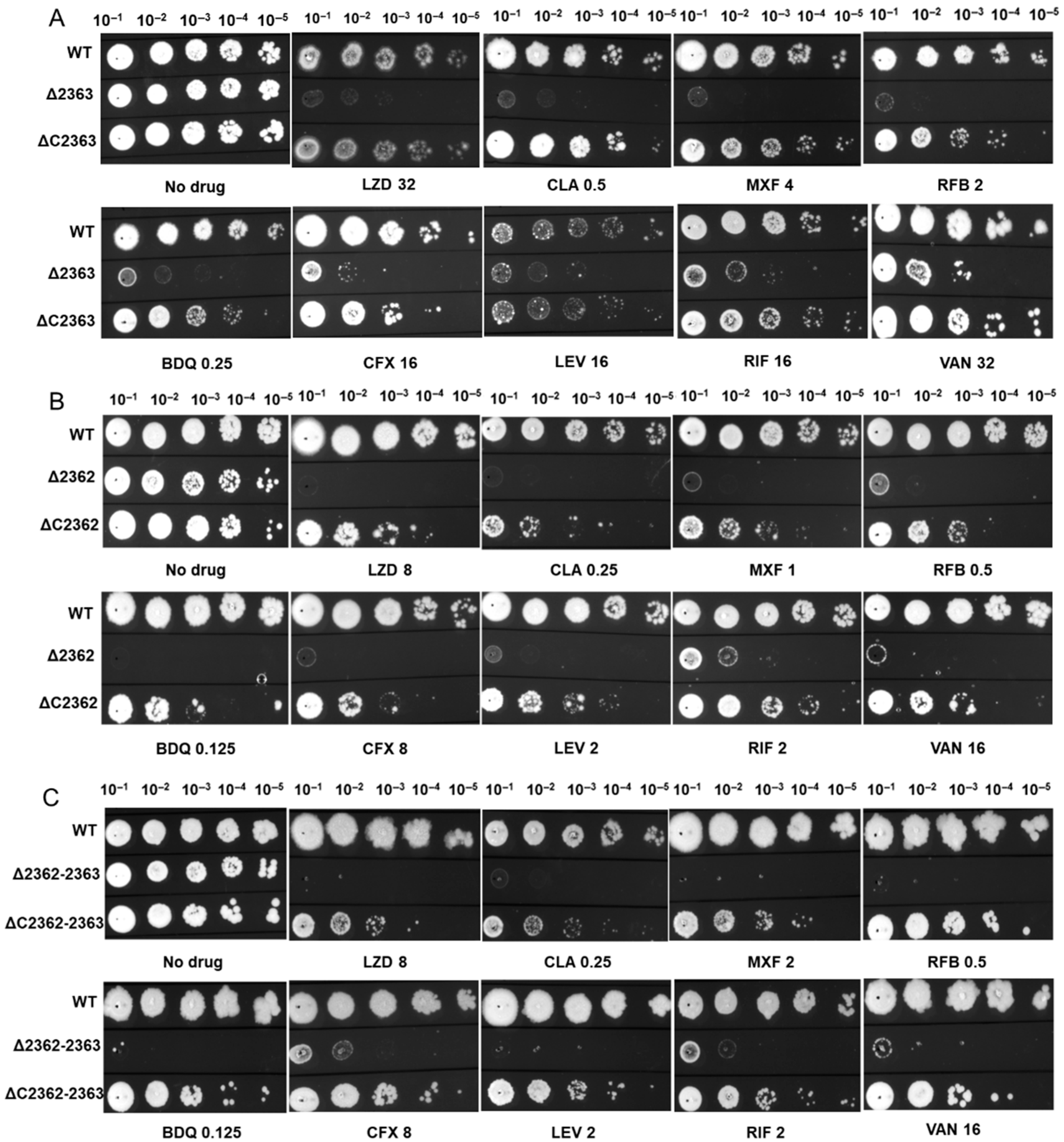
To investigate its functional role, we constructed a MAB_2363 knockout strain (Δ2363) using CRISPR-Cpf1-assisted non-homologous end joining. Sanger sequencing confirmed a 4 bp deletion causing a frameshift mutation (Figure S3A). Drug susceptibility testing revealed that Δ2363 was significantly more susceptible to multiple classes of antibiotics, including the protein synthesis inhibitors linezolid (LZD) and clarithromycin (CLA), the RNA polymerase inhibitor rifabutin (RFB), the β-lactam cefoxitin (CFX), the fluoroquinolones levofloxacin (LEV) and moxifloxacin (MXF), and the ATP synthase inhibitor bedaquiline (BDQ) (Table 1). Consistently, enhanced antibacterial activity against Δ2363 was observed in liquid culture compared with the wild-type (WT) strain (Figure S4), and similar results were obtained on solid medium (Figure 1A). To determine the functional relationship between MAB_2362 and MAB_2363, we compared Δ2363 with the previously characterized Δ2362 mutant and generated a Δ2362-2363 double knockout along with their complemented strains (Figure S3B). Across all tested antibiotics, Δ2363 consistently showed milder increases in susceptibility, whereas Δ2362 and Δ2362-2363 exhibited nearly identical minimum inhibitory concentrations (MICs), which were lower than those of Δ2363 (Table 1, Figure 1). These results indicate that MAB_2362 plays a dominant role in modulating intrinsic drug resistance, whereas MAB_2363 likely acts as a secondary factor. Drug susceptibility in all complemented strains was restored to near WT levels, confirming that the observed phenotypes were associated with the gene deletions. Growth curves of all mutants were comparable to WT (Figure S5), indicating that the increased antibiotic susceptibility is not due to growth defects.

3.2. Deletion of MAB_2363 Resulted in an Increased Cell Envelope Permeability of M. abscessus

The enhanced susceptibility of Δ2363 to multiple antibiotic classes suggested potential alterations in cell envelope integrity. To test this, we performed ethidium bromide (EtBr) accumulation assay.
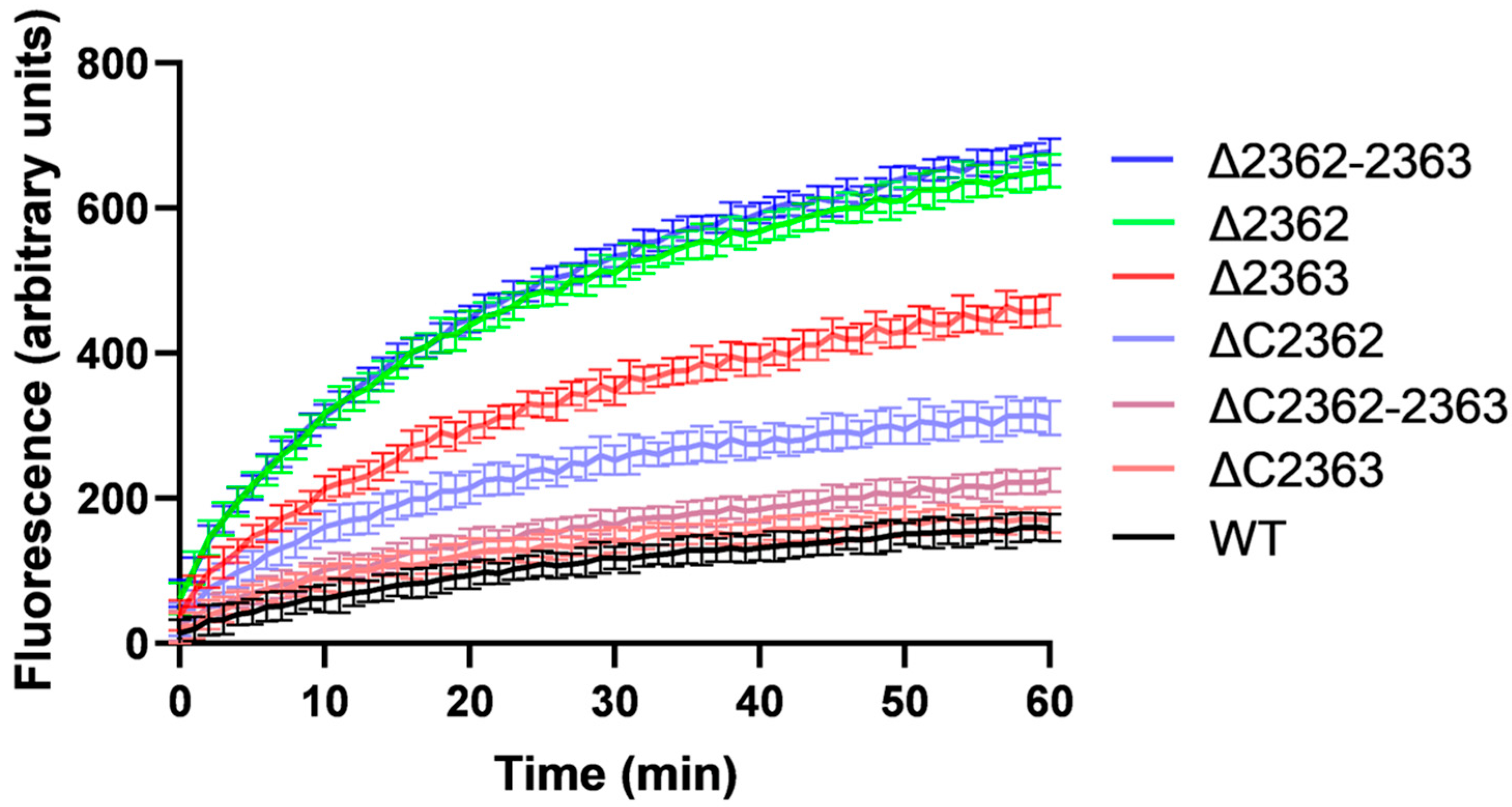
The strain Δ2363 accumulated more EtBr than WT within 60 min (Figure 2), indicating increased cell wall permeability. However, the increase in Δ2363 was less pronounced than in Δ2362, whereas Δ2362 and Δ2362-2363 exhibited similar permeability levels, consistent with their respective antibiotic susceptibility profiles. These results indicate that MAB_2363 contributes to maintaining cell envelope integrity in M. abscessus.

3.3. MAB_2363 Localized to the Septum and Was Essential for Proper Cell Division

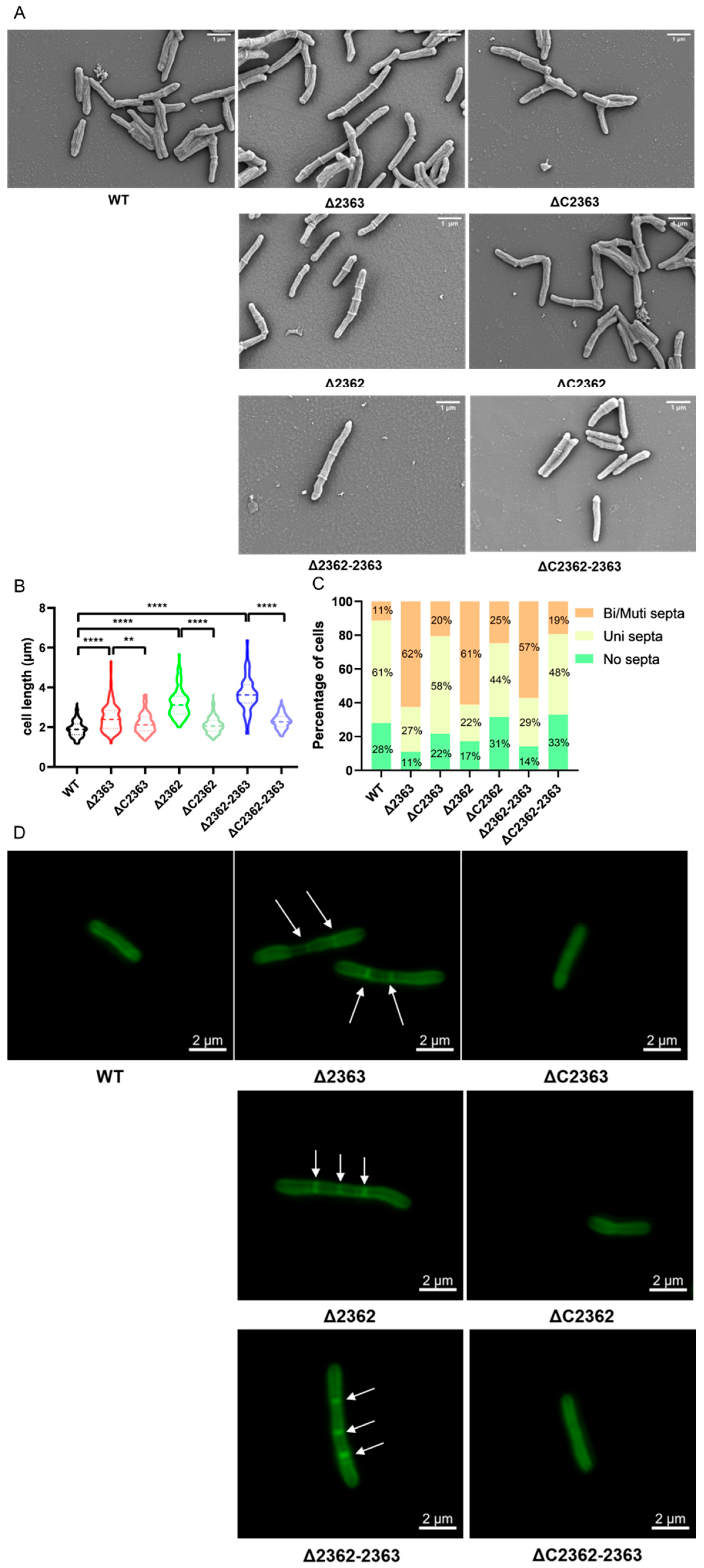
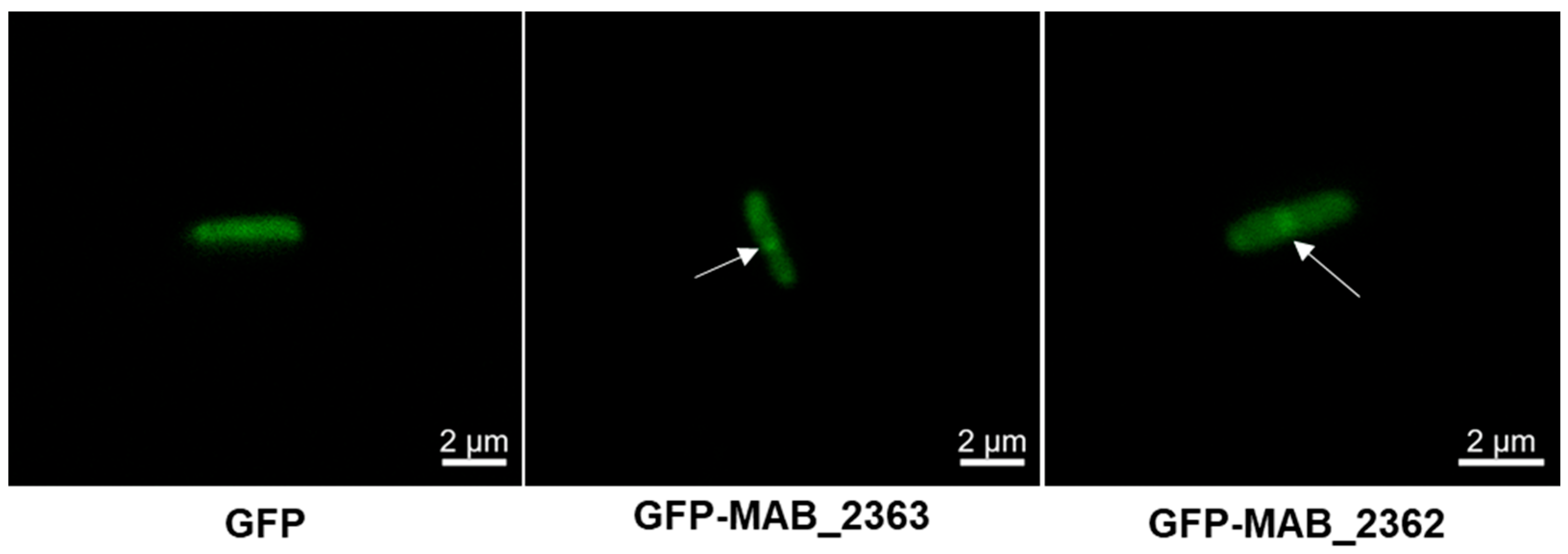
To investigate whether altered drug susceptibility and cell envelope integrity were associated with defects in cell division, we examined cellular morphology. Scanning electron microscopy revealed that Δ2363 cells were markedly elongated compared with WT, with a mean length of 2.45 µm versus 1.85 µm in WT (Figure 3A,B, Table S1). Cells of Δ2362 and the Δ2362-2363 double mutant were even longer, measuring 3.24 µm and 3.66 µm, respectively. Complementation partially restored cell length in all strains (ΔC2363, ΔC2362, and ΔC2362-2363: 2.17 µm, 2.08 µm, and 2.30 µm, respectively). Fluorescent D-amino acid HADA staining further revealed increased septation in Δ2363 (Figure 3C,D). Cells with two or more septa accounted for 62% in Δ2363, compared with 11% in WT. Δ2362 and Δ2362-2363 exhibited similar septation frequencies (61% and 57%, respectively), while complementation largely restored septa numbers to near-WT levels. These results demonstrate that MAB_2363 plays a significant role in regulating cell division, although its effects are milder than those of MAB_2362. To examine whether MAB_2363 directly participates in cell division, we assessed its subcellular localization using a GFP fusion. Fluorescence microscopy showed that GFP-MAB_2363 predominantly localized to the division septum, the site of new cell wall synthesis during cytokinesis (Figure 4). For comparison, GFP-MAB_2362 also localized to the septum. This septal localization mirrors that of established division regulators such as FtsZ and Wag31 [27,28], supporting a direct role for MAB_2363 in cell division in M. abscessus.

3.4. Deletion of MAB_2363 Increased M. abscessus Susceptibility to BDQ In Vivo

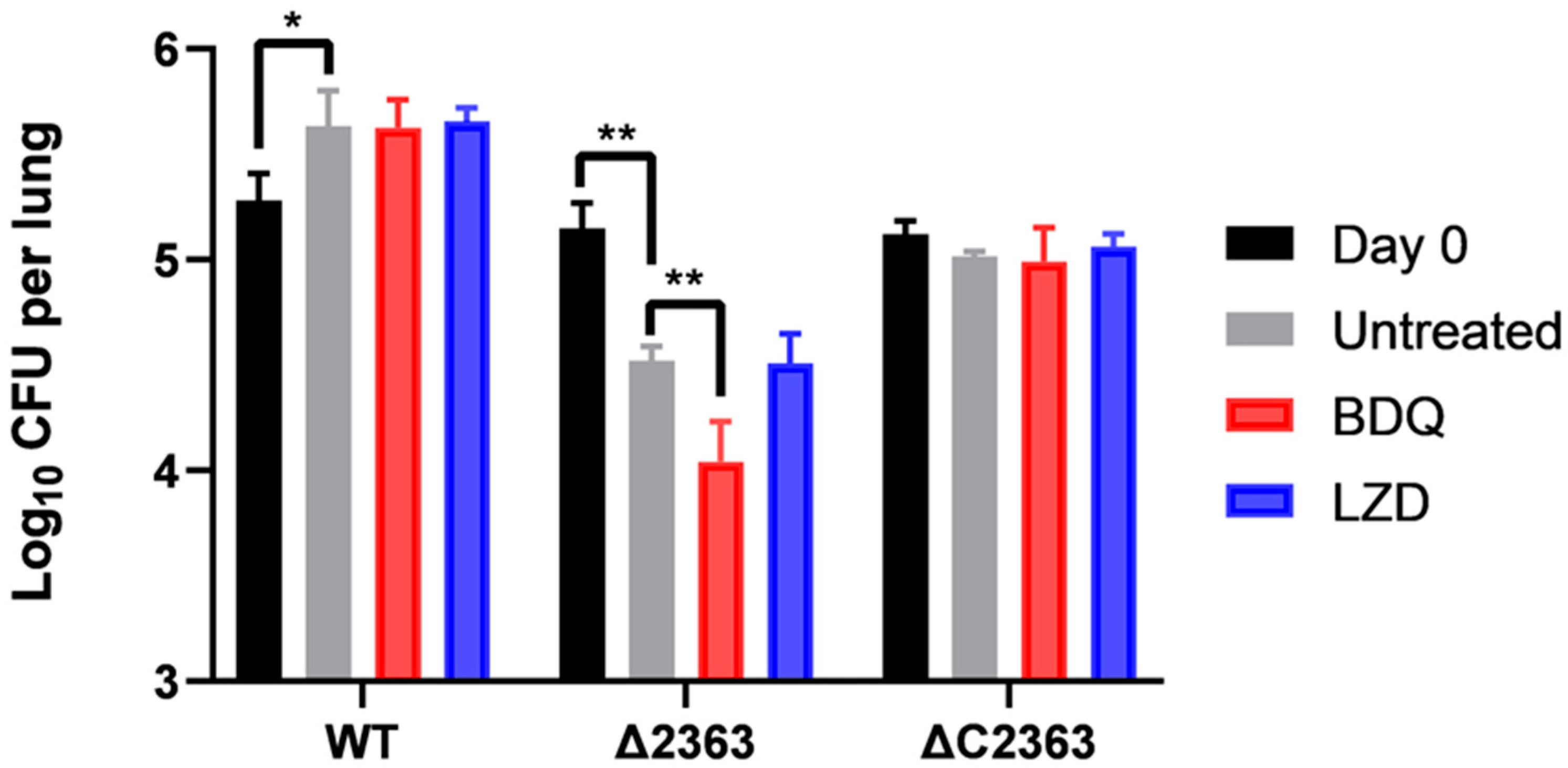
The MICs of BDQ and LZD against Δ2363 were 0.25 µg/mL and 4 µg/mL, respectively (Table 1), values predictive of potential in vivo efficacy [25,29,30]. To test this, mice infected with WT or Δ2363 were treated with BDQ or LZD for 10 days. In WT-infected mice, neither drug reduced lung bacterial loads compared with untreated controls (Figure 5). In contrast, BDQ treatment significantly reduced lung colony forming units (CFUs) in Δ2363-infected mice, whereas LZD produced no measurable effect (Figure 5, Table S2). The lack of an observable response to LZD may reflect the attenuated virulence of the Δ2363 mutant, which results in a progressive, intrinsic decline in bacterial load over time and could obscure any additional impact of this bacteriostatic agent [31]. These results indicate that deletion of MAB_2363 enhances M. abscessus susceptibility to BDQ in vivo, hence presenting MAB_2363 as a critical regulator of intrinsic drug resistance and a potential target for novel therapeutics.

3.5. Deletion of MAB_2363 Significantly Diminished the Virulence of M. abscessus

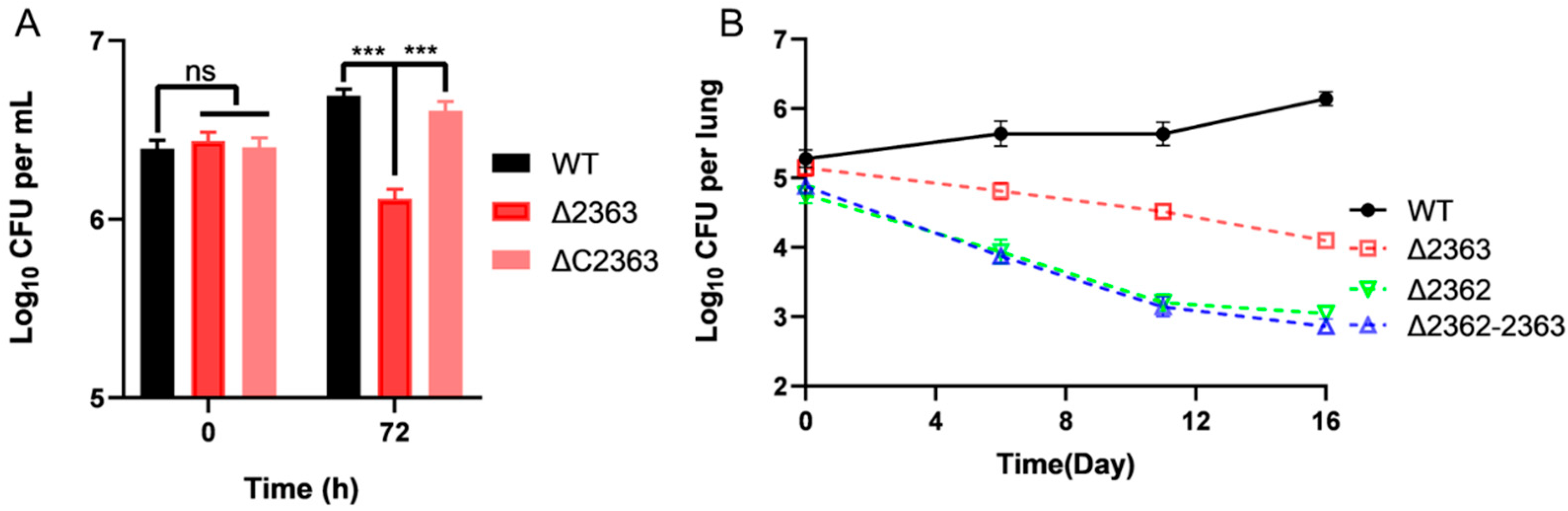
Initial in vivo evaluation of BDQ and LZD revealed that, in untreated mice, pulmonary bacterial loads increased significantly in WT-infected mice by day 11 (p ≤ 0.05), whereas Δ2363-infected mice showed a decline over the same period (p ≤ 0.01), suggesting reduced virulence. To directly assess pathogenicity, we conducted follow-up experiments in macrophage and murine infection models. In RAW264.7 macrophages, Δ2363 exhibited significantly decreased intracellular survival at 72 h post-infection compared with WT (Figure 6A), indicating that deletion of MAB_2363 impairs intramacrophage survival.
To determine whether Δ2363 is attenuated in vivo, we monitored bacterial burdens at multiple time points over a 16-day murine infection course. WT bacterial loads increased steadily from 5.28 ± 0.13 to 6.14 ± 0.10 Log10 CFU per lung. In striking contrast, Δ2363 displayed a clear and consistent downward trajectory across all measured time points, ultimately declining from 5.15 ± 0.12 to 4.10 ± 0.03 Log10 CFU per lung by day 16 (Figure 6B, Table S3). This sustained reduction, approximately 1 Log10, demonstrates that MAB_2363 is required for maintaining bacterial burden during infection. Although Δ2362 and Δ2362-2363 exhibited even steeper declines (~2 Log10), the consistent reduction observed for Δ2363 in macrophage and mouse models firmly establishes MAB_2363 as an important determinant of M. abscessus virulence. The Δ2362 and Δ2362-2363 strains showed even greater reductions in lung bacterial burden (~2 Log10), which is consistent with their more pronounced cell-division defects, that may further increase susceptibility to host clearance.

3.6. Deletion of MAB_2363 Compromised Tolerance to Diverse Environmental Stresses

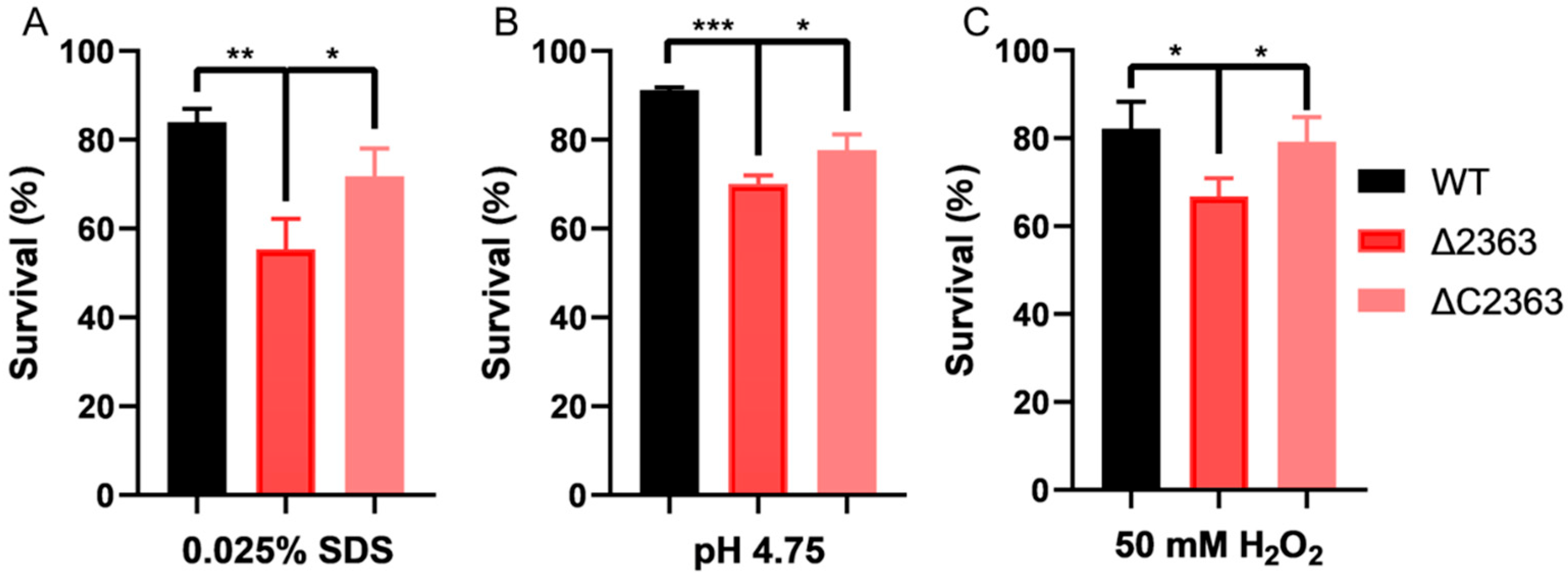
Given the reduced intracellular survival and attenuated virulence of Δ2363, we further evaluated the tolerance of Δ2363 to external stresses. Deletion of MAB_2363 leads to impaired survival under surfactant, acidic, and oxidative conditions. Following a 4 h incubation, Δ2363 exhibited significantly diminished survival rates compared to WT when exposed to SDS, acidic pH, or H2O2 (Figure 7). These results demonstrate that MAB_2363 is required for M. abscessus to survive diverse environmental stresses likely encountered during infection and further underscore its role in maintaining envelope integrity and stress resilience.

4. Discussion

M. abscessus, a notoriously drug-resistant nontuberculous mycobacterial pathogen, causes severe pulmonary diseases and skin or soft tissue infections, particularly in immunocompromised individuals [1,2]. Management of these infections remains clinically challenging due to their intrinsic resistance to most frontline antibiotics [3]. Identifying genetic determinants that underlie this intrinsic resistance is therefore essential for developing new therapeutic strategies or potentiating the activity of existing drugs. In this study, we demonstrate that deletion of MAB_2363 markedly sensitizes M. abscessus to multiple antibiotic classes, revealing a previously unrecognized determinant of intrinsic multidrug resistance.
The broad-spectrum sensitization of Δ2363 across multiple antibiotics suggests that MAB_2363 plays a role in maintaining overarching cellular integrity rather than modulating distinct drug targets. Consistent with this interpretation, Δ2363 exhibited increased cell-envelope permeability and pronounced morphological abnormalities. These phenotypes align with those reported for other envelope- or division-associated proteins in actinomycetes. For example, depletion of Wag31 in M. smegmatis reduces resistance to lipophilic antibiotics by compromising envelope integrity [32], and loss of CwsA disrupts PG synthesis and cell division [33]. Similarly, disruption of the SteA-SteB system in C. glutamicum results in elongated cells, abnormal septum formation, and enhanced susceptibility to cell wall-active antibiotics [20]. Although MAB_2363 shares limited amino acid sequence identity with SteB from C. glutamicum, their high structural similarity supports a conserved functional role in division-associated envelope maintenance. Thus, the increased permeability observed in Δ2363 provides a consistent mechanistic explanation for its heightened susceptibility to diverse antibiotics. Furthermore, while this study characterizes the role of the MAB_2362-2363 locus in intrinsic resistance, its clinical variability remains an open question. Preliminary amino acid sequence comparisons suggest that MAB_2362 and MAB_2363 are highly conserved across M. abscessus subspecies (abscessus, bolletii, and massiliense) (Figure S6); however, polymorphisms within promoter or regulatory regions, which could potentially lead to increased gene expression, may further enhance resistance levels in clinical isolates. Future large-scale genomic surveillance using SRA datasets will be essential to determine whether mutations in this locus contribute to treatment failure in clinical settings. Such insights would provide critical evidence to assess the potential of MAB_2363 as a clinically relevant biomarker for predicting antibiotic susceptibility.
Our findings further suggest that MAB_2363 is required for proper cell division. Δ2363 cells were elongated and exhibited increased septation, and GFP-MAB_2363 localized to the division septum. In mycobacteria, septal remodeling and envelope assembly are tightly coordinated processes; therefore, defects in division frequently translate into envelope instability [34,35]. The milder defects observed in Δ2363 relative to Δ2362 correspond to their differential impacts on permeability and antibiotic susceptibility, suggesting that the two proteins play related yet distinct roles during cytokinesis.
We additionally demonstrate that loss of MAB_2363 attenuates M. abscessus virulence in macrophage and murine infection models. The declining bacterial burden observed in Δ2363-infected mice likely reflects its compromised envelope integrity, rendering Δ2363 less capable of resisting host-derived stresses such as oxidative damage and acidic conditions. Similar virulence attenuation has been reported for mutants with envelope defects, including those lacking LmeA or inhibited in Ag85C activity [36,37]. The attenuation of Δ2363 is therefore consistent with its structural defects and further highlights the role of envelope stability in pathogenic fitness.
Functionally, MAB_2363 is annotated as a putative copper transporter (NCBI GenBank: WP_005058615.1), a class of proteins essential for copper homeostasis. While copper serves as a vital enzymatic cofactor, its excessive intracellular accumulation is cytotoxic. In M. tuberculosis and M. smegmatis, the homologs Rv1698 and MSMEG_3747 are critical for copper efflux; their deletion results in toxic intracellular copper accumulation [38]. Conversely, we observed that M. abscessus Δ2363 remained viable even under high copper concentrations (Figure S7). Despite moderate sequence identity with these homologs (55.77% and 58.01%, respectively; Figure S1B), heterologous expression of Rv1698 or MSMEG_3747 failed to restore the antibiotic resistance phenotype in the Δ2363 background (Table S4). This lack of functional complementation suggests a significant divergence in their biological roles. This is further supported by GFP fusion imaging, which revealed that MAB_2363 predominantly localizes to the division septum—a pattern distinct from the typical distribution of canonical copper transporters. Collectively, these findings demonstrate that MAB_2363 has evolved a species-specific function integrated into cell division-associated processes, rather than functioning primarily in copper homeostasis.
In summary, this study reveals MAB_2363 as an important determinant of cell envelope integrity, cell division, intrinsic antibiotic resistance, and virulence in M. abscessus. Disruption of MAB_2363 markedly enhances susceptibility to multiple antibiotics, including the clinically important agent BDQ, and reduces bacterial survival in vivo. Taken together, these findings highlight MAB_2363 as a potential candidate for further drug target exploration: inhibiting its function may weaken the cell envelope, potentiate the efficacy of existing drugs, and attenuate pathogenicity, collectively providing a compelling strategy for improving treatment outcomes against M. abscessus infections.

Supplementary Materials

The following supporting information can be downloaded at: https://www.mdpi.com/article/10.3390/microorganisms14020409/s1, Figure S1: The alignment of MAB_2363 with SteB and other mycobacterial homologs. Figure S2: Structural superposition of core domains from MAB_2363 and C. glutamicum SteB. Figure S3: Gene knockout schematic and sequence alignment plot of MAB_2363. Figure S4: Dose-response curves for the representative drugs. Figure S5: Growth curves of different M. abscessus strains. Figure S6: Amino acid alignment of MAB_2362 and MAB_2363 across M. abscessus subspecies. Figure S7: Susceptibility of different M. abscessus strains to CuSO4. Table S1: Cell lengths of different M. abscessus strains. Table S2: Bacterial loads in lungs of BDQ- or LZD-treated, and untreated mice. Table S3: Bacterial burden in the lungs of mice infected with different M. abscessus strains. Table S4: MICs of indicated antibiotics against different M. abscessus strains. Table S5: Strains used in this study. Table S6: Plasmids used in this study. Table S7: Primers used in this study. Reference [39] is cited in the Supplementary Materials.

Author Contributions

Conceptualization, T.Z.; Methodology, L.L., Y.J., J.Z. and S.W.; Validation, L.L. and A.M.; Formal analysis, L.L., M.S.A., C.L., H.M.A.H., B.Y., B.A.M., X.T., A.M., C.F., Y.J., J.Z., L.F., W.Y., S.W. and T.Z.; Investigation, L.L.; Resources, L.L., M.S.A., C.L., H.M.A.H., B.Y., B.A.M., X.T., A.M., C.F., Y.J., L.F. and W.Y.; Data curation, L.L., C.L., B.A.M. and S.W.; Writing – original draft, L.L.; Writing – review & editing, L.L., H.M.A.H., J.Z., S.W. and T.Z.; Visualization, L.L.; Supervision, L.L.; Project administration, L.L. and M.S.A.; Funding acquisition, T.Z. All authors have read and agreed to the published version of the manuscript.

Funding

This work was supported by the National Key R&D Program of China (2021YFA1300904), National Natural Science Foundation of China (82502762, 82304575), Guangdong Provincial Basic and Applied Basic Research Fund (2024A1515012412), Guangzhou Science and Technology Plan-Youth Doctoral ‘Sail’ Project (2024A04J4273), the State Key Lab of Respiratory Disease, Guangzhou Institute of Respiratory Diseases, First Affiliated Hospital of Guangzhou Medical University (SKLRD-Z-202412, SKLRD-Z-202301, and SKLRD-OP-202324), Key Research and Development Program of Guangzhou (2025B01J3019), Guangzhou National Laboratory and State Key Laboratory of Respiratory Disease (GZNL2025B01006), and Major Project of Guangzhou National Laboratory (GZNL2025C01003).

Institutional Review Board Statement

The animal study protocol was approved by the Institutional Review Board of Guangzhou Institutes of Biomedicine and Health, Chinese Academy of Sciences (IACUC number 2025089 and 9 August 2025 of approval). Ethical approval was obtained from the institutional animal care and use committee of Guangzhou Institutes of Biomedicine and Health, Chinese Academy of Sciences (IACUC number 2025089 and 9 August 2025 of approval).

Informed Consent Statement

Not applicable.

Data Availability Statement

The data presented in the study are openly available in [BioRxiv] at [https://doi.org/10.64898/2025.12.18.695127].

Conflicts of Interest

The authors declare no conflict of interest.

References

  1. Lee, M.-R.; Sheng, W.-H.; Hung, C.-C.; Yu, C.-J.; Lee, L.-N.; Hsueh, P.-R. Mycobacterium abscessus complex infections in humans. Emerg. Infect. Dis. 2015, 21, 1638–1646. [Google Scholar] [CrossRef] [PubMed]
  2. Katano, T.; Hagiwara, E.; Arai, H.; Sato, M.; Yamaya, T.; Tajiri, M.; Ogura, T. A case of intrathoracic desmoid tumor with pulmonary Mycobacterium abscessus disease. Respir. Med. Case Rep. 2020, 29, 101001. [Google Scholar] [CrossRef]
  3. Luthra, S.; Rominski, A.; Sander, P. The role of antibiotic-target-modifying and antibiotic-modifying enzymes in Mycobacterium abscessus drug resistance. Front. Microbiol. 2018, 9, 2179. [Google Scholar] [CrossRef]
  4. Griffith, D.E.; Girard, W.M.; Wallace, R.J., Jr. Clinical features of pulmonary disease caused by rapidly growing mycobacteria: An analysis of 154 patients. Am. Rev. Respir. Dis. 1993, 147, 1271–1278. [Google Scholar] [CrossRef]
  5. Jarand, J.; Levin, A.; Zhang, L.; Huitt, G.; Mitchell, J.D.; Daley, C.L. Clinical and microbiologic outcomes in patients receiving treatment for Mycobacterium abscessus pulmonary disease. Clin. Infect. Dis. 2011, 52, 565–571. [Google Scholar] [CrossRef]
  6. Jeon, K.; Kwon, O.J.; Lee, N.Y.; Kim, B.-J.; Kook, Y.-H.; Lee, S.-H.; Park, Y.K.; Kim, C.K.; Koh, W.-J. Antibiotic treatment of Mycobacterium abscessus lung disease: A retrospective analysis of 65 patients. Am. J. Respir. Crit. Care Med. 2009, 180, 896–902. [Google Scholar] [CrossRef]
  7. Floto, R.A.; Olivier, K.N.; Saiman, L.; Daley, C.L.; Herrmann, J.-L.; Nick, J.A.; Noone, P.G.; Bilton, D.; Corris, P.; Gibson, R.L.; et al. US Cystic Fibrosis Foundation and European Cystic Fibrosis Society consensus recommendations for the management of non-tuberculous mycobacteria in individuals with cystic fibrosis: Executive summary. Thorax 2016, 71, 88–90. [Google Scholar] [CrossRef]
  8. Griffith, D.E.; Aksamit, T.; Brown-Elliott, B.A.; Catanzaro, A.; Daley, C.; Gordin, F.; Holland, S.M.; Horsburgh, R.; Huitt, G.; Iademarco, M.F.; et al. An official ATS/IDSA statement: Diagnosis, treatment, and prevention of nontuberculous mycobacterial diseases. Am. J. Respir. Crit. Care Med. 2007, 175, 367–416. [Google Scholar] [CrossRef]
  9. Haworth, C.S.; Banks, J.; Capstick, T.; Fisher, A.J.; Gorsuch, T.; Laurenson, I.F.; Leitch, A.; Loebinger, M.R.; Milburn, H.J.; Nightingale, M.; et al. British Thoracic Society guidelines for the management of non-tuberculous mycobacterial pulmonary disease (NTM-PD). Thorax 2017, 72, ii1–ii64. [Google Scholar] [CrossRef] [PubMed]
  10. Shell, S.S.; Bar-Oz, M.; Xiao, J.; Pandey, M.; Bellardinelli, J.; Ibitoye, O.I.; Jackson, M.; Oehlers, S.H.; Barkan, D.; Meir, M. GplR1, an unusual TetR-like transcription factor in Mycobacterium abscessus, controls the production of cell wall glycopeptidolipids, colony morphology, and virulence. mSystems 2025, 10, e0087225. [Google Scholar] [CrossRef] [PubMed]
  11. Typas, A.; Banzhaf, M.; Gross, C.A.; Vollmer, W. From the regulation of peptidoglycan synthesis to bacterial growth and morphology. Nat. Rev. Microbiol. 2011, 10, 123–136. [Google Scholar] [CrossRef]
  12. Bhamidi, S.; Shi, L.; Chatterjee, D.; Belisle, J.T.; Crick, D.C.; McNeil, M.R. A bioanalytical method to determine the cell wall composition of Mycobacterium tuberculosis grown in vivo. Anal. Biochem. 2012, 421, 240–249. [Google Scholar] [CrossRef]
  13. Seiler, P.; Ulrichs, T.; Bandermann, S.; Pradl, L.; Jörg, S.; Krenn, V.; Morawietz, L.; Kaufmann, S.H.; Aichele, P. Cell-wall alterations as an attribute of Mycobacterium tuberculosis in latent infection. J. Infect. Dis. 2003, 188, 1326–1331. [Google Scholar] [CrossRef] [PubMed]
  14. Aldridge, B.B.; Fernandez-Suarez, M.; Heller, D.; Ambravaneswaran, V.; Irimia, D.; Toner, M.; Fortune, S.M. Asymmetry and aging of mycobacterial cells lead to variable growth and antibiotic susceptibility. Science 2012, 335, 100–104. [Google Scholar] [CrossRef]
  15. Baranowski, C.; Rego, E.H.; Rubin, E.J. The dream of a mycobacterium. Microbiol. Spectr. 2019, 7, 10-1128. [Google Scholar] [CrossRef]
  16. Kieser, K.J.; Rubin, E.J. How sisters grow apart: Mycobacterial growth and division. Nat. Rev. Microbiol. 2014, 12, 550–562. [Google Scholar] [CrossRef] [PubMed]
  17. Arejan, N.H.; Czapski, D.R.; Buonomo, J.A.; Boutte, C.C. MmpL3, Wag31, and PlrA are involved in coordinating polar growth with peptidoglycan metabolism and nutrient availability. J. Bacteriol. 2024, 206, e0020424. [Google Scholar] [CrossRef] [PubMed]
  18. Kang, C.-M.; Nyayapathy, S.; Lee, J.-Y.; Suh, J.-W.; Husson, R.N. Wag31, a homologue of the cell division protein DivIVA, regulates growth, morphology and polar cell wall synthesis in mycobacteria. Microbiology 2008, 154, 725–735. [Google Scholar] [CrossRef]
  19. Senzani, S.; Li, D.; Bhaskar, A.; Ealand, C.; Chang, J.; Rimal, B.; Liu, C.; Kim, S.J.; Dhar, N.; Kana, B. An Amidase_3 domain-containing N-acetylmuramyl-L-alanine amidase is required for mycobacterial cell division. Sci. Rep. 2017, 7, 1140. [Google Scholar] [CrossRef]
  20. Lim, H.C.; Sher, J.W.; Rodriguez-Rivera, F.P.; Fumeaux, C.; Bertozzi, C.R.; Bernhardt, T.G. Identification of new components of the RipC-FtsEX cell separation pathway of Corynebacterineae. PLoS Genet. 2019, 15, e1008284. [Google Scholar] [CrossRef]
  21. Ju, Y.; Li, L.; Zhang, J.; Yusuf, B.; Zeng, S.; Fang, C.; Tian, X.; Han, X.; Ding, J.; Zhang, H.; et al. The gene MAB_2362 is responsible for intrinsic resistance to various drugs and virulence in Mycobacterium abscessus by regulating cell division. Antimicrob. Agents Chemother. 2025, 69, e0043324. [Google Scholar] [CrossRef]
  22. Chhotaray, C.; Wang, S.; Tan, Y.; Ali, A.; Shehroz, M.; Fang, C.; Liu, Y.; Lu, Z.; Cai, X.; Hameed, H.M.A.; et al. Comparative analysis of whole-genome and methylome profiles of a smooth and a rough Mycobacterium abscessus clinical strain. G3 Genes|Genomes|Genetics 2020, 10, 13–22. [Google Scholar] [CrossRef]
  23. Guo, J.; Wang, C.; Han, Y.; Liu, Z.; Wu, T.; Liu, Y.; Tan, Y.; Cai, X.; Cao, Y.; Wang, B.; et al. Identification of lysine acetylation in Mycobacterium abscessus using LC-MS/MS after immunoprecipitation. J. Proteome Res. 2016, 15, 2567–2578. [Google Scholar] [CrossRef] [PubMed]
  24. Zeng, S.; Ju, Y.; Alam, M.S.; Lu, Z.; Hameed, H.M.A.; Li, L.; Tian, X.; Fang, C.; Fang, X.; Ding, J.; et al. A CRISPR-nonhomologous end-joining-based strategy for rapid and efficient gene disruption in Mycobacterium abscessus. mLife 2025, 4, 169–180. [Google Scholar] [CrossRef] [PubMed]
  25. Wang, S.; Cai, X.; Yu, W.; Zeng, S.; Zhang, J.; Guo, L.; Gao, Y.; Lu, Z.; Hameed, H.M.A.; Fang, C.; et al. Arabinosyltransferase C mediates multiple drugs intrinsic resistance by altering cell envelope permeability in Mycobacterium abscessus. Microbiol. Spectr. 2022, 10, e0276321. [Google Scholar] [CrossRef] [PubMed]
  26. Story-Roller, E.; Maggioncalda, E.C.; Lamichhane, G. Synergistic efficacy of β-Lactam combinations against Mycobacterium abscessus pulmonary infection in mice. Antimicrob. Agents Chemother. 2019, 63, 10-1128. [Google Scholar] [CrossRef]
  27. Du, S.; Pichoff, S.; Kruse, K.; Lutkenhaus, J. FtsZ filaments have the opposite kinetic polarity of microtubules. Proc. Natl. Acad. Sci. USA 2018, 115, 10768–10773. [Google Scholar] [CrossRef]
  28. Rego, E.H.; Audette, R.E.; Rubin, E.J. Deletion of a mycobacterial divisome factor collapses single-cell phenotypic heterogeneity. Nature 2017, 546, 153–157. [Google Scholar] [CrossRef]
  29. Daley, C.L.; Iaccarino, J.M.; Lange, C.; Cambau, E.; Wallace, R.J., Jr.; Andrejak, C.; Böttger, E.C.; Brozek, J.; Griffith, D.E.; Guglielmetti, L.; et al. Treatment of nontuberculous mycobacterial pulmonary disease: An official ATS/ERS/ESCMID/IDSA clinical practice guideline. Eur. Respir. J. 2020, 56, 2000535. [Google Scholar] [CrossRef]
  30. Zhang, J.; Ju, Y.; Li, L.; Hameed, H.M.A.; Yusuf, B.; Gao, Y.; Fang, C.; Tian, X.; Ding, J.; Ma, W.; et al. MtrAB two-component system is crucial for the intrinsic resistance and virulence of Mycobacterium abscessus. Int. J. Antimicrob. Agents 2025, 65, 107442. [Google Scholar] [CrossRef]
  31. Girase, R.; Ahmad, I.; Patel, H. Bioisosteric modification of Linezolid identified the potential M. tuberculosis protein synthesis inhibitors to overcome the myelosuppression and serotonergic toxicity associated with Linezolid in the treatment of the multi-drug resistance tuberculosis (MDR-TB). J. Biomol. Struct. Dyn. 2024, 42, 2111–2126. [Google Scholar] [CrossRef]
  32. Xu, W.-X.; Zhang, L.; Mai, J.-T.; Peng, R.-C.; Yang, E.-Z.; Peng, C.; Wang, H.-H. The Wag31 protein interacts with AccA3 and coordinates cell wall lipid permeability and lipophilic drug resistance in Mycobacterium smegmatis. Biochem. Biophys. Res. Commun. 2014, 448, 255–260. [Google Scholar] [CrossRef]
  33. Plocinski, P.; Martinez, L.; Sarva, K.; Plocinska, R.; Madiraju, M.; Rajagopalan, M. Mycobacterium tuberculosis CwsA overproduction modulates cell division and cell wall synthesis. Tuberculosis 2013, 93, S21–S27. [Google Scholar] [CrossRef] [PubMed]
  34. Ravindran, R.; Chakrapani, G.; Mitra, K.; Doble, M. Inhibitory activity of traditional plants against Mycobacterium smegmatis and their action on Filamenting temperature sensitive mutant Z (FtsZ)-A cell division protein. PLoS ONE 2020, 15, e0232482. [Google Scholar] [CrossRef] [PubMed]
  35. Vadrevu, I.S.; Lofton, H.; Sarva, K.; Blasczyk, E.; Plocinska, R.; Chinnaswamy, J.; Madiraju, M.; Rajagopalan, M. ChiZ levels modulate cell division process in mycobacteria. Tuberculosis 2011, 91, S128–S135. [Google Scholar] [CrossRef]
  36. Rahlwes, K.C.; Ha, S.A.; Motooka, D.; Mayfield, J.A.; Baumoel, L.R.; Strickland, J.N.; Torres-Ocampo, A.P.; Nakamura, S.; Morita, Y.S. The cell envelope-associated phospholipid-binding protein LmeA is required for mannan polymerization in mycobacteria. J. Biol. Chem. 2017, 292, 17407–17417. [Google Scholar] [CrossRef] [PubMed]
  37. Warrier, T.; Tropis, M.; Werngren, J.; Diehl, A.; Gengenbacher, M.; Schlegel, B.; Schade, M.; Oschkinat, H.; Daffe, M.; Hoffner, S.; et al. Antigen 85C inhibition restricts Mycobacterium tuberculosis growth through disruption of cord factor biosynthesis. Antimicrob. Agents Chemother. 2012, 56, 1735–1743. [Google Scholar] [CrossRef]
  38. Wolschendorf, F.; Ackart, D.; Shrestha, T.B.; Hascall-Dove, L.; Nolan, S.; Lamichhane, G.; Wang, Y.; Bossmann, S.H.; Basaraba, R.J.; Niederweis, M. Copper resistance is essential for virulence of Mycobacterium tuberculosis. Proc. Natl. Acad. Sci. USA 2011, 108, 1621–1626. [Google Scholar] [CrossRef]
  39. Stover, C.K.; de la Cruz, V.F.; Fuerst, T.R.; Burlein, J.E.; Benson, L.A.; Bennett, L.T.; Bansal, G.P.; Young, J.F.; Lee, M.H.; Hatfull, G.F.; et al. New use of BCG for recombinant vaccines. Nature 1991, 351, 456–460. [Google Scholar] [CrossRef]
Figure 1. Susceptibility of various M. abscessus strains to indicated antibiotics on solid medium. (A) Drug susceptibility testing of WT, Δ2363, and ΔC2363. (B) Drug susceptibility testing of WT, Δ2362, and ΔC2362. (C) Drug susceptibility testing of WT, Δ2362-2363, and ΔC2362-2363. WT, wild-type M. abscessus; Δ2363, MAB_2363 knockout strain; ΔC2363, MAB_2363 complemented strain; Δ2362, MAB_2362 knockout strain; ΔC2362, MAB_2362 complemented strain; Δ2362-2363, MAB_2362-MAB_2363 double knockout strain; ΔC2362-2363, MAB_2362-MAB_2363 double complemented strain. Antibiotic concentrations (μg/mL) were optimized for solid media to provide the most discriminative visualization of growth differences, as solid-state susceptibility often deviates from liquid-broth MICs.
Microorganisms 14 00409 g001
Figure 2. Cell wall permeability assay of various M. abscessus strains. WT, wild-type M. abscessus; Δ2363, MAB_2363 knockout strain; ΔC2363, MAB_2363 complemented strain; Δ2362, MAB_2362 knockout strain; ΔC2362, MAB_2362 complemented strain; Δ2362-2363, MAB_2362-MAB_2363 double knockout strain; ΔC2362-2363, MAB_2362-MAB_2363 double complemented strain. The experiment was repeated three times.
Microorganisms 14 00409 g002
Figure 3. Microscopic analysis of cell length and septa in M. abscessus strains. (A) Representative scanning electron microscopy (SEM) images of different strains. (B) Violin plots comparing cell length among the seven strains. Statistical significance was determined by unpaired t-test; **, p < 0.01; ****, p < 0.0001. (C) Proportion of cells with different numbers of septa in each strain. (D) Representative laser confocal microscopy images of different M. abscessus strains. White arrows indicate cellular septa. WT, wild-type M. abscessus; Δ2363, MAB_2363 knockout strain; ΔC2363, MAB_2363 complemented strain; Δ2362, MAB_2362 knockout strain; ΔC2362, MAB_2362 complemented strain; Δ2362-2363, MAB_2362-MAB_2363 double knockout strain; ΔC2362-2363, MAB_2362-MAB_2363 double complemented strain.
Microorganisms 14 00409 g003
Figure 4. Subcellular localization of GFP fusion proteins in M. abscessus. Representative confocal fluorescence microscopy images of the indicated strains. White arrows mark septal localization.
Microorganisms 14 00409 g004
Figure 5. Assessment of susceptibility of different M. abscessus strains to BDQ and LZD in vivo. Lung bacterial burden over the 10-day treatment period. Drug doses (mg/kg): BDQ 20, LZD 100. Statistical significance was determined by an unpaired t-test; *, p < 0.05; **, p < 0.01. WT, wild-type M. abscessus; Δ2363, MAB_2363 knockout strain; ΔC2363, MAB_2363 complemented strain.
Microorganisms 14 00409 g005
Figure 6. The virulence assessment of different M. abscessus strains. (A) Intracellular growth of different strains in macrophages. (B) Growth curves of different strains in a murine model in lungs. Statistical significance was determined by an unpaired t-test; ns, nonsignificant; ***, p < 0.001. WT, wild-type M. abscessus; Δ2363, MAB_2363 knockout strain; ΔC2363, MAB_2363 complemented strain; Δ2362, MAB_2362 knockout strain; Δ2362-2363, MAB_2362-MAB_2363 double knockout strain.
Microorganisms 14 00409 g006
Figure 7. Survival of different M. abscessus strains under diverse stresses. (A) SDS stress: Strains were cultured in medium supplemented with 0.025% SDS. (B) Acid stress: Strains were exposed to medium adjusted to pH 4.75. (C) Oxidative stress: Strains were grown in medium containing 50 mM H2O2. Survival rates were evaluated by measuring CFU/mL at 4 h. Statistical significance was determined by an unpaired t-test; ns, nonsignificant; *, p < 0.05; **, p < 0.01; ***, p < 0.001. WT, wild-type M. abscessus; Δ2363, MAB_2363 knockout strain; ΔC2363, MAB_2363 complemented strain. The experiment was repeated three times.
Microorganisms 14 00409 g007
Table 1. MICs of indicated antibiotics against various M. abscessus strains.
AntibioticsMIC (μg/Ml)
WTΔ2363ΔC2363Δ2362ΔC2362Δ2362-2363ΔC2362-2363
LZD64464264264
CLA20.2510.12510.1251
MXF81418-414
RFB4120.54-20.52
BDQ10.250.50.062510.06250.5
CFX321632832832
LEV3216322828
RIF1286412841284128
VAN1281281281612816128
WT, wild-type M. abscessus; Δ2363, MAB_2363 knockout strain; ΔC2363, MAB_2363 complemented strain; Δ2362, MAB_2362 knockout strain; ΔC2362, MAB_2362 complemented strain; Δ2362-2363, MAB_2362-MAB_2363 double knockout strain; ΔC2362-2363, MAB_2362-MAB_2363 double complemented strain. The experiment was performed in triplicate and repeated three times. The underlined values represent the MICs for the knockout strains.
Disclaimer/Publisher’s Note: The statements, opinions and data contained in all publications are solely those of the individual author(s) and contributor(s) and not of MDPI and/or the editor(s). MDPI and/or the editor(s) disclaim responsibility for any injury to people or property resulting from any ideas, methods, instructions or products referred to in the content.