Article

Isolation and Characterization of Pseudomonas aeruginosa XR2-39 Against Meloidogyne incognita and Its Enhancement of Tomato Growth

1
Hubei Insect Resources Utilization and Sustainable Pest Management Key Laboratory, College of Plant Sciences and Technology, Huazhong Agricultural University, Wuhan 430070, China
2
Institute of Agricultural Applied Microbiology, Jiangxi Academy of Agricultural Sciences, Nanchang 330200, China
*
Authors to whom correspondence should be addressed.
Theses authors contributed equally to this work and should be considered co-first authors.
Microorganisms 2026, 14(1), 5; https://doi.org/10.3390/microorganisms14010005
Submission received: 24 November 2025 / Revised: 14 December 2025 / Accepted: 16 December 2025 / Published: 19 December 2025
(This article belongs to the Special Issue Advances in Agro-Microbiology)

Abstract

Meloidogyne incognita is one of the most detrimental root-knot nematodes (RKNs) globally. The restricted application of chemical nematicides has resulted in an increasing inclination towards environment-friendly alternatives. In this study, a strain of Pseudomonas aeruginosa XR2-39, which was isolated from compost fermentation of edible fungus residue, exhibited effective biocontrol activity against M. incognita. In vitro experiments employing the fermentation filtrate of strain XR2-39 achieved high nematicidal efficacy of second-stage juveniles (J2s), resulting in corrected mortality rates of 97.12% and 100% after 24 h and 48 h, respectively. The fermentation filtrate also demonstrated a high relative hatching inhibition for egg masses (97.87%) and free eggs (100%). In addition, strain XR2-39 exhibited strong capabilities in indole-3-acetic acid (IAA) production (with a yield of 33.01 mg/L), siderophore production (with a yield of 71.45% unit), and phosphate solubilization (with a dissolved amount of 831.15 mg/L). Pot experiments indicated that the incubation of tomato roots with 20% fermentation broth led to an increase in fresh shoot weight, root weight, shoot length, root length, and stem diameter by 448.57%, 136.36%, 179.29%, 49.39%, and 57.14%, respectively, when compared to the water control. Moreover, the inoculation with 20% fermentation broth significantly decreased tomato root galls, resulting in a gall index of 37.00, which was significantly lower than that of the water-control treatment (77.50). Furthermore, the active compound in the fermentation filtrate remained stable within the pH range of 7.0 to 11.0, maintaining a corrected mortality rate of over 89.0%. It also demonstrated thermostability, as the boiled fermentation filtrate (treated at 120 °C for 2 h) showed a high corrected mortality rate against J2s. Additionally, the active substance displayed strong UV tolerance and storage stability. These characteristics of active compounds make strain XR2-39 a promising biocontrol agent for M. incognita.

1. Introduction

Plant-parasitic nematodes (PPNs) are destructive agricultural pathogens distributed worldwide, among which RKN is one of the most damaging pathogens, causing estimated annual economic losses exceeding 100 billion USD [1,2,3]. RKNs are predominantly found in tropical and subtropical regions and are capable of infecting over 3000 plant species globally, including vegetables, grains, weeds, and fruit plants [4,5]. Their transmission occurs through various pathways, such as contaminated soil, infected seeding, human activities, application of uncomposted manure, crop residue incorporation, and irrigation water [6,7,8]. Currently, chemical nematicides, such as ethoprop, fosthiazate, tioxazafen, and oxamyl, are widely used due to their efficiency [6]. However, their application is increasingly restricted in many countries owing to adverse environmental impacts, including non-target toxicity, disruption of the agricultural ecosystem, and risks to public health [9,10,11]. Consequently, there is a pressing need to develop environmentally sustainable alternatives for RKN management. Biological control agents derived from microorganisms or their active metabolites have attracted growing attention due to their eco-friendly properties and are regarded as viable components of sustainable nematode management strategies [12,13,14]. A growing number of bacterial and fungal strains have been identified as potential nematicidal agents, and their biocontrol efficacy has been extensively studied [14,15,16,17].
Plant growth-promoting rhizobacteria (PGPR), a ubiquitous group of microorganisms inhabiting the rhizosphere, are important biological resources for the control of M. incognita [18,19,20]. These microbes provide numerous beneficial functions to host plants, including the production of IAA and ethylene, secretion of chitinases, phosphate solubilization, siderophore production, nitrogen fixation, and protection against various pathogenic organisms [21]. PGPR has been shown to exert biocontrol effects against RKN through multiple mechanisms, such as parasitism, production of nematicidal compounds, intoxication of nematodes, induction of systemic resistance in plants, and enhancement of water and nutrient uptake [22,23]. Several PGPR strains have been demonstrated to have significant efficacy as biocontrol against RKNs [3,15,16,23,24,25,26,27,28,29,30,31]. For instance, Burkholderia arboris J211 exhibited strong nematicidal activity, causing 96.6% mortality of J2s after 24 h exposure, while also reducing root gall formation and promoting plant growth [28]. The cell-free filtrates of Burkholderia sp. JB-2 effectively reduced M. incognita population density in soil and suppressed egg mass development on tomato roots, concomitantly enhancing host plant growth [29]. Gao et al. [24] reported fewer and smaller root galls in tomato plants treated with Bacillus cereus S2. Burkett et al. [32] observed a reduction in M. incognita population in soil following application of B. amyloliquefaciens and B. subtilis. Pseudomons fragi Sneb1990 caused 76.8% J2 mortality after 48 h and inhibited egg hatching by 71.9% after 7 days, in addition to promoting plant growth [3]. Abd et al. [31] showed that Serratia spp. and Pseudomonas spp. significantly suppressed gall formation and enhanced the growth of Luffa aegyptiaca L. compared to untreated controls. B. megaterium was found to suppress soil RKN populations by modulating phosphate solubilization and mineralization capacity [33]. Despite the potential of many PGPR strains for RKN management, their practical application remains limited due to variability in activity and stability under different environmental conditions, such as soil texture, moisture, pH, and temperature [28]. Therefore, the discovery of novel antagonistic PGPR strains is essential to support large-scale production and integration into sustainable RKN control strategies. In the present study, we isolated a strain of P. aeruginosa XR2-39 exhibiting remarkable nematocidal activity and evaluated its effects on M. incognita in vitro. Furthermore, we also investigated the impact of the fermentation broth of XR2-39 on potted tomato plants grown in M. incognita-infested and non-infested soils under greenhouse conditions to assess its potential for both nematode control and plant growth promotion.

2. Materials and Methods

2.1. Plant Material and M. incognita Inoculum

Seeds of Solanum lycopersicum “Zhongza No.9”, a cultivar susceptible to M. incognita, were purchased from Zhongshu Seed Industry Technology Co., Ltd. (Beijingu, China). After surface sterilization with 10% sodium hypochlorite and rinsing thoroughly with sterile water, the seeds were germinated in a Petri dish lined with sterile filter paper and maintained at 60% relative humidity. Uniformly vigorous seeds were selected and sown into sterilized soil within a seedling tray, then cultivated in a greenhouse at 26 °C under a 16 h light/8 h dark photoperiod until they reached the four-true-leaf stage. Subsequently, the seedlings were divided into two groups, one for pot experiments and the other for M. incognita culture.
M. incognita was maintained on tomato roots and incubated in a growth chamber at a temperature of 26 °C under a 16 h light/8 h dark cycle for 45 days. Egg masses were harvested from infected roots and washed three times with sterile water. J2s were collected by hatching the egg masses through incubation at 26 °C for 3 days. Freshly hatched J2s were retrieved, disinfected with 1% sodium hypochlorite solution, and adjusted to a final concentration of 1000 individuals per milliliter for subsequent use.

2.2. Isolation of Biocontrol Bacterial Strains Against M. incognita

Bacterial strains were isolated from compost fermentation of edible fungus residue via the gradient dilution method using Luria–Bertani (LB) agar medium. Following incubation at 37 °C for 48 h, the strains were purified and stored at 4 °C for subsequent use.

2.3. Nematocidal Activity of Bacterial Fermentation Filtrates Against J2s of M. incognita In Vitro

All isolated bacterial strains were cultured separately in 20 mL of LB liquid medium at 37 °C for 20 h. The fermentation broth from each strain was diluted with sterilized water to a final density of 1.0 × 10⁸ cfu/mL [11]. The supernatant was collected by centrifuging at 12,000 rpm for 10 min. To evaluate the effect of bacterial strains on J2s mortality, the supernatant of each isolate was diluted twofold with sterile water and mixed with approximately 100 J2s in a sterile 24-well cell culture plate. Sterile water served as the control, and four replicates were established for each strain supernatant and the water control. After incubating in darkness at 25 °C for 24 h and 48 h, 3~4 drops of 15% NaCl were added to the well, and the samples were recovered for 30 min. Nematodes exhibiting straight bodies or no movement were considered dead [34]. The number of dead J2s was observed and recorded under a microscope, and the mortality of J2 was calculated. Both the mortality rate and corrected mortality rate of J2s were determined using the Equations (1) and (2), respectivly [35]:
M o r t a l i t y   r a t e ( % ) = N d N t × 100
Corrected   mortality   rate   ( % ) = M s M c 100 M c × 100 .
where Nd is the number of dead J2s; Nt is the total number of J2s; Ms is the mortality rate of J2s in the sample; and Mc is the mortality rate of J2s in the control.

2.4. Identification and Characterization of Plant Growth-Promoting (PGR) Traits of XR2-39

2.4.1. Molecular Identification of Strain XR2-39 Against M. incognita

For molecular identification, genomic DNA of strain P. aeruginosa XR2-39, extracted using a bacterial genomic DNA extraction kit (TIANGEN, Beijing, China), was used as a template for polymerase chain reaction (PCR). Primers of 27F (5′-AGAGTTTGATCCTGGCTCAG-3′) and 1492R (5′-GGTTACCTTGTTACGACTT-3′) were employed for 16S rDNA gene amplification. The PCR amplification mixture consists of 2× PrimerSTAR mix (15.0 μL), 27F/1492R primers (1.0 μL each), genomic DNA (1.0 μL), and ddH2O (13.0 μL). The following amplification procedure was applied: initial denaturation at 94 °C for 4 min; followed by 29 cycles of denaturation at 94 °C for 10 s, annealing at 55 °C for 15 s, and extension at 72 °C for 1 min; and final extension at 72 °C for 10 min. The PCR product was sequenced by Sangon Biotech (Shanghai) Co., Ltd. (Shanghai, China), and the sequence analysis was conducted using the NCBI BLAST tool (http://www.ncbi.nlm.nih.gov/) (accessed on 9 September 2025) [11].

2.4.2. Biochemical Characterization of Strain XR2-39

Bacterial strain XR2-39 was further characterized according to Bergey’s Manual of Determinative Bacteriology [36]. Subsequently, the strain cells were subjected to Gram staining for morphological identification [37]. Routine biochemical tests, including catalase activity, glycolysis, nitrate reduction, starch and gelatin hydrolysis, H2S production, citrate utilization, indole production, and Methyl Red (MR) and Voges-Proskauer (VP) tests, were performed on strain XR2-39 [38].

2.4.3. IAA Production

IAA production by strain XR2-39 was determined using a colorimetric method as described by Tang and Bonner [39] with minor modifications. The strain was cultured in Nutrient Broth (NB) including L-tryptophan (100 mg/L) and incubated at 30 °C (180 rpm) for 7 days. The supernatant was collected by centrifugation at 10,000 rpm for 10 min. A volume of 2 mL of Salkowaski reagent (50 mL of 35% perchloric acid mixed with 1 mL of 0.5 M FeCl3) was added to 2 mL of supernatant, and the mixture was incubated in the dark at room temperature for 30 min. Absorbances were measured at 530 nm. The IAA concentration was determined based on a standard curve of IAA [40].

2.4.4. Phosphate Solubilization

The strain XR2-39 was cultured in 100 mL of phosphorus-solubilizing culture medium (containing 1.0 g glucose, 0.5 g Ca3(PO4)2, 0.5 g MgCl2, 0.025 g MgSO4·7H2O, 0.02 g KCl, and 0.001 g (NH4)2SO4) at 30 °C with shaking at 180 rpm for 7 days. The supernatant was collected by centrifugation at 4 °C (10,000 rpm, 10 min). The concentration of soluble phosphorus was determined using the antimony molybdenum anti-colorimetric method [41].

2.4.5. Siderophore Production

The strain XR2-39 was cultured in 100 mL of siderophore-inducing medium (containing 10.0 g glucose, 2.0 g peptone, 0.05 g MgSO4·7H2O, and 0.05g CaCl2, 20 mM Pipes buffer) at 30 °C with shaking at 180 rpm for 7 days. The supernatant was collected by centrifugation at 4 °C (10,000 rpm, 10 min). Subsequently, 200 μL of supernatant was mixed with 200 μL of CAS reagent (containing 0.2 M 5-sulfosalicyclic acid). Absorbance was measured at 630 nm after incubation at 26 °C for 20 min [28]. The percent of siderophore was intended in terms of % of siderophore units by means as follows [28]:
Siderophore   Unit   ( % )   =   A c A s A c × 100 ,
where Ac is the absorbance of the control at 630 nm, and As is the absorbance of the sample at 630 nm.

2.5. Effect of Strain XR2-39 Fermentation Filtrate on J2s, Egg Mass, and Free Egg Hatching of M. incognita

2.5.1. Effects of Strain XR2-39 Fermentation Filtrates on J2s of M. incognita In Vitro

A total of 100 J2s were added to each well of a sterile 24-well cell culture plate containing 500 μL of fermentation filtrate at concentrations of 100%, 20%, 10%, and 5%, respectively. Distilled water served as the control treatment, and four replicates were established for each concentration. After incubating in darkness at 25 °C for 24 h and 48 h, the J2s mortality rates were determined in Section 2.3.

2.5.2. Effects of Strain XR2-39 Fermentation Filtrates on Egg Masses In Vitro

Mature egg masses of uniform size and similar color were selected and disinfected with 0.5% sodium hypochlorite for 3 min, followed by rinsing with sterile water three times to ensure complete removal of residual sodium hypochlorite from the surface. To evaluate the in vitro biocontrol efficiency of strain XR2-39 fermentation filtrate on egg masses, the strain was cultured in LB liquid medium, and the resulting filtrate was diluted to a density of 1.0 × 10⁸ cfu/mL with sterilized water. Three sterilized egg masses were placed in a 50 mL sterile centrifuge tube and exposed to fermentation filtrate at concentrations of 100%, 20%, 10%, and 5%, respectively. Sterile water treatment was set as the control. All treatments were performed in quadruplicate and incubated at 25 °C. After 1, 2, 3, 4, and 5 days, the number of hatched J2s was recorded under a microscope. The relative hatching inhibition was subsequently calculated as follows:
Hatching   rate   ( % )   = N J 2 s N J 2 s + N e g g × 100 ,
Relative   hatching   inhibition   ( % ) = H c H s H c × 100 .
where NJ2s is the number of J2s; Negg is the number of eggs; Hc is the hatching rate of the control; and Hs is the hatching rate of the sample.

2.5.3. Effects of Strain XR2-39 Fermentation Filtrates on Free Eggs In Vitro

M. incognita free eggs were collected from infected tomato roots following the method described by Hussey and Barker [42]. The free eggs were suspended in distilled water and adjusted to a concentration of approximately 1000 eggs/mL. Approximately 100 eggs were exposed to each of the 100%, 20%, 10%, or 5% fermentation filtrate, respectively, with eggs treated with distilled water serving as the control. All treatments were conducted in quadruplicate and incubated at 25 °C. The number of hatched J2s was recorded under a microscope at 1, 2, 3, 4, and 5 day intervals. The relative hatching inhibition was calculated according to Equation (5).

2.6. Effect of Strain XR2-39 Fermentation Broth on Growth of Tomato Plants in Pot Experiment

To evaluate the effect of strain XR2-39 on tomato plant growth, a pot experiment was conducted using tomato seedlings with four true leaves. Each seedling was transplanted into a pot containing 450 g of sterile matrix soil. Three days after transplantation, the seedlings were divided into five groups and subjected to root irrigation with 50 mL of 100%, 20%, 10%, or 5% fermentation filtrate, respectively, while the control group received 50 mL of sterile water. Root irrigation was performed every five days for a total of three applications. Each treatment consisted of three replicates, with 10 plants per replicate. Plant height, fresh shoot weight, root weight, stem diameter, and root length were measured at 15 days post-inoculation (dpi), following the final root irrigation.

2.7. Biocontrol of Strain XR2-39 Fermentation Broth Against M. incognita on Tomato Plants in a Pot

To evaluate the biocontrol efficacy of strain XR2-39 against nematode infection, a pot experiment was conducted using tomato seedlings with four true leaves. Each seedling was transplanted into a pot containing 450 g of sterile matrix soil. Three days after transplantation, seedlings were subjected to root irrigation with 50 mL of 20% XR2-39 fermentation filtrate. Treatments receiving 50 mL of sterile water or 50 mL of abamectin (1.0 mg/L) served as negative and positive controls, respectively. Each treatment consisted of three replicates, with 10 plants per replicate. Three days later, a small hole was made in the soil at a depth of 1 cm and located 2~3 cm from the root, into which 1 mL of a suspension containing 400 J2s was injected. At 40 dpi, plants were harvested, and roots were gently rinsed under running water. Plant height, fresh shoot weight, root weight, stem diameter, and root length were recorded. Concurrently, the root-knot nematode infestation level, root-knot index, and biocontrol efficacy were determined according to the method described by Bridge and Page [43]. Briefly, root-knot severity was classified into the following five grades: (0) no galls; (1) 1~15% of the root system affected; (2) 16~25% affected; (3) 26~50% affected; (4) 51~75% affected; and (5) more than 76% affected. The root-knot index and biocontrol efficacy were calculated as follows:
Root - knot   index   ( % )   =     N d i s × V c d N t × V h d × 100 ,
Biocontrol   effect   ( % ) = 1 R I s R I c × 100 .
where Ndis is the number of diseased plants; Nt is the number of total investigated plants; Vcd is the value of the corresponding disease level; Vhd is the value of the highest investigated disease level; RIs is the root-knot of the sample; and RIc is the root-knot of the control.

2.8. Effect of pH, Temperature, and UV Irradiation and Storage on Stability of Strain XR2-39 Fermentation Filtrate

The pH stability was determined by incubating XR2-39 fermentation filtrate at pH values of 3.0, 4.0, 5.0, 6.0, 7.0, 8.0, 9.0, 10.0, and 11.0 for 12 h at 25 °C. After incubation, the pH was adjusted to 7.0 using 1.0 mol/L HCl or 1.0 mol/L NaOH prior to activity assessment. Thermostability was assessed by incubating fermentation filtrate at −20, 0, 20, 40, 60, 80, 100, and 121 °C for 2 h, respectively. The tolerance of UV irradiation was determined by exposing the filtrate to UV irradiation (15 W) at a distance of 15 cm from the source for 1, 2, 3, 4, 5, and 6 h. To evaluate storage stability, the fermentation filtrate was stored at 4 °C and 25 °C for 3, 7, 14, 28, and 31 days, respectively. Following centrifugation at 10,000 rpm for 5 min, the supernatant was filtered with a 0.22 μm membrane filter. The corrected mortality rate was measured in Section 2.3.

3. Results

3.1. Isolation of Biocontrol Bacterial Strain XR2-39 Against M. incognita

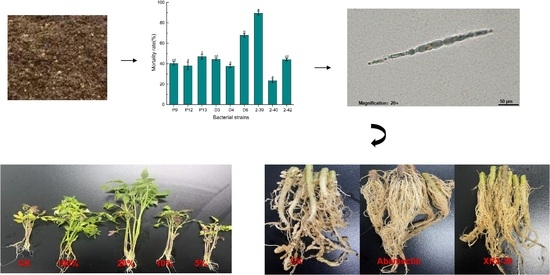
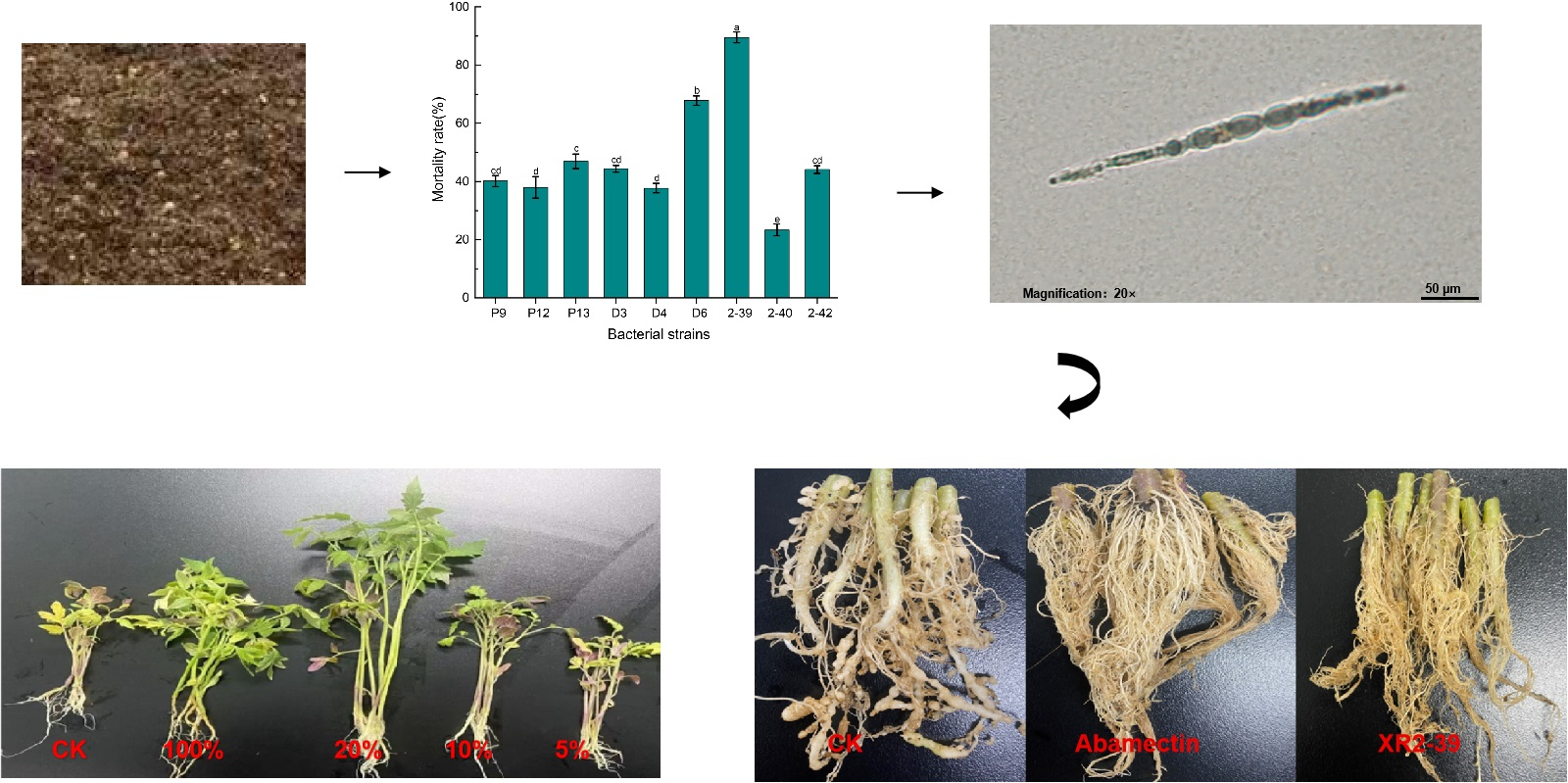
A total of nine bacterial strains exhibiting nematocidal activities against M. incognita were isolated from the compost fermentation of edible fungus residue. Preliminary characterization revealed that strain XR2-39 displayed the highest nematocidal activity, reaching 89.53% (Figure 1), and was therefore selected for identification and further biocontrol evaluation. Microscope observation showed that XR2-39 cells were rod-shaped, and Gram staining indicated that XR2-39 is a Gram-negative bacterium. On LB agar plates, XR2-39 cells formed rufous, moist colonies with flat and irregular margins.

3.2. Identification and Characterization of Plant Growth-Promoting (PGR) Traits of XR2-39

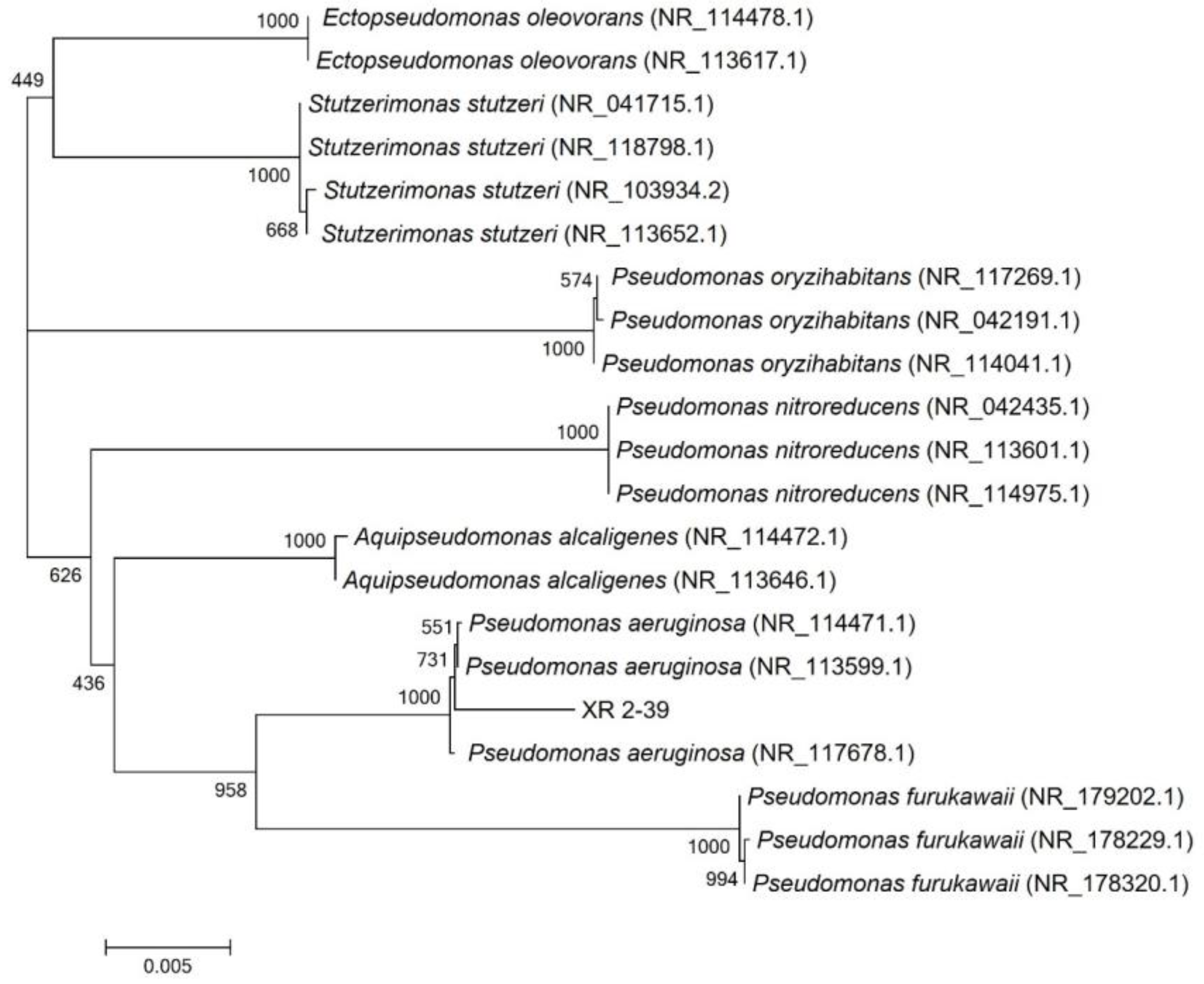
The biochemical characterization of XR2-39 showed positive reactions for catalase activity, nitrate reduction, starch hydrolysis, gelatin hydrolysis, and citrate utilization, while exhibiting negative results for Gram staining, glycolysis, indole production, MR test, VP test, and H2S production. Furthermore, BLAST (2.17.0) analysis of the 16S rDNA gene sequence of XR2-39 against the NCBI database revealed that the strain shares 100% sequence similarity with the 16S rDNA gene of Pseudomonas aeruginosa. The maximum likelihood phylogenetic tree based on 16S rDNA gene sequences further confirmed the close phylogenetic relationship between strain XR2-39 and members of the species of P. aeruginosa (Figure 2). Based on the biochemical and molecular analysis, strain XR2-39 was identified as P. aeruginosa XR2-39 and was deposited in the Guangdong Microbial Culture Collection Center (GDMCC No: 64092).
Furthermore, strain XR2-39 exhibited a strong capacity to produce IAA, with a yield of 33.01 mg/L. Phosphate solubilization analysis revealed that XR2-39 could dissolve inorganic phosphorus, achieving a solubilized concentration of 831.15 mg/L. In addition, XR2-39 demonstrated high siderophore production, reaching 71.45% (Table 1).

3.3. Nematocidal Activity of Strain XR2-39 Fermentation Filtrate Against M. incognita J2s In Vitro

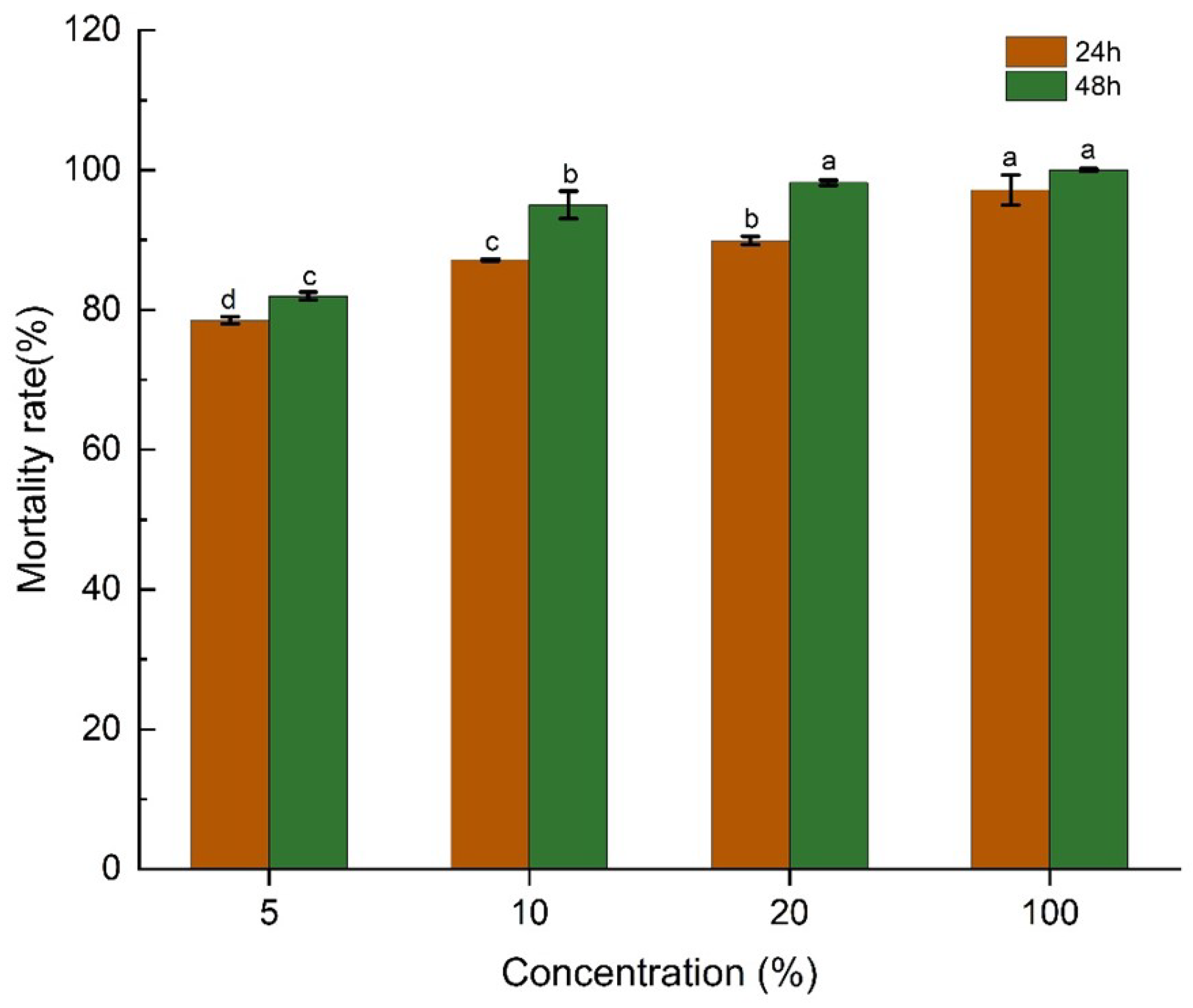
To evaluate the nematocidal potential of the fermentation filtrate of strain XR2-39, 100%, 20%, 10%, and 5% dilutions were tested for their effects on J2 mortality. Results showed that all concentrations exhibited nematocidal activity against J2s, with the corrected mortality rate increasing over time and with high concentration. After 24 h and 48 h of exposure, fermentation filtrate demonstrated strong nematocidal activity, resulting in corrected mortality rates of 97.12% and 100%, respectively. Lower concentrations induced relatively lower mortality. For instance, 20% filtrate caused corrected mortality rates of 89.87% and 98.18% at 24 h and 48 h, respectively. The 10% filtrate resulted in 87.14% and 95.04%, while the 5% filtrate yielded 78.52% and 81.97% of corrected mortality at 24 h and 48 h, respectively (Figure 3).
In addition, microscopic observation revealed that the fermentation filtrate damaged the internal organs and body wall of M. incognita J2s, resulting in the production of vacuoles and cuticle degradation. However, the sterile water did not induce these symptoms in M. incognita J2s (Supplementary Figure S1).

3.4. Effect of Strain XR2-39 Fermentation Filtrate on Egg Mass and Free Egg Hatching of M. incognita

Regarding the effect of XR2-39 on egg mass and free egg hatching, a decrease in the relative hatching inhibition was observed with decreasing fermentation filtrate concentration, whereas an increase in relative hatching inhibition was observed with prolonged incubation time. The highest hatching inhibition of 97.87% for egg masses and 100% for free eggs was recorded after 1 day of incubation with 100% fermentation filtrate. No J2s of M. incognita were detected in the 100% fermentation filtrate after 5 days of incubation, likely due to the degradation of M. incognita J2s. The 20% fermentation filtrate also exhibited high relative hatching inhibition, reaching 96.52% for egg masses and 75.93% for free eggs, followed by the 10% filtrate, which resulted in relative hatching inhibition of 87.15% and 70.58% for egg masses and free eggs, respectively (Table 2).

3.5. Effect of Strain XR2-39 Fermentation Broth on Growth of Tomato Plants in Pot Experiment

Inoculation with 20% fermentation broth on tomato roots increased fresh shoot weight, root weight, shoot length, root length, and stem diameter by 448.57%, 136.36%, 179.29%, 49.39%, and 57.14%, respectively, compared to the water control. Treatment with 100% fermentation broth also promoted longer shoot and root development by 71.00% and 96.97%, increasing fresh shoot weight and stem diameter by 277.14% and 57.14%, respectively. The 10% fermentation broth increased shoot length and root length by 56.14% and 74.85%, respectively. Among all tested parameters, only stem diameter showed a significant difference from the water control in plants treated with 5% fermentation broth (p < 0.05) (Table 3).

3.6. Effect of Strain XR2-39 Fermentation Broth Against M. incognita in Pot Plants

Results of the plant growth-promoting experiment indicated that the 20% fermentation broth exhibited the most effective growth-promoting activity. Therefore, this concentration was selected for further evaluation of the suppressive effect on M. incognita in pot experiments. Treatment with 20% XR2-39 fermentation significantly reduced M. incognita infection in tomato plants, as evidenced by fewer and smaller root galls and enhanced root system development compared to the water control. Both abamectin and XR2-39 fermentation broth treatments resulted in improved root health compared to the control. The gall index of the XR2-39 fermentation broth treatment was 37.00, which was significantly lower than that of the water control treatment (77.50), though higher than that of the abamectin treatment (29.00). The nematicidal control efficiency of the XR2-39 fermentation broth treatment was 52.44%, which was lower than that of the abamectin (62.36%) (Table 4).
Meanwhile, compared with the water control treatment, the XR2-39 fermentation broth treatment increased fresh shoot weight, root length, and stem diameter by 32.42%, 23.81%, and 13.51%, respectively. However, there were no significant differences in measured plant parameters between XR2-39 fermentation broth and abamectin treatments, except for fresh shoot weight (Table 4).

3.7. Effect of pH, Temperature, and Ultraviolet Irradiation and Storage on Stability of Strain XR2-39 Fermentation Filtrate

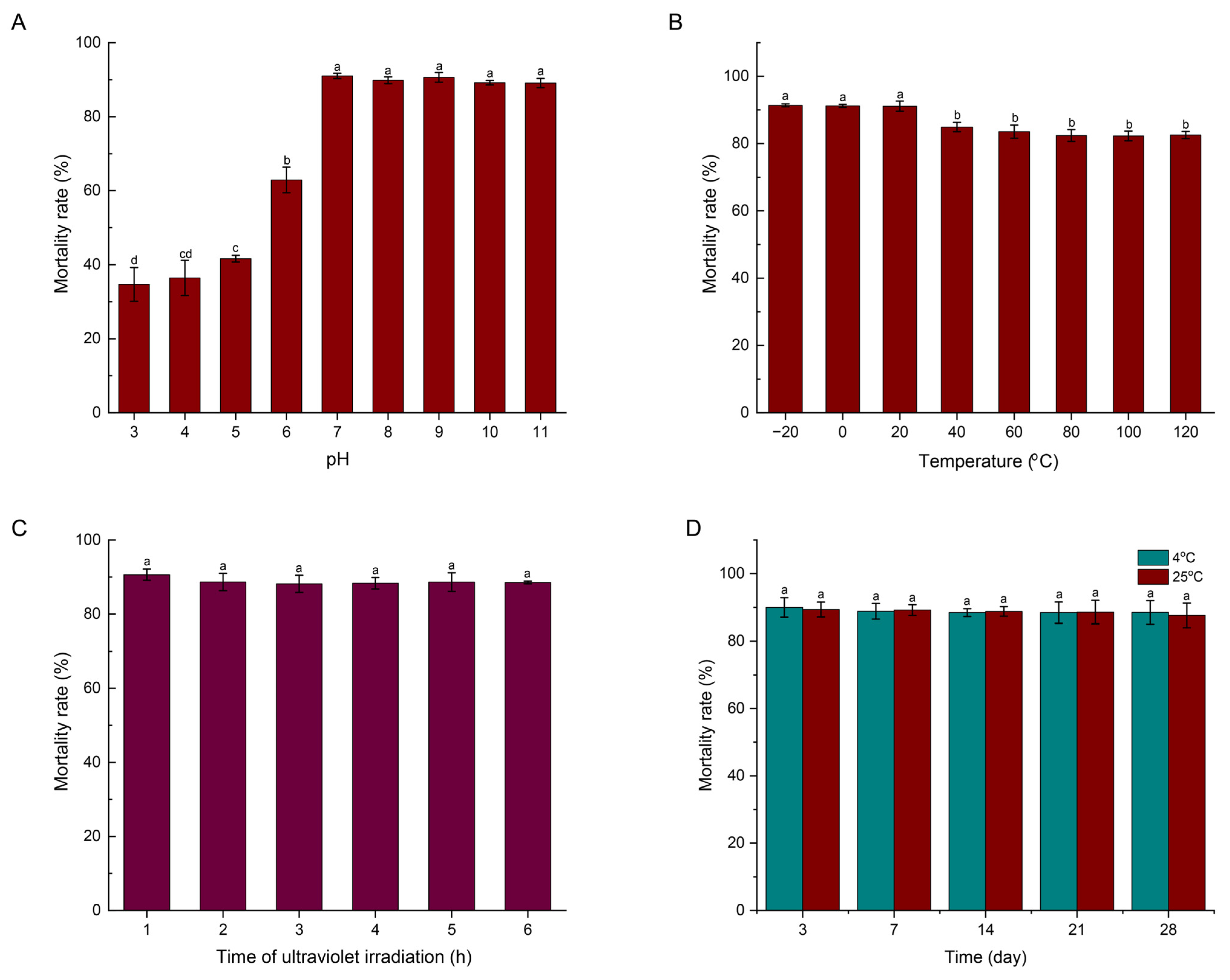
The analysis of the pH effect on corrected mortality revealed that the XR2-39 fermentation filtrate was stable within the pH range of 7.0 to 11.0, with the corrected mortality remaining above 89.0%. However, the nematocidal activity decreased as the pH declined, resulting in corrected mortalities of only 34.68%, 36.43%, and 41.64% mortality at pH levels of 3.0, 4.0, and 5.0, respectively. Temperature stability analysis demonstrated that storage at −20 °C, 0 °C, and 20 °C had no significant effect on corrected mortality induced by XR2-39 fermentation filtrate. Moreover, high levels of nematocidal activity were maintained even at elevated temperatures; for instance, a mortality rate of 82.27% was retained after exposure to 100 °C for 2 h. In addition, ultraviolet irradiation duration showed no significant effect on nematocidal activity, with corrected mortality rates of 90.62%, 88.65%, 88.15%, 88.32%, 88.63%, and 88.53% observed after 1, 2, 3, 4, 5, and 6 h of exposure, respectively. Furthermore, after storage at 4 °C and 25 °C for 28 d, the filtrate still exhibited high mortality rates of 88.49% and 87.63%, respectively. Collectively, these results indicate that the XR2-39 fermentation filtrate possesses favorable properties, including alkali tolerance, thermal stability, UV irradiation resistance, and long-term storage stability (Figure 4).

4. Discussion

Plant-parasitic nematodes cause severe damage to agriculture worldwide [2]. Although chemical nematocidal agents provide effective solutions for mitigating substantial crop losses, their adverse effects on the environment and human health restrict widespread application [44]. Therefore, researchers have sought eco-friendly biological control agents to manage nematode infestations over recent decades, with particular focus on antagonistic microorganisms. A number of fungi and bacterial strains have been identified as effective nematicides [16,26,45]. Specifically, PGPR are beneficial microbes that colonize the rhizosphere and plant roots, promoting plant growth and enhancing resistance to pathogens [46]. Due to their potential for controlling PPNs and promoting plant growth, PGPR have gained increasing attention as promising alternatives to chemical controls for managing PPNs [23,28]. Among PGPR, Bacillus sp. and Pseudomonas sp. have been reported to possess the ability to control M. incognita. In this study, strain P. aeruginosa XR2-39, isolated from compost fermentation of edible fungus residue, exhibited high nematicidal activity against M. incognita. The fermentation filtrate of strain XR2-39 caused significant mortality of J2s and reduced egg hatching of M. incognita. However, both mortality and hatching inhibition were directly influenced by the fermentation concentration and exposure time. Our results revealed that all tested concentrations of the fermentation filtrate exhibited high nematocidal activity against M. incognita. The highest efficacy was observed with 100% XR2-39 fermentation filtrate, which achieved 100% corrected J2 mortality at 48 h. This result was consistent with the findings of Hu et al. [23], who reported that the J2s were killed in the culture filtrate of Bv-DS1 after 48 h of treatment. Hussain et al. [47] also observed a corresponding increase in mortality with rising concentration, with J2 mortality reaching 52.47% at 50% concentration and increasing to 72.10% at 100% concentration after 48 h treatment; mortality further increased to 95.90% after 72 h treatment at 100% concentration. In vitro experiments showed B. licheniformis JF-22, isolated from the tomato rhizosphere soil, achieved 77% inactivation of M. incognita J2s after 24 h and 89% after 48 h of incubation [25]. Gao et al. [24] demonstrated that the fermentation filtrate of B. cereus strain S2 caused 90.96% mortality in M. incognita J2s. Similar antagonistic effects have been observed in certain Pseudomonas strains, which displayed biocontrol activities against M. incognita. Zhai et al. [48] reported that most M. incognita J2s became immobile when incubated with P. putida 1A00316 for 72 h. Zhao et al. [37] found that the mortality rate of P. fluorescens (Sneb 825) increased with prolonged exposure time, reaching a maximum of 80.00% at 96 h.
Our results also showed that all concentrations of XR2-39 fermentation filtrate significantly inhibited hatching of both free eggs and egg masses, with the highest hatching inhibition observed at 100% concentration after 2 days. This was consistent with the findings of Rao et al. [49], who reported that B. subtilis significantly reduced the egg hatching across various concentrations and exposure durations, achieving a maximum inhibition of 94.65% at 100% concentration after 5 days. Hussain et al. [47] demonstrated that egg hatching was progressively inhibited, and no juveniles emerged as incubation time increased. B. cereus strain Bc-cm103 has been reported as a biocontrol agent against M. incognita hatching eggs, with the lowest egg hatching rate recorded in treatment with supernatant (9.99%), followed by 10% supernatant (13.43%) [50]. Hatching inhibition was also found to be directly related to the exposure duration in Pseudomonas spp. [31]. Notably, no egg hatching was observed after 48 h of treatment with 100% XR2-39 filtrate. These results suggested that strain XR2-39 fermentation filtrate may contain nematocidal metabolites that are toxic to M. incognita. Further studies are needed to identify the active substance responsible for its antagonistic effects against M. incognita.
The pot experiment demonstrated a significant reduction in M. incognita infection in tomato plants, which may contribute to the suppression of M. incognita infection at early stages, resulting in a subsequent reduction in root gall formation and egg mass accumulation in the tomato root system following treatment with XR2-39. In addition to its effect on reducing tomato susceptibility to M. incognita, the pot experiment also revealed that strain XR2-39 exhibited significant plant growth-promoting activities. Although the mechanism of action of strain XR2-39 was not elucidated in these experiments, it may be hypothesized that strain XR2-39 metabolites inhibited egg hatch and caused mortality of M. incognita J2s. Concurrently, systemic resistance in plants was induced by strain XR2-39 colonizing the rhizosphere, thereby enhancing the host’s ability to resist nematode invasion and subsequent infection. Abd El-Aa et al. [31] reported that application of Serratia sp. and Pseudomonas spp. resulted in a high level of J2s mortality and a beneficial effect on plant growth. Enhanced growth associated with PGPR application has also been observed in tomato [44], cucumber [51], rice [52], barley [53], pepper [54], and melon [55]. It is well established that PGPR can produce the phytohormone auxin to promote plant growth [56,57], and their growth-promoting effects are mediated through multiple mechanisms, such as acquisition of limiting nutrients, phosphate solubilization [58], siderophore production [59], and nitrogen fixation [60]. The PGP traits of strain XR2-39 were evaluated, revealing outstanding abilities in phosphate solubilization, IAA production, and siderophore synthesis, with yields reaching 831.15 mg/L, 33.01 mg/L, and 71.45%, respectively. Islam et al. [51] demonstrated that P. stutzeri, B.subtilis, Stenotrophomonas maltophilia, and B. amyloliquefaciens isolated from cucumber rhizosphere produced IAA levels at concentrations ranging from 26.78 to 51.28 μg/mL, and treatment with these strains significantly promoted the cucumber growth. Furthermore, Singh et al. [61] showed that B. arboris CSRS12 enhanced lateral root development in mung bean through phosphate solubilization and siderophore production. Therefore, in this study, the plant growth-promoting effect may be attributed to two factors: first, the reduction in root damage caused by M. incognita due to XR2-39 activity and second, the strain’s capacity to produce IAA and siderophores, as well as to solubilize inorganic phosphate. These results indicate that XR2-39 plays an important role in promoting plant growth and biocontrol activity against M. incognita. Further studies are needed to elucidate the underlying mechanisms of plant growth promotion and biocontrol activity by strain XR2-39.
Moreover, the stability of the active abundances produced by biocontrol strains plays a crucial role in disease prevention and significantly influences their practical application [62]. External environmental conditions have a substantial impact on the activity and stability of biocontrol strains. Substances produced by B. altitudinis AMCC 1040 exhibited no difference in nematicidal activity when exposed to pH 2.0~6.0, resulting in J2 mortality exceeding 90%; however, the activity declined sharply and nearly disappeared under alkaline conditions [63]. In contrast, the fermentation filtrate of XR2-39 was stable within the pH range of 7.0 to 11.0, maintaining nematocidal activity with mortality rates above 89.0%, whereas its efficacy decreased at pH 3.0~5.0, with mortality reduced to 34.68%~41.64%. In addition, the fermentation filtrate of XR2-39 demonstrated excellent thermostability, as boiled filtrate still induced high J2 mortality even after treatment at 120 °C, which is consistent with the findings reported by Ye et al. [63]. Furthermore, the fermentation filtrate of XR2-39 exhibited strong UV tolerance and long-term storage stability. These favorable characteristics of the active compounds suggest that strain XR2-39 has strong potential as a biocontrol agent against M. incognita.

5. Conclusions

Strain XR2-39 was isolated from a compost fermentation of edible fungus residue and exhibited pronounced nematocidal activity, egg hatching inhibition, and plant growth-promoting effects. The strain demonstrated outstanding capabilities in phosphate solubilization, siderophore, and IAA production. Furthermore, the activity substances produced by XR2-39 showed alkali stability, high thermostability, strong UV tolerance, and long-term storage ability. However, further research is needed to identify the biological molecules responsible for its antagonistic effects, as well as to elucidate the mechanisms underlying its biocontrol activity and plant growth promotion.

Supplementary Materials

The following supporting information can be downloaded at: https://www.mdpi.com/article/10.3390/microorganisms14010005/s1, Figure S1: Morphological characteristics of M. incognita J2s observed under an optical microscope. (A) sterile water treatment, (B) fermentation filtrate of strain XR2-39 treatment.

Author Contributions

Conceptualization, Y.Y., Z.Z., S.L., and J.Y.; investigation, M.Y., W.L., and J.Y.; resources, F.Z., C.W., L.F., and X.X.; data curation, M.Y., W.L., and J.Y.; writing—original draft preparation, J.Y.; writing—review and editing, Y.Y., Z.Z., S.L., and J.Y.; visualization, M.Y., W.L., and J.Y.; funding acquisition, J.Y. All authors have read and agreed to the published version of the manuscript.

Funding

This work was supported by the Special Project for Basic Research and Talent Cultivation of Jiangxi Academy of Agricultural Sciences (JXSNKYJCRC202639).

Institutional Review Board Statement

Not applicable.

Informed Consent Statement

Not applicable.

Data Availability Statement

The original contributions presented in this study are included in the article/Supplementary Material. Further inquiries can be directed to the corresponding authors.

Conflicts of Interest

The authors declare no conflicts of interest.

References

  1. Elling, A.A. Major emerging problems with minor Meloidogyne species. Phytopathology 2013, 103, 1092. [Google Scholar] [CrossRef] [PubMed]
  2. Jones, J.T.; Haegeman, A.; Danchin, E.G.J.; Gaur, H.S.; Helder, J.; Jones, M.G.K.; Kikuchi, T.; Manzanilla-López, R.; Palomares-Rius, J.E.; Wesemael, W.M.L.; et al. Top 10 plant-parasitic nematodes in molecular plant pathology. Mol. Plant Pathol. 2013, 14, 946–961. [Google Scholar] [CrossRef] [PubMed]
  3. Wang, S.; Fan, H.; Zhao, D.; Zhu, X.; Wang, Y.; Liu, X.; Liu, D.; Duan, Y.; Chen, L. Multifunctional efficacy of the nodule endophyte Pseudomonsa fragi in stimulating tomato immune response against Meloidogyne incognita. Biol. Control 2021, 164, 104773. [Google Scholar] [CrossRef]
  4. Abad, P.; Favery, B.; Rosso, M.N.; Castagnone-Sereno, P. Root-knot nematode parasitism and host response: Molecular basis of a sophisticated interaction. Mol. Plant Pathol. 2003, 4, 217–224. [Google Scholar] [CrossRef] [PubMed]
  5. Mitiku, M. Plant-parasitic nematodes and their management: A review. Agric. Res. Technol. 2018, 8, 30–38. [Google Scholar] [CrossRef]
  6. Zhao, Z.; Wang, L.; Khan, R.A.A.; Song, X.; Najeeb, S.; Zhao, J.; Yang, Y.; Ling, J.; Mao, Z.; Jiang, X.; et al. Methylorubrum rhodesianum M520 as a biocontrol agent against Meloidogyne incognita (Tylenchida: Heteroderidae) J2s infecting cucumber roots. J. Appl. Microbiol. 2023, 134, lxad001. [Google Scholar] [CrossRef]
  7. Kiewnick, S.; Sikora, R.A. Evaluation of Paecilomyces lilacinus strain 251 for the biological control of the northern root-knot nematode Meloidogyne hapla Chitwood. Nematology 2006, 8, 69–78. [Google Scholar] [CrossRef]
  8. Moens, M.; Perry, R.N.; Starr, J.L. Meloidogyne Species—A Diverse Group of Novel and Important Plant Parasites; Perry, R.N., Moens, M., Starr, J.L., Eds.; Root-Knot Nematodes; CAB International: Wallingford, UK, 2009; pp. 1–17. [Google Scholar]
  9. Schneider, S.M.; Rosskopf, E.N.; Leesch, J.G.; Chellemi, D.O.; Bull, C.T.; Mazzola, M. United states department of agriculture-agricultural research service research on alternatives to methyl bromide: Pre-plant and post-harvest. Pest Manag. Sci. 2003, 59, 814–826. [Google Scholar] [CrossRef]
  10. Forghani, F.; Hajihassani, A. Recent advances in the development of environmentally benign treatments to control root-knot nematodes. Front. Plant Sci. 2020, 11, 1125. [Google Scholar] [CrossRef]
  11. Yin, N.; Liu, R.; Zhao, J.L.; Khan, R.A.A.; Mao, Z. Volatile organic compounds of Bacillus cereus strain Bc-cm103 exhibit fumigation activity against Meloidogyne incognita. Plant Dis. 2021, 105, 904–911. [Google Scholar] [CrossRef]
  12. Abd-Elgawad, M.M.; Askary, T.H. Fungal and bacterial nematicides in integrated nematode management strategies. Egypt. J. Biol. Pest Control 2018, 28, 74. [Google Scholar] [CrossRef]
  13. Kanwar, R.S.; Patil, J.A.; Yadav, S. Prospects of using predatory nematodes in biological control for plant parasitic nematodes—A review. Biol. Control 2021, 160, 104668. [Google Scholar] [CrossRef]
  14. Khan, R.A.A.; Najeeb, S.; Mao, Z.; Ling, J.; Yang, Y.; Li, Y.; Xie, B. Bioactive secondary metabolites from Trichoderma spp. against phytopathogenic bacteria and root-knot nematode. Microorganisms 2020, 8, 401. [Google Scholar] [CrossRef] [PubMed]
  15. Geng, C.; Nie, X.; Tang, Z.; Zhang, Y.; Lin, J.; Sun, M.; Peng, D. A novel serine protease, Sep1, from Bacillus firmus DS-1 has nematicidal activity and degrades multiple intestinal-associated nematode proteins. Sci. Rep. 2016, 6, 25012. [Google Scholar] [CrossRef]
  16. Kamalanathan, V.; Sevugapperumal, N.; Nallusamy, S. Antagonistic bacteria Bacillus velezensis VB7 possess nematicidal action and induce an immune response to suppress the infection of root-knot nematode (RKN) in tomato. Genes 2023, 14, 1335. [Google Scholar] [CrossRef]
  17. Kim, J.-H.; Lee, B.-M.; Lee, H.C.; Choi, I.-S.; Koo, K.-B.; Son, K.-H. Antagonistic efficacy of symbiotic bacterium Xenorhabdus sp. SCG against Meloidogyne spp. J. Microbiol. Biotechnol. 2024, 34, 1627–1635. [Google Scholar] [CrossRef]
  18. Paul, D.; Lade, H. Plant-growth-promoting rhizobacteria to improve crop growth in saline soils: A review. Agron. Sustain. Dev. 2014, 34, 737–752. [Google Scholar] [CrossRef]
  19. Bhattacharyya, P.N.; Jha, D.K. Plant growth-promoting rhizobacteria (PGPR): Emergence in agriculture. World J. Microbiol. Biotechnol. 2012, 28, 1327–1350. [Google Scholar] [CrossRef]
  20. Viljoen, J.J.F.; Labuschagne, N.; Fourie, H.; Sikora, R.A. Biological control of the root-knot nematode Meloidogyne incognita on tomatoes and carrots by plant growth-promoting rhizobacteria. Trop. Plant Pathol. 2019, 44, 284–291. [Google Scholar] [CrossRef]
  21. Borah, B.; Ahmed, R.; Hussain, M.; Phukon, P.; Wann, S.B.; Sarmah, D.K.; Bhau, B.S. Suppression of root-knot disease in Pogostemon cablin caused by Meloidogyne incognita in a rhizobacteria mediated activation of phenylpropanoid pathway. Biol. Control 2018, 119, 43–50. [Google Scholar] [CrossRef]
  22. Cetintas, R.; Kusek, M.; Fateh, S.A. Effect of some plant growth-promoting rhizobacteria strains on root-knot nematode, Meloidogyne incognita, on tomatoes. Egypt. J. Biol. Pest Control 2018, 28, 7. [Google Scholar] [CrossRef]
  23. Hu, Y.; You, J.; Wang, Y.; Long, Y.; Wang, S.; Pan, F.; Yu, Z. Biocontrol efficacy of Bacillus velezensis strain YS-AT-DS1 against the root-knot nematode Meloidogyne incognita in tomato plants. Front. Microbiol. 2022, 13, 1035748. [Google Scholar] [CrossRef] [PubMed]
  24. Gao, H.; Qi, G.; Yin, R.; Zhang, H.; Li, C.; Zhao, X. Bacillus cereus strain S2 shows high nematicidal activity against Meloidogyne incognita by producing sphingosine. Sci. Rep. 2016, 6, 28756. [Google Scholar] [CrossRef] [PubMed]
  25. Du, J.; Gao, Q.; Ji, C.; Song, X.; Liu, Y.; Li, H.; Li, C.; Zhang, P.; Li, J.; Liu, X. Bacillus licheniformis JF-22 to control Meloidogyne incognita and its effect on tomato rhizosphere microbial community. Front. Microbiol. 2022, 13, 863341. [Google Scholar] [CrossRef] [PubMed]
  26. Bel, Y.; Galeano, M.; Baños-Salmeron, M.; Andrés-Antón, M.; Escriche, B. Bacillus thuringiensis Cry5, Cry21, App6 and Xpp55 proteins to control Meloidogyne javanica and M. incognita. Appl. Microbiol. Biotechnol. 2024, 108, 525. [Google Scholar] [CrossRef]
  27. Yao, Y.; Wang, L.; Zhai, H.; Dong, H.; Wang, J.; Zhao, Z.; Xu, Y. Bacillus velezensis A-27 as a potential biocontrol agent against Meloidogyne incognita and effects on rhizosphere communities of celery in field. Sci. Rep. 2025, 15, 1057. [Google Scholar] [CrossRef]
  28. Zhang, R.; Ouyang, J.; Xu, X.; Li, J.; Rehman, M.; Deng, G.; Shu, J.; Zhao, D.; Chen, S.; Sayyed, R.Z.; et al. Nematicidal activity of Burkholderia arboris J211 against Meloidogyne incognita on tobacco. Front. Microbiol. 2022, 13, 915546. [Google Scholar] [CrossRef]
  29. Kim, J.-H.; Lee, B.-M.; Kang, M.-K.; Park, D.-J.; Choi, I.-S.; Park, H.-Y.; Lim, C.-H.; Son, K.-H. Assessment of nematicidal and plant growth-promoting effects of Burkholderia sp. JB-2 in root-knot nematode-infested soil. Front. Plant Sci. 2023, 14, 1216031. [Google Scholar] [CrossRef]
  30. Stucky, T.; Hochstrasser, M.; Meyer, S.; Segessemann, T.; Ruthes, A.C.; Ahrens, C.H.; Pelludat, C.; Dahlin, P. A novel robust screening assay identifies Pseudomonas strains as reliable antagonists of the root-knot nematode Meloidogyne incognita. Microorganisms 2023, 11, 2011. [Google Scholar] [CrossRef]
  31. Abd El-Aal, E.M.; Shahen, M.; Sayed, S.; Kesba, H.; Ansari, M.J.; El-Ashry, R.M.; Aioub, A.A.A.; Salma, A.S.A.; Eldeeb, A.M. In vivo and in vitro management of Meloidogyne incognita (Tylenchida: Heteroderidae) using rhizosphere bacteria, Pseudomonas spp. and Serratia spp. compared with oxamyl. Saudi J. Biol. Sci. 2021, 28, 4876–4883. [Google Scholar] [CrossRef]
  32. Burkett, M.; Kokalis-Burelle, N.; Lawrence, K.; van Santen, E.; Kloepper, J. Suppressiveness of root-knot nematodes mediated by rhizobacteria. Biol. Control 2008, 47, 55–59. [Google Scholar] [CrossRef]
  33. El-Hadad, M.E.; Mustafa, M.I.; Selim, S.M.; El-Tayeb, T.S.; Mahgoob, A.E.A.; Aziz, N.H.A. The nematicidal effect of some bacterial biofertilizers on Meloidogyne incognita in sandy soil. Braz. J. Microbiol. 2011, 42, 105–113. [Google Scholar] [CrossRef]
  34. De Nardo, E.A.B.; Grewal, P.S. Compatibility of Steinernema feltiae (Nematoda: Steinernematidae) with pesticides and plant growth regulators used in glasshouse plant production. Biocontrol Sci. Technol. 2003, 13, 441–448. [Google Scholar] [CrossRef]
  35. Shi, Q.Q.; Zhang, J.; Fu, Q.; Hao, G.Y.; Liang, C.; Duan, F.M.; Zhao, H.G.; Song, W.W. Biocontrol efficacy and induced resistance of Paenibacillus polymyxa J2-4 against Meloidogyne incognita infection in cucumber. Biol. Control Microb. Ecol. 2024, 114, 538–548. [Google Scholar] [CrossRef]
  36. Buchanan, R.E.; Gibbons, N.E. Bergey’s Manual of Determinative Bacteriology, 8th ed.; Science Press: Beijing, China, 1984. [Google Scholar]
  37. Zhao, D.; Zhao, H.; Zhao, D.; Zhu, X.F.; Wang, Y.Y.; Duan, Y.X.; Xuan, Y.X.; Chen, L.J. Isolation and identification of bacteria from rhizosphere soil and their effect on plant growth promotion and root-knot nematode disease. Biol. Control 2018, 119, 12–19. [Google Scholar] [CrossRef]
  38. Ei, S.L.; Lwin, K.M.; Padamyar; Khaing, H.O.; Yu, S.S. Study on IAA Producing Rhizobacterial Isolates and Their Effect in Talc-Based Carrier on Some Plants. J. Soil Sci. Plant Health 2018, 2, 1. [Google Scholar]
  39. Tang, Y.W.; Bonner, J. The enzymatic inactivation of indole acetic acid. II. The physiology of the enzyme. Am. J. Bot. 1948, 35, 570–578. [Google Scholar] [CrossRef] [PubMed]
  40. Gordon, S.A.; Weber, R.P. Colorimetric estimation of inodole3-acetic acid. Plant Physiol. 1951, 26, 192–195. [Google Scholar] [CrossRef]
  41. Zhang, T.; Wang, X.L.; Zhou, J.; Zhou, W.; Zhou, S.Q. Construction of phosphate-solubilizing microbial consortium and its effect on the remediation of saline-alkali soil. Microb. Ecol. 2025, 88, 11. [Google Scholar] [CrossRef] [PubMed]
  42. Hussey, R.S.; Barker, K.R. A comparison of methods of collecting inocula of Meloidogyne spp. Including a new technique. Plant Dis. Rep. 1973, 57, 1025–1028. [Google Scholar]
  43. Bridge, J.; Page, S.L. Estimation of root-knot nematode infestation levels on roots using a rating chart. Int. J. Pest Manag. 1980, 26, 296–298. [Google Scholar] [CrossRef]
  44. Ayaz, M.; Ali, Q.; Farzand, A.; Khan, A.R.; Ling, H.; Gao, X. Nematicidal volatiles from Bacillus atrophaeus GBSC56 promote growth and stimulate induced systemic resistance in tomato against Meloidogyne incognita. Int. J. Mol. Sci. 2021, 22, 5049. [Google Scholar] [CrossRef] [PubMed]
  45. Saharan, R.; Patil, J.A.; Yadav, S.; Kumar, A.; Goyal, V. The nematicidal potential of novel fungus, Trichoderma asperellum FbMi6 against Meloidogyne incognita. Sci. Rep. 2023, 13, 6603. [Google Scholar] [CrossRef]
  46. Sharma, I.P.; Sharma, A.K. Effective control of root-knot nematode disease with Pseudomonad rhizobacteria filtrate. Rhizosphere 2017, 3, 123–125. [Google Scholar] [CrossRef]
  47. Hussain, T.; Haris, M.; Shakeel, A.; Ahmad, G.; Khan, G.A.; Khan, M.A. Bio-nematicidal activities by culture filtrate of Bacillus subtilis HussainT-AMU: New promising biosurfactant bioagent for the management of Root Galling caused by Meloidogyne incognita. Vegetos 2020, 33, 229–238. [Google Scholar] [CrossRef]
  48. Zhai, Y.; Shao, Z.; Cai, M.; Zheng, L.; Li, G.; Huang, D.; Cheng, W.; Thomashow, L.S.; Weller, D.M.; Yu, Z.; et al. Multiple modes of nematode control by volatiles of Pseudomonas putida 1A00316 from Antarctic soil against Meloidogyne incognita. Front. Microbiol. 2018, 9, 253. [Google Scholar] [CrossRef]
  49. Rao, M.S.; Kamalnath, M.; Umamaheswari, R.; Rajinikanth, R.; Prabu, P.; Priti, K.; Grace, G.N.; Chaya, M.K.; Gopalakrishnan, C. Bacillus subtilis IIHR BS-2 enriched vermicompost controls root knot nematode and soft rot disease complex in carrot. Sci. Hortic. 2017, 218, 56–62. [Google Scholar] [CrossRef]
  50. Yin, N.; Zhao, J.L.; Liu, R.; Li, Y.; Ling, J.; Yang, Y.H.; Xie, B.Y.; Mao, Z.C. Biocontrol efficacy of Bacillus cereus strain Bc-cm103 against Meloidogyne incognita. Plant Dis. 2021, 105, 2061–2070. [Google Scholar] [CrossRef]
  51. Islam, S.; Akanda, A.M.; Prova, A.; Islam, M.T.; Hossain, M.M. Isolation and identification of plant growth promoting rhizobacteria from cucumber rhizosphere and their effect on plant growth promotion and disease suppression. Front. Microbiol. 2016, 6, 1360. [Google Scholar] [CrossRef]
  52. Khamsuk, K.; Dell, B.; Pathom-Aree, W.; Pathaichindachote, W.; Suphrom, N.; Nakaew, N.; Jumpathong, J. Screening plant growth-promoting bacteria with antimicrobial properties for upland rice. J. Microbiol. Biotechnol. 2024, 34, 1029–1039. [Google Scholar] [CrossRef] [PubMed]
  53. Ghorbel, S.; Aldilami, M.; Zouari-Mechichi, H.; Mechichi, T.; AlSherif, E.A. Isolation and characterization of a plant growth-promoting rhizobacterium strain MD36 that promotes barley seedlings and growth under heavy metals stress. 3 Biotech 2023, 13, 145. [Google Scholar] [CrossRef]
  54. Lau, E.T.; Tani, A.; Khew, C.Y.; Chua, Y.Q.; Hwang, S.S. Plant growth-promoting bacteria as potential bio-inoculants and biocontrol agents to promote black pepper plant cultivation. Microbiol. Res. 2020, 240, 126549. [Google Scholar] [CrossRef]
  55. Dolu, H.; Killi, D.; Bas, S.; Bilecen, D.S.; Seymen, M. Effectiveness of salt priming and plant growth-promoting bacteria in mitigating salt-induced photosynthetic damage in melon. Photosynth. Res. 2025, 163, 7. [Google Scholar] [CrossRef]
  56. Spaepen, S.; Bossuyt, S.; Engelen, K.; Marchal, K.; Vanderleyden, J. Phenotypical and molecular responses of Arabidopsis thaliana roots as a result of inoculation with the auxin-producing bacterium Azospirillum brasilense. New Phytol. 2014, 201, 850–861. [Google Scholar] [CrossRef] [PubMed]
  57. Finkel, O.M.; Salas-González, I.; Castrillo, G.; Conway, J.M.; Law, T.F.; Teixeira, P.J.P.L.; Wilson, E.D.; Fitzpatrick, C.R.; Jones, C.D.; Dangl, J.L. A single bacterial genus maintains root growth in a complex microbiome. Nature 2020, 587, 103–108. [Google Scholar] [CrossRef] [PubMed]
  58. Turan, M.; Gulluce, M.; Von Wirén, N.; Sahin, F. Yield promotion and phosphorus solubilization by plant growth–promoting rhizobacteria in extensive wheat production in Turkey. J. Plant Nutr. Soil Sci. 2012, 175, 818–826. [Google Scholar] [CrossRef]
  59. Marschner, P.; Crowley, D.; Rengel, Z. Rhizosphere interactions between microorganisms and plants govern iron and phosphorus acquisition along the root axis—Model and research methods. Soil Biol. Biochem. 2011, 43, 883–894. [Google Scholar] [CrossRef]
  60. Iniguez, A.L.; Dong, Y.; Triplett, E.W. Nitrogen fixation in wheat provided by Klebsiella pneumoniae 342. Mol. Plant Microbe Interact. 2004, 17, 1078–1085. [Google Scholar] [CrossRef] [PubMed]
  61. Singh, T.B.; Sahai, V.; Goyal, D.; Prasad, M.; Yadav, A.; Shrivastav, P.; Ali, A.; Dantu, P.K. Identification, characterization and evaluation of multifaceted traits of plant growth promoting rhizobacteria from soil for sustainable approach to agriculture. Curr. Microbiol. 2020, 77, 3633–3642. [Google Scholar] [CrossRef]
  62. Syed Ab Rahman, S.F.; Singh, E.; Pieterse, C.M.J.; Schenk, P.M. Emerging microbial biocontrol strategies for plant pathogens. Plant Sci. 2018, 267, 102–111. [Google Scholar] [CrossRef]
  63. Ye, L.; Wang, J.-Y.; Liu, X.-F.; Guan, Q.; Dou, N.-X.; Li, J.; Zhang, Q.; Gao, Y.-M.; Wang, M.; Li, J.-S.; et al. Nematicidal activity of volatile organic compounds produced by Bacillus altitudinis AMCC 1040 against Meloidogyne incognita. Arch. Microbiol. 2022, 204, 521. [Google Scholar] [CrossRef] [PubMed]
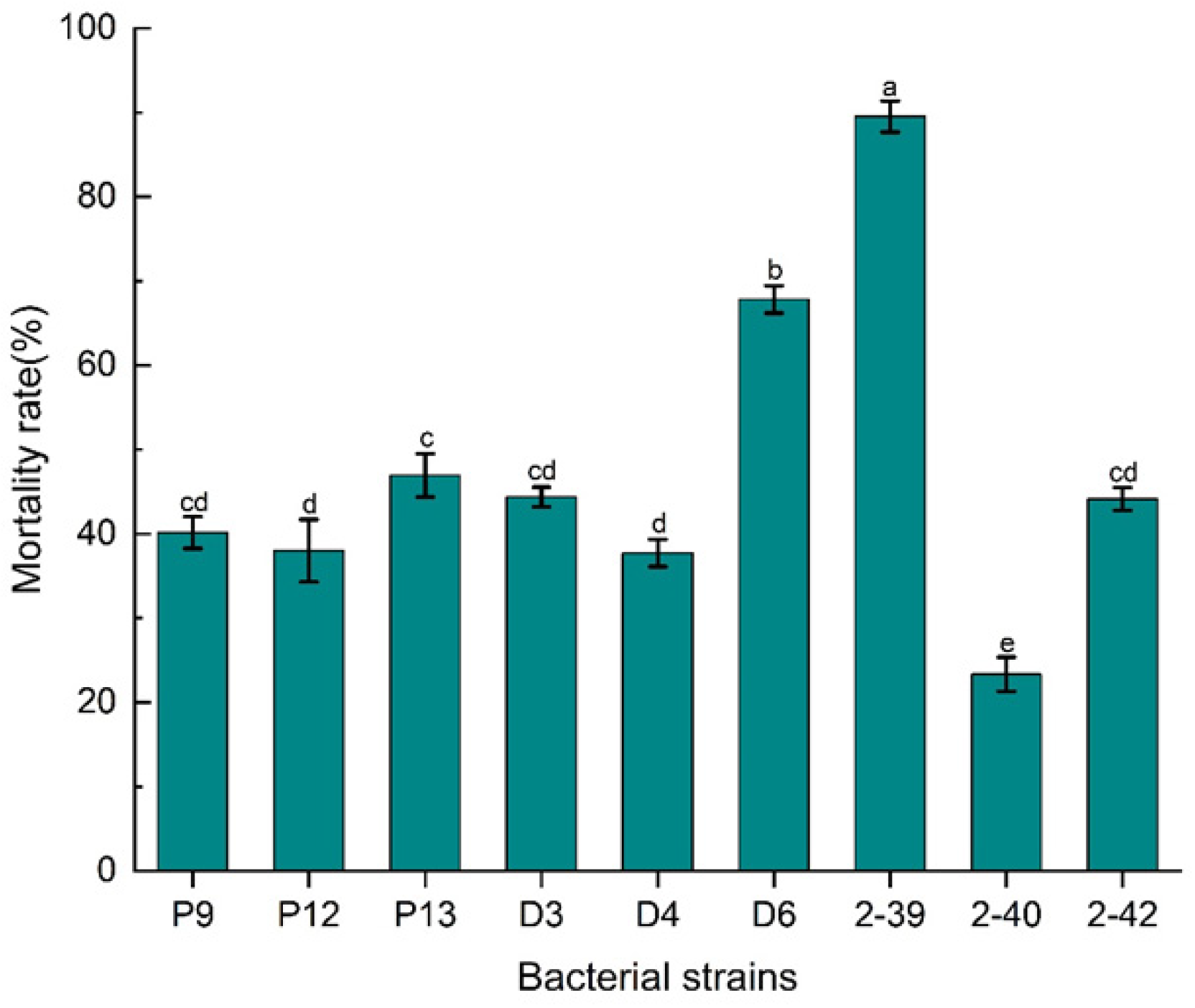
Figure 1. The mortality rate of the bacterial strains on J2s of M. incognita. Different lowercase letters indicate significant differences among strains (p < 0.05).
Microorganisms 14 00005 g001
Figure 2. Phylogenetic tree constructed with the neighbor-joining method based on 16S rDNA genes.
Microorganisms 14 00005 g002
Figure 3. The mortality rates of different concentrations of XR2-39 fermentation filtrate at 24 h and 48 h. Different letters in the bar with the same color indicate a significant difference (p < 0.05).
Microorganisms 14 00005 g003
Figure 4. The pH (A), temperature (B), UV irradiation (C), and storage (D) effects on the stability of XR2-39 fermentation filtrate. Different letters in the bar with the same color indicate a significant difference (p < 0.05).
Microorganisms 14 00005 g004
Table 1. Physiochemical characteristics and plant growth-promoting (PGP) properties of strain XR2-39.
Biochemical TestTest Result
Gram staining
Catalase activity+
Glycolysis
Nitrate reduction+
Starch hydrolysis+
Gelatin hydrolysis+
Indole test
Citrate utilization+
MR test
VP test
H2S production
IAA production (mg/L)33.01 ± 1.36
Phosphate Solubilization (mg/L)831.15 ± 21.40
Siderophore production (%)71.45 ± 2.51
Table 2. The egg hatching inhibition of different concentrations of XR2-39 fermentation filtrate.
TreatmentEgg Mass (%)
1 d2 d3 d4 d5 d
100% Fermentation filtrate97.87 ± 2.71 a100 ± 0.001 a100 ± 0.00 a100 ± 0.00 a100 ± 0.00 a
20% Fermentation filtrate73.91 ± 6.07 b91.26 ± 2.60 b90.30 ± 4.19 b95.10 ± 2.45 a96.52 ± 3.25 ab
10% Fermentation filtrate59.82 ± 4.52 c77.11 ± 4.21 c83.64 ± 8.51 b87.48 ± 8.47 b87.15 ± 1.13 b
5% Fermentation filtrate43.02 ± 1.40 d64.28 ± 6.28 d65.72 ± 6.47 c63.8 ± 1.19 c65.47 ± 11.00 c
 Free egg (%)
100% Fermentation filtrate100 ± 0.00 a99.13 ± 1.73 a100 ± 0.00 a100 ± 0.00 a100 ± 0.00 a
20% Fermentation filtrate47.16 ± 5.80 b56.60 ± 8.35 b70.82 ± 5.50 b75.11 ± 5.11 b75.93 ± 8.44 b
10% Fermentation filtrate36.29 ± 3.77 c38.22 ± 7.02 c57.16 ± 2.02 c68.70 ± 6.29 b70.58 ± 7.59 b
5% Fermentation filtrate30.18 ± 6.49 c36.20 ± 1.17 c49.62 ± 6.99 c51.73 ± 9.35 c48.68 ± 5.99 c
Data were presented as mean ± SE of the mean; values followed by the same letter indicate a significant difference (p < 0.05; n = 4) between treatments according to the Tukey test.
Table 3. Effects of different concentrations of XR2-39 fermentation broth on growth parameters of tomato plants.
TreatmentShoot Length (cm)Fresh Shoot Weight (g)Root Weight (g)Stem Diameter (cm)Root Length (cm)
100% Fermentation 11.97 ± 0.39 b1.32 ± 0.37 b0.15 ± 0.06 b0.33 ± 0.03 a6.50 ± 2.55 a
20% Fermentation19.55 ± 1.39 a1.92 ± 1.57 a0.26 ± 0.03 a0.33 ± 0.01 a4.93 ± 1.01 abc
10% Fermentation10.93 ± 1.04 b0.55 ± 0.43 c0.13 ± 0.01 b0.26 ± 0.02 b5.77 ± 1.45 ab
5% Fermentation7.72 ± 0.58 c0.37 ± 0.15 c0.11 ± 0.04 b0.24 ± 0.03 b4.00 ± 0.70 bc
Water control7.00 ± 1.39 c0.35 ± 0.1 c0.11 ± 0.05 b0.21 ± 0.03 c3.30 ± 1.19 c
Data were presented as mean ± SE of the mean; values followed by the same letter indicate a significant difference (p < 0.05; n = 10) between treatments according to the Tukey test.
Table 4. Effects of different treatments on parameters of tomato plants and M. incognita.
TreatmentShoot Length (cm)Fresh Shoot Weight (g)Root Length (cm)Root Weight (g)Stem Diameter (cm)Root-Knot IndexBiocontrol Effect (%)
Abamectin30.09 ± 2.20 a7.59 ± 0.56 a7.18 ± 1.10 ab0.50 ± 0.11 a0.44 ± 0.04 a29.00 ± 0.05 c62.36
20% XR2-39 fermentation30.48 ± 0.65 a6.29 ± 0.18 b8.06 ± 0.67 a0.48 ± 0.07 a0.42 ± 0.02 a37.00 ± 0.08 b52.44
Water control29.17 ± 0.62 a4.75 ± 0.16 c6.51 ± 0.67 b0.43 ± 0.08 a0.37 ± 0.01 b77.50 ± 0.05 a-
Data were presented as mean ± SE of the mean; values followed by the same letter indicate a significant difference (p < 0.05; n = 30) between treatments according to the Tukey test.
Disclaimer/Publisher’s Note: The statements, opinions and data contained in all publications are solely those of the individual author(s) and contributor(s) and not of MDPI and/or the editor(s). MDPI and/or the editor(s) disclaim responsibility for any injury to people or property resulting from any ideas, methods, instructions or products referred to in the content.