Inconsistent Findings Between Crystal Violet and Congo Red Methods on Biofilms with Comparative Sugar Supplementation

Abstract
1. Introduction
2. Materials and Methods
2.1. Bacterial Strains
2.2. Biofilm Assay
2.2.1. The Congo Red Broth Method
2.2.2. The Crystal Violet (CV) Method
3. Results
3.1. Biofilm Assay
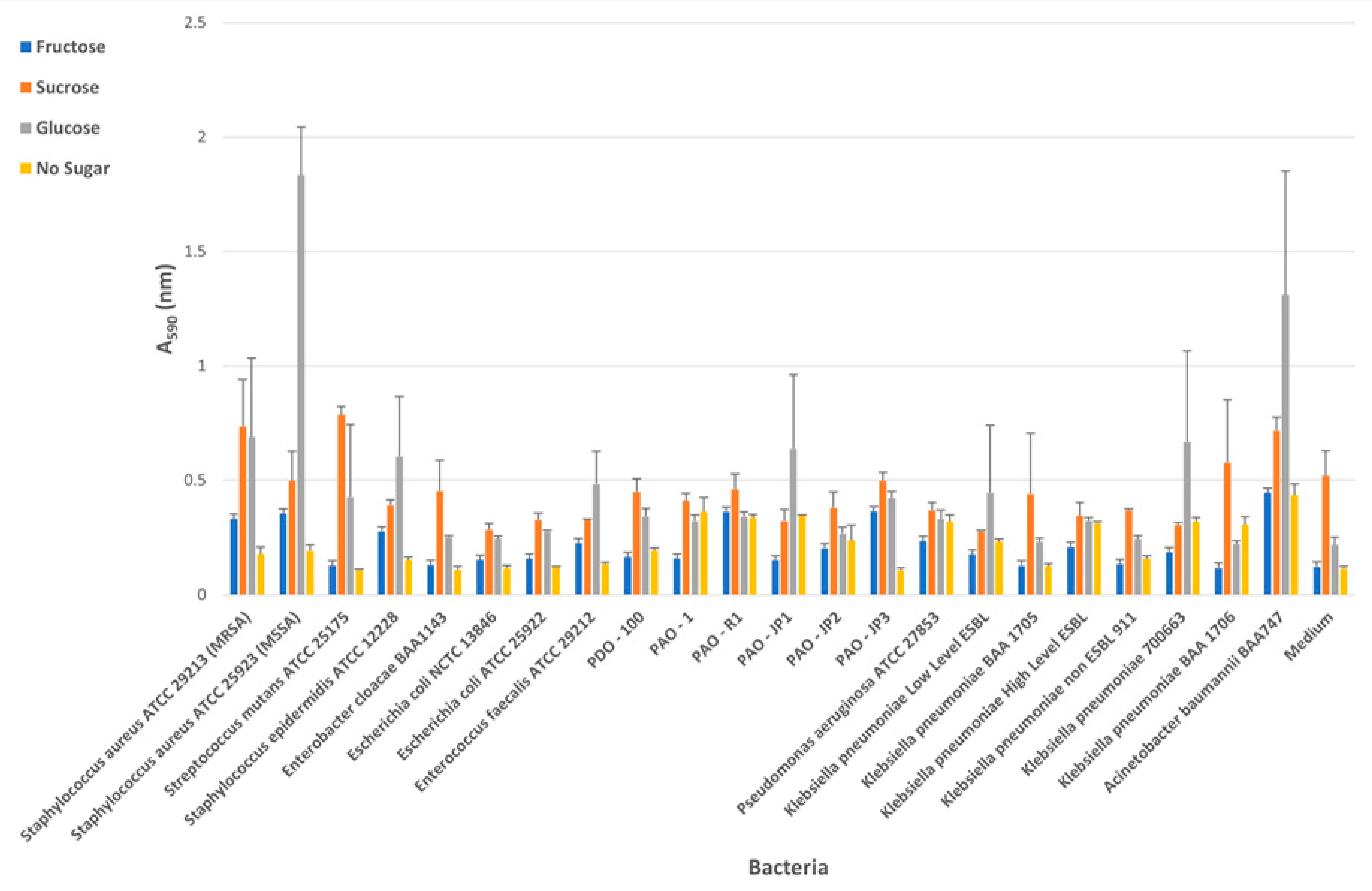
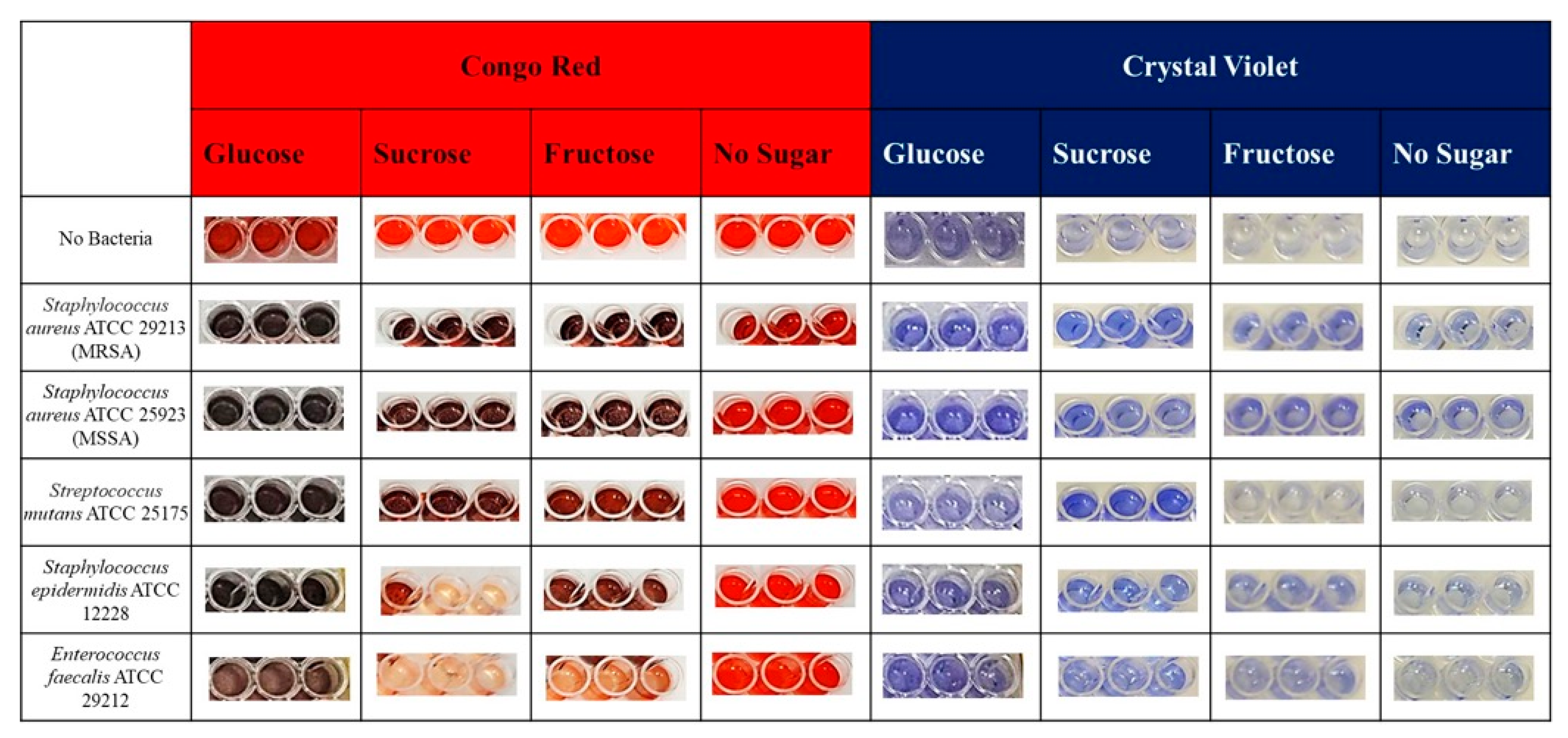
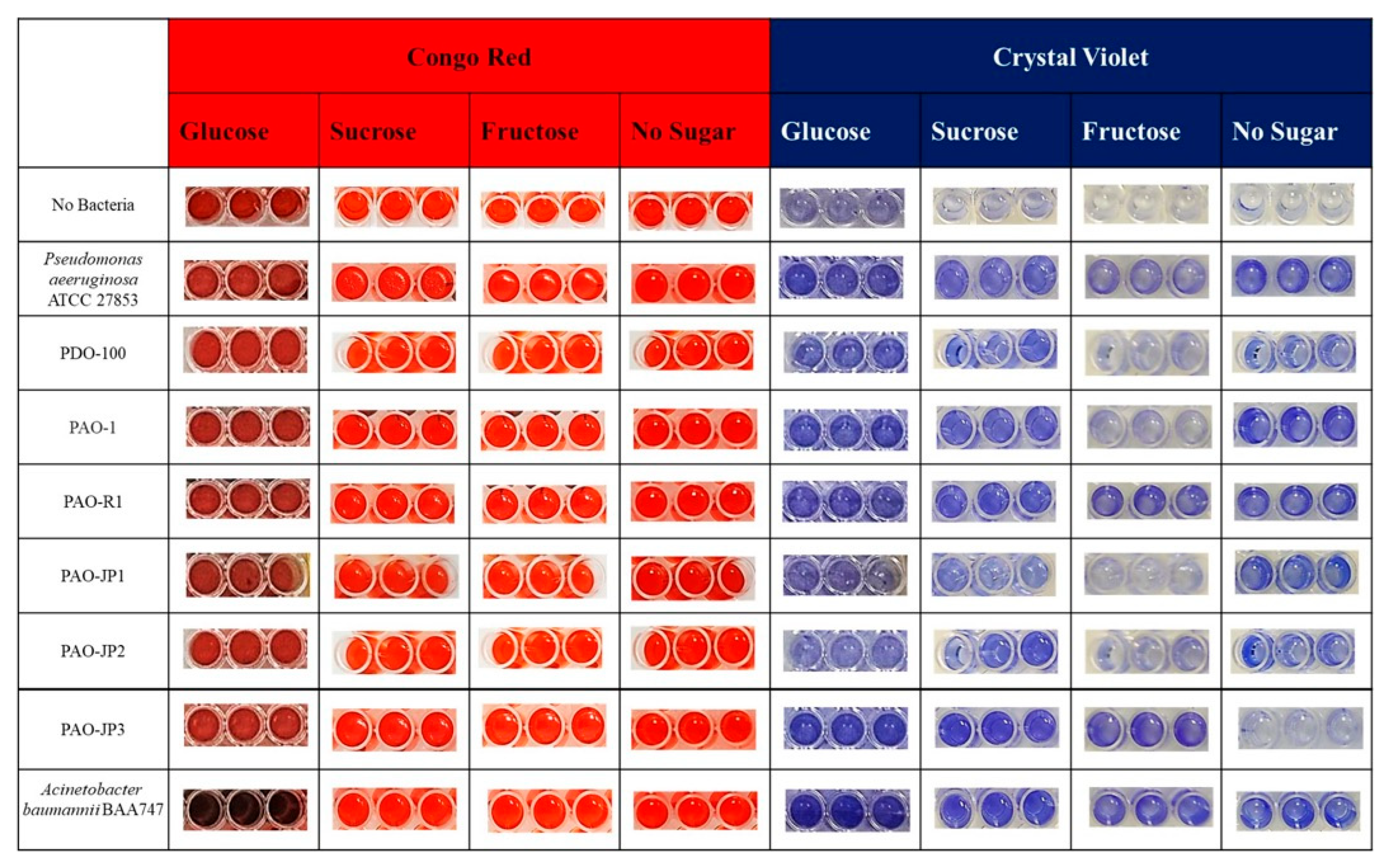
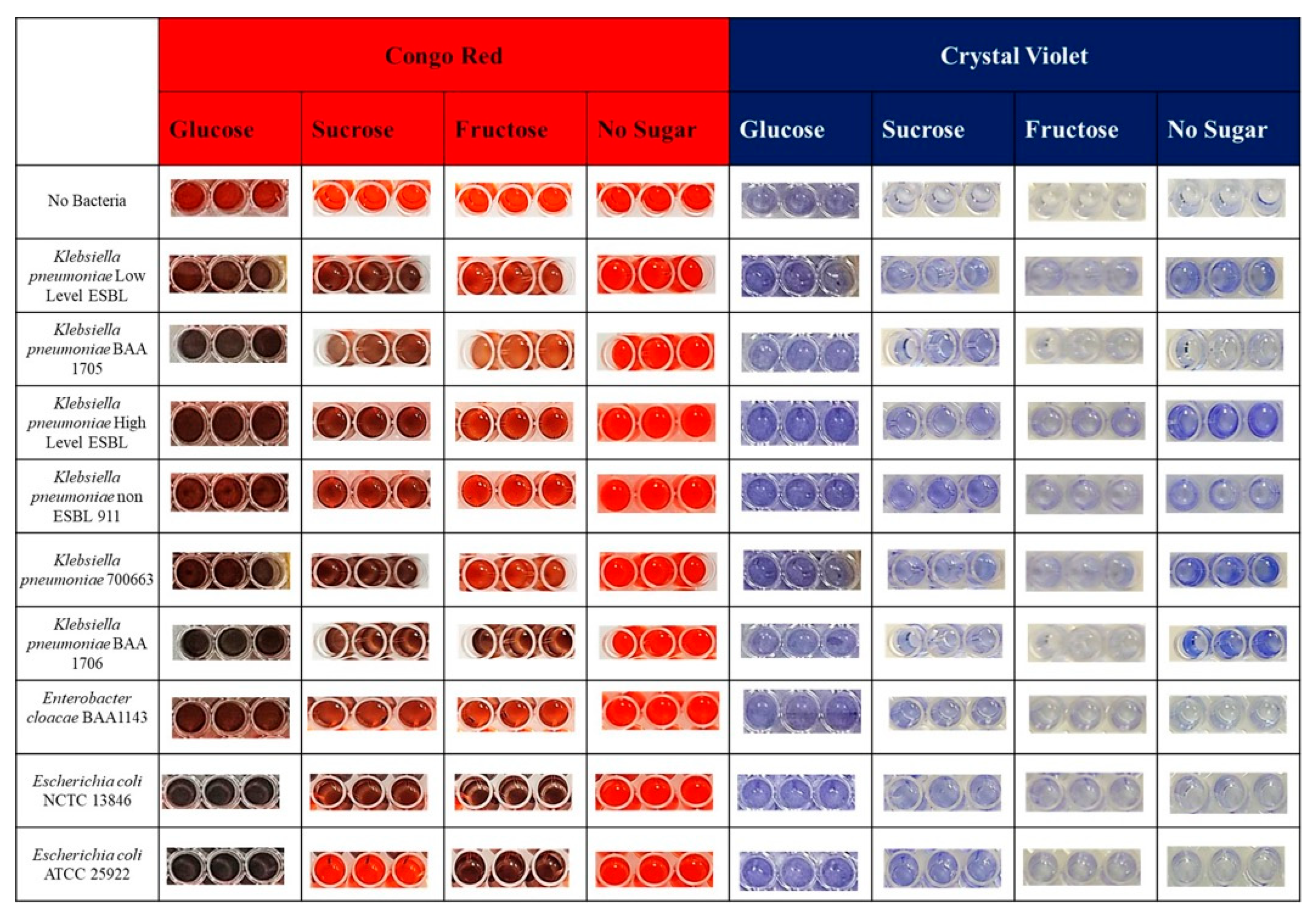
3.2. Comparison of Biofilm Assays
4. Discussion
5. Conclusions
Author Contributions
Funding
Institutional Review Board Statement
Informed Consent Statement
Data Availability Statement
Acknowledgments
Conflicts of Interest
References
- Kolpen, M.; Kragh, K.N.; Enciso, J.B.; Faurholt-Jepsen, D.; Lindegaard, B.; Egelund, G.B.; Jensen, A.V.; Ravn, P.; Mathiesen, I.H.M.; Gheorge, A.G.; et al. Bacterial biofilms predominate in both acute and chronic human lung infections. Thorax 2022, 77, 1015–1022. [Google Scholar] [CrossRef] [Scilit]
- Pietrocola, G.; Campoccia, D.; Motta, C.; Montanaro, L.; Arciola, C.R.; Speziale, P. Colonization and Infection of Indwelling Medical Devices by Staphylococcus aureus with an Emphasis on Orthopedic Implants. Int. J. Mol. Sci. 2022, 23, 5958. [Google Scholar] [CrossRef] [Scilit] [PubMed]
- Wasserman, M.G.; Graham, R.J.; Mansbach, J.M. Airway bacterial colonization, biofilms and blooms, and acute respiratory infection. Pedia Crit. Care Med. 2022, 23, e476–e482. [Google Scholar] [CrossRef] [Scilit]
- Hurlow, J.; Wolcott, R.D.; Bowler, P.G. Clinical management of chronic wound infections: The battleagainst biofilm. Wound Rep. Reg. 2025, 33, e13241. [Google Scholar] [CrossRef] [Scilit]
- Wang, X. Current strategies for monitoring and controlling bacterial biofilm formation on medical surfaces. Ecotoxicol. Environ. Saf. 2024, 282, 116709. [Google Scholar] [CrossRef] [Scilit]
- Hall-Stoodley, L.; Costerton, J.W.; Stoodley, P. Bacterial biofilms: From the natural environment to infectious diseases. Nat. Rev. Microbiol. 2004, 2, 95–108. [Google Scholar] [CrossRef] [Scilit]
- Usman, M.; Yang, H.; Wang, J.; Tang, J.; Zhang, L.; Wang, L. Formation, Regulation, and Eradication of Bacterial Biofilm in Human Infection. Infect. Dis. 2024. [Google Scholar] [CrossRef] [Scilit]
- Das, P.K.; Samal, S. Microbial biofilms: Pathogenicity and treatment strategies. Pharma Tutor. 2018, 6, 16–22. [Google Scholar]
- Thurlow, L.R.; Hanke, M.L.; Fritz, T.; Angle, A.; Aldrich, A.; Williams, S.H.; Engebretsen, I.L.; Bayles, K.W.; Horswill, A.R.; Kielian, T. Staphylococcus aureus biofilms prevent macrophage phagocytosis and attenuate inflammation in vivo. J. Immunol. 2011, 186, 6585–6596. [Google Scholar] [CrossRef] [Scilit] [PubMed]
- Bayer, A.S.; Speert, D.; Park, S.; Tu, J.; Witt, M.; Nast, C.; Norman, D.C. Functional role of mucoid exopolysaccharide (alginate) in antibiotic-induced and polymorphonuclear leukocyte-mediated killing of Pseudomonas aeruginosa. Infect. Immun. 1991, 59, 302–308. [Google Scholar] [CrossRef] [Scilit] [PubMed]
- Malic, S.; Hill, K.E.; Playle, R.; Thomas, D.W.; Williams, D.W. In vitro interaction of chronic wound bacteria in biofilms. J. Wound Care 2011, 20, 569–577. [Google Scholar] [CrossRef] [Scilit]
- Mozioğlu, E.; Kocagöz, T. Synthetic DNA molecules in biosensing of bioflms. Int. J. Environ. Anal. Chem. 2020, 100, 378–382. [Google Scholar] [CrossRef] [Scilit]
- Goudarzi, M.; Navidinia, M.; Khadembashi, N.; Rasouli, R. Bioflm matrix formation in human: Clinical signifcance, diagnostic techniques, and therapeutic drugs. Arch. Clin. Infect. Dis. 2021, 16, e107919. [Google Scholar] [CrossRef] [Scilit]
- Kumar, S.; Nguyen, A.T.; Goswami, S.; Ferracane, J.; Koley, D. Realtime monitoring of bioflm formation using a noninvasive impedance-based method. Sens. Actuators B Chem. 2023, 376, 133034. [Google Scholar] [CrossRef] [Scilit] [PubMed]
- Slobbe, L.; el Barzouhi, A.; Boersma, E.; Rijnders, B.J.A. Comparison of the roll plate method to the sonication method to diagnose catheter colonization and bacteremia in patients with long-term tunnelled catheters: A randomized prospective study. J. Clin. Microbiol. 2009, 47, 885–888. [Google Scholar] [CrossRef] [Scilit]
- Castro, J.; Lima, Â.; Sousa, L.G.V.; Rosca, A.S.; Muzny, C.A.; Cerca, N. Crystal violet staining alone is not adequate to assess synergism or antagonism in multi-species bioflms of bacteria associated with bacterial vaginosis. Front. Cell Infect. Microbiol. 2022, 11, 795797. [Google Scholar] [CrossRef] [Scilit]
- Polat, T.; Soyhan, İ.; Cebeci, S.; İldeniz, T.A.Ö.; Gök, Ö.; Elmas, M.A.; Mozioğlu, E.; Ünübol, N. New-generation biofilm effective antimicrobial peptides and a real-time anti-biofilm activity assay: CoMIC. Appl. Microbiol. Biotechnol. 2024, 108, 316. [Google Scholar] [CrossRef] [Scilit]
- Gündoğ, D.A.; Güngör, G.; Güngör, C.; Ertaş, O.N.; Gönülalan, Z. Comparison of the Efficacy of Congo Red Agar in Detection of Biofilm Forming Abilities of Various Foodborne Pathogenic Bacteria. Bozok Vet. Sci. 2023, 4, 18–26. [Google Scholar] [CrossRef] [Scilit]
- Stepanović, S.; Vuković, D.; Dakić, I.; Savić, B.; Švabić-Vlahović, M. A modified microtiter-plate test for quantification of staphylococcal biofilm formation. J. Microbiol. Methods 2000, 40, 175–179. [Google Scholar] [CrossRef] [Scilit]
- Katongole, P.; Nalubega, F.; Florence, N.C.; Asiimwe, B.; Andia, I. Biofilm formation, antimicrobial susceptibility and virulence genes of Uropathogenic Escherichia coli isolated from clinical isolates in Uganda. BMC Infect. Dis. 2020, 20, 453. [Google Scholar] [CrossRef] [Scilit] [PubMed]
- Moghannem, S.A.M.; Farag, M.M.S.; Shehab, A.M.; Azab, M.S. Media optimization for exopolysaccharide producing Klebsiella oxytoca KY498625 under varying cultural conditions. Int. J. Adv. Res. Biol. Sci. 2017, 4, 15–23. [Google Scholar] [CrossRef] [Scilit]
- Yakupova, E.I.; Bobyleva, L.G.; Vikhlyantsev, I.M.; Bobylev, A.G. Congo Red and amyloids: History and relationship. Biosci. Rep. 2019, 39, BSR20181415. [Google Scholar] [CrossRef] [Scilit]
- Rampelotto, R.F.; Lorenzoni, V.V.; Silva, D.C.; Coelho, S.S.; Wust, V.; Garzon, L.R.; Nunes, M.S.; Meneghetti, B.; Brites, P.C.; Hörner, M.; et al. Assessment of different methods for the detection of biofilm production in coagulase-negative staphylococci isolated from blood cultures of newborns. Rev. Soc. Bras. Med. Trop. 2018, 51, 761–767. [Google Scholar] [CrossRef] [Scilit]
- Rachel, R.; Anuradha, M.; Leela, K.V. Biofilm formation and antifungal susceptibility profile of Candida species responsible for vulvovaginal candidiasis in pregnant and non-pregnant women visiting a tertiary care hospital in Southern India. J. Pure Appl. Microbiol. 2024, 18, 381–388. [Google Scholar] [CrossRef] [Scilit]
- Lavoie, T.; Daffinee, K.E.; Vicent, M.L.; LaPlante, K.L. Staphylococcus biofilm dynamics and antibiotic resistance: Insights into biofilm stages, zeta potential dynamics, and antibiotic susceptibility. Microbiol. Spectr. 2025, 13, e0291524. [Google Scholar] [CrossRef] [Scilit]
- Almutairy, B. Flavonoid-mediated biofilm inhibition and toxicological evaluation of Atriplex laciniata against multidrug-resistant MRSA. Front. Pharmacol. 2025, 16, 1577052. [Google Scholar] [CrossRef] [Scilit] [PubMed]
- Cometta, S.; Hutmacher, D.W.; Chai, L. In vitro models for studying implant-associated biofilms—A review from the perspective of bioengineering 3D microenvironments. Biomaterials 2024, 309, 122578. [Google Scholar] [CrossRef] [Scilit] [PubMed]
- Khatoon, Z.; McTiernan, C.D.; Suuronen, E.J.; Mah, T.F.; Alarcon, E.I. Bacterial biofilm formation on implantable devices and approaches to its treatment and prevention. Heliyon 2018, 4, e01067. [Google Scholar] [CrossRef] [Scilit]
- Ozlem Oyardi, O.; Hacioglu, M.; Yilmaz, F.N.; Inan, N.; Tan, A.S.B. Antibiotic susceptibility and biofilm formation of multi-drug resistant Gram-negative bacteria. Istanbul J. Pharm. 2023, 53, 45–50. [Google Scholar] [CrossRef] [Scilit]
- Ali, A.; Zahra, A.; Kamthan, M.; Husain, F.M.; Albalawi, T.; Zubair, M.; Alatawy, R.; Abid, M.; Noorani, M.S. Microbial Biofilms: Applications, Clinical Consequences, and Alternative Therapies. Microorganisms 2023, 11, 1934. [Google Scholar] [CrossRef] [Scilit]
- Harbool, S.S.; Ghannoum, M. Microbial Biofilms: Where Are We and Where Are We Going? J. Pediatr. Pharmacol. Ther. 2025, 30, 529–538. [Google Scholar] [CrossRef] [Scilit] [PubMed]
- Damyanova, T.; Paunova-Krasteva, T. What We Still Don’t Know About Biofilms Current Overview and Key Research Information. Microbiol. Res. 2025, 16, 46. [Google Scholar] [CrossRef] [Scilit]
- Mohamed, J.A.; Huang, D.B. Biofilm formation by enterococci. J. Med. Microbiol. 2007, 56, 1581–1588. [Google Scholar] [CrossRef] [Scilit]
- Otto, M. Staphylococcal biofilms. Curr. Top. Microbiol. Immunol. 2008, 322, 207–228. [Google Scholar] [CrossRef] [Scilit]
- Asfaw, T. Biofilm Formation by Enterococcus Faecalis and Enterococcus Faecium: Review. IJRSB 2019, 7, 5–10. [Google Scholar] [CrossRef] [Scilit]
- Azeredo, J.; Azevedo, N.F.; Briandet, R.; Cerca, N.; Coenye, T.; Costa, A.R.; Oliveira, R. Critical review on biofilm methods. Crit. Rev. Microbiol. 2017, 43, 313–351. [Google Scholar] [CrossRef] [Scilit]
- Moradali, M.F.; Ghods, S.; Rehm, B.H. Pseudomonas aeruginosa lifestyle: A paradigm for adaptation, survival, and persistence. Front. Cell. Infect. Microbiol. 2017, 7, 39. [Google Scholar] [CrossRef] [Scilit]
- Khoshnood, S.; Sadeghifard, N.; Mahdian, N.; Heidary, M.; Mahdian, S.; Mohammadi, M.; Maleki, A.; Haddadi, M.H. Antimicrobial resistance and biofilm formation capacity among Acinetobacter baumannii strains isolated from patients with burns and ventilator-associated pneumonia. J. Clin. Lab. Anal. 2023, 37, e24814. [Google Scholar] [CrossRef] [Scilit]
- Bhattacharya, S.; Bir, R.; Majumdar, T. Evaluation of Multidrug Resistant Staphylococcus aureus and their Association with Biofilm Production in a Tertiary Care Hospital, Tripura, Northeast India. J. Clin. Diagn. Res. 2015, 9, DC01–DC04. [Google Scholar] [CrossRef] [Scilit] [PubMed]
- Pearson, J.P.; Pesci, E.C.; Iglewski, B.H. Roles of Pseudomonas aeruginosa las and rhl quorum-sensing systems in control of elastase and rhamnolipid biosynthesis genes. J. Bacteriol. 1997, 179, 5756–5767. [Google Scholar] [CrossRef] [Scilit]
- Wilson, C.; Lukowicz, R.; Merchant, S.; Valquier-Flynn, H.; Caballero, J.; Sandoval, J.; Okuom, M.; Huber, C.; Brooks, T.D.; Wilson, E.; et al. Quantitative and Qualitative Assessment Methods for Biofilm Growth: A Mini-review. Res. Rev. J. Eng. Technol. 2017, 6, 1–25. [Google Scholar]
- Turu, D.; Canlı, K. Detection of biofilm formation: Evaluation of Congo red agar and crystal violet staining method. GU J. Sci. 2025, 38, 1663–1684. [Google Scholar] [CrossRef] [Scilit]
- Chirife, J.; Herszage, L.; Joseph, A.; Kohn, E.S. In vitro study of bacterial growth inhibition in concentrated sugar solutions: Microbiological basis for the use of sugar in treating infected wounds. Antimicrob. Agents Chemother. 1983, 23, 766–773. [Google Scholar] [CrossRef] [Scilit]
- Namiki, M.; Watanabe, Y.; Okumura, J.; Kawakishi, S. Antibacterial Effect of Irradiated Sugar Solution: Effect of Irradiated Glucose, Fructose and Sucrose Solutions on the Growth of E. coli. Agric. Biol. Chem. 1973, 37, 989–998. [Google Scholar] [CrossRef] [Scilit]
- Rather, M.A.; Gupta, K.; Mandal, M. Microbial biofilm: Formation, architecture, antibiotic resistance, and control strategies. Braz. J. Microbiol. 2021, 52, 1701–1718. [Google Scholar] [CrossRef] [Scilit] [PubMed]



| Bacterial Strains | Gram Staining Morphology |
|---|---|
| Staphylococcus aureus ATCC 29213 (MRSA) | Gram (+) |
| Staphylococcus aureus ATCC 25923 (MSSA) | Gram (+) |
| Streptococcus mutans ATCC 25175 | Gram (+) |
| Staphylococcus epidermidis ATCC 12228 | Gram (+) |
| Enterobacter cloacae BAA1143 | Gram (−) |
| Enterococcus faecalis ATCC 29212 | Gram (+) |
| Escherichia coli NCTC 13846 | Gram (−) |
| Escherichia coli ATCC 25922 | Gram (−) |
| Pseudomonas aeruginosa (PDO—100) | Gram (−) |
| Pseudomonas aeruginosa (PAO—1) | Gram (−) |
| Pseudomonas aeruginosa (PAO—R1) | Gram (−) |
| Pseudomonas aeruginosa (PAO—JP1) | Gram (−) |
| Pseudomonas aeruginosa (PAO—JP2) | Gram (−) |
| Pseudomonas aeruginosa (PAO—JP3) | Gram (−) |
| Pseudomonas. aeruginosa ATCC 27853 | Gram (−) |
| Klebsiella pneumoniae Low Level ESBL | Gram (−) |
| Klebsiella pneumoniae BAA 1705 | Gram (−) |
| Klebsiella pneumoniae High Level ESBL | Gram (−) |
| Klebsiella pneumoniae non ESBL 911 | Gram (−) |
| Klebsiella pneumoniae 700663 | Gram (−) |
| Klebsiella pneumoniae BAA 1706 | Gram (−) |
| Acinetobacter baumannii BAA747 | Gram (−) |
| Bacteria | CV Glucose | CR Glucose | CV Fructose | CR Fructose | CV Sucrose | CR Sucrose | CV No Sugar | CR No Sugar |
|---|---|---|---|---|---|---|---|---|
| S. aureus ATCC 29213 | + | + | + | + | + | + | + | − |
| S. aureus ATCC 25923 | + | + | + | + | + | + | + | − |
| S. mutans ATCC 25175 | + | + | − | + | + | + | − | − |
| S. epidermidis ATCC 12228 | + | + | + | + | + | − | + | − |
| E. cloacae BAA1143 | + | + | − | − | + | − | − | − |
| E. faecalis ATCC 29212 | + | + | + | − | + | − | + | − |
| E. coli NCTC 13846 | + | + | − | + | + | + | − | − |
| E. coli ATCC 25922 | + | + | − | + | + | − | + | − |
| P. aeruginosa (PDO—100) | + | − | − | − | + | − | + | − |
| P. aeruginosa (PAO—1) | + | − | − | − | + | − | + | − |
| P. aeruginosa (PAO—R1) | + | − | + | − | + | − | + | − |
| P. aeruginosa (PAO—JP1) | + | − | − | − | + | − | + | − |
| P. aeruginosa (PAO—JP2) | + | − | − | − | + | − | + | − |
| P. aeruginosa (PAO—JP3) | + | − | + | − | + | − | − | − |
| P. aeruginosa ATCC 27853 | + | − | + | − | + | − | + | − |
| K. pneumoniae Low Level ESBL | + | + | − | − | + | + | + | − |
| K. pneumoniae BAA 1705 | + | + | − | − | + | + | − | − |
| K. pneumoniae High Level ESBL | + | + | + | − | + | + | + | − |
| K. pneumoniae non ESBL 911 | + | + | − | − | + | + | + | − |
| K. pneumoniae ATCC 700663 | + | + | − | − | + | + | + | − |
| K. pneumoniae BAA 1706 | + | + | + | − | + | + | + | − |
| A. baumannii BAA747 | + | + | + | − | + | − | + | − |
Disclaimer/Publisher’s Note: The statements, opinions and data contained in all publications are solely those of the individual author(s) and contributor(s) and not of MDPI and/or the editor(s). MDPI and/or the editor(s) disclaim responsibility for any injury to people or property resulting from any ideas, methods, instructions or products referred to in the content. |
© 2025 by the authors. Licensee MDPI, Basel, Switzerland. This article is an open access article distributed under the terms and conditions of the Creative Commons Attribution (CC BY) license.
Share and Cite
Unubol, N.; Ayaş, M.; Uyar, N.Y.; Mozioğlu, E. Inconsistent Findings Between Crystal Violet and Congo Red Methods on Biofilms with Comparative Sugar Supplementation. Microorganisms 2026, 14, 21. https://doi.org/10.3390/microorganisms14010021
Unubol N, Ayaş M, Uyar NY, Mozioğlu E. Inconsistent Findings Between Crystal Violet and Congo Red Methods on Biofilms with Comparative Sugar Supplementation. Microorganisms. 2026; 14(1):21. https://doi.org/10.3390/microorganisms14010021
Chicago/Turabian StyleUnubol, Nihan, Meltem Ayaş, Neval Yurttutan Uyar, and Erkan Mozioğlu. 2026. "Inconsistent Findings Between Crystal Violet and Congo Red Methods on Biofilms with Comparative Sugar Supplementation" Microorganisms 14, no. 1: 21. https://doi.org/10.3390/microorganisms14010021
APA StyleUnubol, N., Ayaş, M., Uyar, N. Y., & Mozioğlu, E. (2026). Inconsistent Findings Between Crystal Violet and Congo Red Methods on Biofilms with Comparative Sugar Supplementation. Microorganisms, 14(1), 21. https://doi.org/10.3390/microorganisms14010021