Autotrophic and Mixotrophic Batch Processes with Clostridium autoethanogenum LAbrini in Stirred Tank Bioreactors with Continuous Gassing


Abstract
1. Introduction
2. Materials and Methods
2.1. Media, Microorganism, and Cryo-Conservation
2.2. Autotrophic, Heterotrophic, and Mixotrophic Pre-Cultures
2.3. Setup of Continuously Gassed Stainless Steel, Stirred-Tank Bioreactor
2.4. Analytical Methods
3. Results and Discussion
3.1. Autotrophic Batch Processes with C. autoethanogenum LAbrini
3.1.1. Comparison of C. autoethanogenum LAbrini with the Wild-Type Strain
3.1.2. Comparison of Autotrophic Batch Processes with and Without Yeast Extract
3.2. Mixotrophic Batch Processes with C. autoethanogenum LAbrini
3.2.1. Comparison of Varying Pre-Culture Preparations for Mixotrophic Batch Processes with D-Fructose
3.2.2. Mixotrophic Batch Processes of C. autoethanogenum LAbrini with D-Fructose, D-Xylose, and L-Arabinose
4. Conclusions
Supplementary Materials
 ) and without yeast extract (
 ) in stirred-tank bioreactors with continuous gassing (artificial gas mixture of N2, CO, CO2, and H2 in a ratio of 39:30:22:9). (Fgas = 5 NL h−1, 37 °C, pH 6.0, and P V−1 = 15.1 W L−1); Figure S2: Redox-potential of autotrophic batch processes of C. autoethanogenum LAbrini with 1 g L−1 yeast extract () and without yeast extract () in stirred-tank bioreactors with continuous gassing (artificial gas mixture of N2, CO, CO2, and H2 in a ratio of 39:30:22:9). (Fgas = 5 NL h−1, 37 °C, pH 6.0, and P V−1 = 15.1 W L−1); Figure S3: (a) CO2 formation rate and (b) H2 uptake rate of mixotrophic batch processes of C. autoethanogenum LAbrini with D-Fructose using autotrophic pre-cultures (
 ), mixotrophic pre-cultures (
 ), and heterotrophic pre-cultures (
 ) in stirred-tank bioreactors with continuous gassing (artificial gas mixture of N2, CO, CO2, and H2 in a ratio of 39:30:22:9). (Fgas = 5 NL h−1, 37 °C, pH 6.0, and P V−1 = 15.1 W L−1); Figure S4: Redox-potential of mixotrophic batch processes of C. autoethanogenum LAbrini with D-Fructose using autotrophic pre-cultures (), mixotrophic pre-cultures (), and heterotrophic pre-cultures () in stirred-tank bioreactors with continuous gassing (artificial gas mixture of N2, CO, CO2, and H2 in a ratio of 39:30:22:9). (Fgas = 5 NL h−1, 37 °C, pH 6.0, and P V−1 = 15.1 W L−1); Figure S5: (a) CO2 formation rate and (b) H2 uptake rate of mixotrophic batch processes of C. autoethanogenum LAbrini at varying initial sugar sources ( D-Fructose,
  D-Xylose, and
  L-Arabinose) using autotrophic pre-cultures in stirred-tank bioreactors with continuous gassing (artificial gas mixture of N2, CO, CO2, and H2 in a ratio of 39:30:22:9). (Fgas = 5 NL h−1, 37 °C, pH 6.0, and P V−1 = 15.1 W L−1). Figure S6: Redox-potential of mixotrophic batch processes of C. autoethanogenum LAbrini at varying initial sugar sources ( D-Fructose, D-Xylose, and L-Arabinose) using autotrophic pre-cultures in stirred-tank bioreactors with continuous gassing (artificial gas mixture of N2, CO, CO2, and H2 in a ratio of 39:30:22:9). (Fgas = 5 NL h−1, 37 °C, pH 6.0, and P V−1 = 15.1 W L−1). Table S1: Composition of the liquid cultivation medium (Doll et al., 2018 [41]) used for precultures in anaerobic shaken bottles and batch processes in stirred-tank bioreactors.
Author Contributions
Funding
Institutional Review Board Statement
Informed Consent Statement
Data Availability Statement
Acknowledgments
Conflicts of Interest
References
- Bengelsdorf, F.R.; Straub, M.; Dürre, P. Bacterial synthesis gas (syngas) fermentation. Environ. Technol. 2013, 34, 1639–1651. [Google Scholar] [CrossRef] [PubMed]
- Drake, H.L.; Gössner, A.S.; Daniel, S.L. Old acetogens, new light. Trans. N. Y. Acad. Sci. 2008, 1125, 100–128. [Google Scholar] [CrossRef] [PubMed]
- Bredwell, M.D.; Srivastava, P.; Worden, R.M. Reactor design issues for synthesis-gas fermentations. Biotechnol. Prof. 1999, 15, 834–844. [Google Scholar] [CrossRef] [PubMed]
- Suparmin, P.; Purwanti, N.; Oscar Nelwan, L.; Halomoan Tambunan, A. Syngas production by biomass gasification: A meta-analysis. Renew. Sustain. Energy Rev. 2024, 206, 114824. [Google Scholar] [CrossRef]
- Wilhelm, D.J.; Simbeck, D.R.; Karp, A.D.; Dickenson, R.L. Syngas production for gas-to-liquids applications: Technologies, issues and outlook. Fuel Process. Technol. 2001, 71, 139–148. [Google Scholar] [CrossRef]
- Bolívar Caballero, J.J.; Zaini, I.N.; Yang, W. Reforming processes for syngas production: A mini-review on the current status, challenges, and prospects for biomass conversion to fuels. Appl. Energy Combust. Sci. 2022, 10, 100064. [Google Scholar] [CrossRef]
- Sun, X.; Atiyeh, H.K.; Huhnke, R.L.; Tanner, R.S. Syngas fermentation process development for production of biofuels and chemicals: A review. Bioresour. Technol. Rep. 2019, 7, 100279. [Google Scholar] [CrossRef]
- Kremling, M.; Briesemeister, L.; Gaderer, M.; Fendt, S.; Spliethoff, H. Oxygen-blown entrained flow gasification of biomass: Impact of fuel parameters and oxygen stoichiometric ratio. Energy Fuels 2017, 31, 3949–3959. [Google Scholar] [CrossRef]
- Li, X.T.; Grace, J.R.; Lim, C.J.; Watkinson, A.P.; Chen, H.P.; Kim, J.R. Biomass gasification in a circulating fluidized bed. Biomass Bioenergy 2004, 26, 171–193. [Google Scholar] [CrossRef]
- Fast, A.G.; Papoutsakis, E.T. Stoichiometric and energetic analyses of non-photosynthetic CO2-fixation pathways to support synthetic biology strategies for production of fuels and chemicals. Curr. Opin. Chem. Eng. 2012, 1, 380–395. [Google Scholar] [CrossRef]
- Cotton, C.A.; Edlich-Muth, C.; Bar-Even, A. Reinforcing carbon fixation: CO2 reduction replacing and supporting carboxylation. Curr. Opin. Biotechnol. 2018, 49, 49–56. [Google Scholar] [CrossRef] [PubMed]
- Taha, A.; Patón, M.; Rodríguez, J. Bioenergetic trade-offs can reveal the path to superior microbial CO2 fixation pathways. mSystems 2025, 10, e0127424. [Google Scholar] [CrossRef]
- Mock, J.; Zheng, Y.; Mueller, A.P.; Ly, S.; Tran, L.; Segovia, S.; Nagaraju, S.; Köpke, M.; Dürre, P.; Thauer, R.K. Energy conservation associated with ethanol formation from H2 and CO2 in Clostridium autoethanogenum involving electron bifurcation. Front. Bacteriol. 2015, 197, 2965–2980. [Google Scholar] [CrossRef] [PubMed]
- Poehlein, A.; Zeldes, B.; Flaiz, M.; Böer, T.; Lüschen, A.; Höfele, F.; Baur, K.S.; Molitor, B.; Kröly, C.; Wang, M.; et al. Advanced aspects of acetogens. Bioresour. Technol. 2025, 427, 131913, Erratum in Bioresour. Technol. 2025, 435, 132886. [Google Scholar] [CrossRef]
- Doyle, D.A.; Smith, P.R.; Lawson, P.A.; Tanner, R.S. Clostridium muellerianum sp. nov., a carbon monoxide-oxidizing acetogen isolated from old hay. Int. J. Syst. Evol. Microbiol. 2022, 72, 005297. [Google Scholar] [CrossRef] [PubMed]
- Owoade, A.; Alshami, A.S.; Levin, D.; Onaizi, S.; Malaibari, Z.O. Progress and development of syngas fermentation processes toward commercial bioethanol production. Biofuels Bioprod. Biorefining 2023, 17, 1328–1342. [Google Scholar] [CrossRef]
- Weuster-Botz, D. Process Engineering Aspects for the Microbial Conversion of C1 Gases, 180th ed.; Springer: Berlin/Heidelberg, Germany, 2021; ISBN 978-3-031-06853-9. [Google Scholar]
- Liew, F.; Martin, M.E.; Tappel, R.C.; Heijstra, B.D.; Mihalcea, C.; Köpke, M. Gas fermentation-A flexible platform for commercial scale production of low-carbon-fuels and chemicals from waste and renewable feedstocks. Front. Microbiol. 2016, 7, 694. [Google Scholar] [CrossRef]
- Rückel, A.; Hannemann, J.; Maierhofer, C.; Fuchs, A.; Weuster-Botz, D. Studies on syngas fermentation with Clostridium carboxidivorans in stirred-tank reactors with defined gas impurities. Front. Microbiol. 2021, 12, 655390. [Google Scholar] [CrossRef]
- Benevenuti, C.; Amaral, P.; Ferreira, T.; Seidl, P. Impacts of syngas composition on anaerobic fermentation. Reactions 2021, 2, 391–407. [Google Scholar] [CrossRef]
- Liew, F.E.; Nogle, R.; Abdalla, T.; Rasor, B.J.; Canter, C.; Jensen, R.O.; Wang, L.; Strutz, J.; Chirania, P.; Tissera, S.; et al. Carbon-negative production of acetone and isopropanol by gas fermentation at industrial pilot scale. Nat. Biotechnol. 2022, 40, 335–344. [Google Scholar] [CrossRef]
- Maru, B.T.; Munasinghe, P.C.; Gilary, H.; Jones, S.W.; Tracy, B.P. Fixation of CO2 and CO on a diverse range of carbohydrates using anaerobic, non-photosynthetic mixotrophy. FEMS Microbiol. Lett. 2018, 365, fny039. [Google Scholar] [CrossRef] [PubMed]
- Abrini, J.; Naveau, H.; Nyns, E.J. Clostridium autoethanogenum, sp. nov., an anaerobic bacterium that produces ethanol from carbon monoxide. Arch. Microbiol. 1994, 1994, 345–351. [Google Scholar] [CrossRef]
- Köpke, M.; Held, C.; Hujer, S.; Liesegang, H.; Wiezer, A.; Wollherr, A.; Ehrenreich, A.; Liebl, W.; Gottschalk, G.; Dürre, P. Clostridium ljungdahlii represents a microbial production platform based on syngas. Proc. Natl. Acad. Sci. USA 2010, 107, 13087–13092, Erratum in Proc. Natl. Acad. Sci. USA, 2010, 107, 15305. [Google Scholar] [CrossRef] [PubMed]
- Xiao, H.; Gu, Y.; Ning, Y.; Yang, Y.; Mitchell, W.J.; Jiang, W.; Yang, S. Confirmation and elimination of xylose metabolism bottlenecks in glucose phosphoenolpyruvate-dependent phosphotransferase system-deficient Clostridium acetobutylicum for simultaneous utilization of glucose, xylose, and arabinose. Appl. Environ. Microbiol. 2011, 77, 7886–7895. [Google Scholar] [CrossRef]
- Schuchmann, K.; Müller, V. Autotrophy at the thermodynamic limit of life: A model for energy conservation in acetogenic bacteria. Nat. Rev. Microbiol. 2014, 12, 809–821. [Google Scholar] [CrossRef]
- Wamelink, M.M.C.; Struys, E.A.; Jakobs, C. The biochemistry, metabolism and inherited defects of the pentose phosphate pathway: A review. J. Inherit. Metab. Dis. 2008, 31, 703–717. [Google Scholar] [CrossRef]
- Hill, J.D.; Hyeongmin, S.; Papoutsakis, E.T. Acetogenic mixotrophy for carbon-neutral and carbon-negative production of chemicals. Curr. Opin. Biotechnol. 2025, 93, 103298. [Google Scholar] [CrossRef]
- Fast, A.G.; Schmidt, E.D.; Jones, S.W.; Tracy, B.P. Acetogenic mixotrophy: Novel options for yield improvement in biofuels and biochemicals production. Curr. Opin. Biotechnol. 2015, 33, 60–72. [Google Scholar] [CrossRef]
- Mann, M.; Munch, G.; Regestein, L.; Rehmann, L. Cultivation strategies of Clostridium autoethanogenum on xylose and carbon monoxide combination. ACS Sustain. Chem. Eng. 2020, 8, 2632–2639. [Google Scholar] [CrossRef]
- Abubackar, H.N.; Fernández-Naveira, Á.; Veiga, M.; Kennes, C. Impact of cyclic pH shifts on carbon monoxide fermentation to ethanol by Clostridium autoethanogenum. Fuel 2016, 178, 56–62. [Google Scholar] [CrossRef]
- Jones, S.W.; Fast, A.G.; Carlson, E.D.; Wiedel, C.A.; Au, J.; Antoniewicz, M.R.; Papoutsakis, E.T.; Tracy, B.P. CO2 fixation by anaerobic non-photosynthetic mixotrophy for improved carbon conversion. Nat. Commun. 2016, 7, 12800. [Google Scholar] [CrossRef] [PubMed]
- Oppelt, A.; Rückel, A.; Rupp, M.; Weuster-Botz, D. Mixotrophic syngas conversion enables the production of meso-2,3-butanediol with Clostridium autoethanogenum. Fermentation 2024, 10, 102. [Google Scholar] [CrossRef]
- Abubackar, H.N.; Veiga, M.C.; Kennes, C. Biological conversion of carbon monoxide: Rich syngas or waste gases to bioethanol. Biofuels Bioprod. Biorefining 2011, 5, 93–114. [Google Scholar] [CrossRef]
- Kantzow, C.; Mayer, A.; Weuster-Botz, D. Continuous gas fermentation by Acetobacterium woodii in a submerged membrane reactor with full cell retention. J. Biotechnol. 2015, 212, 11–18. [Google Scholar] [CrossRef]
- Ragsdale, S.W.; Pierce, E. Acetogenesis and the Wood-Ljungdahl pathway of CO2 fixation. Biochim. Biophys. Acta (BBA)-Proteins Proteom. 2008, 1784, 1873–1898. [Google Scholar] [CrossRef]
- Ingelman, H.; Heffernan, J.K.; Valgepea, K. Adaptive laboratory evolution for improving acetogen gas fermentation. Curr. Opin. Biotechnol. 2025, 93, 103305. [Google Scholar] [CrossRef]
- Ingelman, H.; Shaikh, K.M.; Valgepea, K. Reverse-engineered gas-fermenting acetogen strains recover enhanced phenotypes from autotrophic adaptive laboratory evolution. Microb. Physiol. 2025, 18, e70208. [Google Scholar] [CrossRef]
- Tao, Z.; Yuan, H.; Liu, M.; Liu, Q.; Zhang, S.; Liu, H.; Jiang, Y.; Huang, D.; Wang, T. Yeast extract: Characteristics, production, applications and future perspectives. J. Microbiol. Biotechnol. Res. 2023, 33, 151–166. [Google Scholar] [CrossRef]
- Im, H.; An, T.; Kwon, R.; Park, S.; Kim, Y.K. Effect of organic nitrogen supplements on syngas fermentation using Clostridium autoethanogenum. Biotechnol. Bioproc E 2021, 26, 476–482. [Google Scholar] [CrossRef]
- Doll, K.; Rückel, A.; Kämpf, P.; Wende, M.; Weuster-Botz, D. Two stirred-tank bioreactors in series enable continuous production of alcohols from carbon monoxide with Clostridium carboxidivorans. Bioprocess Biosyst. Eng. 2018, 41, 1403–1416. [Google Scholar] [CrossRef]
- Rückel, A.; Oppelt, A.; Leuter, P.; Johne, P.; Fendt, S.; Weuster-Botz, D. Conversion of syngas from entrained flow gasification of biogenic residues with Clostridium carboxidivorans and Clostridium autoethanogenum. Ferment. 2022, 8, 465. [Google Scholar] [CrossRef]
- Ingelman, H.; Heffernan, J.K.; Harris, A.; Brown, S.D.; Shaikh, K.M.; Saqib, A.Y.; Pinheiro, M.J.; de Lima, L.A.; Martinez, K.R.; Gonzalez-Garcia, R.A.; et al. Autotrophic adaptive laboratory evolution of the acetogen Clostridium autoethanogenum delivers the gas-fermenting strain LAbrini with superior growth, products, and robustness. New Biotechnol. 2024, 83, 1–15. [Google Scholar] [CrossRef]
- Gompertz, B. On the Nature of the Function Expressive of the Law of Human Mortality, and on a New Mode of Determining the Value of Life Contingencies. Philos. Trans. A Math. Phys. Eng. Sci. 1825, 115, 513–583. [Google Scholar] [CrossRef]
- Paredes, C.J.; Alsaker, K.V.; Papoutsakis, E.T. A comparative genomic view of clostridial sporulation and physiology. Nat. Rev. Microbiol. 2005, 3, 969–978. [Google Scholar] [CrossRef] [PubMed]
- Tirado-Acevedo, O.; Cotter, J.L.; Chinn, M.S.; Grunden, A.M. Influence of carbon source pre-adaptation on Clostridium ljungdahlii growth and product formation. Bioprocess Biotech. 2011, 1, 2. [Google Scholar] [CrossRef]
- Köpke, M.; Mihalcea, C.; Liew, F.; Tizard, J.H.; Ali, M.S.; Conolly, J.J.; Al-Sinawi, B.; Simpson, S.D. 2,3-butanediol production by acetogenic bacteria, an alternative route to chemical synthesis, using industrial waste gas. Appl. Environ. Microbiol. 2011, 77, 5467–5475. [Google Scholar] [CrossRef]
- Köpke, M.; Gerth, M.L.; Maddock, D.J.; Mueller, A.P.; Liew, F.; Simpson, S.D.; Patrick, W.M. Reconstruction of an acetogenic 2,3-butanediol pathway involving a novel NADPH-dependent primary-secondary alcohol dehydrogenase. Appl. Environ. Microbiol. 2014, 80, 3394–3403. [Google Scholar] [CrossRef]
- Duval, A.; Sarbu, A.; Dalmas, F.; Albertini, D.; Avérous, L. 2,3-Butanediol as a Biobased Chain Extender for Thermoplastic Polyurethanes: Influence of Stereochemistry on Macromolecular Architectures and Properties. Macromolecules 2022, 55, 5371–5381, Erratum in Macromolecules 2023, 56, 3255. [Google Scholar] [CrossRef]
- Khalifa, M.; Anandhan, S.; Wuzella, G.; Lammer, H.; Mahendran, A.R. Thermoplastic polyurethane composites reinforced with renewable and sustainable fillers—A review. Polym.-Plast. Technol. Mater. 2020, 59, 1751–1769. [Google Scholar] [CrossRef]
- Lee, C.-G.; Jo, C.Y.; Lee, K.B.; Mun, S. Optimization of a simulated-moving-bed process for continuous separation of racemic and meso-2,3-butanediol using an efficient optimization tool based on nonlinear standing-wave-design method. Sep. Purif. Technol. 2021, 254, 117597. [Google Scholar] [CrossRef]
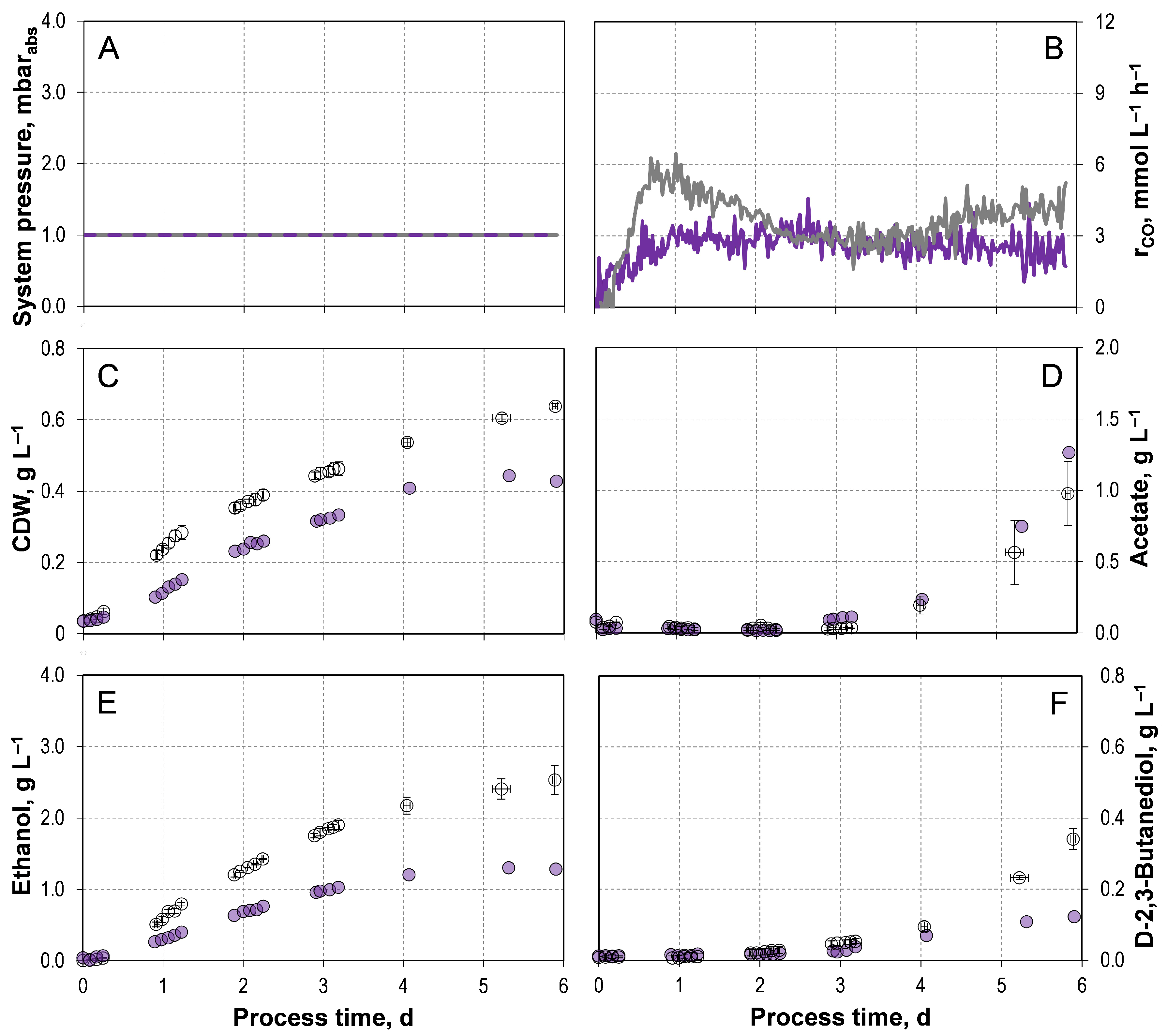
) and without yeast extract () in stirred-tank bioreactors with continuous gassing (artificial gas mixture of N2, CO, CO2, and H2 in a ratio of 39:30:22:9). (Fgas = 5 NL h−1, 37 °C, pH 6.0, and P V−1 = 15.1 W L−1). (A) System pressure; (B) Carbon monoxide uptake rate; (C) Cell dry weight concentration (CDW); (D) Acetate concentration; (E) Ethanol concentration; (F) D-2,3-butanediol concentration. The error bars indicate the minimum and maximum values of two individual autotrophic batch processes.
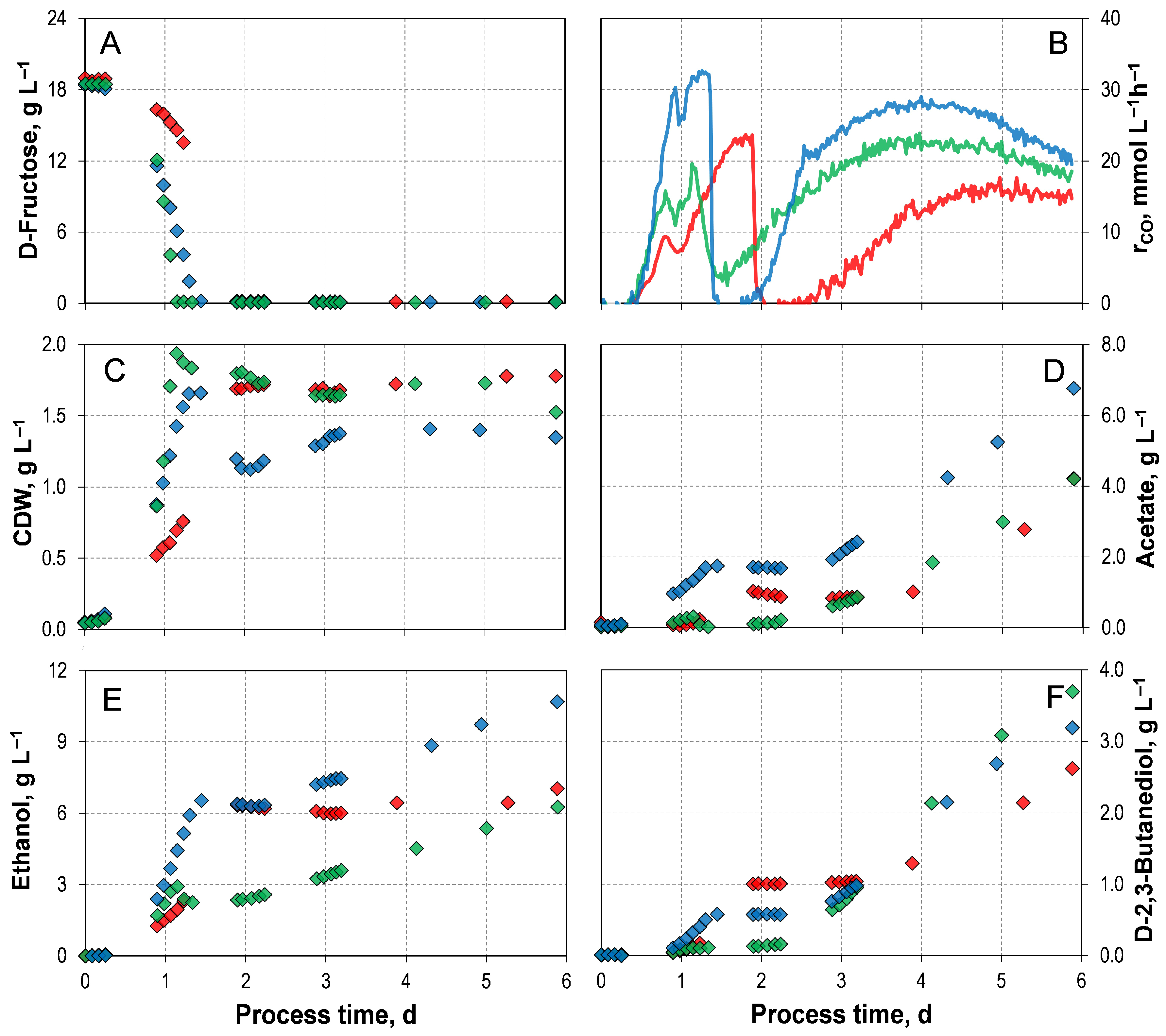
) and without yeast extract () in stirred-tank bioreactors with continuous gassing (artificial gas mixture of N2, CO, CO2, and H2 in a ratio of 39:30:22:9). (Fgas = 5 NL h−1, 37 °C, pH 6.0, and P V−1 = 15.1 W L−1). (A) System pressure; (B) Carbon monoxide uptake rate; (C) Cell dry weight concentration (CDW); (D) Acetate concentration; (E) Ethanol concentration; (F) D-2,3-butanediol concentration. The error bars indicate the minimum and maximum values of two individual autotrophic batch processes. ), mixotrophic pre-cultures (), and heterotrophic pre-cultures () in stirred-tank bioreactors with continuous gassing (390 mbar N2, 300 mbar CO, 220 mbar H2, and 90 mbar CO2). (Fgas = 5 NL h−1, 1.0 barabs, 37 °C, pH 6.0, and P V−1 = 15.1 W L−1). (A) D-Fructose concentration; (B) Carbon monoxide uptake rate; (C) Cell dry weight concentration (CDW); (D) Acetate concentration; (E) Ethanol concentration; (F) D-2,3-butanediol concentration.
), mixotrophic pre-cultures (), and heterotrophic pre-cultures () in stirred-tank bioreactors with continuous gassing (390 mbar N2, 300 mbar CO, 220 mbar H2, and 90 mbar CO2). (Fgas = 5 NL h−1, 1.0 barabs, 37 °C, pH 6.0, and P V−1 = 15.1 W L−1). (A) D-Fructose concentration; (B) Carbon monoxide uptake rate; (C) Cell dry weight concentration (CDW); (D) Acetate concentration; (E) Ethanol concentration; (F) D-2,3-butanediol concentration.
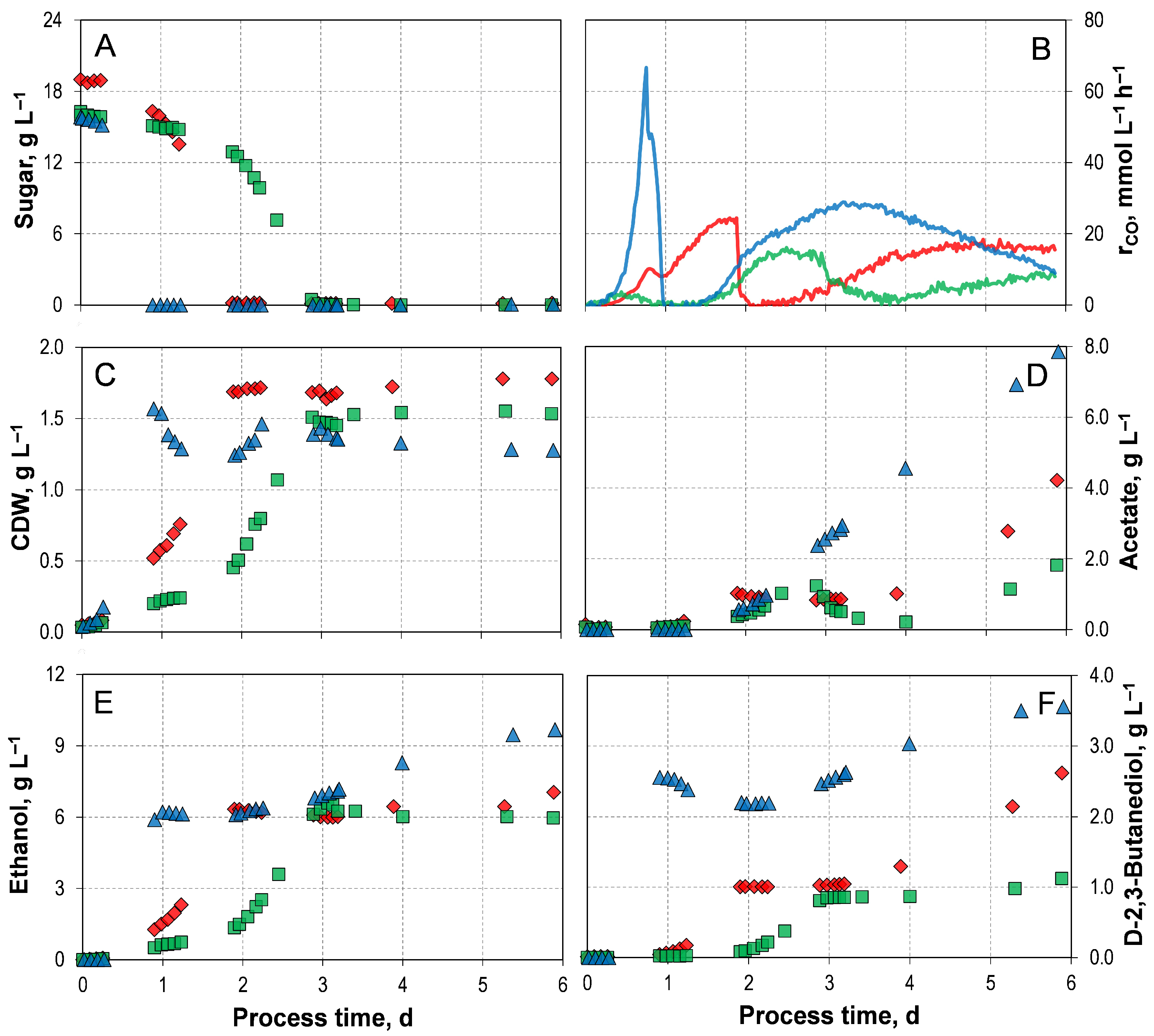
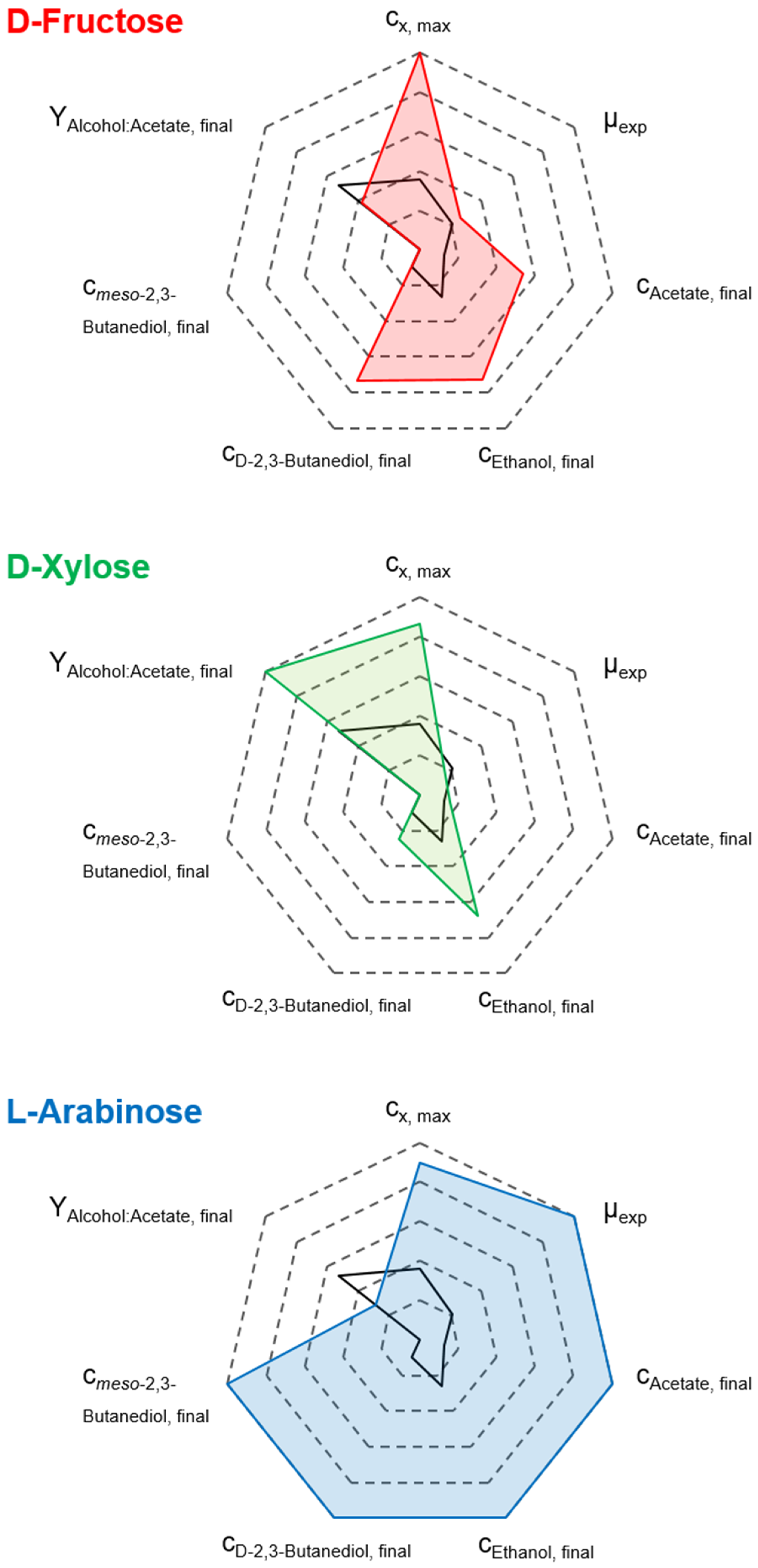
), mixotrophic pre-cultures (), and heterotrophic pre-cultures () in stirred-tank bioreactors with continuous gassing (390 mbar N2, 300 mbar CO, 220 mbar H2, and 90 mbar CO2). (Fgas = 5 NL h−1, 1.0 barabs, 37 °C, pH 6.0, and P V−1 = 15.1 W L−1). (A) D-Fructose concentration; (B) Carbon monoxide uptake rate; (C) Cell dry weight concentration (CDW); (D) Acetate concentration; (E) Ethanol concentration; (F) D-2,3-butanediol concentration. D-Fructose, D-Xylose, and L-Arabinose) using autotrophic pre-cultures in stirred-tank bioreactors with continuous gassing (390 mbar N2, 300 mbar CO, 220 mbar H2, and 90 mbar CO2). (Fgas = 5 NL h−1, 1.0 barabs, 37 °C, pH 6.0, and P V−1 = 15.1 W L−1). (A) Sugar concentration; (B) Carbon monoxide uptake rate; (C) Cell dry weight concentration (CDW); (D) Acetate concentration; (E) Ethanol concentration; (F) D-2,3-butanediol concentration.
D-Fructose, D-Xylose, and L-Arabinose) using autotrophic pre-cultures in stirred-tank bioreactors with continuous gassing (390 mbar N2, 300 mbar CO, 220 mbar H2, and 90 mbar CO2). (Fgas = 5 NL h−1, 1.0 barabs, 37 °C, pH 6.0, and P V−1 = 15.1 W L−1). (A) Sugar concentration; (B) Carbon monoxide uptake rate; (C) Cell dry weight concentration (CDW); (D) Acetate concentration; (E) Ethanol concentration; (F) D-2,3-butanediol concentration.
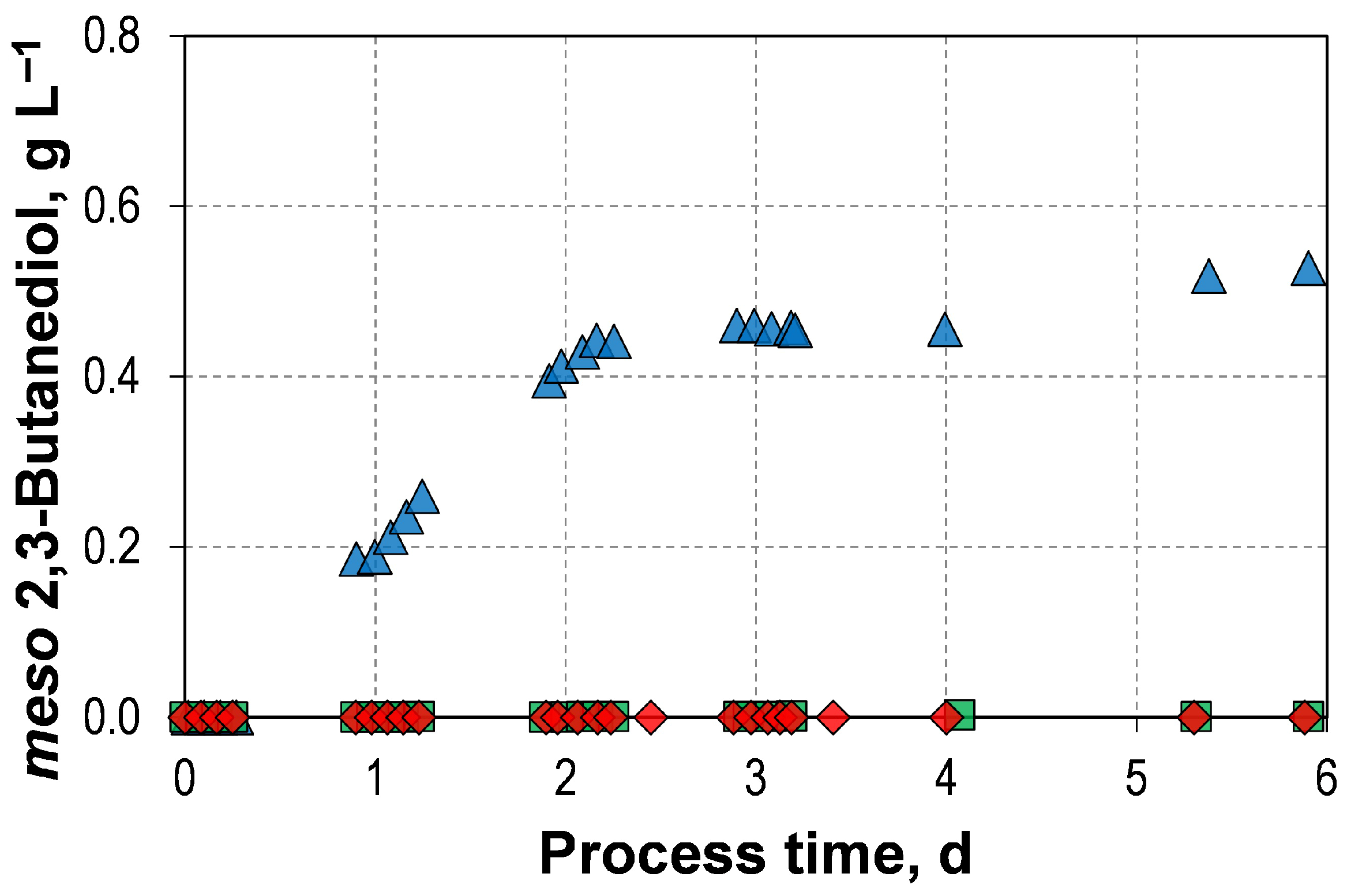
D-Fructose, D-Xylose, and L-Arabinose) using autotrophic pre-cultures in stirred-tank bioreactors with continuous gassing (390 mbar N2, 300 mbar CO, 220 mbar H2, and 90 mbar CO2). (Fgas = 5 NL h−1, 1.0 barabs, 37 °C, pH 6.0, and P V−1 = 15.1 W L−1). (A) Sugar concentration; (B) Carbon monoxide uptake rate; (C) Cell dry weight concentration (CDW); (D) Acetate concentration; (E) Ethanol concentration; (F) D-2,3-butanediol concentration. ) compared to the mixotrophic batch processes with D-Fructose () and D-Xylose () using autotrophic pre-cultures in stirred-tank bioreactors with continuous gassing (390 mbar N2, 300 mbar CO, 220 mbar H2, and 90 mbar CO2). (Fgas = 5 NL h−1, 1.0 barabs, 37 °C, pH 6.0, and P V−1 = 15.1 W L−1).
) compared to the mixotrophic batch processes with D-Fructose () and D-Xylose () using autotrophic pre-cultures in stirred-tank bioreactors with continuous gassing (390 mbar N2, 300 mbar CO, 220 mbar H2, and 90 mbar CO2). (Fgas = 5 NL h−1, 1.0 barabs, 37 °C, pH 6.0, and P V−1 = 15.1 W L−1).
) compared to the mixotrophic batch processes with D-Fructose () and D-Xylose () using autotrophic pre-cultures in stirred-tank bioreactors with continuous gassing (390 mbar N2, 300 mbar CO, 220 mbar H2, and 90 mbar CO2). (Fgas = 5 NL h−1, 1.0 barabs, 37 °C, pH 6.0, and P V−1 = 15.1 W L−1).


| Clostridium autoethanogenum | JA1-1 (*) Min/Max | LAbrini Min/Max | LAbrini (Without YE) |
|---|---|---|---|
| Yeast extract, g L−1 | 1.0 | 1.0 | - |
| µexpt, h−1 | 0.06 | 0.08–0.09 | 0.06 |
| CDW, g L−1 | 0.49–0.54 | 0.63–0.65 | 0.44 |
| cAcetate,final, g L−1 | 1.11–1.15 | 0.75–1.20 | 1.27 |
| cEthanol,final, g L−1 | 2.62–2.77 | 2.33–2.74 | 1.30 |
| cD-2,3-Butanediol,final, g L−1 | 0.31–0.32 | 0.31–0.37 | 0.12 |
| RatioAlcohol,final:Acetatefinal, g g−1 | 2.64–2.68 | 2.20–4.14 | 1.12 |
| Carbon in medium, mmol C L−1 | 9.94 | 9.94 | 0.90 |
| Carbon in biomass, mmol C L−1 | 15.67–17.10 | 21.03–21.55 | 14.79 |
| Carbon in products, mmol C L−1 | 147.15–160.19 | 144.61–148.17 | 101.83 |
| CO consumption, mmol C L−1 | 626.31–652.06 | 598.16–632.37 | 359.09 |
| CO2 production, mmol C L−1 | 400.96–438.80 | 443.41–445.97 | 212.00 |
| CO cons./CO2 prod., - | 1.49–1.56 | 1.34–1.41 | 1.69 |
| CO consumptionmax, mmol L h−1 | 7.91–8.15 | 6.45–8.70 | 4.56 |
| C-balance (recovery), % | 90.66–91.10 | 96.44–99.82 | 91.29 |
| CD-Fructose,initial, g L−1 | 0 Min/Max | 19.0 | 18.7 | 18.5 |
|---|---|---|---|---|
| Pre-culture | autotrophic | autotrophic | mixotrophic | heterotrophic |
| µexp, h−1 | 0.08–0.09 | 0.11 | 0.26 | 0.15 |
| CDW, g L−1 | 0.63–0.65 | 1.78 | 1.94 | 1.66 |
| cAcetate,final, g L−1 | 0.75–1.20 | 4.22 | 4.20 | 6.77 |
| cEthanol,final, g L−1 | 2.33–2.74 | 7.05 | 6.27 | 10.69 |
| cD-2,3-Butanediol,final, g L−1 | 0.31–0.37 | 2.62 | 3.70 | 3.19 |
| RatioAlcohol,final:Acetate,final, g g−1 | 2.20–4.14 | 2.29 | 2.37 | 2.05 |
| Carbon in medium, mmol C L−1 | 9.94 | 9.94 | 9.94 | 9.94 |
| Carbon in biomass, mmol C L−1 | 21.03–21.55 | 59.32 | 64.60 | 55.35 |
| Carbon in products, mmol C L−1 | 144.61–148.17 | 493.85 | 452.88 | 731.65 |
| CO consumption, mmol C L−1 | 598.16–632.37 | 1699.65 | 2146.33 | 2644.26 |
| CO2 production, mmol C L−1 | 443.41–445.97 | 1317.44 | 1723.32 | 2194.71 |
| CO cons./CO2 prod., - | 1.34–1.41 | 1.04 | 1.25 | 1.20 |
| CO consumptionmax, mmol L h−1 | 6.45–8.70 | 26.02 | 23.88 | 32.64 |
| C-balance (recovery), % | 96.44–99.82 | 91.88 | 104.40 | 90.58 |
| csugar,initial, g L−1 | 0 Min/Max | 19.0 D-Fructose | 16.3 D-Xylose | 15.9 L-Arabinose |
|---|---|---|---|---|
| µexp, h−1 | 0.08–0.09 | 0.11 | 0.07 | 0.42 |
| CDW, g L−1 | 0.63–0.65 | 1.78 | 1.54 | 1.60 |
| cAcetate,final, g L−1 | 0.75–1.20 | 4.22 | 1.24 | 7.86 |
| cEthanol,final, g L−1 | 2.33–2.74 | 7.05 | 6.59 | 9.68 |
| cD-2,3-Butanediol,final, g L−1 | 0.31–0.37 | 2.62 | 0.89 | 3.56 |
| cmeso 2,3-Butanediol,final, g L−1 | 0.00 | 0.00 | 0.00 | 0.53 |
| RatioAlcohol,final:Acetatefinal, g g−1 | 2.20–4.14 | 2.29 | 6.04 | 1.75 |
| Carbon in medium, mmol C L−1 | 9.94 | 9.94 | 9.94 | 9.94 |
| Carbon in biomass, mmol C L−1 | 21.03–21.55 | 59.32 | 51.76 | 52.30 |
| Carbon in products, mmol C L−1 | 144.61–148.17 | 493.85 | 365.44 | 824.97 |
| CO consumption, mmol C L−1 | 598.16–632.37 | 1699.65 | 747.10 | 2376.87 |
| CO2 production, mmol C L−1 | 443.41–445.97 | 1317.44 | 819.54 | 1799.90 |
| CO cons./CO2 prod., - | 1.34–1.41 | 1.04 | 0.91 | 1.32 |
| CO consumptionmax, mmol L h−1 | 6.45–8.70 | 26.02 | 16.11 | 66.34 |
| C-balance (recovery), % | 96.44–99.82 | 91.88 | 96.47 | 91.13 |
Disclaimer/Publisher’s Note: The statements, opinions and data contained in all publications are solely those of the individual author(s) and contributor(s) and not of MDPI and/or the editor(s). MDPI and/or the editor(s) disclaim responsibility for any injury to people or property resulting from any ideas, methods, instructions or products referred to in the content. |
© 2026 by the authors. Licensee MDPI, Basel, Switzerland. This article is an open access article distributed under the terms and conditions of the Creative Commons Attribution (CC BY) license.
Share and Cite
Oppelt, A.; Nguyen, T.Y.N.; Zhang, Y.; Weuster-Botz, D. Autotrophic and Mixotrophic Batch Processes with Clostridium autoethanogenum LAbrini in Stirred Tank Bioreactors with Continuous Gassing. Microorganisms 2026, 14, 175. https://doi.org/10.3390/microorganisms14010175
Oppelt A, Nguyen TYN, Zhang Y, Weuster-Botz D. Autotrophic and Mixotrophic Batch Processes with Clostridium autoethanogenum LAbrini in Stirred Tank Bioreactors with Continuous Gassing. Microorganisms. 2026; 14(1):175. https://doi.org/10.3390/microorganisms14010175
Chicago/Turabian StyleOppelt, Anne, Tran Yen Nhi Nguyen, Yaodan Zhang, and Dirk Weuster-Botz. 2026. "Autotrophic and Mixotrophic Batch Processes with Clostridium autoethanogenum LAbrini in Stirred Tank Bioreactors with Continuous Gassing" Microorganisms 14, no. 1: 175. https://doi.org/10.3390/microorganisms14010175
APA StyleOppelt, A., Nguyen, T. Y. N., Zhang, Y., & Weuster-Botz, D. (2026). Autotrophic and Mixotrophic Batch Processes with Clostridium autoethanogenum LAbrini in Stirred Tank Bioreactors with Continuous Gassing. Microorganisms, 14(1), 175. https://doi.org/10.3390/microorganisms14010175