Editorial

Editorial for Special Issue “Phytopathogens: Detection and Control”


Department of Forest Protection, Forest Research Institute, Braci Leśnej 3, 05-090 Sękocin Stary, Poland
Microorganisms 2025, 13(12), 2873; https://doi.org/10.3390/microorganisms13122873
Submission received: 8 November 2025 / Revised: 24 November 2025 / Accepted: 2 December 2025 / Published: 18 December 2025
(This article belongs to the Special Issue Phytopathogens: Detection and Control)
Plant diseases caused by a wide range of pathogens—including fungi, bacteria, viruses, and fungus-like organisms (oomycetes)—represent one of the most significant threats to global food security, agricultural sustainability, and ecosystem balance. Crop intensification, globalization of trade, and climate change all facilitate the rapid dissemination of pathogenic agents and accelerate their evolution toward greater virulence and resistance to conventional control strategies. Against this backdrop, this Special Issue, “Plant Pathogens: Detection and Control,” highlights recent advances in the identification, monitoring, and management of plant pathogens, with an emphasis on rapid, precise, and field-deployable diagnostic tools.
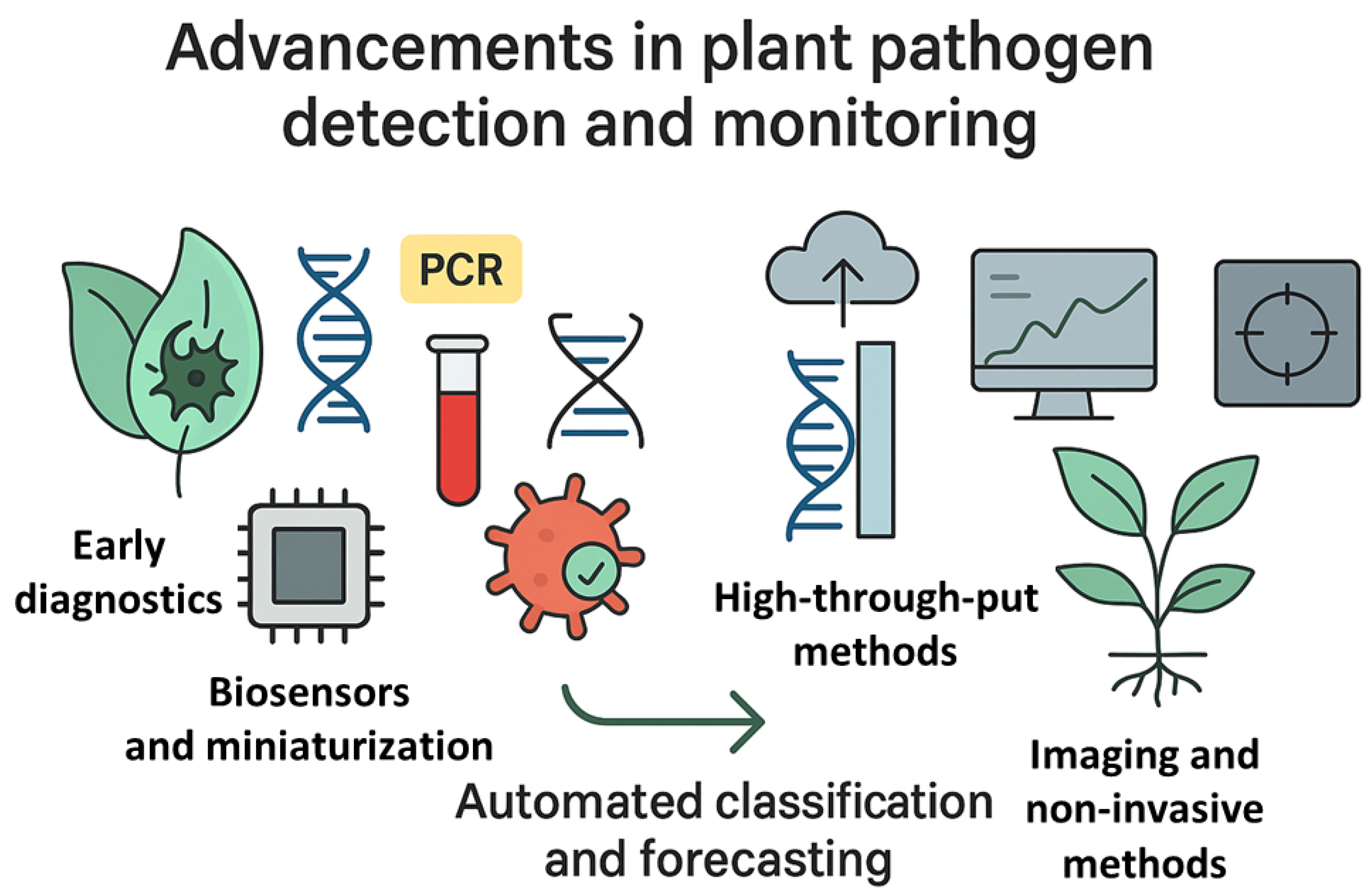
Recent studies indicate several particularly promising directions of development. Early diagnostics has become a focal area, dominated by molecular approaches based on PCR and its quantitative derivatives, as well as isothermal amplification techniques such as LAMP and RPA, increasingly coupled with CRISPR-Cas systems [1]. These innovations enable pathogen detection prior to the onset of visible symptoms, which is critical for minimizing crop losses. In parallel, biosensors and miniaturized analytical platforms are emerging, utilizing nanomaterials and optoelectronic systems. When integrated with mobile applications, these technologies allow for rapid and relatively low-cost testing directly under field conditions [2]. High-throughput methods—including next-generation sequencing, metagenomics, and digital PCR—are also gaining prominence. These techniques not only facilitate the detection of pathogens that are difficult to identify using traditional approaches but also provide insights into their genetic variability and evolutionary dynamics [3]. Complementary progress is being made in non-invasive imaging methods such as spectroscopy, thermography, and multispectral imaging [4]. Their advantage lies in the ability to monitor plant physiological status prior to symptom expression. Coupled with machine learning algorithms, such methods pave the way for automated classification of threats and forecasting of epidemic dynamics. Together, these approaches bring us closer to fully integrated decision-support systems that combine diagnostic and environmental data, enabling growers to respond rapidly and accurately (Figure 1).
Yet detection is only the first step; sustainable and effective disease control remains equally critical. Increasing attention is being directed toward integrated management strategies that combine conventional chemical control with biological antagonists, biofungicides, resistant cultivars, and nanomaterial-based technologies [5]. Such multifaceted approaches reduce selection pressure, limit pesticide use, minimize environmental impact, and enhance the durability of crop protection. Nonetheless, implementation faces important challenges, including high costs of equipment and reagents, lack of methodological standardization, and difficulties in transferring laboratory-based protocols into field practice. Environmental complexity poses an additional obstacle: many diseases are caused by multiple pathogens simultaneously, while mixed and latent infections complicate the interpretation of diagnostic results [6].
The future of plant pathogens research thus requires continued integration of expertise across disciplines—including molecular biology, bioinformatics, materials engineering, and agricultural sciences—to develop diagnostic and control tools that are sensitive, accessible, and user-friendly. This Special Issue, “Plant Pathogens: Detection and Control,” seeks not only to provide a state-of-the-art overview but also to inspire innovation in plant pathology research. By advancing the understanding of infection mechanisms, improving diagnostic workflows, and fostering sustainable control strategies, the contributions presented here aim to strengthen crop protection and global food security in an environmentally responsible manner.

Data Availability Statement

Not applicable.

Conflicts of Interest

The author declares no conflicts of interest.

List of Contributions

“Plant Pathogens: Detection and Control” presents a diverse collection of studies addressing plant pathogens, their diagnostics, and their impact on both agricultural crops and forest ecosystems. The articles explore bacterial contributions to oak decline in forest environments, the development of highly specific immunoassays for the detection of priority pathogens, and the characterization of emerging threats such as rosemary dieback caused by Phytophthora pseudocryptogea, a new bacterial leaf disease of rice associated with Pantoea species, and the growing challenge posed by Phytophthora plurivora in walnut cultivation.
Taken together, these contributions highlight the breadth of phytopathological challenges—from diseases affecting forest trees and medicinal plants to those threatening staple cereals and fruit crops. They emphasize the urgent need for innovative diagnostic approaches and integrated management strategies that can keep pace with evolving pathogens. Beyond advancing the scientific understanding of pathogen biology and epidemiology, the findings also point toward practical solutions for agriculture and forestry, supporting the development of more effective and sustainable plant disease control.
  • Tkaczyk, M.; Sikora, K. The Role of Bacteria in Acute Oak Decline in South-West Poland. Microorganisms 2024, 12, 993.
  • Safenkova, I.V.; Galushka, P.A.; Varitsev, Y.A.; Kamionskaya, M.V.; Drenova, N.V.; Vasilyeva, A.A.; Zherdev, A.V.; Uskov, A.I.; Dzantiev, B.B. Highly Targeted Detection of Priority Phytopathogen Pectobacterium brasiliense: From Obtaining Polyclonal Antibodies to Development and Approbation of Enzyme-Linked Immunoassay and Lateral Flow Immunoassay. Microorganisms 2024, 12, 2436.
  • Benigno, A.; Aglietti, C.; Cacciola, S.O.; Moricca, S. Morphological, Molecular and Pathological Characterization of Phytophthora pseudocryptogea Associated with Rosmarinus officinalis Dieback in Tuscany, Central Italy. Microorganisms 2025, 13, 567. https://doi.org/10.3390/microorganisms13030567.
  • Duan, G.; Liu, X.; Zhang, S.; Chai, M.; Peng, Z.; Lin, Z.; Li, D.; Sun, W. An Emerging Bacterial Leaf Disease in Rice Caused by Pantoea ananatis and Pantoea eucalypti in Northeast China. Microorganisms 2025, 13, 1376. https://doi.org/10.3390/microorganisms13061376.
  • Benigno, A.; Papini, V.; La Spada, F.; Rizzo, D.; Cacciola, S.O.; Moricca, S. Phytophthora plurivora: A Serious Challenge for English Walnut (Juglans regia) Cultivation in Europe. Microorganisms 2025, 13, 2094. https://doi.org/10.3390/microorganisms13092094.

References

  1. Hariharan, G.; Prasannath, K. Recent advances in molecular diagnostics of fungal plant pathogens: A mini review. Front. Cell. Infect. Microbiol. 2021, 10, 600234. [Google Scholar] [CrossRef] [PubMed]
  2. Yadav, A.; Yadav, K. Portable solutions for plant pathogen diagnostics: Development, usage, and future potential. Front. Microbiol. 2025, 16, 1516723. [Google Scholar] [CrossRef] [PubMed]
  3. Patela, R.; Mitrab, B.; Vinchurkarc, M.; Adamib, A.; Patkarc, R.; Giacomozzib, F.; Lorenzellib, L.; Baghin, M. A review of recent advances in plant-pathogen detection systems. Heliyon 2022, 8, e11855. [Google Scholar] [CrossRef] [PubMed]
  4. Venbrux, M.; Crauwels, S.; Rediers, H. Current and emerging trends in techniques for plant pathogen detection. Front. Plant Sci. 2023, 14, 1120968. [Google Scholar] [CrossRef] [PubMed]
  5. Oszust, K.; Szpilska, K.; Gryta, A.; Panek, J.; Pylak, M.; Lipa, T.; Frąc, M. New biotechnological solutions in biocontrol and molecular diagnostics of Neofabraea spp. in apples—A review. Postharvest Biol. Technol. 2023, 204, 112442. [Google Scholar] [CrossRef]
  6. Denman, S.; Brown, N.; Vanguelova, E.; Crampton, B. Temperate Oak Declines: Biotic and Abiotic Predisposition Drivers; Academic Press: Cambridge, MA, USA, 2022; pp. 239–263. [Google Scholar] [CrossRef]
Figure 1. Key directions in the development of plant pathogen diagnostics and monitoring: from early molecular diagnostics, through biosensors and miniaturized technologies, high-throughput methods, and non-invasive imaging, to integrated systems for classification and epidemic forecasting.
Microorganisms 13 02873 g001
Disclaimer/Publisher’s Note: The statements, opinions and data contained in all publications are solely those of the individual author(s) and contributor(s) and not of MDPI and/or the editor(s). MDPI and/or the editor(s) disclaim responsibility for any injury to people or property resulting from any ideas, methods, instructions or products referred to in the content.