Soil Microbial Life History Strategies Drive Microbial Carbon Use Efficiency Following Afforestation


Abstract
1. Introduction
2. Materials and Methods
2.1. Site Description and Sampling
2.2. Soil Properties Analysis
2.2.1. Soil Physical and Chemical Analyses
2.2.2. Soil Microbial Biomass and Enzyme Activity Analysis
2.3. Microbial CUE
2.4. DNA Extraction, Sequencing, and Data Processing
2.5. Metagenome Assembly and Life History Strategy
2.6. Statistical Analyses
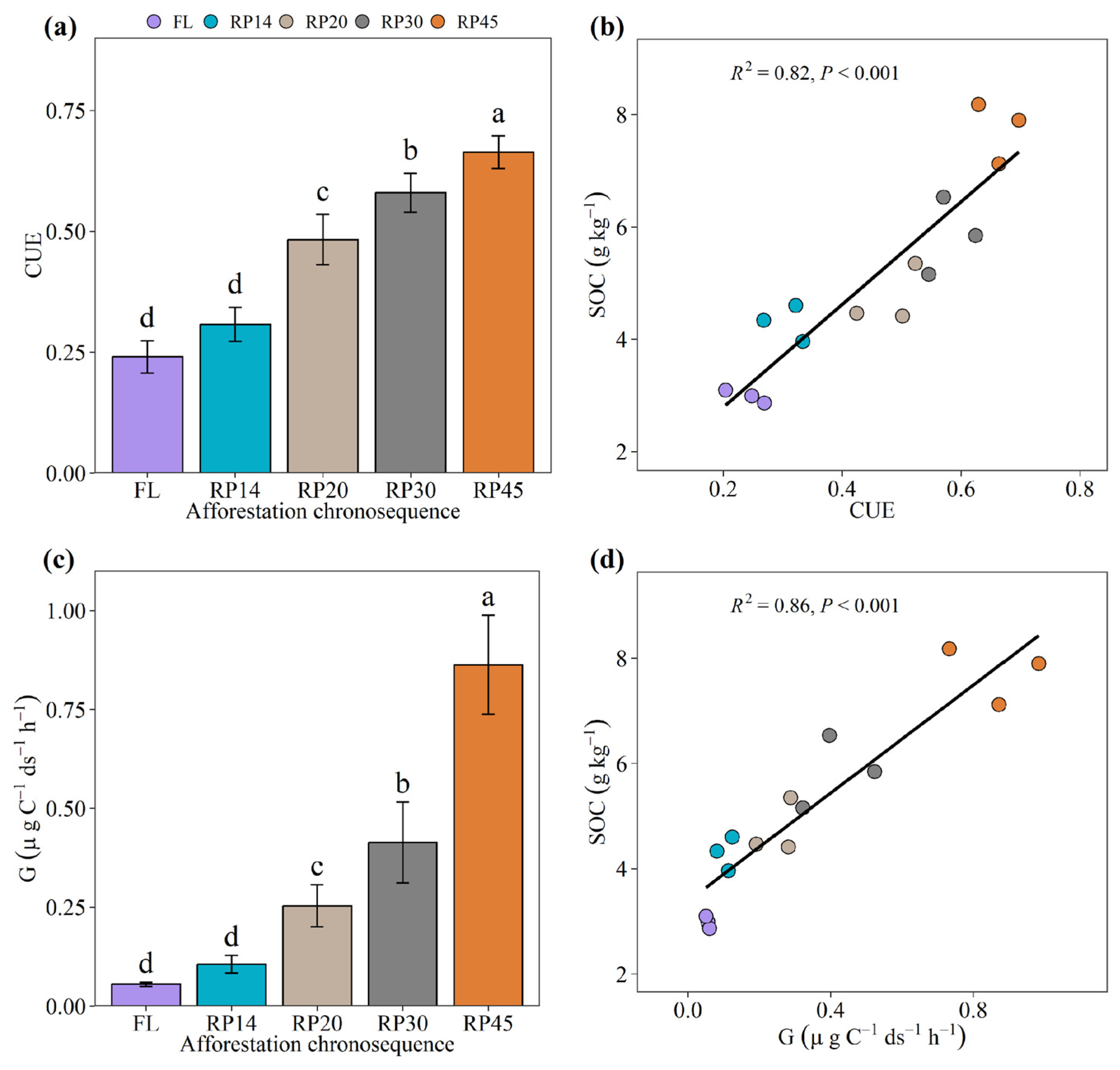
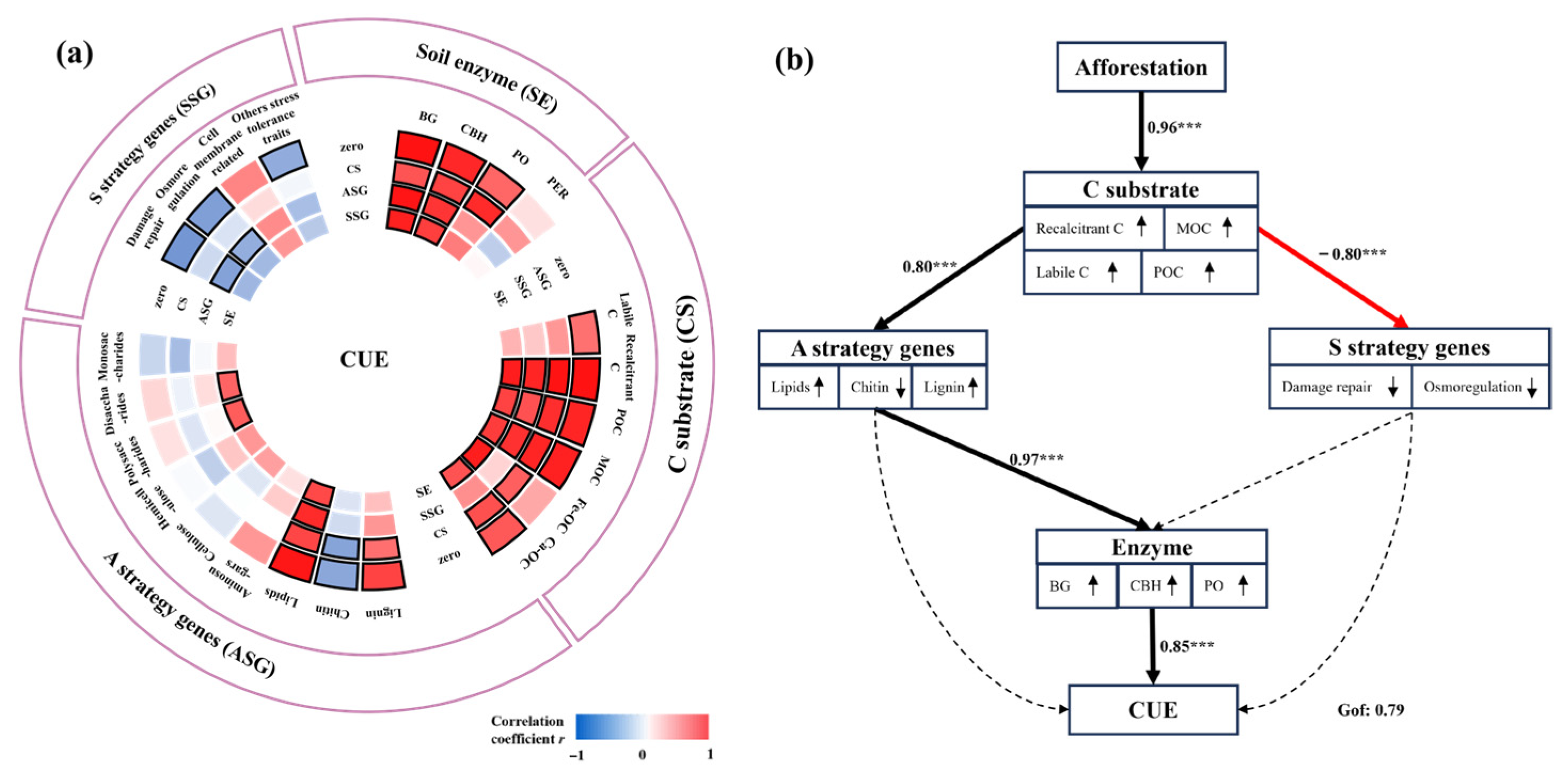
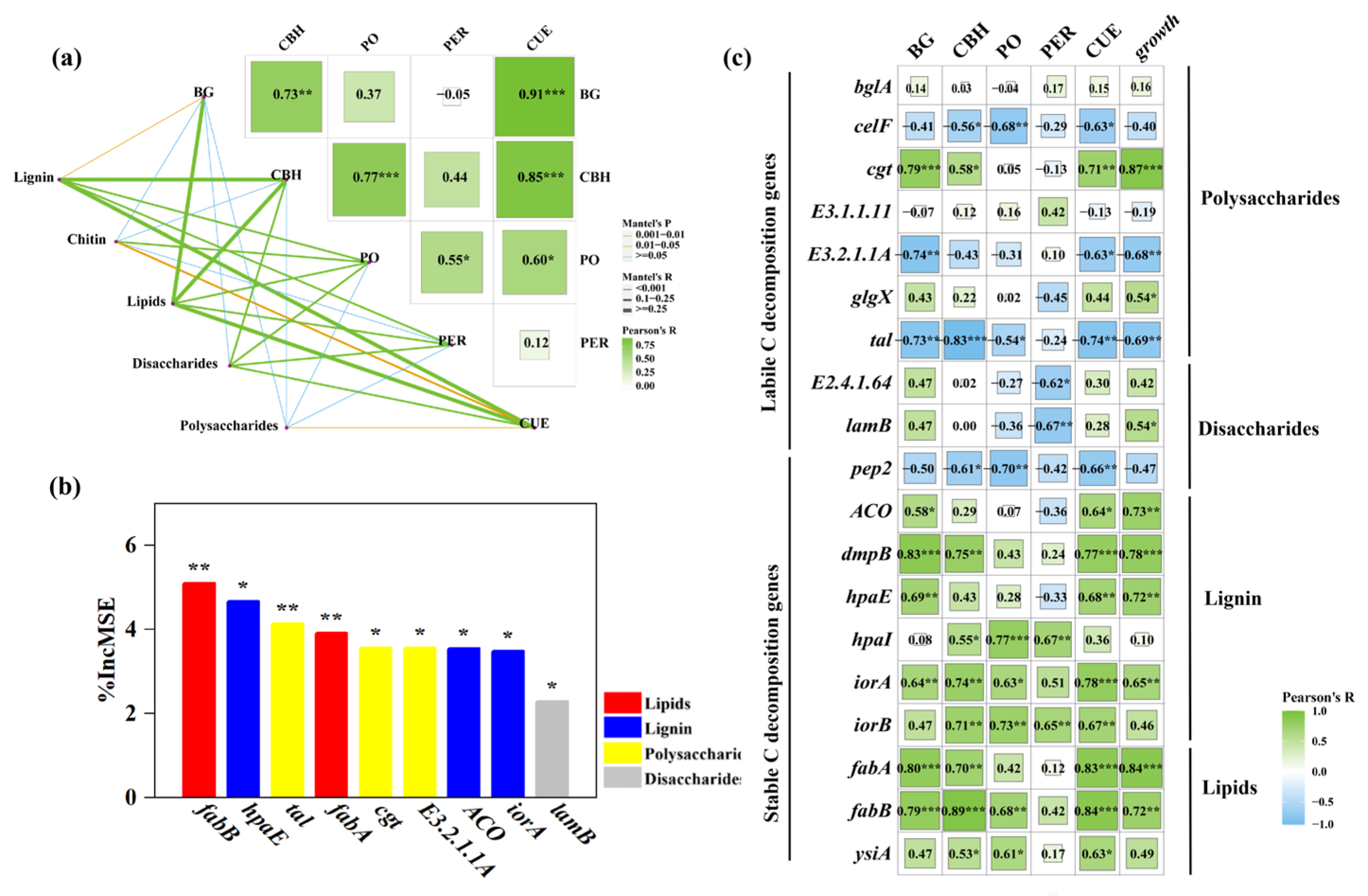
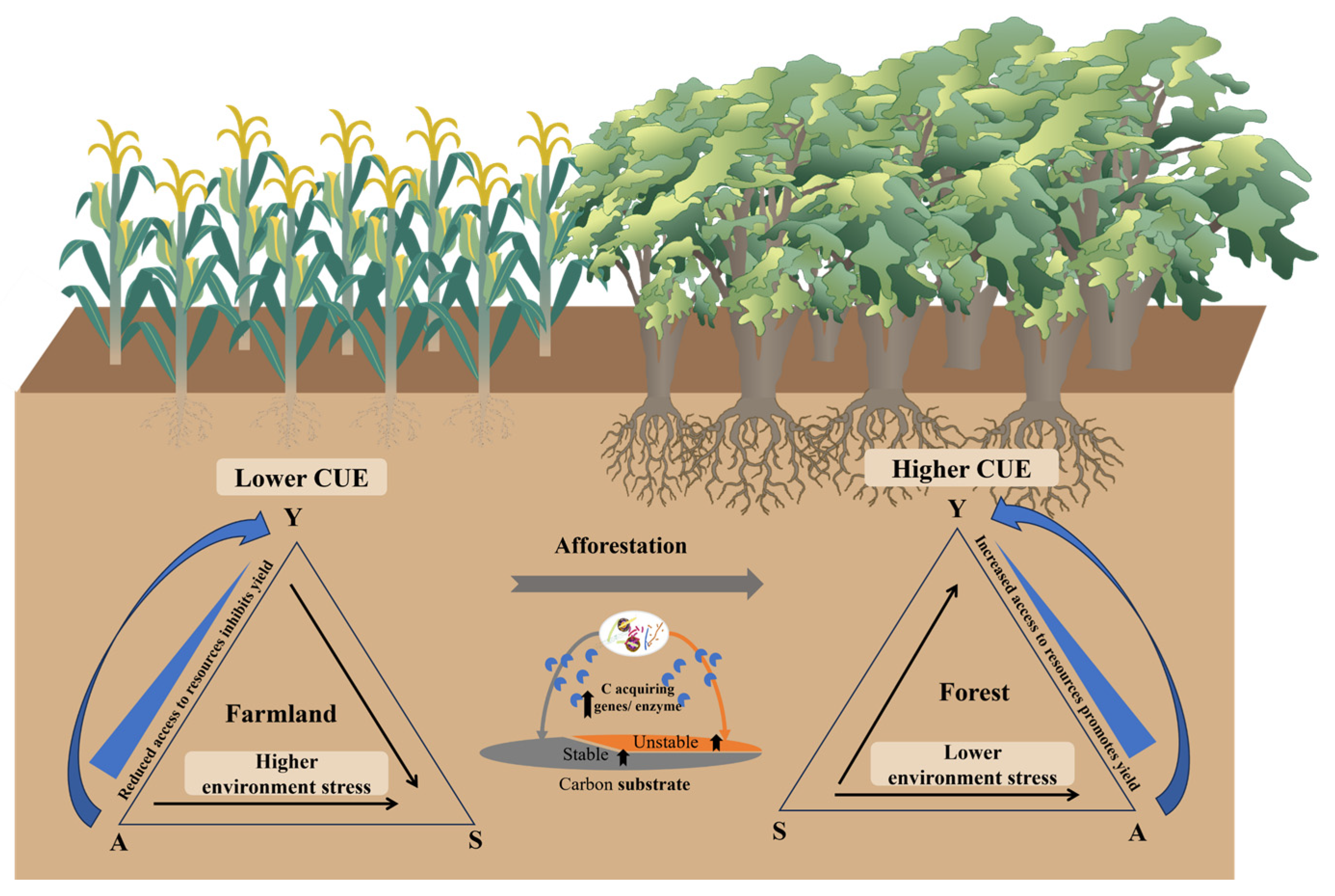
3. Result and Discussion
4. Conclusions
Supplementary Materials
Author Contributions
Funding
Institutional Review Board Statement
Informed Consent Statement
Data Availability Statement
Acknowledgments
Conflicts of Interest
Abbreviations
| CUE | N mineralization rates |
| SOC | Soil organic C |
| TN | Total N |
| MAT | Mean annual temperature |
| MAP | Mean annual precipitation |
| BD | Soil bulk density |
Appendix A. Method for the Determination of Ca-OC and Caexe
Appendix B. Method for the Determination of Fe-OC and Fed
References
- Jackson, R.B.; Lajtha, K.; Crow, S.E.; Hugelius, G.; Kramer, M.G.; Piñeiro, G. The ecology of soil carbon: Pools, vulnerabilities, and biotic and abiotic controls. Annu. Rev. Ecol. Evol. Syst. 2017, 48, 419–445. [Google Scholar] [CrossRef]
- Duan, P.; Fu, R.; Nottingham, A.T.; Domeignoz-Horta, L.A.; Yang, X.; Du, H.; Wang, K.; Li, D. Tree species diversity increases soil microbial carbon use efficiency in a subtropical forest. Glob. Change Biol. 2023, 29, 7131–7144. [Google Scholar] [CrossRef]
- Tao, F.; Huang, Y.Y.; Hungate, B.A.; Manzoni, S.; Frey, S.D.; Schmidt, M.W.I.; Reichstein, M.; Carvalhais, N.; Ciais, P.; Jiang, L.F.; et al. Microbial carbon use efficiency promotes global soil carbon storage. Nature 2023, 618, 981–985. [Google Scholar] [CrossRef]
- Melillo, J.M.; Frey, S.D.; De Angelis, K.M.; Werner, W.J.; Bernard, M.J.; Bowles, F.P.; Pold, G.; Knorr, M.A.; Grandy, A.S. Long-term pattern and magnitude of soil carbon feedback to the climate system in a warming world. Science 2017, 358, 101–104. [Google Scholar] [CrossRef] [PubMed]
- Kallenbach, C.M.; Frey, S.D.; Grandy, A.S. Direct evidence for microbial-derived soil organic matter formation and its ecophysiological controls. Nat. Commun. 2016, 7, 13630, Erratum in Nat. Commun. 2018, 9, 3929. [Google Scholar] [CrossRef] [PubMed]
- Domeignoz-Horta, L.A.; Pold, G.; Liu, X.J.A.; Frey, S.D.; Melillo, J.M.; DeAngelis, K.M. Microbial diversity drives carbon use efficiency in a model soil. Nat. Commun. 2020, 11, 3684. [Google Scholar] [CrossRef]
- Simon, E.; Canarini, A.; Martin, V.; Séneca, J.; Böckle, T.; Reinthaler, D.; Pötsch, E.M.; Piepho, H.P.; Bahn, M.; Wanek, W.; et al. Microbial growth and carbon use efficiency show seasonal responses in a multifactorial climate change experiment. Commun. Biol. 2020, 3, 584. [Google Scholar] [CrossRef]
- Feng, X.H.; Qin, S.Q.; Zhang, D.Y.; Chen, P.D.; Hu, J.; Wang, G.Q.; Liu, Y.; Wei, B.; Li, Q.L.; Yang, Y.H.; et al. Nitrogen input enhances microbial carbon use efficiency by altering plant-microbe-mineral interactions. Glob. Change Biol. 2022, 28, 4845–4860. [Google Scholar] [CrossRef]
- Malik, A.A.; Puissant, J.; Buckeridge, K.M.; Goodall, T.; Jehmlich, N.; Chowdhury, S.; Gweon, H.S.; Peyton, J.M.; Mason, K.E.; van Agtmaal, M.; et al. Land use driven change in soil pH affects microbial carbon cycling processes. Nat. Commun. 2018, 9, 3591. [Google Scholar] [CrossRef] [PubMed]
- Lipson, D.A. The complex relationship between microbial growth rate and yield and its implications for ecosystem processes. Front. Microbiol. 2015, 6, 615. [Google Scholar] [CrossRef]
- Molenaar, D.; van Berlo, R.; de Ridder, D.; Teusink, B. Shifts in growth strategies reflect tradeoffs in cellular economics. Mol. Syst. Biol. 2009, 5, 323. [Google Scholar] [CrossRef]
- Fierer, N. Embracing the unknown: Disentangling the complexities of the soil microbiome. Nat. Rev. Microbiol. 2017, 15, 579–590. [Google Scholar] [CrossRef]
- Malik, A.A.; Martiny, J.B.H.; Brodie, E.L.; Martiny, A.C.; Treseder, K.K.; Allison, S.D. Defining trait-based microbial strategies with consequences for soil carbon cycling under climate change. ISME J. 2020, 14, 1–9. [Google Scholar] [CrossRef]
- Piton, G.; Allison, S.D.; Bahram, M.; Hildebrand, F.; Martiny, J.B.H.; Treseder, K.K.; Martiny, A.C. Life history strategies of soil bacterial communities across global terrestrial biomes. Nat. Microbiol. 2023, 8, 2093–2102. [Google Scholar] [CrossRef]
- Geyer, K.M.; Kyker-Snowman, E.; Grandy, A.S.; Frey, S.D. Microbial carbon use efficiency: Accounting for population, community, and ecosystem-scale controls over the fate of metabolized organic matter. Biogeochemistry 2016, 127, 173–188. [Google Scholar] [CrossRef]
- Ren, C.J.; Zhang, X.Y.; Zhang, S.H.; Wang, J.Y.; Xu, M.P.; Guo, Y.X.; Wang, J.; Han, X.H.; Zhao, F.Z.; Yang, G.H.; et al. Altered microbial CAZyme families indicated dead biomass decomposition following afforestation. Soil Biol. Biochem. 2021, 160, 108362. [Google Scholar] [CrossRef]
- Zhong, Z.K.; Li, W.J.; Lu, X.Q.; Gu, Y.Q.; Wu, S.J.; Shen, Z.Y.; Han, X.H.; Yang, G.H.; Ren, C.J. Adaptive pathways of soil microorganisms to stoichiometric imbalances regulate microbial respiration following afforestation in the Loess Plateau, China. Soil Biol. Biochem. 2020, 151, 108048. [Google Scholar] [CrossRef]
- Bao, S. Soil Analysis Manual, 3rd ed.; China Agriculture Press: Beijing, China, 2005. [Google Scholar]
- Cotrufo, M.F.; Ranalli, M.G.; Haddix, M.L.; Six, J.; Lugato, E. Soil carbon storage informed by particulate and mineral-associated organic matter. Nat. Geosci. 2019, 12, 989–994. [Google Scholar] [CrossRef]
- Wei, Z.Q.; Ji, J.H.; Li, Z.; Yan, X. Changes in organic carbon content and its physical and chemical distribution in paddy soils cultivated under different fertilisation practices. J. Soils Sediments 2017, 17, 2011–2018. [Google Scholar] [CrossRef]
- Liu, F.P.; Liu, H.Q.; Zhou, H.L.; Dong, Z.G.; Bai, X.H.; Bai, P.; Qiao, J.J. Isolation and characterization of phosphate-solubilizing bacteria from betel nut (Areca catechu) and their effects on plant growth and phosphorus mobilization in tropical soils. Biol. Fertil. Soils 2014, 50, 927–937. [Google Scholar] [CrossRef]
- Lalonde, K.; Mucci, A.; Ouellet, A.; Gélinas, Y. Preservation of organic matter in sediments promoted by iron. Nature 2012, 483, 198–200. [Google Scholar] [CrossRef] [PubMed]
- Ren, C.J.; Kang, D.; Wu, J.P.; Zhao, F.Z.; Yang, G.H.; Han, X.H.; Feng, Y.Z.; Ren, G.X. Temporal variation in soil enzyme activities after afforestation in the loess plateau, china. Geoderma 2016, 282, 103–111. [Google Scholar] [CrossRef]
- Saiya-Cork, K.R.; Sinsabaugh, R.L.; Zak, D.R. The effects of long term nitrogen deposition on extracellular enzyme activity in an acer saccharum, forest soil. Soil Biol. Biochem. 2002, 34, 1309–1315. [Google Scholar] [CrossRef]
- Martin, M. Cutadapt removes adapter sequences from high-throughput sequencing reads. EMBnet J. 2011, 17, 10–12. [Google Scholar] [CrossRef]
- Chen, S.F.; Zhou, Y.Q.; Chen, Y.R.; Gu, J. fastp: An ultra-fast all-in-one FASTQ preprocessor. Bioinformatics 2018, 34, 884–890. [Google Scholar] [CrossRef]
- Li, D.H.; Liu, C.M.; Luo, R.B.; Sadakane, K.; Lam, T.W. MEGAHIT: An ultra-fast single-node solution for large and complex metagenomics assembly via succinct de Bruijn graph. Bioinformatics 2015, 31, 1674–1676. [Google Scholar] [CrossRef]
- Zhu, W.H.; Lomsadze, A.; Borodovsky, M. Ab initio gene identification in metagenomic sequences. Nucleic Acids Res. 2010, 38, e132. [Google Scholar] [CrossRef]
- Karin, E.L.; Mirdita, M.; Söding, J. MetaEuk-sensitive, high-throughput gene discovery, and annotation for large-scale eukaryotic metagenomics. Microbiome 2020, 8, 48. [Google Scholar] [CrossRef]
- Xue, K.; Yuan, M.M.; Shi, Z.J.; Qin, Y.J.; Deng, Y.; Cheng, L.; Wu, L.Y.; He, Z.L.; Van Nostrand, J.D.; Bracho, R.; et al. Tundra soil carbon is vulnerable to rapid microbial decomposition under climate warming. Nat. Clim. Change 2016, 6, 595–600. [Google Scholar] [CrossRef]
- Ren, C.J.; Wang, J.Y.; Bastida, F.; Delgado-Baquerizo, M.; Yang, Y.H.; Wang, J.; Zhong, Z.K.; Zhou, Z.H.; Zhang, S.H.; Guo, Y.X.; et al. Microbial traits determine soil C emission in response to fresh carbon inputs in forests across biomes. Glob. Change Biol. 2022, 28, 1516–1528. [Google Scholar] [CrossRef] [PubMed]
- Li, C.N.; Liao, H.J.; Xu, L.; Wang, C.T.; He, N.P.; Wang, J.M.; Li, X.Z. The adjustment of life history strategies drives the ecological adaptations of soil microbiota to aridity. Mol. Ecol. 2022, 31, 2920–2934. [Google Scholar] [CrossRef]
- Chen, L.Y.; Fang, K.; Wei, B.; Qin, S.Q.; Feng, X.H.; Hu, T.Y.; Ji, C.J.; Yang, Y.H. Soil carbon persistence governed by plant input and mineral protection at regional and global scales. Ecol. Lett. 2021, 24, 1018–1028. [Google Scholar] [CrossRef]
- Doetterl, S.; Stevens, A.; Six, J.; Merckx, R.; Van Oost, K.; Pinto, M.C.; Casanova-Katny, A.; Muñoz, C.; Boudin, M.; Venegas, E.Z.; et al. Soil carbon storage controlled by interactions between geochemistry and climate. Nat. Geosci. 2015, 8, 780–783. [Google Scholar] [CrossRef]
- Genuer, R.; Poggi, J.M.; Tuleau-Malot, C. Variable selection using random forests. Pattern Recognit. Lett. 2010, 31, 2225–2236. [Google Scholar] [CrossRef]
- Zheng, Q.; Hu, Y.T.; Zhang, S.S.; Noll, L.; Böckle, T.; Richter, A.; Wanek, W. Growth explains microbial carbon use efficiency across soils differing in land use and geology. Soil Biol. Biochem. 2019, 128, 45–55. [Google Scholar] [CrossRef] [PubMed]
- Wang, C.; Qu, L.R.; Yang, L.M.; Liu, D.W.; Morrissey, E.; Miao, R.H.; Liu, Z.P.; Wang, Q.K.; Fang, Y.T.; Bai, E. Large-scale importance of microbial carbon use efficiency and necromass to soil organic carbon. Glob. Change Biol. 2021, 27, 2039–2048. [Google Scholar] [CrossRef] [PubMed]
- Liang, C.; Schimel, J.P.; Jastrow, J.D. The importance of anabolism in microbial control over soil carbon storage. Nat. Microbiol. 2017, 2, 17105. [Google Scholar] [CrossRef]
- Allison, S.D. Microbial drought resistance may destabilize soil carbon. Trends Microbiol. 2023, 31, 780–787. [Google Scholar] [CrossRef] [PubMed]
- Manzoni, S.; Schaeffer, S.M.; Katul, G.; Porporato, A.; Schimel, J.P. A theoretical analysis of microbial eco-physiological and diffusion limitations to carbon cycling in drying soils. Soil Biol. Biochem. 2014, 73, 69–83. [Google Scholar] [CrossRef]
- Lashermes, G.; Gainvors-Claisse, A.; Recous, S.; Bertrand, I. Enzymatic Strategies and Carbon Use Efficiency of a Litter-Decomposing Fungus Grown on Maize Leaves, Stems, and Roots. Front. Microbiol. 2016, 7, 1315. [Google Scholar] [CrossRef]
- Kleber, M.; Eusterhues, K.; Keiluweit, M.; Mikutta, C.; Mikutta, R.; Nico, P.S. Mineral-Organic Associations: Formation, Properties, and Relevance in Soil Environments. In Advances in Agronomy; Sparks, D.L., Ed.; Elsevier: Amsterdam, The Netherlands, 2015; Volume 130, pp. 1–140. [Google Scholar]
- Wang, Y.Y.; Wang, H.; He, J.S.; Feng, X.J. Iron-mediated soil carbon response to water-table decline in an alpine wetland. Nat. Commun. 2017, 8, 15972. [Google Scholar] [CrossRef] [PubMed]


Disclaimer/Publisher’s Note: The statements, opinions and data contained in all publications are solely those of the individual author(s) and contributor(s) and not of MDPI and/or the editor(s). MDPI and/or the editor(s) disclaim responsibility for any injury to people or property resulting from any ideas, methods, instructions or products referred to in the content. |
© 2025 by the authors. Licensee MDPI, Basel, Switzerland. This article is an open access article distributed under the terms and conditions of the Creative Commons Attribution (CC BY) license (https://creativecommons.org/licenses/by/4.0/).
Share and Cite
Cheng, H.; Chong, H.; Yuan, M.; Ren, C.; Wang, J.; Zhao, F. Soil Microbial Life History Strategies Drive Microbial Carbon Use Efficiency Following Afforestation. Microorganisms 2025, 13, 2870. https://doi.org/10.3390/microorganisms13122870
Cheng H, Chong H, Yuan M, Ren C, Wang J, Zhao F. Soil Microbial Life History Strategies Drive Microbial Carbon Use Efficiency Following Afforestation. Microorganisms. 2025; 13(12):2870. https://doi.org/10.3390/microorganisms13122870
Chicago/Turabian StyleCheng, Hongyan, Haoyuan Chong, Minshu Yuan, Chengjie Ren, Jun Wang, and Fazhu Zhao. 2025. "Soil Microbial Life History Strategies Drive Microbial Carbon Use Efficiency Following Afforestation" Microorganisms 13, no. 12: 2870. https://doi.org/10.3390/microorganisms13122870
APA StyleCheng, H., Chong, H., Yuan, M., Ren, C., Wang, J., & Zhao, F. (2025). Soil Microbial Life History Strategies Drive Microbial Carbon Use Efficiency Following Afforestation. Microorganisms, 13(12), 2870. https://doi.org/10.3390/microorganisms13122870