Article

Experimentally Induced Dieback Conditions Limit Phragmites australis Growth

by
Wesley A. Bickford
1,*,
Danielle S. Snow
2,
McKenzie K. H. Smith
3,
Kathryn L. Kingsley
4,
James F. White
4 and
Kurt P. Kowalski
1
1
Great Lakes Science Center, U.S. Geological Survey, 1451 Green Road, Ann Arbor, MI 48105, USA
2
Akima Systems Engineering, Herndon, VA 20171, USA
3
Department of Ecology and Evolutionary Biology, Tulane University, New Orleans, LA 70118, USA
4
Department of Plant Biology, Rutgers University, New Brunswick, NJ 08901, USA
*
Author to whom correspondence should be addressed.
Microorganisms 2023, 11(3), 639; https://doi.org/10.3390/microorganisms11030639

Submission received: 8 December 2022 / Revised: 20 January 2023 / Accepted: 4 February 2023 / Published: 2 March 2023
(This article belongs to the Special Issue Advances in Plant-Microbe Interactions)

Abstract

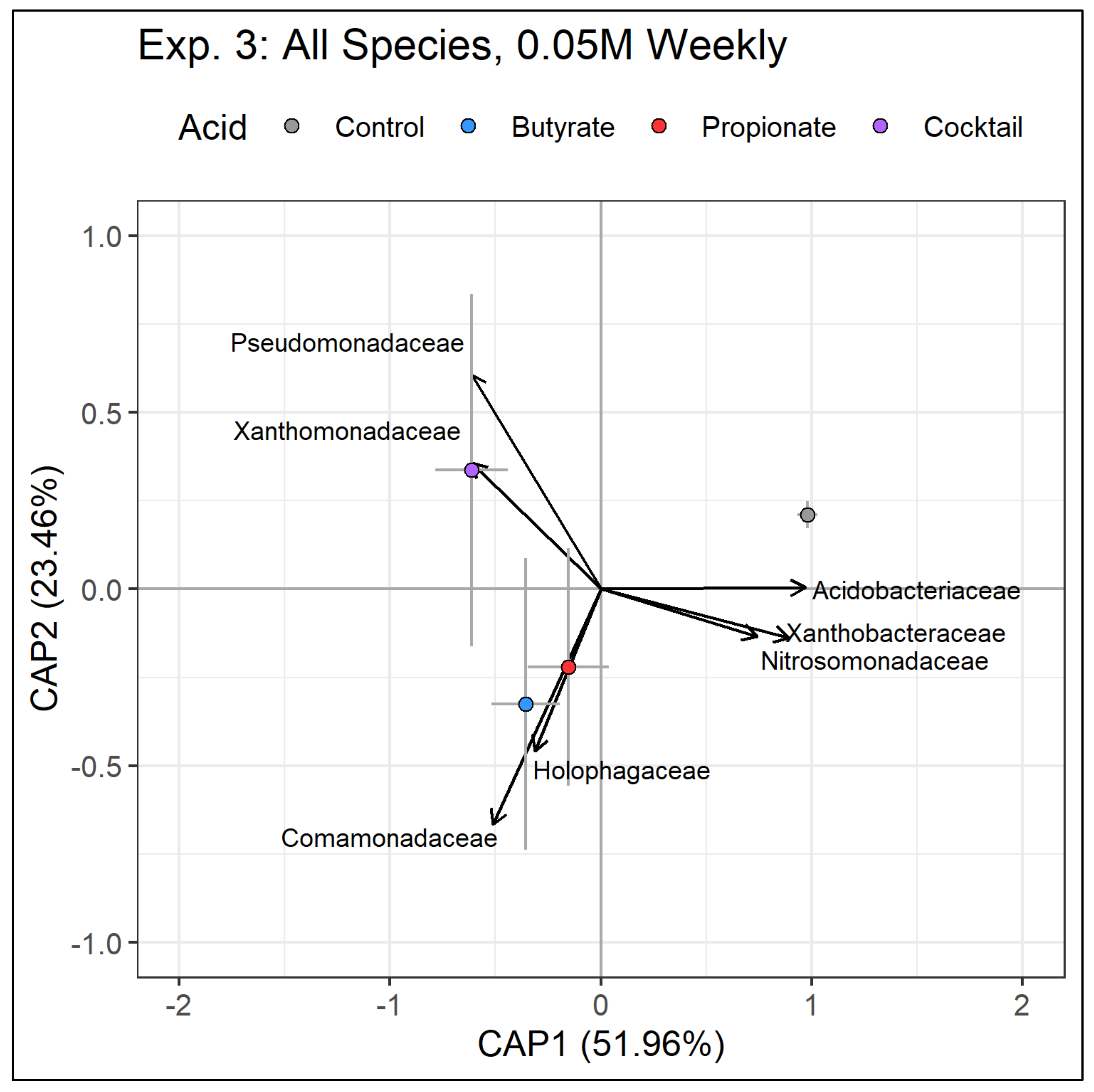
Phragmites australis is a cosmopolitan grass species common in wetland ecosystems across the world. In much of North America, the non-native subspecies of Phragmites threatens wetland biodiversity, hinders recreation, and is a persistent problem for natural resource managers. In other parts of the world, populations are in decline, as Reed Die-Back Syndrome (RDBS) plagues some Phragmites stands in its native range. RDBS is defined by a clumped growth form, stunted root and shoot growth, premature senescence, and shoot death. RDBS has been associated with a build-up of short-chain fatty acids (SCFAs) and altered bacterial and oomycete communities in soils, but the exact causes are unknown. To control invasive Phragmites populations, we sought to develop treatments that mimic the conditions of RDBS. We applied various SCFA treatments at various concentrations to mesocosm soils growing either Phragmites or native wetland plants. We found that the high-concentration SCFA treatments applied weekly induced strong significant declines in above- and belowground biomass of Phragmites. Declines were significant but slightly weaker in native species. In addition, soil bacterial abundance increased, diversity decreased, and bacterial community composition significantly differed following treatments, such that treated pots maintained a higher relative abundance of Pseudomonadaceae and fewer Acidobacteriaceae than untreated pots. Our results suggest that application of SCFAs to Phragmites can lead to stunted plants and altered soil bacterial communities similar to populations affected by RDBS. However, the lack of species-specificity and intensive application rate may not make this treatment ideal as a widespread management tool.
Keywords: short-chain fatty acid; soil bacteria; invasive plants; symbiosis short-chain fatty acid; soil bacteria; invasive plants; symbiosis