Article

Supporting Clinical Decisions with Rapid Molecular Diagnostic Pneumonia Panel in Pediatric Intensive Care Unit: Single Center Experience in Turkiye


1
Pediatric Intensive Care Unit, Faculty of Medicine, Eskisehir Osmangazi University, Eskisehir 26040, Türkiye
2
Pediatric Infectious Disease Unit, Faculty of Medicine, Eskisehir Osmangazi University, Eskisehir 26040, Türkiye
3
Department of Microbiology, Faculty of Medicine, Eskisehir Osmangazi University, Eskisehir 26040, Türkiye
*
Author to whom correspondence should be addressed.
Microorganisms 2023, 11(10), 2391; https://doi.org/10.3390/microorganisms11102391

Submission received: 4 August 2023 / Revised: 6 September 2023 / Accepted: 8 September 2023 / Published: 25 September 2023
(This article belongs to the Special Issue Antibiotic Resistance: Present Knowledge and Future Challenges)

Abstract

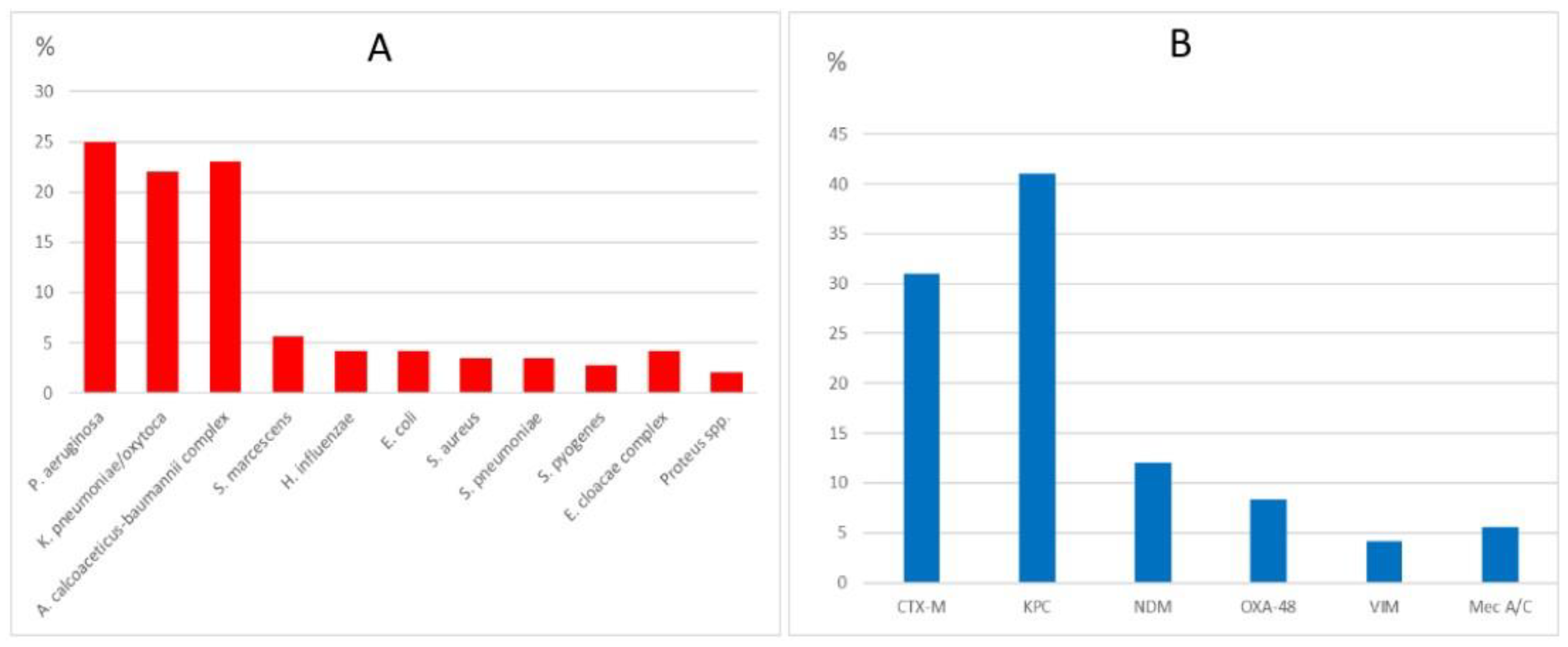
Introduction: Lower respiratory tract infections are the leading cause of morbidity and mortality in children worldwide. It is crucial to promptly conduct diagnostic investigations in order to determine the microbiological cause of pneumonia, since this is necessary to ensure the appropriate delivery of antibiotic therapy to each individual patient. We evaluated the results of a rapid molecular diagnostic pneumonia panel in children with LRTI in a pediatric intensive care unit (PICU). Patients and Methods: Rapid molecular diagnostic pneumonia panel (BioFire®, FilmArray Pneumonia Panel plus; FA-PP) findings (71 results from 46 children) in a tertiary care PICU between 2019 and 2023 were retrospectively reviewed. Results: At least one bacterial pathogen was detected in 57 cases. A total of 77% of children had underlying conditions. A total of 70.4% of children needed invasive mechanical ventilation and 54.4% had ventilator-associated pneumonia. Pseudomonas aeruginosa (50.8%), Acinetobacter calcoaceticus baumannii complex (42%), and Klebsiella pneumoniae (38.6%) were the most common pathogens detected with the FA-PP. Of the 33 cases diagnosed with VAP, more than one pathogen was identified in 65.9% of cases, with the most commonly identified bacteria being K. pneumoniae (43.1%), P. aeruginosa (38.6%), and Acinetobacter calcoaceticus baumannii complex (31.8%). According to the FA-PP results, the same antibiotic therapy was continued in 39.4% of cases, escalated in 54.5%, and de-escalated in 6.1%. Conclusions: The utilization of the FA-PP has some beneficial effects, including more prompt delivery of findings compared to conventional approaches. Additionally, this approach enables the identification of resistance profiles in children diagnosed with pneumonia in the PICU. Consequently, these test results facilitate the organization of antibiotic treatment strategies, including escalation and de-escalation approaches. The detection of resistance patterns was exclusively determined via the implementation of molecular testing, prompting a reevaluation of the isolation technique in accordance with the obtained data.
Keywords: pneumonia; ventilator-associated pneumonia; rapid molecular diagnostic panel; pediatric intensive care unit; antibiotic resistance pneumonia; ventilator-associated pneumonia; rapid molecular diagnostic panel; pediatric intensive care unit; antibiotic resistance