Review

How Does Hospital Microbiota Contribute to Healthcare-Associated Infections?

by
Flora Cruz-López
1,
Adrián Martínez-Meléndez
1 and
Elvira Garza-González
2,*
1
Subdirección Académica de Químico Farmacéutico Biólogo, Facultad de Ciencias Químicas, Universidad Autónoma de Nuevo León, Pedro de Alba S/N, Ciudad Universitaria, San Nicolás de los Garza 66450, Nuevo León, Mexico
2
Laboratorio de Microbiología Molecular, Departamento de Bioquímica y Medicina Molecular, Facultad de Medicina/Hospital Universitario “Dr. José Eleuterio González”, Universidad Autónoma de Nuevo León, Avenida Gonzalitos y Madero s/n, Colonia Mitras Centro, Monterrey 64460, Nuevo León, Mexico
*
Author to whom correspondence should be addressed.
Microorganisms 2023, 11(1), 192; https://doi.org/10.3390/microorganisms11010192

Submission received: 1 December 2022 / Revised: 9 January 2023 / Accepted: 10 January 2023 / Published: 12 January 2023
(This article belongs to the Special Issue Recent Advances in Emerging Infectious Diseases)

Abstract

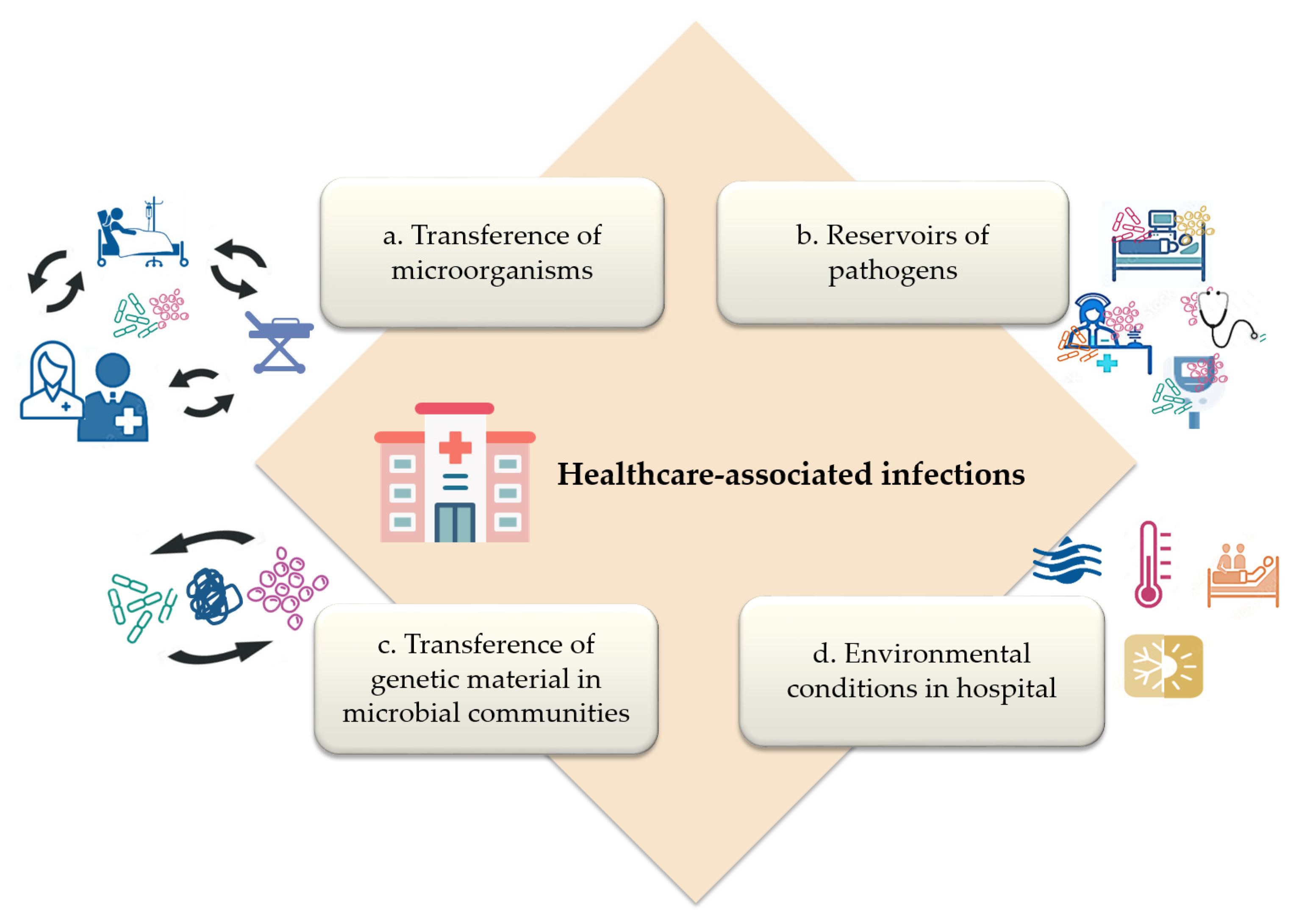
Healthcare-associated infections (HAIs) are still a global public health concern, associated with high mortality and increased by the phenomenon of antimicrobial resistance. Causative agents of HAIs are commonly found in the hospital environment and are monitored in epidemiological surveillance programs; however, the hospital environment is a potential reservoir for pathogenic microbial strains where microorganisms may persist on medical equipment surfaces, on the environment surrounding patients, and on corporal surfaces of patients and healthcare workers (HCWs). The characterization of hospital microbiota may provide knowledge regarding the relatedness between commensal and pathogenic microorganisms, their role in HAIs development, and the environmental conditions that favor its proliferation. This information may contribute to the effective control of the dissemination of pathogens and to improve infection control programs. In this review, we describe evidence of the contribution of hospital microbiota to HAI development and the role of environmental factors, antimicrobial resistance, and virulence factors of the microbial community in persistence on hospital surfaces.
Keywords: healthcare-associated infections; hospital microbiota; infection control; antimicrobial resistance; surfaces persistence healthcare-associated infections; hospital microbiota; infection control; antimicrobial resistance; surfaces persistence