1. Introduction
With ongoing advancements in fields such as mechanical engineering, artificial intelligence, control theory, wireless communication, and materials science, robotics technology continues to evolve steadily. Robots are now widely used in areas including intelligent manufacturing, medical surgery, aerospace, and national defense. As supportive policies continue to emerge and the market scale expands, the growing importance of robotics technology has become increasingly evident. In parallel, the demand for robots—both in terms of quantity and diversity—has been rising across industries [
1,
2]. Robots are automated mechanical devices or virtual agents capable of performing specific tasks. They can be programmed to carry out a wide range of operations, from simple repetitive actions to complex procedures and decision-making processes. With considerable variation in design and functionality, robots can be broadly categorized into types such as industrial robots, service robots, medical robots, and military robots.
With the rapid advancement of socio-economic development and technology, people’s pursuit of a higher quality of life has steadily increased, intensifying the demand for robots capable of operating in dangerous or extreme environments on behalf of humans. As a specialized category of robotic systems, wall-climbing robots hold promise for diverse applications, including industrial inspection, building maintenance, and disaster rescue. Their broad range of application scenarios and ability to perform targeted tasks make them particularly valuable. For instance, in the field of high-end equipment inspection, current practices still rely heavily on manual labor. However, large-scale equipment such as aircraft engines, wind turbines, and industrial pipelines often contain complex internal structures and confined spaces that are difficult for humans to access. Detecting faults in such environments typically requires disassembly of components, which entails substantial human resources, financial costs, and time and may even lead to unintended damage [
3,
4]. Hence, there is an urgent need for robotic solutions to update and ultimately replace manual inspection methods. Wall-climbing robots are designed to operate on vertical walls or object surfaces while maintaining secure adhesion to perform designated tasks. This capability enhances operational efficiency, reduces safety risks to human workers, and minimizes labor consumption. In addition, wall-climbing robots can undertake tasks traditionally requiring human presence at height or in hazardous positions, such as cleaning the exteriors of high-rise buildings or ship hulls. To date, wall-climbing robots have demonstrated the ability to traverse wall surfaces with various orientations, including vertical walls, inclined planes, and curved pipelines.
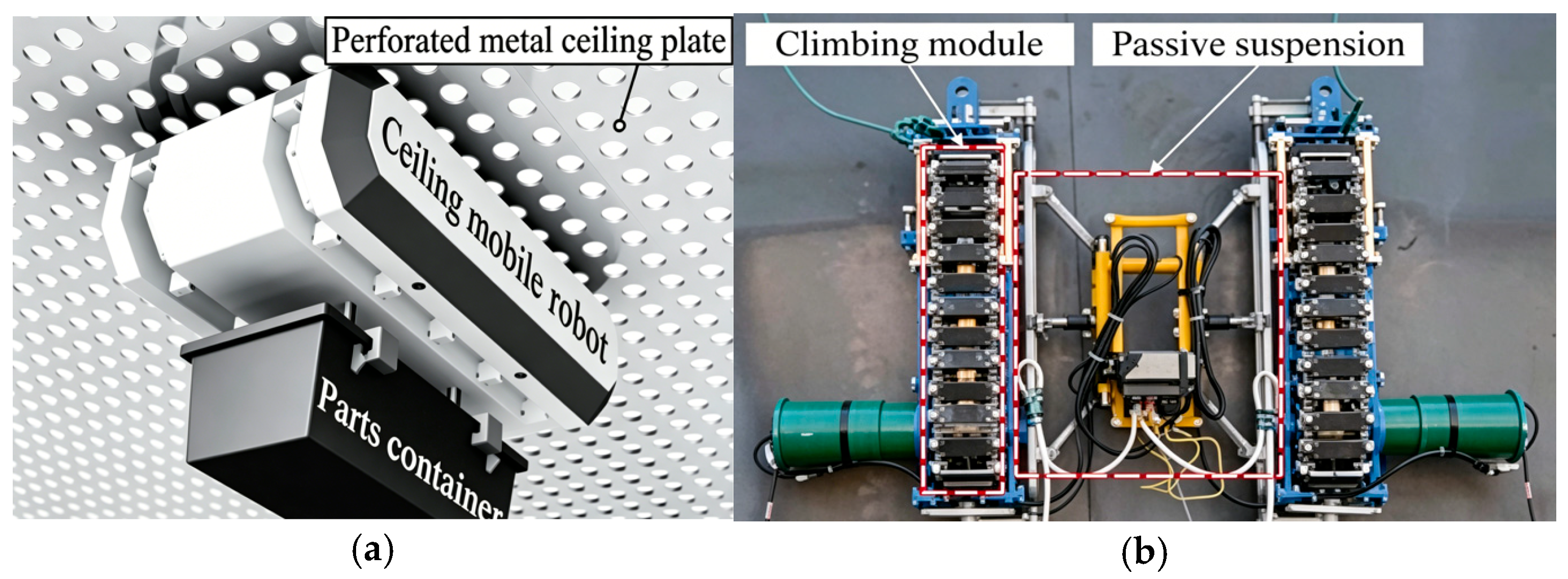
Figure 1 illustrates typical wall-climbing robots. As shown in
Figure 1a, Rui, F. et al. [
5] developed a wall-climbing robot named HanGrawler, which is capable of rapid movement on ceilings by attaching to overhead structures. In
Figure 1b, Hu Junyu [
6] designed a magnetic tracked wall-climbing robot that can carry a payload of up to 75 kg and traverse cylindrical walls with a curvature radius of 3000 mm. This allows the robot to handle heavy tools during operations with high reliability.
Currently, existing wall-climbing robots still face several challenges, including poor environmental adaptability, limited functionality, cumbersome cabling, and large structural size, which constrain their ability to perform agile climbing movements in deep cavities or complex environments [
7]. To successfully execute tasks, wall-climbing robots must be capable of moving across surfaces, which necessitates effective motion control. Path planning for such robots involves determining a feasible trajectory from the current position to a target point while avoiding obstacles to ensure collision-free navigation. Depending on the characteristics of the wall surface and the specific task requirements, motion path planning for wall-climbing robots can be broadly classified into global path planning and local path planning [
8]. For example, in applications such as wall cleaning, the robot is required to achieve complete coverage of the target surface, which calls for the implementation of full-coverage path planning algorithms [
9].
In more complex or unknown environments, wall-climbing robots are unable to obtain prior environmental information and must instead rely on real-time sensor data to perceive their surroundings. This perceptual information is then integrated with path planning algorithms to compute an appropriate motion trajectory. Through reinforcement learning, the robot can continuously interact with and learn from the environment to improve its navigation performance. Consequently, wall-climbing robots must adopt different motion planning strategies tailored to environmental conditions and task objectives, which presents significant challenges to the real-time responsiveness and reliability of their perception systems.
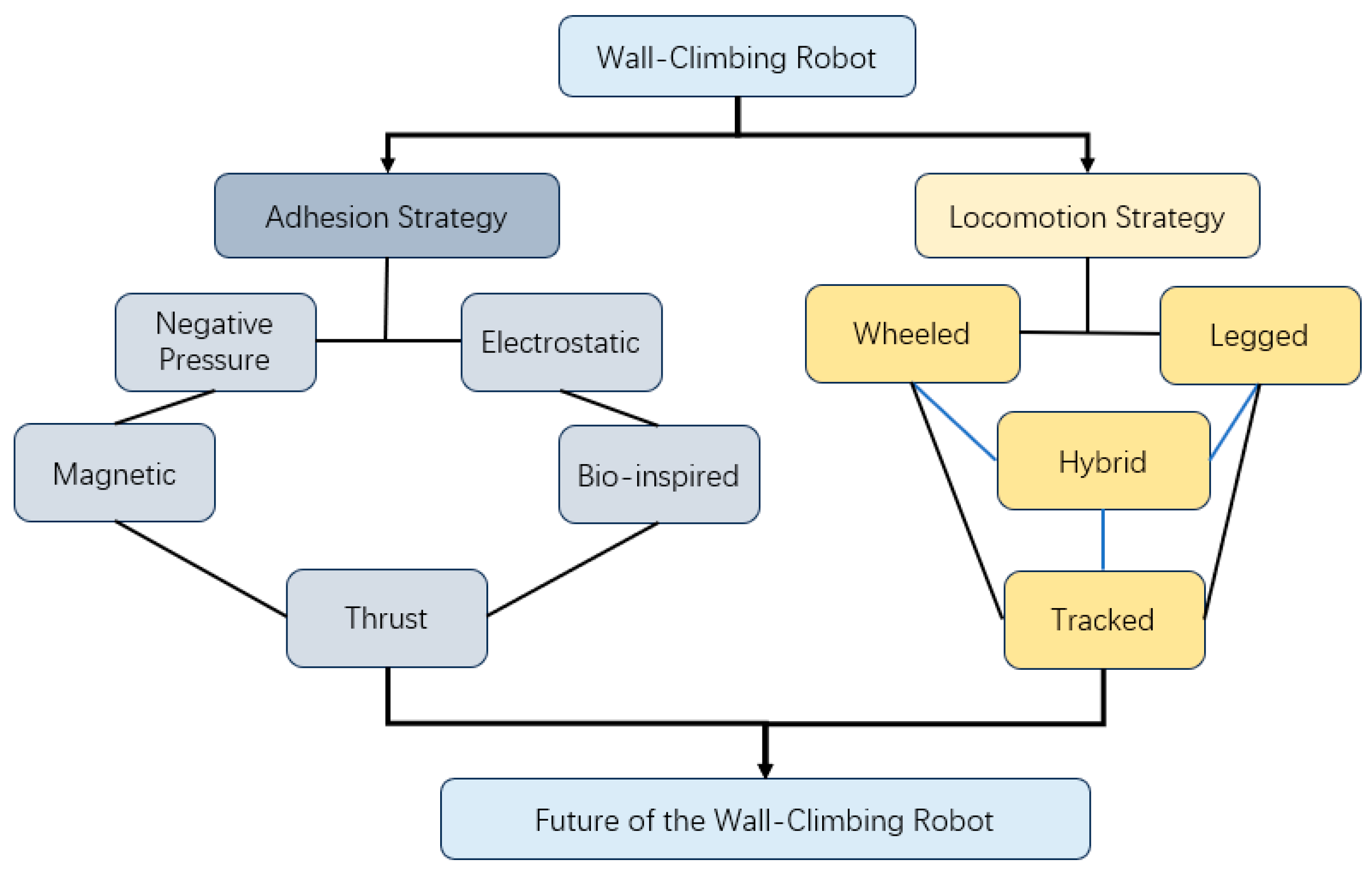
A wall-climbing robot typically comprises three main components: an adhesion device, a locomotion mechanism, and a driving device. The locomotion mechanism and driving device together determine the robot’s mode of movement, while the adhesion device is defined by the specific adhesion method employed. Based on adhesion principles, wall-climbing robots can be classified into several types, including negative pressure adhesion, magnetic adhesion, electrostatic adhesion, biomimetic adhesion, and thrust-based adhesion. According to their locomotion mode, they can be further categorized as wheeled, tracked, legged, or hybrid configurations. An overview of the different types of wall-climbing robots is presented in
Figure 2.
This review summarizes recent advances in wall-climbing robots, highlighting key technology in adhesive methods, locomotion mechanisms, and real-time perception for planning integration. The organization of this paper proceeds as follows:
Section 2 reviews the classification of adhesive principles across vacuum, magnetic, electrostatic, and bio-inspired approaches;
Section 3 analyzes locomotion kinematics and control strategies for vertical and overhanging surfaces;
Section 4 examines planning strategies that fuse multimodal sensing with dynamic path optimization, emphasizing adaptive decision-making under uncertain surface conditions; finally,
Section 5 outlines open challenges—including energy-efficient adhesion switching, and AI-driven navigation generalization across unseen urban environments—pointing toward next-generation autonomous inspection systems.
2. Adhesion Mechanisms of Wall-Climbing Robots
2.1. Negative Pressure Adhesion
Negative pressure adhesion wall-climbing robots operate by creating a region of pressure lower than the external atmospheric environment, thereby enabling the robot to adhere to wall surfaces under the influence of atmospheric pressure. Currently, negative pressure-based climbing robots are primarily categorized into two types: those utilizing pressed suction cups and those employing evacuated negative pressure chambers.
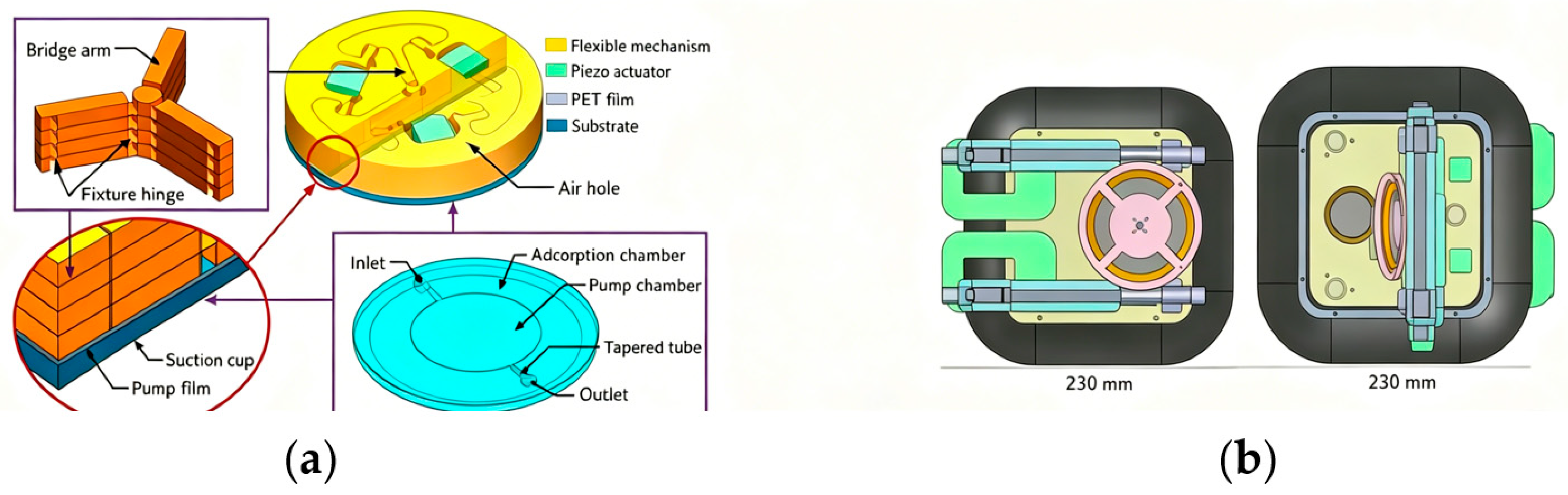
As illustrated in
Figure 3a, Liu, J. et al. [
10] developed a bridge-structured piezoelectric flexible actuator that drives a thin-film micropump. This micropump generates negative pressure within the suction cup to produce adhesion. The suction cup is capable of achieving a negative pressure of 2.45 kPa at an operating frequency of 13.2 kHz, with a maximum suction force of 0.33 N. The entire robot weighs only 1.3 g, making it suitable for adhesion on planar surfaces. However, conventional vacuum suction cups often struggle to maintain reliable adhesion on rough or uneven surfaces and are prone to slipping on smooth or wet walls, posing safety risks. Moreover, when traversing irregular surfaces, the suction cups are susceptible to mechanical damage. In contrast, as shown in
Figure 3b, Amakawa, T. et al. [
11] developed a wall-climbing robot intended for aircraft fuselage inspection. To address the limitations of magnetic adhesion on curved aircraft surfaces, the robot adopts a negative pressure adhesion mechanism combined with a flexible rubber skirt seal, which enables reliable adhesion and locomotion on curved surfaces. Typically, wall-climbing robots employing negative pressure chambers rely on fans to evacuate air, thereby establishing the necessary negative pressure within the chamber for sustained attachment.
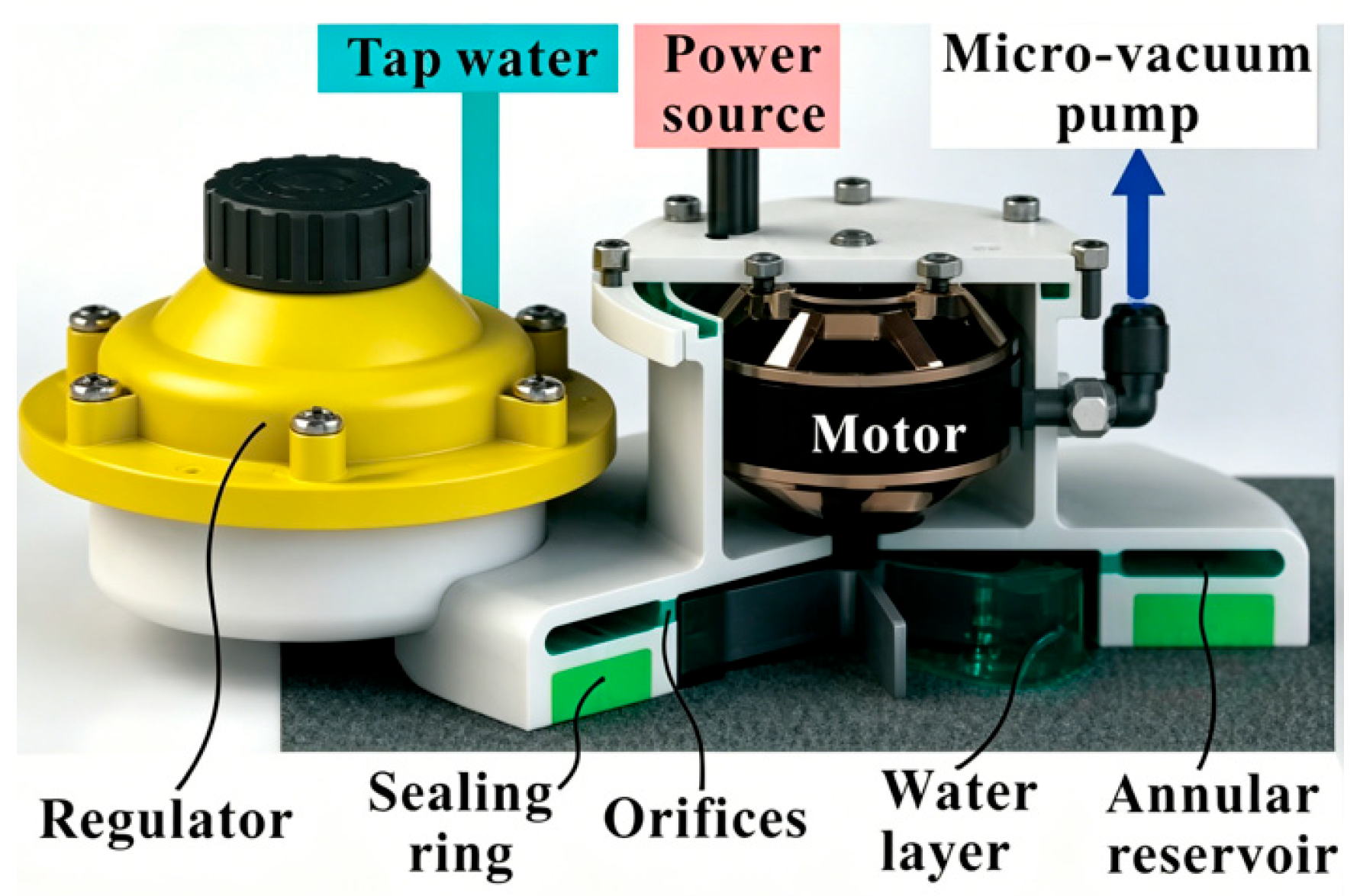
To mitigate the problem of air leakage that can lead to adhesion failure in negative pressure systems, Kaige Shi et al. [
12] proposed a design using a water seal to develop a Zero Pressure Difference (ZPD) vacuum adhesion module. The water seal helps maintain a high vacuum level within the module with reduced energy consumption. Experimental results indicate that the ZPD vacuum adhesion module enables the robot to generate greater suction force while operating more efficiently. The structure of the proposed robot is shown in
Figure 4.
Negative pressure adhesion offers several advantages for wall-climbing robots. It allows the adhesion force and load capacity to be adjusted by varying the pressure differential, and it is not constrained by the material properties of the wall surface, enabling broad applicability across different environments. Rigid negative pressure modules are particularly well-suited for flat wall surfaces, although their adaptability to curved walls is considerably lower compared to robots with flexible adhesion modules. Moreover, this adhesion method enables non-destructive contact between the robot and the wall surface.
However, negative pressure adhesion also presents notable drawbacks. The operation of such systems often generates high noise levels and consumes significant energy, resulting in considerable power demands that typically necessitate a wired power supply. Additionally, air leakage poses a critical safety concern: if leakage occurs while the robot is in operation, it may lose adhesion and fall from the wall, potentially causing damage to the robot and creating safety hazards.
2.2. Magnetic Adhesion
The magnetic adhesion wall-climbing robot is equipped with magnets on its underside, which generate attractive forces with ferromagnetic wall surfaces—such as those made of iron, cobalt, or nickel—enabling the robot to adhere securely. Typical magnetic adhesion robots utilize either permanent magnets or electromagnets to achieve contact or non-contact adhesion to steel surfaces. The adhesion force of a magnet generally depends on several factors, including the magnetic field strength, the effective contact area, the distance between the magnet and the surface, the magnet volume, and the magnetic susceptibility of the wall material.
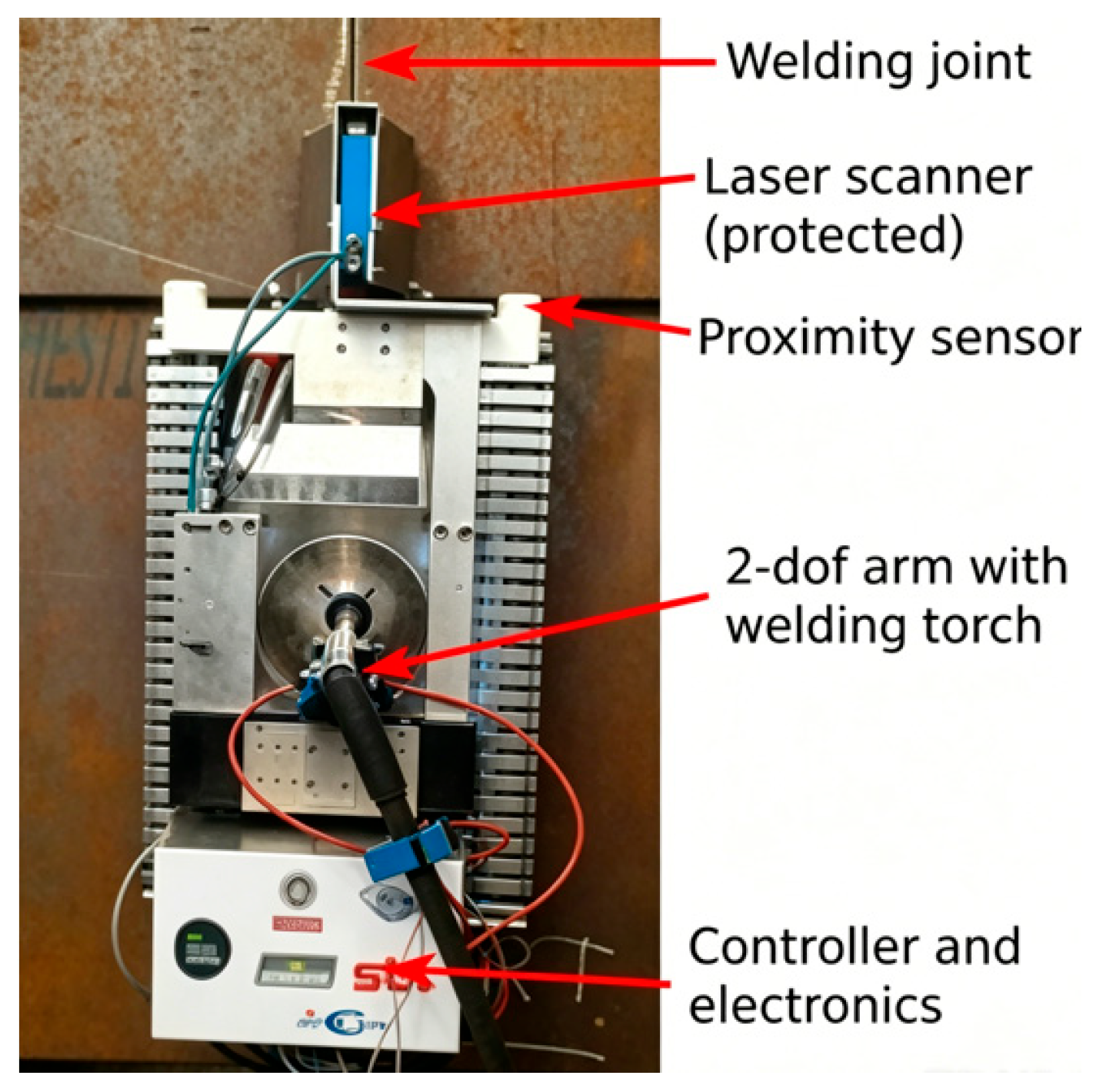
As illustrated in
Figure 5, the magnetic adhesion wall-climbing robot is capable of performing welding operations on steel ship hull surfaces [
13]. It can carry out welding on vertical ship surfaces with a load capacity of up to 100 kg. In
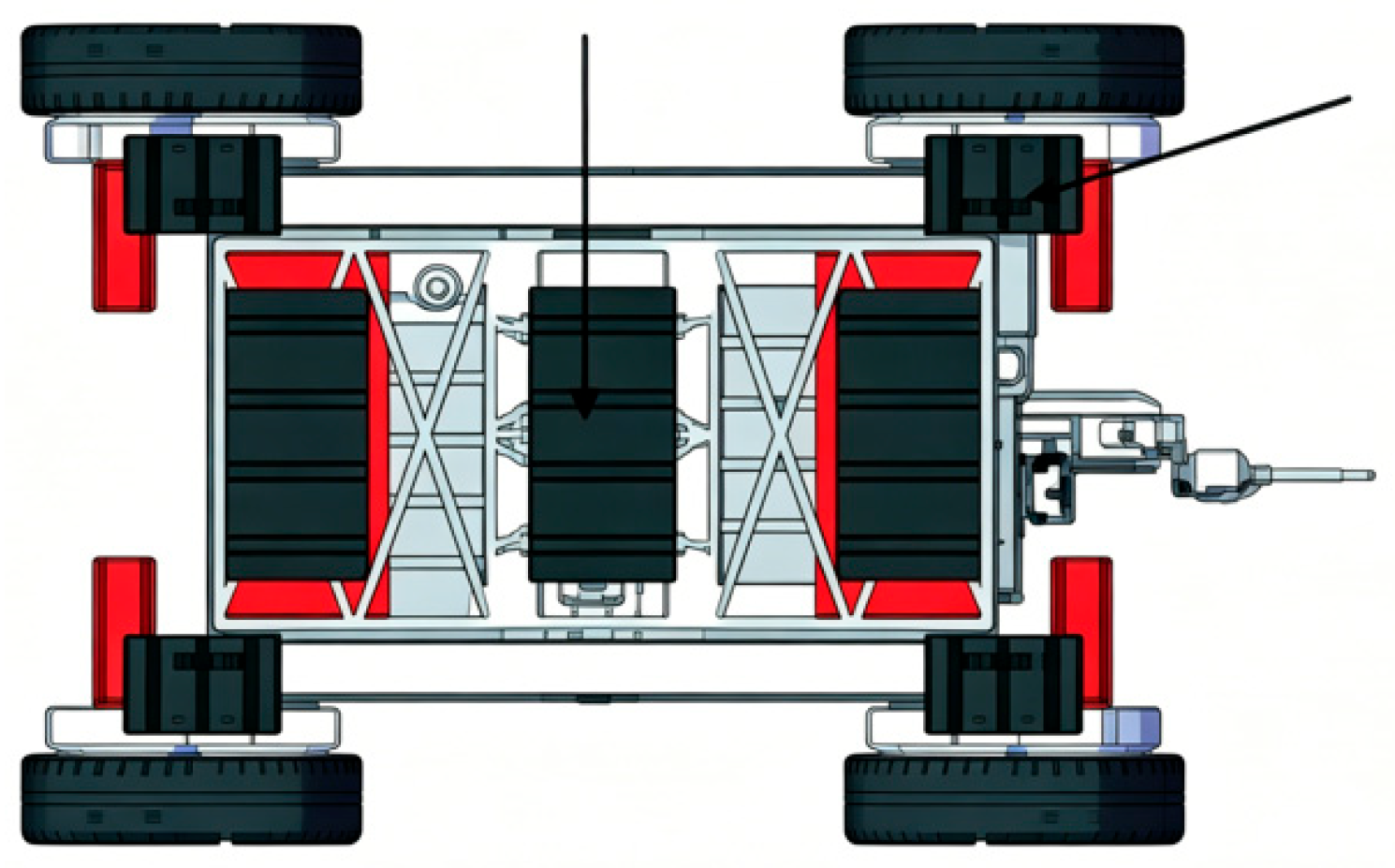
Figure 6, a novel non-contact permanent magnetic wall-climbing robot is presented. Equipped with servo motors and a tracked motion mechanism, the robot is capable of adapting to surfaces with varying radii of curvature and can execute turns based on the differential motion principle. It features a six-degree-of-freedom robotic arm, enabling it to perform a range of tasks, including welding, grinding, non-destructive testing, lighting, and airless spraying [
14].
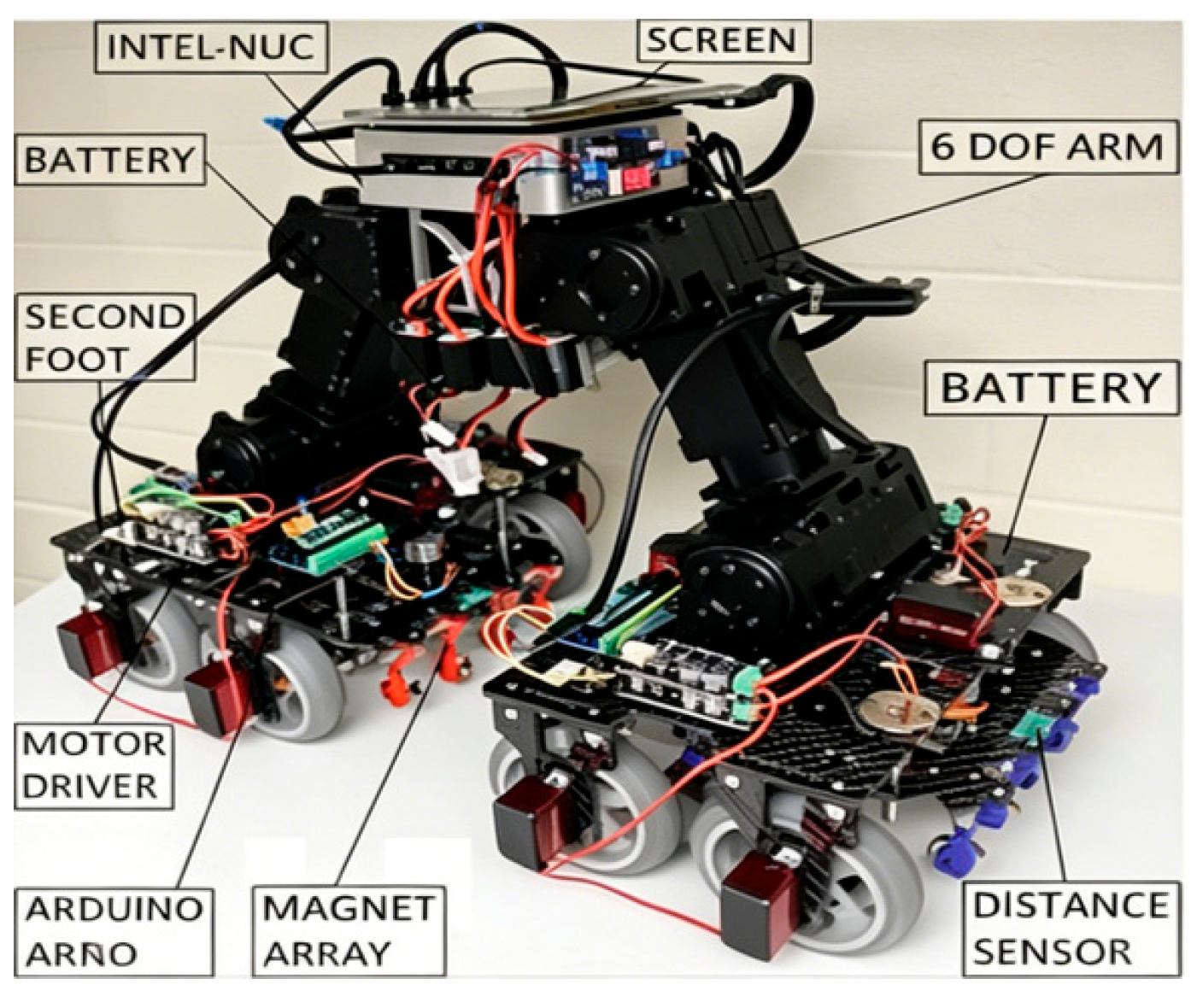
The University of Nevada, Reno, proposed and designed a magnetic wall-climbing robot capable of traversing complex surface structures. Inspired by the inchworm robot, this design utilizes permanent magnets to achieve adhesion to the wall surface. By adjusting the distance between the magnet and the wall, the adhesion force can be controlled. The robot features six degrees of freedom, enabling it to perform complex maneuvers such as crossing obstacles and climbing in challenging environments [
15]. The robot is illustrated in
Figure 7.
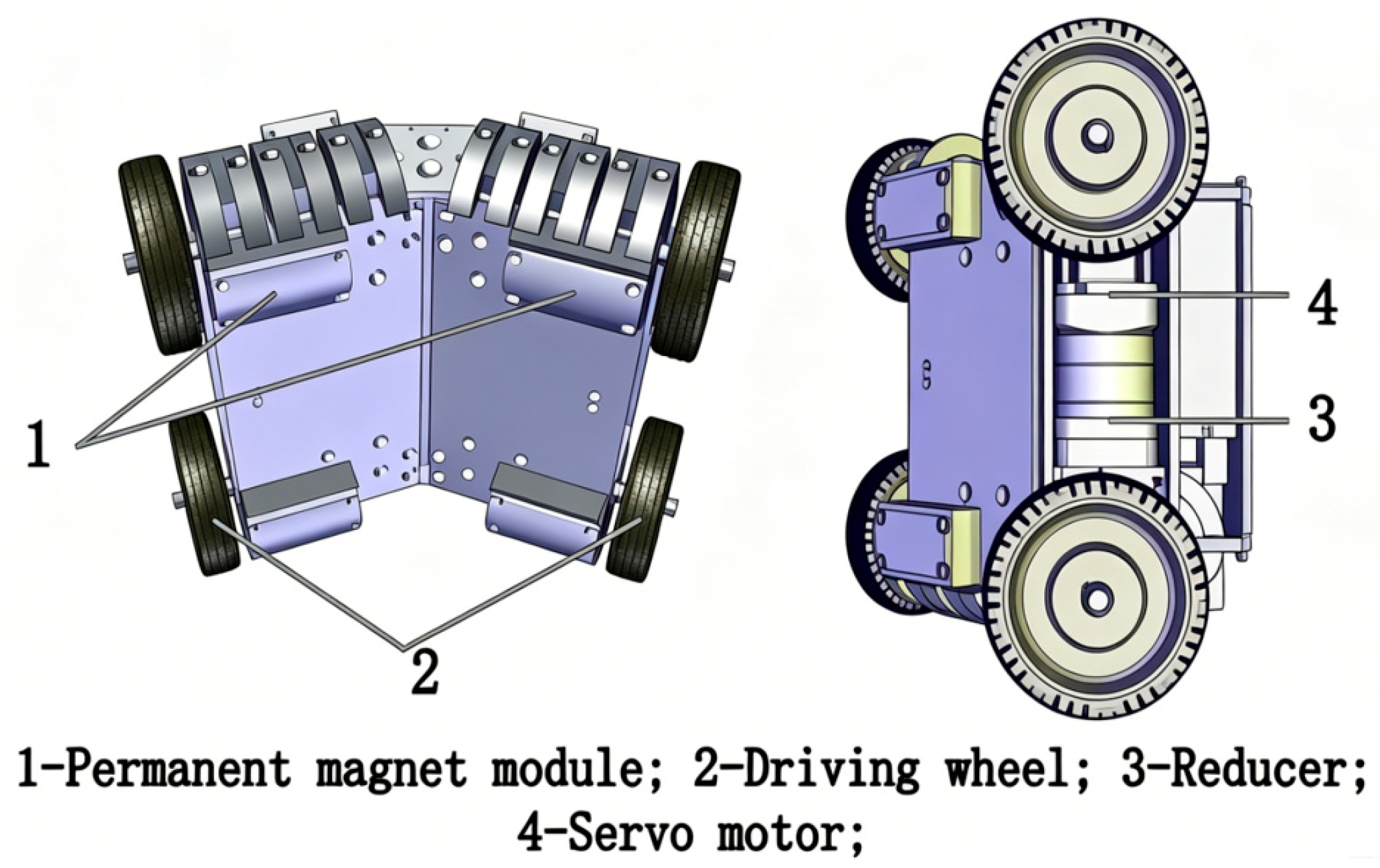
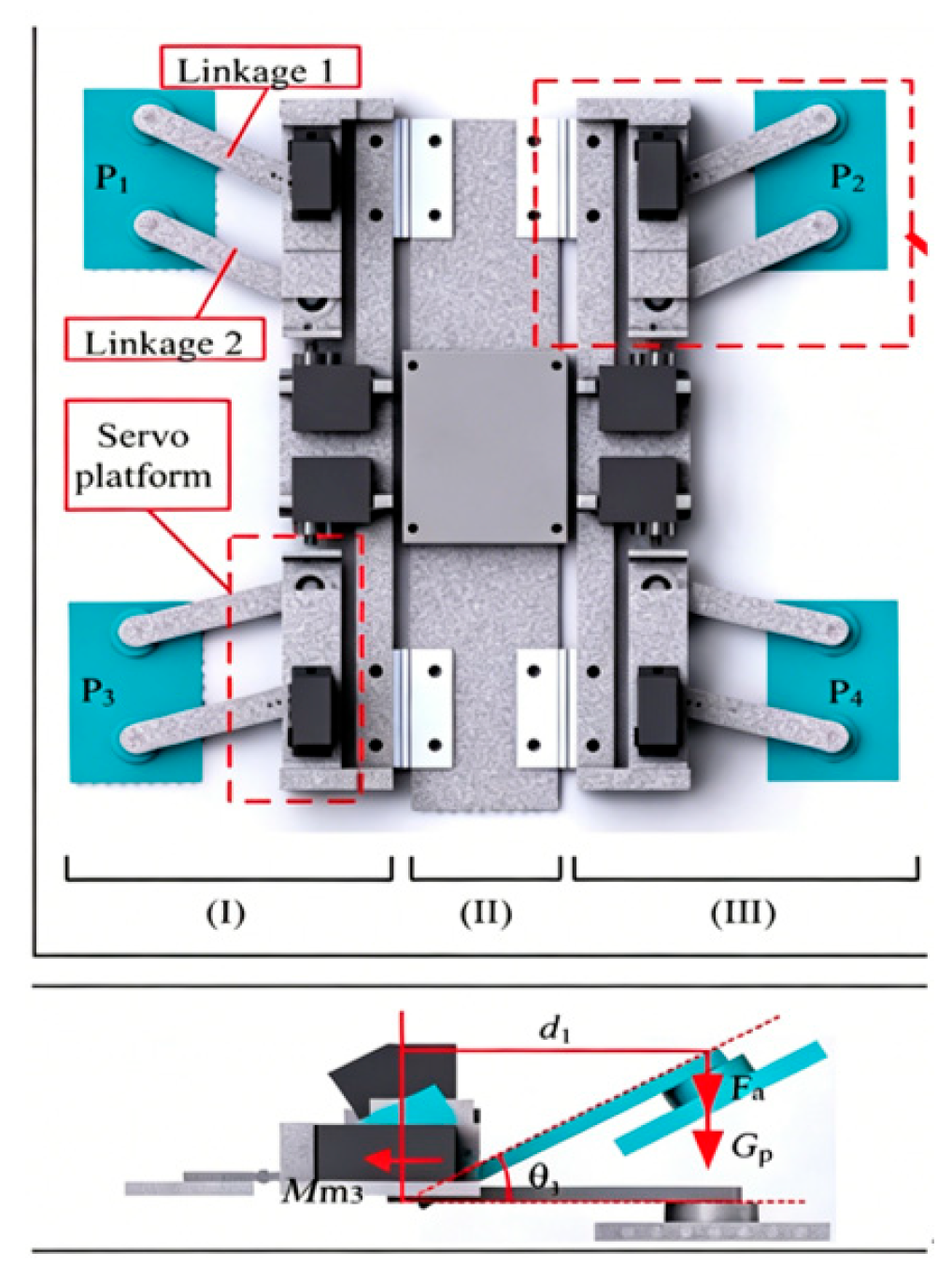
G. Xiang et al. [
16] investigated the stability of a wheeled permanent magnet wall-climbing robot for in-pipe wall climbing applications. Their analysis, illustrated in
Figure 8, formulated safe adhesion conditions that enable the robot to avoid slip and longitudinal overturning imbalances, irrespective of the inclination angle.
Magnetic adhesion offers a reliable method for wall-climbing robots on ferromagnetic surfaces, characterized by high load capacity—scalable with magnet size and strength—and greater energy efficiency with a simpler structure compared to negative pressure systems. The primary trade-off is its limited material adaptability, as this method is only applicable to magnetic walls.
2.3. Bio-Inspired Adhesion
Inspired by the remarkable locomotive capabilities of various crawling animals in nature, researchers have increasingly turned to biomimetics to develop innovative adhesion methods for wall-climbing robots. These bio-inspired adhesion techniques are broadly categorized into two main types based on the environmental conditions in which they operate: dry adhesion and wet adhesion. Each category mimics different biological mechanisms and offers unique advantages for robotic applications.
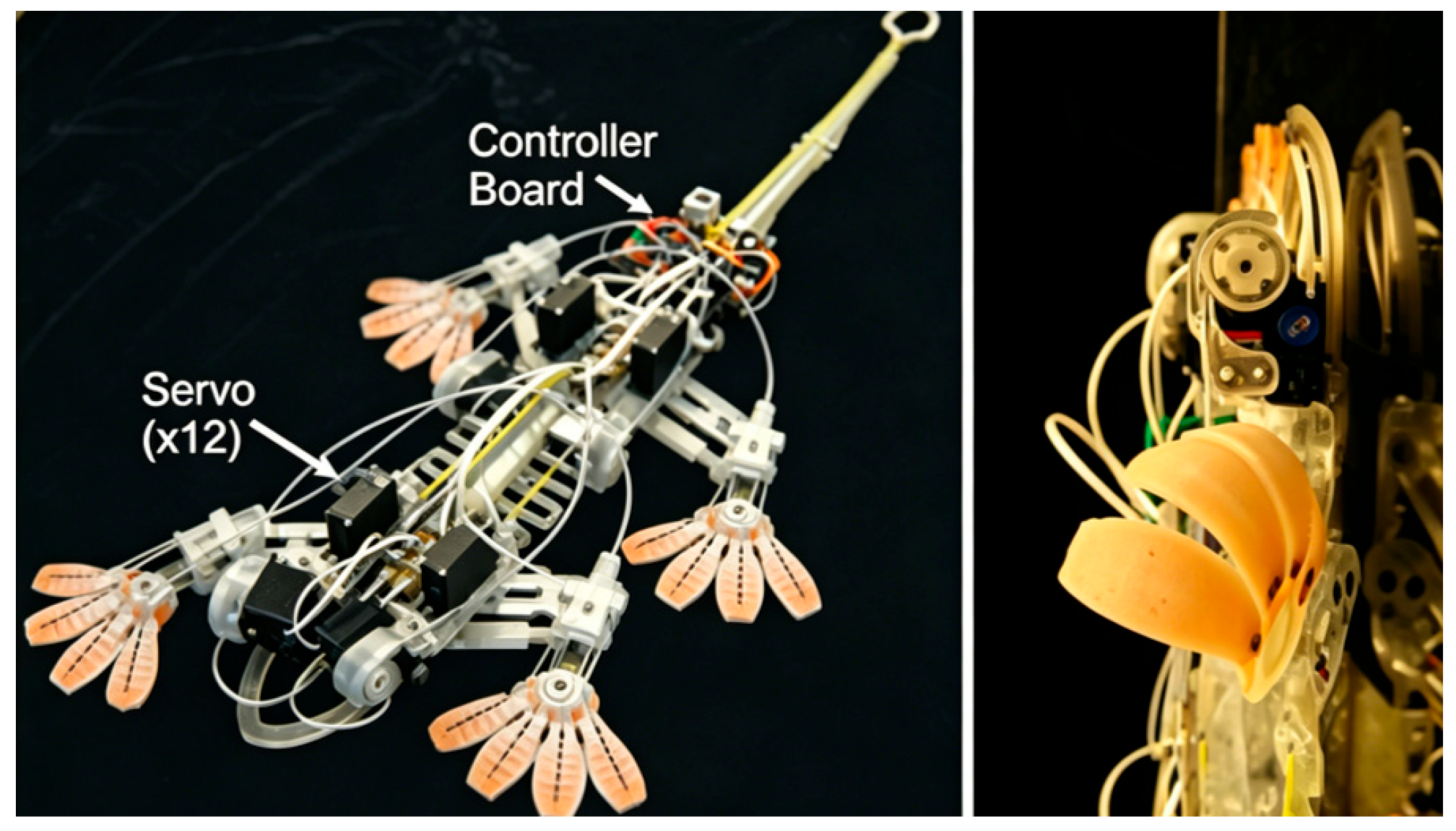
Dry adhesion, as its name suggests, functions without the need for liquid media and is primarily inspired by the extraordinary climbing abilities of geckos. Geckos can effortlessly scale vertical surfaces and even traverse ceilings due to the hierarchical structures on their feet, which consist of millions of microscopic hairs called setae. These setae are further divided into nanoscale spatulae, enabling intimate contact with surfaces and generating adhesion through van der Waals forces. Drawing inspiration from this natural dry adhesive system, SANTOS et al. [
17] designed and developed a pioneering climbing robot named Stickybot, which is illustrated in
Figure 9. This robot features biomimetic feet that replicate the gecko’s adhesive mechanism. The artificial gecko feet are fabricated from polyurethane, a durable and flexible polymer that allows for precise control over the adhesive fibers. A distinctive characteristic of these bio-inspired adhesive fibers is their direction-dependent behavior: the adhesion force becomes negligible when the tangential force approaches zero. This property enables rapid and efficient switching between attachment and detachment phases during climbing, allowing the robot to establish firm grip when needed and release effortlessly when taking the next step, thereby ensuring smooth and efficient vertical locomotion.
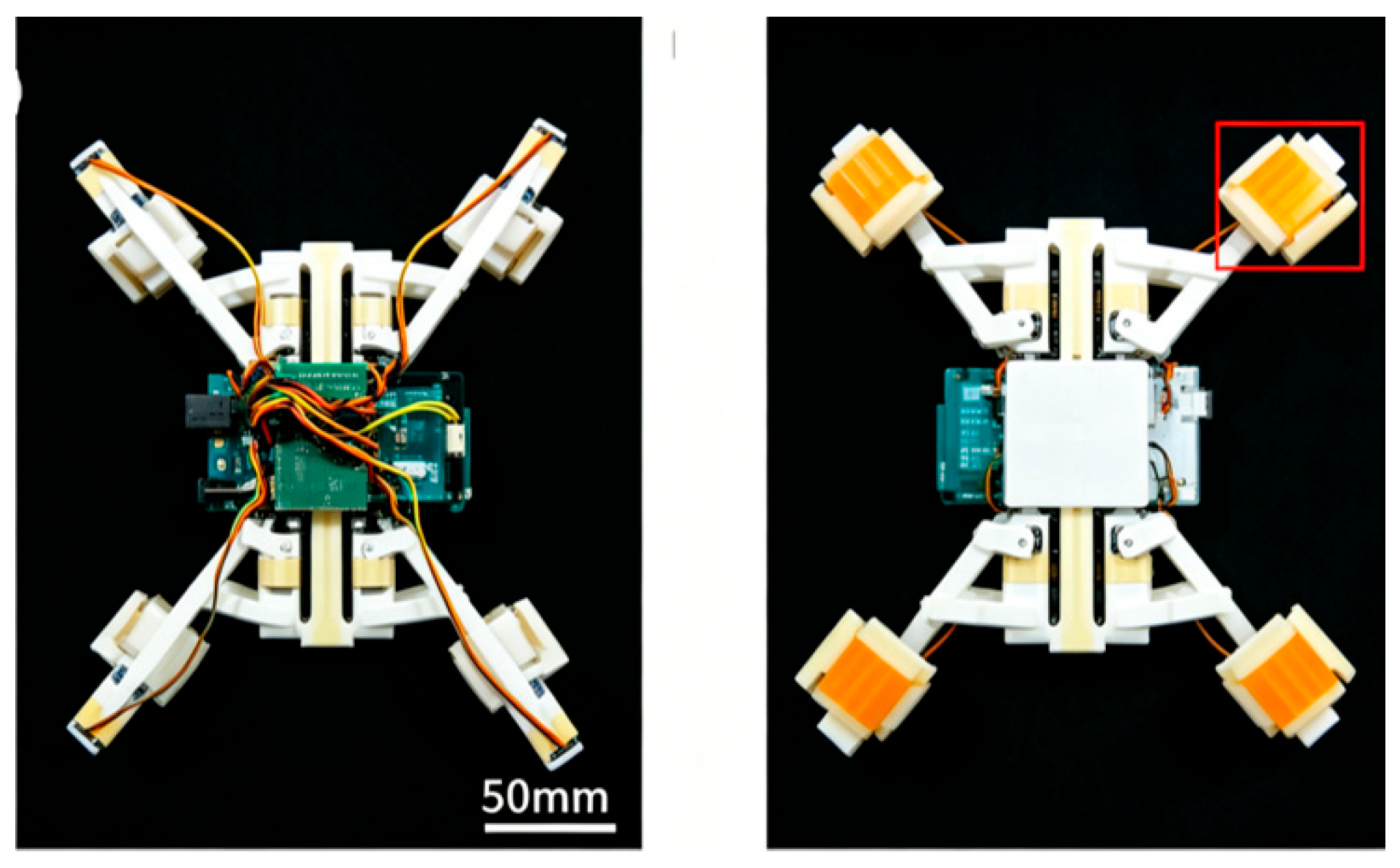
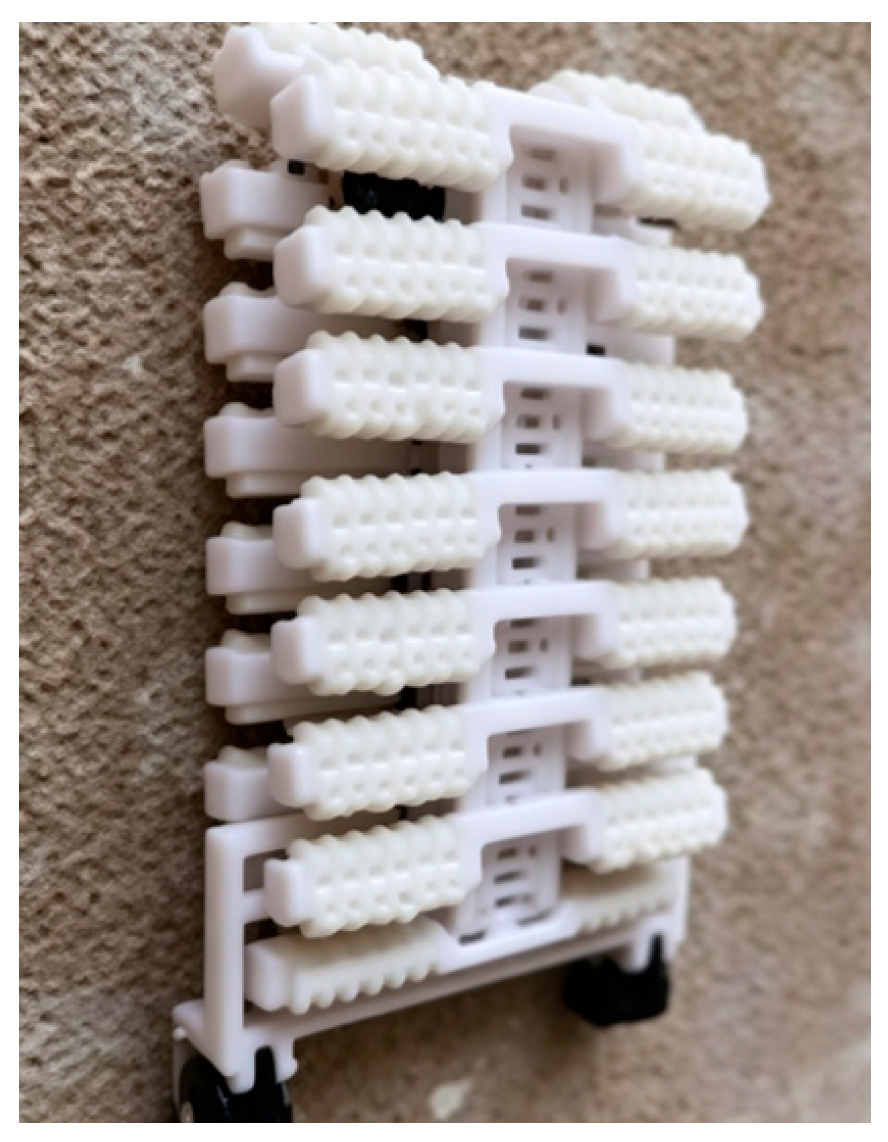
Building upon the same gecko-inspired principle, Ko, H et al. [
18] proposed an innovative wall-climbing robot, presented in
Figure 10. This advanced robotic system demonstrates remarkable versatility in its locomotive capabilities, being able to traverse not only vertical walls but also ceilings and surfaces oriented at various angles. The robot’s complex biomimetic structure is fabricated using state-of-the-art 3D printing technology, which offers multiple manufacturing advantages. This additive manufacturing approach is not only straightforward and time-efficient but also environmentally friendly compared to traditional subtractive manufacturing methods, as it minimizes material waste and reduces energy consumption. The precise control afforded by 3D printing allows for the creation of intricate adhesive pad geometries that closely mimic the natural hierarchical structures found in gecko feet, resulting in enhanced adhesion performance across different surface conditions.
In contrast to dry adhesion, wet adhesion draws inspiration from a different class of biological organisms, including tree frogs, ants, and stick insects. These creatures have evolved specialized smooth pad structures that enable them to adhere to various surfaces in humid or wet environments. When these organisms walk on surfaces, a thin liquid film forms between their smooth, soft pads and the substrate, creating adhesive forces through multiple physical mechanisms. This sophisticated adhesion system relies primarily on three interrelated phenomena: surface tension at the liquid-air interface, capillary action that draws the liquid into the narrow gap between the pad and surface, and the viscous properties of the secreted fluid that resist separation. The combination of these forces allows these organisms to maintain secure attachment even on smooth, wet, or vertical surfaces, providing valuable inspiration for climbing robots designed to operate in environments where dry adhesion might prove ineffective [
19]. This wet adhesion mechanism has particular relevance for applications in humid industrial settings, marine environments, or during wet weather conditions where traditional adhesion methods may fail.
2.4. Electrostatic Adhesion
Electrostatic adhesion represents a fundamentally different approach to wall-climbing robot attachment, operating through the physical principle of electrostatic attraction. This adhesion mechanism relies on the uneven distribution of positive and negative electrical charges between two objects or surfaces, which generates an attractive electrostatic force that can be harnessed for robotic applications. When a voltage difference is applied across two conductive surfaces separated by a dielectric material, opposite charges accumulate on each surface, creating a strong electrostatic field that pulls them together. The most fundamental and illustrative example of this phenomenon is the parallel-plate capacitor model: when a power source applies a voltage across two conductive plates separated by an insulating layer, it creates an imbalance in charge distribution between the plates, with one plate accumulating positive charges while the other accumulates negative charges. This charge separation generates a powerful electrostatic attraction force that causes the plates to adhere to each other, effectively demonstrating the core principle behind electrostatic adhesion technology.
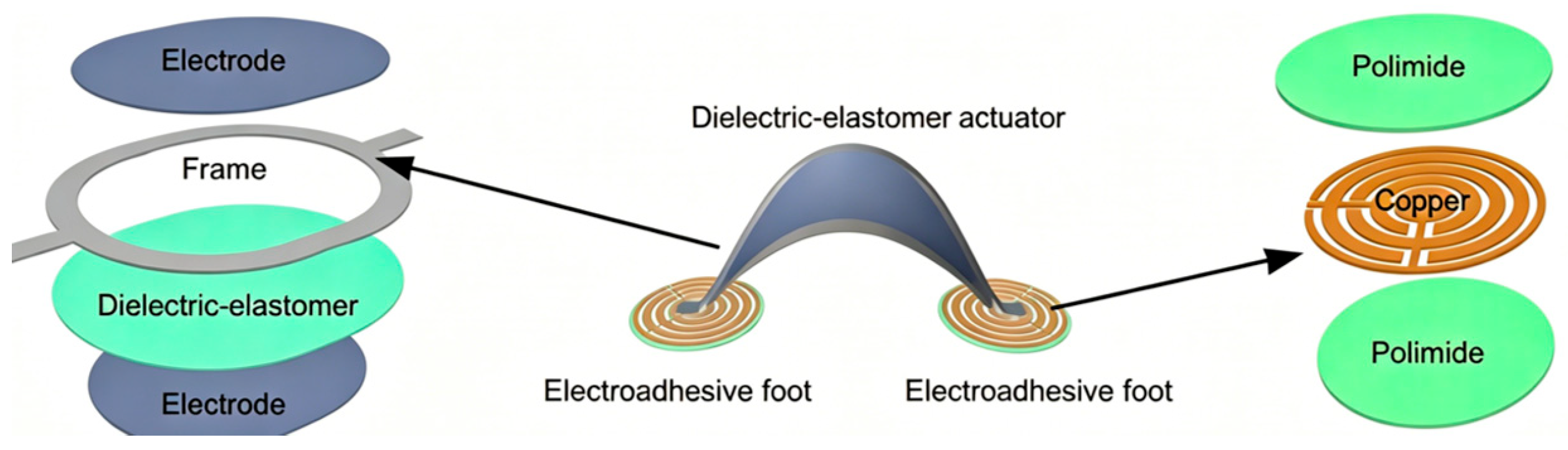
A notable advancement in this field was presented by Gu et al. [
20], who developed an innovative bipedal soft robot leveraging artificial muscles for locomotion, as illustrated in
Figure 11. This sophisticated robotic system represents a significant breakthrough in soft robotics and adhesion technology integration. The robot is driven by rapidly cycling dielectric elastomer actuators, which function as artificial muscles by contracting and expanding in response to electrical stimulation. These actuators can achieve high-frequency deformation cycles, enabling rapid and precise movement control. Through a carefully designed control strategy, the robot synergistically combines two critical functions: shape deformation for locomotion and electrostatic adhesion for surface attachment. This integrated approach allows the robot to achieve stable climbing on various vertical surfaces, demonstrating remarkable versatility in its operational capabilities. Experimental results show that the robot can successfully climb on vertical walls constructed from diverse materials, including wood, paper, and glass, achieving speeds of up to 0.75 body lengths per second. This performance demonstrates the practical viability of electrostatic adhesion for real-world climbing robot applications across different surface types.
The electrostatic adhesion method offers several distinctive advantages that make it particularly attractive for certain robotic applications. Perhaps its most significant benefit is its wide applicability across virtually all material types, including both conductive and non-conductive surfaces. Unlike magnetic adhesion, which requires ferromagnetic materials, or suction-based methods, which need smooth, non-porous surfaces, electrostatic adhesion can function effectively on wood, paper, glass, plastic, concrete, and many other common construction materials. This versatility opens up numerous potential applications in various industries and environments. Furthermore, electrostatic adhesion systems feature remarkably simple and lightweight structures, typically consisting of thin flexible electrodes and dielectric layers that add minimal weight to the robot. This simplicity greatly facilitates robot miniaturization, enabling the development of compact, agile climbing robots for inspection and maintenance tasks in confined spaces. Additionally, these systems consume relatively low energy compared to some alternative adhesion methods, as the electrostatic force requires minimal current to maintain once established, only drawing significant power during the initial charging phase. The absence of moving parts in the adhesion mechanism also enhances reliability and reduces maintenance requirements.
However, despite these considerable advantages, electrostatic adhesion technology also faces certain limitations that constrain its practical applications. The primary drawback is its relatively low absolute load capacity compared to magnetic or mechanical adhesion methods. The electrostatic forces generated, while sufficient for lightweight robots and small payloads, diminish rapidly with increasing distance between the electrode and surface, making it challenging to achieve high adhesion forces for heavy-duty applications. This fundamental physical limitation means that electrostatic adhesion is best suited for smaller robots carrying lightweight sensors and cameras rather than for heavy manipulation tasks. Additionally, the locomotion capability of electrostatic adhesion-based robots can be relatively limited, particularly on rough or uneven surfaces where the intimate electrode-surface contact required for optimal adhesion is difficult to maintain. Surface roughness, dust, moisture, and contamination can all significantly reduce the effective adhesion force, requiring careful surface preparation or more sophisticated electrode designs to maintain reliable attachment. Furthermore, the high voltages typically required for generating sufficient electrostatic forces (often in the kilovolt range) necessitate careful electrical insulation and safety considerations, particularly for applications in sensitive environments or those involving human interaction. These challenges continue to drive ongoing research into improved electrode materials, optimized control strategies, and novel system designs that can maximize the benefits of electrostatic adhesion while mitigating its inherent limitations.
2.5. Thrust Adhesion
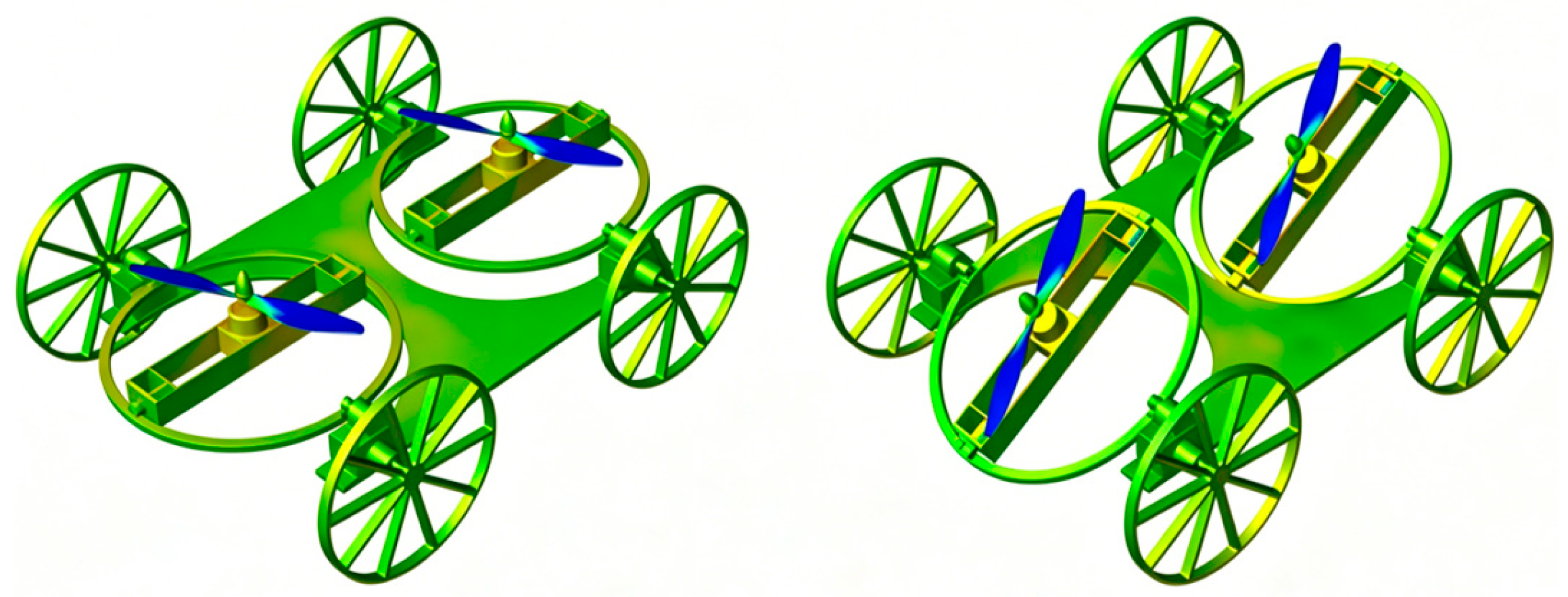
Thrust adhesion represents a distinctive approach to wall-climbing robot attachment that fundamentally differs from other adhesion mechanisms. This method operates by generating continuous thrust force that presses the robot against the wall surface, with careful management of thrust direction enabling control over both the robot’s movement trajectory and velocity. Unlike magnetic adhesion, which requires ferromagnetic surfaces, or electrostatic adhesion, which depends on intimate surface contact, thrust adhesion functions purely through aerodynamic forces, making it applicable to virtually any wall material regardless of its magnetic or conductive properties. The underlying principle draws from aerospace engineering concepts, essentially creating flying vehicles that can maintain controlled contact with vertical surfaces through carefully directed thrust vectors.
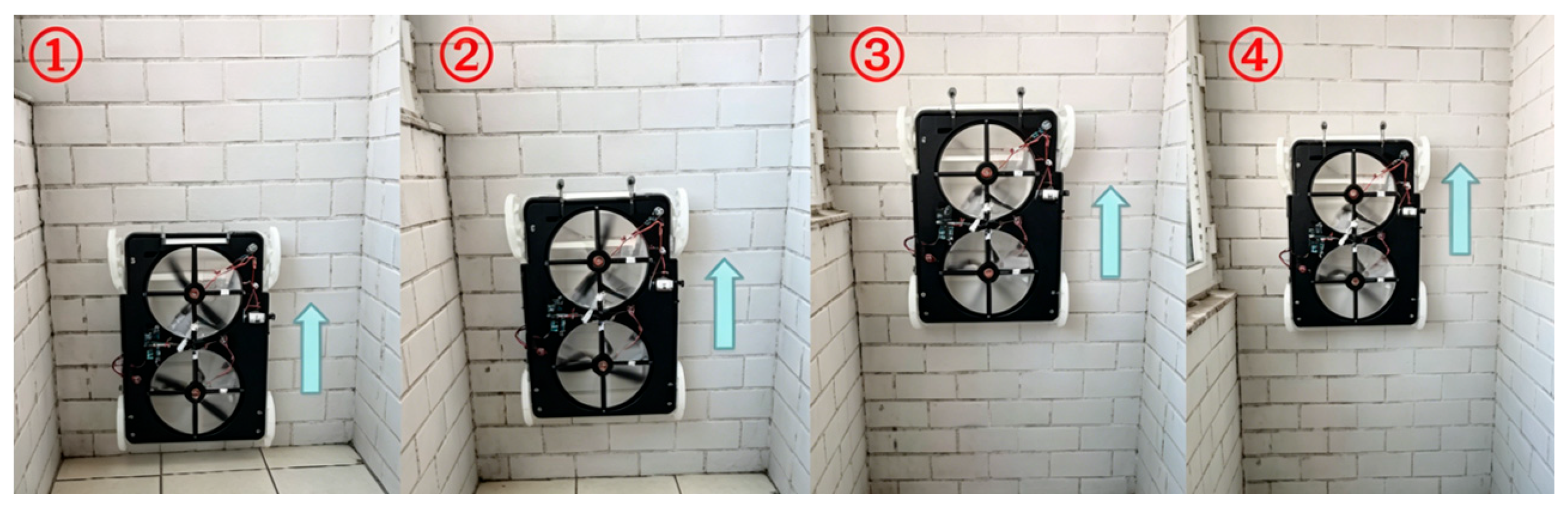
A notable contribution to this field comes from Guo, Y., who developed an innovative dual-propeller counter-thrust system specifically designed for wall-climbing applications. In this configuration, as illustrated in
Figure 12, the propellers rotate to generate substantial thrust force that continuously presses the robot against the wall surface, thereby enabling stable climbing motion. The counter-thrust arrangement, with propellers oriented to push toward the wall, creates a balanced force distribution that helps maintain the robot’s orientation and prevents undesirable rotation or pitching. Through comprehensive computational simulations coupled with rigorous experimental validation, Guo systematically calculated and verified the precise thrust requirements necessary for the robot to achieve reliable wall climbing across various operational conditions [
21]. This integrated approach combining theoretical analysis with empirical testing ensured that the thrust generation system could provide sufficient adhesive force while maintaining energy efficiency and stable operation.
Building upon this foundation, Guo advanced the technology by designing a more sophisticated 2-degree-of-freedom (2-DOF) rotor-based counter-thrust adhesion robot structure, along with its corresponding control system [
22]. This enhanced design, shown in
Figure 13, introduces pivotal mechanisms that allow the propellers to adjust their angles relative to the wall surface, providing unprecedented control over the thrust vector direction. By dynamically modifying propeller orientation, the system can precisely manage the component of thrust parallel to the wall surface, which serves to partially counteract the robot’s own gravitational force. This capability proves particularly valuable during vertical ascent, descent, or when traversing inclined surfaces, as the parallel thrust component can be modulated to either assist or resist gravity as needed. The rotor-based configuration also offers improved maneuverability, enabling the robot to execute turns and position adjustments with greater precision compared to fixed-propeller designs. This advancement represents a significant step toward more agile and adaptable thrust-based climbing robots capable of navigating complex surface geometries.
However, despite these innovative design improvements, thrust-based wall-climbing robots face several inherent limitations that constrain their practical applications. The fundamental requirement for continuous thrust generation necessitates relatively powerful propulsion devices, which inherently leads to several interconnected challenges. First, the payload capacity of these robots remains comparatively weak, as any additional weight carried by the robot directly increases the thrust required to maintain wall attachment, creating a demanding trade-off between robot weight, battery capacity, and useful payload. Second, the power requirements for thrust devices are substantial, typically far exceeding those of magnetic or electrostatic adhesion systems, which only require power for locomotion rather than continuous attachment. This high power consumption directly translates to significant energy demands, limiting operational duration and necessitating larger battery packs that further increase robot weight and reduce payload capacity. Third, and perhaps most critically, controlling the robot’s attitude stability on the wall presents extreme complexity, requiring sophisticated real-time control systems. The robot must continuously perceive its own posture and orientation through sensors such as IMUs (Inertial Measurement Units), while simultaneously calculating and executing precise adjustments to the thrust output from multiple propellers. Any disturbance, whether from wind gusts, surface irregularities, or dynamic load changes, requires immediate compensation through complex control algorithms. This real-time control challenge becomes particularly acute during transitions between surfaces, when navigating around obstacles, or when operating in environments with variable air flow conditions. These limitations continue to drive research into more efficient propulsion systems, advanced control strategies, and hybrid approaches that combine thrust adhesion with complementary attachment methods to leverage the advantages of each while mitigating their respective drawbacks.
2.6. Comparative Summary of Adhesion Methods
Each adhesion mechanism described above offers distinct advantages but also suffers from inherent limitations. A comparative summary is provided in
Table 1.
3. Locomotion Methods for Wall-Climbing Robots
Wall-climbing robots are categorized into wheeled, tracked, legged and hybrid types based on their locomotion methods. These four mobility modalities are applied in different scenarios, each with its own advantages, enabling them to perform specific tasks.
3.1. Wheeled Wall-Climbing Robots
Wheeled wall-climbing robots utilize various types of wheels—ranging from standard conventional wheels to specialized omnidirectional wheels (omni-wheels)—as their primary locomotion mechanism for navigating vertical surfaces. These wheels are driven by electric motors that generate torque, which is converted into linear or rotational motion through frictional interaction with the wall surface. The frictional force at the wheel-wall interface must be carefully balanced against the adhesion force (whether magnetic, negative pressure, or other types) to ensure both secure attachment and effective locomotion. Compared to other locomotion modalities such as tracked mechanisms or legged designs, wheeled robots generally offer distinct advantages, including higher achievable speeds on relatively smooth surfaces, smoother continuous motion, and simpler control architectures due to their reduced mechanical complexity. The continuous rolling contact also minimizes the start-stop motions characteristic of legged robots, enabling more energy-efficient operation over longer distances. However, the effectiveness of wheeled locomotion depends critically on surface conditions, with rough, uneven, or highly curved surfaces presenting significant challenges for maintaining consistent wheel contact and traction.
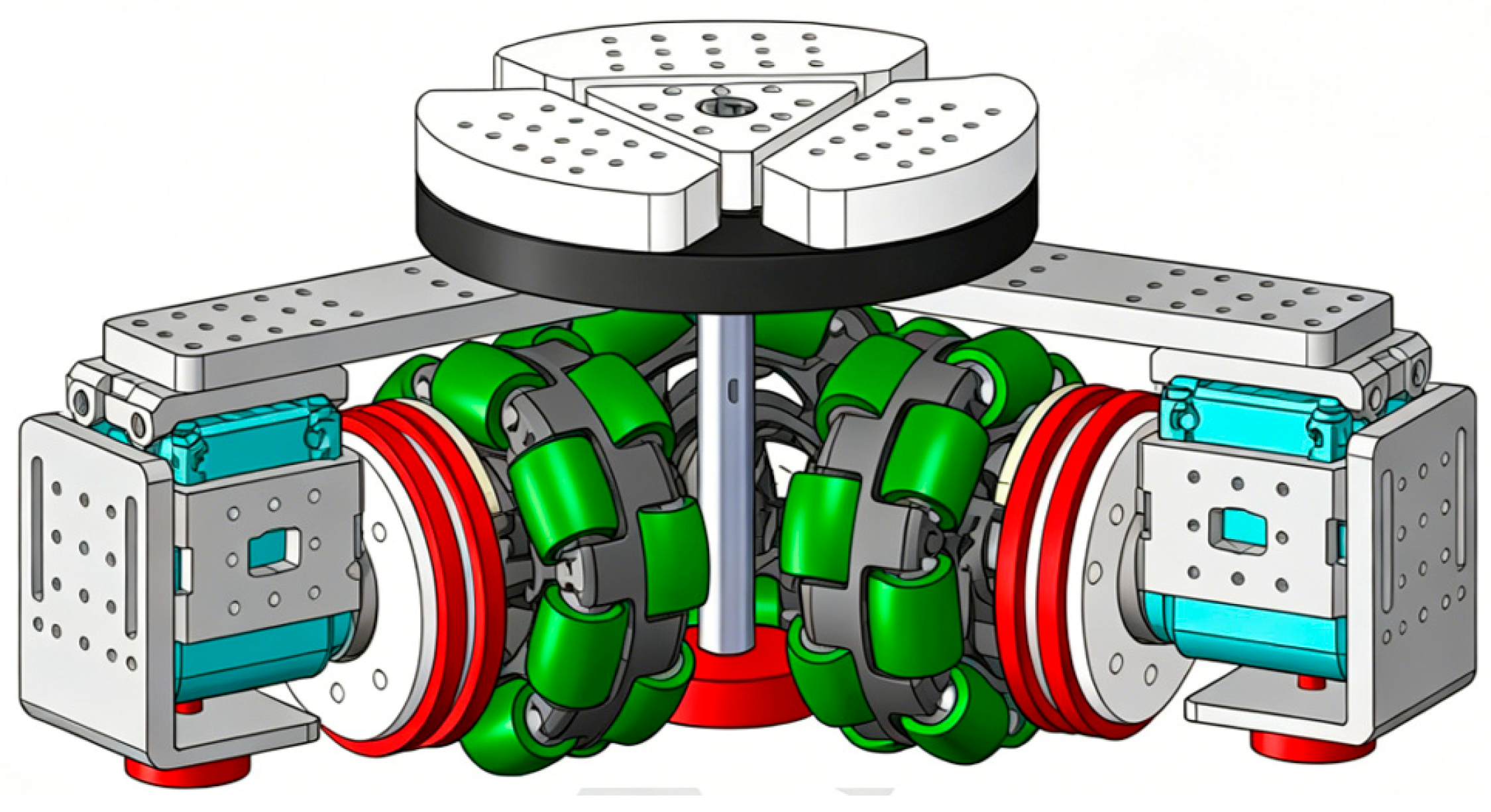
Tavakoli et al. developed an innovative magnetic wall-climbing robot based on omni-wheels, appropriately named the OmniClimber [
23]. This sophisticated robotic system, illustrated in
Figure 14, was specifically engineered to achieve three-axis movement capability, enabling unprecedented maneuverability on complex curved surfaces. The robot’s design incorporates articulated joints that allow the chassis to bend and conform to surface curvature, thereby maintaining optimal wheel contact even on non-planar geometries. Through this top-bending mechanism, the OmniClimber can effectively adapt to surfaces with varying radii of curvature, demonstrating particular effectiveness on cylindrical or spherical structures commonly found in industrial settings such as storage tanks, pipelines, and pressure vessels. The omni-wheels themselves represent a key design choice, as their unique roller configuration permits both forward motion and lateral sliding, enabling the robot to execute complex trajectories without requiring complex steering mechanisms. However, this design introduces certain performance trade-offs: the segmented roller structure of omni-wheels inevitably generates mechanical vibrations during rotation, which can propagate through the robot structure and cause unsteady movement patterns that potentially affect sensor readings or operational precision. Despite this limitation, extensive testing has confirmed that the OmniClimber exhibits remarkably high mobility and maintains reliable operation on curved surfaces with diameters exceeding 300 mm, making it particularly suitable for inspection and maintenance tasks in confined industrial environments where access is limited.
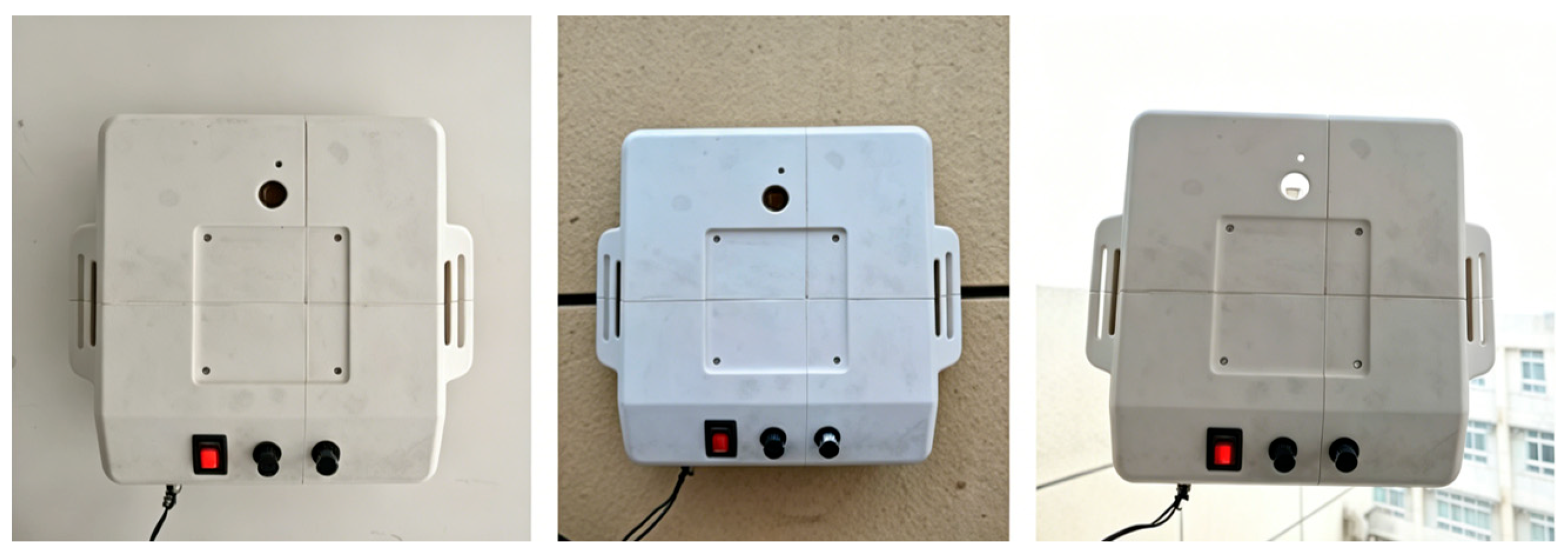
In a complementary line of research, Tao Qiuyu [
24] designed an innovative wall-climbing robot that combines wheeled locomotion with negative pressure adhesion technology, specifically engineered for operation on building facades and similar architectural surfaces, as shown in
Figure 15. This robot addresses the unique challenges posed by building exteriors, which often feature variable surface materials, occasional cracks or openings, and exposure to environmental disturbances. The negative pressure adhesion system creates a controlled vacuum chamber between the robot and the wall surface, generating suction force that maintains attachment even on non-magnetic materials such as concrete, brick, glass, or coated panels. A particularly innovative aspect of this research lies in the development of a closed-loop adaptive regulation method employing fuzzy PID (Proportional-Integral-Derivative) control for precise negative pressure management. This advanced control strategy continuously monitors the pressure differential and adjusts the suction system in real-time to compensate for air leakage caused by surface irregularities or temporary gaps in the seal. Comparative analysis demonstrated that the fuzzy PID controller exhibits superior dynamic response characteristics compared to conventional PID control, achieving faster and more accurate pressure regulation in response to varying leakage conditions. The controller maintains the target negative pressure with exceptional precision, achieving an overshoot of merely 7.3% during transient conditions while exhibiting no obvious oscillation or instability, which is critical for maintaining reliable attachment during dynamic maneuvers. Performance testing confirmed that the robot can operate at speeds exceeding 5 m per minute while maintaining secure adhesion, demonstrating both high mobility and excellent adaptability to diverse building surface conditions. This combination of reliable adhesion, precise pressure control, and practical operational speed makes the robot suitable for various building maintenance applications, including facade inspection, cleaning, and light repair work on modern architectural structures.
3.2. Tracked Wall-Climbing Robots
Compared to wheeled counterparts, tracked wall-climbing robots benefit from a larger contact area with the climbing surface, which generates greater adhesive friction and ensures more stable locomotion. This design allows them to traverse small obstacles and surface discontinuities with ease, offering strong environmental adaptability and high operational reliability. However, these advantages come with certain trade-offs, including relatively slower travel speeds, a tendency to skid during steering, and higher energy consumption due to increased mechanical resistance.
Wang [
25] developed a bio-inspired tracked climbing robot featuring an array of compliant claw spines integrated into the track structure, as illustrated in
Figure 16. The adhesion and friction generated between the claw spines and the wall surface enable the robot to ascend vertical substrates effectively. In experimental validation, the robot achieved a climbing speed of 13.3 mm/s and demonstrated a payload capacity equivalent to its own weight, highlighting the potential of spine-based adhesion mechanisms for lightweight climbing platforms.
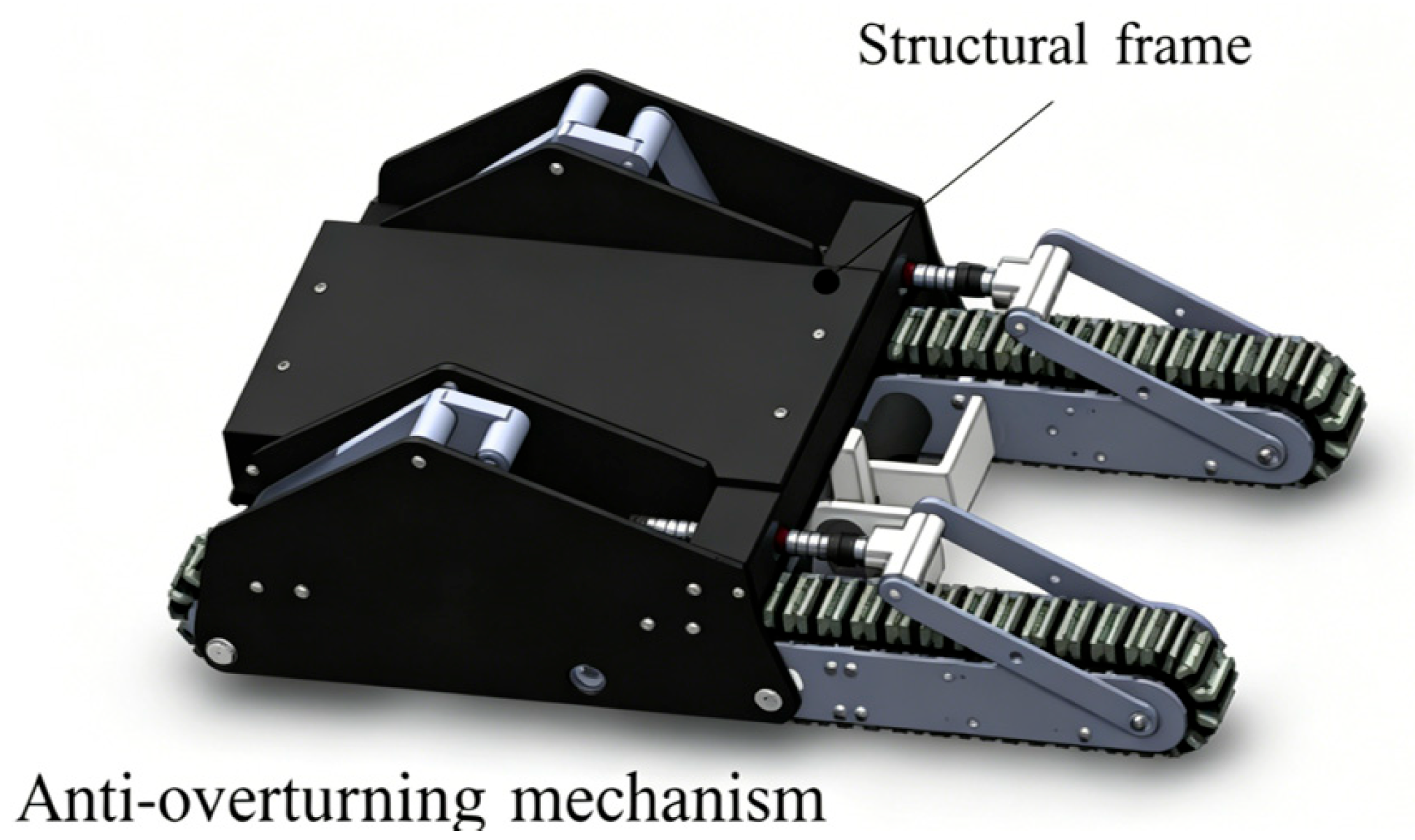
In a separate study, a wall-climbing robot developed by Gao, J. et al. [
26] adopts a dual-module configuration comprising two climbing units connected by an anti-overturning linkage mechanism. This structural design enhances stability during transition over obstacles by providing a compensating anti-overturning moment. As a result, the robot is capable of traversing 10 mm high weld seams on vertical steel surfaces while carrying a maximum payload of up to 10 kg. The mechanical robustness and magnetic adhesion system of the robot are depicted in
Figure 17, demonstrating its suitability for heavy-duty inspection and maintenance tasks in industrial environments.
3.3. Legged Wall-Climbing Robots
Compared with wheeled or tracked counterparts, legged wall-climbing robots exhibit superior adaptability in complex and unstructured environments. By coordinating leg lifting, stepping, and body posture adjustment, these robots can actively negotiate obstacles and maintain stable adhesion on curved or uneven surfaces. Their biomimetic design enables multimodal locomotion, such as walking, transitioning, and climbing across wall–ceiling interfaces, making them suitable for inspection tasks in highly confined or irregularly shaped spaces. However, these advantages are accompanied by increased system complexity. Legged robots typically require multiple degrees of freedom, precise joint control, and real-time stability maintenance, which lead to more complicated mechanical structures, higher manufacturing costs, and greater demands on control algorithms. Dynamic balance during locomotion, especially during gait switching or obstacle traversal, remains a critical challenge that limits their practical deployment in real-world scenarios.
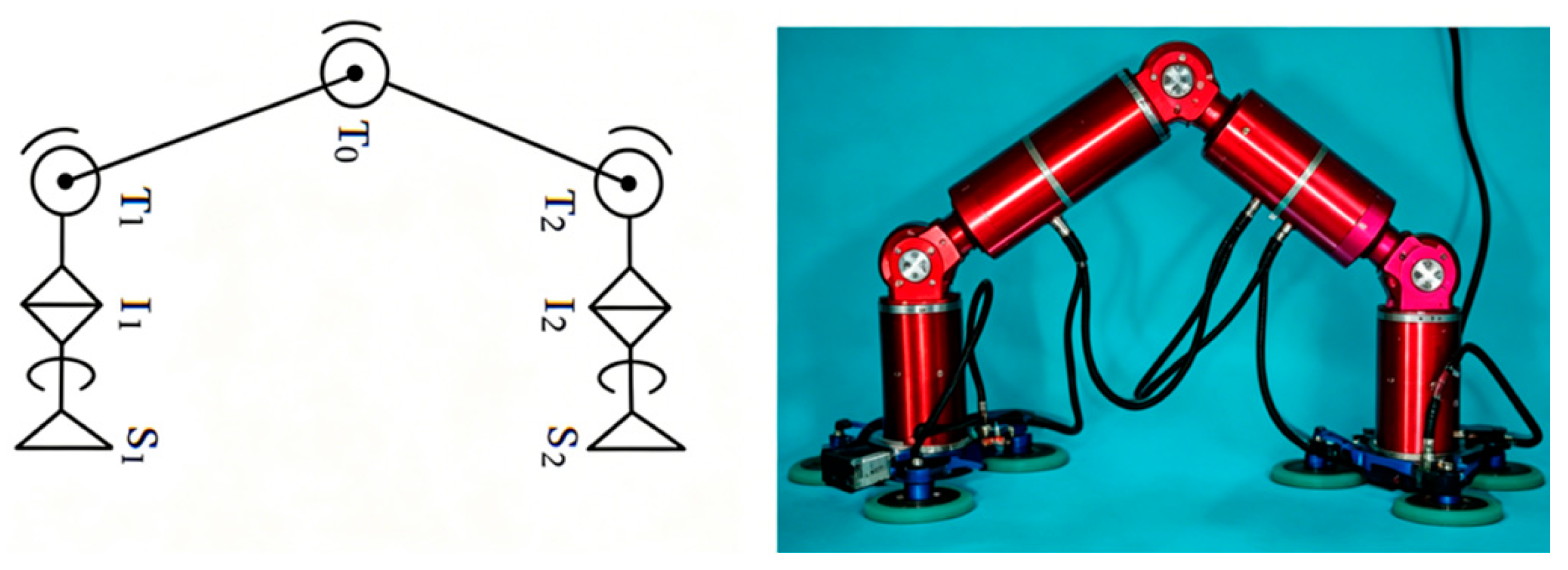
Y. Guan et al. [
27] developed a bipedal wall-climbing robot named WClimbot, which features a five-degree-of-freedom configuration and employs negative pressure adsorption units for adhesion, as illustrated in
Figure 18. The robot is capable of performing multiple gaits, including inchworm-like crawling, rotational steering, and vaulting motions, allowing it to adapt to diverse mission requirements. Its articulated structure enables flexible posture adjustment, facilitating obstacle negotiation and surface-to-surface transitions. Experimental validations have demonstrated the robot’s capability to climb vertical walls, cross ledges, and move between orthogonal planes, highlighting its potential for applications in bridge inspection, high-rise building maintenance, and disaster response scenarios.
Inspired by biological attachment mechanisms, Kong et al. from the Chinese Academy of Sciences [
28] proposed a quadruped wall-climbing robot capable of adhering to both rough and smooth surfaces, as shown in
Figure 19. The design draws from the claw structures of the long-horned beetle, which enable secure interlocking on rough substrates, and the setae arrays found on gecko feet, which provide van der Waals force-based adhesion on smooth surfaces. By integrating both bionic hooks and dry adhesive materials into the robot’s feet, the system achieves adaptive climbing across surfaces with varying roughness. Furthermore, the robot’s body incorporates compliant joints that allow it to conform to cylindrical surfaces of different curvatures, enhancing its versatility for tasks such as pipeline inspection, storage tank monitoring, and exterior facade scanning. The combination of structural compliance and hybrid adhesive mechanisms positions this robot as a promising platform for inspection and maintenance in both indoor and outdoor industrial environments.
3.4. Hybrid Locomotion for Wall-Climbing Robots
Hybrid locomotion integrates multiple mobility mechanisms—such as tracked and wheeled systems—into a unified robotic platform, enabling wall-climbing robots to adapt to a broader spectrum of surface conditions. By combining the advantages of different locomotion modes, hybrid designs allow robots to seamlessly traverse flat, smooth, rough, or uneven wall surfaces, overcoming the limitations inherent to single-mode systems. This integration not only enhances surface adaptability but also significantly improves the robot’s flexibility and maneuverability during complex tasks such as obstacle negotiation, directional switching, and multi-plane transitions. However, the increased mechanical complexity associated with hybrid locomotion mechanisms imposes higher demands on system maintenance and repair, as more components and actuation units are involved, and failure diagnosis becomes more challenging.
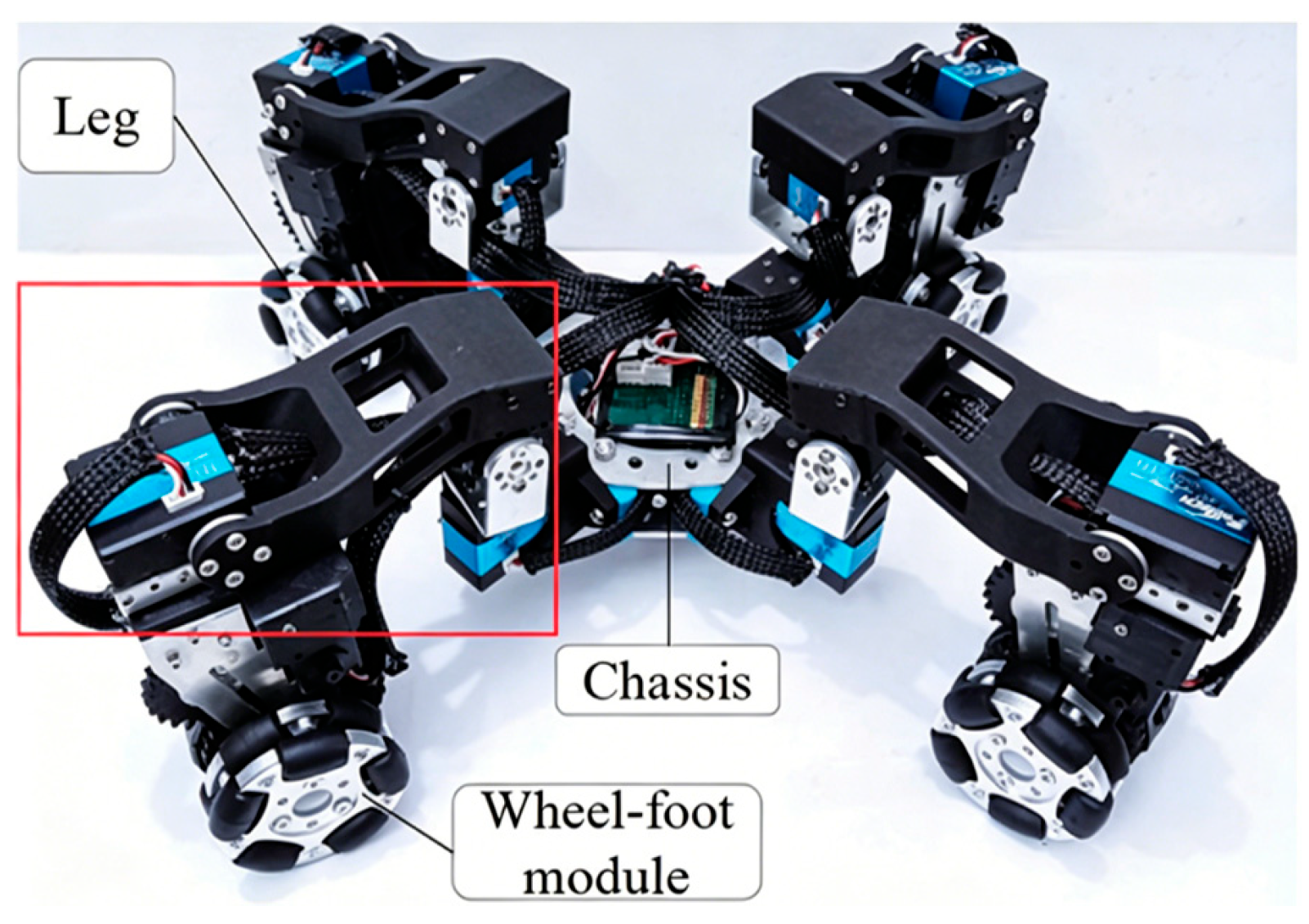
Bu et al. [
29] developed a quadruped wheel-leg hybrid robot aimed at enhancing the dexterity and operational flexibility of wall-climbing platforms, as illustrated in
Figure 20. The robot is equipped with four articulated legs, each fitted with two magnetic omni-wheels at the distal end, enabling both stable adhesion and multi-directional mobility on ferromagnetic surfaces. This wheel-leg hybrid configuration provides the robot with a high degree of kinematic freedom while preserving motion stability and traversal speed, allowing it to perform agile maneuvers such as in-place rotation, lateral movement, and adaptive gait adjustment. The design effectively combines the continuous mobility of wheeled systems with the obstacle-climbing capability of legged mechanisms, offering a versatile solution for inspection and maintenance tasks in complex industrial environments such as steel bridges, storage tanks, and ship hulls.
3.5. Comparative Summary of Locomotion Methods
A comparative summary of the advantages and disadvantages of different locomotion methods discussed above is presented in
Table 2.
4. Wall-Climbing Robot Path Planning
For wall-climbing robots to effectively execute inspection, maintenance, or cleaning tasks within designated operational zones, they must be capable of performing various types of motion, including point-to-point (PTP) transitions, end-to-end coverage, and adaptive traversal across complex wall surfaces. The path planning strategies employed to achieve these motions are fundamentally categorized based on the availability and prior knowledge of the environmental map. When the working environment is fully known and structured, path planning is typically conducted offline using pre-established maps, a paradigm commonly referred to as global path planning. This approach enables the robot to compute optimal or feasible trajectories before deployment, minimizing online computational burden and ensuring deterministic motion execution. Global path planning can be further classified into three primary subtypes: Complete Coverage Path Planning (CCPP) [
30], which aims to ensure that every point in the target area is traversed at least once—essential for tasks such as surface inspection or painting; Coverage Path Planning (CPP) [
31], which focuses on efficiently covering a region without necessarily requiring exhaustive traversal, often applied in cleaning or spraying operations; and Point-to-Point Path Planning (PTP), which seeks to determine the shortest or most energy-efficient route between two specified locations while avoiding obstacles and adhering to kinematic constraints.
In contrast, when wall-climbing robots are deployed in unstructured, dynamic, or previously unmapped environments, global maps are often unavailable or unreliable. In such scenarios, path planning must be performed online, relying on real-time perceptual feedback from onboard sensors. This paradigm, known as local path planning or online path planning, enables the robot to incrementally construct a representation of its surroundings while simultaneously adjusting its trajectory to avoid unforeseen obstacles and adapt to changing surface conditions. Common sensing modalities include vision-based systems (e.g., monocular or stereo cameras) for feature detection and depth estimation, ultrasonic sensors for proximity measurement and collision avoidance, and Light Detection and Ranging (LiDAR) systems for high-precision distance mapping and environmental reconstruction. The integration of these sensors allows the robot to perform simultaneous localization and mapping (SLAM), detect surface discontinuities such as welds or gaps, and make real-time navigational decisions. Local path planning algorithms often incorporate reactive control strategies, such as the dynamic window approach (DWA) or artificial potential fields, to balance goal-directed motion with obstacle avoidance. The robustness of online planning is critical for applications such as disaster response, infrastructure inspection in unknown facilities, or exploration of confined industrial spaces, where environmental conditions cannot be fully anticipated prior to deployment.
The choice between global and local path planning—or their hybrid integration—depends on multiple factors, including mission objectives, environmental complexity, computational resources, and sensor payload capacity. For instance, a wall-climbing robot tasked with periodic inspection of a well-documented steel bridge may rely predominantly on global CCPP to ensure comprehensive coverage, while intermittently using local sensing to compensate for minor deviations or temporary obstructions. Conversely, a robot deployed for search-and-rescue in a collapsed structure must prioritize online adaptability, continuously updating its path based on sensor-derived environmental cues. Recent advances in machine learning, particularly deep reinforcement learning, have further blurred the distinction between these categories, enabling robots to learn navigation policies that generalize across both known and unknown environments. As wall-climbing robots continue to evolve toward greater autonomy and versatility, path planning methodologies will increasingly emphasize seamless integration of prior knowledge and real-time perception, as well as robustness to surface variability and adhesion constraints.
4.1. Path Planning Challenges Specific to Wall-Climbing Robots
While the path planning algorithms described in
Section 4.1 and
Section 4.2 were originally developed for ground-based mobile robots, their application to wall-climbing robots introduces several additional constraints that must be explicitly addressed:
(1) Gravity-dependent motion cost. On vertical or inclined surfaces, moving upward against gravity consumes significantly more energy than moving downward. Conventional cost functions based solely on Euclidean distance or uniform movement cost fail to capture this anisotropy. Therefore, path planners for climbing robots should incorporate directional cost weights that penalize upward motion and reward downward or lateral motion when energy minimization is a priority.
(2) Orientation-dependent adhesion reliability. The adhesion force of many mechanisms (e.g., negative pressure cups, electrostatic pads, directional dry adhesives) varies with the robot’s orientation relative to the surface and the local surface curvature. Path planning must preferentially select trajectories that keep the robot in regions where adhesion is well-characterized (e.g., avoiding sharp edges or highly curved panels where magnetic flux drops). In addition, sudden changes in surface angle (e.g., from vertical to ceiling) may require the planner to include a transition phase where speed is reduced and adhesion safety margins are increased.
(3) Surface transition feasibility. Moving between orthogonal surfaces (e.g., from a vertical wall to a ceiling, or across a convex corner) imposes kinematic and dynamic constraints that are absent in planar navigation. Not all trajectories that are collision-free on a flattened 2D map are physically realizable on a 3D curved structure. Global planners must therefore consider the robot’s ability to negotiate such transitions, which may require specific gaits (for legged robots) or specialized wheel/track configurations.
(4) Adhesion–locomotion coupling. The available adhesion force can limit the maximum allowable acceleration and speed, especially for suction-based or thrust-based robots. A path that demands rapid acceleration on a low-friction surface may cause the robot to slip or detach. Local planners should incorporate adhesion margins into their velocity sampling and trajectory evaluation.
(5) Curved and non-developable surfaces. Many industrial structures (storage tanks, wind turbine blades, aircraft fuselages) are not planar. Path planning on such surfaces must operate on 2.5D or 3D surface representations rather than flat grids, which adds complexity to both global and local planning.
4.2. Global Path Planning
Global path planning presupposes the availability of a complete and prior map of the operational environment, encompassing detailed information on obstacle geometries, spatial constraints, and feasible regions. Within this known context, the objective is to compute a globally optimal trajectory that satisfies mission-specific requirements while adhering to robot kinematics, safety constraints, and energy limitations. Depending on the nature of the task, global path planning can be further categorized into three distinct subproblems. Complete Coverage Path Planning (CCPP) aims to generate a trajectory that ensures every reachable point within the target workspace is traversed at least once, which is essential for applications such as surface inspection, painting, or disinfection. Coverage Path Planning (CPP), by contrast, focuses on efficiently covering a designated region of interest without necessarily requiring exhaustive traversal of the entire reachable area, making it suitable for tasks like cleaning or selective monitoring. Point-to-Point Path Planning (PTP) seeks to determine a collision-free optimal route between a specified start configuration and a target configuration, optimizing for metrics such as shortest path length, minimum energy consumption, or maximum safety margin.
A diverse array of algorithmic approaches has been developed to address these global path planning challenges, each offering distinct trade-offs between optimality, computational efficiency, and scalability. Among the most foundational is Dijkstra’s algorithm [
32], which operates by iteratively expanding from the start node, selecting the nearest unvisited node, updating distance estimates to all reachable nodes, and repeating this process until the target is reached. While Dijkstra’s algorithm guarantees the shortest path in graphs with non-negative edge weights and is prized for its logical simplicity and completeness, it suffers from lack of directional guidance, resulting in high computational overhead and diminished efficiency when applied to large-scale or complex environments. The absence of heuristic information leads to exhaustive exploration, which can be prohibitive for real-time applications or high-dimensional configuration spaces.
To address the directional inefficiency of Dijkstra’s approach, the A* algorithm [
33] introduces a heuristic function to guide the search toward the goal, as formalized in
, where
denotes the current node during the search,
is the comprehensive evaluation function,
is the cost function for the path taken, and
is the heuristic function. The path with the smallest
is chosen. A* effectively balances optimality and search efficiency, making it one of the most widely adopted algorithms for robotic path planning. Its advantages include relatively short route generation and ease of implementation across diverse domains. However, A* is not without limitations; the resulting paths often exhibit poor smoothness due to grid-based discretization, and the presence of numerous waypoints may necessitate post-processing techniques such as path pruning or spline interpolation to achieve kinematically feasible trajectories.
For high-dimensional planning problems, particularly those involving complex manipulators or multi-degree-of-freedom systems, sampling-based methods offer a scalable alternative. The Rapidly exploring Random Tree (RRT) algorithm [
34] constructs a search tree by iteratively sampling random configurations in the state space, extending the tree toward sampled points, and terminating when a node containing the target configuration is reached. RRT is renowned for its computational efficiency and ability to handle nonholonomic constraints and high-dimensional spaces without explicit environment discretization. However, its stochastic nature often yields suboptimal paths characterized by jagged trajectories and excessive turning points, necessitating subsequent optimization or smoothing stages. Variants such as RRT* have been developed to address optimality concerns by incorporating rewiring procedures that asymptotically converge to the shortest path.
Recent advances in artificial intelligence have catalyzed the development of learning-based global path planning methodologies. Deep learning approaches [
35] leverage neural networks to learn implicit representations of environments and generate collision-free trajectories directly from sensory inputs or occupancy maps, offering the potential for rapid inference once training is complete. Reinforcement learning algorithms [
36] frame path planning as a sequential decision-making problem, enabling robots to learn optimal policies through trial-and-error interaction with simulated environments, with particular promise for adapting to dynamic or partially known settings. These data-driven methods, while powerful, often require extensive training data and may lack the formal guarantees of completeness and optimality associated with classical algorithms.
Parallel to AI-based methods, intelligent bio-inspired optimization algorithms have gained traction for their ability to handle complex, multi-objective planning problems. Ant Colony Optimization (ACO) [
37] simulates the pheromone-trail following behavior of ants to iteratively construct and refine paths, exhibiting robust performance in graph-based planning tasks. Genetic Algorithms (GA) [
38] employ mechanisms of selection, crossover, and mutation to evolve populations of candidate trajectories toward optimality, offering flexibility in incorporating diverse objective functions. Particle Swarm Optimization (PSO) [
39] models the social behavior of bird flocks to explore the solution space, with particles adjusting their trajectories based on individual and collective best-known positions, proving effective for continuous optimization problems in path planning.
Recent contributions have sought to synergize multiple algorithmic paradigms to overcome individual limitations. Chen et al. [
40] proposed a dual-layer path planning framework for multi-robot systems operating in shared environments. The first layer enhances the conventional A* algorithm by introducing a dynamic weight factor into the heuristic function, enabling adaptive trade-offs between optimality and computational speed based on environmental complexity. The second layer incorporates a temporal dimension through the construction of a path-time graph, facilitating collision avoidance and coordination among multiple agents. This hierarchical integration significantly improves the real-time performance and scalability of multi-robot path planning, as validated through simulation and experimental studies.
Nazarahar et al. [
41] developed an enhanced genetic algorithm tailored for continuous-space path planning, focusing on refining initial suboptimal trajectories to converge toward globally optimal routes between start and target locations. By incorporating domain-specific crossover and mutation operators, along with fitness functions that penalize collisions and reward path efficiency, their approach demonstrated both effectiveness and real-time viability in generating collision-free paths across diverse environmental configurations.
Zhang et al. [
42] contributed a novel hybrid methodology that integrates Ant Colony Optimization with deep learning models, termed the neural adaptive heuristic ant colony optimization algorithm. This framework leverages deep neural networks to learn adaptive heuristic information from environmental features, which then guides the pheromone update and transition rules of the ACO process. Crucially, the algorithm incorporates a congestion-aware loss function during training, enabling the system to proactively avoid regions with high obstacle density or narrow passages. Experimental results indicate superior convergence speed and path quality compared to conventional ACO and other metaheuristic baselines, highlighting the potential of neuro-symbolic integration for next-generation path planning systems.
4.3. Local Path Planning
Local path planning, also referred to as online path planning or reactive navigation, enables robots to navigate and avoid obstacles in real time through continuous acquisition and processing of environmental information via onboard sensors, without relying on pre-existing maps. This paradigm is essential for deployment in unstructured, dynamic, or previously unexplored environments where global map information is unavailable, outdated, or insufficiently detailed. The core principle underlying local path planning is the tight integration of perception and action: sensor data—ranging from depth images and point clouds to ultrasonic range measurements—are processed to construct an implicit or explicit representation of the immediate surroundings, which then informs incremental motion decisions that guide the robot toward its goal while ensuring collision avoidance and adherence to kinematic constraints.
The sensing suite for local path planning typically comprises a combination of modalities selected based on operational requirements, environmental conditions, and payload constraints. Vision-based systems, including monocular and stereo cameras, provide rich semantic and geometric information, enabling feature detection, depth estimation, and visual odometry. Ultrasonic sensors offer robust proximity detection at close range, particularly useful for transparent or reflective surfaces that challenge optical sensors. Light Detection and Ranging (LiDAR) systems deliver high-precision distance measurements and are widely employed for environmental mapping and obstacle detection in both indoor and outdoor settings. The fusion of data from multiple sensor types, often through Kalman filtering or factor graph optimization, enhances robustness and reduces uncertainty in state estimation. Recent advances in embedded computing and sensor miniaturization have facilitated the integration of these capabilities into compact, lightweight platforms suitable for wall-climbing robots operating in vertically oriented or inverted configurations.
A diverse portfolio of algorithmic methodologies has been developed to address the challenges of local path planning, each embodying distinct philosophical approaches to the trade-off between reactivity, optimality, and computational efficiency. Among the most enduring and widely adopted is the Artificial Potential Field (APF) method [
43], which conceptualizes the robot’s navigation space as a field imbued with virtual forces. The target location exerts an attractive potential that draws the robot toward it, while obstacles generate repulsive potentials that push the robot away. The robot’s motion is then governed by the resultant force vector, computed as the gradient of the combined potential field. The mathematical elegance and computational simplicity of APF have contributed to its sustained popularity in real-time applications. However, the method is susceptible to several well-documented limitations. Local minima can arise when attractive and repulsive forces cancel, trapping the robot short of its goal. Oscillatory behavior may occur in narrow corridors or when obstacles are symmetrically arranged. Furthermore, the “goal non-reachable with obstacles nearby” (GNRON) problem emerges when repulsive forces from obstacles near the target overwhelm the attractive force, preventing the robot from completing its mission. Numerous enhancements have been proposed to address these shortcomings, including the incorporation of harmonic functions, navigation functions, and virtual obstacle techniques to eliminate local minima and guarantee convergence.
The Dynamic Window Approach (DWA) represents a fundamentally different paradigm rooted in predictive control theory. DWA explicitly accounts for the robot’s kinematic and dynamic constraints by searching for admissible velocity commands within a two-dimensional velocity command space (
v,
ω) of translational and rotational velocities. The “dynamic window” concept restricts this search to velocities that can be achieved within the next time interval given acceleration limits, ensuring that planned trajectories are dynamically feasible. For each candidate velocity pair, the robot’s motion is simulated forward over a fixed time horizon, generating a predicted trajectory. These trajectories are evaluated using a multi-objective evaluation function that typically incorporates terms for progress toward the goal, clearance from obstacles, and forward velocity magnitude. The velocity command that maximizes this evaluation function is then executed, and the process repeats in a receding horizon fashion until the target is reached. DWA offers several compelling advantages for unknown environment navigation: it operates without requiring a global map, maintains computational efficiency suitable for real-time implementation, and naturally accommodates robot dynamics. The method’s predictive nature enables proactive obstacle avoidance, as trajectories that would lead to future collisions are penalized or discarded. However, DWA is inherently a local optimization technique and may converge to suboptimal paths or become trapped in dead ends without higher-level guidance. The selection of evaluation function weights critically influences behavior, and tuning these parameters for diverse environments remains a subject of ongoing research. To address these limitations, various improved DWA methods have been proposed [
44].
Beyond these classical approaches, artificial intelligence has emerged as a transformative paradigm for local path planning, offering the potential to learn complex navigation policies directly from data. Deep learning-based methods [
45] leverage neural architectures to map sensory inputs to motion commands or intermediate representations. Convolutional neural networks (CNNs) process visual and depth imagery to extract features relevant to obstacle detection and traversability estimation. Recurrent neural networks (RNNs) and transformers capture temporal dependencies essential for motion prediction and planning under uncertainty. End-to-end learning approaches train policies that directly output velocity commands from raw sensor streams, eliminating the need for explicit mapping or planning modules. While these methods have demonstrated impressive capabilities in simulation and controlled settings, they face challenges related to data efficiency, generalization to unseen environments, and interpretability. Reinforcement learning offers a complementary framework in which robots learn optimal policies through trial-and-error interaction with the environment, guided by reward signals that encode task objectives and safety constraints. Deep reinforcement learning (DRL) combines the representational power of neural networks with the sequential decision-making formalism of Markov decision processes, enabling learning in high-dimensional state and action spaces. Recent advances in safe reinforcement learning incorporate constraints that explicitly enforce collision avoidance during training and deployment, addressing a critical requirement for physical robotic systems.
Recent research has increasingly focused on hybrid methodologies that synergize classical algorithms with learning-based techniques to leverage the strengths of both paradigms. Zhang et al. [
46] proposed a Bug-APF path planning method that integrates the minimalism of Bug algorithms with the reactive flexibility of artificial potential fields. The Bug algorithm family, renowned for its theoretical guarantee of convergence in unknown environments, operates through simple rules: follow walls and move toward the goal when possible. In the Bug-APF hybrid, the Bug algorithm generates a sequence of sub-goal nodes that guide the robot around obstacles, while the artificial potential field method performs local navigation between successive sub-goals. This decomposition addresses two fundamental limitations of standalone APF: the local minima problem and the GNRON issue. By structuring navigation as a series of provably reachable intermediate targets, the hybrid approach ensures global convergence while preserving the smooth, reactive motion characteristic of potential fields. Experimental validation demonstrated significant improvements over conventional APF, with average path length reduced by 8%, mean curvature of turning trajectories decreased by 85%, and complete elimination of local trapping incidents. These results underscore the value of algorithmic hybridization in achieving both theoretical guarantees and practical performance.
Fu et al. [
45] addressed limitations of the traditional Dynamic Window Approach related to the paucity of information available for evaluation function adaptation. Conventional DWA relies on fixed or manually tuned weights that may not generalize across diverse environments or task contexts. Their proposed deep learning-enhanced DWA framework leverages convolutional neural networks to process multimodal sensor information—including laser range findings, robot pose estimates, and local occupancy representations—and generates key parameters that dynamically adjust the evaluation function weights in real time. This adaptive mechanism enables the robot to modulate its behavior based on environmental context: prioritizing obstacle clearance in cluttered spaces, emphasizing goal progress in open areas, and balancing both in transitional zones. The neural network is trained using supervised learning on datasets derived from expert demonstrations or optimal trajectory simulations, capturing nuanced relationships between environmental features and appropriate behavioral responses. Experimental results confirmed that the deep learning-augmented DWA outperforms its conventional counterpart in terms of navigation success rate, path efficiency, and smoothness, particularly in environments with varying obstacle densities and configurations. This work exemplifies the broader trend toward learned adaptive components that enhance classical algorithms without discarding their structural advantages.
The integration of local path planning with higher-level global planning represents an active frontier of research. Hierarchical architectures typically employ a global planner to generate a coarse reference path based on available map information, while a local planner performs real-time trajectory tracking and obstacle avoidance within the vicinity of the robot. This decomposition balances the complementary strengths of global optimality and local reactivity. However, the interface between levels poses challenges: the local planner may deviate significantly from the global reference in response to unforeseen obstacles, potentially invalidating the global plan’s assumptions. Recent approaches address this through replanning mechanisms that update the global plan when deviations exceed thresholds, or through elastic planning frameworks that allow the reference path to deform locally in response to environmental feedback. Model predictive control (MPC) formulations that incorporate both global guidance and local constraints within a unified optimization framework offer a principled approach to reconciling these objectives.
Looking forward, several directions promise to advance the capabilities of local path planning for wall-climbing robots. The incorporation of learning-based perception systems that can generalize across diverse surface materials and lighting conditions will enhance environmental understanding. Uncertainty-aware planning methods that explicitly model sensor noise and prediction errors will improve safety and robustness. Multi-robot coordination in shared workspaces will require distributed local planning algorithms that maintain safety without centralized coordination. The integration of task-level knowledge—such as inspection priorities or semantic constraints—into local planning objectives will enable more intelligent, context-aware navigation. As wall-climbing robots transition from laboratory prototypes to deployed systems in industrial inspection, infrastructure maintenance, and disaster response, the continued evolution of local path planning methodologies will remain central to their autonomous capabilities.
5. Conclusions and Discussions
This review has surveyed the state of the art in wall-climbing robots, focusing on three interconnected aspects: adhesion mechanisms, locomotion modalities, and path planning strategies. Rather than reiterating all descriptive details, we synthesize here the main findings in a critical manner and identify clear paths forward.
Most promising adhesion–locomotion pairings for specific applications. No universal solution exists; the optimal choice depends strongly on the target task and environment. For heavy-duty industrial inspection on steel structures (e.g., bridges, storage tanks, ship hulls), magnetic adhesion combined with tracked or wheeled locomotion offers the best combination of high load capacity (up to 100 kg), low energy consumption (permanent magnets require no continuous power), and low control complexity. For building façade maintenance (concrete, glass, brick), negative pressure adhesion with wheeled or legged locomotion is currently the most practical, despite energy and noise drawbacks, because it works on non-magnetic materials. For lightweight inspection on mixed or delicate surfaces (e.g., historical monuments, indoor walls), bio-inspired dry adhesion paired with legged or hybrid locomotion provides the highest surface adaptability and zero external power consumption, albeit at the cost of complex fabrication and limited durability. Electrostatic adhesion remains attractive for miniaturized, low-payload climbing robots (e.g., covert inspection, small electronic devices), while thrust adhesion is reserved for rough or permeable surfaces where other methods fail, accepting high energy consumption and control complexity.
Unresolved technical barriers. Despite significant progress, several critical gaps remain. First, adhesion reliability on real-world surfaces is still unsatisfactory. Most studies test on clean, smooth, or well-characterized substrates, whereas industrial surfaces are often dusty, wet, uneven, or coated. Second, energy autonomy is a fundamental bottleneck. Negative pressure and thrust systems require tethered power or large batteries; magnetic and bio-inspired systems are more efficient but still struggle with long-duration missions. Third, surface transition capability (e.g., wall-to-ceiling, convex/concave corners) remains largely unsolved for most climbing robots, especially for wheeled and tracked designs. Fourth, path planning algorithms rarely incorporate climbing-specific constraints such as gravity-dependent energy costs, orientation-dependent adhesion margins, and non-developable surface geometries. Most existing planners are adapted from ground-robot algorithms without rigorous validation on vertical or curved surfaces.
Priority research directions for next-generation autonomous wall-climbing robots. We identify four high-impact directions. (1) Hybrid and switchable adhesion: Combining two or more mechanisms (e.g., magnetic + dry adhesive, negative pressure + electrostatic) on the same robot, with active switching, could expand the range of surface materials while maintaining energy efficiency. (2) Energy-aware and adhesion-aware path planning: Future planners must explicitly model the energy cost of upward motion, the safety margin of adhesion near surface edges or curvature changes, and the feasibility of surface transitions. This requires tight integration of global and local planning with real-time adhesion feedback. (3) Learning-based adaptation for unstructured environments: Deep reinforcement learning and sim-to-real transfer offer promising routes to enable climbing robots to generalize to unseen wall materials, surface irregularities, and dynamic obstacles without manual re-engineering. (4) Lightweight, modular, and tetherless designs: Advances in high-energy-density batteries, wireless power transmission, and structural composites are essential to remove the umbilical cord that limits many current climbing robots. Miniaturization and modularity will also allow swarms of small climbing robots to cooperatively inspect large infrastructures.
In summary, the field of wall-climbing robots has matured considerably, with well-established adhesion and locomotion solutions for relatively simple, structured environments. The next frontier lies in achieving robust, energy-efficient, and autonomous operation on complex, real-world surfaces. This will require not only incremental improvements in individual components but also a systems-level integration of adaptive adhesion, climbing-aware planning, and learning-based perception–action loops.




 ,
,