Article

Geometry–Dynamics Coupled Lateral Control with Adaptive Speed Planning for Six-Axle Vehicles Under Confined Spatial and Low-Friction Conditions Based on Dual-Point Preview and Multi-Mode Steering Fusion


Automotive Engineering Research Institute, Jiangsu University, Zhenjiang 212013, China
*
Author to whom correspondence should be addressed.
Actuators 2026, 15(7), 363; https://doi.org/10.3390/act15070363
Submission received: 26 May 2026 / Revised: 15 June 2026 / Accepted: 23 June 2026 / Published: 1 July 2026
(This article belongs to the Section Actuators for Surface Vehicles)

Abstract

Distributed-drive all-wheel steering (AWS) six-axle vehicles possess distinct advantages in power performance, maneuverability, and environmental adaptability. However, when navigating tight curves under sudden low-friction road conditions, their inherent long wheelbase and strong inter-axle coupling typically lead to compromised spatial maneuverability, trajectory decoupling between the vehicle nose and tail, and lateral dynamic instability. To resolve these critical issues, this paper proposes a geometry–dynamics coupled lateral control scheme with adaptive speed planning for six-axle vehicles under confined spatial and low-friction conditions by seamlessly fusing a dual-point preview mechanism with multi-mode steering mappings. First, a three-degree-of-freedom nonlinear vehicle dynamic model incorporating longitudinal, lateral, and yaw motions is constructed, alongside the formulation of extended Ackermann kinematic steering manifolds for three distinct modes: rear-axle steering, center steering, and crab steering. To rectify the kinematic under-constrained deficiency inherent in conventional single-point preview path-tracking architectures, a joint front-and-rear dual-point preview constraint mechanism is established. This framework permits the quantitative derivation of a spatial geometric reconstruction method for the instantaneous center of rotation (ICR), which algebraically maps the ideal ICR trajectory requirements onto the physical constraints of the selected steering modes. Consequently, complete geometric constraints on both the front and rear trajectories are achieved, enabling active compression of the vehicle’s turning radius. Furthermore, to handle sudden low-friction disturbances, road adhesion limits and vehicle lateral stability boundaries are explicitly incorporated to design a multi-scale adaptive preview distance dynamic scaling mechanism driven by dynamic safety margin corrections. By adaptively scaling the spatial constraint at the geometric layer, this mechanism proactively mitigates nonlinear tire sideslip force saturation via feedforward action, thereby preventing tracking divergence and catastrophic sideslip instability under physical adhesion limits. Co-simulations based on the high-fidelity TruckSim-Simulink platform demonstrate that, in standard curves, the proposed dual-point preview manifold fusion strategy reduces the minimum turning radius by 9.6–10.1% and shortens the cornering transit time by 7.5% compared with the traditional single-point preview mechanism. By actively constraining the front and rear trajectories, the trajectory decoupling between the vehicle nose and tail is effectively resolved. Under narrow-lane scenarios, the maximum lateral error is restricted within 0.78 m, representing a 37.6% reduction relative to the single-point preview, while the maximum steering angle of the front axle is compressed by approximately 18%, thereby significantly improving spatial passability and preventing intermediate body interference. Most notably, under low-friction surface disturbances, the dynamic-margin-corrected adaptive preview adjustment mechanism exhibits remarkable robustness, constraining the maximum lateral tracking error to within 0.68 m. The proposed geometry–dynamics coupled lateral control strategy successfully elevates the tight-curve maneuverability of heavy transport vehicles while concurrently reinforcing their lateral dynamic stability under limit combined spatial and adhesion constraints.

1. Introduction

Six-axle heavy-duty transport vehicles play an indispensable role in modern strategic engineering, defense logistics, and oversized cargo transportation due to their exceptional payload capacity and high transport efficiency [1,2]. Driven by recent advancements in vehicular electrification and intelligence, distributed electric drive architectures are increasingly being integrated into these heavy-duty platforms [3]. This configuration not only permits decoupled and high-precision torque allocation at each motorized wheel but also provides a high-degree-of-freedom hardware foundation for the engineering deployment of all-wheel steering (AWS) systems [4]. Compared with conventional heavy trucks restricted to front-axle steering, coordinated multi-axle AWS systems can substantially compress the low-speed turning radius and minimize the transient swept area by optimally regulating the steering angles across all axles, thereby significantly enhancing low-speed maneuverability in space-constrained scenarios such as sharp hairpins [5].
However, owing to their intrinsic physical characteristics—specifically an extended wheelbase, elevated center of gravity (CG), and massive rotational inertia—six-axle vehicles exhibit severe kinematic and dynamic nonlinear coupling among multiple axles. During low-speed cornering, the pronounced off-tracking effect and the substantial inward deviation of the rear-axle trajectory frequently culminate in side-scraping collisions between the mid-rear fuselage and roadside obstacles. Conversely, under high-speed cruising or ramp-negotiating conditions, improper coordination within the AWS system inevitably triggers high-frequency steering interference and parasitic multi-axle sideslip, which can induce severe lateral vehicle instability [6]. Consequently, maximizing the maneuverability advantages of distributed-drive AWS heavy vehicles while ensuring robust lateral dynamic stability across the entire operational envelope has emerged as a critical yet challenging issue in the field of intelligent heavy vehicle dynamics control.
To address these challenges, substantial research has been conducted globally, primarily focusing on multi-mode steering switching and path-tracking control strategies. Regarding multi-mode steering, various cooperative steering strategies have been proposed to optimize spatial agility. Fang et al. [7] developed a hierarchical dynamic control topology for distributed-drive heavy trucks and investigated steering mode transition rules based on handling stability boundaries. Although their approach effectively expands the low-speed handling envelope, the switching mechanism relies predominantly on vehicle speed and fails to quantitatively integrate complex road curvature variations or physical lane width constraints, leaving the vehicle vulnerable to side-scraping in extremely tight curves. Similarly, Zeng et al. [8] quantified the inter-axle steering interference mechanism using an equivalent rigid multi-axle vehicle dynamic model, highlighting the necessity of a fixed rotation center to mitigate mechanical power dissipation. Nevertheless, their findings were constrained to ideal high-traction surfaces and lacked an adaptive geometric evolution mechanism capable of accommodating sudden drops in road friction.
In the realm of path-tracking preview control [9], recent studies have highlighted the profound benefits of incorporating road preview information into integrated chassis control, particularly for anticipating tire-road friction boundaries [10]. Building on this, researchers have synthesized preview mechanisms with longitudinal-lateral cooperative control, which has proven highly effective in stabilizing intelligent vehicles under varying adhesion conditions [11]. For instance, Cao et al. [12] introduced a lateral adaptive preview architecture synthesized with longitudinal velocity planning, achieving excellent tracking accuracy under extreme road curvatures for standard passenger cars. However, these methods fundamentally rely on a single-point preview mechanism. Directly migrating such a strategy to a six-axle heavy vehicle with an ultra-long wheelbase leaves the rear-axle trajectory in an open-loop, under-constrained state, failing to kinematically eliminate inner-wheel differences and rear-axle inward tracking deviations. To handle articulated vehicles, Yue et al. [13] designed an adaptive robust preview control scheme that accounts for trailer sway and stochastic disturbances. Although their approach suppresses random interferences, the geometric limitations inherent in single-point preview forced the formulation to rely on artificial slip assumptions in narrow, sharp curves, which ultimately destroys the tracking synergy between the front and rear vehicle trajectories [14].
To summarize, the current literature on the cornering maneuverability of multi-axle vehicles suffers from a fundamental kinematic limitation: the under-constrained nature of the traditional single-point preview mechanism. Because single-point preview only considers the forward trajectory, it leaves the rear-axle trajectory in an open-loop state. From a rigid-body kinematics perspective, this provides insufficient geometric constraints to determine a unique instantaneous center of rotation (ICR). Consequently, multi-axle steering algorithms are forced to rely on artificial slip assumptions to resolve the steering angles, failing to geometrically eliminate the inner-wheel difference and inherently causing the mid-rear axles to cut inward during tight cornering.
To bridge this critical gap, this paper presents a hierarchical, geometry–dynamics coupled lateral control strategy for distributed-drive AWS six-axle vehicles. The engineering significance of this approach lies in its return to foundational mechanism theory: by rigorously deriving a joint constraint framework based on dual front-and-rear preview points, the solution for the ICR is transformed from an under-determined, one-dimensional ray into a spatially well-posed, unique algebraic coordinate.
This dual-point constraint concept fundamentally eliminates trajectory decoupling between the vehicle nose and tail. Furthermore, an algebraic manifold projection algorithm is proposed to seamlessly map these ideal ICR requirements onto the physical constraints of multi-mode steering. Combined with an adaptive geometric margin correction mechanism tailored to low-friction limits, this architecture significantly augments tight-curve maneuverability while proactively suppressing nonlinear tire force saturation via spatial feedforward action.

2. Vehicle Dynamics Modeling and Multi-Mode Steering Principles

2.1. Vehicle Dynamics Model

To strike an optimal balance between the computational real-time capability of multi-axle steering control and the high-fidelity representation of vehicle dynamics, a three-degree-of-freedom (3-DOF) nonlinear dynamics model considering longitudinal, lateral, and yaw motions is formulated [15]. Within this modeling framework, the vehicle body is conceptualized as a rigid body, while vertical, pitch, and roll degrees of freedom are neglected. Additionally, the damping effect of aerodynamic drag on longitudinal dynamics is explicitly incorporated.
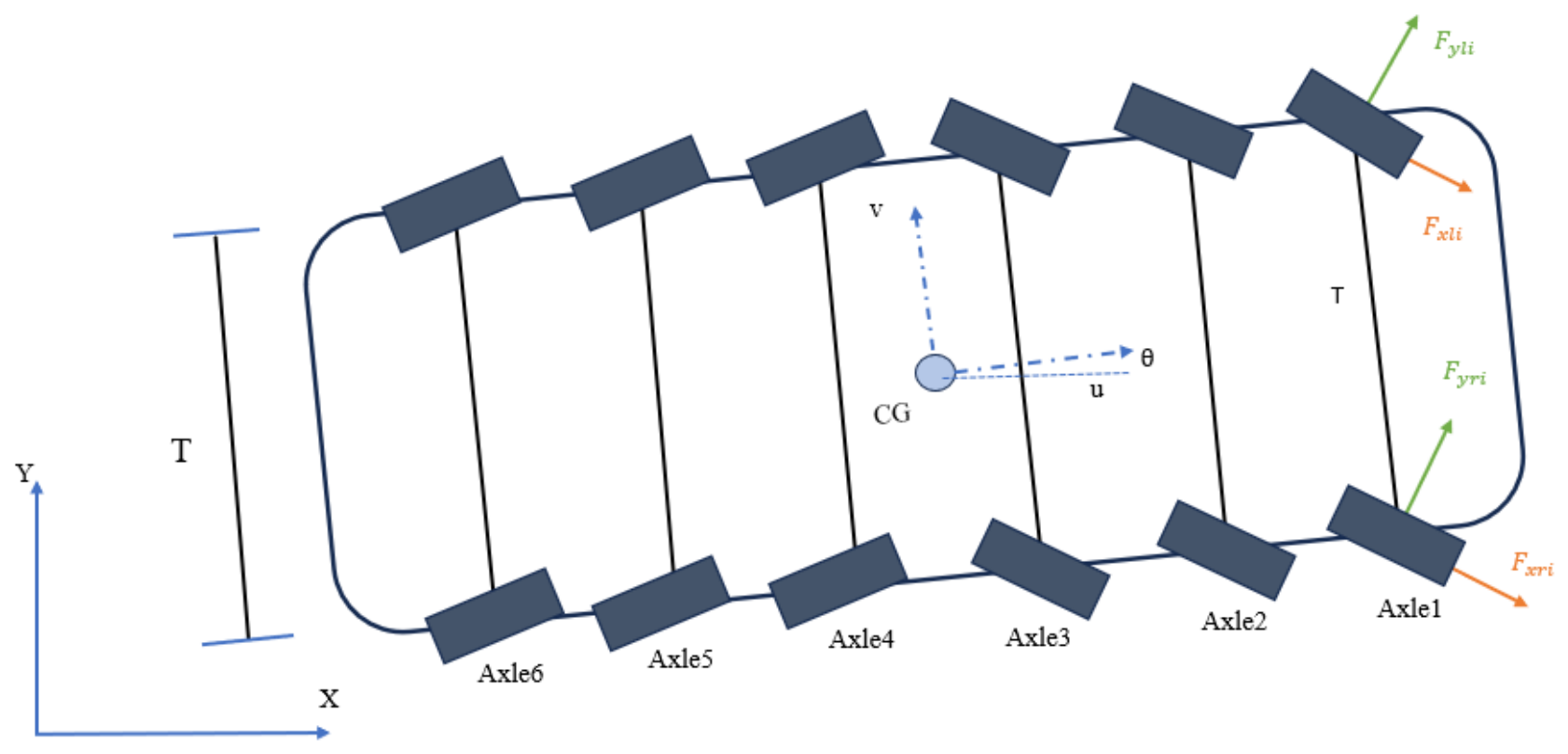
Based on the Newton-Euler equations [16], the force analysis of the steering wheels for the six-axle vehicle is illustrated in Figure 1.
By taking into account the steering angles and the longitudinal drive/braking force distribution of all wheels, the governing equations of the total vehicle dynamics are formulated as follows:
{ m ( u ˙ v θ ˙ ) = i = 1 6 ( F x l , i + F x r , i ) c o s δ i ( F y l , i + F y r , i ) s i n δ i m ( v ˙ + u θ ˙ ) = i = 1 6 ( F x l , i + F x r , i ) s i n δ i + ( F y l , i + F y r , i ) c o s δ i I z θ ¨ = i = 1 6 ( F x l , i + F x r , i ) a i s i n δ i + ( F y l , i + F y r , i ) a i c o s δ i + ( F x l , i + F x r , i ) T 2 c o s δ i + ( F y l , i F y r , i ) T 2 s i n δ i
where m denotes the total gross mass of the vehicle; I z represents the yaw moment of inertia; u and v signify the longitudinal and lateral velocities at the vehicle center of gravity (CG), respectively; θ is the vehicle yaw angle; δ i designates the steering angle of the i-th axle; F x l , i and F x r , i correspond to the longitudinal tire-road contact forces of the left and right wheels on the i-th axle, respectively.

2.2. Key Technical Parameters of the Six-Axle Vehicle

In compliance with the national standard GB 1589-2016 [17], a domestic heavy-duty commercial vehicle featuring a six-axle distributed drive and all-wheel steering capabilities is chosen as the plant for this study. The primary specifications and technical parameters of this heavy transport vehicle are tabulated in Table 1, and the structural steering angle limits for each axle are enumerated in Table 2.
Furthermore, to faithfully replicate the transient physical response of the heavy vehicle’s distributed steering actuators during co-simulation, the dynamic characteristics of the steering system must be explicitly modeled. In this study, the actuator dynamics for each axle are represented by a first-order lag system coupled with a nonlinear rate saturation constraint. The actual executed steering angle δ i , r e a l for the i -th axle relates to the target command δ i , c m d through the following dynamic differential equation:
δ i , r e a l = sat ( 1 τ s ( δ i , c m d δ i , r e a l ) , δ m a x )  
where τ s is the characteristic time constant of the steering actuator (calibrated to 0.15   s to represent the inherent mechanical and hydraulic delay of the heavy-duty chassis), and δ m a x defines the maximum hardware steering rate limit. As tabulated in Table 2, a strict dynamic rate boundary of 0.43   rad / s is enforced across all actuators to prevent mathematically unfeasible transient steering jerks and strictly align the simulation with realistic hardware capabilities.

2.3. Multi-Mode Steering Principles

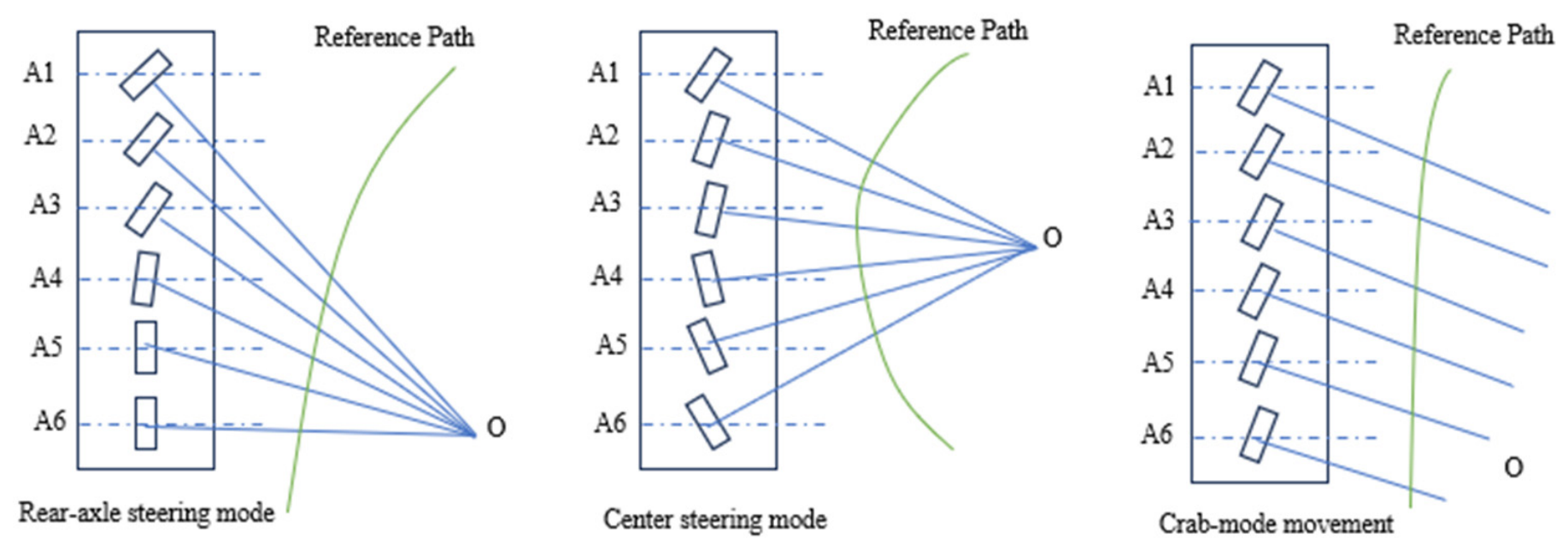
To satisfy the conflicting requirements of cornering maneuverability and directional stability across diverse operational scenarios, three distinct steering modes are engineered, as illustrated in Figure 2. The steering angle allocation among the multiple axles in each mode strictly complies with the generalized Ackermann steering principle to eliminate kinematic conflict [18].
(1)
Rear-Axle Steering Mode
This mode is tailored for medium-curvature curves (where path curvature ρ <   0.04   m 1 and road width W 5   m ) or high-speed cruising scenarios. Under this operational mode, the rear axles are mechanically locked or electronically regulated to a zero angle ( δ 5 = δ 6 = 0 ), whereas the front and intermediate axles steer in a coordinated manner. The kinematic steering angle of the i-th axle wheel is derived as [19]:
δ i = a r c t a n ( L i R )
where L i represents the longitudinal distance from the center of the i-th axle to the instantaneous center of rotation (ICR), and R denotes the nominal turning radius.
Constrained by the maximum angular bounds of Axle 1 and Axle 4, the minimum attainable turning radius is governed by the specific axle that reaches its physical saturation limit first:
R m i n , r e a r = m a x ( | a 1 a 6 | t a n δ 1 , m a x , | a 4 a 6 | t a n δ 4 , m a x )
This configuration is characterized by a moderate turning radius, smooth yaw rate response, and superior lateral stability, making it highly compatible with medium-to-high-speed operations.
(2)
Center Steering Mode
This mode is designed for acute cornering maneuvers (where ρ   0.04   m 1 or W < 5   m ) or highly confined space navigation. The ICR of the vehicle is dynamically reconstructed onto the geometric centerline of the vehicle body. Consequently, the steering angles of the axles are symmetrically allocated with opposite signs to achieve the minimum possible turning radius [20]. The steering angle for each axle wheel [21] is given by:
δ i = ± a r c t a n ( L i , c R c )
where L i , c denotes the longitudinal distance from the i-th axle center to the geometric center of the vehicle, and R c represents the turning radius under the center steering configuration.
Subject to the physical envelope constraints of Axle 1 and Axle 6, the minimum turning radius is bounded by:
R m i n , c e n t e r = m a x ( | a 1 | , | a 6 | ) m i n ( t a n δ 1 , m a x , t a n δ 6 , m a x )
The distinguishing feature of this mode is the significant minimization of the turning radius, which provides optimal spatial path-clearing capability in tight curves at the expense of high-speed directional stability.
(3)
Crab-Steering Mode
When executing lane-change maneuvers or pure lateral translations, all axles are actuated to identical angular displacements, allowing the vehicle to translate laterally without changing its heading. The steering angle allocation is uniform across all axles [22]:
δ c r a b = a r c t a n ( Δ y S ) , δ 1 = = δ 6 = δ c r a b
Crab steering represents a pure translation lacking rotational components; hence, the conventional turning radius is undefined. The lateral displacement velocity is strictly bounded by the maximum steering capability of the intermediate axles as follows:
d ( Δ y ) d t = u · t a n δ c r a b u · t a n δ m a x , c r a b

3. Principles of Single-Point and Dual-Point Preview Mechanisms

3.1. Single-Point Preview Mechanism

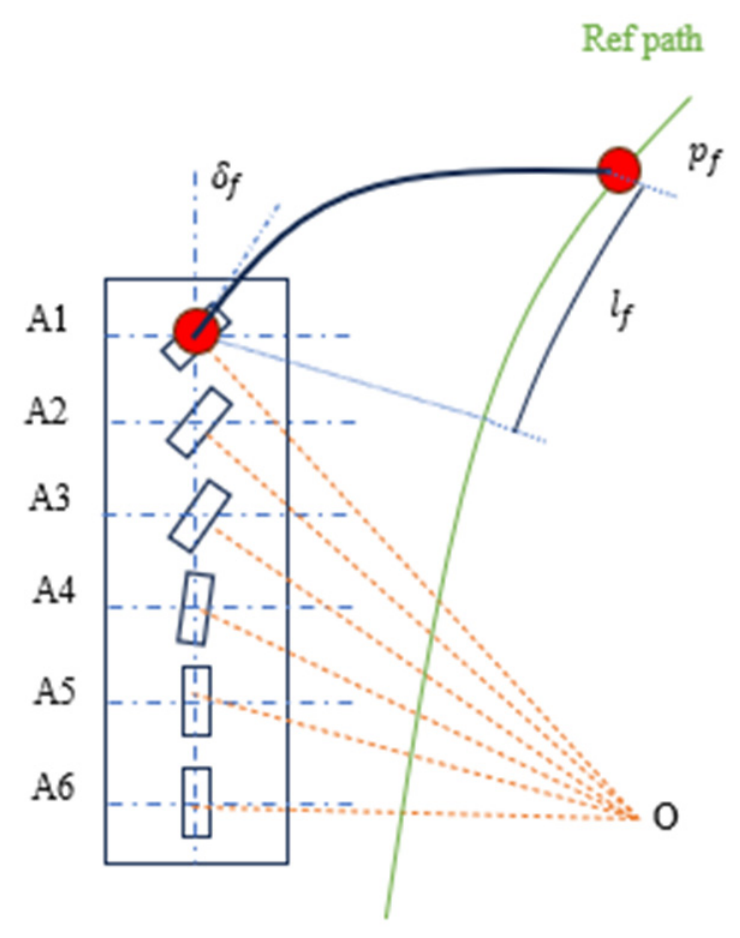
Although the aforementioned multi-mode steering manifold successfully resolves the co-centric problem of steering angle allocation for multi-axle vehicles, it does not address the selection of the baseline reference point in path-following control. Conventional passenger cars or short-wheelbase commercial vehicles typically adopt a single-point preview control strategy [23], the fundamental principle of which is schematically illustrated in Figure 3.
The single-point preview mechanism designates the vehicle center of gravity (CG) or the center of the front axle as the unique baseline point for path following. It locates a forward reference point P f on the target path by projecting a look-ahead distance L f . Under a low-speed, pure geometric-kinematic relationship, the mapping relationship between the equivalent desired steering angle of the front wheel δ f and the single-point instantaneous turning radius R single is mathematically expressed as [24]:
R s i n g l e = L f t a n δ f
where L f represents the preview distance and δ f denotes the equivalent steering angle of the front wheels.
However, from the perspective of multi-body nonlinear kinematics, applying the single-point preview mechanism to a six-axle heavy transport vehicle reveals an inherent geometric under-constraint deficiency [25]. According to the planar rigid-body motion constraints, given a single target position point P f and its corresponding tangent direction along the path, there exists an infinite number of valid instantaneous centers of rotation in the two-dimensional spatial plane that satisfy the kinematic condition wherein the velocity vector at that point is tangent to the path. These admissible ICRs geometrically construct a one-dimensional ray in space.
Crucially, due to the absence of a spatial constraint manifold at the vehicle rear, the single-point preview mechanism cannot rigidly couple the full vehicle pose to the target trajectory. Consequently, when solving for the multi-axle steering angle commands, steering control algorithms are compelled to introduce artificial ideal assumptions to forcefully restrict the system’s degrees of freedom and obtain a unique solution. Such artificial constraints inevitably compromise the kinematic and geometric compatibility inherent to long-wheelbase multi-axle vehicles. Under sharp cornering conditions, the lack of explicit constraints on the vehicle’s rear trajectory causes the intermediate and rear axles to undergo severe inward cutting under the influence of tire slip forces. This significantly amplifies the swept path and exacerbates the risk of side-scraping collisions between the mid-to-rear section of the vehicle body and roadside obstacles.

3.2. Dual-Point Preview Mechanism

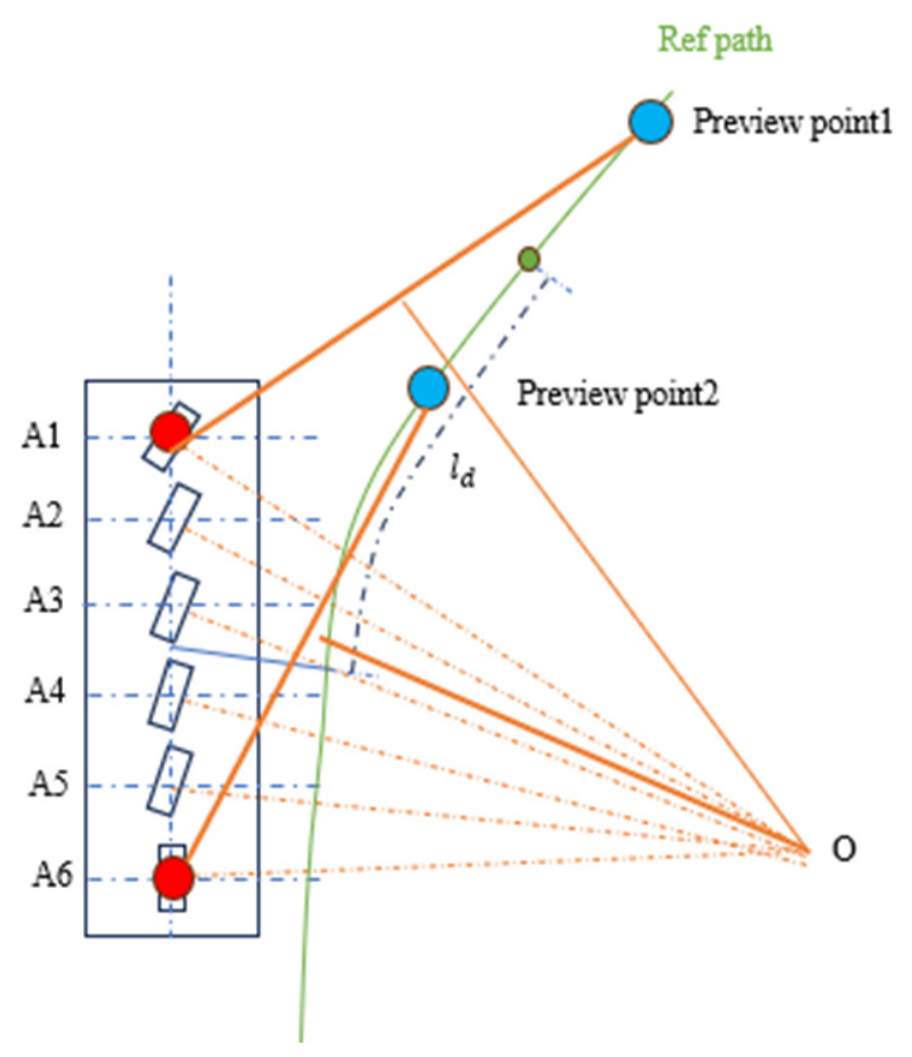
To overcome the under-constraint limitations of the single-point preview mechanism and achieve active compression of the minimum turning radius for six-axle vehicles under extreme scenarios—such as confined, sharp curves—this section establishes a dual-point preview cooperative steering kinematic model. First, a quantitative mapping relationship among the minimum turning radius, vehicle state variables, and road geometric parameters is formulated. Leveraging a dual-point preview feedback architecture, a methodology is proposed to evaluate the minimum turning radius by dynamically reconstructing the ICR. The fundamental principle of the dual-point preview mechanism is illustrated in Figure 4.

3.2.1. Reconstruction of the Instantaneous Center of Rotation (ICR)

To establish a physically meaningful path-following framework and eliminate coordinate singularities, the kinematic vehicle state and geometric path trajectories are systematically formulated within a vehicle-fixed local coordinate system ( x v , y v ) . The origin of this local frame is rigidly attached to the vehicle’s center of gravity (CG), where the longitudinal centerline designates the x v -axis (forward positive) and the lateral centerline defines the y v -axis (leftward positive). The global reference path points and targeted vehicle poses captured in the global absolute coordinate system ( X E , Y E ) are seamlessly mapped onto this local vehicle frame via a standard homogeneous transformation matrix.
In this vehicle-fixed local frame, the forward preview point p f = [ x f , y f ] T is determined by searching a forward arc-length distance L f along the desired trajectory relative to the CG. Concurrently, the rearward look-behind point p r = [ x r , y r ] T is identified by searching a backward arc-length distance L r along the reverse path direction.
Let θ f and θ r represent the global tangent angles of the target path at the front preview point p f and the rear preview point p r , respectively. With the vehicle’s current global heading denoted as θ , the equivalent kinematic steering angles (i.e., local tracking deviation angles) δ f and δ r in the vehicle-fixed frame must strictly satisfy:
δ f = θ f θ ,   δ r = θ r θ
According to the orthogonal normality principle of planar rigid-body kinematics [26], to guarantee that both the vehicle nose and tail converge simultaneously onto the targeted path, the ideal instantaneous center of rotation (ICR) in the local frame, denoted as [ x i c r , y i c r ] T , must reside precisely at the spatial intersection of the orthogonal normal lines projecting from the velocity vectors at p f and p r . This constructs the following well-posed algebraic system of spatial constraint equations:
{ ( x f x i c r ) c o s ( δ f ) + ( y f y i c r ) s i n ( δ f ) = 0 ( x r x i c r ) c o s ( δ r ) + ( y r y i c r ) s i n ( δ r ) = 0
Transforming the linear geometric constraint system into a standard algebraic matrix representation yields:
A [ x i c r y i c r ] = B
where the local spatial coefficient characteristic matrix A and the non-homogeneous control column vector B are rigorously defined as: A = [ c o s ( δ f   ) s i n ( δ f   ) c o s ( δ r   ) s i n ( δ r   ) ] , B = [ x f c o s ( δ f   ) + y f s i n ( δ f   ) x r c o s ( δ r   ) + y r s i n ( δ r   ) ] .
When the six-axle vehicle is navigating a curve, the characteristic matrix A remains full rank with a non-zero determinant det ( A ) = sin ( δ r δ f ) 0 . Consequently, by executing an inverse mapping, the unique and deterministic analytical solution for the local coordinates of the ideal instantaneous center of rotation can be explicitly derived as:
[ x i c r y i c r ] = A 1 B

3.2.2. Theoretical Turning Radius and Effective Boundary Evaluation

Once the ideal instantaneous center of rotation I C R ( x i c r , y i c r ) is reconstructed via the fully constrained dual-point spatial framework, the nominal theoretical turning radius R at the vehicle CG can be unbiasedly defined as the Euclidean distance from the CG origin to the ICR:
R = ( x i c r ) 2 + ( y i c r ) 2
Under this fully constrained geometric framework, the theoretical steering angle allocation for Axles 1 through 6 of the distributed all-wheel steering vehicle is uniquely mapped by the absolute spatial position of the resolved local ICR. To eliminate kinematic conflicts across the multi-axle steering mechanisms, the reference ideal steering angle for the i-th axle is defined based on the geometric relationship between the axle center and the local ICR coordinate y i c r :
δ i , i d e a l = a r c t a n ( a i x i c r y i c r )
where a i denotes the physical longitudinal distance from the vehicle CG to the center of the i-th axle. It must be explicitly emphasized that δ i , i d e a l evaluated in Equation (15) represents the axle-center equivalent steering angle. In the physical actuator execution layer, the specific actual steering angles for the left and right independent wheels of the i-th axle are further distributed according to the standard generalized Ackermann steering geometry to guarantee coordinate motion without parasitic tire scrub:
{ c o t ( δ i l ) = c o t ( δ i , i d e a l ) + T 2 a i c o t ( δ i r ) = c o t ( δ i , i d e a l ) T 2 a i  
where T represents the track width of the six-axle vehicle.
Where a i denotes the physical longitudinal distance from the vehicle CG to the i-th axle. The actual executed steering angle of each individual axle is bounded by the physical limitations of the hardware mechanism, enforced through a nonlinear saturation function:
δ i , r e a l = s a t ( δ i , i d e a l ,   δ i , m a x )
In accordance with engineering constraint criteria, where the spatial passability of confined curves is dictated by the outer wheel interference envelope [27], the effective minimum turning radius R min of the vehicle is quantitatively formulated as the maximum envelope value of the actual effective radii output across all axles:
R m i n m a x i = a i t a n | δ i , r e a l |
By algebraically introducing complementary tail constraint boundaries, the cooperative dual-point preview control framework establishes a feasible solution space that completely envelops the boundary conditions of the conventional single-point preview approach. Through the dynamic co-optimization of the spatial preview vector [ L f , L r ] T , the ICR is actively induced to shift along the axial direction toward the inner side of the curve. This fundamentally eliminates the under-constrained kinematic conflicts associated with the “head-entering, tail-swinging” phenomenon from a geometric origin, thereby realizing an active, compact compression of both the swept path area and the off-tracking inner-wheel difference for six-axle heavy transport vehicles.

4. Design of Steering Control Strategy for Six-Axle Vehicles

4.1. Overall Framework of Control Strategy

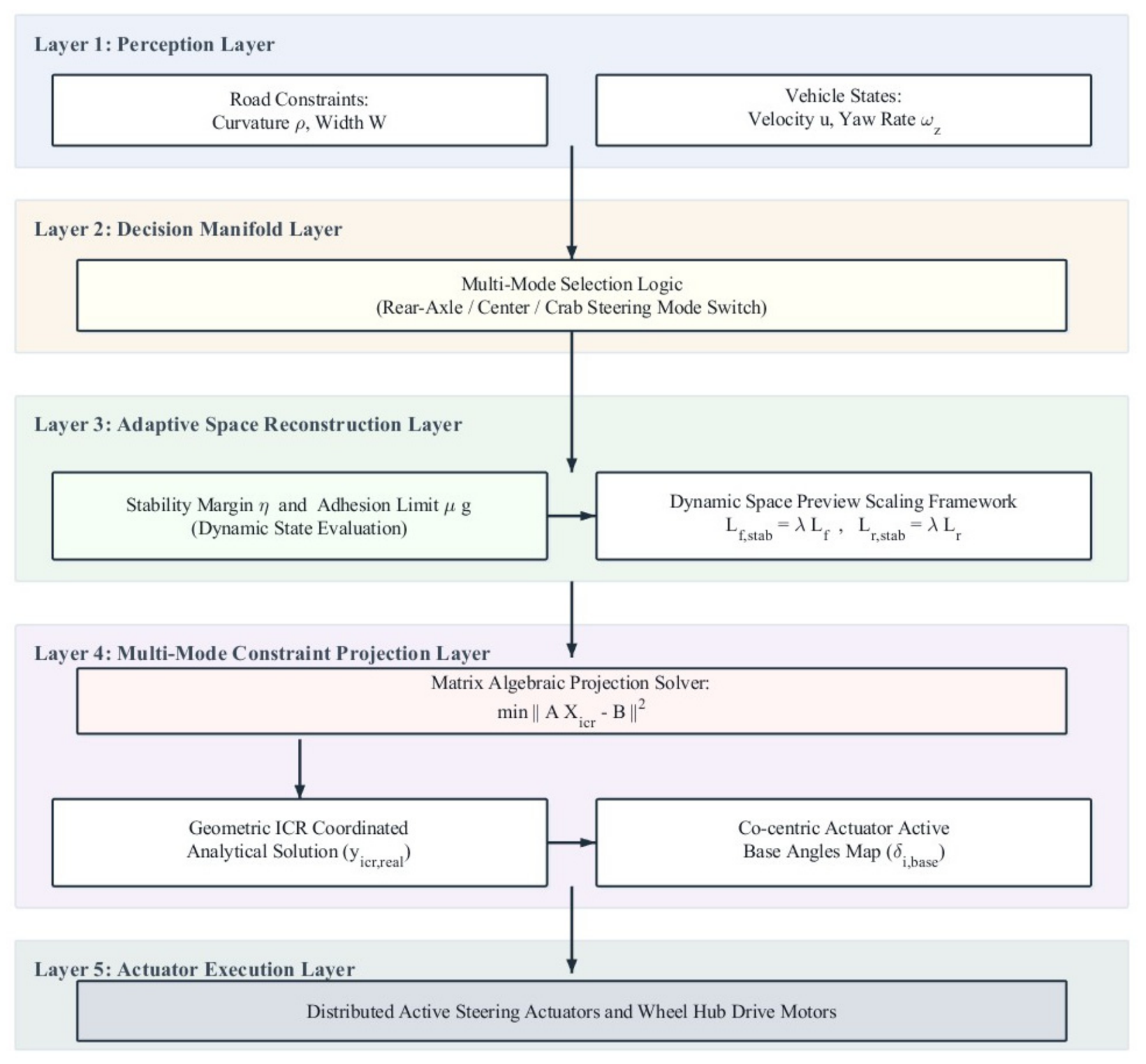
To achieve coordinated multi-axle steering motion control of six-axle vehicles across all operational conditions, numerous scholars have conducted extensive research on hierarchical control topologies and multi-mode steering switching rules [28]. However, existing achievements heavily rely on a single vehicle speed state decision-making process that lacks a deep quantitative integration of road spatial geometric boundaries and full-vehicle head-and-tail pose trajectories. To address this gap, based on the aforementioned mapping compatibility between the dual-point preview theory and multi-mode steering, this section proposes an adaptive multi-axle steering motion cooperative control strategy oriented toward all operational conditions. A hierarchical architecture comprising “perception—decision manifold—adaptive preview space reconstruction—multi-mode constrained projection solver” is adopted, as illustrated in Figure 5.

4.2. Multi-Mode Steering Switching and Preview Distance Adaptive Regulation Based on Road Curvature

Targeting the mode decision layer and the dual-preview point localization layer presented in Figure 5, this section elucidates the steering mode switching rules and the adaptive regulation mechanism of the preview distance.

4.2.1. Steering Mode Switching Rules

The steering mode switching rules tailored for different operational scenarios are tabulated in Table 3.

4.2.2. Visual Preview Model

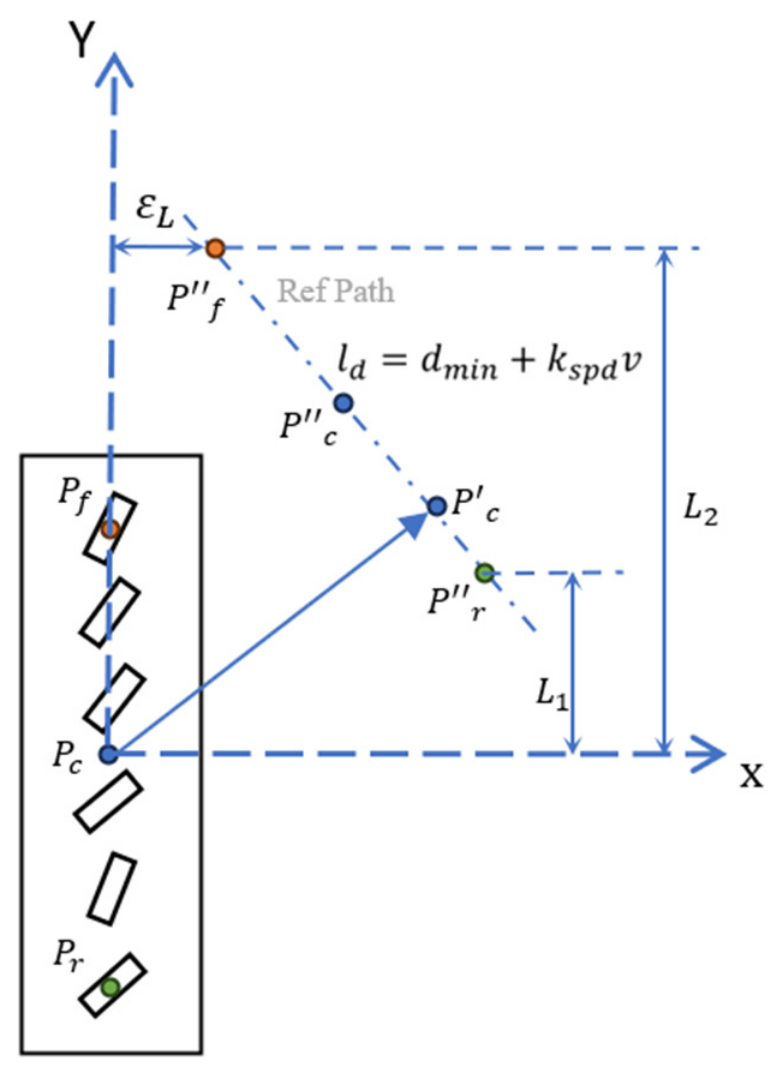
To achieve precise trajectory tracking for six-axle vehicles, establishing an accurate preview error model [29] is fundamental to the control strategy. Based on the vehicle-path geometric relationship illustrated in Figure 6, a differential dynamics system model incorporating a dynamic preview mechanism and lateral errors is constructed.
To simultaneously guarantee low-speed tracking accuracy and high-speed stability, a speed-adaptive gain strategy is introduced [30]. As shown in Figure 6, the control system dynamically regulates the effective preview distance l d based on the real-time vehicle speed u :
l d = d m i n + k s p d · u
where d min represents the minimum preview distance and k s p d denotes the speed gain coefficient.
Furthermore, the lateral deviation at the front preview point is defined as ε lat , and the heading deviation is defined as θ φ . Incorporating the kinematic constraints of the multi-axle vehicle, the preview error state-space equation is derived as follows [31]:
[ ε ˙ l a t ; θ ˙ φ ] = [ [ 0 , u ] ; [ 0,0 ] ] [ ε l a t ; θ φ ] + [ [ 1 , L d ] ; [ 0 , 1 ] ] [ v ; θ ˙ ] + [ 0 ; u ] k
By utilizing L d to directly map the vehicle yaw and sideslip motions onto the preview point deviations, this model distinctly contrasts with conventional fixed-distance preview models. It adaptively adjusts the preview distance according to operational conditions, thereby providing a precise state-space description for subsequent decoupling control.

4.2.3. Multi-Scale Adaptive Preview Distance Regulation Mechanism

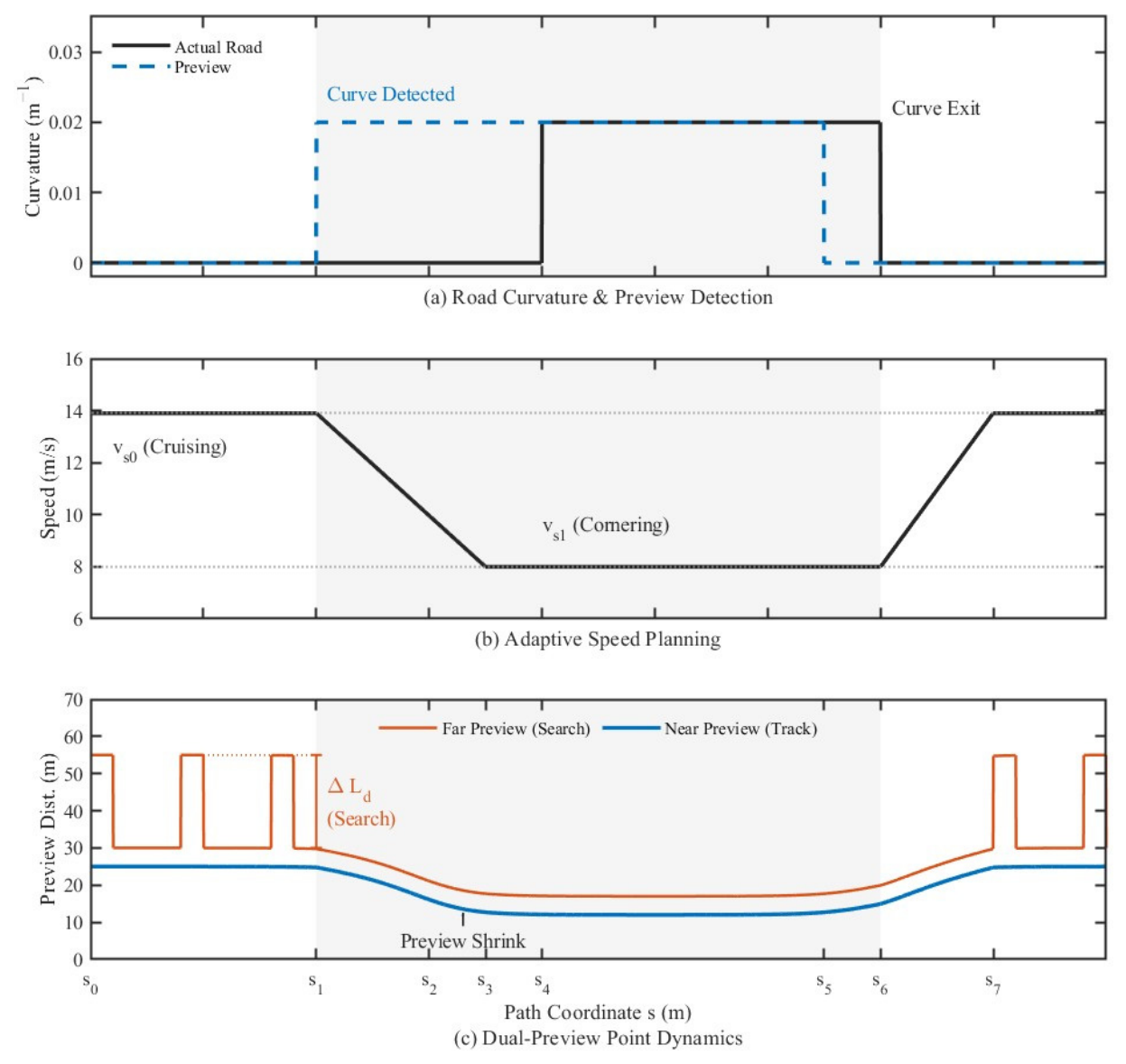
Although the aforementioned state Equation (18) describes the evolution of the preview point deviation, the preview distance itself must be dynamically adjusted based on vehicle speed and road curvature. To this end, this section designs a multi-scale adaptive preview distance regulation mechanism to determine the specific values of the near preview distance L 1 and the far preview distance L 2 , the regulation principle of which is illustrated in Figure 7.
(1)
Speed-Adaptive Regulation of the Near Preview Distance
During the straight-line cruising phase, the near preview distance L 1 primarily varies linearly with the vehicle speed v to ensure sufficient response time and tracking precision:
L 1 = { L s m i n   v < v m i n a 1 v + a 2   v m i n v v m a x L s m a x   v > v m a x
where L s m i n and L s m a x denote the minimum and maximum preview distances for straight paths, respectively, which are calibrated based on the vehicle wheelbase, visual blind zones, and braking response time. In this study, L s m i n = 10.0   m and L s m a x = 25.0   m are selected, with vehicle speed thresholds set at v min = 1.5   m / s and v max = 13.9   m / s .
(2)
Periodic Scanning and Locking of the Far Preview Distance
Under straight-line conditions, L 2 switches periodically with a time period of T = 1.5   s . Within a single cycle, it extends to L 1 + Δ L d for a duration of t d = 0.3   s to scan the far-end curvature, while it retracts to L 1 + Δ L n for the remaining duration to mitigate computational load. When the far-end curvature exceeds the threshold ρ > 0.002   m - 1 , the system identifies an upcoming curve and issues a deceleration command. At this juncture, L 2 exits the periodic mode and is locked at L 1 + Δ L n to maintain continuous curve tracking.
(3)
Adaptive Curve Regulation of the Near Preview Distance
As the vehicle approaches the curve entrance, to eliminate the chord-length error introduced by an excessively long preview distance, L 1 is adjusted based on the forward curvature ρ :
L 1 = { L c m a x   | ρ 2 | < ρ 2   m i n b 1   | ρ 2 | + b 2   ρ 2   m i n | ρ 2 | ρ 2   m a x L c m i n   | ρ 2 | ρ 2   m a x
where L c m i n = 10.0   m and L c m a x = 18.0   m , and the curvature threshold is defined as ρ max = 0.025   m - 1 . This mechanism achieves compact tracking along sharp curves and smooth transitions through gentle curves.
The core objective of the aforementioned regulation mechanism is to dynamically adjust the spatial positions of the preview points under varying road curvatures, thereby forcing the instantaneous center of rotation to shift toward the inner side of the bend, which effectively compresses the minimum turning radius required for cornering.
(4)
Curve Exit Recovery and Cycle Reset
During the curve exit phase, if the far preview point enters the straight section first while the near point remains inside the curve, L 1 is maintained in its retracted state to suppress yaw overshoot until the entire vehicle completely exits the bend. Upon entering the straight-line acceleration segment, L 1 and L 2 are reset to the speed-adaptive and periodic scanning modes, respectively, initiating the next cycle.
It is critical to note that while steady-state cornering is frequently evaluated using constant-radius segments, real-world road alignments are predominantly composed of transition curves characterized by continuously varying curvature profiles. The proposed adaptive preview mechanism inherently accommodates these spatial variations. By dynamically scanning the far-field curvature and smoothly scaling the near preview distance through the continuous blending logic, the dual-point spatial framework effectively functions as a geometric low-pass filter. As the vehicle traverses a clothoid transition, the incremental change in target curvature prevents discontinuous leaps in the reconstructed ICR coordinate, ensuring that the steering actuator baseline commands evolve smoothly without triggering high-frequency yaw rate feedback oscillations.

4.3. Fusion Strategy of Dual-Point Preview and Multi-Mode Steering

By establishing coordinated geometric constraints at both the vehicle head and tail, the dual-point preview path-following mechanism yields an ideal instantaneous center of rotation that satisfies complete convergence of the front and rear trajectories. However, in actual physical execution mechanisms, multi-mode steering is rigidly restricted by mechanical linkages, wheel-hub motor steering angle limits, and control topologies, which dictate the actual feasible domain manifold of the vehicle’s spatial ICR.
Directly applying the open-loop commands derived from the dual-point preview calculation to multi-mode switching will inevitably induce parasitic sideslip among the multi-axle steering mechanisms, inter-axle kinematic interference, and severe mechanical energy dissipation [32]. Consequently, an adaptive control architecture capable of seamlessly fusing path spatial requirements with underlying hardware constraints must be established. This section investigates the triggering timing, the algebraic projection mapping mechanism, and the geometric principles of the fusion strategy under all operational conditions.

4.3.1. Adaptive Triggering Timing and Operational Boundaries of the Fusion Strategy

By decoupling the vehicle speed u , road reference curvature ρ , and constrained road width W acquired by the perception layer in real time, the control system defines the adaptive triggering boundaries for multi-mode fusion within a three-dimensional decision space:
Spatially unconstrained high-speed/straight cruising conditions: The triggering criteria are defined as road curvature ρ < 0.01   m - 1 and road width W 5   m . In this scenario, the risk of lateral vehicle dynamics instability dominates; hence, the system triggers the “dual-point preview—rear-axle steering fusion mapping”. Within this mode, the physical layer rigidly locks the rear axles, constraining the longitudinal coordinate of the actual ICR onto the centerline of the rearmost axle, while elongating the forward preview distance L f to reinforce yaw damping and lateral stability during medium-to-high-speed cornering.
Spatially constrained low-speed/confined sharp curve conditions: The triggering criteria are defined as forward preview curvature ρ 0.04   m - 1 or current road width W < 5   m . Here, spatial passability and side-scraping risks due to the inner-wheel difference become the core contradictions. The system adaptively triggers the “dual-point preview—center steering fusion mapping”. This manifold shifts the ideal ICR toward the vehicle’s geometric center axis by shortening the spatial preview distance, actively forcing a symmetrical, reverse all-wheel steering deflection across the six axles to actively compress the minimum turning radius.
Obstacle avoidance or lateral lane-change conditions: When the vehicle planning layer issues a parallel lane-change or lateral translation pulse command, the “dual-point preview—crab steering fusion mapping” is triggered [33]. The control system strictly constrains the actual output steering angles of Axles 1 through 6 to be completely identical, leveraging a pure lateral translation state to eliminate the response lag and overshoot characteristic of an ultra-long multi-axle rigid vehicle during maneuvering.
To eliminate the potential discontinuities and actuator chattering inherently caused by the aforementioned hard-threshold logic, this paper introduces a C 1 -continuous smooth transition strategy augmented by a curvature hysteresis band. To prevent high-frequency mode oscillation when the vehicle travels near the threshold boundary, a hysteresis zone is defined with an upper curvature threshold ρ h i g h and a lower threshold ρ l o w .
Furthermore, upon triggering a mode switch at time t 0 , the final steering angle command δ c m d is not abruptly switched. Instead, it is seamlessly blended over a predefined transition time window T t r a n s to ensure physical execution continuity. The blended steering command is governed by:
δ c m d ( t ) = λ ( t ) δ t a r g e t ( t ) + ( 1 λ ( t ) ) δ c u r r e n t ( t )
where δ t a r g e t ( t ) is the steering command of the newly activated mode, δ c u r r e n t ( t ) is the command of the exiting mode, and λ ( t ) is the dynamic transition weight defined by a smooth cosine fading function:
λ ( t ) = { 0 1 2 1 [ 1 c o s ( π t t 0 T t r a n s ) ] , t t 0 t 0 < t < t 0 + T t r a n s t t 0 + T t r a n s
By taking the derivative of the blending function λ ( t ) , it is mathematically guaranteed that the steering actuator rate δ ˙ c m d remains continuous and smoothly differentiable at the boundary nodes t 0 and t 0 + T t r a n s . This rigorously respects the hardware execution limitations of the multi-axle steering system and averts transient lateral jerks.

4.3.2. Algebraic Projection Mapping Algorithm for Ideal ICR Path Requirements on Physical Constraints

The fully constrained dual-point preview equations provide the ideal instantaneous center of rotation coordinates [ x icr , ideal , y icr , ideal ] T under the global reference path. However, the physical limitations of specific steering modes dictate that the longitudinal coordinate of the actual ICR must be rigidly locked onto a specific geometric plane.
To maximize the path-following demands of both the front and rear dual-point previews while ensuring no mechanical interference occurs within the actuation mechanisms, this paper develops a least-squares spatial geometric projection algorithm [34]. The ideal ICR path requirement is algebraically projected onto the physical constraint boundary line of the corresponding steering mode, solving for the optimal actual steering center lateral coordinate y icr , real by relaxing the lateral geometric residual:
According to the established local coordinate framework, the orthogonal normal compatibility system derived from the front and rear preview points can be written in the vehicle-fixed frame as:
A [ x i c r y i c r ] = B
where A = [ c o s ( δ f ) s i n ( δ f ) c o s ( δ r ) s i n ( δ r ) ] , B = [ x f c o s ( δ f ) + y f s i n ( δ f ) x r c o s ( δ r ) + y r s i n ( δ r ) ] = [ b f b r ] .
When a specific steering mode introduces a rigid physical constraint boundary that forcefully locks the longitudinal coordinate of the local ICR onto a specific geometric plane (i.e., x i c r = x c ), the original system’s degrees of freedom degrade. The constraint transforms the exact orthogonal system into an overdetermined linear equation system regarding the sole unknown lateral variable y i c r :
[ s i n ( δ f ) s i n ( δ r ) ] y i c r = [ b f b r ] [ c o s ( δ f ) c o s ( δ r ) ] x c
To reconcile the spatial conflict between front and rear tracking requirements on a rigorous algebraic level, a least-squares projection algorithm is formulated. The Euclidean L 2 -norm squared of the residual vector is introduced as the convex objective function:
J ( y i c r ) = [ s i n ( δ f ) s i n ( δ r ) ] y i c r ( [ b f b r ] [ c o s ( δ f ) c o s ( δ r ) ] x c ) 2 2
To obtain the global analytical solution to this convex optimization problem, extremum conditions [35] are applied by setting the first-order algebraic derivative with respect to y i c r to zero ( J y i c r = 0 ):
2 [ s i n ( δ f ) s i n ( δ r ) ] ( [ s i n ( δ f ) s i n ( δ r ) ] y i c r [ b f x c c o s ( δ f ) b r x c c o s ( δ r ) ] ) = 0
Expanding the matrix multiplication and isolating the unknown yields the closed-loop algebraic analytical solution for the actual instantaneous center of rotation lateral coordinate y i c r , r e a l , which represents the mathematically optimal projection onto the physical constraint boundary:
y i c r , r e a l = sin ( δ f ) ( b f x c cos ( δ f ) ) + sin ( δ r ) ( b r x c cos ( δ r ) ) sin 2 ( δ f ) + s i n 2 ( δ r )
Based on this generalized projection formula, the specific fusion mappings for different steering manifolds are detailed as follows:
(1)
Manifold fusion for the rear-axle steering mode: Under this mode, the system locks the rear axle, imposing the physical constraint boundary x c = a 6 . Substituting this into Equation (29) directly yields the optimal actual cornering radius that balances both front and rear trajectories, from which the baseline desired deflection angle for each axle is evaluated via δ i , base = arctan [ ( a i a 6 ) / y i c r , r e a l ] .
(2)
Manifold fusion for the center steering mode: This mode requires the ICR to lie strictly on the vehicle’s geometric centerline, establishing the physical manifold constraint x c = 0 . Consequently, Equation (29) simplifies and degenerates into:
y i c r , r e a l = b f s i n ( δ f ) + b r sin ( δ r ) sin 2 ( δ f ) + s i n 2 ( δ r )
This solution algebraically guarantees a completely symmetrical and reversed Ackermann geometric steering output for Axles 1 through 6, achieving an optimal balance of the physical steering limits across all axles in space.
(3)
Manifold fusion for the crab steering mode: Upon entering the pure translation manifold, the system forces the front and rear target deflection angles to be identical, causing a nonlinear singular degeneration of the characteristic matrix A . Once the fusion strategy detects this singular state, it automatically exits the ICR projection computation and directly assigns the path-desired translation angle to the baseline steering angles of Axles 1 through 6, yielding δ i , base = δ crab .

4.4. Adaptive Dynamic Scaling Strategy of the Preview Spatial Manifold Under Low-Friction Conditions

The dual-point preview algebraic projection fusion strategy derived above exhibits exceptionally high spatial maneuverability and geometric compatibility on high-friction road surfaces. However, when the six-axle all-wheel steering vehicle operates under extreme conditions—such as low-friction surfaces or sharp curves—the tire lateral forces easily approach the nonlinear saturation region. Under such circumstances, continuing to output steering angle commands based purely on the nominal geometric model will induce severe tire slip, generating “parasitic sideslip moments” and causing trajectory divergence and instability.
To circumvent the high computational burden and divergence risks associated with intense iterations of conventional nonlinear closed-loop control within the tire saturation zone, this paper proposes a feedforward correction strategy that inversely solves for the spatial geometric safety margin based on vehicle dynamic boundaries. By adjusting the spatial geometric constraints of the preview mechanism prior to the tire forces reaching saturation, the challenge of nonlinear instability under low-friction conditions is successfully resolved.
Due to the high center of gravity and long wheelbase of six-axle heavy transport vehicles, the sideslip and rollover boundaries during cornering can be parameterized by the road friction limits and the full-vehicle physical topology limits [36]. The maximum allowable vehicle lateral acceleration a y , max is defined as:
a y , m a x = m i n ( T g 2 H c g SF , μ g )
where S F = 0.8 is the safety margin coefficient employed to prevent vehicle tipping, μ denotes the real-time estimated road friction coefficient, and g is the acceleration of gravity. Crucially, due to the substantial mass and high-positioned center of gravity of the payload carried by the heavy transport vehicle, the parameter H c g represents the equivalent composite height of the global vehicle center of gravity (CG) under full-load conditions. To ensure theoretical rigor and bridge the mass property definitions in Table 1 with the dynamic boundaries, H c g is derived using the static moment equilibrium method as follows:
H c g = m v e h H c , v e h + m o b j H c , o b j m v e h + m o b j
By substituting the verified vehicle parameters tabulated in Table 1 into Equation (32), the explicit equivalent CG height for the fully loaded plant is quantitatively determined as H c g 3.22   m , which directly parameterizes the dynamic rollover stability boundary.
Based on the maximum lateral acceleration limit, the feedforward upper limit of the safe cornering vehicle speed planning under the forward reference path curvature k is expressed as [37]:
v l i m i t = a y , m a x | k |
To establish a closed-loop compatibility between the geometric spatial manifold and the vehicle lateral dynamics, the vehicle dynamics stability margin index is introduced as follows:
η = a y , m a x | y i c r , r e a l | u 2
where y icr , real represents the optimal actual instantaneous center of rotation lateral coordinate resolved via the algebraic projection under the current steering manifold, and u is the current actual longitudinal velocity of the vehicle. This index directly reflects the intensity of lateral force overload under the current nominal turning radius.
Based on this stability margin, the adaptive scaling coefficient λ for the spatial constraint manifold is designed as [38]:
λ = m a x ( 0.6 , m i n ( 1.0 , η ) )
Consequently, the adaptive near preview distance L 1 , stab and far preview distance L 2 , stab actually participating in the spatial ICR reconstruction and mode projection fusion are dynamically corrected as:
L 1 , s t a b = λ L 1 , L 2 , s t a b = λ L 2

Tire Nonlinear Accommodation Mechanism Under Low-Friction Conditions

When the vehicle encounters a low-friction surface or a sharp escalation in path curvature, the dynamic stability margin η rapidly degrades, actively triggering a reduction in the spatial scaling coefficient λ .
It is crucial to distinguish the proposed geometric framework from conventional error-driven preview controllers. In traditional feedback-based architectures, shortening the preview distance mathematically amplifies the error-feedback gain, which inherently induces aggressive steering actions and exacerbates lateral instability. By contrast, the proposed dual-point fusion strategy operates entirely as a spatial feedforward geometric mapping.
Under extreme sharp curves, an unscaled far-preview point exhibits a massive lateral offset relative to the vehicle’s current heading. Solving the orthogonal geometric constraints based on this far-field point would mandate an aggressively small instantaneous turning radius, demanding an extreme and sudden steering angle output that instantly saturates the limited tire lateral forces [39] under low- μ conditions.
By adaptively shrinking the spatial preview distances ( L f , s t a b   a n d   L r , s t a b ), the target preview points are drawn closer to the vehicle chassis. Consequently, the local path segment fitted by the dual-point constraint becomes geometrically gentler relative to the vehicle’s current pose. This spatial contraction forcefully acts as a geometric low-pass filter: it proactively relaxes the instantaneous curvature demand and yields a substantially gentler, more progressive steering angle allocation across all axles. Rather than aggressively reacting to the far-end curve and breaking traction, the system temporarily prioritizes local grip over far-field tracking precision. This feedforward mechanism strictly confines the execution steering angles within the linear region of the tire slip curve, fundamentally preventing parasitic sideslip and catastrophic spin-outs without requiring heavy, reactive closed-loop interventions.

5. Simulation Verification and Results Analysis

To evaluate the efficacy and all-encompassing operational robustness of the proposed “fully constrained dual-point preview space and multi-mode steering manifold adaptive fusion strategy,” a high-fidelity six-axle vehicle dynamics testing framework was constructed utilizing a co-simulation platform based on TruckSim and MATLAB R2024a/Simulink. The simulation vehicle configuration strictly complies with the physical parameters tabulated in Table 1. The comprehensive simulation verification program is systematically executed across three primary dimensions: a comparison of pure geometric boundaries and transit efficiency, path-following performance evaluations under conventional high-friction multi-scenario conditions, and robustness validation of the spatially constrained manifold under low-friction conditions. These tests are designed to comprehensively assess both the passability and directional stability of the six-axle all-wheel steering vehicle under concurrent spatial constraints and nonlinear vehicle dynamics boundaries.

5.1. Comparisons of Turning Radius and Transit Efficiency Under Pure Geometric Strategies

This section provides a simulation-based evaluation to analyze the performance of the dual-point preview and multi-mode steering fusion strategy in actively compressing the theoretical minimum turning radius of the vehicle and enhancing transit efficiency under an ideal low-speed kinematic manifold.
The simulation environment is configured with a road friction coefficient of μ =   0.85 . The vehicle navigates the test curves at an ultra-low velocity utilizing the conventional single-point preview strategy and the proposed dual-point preview multi-mode steering manifold fusion strategy, respectively. The geometric characteristics of the test curves are specified as follows: Curve A features a reference curvature of ρ = 0.02   m - 1 , and Curve B features a reference curvature of ρ = 0.025   m - 1 . The steering deflection angles of the multiple axles are algebraically allocated in strict compliance with their respective kinematic manifolds, without the deployment of any closed-loop feedback. The comparative results of the minimum turning radius for both curve scenarios are summarized in Table 4.
As evidenced by Table 4, the dual-point preview strategy successfully shifts the ICR toward the inner side of the curve via the head-and-tail cooperative constraint manifold, thereby yielding a pronounced reduction in the maximum value of the effective turning radius across all axles. In Curve B, the simulated minimum turning radius R min achieved by the dual-preview framework is compressed to merely 35.9   m , implying that the vehicle can comfortably negotiate a road with a geometric radius of 40   m . Conversely, the conventional single-point preview mechanism requires a radius approaching 40   m , which closely impinges upon the physical road boundary limits.
Furthermore, the cornering efficiency of both strategies was evaluated on Curve B, with the quantitative indicators compiled in Table 5. It is readily observable that due to the approximately 10% compression in the turning radius, the dual-point preview strategy elevates the allowable cornering speed by roughly 5.4% under identical lateral acceleration limits, which successfully abbreviates the actual transit time by 7.5%. For heavy-duty transport vehicles, these findings demonstrate that the proposed strategy not only enhances spatial passability in confined curves but also significantly augments the transit velocity through the curves, thereby driving a substantial upgrade in overall transportation efficiency.

5.2. Continuous S-Curve Operational Condition

This section conducts a simulation experiment under a continuous S-curve condition to verify the tracking accuracy and full-pose spatial coordination capabilities of the dual-point preview multi-mode cooperative strategy under nominal road friction conditions ( μ =   0.85 ).
The simulation scenario replicates a typical continuous direction-switching maneuver at an urban expressway interchange. The spatial curvature manifold of the reference path is distributed as follows: a straight section the first acute curve ( ρ = 0.020 \ m - 1 ) a gentle transition zone the second acute curve ( ρ = 0.020   m - 1 ) a straight section. The benchmark longitudinal velocities are designated as 5   m / s , 10   m / s , and 13.9   m / s , respectively.
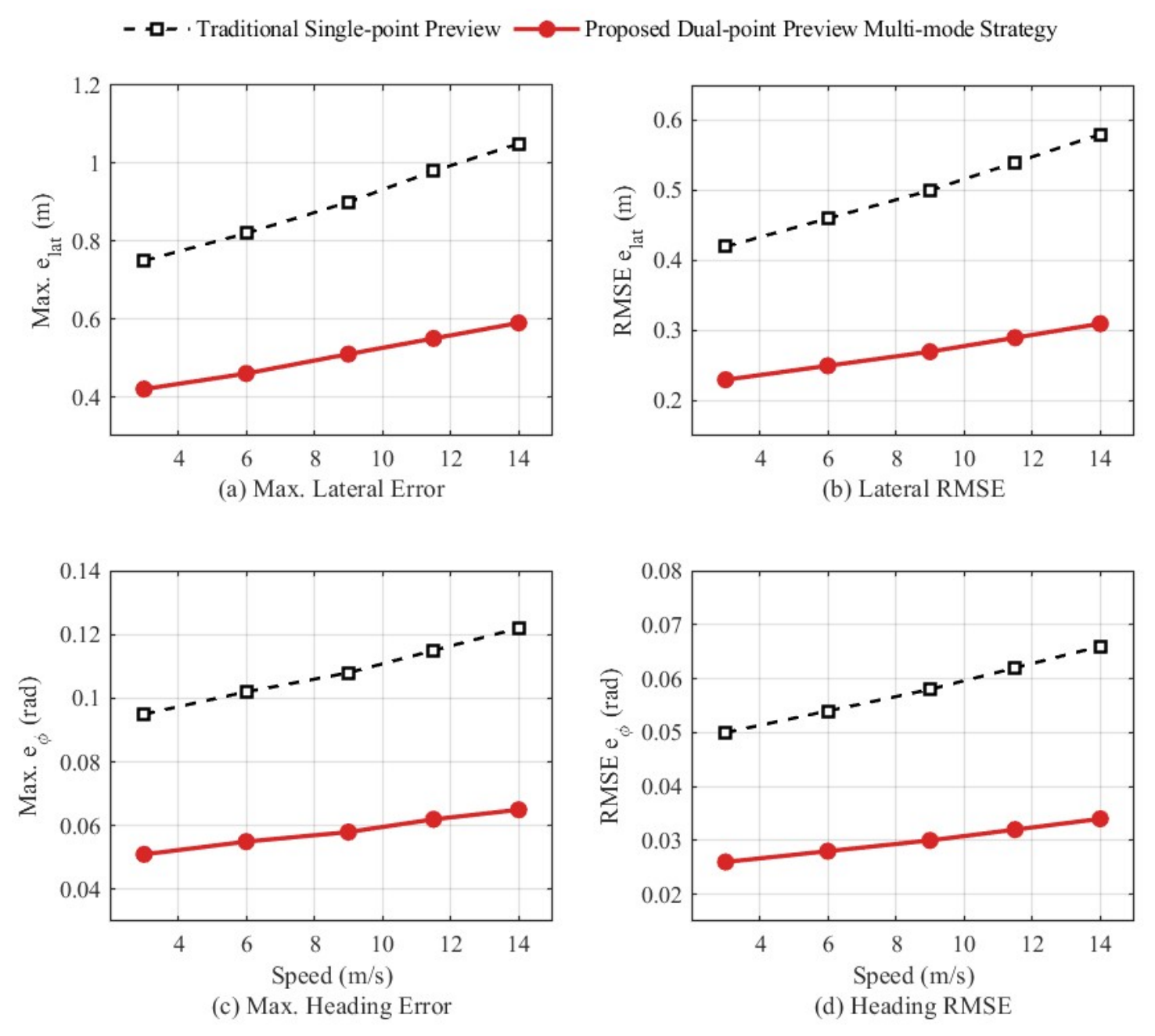
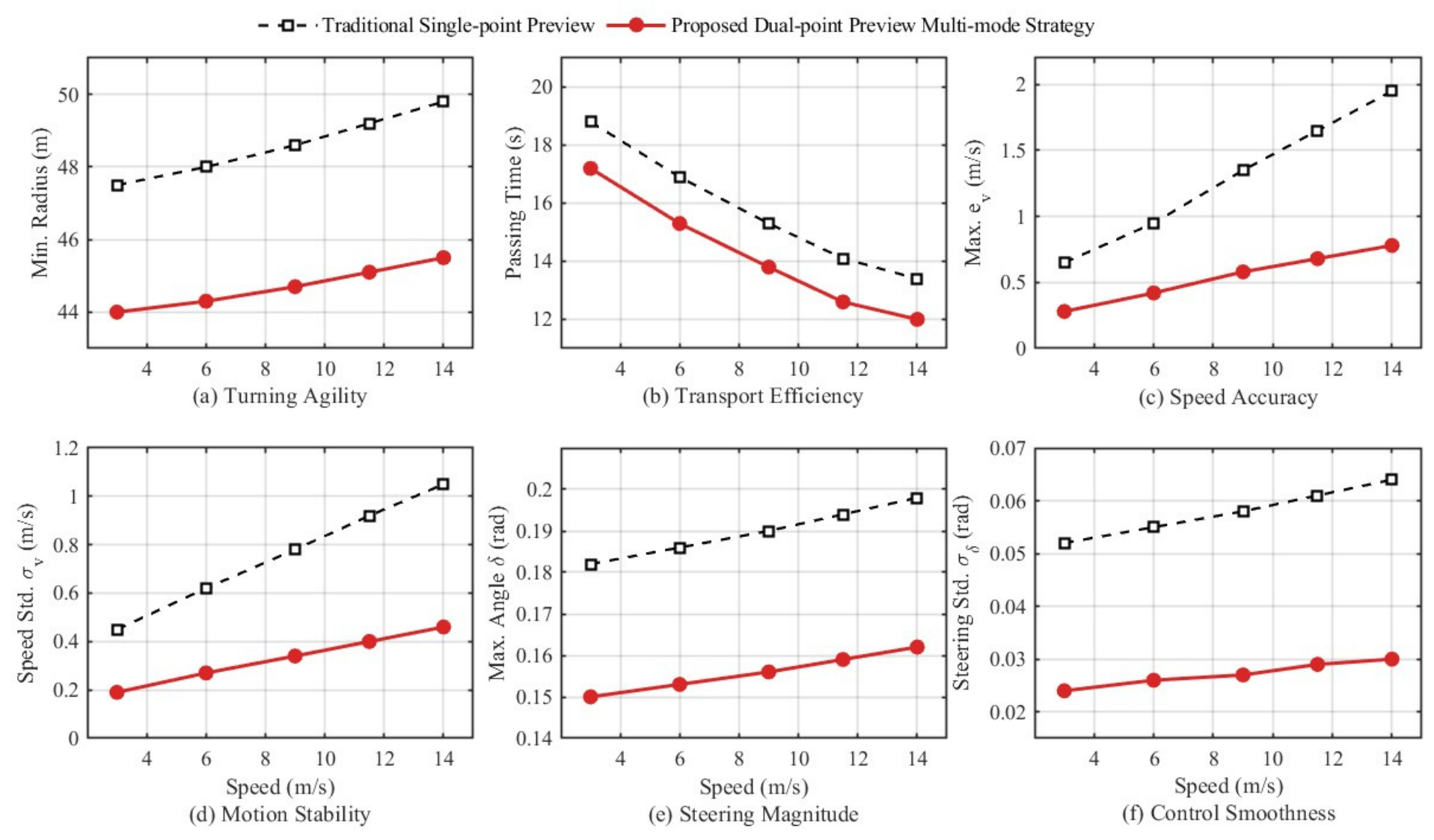
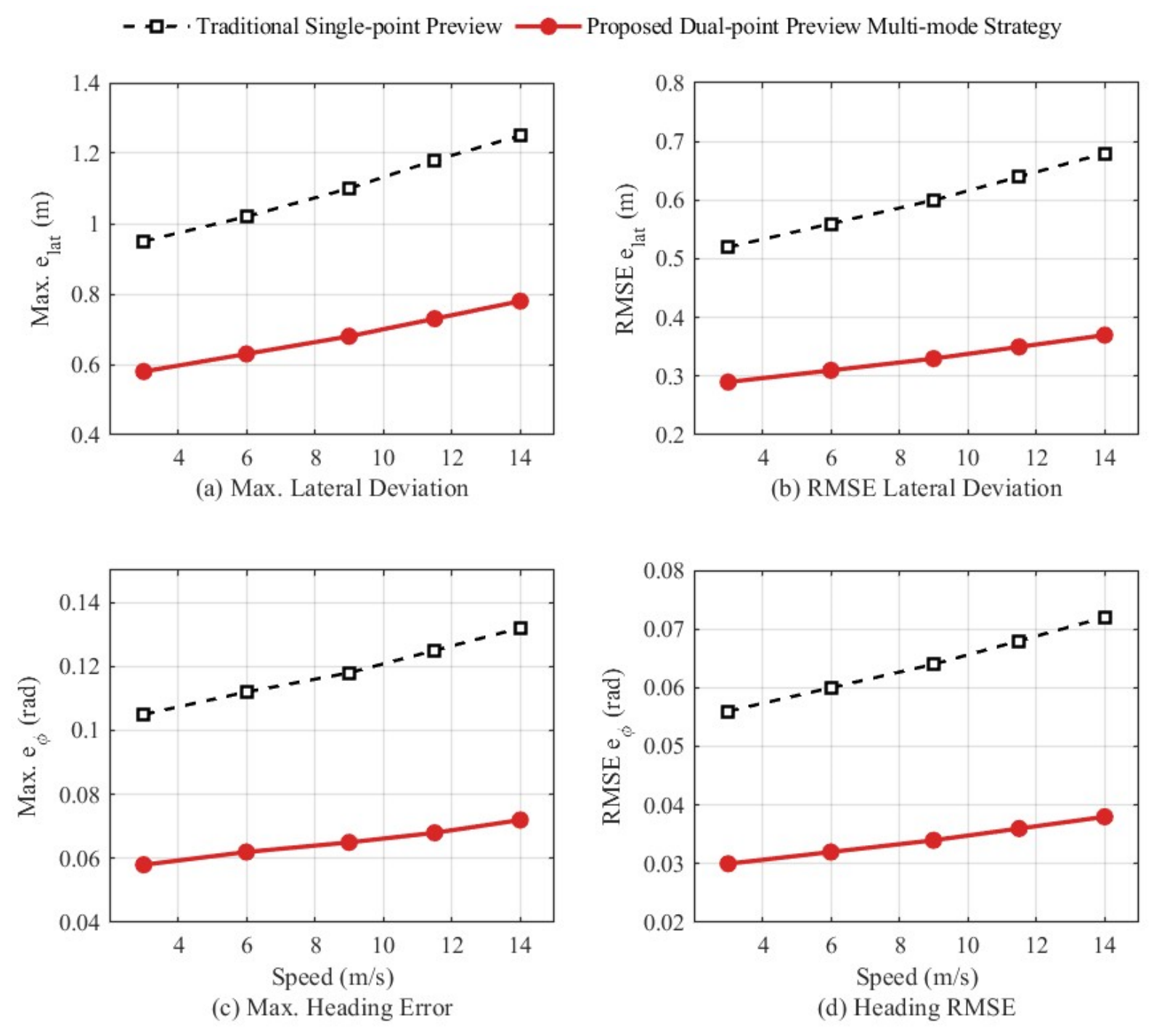
The quantitative results extracted from Figure 8 and Figure 9 yield the following insights:
(1)
Tracking Accuracy and Pose Stability
As the longitudinal vehicle speed escalates, the lateral error under the single-point preview strategy exhibits a monotonic divergence trend, reaching a peak deviation of 1.05   m at a speed of 13.9   m / s , accompanied by pronounced tail-flicking at the curve transition junctions. In sharp contrast, the proposed dual-point preview and multi-mode steering cooperative strategy sustains a strictly bounded error envelope across all tested speeds. Even at the maximum cruise velocity, the peak lateral error is strictly confined to 0.59   m , and the root-mean-square error (RMSE) of the heading deviation is suppressed by over 48% compared to the single-point preview baseline.
(2)
Turning Radius and Transit Efficiency
The dual-point preview multi-mode cooperative strategy compresses the minimum turning radius by 9.6% to 10.1% relative to the single-point preview counterpart, while cutting the curve transit time by 7.5%. This fundamentally enhances the low-speed maneuverability and high-speed agility of the multi-axle vehicle during rapid direction-switching transitions.
(3)
Control Smoothness and Actuator Protection
The conventional single-point preview strategy triggers high-frequency steering angle oscillations at the curve reversal points, where the standard deviation of the steering commands exhibits a severe amplification with increasing vehicle speed, peaking beyond 0.08   rad . Conversely, the steering angle commands generated by the dual-point preview multi-mode cooperative strategy remain remarkably smooth and continuous, with the standard deviation consistently capped below 0.03   rad . This verifies that the proposed framework delivers highly stable steering outputs, successfully averting high-frequency chattering in the steering linkages and significantly mitigating the physical workload imposed on the underlying steering actuators.
Figure 8. Path-following accuracy comparison between the two control strategies under different vehicle speeds.
Actuators 15 00363 g008
Figure 9. Comprehensive performance comparison between the two control strategies under different vehicle speeds.
Actuators 15 00363 g009

5.3. High-Curvature Sharp Curve and Confined Curve-Exit Condition

To thoroughly test the maneuverability of the multi-mode steering framework in spatially restricted environments, this section constructs an extreme testing scenario featuring a high-curvature sharp curve followed immediately by a confined curve exit. This simulation isolates and analyzes the spatial passability of the vehicle when fusing the center steering mode with the dual-point preview mechanism.
The simulation environment is meticulously tailored to replicate an unstructured turning maneuver at a narrow suburban intersection. The planned trajectory profile is organized as follows: a straight path a high-curvature sharp curve ( ρ = 0.025   m - 1 , road width W = 4.5   m ) a narrow curve exit a straight path. The nominal tire-road friction coefficient is maintained at μ =   0.85 .
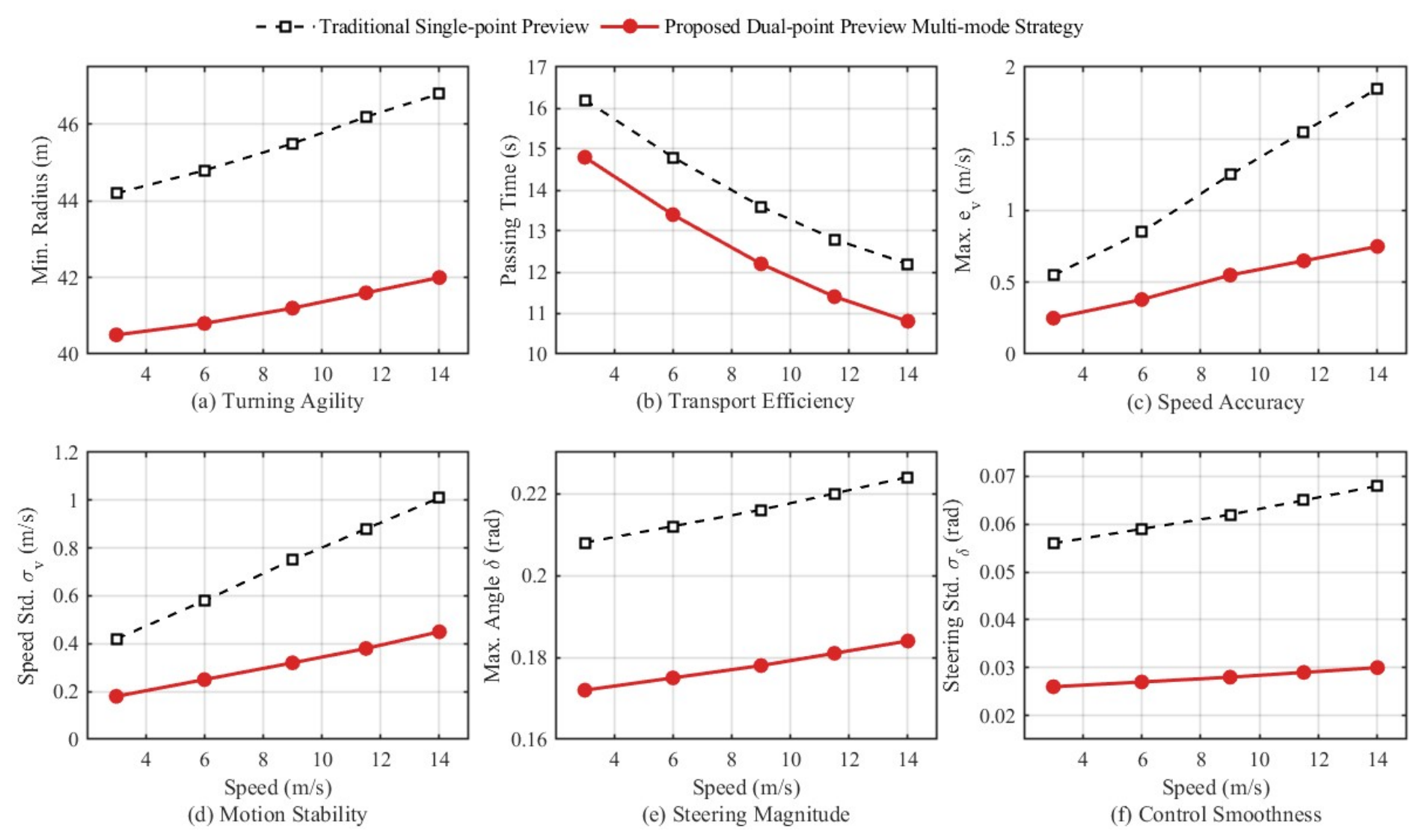
The performance indicators illustrated in Figure 10 and Figure 11 reveal the following conclusions:
  • Curve-Entry Precision and Overshoot Suppression
The single-point preview strategy exhibits a prominent phase lag during curve entry, resulting in a maximum lateral deviation of 1.25   m , which incurs a severe risk of encroaching on the oncoming traffic lane. By utilizing dual-point joint geometric boundaries, the proposed strategy ensures highly responsive and precise curve entry, throttling the maximum lateral error within 0.78   m while cutting the heading error RMSE by 50% relative to the single-point preview baseline.
2.
Geometric Passability and Inner-Wheel Difference Mitigation
The dual-point preview strategy compresses the minimum turning radius by approximately 4.0   m compared to the single-point baseline, which effectively neutralizes the off-tracking inner-wheel difference intrinsic to multi-axle heavy vehicles. Consequently, the total cornering duration is shortened by 1.4   s to 1.5   s , markedly optimizing the geometric clearance efficiency in tightly constrained curves.
3.
Load Mitigation of Steering Actuators
The proposed dual-point preview strategy introduces a substantial reduction in the peak steering angle of the front axle. This proves that while the strategy maximizes vehicle maneuverability, it concurrently alleviates the mechanical structural load on the front-axle steering actuation systems.
Figure 10. Path-following accuracy comparison between single-point and dual-point preview strategies under different vehicle speeds.
Actuators 15 00363 g010
Figure 11. Comprehensive performance comparison between single-point and dual-point preview strategies under different vehicle speeds.
Actuators 15 00363 g011

5.4. Robustness Testing Under Extreme Low-Friction Sharp Curve Conditions

To rigorously validate the lateral directional stability of the vehicle on low-friction surfaces, this section executes a robustness simulation program focusing on the adaptive spatial preview strategy backed by vehicle dynamics margin corrections. The analysis targets the control strategy’s capability to dynamically scale the spatial preview distance to neutralize sudden friction drops when the tire forces approach nonlinear saturation zones.
The evaluation is conducted atop the high-curvature confined curve scenario described in Section 5.3 ( ρ = 0.025   m 1 , W = 4.5   m ). At the exact simulation timestamp of t = 5   s —which corresponds precisely to the high-risk instant where the vehicle enters the apex of the sharp curve—the road friction coefficient μ is step-dropped from 0.85 down to 0.35 to simulate a sudden encounter with a slippery, low-friction road surface.
It is worth noting that while Section 5.1, Section 5.2 and Section 5.3 primarily focused on evaluating the kinematic spatial tracking superiority of the dual-point concept against conventional geometric strategies under nominal conditions, this section shifts the focus strictly to dynamic boundary stability. Therefore, to provide a highly rigorous dynamic evaluation under extremely low-friction conditions, a mature Linear Quadratic Regulator (LQR) preview controller—a control architecture recently validated for trajectory tracking in autonomous multi-axle vehicles equipped with wheel-hub motors [40]—is additionally introduced here as a state-of-the-art dynamic baseline.
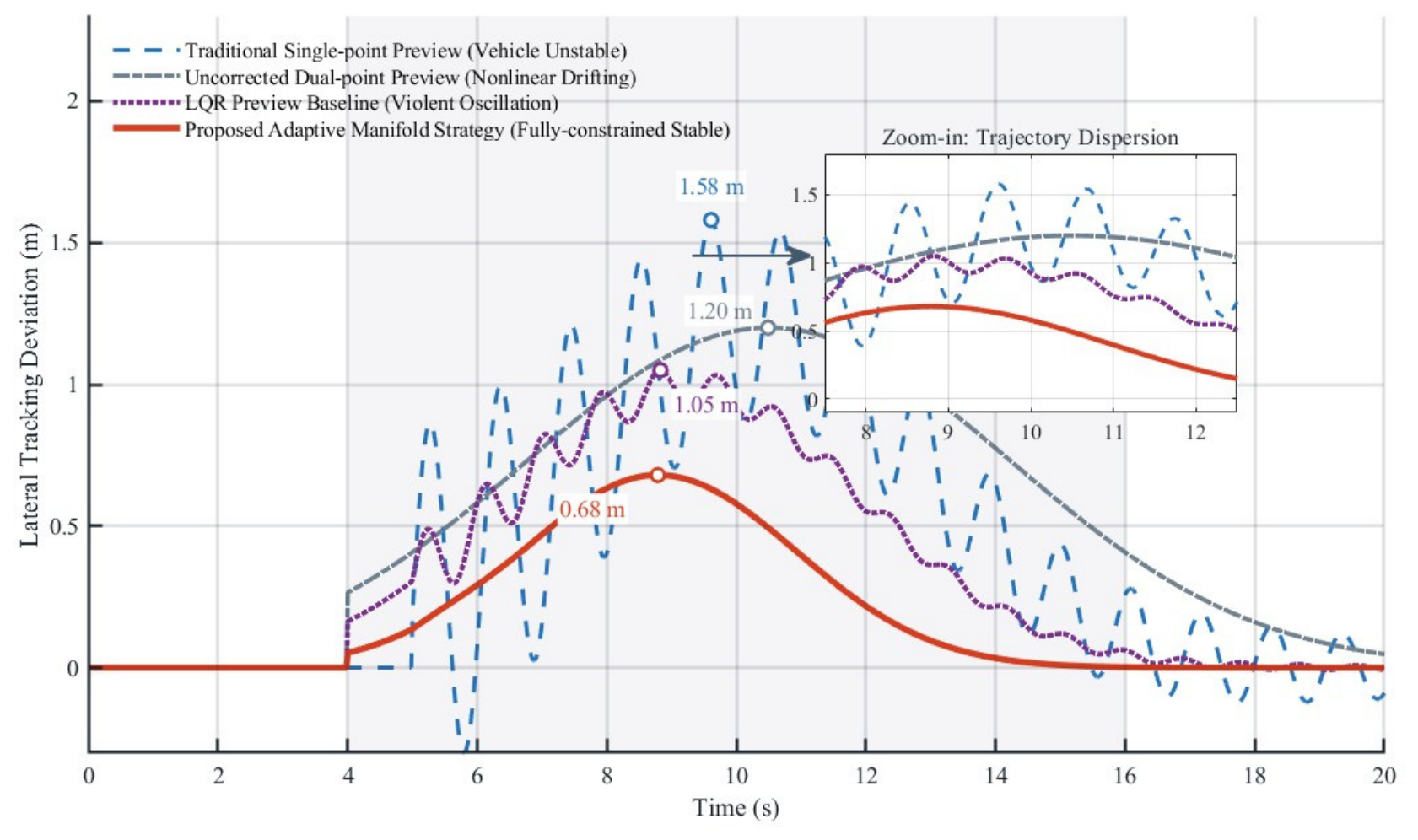
Synthesizing the quantitative tracking metrics presented in Figure 12 and Table 6, it is rigorously demonstrated that upon encountering the abrupt step-drop in road friction, all baseline strategies severely violate the dynamic stability boundaries. Specifically, the conventional single-point strategy drives the peak center of gravity (CG) sideslip angle far beyond the physical instability limit ( > 0.17   rad ), resulting in lateral instability and trajectory divergence. The LQR controller, while reducing the lateral tracking error to 1.05   m , mathematically demands high-frequency corrective oscillations, driving the peak steering actuator rate beyond the absolute hardware saturation limit of 0.43   rad / s . By contrast, by proactively mapping the spatial boundaries, the proposed strategy strictly bounds the transient peak CG sideslip angle to a safe margin of 0.045   rad and contains the maximum actuator execution rate at 0.28   rad / s . These quantitative results verify that the proposed method maintains lateral directional stability without triggering nonlinear actuator saturation.
Although the pure geometric dual-point preview strategy maintains tighter spatial tracking boundaries than the conventional single-point baseline, its lack of perception regarding the road friction transition causes its aggressive wheel steering outputs to instantaneously drive the tire lateral forces deep into the nonlinear saturation region, triggering severe lateral drifting. Furthermore, although the established LQR preview baseline exhibited optimal tracking under the previous high-friction linear conditions, its limitations are exposed here. By aggressively attempting to minimize the geometric tracking error despite the friction drop, the LQR manages to reduce the maximum lateral deviation to 1.05 m (outperforming the pure geometric strategy). However, this is achieved at a severe cost. Lacking explicit dynamic boundary constraints, the LQR commands violent, high-frequency steering corrections, inadvertently driving the tires deep into nonlinear saturation and triggering severe mechanical actuator saturation.
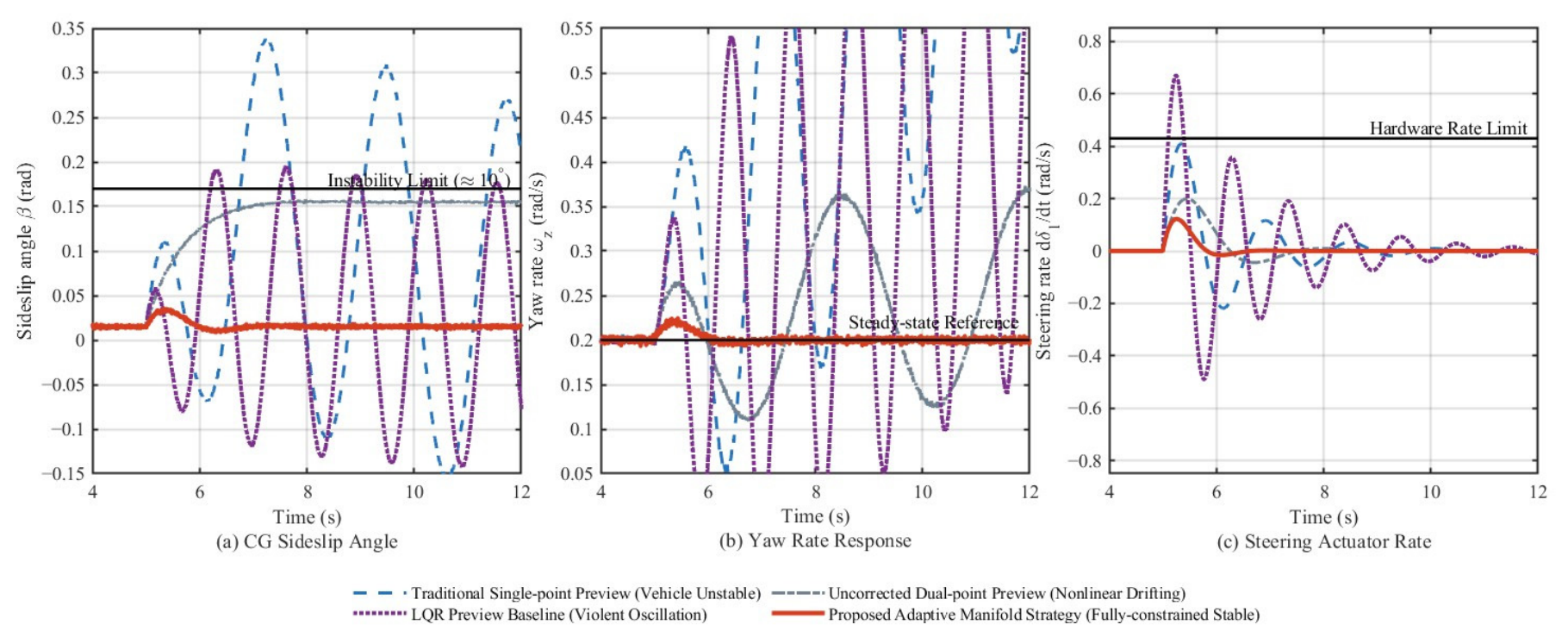
To comprehensively elucidate the internal dynamic mechanisms driving this instability and to verify the prevention of nonlinear tire saturation, Figure 13 illustrates the transient responses of the vehicle’s core stability indicators—the center of gravity (CG) sideslip angle β , yaw rate ω z , and the front-axle steering actuator rate d δ 1 / d t —during the 0.35 step-drop maneuver.
As depicted in Figure 13a,b, when the road friction abruptly deteriorates at t = 5   s , the conventional single-point preview strategy forces the vehicle into an uncontrollable spin-out state, with its CG sideslip angle rapidly diverging beyond the physical instability limit ( > 0.17 rad). Similarly, the LQR baseline responds too aggressively to the path deviation; its transient sideslip angle sharply peaks, and its yaw rate experiences high-frequency oscillations exceeding 0.40 rad/s. The pure geometric dual-point preview strategy drifts to a dangerous steady-state sideslip bias of 0.15 rad, indicating an impending loss of lateral grip.
By contrast, the geometry–dynamics coupled lateral control strategy proposed in this paper actively monitors the vehicle’s lateral dynamics stability margin to dynamically contract the preview spatial distance, thereby feedforward-suppressing the nonlinear saturation of tire forces. As verified by Figure 13, this proactive feedforward mechanism fundamentally bounds the maximum CG sideslip angle to a strictly safe transient peak of merely 0.045 rad, and the yaw rate converges smoothly back to the 0.20 rad/s steady-state reference without excessive overshoot. This framework robustly dampens the maximum lateral tracking error within a tight envelope of 0.68 m.
Furthermore, as shown in Figure 13c, the steering actuator execution rate d δ 1 / d t remains strictly continuous and dynamically bounded. During the sudden mode transition and adaptive spatial scaling triggered at t = 5   s , the steering command exhibits absolutely no step jumps or singular spikes. The peak steering actuator rate is successfully restricted to 0.28 rad/s, safely below the hardware saturation boundary ( 0.43 rad/s). This smooth, jump-free transient response validates the efficacy of the C 1 -continuous cosine blending function and hysteresis logic designed in Section 4.3.1, proving that the multi-mode fusion framework fully guarantees execution continuity without inducing mechanical shocks to the steering linkages. Conversely, the LQR baseline severely violates this mechanical limit, proving that conventional unconstrained linear optimal controllers are inadequate for multi-axle heavy vehicles operating near adhesion limits. These results demonstrate that the proposed adaptive correction mechanism profoundly upgrades both the tracking precision and disturbance rejection robustness of six-axle vehicles under extreme operating conditions.

5.5. Qualitative Discussion on Energetic Consequences and Practical Road Geometry

While the primary objective of the proposed geometry–dynamics coupled control strategy is to enhance spatial maneuverability and lateral stability, the kinematic optimization of the ICR yields substantial secondary benefits regarding vehicle energy consumption.
In conventional single-point preview systems, the under-constrained rear trajectory inevitably leads to parasitic tire sideslip across the intermediate and rear axles. This geometric conflict forces the tires to operate with elevated slip angles merely to maintain the vehicle’s yaw motion, directly converting mechanical tractive energy into heat via tire scrub. By enforcing a fully constrained dual-point manifold, the proposed multi-mode steering fusion aligns the instantaneous slip vectors of all six axles strictly with the vehicle’s turning geometry. This active mitigation of inter-axle kinematic interference qualitatively reduces the vehicle’s overall rolling resistance and tire wear. Consequently, compared to conventional arrangements, the dual-point methodology is expected to lower the propulsion energy required during heavy-duty low-speed maneuvering, thereby contributing to enhanced transport efficiency and operational reliability.

6. Conclusions

This paper investigates a novel geometry–dynamics coupled lateral control strategy for distributed-drive all-wheel steering (AWS) six-axle heavy vehicles, fusing a fully constrained dual-point preview mechanism with multi-mode steering manifolds. Based on rigorous kinematic derivation and extensive high-fidelity validation via a TruckSim-Simulink co-simulation platform, the primary simulation-based findings are summarized as follows:
Resolution of Geometric Under-Constraint: By establishing rigid boundary constraints concurrently at the vehicle head and tail, the dual-point preview strategy actively compresses the minimum turning radius by 9.6 % to 10.1 % and shortens curve transit time by 7.5 % compared to conventional single-point preview, effectively mitigating trajectory inward cutting.
Enhanced Spatial Passability: The algebraic projection mapping algorithm effectively maps ideal path demands onto physically feasible steering modes. Under confined sharp curve conditions, the strategy limits the maximum lateral tracking deviation to 0.78 m and reduces the front-axle peak steering angle by approximately 18%, successfully mitigating side-scraping risks.
Robustness Under Low-Friction Limits: Under an extreme low-friction condition ( μ =   0.35 ), the dynamic stability margin correction mechanism feedforward-suppresses nonlinear tire force saturation. By adaptively scaling the spatial manifold, it restricts the maximum lateral error to 0.68 m and prevents catastrophic spin-outs without requiring intensive closed-loop dynamic intervention.
Expectations for Practical Deployment: Moving beyond the simulation environment, the proposed methodology holds strong potential for real-world deployment on heavy-duty intelligent transport platforms. The demonstrated reduction in off-tracking and parasitic inter-axle sideslip qualitatively points to improved transport energy efficiency, as optimized tire scrub directly minimizes mechanical energy dissipation and rolling resistance. In practical engineering applications involving continuously varying road alignments (e.g., clothoid transitions), the C 1 -continuous blending logic and dynamic preview scaling are expected to ensure highly smooth steering actuator responses, promoting component durability. Future field deployments will focus on integrating real-time road friction estimation modules and addressing variable actuator communication latencies to fully realize these theoretical advantages in unstructured environments.

7. Patents

A patent application related to the work reported in this manuscript has been filed with the China National Intellectual Property Administration (CNIPA).
Patent details:
Application number: 202610198897.6
Filing date: 11 February 2026
Applicant: Jiangsu University
Inventors: Haobin Jiang, Yurui Xie, Chenxu Li, Bin Tang
Title: A Dual Preview Multi-Mode Steering Control Method for Multi-Axis Distributed Electric Drive Vehicles

Author Contributions

Conceptualization, H.J. and Y.X.; methodology, Y.X.; software, B.T.; validation, A.L., Y.X. and B.T.; formal analysis, H.J.; investigation, Y.X.; resources, H.J.; data curation, Y.X.; writing—original draft preparation, Y.X.; writing—review and editing, H.J.; visualization, H.J.; supervision, B.T.; project administration, H.J.; funding acquisition, H.J. All authors have read and agreed to the published version of the manuscript.

Funding

This work was supported by Jiangsu Provincial Department of Science and Technology, Funding Number: BE2022053-4.

Institutional Review Board Statement

Not applicable.

Informed Consent Statement

Not applicable.

Data Availability Statement

The original contributions presented in this study are included in this article. Further inquiries can be directed to the corresponding author.

Acknowledgments

The authors have reviewed and edited the output and take full responsibility for the content of this publication.

Conflicts of Interest

The authors declare no conflicts of interest.

References

  1. Rahman, S.; Gordon, T.; Gao, Y.; Henderson, L.; Liu, Q.; Laine, L. Automated steering control for improved path tracking and stability of articulated heavy goods vehicles. Veh. Syst. Dyn. 2026, 64, 419–439. [Google Scholar]
  2. Zhang, G.; Wang, T.; Wang, H.; Wu, S.; Shao, Z. Stability analysis of a vehicle–cargo securing system for autonomous trucks based on 6-SPS-type parallel mechanisms. Machines 2023, 11, 745. [Google Scholar]
  3. Zhou, S.; Zhao, H.; Chen, W.; Liu, Z.; Wang, H.; Liu, Y.-H. Dynamic state estimation and control of a heavy tractor–trailers vehicle. IEEE/ASME Trans. Mechatron. 2021, 26, 1467–1478. [Google Scholar]
  4. Zhang, B.; Zong, C.; Chen, G.; Huang, Y.; Xu, T. A novel integrated stability control based on differential braking and active steering for four-axle trucks. Chin. J. Mech. Eng. 2019, 32, 12. [Google Scholar] [CrossRef]
  5. Wang, J.; Zhang, L.; Zong, D. Rear axle trajectory deviation of heavy trucks during cornering: A simulation study. Veh. Syst. Dyn. 2019, 57, 1450–1468. [Google Scholar]
  6. Li, S.; Chen, Y.; Hu, J. Multi-axle steering coordination for heavy-duty vehicles: A review. Int. J. Heavy Veh. Syst. 2021, 28, 215–236. [Google Scholar]
  7. Fang, R.; Shen, T.; Bai, X.; Liang, J.; Wang, F.; Zhuang, W.; Yin, G. Hierarchical control with steering mode switching for MDED-HDV via maneuver stability region analysis. IEEE Trans. Autom. Sci. Eng. 2024, 21, 1825–1838. [Google Scholar]
  8. Zeng, D.; Luo, W.; Yu, Y.; Hu, Y.; Zhang, P.; Carbone, G.; Xie, D.; Fang, H.; Gao, L. Dynamic analysis and equivalent modeling for a four-axle vehicle with multi-axial steering. Actuators 2024, 13, 473. [Google Scholar]
  9. Wang, A.Z.; Ji, X.; Song, Q.; Wei, X.H.; Chen, W.M.; Wang, K. Path tracking controller and system design for agricultural tractors based on improved Stanley and sliding mode algorithms considering sideslip compensation. Agronomy 2025, 15, 2329. [Google Scholar] [CrossRef]
  10. Lazzarini, D.; Depalo, M.; Tota, A.; Dimauro, L.; Dhaens, M.; Sorniotti, A. On the benefits of road preview on integrated chassis control. Veh. Syst. Dyn. 2026. [Google Scholar] [CrossRef]
  11. Tang, M.; Chen, X.; Tang, K.; Zhang, Y.; Wang, W. Longitudinal and lateral cooperative control of preview intelligent vehicles with stabilization. J. Intell. Robot. Syst. 2024, 110, 156. [Google Scholar] [CrossRef]
  12. Cao, H.; Song, X.; Zhao, S.; Bao, S.; Huang, Z. An optimal model-based trajectory following architecture synthesising the lateral adaptive preview strategy and longitudinal velocity planning for highly automated vehicle. Veh. Syst. Dyn. 2017, 55, 1143–1188. [Google Scholar] [CrossRef]
  13. Yue, M.; Liu, Y.; Wang, L. Adaptive robust path tracking preview control for tractor-trailer trucks considering trailer sway and stochastic disturbances. IEEE Trans. Intell. Transp. Syst. 2023, 24, 5422–5434. [Google Scholar]
  14. Lu, E.; Ma, Z.; Li, Y.; Xu, L.; Tang, Z. Adaptive backstepping control of tracked robot running trajectory based on real-time slip parameter estimation. Int. J. Agric. Biol. Eng. 2020, 13, 178–187. [Google Scholar] [CrossRef]
  15. Jing, H.; Wang, W.; Chen, N. Interaction-aware lateral stability control for distributed drive electric trucks. IEEE Trans. Intell. Transp. Syst. 2022, 23, 8632–8643. [Google Scholar]
  16. Zhang, Y.; Khajepour, A.; Ataei, M. A universal and reconfigurable stability control methodology for articulated vehicles with any configurations. IEEE Trans. Veh. Technol. 2020, 69, 3748–3759. [Google Scholar] [CrossRef]
  17. GB 1589-2016; Limits of Dimensions, Axle Load and Masses for Motor Vehicles, Trailers and Combination Vehicles. Standardization Administration of China: Beijing, China, 2016.
  18. Mitschke, M.; Wallentowitz, H. Dynamik der Kraftfahrzeuge, 4th ed.; Springer: Berlin, Germany, 2004; pp. 185–220. [Google Scholar]
  19. Wong, J.Y. Theory of Ground Vehicles, 4th ed.; John Wiley & Sons: Hoboken, NJ, USA, 2008; pp. 345–380. [Google Scholar]
  20. Tao, J.; Zhou, B.; Jiao, X. Multi-mode steering control strategy for multi-axle heavy-duty vehicles based on Ackermann principle. Int. J. Veh. Des. 2020, 83, 145–168. [Google Scholar]
  21. Chen, T.; Chen, L.; Xu, X.; Cai, Y.; Sun, X. Passive fault-tolerant path following control of autonomous distributed drive electric vehicle considering steering system fault. Mech. Syst. Signal Process. 2019, 123, 298–315. [Google Scholar] [CrossRef]
  22. Kati, M.S.; Chalamalasetti, S.R. Evaluation of all-wheel steering control strategies for multi-axle vehicles in tight cornering manoeuvres. Veh. Syst. Dyn. 2021, 59, 1201–1224. [Google Scholar]
  23. Zhai, J.; Chen, H.; Nan, G. Crab steering control and mobility analysis of independent-drive multi-axle vehicles. J. Terramech. 2019, 85, 35–49. [Google Scholar]
  24. MacAdam, C.C. Application of an optimal preview control for simulation of closed-loop automobile driving. IEEE Trans. Syst. Man Cybern. 1981, 11, 393–399. [Google Scholar] [CrossRef]
  25. Sharp, R.S.; Casanova, D.; Symonds, P. A mathematical model for driver steering control, with design, tuning and performance results. Veh. Syst. Dyn. 2000, 33, 289–326. [Google Scholar] [CrossRef]
  26. Plöchl, M.; Edelmann, J. Driver models in automobile dynamics application. Veh. Syst. Dyn. 2007, 45, 699–741. [Google Scholar] [CrossRef]
  27. Deng, Z.; Yang, Z.; Chu, L. A hierarchical directional control framework for multi-axle heavy vehicles with active steering. Proc. Inst. Mech. Eng. Part D J. Automob. Eng. 2023, 237, 2845–2860. [Google Scholar]
  28. Razvan, R.; Preda, I. Advanced vision-based preview models for lateral control of intelligent commercial vehicles. Transp. Res. Part C Emerg. Technol. 2021, 128, 103190. [Google Scholar]
  29. Amin, A.; Gordon, T. Adaptive look-ahead preview control for path following of heavy vehicles under varying speed profiles. IEEE Trans. Control Syst. Technol. 2018, 26, 1345–1358. [Google Scholar]
  30. Katz, R.; Shalom, A. State-space modelling of preview error dynamics for multi-axle articulated heavy goods vehicles. Veh. Syst. Dyn. 2020, 58, 1420–1442. [Google Scholar]
  31. He, Y.; Khajepour, A.; McPhee, J.; Huang, Y. Dynamic modeling and tire force optimization for multi-axle heavy vehicles with independent steering systems. Veh. Syst. Dyn. 2016, 54, 312–336. [Google Scholar]
  32. Gong, J.; Jiang, Y.; Xu, W. Model predictive control for autonomous ground vehicles with dual-point preview path-tracking. In Proceedings of the IEEE Intelligent Vehicles Symposium (IV), Gothenburg, Sweden; IEEE: New York, NY, USA, 2016; pp. 687–692. [Google Scholar]
  33. Boyd, S.; Vandenberghe, L. Convex Optimization; Cambridge University Press: Cambridge, UK, 2004; pp. 120–150. [Google Scholar]
  34. Nocedal, J.; Wright, S.J. Numerical Optimization, 2nd ed.; Springer: New York, NY, USA, 2006; pp. 345–378. [Google Scholar]
  35. de Silva, P.M. Rollover risk mitigation framework for heavy commercial vehicles under geometric layout configurations. J. Saf. Res. 2020, 72, 211–224. [Google Scholar]
  36. Dahlberg, T.J. Dynamic vehicle speeds planning on curved highway zones considering rollover and side-slip thresholds. ASME J. Dyn. Syst. Meas. Control. 2019, 141, 081005. [Google Scholar]
  37. Rajamani, R. Vehicle Dynamics and Control, 2nd ed.; Springer: New York, NY, USA, 2012; pp. 135–178. [Google Scholar]
  38. Hu, C.; Chen, Y.; Wang, J. Fuzzy observer-based transitional path-tracking control for autonomous vehicles. IEEE Trans. Intell. Transp. Syst. 2021, 22, 3078–3088. [Google Scholar]
  39. Zhang, L.; Wang, Z.; Ding, H. Robust lateral stability control of distributed drive vehicles considering tire nonlinearity and parameter uncertainties. IEEE Trans. Veh. Technol. 2019, 68, 8567–8579. [Google Scholar]
  40. Huang, B.; Fu, W.; Yuan, Z.; Zhong, S. Trajectory Tracking for Autonomous Multi-Axle Vehicles Based on Linear Quadratic Regulator; SAE Technical Paper 2024-01-5023; SAE International: Warrendale, PA, USA, 2024. [Google Scholar]
Figure 1. Simplified schematic of the vehicle dynamics model.
Actuators 15 00363 g001
Figure 2. Kinematic principles of the three distinct steering modes.
Actuators 15 00363 g002
Figure 3. Schematic diagram of the conventional single-point preview principle.
Actuators 15 00363 g003
Figure 4. Schematic of the dual-point preview steering principle for a six-axle vehicle.
Actuators 15 00363 g004
Figure 5. Overall framework of the control strategy.
Actuators 15 00363 g005
Figure 6. Geometric relationship between the vehicle and the target path.
Actuators 15 00363 g006
Figure 7. Principle of adaptive preview distance regulation.
Actuators 15 00363 g007
Figure 12. Lateral tracking deviation comparison across different strategies under low-friction conditions.
Actuators 15 00363 g012
Figure 13. Dynamic stability indicators under extreme low-friction step-drop conditions.
Actuators 15 00363 g013
Table 1. Primary technical parameters of the six-axle heavy transport vehicle.
Parameter DescriptionSymbolValueUnit
Overall Vehicle Length L v e h 18.74m
Overall Vehicle Width W v e h 3.74m
Overall Vehicle Height H v e h 2.04m
Payload Length L o b j 22.06m
Payload Width W o b j 4.72m
Track WidthT2.60m
Longitudinal Distance from CG to Axles 1–6 a 1 ~   a 6 [7.45, 4.40, 1.33,−1.33, −4.40, −7.45]m
Vehicle Curb Weight m v e h 12500.00kg
Payload Mass m o b j 16896.00kg
Gross Combination Weight (GCW)m29396.00kg
Height of Vehicle CG H c , v e h 1.65m
Height of Payload CG H c , o b j 4.39m
Table 2. Mechanical steering angle limitations for each individual axle.
Axle NumberOperational PositionMaximum Steering Angle BoundMaximum Steering Rate
Axle 1Front Steering Axle±38°±25°/s (≈0.43 rad/s)
Axle 2Front Steering Axle±32°±25°/s (≈0.43 rad/s)
Axle 3Intermediate Axle±15°±25°/s (≈0.43 rad/s)
Axle 4Intermediate Axle±15°±25°/s (≈0.43 rad/s)
Axle 5Rear Steering Axle±28°±25°/s (≈0.43 rad/s)
Axle 6Rear Steering Axle±34°±25°/s (≈0.43 rad/s)
Table 3. Steering mode switching rules under different scenarios.
ConditionsSteering ModeDescription
ρ ρ l o w ( 0.035   m - 1 )   a n d   W 5   m Rear-Axle SteeringMedium-curvature curves or high-speed, stability-oriented
ρ ρ h i g h ( 0.04   m - 1 ) o r   W < 5   m Center SteeringSharp curves or confined roads, minimum turning radius
ρ l o w < ρ < ρ h i g h Mode Transition Zone C 1 -continuous cosine blending to prevent limit-cycle oscillation
Reception of “lane change/translation” commandCrab SteeringLateral translation, uniform steering angle for all axles
Note: To prevent high-frequency mode oscillation (“ping-pong” effect) near the switching boundaries, a hysteresis zone [ ρ l o w , ρ h i g h ] is defined. The explicit smooth transition and geometric blending mechanisms within this zone are detailed in Section 4.3.1.
Table 4. Comparison of the minimum turning radius between single-point and dual-point preview strategies.
CurveStrategyTheoretical R min (m)Simulated R min (m)Radius Reduction Rate (%)
A (R = 50)Single-point Preview47.848.5
Dual-point Preview42.943.610.1
B (R = 40)Single-point Preview38.539.7
Dual-point Preview34.935.99.6
Table 5. Cornering efficiency comparison under pure geometric single-point and dual-point preview strategies.
StrategyMaximum Allowable Speed (m/s)Actual Average Cornering Speed (m/s)Curve Transit Time (s)Efficiency Improvement (%)
Single-point Preview11.210.512.0-
Dual-point Preview11.811.311.17.5
Table 6. Lateral stability performance metrics under extreme low-friction conditions.
StrategyMaximum Lateral Deviation (m)Peak CG Sideslip Angle (rad)Peak Yaw Rate (rad/s)Peak Steering Actuator Rate (rad/s)
Conventional Single-point Preview1.58 > 0.17 (Diverged)>0.50 (Diverged)Uncontrollable
Pure Geometric Dual-point Preview1.200.150 (Steady-state bias)0.360.20
LQR Preview Control1.050.191 (Transient peak)>0.40 (Oscillation)>0.43 (Hardware saturated)
Proposed Adaptive Manifold Strategy0.680.0450.22 (Converges to 0.20)0.28
Disclaimer/Publisher’s Note: The statements, opinions and data contained in all publications are solely those of the individual author(s) and contributor(s) and not of MDPI and/or the editor(s). MDPI and/or the editor(s) disclaim responsibility for any injury to people or property resulting from any ideas, methods, instructions or products referred to in the content.