


Abstract
Tendon-driven manipulators possess obvious advantages compared to rigid-link manipulators, such as lighter weight, greater flexibility, and adaptability to confined spaces. To solve the problems of backlash and improve the accuracy of motion in specific application environments, this paper proposes a novel single-tendon-driven design for each joint of the manipulator. Kinematic modeling of the manipulator is systematically derived. Then, a decoupling algorithm is designed to mitigate motion coupling effects and enable accurate mapping between motor inputs and joint motions. Moreover, to improve the accuracy of trajectory tracking control for the tendon-driven manipulator, this paper proposes a nonsingular terminal sliding mode (NTSM) control scheme based on time-delay estimation (TDE). TDE is used to estimate unknown disturbances. An adjustable parameter was introduced based on TDE technology, which can enhance the system’s robustness against uncertainties and external disturbances. The stability of the closed-loop control system is verified through Lyapunov stability theory. Finally, decoupling experiments are conducted to validate the kinematic model and the feasibility of the proposed design. And comparative experiments are performed to prove the advantages of the proposed control scheme.
1. Introduction
The tendon-driven technique is widely applied in wearable robots [1,2,3], parallel robots [4,5,6] and serial robots [7,8,9]. Cables are usually lightweight and suitable for long-distance motion transmission, properties that provide them greater potential in robot design [10,11]. When designing wearable robots, designers can place motors or other driving units on the base to free users from the load of the driving motors [12,13]. Compared with rigid links, cables are more convenient for driving parallel robots than rigid links, and consequently, they are indispensable for parallel robots to some extent [14]. For serial robots, the robot arm will be big and heavy when motors are installed on the robot arm, because motors and speed reducers take up large amounts of space and weight. Continuum robots are a special kind of serial robot whose shape resembles that of a snake. Space is greatly limited in continuum robots, so they can only place motors at the base with tendon-driven techniques applied [15]. Various types of tendon-driven serial robots have been designed for different purposes. For instance, Martin Varga et al. investigated three different structures of continuum robots, namely, one type of elastic module and two types of rigid modules. They carried out experimental research and showed the differences in motions between these structures [16].
Multi-vertebrae continuum structure is commonly used in continuum manipulator design. The constant curvature assumption is usually used in the modeling of continuum robots, which is, however, not theoretically precise. Multi-vertebrae continuum robots (MVCRs) are also called multi-backbone continuum robots, whose curvature is constant. In other words, one can precisely calculate the dynamic model of a multi-vertebrae continuum robot without theoretical error. MVCRs offer more compliance than rigid-link ones and improve reliability over soft ones. Xinge Li et al. designed an MVCR with a large extension ratio. They connected two extensible sections to build a series, with each section equipped with intermediate constraints. The structure was verified theoretically and experimentally [17]. A multi-vertebrae continuum robot can be made from a super-elastic NITI alloy. To improve the unevenness of the corners, elastic beams are used on each joint of the manipulator. After building the kinetic model, geometric constraint equations and force balance equations, such a Continuum Robot, can be used as minimally invasive surgical instruments [18]. A serial S-shaped backbone structure of a continuum robot was proposed by Kaidi Zhu et al., which can be manufactured by 3D-printing techniques. A serial S-shaped backbone can greatly reduce the deformation of the continuum robot. Experiments have been done to verify the effectiveness of the S-shaped backbone structure [7].
Extensible single-section soft robots are also found in the existing literature [19,20,21]. This type of robot is bio-inspired, featuring a honeycomb pattern similar to that of a cell or a honeycomb. This type possesses an important advantage in mechanical performance: it has high energy absorption potential. Ibrahim A. Seleem et al. provided a practical example of extensible single-section soft robots. Their robot is designed using a flat metal sheet whose pattern is distributed vertically and horizontally. The robot can perform compression, extension and bending under the contraction of cables [22]. The magnetic continuum robot is a novel idea in continuum robot design [23,24]. Bentao Zou et al. designed an inchworm-shaped magnetic micro-robot for gastric operations. They enhanced the structure by optimizing the batch fabrication process of pH-responsive hydrogels. An inchworm-shaped magnetic microrobot was designed for gastric operations [25]. Another example of a magnetic continuum robot is the one designed by Tianxiang Liu et al. They proposed a real-time static model to cope with nonlinearity. Moreover, they employed a point dipole model to represent the magnetic field to describe the robot’s nonlinear deformation more precisely [26]. Chunbo Wang et al. designed a pre-set stiffness continuum robot for minimally invasive surgery. The robot had an integrated structure to obtain a certain pre-set stiffness with bidirectional push-pull capabilities [27]. Single-tendon actuation makes precise distal manipulation possible. Single-tendon actuation is a promising approach in tendon-driven robots for improving precision in distal control. Previous work used single-tendon-sheath transmission to build a precise model [28]. Inspired by these ideas, this work will use single-tendon actuation to design a rigid-link tendon-driven robot. When it comes to a soft continuum robot, stiffness is very important for its working performance. Jung-Che Chang et al. designed a stiffness-adjustable continuum robot with a 6-DOF continuum section. The robot had a long continuum arm and a 6-DOF continuum tip for industrial applications [29]. Pengyuan Wang et al. designed a continuum manipulator based on a helical structure whose stiffness could be changed. They used soft pneumatic actuators to improve the flexibility and payload-to-weight ratio [30].
Some scholars and engineers are devoted to solving motion decoupling in tendon-driven robots in different ways [31]. Noncircular pulleys provide one approach to compensating for motion coupling with small errors. Based on this idea, one can characterize the pulley profile and design the mechanical structure of the decoupling system [32]. Another way to handle the motion-coupling phenomenon is by using movable pulleys. Translational compensation and rotational compensation are designed for different types of rotation joints, including roll, pitch and yaw. Driving cables are used to ascertain the position of movable pulleys and bear the axial force exerted on them [33]. Tendon-driven modules are also used as a linear decoupling mechanism. By carefully designing the relationship between the motor and the cable, linear transmission between the motors and the joints can be realized. Motion deformation in the driving cables can be compensated for by establishing a static model of the manipulator [34]. Regardless of the decoupling method used, the primary principle is to avoid entanglement, as it can lead to friction and even damage the cable transmission system. Existing decoupling units avoid potential entanglement and effectively solve the coupling in tendon-driven robots. However, decoupling mechanisms or units add extra mass to the robot arm, which significantly increases the moving mass of the tendon-driven system. Heavy arms decrease the payload-to-weight ratio and increase the energy consumption of tendon-driven robots.
Many scholars use flexible dynamics to set up systems, which can provide high tracking control performance. In most experiments, the time-delay control (TDC) scheme is a useful method to utilize past system data to estimate current uncertainties [35]. The time-delay estimation (TDE) technique, as the core of TDC, not only provides a model-free structure but also approximates the unknown dynamics and uncertainties of the robot [36,37]. In order to improve the effectiveness of systems, many experiments have been made with the TDE technique. To reduce the tracking error of a three-axis parallel mechanism with strong coupling, nonlinearity and time-varying uncertainties, Zhou et al. designed a model-free decoupled and robust repetitive controller using time-delay estimation (TDE) [38]. Alsaied et al. designed a model-free control approach using time-delay estimation (TDE) combined with an optimized Type-2 fuzzy logic controller, and the control approach is used for gait trajectory tracking of a lower-limb exoskeleton robot [39]. Alqaisi et al. integrated time-delay estimation (TDE) with feedback linearization and sliding mode control, and the TDE is used to estimate nonlinear disturbances [40]. For the purpose of reducing contour errors of machine tools, Dai et al. designed a time-delay-based sliding mode control method incorporating contour error pre-compensation [41]. In [42], a novel adaptive sliding mode control scheme was proposed for a modular self-reconfigurable spacecraft. The control scheme compensates for coupling terms and uncertainties by using TDE. To control the position of a coaxial rotor drone with unknown model dynamics, an optimal model-free fuzzy control algorithm based on TDE was proposed. TDE is used to estimate the unknown dynamic function [43]. Furthermore, the TDE technique has been widely applied in the field of robotic manipulator control [44,45,46].
In this paper, a novel single-tendon-driven manipulator is designed. To solve the motion coupling problems for the manipulator, this paper builds a kinematic model by developing a coupling model and a decoupling algorithm. Then, a nonsingular terminal sliding mode control scheme is proposed based on α-TDE for trajectory tracking. We will try to make some contributions as follows:
- Design a tendon-driven manipulator and describe how the proposed manipulator’s tendons keep a positive tension force.
- Calculate the kinematic model and propose a decoupling algorithm.
- Design a novel nonsingular terminal sliding mode control scheme based on α-TDE.
- Validate the feasibility and effectiveness of the above method through experiments.
The rest of the structure of this paper is as follows. The method of manipulator design is given in Section 2. Section 3 describes the theoretical knowledge of decoupling. The system dynamics and main control theory results are given in Section 4. Afterward, the decoupling experiment and comparative experiment are presented in Section 5. Finally, Section 6 concludes this paper.
2. Manipular Design
2.1. Overall Structure
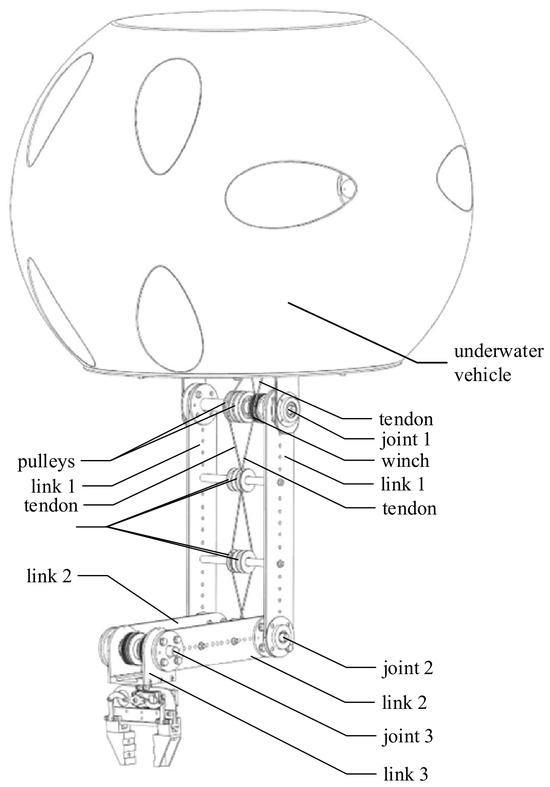
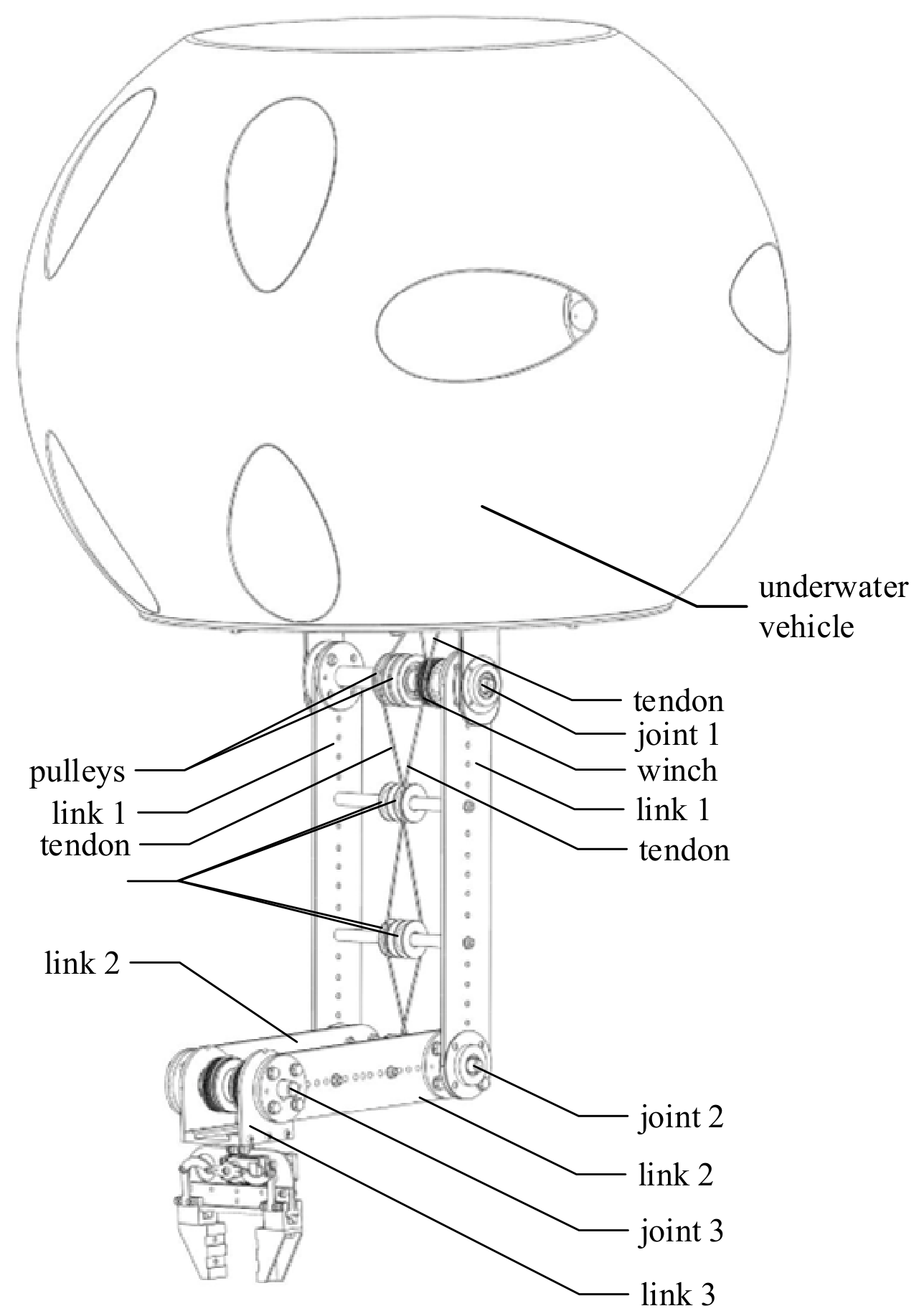
As shown in Figure 1, the manipulator is mounted on a vehicle that houses all the driving units and supporting equipment. For joint 1, a tendon stretches out of the vehicle and drives the winch of joint 1, which drives link 1 directly. The situation becomes more complex for joint 2 because the tendon should pass through joint 1 before driving the winch of joint 2. Some pulleys are set on the axle of joint 1 to locate tendons that pass through it. A tendon is set to stretch out of the vehicle and pass through joint 1, and finally drive the winch of joint 2. A tendon goes the same way to drive the winch of joint 3. Two pulleys are set on the axle of joint 1 and joint 2, respectively. A tendon stretches out of the vehicle, passes through the two pulleys, and eventually drives the winch of joint 3. The winch drives the corresponding axle and then drives link 3 to finish the whole force transmission.
Figure 1.
Overall structure of the newly designed tendon-driven manipulator.
2.2. Tendon Routing
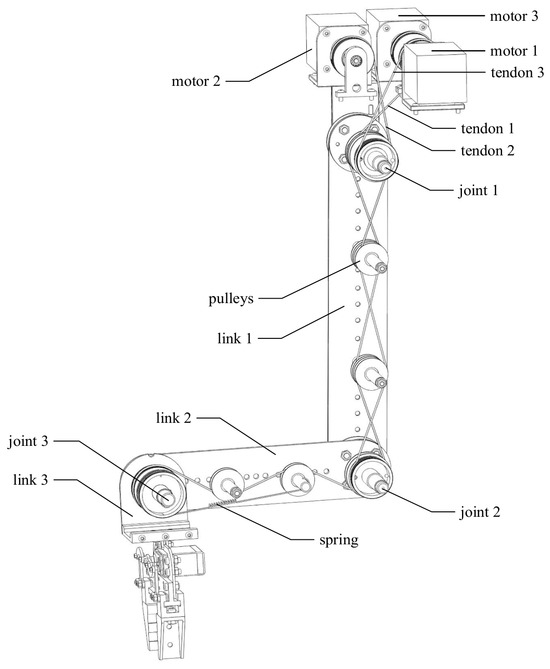
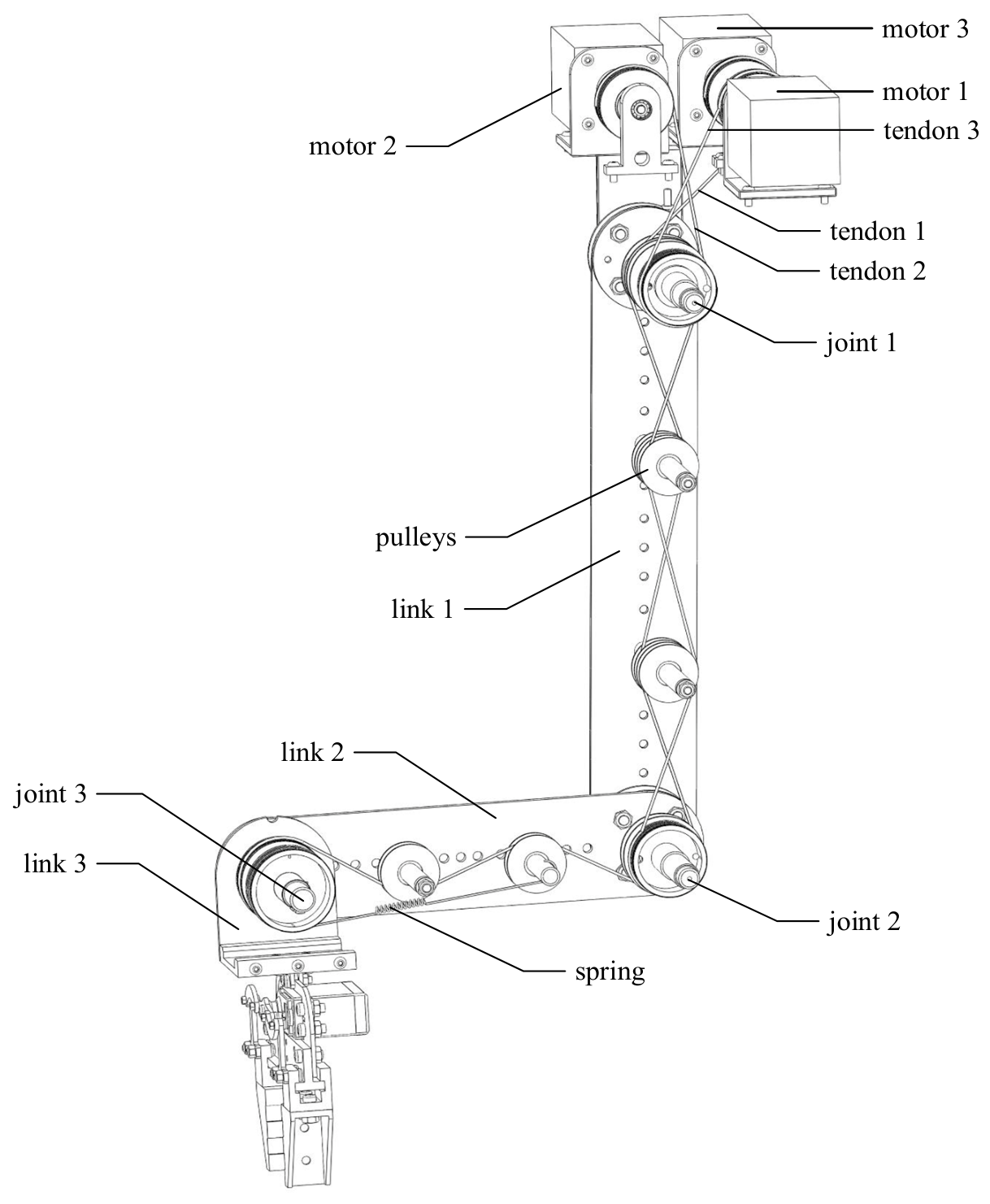
A diagram of cable routing is presented in Figure 2, where some parts of the tendon-driven manipulator are moved for clarity. As shown, joint 1 is driven by a single tendon from the winch of motor 1. The tendon can drive joint 1 to rotate in a clockwise direction when the motor is energized to pull the tendon. Meanwhile, assuming gravity is downward, the first joint tends to rotate counter-clockwise under gravity, which ensures the tendon of joint 1 remains in positive tension.
Figure 2.
Diagram of cable routing of tendon-driven manipulator.
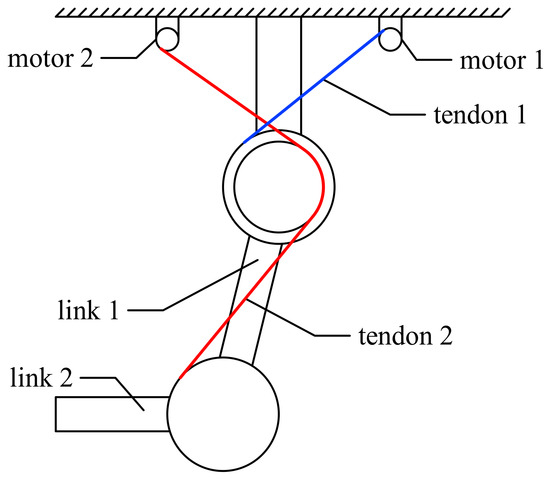
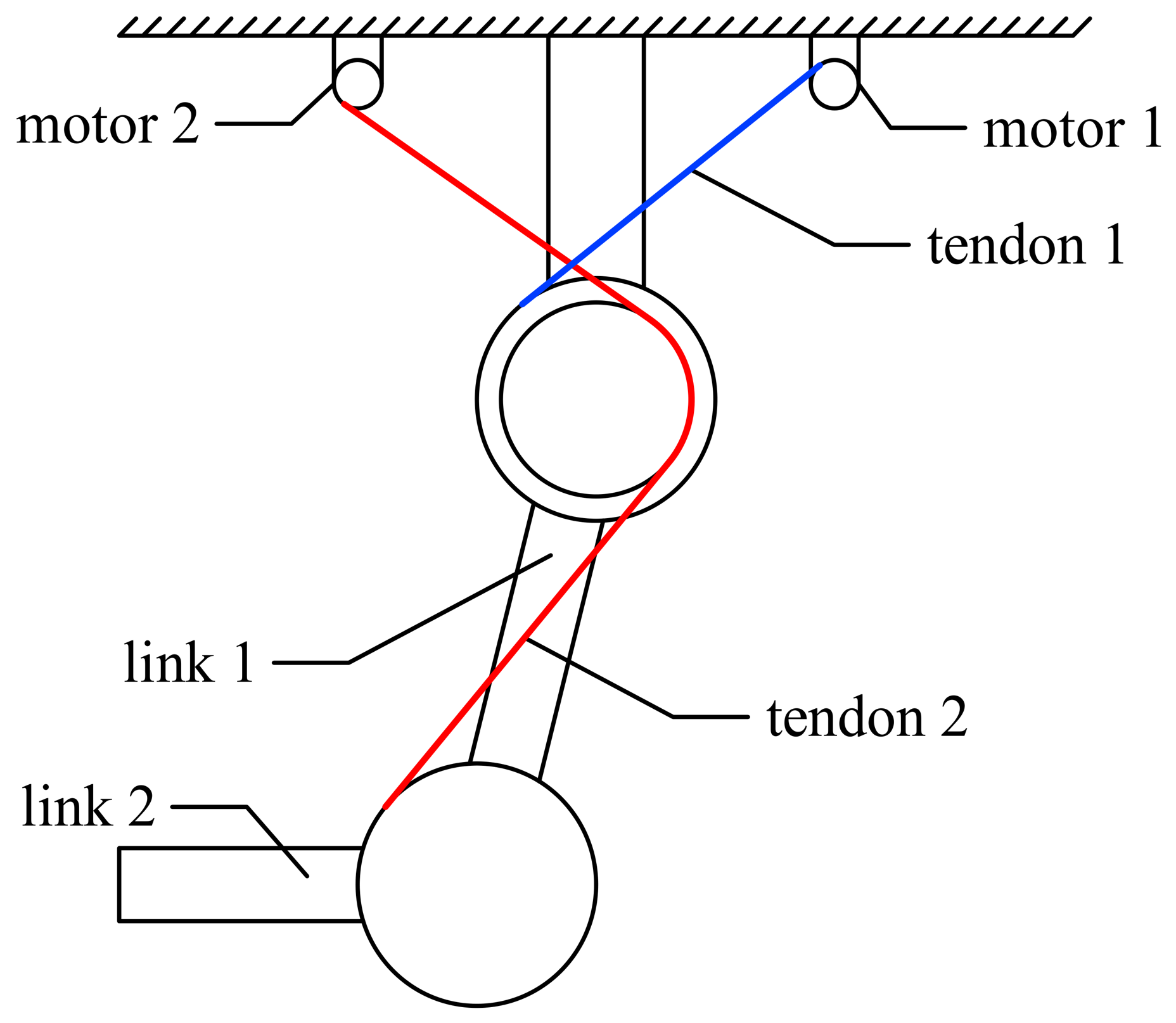
Consider a simplified 2-DOF tendon-driven manipulator, as shown in Figure 3. Based on the above analysis, the tendon of the first joint is always in positive tension when the arm is on the left side. However, gravity alone is often insufficient to maintain constant positive tension in the tendons when subjected to external disturbances. Fortunately, the driving tendon of joint 2 helps to keep tendon 1 in positive tension.
Figure 3.
An example of a simplified 2-DOF tendon-driven manipulator.
For joint 2 and tendon 2, suppose the hinge of joint 1 is locked, and motor 2 is energized to pull the tendon. Under these circumstances, tendon 2 tends to shorten and wind onto the winch of motor 2, which can be achieved in two ways. The first way is straightforward: joint 2 rotates clockwise. The second way is that joint 1 rotates counter-clockwise. In other words, pulling tendon 2 provides joint 1 a rotating tendency in a counter-clockwise direction.
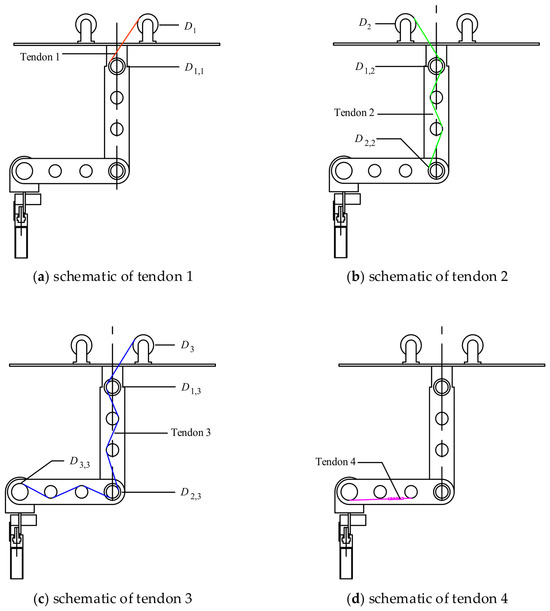
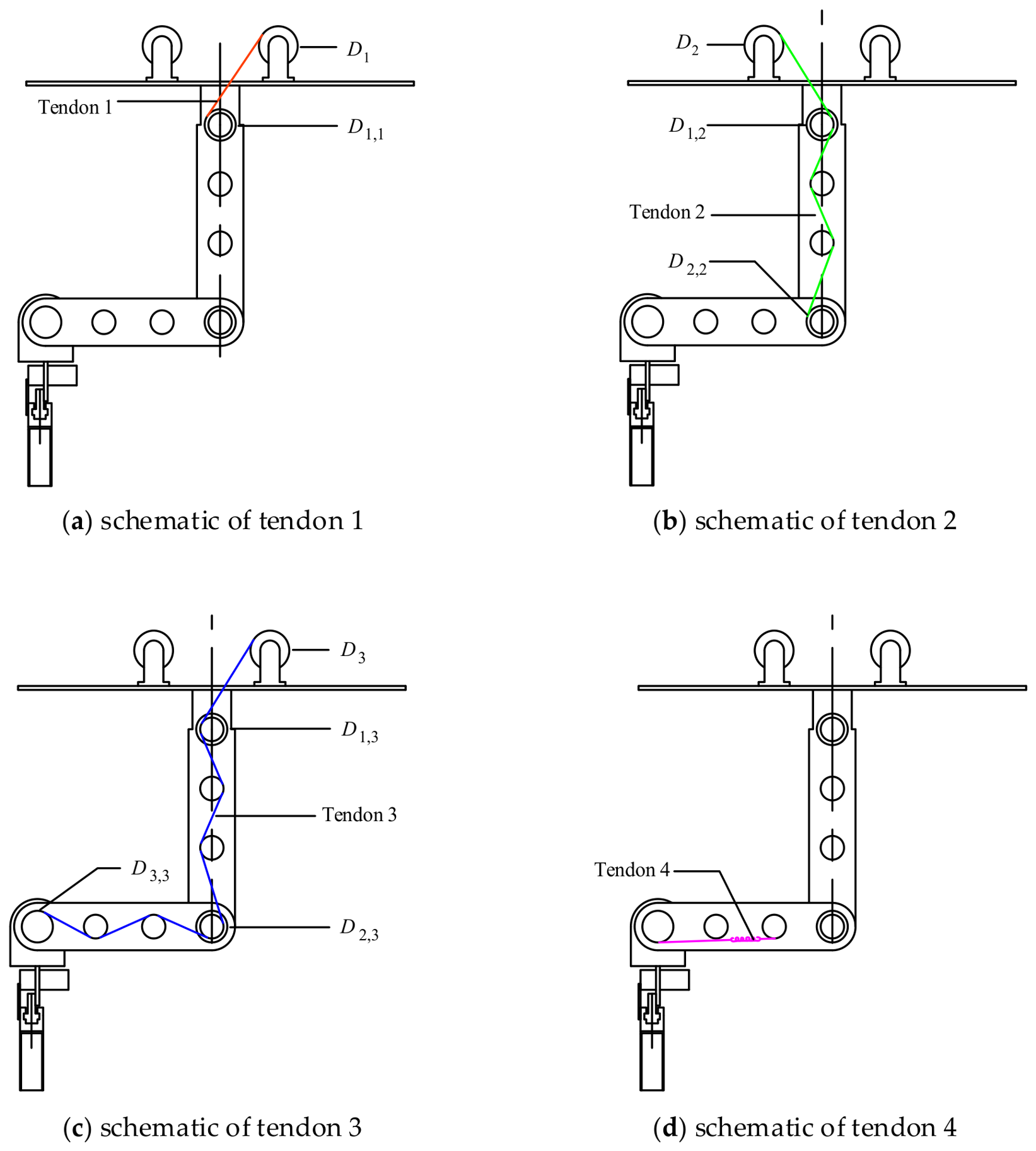
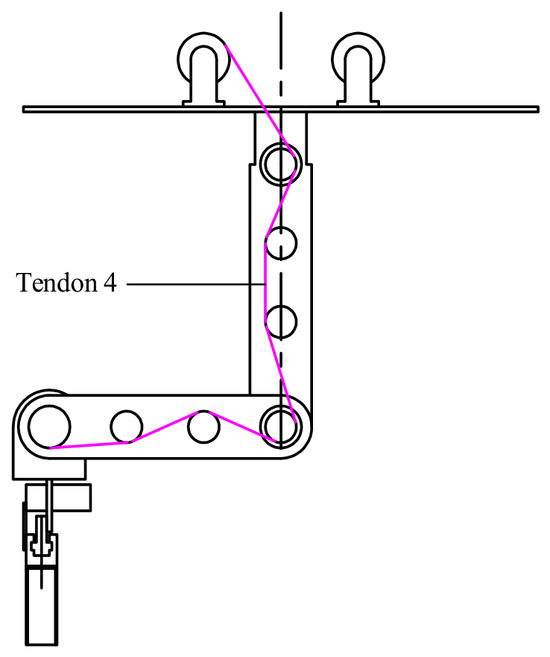
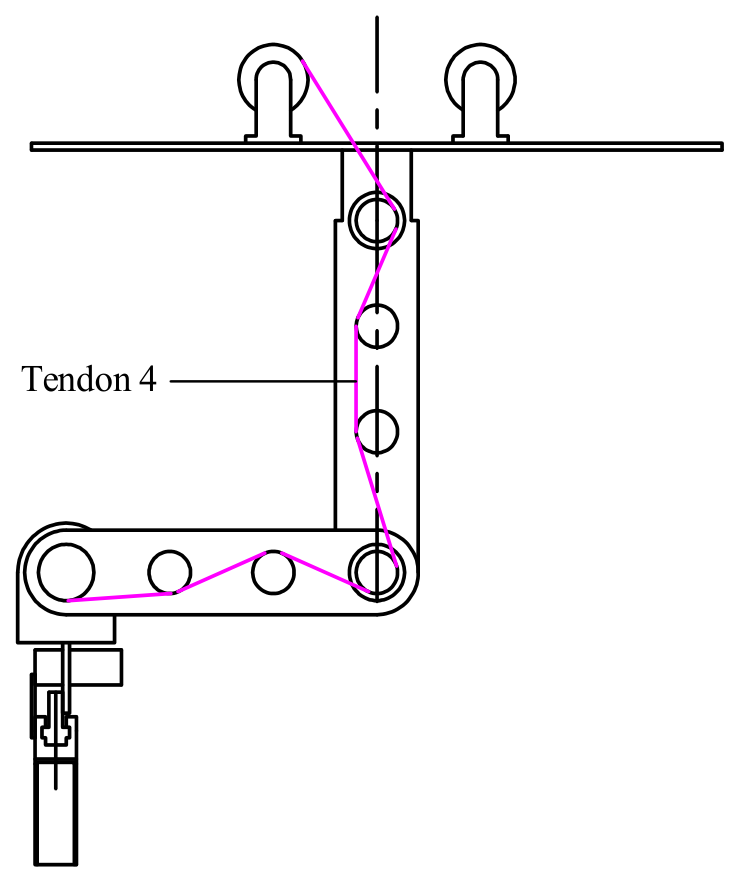
To discuss tendon routing and how to keep all tendons in positive tension, each tendon in Figure 2 is picked out and plotted in Figure 4. From previous analysis, tendon 1 is driven by motor 1, which can drive joint 1 to rotate in a clockwise direction. Tendon 2 passes through joint 1 and causes it to rotate counter-clockwise when pulled by the motor. Therefore, these two tendons provide joint 1 with two opposing torques, which guarantee that tendon 1 remains in positive tension. The same thing happens on other tendons and joints, but slightly differently on the last joint. Joint 2 is driven by tendon 2, which makes joint 2 rotate clockwise. Similarly, tendon 3, which passes through joint 2, makes joint 2 rotate counterclockwise. Therefore, two torques in different directions ensure the feasibility of joint 2. When it comes to joint 3, however, no tendon passes through this joint because it is the distal end. Tendon 3 drags joint 3 to rotate in a clockwise direction, and tendon 4, with a spring, is used to drag joint 3 to rotate in the opposite direction. A spring has a notable disadvantage: its force varies significantly during operation. Too much preload burdens the motors and increases energy consumption. Therefore, this work finds an alternative to tighten the tendons that uses another motor and tendon instead of the spring, as shown in Figure 5. Tendon 4 passes through joint 1 and joint 2 and connects to a driving motor, which can provide a consistent force. This can be regarded as an improvement because the preload can be adjusted freely under different working requirements. In addition, gravity also plays a role during motion. By limiting the working envelope of the tendon-driven manipulator, the gravity torque is opposite to the driving torque and helps to keep the tendons in positive tension.
Figure 4.
Schematic of tendon routing of tendon-driven manipulator.
Figure 5.
An alternative way to tighten the tendons (schematic of tendon 4).
In this paper, the workspace is divided into two halves, as the manipulator always works in the left area to keep the tendons tight. The left side is referred to as the ‘positive’ side to describe the cable routing for a multi-DOF tendon-driven manipulator. Tendon 1 winds onto joint 1 on the left of joint 1, the same side as the work area of the manipulator. In this work, tendon 1 is on the positive side of joint 1. In contrast, tendon 2 passes through joint 1 from the opposite side, so we think tendon 2 passes through joint 1 on the negative side. Similarly, tendon 2 is on the positive side of joint 2, and tendon 3 passes through joint 2 on the negative side.
3. Kinematic Model
3.1. Description of Motion-Coupling
A kinematic model is essential for trajectory planning and practical use for a tendon-driven manipulator. Motion-coupling is a unique phenomenon existing in a tendon-driven manipulator, which should be analyzed before establishing the kinematic model. First of all, let us make the following assumptions.
Assumption 1.
Tendons remain at constant length during operation.
Assumption 2.
Tendons maintain positive tension during operation and never disengage from the pulleys.
Assumption 3.
The links of the tendon-driven manipulator will not change their shape during work.
Assumption 4.
If a tendon winds onto a winch, the tendon will not slip relative to the winch.
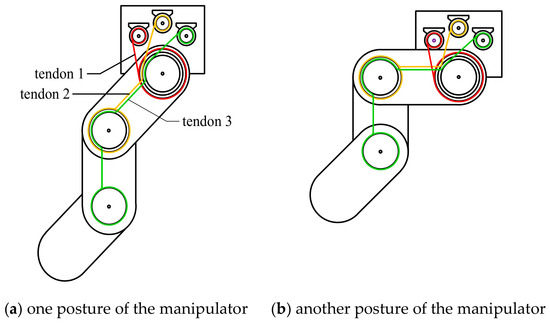
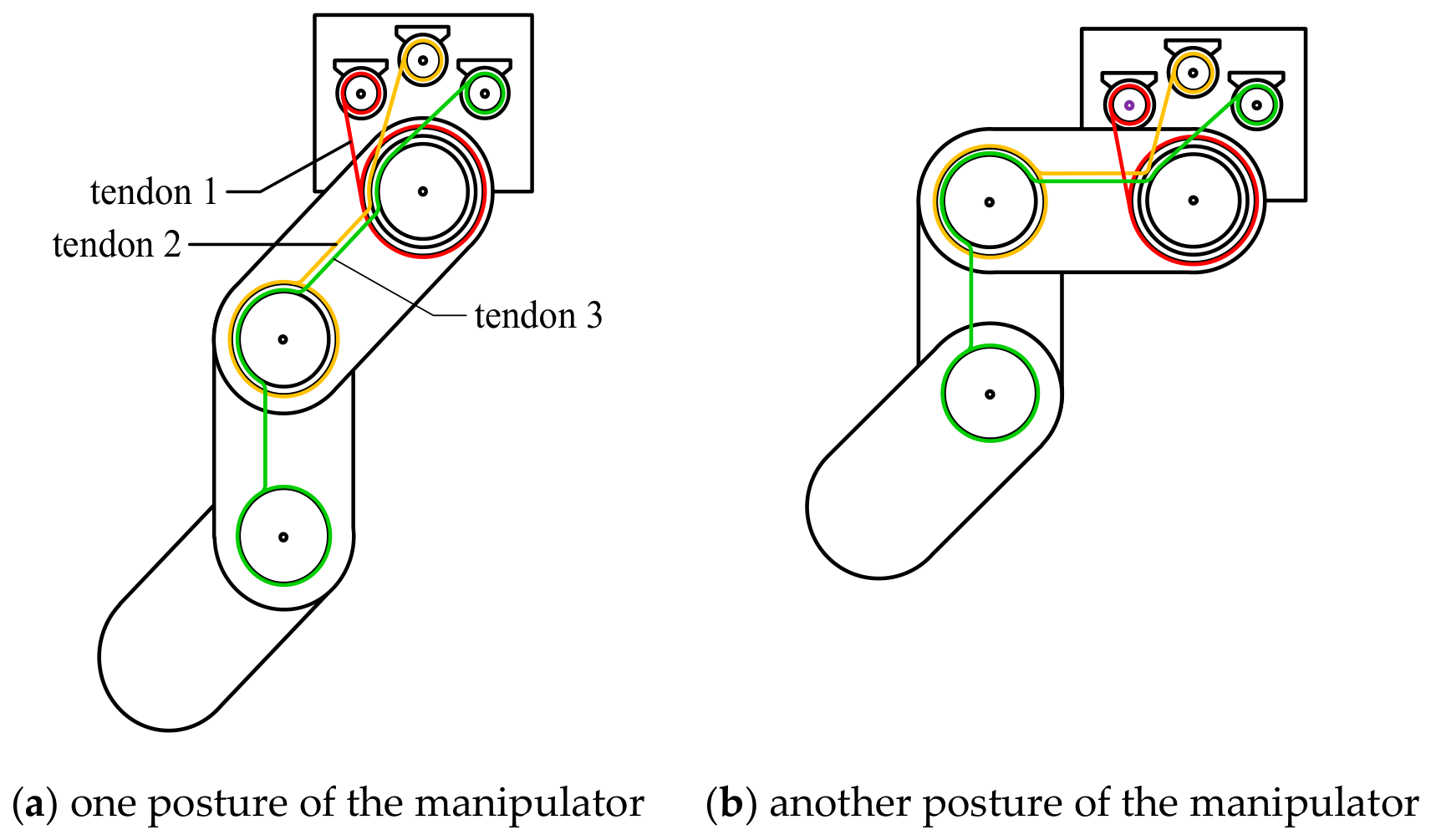
For a traditional direct-driven manipulator, one joint’s rotation will not change another joint’s position. For a tendon-driven manipulator, however, joints near the base will influence the joints near the distal end. As shown in Figure 6, tendons 1, 2 and 3 are depicted in red, orange and green, respectively. From the posture in Figure 6a to that in Figure 6b, only motor 1 rotates to pull tendon 1. Motor 2 holds stable in this procedure, but joint 2 rotates in the opposite direction, which makes link 2 seem to only translate without rotating. This phenomenon is called motion-coupling of a tendon-driven manipulator.
Figure 6.
Posture change after a motor rotation for tendon-driven manipulator.
3.2. Notations
The aim of dynamic modeling is to calculate the position of the end-effector using the rotation angles of the motors. First, the rotational relationship between the motors and the joints should be established. The first joint, numbered joint 1, will not be influenced by other joints and is only determined by the rotation angle of motor 1. For the sake of simplicity and without loss of generality, when a motor pulls the tendon and makes the tendon wind onto the winch, the rotating direction of the winch is considered positive.
Let denote the diameter of the winch connected to motor 1, as that for motor 2, and as that for motor 3. In order to give a general solution of an n-DOF tendon-driven manipulator, is used to represent the diameter of the winch of motor n. There are several pulleys and a winch on the axle of joint 1. The winch is used to drive joint 1, whose diameter is denoted by . Tendon 2 passes through joint 1, and a pulley is required to guide it, whose diameter is denoted by . Here, 1 means the pulley is located at joint 1, and 2 represents that tendon 2 is guided by the pulley. The diameter of other pulleys and winches will be denoted as by the same rule. The first subscript, p, indicates the joint at which the pulley is located, and the second subscript, q, indicates the tendon that is guided by the pulley. Specifically, when p is equal to q, is the diameter of the winch that drives joint p.
For an n-DOF tendon-driven manipulator, the rotation angles of motors are denoted by , and those of joints are denoted by . Let represent the rotation angle of motor , and represent the rotation angle of joint .
3.3. Mathematical Expression of Motion-Coupling
Referring back to Figure 4, first consider joint 1. It can be found that , because the speed of the tendon is constant everywhere. Forwardly, the rotation angle of joint 2 is not only decided by motor 1, but also influenced by joint 1, i.e., the rotation angle of joint 2 is the sum of the above-mentioned two factors. From Figure 4a,b, we can analyze the length variation in tendon 2 caused by joint 1. The length of the tendon between two pulleys remains constant because tendons are tangent lines of two pulleys. The distance between two pulleys will not change when joints and links rotate. Therefore, when joint 1 rotates, the length variation in tendon 2 is only the amount that tendon winds onto or out of the corresponding pulley. The length change in tendon 2 caused by the rotation of joint 1 is proportional to the rotation angle of joint 1. In addition, we should consider whether the variation is positive or negative. We can see that tendon 1 and tendon 2 wind in opposite directions with respect to joint 1. When tendon 1 moves in a positive direction, i.e., motor 1 drags tendon 1, tendon 2 winds onto the pulley, and tendon 2 drags joint 2. Consequently, when joint 1 moves in a positive direction, joint 2 moves in a positive direction, so depicts a positive correlation. From Figure 4c, tendon 3 passes through joint 1 from its left side, so describes a negative correlation. Mathematically, is used to show the coupling amount of tendon 2 when it passes through joint 1. If a joint rotates clockwise from the view of Figure 4, we think the joint rotates in a positive direction. As shown in this figure, when tendons are pulled, all joints rotate clockwise and are given to describe it. For the joint n of a tendon-driven manipulator, the following relationship exists.
The motion-coupling can be re-expressed in matrix form, i.e., . Usually, we hope to obtain the joints’ rotation angles to locate the end-effector, and the motion-coupling matrix will be helpful. The contents of can be obtained by rearranging the above-mentioned formulas and are given as follows.
is a lower triangular matrix whose elements on the diagonal are , which presents the transmission ratio between a motor and the joint it drives. is non-zero, so can be obtained by matrix inversion, which is also a lower triangular matrix. The elements of below the diagonal represent the influence of motion coupling, which decreases with increasing and decreasing ().
Remark 1.
We have already taken the manufacturing tolerances of the robotic arm’s pulley into account during the modeling process; the diameter of the pulley used can be accurately measured with a vernier caliper, with a very small tolerance.
4. NTSM Scheme Design with TDE
4.1. System Dynamics Scheme
The dynamic model for an n-DOF single-tendon-driven manipulator can be described as
where and stand for the positions of the joints and motors. and are the motor’s inertia and damping matrices. is the mass-inertia matrix of the manipulator. is the Coriolis matrix. and stand for the gravitational vector and friction vector. is the lumped unknown disturbance. is the motor input torque vector. is the joint compliance torque vector. and are the joint stiffness and damping matrices.
Combining (3) with (4) and using a constant matrix , the following equation can be obtained.
where is a constant parameter. describes the unknown dynamics of the single-tendon-driven manipulator as
As shown in (7), is very complex and difficult to obtain using traditional methods.
To obtain the information of , the TDE technique is employed as follows
where L is the delay time.
First, we employ the TDC scheme with TDE to set up a control law as follows
where is the tracking error. and are control parameters. From Equation (9), a model-free scheme is designed without using system dynamics.
Substituting (9) into (6), the results are as follows
If using the appropriate and , the control errors and can be confined to a certain range.
4.2. NTSM Control Design
Although the TDC control scheme has good results in many practical systems, it also has shortcomings that need to be further improved. In order to have good control performance, the NTSM surface is proposed as follows
where are the positive control parameters.
The is designed as
where , , , and . and are given as follows
Afterwards, in order to reduce the influence of external disturbances during the reaching phase, the linear reaching law we utilize is as follows
where are the positive control parameters.
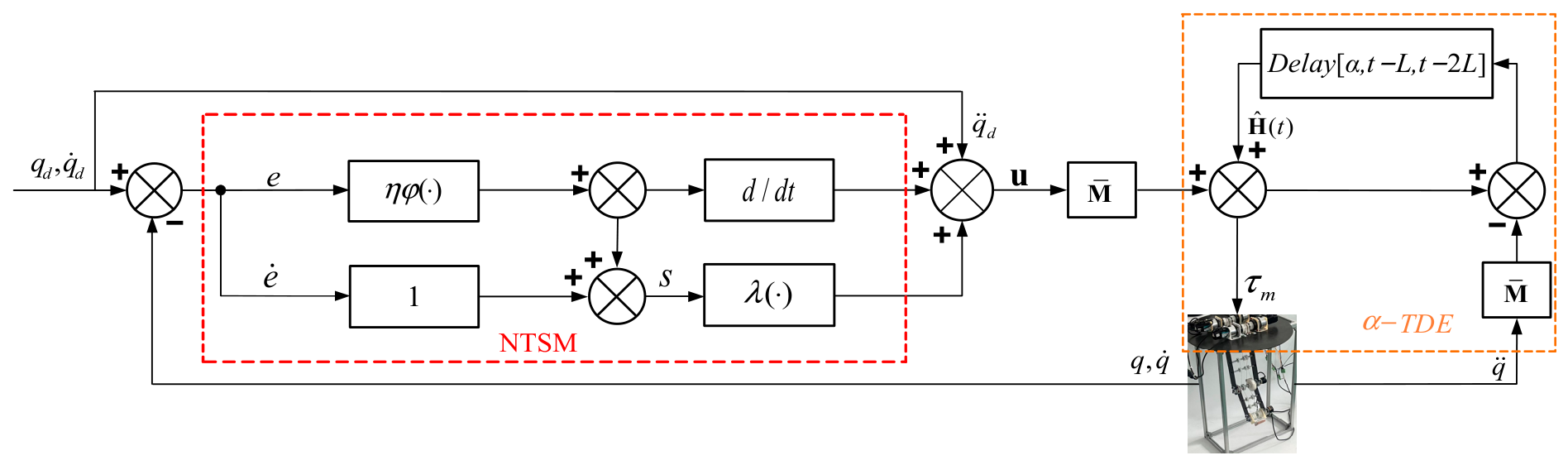
Compared to the TDE scheme, we proposed the α-TDE scheme. The α-TDE design uses data from time t − L and time t − 2L and a parameter α to estimate the overall uncertainty. The parameter α can improve estimation accuracy and enhance the system’s robustness against uncertainty. The formula is as follows
where is a constant parameter.
and are usually obtained as follows
Because acceleration encoders are not commonly used in manipulator control, most experiments obtain the angle signal from a position encoder and then, through numerical differentiation, obtain the angular acceleration. This method has been widely adopted in TDE-based control schemes.
From Equation (16), numerical differentiation often introduces a large noise effect, so choosing an appropriate small control parameter can effectively solve the problems above.
Combining the designed NTSM surface and reaching law, the proposed control scheme is given as
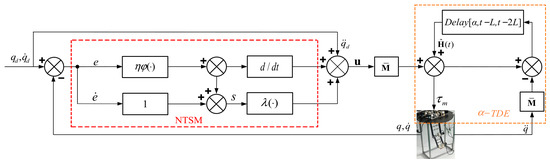
The overall control scheme of α-TDE-based NTSM is shown in Figure 7.
Figure 7.
Overall control scheme of α-TDE-based NTSM.
4.3. Stability Analysis
Substituting (18) into (6), we obtain the following
where is the estimation error of TDE, which is bounded by [47]. The boundedness of the TDE error has been applied to many experimental results.
Choosing the Lyapunov function as
and differentiating (20) along time provides the following
Combining (19) with (21), we have
If and , Equation (22) will remain . Therefore, the manifold of the system converges as
Case 1: For , ; in this case, the tracking error e is bounded by and .
Then, combining (11) with (23), we obtain the follwing
Equation (24) can be further derived as
Then, substituting (13) into (25), the will converge to
Case 2: For , ; in this case, , and Equation (24) becomes
The following equation can be written from (27) as
When , Equation (28) will remain the NTSM surface. Considering , will converge to the following
Finally, considering the two situations, will converge to the following
and will converge to the following
5. Experiments
In this section, there are two experiments, including a decoupling experiment and a comparative controller experiment. The decoupling experiment was performed to verify the feasibility and effectiveness of the proposed design for the kinematic model. Then, the comparative controller experiments have been conducted to prove the advantages of the proposed NTSM control scheme based on α-TDE.
5.1. Experimental Setup
The experiments use the manipulator named ‘Lumidouce II’, which has an SDGA-01C11BD motor. The motor has a rated torque of under 3000 rpm rated speed, and it connects to a harmonic reducer whose reduction ratio is 1:100. We collect feedback information through an E6B2-CWZ1X4096P/R encoder, and the resolution of it is 0.022°. Then, we use a Simulink real-time system with an NI PCI-6229 board to run all the controllers. The sampling time is set to 1 ms.
Remark 2.
The sampling period used in this experiment is 1 millisecond, which is commonly used in manipulator control experiments. A smaller sampling period improves the accuracy of time-delay estimation but increases the computational burden on the controller. Conversely, a larger sampling period reduces the computational burden but decreases estimation accuracy.
5.2. Decoupling Experiment Verification
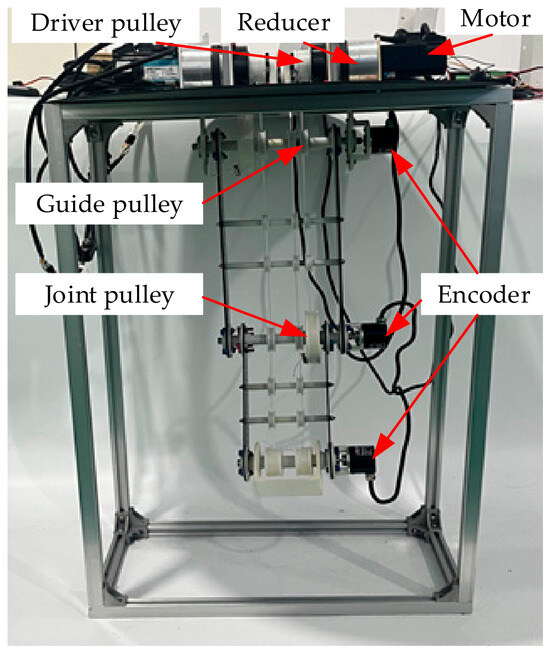
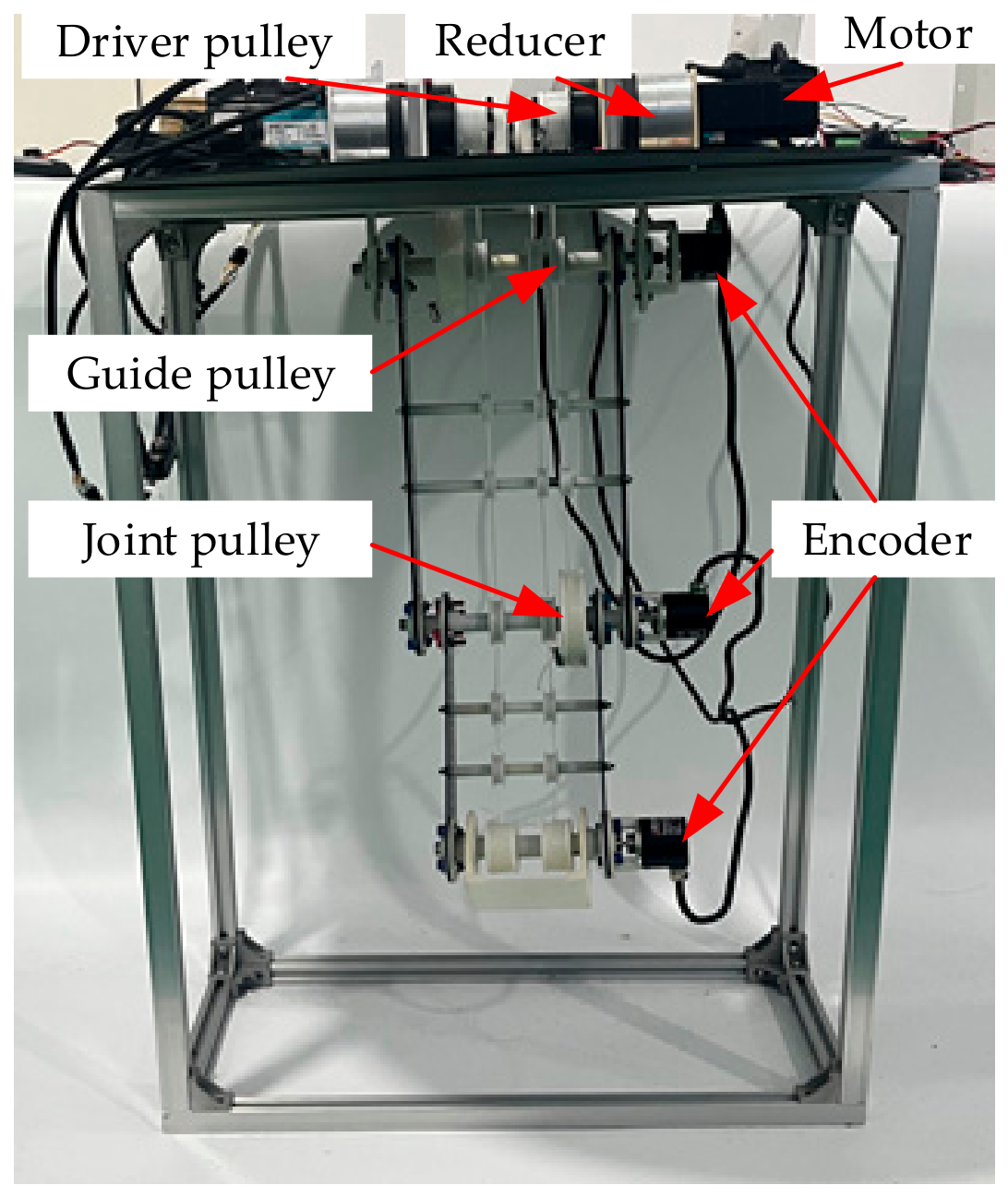
The manipulator illustrated in Figure 2 was manufactured and is presented in Figure 8. In this design, an extra motor is used to provide tension force instead of a spring. The spring force varies when it changes its length, which makes it impossible to keep a constant tension. In this study, it is assumed that the links of the manipulator do not bend and that the joint hinges have no clearance. However, links change their shape when the applied force increases. Therefore, we try to minimize the influence of force changing by using a motor instead of a spring.
Figure 8.
Prototype of designed tendon-driven manipulator.
The elements of the coupling matrix were measured and calculated, as listed in Table 1. The diameters of tendons and pulleys were both taken into account. Using the data in Table 1, the coupling matrix of Equation (2) can be calculated as follows
Table 1.
Elements of the coupling matrix.
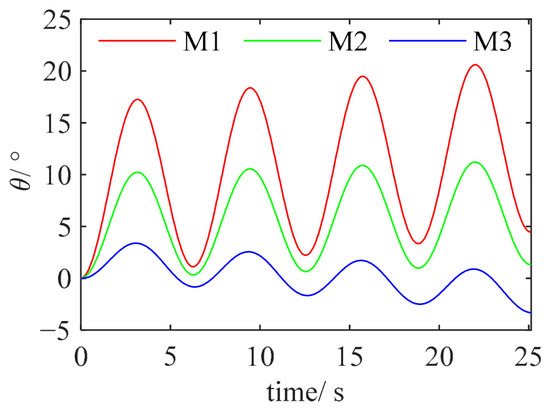
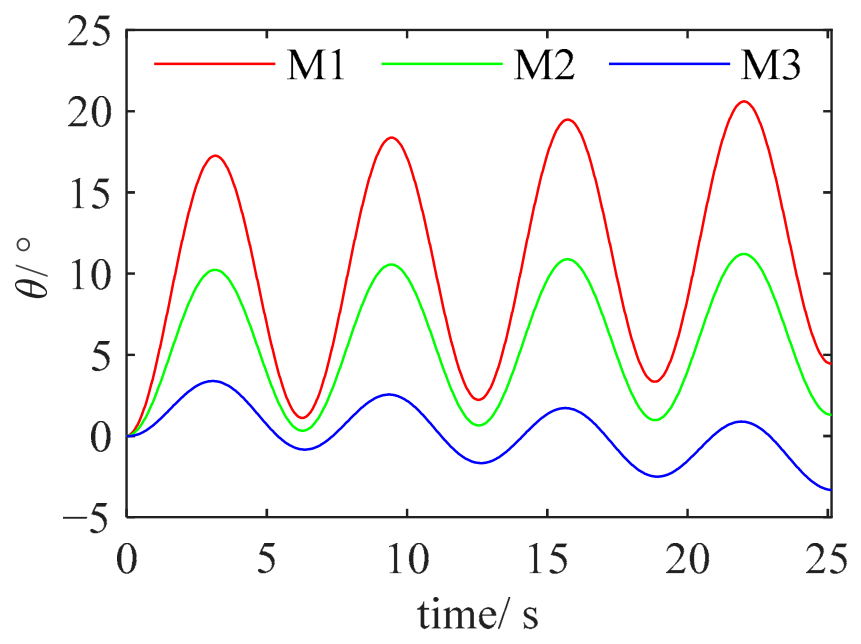
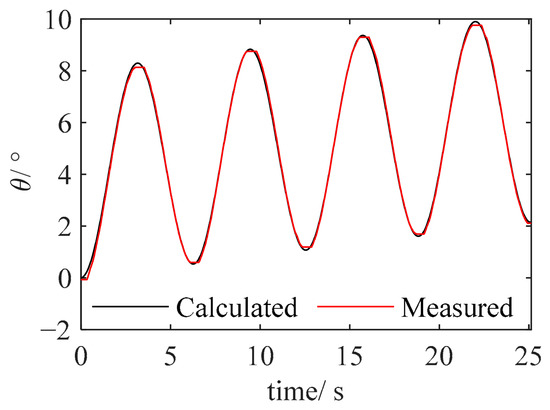
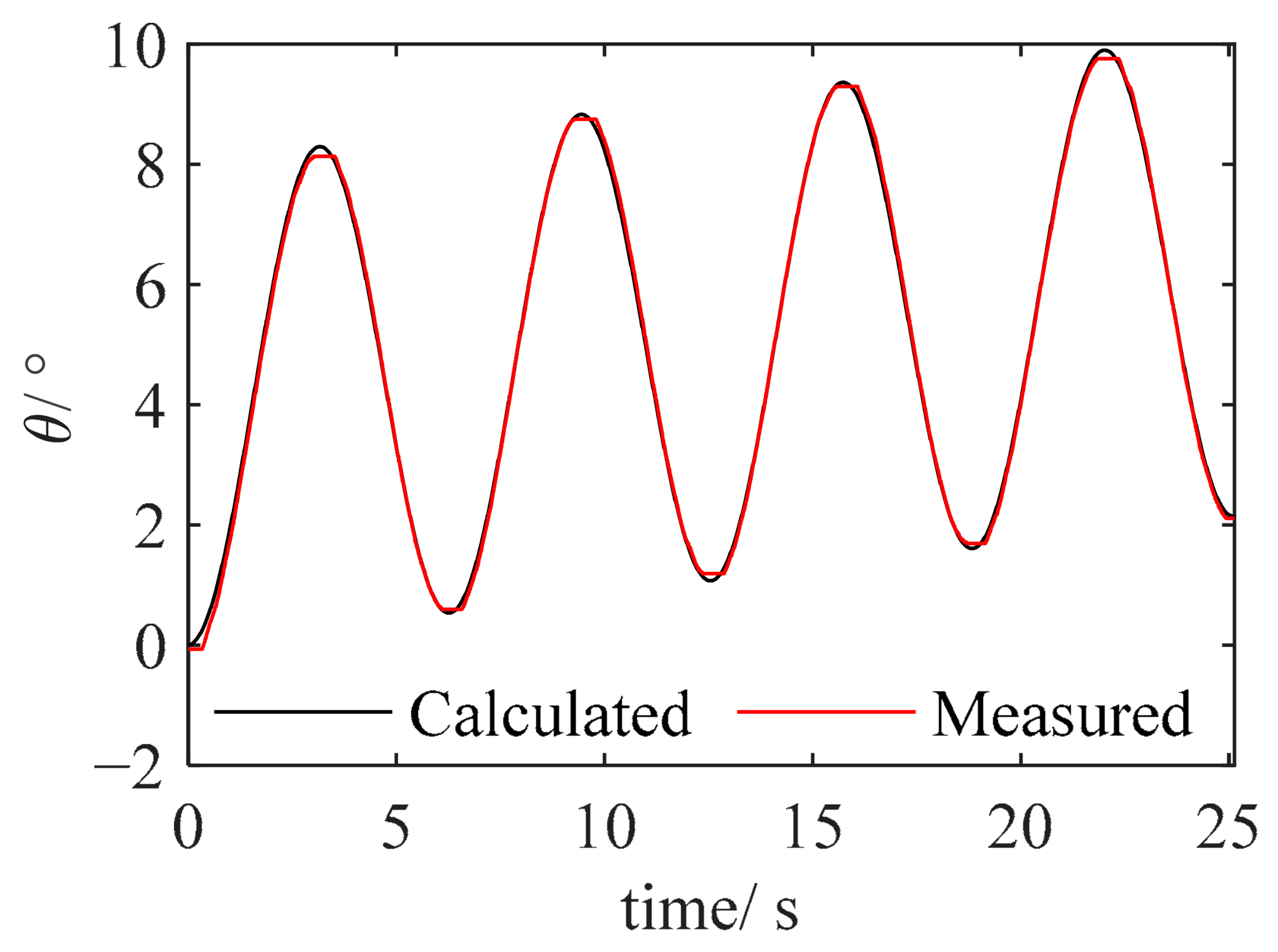
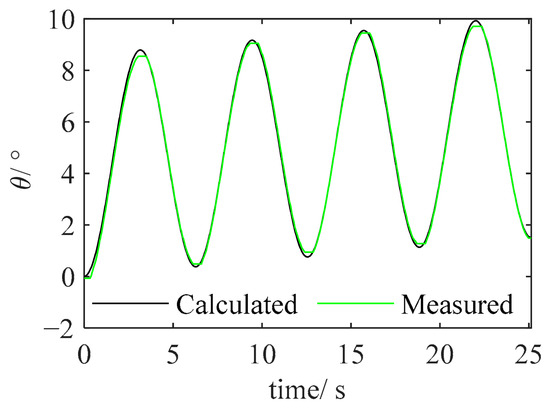
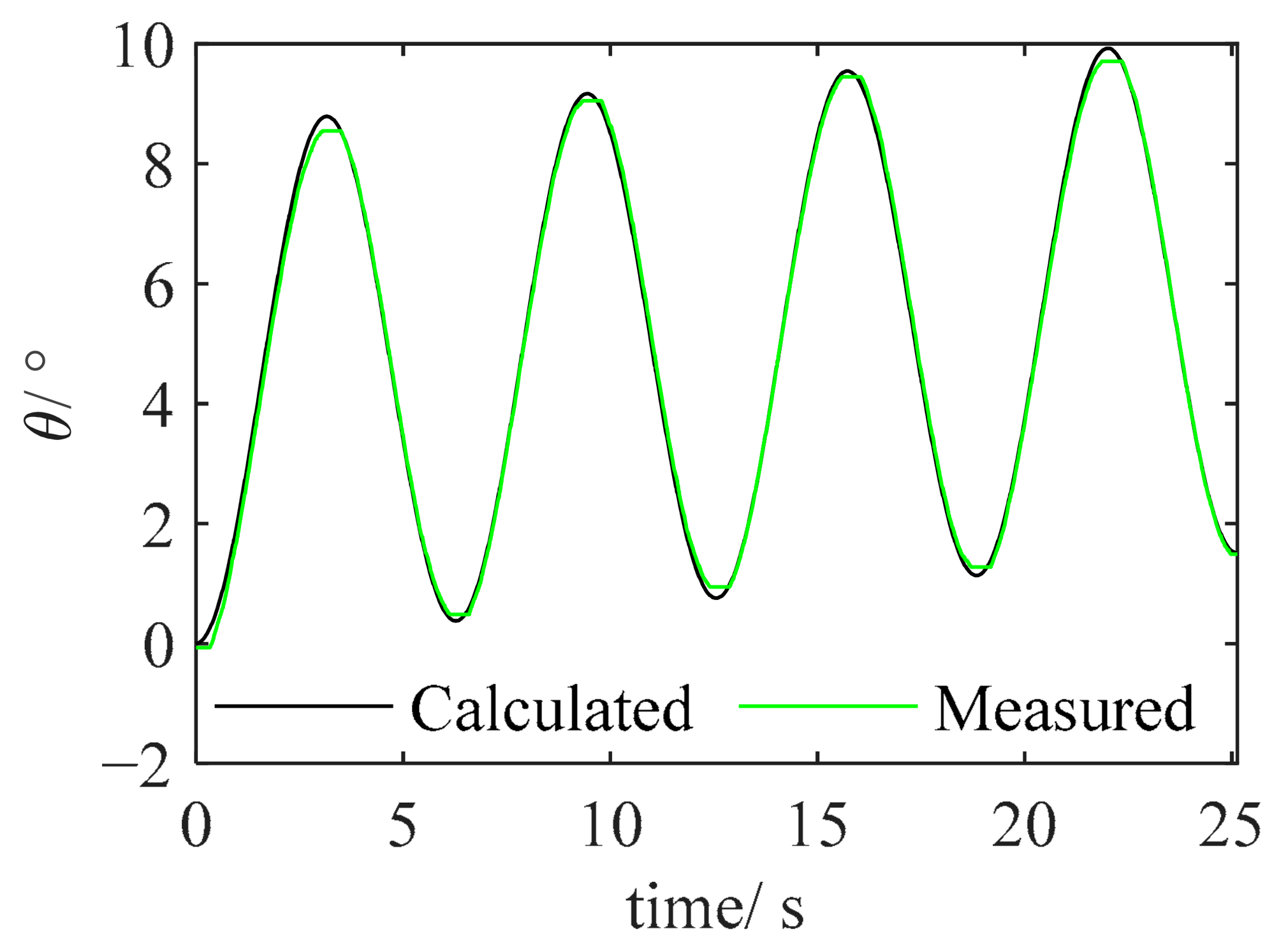
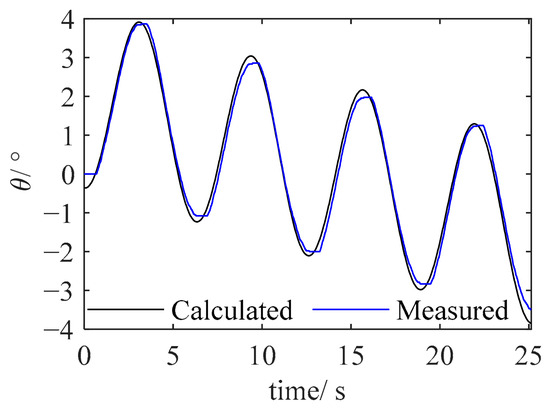
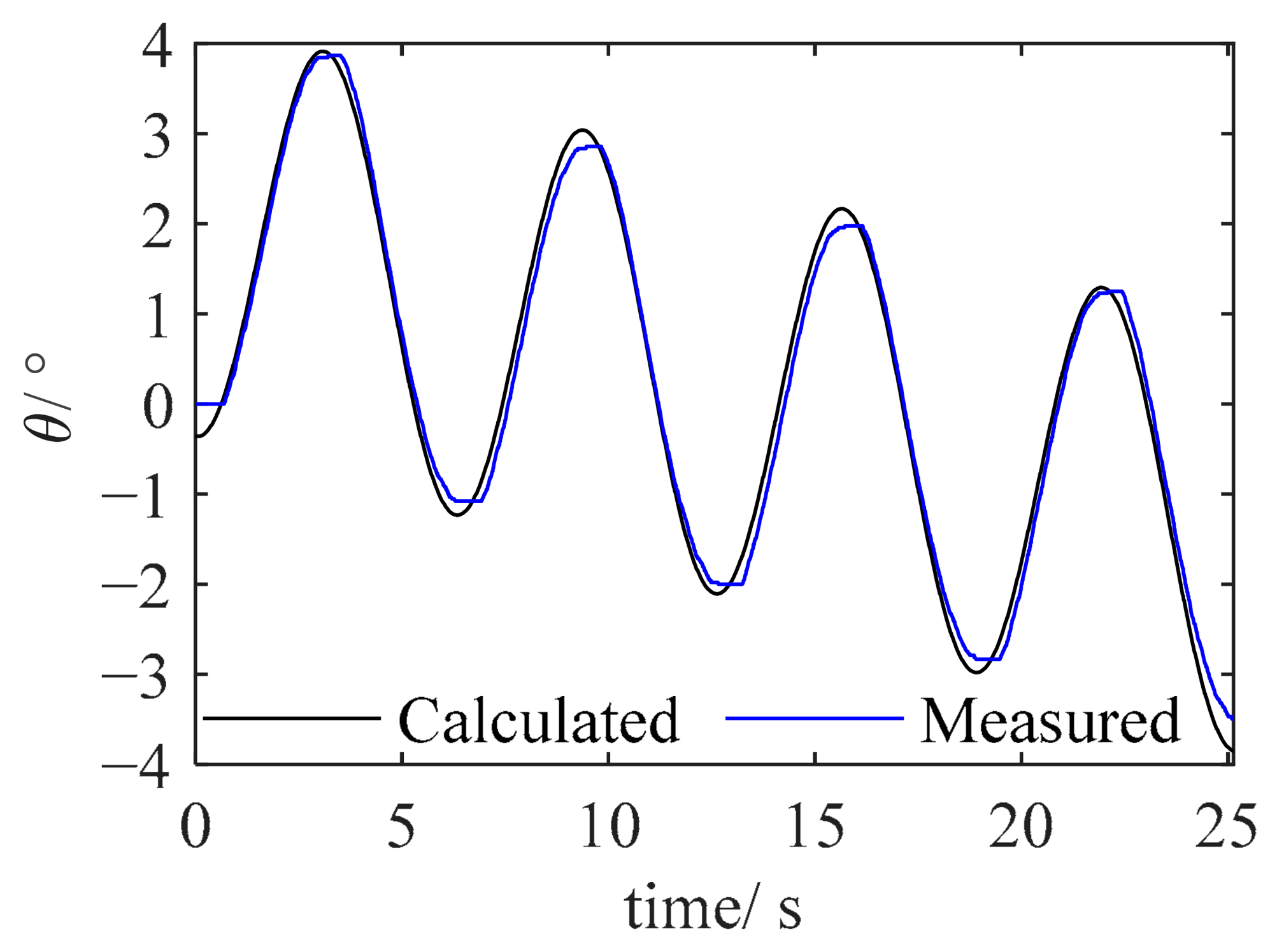
The angular position of the motors is shown in Figure 9, which is used to estimate the position of the joints. The estimated results of joint positions and actual values are both shown in Figure 10, Figure 11 and Figure 12. The position of joints can be calculated by , in which is given by
Figure 9.
The angular position of motors.
Figure 10.
The angular position of joint 1.
Figure 11.
The angular position of joint 2.
Figure 12.
The angular position of joint 3.
As shown in Figure 10, Figure 11 and Figure 12, the trajectories calculated from the kinematic model and those obtained from the encoders are essentially identical. This indicates that the theoretical model and experimental measurements have high consistency. The difference in the trajectory of joint 1 is tiny because joint 1 is totally decided by its driving motor and free of the influence of other joints, so joint 1 can achieve precise and independent control. The trajectory of joint 2 is decided by its driving motor and the rotation angle of joint 1, which introduces a small coupling effect. However, due to the effective compensation and coordination that occurred between the joints, the trajectory of joint 2 is still small. The trajectory of joint 3 is determined by its driving motor, as well as by joints 1 and 2. Due to assembly clearance and elasticity, joint 3, as the distal end, is greatly influenced. Consequently, the trajectory error of joint 3 is slightly larger than that of the other joints. However, the calculated trajectory and the measured one have a similar trend in growth, which shows the correctness of the theory. Overall, the experimental results support the correctness of the kinematic model presented in this paper.
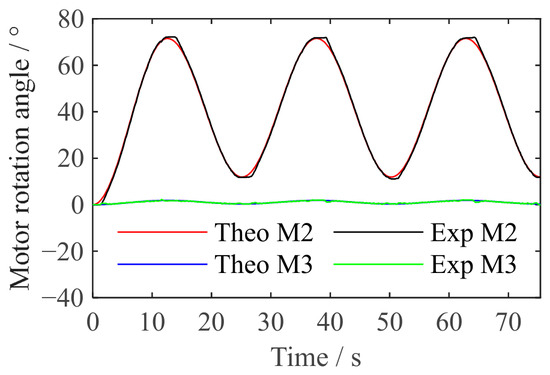
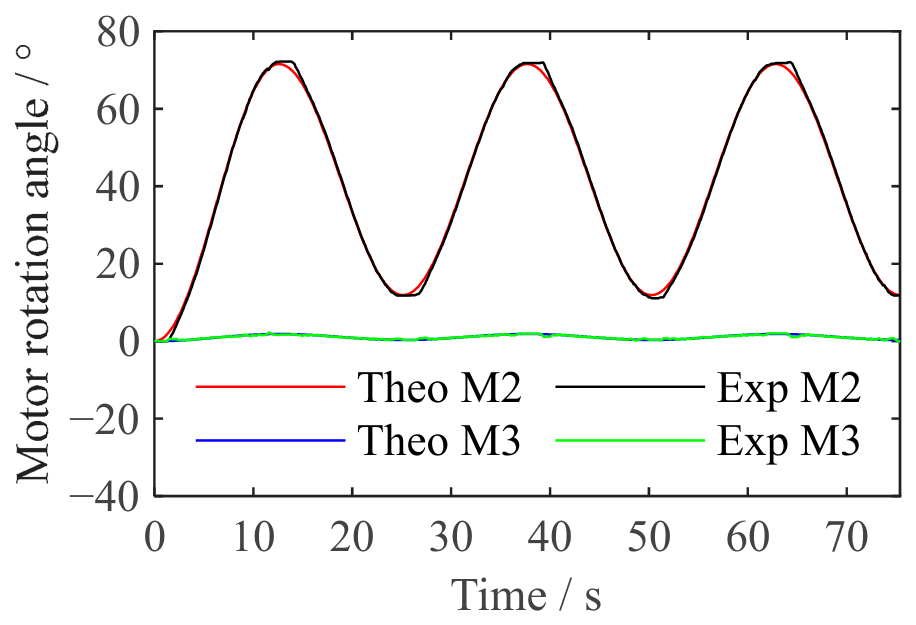
To further verify the correctness of the proposed kinematic model, additional analyses were conducted based on the data from the comparative controller experiments. The joint rotation angle was obtained from the encoder. Then, substituting the angle joint angles into , the experimental motor angles were derived. Using the same method, the theoretical motor rotation angles, which are associated with the expected joint angles, were obtained. As indicated in Figure 13, when joint 2 and joint 3 have the same expected angle, the angles of motor 2 and motor 3 differ significantly. The reason for it is that the coupling angle of joint 3 is almost equal to the expected angle, so motor 3 only needs to rotate a small angle when the joint rotates to the expected angle. By further analysis of Figure 13, the theoretical and experimental results of the motor angle are essentially identical. Due to external disturbances and joint reversals, the experimental joint angles exhibit some changes, which lead to changes in the experimental motor angles. Nevertheless, the theoretical and experimental results of motor angles have similar change trends, thereby verifying the correctness of the proposed kinematic model.
Figure 13.
Motor rotation angle.
5.3. Comparative Experiment Studies
Controller 1
(proposed). A nonsingular terminal sliding mode control scheme based on α-TDE.
Controller 2.
A nonsingular terminal sliding mode control scheme based on TDE. The sliding mode surface adopted in Controller 2 is identical to that of the proposed controller 1.
Controller 3.
A terminal sliding mode control scheme based on TDE.
For our proposed control scheme based on α-TDE, the parameters are set as , , , , , and . The control parameters for Controller 2 are the same as ours. The control parameters for Controller 3 are set as , and the others are chosen to be the same as ours.
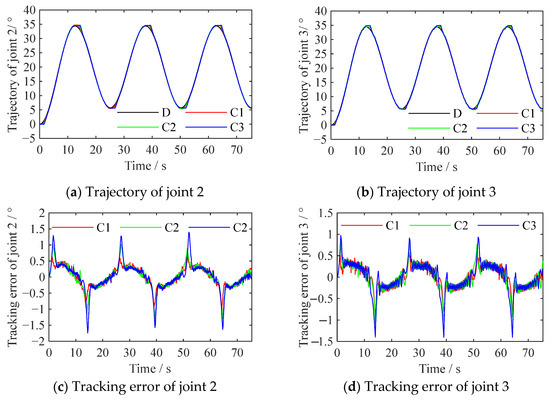
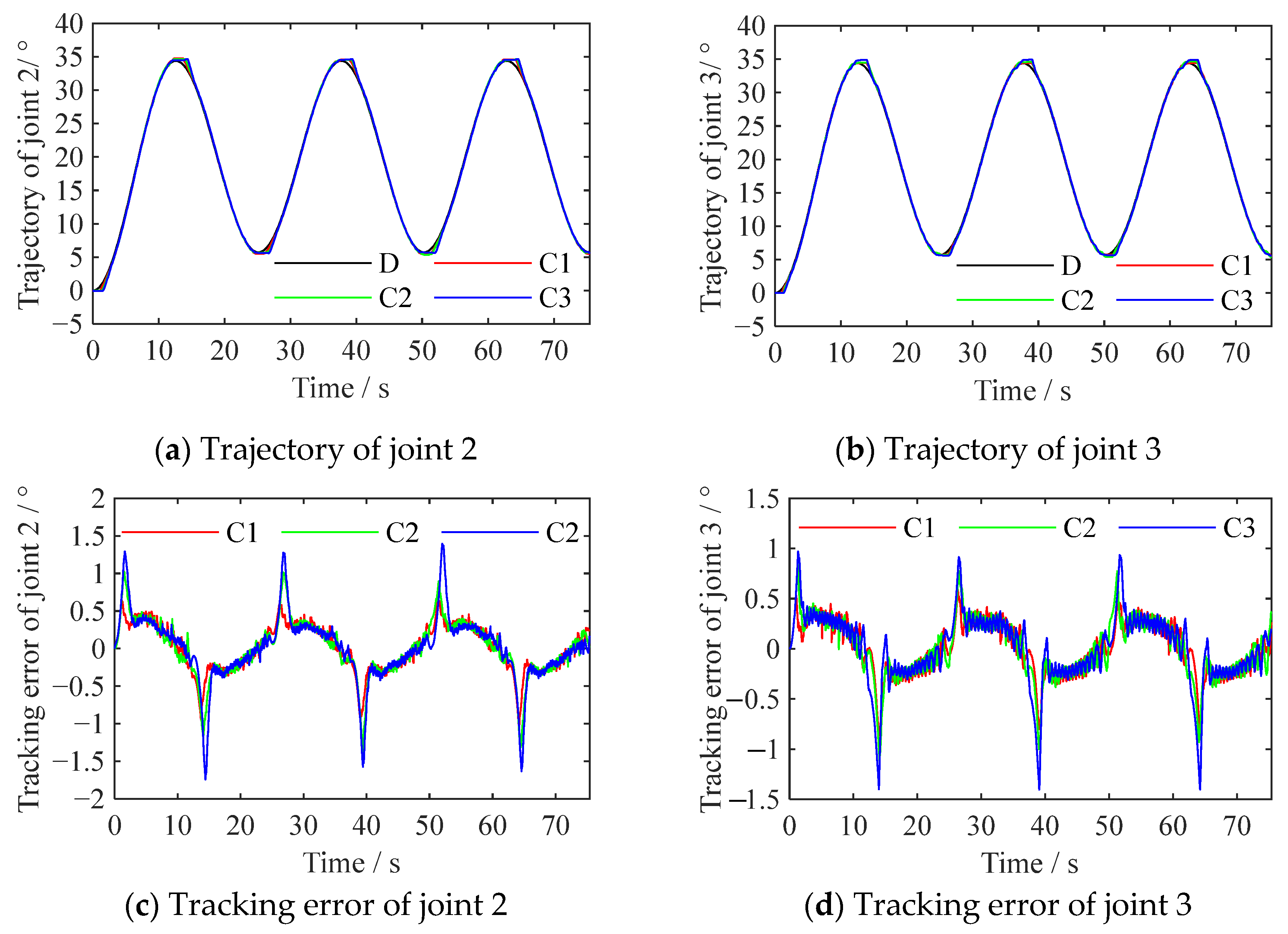
In the comparative experiments, the tendon-driven manipulator moves to track a trajectory, which is shown in Figure 14a,b. The tracking errors of the two joints are shown in Figure 14c,d. As indicated in Figure 14c,d, it can be observed that the control performances of the three controllers achieve good results. However, the proposed Controller 1 achieves the smallest tracking errors of the three controllers. Especially during the rapid acceleration and deceleration phases, the superiority of Controller 1 is most prominent. Then, the mean absolute error (MAE) and root mean square error (RMSE) were calculated based on the tracking error data, and the calculated results are shown in Table 2. In order to make the comparisons quantitative, we further compared the data from Table 2. For MAE, the values of the proposed Controller 1 can achieve 0.261° and 0.219° for joint 2 and joint 3, corresponding to 90.3% and 91.2% of those achieved by Controller 2, whereas those of Controller 3 are 85.5% and 82.3%. For RMSE, the values of the proposed Controller 1 can achieve 0.311° and 0.261° for joint 2 and joint 3, corresponding to 82.9% and 89.3% of those achieved by Controller 2, whereas those of Controller 3 are 71.3% and 74.7%. Overall, the comparison of MAE and RMSE indicates that the proposed Controller 1 is superior to the other controllers in terms of tracking accuracy.
Figure 14.
Trajectory tracking performance and tracking error.
Table 2.
MAE and RMSE of trajectory tracking performance.
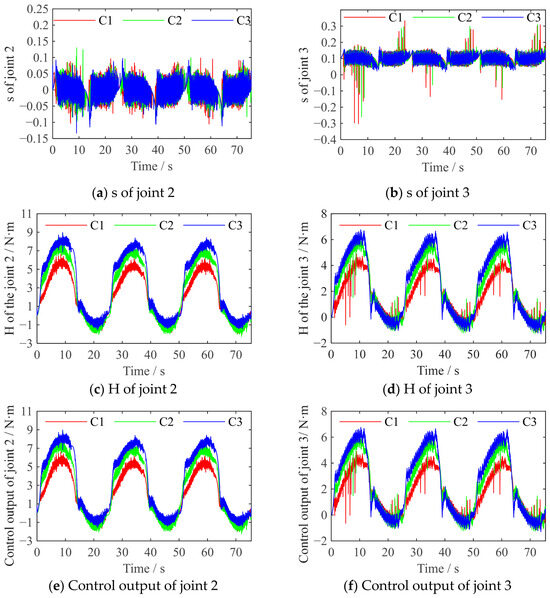
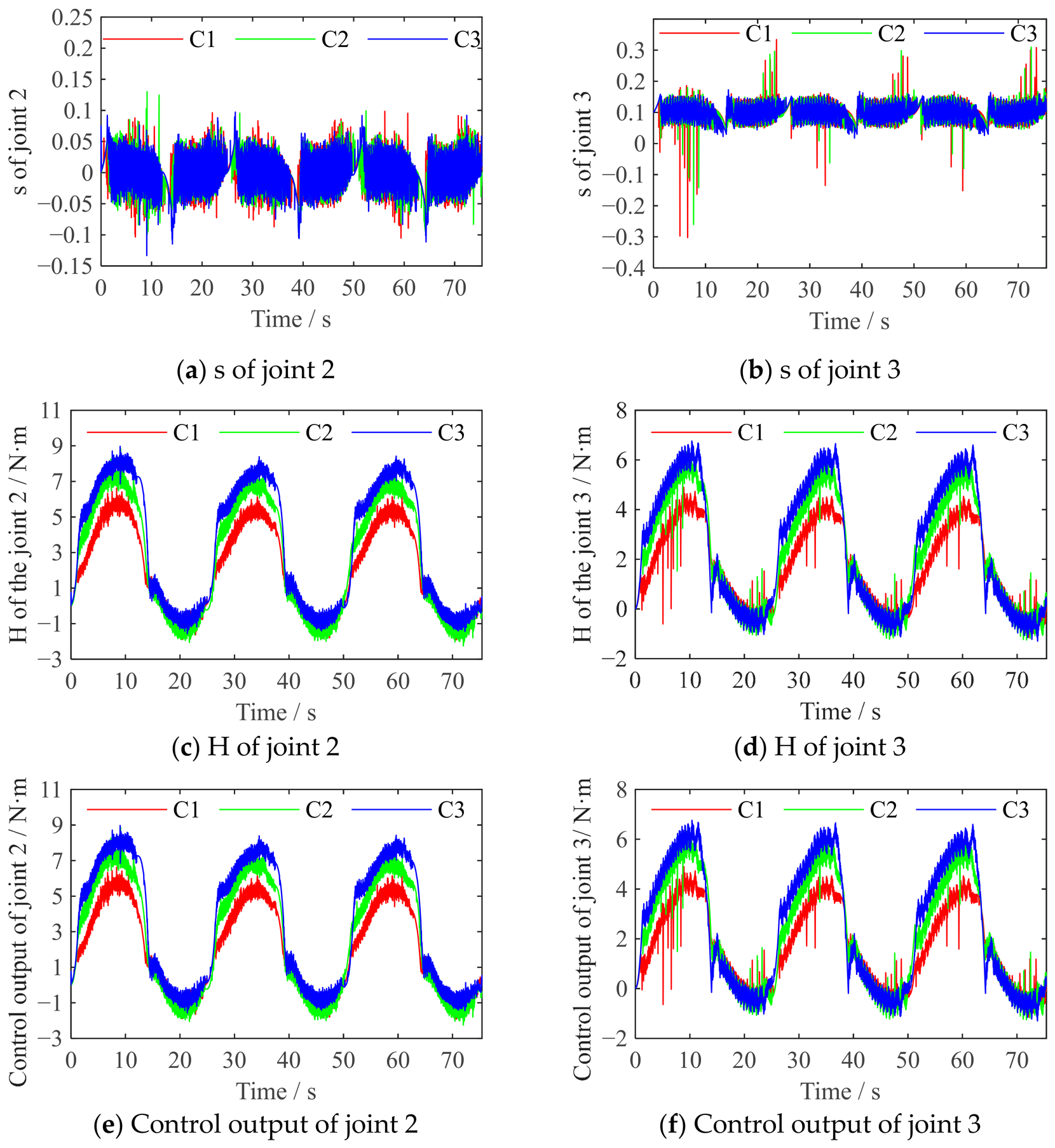
The results of the experiments are shown in Figure 15. As indicated in Figure 15a,b, the sliding mode surfaces of the three controllers are similar, indicating that all controllers maintain a stable sliding regime. Taking further analysis of Figure 15c,d, when the tendon-driven manipulator moves upward, the value of the proposed controller is smaller than that of the other two controllers. Owing to the effect of gravity, the pulling force of the link increases, leading to greater nonlinear disturbances. The proposed Controller 1 uses the α-TDE technique, which utilizes a weighted average of two moments (t − L, t − 2L) along with an adjusting parameter α, which can improve the accuracy of the time-delay estimation. This achieves better tracking performance of the single-tendon-driven manipulator. When the tendon-driven manipulator moves downward, gravity can assist the manipulator to move downward, and in this case, the value of the proposed Controller 1 is similar to the other two controllers.
Figure 15.
Experiment results.
As shown in Figure 15e,f, the control torque of the proposed Controller 1 is significantly smaller than that of the other two controllers during the upward phase. This reduction is attributed to the influence of the α-TDE; this explains that the α-TDE-NTSM controller can effectively solve the nonlinear dynamics of the tendon-driven manipulator. Furthermore, the smoother torque of the proposed Controller 1 reduces mechanical vibration, which is beneficial for trajectory tracking. Overall, the proposed Controller 1 achieves superior tracking performance, which uses lower control torque. This further indicates the effectiveness and practicality of our proposed Controller 1 in practical applications.
Overall, all control schemes employed in the experiments provide good tracking control for the single-tendon-driven manipulator. However, experimental results indicate that our proposed control scheme exhibits superior comprehensive control performance.
5.4. Control Experiments with and Without Load
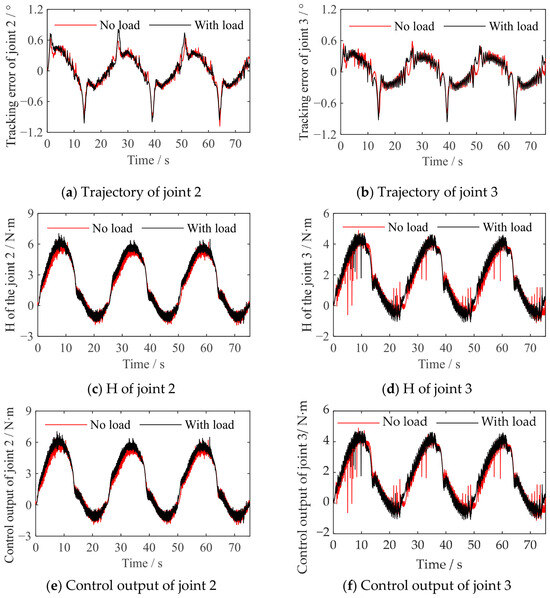
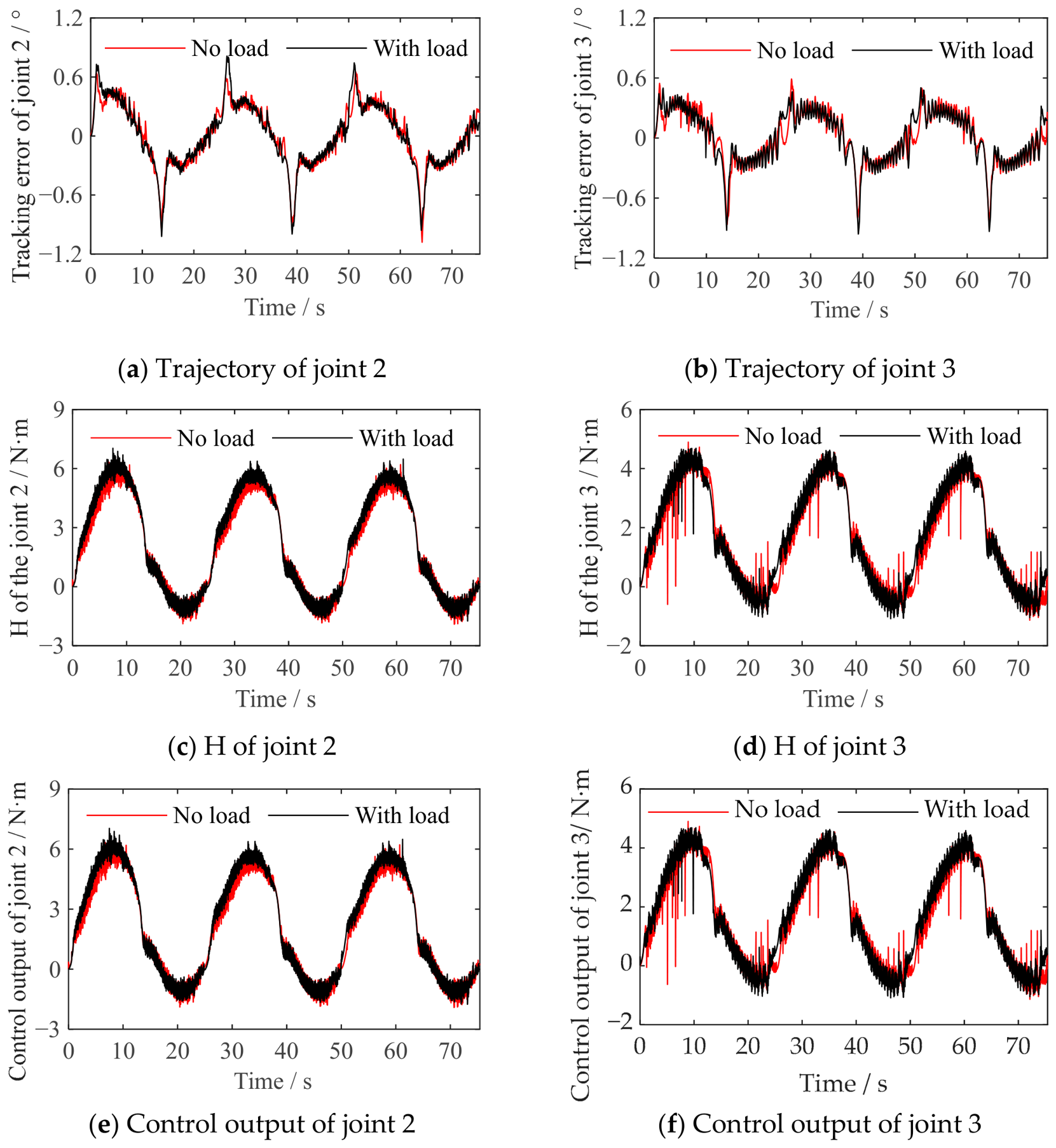
To demonstrate the robustness of our proposed control scheme against unknown uncertainties, an additional 0.2 kg payload was added to the end-effector of the robotic manipulator. The experiment used the same desired trajectory and period as the previous comparative experiments. The results of the experiment are depicted in Figure 16, and the calculated RMSE and MAE values from the experimental data are summarized in Table 3.
Figure 16.
Experimental results with a 0.2 kg payload vs. no payload.
Table 3.
Control performance with a 0.2 kg payload vs. no payload.
As indicated in Figure 16a,b, our proposed controller is still able to maintain accurate tracking performance under load disturbances. For MAE, the values increase by 1.1% and 3.7% for joints 1 and 2, respectively. For RMSE, the values increase by 4.5% and 1.5% for joints 1 and 2, respectively. Summarizing the above experimental results, it can be seen that the strong robustness of our newly proposed control scheme is demonstrated.
6. Conclusions
This paper presents the design, modeling, and experimental validation of a single-tendon-driven manipulator. The proposed design utilizes a single-tendon actuation method for each joint to reduce backlash and improve motion precision, while an additional tendon and motor serve as a tensioner to maintain positive tendon tension throughout the manipulator’s workspace. Then, we designed an NTSM control scheme based on α-TDE for the trajectory tracking control for a single-tendon-driven manipulator, and conducted a comparative experiment to verify the superiority of the proposed controller.
- The development of a tendon routing strategy that ensures all tendons remain under positive tension. This is achieved by leveraging opposing torques and an active tensioning mechanism, where a motor-driven tendon replaces traditional springs to allow consistent preload adjustment.
- The derivation of a kinematic model that explicitly accounts for motion coupling between joints—a distinctive characteristic of tendon-driven systems. The coupling matrix was formulated to relate motor inputs to joint angles, enabling accurate forward kinematics.
- The NTSM control design enables the single-tendon-driven manipulator to achieve better trajectory tracking. This is accomplished by employing the α-TDE technique, which estimates external disturbances, and by extending the sampling data period to mitigate the overshoot problems caused by TDE. The stability of the control system is analyzed using the Lyapunov method.
- The fabrication of a prototype and experimental validation of the kinematic model. Results show close agreement between the predicted and measured joint trajectories, with minor deviations attributed to assembly tolerances and structural elasticity, particularly at the distal end.
- Compared with the two TDE control schemes, the α-TDE scheme achieves a smaller tracking error and a smoother curve. Furthermore, comparative experiments with and without load further validate the proposed controller’s reliability under strong robust performance requirements.
The proposed design and modeling approach demonstrates feasibility for applications, offering advantages in weight reduction, drag minimization, and decoupled control. And our proposed control scheme achieves great performance on trajectory tracking for a single-tendon-driven manipulator. Future work may focus on dynamic modeling, closed-loop control, and extending the design to manipulators with more degrees of freedom.
Author Contributions
Conceptualization, F.Y.; Writing, F.Y.; Data curation, J.L.; Software, J.L.; Formal analysis, H.H.; Funding acquisition, F.Y., H.H.; Validation, Q.X.; Methodology, L.H. All authors have read and agreed to the published version of the manuscript.
Funding
This research was funded by the National Natural Science Foundation of China, grant number 52305136, Yantai Science and Technology Innovation Development Plan, grant number 2024JCYJ093 and Major scientific and technological innovation projects in Shandong Province, grant number 2023CXGC010407.
Data Availability Statement
The original data presented in the study are openly available in Zenodo repository at https://zenodo.org/records/19467931 (accessed on 5 April 2026).
Conflicts of Interest
The authors declare no conflicts of interest.
Abbreviations
The following abbreviations are used in this manuscript:
| NTSM | Nonsingular terminal sliding mode |
| TDE | Time-delay estimation |
References
- Bales, I.; Zhang, H. A six degrees-of-freedom cable-driven robotic platform for head–neck movement. Sci. Rep. 2024, 14, 8750. [Google Scholar] [CrossRef] [Scilit]
- Khomami, A.M.; Najafi, F. A survey on soft lower limb cable-driven wearable robots without rigid links and joints. Rob. Auton. Syst. 2021, 144, 103846. [Google Scholar] [CrossRef] [Scilit]
- Doss, A.S.A.; Lingampally, P.K.; Nguyen, G.M.T.; Schilberg, D. A comprehensive review of wearable assistive robotic devices used for head and neck rehabilitation. Results Eng. 2023, 19, 101306. [Google Scholar] [CrossRef] [Scilit]
- Peñaloza, E.A.G.; Caballero, F.D.B.; Leston, L.A.; de Lima, S. Development of a four-cable-driven parallel robot for execution of complex tasks in closed environments. Int. J. Dyn. Control 2025, 13, 83. [Google Scholar] [CrossRef] [Scilit]
- Ha, S.-H.; Woo, S.-W.; Kim, M.-C.; Piao, J.; Kim, G.-H.; Sarker, M.S.; Park, B.-J.; Kim, S.; Jung, M.; Hong, K.-S. A Cable-driven Parallel Robot for High-rack Logistics Automation. Int. J. Control Autom. Syst. 2024, 22, 3329–3340. [Google Scholar] [CrossRef] [Scilit]
- Pannequin, R.; Jouaiti, M.; Boutayeb, M.; Lucas, P.; Martinez, D. Automatic tracking of free-flying insects using a cable-driven robot. Sci. Robot. 2020, 5, eabb2890. [Google Scholar] [CrossRef] [Scilit] [PubMed]
- Zhu, K.; Lueth, T.C.; Sun, Y. Design of FDM-printable tendon-driven continuum robots using a serial S-shaped backbone structure. Biomim. Intell. Robot. 2025, 5, 100188. [Google Scholar] [CrossRef] [Scilit]
- Shi, K.; Yang, J.; Tong, Y.; Hou, Z.; Yu, H. Design and analysis of a cable-driven gravity compensation mechanism for spatial multi-DoF robotic systems. Mech. Mach. Theory 2023, 190, 105452. [Google Scholar] [CrossRef] [Scilit]
- Pigani, L.; Gallina, P. Cable-direct-driven-robot (CDDR) with a 3-link passive serial support. Robot. Comput. Integr. Manuf. 2014, 30, 265–276. [Google Scholar] [CrossRef] [Scilit]
- Gueners, D.; Chanal, H.; Bouzgarrou, B. Design and implementation of a cable-driven parallel robot for additive manufacturing applications. Mechatronics 2022, 86, 102874. [Google Scholar] [CrossRef] [Scilit]
- Song, D.; Lu, M.; Zhao, L.; Sun, Z.; Wang, H.; Zhang, L. A novel real-time tension distribution method for cable-driven parallel robots. Robotica 2024, 42, 3692–3708. [Google Scholar] [CrossRef] [Scilit]
- Banala, S.K.; Agrawal, S.K.; Scholz, J.P. Active Leg Exoskeleton (ALEX) for Gait Rehabilitation of Motor-Impaired Patients. In IEEE International Conference on Rehabilitation Robotics; IEEE: Noordwijk, The Netherlands, 2007. [Google Scholar] [CrossRef] [Scilit]
- Brackbill, E.A.; Mao, Y.M.Y.; Agrawal, S.K.; Annapragada, M.; Dubey, V.N. Dynamics and control of a 4-dof wearable cable-driven upper arm exoskeleton. In IEEE International Conference on Robotics & Automation; IEEE: Kobe, Japan, 2009. [Google Scholar] [CrossRef] [Scilit]
- Pott, A. Cable-Driven Parallel Robots: Theory and Application; Springer Tracts in Advanced Robotics; Springer: Berlin/Heidelberg, Germany, 2018. [Google Scholar] [CrossRef] [Scilit]
- Troncoso, D.A.; Robles-Linares, J.A.; Russo, M.; Elbanna, M.A.; Wild, S.; Dong, X.; Mohammad, A.; Kell, J.; Nor-ton, A.D.; Axinte, D. A Continuum Robot for Remote Applications: From Industrial to Medical Surgery with Slender Continuum Robots. IEEE Robot. Autom. Mag. 2022, 30, 94–105. [Google Scholar] [CrossRef] [Scilit]
- Varga, M.; Sinčák, P.J.; Merva, T.; Marcinko, P.; Miková, L.; Prada, E.; Schnitzer, M.; Virgala, I. Design and analyses of tendon-driven continuum robots for minimally invasive surgery. IFAC-PapersOnLine 2024, 58, 25–30. [Google Scholar] [CrossRef] [Scilit]
- Li, X.; Wang, Y.; Wu, K.; Xu, Y.; Cao, X.; Feng, T.; Chen, T.; Jin, P.; Wang, Z.; Xue, Y.; et al. Design and modeling of a multi-backbone continuum robot with a large extension ratio. Mech. Mach. Theory 2025, 206, 105935. [Google Scholar] [CrossRef] [Scilit]
- Zhang, T.; Zhang, G.; Zhang, X.; Du, F.; Song, R. Design and Modeling of Multi-vertebrae Continuum Robot for Minimally Invasive Surgery. Procedia Comput. Sci. 2023, 226, 85–91. [Google Scholar] [CrossRef] [Scilit]
- Rus, D.; Tolley, M.T. Design, fabrication and control of soft robots. Nat. News 2015, 521, 467–475. [Google Scholar] [CrossRef] [Scilit] [PubMed]
- Abozaid, Y.A.; Aboelrayat, M.T.; Fahim, I.S.; Radwan, A.G. Soft robotic grippers: A review on technologies, materials, and applications. Sens. Actuators Phys. 2024, 372, 115380. [Google Scholar] [CrossRef] [Scilit]
- Vatanaprasan, P.; Chumnanvej, S.; Suthakorn, J.; Treratanakulchai, S. Design Optimization of a Soft Robotic Manipulator for Intraventricular Hemorrhage Evacuation. In Proceedings of the 16th Hamlyn Symposium on Medical Robotics, London, UK, 25–28 June 2024; pp. 53–54. [Google Scholar]
- Seleem, I.A.; Naeem, M.A.; Takemura, H.; Ishii, H. Tendon-driven based extensible soft robot with variable stiffness. Rob. Auton. Syst. 2025, 190, 104988. [Google Scholar] [CrossRef] [Scilit]
- Dreyfus, R.; Boehler, Q.; Lyttle, S.; Gruber, P.; Lussi, J.; Chautems, C.; Gervasoni, S.; Berberat, J.; Seibold, D.; Ochsenbein-Kölble, N. Dexterous helical magnetic robot for improved endovascular access. Sci. Robot. 2024, 9, eadh0298. [Google Scholar] [CrossRef] [Scilit]
- Kim, Y.; Genevriere, E.; Harker, P.; Choe, J.; Balicki, M.; Regenhardt, R.W.; Vranic, J.E.; Dmytriw, A.A.; Patel, A.B.; Zhao, X. Telerobotic neurovascular interventions with magnetic manipulation. Sci. Robot. 2025, 7, eabg9907. [Google Scholar] [CrossRef] [Scilit] [PubMed]
- Zou, B.; Liu, H.; Fen, X.; Gao, Z.; Ge, Z.; Yang, W. Design, optimization, and validation of a magnetic mother-child robot system for targeted drug delivery. Mater. Des. 2025, 253, 113827. [Google Scholar] [CrossRef] [Scilit]
- Liu, T.; Zhang, G.; Du, F.; Zhang, X.; He, C.; Li, Y.; Song, R. Magnetic continuum robot: Design, modeling and verification. Int. J. Mech. Sci. 2025, 301, 110460. [Google Scholar] [CrossRef] [Scilit]
- Wang, C.; Jin, T.; Ren, H.; Zhang, H.; Zhao, J. Modeling and design of pre-set stiffness continuum robot. Int. J. Mech. Sci. 2025, 295, 110224. [Google Scholar] [CrossRef] [Scilit]
- Shao, Z.; Wu, Q.; Chen, B.; Wu, H.; Zhang, Y. Modeling and inverse control of a compliant single-tendon-sheath artificial tendon actuator with bending angle compensation. Mechatronics 2019, 63, 102262. [Google Scholar] [CrossRef] [Scilit]
- Chang, J.-C.; Dai, H.; Wang, X.; Axinte, D.; Dong, X. Development of a continuum robot with inflatable stiffness-adjustable elements for in-situ repair of aeroengines. Robot. Comput. Integr. Manuf. 2025, 95, 103018. [Google Scholar] [CrossRef] [Scilit]
- Wang, P.; Zang, J.; Dong, Z.; Xing, Z.; Zhao, J. Design and statics model of an extensible hybrid-driven continuum robot with variable stiffness. Sens. Actuators Phys. 2025, 384, 116177. [Google Scholar] [CrossRef] [Scilit]
- Sai, X.U.; Honglei, Z. Design of a 6-DoF cable-driven parallel robot experimental platform. Exp. Technol. Manag. 2025, 42, 188–195. [Google Scholar]
- Cheng, J.; Shen, T. Motion decoupling for cable-driven serial robots based on a noncircular pulley. In 2023 IEEE/ASME International Conference on Advanced Intelligent Mechatronics (AIM); IEEE: New Youk, NY, USA, 2023; pp. 739–745. [Google Scholar]
- Xu, F.; Zi, B.; Yu, Z.; Zhao, J.; Ding, H. Design and implementation of a 7-DOF cable-driven serial spray-painting robot with motion-decoupling mechanisms. Mech. Mach. Theory 2024, 192, 105549. [Google Scholar] [CrossRef] [Scilit]
- Wang, F.; Dong, H.; Yan, L.; Xu, W.; Liang, B. Development of a linear decoupling cable-driven manipulator with independent driving joints. Mechatronics 2024, 100, 103192. [Google Scholar] [CrossRef] [Scilit]
- Seo, D.H.; Lee, J.W.; An, H.M.; Lee, S.Y. An Adaptive Sliding Mode Control Using a Novel Adaptive Law Based on Quasi-Convex Functions and Average Sliding Variables for Robot Manipulators. Electronics 2024, 13, 3940. [Google Scholar] [CrossRef] [Scilit]
- Duong, T.T.C.; Nguyen, C.C.; Tran, T.D. Experimental Investigation of Motion Control of a Closed-Kinematic Chain Robot Manipulator Using Synchronization Sliding Mode Method with Time Delay Estimation. Appl. Sci. 2025, 15, 5206. [Google Scholar] [CrossRef] [Scilit]
- Truong, T.N.; Vo, A.T.; Kang, H.J. A Novel Time Delay Nonsingular Fast Terminal Sliding Mode Control for Robot Manipulators with Input Saturation. Mathematics 2025, 13, 119. [Google Scholar] [CrossRef] [Scilit]
- Zhou, Z.; Gao, J.; Zhang, L. A model-free decoupled and robust repetitive controller for trajectory tracking performance of a three-axis parallel mechanism. J. Mech. Sci. Technol. 2025, 39, 857–875. [Google Scholar] [CrossRef] [Scilit]
- Alsaied, A.; Li, K. An Optimized Type 2 Fuzzy Control with Time Delay Estimation for Gait Trajectory Tracking in Lower-Limb Exoskeleton Robot. Int. J. Fuzzy Syst. 2025. [Google Scholar] [CrossRef] [Scilit]
- Alqaisi, W.; Soliman, M.; Badawi, A.; El-Bayeh, C. Detection and tracking quadrotor using surf and feedback linearization sliding mode control. ROBOMECH J. 2025, 12, 36. [Google Scholar] [CrossRef] [Scilit]
- Dai, J.; Wan, M.; Qin, X.-B.; Zhang, W.-H. A time-delay-based sliding mode controlling method for reducing contour errors of machine tools. J. Manuf. Process 2023, 106, 407–421. [Google Scholar] [CrossRef] [Scilit]
- Li, X.; Zhang, Z.; An, J.; Zhou, X.; Hu, G.; Zhang, G.; Man, W. Adaptive sliding mode control of modular self-reconfigurable spacecraft with time-delay estimation. Def. Technol. 2022, 18, 2170–2180. [Google Scholar] [CrossRef] [Scilit]
- Glida, H.E.; Chelihi, A.; Abdou, L.; Sentouh, C.; Perozzi, G. Trajectory tracking control of a coaxial rotor drone: Time-delay estimation-based optimal model-free fuzzy logic approach. ISA Trans. 2023, 137, 236–247. [Google Scholar] [CrossRef] [Scilit]
- Boudjedir, C.E. A widely-practical model-free prescribed time control for trajectory tracking of n-DOF robot manipulators. Eur. J. Control 2025, 86, 101396. [Google Scholar] [CrossRef] [Scilit]
- Vo, A.T.; Truong, T.N.; Kang, H.-J.; Nguyen, N.H.A. Prescribed performance model-free sliding mode control using time-delay estimation and adaptive technique applied to industrial robot arms. Inf. Sci. 2025, 702, 121911. [Google Scholar] [CrossRef] [Scilit]
- Choi, J.; Kwon, W.; Lee, Y.S.; Han, S. Adaptive time-delay estimation error compensation for application to robot manipulators. Control Eng. Pract. 2024, 151, 106029. [Google Scholar] [CrossRef] [Scilit]
- Meng, D.; Xu, H.; Xu, H.; Sun, H.; Liang, B. Trajectory tracking control for a cable-driven space manipulator using time-delay estimation and nonsingular terminal sliding mode. Control Eng. Pract. 2023, 139, 105649. [Google Scholar] [CrossRef] [Scilit]

Disclaimer/Publisher’s Note: The statements, opinions and data contained in all publications are solely those of the individual author(s) and contributor(s) and not of MDPI and/or the editor(s). MDPI and/or the editor(s) disclaim responsibility for any injury to people or property resulting from any ideas, methods, instructions or products referred to in the content. |
© 2026 by the authors. Licensee MDPI, Basel, Switzerland. This article is an open access article distributed under the terms and conditions of the Creative Commons Attribution (CC BY) license.