Article

A Fast Reaching Law in Sliding Mode Control with Application to an Inverted Pendulum Robot

1
College of Engineering, Shantou University, Shantou 515063, China
2
Shenzhen Institute for Advanced Study, University of Electronic Science and Technology of China, Shenzhen 518038, China
*
Author to whom correspondence should be addressed.
Actuators 2026, 15(4), 200; https://doi.org/10.3390/act15040200
Submission received: 21 January 2026 / Revised: 15 March 2026 / Accepted: 20 March 2026 / Published: 2 April 2026
(This article belongs to the Special Issue Analysis and Design of Linear/Nonlinear Control System—2nd Edition)

Abstract

Sliding mode control (SMC) is an effective and robust technique for managing uncertain nonlinear systems. The conventional SMC approach integrates a constant-rate reaching law with the boundary layer method to regulate the system. However, it does not address scenarios in which the initial state variables are significantly distant from the boundary layer. To expedite the process of reaching the sliding surface, this study introduces a fast reaching law in SMC, ensuring a fixed control time for reaching the sliding mode surface. The proposed fast reaching law is applied to an inverted pendulum robot, demonstrating its effectiveness in this typical system. In addition, we propose a qualitative evaluation method to compare various existing reaching law methods. The simulation results indicate that the proposed reaching law outperforms current approaches, substantiating its effectiveness.

1. Introduction

Many methods are available for controlling nonlinear systems, such as feedback linearization [1], adaptive control [2], sliding mode control (SMC) [3,4,5], and backstepping control [6,7]. Among these, SMC, which has been studied extensively owing to its robustness and simplicity, which involves designing a sliding mode surface and an effective control law to drive the system states toward it [8]. Once the system reaches the sliding mode surface, it moves towards the equilibrium point and remains unaffected by external disturbances [1]. Due to the robustness, fast convergence, and ability to handle nonlinearities, sliding mode control is widely applied in fields such as multi-area power systems [9], energy storage [10], and hybrid-source power systems [11].
In many nonlinear systems, reaching an equilibrium point is desirable, leading to the concept of settling time, which measures the time required to reach equilibrium. Nonlinear control can be divided into two types depending on the characteristics of the settling time. The first is asymptotic-time stable control [12], which can achieve stability but struggles to achieve settling time. The second type is finite-time stable control [13,14,15], which ensures that dynamic systems eventually settle at their equilibrium point after running for a finite time. However, finite-time control relies on the initial system conditions. Polyakov [16] introduced the design of fixed-time stable control to eliminate the dependency on the initial conditions. Following its introduction, several variants were developed by many authors, such as [17,18,19,20,21].
As a special case of finite-time and fixed-time control, SMC has recently emerged as an effective approach for nonlinear system control. However, chattering is a major challenge that must be addressed during SMC [22]. Many methods, including the disturbance observer technique [23,24], high-order sliding mode technique [25,26,27,28], boundary layer approach [1], and others [29,30], have been proposed to reduce chattering. The disturbance observer technique is used to detect disturbances. Therefore, it can attenuate the chattering amplitude [23,24]. The boundary layer approach replaces the sign function with saturation or hyperbolic tangent functions, which ensures that the system states enter a narrow boundary layer surrounding the sliding surface, albeit at the expense of increased steady-state tracking errors [1]. Other techniques, such as that of [29], add a low-pass filter to the control input. Thus, the output of the low-pass filter does not have a sign function and can handle chattering.
In addition, the design of reaching laws is crucial in the aforementioned attempts to address chattering effects. Control methods with a constant-rate reaching law often use the boundary layer method, especially the saturation function, to handle the chattering problem. However, these approaches do not consider the situation in which the initial state point is distant from the sliding mode surface. In this situation, when employing traditional SMC, the time required to reach the sliding surface is excessively long. To address this problem, many scholars have conducted in-depth studies and proposed various reaching laws, such as the exponential reaching law [31], double power reaching law [32], and others [33,34,35,36]. These studies achieved good control effects; however, there are two problems with these reaching laws. First, to the best of our knowledge, when comparing different reaching laws such as [31,32,33,34,35,36,37], their parameter selection is relatively arbitrary, rendering the comparisons unfair. Second, these reaching laws may result in excessive overshoot.
Therefore, to address these issues, this study introduces a fixed-time reaching law called the hyperbolic reaching law (HRL) to reduce the time needed to reach the sliding mode surface. Furthermore, we propose a new and more objective method for comparing different reaching laws. Specifically, the comparison is based on three variables: overshoot, steady-state error, and settling time. The first two variables are kept the same and the remaining variable is compared. Lastly, a method is proposed to add bounds to the reaching rate in order to mitigate excessive overshoot. We assume that the saturation function replaces the sign function to handle chattering in the reaching laws. The primary contributions of this study are summarized as follows:
(1)
The HRL is proposed to achieve a shorter reaching time than the exponential reaching law (ERL). The primary difference is that the ERL is linear, whereas the proposed reaching law uses an exponential function.
(2)
A new method is presented to compare the quality of different reaching laws. The reaching law parameters are determined based on the condition that when the initial state variables are at the same point in the boundary layer, the behaviors of the reaching laws are nearly the same. Subsequently, the reaching rates of these reaching laws are compared.
(3)
A solution is proposed for the particular case in which the input is excessively large owing to the design of the reaching law. Specifically, the upper and lower bounds should be added to the outer layer of the reaching law to ensure that the first derivative of the sliding mode variable is not excessively large, thereby reducing overshoot.
The subsequent sections of this paper are structured as follows: Section 2 outlines some preliminary steps. The primary contributions are elaborated on in Section 3. Applications to sliding mode control and numerical simulations are detailed in Section 4. Finally, Section 5 concludes the paper.

2. Preliminaries

Consider the following common uncertain nonlinear system [19,38] with a single input:
x n = f X + g X u + d ,
where X   =   x   x .   x n 1 T denotes the state vector, u denotes the control input, and x represents the system output. Functions f and g are known continuous functions such that f 0 = 0 and g X 0 for all X. The term d denotes a lumped disturbance, which includes both external disturbances and model uncertainties [39,40], with d t L , where L is a positive constant. The primary objective is to drive x toward the origin.

2.1. Sliding Mode Control

SMC is a variable-structure control method that guides the system states along a predefined trajectory using a sliding mode surface [1]. The control process consists of two phases. In the reaching phase, the control law drives the system states toward the sliding surface ( s = 0 ), whereas in the sliding phase, the system states move along the sliding surface toward an equilibrium point. The sliding mode surface s t is generally defined as
s t = x n 1 + i = 0 n 2 c i x i ,
where x   x .   x n 1 are the system state variables and the parameters c i i =   0 , , n 2 are selected such that the resulting polynomials are Hurwitz, ensuring system stability along the sliding surface.
SMC should take action against the chattering phenomenon. A popular strategy for reducing chattering is to apply the boundary layer method, which substitutes a saturation function for the sign function when building a control law. The sign and saturation functions are defined as follows:
sign x   =   + 1 if   x > 0   0 if   x = 0 1 if   x < 0     , sat x / Φ   =   + 1 if   x > Φ   x / Φ   if   x Φ   1 if   x < Φ .

2.2. Approach of Existing Reaching Laws

The constant-rate reaching law (CRL) [31] and ERL [41] are two approaches for SMC.
The CRL is defined as
s . = η   sign s ,
where η is a positive constant. If an external disturbance d t exists, a robust form is
s . = η + L   sign s + d ,
where L bounds d t with d t L . The reaching time t r is bounded by
t r s 0 η .
To reduce the reaching time, the ERL is introduced:
s . = ε s k   sign s ,
where ε > 0 and k > 0 are constants. For robustness against disturbance d t :
s . = ε s k + L sign s + d .
The reaching time t r is bounded by
t r 1 ε In k + ε s 0 k .

3. Main Contributions

3.1. Proposed Reaching Law

To reach the sliding mode surface as quickly as possible, the absolute value of the derivative of s must be as large as possible. Therefore, we introduce an exponential function to increase the absolute value of the derivative. Based on this, the proposed HRL is formulated as
s . = k 1 e k 2 s e k 2 s k 3 sign s ,
where k 1 > 0 , k 2 > 0 , and k 3 > 0 are constants. By integrating (10) from 0 to t r , we derive the following expression for the reaching time t r :
t r = 1 k 2 4 k 1 2 + k 3 2 In 2 k 1 + k 3 + 4 k 1 2 + k 3 2 2 k 1 + k 3 4 k 1 2 + k 3 2 + In 2 k 1 e k 2 | s 0 | + k 3 4 k 1 2 + k 3 2 2 k 1 e k 2 | s 0 | + k 3 + 4 k 1 2 + k 3 2 .
Consider the robust fixed-time stability analysis.
Theorem 1.
The system, defined by
s .   =   k 1 e k 2 s e k 2 s k 3 + L sign s + d ,
where k 1 > 0 , k 2 > 0 , and k 3 > 0 are constants; s t R represents a state variable; and d t R represents a lumped disturbance subject to d t L for a positive constant L, is globally fixed-time stable. The settling time t r is a fixed time according to the relation
t r 1 k 2 4 k 1 2 + k 3 2 In 2 k 1 + k 3 + 4 k 1 2 + k 3 2 2 k 1 + k 3 4 k 1 2 + k 3 2 .
Proof. 
Consider the following common Lyapunov function
V s   =   1 2 s 2 .
This leads to
V . s = s s .   = s k 1 e k 2 s e k 2 s k 3 + L sign s + d   = k 1 s e k 2 s e k 2 s k 3 | s | L | s | + d s < 0 ,   when   s 0 .
Because when s is greater than zero, e k 2 s e k 2 s is also greater than zero, and when s is less than zero, e k 2 s e k 2 s is also less than zero, and s e k 2 s e k 2 s is greater than zero. Given that d t < L , L | s | + d s < 0 . Therefore, the derivative of V ( s ) is a negative definite function.
According to Lyapunov’s direct method, the system is globally asymptotically stable.
When s > 0 , from (12), we obtain
s .     k 1 e k 2 s e k 2 s k 3 .
Integrating (16) yields
s 0 0 1 k 1 e k 2 s e k 2 s + k 3 d s   0 t r d t .
Since one of the antiderivatives of the function
1 k 1 e k 2 s e k 2 s + k 3
is
1 k 2 4 k 1 2 + k 3 2 In 2 k 1 e k 2 s + k 3 4 k 1 2 + k 3 2 2 k 1 e k 2 s + k 3 + 4 k 1 2 + k 3 2 .
Thus,
t r 1 k 2 4 k 1 2 + k 3 2 In 2 k 1 + k 3 + 4 k 1 2 + k 3 2 2 k 1 + k 3 4 k 1 2 + k 3 2 + In 2 k 1 e k 2 s 0 + k 3 4 k 1 2 + k 3 2 2 k 1 e k 2 s 0 + k 3 + 4 k 1 2 + k 3 2 .
When s < 0 , from (12), we obtain
s .     k 1 e k 2 s e k 2 s + k 3 .
Integrating (21) yields
s 0 0 1 k 1 e k 2 s e k 2 s + k 3   d s   0 t r d t .
Since one of the antiderivatives of the function
1 k 1 e k 2 s e k 2 s + k 3
is
1 k 2 4 k 1 2 + k 3 2 In 2 k 1 e k 2 s + k 3 + 4 k 1 2 + k 3 2 2 k 1 e k 2 s + k 3 4 k 1 2 + k 3 2 .
Therefore,
t r 1 k 2 4 k 1 2 + k 3 2 In 2 k 1 + k 3 + 4 k 1 2 + k 3 2 2 k 1 + k 3 4 k 1 2 + k 3 2 + In 2 k 1 e k 2 s 0 + k 3 4 k 1 2 + k 3 2 2 k 1 e k 2 s 0 + k 3 + 4 k 1 2 + k 3 2 .
Combining (20) and (25), the settling time for (12) is expressed as
t r 1 k 2 4 k 1 2 + k 3 2 In 2 k 1 + k 3 + 4 k 1 2 + k 3 2 2 k 1 + k 3 4 k 1 2 + k 3 2   + In 2 k 1 e k 2 s 0 + k 3 4 k 1 2 + k 3 2 2 k 1 e k 2 s 0 + k 3 + 4 k 1 2 + k 3 2   1 k 2 4 k 1 2 + k 3 2 In 2 k 1 + k 3 + 4 k 1 2 + k 3 2 2 k 1 + k 3 4 k 1 2 + k 3 2 .
The above inequality holds because
In 2 k 1 e k 2 s 0 + k 3 4 k 1 2 + k 3 2 2 k 1 e k 2 s 0 + k 3 + 4 k 1 2 + k 3 2 < 0 .
It is less than 0 because k 1 , k 2 , k 3 are all positive constants, and the argument of the logarithm represents a ratio where the numerator is smaller than the denominator, making the entire fraction less than 1. Since the logarithm of a number less than 1 is negative, the expression results in a value less than zero.
Thus, the settling time is fixed and is expressed as (13). □

3.2. Method for Comparing Different Reaching Laws

Some issues must be considered when comparing different reaching laws. First, for any reaching law, if there are no input size restrictions or chattering restrictions, theoretically, any reaching law can cause the system sliding mode variable s to reach the sliding mode surface in an infinitesimal time. This is because the more significant the derivative of s, the faster the sliding mode variable s tends toward zero. Similar to the CRL, increasing the coefficient η of the CRL can make it approach its origin faster. However, the larger the coefficient, the larger the input required, and significant oscillation will occur after reaching the sliding mode surface. For the same initial conditions and by selecting different parameters for the same reaching law, if the speed of reaching the sliding mode surface s = 0 is faster, the oscillation will also be more significant after reaching the sliding mode surface. In summary, there should be a compromise between the convergence time and oscillation amplitude (or chattering) [33].
We aim for a reaching law that minimizes both the settling time (convergence time) and steady-state error (the amplitude of the oscillation after reaching the sliding mode surface). Therefore, if we disregard the input constraints and compare the different reaching laws, two methods can be used. The first method involves fixing the settling time under the same initial conditions and comparing the steady-state error. A smaller amplitude is preferable. The second method entails fixing the steady-state error and comparing the settling time for different reaching laws under the same initial conditions. Therefore, a shorter time is preferable.
Because there are conceptual differences between the finite-time and fixed-time reaching laws, the first method requires that the settling time be fixed under the same initial conditions. This may not be convenient for finite-time reaching laws because changing the initial conditions necessitates adjustments to the parameters. In addition, for most reaching laws, assessing the oscillation amplitude appears feasible only through experimental comparison. Therefore, we opt to use the second method for comparison.
This raises another question: How can we fix the steady-state error for the second method? In any practical system with disturbances, it is impossible to eliminate oscillations completely after the system reaches the sliding mode surface. Therefore, we establish a tolerance limit for practical systems. If the oscillations remain within the acceptable range, we can assume that the system has no significant oscillations. Similarly, the objective of reaching laws is to control the sliding mode variable to reach zero. We can set a small value Φ as the tolerance limit. If s Φ , we consider that the sliding mode variable has reached the sliding mode surface. A general reaching law can be expressed as
s . = H s , sign s L sign s + d ,
where H s , sign s is a function involving s or sign s and d represents lumped disturbance, which includes both external disturbances and model uncertainties, such that d t L , where L is a positive constant.
Considering the use of a saturation function instead of a sign function, there is no difference between using a saturation function and sign function outside the boundary layer. Inside the boundary layer, we can replace sign ( s ) with s / Φ and then approximate the H function with a Taylor expansion at zero (if it can be approximated using a Taylor expansion), neglecting terms of the second order and higher. Consequently, the reaching law inside the boundary layer (28) can be transformed as follows:
s . λ 1 + L Φ s + d ,
where λ 1 is a number irrelevant to s and is typically related to certain parameters of the reaching law. If we let
λ = λ 1 + L Φ ,
we can obtain
s . λ s + d .
We now consider the results of (31). The sliding variable s is generated from the disturbance d via a first-order low-pass filter (see Figure 1, where the Laplace operator is represented by p = d / dt and the parameter λ > 0 signifies the cutoff frequency of the low-pass filter).
At this point, the corresponding parameters for the different reaching laws are set. Under the same parameter λ and disturbance conditions, the sliding mode variables within the boundary layer are identical and the corresponding state variables also match. Consequently, the oscillations are the same. This satisfies the requirement of the second method, i.e., the steady-state error of the different reaching laws are equal. Therefore, the merits of the different reaching laws can be evaluated by comparing the settling times of the respective boundary layers.
The following section provides methodological guidance on how to design the parameters of the reaching laws to ensure the prerequisites for comparison. Two key aspects should be considered:
Condition (1): The behaviors of the reaching laws to be compared should be nearly identical when the initial state variables are both inside the boundary layer. This implies that, when the initial state variables are located at the same point within the boundary layer, the system states, sliding mode variable, and even the control input should evolve in a nearly identical manner over time.
Condition (2): When the initial state variables are located at the same point outside the boundary layer, the comparison should focus on the settling time to the boundary layer. A shorter time is preferable.
We use the CRL, ERL, and HRL to illustrate how to achieve condition (1).
Consider (5), (8), and (12). When we use saturation to replace the sign function to handle chattering, we obtain
s . = η + L sat s / Φ + d s . = ε s k + L sat s / Φ + d s . = k 1 e k 2 s e k 2 s k 3 + L sat s / Φ + d .
When the system state variables are inside the boundary layer, we obtain
s . = η + L Φ s + d s . = k + L Φ + ε s + d s . k 3 + L Φ + 2 k 1 k 2 s + d .
To satisfy condition (1), we must guarantee that
λ = η + L Φ k + L Φ + ε k 3 + L Φ + 2 k 1 k 2   λ 1 = η Φ k Φ + ε k 3 Φ + 2 k 1 k 2 .
Therefore, based on the same sliding surface selection, we can use condition (1) to determine the relevant parameters of the reaching laws and then use condition (2) to compare their quality. Notably, λ can be considered the cutoff frequency of the filter. If the sole purpose is to compare the different reaching laws, this value can be selected arbitrarily. However, if a specific system is to be implemented, this value needs to be set according to the actual conditions so that it does not exceed the degree that the system can tolerate.
Having completed the parameter selection for the reaching law using condition (1), how do we determine the duration for the sliding mode variable s to reach the boundary layer to compare the reaching laws? This duration can typically be determined through simulations or experiments. In addition, there exists a simpler method for comparing reaching laws: directly analyzing the graphical representation of the reaching law (with s as the abscissa and the first derivative of s as the ordinate, considering d and L as zero).
The speed at which the sliding mode variable s reaches the boundary layer is directly related to the absolute value of its first derivative. Based on this principle, we can compare the speeds of the different reaching laws by plotting their respective graphs. Outside the boundary layer, the reaching law, whose ordinate is the farthest from the horizontal axis, reaches the boundary layer more quickly. Because there is no significant difference between using a saturation function or a sign function outside the boundary layer, we can use the sign function version of the reaching law for plotting. Furthermore, because d and L are assumed to be the same when comparing the reaching laws, these parameters can be ignored, leading to identical results.
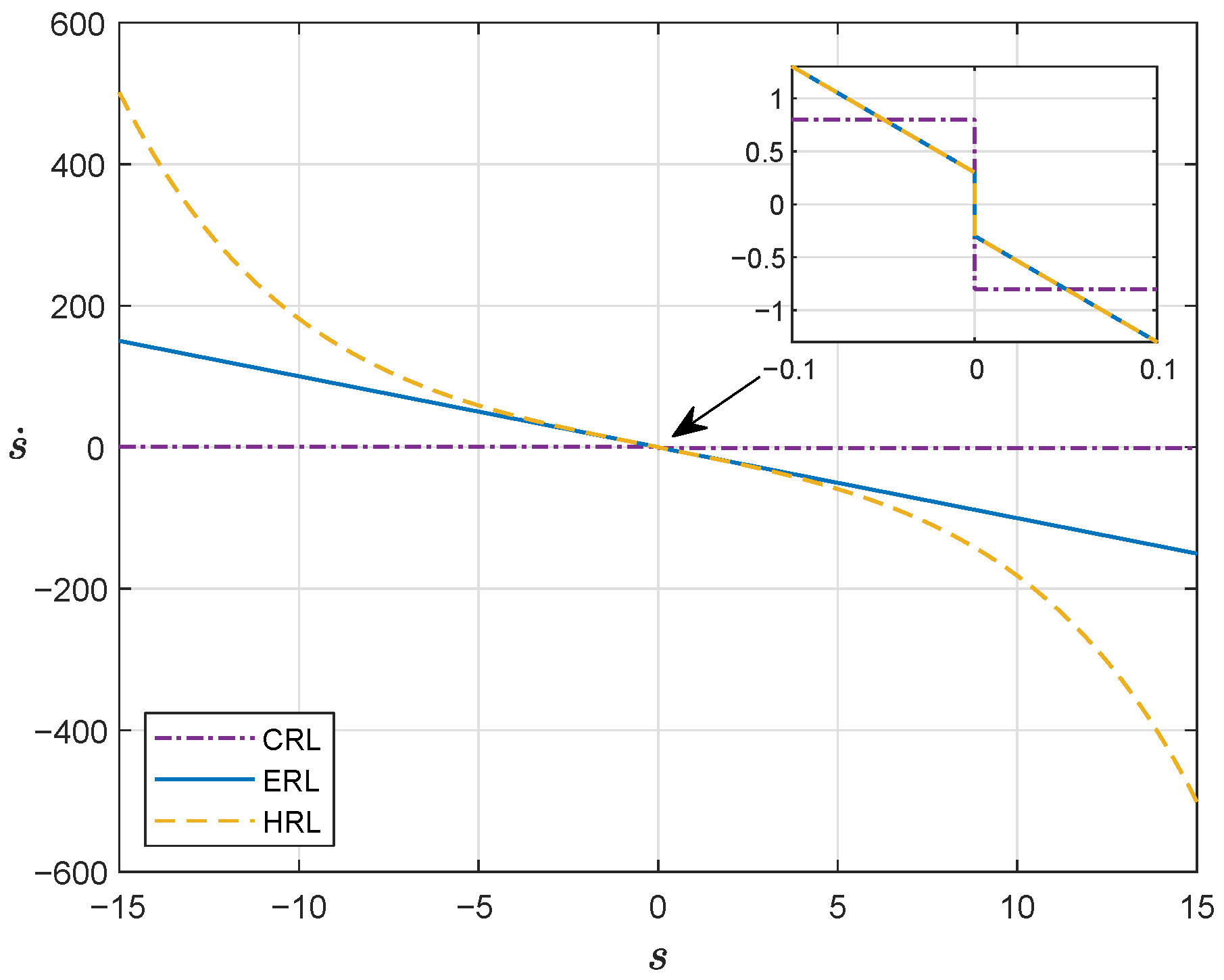
In the following, we use this method to explain why the HRL (10) is better than CRL (4) and ERL (7); the simulations in Section 4 also validate this point. First, we use condition (1) to determine their parameters. When comparing through figures, d and L can be ignored and the boundary layer size Φ is the same. Therefore, we must only ensure that λ 1 is the same. Without loss of generality, we assume that the value of λ 1 is 16 and the value of Φ is 0.05. Then, to satisfy (34), η in the CRL needs to be equal to 0.8. However, for the ERL and HRL, because (34) has only one equation, but there are two parameters ( k , ε ) and three parameters ( k 1 , k 2 , k 3 ), respectively, these parameters cannot be uniquely determined. We set k = 0.3 ,   ε = 10 for the ERL and k 1 = 25 , k 2 = 0.2 , k 3 = 0.3 for the HRL. The corresponding graphs are presented in Figure 2.
It can be observed from Figure 2 that, with the aforementioned parameters, the HRL performs better than both the ERL and CRL, because the HRL is farther from the horizontal axis than the other two.
Actually, when k 3 = k and 2 k 1 k 2 = ε , performing a Taylor expansion of e k 2 s and e k 2 s at s = 0 easily leads to the following inequality
ε s k 1 e k 2 s e k 2 s .
Therefore,
ε s k sign s k 1 e k 2 s e k 2 s k 3 sign s .
Thus, within this framework, it is considered that HRL is superior to ERL.

3.3. Solution for Handling Input Saturation

Considering Figure 2, for the HRL, it can be observed that the first derivative of s changes very rapidly. Even before s approaches −15, the first derivative of s exceeds 400. For all fixed-time reaching laws, if the settling time required for the reaching law is a fixed value, the larger the initial s, the larger the derivative of s must be to achieve this goal. However, a very large first derivative of s is impractical in real systems because it may result in very large control inputs and overshoot. Therefore, fixed-time reaching laws are unsuitable for practical systems in some cases. A simple solution is to impose upper and lower bounds on the first derivative of s, although this may affect the properties of the fixed-time convergence.
For example, by defining
b x , Ψ = x i f   x Ψ Ψ sign x   e l s e , Ψ > 0 ,
using this solution to our proposed reaching law (10), we can obtain the following reaching law:
s . = b k 1 e k 2 s e k 2 s k 3 sign s , Ψ ,
where Ψ > 0 denotes the predefined upper bound of the reaching law.
By adding upper and lower bounds to the derivative of s, it results in the same approaching rate as the original reaching law when s . Ψ . However, when s . > Ψ , the derivative of s becomes a constant Ψ , so the time taken to reach the sliding surface s = 0 depends on the initial sliding mode state s 0 . In this case, the time to reach the sliding surface is no longer fixed, but rather finite, and this time is similar to the constant reaching law. The only difference is that the parameter η , in the constant reaching law is smaller, while Ψ is typically larger, so the time to reach the sliding surface will be faster than that of the CRL.

4. Numerical Simulation

4.1. Input of Sliding Mode Control

Consider the standard sliding variable defined in (2), and the controller expressed as
u = g X 1 f X + i = 0 n 2 c i x i + 1   + k 1 e k 2 s e k 2 s + k 3 + L sign s ,
where k 1 > 0 , k 2 > 0 , k 3 > 0 , and d t L .
Theorem 2.
The closed-loop system (1)-(2)-(39) achieves s x = 0 within a fixed-time duration t r that satisfies (13). This also ensures global asymptotic stability.
Proof. 
We take the derivative of (2) and substitute (1) and (39) into it. Thus, we obtain
s . = f X + g X u + i = 0 n 2 c i x i + 1 + d   = k 1 e k 2 s e k 2 s k 3 + L sign s + d .
The first part of the theorem follows from the fixed-time proof of (12). Upon reaching the sliding surface, the design of the sliding mode surface ensures that the closed-loop system (1)-(2)-(39) is asymptotically stable at the equilibrium point (the origin). □

4.2. Simulation

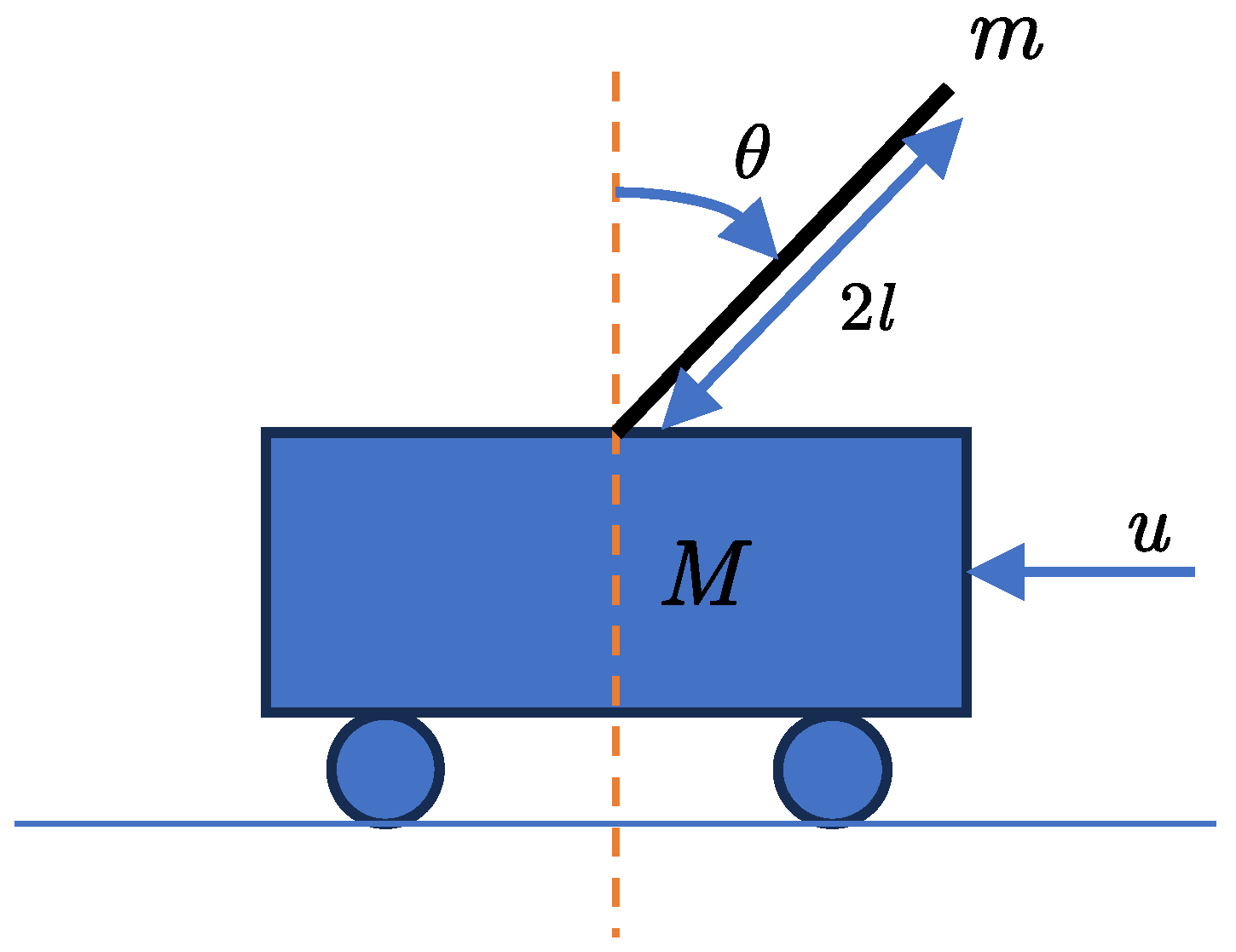
To evaluate the effectiveness of the proposed HRL, simulations were performed using the inverted pendulum robot model described in [42]. An inverted pendulum is a classic system featuring a pendulum attached to a motor-driven cart by a rotational joint that moves horizontally to keep the pendulum balanced and upright (Figure 3).
Let θ (radians unit) denote the pendulum rotation. Let x 1 : = θ , x 2 : = θ . , and u be the force applied to the cart. The dynamic equations of the inverted pendulum robot under disturbance are as follows:
x . 1 = x 2 x . 2 = f 1 x 1 , x 2 + g 1 x 1 , x 2 u + d ,
with
f 1 x 1 , x 2 = M + m g sin x 1 m l x 2 2 sin x 1 cos x 1 4 3 M + m l m l cos 2 x 1 ,
g 1 x 1 , x 2 = cos x 1 4 3 M + m l m l cos 2 x 1 ,
such that M = 1 kg is the cart mass, m = 0.1 kg is the pendulum mass, l = 0.5 m is the half length of the pendulum, g = 9.8 m / s 2 is the acceleration of gravity, and d = 0.2 sin t .
The sliding surface is selected from (2) as follows:
s   =   x 2 + c 0 x 1 ,
with c 0 = 20 .
Based on the HRL and boundary layer method with Φ = 0.05 , the control input u is designed as follows:
u = g 1 1 f 1 c 0 x 2 L sat s / Φ +   g 1 1 k 1 e k 2 s e k 2 s k 3 sat s / Φ ,
where k 1 = 25 , k 2 = 0.2 , k 3 = 0.3 , and L = 0.2 .
If we consider that the control input may be too large, based on the bounded proposed hyperbolic reaching law (HRL bound) with Ψ = 200 and the boundary layer method with Φ = 0.05 , the control input u is designed as follows:
u = g 1 1 f 1 c 0 x 2 L sat s / Φ +   g 1 1 b k 1 e k 2 s e k 2 s k 3 sat s / Φ , Ψ ,
where k 1 = 25 , k 2 = 0.2 , k 3 = 0.3 , and L = 0.2 .
Based on the CRL and boundary layer method with Φ = 0.05 , the control input u is designed as follows:
u = g 1 1 f 1 c 0 x 2 η + L sat s / Φ ,
where η = 0.8 and L = 0.2 .
Based on the ERL and boundary layer method with Φ = 0.05 , the control input u is designed as follows:
u = g 1 1 f 1 c 0 x 2 k + L sat s / Φ ε s ,
where ε = 10 , k = 0.3 , and L = 0.2 .
To enhance persuasiveness, we also introduce the novel reaching law (abbreviated as NRL) mentioned in [36] for comparison. The mathematical expression of this reaching law is as follows:
s ˙ = c 1 tanh s q p s + 1 q p s e p s c 2 s ,
where c 1 > 0 , c 2 > 0 , p > 0 , and 0 < q < 1 .
To satisfy condition (1) and facilitate subsequent comparisons, a Taylor expansion of the NRL at zero is performed. The final result obtained is:
s ˙ = ( c 1 + c 2 ) s ,
In the experiments conducted in this paper, the value of λ is set to 20; hence, it is required that c 1 + c 2 = 20 . The parameters of the NRL used in this paper are c 1 = 10 , c 2 = 10 , p = 0.025 , and q = 0.01 .
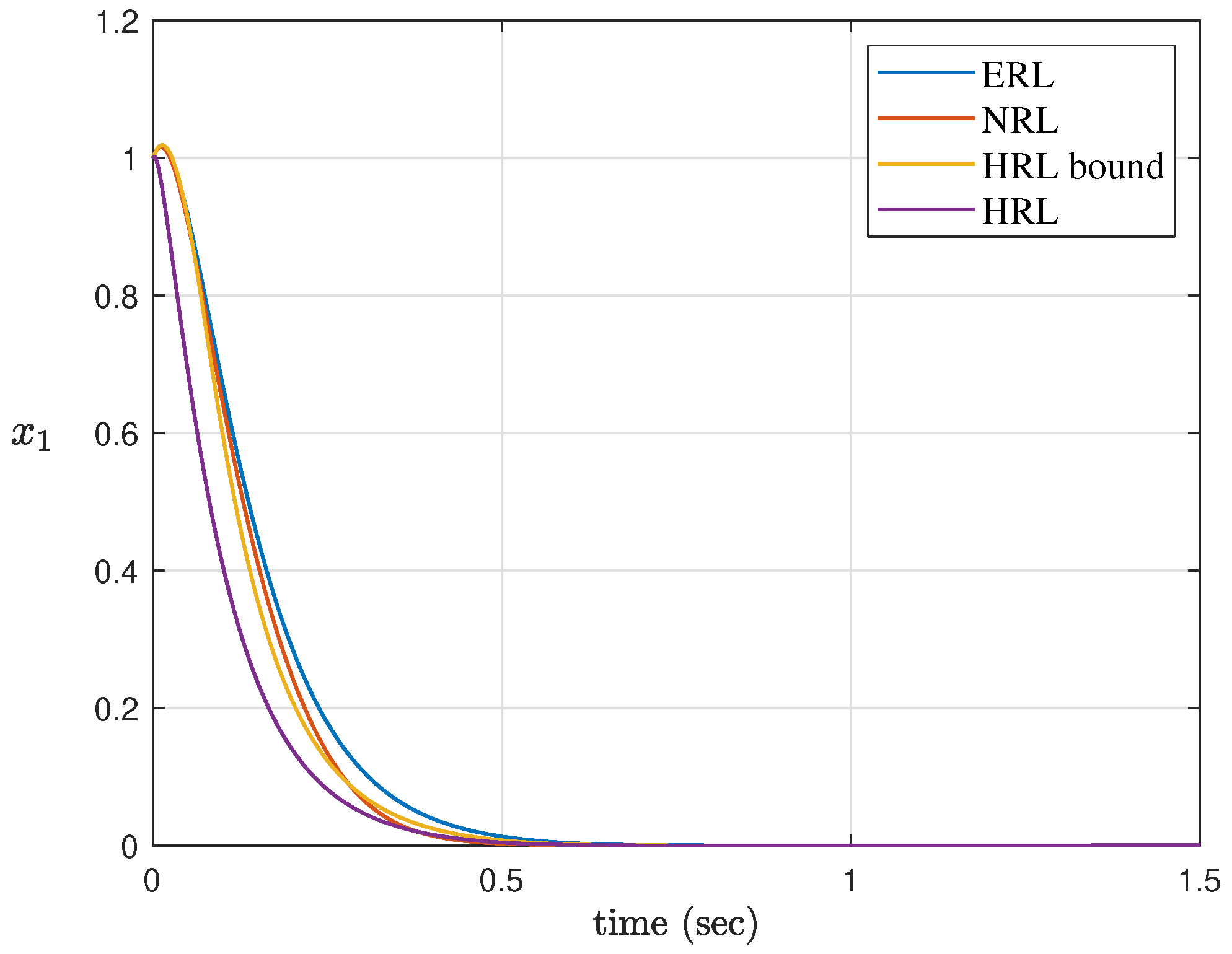
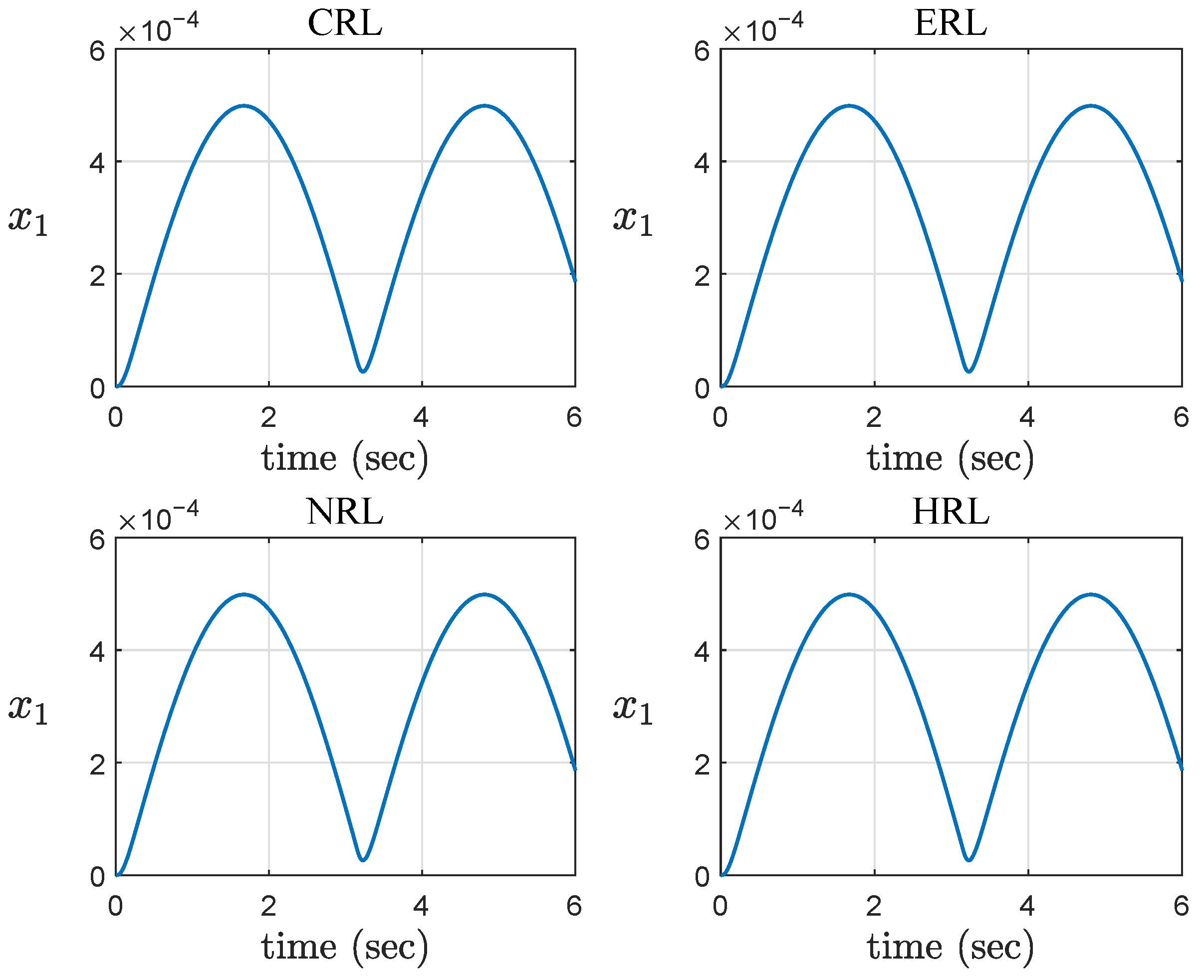
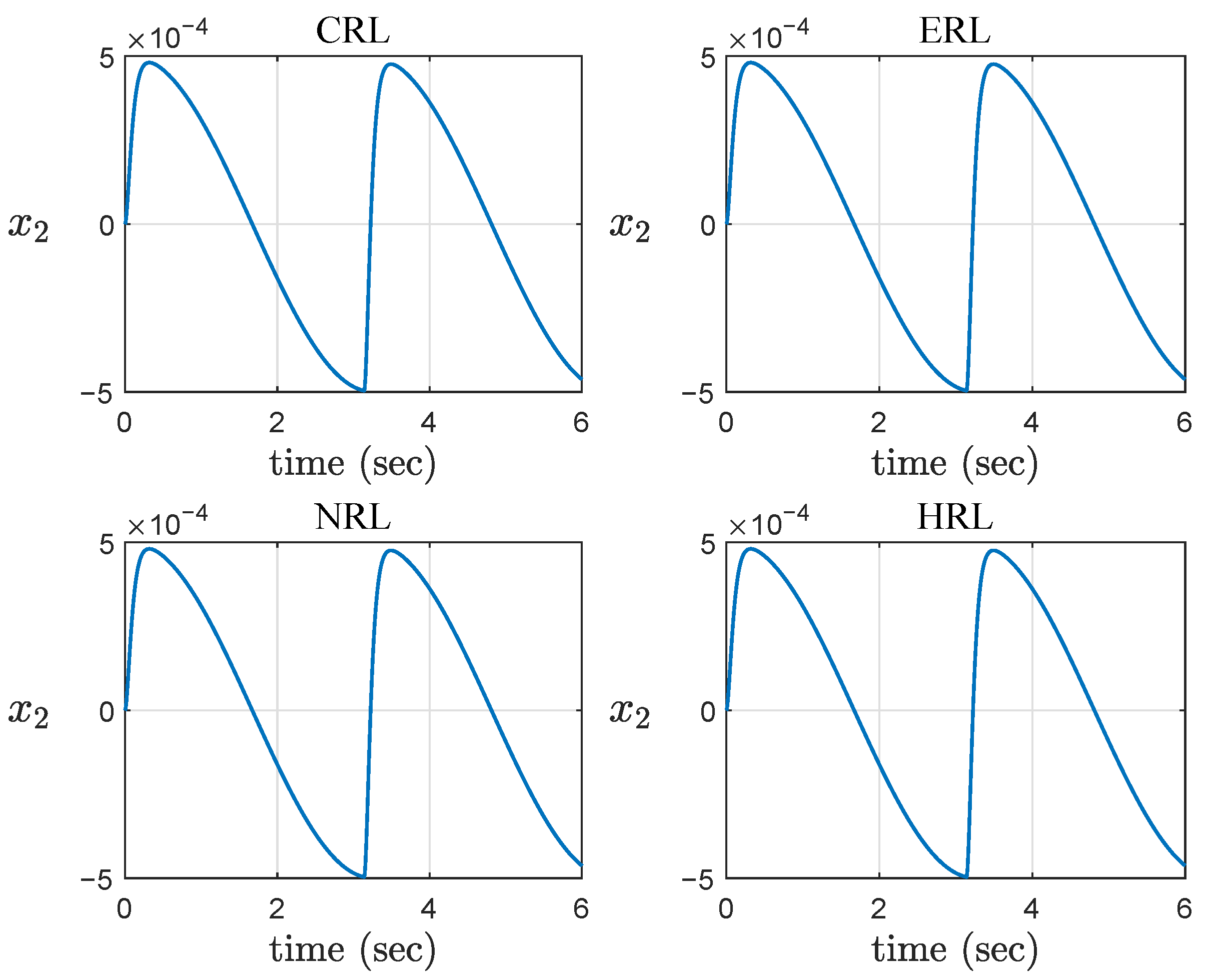
Consider the parameters of the control inputs (45), (47), and (48). We conclude that these parameters are consistent with (34), where λ = 20 . When the initial state variable of the system is [ x 1 = 0 , x 2 = 0 ], which means that it is within the boundary layer, the simulation outcomes are illustrated in Figure 4 and Figure 5. Figure 4 shows the state variable x 1 , whereas Figure 5 shows the state variable x 2 .
These figures illustrate that, when the initial state variable is within the boundary layer, the results obtained by the compared reaching laws are nearly identical. This satisfies condition (1) of Section 3.
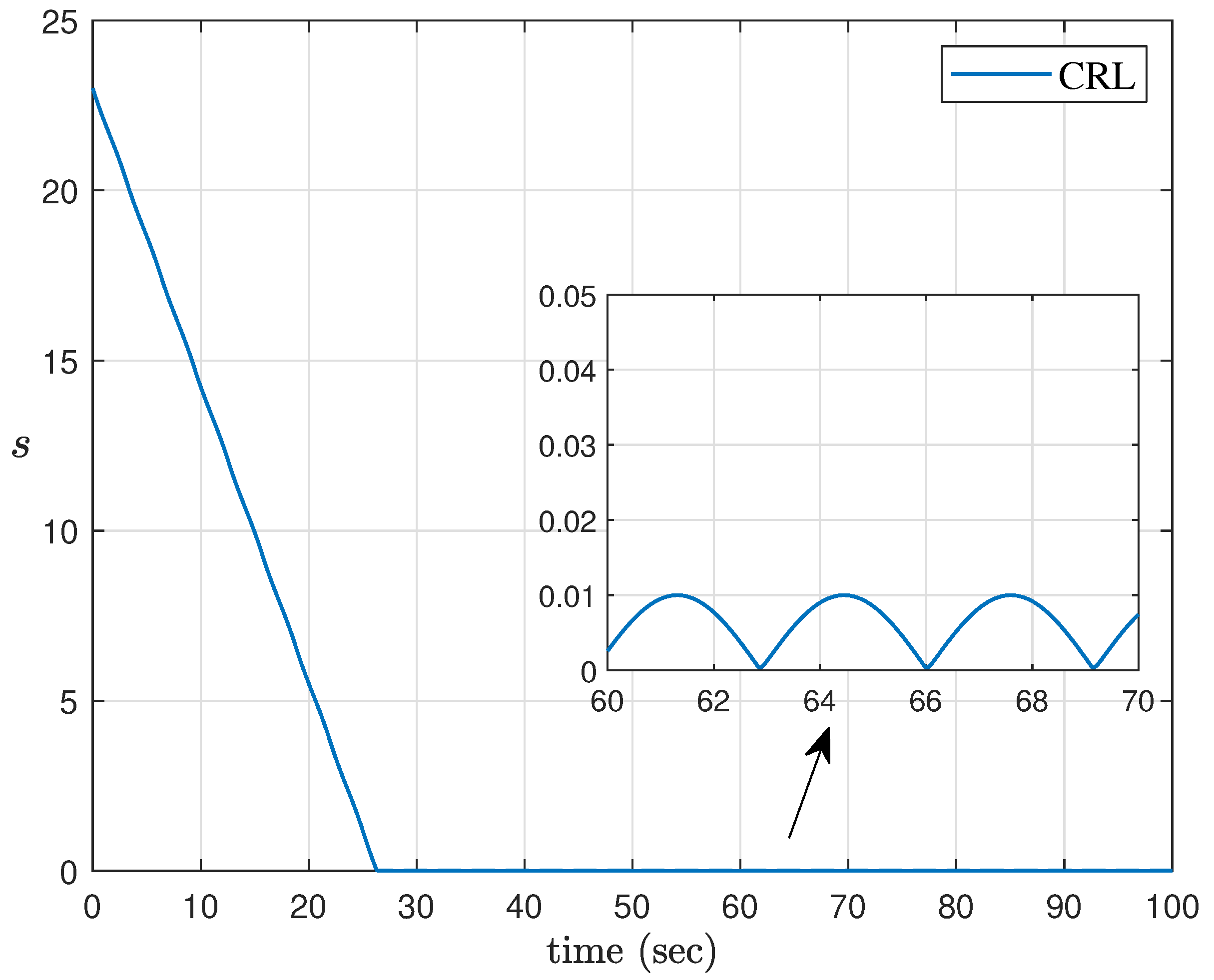
Consider the case in which the initial system state variable is [ x 1 = 1 , x 2 = 3 ]. This corresponds to an initial sliding mode variable of 23, implying that the initial system state variable is outside the boundary layer ( Φ = 0.05 ). When we use the control law in (47) based on the CRL, the sliding variable is as shown in Figure 6. It can be observed that the settling time is relatively long. Therefore, the CRL is not considered in the subsequent comparisons.
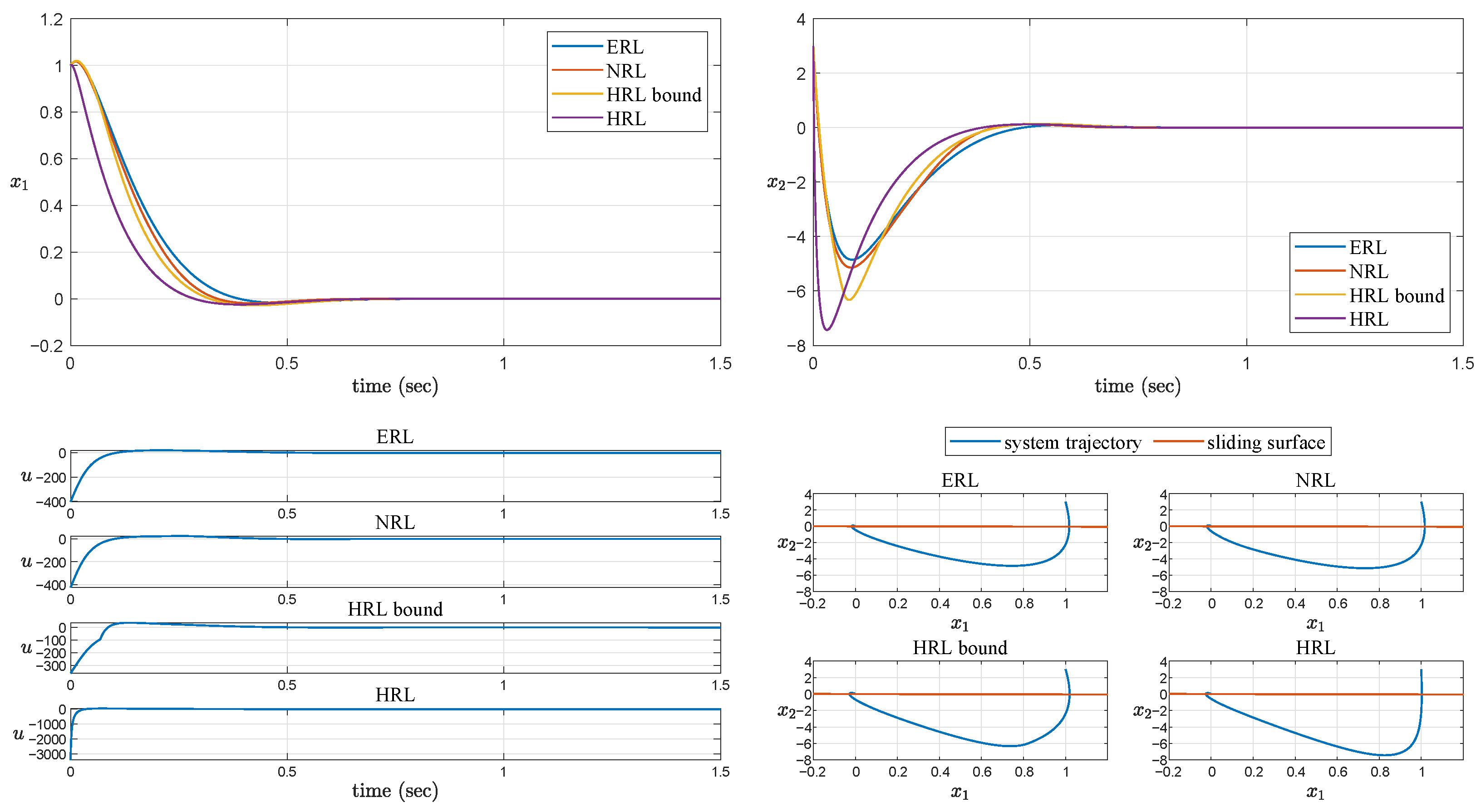
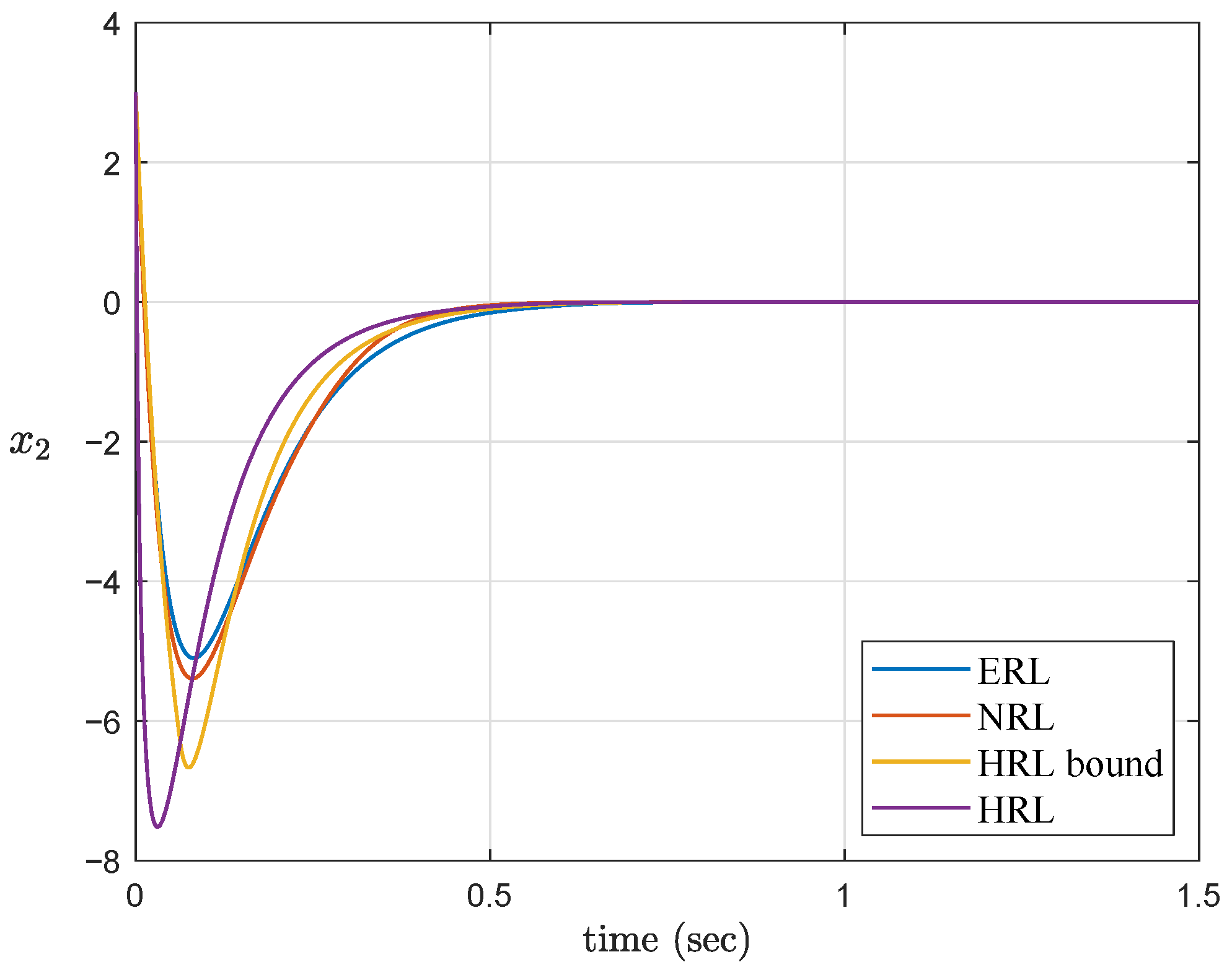
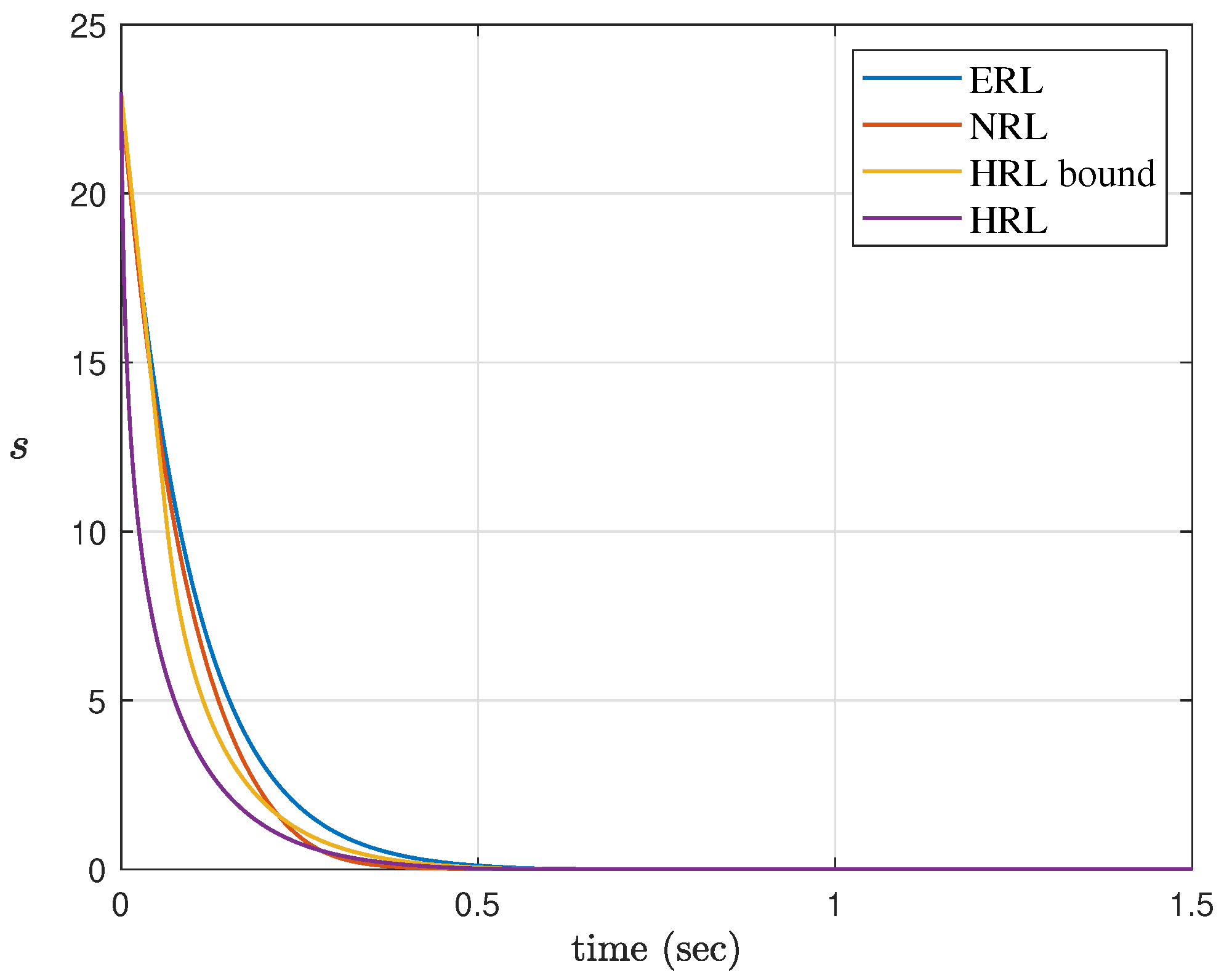
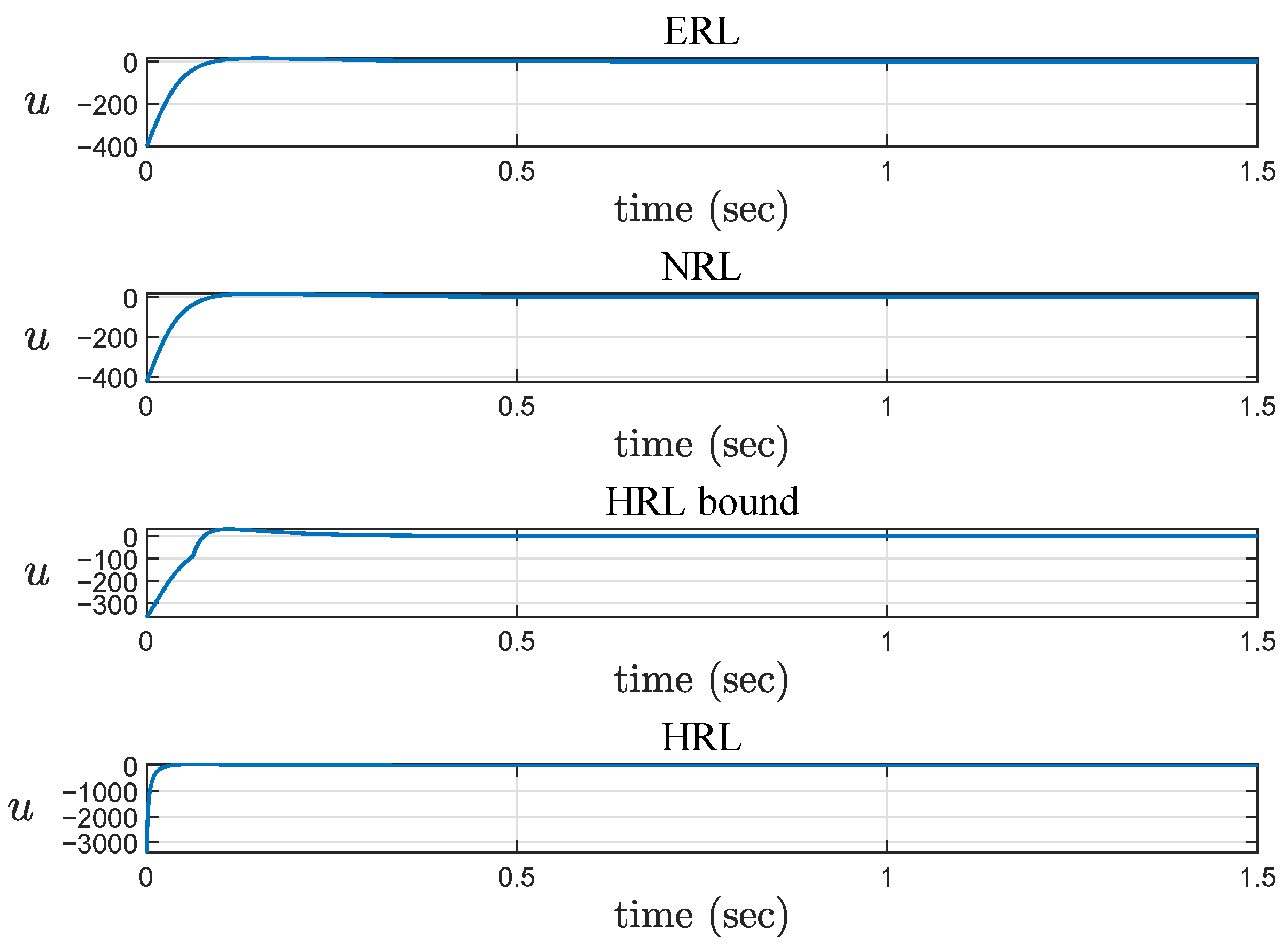
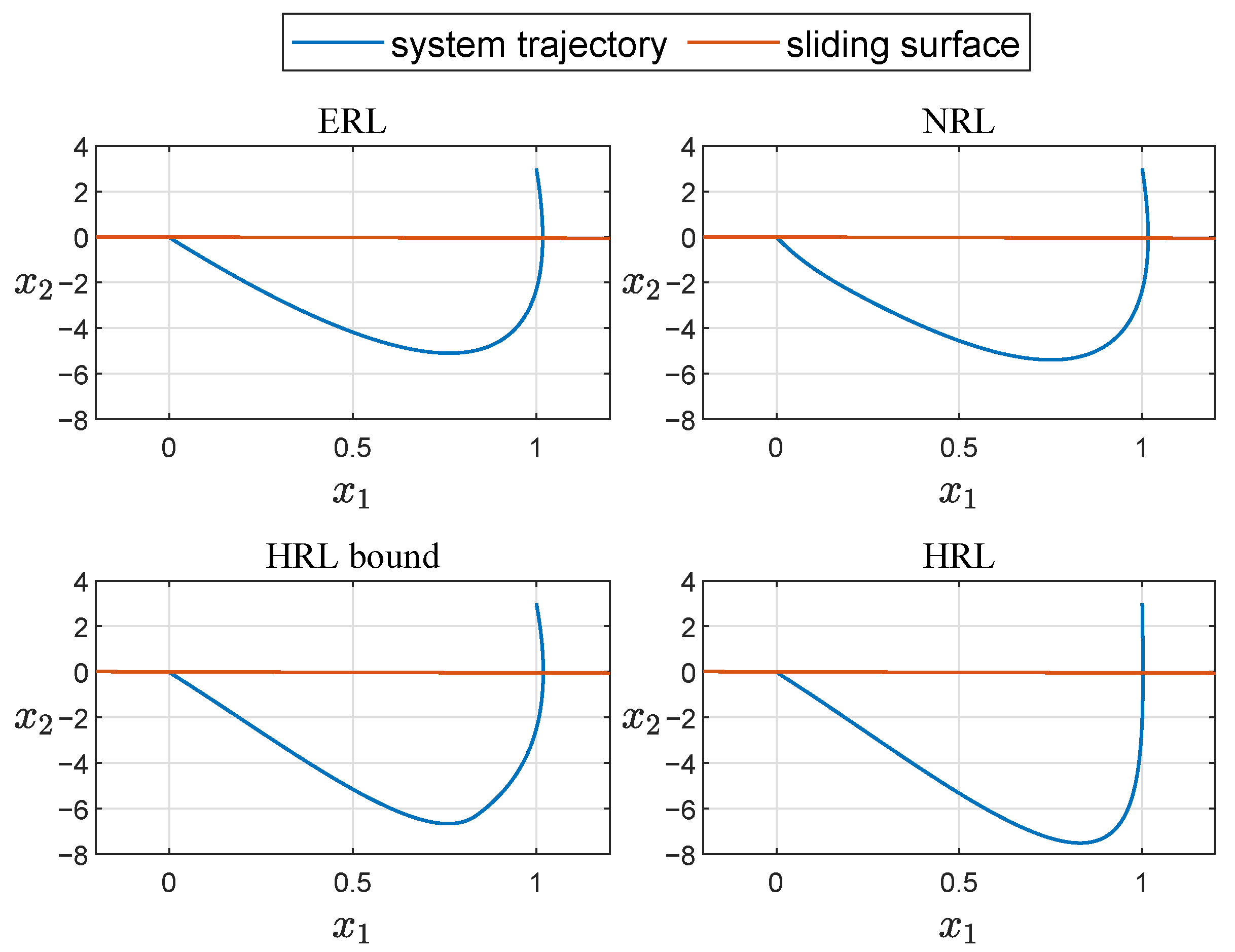
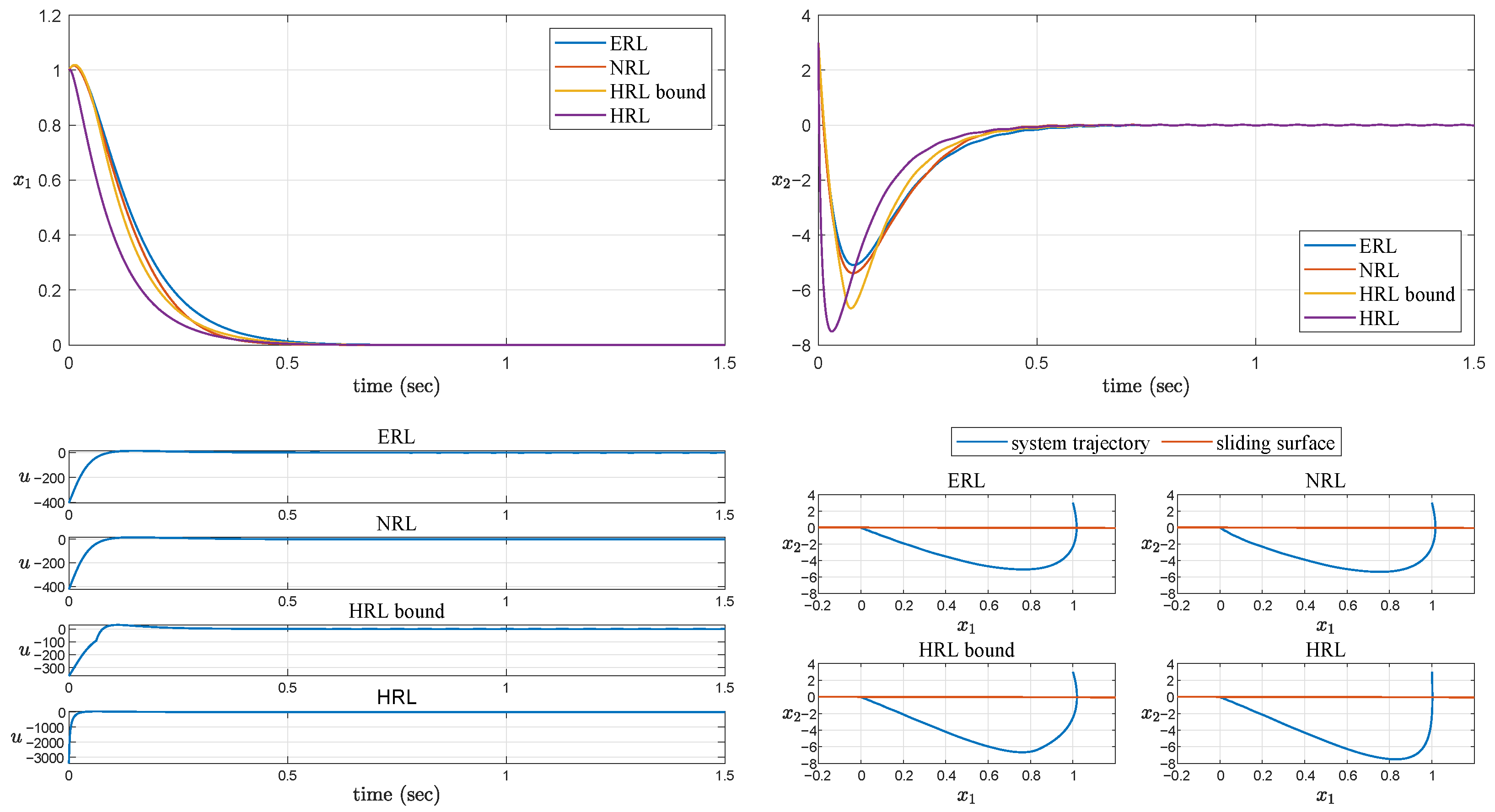
The simulation results using the control inputs in (45), (46), and (48) are shown in Figure 7, Figure 8, Figure 9, Figure 10 and Figure 11. Figure 7 shows the state variable x 1 , whereas Figure 8 shows the state variable x 2 . The sliding variables are presented in Figure 9, and Figure 10 illustrates the control input applied to the system. Table 1 presents the peak control input and the root-mean-square (RMS) value of the control input u for different methods. The RMS value is calculated using the first 1.5 s, as the control inputs of each method have already approached zero within this time frame. Figure 11 shows the phase plane graph between x 1 and x 2 .
Figure 7, Figure 8 and Figure 9 show that the HRL achieves a shorter settling time and better performance than the ERL and NRL. Figure 10 and Table 1 reveals that the shortcoming of the HRL is the relatively large control input and overshoot. By controlling the range of the derivative of s (the HRL bound), the range of the control input closely approaches that of the ERL and NRL while maintaining a faster reaching speed.
To test the stability of the proposed method, the system’s transient response and control input under different disturbances, including input disturbances, model parameter disturbances, and output disturbances, are tested.
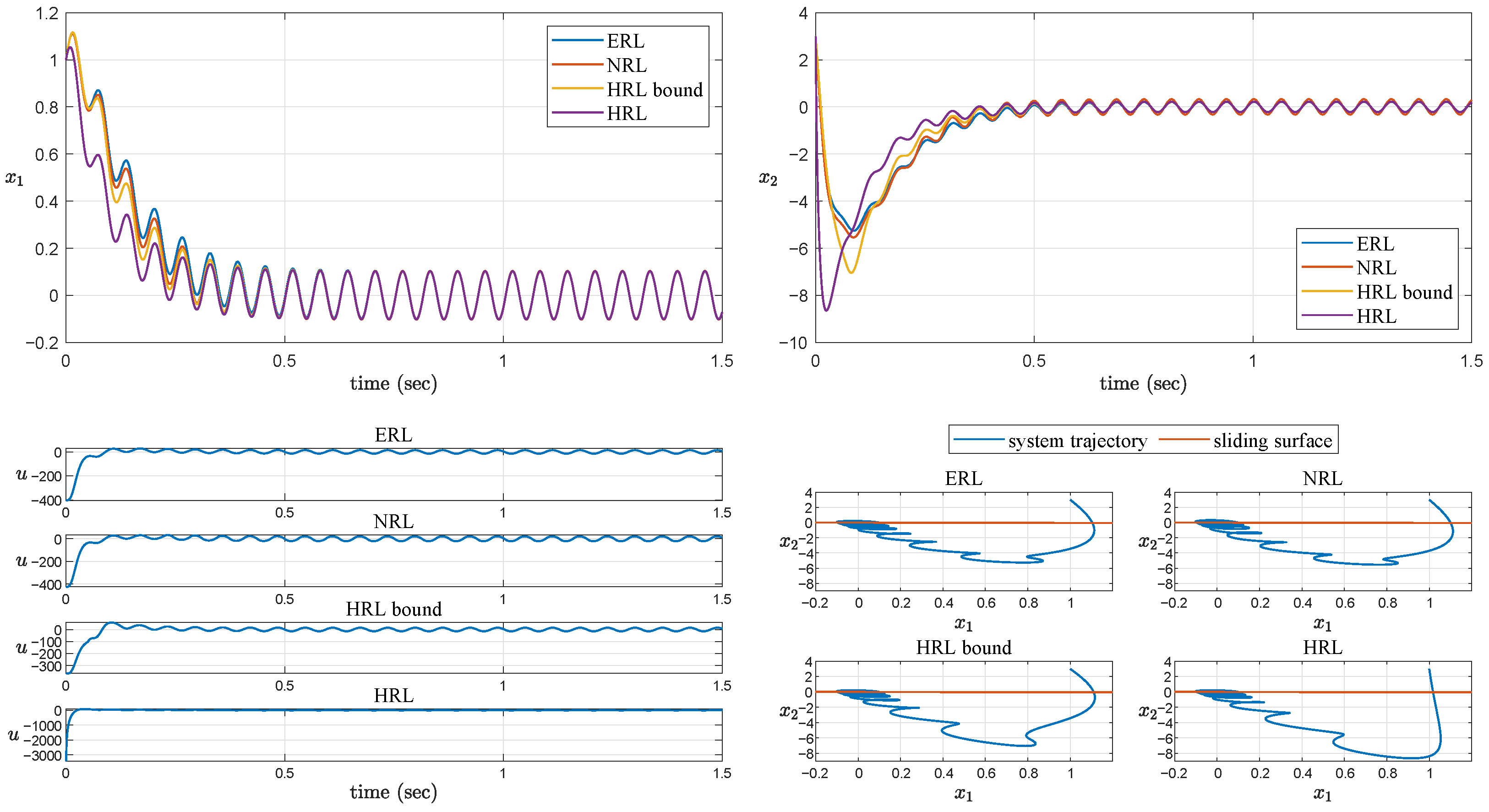
Figure 12 shows the transient response, control input, and phase plane diagram of the system under input disturbances. The added input disturbance term is set as sin ( 100 t ) . As shown in the figure, the input disturbance has little effect on the system, and the system remains stable.
Figure 13 presents the transient response, control input, and phase plane diagram of the system under model parameter (cart mass) disturbances. The added cart mass disturbance term is set as sin ( 5 t ) . From the figure, it can be seen that the disturbance in the cart mass parameter also has minimal effect on the system, and the system remains stable.
Figure 14 shows the transient response, control input, and phase plane diagram of the system under output disturbances. The added output disturbance term (with output being x 1 ) is set as 0.1 sin ( 100 t ) . As shown in the figure, the output disturbance has a relatively large impact on the system, but the system still converges, although to a specific range. This is because the output disturbance can be considered as an error caused by measuring the state variable, and such errors cannot be eliminated by the control method. The system can only be controlled to a stable region, which makes the results normal.
From Figure 12, Figure 13 and Figure 14, it can be seen that when the system experiences input disturbances, load disturbances, or output disturbances, the proposed method reaches the steady state faster than the other methods. Therefore, this verifies the robustness and efficiency of the proposed reaching law.

5. Conclusions

This study has proposed the HRL based on Lyapunov stability theory, which we compared with the CRL, ERL and NRL. A new comparison method was introduced to ensure fairness. The steady-state error is fixed and the settling times are compared, with shorter times preferred. Theories and simulations demonstrated that the HRL performs better than the CRL, ERL and NRL. Notably, fixed-time reaching laws generally cannot be compared using this method, for two reasons. First, they have many tunable parameters. Second, some reaching law functions cannot be expanded using the Taylor series at the origin. Therefore, other methods are required to compare the performances of fixed-time reaching laws. To handle cases in which the control input is too large and overshoot owing to an excessively large derivative of the sliding variable, we propose adding upper and lower bounds to the reaching law. Similarly, the simulation results show superior performance compared with both the CRL and ERL.

Author Contributions

Conceptualization, D.W. and G.M.; Methodology, D.W.; Software, G.M.; Validation, D.W. and G.M.; Formal analysis, D.W. and Z.F.; Investigation, D.W.; Resources, D.W.; Data curation, G.M.; Writing—original draft, D.W. and G.M.; Writing—review and editing, D.W. and Z.F.; Visualization, G.M.; Supervision, D.W.; Project administration, D.W.; Funding acquisition, D.W. All authors have read and agreed to the published version of the manuscript.

Funding

This research is funded by the Technology Planning Project of Guangdong Province, China (grant number 2023A1515011574).

Institutional Review Board Statement

Not applicable.

Informed Consent Statement

Not applicable.

Data Availability Statement

The original contributions presented in this study are included in the article. Further inquiries can be directed to the corresponding author.

Conflicts of Interest

The authors declare no conflicts of interest.

References

  1. Slotine, J.J.E.; Li, W. Applied Nonlinear Control; Prentice Hall: Englewood Cliffs, NJ, USA, 1991; Volume 199. [Google Scholar]
  2. Fu, J.; Ma, Z.; Fu, Y.; Chai, T. Hybrid adaptive control of nonlinear systems with non-Lipschitz nonlinearities. Syst. Control Lett. 2021, 156, 105012. [Google Scholar] [CrossRef]
  3. Narayan, J.; Gritli, H.; Dwivedy, S.K. Fast terminal sliding mode control with rapid reaching law for a pediatric gait exoskeleton system. Int. J. Intell. Robot. Appl. 2024, 8, 76–95. [Google Scholar] [CrossRef]
  4. Samantaray, J.; Chakrabarty, S. Discrete-time sliding mode control with inverse hyperbolic sine reaching law. J. Frankl. Inst. 2024, 361, 107108. [Google Scholar] [CrossRef]
  5. Zhao, J.; Lin, Z.; Xiao, M.; Gao, Z.; Ding, J. A novel fixed-time fractional order nonsingular terminal sliding mode control. Asian J. Control 2023, 25, 3660–3670. [Google Scholar] [CrossRef]
  6. Alipour, M.; Zarei, J.; Razavi-Far, R.; Saif, M.; Mijatovic, N.; Dragičević, T. Observer-based backstepping sliding mode control design for microgrids feeding a constant power load. IEEE Trans. Ind. Electron. 2022, 70, 465–473. [Google Scholar] [CrossRef]
  7. Zhang, H.; Ding, S. Adaptive asymptotic tracking control design for high-order uncertain nonlinear systems. Appl. Math. Comput. 2023, 445, 127867. [Google Scholar] [CrossRef]
  8. Mao, B. Two methods for terminal sliding-mode synchronization of fractional-order nonlinear chaotic systems. Asian J. Control 2021, 23, 1720–1727. [Google Scholar] [CrossRef]
  9. Tran, D.T.; Tran, A.T. Decentralized frequency regulation by using novel PID sliding mode structure in multi-area power systems with hydropower turbines. IEEE Access 2025, 13, 18850–18862. [Google Scholar] [CrossRef]
  10. Huynh, V.V.; Naqvi, S.; Nguyen, B.L.H.; Tran, A.T.; Shim, J.W.; Do, T.D. Robust super-twisting algorithm-based single-phase sliding mode frequency controller in power systems integrating wind turbines and energy storage systems. Sci. Rep. 2025, 15, 19740. [Google Scholar] [CrossRef]
  11. Tran, A.T.; Van Huynh, V.; Nguyen, B.L.H.; Shim, J.W.; Do, T.D. Multi-stage sliding mode control design with optimal state estimator for load frequency regulation in hybrid-source power systems. Sci. Rep. 2025, 15, 43795. [Google Scholar] [CrossRef]
  12. Zhang, X.M.; Han, Q.L.; Wang, J. Admissible delay upper bounds for global asymptotic stability of neural networks with time-varying delays. IEEE Trans. Neural Netw. Learn. Syst. 2018, 29, 5319–5329. [Google Scholar] [CrossRef] [PubMed]
  13. Bhat, S.P.; Bernstein, D.S. Finite-time stability of continuous autonomous systems. SIAM J. Control Optim. 2000, 38, 751–766. [Google Scholar] [CrossRef]
  14. Sun, L.; Zheng, Z. Finite-time sliding mode trajectory tracking control of uncertain mechanical systems. Asian J. Control 2017, 19, 399–404. [Google Scholar] [CrossRef]
  15. Wang, L.; Dong, T.; Ge, M.F. Finite-time synchronization of memristor chaotic systems and its application in image encryption. Appl. Math. Comput. 2019, 347, 293–305. [Google Scholar] [CrossRef]
  16. Polyakov, A. Nonlinear feedback design for fixed-time stabilization of linear control systems. IEEE Trans. Autom. Control 2011, 57, 2106–2110. [Google Scholar] [CrossRef]
  17. Wu, Z.; Hu, S.; Dong, S. Fixed-Time Integral Sliding Mode Prescribed Performance MPPT Control for Direct-Drive Wave Power Generation Systems. Int. J. Robust Nonlinear Control 2025, 35, 7556–7570. [Google Scholar] [CrossRef]
  18. Wang, L.; Dong, W.; Ding, Q. A new fixed-time sliding mode control scheme for synchronization of chaotic systems. Phys. Scr. 2024, 99, 095240. [Google Scholar] [CrossRef]
  19. Moulay, E.; Léchappé, V.; Bernuau, E.; Plestan, F. Robust fixed-time stability: Application to sliding-mode control. IEEE Trans. Autom. Control 2021, 67, 1061–1066. [Google Scholar] [CrossRef]
  20. Zhang, M.; Zang, H.; Bai, L. A new predefined-time sliding mode control scheme for synchronizing chaotic systems. Chaos Solitons Fractals 2022, 164, 112745. [Google Scholar] [CrossRef]
  21. Ma, X.; Liu, K.; Ji, Z.; Cui, M. Finite-time and fixed-time tracking consensus for multi-agent systems with disturbances via integral sliding mode control. Asian J. Control 2025, 27, 2915–2928. [Google Scholar] [CrossRef]
  22. Deng, X.; Feng, Z.; He, C. An adaptive reaching law of chattering-free discrete-time sliding mode control for systems with external disturbance. Asian J. Control 2023, 25, 2012–2019. [Google Scholar] [CrossRef]
  23. Gil, J.; You, S.; Lee, Y.; Kim, W. Nonlinear sliding mode controller using disturbance observer for permanent magnet synchronous motors under disturbance. Expert Syst. Appl. 2023, 214, 119085. [Google Scholar] [CrossRef]
  24. Gandikota, G.; Das, D.K. Disturbance observer–based adaptive boundary layer sliding mode controller for a type of nonlinear multiple-input multiple-output system. Int. J. Robust Nonlinear Control 2019, 29, 5886–5912. [Google Scholar] [CrossRef]
  25. Guo, J. A novel high order sliding mode control method. ISA Trans. 2021, 111, 1–7. [Google Scholar] [CrossRef] [PubMed]
  26. Li, Z.; Tian, B.; Zhang, X. RLV integrated guidance and control based on adaptive high-order sliding mode. Nonlinear Dyn. 2023, 111, 16133–16144. [Google Scholar] [CrossRef]
  27. Russo, A.; Incremona, G.P.; Cavallo, A. Higher-order sliding mode design with bounded integral control generation. Automatica 2022, 143, 110430. [Google Scholar] [CrossRef]
  28. Wang, T.; Wang, B.; Yu, Y.; Xu, D. High-order sliding-mode observer with adaptive gain for sensorless induction motor drives in the wide-speed range. IEEE Trans. Ind. Electron. 2022, 70, 11055–11066. [Google Scholar] [CrossRef]
  29. Feng, Y.; Han, F.; Yu, X. Chattering free full-order sliding-mode control. Automatica 2014, 50, 1310–1314. [Google Scholar] [CrossRef]
  30. Utkin, V.; Poznyak, A.; Orlov, Y.; Polyakov, A. Conventional and high order sliding mode control. J. Frankl. Inst. 2020, 357, 10244–10261. [Google Scholar] [CrossRef]
  31. Gao, W.; Hung, J.C. Variable structure control of nonlinear systems: A new approach. IEEE Trans. Ind. Electron. 1993, 40, 45–55. [Google Scholar] [CrossRef]
  32. Liu, Y.; Zhao, H.; Li, M.; Jia, Y. An Improved Discrete-Time Super-Twisting Control Algorithm with Double-Power Reaching Law. Int. J. Robust Nonlinear Control 2025, 35, 6699–6711. [Google Scholar] [CrossRef]
  33. Komurcugil, H.; Bayhan, S.; Guler, N.; Abu-Rub, H. A New Exponential Reaching Law Approach to the Sliding Mode Control: A Multilevel Multifunction Converter Application. IEEE Trans. Ind. Electron. 2022, 70, 7557–7568. [Google Scholar] [CrossRef]
  34. Pan, J.; Li, W.; Zhang, H. Control algorithms of magnetic suspension systems based on the improved double exponential reaching law of sliding mode control. Int. J. Control Autom. Syst. 2018, 16, 2878–2887. [Google Scholar] [CrossRef]
  35. Xiu, C.; Guo, P. Global terminal sliding mode control with the quick reaching law and its application. IEEE Access 2018, 6, 49793–49800. [Google Scholar] [CrossRef]
  36. Li, H. A Novel Sliding-Mode-Based Control Method for Permanent Magnet Synchronous Motor Drive Systems Based on New Hyperbolic Reaching Law. J. Electr. Eng. Technol. 2025, 20, 5379–5388. [Google Scholar] [CrossRef]
  37. Jia, L.; Chen, K.; Liao, Z.; Qiu, A.; Cao, M. Adaptive Robust Impedance Control of Grinding Robots Based on an RBFNN and the Exponential Reaching Law. Actuators 2025, 14, 393. [Google Scholar] [CrossRef]
  38. Qu, Y.; Zhang, B.; Chu, H.; Shen, H.; Zhang, J.; Yang, X. Sliding-mode anti-disturbance speed control of permanent magnet synchronous motor based on an advanced reaching law. ISA Trans. 2023, 139, 436–447. [Google Scholar] [CrossRef] [PubMed]
  39. Sui, B.; Zhang, J.; Liu, Z. Event triggered prescribed time trajectory tracking control for unmanned surface vessels with lumped disturbances and prescribed performance constraints. Sci. Rep. 2025, 15, 8157. [Google Scholar] [CrossRef]
  40. Zhang, Q.; Liu, P.; Chen, Y.; Deng, Q.; Tong, A. Disturbance observer-based terminal sliding mode tracking control for a class of nonlinear siso systems with input saturation. Processes 2023, 11, 1878. [Google Scholar] [CrossRef]
  41. Ma, S.; Zhao, J.; Xiong, Y.; Wang, H.; Yao, X. Sliding-mode control of linear induction motor based on exponential reaching law. Electronics 2024, 13, 2352. [Google Scholar] [CrossRef]
  42. Derbel, N.; Ghommam, J.; Zhu, Q. Applications of Sliding Mode Control; Springer: Berlin/Heidelberg, Germany, 2017; Volume 79. [Google Scholar]
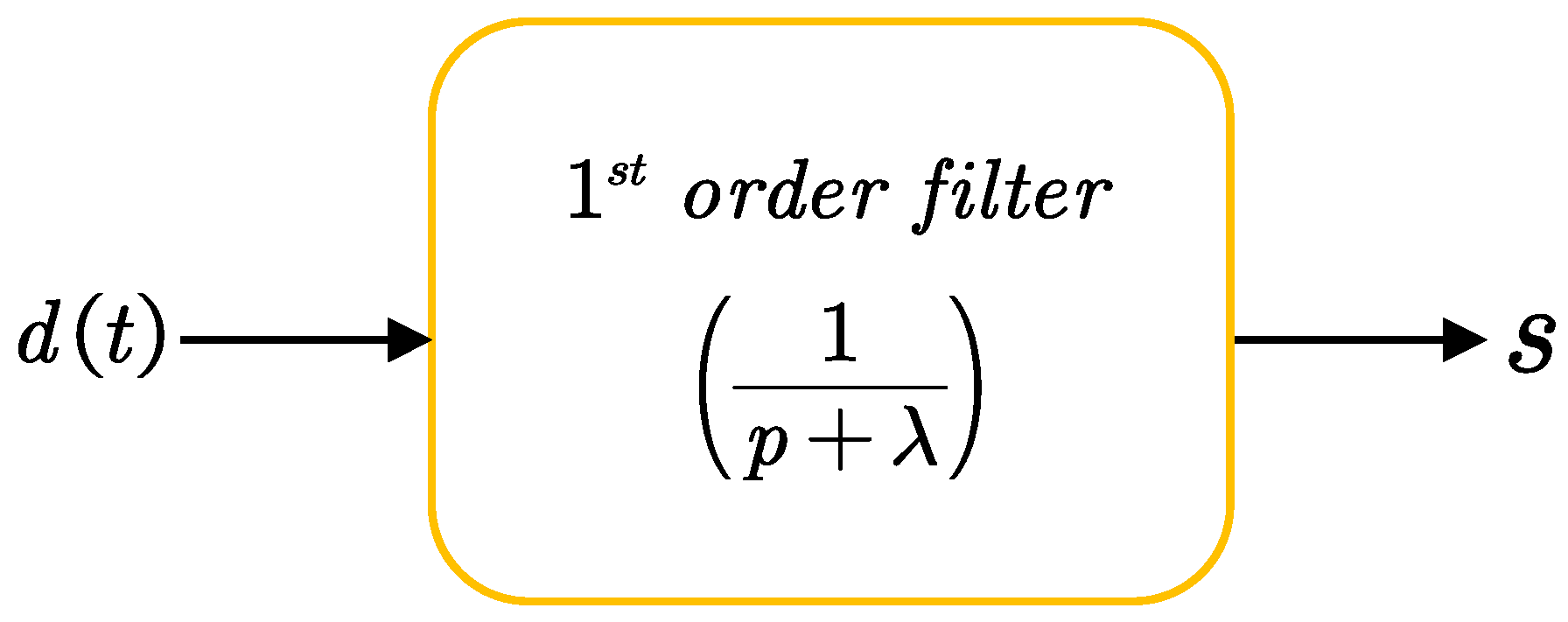
Figure 1. Definition of (31).
Actuators 15 00200 g001
Figure 2. Comparison graph of reaching laws.
Actuators 15 00200 g002
Figure 3. Schematic of the inverted pendulum robot.
Actuators 15 00200 g003
Figure 4. System state x 1 of the system when the initial state is [0, 0].
Actuators 15 00200 g004
Figure 5. System state x 2 of the system when the initial state is [0, 0].
Actuators 15 00200 g005
Figure 6. Sliding variable of CRL.
Actuators 15 00200 g006
Figure 7. System state x 1 of the system when the initial state is [1, 3].
Actuators 15 00200 g007
Figure 8. System state x 2 of the system when the initial state is [1, 3].
Actuators 15 00200 g008
Figure 9. Sliding variable of the system when the initial state is [1, 3].
Actuators 15 00200 g009
Figure 10. Control input of the system when the initial state is [1, 3].
Actuators 15 00200 g010
Figure 11. Phase plane graph of the system when the initial state is [1, 3].
Actuators 15 00200 g011
Figure 12. The transient response plots of x 1 and x 2 under input disturbances, the control input plot, and the phase plane diagram of the system.
Actuators 15 00200 g012
Figure 13. The transient response plots of x 1 and x 2 under cart mass disturbances, the control input plot, and the phase plane diagram of the system.
Actuators 15 00200 g013
Figure 14. The transient response plots of x 1 and x 2 under output disturbances, the control input plot, and the phase plane diagram of the system.
Actuators 15 00200 g014
Table 1. Control Input RMS Value and Peak Control Input for Different Methods.
MethodControl Input RMS ValuePeak Control Input
ERL43.4092402.8477
NRL45.1957424.5901
HRL_bound46.5397362.5412
HRL113.12193405.0307
Disclaimer/Publisher’s Note: The statements, opinions and data contained in all publications are solely those of the individual author(s) and contributor(s) and not of MDPI and/or the editor(s). MDPI and/or the editor(s) disclaim responsibility for any injury to people or property resulting from any ideas, methods, instructions or products referred to in the content.